• Trade
  • Markets
  • Copy
  • Contests
  • News
  • 24/7
  • Calendar
  • Q&A
  • Chats
Trending
Screeners
SYMBOL
LAST
BID
ASK
HIGH
LOW
NET CHG.
%CHG.
SPREAD
SPX
S&P 500 Index
6827.42
6827.42
6827.42
6899.86
6801.80
-73.58
-1.07%
--
DJI
Dow Jones Industrial Average
48458.04
48458.04
48458.04
48886.86
48334.10
-245.98
-0.51%
--
IXIC
NASDAQ Composite Index
23195.16
23195.16
23195.16
23554.89
23094.51
-398.69
-1.69%
--
USDX
US Dollar Index
97.950
98.030
97.950
98.500
97.950
-0.370
-0.38%
--
EURUSD
Euro / US Dollar
1.17394
1.17409
1.17394
1.17496
1.17192
+0.00011
+ 0.01%
--
GBPUSD
Pound Sterling / US Dollar
1.33707
1.33732
1.33707
1.33997
1.33419
-0.00148
-0.11%
--
XAUUSD
Gold / US Dollar
4299.39
4299.39
4299.39
4353.41
4257.10
+20.10
+ 0.47%
--
WTI
Light Sweet Crude Oil
57.233
57.485
57.233
58.011
56.969
-0.408
-0.71%
--

Community Accounts

Signal Accounts
--
Profit Accounts
--
Loss Accounts
--
View More

Become a signal provider

Sell trading signals to earn additional income

View More

Guide to Copy Trading

Get started with ease and confidence

View More

Signal Accounts for Members

All Signal Accounts

Best Return
  • Best Return
  • Best P/L
  • Best MDD
Past 1W
  • Past 1W
  • Past 1M
  • Past 1Y

All Contests

  • All
  • Trump Updates
  • Recommend
  • Stocks
  • Cryptocurrencies
  • Central Banks
  • Featured News
Top News Only
Share

Iranian Media Says 18 Crew Members Of Foreign Tanker Seized In Gulf Of Oman Over Carrying 'Smuggled Fuel' Detained

Share

Regional Governor: Two Killed In Ukrainian Drone Strike On Russia's Saratov

Share

Chinese Foreign Ministry - China Foreign Minister Met With United Arab Emirates Counterpart On Dec 12

Share

China's Central Financial And Economic Affairs Commission Deputy Director: Will Expand Export And Increase Import In 2026

Share

Thai Leader Anutin: Landmine Blast That Killed Thai Soldiers 'Not A Roadside Accident'

Share

Thai Leader Anutin: Thailand To Continue Military Action Until 'We Feel No More Harm'

Share

Cambodian Prime Minister Hun Manet Says He Had Phone Calls With Trump And Malaysian Leader Anwar About Ceasefire

Share

Cambodia's Hun Manet Says USA, Malaysia Should Verify 'Which Side Fired First' In Latest Conflict

Share

Cambodia's Hun Manet: Cambodia Maintains Its Stance In Seeking Peaceful Resolution Of Disputes

Share

Nasdaq Companies: Allergan, Ferrovia, Insmed, Monolithic Power Systems, Seagate Technology, And Western Digital Will Be Added To The NASDAQ 100 Index. Biogen, CdW, GlobalFoundries, Lululemon, ON Semiconductor, And Tradedesk Will Be Removed From The NASDAQ 100 Index

Share

Witkoff Headed To Berlin This Weekend To Meet With Zelenskiy, European Leaders -Wsj Reporter On X

Share

Russia Attacks Two Ukrainian Ports, Damaging Three Turkish-Owned Vessels

Share

[Historic Flooding Occurs In At Least Four Rivers In Washington State Due To Days Of Torrential Rains] Multiple Areas In Washington State Have Been Hit By Severe Flooding Due To Days Of Torrential Rains, With At Least Four Rivers Experiencing Historic Flooding. Reporters Learned On The 12th That The Floods Caused By The Torrential Rains In Washington State Have Destroyed Homes And Closed Several Highways. Experts Warn That Even More Severe Flooding May Occur In The Future. A State Of Emergency Has Been Declared In Washington State

Share

Trump Says Proposed Free Economic Zone In Donbas Would Work

Share

Trump: I Think My Voice Should Be Heard

Share

Trump Says Will Be Choosing New Fed Chair In Near Future

Share

Trump Says Proposed Free Economic Zone In Donbas Complex But Would Work

Share

Trump Says Land Strikes In Venezuela Will Start Happening

Share

US President Trump: Thailand And Cambodia Are In A Good Situation

Share

State Media: North Korean Leader Kim Hails Troops Returning From Russia Mission

TIME
ACT
FCST
PREV
U.K. Trade Balance Non-EU (SA) (Oct)

A:--

F: --

P: --

U.K. Trade Balance (Oct)

A:--

F: --

P: --

U.K. Services Index MoM

A:--

F: --

P: --

U.K. Construction Output MoM (SA) (Oct)

A:--

F: --

P: --

U.K. Industrial Output YoY (Oct)

A:--

F: --

P: --

U.K. Trade Balance (SA) (Oct)

A:--

F: --

P: --

U.K. Trade Balance EU (SA) (Oct)

A:--

F: --

P: --

U.K. Manufacturing Output YoY (Oct)

A:--

F: --

P: --

U.K. GDP MoM (Oct)

A:--

F: --

P: --

U.K. GDP YoY (SA) (Oct)

A:--

F: --

P: --

U.K. Industrial Output MoM (Oct)

A:--

F: --

P: --

U.K. Construction Output YoY (Oct)

A:--

F: --

P: --

France HICP Final MoM (Nov)

A:--

F: --

P: --

China, Mainland Outstanding Loans Growth YoY (Nov)

A:--

F: --

P: --

China, Mainland M2 Money Supply YoY (Nov)

A:--

F: --

P: --

China, Mainland M0 Money Supply YoY (Nov)

A:--

F: --

P: --

China, Mainland M1 Money Supply YoY (Nov)

A:--

F: --

P: --

India CPI YoY (Nov)

A:--

F: --

P: --

India Deposit Gowth YoY

A:--

F: --

P: --

Brazil Services Growth YoY (Oct)

A:--

F: --

P: --

Mexico Industrial Output YoY (Oct)

A:--

F: --

P: --

Russia Trade Balance (Oct)

A:--

F: --

P: --

Philadelphia Fed President Henry Paulson delivers a speech
Canada Building Permits MoM (SA) (Oct)

A:--

F: --

P: --

Canada Wholesale Sales YoY (Oct)

A:--

F: --

P: --

Canada Wholesale Inventory MoM (Oct)

A:--

F: --

P: --

Canada Wholesale Inventory YoY (Oct)

A:--

F: --

P: --

Canada Wholesale Sales MoM (SA) (Oct)

A:--

F: --

P: --

Germany Current Account (Not SA) (Oct)

A:--

F: --

P: --

U.S. Weekly Total Rig Count

A:--

F: --

P: --

U.S. Weekly Total Oil Rig Count

A:--

F: --

P: --

Japan Tankan Large Non-Manufacturing Diffusion Index (Q4)

--

F: --

P: --

Japan Tankan Small Manufacturing Outlook Index (Q4)

--

F: --

P: --

Japan Tankan Large Non-Manufacturing Outlook Index (Q4)

--

F: --

P: --

Japan Tankan Large Manufacturing Outlook Index (Q4)

--

F: --

P: --

Japan Tankan Small Manufacturing Diffusion Index (Q4)

--

F: --

P: --

Japan Tankan Large Manufacturing Diffusion Index (Q4)

--

F: --

P: --

Japan Tankan Large-Enterprise Capital Expenditure YoY (Q4)

--

F: --

P: --

U.K. Rightmove House Price Index YoY (Dec)

--

F: --

P: --

China, Mainland Industrial Output YoY (YTD) (Nov)

--

F: --

P: --

China, Mainland Urban Area Unemployment Rate (Nov)

--

F: --

P: --

Saudi Arabia CPI YoY (Nov)

--

F: --

P: --

Euro Zone Industrial Output YoY (Oct)

--

F: --

P: --

Euro Zone Industrial Output MoM (Oct)

--

F: --

P: --

Canada Existing Home Sales MoM (Nov)

--

F: --

P: --

Euro Zone Total Reserve Assets (Nov)

--

F: --

P: --

U.K. Inflation Rate Expectations

--

F: --

P: --

Canada National Economic Confidence Index

--

F: --

P: --

Canada New Housing Starts (Nov)

--

F: --

P: --

U.S. NY Fed Manufacturing Employment Index (Dec)

--

F: --

P: --

U.S. NY Fed Manufacturing Index (Dec)

--

F: --

P: --

Canada Core CPI YoY (Nov)

--

F: --

P: --

Canada Manufacturing Unfilled Orders MoM (Oct)

--

F: --

P: --

Canada Manufacturing New Orders MoM (Oct)

--

F: --

P: --

Canada Core CPI MoM (Nov)

--

F: --

P: --

Canada Manufacturing Inventory MoM (Oct)

--

F: --

P: --

Canada CPI YoY (Nov)

--

F: --

P: --

Canada CPI MoM (Nov)

--

F: --

P: --

Canada CPI YoY (SA) (Nov)

--

F: --

P: --

Canada Core CPI MoM (SA) (Nov)

--

F: --

P: --

Q&A with Experts
    • All
    • Chatrooms
    • Groups
    • Friends
    Connecting
    .
    .
    .
    Type here...
    Add Symbol or Code

      No matching data

      All
      Trump Updates
      Recommend
      Stocks
      Cryptocurrencies
      Central Banks
      Featured News
      • All
      • Russia-Ukraine Conflict
      • Middle East Flashpoint
      • All
      • Russia-Ukraine Conflict
      • Middle East Flashpoint
      Search
      Products

      Charts Free Forever

      Chats Q&A with Experts
      Screeners Economic Calendar Data Tools
      Membership Features
      Data Warehouse Market Trends Institutional Data Policy Rates Macro

      Market Trends

      Market Sentiment Order Book Forex Correlations

      Top Indicators

      Charts Free Forever
      Markets

      News

      News Analysis 24/7 Columns Education
      From Institutions From Analysts
      Topics Columnists

      Latest Views

      Latest Views

      Trending Topics

      Top Columnists

      Latest Update

      Signals

      Copy Rankings Latest Signals Become a signal provider AI Rating
      Contests
      Brokers

      Overview Brokers Assessment Rankings Regulators News Claims
      Broker listing Forex Brokers Comparison Tool Live Spread Comparison Scam
      Q&A Complaint Scam Alert Videos Tips to Detect Scam
      More

      Business
      Events
      Careers About Us Advertising Help Center

      White Label

      Data API

      Web Plug-ins

      Affiliate Program

      Awards Institution Evaluation IB Seminar Salon Event Exhibition
      Vietnam Thailand Singapore Dubai
      Fans Party Investment Sharing Session
      FastBull Summit BrokersView Expo
      Recent Searches
        Top Searches
          Markets
          News
          Analysis
          User
          24/7
          Economic Calendar
          Education
          Data
          • Names
          • Latest
          • Prev

          View All

          No data

          Scan to Download

          Faster Charts, Chat Faster!

          Download App
          English
          • English
          • Español
          • العربية
          • Bahasa Indonesia
          • Bahasa Melayu
          • Tiếng Việt
          • ภาษาไทย
          • Français
          • Italiano
          • Türkçe
          • Русский язык
          • 简中
          • 繁中
          Open Account
          Search
          Products
          Charts Free Forever
          Markets
          News
          Signals

          Copy Rankings Latest Signals Become a signal provider AI Rating
          Contests
          Brokers

          Overview Brokers Assessment Rankings Regulators News Claims
          Broker listing Forex Brokers Comparison Tool Live Spread Comparison Scam
          Q&A Complaint Scam Alert Videos Tips to Detect Scam
          More

          Business
          Events
          Careers About Us Advertising Help Center

          White Label

          Data API

          Web Plug-ins

          Affiliate Program

          Awards Institution Evaluation IB Seminar Salon Event Exhibition
          Vietnam Thailand Singapore Dubai
          Fans Party Investment Sharing Session
          FastBull Summit BrokersView Expo

          The Unraveling Tapestry: China's $6 Trillion Stock Market Rout and the Pervasive Pessimism Shaping its Economic Landscape

          Ukadike Micheal

          Economic

          Stocks

          Summary:

          China's $6 trillion stock market plunge exposes a stark reality for President Xi Jinping's administration: widespread pessimism about the outlook for the world's second-largest economy is impossible to overlook.

          China's stock market is experiencing a significant downturn, with the CSI 300 Index plummeting by 40% over the past three years. This steep decline has raised concerns and prompted the government to consider a rescue package of about 2 trillion yuan ($280 billion) to stabilize the market. However, both international and retail investors remain skeptical about the effectiveness of these measures in sparking a sustained recovery.
          The recent selloff in the stock market is exacerbating the economic challenges faced by China, adding to existing issues such as a prolonged property crisis, demographic challenges, and rising trade tensions. While equities represent only a fraction of household wealth compared to real estate, the public nature of stock market fluctuations serves as a visible reminder of the broader economic problems, including slumping house prices. The potential impact on consumer spending and business investment poses a threat to the overall economic health.
          In a country where the government tightly controls financial commentary and economic data, the stock market's performance becomes a barometer of the real economy's woes. Despite official assurances that the Chinese economy is on track, the market downturn signals underlying issues that cannot be easily dismissed. Frank Tsai, an adjunct professor of international studies, highlights the importance of aligning government perceptions with those of Chinese and global investors.
          The current situation in China's stock market is reminiscent of a similar level of concern almost a decade ago. In 2015, the government took decisive action to stimulate the economy, focusing on the real estate sector. Massive stimulus, including central bank funds for demolishing old buildings and constructing new ones, coupled with interest rate cuts, spurred consumer spending and business investment. The introduction of the two-child policy also boosted investor confidence. However, the economic backdrop in 2023 is vastly different.
          While the economy met its annual growth target of about 5%, it also faced challenges such as deflation, shrinking exports, a declining population, and a significant number of unemployed graduates. Notably, the authorities seem less inclined to rely on debt-fueled stimulus to drive growth, signaling a shift away from supporting the property sector. Policy measures have been modest, with national security taking precedence over growth. The concentration of power within the Communist Party suggests potential challenges for swift crisis responses.
          Jason Hsu, Chief Investment Officer at Rayliant Global Advisors Ltd., emphasizes that China's policy shift has led to a "withdrawal of credit from the market," particularly due to lending tied to real estate. This shift magnifies the scale of the current downturn compared to the situation in 2015. The negative wealth impact and deflating confidence are contributing to widespread pessimism about the future.
          In conclusion, the deepening stock market rout in China reveals a growing sense of pessimism about the country's economic outlook. The government's consideration of a rescue package and a bank reserve ratio cut reflects the urgency to stem the market's decline. However, skepticism persists among investors, both domestic and international, regarding the effectiveness of these measures. Against the backdrop of a changing economic landscape, characterized by a shift away from debt-fueled stimulus and a focus on national security, the challenges facing China's economy appear more complex than in 2015. The stock market's role as a public barometer underscores the broader issues impacting consumer confidence and business investment, making it a critical concern for President Xi Jinping's government.

          Source: Bloomberg

          To stay updated on all economic events of today, please check out our Economic calendar
          Risk Warnings and Disclaimers
          You understand and acknowledge that there is a high degree of risk involved in trading. Following any strategies or investment methods may lead to potential losses. The content on the site is provided by our contributors and analysts for information purposes only. You are solely responsible for determining whether any trading assets, securities, strategy, or any other product is suitable for investing based on your own investment objectives and financial situation.
          Comments
          Add to Favorites
          Share

          How Singapore's Unique Monetary Policy Works

          Thomas

          Central Bank

          Economic

          Singapore's central bank has a unique method of managing monetary policy, tweaking the exchange rate of its dollar instead of changing domestic interest rates like most other economies.
          The Monetary Authority of Singapore (MAS) sets the path of what it calls the policy band of the Singapore dollar nominal effective exchange rate (S$NEER), thus strengthening or weakening the local currency against those of its main trading partners.
          Why does Singapore use this method?
          Singapore is a small and trade-reliant economy. Gross exports and imports of goods and services in the city state are more than three times its gross domestic product (GDP). Meanwhile, almost S$0.40 of every dollar spent domestically is on imports.
          Given such a setting, the exchange rate has a much stronger influence on inflation than domestic interest rates.
          For example, if the Singapore dollar appreciates against currencies of major trading partners, it will reduce prices of imported goods and services. This dampens the prices that households have to pay.
          What Is The S$NEER?
          The S$NEER is a combined index made up of bilateral exchange rates between Singapore and its major trading partners.
          The index is a trade-weighted exchange rate, where weights are assigned to the various currencies of Singapore's major trading partners based on the importance of the trade relationships.
          The central banks says this allows the Singapore dollar to perform collectively in relation to its major trading partners, which is what matters for general price levels in Singapore.
          How does the S$NEER policy band work?
          MAS does not set the precise level of the exchange rate or control it in real time. Instead, the S$NEER is allowed to move up and down within a policy band of which the exact levels are not disclosed. If it goes out of this band, the MAS steps in by buying or selling Singapore dollars.
          The policy band has three parameters that the MAS can adjust. Until 2024, these parameters were reviewed at least twice a year, typically in April and October.
          Additional reviews can be held if conditions demand an immediate change in settings, such as in 2022 when high inflation triggered two off-cycle moves.
          But this year, the central bank will make monetary policy announcements every quarter instead of semi-annually, citing a need to "enhance monetary policy communications".
          The three policy levers are the slope, the level and the width.
          Adjusting the slope will influence the pace at which the Singapore dollar strengthens or weakens.
          Adjusting the level, or mid-point, of the policy band allows for an immediate strengthening or weakening of the S$NEER, making this a tool for drastic situations such as a recession.
          By widening the policy band, the MAS can allow for more volatility of the S$NEER.

          Source: Reuters

          To stay updated on all economic events of today, please check out our Economic calendar
          Risk Warnings and Disclaimers
          You understand and acknowledge that there is a high degree of risk involved in trading. Following any strategies or investment methods may lead to potential losses. The content on the site is provided by our contributors and analysts for information purposes only. You are solely responsible for determining whether any trading assets, securities, strategy, or any other product is suitable for investing based on your own investment objectives and financial situation.
          Comments
          Add to Favorites
          Share

          Anticipated: Fourth-Quarter GDP Reveals 2% Expansion for the US Economy

          Ukadike Micheal

          Economic

          Forex

          The U.S. economy is poised to conclude 2023 on a solid note, but experts anticipate a slowdown in momentum compared to earlier in the year. Economists project that the Commerce Department's initial reading of gross domestic product (GDP) for the fourth quarter will reveal a 2% annualized expansion, a significant drop from the 4.9% reported in the third quarter. This shift reflects the challenges faced by consumers grappling with elevated inflation and rising interest rates.
          Bank of America analysts note that incoming data suggests a resilient yet cooling U.S. economy, primarily driven by consumer spending amid a tight labor market, robust holiday expenditures, and reasonably strong balance sheets. However, they anticipate a deceleration in non-consumer spending and subdued growth in non-residential business fixed investment. Housing, faced with obstacles like high mortgage rates, low inventory, and affordability issues, is likely to see only minor improvement, if any.
          Despite earlier predictions of a recession due to the Federal Reserve's aggressive interest rate hikes, the economy has displayed unexpected resilience. Nevertheless, signs of a slowdown are emerging as job growth moderates, the housing market experiences a prolonged downturn, and consumer spending shows indications of cooling. Many economists foresee further cooling in the months ahead as higher interest rates permeate the economy, leading to increased borrowing costs and potential cutbacks in spending by employers.
          There is a growing sense of optimism on Wall Street, with Bank of America, Goldman Sachs, and UBS raising the odds of the U.S. economy achieving a soft landing without a severe spike in unemployment. The Federal Reserve's recent decisions, including projecting three quarter-point rate cuts in 2024 and revising down their inflation outlook, contribute to this positive outlook. While acknowledging the headwinds and risks, experts like Gregory Daco, EY chief economist, see a soft landing as the most likely outcome in 2024, even as recession odds hover around 40%.
          As the U.S. economy navigates the challenges of inflation, rising interest rates, and evolving economic dynamics, the possibility of a soft landing remains within reach. The delicate balance between consumer caution, labor market conditions, and the Federal Reserve's strategic interventions will shape the economic landscape in the coming months. The optimism on Wall Street reflects a belief that, despite the hurdles, the U.S. economy can adapt and cool without succumbing to a recession. As we enter a new year, the intricate dance between economic indicators and policy decisions will determine the trajectory of the world's largest economy.

          Source: Fox News

          To stay updated on all economic events of today, please check out our Economic calendar
          Risk Warnings and Disclaimers
          You understand and acknowledge that there is a high degree of risk involved in trading. Following any strategies or investment methods may lead to potential losses. The content on the site is provided by our contributors and analysts for information purposes only. You are solely responsible for determining whether any trading assets, securities, strategy, or any other product is suitable for investing based on your own investment objectives and financial situation.
          Comments
          Add to Favorites
          Share

          [Bank of Canada] Rate Desicion: Housing Inflation Is a Major Impediment to De-inflation

          FastBull Featured

          Remarks of Officials

          The Bank of Canada announced its latest interest rate resolution on January 24th local time, leaving the benchmark interest rate unchanged at the current level of 5%. The monetary policy report showed that:
          Some progress has been made in the disinflation process, but inflation remains too high, particularly housing inflation (close to 7%) and food inflation (around 5%). Food inflation is expected to slow down due to lower global agricultural prices. However, strong demand from structural supply challenges and population growth could lead to further increases in housing and rents, which have become one of the impediments to de-inflation.
          Consumption growth is expected to remain weak until the end of 2024, with a recovery expectation in 2025.
          Inflation is expected to remain near 3% in the first half of the year and fall back to around 2.5% by the end of the year, returning to the policy target of 2% by 2025.
          Economic growth is expected to be close to zero in the first quarter of this year and then begin to pick up in the middle of the year, with growth expected to rise to 0.8% in 2024 and 2.4% in 2025.
          Labor market conditions have eased further, with the job vacancy rate falling back to its pre-epidemic level, while the pace of new job supply has been slower than the population growth rate. Labor supply and demand have been balanced, and wage growth has remained at a high level of 4%-5%.
          Cost pressures and geopolitical conflicts could exacerbate the upside risks to inflation. In the former case, as wage growth is higher than productivity growth, consumers' real payrolls are higher than before the epidemic, but productivity growth has stagnated. Firms may pass on additional costs, thus adding to inflationary pressures. In the latter cases, the Israeli-Palestinian conflict and the events in the Red Sea have affected maritime trade in the region, pushing up oil prices and shipping costs.
          Monetary Policy Report
          Risk Warnings and Disclaimers
          You understand and acknowledge that there is a high degree of risk involved in trading. Following any strategies or investment methods may lead to potential losses. The content on the site is provided by our contributors and analysts for information purposes only. You are solely responsible for determining whether any trading assets, securities, strategy, or any other product is suitable for investing based on your own investment objectives and financial situation.
          Comments
          Add to Favorites
          Share

          Chinese Stock Rescue Sparks Optimism for Australian Dollar Recovery

          Warren Takunda

          Central Bank

          Economic

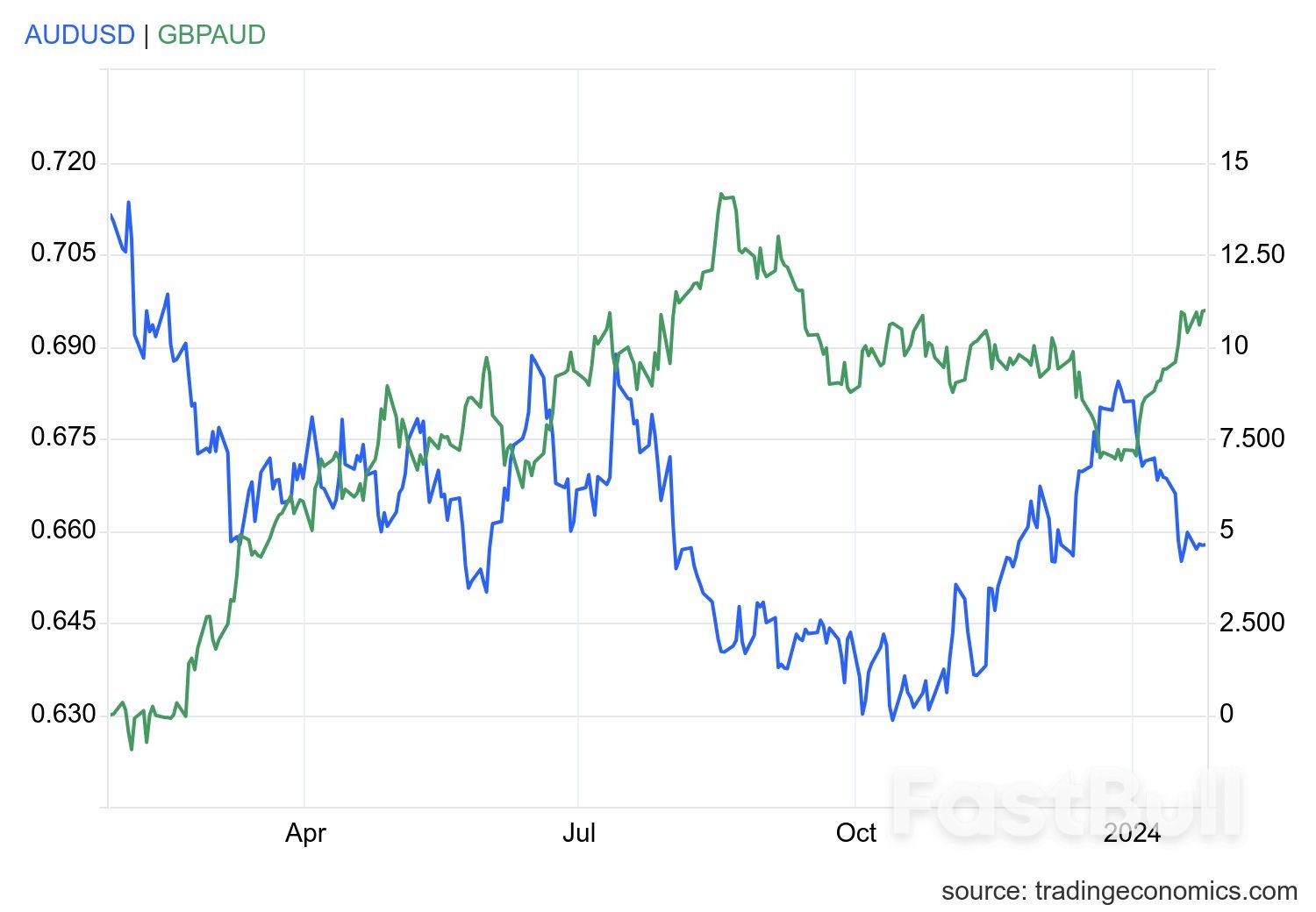
          In the complex dance of global financial markets, the fate of the Australian Dollar (AUD) is intricately tied to the movements of Chinese equities. Over the past few years, the AUD has demonstrated a strong correlation with the performance of Chinese stocks, until a significant divergence occurred in the final quarter of 2023. A confluence of factors, including a fall in U.S. bond yields, disrupted this correlation, leading to a pro-carry environment that temporarily shielded the AUD from the slide in Asian stocks. However, 2024 has proven to be a challenging year for the Australian Dollar, as it once again succumbed to the downward pressure exerted by falling Asian equity markets.
          Chinese Stock Rescue Sparks Optimism for Australian Dollar Recovery_1
          The Australian Dollar's vulnerability is evident in the numbers. The AUD/USD exchange rate has witnessed a 2.80% decline, settling at 0.6618, while the Pound to Australian Dollar exchange rate has experienced a 3.27% increase, reaching 1.9255. These figures underscore the impact of external market forces on the AUD, emphasizing the need for a nuanced understanding of global economic dynamics.
          The recent shift in fortunes for the AUD can be traced back to a fall in U.S. bond yields, which had a cascading effect on the U.S. dollar. In the pro-carry environment that ensued, the AUD/USD pair managed to defy the broader trend in Asian equities. However, the resilience was short-lived, as the year 2024 unfolded with renewed challenges for the Australian Dollar amid the broader decline in Asian equity markets.
          Amid the bleak outlook, a glimmer of hope emerged with an unexpected ally – Chinese authorities. Chinese Premier Li Qiang recently called for "forceful" measures to stabilize sliding share prices and rejuvenate investor sentiment. This call to action follows a disconcerting trend where China's benchmark CSI 300 Index lost a fifth of its value in the last nine months, reaching its lowest level since the start of 2019.
          Chinese Stock Rescue Sparks Optimism for Australian Dollar Recovery_2
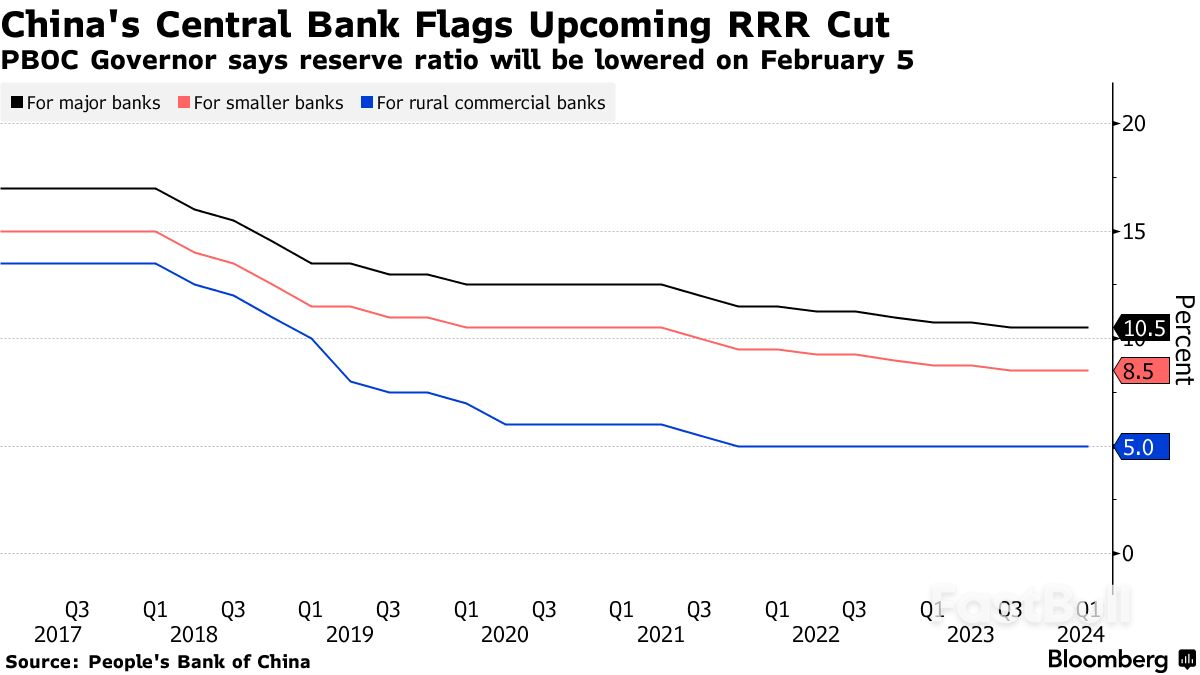
          The response from Chinese authorities has been swift and comprehensive. The People's Bank of China (PBOC) announced a 50 basis points Reserve Requirement Ratio (RRR) cut on February 5, injecting approximately RMB1 trillion of long-term liquidity into the market. This move is strategically aimed at easing financing costs, with a simultaneous 25 basis points reduction in re-lending and rediscount rates for bank lending to agriculture and small businesses.
          The PBOC's actions, while impactful, are not the sole components of China's rescue strategy. The state-owned Securities Daily revealed that China's medium- to long-term investment funds, including the formidable $406 billion National Social Security Fund and select state-owned insurance giants, are poised to enter the market. Their intended mission: to purchase shares and provide a much-needed boost to the beleaguered stock markets.
          In a further display of commitment, Chinese authorities have pledged to open the country's $64 trillion financial industry to international investors. This ambitious move signals a willingness to leverage external capital and expertise to fortify the domestic financial landscape. The confluence of these measures represents a major rescue package orchestrated by Chinese authorities to restore investor confidence and stem the tide of declining stock values.
          The impact of these interventions has already manifested in a positive performance by both Chinese equities and the Australian Dollar. The AUD experienced its most robust showing of the year following the news of the Chinese government's commitment to market stabilization. However, it is important to note that while the initial response is encouraging, a sustained reversal of the losses witnessed in the past three weeks will require continued efforts and vigilance.
          China's reported package to bolster its equity market, coupled with the RRR cut by the PBOC, provides crucial background support to the Australian Dollar. The interconnectedness of these financial landscapes cannot be overstated, and the success of the rescue package could potentially determine the trajectory of both the Chinese stock market and the Australian Dollar.
          To stay updated on all economic events of today, please check out our Economic calendar
          Risk Warnings and Disclaimers
          You understand and acknowledge that there is a high degree of risk involved in trading. Following any strategies or investment methods may lead to potential losses. The content on the site is provided by our contributors and analysts for information purposes only. You are solely responsible for determining whether any trading assets, securities, strategy, or any other product is suitable for investing based on your own investment objectives and financial situation.
          Comments
          Add to Favorites
          Share

          Fed Cancels the Free Lunch

          ING

          Forex

          USD: Let's see how the US regional banks do today
          FX markets continue in their slightly risk-averse mode, where some of the investors' favourite high-yield currencies - such as the Mexican peso and the Hungarian forint - remain under some pressure. This is despite global equity markets doing reasonably well. In short, we continue to see a very mixed investment environment and one in which conviction views can be dangerous.
          Looking ahead today, there are two US themes to focus on. The first is the Federal Reserve's announcement last night that its Bank Term Funding Program (BTFP) would end as scheduled on 11 March. And effective immediately, banks will be charged the rate paid on Fed reserve balances (around 5.40%) rather than the prior one-year USD OIS +10 bp (around 4.88%) to borrow money from the facility. This cancels the free lunch of banks borrowing at the BTFP and parking it at the Fed. The question is how US regional bank equity prices react to this news today. We presume that the Fed has a good handle on this such that these regional banks do not come under stress again. But let's see how this group trades today and whether it ushers in a new, potentially risk-off tone in US markets.
          The second focus is the 4Q23 US GDP data. We are looking at an above-consensus 2.5% quarter-on-quarter annualised figure. Consensus is now 2.0%. In theory that should be dollar-positive, but not necessarily risk-negative because the price data is far more important to the Fed right now. On that topic, Friday sees the December core PCE deflator (expected at a subdued 02.% month-on-month), while 13 February remains a major day for calendars in the release of the January CPI figure and the 2023 annual CPI revisions.
          Given also the event risk of the US quarterly refunding on Monday as well as the CPI release on 11 February, we doubt investors will want to commit much capital just yet. Instead, then, we think rangebound trading is the order of the day, with little follow-through should the dollar look particularly bid or offered. 102.75-103.75 looks the near-term DXY range.
          EUR: Lagarde will try to hold the data dependency line
          As Francesco Pesole discusses in our ECB Cheat Sheet, President Christine Lagarde will try to avoid being drawn into any pre-commitment over a summer rate cut. In theory then, if she can avoid this and leave markets with a sense that the European Central Bank is truly data-dependent, short-term euro interest rates could nudge a little higher and support FX pairs like EUR/USD and EUR/CHF. For reference, the market still prices 17bp of ECB rate cuts for the 17 April meeting, whereas our team only sees the easing cycle starting in June once the ECB has a better understanding of the spring wage round. We would say that the ECB event risk (statement 14:15CET, press conference 14:45CET) proves a mild upside risk to EUR/USD - but the carpet could be pulled from under the euro should President Lagarde somehow convey the message that the policy rate will be getting cut in the summer after all. 1.0850-1.0950 looks the EUR/USD range, with outside risk to 1.0980/90 should the ECB pushback against easing expectations prove surprisingly effective.
          Elsewhere Norges Bank announces rates today. The policy rate was hiked to 4.50% in December - so it would seem far too soon for Norges Bank to embrace any idea of easing. However, the Norwegian krone has been suffering a little this year as the backup in market interest rates has hit the risk environment. In all, we suspect EUR/NOK needs to trade a little longer in this 11.35-45 range.
          CEE: FX looking for hard ground
          The calendar in the region is basically empty today but it seems that financial markets can find their own entertainment without it. CEE assets continue in higher volatility mode. After Tuesday's sell-off, Local currencies found some ground yesterday. From our perspective, we continue to see the Czech koruna as the most stable in this risk-off environment. Positioning was already short before the sell-off and the CZK seems to be firmly anchored to rates, which are not going anywhere for now thanks to the CNB's cautious approach. Therefore, we continue to see the 24.700-800 range as an anchor for EUR/CZK.
          Poland's zloty remains the only currency supported by higher market rates, improving the interest rate differential. On the other hand, market positioning here supports more selling pressure. Moreover, the political situation has only temporarily calmed down, in our view, and we are likely to see more noise in the near term. Therefore, we expect to see 4.400 EUR/PLN levels again soon - rather next week than this.
          However, the key now will be mainly EUR/HUF, which is moving up fast ahead of next week's National Bank of Hungary meeting. We expect a 100bp cut on Tuesday but a still-weak forint is the risk to our call. We see 390 as a pain threshold where NBH will start to be more cautious and 395 as a hard stop for a 100bp rate cut and switch to the previous 75bp pace. We turned negative on HUF before the start of this sell-off due to FX and rate divergence, discussed here earlier. But now we believe this gap has closed in the last few days and the pressure on HUF should stop. However, the risk-off sentiment and long positioning is a clear risk here, which may further threaten the forint.
          TRY: The final CBT hike
          The Central Bank of Turkey (CBT) is today expected to conclude its tightening cycle with a 250bp rate hike - taking the one-week policy rate to 45.00%. We presume the CBT will retain the language that it can hike again if necessary. For reference, the Turkish lira is one of the very few emerging market currencies with positive total returns against the dollar this year. With cross-market volatility low, it looks like investors are keen to take on Turkish foreign currency risk and try to receive rates. We tend to cautiously favour these strategies too.
          Risk Warnings and Disclaimers
          You understand and acknowledge that there is a high degree of risk involved in trading. Following any strategies or investment methods may lead to potential losses. The content on the site is provided by our contributors and analysts for information purposes only. You are solely responsible for determining whether any trading assets, securities, strategy, or any other product is suitable for investing based on your own investment objectives and financial situation.
          Comments
          Add to Favorites
          Share

          High US Stocks Grow More Expensive Versus Global Peers

          Damon

          Economic

          Stocks

          The U.S. stock market's march to all-time highs is putting the spotlight on its large valuation premium over global equities, leading some investors to look abroad for outsize returns.
          The S&P 500 topped most key regional indexes in 2023 with a 24% gain, building on a decade of U.S. outperformance. The index is up over 2% so far in 2024, outpacing many rivals after notching its first record high in over two years last week.
          Many investors are reluctant to reduce their U.S. exposure, pointing to better economic and earnings prospects in 2024 for the country over Europe and other regions. The S&P 500's heavy weighting in technology companies also stands to draw investors who want to bet on new fields like artificial intelligence.
          But the valuation gap between the S&P 500 and MSCI's index of stocks in over 40 other countries is near its widest in over 20 years, and some investors are betting the opportunity abroad is too much of a bargain to pass up.
          International equity funds notched $73.6 billion in net inflows in 2023, while U.S. equity funds had $52.1 billion in net outflows, EPFR data showed, although both flows represent roughly 1% or less of overall assets for each category.
          "I don't think you can justify that record-wide gap between the U.S. and the rest of the world, and as that closes, that is going to benefit international markets," said Jeff Kleintop, chief global investment strategist at Charles Schwab.
          "Most people are probably underweighting where their long-term allocation to international (stocks) should be, and now is the time to consider upping that."
          The S&P 500 is trading at nearly 20 times forward earnings estimates, well above its long-term average of 15.6. By contrast, MSCI's all-country world index that excludes the U.S. is trading at 12.8 times below its historic average of 13.5. That gap is close to its widest in over two decades.High US Stocks Grow More Expensive Versus Global Peers_1
          Plenty of investors are happy to pay that premium for U.S. stocks. U.S. gross domestic product is expected to rise by 1.6% in 2024, against 0.7% for the Euro area and 0.9% for Japan, according to World Bank forecasts.
          China's stock market, meanwhile, tumbled over 10% in 2023 and has extended its slide this year, with a deepening property crisis and local government debt crunch among the factors spooking investors.
          S&P 500 companies are expected to increase earnings by 10.6% in 2024, nearly twice the pace of Europe's STOXX 600, according to LSEG Datastream.
          The question is, however, whether those U.S. advantages are already more-than-reflected in stock prices.
          Vanguard's economic models, which take valuation into account, projects U.S. equity returns over the next decade at an average annual rate of 4.2% to 6.2%. Ten-year projections are rosier elsewhere: 7% to 9% annualized return for non-U.S. developed markets, and 6.6% to 8.6% for emerging markets.
          "In the case of the U.S., we see that market is expensive," said Roger Aliaga-Diaz, head of portfolio construction at Vanguard. "That predicts a much lower return environment for U.S. equities than for ex-U.S."
          Japan's stock market is also rallying, with the Nikkei already up 8% this year at 34-year highs.
          High US Stocks Grow More Expensive Versus Global Peers_2LPL Financial recommends investors "overweight" Japanese equities in portfolios, noting still-cheap valuations despite recent gains, improving technical factors and companies' improved focus on shareholder returns.
          But the firm is "underweight" Europe, having downgraded international developed markets overall in October to "neutral," while upgrading the U.S. to "overweight."
          While valuations in international developed markets are attractive, "they have been attractive for a long time," said Jeffrey Buchbinder, chief equity strategist for LPL Financial. "We want more than just cheap valuations to get more interested in international."
          Investors have been rewarded for sticking with the U.S. in recent years. The S&P 500 is up 160% over the past decade, versus 130% for the Nikkei, 40% for the STOXX and about 10% for the MSCI all-country index that excludes the U.S.
          Hans Olsen, chief investment officer for Fiduciary Trust Company, said U.S. stock valuations are more reasonable when removing the impact of heavily weighted tech and growth shares that are more expensive.
          At the same time, he is confident that a strong U.S. economy will translate into solid corporate profits, helping U.S. stocks outperform international markets this year.
          "If you have an economy that is actually a bit stronger than people are giving it credit for ... that should flow through to the earnings," Olsen said.

          Source: Reuters

          To stay updated on all economic events of today, please check out our Economic calendar
          Risk Warnings and Disclaimers
          You understand and acknowledge that there is a high degree of risk involved in trading. Following any strategies or investment methods may lead to potential losses. The content on the site is provided by our contributors and analysts for information purposes only. You are solely responsible for determining whether any trading assets, securities, strategy, or any other product is suitable for investing based on your own investment objectives and financial situation.
          Comments
          Add to Favorites
          Share
          FastBull
          Copyright © 2025 FastBull Ltd

          728 RM B 7/F GEE LOK IND BLDG NO 34 HUNG TO RD KWUN TONG KLN HONG KONG

          TelegramInstagramTwitterfacebooklinkedin
          App Store Google Play Google Play
          Products
          Charts

          Chats

          Q&A with Experts
          Screeners
          Economic Calendar
          Data
          Tools
          Membership
          Features
          Function
          Markets
          Copy Trading
          Latest Signals
          Contests
          News
          Analysis
          24/7
          Columns
          Education
          Company
          Careers
          About Us
          Contact Us
          Advertising
          Help Center
          Feedback
          User Agreement
          Privacy Policy
          Business

          White Label

          Data API

          Web Plug-ins

          Poster Maker

          Affiliate Program

          Risk Disclosure

          The risk of loss in trading financial instruments such as stocks, FX, commodities, futures, bonds, ETFs and crypto can be substantial. You may sustain a total loss of the funds that you deposit with your broker. Therefore, you should carefully consider whether such trading is suitable for you in light of your circumstances and financial resources.

          No decision to invest should be made without thoroughly conducting due diligence by yourself or consulting with your financial advisors. Our web content might not suit you since we don't know your financial conditions and investment needs. Our financial information might have latency or contain inaccuracy, so you should be fully responsible for any of your trading and investment decisions. The company will not be responsible for your capital loss.

          Without getting permission from the website, you are not allowed to copy the website's graphics, texts, or trademarks. Intellectual property rights in the content or data incorporated into this website belong to its providers and exchange merchants.

          Not Logged In

          Log in to access more features

          FastBull Membership

          Not yet

          Purchase

          Become a signal provider
          Help Center
          Customer Service
          Dark Mode
          Price Up/Down Colors

          Log In

          Sign Up

          Position
          Layout
          Fullscreen
          Default to Chart
          The chart page opens by default when you visit fastbull.com