• Trade
  • Markets
  • Copy
  • Contests
  • News
  • 24/7
  • Calendar
  • Q&A
  • Chats
Trending
Screeners
SYMBOL
LAST
BID
ASK
HIGH
LOW
NET CHG.
%CHG.
SPREAD
SPX
S&P 500 Index
6827.42
6827.42
6827.42
6899.86
6801.80
-73.58
-1.07%
--
DJI
Dow Jones Industrial Average
48458.04
48458.04
48458.04
48886.86
48334.10
-245.98
-0.51%
--
IXIC
NASDAQ Composite Index
23195.16
23195.16
23195.16
23554.89
23094.51
-398.69
-1.69%
--
USDX
US Dollar Index
97.890
97.970
97.890
98.070
97.880
-0.060
-0.06%
--
EURUSD
Euro / US Dollar
1.17470
1.17477
1.17470
1.17486
1.17262
+0.00076
+ 0.06%
--
GBPUSD
Pound Sterling / US Dollar
1.33854
1.33861
1.33854
1.33894
1.33546
+0.00147
+ 0.11%
--
XAUUSD
Gold / US Dollar
4340.42
4340.76
4340.42
4350.16
4294.68
+41.03
+ 0.95%
--
WTI
Light Sweet Crude Oil
57.037
57.067
57.037
57.601
57.030
-0.196
-0.34%
--

Community Accounts

Signal Accounts
--
Profit Accounts
--
Loss Accounts
--
View More

Become a signal provider

Sell trading signals to earn additional income

View More

Guide to Copy Trading

Get started with ease and confidence

View More

Signal Accounts for Members

All Signal Accounts

Best Return
  • Best Return
  • Best P/L
  • Best MDD
Past 1W
  • Past 1W
  • Past 1M
  • Past 1Y

All Contests

  • All
  • Trump Updates
  • Recommend
  • Stocks
  • Cryptocurrencies
  • Central Banks
  • Featured News
Top News Only
Share

EU Commission Spokersperson: EU Commission President Set To Travel To Berlin Monday Evening

Share

Brazil Economists See Brazilian Real At 5.40 Per Dollar By Year-End 2025 Versus 5.40 In Previous Estimate - Central Bank Poll

Share

Brazil Economists See Year-End 2026 Interest Rate Selic At 12.13% Versus 12.25% In Previous Estimate - Central Bank Poll

Share

Indonesia Minister: Final Agreement With USA On Tariffs Will Be Signed By Both Leaders And It Likely Would Not Happened This Year

Share

EU Commission Spokesperson: EU Commission Still Expects To Sign EU MERCOSUR Agreement By The End Of The Year

Share

New Czech Finance Minister Schillerova: Aiming For 2026 Budget To Be Approved By Cabinet In Second Half Of January

Share

Capital One Financial-30+ Day Performing Delinquencies Rate For Domestic Credit Card 4.01% At November End

Share

Capital One Financial- November Domestic Credit Card Net Charge-Offs Rate 5.02%

Share

Capital One Financial - November Auto Net Charge-Offs Rate 1.71%

Share

Capital One Financial - 30+ Day Performing Delinquencies Rate For Auto 5.02% At November End

Share

Brazil's Igp-10 Price Index Rises 0.04% In Dec

Share

Ukraine President Zelenskiy Will Meet Dutch Prime Minister Schoof And Dutch King In The Hague On Tuesday

Share

Pakistan Central Bank: Cuts Key Rate By 50 Bps To 10.50%

Share

German Government Spokesperson: Russian Central Bank Lawsuit Has No Impact On EU Plans To Use Frozen Russian State Assets For Ukraine

Share

German Government Spokesperson: United States Is Also Invited To This Evening's Talks Between The Europeans And Ukraine President Zelenskiy

Share

EU Official: EU Foreign Ministers Adopt Sanctions Targeting 14 Persons, Entities Under Russia Hybrid Threats Regime

Share

Polish Zloty Firms To 4.2175 Versus Euro, Strongest Since Early April

Share

China Npc Standing Committee Meeting To Review Draft Revision To Foreign Trade Law

Share

China Npc Standing Committee To Hold Meeting Dec 22-27

Share

The European Council Stated That, In Light Of Recent Mixed Activities And Threats Against Member States, It Has Expanded The List Of Individuals And Entities That Support Or Benefit From Actions Linked To The Belarusian Government

TIME
ACT
FCST
PREV
China, Mainland M1 Money Supply YoY (Nov)

A:--

F: --

P: --

India CPI YoY (Nov)

A:--

F: --

P: --

India Deposit Gowth YoY

A:--

F: --

P: --

Brazil Services Growth YoY (Oct)

A:--

F: --

P: --

Mexico Industrial Output YoY (Oct)

A:--

F: --

P: --

Russia Trade Balance (Oct)

A:--

F: --

P: --

Philadelphia Fed President Henry Paulson delivers a speech
Canada Building Permits MoM (SA) (Oct)

A:--

F: --

P: --

Canada Wholesale Sales YoY (Oct)

A:--

F: --

P: --

Canada Wholesale Inventory MoM (Oct)

A:--

F: --

P: --

Canada Wholesale Inventory YoY (Oct)

A:--

F: --

P: --

Canada Wholesale Sales MoM (SA) (Oct)

A:--

F: --

P: --

Germany Current Account (Not SA) (Oct)

A:--

F: --

P: --

U.S. Weekly Total Rig Count

A:--

F: --

P: --

U.S. Weekly Total Oil Rig Count

A:--

F: --

P: --

Japan Tankan Small Manufacturing Outlook Index (Q4)

A:--

F: --

P: --

Japan Tankan Large Non-Manufacturing Diffusion Index (Q4)

A:--

F: --

P: --

Japan Tankan Large Non-Manufacturing Outlook Index (Q4)

A:--

F: --

P: --

Japan Tankan Large Manufacturing Outlook Index (Q4)

A:--

F: --

P: --

Japan Tankan Small Manufacturing Diffusion Index (Q4)

A:--

F: --

P: --

Japan Tankan Large Manufacturing Diffusion Index (Q4)

A:--

F: --

P: --

Japan Tankan Large-Enterprise Capital Expenditure YoY (Q4)

A:--

F: --

P: --

U.K. Rightmove House Price Index YoY (Dec)

A:--

F: --

P: --

China, Mainland Industrial Output YoY (YTD) (Nov)

A:--

F: --

P: --

China, Mainland Urban Area Unemployment Rate (Nov)

A:--

F: --

P: --

Saudi Arabia CPI YoY (Nov)

A:--

F: --

P: --

Euro Zone Industrial Output YoY (Oct)

A:--

F: --

P: --

Euro Zone Industrial Output MoM (Oct)

A:--

F: --

P: --

Canada Existing Home Sales MoM (Nov)

A:--

F: --

P: --

U.K. Inflation Rate Expectations

--

F: --

P: --

Euro Zone Total Reserve Assets (Nov)

--

F: --

P: --

Canada National Economic Confidence Index

--

F: --

P: --

Canada New Housing Starts (Nov)

--

F: --

P: --

U.S. NY Fed Manufacturing Employment Index (Dec)

--

F: --

P: --

U.S. NY Fed Manufacturing Index (Dec)

--

F: --

P: --

Canada Core CPI YoY (Nov)

--

F: --

P: --

Canada Manufacturing Unfilled Orders MoM (Oct)

--

F: --

P: --

U.S. NY Fed Manufacturing Prices Received Index (Dec)

--

F: --

P: --

U.S. NY Fed Manufacturing New Orders Index (Dec)

--

F: --

P: --

Canada Manufacturing New Orders MoM (Oct)

--

F: --

P: --

Canada Core CPI MoM (Nov)

--

F: --

P: --

Canada Trimmed CPI YoY (SA) (Nov)

--

F: --

P: --

Canada Manufacturing Inventory MoM (Oct)

--

F: --

P: --

Canada CPI YoY (Nov)

--

F: --

P: --

Canada CPI MoM (Nov)

--

F: --

P: --

Canada CPI YoY (SA) (Nov)

--

F: --

P: --

Canada Core CPI MoM (SA) (Nov)

--

F: --

P: --

Canada CPI MoM (SA) (Nov)

--

F: --

P: --

Federal Reserve Board Governor Milan delivered a speech
U.S. NAHB Housing Market Index (Dec)

--

F: --

P: --

Australia Composite PMI Prelim (Dec)

--

F: --

P: --

Australia Services PMI Prelim (Dec)

--

F: --

P: --

Australia Manufacturing PMI Prelim (Dec)

--

F: --

P: --

Japan Manufacturing PMI Prelim (SA) (Dec)

--

F: --

P: --

U.K. 3-Month ILO Employment Change (Oct)

--

F: --

P: --

U.K. Unemployment Claimant Count (Nov)

--

F: --

P: --

U.K. Unemployment Rate (Nov)

--

F: --

P: --

U.K. 3-Month ILO Unemployment Rate (Oct)

--

F: --

P: --

U.K. Average Weekly Earnings (3-Month Average, Including Bonuses) YoY (Oct)

--

F: --

P: --

U.K. Average Weekly Earnings (3-Month Average, Excluding Bonuses) YoY (Oct)

--

F: --

P: --

Q&A with Experts
    • All
    • Chatrooms
    • Groups
    • Friends
    Connecting
    .
    .
    .
    Type here...
    Add Symbol or Code

      No matching data

      All
      Trump Updates
      Recommend
      Stocks
      Cryptocurrencies
      Central Banks
      Featured News
      • All
      • Russia-Ukraine Conflict
      • Middle East Flashpoint
      • All
      • Russia-Ukraine Conflict
      • Middle East Flashpoint
      Search
      Products

      Charts Free Forever

      Chats Q&A with Experts
      Screeners Economic Calendar Data Tools
      Membership Features
      Data Warehouse Market Trends Institutional Data Policy Rates Macro

      Market Trends

      Market Sentiment Order Book Forex Correlations

      Top Indicators

      Charts Free Forever
      Markets

      News

      News Analysis 24/7 Columns Education
      From Institutions From Analysts
      Topics Columnists

      Latest Views

      Latest Views

      Trending Topics

      Top Columnists

      Latest Update

      Signals

      Copy Rankings Latest Signals Become a signal provider AI Rating
      Contests
      Brokers

      Overview Brokers Assessment Rankings Regulators News Claims
      Broker listing Forex Brokers Comparison Tool Live Spread Comparison Scam
      Q&A Complaint Scam Alert Videos Tips to Detect Scam
      More

      Business
      Events
      Careers About Us Advertising Help Center

      White Label

      Data API

      Web Plug-ins

      Affiliate Program

      Awards Institution Evaluation IB Seminar Salon Event Exhibition
      Vietnam Thailand Singapore Dubai
      Fans Party Investment Sharing Session
      FastBull Summit BrokersView Expo
      Recent Searches
        Top Searches
          Markets
          News
          Analysis
          User
          24/7
          Economic Calendar
          Education
          Data
          • Names
          • Latest
          • Prev

          View All

          No data

          Scan to Download

          Faster Charts, Chat Faster!

          Download App
          English
          • English
          • Español
          • العربية
          • Bahasa Indonesia
          • Bahasa Melayu
          • Tiếng Việt
          • ภาษาไทย
          • Français
          • Italiano
          • Türkçe
          • Русский язык
          • 简中
          • 繁中
          Open Account
          Search
          Products
          Charts Free Forever
          Markets
          News
          Signals

          Copy Rankings Latest Signals Become a signal provider AI Rating
          Contests
          Brokers

          Overview Brokers Assessment Rankings Regulators News Claims
          Broker listing Forex Brokers Comparison Tool Live Spread Comparison Scam
          Q&A Complaint Scam Alert Videos Tips to Detect Scam
          More

          Business
          Events
          Careers About Us Advertising Help Center

          White Label

          Data API

          Web Plug-ins

          Affiliate Program

          Awards Institution Evaluation IB Seminar Salon Event Exhibition
          Vietnam Thailand Singapore Dubai
          Fans Party Investment Sharing Session
          FastBull Summit BrokersView Expo

          The Federal Reserve's Pursuit of a 'reverse Wealth Effect' is Undermining Crypto

          Jason

          Cryptocurrency

          Summary:

          The Federal Reserve is seeking to push investors into reevaluating their portfolios by injecting chaos into markets.

          The Federal Reserve’s strategy to hike interest rates may continue, making it difficult for the crypto industry to bounce back. For crypto assets to become the hedge against inflation, the industry needs to explore ways to decouple crypto from traditional markets. Decentralized finance (DeFi) can perhaps offer a way out by breaking away from legacy financial models.

          How Federal Reserve policies are affecting crypto

          In the 1980s, Paul Volcker, the chairman of the Federal Reserve Board, introduced the interest hiking policy to control inflation. Volcker raised interest rates to over 20%, forcing the economy into a recession by reducing people’s purchasing capacity. The strategy worked, and the Consumer Price Index (CPI) went down from 14.85% to 2.5%. Even now, the Federal Reserve continues to use the same methodology to bring down high inflation rates.

          In 2022, core U.S. inflation reached a 40-year high, making the Federal Reserve consistently hike interest rates throughout the year. This has negatively hit the crypto market. Mike McGlone, the Senior Commodity Strategist at Bloomberg Intelligence, explained that the Fed‘s “sledgehammer” has “been pressuring crypto this year.” McGlone believes that the Fed’s policies could lead to a crash that is worse than the 2008 financial crisis.

          Market data shows a clear pattern where the Federal Reserve’s interest rate hikes correspond to significant drops in cryptocurrency prices. For example, Bitcoin (BTC) prices declined on May 6 after the Fed’s meeting on May 3 and 4 to increase interest by 0.5%. Similarly, Bitcoin fell to $17,500 after the Fed meeting on June 14 and 15, where they raised interest rates by 0.75%.

          The rate hike in June was a significant factor for cryptocurrencies like BTC and Ether (ETH) to fall 70% since their all-time highs. As the price charts demonstrate, the Federal Reserve’s policies have a direct correlation with crypto market volatility. This uncertainty hampers the crypto industry from making a definitive comeback. Since cryptocurrencies are a risky asset class, investors are reducing their exposure to crypto due to rising interest rates and recession fears.

          The Federal Reserve implemented another 0.75% hike in interest rates in November. The Fed said it was trying to bring down “inflation at the rate of 2 percent over the long run”. The Fed Committee will continue to hike federal fund rates to 3-4%. It “anticipates that ongoing increases in the target range will be appropriate in order to attain a stance of monetary policy that is sufficiently restrictive to return inflation to 2% over time.”

          As inflation remains high, there’s no reason to believe that the Federal Reserve will stop hiking interest rates anytime soon. Unfortunately, this isn’t good news for risk assets like cryptocurrencies.

          The future trajectory of Fed policies

          In all probability, the Federal Reserve will continue with its interest rate hikes in accordance with market data feedback. Bank of America wrote, “The Fed will stress data dependence […] they will get two more NFP and CPI prints before the [December] meeting; if they stay hot, another 75 bps is in the cards, if not, a deceleration to 50 bps is possible.” The strategists added, “The Fed isn’t done hiking until the data says so.”

          Echoing the sentiment, Barclays’s credit research team said, “The Fed needs to see inflation turning … before turning meaningfully dovish.” So, there’s a high chance that even if the Federal Reserve reduces the hike percentage, they’ll keep raising interest rates. Depending on inflation figures, the Fed might slow down its liquidity tightening measures from December but won’t stop with its inflation mitigation strategies immediately. Thus, investors need to brace for a long period of crypto market volatility.

          The Federal Reserve intends to create a reverse wealth effect so that investors reassess their crypto portfolio. They want to create a precarious market situation by slowing down demand but also be careful to avoid any chaos. Despite the U.S. GDP contracting for two consecutive quarters, the Fed is eager to evaluate and implement painful policies. So, the crypto industry needs to find alternative methods to tackle the Fed challenge.

          The current market scenario demonstrates that crypto asset prices are entwined with the equity and stock markets. Investors still consider them to be high-risk assets and get skeptical about investing during high inflation periods. So, it is imperative for the crypto sector to distance itself from other traditional risky asset classes. Fortunately, a U.S. central bank report suggests that risk perception towards crypto is gradually changing.

          According to a Federal Reserve Bank of New York report, cryptocurrencies are no longer in the top 10 most cited as potential risks for the U.S. economy. This reveals an important change in the investor mindset, demonstrating that crypto will eventually become a non-risky asset class. But, that won’t happen if crypto continues to follow the legacy financial model. To beat inflation and offset Fed policies, the crypto industry must embrace decentralized finance for a robust future economy.

          Bernd Stöckl is the co-founder and chief product officer of Palmswap, a decentralized perpetual contract trading protocol.

          This article is for general information purposes and is not intended to be and should not be taken as legal or investment advice. The views, thoughts, and opinions expressed here are the author’s alone and do not necessarily reflect or represent the views and opinions of Cointelegraph.

          Article Source: COINTELEGRAPH

          Risk Warnings and Disclaimers
          You understand and acknowledge that there is a high degree of risk involved in trading. Following any strategies or investment methods may lead to potential losses. The content on the site is provided by our contributors and analysts for information purposes only. You are solely responsible for determining whether any trading assets, securities, strategy, or any other product is suitable for investing based on your own investment objectives and financial situation.
          Comments
          Add to Favorites
          Share

          USD/JPY Bears Poke 136.00 as BOJ Hawks Flex Muscles

          Devin

          Forex

          • USD/JPY extends Friday’s losses to challenge two-week uptrend.
          • Chatters over BOJ’s rate hike gain momentum as dovish leader Haruhiko Kuroda nears retirement.
          • US Dollar’s failure to cheer hawkish Fedspeak adds strength to the pullback moves.
          • Risk catalysts, BOJ and the Fed’s preferred inflation gauge eyed for clear directions.

          USD/JPY holds lower grounds near the intraday bottom of 135.77 as the Yen buyers keep the reins ahead of this week’s Bank of Japan (BOJ) monetary policy meeting. With this, the quote prints a two-day downtrend as traders anticipate hawkish signals from the Japanese central bank as the utter dove Governor Haruhiko Kuroda nears his retirement looming in April.

          During the weekend, Reuters reported that Japan's government is set to revise a decade-old joint statement with the Bank of Japan (BOJ) that commits the central bank to achieve its 2% inflation "at the earliest date possible," Kyodo news agency reported on Saturday, citing government sources.

          Following that, BOJ’s former deputy governor Hirohide Yamaguchi said, “Bank of Japan (BOJ) must make its monetary policy framework more flexible and stand ready to raise its long-term interest rate target next year if the economy can withstand overseas risks.”

          However, the latest comments from Japan’s Chief Cabinet Secretary Hirokazu Matsuno challenges the USD/JPY bears while pouring cold water on the face of hawkish expectations from the BOJ. “The government hopes to continue working closely with the Bank of Japan (BoJ) to achieve sustained economic growth and price stability, based on the agreement made in the joint statement,” said Japan’s Matsuno.

          On the other hand, the US Dollar Index (DXY) prints the first daily loss in three, down 0.20% intraday near 104.55, amid cautious optimism in the market. In doing so, the DXY struggles to justify the recently hawkish comments from Federal Reserve Bank of Cleveland President Loretta Mester and New York Federal Reserve President John Williams. The reason could be linked to Friday’s downbeat prints of the preliminary US PMIs for December, as well as the Fed’s 0.50% rate hike.

          Elsewhere, the US Treasury yields portray recession amid hawkish Fedspeak and hence challenge USD/JPY bears amid a sluggish Asian session.

          Looking forward, USD/JPY traders should pay attention to the risk catalysts, as well as BOJ-linked chatters in the market ahead of Tuesday’s Monetary Policy Meeting. Even if the Japanese central bank isn’t expected to alter the current monetary policy during this meeting, the hints for future moves could be enough to please the bears.

          Technical analysis

          A two-week-old rising wedge formation restricts immediate USD/JPY moves between 134.85 and 138.30.

          Additional important levels

          Overview
          Today last price 135.99
          Today Daily Change -0.70
          Today Daily Change % -0.51%
          Today daily open 136.69
          Trends
          Daily SMA20 137.62
          Daily SMA50 142.54
          Daily SMA100 141.15
          Daily SMA200 135.56
          Levels
          Previous Daily High 137.9
          Previous Daily Low 136.29
          Previous Weekly High 138.18
          Previous Weekly Low 134.52
          Previous Monthly High 148.82
          Previous Monthly Low 137.5
          Daily Fibonacci 38.2% 136.91
          Daily Fibonacci 61.8% 137.29
          Daily Pivot Point S1 136.02
          Daily Pivot Point S2 135.35
          Daily Pivot Point S3 134.41
          Daily Pivot Point R1 137.63
          Daily Pivot Point R2 138.58
          Daily Pivot Point R3 139.25

          Article Source: FXSTREET

          Risk Warnings and Disclaimers
          You understand and acknowledge that there is a high degree of risk involved in trading. Following any strategies or investment methods may lead to potential losses. The content on the site is provided by our contributors and analysts for information purposes only. You are solely responsible for determining whether any trading assets, securities, strategy, or any other product is suitable for investing based on your own investment objectives and financial situation.
          Comments
          Add to Favorites
          Share

          Bitcoin Price Prints Bearish Technical Pattern, Why It Could Continue Lower

          Thomas

          Cryptocurrency

          Bitcoin price declined heavily and traded below $17,000. BTC is consolidating losses and remains at a risk of more losses below the $16,500 support.

          • Bitcoin started a fresh decline below the $17,200 and $17,000 support levels.
          • The price is trading below $17,000 and the 100 hourly simple moving average.
          • There is a key bearish trend line forming with resistance near $16,800 on the hourly chart of the BTC/USD pair (data feed from Kraken).
          • The pair could continue to move lower unless it clears the 100 hourly SMA.

          Bitcoin Price Tumbles

          Bitcoin price restarted a fresh decline from the $18,400 zone resistance zone. BTC gained pace below the $17,500 and $17,200 support levels. The bears even pushed it below the $17,000 level and the 100 hourly simple moving average.

          It tested the $16,500 support zone. A low is formed near $16,541 and the price is now consolidating losses. It climbed a few points higher and traded above the $16,700 level.

          Bitcoin price is now trading below $17,000 and the 100 hourly simple moving average. On the upside, an immediate resistance is near the $16,800 zone. There is also a key bearish trend line forming with resistance near $16,800 on the hourly chart of the BTC/USD pair.

          The first major resistance is near the $17,000 zone and the 100 hourly simple moving average. It is near the 23.6% Fib retracement level of the downward move from the $18,387 swing high to $16,541 swing low.

          Source: BTCUSD on TradingView.com

          A clear move above the $17,000 resistance might call for a move towards the $17,500 resistance. It is close to the 50% Fib retracement level of the downward move from the $18,387 swing high to $16,541 swing low. The next major resistance is near $17,800, above which the price might gain pace and rise towards the $18,000 level.

          More Losses in BTC?

          If bitcoin fails to clear the $17,000 resistance, there could be more downsides. An immediate support on the downside is near the $16,600 level.

          The next major support is near the $16,500 zone. A downside break below the $16,500 support might call more losses. In the stated case, the price could decline towards the $16,000 support in the near term. Any more losses might send the price towards $15,500.

          Technical indicators:

          Hourly MACD – The MACD is now losing pace in the bearish zone.

          Hourly RSI (Relative Strength Index) – The RSI for BTC/USD is now above the 50 level.

          Major Support Levels – $16,600, followed by $16,500.

          Major Resistance Levels – $16,800, $17,000 and $17,500.

          Article Source: CRYPTONEWS

          Risk Warnings and Disclaimers
          You understand and acknowledge that there is a high degree of risk involved in trading. Following any strategies or investment methods may lead to potential losses. The content on the site is provided by our contributors and analysts for information purposes only. You are solely responsible for determining whether any trading assets, securities, strategy, or any other product is suitable for investing based on your own investment objectives and financial situation.
          Comments
          Add to Favorites
          Share

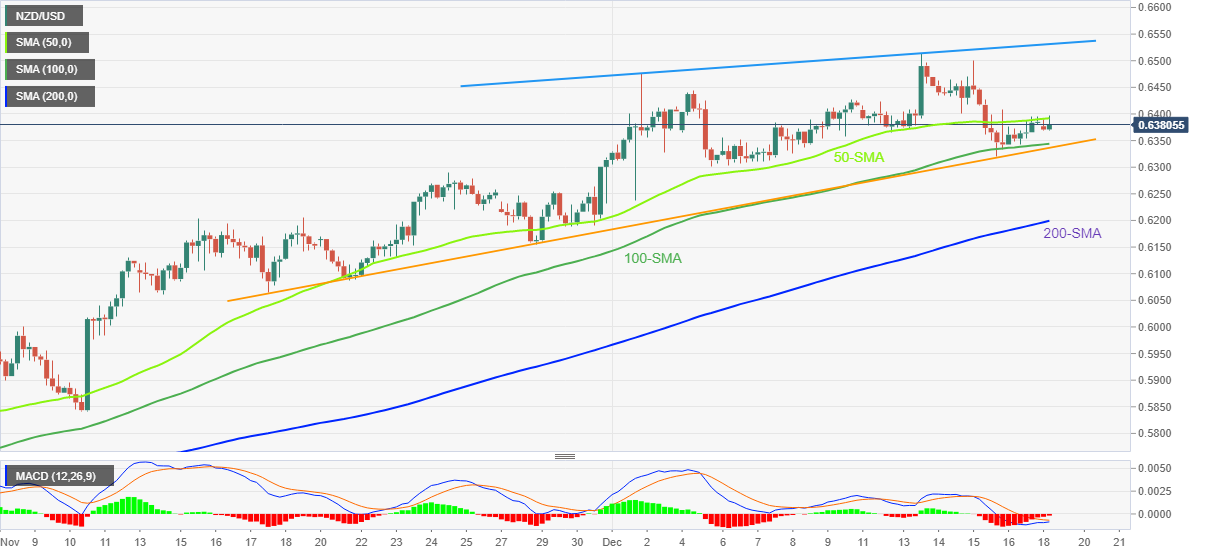
          NZD/USD Price Analysis: Fades recovery moves below 0.6400 as 50-SMA probes bulls

          Damon

          Forex

          • NZD/USD prints mild gains to keep Friday’s recovery moves between 50-SMA and 100-SMA.
          • Impending bull cross on MACD, sustained bounce off monthly support line keep buyers hopeful.
          • 200-SMA, monthly resistance line act as additional trading filters.

          NZD/USD grinds higher towards 0.6400, around 0.6385 by the press time, as buyers flirt with the 50-SMA during early Monday.

          In doing so, the Kiwi pair defends the previous day’s rebound from the 100-SMA, as well as the recovery moves from an upward-sloping support line from November 17.

          Given the impending bull cross on the MACD, as well as the quote’s repeated hesitance in breaking the 100-SMA, NZD/USD is likely to overcome the hurdle of 0.6392 level comprising the 50-SMA.

          Following that, the run-up could aim for the 0.6400 and the 0.6500 thresholds before the monthly resistance line, around 0.6535 at the latest, could challenge the bulls.

          In a case where NZD/USD manages to keep the reins past 0.6535, June’s top at around 0.6575 and the 0.6600 round figure will be in focus.

          Meanwhile, the 100-SMA level surrounding 0.6345 precedes the one-month-long ascending support line, mentioned previously, to restrict the immediate downside near 0.6335.

          It’s worth noting, however, that a downside break of the 0.6335 support could quickly drag NZD/USD prices towards the 200-SMA level surrounding 0.6200. However, any further downside appears bumpy.

          NZD/USD: Four-hour chart

          NZD/USD Price Analysis: Fades recovery moves below 0.6400 as 50-SMA probes bulls_1

          Trend: Further recovery expected

          Additional important levels

          Overview
          Today last price0.6382
          Today Daily Change-0.0003
          Today Daily Change %-0.05%
          Today daily open0.6385
          Trends
          Daily SMA200.6314
          Daily SMA500.6025
          Daily SMA1000.6041
          Daily SMA2000.6269
          Levels
          Previous Daily High0.6409
          Previous Daily Low0.6333
          Previous Weekly High0.6514
          Previous Weekly Low0.6319
          Previous Monthly High0.6314
          Previous Monthly Low0.5741
          Daily Fibonacci 38.2%0.638
          Daily Fibonacci 61.8%0.6362
          Daily Pivot Point S10.6342
          Daily Pivot Point S20.63
          Daily Pivot Point S30.6266
          Daily Pivot Point R10.6418
          Daily Pivot Point R20.6451
          Daily Pivot Point R30.6494

          Article Source: FXSTREET

          Risk Warnings and Disclaimers
          You understand and acknowledge that there is a high degree of risk involved in trading. Following any strategies or investment methods may lead to potential losses. The content on the site is provided by our contributors and analysts for information purposes only. You are solely responsible for determining whether any trading assets, securities, strategy, or any other product is suitable for investing based on your own investment objectives and financial situation.
          Comments
          Add to Favorites
          Share

          US Crypto Ban Proposal Tossed Around By Senate Banking Chair

          Alex

          Cryptocurrency

          The anti-crypto rhetoric has been ramping up in the United States. The latest lawmaker to deride the entire ecosystem is Senate banking chairman Sherrod Brown who suggested a full-out crypto ban.

          Brown is an ardent anti-crypto campaigner, just like his Senate colleague Elizabeth Warren. The pair has been actively working to quash the entire crypto sector in the United States.

          Sherrod Brown is the chairman of the Senate Banking, Housing, and Urban Affairs Committee. Over the weekend, he told NBC that the Treasury and all federal agencies should join forces to take action against the crypto sector.

          He even went as far as suggesting a crypto ban in the country, according to a report by The Hill on Dec. 18:

          “Maybe banning it, although banning it is very difficult because it will go offshore and who knows how that will work,”

          A Crypto Ban Won’t Work

          Waving angry fists at Bitcoin and its brethren will solve nothing, and neither will banning the embryonic asset class. The primary reason FTX split into two entities was that there is no regulatory framework in the U.S.

          Traders and investors were forced offshore to an unregulated exchange that ultimately collapsed. Developing a productive framework to ensure there are safeguards for crypto investors should be the main priority. Not bringing down the ban hammer as these bankers and Senators would like.

          Brown commented that the cryptocurrency market is a “complicated, unregulated pot of money,” declaring that the issue was much larger than FTX.

          Just like Senator Warren, Brown views crypto as a threat to national security. He also believes the entire sector is a swindle designed to scam unwitting participants.

          Brown said he had spent much of his eight years as the Senate Banking Chair trying to “educate” his colleagues and:

          “trying to educate the public about crypto and the dangers that it presents to our security as a nation and the consumers that get hoodwinked by them.”

          Last week, Elizabeth Warren unleashed another of her tirades against the crypto industry. “Rogue nations, oligarchs, and drug lords are using crypto to launder billions, evade sanctions and finance terrorism,” she proclaimed.

          Her proposed crypto bill aims to force blockchain architecture, such as nodes and validators to register as “financial institutions.”

          Source: Shutterstock

          Crypto Markets See Red

          Crypto markets are still consolidating and have been largely inactive over the weekend. Total capitalization dipped below $840 billion during Monday morning’s Asian trading session.

          As a result, markets are dropping toward their cycle low again, but there has yet to be another panic sell-off.

          Article Source: CRYPTONEWS

          Risk Warnings and Disclaimers
          You understand and acknowledge that there is a high degree of risk involved in trading. Following any strategies or investment methods may lead to potential losses. The content on the site is provided by our contributors and analysts for information purposes only. You are solely responsible for determining whether any trading assets, securities, strategy, or any other product is suitable for investing based on your own investment objectives and financial situation.
          Comments
          Add to Favorites
          Share

          China's yuan eases on COVID worries amid sluggish trades

          Samantha Luan

          Forex

          China's yuan eased against the dollar on Monday as sentiment was impacted after reports of the country's first COVID-related deaths since strict prevention protocols started to be dismantled earlier this month. Yuan trades were sluggish as many market participants had to work from home and trade remotely amid the fast spread of the virus in major cities. The volume hit $6.3 billion as of midday, down from the normal half-day volume of about $15 billion.

          Daily average dollar/yuan trade in the interbank market shrunk to about $20 billion last week, the lowest since April, when the financial hub of Shanghai imposed lockdowns. Prior to market opening, the People's Bank of China (PBOC) set the midpoint rate at 6.9746 per dollar, 45 pips, or 0.06% firmer than the previous fix 6.9791. In the spot market, the onshore yuan opened at 6.9700 per dollar and was changing hands at 6.9831 at midday, 81 pips weaker than the previous late session close.

          COVID-19 developments and monetary policy divergence with other major economies, particularly the United States, have been major factors affecting the yuan's performance and market sentiment. The Chinese currency has lost about 9% to the dollar so far this year and is on course for the biggest annual drop since 1994, when China unified market and official rates. But some economists believe the yuan may reverse the weakening trend in 2023 as improved economic fundamentals could lend support. "Favorable factors such as improved growth expectations might still outweigh unfavorable ones such as deterioration in goods and services trade balances, and we continue to expect small appreciation of the USD/CNY over the 12-month horizon to 6.90," analysts at Goldman Sachs said in a note.

          Senior leaders also vowed to focus on stabilising the $17-trillion economy in 2023 and step up policy adjustments to ensure targets are hit, according to a statement published by the official Xinhua News agency following the annual Central Economic Work Conference. Various officials pledged to keep financial market liquidity sufficient and implement proactive fiscal policy to underpin the economy next year. By midday, the dollar index fell to 104.62 from the previous close of 104.701, while the offshore yuan was trading at 6.9827 per dollar. The yuan market at 0402 GMT: ONSHORE SPOT: Item Current Previous Change PBOC midpoint 6.9746 6.9791 0.06% Spot yuan 6.9831 6.975 -0.12% Divergence from 0.12% midpoint* Spot change YTD -8.99% Spot change since 2005 18.52% revaluation Key indexes: Item Current Previous Change Thomson 0.0 Reuters/HKEX CNH index Dollar index 104.62 104.701 -0.1 *Divergence of the dollar/yuan exchange rate. Negative number indicates that spot yuan is trading stronger than the midpoint.

          The People's Bank of China (PBOC) allows the exchange rate to rise or fall 2% from official midpoint rate it sets each morning. OFFSHORE CNH MARKET Instrument Current Difference from onshore Offshore spot yuan 6.9827 0.01% * Offshore 6.8265 2.17% non-deliverable forwards ** *Premium for offshore spot over onshore **Figure reflects difference from PBOC's official midpoint, since non-deliverable forwards are settled against the midpoint. . (Reporting by Winni Zhou and Brenda Goh; Editing by Christian Schmollinger) 

          Article Source: zawya

          Risk Warnings and Disclaimers
          You understand and acknowledge that there is a high degree of risk involved in trading. Following any strategies or investment methods may lead to potential losses. The content on the site is provided by our contributors and analysts for information purposes only. You are solely responsible for determining whether any trading assets, securities, strategy, or any other product is suitable for investing based on your own investment objectives and financial situation.
          Comments
          Add to Favorites
          Share

          December 19th Financial News

          FastBull Featured

          Daily News

          [Quick Facts]

          1. Several Fed policymakers said peak interest rates may be higher than expected.
          2. Corruption scandal triggered the European Parliament's " Big Earthquake ".
          3. U.S. technology companies are showing a " Layoff Tidal Wave".
          4. U.S. government shutdown time limit will be extended to Christmas Eve.

          [News Details]

          1. Several Fed policymakers said peak interest rates may be higher than expected.
          A number of Federal Reserve policymakers said on Friday that the U.S. borrowing costs may need to be higher than the 5.1 percent peak forecast earlier this week and will remain at peak levels through 2024 to drive a slowdown in the labor market and bring inflation back down from its high levels.
          New York Fed President Williams, San Francisco Fed President Daly, and Cleveland Fed President Mester all sent hawkish messages on different occasions, which underscored the Fed's determination to do all it can to ease the price pressures that are eroding wages and hitting low-income Americans in particular.
          New York Fed President Williams said that if necessary, interest rates may rise to levels higher than the latest forecasts of Fed officials.
          San Francisco Fed President Daly said, I'm not quite sure why the market is so optimistic about inflation, for we don't have been given the luxury of assuming the perfect scenario because we are tasked with maintaining price stability, so we have to imagine what risks inflation faces, and in my opinion, it's still facing upside risks.
          Cleveland Fed President Mester said we must continue to raise interest rates and rates will have to be above 5%.
          This is also in contrast to the expectations expressed by the financial markets. Traders on Friday tended to bet that the Fed policy rate will reach a peak below 5% and that the Fed will start cutting rates in the second half of 2023 to cushion the impact of the recession. The New York Fed's internal model also suggests the economy will fall into recession.
          2. Corruption scandal triggered the European Parliament's " Big Earthquake ".
          The European Parliament, a pivotal institution in the European Union, has recently been embroiled in a corruption scandal. According to several European media reports, Eva Kaili, the vice president of the European Parliament, and a number of former and current members of the Parliament were arrested and charged by the Belgian police for alleged corruption. This has triggered a "major earthquake" inside and outside the EU, and the reputation of the European Parliament and the EU has been damaged as a result. Critics accuse the EU's oversight mechanism of failing, and argue that the European Parliament urgently needs to carry out fundamental reforms to improve transparency and strengthen internal supervision. European Commission President Von der Leyen has called for the establishment of a new ethics body to oversee all EU institutions, including the European Parliament, in a special message.
          3. U.S. technology companies are showing a " Layoff Tidal Wave".
          Since 2022, several U.S. technology companies have launched unprecedented layoff plans, with the " layoff tidal wave" reaching a peak in November. On the 3rd of that month, executives from online payment company Stripe and ride-sharing company Lyft announced 14% and 13% layoffs respectively in a letter to their employees. The following day, Twitter executives confirmed in a tweet that about 50 percent of the company's workforce was being laid off. On Nov. 9, Meta decided to reduce the size of its team by about 13 percent, and more than 11,000 employees would be let go. On Nov. 17, Amazon CEO Jassy told employees that the company's current layoff plan would continue through 2023 and that the current round of layoffs at Amazon was expected to affect about 10,000 people. According to data released by U.S. employment consulting firm Challenger, Gray & Christmas on Dec. 1, U.S. companies announced 76,835 layoffs in November this year, an increase of 417 percent year-on-year. Among them, the technology industry announced 52,771 layoffs, the highest since the company began counting related data in 2000.
          4. U.S. government shutdown time limit will be extended to Christmas Eve.
          The continuing resolution (H.R. 1437) to provide temporary funding to avert a government shutdown passed the U.S. Senate Thursday evening by a large margin of 71-19, following Wednesday's 224-201 vote in the House of Representatives.
          As of midday Friday (Dec. 16), the resolution had been signed into law by President Biden.
          The new round of temporary appropriations will maintain FY22 old fiscal year levels for the short term until Christmas Eve, December 23, 2022. The Senate Appropriations Committee has already passed setting up 302(b) appropriations, ready to introduce a new fiscal year FY23 Omnibus Appropriations bill next Monday (Dec. 19).
          The large vote in the Senate for the continuing resolution broadly reflects the bipartisan support the omnibus appropriations bill is likely to reap.

          [Today's Focus]

          UTC+8 16:00 Speech by ECB Deputy President Guindos
          UTC+8 17:00 The German IFO Business Climate Index for December
          UTC+8 19:00 UK December CBI Industrial Trends-Orders
          UTC+8 23:00 U.S. December NAHB Housing Market Index
          Risk Warnings and Disclaimers
          You understand and acknowledge that there is a high degree of risk involved in trading. Following any strategies or investment methods may lead to potential losses. The content on the site is provided by our contributors and analysts for information purposes only. You are solely responsible for determining whether any trading assets, securities, strategy, or any other product is suitable for investing based on your own investment objectives and financial situation.
          Comments
          Add to Favorites
          Share
          FastBull
          Copyright © 2025 FastBull Ltd

          728 RM B 7/F GEE LOK IND BLDG NO 34 HUNG TO RD KWUN TONG KLN HONG KONG

          TelegramInstagramTwitterfacebooklinkedin
          App Store Google Play Google Play
          Products
          Charts

          Chats

          Q&A with Experts
          Screeners
          Economic Calendar
          Data
          Tools
          Membership
          Features
          Function
          Markets
          Copy Trading
          Latest Signals
          Contests
          News
          Analysis
          24/7
          Columns
          Education
          Company
          Careers
          About Us
          Contact Us
          Advertising
          Help Center
          Feedback
          User Agreement
          Privacy Policy
          Business

          White Label

          Data API

          Web Plug-ins

          Poster Maker

          Affiliate Program

          Risk Disclosure

          The risk of loss in trading financial instruments such as stocks, FX, commodities, futures, bonds, ETFs and crypto can be substantial. You may sustain a total loss of the funds that you deposit with your broker. Therefore, you should carefully consider whether such trading is suitable for you in light of your circumstances and financial resources.

          No decision to invest should be made without thoroughly conducting due diligence by yourself or consulting with your financial advisors. Our web content might not suit you since we don't know your financial conditions and investment needs. Our financial information might have latency or contain inaccuracy, so you should be fully responsible for any of your trading and investment decisions. The company will not be responsible for your capital loss.

          Without getting permission from the website, you are not allowed to copy the website's graphics, texts, or trademarks. Intellectual property rights in the content or data incorporated into this website belong to its providers and exchange merchants.

          Not Logged In

          Log in to access more features

          FastBull Membership

          Not yet

          Purchase

          Become a signal provider
          Help Center
          Customer Service
          Dark Mode
          Price Up/Down Colors

          Log In

          Sign Up

          Position
          Layout
          Fullscreen
          Default to Chart
          The chart page opens by default when you visit fastbull.com