• Trade
  • Markets
  • Copy
  • Contests
  • News
  • 24/7
  • Calendar
  • Q&A
  • Chats
Trending
Screeners
SYMBOL
LAST
BID
ASK
HIGH
LOW
NET CHG.
%CHG.
SPREAD
SPX
S&P 500 Index
6846.50
6846.50
6846.50
6878.28
6827.18
-23.90
-0.35%
--
DJI
Dow Jones Industrial Average
47739.31
47739.31
47739.31
47971.51
47611.93
-215.67
-0.45%
--
IXIC
NASDAQ Composite Index
23545.89
23545.89
23545.89
23698.93
23455.05
-32.22
-0.14%
--
USDX
US Dollar Index
99.000
99.080
99.000
99.000
99.000
+0.050
+ 0.05%
--
EURUSD
Euro / US Dollar
1.16369
1.16379
1.16369
1.16388
1.16322
+0.00005
0.00%
--
GBPUSD
Pound Sterling / US Dollar
1.33224
1.33235
1.33224
1.33234
1.33140
+0.00019
+ 0.01%
--
XAUUSD
Gold / US Dollar
4192.60
4193.04
4192.60
4193.27
4189.64
+2.90
+ 0.07%
--
WTI
Light Sweet Crude Oil
58.660
58.702
58.660
58.676
58.543
+0.105
+ 0.18%
--

Community Accounts

Signal Accounts
--
Profit Accounts
--
Loss Accounts
--
View More

Become a signal provider

Sell trading signals to earn additional income

View More

Guide to Copy Trading

Get started with ease and confidence

View More

Signal Accounts for Members

All Signal Accounts

Best Return
  • Best Return
  • Best P/L
  • Best MDD
Past 1W
  • Past 1W
  • Past 1M
  • Past 1Y

All Contests

  • All
  • Trump Updates
  • Recommend
  • Stocks
  • Cryptocurrencies
  • Central Banks
  • Featured News
Top News Only
Share

KCNA: North Korea's Supreme Leader Kim Jong UN Sends Condolences To Russian Embassy For Ambassador's Death

Share

Japan Prime Minister Takaichi: 30 Injuries Reported So Far From Monday Earthquake

Share

USA Senate Committee Votes To Advance Nomination Of Jared Isaacman To Head Nasa

Share

Singapore Post - New Rate For Standard Regular Mail & Standard Large Mail Will Be S$0.62 And S$0.90 Respectively

Share

Australia's S&P/ASX 200 Index Down 0.27% At 8601.10 Points In Early Trade

Share

Trump: The USA Needs Mexico To Release 200000 Acre-Feet Of Water Before December 31St, And The Rest Must Come Soon After

Share

Trump: I Have Authorized Documentation To Impose A 5% Tariff On Mexico If This Water Isn't Released

Share

Brazil's Sao Paulo State Governor Tarcisio De Freitas Says Flavio Bolsonaro Will Have His Support - Cnn Brasil

Share

Ukraine's Security Must Be Guaranteed, In The Long Term, As A First Line Of Defence For Our Union, Says European Commission President

Share

Ukraine's Sovereignty Must Be Respected, Says European Commission President

Share

The Goal Is A Strong Ukraine, On The Battlefield And At The Negotiating Table, Says European Commission President

Share

As Peace Talks Are Ongoing, The EU Remains Ironclad In Its Support For Ukraine, Says European Commission President

Share

Pepsico: Asking USA-Based Pepna Employees As Well As Pbus Division Offices And Pfus Region Offices To Work Remotely This Week

Share

A U.S. Judge Ruled That President Trump’s Ban On Several Wind Power Projects Was Illegal

Share

Senior USA Administration Official: We Continue To Monitor Drc-Rwanda Situation Closely, Continue To Work With All Sides To Ensure Commitments Are Honored

Share

Israeli Military Says It Has Struck Infrastructure Belonging To Hezbollah In Several Areas In Southern Lebanon

Share

SPDR Gold Holdings Down 0.11%, Or 1.14 Tonnes

Share

On Monday (December 8), In Late New York Trading, S&P 500 Futures Fell 0.21%, Dow Jones Futures Fell 0.43%, NASDAQ 100 Futures Fell 0.08%, And Russell 2000 Futures Fell 0.04%

Share

Morgan Stanley: Data Center ABS Spreads Are Expected To Widen In 2026

Share

(US Stocks) The Philadelphia Gold And Silver Index Closed Down 2.34% At 311.01 Points. (Global Session) The NYSE Arca Gold Miners Index Closed Down 2.17%, Hitting A Daily Low Of 2235.45 Points; US Stocks Remained Slightly Down Before The Opening Bell—holding Steady Around 2280 Points—before Briefly Rising Slightly

TIME
ACT
FCST
PREV
France Trade Balance (SA) (Oct)

A:--

F: --

P: --
Euro Zone Employment YoY (SA) (Q3)

A:--

F: --

P: --
Canada Part-Time Employment (SA) (Nov)

A:--

F: --

P: --

Canada Unemployment Rate (SA) (Nov)

A:--

F: --

P: --

Canada Full-time Employment (SA) (Nov)

A:--

F: --

P: --

Canada Labor Force Participation Rate (SA) (Nov)

A:--

F: --

P: --

Canada Employment (SA) (Nov)

A:--

F: --

P: --

U.S. PCE Price Index MoM (Sept)

A:--

F: --

P: --

U.S. Personal Income MoM (Sept)

A:--

F: --

P: --

U.S. Core PCE Price Index MoM (Sept)

A:--

F: --

P: --

U.S. PCE Price Index YoY (SA) (Sept)

A:--

F: --

P: --

U.S. Core PCE Price Index YoY (Sept)

A:--

F: --

P: --

U.S. Personal Outlays MoM (SA) (Sept)

A:--

F: --

P: --
U.S. 5-10 Year-Ahead Inflation Expectations (Dec)

A:--

F: --

P: --

U.S. Real Personal Consumption Expenditures MoM (Sept)

A:--

F: --

P: --
U.S. Weekly Total Rig Count

A:--

F: --

P: --

U.S. Weekly Total Oil Rig Count

A:--

F: --

P: --

U.S. Consumer Credit (SA) (Oct)

A:--

F: --

P: --
China, Mainland Foreign Exchange Reserves (Nov)

A:--

F: --

P: --

Japan Trade Balance (Oct)

A:--

F: --

P: --

Japan Nominal GDP Revised QoQ (Q3)

A:--

F: --

P: --

China, Mainland Imports YoY (CNH) (Nov)

A:--

F: --

P: --

China, Mainland Exports (Nov)

A:--

F: --

P: --

China, Mainland Imports (CNH) (Nov)

A:--

F: --

P: --

China, Mainland Trade Balance (CNH) (Nov)

A:--

F: --

P: --

China, Mainland Exports YoY (USD) (Nov)

A:--

F: --

P: --

China, Mainland Imports YoY (USD) (Nov)

A:--

F: --

P: --

Germany Industrial Output MoM (SA) (Oct)

A:--

F: --

P: --
Euro Zone Sentix Investor Confidence Index (Dec)

A:--

F: --

P: --

Canada National Economic Confidence Index

A:--

F: --

P: --

U.K. BRC Like-For-Like Retail Sales YoY (Nov)

--

F: --

P: --

U.K. BRC Overall Retail Sales YoY (Nov)

--

F: --

P: --

Australia Overnight (Borrowing) Key Rate

--

F: --

P: --

RBA Rate Statement
RBA Press Conference
Germany Exports MoM (SA) (Oct)

--

F: --

P: --

U.S. NFIB Small Business Optimism Index (SA) (Nov)

--

F: --

P: --

Mexico 12-Month Inflation (CPI) (Nov)

--

F: --

P: --

Mexico Core CPI YoY (Nov)

--

F: --

P: --

Mexico PPI YoY (Nov)

--

F: --

P: --

U.S. Weekly Redbook Index YoY

--

F: --

P: --

U.S. JOLTS Job Openings (SA) (Oct)

--

F: --

P: --

China, Mainland M1 Money Supply YoY (Nov)

--

F: --

P: --

China, Mainland M0 Money Supply YoY (Nov)

--

F: --

P: --

China, Mainland M2 Money Supply YoY (Nov)

--

F: --

P: --

U.S. EIA Short-Term Crude Production Forecast For The Year (Dec)

--

F: --

P: --

U.S. EIA Natural Gas Production Forecast For The Next Year (Dec)

--

F: --

P: --

U.S. EIA Short-Term Crude Production Forecast For The Next Year (Dec)

--

F: --

P: --

EIA Monthly Short-Term Energy Outlook
U.S. API Weekly Gasoline Stocks

--

F: --

P: --

U.S. API Weekly Cushing Crude Oil Stocks

--

F: --

P: --

U.S. API Weekly Crude Oil Stocks

--

F: --

P: --

U.S. API Weekly Refined Oil Stocks

--

F: --

P: --

South Korea Unemployment Rate (SA) (Nov)

--

F: --

P: --

Japan Reuters Tankan Non-Manufacturers Index (Dec)

--

F: --

P: --

Japan Reuters Tankan Manufacturers Index (Dec)

--

F: --

P: --

Japan Domestic Enterprise Commodity Price Index MoM (Nov)

--

F: --

P: --

Japan Domestic Enterprise Commodity Price Index YoY (Nov)

--

F: --

P: --

China, Mainland PPI YoY (Nov)

--

F: --

P: --

China, Mainland CPI MoM (Nov)

--

F: --

P: --

Italy Industrial Output YoY (SA) (Oct)

--

F: --

P: --

Q&A with Experts
    • All
    • Chatrooms
    • Groups
    • Friends
    Connecting
    .
    .
    .
    Type here...
    Add Symbol or Code

      No matching data

      All
      Trump Updates
      Recommend
      Stocks
      Cryptocurrencies
      Central Banks
      Featured News
      • All
      • Russia-Ukraine Conflict
      • Middle East Flashpoint
      • All
      • Russia-Ukraine Conflict
      • Middle East Flashpoint
      Search
      Products

      Charts Free Forever

      Chats Q&A with Experts
      Screeners Economic Calendar Data Tools
      Membership Features
      Data Warehouse Market Trends Institutional Data Policy Rates Macro

      Market Trends

      Market Sentiment Order Book Forex Correlations

      Top Indicators

      Charts Free Forever
      Markets

      News

      News Analysis 24/7 Columns Education
      From Institutions From Analysts
      Topics Columnists

      Latest Views

      Latest Views

      Trending Topics

      Top Columnists

      Latest Update

      Signals

      Copy Rankings Latest Signals Become a signal provider AI Rating
      Contests
      Brokers

      Overview Brokers Assessment Rankings Regulators News Claims
      Broker listing Forex Brokers Comparison Tool Live Spread Comparison Scam
      Q&A Complaint Scam Alert Videos Tips to Detect Scam
      More

      Business
      Events
      Careers About Us Advertising Help Center

      White Label

      Data API

      Web Plug-ins

      Affiliate Program

      Awards Institution Evaluation IB Seminar Salon Event Exhibition
      Vietnam Thailand Singapore Dubai
      Fans Party Investment Sharing Session
      FastBull Summit BrokersView Expo
      Recent Searches
        Top Searches
          Markets
          News
          Analysis
          User
          24/7
          Economic Calendar
          Education
          Data
          • Names
          • Latest
          • Prev

          View All

          No data

          Scan to Download

          Faster Charts, Chat Faster!

          Download App
          English
          • English
          • Español
          • العربية
          • Bahasa Indonesia
          • Bahasa Melayu
          • Tiếng Việt
          • ภาษาไทย
          • Français
          • Italiano
          • Türkçe
          • Русский язык
          • 简中
          • 繁中
          Open Account
          Search
          Products
          Charts Free Forever
          Markets
          News
          Signals

          Copy Rankings Latest Signals Become a signal provider AI Rating
          Contests
          Brokers

          Overview Brokers Assessment Rankings Regulators News Claims
          Broker listing Forex Brokers Comparison Tool Live Spread Comparison Scam
          Q&A Complaint Scam Alert Videos Tips to Detect Scam
          More

          Business
          Events
          Careers About Us Advertising Help Center

          White Label

          Data API

          Web Plug-ins

          Affiliate Program

          Awards Institution Evaluation IB Seminar Salon Event Exhibition
          Vietnam Thailand Singapore Dubai
          Fans Party Investment Sharing Session
          FastBull Summit BrokersView Expo

          Stronger Earnings Growth Could be Signal BoJ Has Been Waiting For

          Justin

          Central Bank

          Economic

          Forex

          Summary:

          Another month has started but the discussion about the BoJ still revolves around the same issues. With the largest central banks globally ready to pause their hiking cycle, can the BoJ map a way out of its ultra-loose monetary policy and finally boost the ailing yen?
          What has been happening lately?

          As we have been highlighting in recent previews, the BoJ remains in an uncomfortable position. With the largest central banks being very close to completing their rate hiking cycle, the BoJ is still looking for the light at the end of the decade-long tunnel. Its outlook was looking brighter a couple of months ago but, unfortunately for the BoJ, inflationary pressures globally appear to be abating. This was also evident at the recent Tokyo CPI print for May that surprised on the downside. So, how can the BoJ embark on some sort of monetary tightening with inflation on a downwards path?
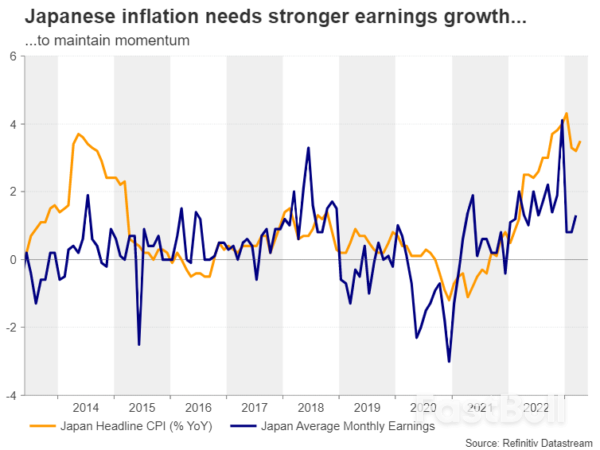
          BoJ Governor Ueda has repeatedly highlighted the fact that the Japanese inflation rise is due to external, cost-push factors. Domestic demand has been playing a secondary, much weaker role, compared to what we have seen in other countries, tying the BoJ’s hands. The way out of the current deadlock is the consumer sector, thus raising the importance of the recent strong, above-inflation wage increases. The BoJ is expecting these increases to have a material impact on consumer spending and consumer sentiment going forward.
          Amidst this challenging environment, there is increased nervousness about the BoJ’s next move. The market has gotten used to the ultra-loose monetary stance with the yen being the traditional funding currency for carry trades. Therefore, a change of policy by the BoJ or even adoption of a more hawkish stance is expected to have a stronger impact, especially on the FX markets. The ECB was quite vocal about this possibility at its most recent Financial Stability review. It was also highlighted that a wave of yen repatriation could create an investment gap in the European and US bond markets.
          Stronger Earnings Growth Could be Signal BoJ Has Been Waiting For_1

          Plethora of data but two releases stand out next week

          Understandably, next week’s focus will be on Tuesday’s figures and, to a lesser extent, on Thursday’s releases. The final GDP print for the first quarter of 2023 and the current account figures for April, both released on Thursday, are critical pieces of the economic puzzle, but as described above the focus is squarely on domestic earnings and spending.
          The year-on-year change in the labour cash earnings is forecast to moderate even further to 0.5%. If confirmed, this would be the lowest print since February 2022, and a potential signal that the optimism after the recent wage agreements might have been premature. Similarly, the overall household spending data for April is expected to show some improvement but remain in negative territory. A positive set of data figures on Tuesday would be greatly welcomed at the BoJ halls, but probably not by the bond markets.

          Can the yen finally recover some of its 2023 losses?

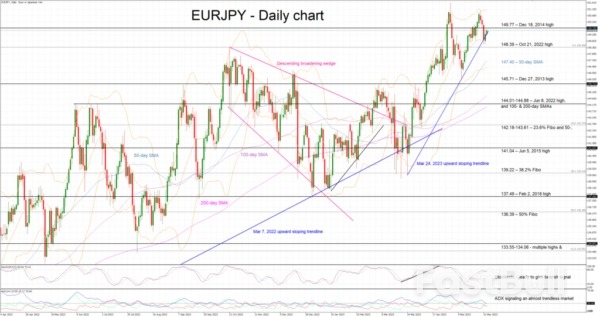
          The 15-year high at 151.61 in euro/yen appears to have somewhat energized the yen bulls as they have been trying to stop this pair’s advance. Their effort has been fruitless up to now, but the formation of a double top pattern could be the answer to their prayers.
          Should the data releases surprise to the upside and sentiment turn in favour of the yen, we would see a retreat towards the 148.39 level and a retest of the 147.22 level. A break of the neckline of the formed pattern at 146.13 could result in an even stronger correction. On the other hand, an upwards break of the 149.77 level could open the door for a higher high, above the recent 151.61.
          Stronger Earnings Growth Could be Signal BoJ Has Been Waiting For_2

          Source:XM

          To stay updated on all economic events of today, please check out our Economic calendar
          Risk Warnings and Disclaimers
          You understand and acknowledge that there is a high degree of risk involved in trading. Following any strategies or investment methods may lead to potential losses. The content on the site is provided by our contributors and analysts for information purposes only. You are solely responsible for determining whether any trading assets, securities, strategy, or any other product is suitable for investing based on your own investment objectives and financial situation.
          Comments
          Add to Favorites
          Share

          CBDC Platforms Are Revolutionising Financial Inclusion

          Justin

          Central Bank

          Economic

          For many of those involved in implementing central bank digital currency platforms, the goal is the same: financial inclusion. While most households can access some form of digital payments, there are still 2.5bn people globally who do not have bank accounts. Without a bank account and, subsequently, no payment history to show, credit for this population is not guaranteed and they may fall victim to paying high interest rates.
          By covering all three types of financial institutions engaged in wholesale and retail CBDC – central banks, commercial banks and non-bank financial institutions – GVE’s CBDC platform provides real-time gross settlement for all users. It has the capacity to make 5.8tn transactions annually, which is enough to cover the 8bn individual and 300m corporate customers around the world.
          Beyond the goals of financial inclusion, platforms like GVE also consider cost savings. Most fintech companies build light infrastructure on top of global brands like Visa and Mastercard by taking margins of between 10 and 15 basis points of the transaction value. By providing RTGS for all users, it is possible to bypass global brands, which enables platforms to substantially reduce the cost of payments.
          Credit card companies, together with card issuers in each country, typically charge a total of 2.5% brand and issuing fees on transaction value in addition to the card readers’ fee and acquirer’s fee. This increases the payment cost. As merchants and companies have accounts with banks, GVE – together with all banks co-operating with GVE – does not require acquirers, further reducing the cost of transacting.
          Another important priority for CBDC platforms is the green transition. According to Ajay Banga, president of the World Bank, central banks spend between 0.5% to 1.5% of their gross domestic product every year on printing, securing and distributing cash. To transport this cash to bank branches and ATMs, over 100,000 armoured vehicles are used by banks. New digital systems seek to eliminate the fuel consumption and carbon dioxide emissions of these cars.
          Finally, one of the most important considerations for CBDC platforms is security and privacy protection. The public key infrastructure, an encryption method used in most areas of banking, is becoming increasingly vulnerable as quantum computing technology advances. GVE has patented a key management cybersecurity platform, which manages 2,000 separate keys for each user. Such platforms have the security infrastructure that could be the solution for services that require a high level of privacy protection under data regulations, such as electronic medical records. Spending can be only monitored by the bank that has opened the account. This is the same level of privacy protection available now, but the more sophisticated system will deter bad actors.

          Source:Koji Fusa

          To stay updated on all economic events of today, please check out our Economic calendar
          Risk Warnings and Disclaimers
          You understand and acknowledge that there is a high degree of risk involved in trading. Following any strategies or investment methods may lead to potential losses. The content on the site is provided by our contributors and analysts for information purposes only. You are solely responsible for determining whether any trading assets, securities, strategy, or any other product is suitable for investing based on your own investment objectives and financial situation.
          Comments
          Add to Favorites
          Share

          Germany Energy Transition Faces Key Chemical Sector Conundrum

          Devin

          Energy

          Europe's largest economy is also one of the region's most aggressive advocates for shifting energy systems away from fossil fuels, and leads the continent in emissions reduction targets and investments in renewable energy supplies.
          However, Germany is also home to Europe's largest chemicals sector which churns out plastics, paints, acids and other key inputs that are critical to manufacturers and heavy industries that form the backbone of the German economy.
          And as most chemical plants run off natural gas or coal, and use crude oil as a major feedstock, Germany's plans to phase out use of fossil fuels over the coming decades represent a potential existential threat to the entire chemical sector.
          Ensuring the continuing viability of such an important segment of the German economy even as the country's energy system is retooled will be a key test for policymakers and business planners over the coming years.
          Critical Stability
          An ill-managed collapse of the chemicals supply chain could deal a heavy blow to the rest of Germany's manufacturing economy, which relies on an abundant array of affordable inputs to generate its own products.
          The sector is also a major employer that sustains large raw material and end-product supply chains, so any downturn could pose significant unemployment risks across Europe.
          That said, a successful shepherding of the chemicals industry through the country's energy transition, including enabling chemical producers to decarbonise their own energy supplies and outputs, would sustain a vital competitive advantage for Germany's overall economy.
          In addition, an updated and low-emitting chemicals sector that generates suites of critical products for other industries could become a vital export earner for Germany, which has ambitions to develop global leaders across the energy transition spectrum, including in the recycling of plastic waste.
          Tough 2022, Trying 2023
          Before embarking on any modernisation drives, however, Germany's chemicals sector must first recover from a torrid 2022, when surging power costs caused chemicals output to drop by 10%, petrochemical production to fall 15.5%, and for one in every four firms in the sector to incur losses, according to the German Chemicals Association (VCI).
          Sharply lower business activity also caused a drop in chemicals consumption last year, but as economic activity recovered in 2023 a lingering shortage of key chemical products has pushed German chemicals prices to near record premiums over those supplied by other producers.
          German prices of polyvinyl chloride (PVC), used for pipes, wire insulation and by the construction sector, are currently trading at nearly 90% more than the same product on offer in South East Asia, according to data from Polymerupdate.
          Germany Energy Transition Faces Key Chemical Sector Conundrum_1German high impact polystyrene, used for signs, packaging, toys and furniture, is trading at a roughly 50% premium to Asian prices, while linear low density polyethylene, used for bags and wraps, is trading around 80% above prices offered out of the United States.
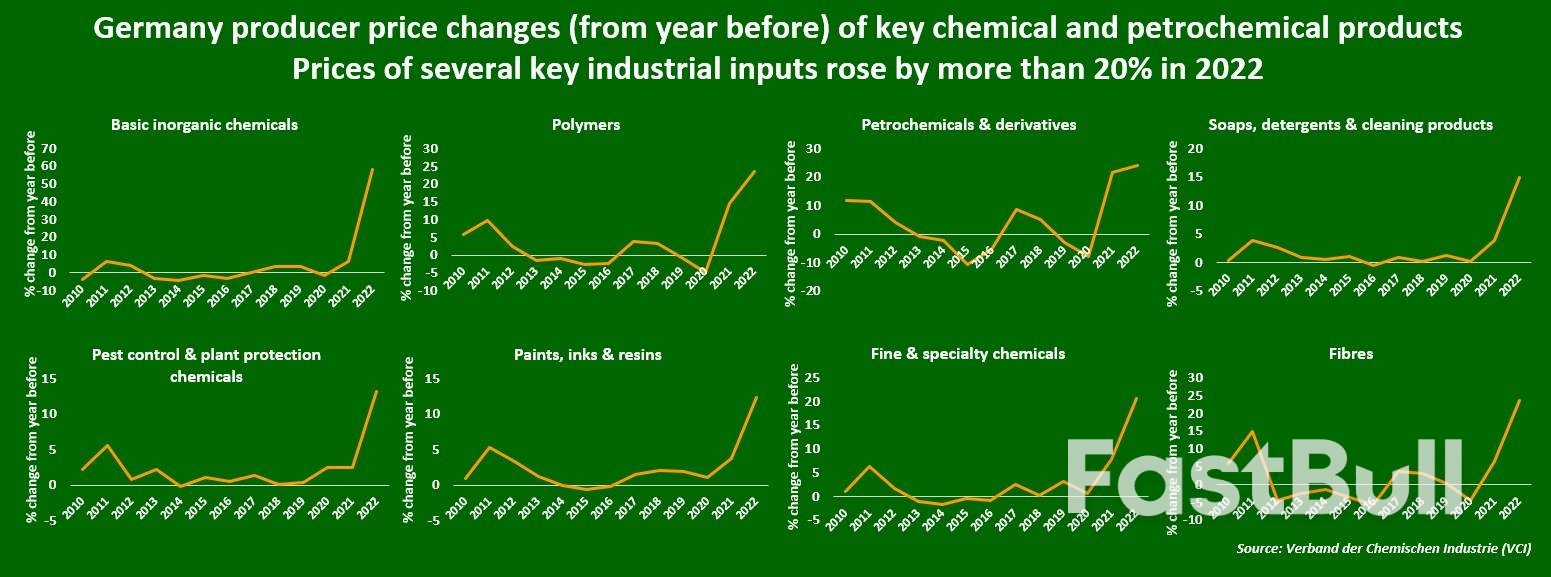
          Even prices of vinyl chloride, the main base ingredient to make PVC and other products, is trading at a rare sustained premium over Chinese vinyl chloride prices, which historically have been more expensive than German prices, Polymerupdate data shows.
          Damage Done
          The sustained high prices of German chemical products over international rivals have two important damaging consequences.
          Firstly, the high price tags have had the effect of undermining the German chemical sector's hard-won reputation as a reliable and cost-competitive supplier of critical products, while showcasing the global reach and cost advantages of rival suppliers in other markets.
          Germany Energy Transition Faces Key Chemical Sector Conundrum_2Secondly, the high chemicals costs have hurt cost-sensitive consumers, including manufacturing businesses that have also been hit by high energy bills and are looking to keep costs in check in order to ensure their own survival.
          Many such businesses are in an especially delicate state in Germany, which was Europe's largest importer of Russian natural gas and which continues to wrestle with power prices that remain well above long-term averages.
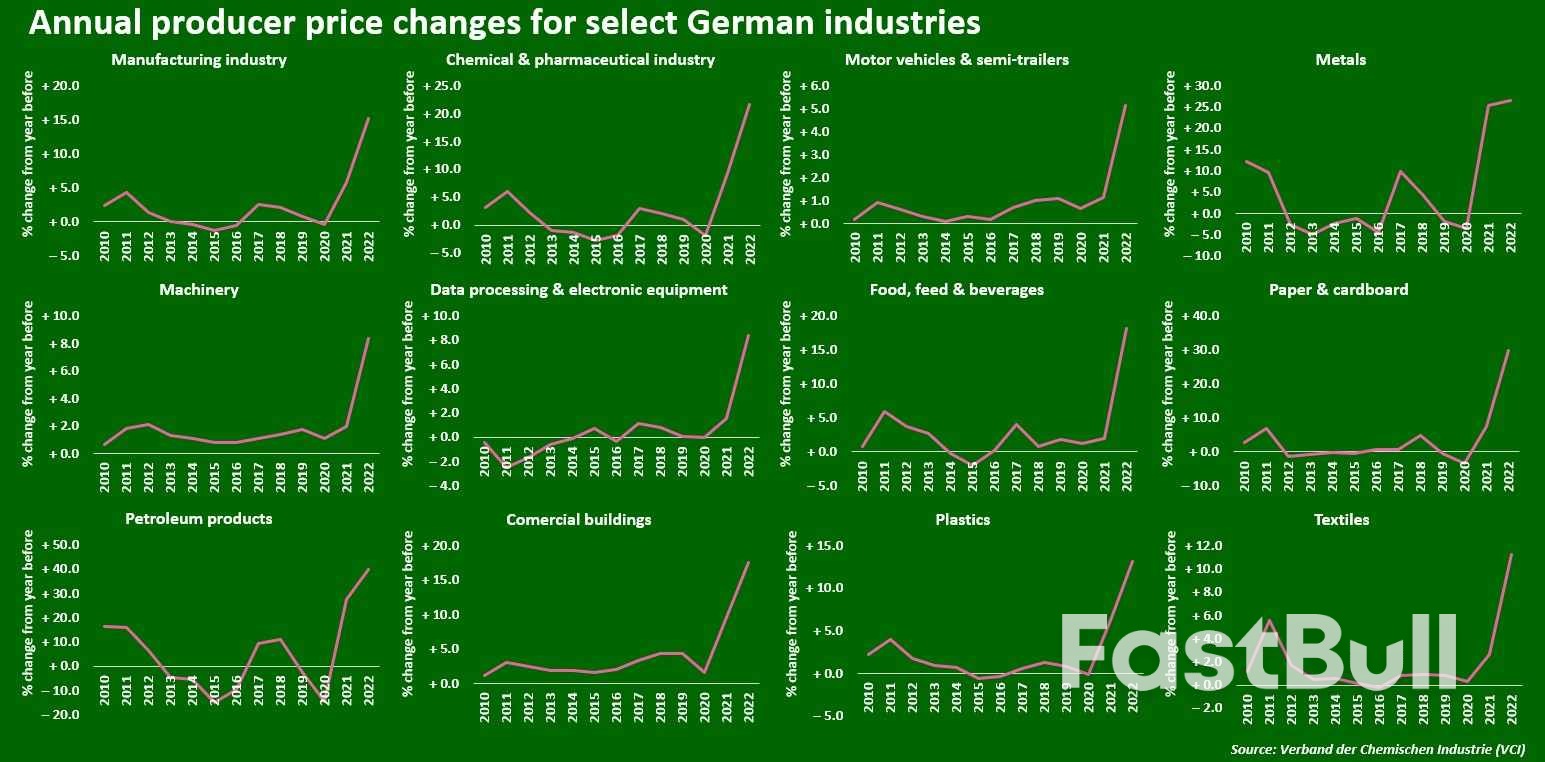
          Every major industrial segment, from basic manufacturers and machine makers to the producers of high-end cars, have been hit by steep jumps in producer prices in Germany, according to VCI data.
          Germany Energy Transition Faces Key Chemical Sector Conundrum_3Producers of bulk commodities such as metals, paper goods and petroleum products have been hit especially hard, and saw producer prices jump by 26.5%, 29.8% and 40% respectively in 2022.
          These same companies are typically major consumers of goods produced by Germany's chemicals sector, but are currently ill-equipped to pay premium prices for industrial inputs that can be easily acquired much more cheaply from other suppliers.
          If the German chemicals sector is to ensure its own long-term future, it must somehow win back any business lost among commodity manufacturers by driving product prices steadily lower relative to rival offerings.
          German chemicals makers must also develop and showcase their own green credentials so as to lock up demand from higher-margin climate-conscious customers who are under pressure from their own consumers and investors to ensure clean supply chains.
          On its own, the chemicals sector may struggle to both cut costs and clean up its own product lines and emissions footprints.
          But with strategic aid from government and industry bodies, Germany's chemical producers could undertake a major overhaul that could ensure its continued central role at the heart of the German economy even as its own and its customers' energy systems steadily shift away from fossil fuels.

          Source: TimesLIVE

          Risk Warnings and Disclaimers
          You understand and acknowledge that there is a high degree of risk involved in trading. Following any strategies or investment methods may lead to potential losses. The content on the site is provided by our contributors and analysts for information purposes only. You are solely responsible for determining whether any trading assets, securities, strategy, or any other product is suitable for investing based on your own investment objectives and financial situation.
          Comments
          Add to Favorites
          Share

          Risks Skewed Towards Higher-For-Longer U.S. Interest Rates

          Cohen

          Central Bank

          Economic

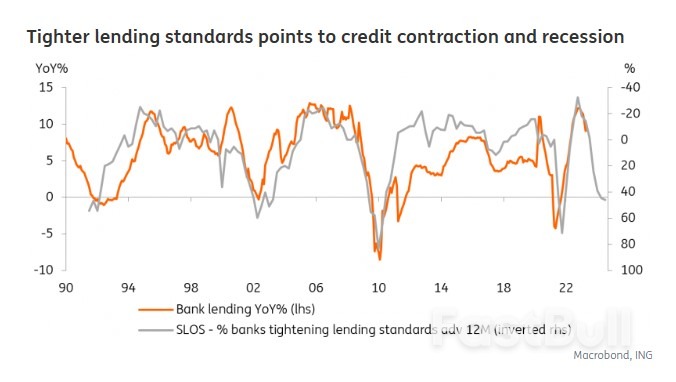
          After the most rapid and aggressive tightening of monetary policy for more than 40 years, we expected financial and economic stresses to appear sooner rather than later. The small and regional banks are where this is most evident, but even before recent failures, banks were changing their attitudes and becoming more restrictive in terms of who they lend to, how much they lend and at what rate.
          This combination of rapidly tightening lending conditions and significantly higher borrowing costs points to outstanding lending turning negative by the end of this year. For the U.S. economy, where credit is such an important driver of economic activity, this outcome has in the past always meant recession. At the same time, corporate pricing plan intentions are softening and the high weighting of shelter and vehicles in the CPI basket means inflation should drop below 3% before year-end.
          Risks Skewed Towards Higher-For-Longer U.S. Interest Rates_1Where we stand relative to the market
          Compared with the consensus, we are forecasting a slightly more V-shaped profile for GDP growth of 1.2% for 2023, 0% for 2024 and 2.2% for 2025 – consensus is 1.1%, 0.8% and 2.0%, respectively. For inflation, we are broadly in line with the consensus for 2023 and 2025 at 4.1% and 2.3%, respectively, but for 2024 our more pessimistic growth view means we forecast inflation at 2% versus market expectations of 2.6%.
          We are earlier and more aggressive in looking for Fed rate cuts, expecting a 50bp rate cut at both the November and December policy meetings with 3% rates by the end of the second quarter of 2024. The consensus is for no rate change this year before rates drop to 3.5% in 2024 and 2.75% in 2025. The market is, however, pricing modest interest rate cuts before the end of this year.
          Where we could be wrong… inflation is stickier and the Fed tightens further
          We see three key areas where our forecasts look vulnerable. First, we may be too optimistic that inflation falls rapidly. The unemployment rate is just 3.4% and labour market resilience could result in stickier wage pressures that keep service sector pricing more robust, especially if consumer spending remains firm. There are several hawks on the Federal Open Market Committee who want to see clear evidence that inflation is on a clear path to 2% before they are prepared to call time on hikes. If we see month-on-month inflation prints continuing to come in at 0.3% or 0.4%, rather than averaging 0.2%, and jobs numbers remain firm, we will probably see interest rates rise further with a Fed funds rate perhaps at 5.5% or even 5.75%.
          Or we are too early in our downturn expectations
          The second risk relates to the timing of events. Our long-held thesis is that the combination of higher borrowing costs and less credit availability weighs heavily on business and consumer spending in an environment where sentiment is already at recession levels.
          Historically, credit growth lags movements in lending conditions by 12 months and unemployment responds similarly. Given lending conditions started tightening rapidly more than 12 months ago and interest rates have risen by 500bp since March 2022, our best guess has been that the economy will be showing the effects in the second half of this year.
          However, strong household and corporate balance sheets may mitigate some of these effects and the downturn story could happen later than we are predicting. Therefore, Fed rate cuts may come later and possibly be less aggressive than we are predicting.
          But things could get even worse
          There are risks in the other direction though. We are hopeful we are almost through the debt ceiling crisis that has been unsettling for financial markets, but we can't rule out an intensification of stresses elsewhere. These could certainly resurface in the small and regional banks, most probably through their heavy exposure to the commercial real estate sector. Significant losses here could weaken balance sheets, resulting in a further tightening of lending conditions and a potential mini-credit crunch.
          Also, we need to keep an eye on the Supreme Court deliberations regarding President Joe Biden's $20,000 student debt forgiveness plan. Then there is the resumption of student loan repayments that were paused during the Covid-19 pandemic. As part of the debt ceiling deal between House Republicans and the president, it appears that interest will be charged again from September with repayments resuming from October. According to Federal Reserve data, $1.6tr is owed by more than 43 million Americans, so from the fourth quarter onward these households could end up needing to divert hundreds of dollars each month towards loan repayments. This has the potential to weigh very heavily on consumer spending.
          A worst-case scenario of a return of banking strife and the resumption of student loan repayments amid a housing market downturn and weaker general activity would heighten the chances of a recession and an even swifter, sharper response from the Federal Reserve than we are forecasting.

          Source: ING

          To stay updated on all economic events of today, please check out our Economic calendar
          Risk Warnings and Disclaimers
          You understand and acknowledge that there is a high degree of risk involved in trading. Following any strategies or investment methods may lead to potential losses. The content on the site is provided by our contributors and analysts for information purposes only. You are solely responsible for determining whether any trading assets, securities, strategy, or any other product is suitable for investing based on your own investment objectives and financial situation.
          Comments
          Add to Favorites
          Share

          Should SSA and Sovereign Markets Be Grouped Together?

          Justin

          Central Bank

          Economic

          There is an argument that grouping all European sovereign, supranational and agency debt as one would boost the availability of liquid safe assets in the continent.
          Boosting liquidity in the SSA bond market and the challenges facing issuers were discussed in detail at OMFIF’s Public sector debt summit. Around 20 global SSA borrowers, a similar number of investors as well as other key market participants explored important issues facing the public sector bond market.
          ‘We have to get rid of the split of SSA markets and sovereign markets, because this is all public debt,’ said a senior funding official at a European borrower. ‘I spoke recently to a hedge fund who said they can buy and take more positions in govvies [government bonds] because it’s a govvie and not an SSA. This doesn’t make sense if you compare smaller govvies with large SSAs.’ There are some SSA borrowers, including some German states, that have larger funding programmes than some sovereigns.
          The funding official also argued that removing the split between SSAs and sovereigns would create a larger pool of liquid safe assets in Europe and strengthen the international role of the euro. He added the classification between SSAs and sovereigns should instead be based on liquidity and credit.
          Who would be in charge of removing this classification between SSAs and sovereigns? ‘I don’t think this is a question for markets,’ said a sovereign debt portfolio manager. ‘It’s a question for the regulators.’ However, there is no legal definition of what a sovereign or an SSA is in the capital markets.

          The EU as a sovereign issuer

          Since reinventing itself as a super-sized borrower, the European Union has been working on being accepted universally as a sovereign rather than supranational issuer. However, the portfolio manager highlighted some concerns for the EU’s classification as a sovereign given its finite status as a large and sovereign-like borrower. ‘No one is sure whether the EU is going to be a permanent issuer and, because of that, if I’m buying those bonds, I’m not sure what the end game is.’
          The lack of clarity on the EU’s status as a permanent large issuer in the capital markets is perhaps the biggest challenge it faces in being accepted as a sovereign borrower. But while net funding under its Next Generation EU programme ends in 2026, the EU will still roll over debt with funding needs of €40bn-€50bn in the 2030s, which is akin to a mid-sized sovereign borrower.
          The EU will also have funding needs for its other programmes, such as its Macro-Financial Assistance programme, through which it has been disbursing loans to support Ukraine – positioning the EU as an important vehicle to support other crises in the future.
          The EU is steadily progressing towards being accepted universally as a sovereign borrower. It has adopted a unified funding approach whereby all of the issuance under its various funding programmes is classified as ‘EU bonds’ to avoid fragmentation in its curve. The EU will introduce quoting commitments for its primary dealers from the second half of the year, which will boost secondary market liquidity.
          Meanwhile, from 29 June, the EU’s bonds will be classified under haircut category I – the same as government bonds – making them more favourable for use in repurchase transactions with the European Central Bank. However, from a pricing perspective, the EU’s bonds are more similar to an SSA than a sovereign, which is a challenge the EU funding team faces.
          Another senior funding official at a European borrower said some SSAs have made themselves distinct from sovereigns in the way they issue bonds by allocating primarily to real-money investors who buy and hold bonds, which leads to lower levels of secondary trading and liquidity. ‘Have the issuers themselves created a lack of liquidity in the market?’ he asked.
          The need for more liquid safe assets in Europe was highlighted by other borrowers at the summit. ‘We strongly believe that we need more safe assets in the euro area – safe assets that can serve as a benchmark for pricing other securities or that can be used as a safe haven in case of market turbulences,’ said an official at a European SSA. ‘A large, safe asset base also contributes to good liquidity conditions. So, we really welcome the arrival of the EU because we think that there are not enough safe assets in the euro area.’
          Whether the split between SSAs and sovereigns should be removed to boost the availability of euro liquid assets is something that market participants do not agree on. In a snap poll carried out by the OMFIF Sovereign Debt Institute’s LinkedIn page between 26-30 May, results were split 50-50, for and against.

          Source:Burhan Khadbai

          To stay updated on all economic events of today, please check out our Economic calendar
          Risk Warnings and Disclaimers
          You understand and acknowledge that there is a high degree of risk involved in trading. Following any strategies or investment methods may lead to potential losses. The content on the site is provided by our contributors and analysts for information purposes only. You are solely responsible for determining whether any trading assets, securities, strategy, or any other product is suitable for investing based on your own investment objectives and financial situation.
          Comments
          Add to Favorites
          Share

          Can a New York State Law Solve an Emerging Markets Debt Crisis?

          Alex

          Bond

          A bill backed by debt justice campaigners and civil society groups advocating on behalf of economically distressed countries could alter past and future sovereign debt restructurings covered by New York state law - and Wall Street is watching.
          These are some key points about the bill.
          What does the bill propose?
          Senate Bill S4747, the NY Taxpayer and International Debt Crises Protection Act, "relates to New York state's support of international debt relief initiatives for certain developing countries."
          The bill includes limits to state investments into foreign entities and would include private creditors in "burden-sharing standards" in which they would take the same losses - or "haircuts" - that the United States government would as a sovereign creditor when a low-income country in distress qualifies for debt relief.
          The limit of this definition is a point of contention between the advocates of the bill and its detractors.
          What are the next steps for the bill?
          In the Assembly, the bill passed 14 to 5 in the Judiciary committee and is now awaiting vote in the Ways and Means committee. Alexander Flood, director of communications for Patricia Fahy, the bill sponsor in that chamber, said they are "hopeful" it will be out of committee and up for a full vote next week. At the Senate, it remains at the Judiciary committee.
          Time is tight, as the 2023 legislative session ends on June 8. It could get a floor vote as late as June 7, and if same versions are approved it goes to Governor Kathy Hochul who, in the off-session, would call the bill up at her own time. She could sign, veto or amend it - in which case it needs to go back to the sponsors.
          Why is the issue so pressing?
          A toxic mix of ballooning inflation, escalating borrowing costs and a strong dollar in the wake of COVID-19 and Russia's war in Ukraine has made repaying loans and raising money significantly more expensive for dozens of developing nations. Some, such as Sri Lanka and Zambia have tipped into default.
          Emerging markets total debt climbed to over $100 trillion by end-March, a nominal record, according to data from the Institute of International Finance (IIF).
          The Group of 20 pledged to streamline debt treatments through its Common Framework platform and seeks comparable relief from bilateral creditors such as the Paris Club and China. The initiative has so far failed to accelerate debt relief talks, while private creditors are not even formally included in this initiative.
          Who are the bill's backers?
          The bill is supported by major state and national unions and churches, as well as economic development organizations. It would "bring badly needed improvements to the framework for resolving unsustainable sovereign debt burdens," according to Nobel Prize-winning U.S. economist Joseph Stiglitz.
          "The bill helps to add enforcement capabilities - something that the G20 Common Framework lacks even though as a matter of principle it recognizes the need for private sector participation," said Rishikesh Ram Bhandary, Assistant Director of the Global Economic Governance Initiative at Boston University's Global Development Policy Center.
          "A speedy and orderly economic recovery is in the interest of all creditors," he said. "Moreover, through this legislation creditors would also have the clarity on what the terms are for everyone else, so this helps inter-creditor equity as well."
          Why are private creditors against the bill?
          The argument from banking trade group IIF and others is that the bill won't work as written, with investors concerned their capital would potentially "become hostage to a protracted legal process to define appropriate recovery values." Additionally, issuers could face higher costs as the legal uncertainty raises risk premiums.
          "The bill's proponents hope to change international debt markets, but the much more likely outcome would be capital flight from New York, ultimately leading to lost income tax and other revenue to the state," a group of capital markets trade groups, including the IIF and insurers said in a recent statement.
          If this bill passes, "I would recommend issuers not go through New York law, (but) through London or any other jurisdiction," said Rodrigo Olivares-Caminal, professor of banking and finance law at Queen Mary University of London.
          The law as written is "way more far-reaching" than covering just the debt of poor and distressed countries and, for example, a Paris Club agreement with U.S. participation and dealing with Brazil, Argentina or other non-low-income country could fall under this if few private creditors are somehow involved, he said.

          Source: Reuters

          Risk Warnings and Disclaimers
          You understand and acknowledge that there is a high degree of risk involved in trading. Following any strategies or investment methods may lead to potential losses. The content on the site is provided by our contributors and analysts for information purposes only. You are solely responsible for determining whether any trading assets, securities, strategy, or any other product is suitable for investing based on your own investment objectives and financial situation.
          Comments
          Add to Favorites
          Share

          Credit Market Developments May Limit ECB Actions on Interest Rates

          Justin

          Central Bank

          Economic

          Ignazio Angeloni, a former member of the European Central Bank’s supervisory board, is one of Europe’s most seasoned central bankers, with ample experience of covering twin responsibilities in monetary and financial stability. This is an edited extract of Angeloni’s conversation with David Marsh, OMFIF chairman, at the DZ BANK-OMFIF capital market conference in Frankfurt.
          Angeloni thinks that the ECB should not have relaunched expansionary policies just before the Covid-19 outbreak and should not have prolonged quantitative easing for so long in 2021 and in the first half of 2022. But he says: ‘These bygones are not very important from today’s perspective. The interest stance the ECB has taken since last July is correct.’
          Given worries about financial stability, Angeloni cautions the ECB to go carefully with further interest rate increases – echoing comments by Ignazio Visco, governor of Banca d’Italia. Angeloni said: ‘To the extent that banks tighten credit, slower or lower ECB tightening action may be needed as we move on.’ In view of a likely period of low growth and relatively high inflation, Angeloni warns: ‘Some of the risks of the 2008-12 period could resurface’.

          ‘The banks face two unhappy alternatives’

          David Marsh: There have been squalls with banks in both the US and Europe in the last two months, partly reflecting the difficulties of coping with higher interest rates. We remember the early years of the 2000s, when supervisory and regulators allowed too much risk to build up in the banking system. How close are we to a return of these difficulties of 2007-09 – in both Europe and the US?
          Ignazio Angeloni: There are both commonalities and differences between the US and Europe, as far as banks are concerned. The main commonality is that banks reacted to the lower-for-long period of interest rates in a similar (and predictable) way by increasing exposures to long-dated bonds, and also increasing mortgage exposures, mainly at fixed rates but also at floating rates.
          DM: What are the effects as interest rates rise?
          IA: The banks face two unhappy alternatives. They either hold on to their assets and haemorrhage gradually through their profit and loss accounts. Or they sell the assets and face losses all at once. To the extent that mortgages were arranged at floating rates, the losses fall on households, with a possible strong contractionary effect on consumption.
          DM: What about deposit movements?
          IA: That’s another commonality. Evidence is mounting that the velocity of deposit runs has increased in the US as a result of digital banking and the concentration of deposits. We still lack good analyses of this phenomenon for Europe. The speed of deposit movements may have increased here as well.

          ‘The US relaxed its post-crisis regulatory stance too much during the Donald Trump administration’

          DM: What are the main differences?
          IA: These lie in the regulatory stance. The US relaxed its post-crisis regulatory stance too much during the Donald Trump administration. The US’s strength lies in a functioning crisis management framework, centred on the Federal Deposit Insurance Corporation. The euro area has had a better supervisory stance but its weakness is in the incompleteness of the banking union and especially in the lack of a credible crisis management framework.
          DM: How close are we to repeating the events of 2008?
          IA: I am concerned because we do not have a good picture yet. The interest rate rises and the transmission of their effects are still playing out and could still present surprises. Hopefully, the single supervisory mechanism has good information, especially on bank exposures and related risks. In any case, the ECB from now on will have to manage the situation very cautiously and gradually.

          ‘The last pre-pandemic expansionary step was unnecessary’

          DM: What do you think of the view of Jacques de Larosière that central banks themselves are to blame for this state of affairs through their insufficient grasp of the earlier problem of higher inflation?
          IA: De Larosière’s remarks are true, but not very useful in dealing with the situation. The LFL phase is to a large extent at the root of our present problems. Had the inflation risk been spotted earlier, the interest rate rise could have been more gradual, giving the system more time to adapt.
          DM: Where have mistakes been made?
          IA: The last pre-pandemic expansionary step – the ECB’s decision to restart quantitative easing in September 2019 – was unnecessary. And the tightening cycle should have come in the second half of 2021, rather than in 2022. But we are where we are: we need to face the situation as it is now. These bygones are not very important from today’s perspective. The interest stance the ECB has taken since last July is correct.’

          ‘The ECB has moved well, but now may come the difficult part’

          DM: What should happen next? Does the ECB decision on 4 May to raise interest rates by a relatively moderate 0.25 points and stop all asset purchase programme reinvestments from 1 July go far enough?
          IA: After some initial hesitation, the ECB has moved well, but now may come the difficult part: understanding how the transmission through banks is playing out. The interest rate stance is still expansionary, as measured by the short-term interest rates net of short-term inflation. But the impact on banks is a big unknown.
          DM: You have suggested a means of drawing liquidity through reverse targeted long-term refinancing operations.
          IA: Yes, a new reverse long-term operation providing commercial banks with the rights to swap central bank deposits for long-term securities, allowing a gradual lowering of the deposit rate. Bank liquidity buffers are declining already, but a repurchase instrument would accelerate the process and make it more flexible.
          DM: How close are we to seeing action to improve matters?
          IA: The ECB has three levers to move: interest rate increases, quantitative tightening and liquidity absorption, and action on the deposit rate. To the extent that banks tighten credit, slower or lower ECB tightening action will be needed.

          ‘Operating two sets of policies is not a choice, but an obligation’

          DM: Are worries over financial stability likely to prevent central banks from taking tough measures to reduce inflation? There are surely trade-offs – whatever the official doctrine of the ECB? Can central banks operate two sets of policies at once to safeguard both monetary and financial stability?
          IA: The ECB has been, since 2014, responsible for both price stability and financial stability. So operating two sets of policies is not a choice, but an obligation. The question is: are the instruments for these policies separate or to some extent related? My short answer is that these instruments must stay separate in calm times but need to come together and reinforce each other in a crisis.
          DM: Are there lessons you can draw from the UK’s autumn 2022 fiscal-monetary episode over the Liz Truss – Kwasi Kwarteng budget?
          IA: The main lesson from the UK episode is that governments can help the action of central banks, or they can hinder it.
          DM: What implications does this have for the transmission protection instrument – where you have famously called for a ‘user manual’? There isn’t one yet!
          IA: In the euro area, governments can help by reducing the probability of ‘doom loops’ between government finances and bank instability. Concretely this requires keeping government finances under control and ensuring that banks are sound. The main problem in the euro area is the imperfect banking union. But member states also have work to do: strengthen their banks and reinforce the parts of the banking frameworks for which national authorities are responsible.

          ‘The distinction in the EU treaty between bond purchases at issue and on the secondary market is a tenuous one’

          DM: The European treaties say that the ECB must not get into the business of financing governments. How do you react to criticism that QE protects governments from the discipline of sound fiscal policies? There has been an arithmetical correlation in recent years between net issuance by euro area government and net ECB bond purchases. Is this another reason why did the ECB’s QE went on for too long?
          IA: Indeed, the distinction in the EU treaty between bond purchases at issue and on the secondary market is a tenuous one. Especially when purchases are massive and long-lasting, as they have been, buying on the secondary market helps the primary market as well, because auction participants know that they will be able to re-sell the bonds they purchase at issue, so they are encouraged to buy.
          DM: Can this problem be avoided?
          IA: Any central bank must intervene in bond markets. They have to be independent in doing so. Ultimately it is up to them and their judgement.

          ‘It will be difficult to bring inflation back to 2% on a stable basis’

          DM: Given central banks’ difficulties controlling inflation, particularly after the outbreak of the war in Ukraine, it seems likely to me that inflation in the euro area will settle in the area of 3% to 4% for some years because it will be highly difficult (and painful) to get it down to 2%. That need not be a tragedy. It will help to reduce the debt burden for the most indebted nations. So how likely is this scenario?
          IA: I agree that in the euro area it will be difficult to bring inflation back to 2% on a stable basis. Most factors that facilitated that outcome in the years of the ‘great moderation’ are now gone. Economists were debating then whether that outcome was the result of ‘good policies’ or ‘good luck’. Now we know that it was the second.
          DM: So what does the future hold?
          IA: My main concern is that the euro area may be entering a phase of stagflation, owing to a combination of three factors. Private expenditure is stalling as a result of uncertainty and risk aversion. Public expenditure is not sufficiently supportive because of an inability to implement the recovery and resilience investment plans in full under the Next Generation EU programme. And monetary policy is stuck in a bad equilibrium with high inflation.
          DM: What is your conclusion?
          IA: In that scenario, some of the risks of the 2008-12 period could resurface.

          Source:Angeloni

          To stay updated on all economic events of today, please check out our Economic calendar
          Risk Warnings and Disclaimers
          You understand and acknowledge that there is a high degree of risk involved in trading. Following any strategies or investment methods may lead to potential losses. The content on the site is provided by our contributors and analysts for information purposes only. You are solely responsible for determining whether any trading assets, securities, strategy, or any other product is suitable for investing based on your own investment objectives and financial situation.
          Comments
          Add to Favorites
          Share
          FastBull
          Copyright © 2025 FastBull Ltd

          728 RM B 7/F GEE LOK IND BLDG NO 34 HUNG TO RD KWUN TONG KLN HONG KONG

          TelegramInstagramTwitterfacebooklinkedin
          App Store Google Play Google Play
          Products
          Charts

          Chats

          Q&A with Experts
          Screeners
          Economic Calendar
          Data
          Tools
          Membership
          Features
          Function
          Markets
          Copy Trading
          Latest Signals
          Contests
          News
          Analysis
          24/7
          Columns
          Education
          Company
          Careers
          About Us
          Contact Us
          Advertising
          Help Center
          Feedback
          User Agreement
          Privacy Policy
          Business

          White Label

          Data API

          Web Plug-ins

          Poster Maker

          Affiliate Program

          Risk Disclosure

          The risk of loss in trading financial instruments such as stocks, FX, commodities, futures, bonds, ETFs and crypto can be substantial. You may sustain a total loss of the funds that you deposit with your broker. Therefore, you should carefully consider whether such trading is suitable for you in light of your circumstances and financial resources.

          No decision to invest should be made without thoroughly conducting due diligence by yourself or consulting with your financial advisors. Our web content might not suit you since we don't know your financial conditions and investment needs. Our financial information might have latency or contain inaccuracy, so you should be fully responsible for any of your trading and investment decisions. The company will not be responsible for your capital loss.

          Without getting permission from the website, you are not allowed to copy the website's graphics, texts, or trademarks. Intellectual property rights in the content or data incorporated into this website belong to its providers and exchange merchants.

          Not Logged In

          Log in to access more features

          FastBull Membership

          Not yet

          Purchase

          Become a signal provider
          Help Center
          Customer Service
          Dark Mode
          Price Up/Down Colors

          Log In

          Sign Up

          Position
          Layout
          Fullscreen
          Default to Chart
          The chart page opens by default when you visit fastbull.com
