• Trade
  • Markets
  • Copy
  • Contests
  • News
  • 24/7
  • Calendar
  • Q&A
  • Chats
Trending
Screeners
SYMBOL
LAST
BID
ASK
HIGH
LOW
NET CHG.
%CHG.
SPREAD
SPX
S&P 500 Index
6868.38
6868.38
6868.38
6895.79
6858.32
+11.26
+ 0.16%
--
DJI
Dow Jones Industrial Average
47969.71
47969.71
47969.71
48133.54
47871.51
+118.78
+ 0.25%
--
IXIC
NASDAQ Composite Index
23552.43
23552.43
23552.43
23680.03
23506.00
+47.30
+ 0.20%
--
USDX
US Dollar Index
98.930
99.010
98.930
99.060
98.740
-0.050
-0.05%
--
EURUSD
Euro / US Dollar
1.16423
1.16430
1.16423
1.16715
1.16277
-0.00022
-0.02%
--
GBPUSD
Pound Sterling / US Dollar
1.33299
1.33308
1.33299
1.33622
1.33159
+0.00028
+ 0.02%
--
XAUUSD
Gold / US Dollar
4212.94
4213.35
4212.94
4259.16
4194.54
+5.77
+ 0.14%
--
WTI
Light Sweet Crude Oil
59.944
59.974
59.944
60.236
59.187
+0.561
+ 0.94%
--

Community Accounts

Signal Accounts
--
Profit Accounts
--
Loss Accounts
--
View More

Become a signal provider

Sell trading signals to earn additional income

View More

Guide to Copy Trading

Get started with ease and confidence

View More

Signal Accounts for Members

All Signal Accounts

Best Return
  • Best Return
  • Best P/L
  • Best MDD
Past 1W
  • Past 1W
  • Past 1M
  • Past 1Y

All Contests

  • All
  • Trump Updates
  • Recommend
  • Stocks
  • Cryptocurrencies
  • Central Banks
  • Featured News
Top News Only
Share

New York Fed Accepts $1.485 Billion Of $1.485 Billion Submitted To Reverse Repo Facility On Dec 05

Share

Oil Price Analysis Firm Platts Will Ignore Fuel Products Produced From Russian Oil

Share

Baker Hughes - US Drillers Add Oil And Natgas Rigs For Fourth Time In Five Weeks

Share

Baker Hughes - USA Oil Rig Count Rose 6 At 413

Share

Baker Hughes - US Natgas Rig Count Fell 1 At 129

Share

Baker Hughes - Gulf Of Mexico Rig Count Up 1, North Dakota Rigs Unchanged, Pennsylvania Unchanged, Texas Unchanged In Week To Dec 5

Share

The Total Number Of Drilling Rigs In The United States For The Week Ending December 5 Was 549, Compared To 544 In The Previous Week

Share

Canadian Prime Minister Mark Carney And Mexican President Jaime Sinbaum Discussed The Recent Bilateral Framework

Share

Barclays Is Exploring The Acquisition Of Evelyn Partners

Share

Democratic Members Of The Senate Banking Committee Are Pressuring President Trump's Republican Camp To Have Federal Housing Finance Agency (FhFA) Commissioner Bill Pulte Appear Before A Hearing By The End Of January 2026

Share

Trump Says He Will Talk Trade With Leaders Of Mexico, Canada At World Cup Draw

Share

US Envoy Kushner Asked To Meet France's Sarkozy In Jail

Share

Anthropic Executive Amodei Met With President Trump’s Administration Officials On Thursday And Also Met With A Bipartisan Group In The Senate

Share

Chechen Leader Kadyrov Says Grozny Was Attacked By Ukrainian Drone

Share

Cnn Brasil: Brazil Ex-President Bolsonaro Signals Support For Senator Flavio Bolsonaro As Presidential Candidate Next Year

Share

French Energy Minister: Request For State Aid Approval For EDF's Six Nuclear Reactor Projects Has Been Sent To Brussels

Share

Congo Orders Cobalt Exporters To Pre-Pay 10% Royalty Within 48 Hours Under New Export Rules, Government Circular Seen By Reuters Shows

Share

US Court Says Trump Can Remove Democrats From Two Federal Labor Boards

Share

In The Past 24 Hours, The Marketvector Digital Asset 100 Small Cap Index Fell 6.62%, Temporarily Reporting 4066.13 Points. The Overall Trend Continued To Decline, And The Decline Accelerated At 00:00 Beijing Time

Share

MSCI Nordic Countries Index Rose 0.5% To 358.24 Points, A New Closing High Since November 13, With A Cumulative Gain Of Over 0.66% This Week. Among The Ten Sectors, The Nordic Industrials Sector Saw The Largest Increase. Neste Oyj Rose 5.4%, Leading The Pack Among Nordic Stocks

TIME
ACT
FCST
PREV
France Current Account (Not SA) (Oct)

A:--

F: --

P: --

France Trade Balance (SA) (Oct)

A:--

F: --

P: --

Italy Retail Sales MoM (SA) (Oct)

A:--

F: --

P: --

Euro Zone Employment YoY (SA) (Q3)

A:--

F: --

P: --

Euro Zone GDP Final YoY (Q3)

A:--

F: --

P: --

Euro Zone GDP Final QoQ (Q3)

A:--

F: --

P: --

Euro Zone Employment Final QoQ (SA) (Q3)

A:--

F: --

P: --

Euro Zone Employment Final (SA) (Q3)

A:--

F: --

P: --
Brazil PPI MoM (Oct)

A:--

F: --

P: --

Mexico Consumer Confidence Index (Nov)

A:--

F: --

P: --

Canada Unemployment Rate (SA) (Nov)

A:--

F: --

P: --

Canada Labor Force Participation Rate (SA) (Nov)

A:--

F: --

P: --

Canada Employment (SA) (Nov)

A:--

F: --

P: --

Canada Part-Time Employment (SA) (Nov)

A:--

F: --

P: --

Canada Full-time Employment (SA) (Nov)

A:--

F: --

P: --

U.S. Personal Income MoM (Sept)

A:--

F: --

P: --

U.S. PCE Price Index YoY (SA) (Sept)

A:--

F: --

P: --

U.S. PCE Price Index MoM (Sept)

A:--

F: --

P: --

U.S. Personal Outlays MoM (SA) (Sept)

A:--

F: --

P: --

U.S. Core PCE Price Index MoM (Sept)

A:--

F: --

P: --

U.S. Core PCE Price Index YoY (Sept)

A:--

F: --

P: --

U.S. UMich 5-Year-Ahead Inflation Expectations Prelim YoY (Dec)

A:--

F: --

P: --

U.S. Real Personal Consumption Expenditures MoM (Sept)

A:--

F: --

P: --

U.S. 5-10 Year-Ahead Inflation Expectations (Dec)

A:--

F: --

P: --

U.S. UMich Current Economic Conditions Index Prelim (Dec)

A:--

F: --

P: --

U.S. UMich Consumer Sentiment Index Prelim (Dec)

A:--

F: --

P: --

U.S. UMich 1-Year-Ahead Inflation Expectations Prelim (Dec)

A:--

F: --

P: --

U.S. UMich Consumer Expectations Index Prelim (Dec)

A:--

F: --

P: --

U.S. Weekly Total Rig Count

A:--

F: --

P: --

U.S. Weekly Total Oil Rig Count

A:--

F: --

P: --

U.S. Unit Labor Cost Prelim (SA) (Q3)

--

F: --

P: --

U.S. Consumer Credit (SA) (Oct)

--

F: --

P: --

China, Mainland Foreign Exchange Reserves (Nov)

--

F: --

P: --

China, Mainland Exports YoY (USD) (Nov)

--

F: --

P: --

China, Mainland Imports YoY (CNH) (Nov)

--

F: --

P: --

China, Mainland Imports YoY (USD) (Nov)

--

F: --

P: --

China, Mainland Imports (CNH) (Nov)

--

F: --

P: --

China, Mainland Trade Balance (CNH) (Nov)

--

F: --

P: --

China, Mainland Exports (Nov)

--

F: --

P: --

Japan Wages MoM (Oct)

--

F: --

P: --

Japan Trade Balance (Oct)

--

F: --

P: --

Japan Nominal GDP Revised QoQ (Q3)

--

F: --

P: --

Japan Trade Balance (Customs Data) (SA) (Oct)

--

F: --

P: --

Japan GDP Annualized QoQ Revised (Q3)

--

F: --

P: --
China, Mainland Exports YoY (CNH) (Nov)

--

F: --

P: --

China, Mainland Trade Balance (USD) (Nov)

--

F: --

P: --

Germany Industrial Output MoM (SA) (Oct)

--

F: --

P: --

Euro Zone Sentix Investor Confidence Index (Dec)

--

F: --

P: --

Canada Leading Index MoM (Nov)

--

F: --

P: --

Canada National Economic Confidence Index

--

F: --

P: --

U.S. Dallas Fed PCE Price Index YoY (Sept)

--

F: --

P: --

U.S. 3-Year Note Auction Yield

--

F: --

P: --

U.K. BRC Overall Retail Sales YoY (Nov)

--

F: --

P: --

U.K. BRC Like-For-Like Retail Sales YoY (Nov)

--

F: --

P: --

Australia Overnight (Borrowing) Key Rate

--

F: --

P: --

RBA Rate Statement
RBA Press Conference
Germany Exports MoM (SA) (Oct)

--

F: --

P: --

U.S. NFIB Small Business Optimism Index (SA) (Nov)

--

F: --

P: --

Q&A with Experts
    • All
    • Chatrooms
    • Groups
    • Friends
    Connecting
    .
    .
    .
    Type here...
    Add Symbol or Code

      No matching data

      All
      Trump Updates
      Recommend
      Stocks
      Cryptocurrencies
      Central Banks
      Featured News
      • All
      • Russia-Ukraine Conflict
      • Middle East Flashpoint
      • All
      • Russia-Ukraine Conflict
      • Middle East Flashpoint
      Search
      Products

      Charts Free Forever

      Chats Q&A with Experts
      Screeners Economic Calendar Data Tools
      Membership Features
      Data Warehouse Market Trends Institutional Data Policy Rates Macro

      Market Trends

      Market Sentiment Order Book Forex Correlations

      Top Indicators

      Charts Free Forever
      Markets

      News

      News Analysis 24/7 Columns Education
      From Institutions From Analysts
      Topics Columnists

      Latest Views

      Latest Views

      Trending Topics

      Top Columnists

      Latest Update

      Signals

      Copy Rankings Latest Signals Become a signal provider AI Rating
      Contests
      Brokers

      Overview Brokers Assessment Rankings Regulators News Claims
      Broker listing Forex Brokers Comparison Tool Live Spread Comparison Scam
      Q&A Complaint Scam Alert Videos Tips to Detect Scam
      More

      Business
      Events
      Careers About Us Advertising Help Center

      White Label

      Data API

      Web Plug-ins

      Affiliate Program

      Awards Institution Evaluation IB Seminar Salon Event Exhibition
      Vietnam Thailand Singapore Dubai
      Fans Party Investment Sharing Session
      FastBull Summit BrokersView Expo
      Recent Searches
        Top Searches
          Markets
          News
          Analysis
          User
          24/7
          Economic Calendar
          Education
          Data
          • Names
          • Latest
          • Prev

          View All

          No data

          Scan to Download

          Faster Charts, Chat Faster!

          Download App
          English
          • English
          • Español
          • العربية
          • Bahasa Indonesia
          • Bahasa Melayu
          • Tiếng Việt
          • ภาษาไทย
          • Français
          • Italiano
          • Türkçe
          • Русский язык
          • 简中
          • 繁中
          Open Account
          Search
          Products
          Charts Free Forever
          Markets
          News
          Signals

          Copy Rankings Latest Signals Become a signal provider AI Rating
          Contests
          Brokers

          Overview Brokers Assessment Rankings Regulators News Claims
          Broker listing Forex Brokers Comparison Tool Live Spread Comparison Scam
          Q&A Complaint Scam Alert Videos Tips to Detect Scam
          More

          Business
          Events
          Careers About Us Advertising Help Center

          White Label

          Data API

          Web Plug-ins

          Affiliate Program

          Awards Institution Evaluation IB Seminar Salon Event Exhibition
          Vietnam Thailand Singapore Dubai
          Fans Party Investment Sharing Session
          FastBull Summit BrokersView Expo

          Stock Market’s Fate Comes Down to Next 14 Trading Sessions

          Adam

          Stocks

          Summary:

          Wall Street enters a pivotal 14-session stretch with jobs data, CPI, and the Fed decision set to define market direction. Despite record highs and calm volatility, seasonal weakness and lofty valuations raise correction risks.
          The next few weeks will give Wall Street a clear reading on whether this latest stock market rally will continue — or if it’s doomed to get derailed.
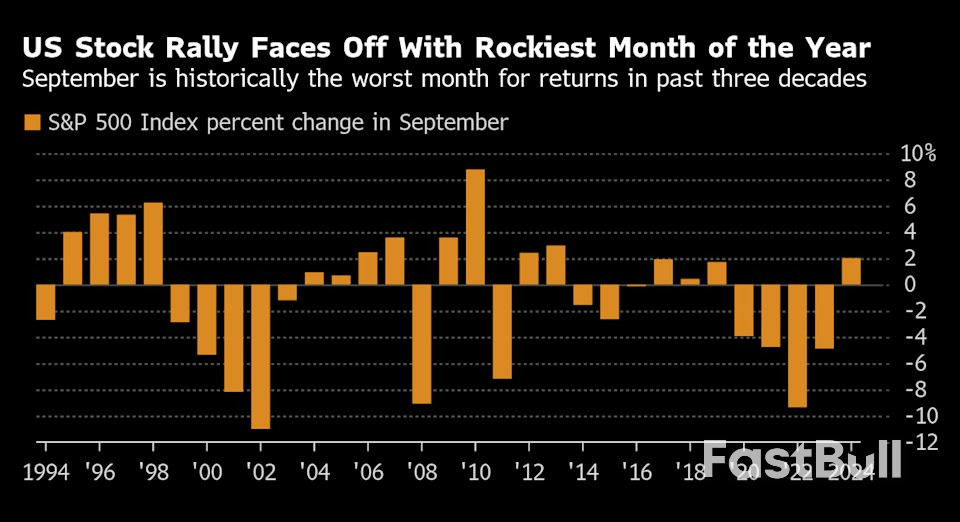
          Jobs reports, a key inflation reading and the Federal Reserve’s interest rate decision all hit over the next 14 trading sessions, setting the tone for investors as they return from summer vacations. The events arrive with the stock market seemingly at a crossroads after the S&P 500 Index posted its smallest monthly gain since July 2024 and heads into September, historically its worst month of the year.
          At the same time, volatility has vanished, with the Cboe Volatility Index, or VIX, trading above the key 20 level just once since the end of June. The S&P 500 hasn’t suffered a 2% selloff in 91 sessions, its longest stretch since July 2024. It touched another all-time high at 6,501.58 on Aug. 28, and is up 9.8% for the year after soaring 30% since its April 8 low.
          “Investors are assuming correctly to be cautious in September,” said Thomas Lee, head of research at Fundstrat Global Advisors. “The Fed is re-embarking on a dovish cutting cycle after a long pause. This makes it tricky for traders to position.”
          The long-time stock-market bull sees the S&P 500 losing 5% to 10% in the fall before rebounding to between 6,800 to 7,000 by year-end.
          Eerie Calm
          Lee isn’t alone in his near-term skepticism. Some of Wall Street’s biggest optimists are growing concerned that the eerie calm is sending a contrarian signal in the face of seasonal weakness. The S&P 500 has lost 0.7% on average in September over the past three decades, and it has posted a monthly decline in four of the last five years, according to data compiled by Bloomberg.
          The major market catalysts begin to hit on Friday with the monthly jobs report. Economists project about 75,000 jobs were added, based on the median of a Bloomberg survey. This data ended up in the spotlight at the beginning of August, when the Bureau of Labor Statistics marked down nonfarm payrolls for May and June by nearly 260,000. The adjustment set off a tirade by President Donald Trump, who fired the head of the agency and accused her of manipulating the data for political purposes.
          Stock Market’s Fate Comes Down to Next 14 Trading Sessions_1
          After that, the BLS will announce its projected revision to the Current Employment Statistics establishment survey on Sept. 9, which may result in further adjustments to expectations for jobs growth.
          Then inflation takes the stage with the consumer price index report arriving on Sept. 11. And on Sept. 17, the Fed will give its policy decision and quarterly interest-rate projections, after which Chair Jerome Powell will hold his press conference. Investors will be looking for any roadmap Powell provides for the trajectory of interest rates. Swaps markets are pricing in roughly 90% odds that the Fed will cut them at this meeting.
          Two days later comes “triple witching,” when a large swath of equity-tied options expire, which should amplify volatility.
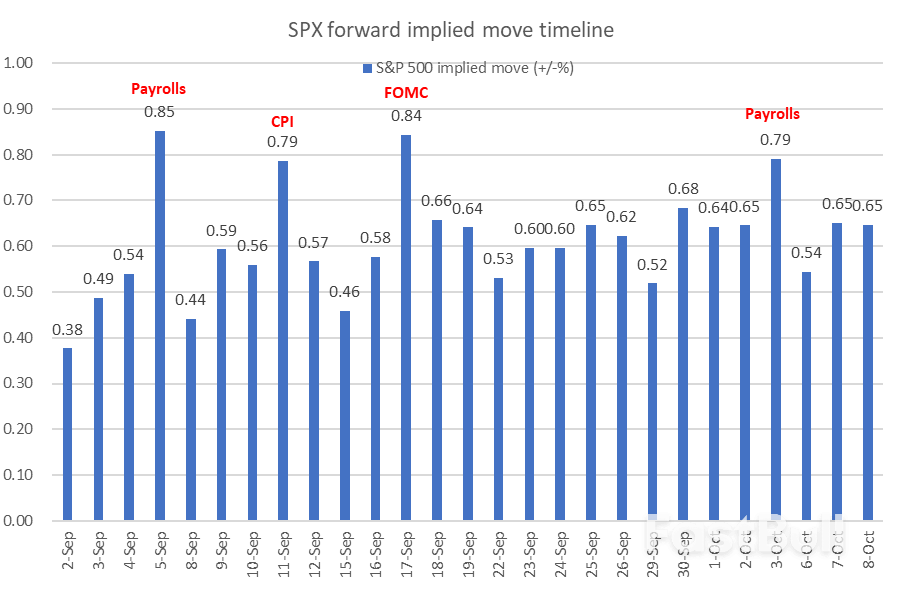
          That’s a lot of uncertainty to process. But traders seem oddly unconcerned about this crucial stretch of data and decisions. Hedge funds and large speculators are shorting the Cboe Volatility Index, or VIX, at rates not seen in three years in a bet the calm will last. And jobs day has a forward implied volatility reading of just 85 basis points, indicating the market is underpricing that risk, according to Stuart Kaiser, Citigroup’s head of US equity trading strategy.
          Turbulence Risk
          The problem is, this kind of tranquility and extreme positioning has historically foreshadowed a spike in turbulence. That’s what happened in February, when the S&P 500 peaked and volatility jumped on worries about the Trump administration’s tariff plans, which caught pro traders off-sides after coming into 2025 betting that volatility would stay low. Traders also shorted the VIX at extreme levels in July 2024, before the unwinding of the yen carry trade upended global markets that August.
          The VIX climbed toward 16 on Friday after touching its lowest levels of 2025, but Wall Street’s chief fear gauge still remains 19% below its one-year average.
          Of course, there are fundamental reasons for the S&P 500’s rally. The economy has stayed relatively resilient in the face of Trump’s tariffs, while Corporate America’s profit growth remains strong. That’s left investors the most bullish on US stocks since they peaked in February, with cash levels historically low at 3.9%, according to Bank of America’s latest global fund manager survey.
          But here’s the circular problem: As the S&P 500 climbs higher, investors become increasingly concerned that it is overvalued. The index trades at 22 times analysts’ average earnings forecast for the next 12 months. Since 1990, the market was only more expensive at the height of dot-com bubble and the technology euphoria coming out of the depths of the Covid pandemic in 2020.
          “We’re buyers of big tech,” said Tatyana Bunich, president and founder of Financial 1 Tax. “But those shares are very pricey right now, so we’re holding some cash on the sidelines and waiting for any decent pullback before we add more to that position.”
          Stock Market’s Fate Comes Down to Next 14 Trading Sessions_2
          Another well-known bull, Ed Yardeni of eponymous firm Yardeni Research, is questioning whether the Fed will even cut rates in September, which would hit the stock market hard, at least temporarily. His reason? Inflation remains a persistent risk.
          “I expect this stock rally to stall soon,” Yardeni said. “The market is discounting a lot of happy news, so if CPI is hot and there’s a strong jobs report, traders suddenly may conclude rate cuts aren’t necessarily a done deal, which may lead to a brief selloff. But stocks will recover once traders realize the Fed can’t cut rates by much because of a good reason: The economy is still strong.”

          Source: Bloomberg

          Risk Warnings and Disclaimers
          You understand and acknowledge that there is a high degree of risk involved in trading. Following any strategies or investment methods may lead to potential losses. The content on the site is provided by our contributors and analysts for information purposes only. You are solely responsible for determining whether any trading assets, securities, strategy, or any other product is suitable for investing based on your own investment objectives and financial situation.
          Add to Favorites
          Share

          Asia Factory Activity Shrinks As US Tariffs Bite, China Bucks Trend

          Winkelmann

          Economic

          Political

          Forex

          China–U.S. Trade War

          U.S. tariffs took a toll on factory activity across Asia, overshadowing a surprisingly upbeat performance in China, private surveys showed on Monday, keeping pressure on policymakers to underpin the region's fragile economic recovery.The outcome reinforces concerns that manufacturers in Asia, which have been frontloading shipments to beat higher U.S. levies, will face pressure on profits as exports weaken in the months ahead, analysts say.

          Export powerhouse Japan, South Korea and Taiwan all saw manufacturing activity shrink in August, the surveys showed, underscoring the challenge Asia faces in weathering the hit from President Donald Trump's tariffs."It's a double-whammy for Asian economies, as they face higher U.S. tariffs and competition from cheap Chinese exports," said Toru Nishihama, chief emerging market economist at Dai-ichi Life Research Institute.

          "We'll likely see the hit from U.S. tariffs intensify going forward, with countries reliant on U.S.-bound shipments like Thailand and South Korea particularly vulnerable," he said.The RatingDog China General Manufacturing PMI, compiled by S&P Global, rose to 50.5 in August from 49.5 in July, beating market forecasts and exceeding the 50-mark that separates growth from contraction.

          The reading confounds an official survey on Sunday that showed China's manufacturing activity shrank for a fifth straight month in August on weak domestic demand and uncertainty over the outcome of Beijing's trade deal with the U.S.Taken together, the surveys suggest the world's second-biggest economy is still under significant strain."Notably, the manufacturing sector is helping the recovery, but this rebound is patchy," said Yao Yu, founder of RatingDog.

          "With weak domestic demand, potentially overstretched external orders, and slow profit recovery, the durability of the improvement depends on whether exports truly stabilise and whether domestic demand can pick up pace."The S&P Global Japan Manufacturing Purchasing Managers' Index (PMI) stood at 49.7 in August, improving from 48.9 in July but staying below the 50 threshold for two straight months.

          New orders from overseas fell at the fastest pace since March 2024 as companies battled weak demand from key markets like China, Europe and the U.S., the Japan PMI survey showed.South Korea's factory activity also shrank with the S&P Global PMI standing at 48.3 in August, up from 48.0 in July but contracting for the seventh straight month.

          Source: Yahoo Finance

          To stay updated on all economic events of today, please check out our Economic calendar
          Risk Warnings and Disclaimers
          You understand and acknowledge that there is a high degree of risk involved in trading. Following any strategies or investment methods may lead to potential losses. The content on the site is provided by our contributors and analysts for information purposes only. You are solely responsible for determining whether any trading assets, securities, strategy, or any other product is suitable for investing based on your own investment objectives and financial situation.
          Add to Favorites
          Share

          What does September normally have in store for markets?

          Adam

          Economic

          Don't you just love when the first day of the new month is a Monday? It somehow makes for a fresh, clean start for markets. Or at least it gives me that sort of feeling. As we embark on September trading and the final month of Q3, let's take a look at some seasonal patterns that have typically shaped how the month has gone in years prior.
          For one, we usually see stocks face one of their worst months of the year. That means investors will be familiar with the tune Wake Me Up When September Ends. This year though, everything will ride on Fed expectations and the upcoming FOMC meeting decision on 17 September.
          What does September normally have in store for markets?_1

          S&P 500 index seasonal pattern (monthly % change)

          In the past 20 years, September has in fact been the worst month for the S&P 500. But as mentioned, the drivers this time around might make for a different pathway. After four years of bad Septembers from 2020 to 2023, we also saw the seasonal streak snap last year with the index posting roughly 2% gains.
          Circling back to this year, everything will ride on expectations going into the Fed decision first and foremost. And that begins with the US labour market report this Friday, as well as Fedspeak during the week before the FOMC blackout period starts this weekend.
          After that, we'll move on to focusing on the US CPI report on 11 September before the Fed meets on 17 September. As things stand, traders are pricing in ~90% odds of a 25 bps rate cut for this month with ~54 bps of rate cuts by year-end.
          A key consideration will be the inflation numbers to see if there is any further evidence of tariffs passthrough on prices. So, keep an eye out for that.
          Besides that, September also marks the worst month in the past 20 years for the Nasdaq as well as the MSCI World Index. As such, it typically isn't a great month for stocks in general if you go by the standard playbook that is.

          What does September normally have in store for markets?_2

          Nasdaq Composite index seasonal pattern (monthly % change)

          What does September normally have in store for markets?_3

          MSCI World Index seasonal pattern (monthly % change)

          Besides that, September also isn't really a good month for gold historically. The precious metal might be off to a hot start today but has typically run into trouble over the past two decades in the final month of Q3 trading.
          It is the second worst month in terms of performance for gold in the past 20 years with prices having fallen in 8 of the past 10 September months.
          What does September normally have in store for markets?_4

          Gold (XAU/USD) seasonal pattern (monthly % change)

          The same drivers impacting stocks above will also be key for gold alongside the recent dispute on the legality of Trump's tariffs. The precious metal had a funny 2024 where it bucked the September seasonal trend amid a hot streak that started since February, before also bucking the trend in December where it stopped seven straight years of gains in the final month of the year.
          With gold being up in seven of the last eight months, are we also due a similar story in 2025?
          Lastly, let's take a look at oil to see how the September month typically shapes up for the commodity.
          What does September normally have in store for markets?_5

          WTI crude oil seasonal pattern (monthly % change)

          During most years, the tail end of summer and the start of fall hasn't been too kind for oil prices. And that was the case last year as well. September is usually the middle of a bad stretch of months for oil that typically spans from August to October/November.
          So, that will be something to keep in the back pocket just in case when taking any views on the oil market in the month ahead.

          Source: investinglive

          To stay updated on all economic events of today, please check out our Economic calendar
          Risk Warnings and Disclaimers
          You understand and acknowledge that there is a high degree of risk involved in trading. Following any strategies or investment methods may lead to potential losses. The content on the site is provided by our contributors and analysts for information purposes only. You are solely responsible for determining whether any trading assets, securities, strategy, or any other product is suitable for investing based on your own investment objectives and financial situation.
          Add to Favorites
          Share

          US Dollar: Bearish Momentum Continues as Key Support Faces Pressure

          Adam

          Forex

          The US Dollar Index (DXY) is trading at 97.70, after an intraday high of 97.74 and a low of 97.70. The index remains under pressure, failing to reclaim its short-term moving averages, with the 15-day moving average at 98.08 and the 20-day moving average at 98.16, both trending lower.

          Key Technical Observations

          Downtrend Intact: Price action continues to post lower highs and lower lows since the late 2024 peak, showing sustained bearish momentum.
          Moving Averages as Resistance: The 15- and 20-day moving averages are closely aligned above price and acting as dynamic resistance.
          RSI at 44.31: Momentum remains weak, with RSI hovering below 50, confirming sellers retain control without being oversold.
          Sideways Base Attempt: The index is trying to form a short-term base between 97.50 – 98.50, but lacks bullish follow-through.

          Macro & Market Context

          Fed Policy Outlook: Softer US economic data and dovish tones from the Federal Reserve have limited upside for the US dollar.
          Global Risk Sentiment: Risk-on sentiment has supported other majors (EUR, GBP, EM currencies), putting pressure on the US dollar index.
          Yields & Inflation: Declining US yields continue to weigh on the US dollar’s relative attractiveness.

          Key Levels to Watch

          Immediate Resistance: 98.20 – 98.50 (moving averages & recent supply zone)
          Next Resistance: 99.50 – 100.00 (psychological barrier & prior breakdown point)
          Immediate Support: 97.50 (range floor)
          Breakdown Support: 96.50 (key swing low, major downside risk)
          Bias: Bearish to Neutral
          The US dollar remains in a bearish trend as long as it trades below 98.50. A decisive close under 97.50 could accelerate losses toward 96.50. Only a sustained recovery above the moving averages would shift momentum toward neutral.
          The index remains weak, with downside risk outweighing upside potential. Traders should be cautious of false rebounds near the 98.00 zone, as rallies are likely to face heavy resistance. A clean breakdown below 97.50 would strengthen the bearish case, while a recovery above 98.50 is needed to confirm stabilization.
          US Dollar: Bearish Momentum Continues as Key Support Faces Pressure_1

          Source: investing

          Risk Warnings and Disclaimers
          You understand and acknowledge that there is a high degree of risk involved in trading. Following any strategies or investment methods may lead to potential losses. The content on the site is provided by our contributors and analysts for information purposes only. You are solely responsible for determining whether any trading assets, securities, strategy, or any other product is suitable for investing based on your own investment objectives and financial situation.
          Add to Favorites
          Share

          The Harsh Truth About Life In Canada Today

          Winkelmann

          Economic

          Forex

          Political

          Canada is often portrayed as a land of freedom, opportunity, and prosperity. Reality, however, tells a different story...

          Statist policies, crushing taxes, bloated bureaucracy, and a society overtaken by woke ideology have shattered Canada. This is a cautionary tale for those looking at Canada as an ideal living space. If you are asking yourself what living in Canada is like, let me explain: Canada is not a land of fulfilled dreams but of enduring harsh conditions and barely getting by.

          As if economic hardships aren’t enough, Canadians are also oppressed by the Orwellian newspeak that woke culture is creating. If you speak your mind, you’re labeled a fascist. If you question social policies, you’re accused of microaggressions.There are no best places to live in Canada anymore. As a Canadian, I see little chance of Canada becoming livable again. Since I founded Expat Money in 2017, I have been helping expats build their Plan-Bs to protect their wealth and freedom and leave countries like this one.

          Let’s look at the unfortunate condition that Canada has fallen into.

          The Restrictions Imposed During Covid

          The strict quarantine measures and harsh government interventions implemented in Canada during the COVID-19 hysteria were shameful. The government expanded police and administrative powers to smash public backlash against its COVID policies.A significant protest movement called The Freedom Convoy began in early 2022. Truckers and citizens held large demonstrations in Ottawa against vaccination mandates, harsh pandemic restrictions, and the government’s authoritarian tendencies.

          Former Prime Minister Trudeau used extraordinary powers to freeze the bank accounts of protesters and crack down on activists. Individual and property rights were arbitrarily violated.The Canadian government imposed mandatory vaccinations on federal employees, healthcare workers, and those in the transportation sector, turning personal health decisions into state mandates. Those who were not vaccinated were suspended from their jobs, their travel rights were restricted, and they were ostracized from society. Even the private sector was coerced to impose vaccinations under government pressure.

          Moreover, harsh lockdowns and restricted entry into the country forced businesses into bankruptcy. Massive numbers of people lost their jobs, and the government’s financial structure was severely damaged.

          Woke Culture And The End Of Free Speech

          The problems aren’t limited to elections. In recent years, woke ideology has overtaken Canada’s politics, education system, and workplace. This “progressive” ideology has replaced individual freedoms and meritocracy with the so-called principle of inclusivity and equity. As a result, freedom of speech has been destroyed, social engineering has increased, and social polarization has deepened.In Canada, laws enacted under the guise of “combatting hate speech” have imposed mandatory language use by the government, determining how individuals should speak.

          Now, we have another Bill C-11 to update the Broadcasting Act. The government’s media watchdog, the CRTC, will now be able to monitor online platforms such as YouTube, TikTok, and Spotify. Bill C-11 is a censorship tool to kill free speech in Canada. The government may have sugar-coated the law by saying, “We support Canadian content,” but at its core, it’s an attempt to take control of the internet. The government deciding what content is “sufficiently Canadian” will soon become a matter of deciding what content is appropriate, approved, and safe.

          What about Bill C-18? This is another example of an intervention that legislates internet censorship under the pretext of “protecting the independent press.” Bill C-18 requires internet platforms (especially companies like Google and Meta) to pay media outlets for news content. The government is turning content sharing into an economic penalty to extract money from big tech companies.Because of this law, platforms like Google and Meta have decided to remove news content completely. In other words, the government’s move to “access information” has actually restricted access to information.

          Similarly, due to cancel culture, academics, business people, and members of the media are censored, fired, and subject to social lynching when they voice different views. Diversity, equity, and inclusion (DEI) policies, especially in business and academic institutions, cause decisions to be made based on identity rather than merit. Canadian universities have been degraded from institutions that encourage intellectual freedom into ideological centres where a singular type of thinking is imposed. Companies must prioritize political correctness over efficiency and productivity in business life. Canada has shifted from a society based on individual freedom and voluntary cooperation to a system governed by the ideological impositions of the government.

          Assisted Suicide And Moral Decline

          Indicators of Canada’s political and economic collapse can also be traced to the individual level. The rapid increase in Medical Assistance in Dying (MAiD) applications in Canada has led to deep debate on personal freedoms, ethical values, ​​and the role of the state in the country.

          Canada has the fastest-growing assisted suicide program in the world. When MAiD was legalized in 2016, it only included individuals with terminal illnesses. However, over time, the criteria were relaxed and expanded to include psychological disorders or illnesses that do not have a natural death period. In 2021, approximately 10,000 people ended their lives under MAiD. This number constitutes 3.3% of all deaths. Even people who were experiencing financial difficulties or housing problems resorted to euthanasia, causing heated arguments in the public domain.

          In the face of all the challenges, assuming Canada has a functioning social welfare state would be unwise. Canada’s health system is seriously unreliable because of long waiting times, overburdened hospitals, and staff shortages.Before moving to Canada, be mindful that you can wait months to years for doctor’s appointments and surgeries. The shortage of doctors and nurses severely disrupts health services. Excessive bureaucracy and limited private health services make the health system even more inefficient.

          Federal Government Overreach

          The federal government’s drama is not Canada’s only political issue. The political conflict between the federal and provincial governments is becoming a serious problem.

          There are several main disagreements between the federal and provincial governments:

          ● First, the federal government’s carbon tax has drawn fierce criticism from energy-independent provinces such as Alberta, Saskatchewan, and Ontario.

          ● Second, the federal government demands that the provinces spend more on healthcare financing, while the provinces say they are underfunded and subject to excessive federal intervention.

          ● Third, immigration has exacerbated the housing crisis and the burden on public services in large provinces such as Ontario, Quebec, and British Columbia. The provinces demand more funding, saying they shoulder much of the cost burden, but funding is unavailable.

          ● Fourth, the federal government’s policies restricting fossil fuel use continue to economically harm provinces such as Alberta and Saskatchewan, which depend on oil and gas.

          It’s no surprise that many people in Alberta and the Prairie provinces responded positively to Trump’s annexation proposal. It reflects a deep and long-standing frustration with federal control over energy policy. At the same time, a grassroots “Make Alberta Great Again” movement is gaining real traction. Pro-separation initiatives are picking up momentum, with growing calls for a referendum on Alberta’s independence.

          Even Bill 54, passed in May 2025, lowered the threshold required to trigger a referendum on the province’s sovereignty. Now it’s easier for separatist groups to push for a vote.I was in Alberta last year and met with several people involved in the movement in person. We spoke at length about the political landscape, their frustrations, and their hopes for Alberta’s future. Many of them told me that, while they believe strongly in the cause, they also know how easily their involvement could make them political targets. That’s why they’re working on their Plan-B strategies to protect themselves and their families if things take a turn for the worse.

          Over-Regulation And High Taxes

          Strict government regulations and high tax rates in Canada negatively impact economic growth and entrepreneurship by increasing the financial burden on individuals and businesses.Let me give you an example. Ontario’s total income tax payment can be as high as 53.5%. These high tax rates reduce the disposable income of individuals and businesses and restrict economic mobility. Under the guise of “Tax the rich” and “Pay your fair share,” the Canadian government began taxing capital gains over $250,000 CAD at up to 66.6% starting in 2024. Being an entrepreneur or creating economic productivity in Canada is one of the government’s favourite activities to punish.

          High Cost Of Living

          Rising real estate prices, the cost of essential consumer goods, and transportation have greatly increased the economic burden on individuals. Real estate prices have reached astronomical levels in cities like Vancouver and Toronto. This fact makes home ownership nearly impossible for the middle class. The lack of affordable housing options is threatening life in Canada.

          With average home prices pushing $730,000 CAD ($536,000 USD), double-digit inflation on food and energy, and yet another round of carbon taxes, everyday life in Canada has become flat-out unaffordable. More and more people are waking up to the reality that they can live better, in places like Latin America, for a fraction of the cost and without being punished for simply trying to get ahead.

          Most people seeking to migrate to Canada think about living in Toronto. The average rent for a one-bedroom apartment in Toronto is around $ 2,500 CAD ($1,700 USD). If your job is in Vancouver, the average rent for a one-bedroom apartment is around $2,700 CAD ($1,900 USD).Living expenses in Toronto and Vancouver are sky-high, and if you’re hoping Montreal offers a more affordable alternative, you’ll be disappointed—it’s just as costly. Factor in additional expenses for your family, and Canada quickly becomes an impractical place to invest in or build your future. It is difficult to see the benefits of living there.

          The rapid growth of Canada’s immigrant population has also become another socio-economic issue. Canada does not have a dynamic market economy that can absorb all immigrants without lowering the standard of living of other citizens. Therefore, economic difficulties have not only caused immigrants to become targets but also a threat to social peace.

          Elections In Canada

          Do you recall the political debate that flared up after Trudeau’s resignation, revealing Canada’s polarized politics? Canadian politics was left in confusion about which way to turn after U.S. President Donald Trump hinted at annexing Canada as the 51st state.What an absolutely painful circus to watch unfold. After being thoroughly humiliated by Trump and losing whatever political capital he had left, Trudeau stepped down, hoping to give the Liberals one last shot at survival in the next election.

          The Liberals wasted no time in installing Mark Carney, a globalist even more elitist than Trudeau, as Prime Minister. As a career technocrat, Carney’s credentials read like a who’s who of globalist power centres—Goldman Sachs, the Bank of Canada, the Bank of England, and the World Economic Forum.When I saw that the so-called conservative Pierre Poilievre was positioned to run against Carney in the snap elections on April 28, 2025, it became obvious that the entire contest was pure theatre. Poilievre played his part well, talking tough, staying on script, and never crossing the lines he wasn’t supposed to. In an election where the outcome was never in doubt, Carney picked up where Trudeau left off.

          What’s truly hilarious is that Canadians rallied behind Carney, thinking he was the tough guy who could stand up to Trump, as if a globalist banker could salvage national pride. They saw him as the unifier for the challenges ahead, not realizing he was just the next polished face of the same worn-out agenda. They did not hesitate to choose a copy of the same man as their hope, as if they had forgotten why they had withdrawn their support for Trudeau.

          Watching these painful realities from a distance, I feel compelled to speak the truth. Liberals and conservatives are inflicting irreparable wounds on social cohesion without knowing that the system itself is rigged. Political scandals, unfulfilled campaign promises, and a lack of transparency continue to fuel growing skepticism toward Canadian leaders. My only hope is that more people begin to realize there are far better places to live and truly thrive outside of Canada.

          Canada is no longer worth the debate. Broken systems, high taxes, lost freedoms, there’s nothing left to fix. The smart ones aren’t waiting. They’re departing.

          Conclusion

          It’s time to stop calculating the pros and cons of living in Canada. There are no advantages at all. Canada is a country stuck under high taxes, failing public services, ideological impositions, and an increasingly authoritarian government. Buying a house has become a dream, healthcare a lottery, and freedom of expression a luxury.Even worse, despite all these problems, there is no will to fix Canada’s future. Canada has become divided by ideological wars between ever-growing state control and failed economic policies. Simply put, the best place to live in Canada doesn’t exist.

          The answer for those looking to secure their future is to look beyond Canada. If you don’t want to be penalized for your success, crushed by high taxes, and deprived of your fundamental rights, now is the time to explore alternative countries that genuinely value freedom and opportunity.

          The truth is, Canada’s decline is just one piece of a much bigger global pattern. The warning signs are everywhere: collapsing economies, overreaching governments, and shrinking personal freedoms. You don’t have to wait until it’s too late—or stay trapped in a system that’s stacked against you. There’s a better way forward, and the time to act is now. That’s why we’re urging you to join Doug Casey’s urgent online video event, where he’ll reveal his proven strategy to survive and thrive during the coming collapse. You’ll learn exactly how to secure a real Plan B with second passports, offshore banking, and the kind of freedom insurance that governments can’t take away from you. Reserve your spot here before it’s too late.

          Source: Zero Hedge

          To stay updated on all economic events of today, please check out our Economic calendar
          Risk Warnings and Disclaimers
          You understand and acknowledge that there is a high degree of risk involved in trading. Following any strategies or investment methods may lead to potential losses. The content on the site is provided by our contributors and analysts for information purposes only. You are solely responsible for determining whether any trading assets, securities, strategy, or any other product is suitable for investing based on your own investment objectives and financial situation.
          Add to Favorites
          Share

          Oil News: Bullish Oil Outlook Hinges on Break Above 50-Day Moving Average in Thin Trade

          Adam

          Commodity

          WTI Holds Gains While Pressing Into 50-Day Moving Average and Long-Term 50% Resistance Zone

          Oil News: Bullish Oil Outlook Hinges on Break Above 50-Day Moving Average in Thin Trade_1Daily Light Crude Oil Futures

          Light crude oil futures moved higher on Monday in a quiet session, with U.S. markets closed for Labor Day. West Texas Intermediate (WTI) is testing a resistance cluster defined by the 50-day moving average at $64.40 and the long-term 50% level at $64.56.
          At 10:28 GMT, Light Crude Oil Futures are trading $64.65, up $0.64 or 1.00%.
          A breakout above this zone could unlock upside momentum toward last week’s swing top at $65.10, followed by a minor pivot at $65.41. The next major objective is $66.18, which marks the 50% retracement of the $56.09 to $76.27 trading range. A sustained move through that level could drive prices toward heavier resistance between $68.70 and $69.69.
          On the downside, the 200-day moving average at $63.28 remains the key support level. With major players sidelined for the holiday, traders are treating price action with caution. Thin volume increases the likelihood of false breakouts and intraday traps.

          OPEC+ Supply Growth and U.S. Output Expansion Cap Upside

          From a supply standpoint, the market remains heavy. U.S. crude production rose to a record 13.58 million barrels per day in June, according to the EIA, up 133,000 bpd. OPEC+ is set to increase output by 547,000 bpd in September, and analysts suggest the group may not be finished with supply hikes.
          Both WTI and Brent declined more than 6% in August, breaking a four-month winning streak as supply growth outpaced demand. A Reuters poll showed limited upside, with WTI expected to average $64.65 and Brent $67.65 in 2025. For now, rising production and soft demand projections continue to weigh on sentiment.

          Geopolitical Risks Offer Limited Support Amid Rising Tensions

          Russia-Ukraine tensions remain a factor, offering a modest geopolitical risk premium. Russia’s weekly crude exports fell to a four-week low of 2.72 million bpd, impacted by intensified cross-border strikes. Ukrainian President Zelenskiy vowed retaliation following fresh attacks on power facilities.
          While no major supply outages have materialized, risks remain elevated. Markets are also monitoring a regional summit in Beijing involving Russia, India, and China ahead of the September 7 OPEC+ meeting.

          Crude Oil Forecast: Upside Depends on Break Above $66.18 With Volume

          WTI’s near-term setup looks technically bullish, but conviction is lacking without participation from large funds. A break above $66.18 on stronger volume could pave the way to upper resistance zones. Until then, rising output from the U.S. and OPEC+ continues to limit upside. The oil prices forecast remains neutral to bearish unless price clears key levels with confirmation post-holiday.

          Source: fxempire

          Risk Warnings and Disclaimers
          You understand and acknowledge that there is a high degree of risk involved in trading. Following any strategies or investment methods may lead to potential losses. The content on the site is provided by our contributors and analysts for information purposes only. You are solely responsible for determining whether any trading assets, securities, strategy, or any other product is suitable for investing based on your own investment objectives and financial situation.
          Add to Favorites
          Share

          The surge in gold prices in not good news: an explainer on what's driving it

          Adam

          Commodity

          Gold is of course one of the main topics of the day in the markets as the precious metal is approaching the all-time high after several months of rangebound price action. Now, this latest move higher since Friday could be just a technical squeeze and I wouldn't chase it ahead of the key US data. Nonetheless, it's a good opportunity to talk about the reasons driving it higher.
          The catalyst that triggered the whole rally that eventually led to a breakout of the 4-month range was of course Powell's dovish tilt at the Jackson Hole Symposium.
          The surge in gold prices in not good news: an explainer on what's driving it_1

          Federal Reserve Bias and Real Yields

          And this is the first bad news for the surge in prices. A too accomodative Federal Reserve into a strengthening economy and rising inflation.
          The main driver of gold prices is the change in real yields. In this case, the real yield is the difference between nominal Treasury yield and inflation expectations.
          When inflation expectations rise faster than nominal yields or nominal yields fall faster than inflation expectations, real yields fall and that’s positive for gold. Conversely, when inflation expectations fall faster than nominal yields or nominal yields rise faster than inflation expectations, real yields rise and that’s negative for gold.
          The surge in gold prices in not good news: an explainer on what's driving it_2
          In the chart above you can see that when the Fed started to hike rates in 2022 and kept the tightening bias, gold prices kept on falling for most of the year. By the end of 2022, we reached the peak in the tightening expectations and the market started to look towards a less hawkish Fed after the first lower than expected US inflation report.
          That unwinding led to the first rally that extended into the summer of 2023 where hawkish data and Fed commentary led to a correction into the final part of the year. Then again, Fed's Waller was the first governor opening the door for rate cuts and eventually the Fed adopted an easing bias.
          Since then, gold just kept on rallying and the momentum increased when the market priced in more and more rate cuts. Of course, when we got the hawkish repricing in those aggressive cuts, we saw pullbacks like the one in November 2024 when Trump got elected and the markets expected a less dovish Fed.
          The problem is that Trump adopted policies that the markets expected to be stagflationary. The trade war and the tax cuts led the market to expect higher inflation with lower growth. That culminated in the "Liberation Day" when Trump unveiled much aggressive tariff rates than expected. Gold experienced a parabolic surge.
          The surge in gold prices in not good news: an explainer on what's driving it_3
          Luckily, Trump reversed his aggressive tariffs and the de-escalation led to improving economic conditions. The Fed got less dovish because of the inflation threat and gold of course got stuck in a range awaiting the next direction.
          Now, the economic conditions are clearly improving. The tariffs saga is behind us, even though there are still minor things going on. The data is showing a strengthening economy as seen also with the latest US PMIs and Atlanta Fed GDPNow. Inflation risk is much higher than recession risk. And in the face of this, the Fed wants to cut interest rates.
          In fact, real yields have been falling recently and that was a tailwind for gold prices. The Fed's dovish reaction function is what continues to support gold. And that's not going to change unless they start talking about rate hikes (which looks like it's not going to happen anytime soon).
          The Fed might be making another policy mistake which not only could keep inflation higher for longer, but could also lead to a de-anchoring of inflation expectations. And re-anchoring them would require a painful recession.

          Attacks on Fed Independence

          The second bad news is the continuous attack on Fed independence from the Trump's administration. Last week, US VP Vance made it pretty clear that they are against Fed independence in an interview with USA Today. Moreover, Trump is testing his powers of firing Fed governors with Fed governor Lisa Cook. This is all noise for now because Fed independence can be reduced or revoked only by the US Congress and it's very unlikely that it would ever happen.
          Nonetheless, that's a risk (and a huge one) to keep an eye on because the economic and financial consequences would be enormous. In such a scenario, gold would be the best asset to own and we would almost certainly see a once in a lifetime parabolic surge in prices.

          Source: investinglive

          Risk Warnings and Disclaimers
          You understand and acknowledge that there is a high degree of risk involved in trading. Following any strategies or investment methods may lead to potential losses. The content on the site is provided by our contributors and analysts for information purposes only. You are solely responsible for determining whether any trading assets, securities, strategy, or any other product is suitable for investing based on your own investment objectives and financial situation.
          Add to Favorites
          Share
          FastBull
          Copyright © 2025 FastBull Ltd

          728 RM B 7/F GEE LOK IND BLDG NO 34 HUNG TO RD KWUN TONG KLN HONG KONG

          TelegramInstagramTwitterfacebooklinkedin
          App Store Google Play Google Play
          Products
          Charts

          Chats

          Q&A with Experts
          Screeners
          Economic Calendar
          Data
          Tools
          Membership
          Features
          Function
          Markets
          Copy Trading
          Latest Signals
          Contests
          News
          Analysis
          24/7
          Columns
          Education
          Company
          Careers
          About Us
          Contact Us
          Advertising
          Help Center
          Feedback
          User Agreement
          Privacy Policy
          Business

          White Label

          Data API

          Web Plug-ins

          Poster Maker

          Affiliate Program

          Risk Disclosure

          The risk of loss in trading financial instruments such as stocks, FX, commodities, futures, bonds, ETFs and crypto can be substantial. You may sustain a total loss of the funds that you deposit with your broker. Therefore, you should carefully consider whether such trading is suitable for you in light of your circumstances and financial resources.

          No decision to invest should be made without thoroughly conducting due diligence by yourself or consulting with your financial advisors. Our web content might not suit you since we don't know your financial conditions and investment needs. Our financial information might have latency or contain inaccuracy, so you should be fully responsible for any of your trading and investment decisions. The company will not be responsible for your capital loss.

          Without getting permission from the website, you are not allowed to copy the website's graphics, texts, or trademarks. Intellectual property rights in the content or data incorporated into this website belong to its providers and exchange merchants.

          Not Logged In

          Log in to access more features

          FastBull Membership

          Not yet

          Purchase

          Become a signal provider
          Help Center
          Customer Service
          Dark Mode
          Price Up/Down Colors

          Log In

          Sign Up

          Position
          Layout
          Fullscreen
          Default to Chart
          The chart page opens by default when you visit fastbull.com