• Trade
  • Markets
  • Copy
  • Contests
  • News
  • 24/7
  • Calendar
  • Q&A
  • Chats
Trending
Screeners
SYMBOL
LAST
BID
ASK
HIGH
LOW
NET CHG.
%CHG.
SPREAD
SPX
S&P 500 Index
6836.12
6836.12
6836.12
6878.28
6827.18
-34.28
-0.50%
--
DJI
Dow Jones Industrial Average
47686.39
47686.39
47686.39
47971.51
47611.93
-268.59
-0.56%
--
IXIC
NASDAQ Composite Index
23488.04
23488.04
23488.04
23698.93
23455.05
-90.08
-0.38%
--
USDX
US Dollar Index
99.020
99.100
99.020
99.160
98.730
+0.070
+ 0.07%
--
EURUSD
Euro / US Dollar
1.16392
1.16400
1.16392
1.16717
1.16162
-0.00034
-0.03%
--
GBPUSD
Pound Sterling / US Dollar
1.33264
1.33273
1.33264
1.33462
1.33053
-0.00048
-0.04%
--
XAUUSD
Gold / US Dollar
4190.58
4190.99
4190.58
4218.85
4175.92
-7.33
-0.17%
--
WTI
Light Sweet Crude Oil
58.612
58.642
58.612
60.084
58.495
-1.197
-2.00%
--

Community Accounts

Signal Accounts
--
Profit Accounts
--
Loss Accounts
--
View More

Become a signal provider

Sell trading signals to earn additional income

View More

Guide to Copy Trading

Get started with ease and confidence

View More

Signal Accounts for Members

All Signal Accounts

Best Return
  • Best Return
  • Best P/L
  • Best MDD
Past 1W
  • Past 1W
  • Past 1M
  • Past 1Y

All Contests

  • All
  • Trump Updates
  • Recommend
  • Stocks
  • Cryptocurrencies
  • Central Banks
  • Featured News
Top News Only
Share

Bessent: We Are Still Working On India Trade Deal

Share

Brent Crude Futures Settle At $62.49/Bbl, Down $1.26, 1.98 Percent

Share

Trump: Farming Equipment Has Gotten Too Expensive

Share

Trump: We Will Take Off A Lot Of Environment Rules That Affect Tractor Companies

Share

Kremlin Says Still No Word On US-Ukraine Talks In Florida

Share

Trump: USA Will Take Small Portion Of Tariff Revenues To Give It To Farmers

Share

Trump: Taking Action To Protect Farmers

Share

Nymex January Gasoline Futures Closed At $1.7981 Per Gallon, And Nymex January Heating Oil Futures Closed At $2.2982 Per Gallon

Share

USA Crude Oil Futures Settle At $58.88/Bbl, Down $1.20, 2.00 Percent

Share

Netflix Co-CEO On Warner Bros Deal: We Are Very Confident That Regulators Should And Will Approve It

Share

Alina Habba, The Interim Federal Prosecutor For New Jersey, Has Resigned. This Follows An Appeals Court Ruling That President Trump's Nomination Of Her Was Illegitimate

Share

Netflix Co-CEO On Paramount Skydance Bid For Warner Bros Says The Move Was Entirely Expected- UBS Conf

Share

U.S. Senate Democratic Member And Antitrust Activist Warren Stated That Paramount Skydance's Hostile Takeover Offer Triggered A "Level 5 Antitrust Alert."

Share

Benin Government: Coup Plotters Kidnapped Two Senior Military Officials Who Were Later Freed

Share

Canada: G7 Finance Ministers Discussed Export Controls And Critical Minerals In Call

Share

Benin Government: Nigeria Carried Out Air Strikes To Help Thwart Coup Bid

Share

Fitch: Expects General Government (Gg) Deficit To Fall Modestly In Canada And But Rise Modestly In USA In 2026

Share

An Important Point Of Consensus Was Concern Regarding Application Of Non-Market Policies, Including Export Controls, To Critical Minerals Supply Chains

Share

Fitch: Despite Full-Year Impact Of Tariffs, We Expect USA Fiscal Deficit To Widen In 2026 Due To Additional Tax Cuts Under One Big Beautiful Bill Act

Share

Private Equity Firm Cinven Has Signed A £190 Million Deal To Acquire A Majority Stake In UK Advisory Firm Flint Global

TIME
ACT
FCST
PREV
France Trade Balance (SA) (Oct)

A:--

F: --

P: --
Euro Zone Employment YoY (SA) (Q3)

A:--

F: --

P: --
Canada Part-Time Employment (SA) (Nov)

A:--

F: --

P: --

Canada Unemployment Rate (SA) (Nov)

A:--

F: --

P: --

Canada Full-time Employment (SA) (Nov)

A:--

F: --

P: --

Canada Labor Force Participation Rate (SA) (Nov)

A:--

F: --

P: --

Canada Employment (SA) (Nov)

A:--

F: --

P: --

U.S. PCE Price Index MoM (Sept)

A:--

F: --

P: --

U.S. Personal Income MoM (Sept)

A:--

F: --

P: --

U.S. Core PCE Price Index MoM (Sept)

A:--

F: --

P: --

U.S. PCE Price Index YoY (SA) (Sept)

A:--

F: --

P: --

U.S. Core PCE Price Index YoY (Sept)

A:--

F: --

P: --

U.S. Personal Outlays MoM (SA) (Sept)

A:--

F: --

P: --
U.S. 5-10 Year-Ahead Inflation Expectations (Dec)

A:--

F: --

P: --

U.S. Real Personal Consumption Expenditures MoM (Sept)

A:--

F: --

P: --
U.S. Weekly Total Rig Count

A:--

F: --

P: --

U.S. Weekly Total Oil Rig Count

A:--

F: --

P: --

U.S. Consumer Credit (SA) (Oct)

A:--

F: --

P: --
China, Mainland Foreign Exchange Reserves (Nov)

A:--

F: --

P: --

Japan Trade Balance (Oct)

A:--

F: --

P: --

Japan Nominal GDP Revised QoQ (Q3)

A:--

F: --

P: --

China, Mainland Imports YoY (CNH) (Nov)

A:--

F: --

P: --

China, Mainland Exports (Nov)

A:--

F: --

P: --

China, Mainland Imports (CNH) (Nov)

A:--

F: --

P: --

China, Mainland Trade Balance (CNH) (Nov)

A:--

F: --

P: --

China, Mainland Exports YoY (USD) (Nov)

A:--

F: --

P: --

China, Mainland Imports YoY (USD) (Nov)

A:--

F: --

P: --

Germany Industrial Output MoM (SA) (Oct)

A:--

F: --

P: --
Euro Zone Sentix Investor Confidence Index (Dec)

A:--

F: --

P: --

Canada National Economic Confidence Index

A:--

F: --

P: --

U.K. BRC Like-For-Like Retail Sales YoY (Nov)

--

F: --

P: --

U.K. BRC Overall Retail Sales YoY (Nov)

--

F: --

P: --

Australia Overnight (Borrowing) Key Rate

--

F: --

P: --

RBA Rate Statement
RBA Press Conference
Germany Exports MoM (SA) (Oct)

--

F: --

P: --

U.S. NFIB Small Business Optimism Index (SA) (Nov)

--

F: --

P: --

Mexico 12-Month Inflation (CPI) (Nov)

--

F: --

P: --

Mexico Core CPI YoY (Nov)

--

F: --

P: --

Mexico PPI YoY (Nov)

--

F: --

P: --

U.S. Weekly Redbook Index YoY

--

F: --

P: --

U.S. JOLTS Job Openings (SA) (Oct)

--

F: --

P: --

China, Mainland M1 Money Supply YoY (Nov)

--

F: --

P: --

China, Mainland M0 Money Supply YoY (Nov)

--

F: --

P: --

China, Mainland M2 Money Supply YoY (Nov)

--

F: --

P: --

U.S. EIA Short-Term Crude Production Forecast For The Year (Dec)

--

F: --

P: --

U.S. EIA Natural Gas Production Forecast For The Next Year (Dec)

--

F: --

P: --

U.S. EIA Short-Term Crude Production Forecast For The Next Year (Dec)

--

F: --

P: --

EIA Monthly Short-Term Energy Outlook
U.S. API Weekly Gasoline Stocks

--

F: --

P: --

U.S. API Weekly Cushing Crude Oil Stocks

--

F: --

P: --

U.S. API Weekly Crude Oil Stocks

--

F: --

P: --

U.S. API Weekly Refined Oil Stocks

--

F: --

P: --

South Korea Unemployment Rate (SA) (Nov)

--

F: --

P: --

Japan Reuters Tankan Non-Manufacturers Index (Dec)

--

F: --

P: --

Japan Reuters Tankan Manufacturers Index (Dec)

--

F: --

P: --

Japan Domestic Enterprise Commodity Price Index MoM (Nov)

--

F: --

P: --

Japan Domestic Enterprise Commodity Price Index YoY (Nov)

--

F: --

P: --

China, Mainland PPI YoY (Nov)

--

F: --

P: --

China, Mainland CPI MoM (Nov)

--

F: --

P: --

Italy Industrial Output YoY (SA) (Oct)

--

F: --

P: --

Q&A with Experts
    • All
    • Chatrooms
    • Groups
    • Friends
    Connecting
    .
    .
    .
    Type here...
    Add Symbol or Code

      No matching data

      All
      Trump Updates
      Recommend
      Stocks
      Cryptocurrencies
      Central Banks
      Featured News
      • All
      • Russia-Ukraine Conflict
      • Middle East Flashpoint
      • All
      • Russia-Ukraine Conflict
      • Middle East Flashpoint
      Search
      Products

      Charts Free Forever

      Chats Q&A with Experts
      Screeners Economic Calendar Data Tools
      Membership Features
      Data Warehouse Market Trends Institutional Data Policy Rates Macro

      Market Trends

      Market Sentiment Order Book Forex Correlations

      Top Indicators

      Charts Free Forever
      Markets

      News

      News Analysis 24/7 Columns Education
      From Institutions From Analysts
      Topics Columnists

      Latest Views

      Latest Views

      Trending Topics

      Top Columnists

      Latest Update

      Signals

      Copy Rankings Latest Signals Become a signal provider AI Rating
      Contests
      Brokers

      Overview Brokers Assessment Rankings Regulators News Claims
      Broker listing Forex Brokers Comparison Tool Live Spread Comparison Scam
      Q&A Complaint Scam Alert Videos Tips to Detect Scam
      More

      Business
      Events
      Careers About Us Advertising Help Center

      White Label

      Data API

      Web Plug-ins

      Affiliate Program

      Awards Institution Evaluation IB Seminar Salon Event Exhibition
      Vietnam Thailand Singapore Dubai
      Fans Party Investment Sharing Session
      FastBull Summit BrokersView Expo
      Recent Searches
        Top Searches
          Markets
          News
          Analysis
          User
          24/7
          Economic Calendar
          Education
          Data
          • Names
          • Latest
          • Prev

          View All

          No data

          Scan to Download

          Faster Charts, Chat Faster!

          Download App
          English
          • English
          • Español
          • العربية
          • Bahasa Indonesia
          • Bahasa Melayu
          • Tiếng Việt
          • ภาษาไทย
          • Français
          • Italiano
          • Türkçe
          • Русский язык
          • 简中
          • 繁中
          Open Account
          Search
          Products
          Charts Free Forever
          Markets
          News
          Signals

          Copy Rankings Latest Signals Become a signal provider AI Rating
          Contests
          Brokers

          Overview Brokers Assessment Rankings Regulators News Claims
          Broker listing Forex Brokers Comparison Tool Live Spread Comparison Scam
          Q&A Complaint Scam Alert Videos Tips to Detect Scam
          More

          Business
          Events
          Careers About Us Advertising Help Center

          White Label

          Data API

          Web Plug-ins

          Affiliate Program

          Awards Institution Evaluation IB Seminar Salon Event Exhibition
          Vietnam Thailand Singapore Dubai
          Fans Party Investment Sharing Session
          FastBull Summit BrokersView Expo

          Seoul Eyes Taipei Alliance Amid U.S. Chip Tariff Negotiations

          Gerik

          Economic

          Summary:

          South Korea is exploring potential cooperation with Taiwan to secure favorable treatment under U.S. chip tariffs, following its own deal with the U.S. aimed at easing trade barriers in exchange for major semiconductor investments....

          South Korea Opens Door For Coordination With Taiwan On U.S. Semiconductor Tariffs

          In a radio interview on November 24, South Korean Trade Minister Yeo Han-koo revealed that Seoul sees strategic value in cooperating with Taiwan as both economies navigate U.S. tariff policies on semiconductor products. This comes in the wake of South Korea’s recent trade agreement with Washington, which links tariff relief to expanded Korean investments in critical U.S. sectors.
          According to the agreement, the U.S. has committed to offering South Korea semiconductor trade terms no less favorable than those potentially granted to any future partner with comparable trade volume an indirect reference to Taiwan, widely seen as South Korea’s top competitor in advanced chip manufacturing.

          Strategic Context And Policy Alignment

          This development signals a potential alignment between two of Asia’s semiconductor powerhouses as they face evolving trade realities under the U.S. administration. Though there have been no confirmed direct talks between Seoul and Taipei, Yeo’s comments imply that informal coordination may improve both parties’ bargaining positions with Washington.
          Reuters recently reported that the U.S. may delay imposing long-discussed tariffs on semiconductor imports, a move originally considered central to President Donald Trump’s economic agenda. While still unconfirmed, such a delay would provide space for U.S. allies like South Korea and Taiwan to shape the policy landscape through negotiation rather than confrontation.

          Market Trends Reinforce Political Stakes

          South Korea’s chip exports to the U.S. rose sharply by 51.2% in October, reaching $1.2 billion, driven by the escalating demand for AI-grade semiconductors. This surge highlights both the economic stakes of any potential tariff adjustment and the urgency for countries like South Korea and Taiwan to protect their market access.
          While the trade deal with Seoul is already in place, Taiwan remains in active negotiation with U.S. officials. Minister Yeo’s remarks suggest that Seoul is prepared to engage in diplomatic coordination with Taipei to ensure that both countries secure equal or enhanced preferential access under any finalized U.S. semiconductor tariff regime.

          Strategic Positioning And Bilateral Leverage

          South Korea’s outreach toward Taiwan is not a random or reactive move it stems from a clear causal chain. With the U.S. leveraging tariff threats as a tool to drive investment and supply chain relocation, countries like South Korea are proactively seeking to maximize their leverage. By aligning with Taiwan, Seoul increases its chances of safeguarding competitive parity, while also strengthening its influence in Washington’s broader Indo-Pacific semiconductor agenda.
          This is not simply a correlated reaction to market trends but a deliberate strategy to shape policy outcomes before they harden into legislation or regulation. The fact that the U.S. explicitly referenced future deals in South Korea’s agreement indicates an ongoing, dynamic negotiation space one where diplomatic coalitions could matter as much as commercial terms.
          South Korea’s consideration of coordinated negotiation with Taiwan underscores the geopolitical complexity of the semiconductor supply chain and the stakes of U.S. tariff policy. With chip exports surging and trade policy in flux, Seoul is maneuvering to protect its interests and ensure equal treatment under Washington’s evolving industrial framework. Whether or not formal collaboration with Taiwan materializes, the signal from Minister Yeo reflects a broader shift in trade diplomacy one driven by competition, cooperation, and the race to stay ahead in the global semiconductor arena.

          Source: Reuters

          To stay updated on all economic events of today, please check out our Economic calendar
          Risk Warnings and Disclaimers
          You understand and acknowledge that there is a high degree of risk involved in trading. Following any strategies or investment methods may lead to potential losses. The content on the site is provided by our contributors and analysts for information purposes only. You are solely responsible for determining whether any trading assets, securities, strategy, or any other product is suitable for investing based on your own investment objectives and financial situation.
          Add to Favorites
          Share

          Oil Weaker On Ukraine Peace Talks

          ING

          Commodity

          Forex

          Political

          Russia-Ukraine Conflict

          Oil Weaker On Ukraine Peace Talks_1


          Energy – Russia/Ukraine peace talks weigh on energy markets

          Oil prices ended last week on a weak footing, with ICE Brent down more than 2.8%. This downward pressure continued in early morning today, with Brent trading at its lowest level in over a month. Ongoing talks to reach a Russia-Ukraine peace deal are weighing on the market. Yet while the US said progress has been made, there's been significant criticism of the 28-point plan, particularly from EU leaders, who see it as favourable to Russia. It's unlikely a deal will be reached anytime soon. Likely sticking points include Ukraine having to give up territory and cap its military size. In addition, Ukraine would want clear, explicit security guarantees as part of any deal. While President Trump set a Thursday deadline for a deal, Secretary of State Marco Rubio said it could be extended by several days.

          Developments related to a potential peace agreement are important for the oil market, particularly amid significant uncertainty about the impact of recently imposed sanctions on Russia's Rosneft and Lukoil. Clearly, a peace deal increases the likelihood that sanctions will be lifted, or at least not enforced strictly. Middle distillate cracks have also eased since Tuesday, as talks soothed concerns over Russian diesel exports. Both sanctions and continued Ukrainian drone attacks on Russian refiners have led to plenty of supply worries in the middle distillate market.

          The latest positioning data shows speculators increased their net long in ICE Brent by 13,497 lots over the last week to 178,364 lots as of last Tuesday. The move was driven by fresh longs entering the market. It's also no surprise that speculators increased their net long in ICE gasoil over the last reporting week, given the market's strength. The managed money net long increased by 3,909 lots to 102,195 lots as of last Tuesday.

          Reports suggest that the 615k b/d Al-Zour refinery in Kuwait is set to start increasing output through December, after facing issues since October that kept it operating at only around a third of capacity. A ramp-up in output should help ease some of the lingering supply concerns in the refined products market.


          Agriculture – Coffee prices weaken on tariff cuts

          Arabica coffee prices declined on Friday, falling more than 6.5% at one point (although they ended the day 1.9% lower), after Trump expanded the tariff exemption for Brazilian food products, easing supply concerns. Last week, Trump signed an executive order exempting several food items, including coffee, from a 40% tariff on Brazilian goods. The removal of tariffs is expected to unlock major volumes of Brazilian coffee.

          The latest estimates from the Western Australia Grain Association show that the wheat harvest from the nation's top wheat-producing state could rise 4.8% year on year to 13.1mt (the highest level since 2022) in 2025, up from its previous estimate of 12.6mt. The increase in estimates was largely driven by the heavier-than-expected rainfall across key growing regions.

          Source: ING

          Risk Warnings and Disclaimers
          You understand and acknowledge that there is a high degree of risk involved in trading. Following any strategies or investment methods may lead to potential losses. The content on the site is provided by our contributors and analysts for information purposes only. You are solely responsible for determining whether any trading assets, securities, strategy, or any other product is suitable for investing based on your own investment objectives and financial situation.
          Add to Favorites
          Share

          Dollar Steady, Thanksgiving Looms As Yen Test

          Edward Lawson

          The dollar was steady and traders wary on Monday as intervention risks swirled around the yen, with the gilt market on edge ahead of a British budget in a holiday-interrupted week where a New Zealand policy meeting is also expected to deliver a rate cut.

          A holiday in Tokyo lightened trade in Asia and left the yendrifting lower at 156.71 per dollar in the early morning.

          Japan's currency has been sliding on a combination of its low interest rate and looser fiscal policies, but it bounced from 10-month lows late last week when Finance Minister Satsuki Katayama ramped up verbal warnings of official yen buying.

          Traders see intervention looming somewhere between 158 and 162 yen per dollar, with Thanksgiving-thinned trade later in the week a possible window for authorities to step in.

          "We do not rule out a move as early as Friday, London/New York hours, ahead of 160 and if it happens the move lower can be sharp especially if liquidity is thin," said OCBC strategists Frances Cheung and Christopher Wong in a note.

          Japan can actively intervene in the currency market to mitigate the negative economic impact of a weak yen, Takuji Aida, a private-sector member of a key government panel, said in a television programme on public broadcaster NHK on Sunday.

          Elsewhere the eurowas held in check at $1.1506, without much of a boost despite a resurgence in wagers on a U.S. rate cut in December. That followed New York Fed President John Williams saying there is room to lower rates in the near term.

          It has made no initial reaction to Ukraine peace plans, with Ukraine and the U.S. saying they had created an updated and refined framework that modifies last week's 28-point plan.

          The dollar indexwas steady at 100.25 and other majors were held fairly close to recent lows.

          Sterlingtraded at $1.3093 ahead of Wednesday's budget announcement, where finance minister Rachel Reeves seeks to tread a path between spending to support faltering growth, while showing the market Britain can meet its fiscal targets.

          The New Zealand dollarwas clinging on at $0.5608, having slid nearly 8% since July on a souring economic outlook.

          Markets are all but certain the Reserve Bank of New Zealand will cut rates by 25 basis points on Wednesday, but are on the fence about whether a further reduction will follow next year. (0#NZDIRPR)

          The Australian dollarwas at $0.6453, with traders looking ahead to Wednesday's CPI reading, which will be the first full release of monthly price data. A Reuters poll showed weighted annual CPI is expected to be sticky at 3.6%.

          "This type of result could, in our opinion, reinforce the view that the RBA may not cut interest rates again this cycle," said Peter Dragicevich, Asia-Pacific currency strategist at payments firm Corpay.

          Source: TradingView

          Risk Warnings and Disclaimers
          You understand and acknowledge that there is a high degree of risk involved in trading. Following any strategies or investment methods may lead to potential losses. The content on the site is provided by our contributors and analysts for information purposes only. You are solely responsible for determining whether any trading assets, securities, strategy, or any other product is suitable for investing based on your own investment objectives and financial situation.
          Add to Favorites
          Share

          Wall Street Futures Jump As Dec Rate Cut Bets Rebound, Tech Recovery Eyed

          Patrick Turner

          Wall Street futures rose on Sunday evening as resurgent bets on a December interest rate cut by the Federal Reserve helped spur a rebound from recent losses, with investors watching for a recovery in battered technology stocks.

          Futures rose after a positive Friday session on Wall Street, as investors welcomed comments from some Fed officials calling for an interest rate cut in December. Mixed readings on the labor market also spurred bets on more easing by the Fed.

          Focus is now on a slew of key economic readings due this week, as the government releases data for September, which was delayed by a prolonged shutdown.

          S&P 500 Futures rose 0.6% to 6,657.0 points by 18:28 ET (23:28 GMT). Nasdaq 100 Futures rose 0.8% to 24,489.75 points, while Dow Jones Futures rose 0.4% to 46,491.0 points.

          Dec rate cut bets rebound, more economic data awaited

          Bets on a December interest rate cut rebounded sharply in recent sessions, with some dovish-leaning commentary from Fed officials sparking the recovery last week.

          New York Fed President John Williams called for a rate cut in December, contrasting more cautious comments from other Fed officials and presenting a split outlook among Fed members on the December decision.

          Williams was among the few Fed officials calling for a December cut. But his comments saw bets on a rate cut sharply rebound.

          Traders are pricing in a 67.3% chance the Fed will cut rates by 25 basis points during its December 10-11 meeting, up sharply from a 39.8% chance seen last week, CME Fedwatch showed.

          A host of long-delayed economic readings due this week are set to offer some cues on the U.S. economy and the Fed decision.

          Producer inflation, retail sales, and industrial production prints for September are due on Tuesday, while third-quarter gross domestic product data is due on Wednesday.

          Any signs of a cooling labor market and economic growth are likely to further the case for more easing by the Fed.

          But the central bank is still seen flying blind into the December meeting, due to a lack of economic readings for October.

          Wall St rebounds on rate cut hopes; tech recovery in focus

          Wall Street indexes rose sharply on Friday, rebounding from recent losses on hopes of lower interest rates in the near-term. But technology shares lagged, amid losses in major chipmakers, especially NVIDIA Corporation (NASDAQ:NVDA).

          The S&P 500 surged nearly 1% to 6,602.99 points on Friday. The NASDAQ Composite jumped 0.9% to 22,273.08 points, while the Dow Jones Industrial Average rose 1.1% to 46,245.41 points.

          Wall Street indexes were battered by an extended rout in tech shares over the past two weeks, with positive earnings from Nvidia doing little to support the sector. Questions over rising chip inventory levels and the company's allegedly circular financing in its customers also weighed.

          Heightened concerns over an artificial intelligence-fueled valuation bubble in the sector were the biggest driver of tech's losses in recent weeks, as investors locked in profits from a near three-year rally.

          Source: Investing

          Risk Warnings and Disclaimers
          You understand and acknowledge that there is a high degree of risk involved in trading. Following any strategies or investment methods may lead to potential losses. The content on the site is provided by our contributors and analysts for information purposes only. You are solely responsible for determining whether any trading assets, securities, strategy, or any other product is suitable for investing based on your own investment objectives and financial situation.
          Add to Favorites
          Share

          Playing The Long Game Amid Risk Market Turbulence

          Winkelmann

          Forex

          Stocks

          Economic

          Among the factors driving equity market swings recently and since summer, monetary policy – and very recently, the fear of a misstep in monetary policy – has been particularly powerful.

          Last week was particularly bruising, with pronounced swings lower in some corners of financial markets.

          U.S. cyclical stocks have erased much of their post-summer rally relative to defensive stocks, and under the hood, technology stocks and consumer discretionary have been especially weak, notwithstanding punchy earnings from Nvidia and a broadly decent sweep of U.S. macro data, respectively.

          From the bird's eye view of an asset allocator, cross-asset volatility is also higher, though not alarmingly so. For example, equity, rates and oil volatility (as measured by the VIX, MOVE and OVX indexes, respectively) have retraced half (or just over half) of where they were at the peaks of the 'liberation day' sell-off in early April.

          It also has not been 'all risk off': government bonds haven't meaningfully rallied (Japanese bonds have in fact sold off, pushing long-end yields to post-Global Financial Crisis highs), index credit spreads remain generally contained, and areas like emerging markets have outperformed.

          Fears Around a (Near-Term) Policy Misstep

          In our view, fears around a near-term Federal Reserve 'policy mistake', akin to say late 2018, have been an important factor driving markets recently. Current odds—at less than 40%—of a December rate cut being priced into Fed Funds futures are at the lowest since March. Just four weeks ago, a 25bp rate cut was fully baked-in, at 100%.

          As the odds of a December rate cut have been rapidly pared back, so, too, have equity prices, especially those more sensitive to domestic policy rates. The recent sell-off in Home Depot, for example, began around 48 hours after expectations of a Fed rate cut in December peaked in mid-October on a 'Powell pivot', and accelerated more recently on weak earnings—and more hawkish Fed commentary.

          While other factors have been at play, including concerns around credit and returns on invested AI capex, policy has been a chief driver of market returns more broadly for much of 2025.

          A simple Principal Component Analysis (PCA) model comprised of 20 cross-market variables distilled into growth, inflation and policy demonstrates how expectations around monetary policy both underpinned the post-summer rally in risk assets, and has driven the recent sell-off.

          Market-implied growth has softened gradually, consistent with soft labor indicators, but resilient GDP and consumer spending data have precluded a deeper slowdown being priced in. And, despite a notable increase in effective U.S. tariff rates, market-implied inflation has stood broadly pat this year, with only a modest uptick since August.

          Playing the Long Game

          Notably, what has been taken away for December has been more than given back for 2026. To be sure, as December rate cut expectations have been clipped back, more meaningful monetary easing has been priced for 2026—around 90bps at the time of writing, 20bp more than a fortnight ago. And insofar as we and markets expect the Fed to cut into firm and even rising economic and earnings growth over the course of 2026, a policy-induced sell-off should be short-lived, creating an opportunity to play the long game.

          Rates pivoting lower without recession tends to be positive for stocks, and nominal GDP growth above 4% tends to limit bear market risks. Importantly, notwithstanding data gaps from the U.S. government shutdown, current and leading indicators signal recovery, not recession, for the U.S. And the combination of productivity-led gains (and resulting inflation-light growth) with weaker labor allows for easier policy, especially monetary policy.

          This in turn sets a constructive backdrop for risk assets, and indeed longer-duration fixed income where negative carry positions turn positive as the Fed eases. We would seek to use periods of market weakness to lean into favored positions in both equities and fixed income.

          Cash Flows and Discount Rates

          For the most part, expected returns from being long an asset, excluding commodities of the major blocs, tend to be a function of two things: anticipated cash flows and the discount rate applied to those cash flows. Although stock markets are emphatically not the economy, firm nominal growth tends to equal firm nominal corporate earnings.

          On cue, the third-quarter corporate earnings season in the U.S. revealed 12% EPS growth for the S&P 493 stocks (ex. the 'Mag 7' mega-cap technology companies), the fastest clip since Q2 2022. Strikingly, and unlike 2022 when earnings for the Mag 7 companies were contracting by mid-double digits, Mag 7 earnings also continue to grow: a healthy 23% was reported for Q3 2025.

          A high conviction view held by our Asset Allocation Committee has been an expected broadening out of equity markets as earnings prospects converged. This has evolved from the Mag 7 to the S&P 493 a year ago, to Europe, Japan and emerging markets over the course of 2025. And while we have recently moved Europe back to at-target, we continue to favor index and key equity sector exposure in Japan and select emerging markets.

          To be sure, in comparing areas such as IT, communication services or even industrials, performance in markets including Japan, China and Korea (particularly) have dwarfed the U.S. in both equal-weighted and market cap terms by sector. And these remain our favored areas to gain market exposure.

          Source: Neuberger Berman

          To stay updated on all economic events of today, please check out our Economic calendar
          Risk Warnings and Disclaimers
          You understand and acknowledge that there is a high degree of risk involved in trading. Following any strategies or investment methods may lead to potential losses. The content on the site is provided by our contributors and analysts for information purposes only. You are solely responsible for determining whether any trading assets, securities, strategy, or any other product is suitable for investing based on your own investment objectives and financial situation.
          Add to Favorites
          Share

          China's Premier Pitches To German Chancellor Closer Collaboration In Strategic Industries

          Samantha Luan

          Political

          Economic

          Key points:

          · China's premier met German chancellor on G20 sidelines
          · World's second- and third-largest economies seek closer ties
          · Li Qiang proposed closer collaboration in strategic industries
          · US President Trump's tariffs squeezing both economies

          China's Premier Li Qiang pitched closer collaboration to German Chancellor Friedrich Merz in new energy, smart manufacturing, biomedicine and intelligent driving during a meeting on Sunday on the sidelines of the G20 summit, Xinhua reported.

          Relations between the world's second- and third-largest economies have improved significantly over the past month, after Chinese export curbs on chips and rare earths caused major disruptions for German firms and German Foreign Minister Johann Wadephul to cancel a visit to Beijing last month due to China rejecting all but one of his meetings.

          German Finance Minister Lars Klingbeil made the first official visit of Merz's premiership last week, stabilising ties by meeting China's top economic official Vice Premier He Lifeng, as U.S. President Donald Trump's tariffs weigh on the two major exporters.

          Merz is also expected to visit China soon.

          Li said he "hoped Germany would maintain a rational and pragmatic policy toward China, eliminate interference and pressure, focus on shared interests, and consolidate the foundation for cooperation," a state media readout released late on Sunday quoted China's second-ranking official as saying.

          For all the friction over Beijing's support for Russia and its actions in the Indo-Pacific, and Berlin's vocal criticism of China's human rights record and state-subsidised industrial policy, the two countries remain bound by a vast and mutually advantageous commercial relationship.

          "China is willing to work with Germany to seize future development opportunities ... in emerging fields such as new energy, smart manufacturing, biomedicine, hydrogen energy technology, and intelligent driving, Li said in Johannesburg, South Africa, which is hosting the first G20 summit on the continent.

          China bought $95 billion worth of German goods last year, around 12% of which were cars, Chinese data shows, putting it among the $19 trillion economy's top 10 trading partners. Germany purchased $107 billion of Chinese goods, mostly chips and other electronic components.

          But Berlin stands out for China as an investment partner, having injected $6.6 billion in fresh capital in 2024, according to data from the Mercator Institute for China Studies, accounting for 45% of all foreign direct investment into China from the European Union and the United Kingdom.

          For Germany, China represents a practically irreplaceable auto market, and is responsible for almost a third of German automakers' sales. German chemicals and pharmaceuticals firms also have a large presence in the country, although they are facing increasing pressure from domestic competitors.

          Source: TradingView

          To stay updated on all economic events of today, please check out our Economic calendar
          Risk Warnings and Disclaimers
          You understand and acknowledge that there is a high degree of risk involved in trading. Following any strategies or investment methods may lead to potential losses. The content on the site is provided by our contributors and analysts for information purposes only. You are solely responsible for determining whether any trading assets, securities, strategy, or any other product is suitable for investing based on your own investment objectives and financial situation.
          Add to Favorites
          Share

          Japanese Yen Forecast: USD/JPY Rises As Fiscal Stimulus Pressures Yen

          Justin

          Forex

          Key Points:

          · USD/JPY trades in the 155–160 intervention zone as Japan's fiscal stimulus and shifting BoJ hike bets fuel renewed volatility.
          · Economists warn Japan's policies deepen yen vulnerability, with intervention risks growing if USD/JPY approaches the 160 level.
          · Upcoming U.S. economic data and dovish Fed expectations could shift USD/JPY toward 155 amid cooling momentum in the broader economy.
          Japanese Yen Forecast: USD/JPY Rises As Fiscal Stimulus Pressures Yen_1

          USD/JPY hovers in 2024's intervention zone of 155-160 on Monday, November 24, raising risks of government action to bolster the Japanese yen.

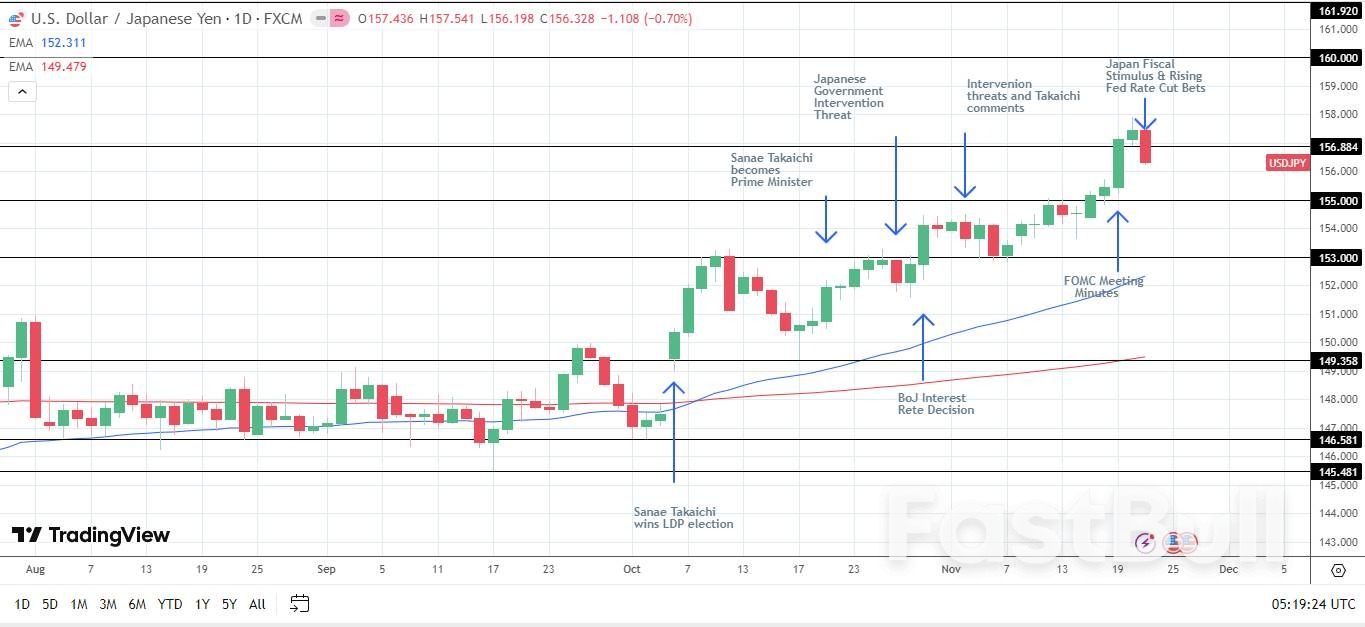
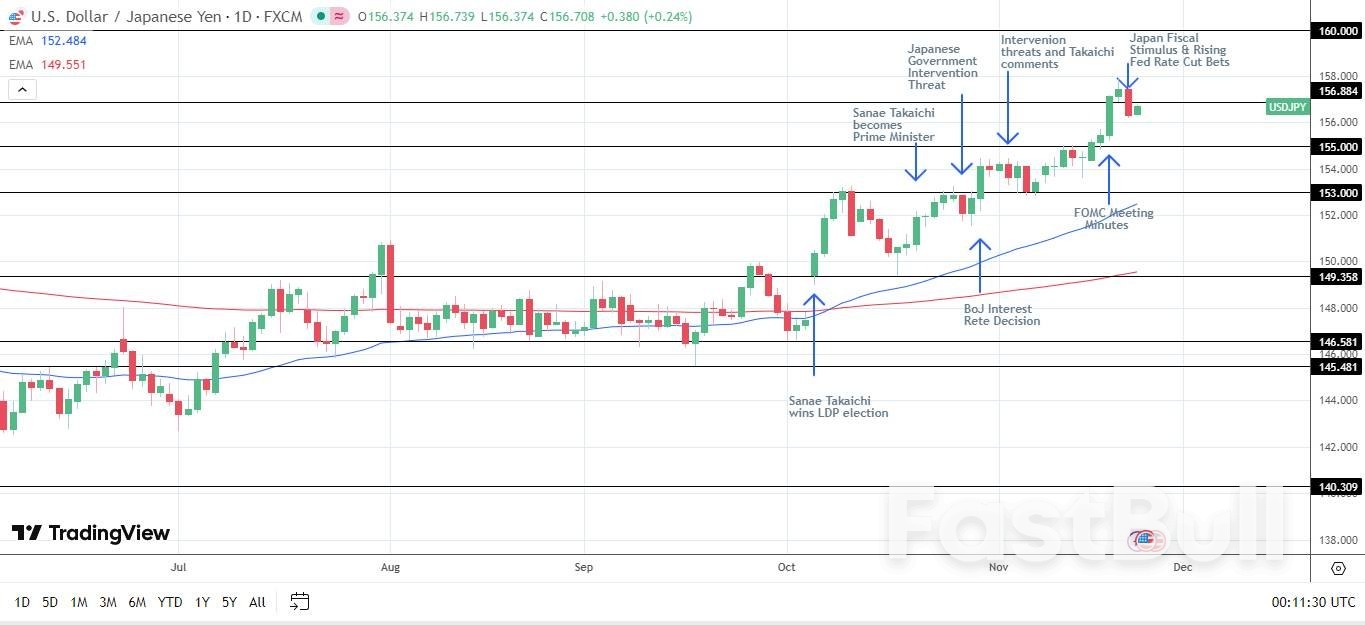
          Prime Minister Sanae Takaichi's fiscal stimulus announcement leaves the yen in a precarious position. Fading bets on a December Bank of Japan rate hike and a potential pullback in inflationary pressures could weaken the yen, sending USD/JPY higher.

          The USD/JPY rally to a 10-month high of 157.893 on Thursday and Friday's sharp pullback underscored market sensitivity to yen intervention warnings and dovish Fed rhetoric. Last week's USD/JPY movements set the stage for a volatile session on Monday, November 24.

          Japanese Yen Forecast: USD/JPY Rises As Fiscal Stimulus Pressures Yen_2USDJPY – Daily Chart – 241125 – Fiscal Stimulus and Dovish Fed

          Japan Fiscal Stimulus in Focus

          Prime Minister Sanae Takaichi's cabinet approved a ¥21.3 trillion ($136 billion) stimulus package on Friday, November 21. The package comprises ¥900 billion in special account spending, ¥2.7 trillion in tax cuts, and ¥17.7 trillion in spending. The fiscal package aligns with Prime Minister Takaichi's support for fiscal policy and ultra-loose monetary policy.

          Unlike fiscal stimulus packages in other countries that typically fuel inflation, Japan's package aims to combat higher prices. Notably, the ¥2.7 trillion in tax breaks includes abolishing a gasoline sales tax surcharge and raising the income threshold for income tax. Economists view these measures as having a low impact on near-term demand.

          However, economists have raised concerns about the ¥20,000 per child under 18 cash handout, which may boost demand and inflationary pressures. While the package seeks to provide near-term relief, structural components such as tax cuts may lift demand and fuel inflation later.

          Crucially, the package has raised criticism over fiscal sustainability, sending Japanese Government Bond (JGBs) yields soaring, reflecting waning confidence in the yen. 10-year yields hit their highest since 2008, while 40-year yields reached historic highs above 3.6%.

          Economists Raise the Alarm Over the Package and the Yen

          Robin Brooks, Senior Fellow at the Brookings Institution, commented on the fiscal stimulus package and yen weakness, stating,

          "Japan's Yen in real effective terms is almost as weak as Turkish Lira, which is the world's weakest currency after Erdogan eviscerated his central bank. Japan is in denial on debt. Sanae Takaichi's fiscal stimulus makes this worse…"

          "Sanae Takaichi, the "Iron Lady of Japan," has revived Abenomics-style stimulus that will expand global liquidity through fiscal easing and ultra-loose credit. Her policies strengthen the yen carry trade and the U.S. dollar, gold's pullback should not be a surprise. Contrary to popular belief, the "death of the dollar" is greatly exaggerated. King Dollar is alive and well."

          On Monday, November 24, debates over the fiscal stimulus package and BoJ commentary will influence USD/JPY trends. Traders should also monitor yen intervention warnings from the Japanese government if USD/JPY climbs toward 160.

          Meanwhile, US economic data will also play a crucial role in driving USD/JPY trends through its impact on Fed rate expectations.

          US Economy and Fed Speakers in Focus

          Economists forecast the Chicago Fed National Activity Index (CFNAI) to drop from -0.12 in August to -0.2 in October. Furthermore, economists expect the Dallas Fed Manufacturing Index to rise from -5.0 in October to -1.0 in November.

          CFNAI will likely face greater scrutiny given that the index captures the entire US economy, including manufacturing and services. Economists view the CFNAI as a broader economic barometer since it considers production, employment, personal income, and sales. By contrast, the manufacturing sector contributes around 10% to the US GDP.

          A sharper-than-expected fall in the CFNAI could signal a loss of economic momentum midway through Q4, supporting a more dovish Fed policy stance. USD/JPY may drop toward 155 on a lower CFNAI reading.

          Beyond the data, traders should closely monitor FOMC members' speeches after last week's shift in sentiment toward Fed rate cuts. According to the CME FedWatch Tool, the chances of a December Fed rate cut jumped from 44.4% on November 14 to 71.0% on November 21.

          Growing support for a December cut could weaken demand for the US dollar and push USD/JPY toward 150.

          USD/JPY Scenarios: Diverging Monetary Policies

          · Bearish USD/JPY Scenario: Hawkish BoJ chatter, intervention threats, softer US data, and dovish Fed comments could drag USD/JPY toward 150.
          · Bullish USD/JPY Scenario: Dovish BoJ rhetoric, stronger US data, and hawkish Fed comments could send USD/JPY toward 160.

          Japanese Yen Forecast: USD/JPY Rises As Fiscal Stimulus Pressures Yen_3USDJPY – Daily Chart – 241125

          Key Market Drivers to Watch Today:

          · Bank of Japan commentary.
          · Intervention threats.
          · US data.
          · Fed speakers.

          Source: FX Empire

          Risk Warnings and Disclaimers
          You understand and acknowledge that there is a high degree of risk involved in trading. Following any strategies or investment methods may lead to potential losses. The content on the site is provided by our contributors and analysts for information purposes only. You are solely responsible for determining whether any trading assets, securities, strategy, or any other product is suitable for investing based on your own investment objectives and financial situation.
          Add to Favorites
          Share
          FastBull
          Copyright © 2025 FastBull Ltd

          728 RM B 7/F GEE LOK IND BLDG NO 34 HUNG TO RD KWUN TONG KLN HONG KONG

          TelegramInstagramTwitterfacebooklinkedin
          App Store Google Play Google Play
          Products
          Charts

          Chats

          Q&A with Experts
          Screeners
          Economic Calendar
          Data
          Tools
          Membership
          Features
          Function
          Markets
          Copy Trading
          Latest Signals
          Contests
          News
          Analysis
          24/7
          Columns
          Education
          Company
          Careers
          About Us
          Contact Us
          Advertising
          Help Center
          Feedback
          User Agreement
          Privacy Policy
          Business

          White Label

          Data API

          Web Plug-ins

          Poster Maker

          Affiliate Program

          Risk Disclosure

          The risk of loss in trading financial instruments such as stocks, FX, commodities, futures, bonds, ETFs and crypto can be substantial. You may sustain a total loss of the funds that you deposit with your broker. Therefore, you should carefully consider whether such trading is suitable for you in light of your circumstances and financial resources.

          No decision to invest should be made without thoroughly conducting due diligence by yourself or consulting with your financial advisors. Our web content might not suit you since we don't know your financial conditions and investment needs. Our financial information might have latency or contain inaccuracy, so you should be fully responsible for any of your trading and investment decisions. The company will not be responsible for your capital loss.

          Without getting permission from the website, you are not allowed to copy the website's graphics, texts, or trademarks. Intellectual property rights in the content or data incorporated into this website belong to its providers and exchange merchants.

          Not Logged In

          Log in to access more features

          FastBull Membership

          Not yet

          Purchase

          Become a signal provider
          Help Center
          Customer Service
          Dark Mode
          Price Up/Down Colors

          Log In

          Sign Up

          Position
          Layout
          Fullscreen
          Default to Chart
          The chart page opens by default when you visit fastbull.com