• Trade
  • Markets
  • Copy
  • Contests
  • News
  • 24/7
  • Calendar
  • Q&A
  • Chats
Trending
Screeners
SYMBOL
LAST
BID
ASK
HIGH
LOW
NET CHG.
%CHG.
SPREAD
SPX
S&P 500 Index
6827.42
6827.42
6827.42
6899.86
6801.80
-73.58
-1.07%
--
DJI
Dow Jones Industrial Average
48458.04
48458.04
48458.04
48886.86
48334.10
-245.98
-0.51%
--
IXIC
NASDAQ Composite Index
23195.16
23195.16
23195.16
23554.89
23094.51
-398.69
-1.69%
--
USDX
US Dollar Index
97.950
98.030
97.950
98.500
97.950
-0.370
-0.38%
--
EURUSD
Euro / US Dollar
1.17394
1.17409
1.17394
1.17496
1.17192
+0.00011
+ 0.01%
--
GBPUSD
Pound Sterling / US Dollar
1.33707
1.33732
1.33707
1.33997
1.33419
-0.00148
-0.11%
--
XAUUSD
Gold / US Dollar
4299.39
4299.39
4299.39
4353.41
4257.10
+20.10
+ 0.47%
--
WTI
Light Sweet Crude Oil
57.233
57.485
57.233
58.011
56.969
-0.408
-0.71%
--

Community Accounts

Signal Accounts
--
Profit Accounts
--
Loss Accounts
--
View More

Become a signal provider

Sell trading signals to earn additional income

View More

Guide to Copy Trading

Get started with ease and confidence

View More

Signal Accounts for Members

All Signal Accounts

Best Return
  • Best Return
  • Best P/L
  • Best MDD
Past 1W
  • Past 1W
  • Past 1M
  • Past 1Y

All Contests

  • All
  • Trump Updates
  • Recommend
  • Stocks
  • Cryptocurrencies
  • Central Banks
  • Featured News
Top News Only
Share

Iranian Media Says 18 Crew Members Of Foreign Tanker Seized In Gulf Of Oman Over Carrying 'Smuggled Fuel' Detained

Share

Regional Governor: Two Killed In Ukrainian Drone Strike On Russia's Saratov

Share

Chinese Foreign Ministry - China Foreign Minister Met With United Arab Emirates Counterpart On Dec 12

Share

China's Central Financial And Economic Affairs Commission Deputy Director: Will Expand Export And Increase Import In 2026

Share

Thai Leader Anutin: Landmine Blast That Killed Thai Soldiers 'Not A Roadside Accident'

Share

Thai Leader Anutin: Thailand To Continue Military Action Until 'We Feel No More Harm'

Share

Cambodian Prime Minister Hun Manet Says He Had Phone Calls With Trump And Malaysian Leader Anwar About Ceasefire

Share

Cambodia's Hun Manet Says USA, Malaysia Should Verify 'Which Side Fired First' In Latest Conflict

Share

Cambodia's Hun Manet: Cambodia Maintains Its Stance In Seeking Peaceful Resolution Of Disputes

Share

Nasdaq Companies: Allergan, Ferrovia, Insmed, Monolithic Power Systems, Seagate Technology, And Western Digital Will Be Added To The NASDAQ 100 Index. Biogen, CdW, GlobalFoundries, Lululemon, ON Semiconductor, And Tradedesk Will Be Removed From The NASDAQ 100 Index

Share

Witkoff Headed To Berlin This Weekend To Meet With Zelenskiy, European Leaders -Wsj Reporter On X

Share

Russia Attacks Two Ukrainian Ports, Damaging Three Turkish-Owned Vessels

Share

[Historic Flooding Occurs In At Least Four Rivers In Washington State Due To Days Of Torrential Rains] Multiple Areas In Washington State Have Been Hit By Severe Flooding Due To Days Of Torrential Rains, With At Least Four Rivers Experiencing Historic Flooding. Reporters Learned On The 12th That The Floods Caused By The Torrential Rains In Washington State Have Destroyed Homes And Closed Several Highways. Experts Warn That Even More Severe Flooding May Occur In The Future. A State Of Emergency Has Been Declared In Washington State

Share

Trump Says Proposed Free Economic Zone In Donbas Would Work

Share

Trump: I Think My Voice Should Be Heard

Share

Trump Says Will Be Choosing New Fed Chair In Near Future

Share

Trump Says Proposed Free Economic Zone In Donbas Complex But Would Work

Share

Trump Says Land Strikes In Venezuela Will Start Happening

Share

US President Trump: Thailand And Cambodia Are In A Good Situation

Share

State Media: North Korean Leader Kim Hails Troops Returning From Russia Mission

TIME
ACT
FCST
PREV
U.K. Trade Balance Non-EU (SA) (Oct)

A:--

F: --

P: --

U.K. Trade Balance (Oct)

A:--

F: --

P: --

U.K. Services Index MoM

A:--

F: --

P: --

U.K. Construction Output MoM (SA) (Oct)

A:--

F: --

P: --

U.K. Industrial Output YoY (Oct)

A:--

F: --

P: --

U.K. Trade Balance (SA) (Oct)

A:--

F: --

P: --

U.K. Trade Balance EU (SA) (Oct)

A:--

F: --

P: --

U.K. Manufacturing Output YoY (Oct)

A:--

F: --

P: --

U.K. GDP MoM (Oct)

A:--

F: --

P: --

U.K. GDP YoY (SA) (Oct)

A:--

F: --

P: --

U.K. Industrial Output MoM (Oct)

A:--

F: --

P: --

U.K. Construction Output YoY (Oct)

A:--

F: --

P: --

France HICP Final MoM (Nov)

A:--

F: --

P: --

China, Mainland Outstanding Loans Growth YoY (Nov)

A:--

F: --

P: --

China, Mainland M2 Money Supply YoY (Nov)

A:--

F: --

P: --

China, Mainland M0 Money Supply YoY (Nov)

A:--

F: --

P: --

China, Mainland M1 Money Supply YoY (Nov)

A:--

F: --

P: --

India CPI YoY (Nov)

A:--

F: --

P: --

India Deposit Gowth YoY

A:--

F: --

P: --

Brazil Services Growth YoY (Oct)

A:--

F: --

P: --

Mexico Industrial Output YoY (Oct)

A:--

F: --

P: --

Russia Trade Balance (Oct)

A:--

F: --

P: --

Philadelphia Fed President Henry Paulson delivers a speech
Canada Building Permits MoM (SA) (Oct)

A:--

F: --

P: --

Canada Wholesale Sales YoY (Oct)

A:--

F: --

P: --

Canada Wholesale Inventory MoM (Oct)

A:--

F: --

P: --

Canada Wholesale Inventory YoY (Oct)

A:--

F: --

P: --

Canada Wholesale Sales MoM (SA) (Oct)

A:--

F: --

P: --

Germany Current Account (Not SA) (Oct)

A:--

F: --

P: --

U.S. Weekly Total Rig Count

A:--

F: --

P: --

U.S. Weekly Total Oil Rig Count

A:--

F: --

P: --

Japan Tankan Large Non-Manufacturing Diffusion Index (Q4)

--

F: --

P: --

Japan Tankan Small Manufacturing Outlook Index (Q4)

--

F: --

P: --

Japan Tankan Large Non-Manufacturing Outlook Index (Q4)

--

F: --

P: --

Japan Tankan Large Manufacturing Outlook Index (Q4)

--

F: --

P: --

Japan Tankan Small Manufacturing Diffusion Index (Q4)

--

F: --

P: --

Japan Tankan Large Manufacturing Diffusion Index (Q4)

--

F: --

P: --

Japan Tankan Large-Enterprise Capital Expenditure YoY (Q4)

--

F: --

P: --

U.K. Rightmove House Price Index YoY (Dec)

--

F: --

P: --

China, Mainland Industrial Output YoY (YTD) (Nov)

--

F: --

P: --

China, Mainland Urban Area Unemployment Rate (Nov)

--

F: --

P: --

Saudi Arabia CPI YoY (Nov)

--

F: --

P: --

Euro Zone Industrial Output YoY (Oct)

--

F: --

P: --

Euro Zone Industrial Output MoM (Oct)

--

F: --

P: --

Canada Existing Home Sales MoM (Nov)

--

F: --

P: --

Euro Zone Total Reserve Assets (Nov)

--

F: --

P: --

U.K. Inflation Rate Expectations

--

F: --

P: --

Canada National Economic Confidence Index

--

F: --

P: --

Canada New Housing Starts (Nov)

--

F: --

P: --

U.S. NY Fed Manufacturing Employment Index (Dec)

--

F: --

P: --

U.S. NY Fed Manufacturing Index (Dec)

--

F: --

P: --

Canada Core CPI YoY (Nov)

--

F: --

P: --

Canada Manufacturing Unfilled Orders MoM (Oct)

--

F: --

P: --

Canada Manufacturing New Orders MoM (Oct)

--

F: --

P: --

Canada Core CPI MoM (Nov)

--

F: --

P: --

Canada Manufacturing Inventory MoM (Oct)

--

F: --

P: --

Canada CPI YoY (Nov)

--

F: --

P: --

Canada CPI MoM (Nov)

--

F: --

P: --

Canada CPI YoY (SA) (Nov)

--

F: --

P: --

Canada Core CPI MoM (SA) (Nov)

--

F: --

P: --

Q&A with Experts
    • All
    • Chatrooms
    • Groups
    • Friends
    Connecting
    .
    .
    .
    Type here...
    Add Symbol or Code

      No matching data

      All
      Trump Updates
      Recommend
      Stocks
      Cryptocurrencies
      Central Banks
      Featured News
      • All
      • Russia-Ukraine Conflict
      • Middle East Flashpoint
      • All
      • Russia-Ukraine Conflict
      • Middle East Flashpoint
      Search
      Products

      Charts Free Forever

      Chats Q&A with Experts
      Screeners Economic Calendar Data Tools
      Membership Features
      Data Warehouse Market Trends Institutional Data Policy Rates Macro

      Market Trends

      Market Sentiment Order Book Forex Correlations

      Top Indicators

      Charts Free Forever
      Markets

      News

      News Analysis 24/7 Columns Education
      From Institutions From Analysts
      Topics Columnists

      Latest Views

      Latest Views

      Trending Topics

      Top Columnists

      Latest Update

      Signals

      Copy Rankings Latest Signals Become a signal provider AI Rating
      Contests
      Brokers

      Overview Brokers Assessment Rankings Regulators News Claims
      Broker listing Forex Brokers Comparison Tool Live Spread Comparison Scam
      Q&A Complaint Scam Alert Videos Tips to Detect Scam
      More

      Business
      Events
      Careers About Us Advertising Help Center

      White Label

      Data API

      Web Plug-ins

      Affiliate Program

      Awards Institution Evaluation IB Seminar Salon Event Exhibition
      Vietnam Thailand Singapore Dubai
      Fans Party Investment Sharing Session
      FastBull Summit BrokersView Expo
      Recent Searches
        Top Searches
          Markets
          News
          Analysis
          User
          24/7
          Economic Calendar
          Education
          Data
          • Names
          • Latest
          • Prev

          View All

          No data

          Scan to Download

          Faster Charts, Chat Faster!

          Download App
          English
          • English
          • Español
          • العربية
          • Bahasa Indonesia
          • Bahasa Melayu
          • Tiếng Việt
          • ภาษาไทย
          • Français
          • Italiano
          • Türkçe
          • Русский язык
          • 简中
          • 繁中
          Open Account
          Search
          Products
          Charts Free Forever
          Markets
          News
          Signals

          Copy Rankings Latest Signals Become a signal provider AI Rating
          Contests
          Brokers

          Overview Brokers Assessment Rankings Regulators News Claims
          Broker listing Forex Brokers Comparison Tool Live Spread Comparison Scam
          Q&A Complaint Scam Alert Videos Tips to Detect Scam
          More

          Business
          Events
          Careers About Us Advertising Help Center

          White Label

          Data API

          Web Plug-ins

          Affiliate Program

          Awards Institution Evaluation IB Seminar Salon Event Exhibition
          Vietnam Thailand Singapore Dubai
          Fans Party Investment Sharing Session
          FastBull Summit BrokersView Expo

          Saudi Embrace of Assad Sends Strong Signal to U.S.

          Devin

          Political

          Summary:

          Once labelled a pariah, Saudi Crown Prince Mohammed bin Salman took centre stage as master of ceremonies last week when Arab states readmitted Syria to the Arab League, signaling to Washington who calls the regional shots.

          Once labelled a pariah, Saudi Crown Prince Mohammed bin Salman took centre stage as master of ceremonies last week when Arab states readmitted Syria to the Arab League, signaling to Washington who calls the regional shots.
          His effusive greeting of President Bashar al-Assad at the Arab summit with kissed cheeks and a warm embrace defied U.S. disapproval at Syria's return to the fold and capped a turnabout in the prince's fortunes spurred by geopolitical realities.
          The prince, known as MbS, seeks to reassert Saudi Arabia as a regional power by using his place atop an energy giant in an oil-dependent world consumed by the war in Ukraine.
          Shunned by Western states after the 2018 killing of journalist Jamal Khashoggi by a Saudi hit squad, the prince has now emerged as a player whom Washington can neither disregard nor disavow, but must deal with on a transactional basis.
          Skeptical of U.S. promises on Saudi security and tired of its scolding tone, MbS is instead building ties with other global powers and, regardless of Washington's consternation, remaking his relations with their shared foes.
          His blithe confidence on the world stage was not only visible in his reception of Assad. Ukrainian President Volodymyr Zelenskiy came to the Jeddah meeting and MbS offered to mediate between Kyiv and fellow oil producer Moscow.
          To be sure Saudi Arabia still depends militarily on the United States, which saved it from possible invasion by Saddam Hussein's Iraq in 1990, monitors Iranian military activity in the Gulf and provides Riyadh with most of its weapons.
          Still, with Washington seemingly less engaged in the Middle East and less receptive to Riyadh's anxieties, MbS is pursuing his own regional policy with less apparent deference to the views of his most powerful ally.
          "This is a strong signal to America that 'we're reshaping and redrawing our relations without you'," said Abdulaziz al-Sager, Chairman of the Gulf Research Center, of the summit.
          "He is not getting what he wants from the other side," Sager added, saying Saudi Arabia's ententes with regional foes were based on Riyadh's approach to regional security.
          Diplomatic Offensive
          MbS' position strengthened last year when Western economies turned to Saudi Arabia to help tame an oil market destabilized by the war in Ukraine. It created the opportunity for MbS to launch a diplomatic offensive that included high profile summit appearances.
          That effort was aided when Washington declared MbS immune from prosecution for Khashoggi's killing despite his being directly implicated in it by U.S. intelligence.
          A visit by U.S. President Joe Biden last July had already demonstrated Riyadh's returning influence: The American leader left empty handed while the prince enjoyed a public display of U.S. commitment to Saudi security.
          The Saudi pivot away from reliance on the United States was meanwhile evident when China mediated this year a settlement between Riyadh and its arch regional foe Iran after years of hostility.
          The deal was not made from a position of Saudi strength: Iran's allies had come out stronger than those of the kingdom in Iraq, Syria and Lebanon, and held most of the populated territory in Yemen.
          Still, it showed Riyadh was able to cut its losses and work with U.S. rivals and foes to shore up its regional interests such as cooling the Yemen war where Saudi forces have been bogged down since 2015.
          Meanwhile the prince has improved ties with Turkey and ended a boycott of Qatar, a neighbour he considered invading in 2017 according to diplomats and Doha officials.
          "Over the past three years, the hatchet was buried and relations were repaired," said Saudi columnist Abdulrahman Al-Rashed in Asharq Al-Awsat newspaper.
          Transactional Relationship
          A Gulf official said the new, more directly transactional, relationship with the United States had replaced the old oil-for-defence model because of what Riyadh saw as a shakier security umbrella after the Arab revolts of 2011.
          A senior State Department official said the relationship is "an important eight-decade one that spans generations, across administrations in our own country and across leaders in Saudi Arabia".
          "We have multiple interests when it comes to our relationship with Saudi Arabia...Our policy and engagement will seek to ensure that our relationship remains sound and able to meet our shared challenges of the future."
          Riyadh thought Washington had abandoned old allies during the revolts and might abandon the Al Saud dynasty too. At the same time it believed the U.S. pursuit of a nuclear deal with Tehran had led Washington to ignore the growing activity around the region of Iranian proxies seen by Riyadh as a threat.
          That impression has strengthened. A Saudi source close to the ruling inner circle pointed to what he saw as lax enforcement of sanctions on Iran and a drawdown in Syria, where a small U.S. contingent has denied territory to Iran's allies.
          "I think countries in the region, as a consequence, will do what is best for them," he said.
          Meanwhile, Riyadh was annoyed that the U.S. pulled its support for Saudi operations in Yemen, launched after Washington repeatedly urged the kingdom to take responsibility for its own security.
          Without direct American intervention or support for its own military efforts, Riyadh had little choice but to strike a deal with Iran even if that annoyed Washington, the source said.
          "This is a consequence of the U.S. action," he added.
          Each side has a list of requests that the other is not willing to grant, the Gulf official said.
          However, both sides may have little choice but to put aside their grudges.
          The kingdom may see the U.S. security umbrella as weakened, but still views it as crucial to Saudi defence. Western states have meanwhile remembered that Riyadh's influence in a volatile oil market requires them to banish their qualms and deal with its de facto ruler and future king.

          Source: Bdnews24

          Risk Warnings and Disclaimers
          You understand and acknowledge that there is a high degree of risk involved in trading. Following any strategies or investment methods may lead to potential losses. The content on the site is provided by our contributors and analysts for information purposes only. You are solely responsible for determining whether any trading assets, securities, strategy, or any other product is suitable for investing based on your own investment objectives and financial situation.
          Comments
          Add to Favorites
          Share

          Regional Head of Research, Americas

          Justin

          Economic

          Political

          Looking for a prospectus for US Treasuries? Good luck, as it does not exist!

          Treasuries are simply backed by the good faith of the US government. So there are no cross default provisions, meaning that if one bond is defaulted on it does not (necessarily) place the entire market into a state of default, where all bond holders would demand a simultaneous resolution. There is also no 30-day grace period, as is often typical in bond documentation. Basically, here, there is no “documentation”. So what would happen?
          Fitch, having just moved the US to negative watch, have noted that it would move the security on which a payment has been missed from AAA to D (default), so a stand-alone default in that security. But Fitch also note it would severely downgrade all securities on which there is a payment due in the subsequent 30 days, the logic being they’d be up next for default. Bonds would move to CCC and bills would move to C.
          A default on one security is a very low probability possibility (albeit not low enough for comfort). But a state of default that extended for 30 days is extraordinarily difficult, as over those 30 days the entire system is at risk of going down, and there would be a high probability attached to that. That said, to continue the analysis, likely there would be a rolling 30-day domino downgrade of securities into the C to CCC buckets as the state of default persisted.
          Again, that would be the least of our concerns, as we would not have a system to talk about.

          For now Bills are at risk of default. Treasuries are not, but will be at risk should we move past 15 June without a deal

          So the question now is which securities are at immediate risk of default? And how big is the problem? The bipartisan policy center has revised the elevated “X-date risk range” to the period between 2 June to 13 June. There are some lumpy payments to be made through 1/2 June which could push us over the edge. And if we get beyond that, there is gauntlet to be run between then and the 15 June tax receipts deadline. If we get to 15 June without a hiccup, then the tax receipts push the X date well into the mid-to-late summer.
          So, the period of immediate concern is from after 1 June to just before 15 June. The good news is no Treasuries are due either coupon or redemption payments through these dates, as payments on Treasuries are made either on a 15th of the month or on the last day of the month. So, for example, there are redemption and coupon payments due on Treasuries on 31 May. This also eats into cash, but the recent refunding also helps cover it.
          The default focus therfore is on bills that redeem between 1 June and 13 June. There are four of them, due on the 1st, the 6th, the 8th and the 13th. The total amount due here is US$489bn. The US Treasury currently has some US$76bn in cash at the Fed, so you can see the problem here. The difference overstates the issue as the Treasury can still issue as part of its extraordinary measures. But still, to get through that period will require quite some jiggery pokery.
          If there were a missed bills payment, the only way to right this would be for Congress to act quickly to suspend the debt ceiling. Recently, Kevin McCarthy, the Speaker of the House, said this could be done within 72 hours. If there was a default on 6 June, that could be too tight to make good on the 8 June payment. But a default on 1 June or 8 June would allow enough time to get a suitable bill passed, and presumably there would be some fast-tracking employed to boot.

          Expect downgrades as we enter the early part of June without a deal. That's okay. A default would not be

          There is a danger that even in the case of a default on one bond that the game of chicken continues. Maybe because the Fed acts quickly to take the defaulted bond out of circulation through an emergency bond buying measure, to protect the system. But this would be extremely dangerous, and could quickly unravel to undermine the dollar and the system. In all probability, a collapse in the Dow Jones would be enough for Capitol Hill to come to its senses and pass something to make this all go away.
          But then what? S&P downgraded the US in 2011 to AA+, and it has been there since. Moody’s and Fitch have the US at AAA. Fitch have now moved to negative watch. One or more of them could downgrade the US even if there is no actual default. Uncontrolled spending and elevated deficits could be enough. But the elevation of a risk for a missed payment is the most obvious front-and-centre rationale.
          A downgrade or two and no default would not be structurally problematic. It would be bad, but we’d move on. However, an actual missed payment on a security would leave a more lasting legacy.
          First, a technical default would have happened. Fitch, for example, would attach an immediate 2-notch downgrade to this event alone. Second, most likely, there would be a downgrade in anticipation of default. So a 3-notch downgrade is probable should there be a default on one just one security, whether a bill or a bond. And importantly, this assumes defaulted upon holders are subsequently made whole.
          That would move the US to low AA (as Fitch have intimated). It could be worse should there be remnants that point to more of this cropping up again in the near future. In either case, clearing houses and other counterparties that accept US Treasuries as collateral can act to reduce their implied value. That would be a really bad front-and-centre outcome (and potentially a legacy one). The sooner this ends in a good way the better.

          Source:ING

          To stay updated on all economic events of today, please check out our Economic calendar
          Risk Warnings and Disclaimers
          You understand and acknowledge that there is a high degree of risk involved in trading. Following any strategies or investment methods may lead to potential losses. The content on the site is provided by our contributors and analysts for information purposes only. You are solely responsible for determining whether any trading assets, securities, strategy, or any other product is suitable for investing based on your own investment objectives and financial situation.
          Comments
          Add to Favorites
          Share

          If There is an Economic Downturn, When Will It Begin?

          Justin

          Economic

          Central Bank

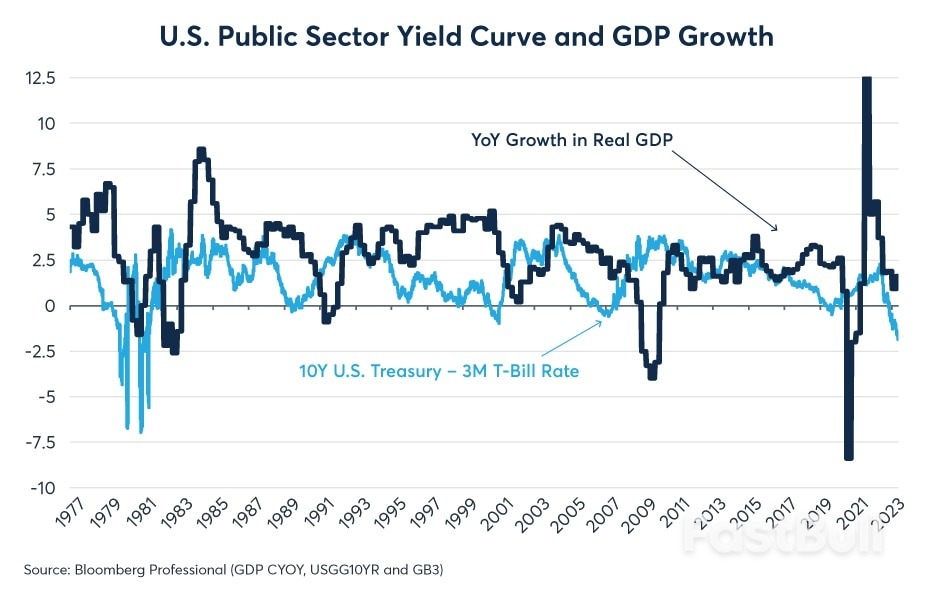
          In what might have been the last rate hike of the current monetary policy tightening cycle, the Federal Reserve (Fed) raised interest rates to 5.125% on May 3. Through the cycle that began in March last year, the Fed has cumulatively raised rates by 500 basis points (bps), the largest since 1981. By early May, U.S. short-term interest rates were around 140 bps above long-term bond yields, making for the most extreme yield curve inversion since 1981.

          The U.S. has the steepest yield curve inversion since 1981

          If There is an Economic Downturn, When Will It Begin?_1
          Yield curve inversions often precede economic downturns by one to two years (Figure 2). The size of the Fed tightening and the degree of the current yield curve inversion has left many wondering if the U.S. is heading toward a recession, and, if so, when it might begin? There are also expectations for the U.S. to avoid a recession, getting away instead with a “soft landing,” where the economy avoids a contraction but still slows down enough to allow inflation to subside, and for the Fed to ease policy.
          History offers some guidance as to the probabilities of a downturn versus soft landing. Over the past 40 years, the Fed has taken the U.S. through six previous tightening cycles. Of those, four were followed by a recession, and two by soft landings (Figure 3). When recessions did happen, they began 10-17 months after the Fed’s last rate hike. The National Bureau of Economic Research (NBER) defines a recession as a “significant decline in economic activity.” This definition is more nuanced that the often cited but incorrect “two straight quarters of negative GDP growth.”

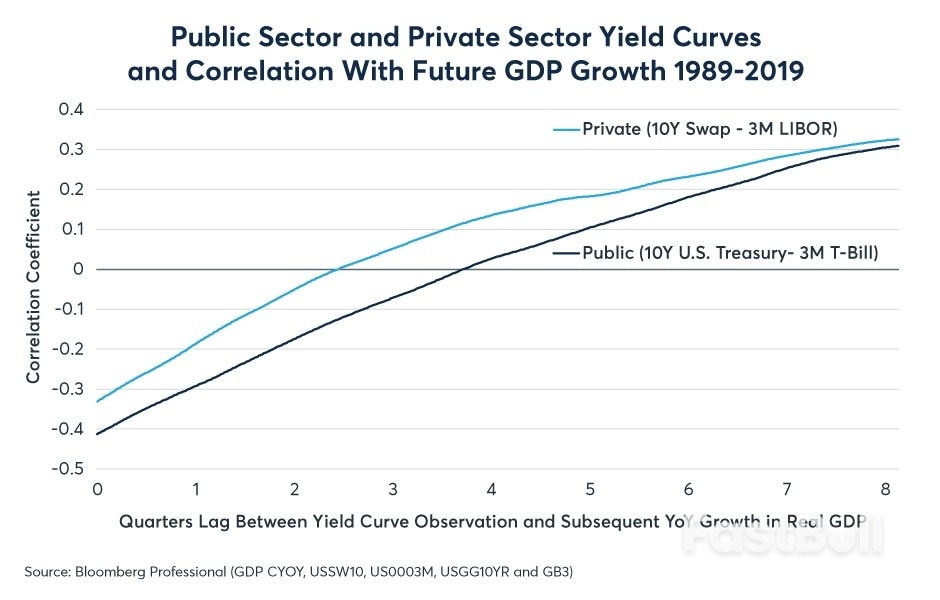
          Shape of yield curve correlates positively with GDP growth 3-8 quarters in the future

          If There is an Economic Downturn, When Will It Begin?_2
          Among the recessions listed in the table above is the brief, but deep, downturn that began in February 2020. It was caused by the policy response to the COVID-19 pandemic, and we will never know if a normal cyclical downturn would have happened had the pandemic not occurred. Excluding the 2015-2018 tightening cycle from the analysis, Fed tightening cycles were followed by downturns only in three of the five cases. This suggests that the probability of a recession in the relatively near future might be as low as 60%.
          However, there are several reasons to think that the risk of an economic downturn might be much higher. For starters, the Fed hiked rates by 500 bps in the past 14 months. This is far greater than in any previous tightening cycle since 1981. The 1981 tightening cycle, which was part of a broader period of tightening that began in 1979, resulted in the deepest recession since the Great Depression of the 1930s.
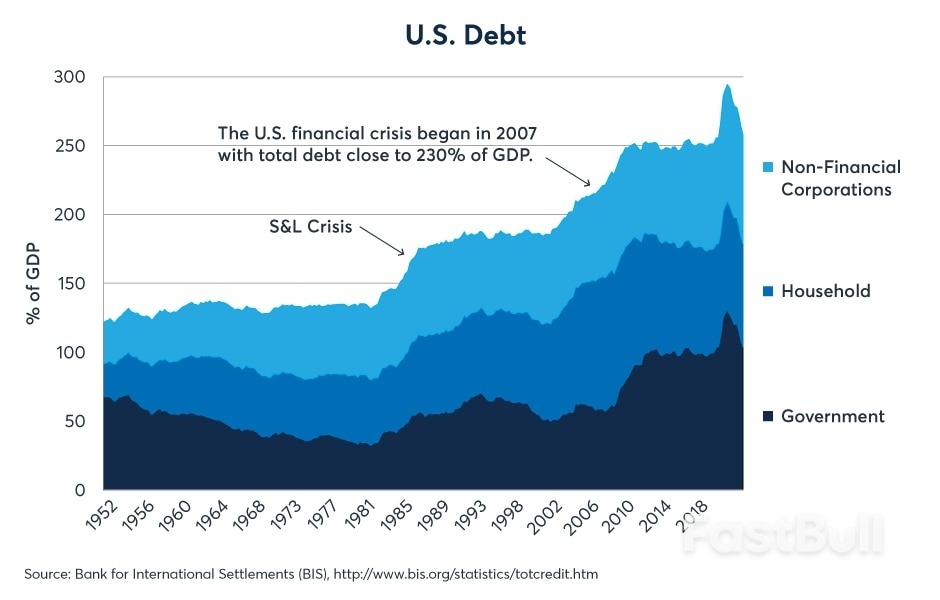
          A second reason why the probability of a recession in the next two years might exceed 60% is the level of debt and leverage in the U.S. economy. Previous tightening cycles happened during periods of much lower levels of leverage. For example, the total debt-to-GDP ratio was around 130-135% at the time of the 1979 and 1981 tightening cycles. By the time of the 1984 tightening cycle, the ratio had risen to 150%. When the 1989 tightening cycle ended, it was 180%. By the May 2000 peak in Fed funds, it was 185%, and by the time the Fed stopped hiking rates in 2006, debt had risen to 217% of GDP. As of Q3 2022, the most recent quarter for which we have data, the total U.S. debt-to-GDP ratio was 257.5%. So not only does the size of the Fed’s current tightening cycle dwarf anything that it’s done in the past 40 years, the combination of public and private sector debt is also far larger than it was during past tightening cycles.

          U.S. debt levels have risen steadily over the past few decades

          If There is an Economic Downturn, When Will It Begin?_3
          For the moment, the U.S. economy still appears to have decent forward momentum. Household incomes are growing strongly. Although the job market is cooling, unemployment remains low, job growth is still positive, and there are still nearly 9.6 million open positions as of the end of March. Even so, there are warning signs. Three regional banks collapsed in the past two months. If the Fed’s 500-bps of tightening slows growth further, default rates could eventually rise and banks might curtail lending further, creating the potential for a downward spiral in economic activity.
          The Fed may have had an easier time engineering soft landings when debt was lower.
          If There is an Economic Downturn, When Will It Begin?_4

          Source:Erik Norland

          To stay updated on all economic events of today, please check out our Economic calendar
          Risk Warnings and Disclaimers
          You understand and acknowledge that there is a high degree of risk involved in trading. Following any strategies or investment methods may lead to potential losses. The content on the site is provided by our contributors and analysts for information purposes only. You are solely responsible for determining whether any trading assets, securities, strategy, or any other product is suitable for investing based on your own investment objectives and financial situation.
          Comments
          Add to Favorites
          Share

          US Spending and Inflation Numbers Boost the Case for Another Rate Hike

          Justin

          Central Bank

          Economic

          Income, spending and inflation remain too strong for the Fed to ignore

          The April US personal income and spending report is a fair bit stronger than expected across the board, which will fuel talk of another Federal Reserve rate hike at either the June or July meetings. Incomes rose 0.4% month-on-month as expected, with wages and salaries up by 0.5%MoM, but spending rose by 0.8%MoM versus the 0.5% consensus with March revised higher. Consequently, we find real consumer spending came in at 0.5%MoM versus the 0.3% expected. This will inevitably lead to upward revisions of second-quarter GDP expectations given consumer spending is two-thirds of economic activity as measured by GDP.
          We then turn to inflation, and the core PCE deflator has come in at 0.4%/4.7% rather than the 0.3%/4.6% expected. This move higher will inevitably boost the case of the Fed hawks such as James Bullard and Neel Kashkari that policy needs to move tighter to ensure inflation returns to the 2% target in a timely manner. We still think it will slow sharply in the second half of the year, but we are increasingly doubtful the Fed will have the patience to hold back from hiking, especially if the spending side is holding up as well as it seems. So, if we get a positive conclusion to the debt ceiling drama and next Friday's jobs number comes in at around 200k, we would have to say the odds will favour a 25bp hike in June.

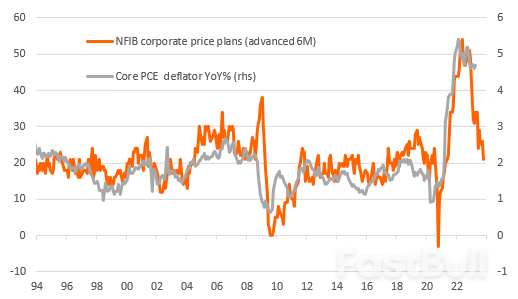
          Weakening pricing power points to sharp inflation falls later in the year

          US Spending and Inflation Numbers Boost the Case for Another Rate Hike_1

          But a turn is coming that will result in an eventual major reversal in Fed policy

          The chart above shows how the rapid weakening of corporate pricing power (led by plummeting business sentiment) indicates we should expect inflation to slow sharply in the second half of the year – the problem is we aren't confident that the Fed will wait for it to happen. We fear that the likely result is we get over-tightening of monetary policy that, in combination with significantly tougher lending standards that will restrict the flow of credit, will tip the economy into what could be a painful recession. Our conclusion, therefore, is that this leads to an even greater interest rate cut story further down the line.

          Source:ING

          To stay updated on all economic events of today, please check out our Economic calendar
          Risk Warnings and Disclaimers
          You understand and acknowledge that there is a high degree of risk involved in trading. Following any strategies or investment methods may lead to potential losses. The content on the site is provided by our contributors and analysts for information purposes only. You are solely responsible for determining whether any trading assets, securities, strategy, or any other product is suitable for investing based on your own investment objectives and financial situation.
          Comments
          Add to Favorites
          Share

          Turkey Election 2023: What's at Stake in the Runoff?

          Devin

          Political

          Turkish President Tayyip Erdogan aims to extend his rule into a third decade in an election on Sunday, with the momentum seen in his favour in the runoff vote after a first round showed him ahead of his challenger, Kemal Kilicdaroglu.
          Already buoyed by a parliamentary majority won by his Islamist-rooted AK Party and its allies on May 14, Erdogan got another boost on Monday thanks to the endorsement of a nationalist politician who came third in the first round.
          The election will decide not only who leads Turkey but also how it is governed, where its economy is headed, and the shape of its foreign policy. Kilicdaroglu, who received the endorsement of another far-right leader, is backed by a six-party alliance including his Republican People's Party (CHP).
          Modern Turkey's longest-serving leader, Erdogan has championed religious piety and low interest rates at home while asserting Turkish influence in the region and loosening the NATO member's ties with the West.
          The election takes place three months after earthquakes in southeast Turkey killed more than 50,000 people.
          What's at stake for turkey ...
          The most powerful leader since Mustafa Kemal Ataturk founded the modern Turkish republic a century ago, Erdogan and his AK Party have shifted Turkey away from Ataturk's secular blueprint.
          Erdogan has also centralised power around an executive presidency, based in a 1,000-room palace on the edge of Ankara, which sets policy on Turkey's economic, security, domestic and international affairs.
          Erdogan's critics say his government has muzzled dissent, eroded rights and brought the judicial system under its sway, a charge denied by officials who say it has protected citizens in the face of unique security threats including a 2016 coup attempt.
          Economists say Erdogan's calls for low rates sent inflation soaring to a 24-year high of 85% last year, and the lira slumping to one tenth of its value against the dollar over the last decade.
          ... And the rest of the world?
          Under Erdogan, Turkey has flexed military power in the Middle East and beyond, launching four incursions into Syria, waging an offensive against Kurdish militants inside Iraq and sending military support to Libya and Azerbaijan.
          Turkey also saw a series of diplomatic clashes with regional powers Saudi Arabia, Egypt, the United Arab Emirates and Israel, as well as a stand-off with Greece and Cyprus over eastern Mediterranean maritime boundaries, until it changed tack two years ago and sought rapprochement with some of its rivals.
          Erdogan's purchase of Russian air defences triggered U.S. arms industry sanctions against Ankara, while his closeness to Russian President Vladimir Putin led critics to question Turkey's commitment to the NATO Western defence alliance. Ankara's objections to NATO membership applications from Sweden and Finland have also raised tensions.
          However, Turkey also brokered a deal for Ukrainian wheat exports, underlining the potential role Erdogan has staked in efforts to end the Ukraine war. It is not clear that a successor would enjoy the same profile he has created on the world stage, a point he has made in the election campaign.
          What is the opposition promising?
          Two main opposition parties, the secularist CHP and centre-right nationalist IYI Party, have allied themselves with four smaller parties under a platform that would reverse many of Erdogan's signature policies.
          They have pledged to restore independence to the central bank and reverse Erdogan's unorthodox economic policies. They would also dismantle his executive presidency in favour of the previous parliamentary system, and send back Syrian refugees.
          They also aim to improve relations with Western allies including the United States, and to return Turkey to the F-35 fighter jet programme, from which it was blocked after buying Russian missile defences.
          Analysts believe the policies promised by the opposition could spur foreign investment.
          Erdogan supported failed efforts to topple Syrian President Bashar al-Assad, while hosting at least 3.6 million Syrian refugees who have become increasingly unwelcome at a time of economic hardship in Turkey.
          Seeking a runoff boost from nationalist voters, Kilicdaroglu has in the last two weeks sharpened his anti-immigrant tone and promised to repatriate migrants.
          Just how close is the race?
          Kilicdaroglu got 44.9% in the first round compared to 49.5% for Erdogan, reflecting solid support despite a deep cost-of-living crisis and polls which had shown Kilicdaroglu in the lead. Pollsters later pointed to an unexpected surge in nationalist support at the ballot box to explain the result.
          Erdogan has said a vote for him will ensure stability after his alliance secured a parliamentary majority.
          Turkey's four-decade conflict with the militant Kurdistan Workers Party (PKK) has factored into the campaigning, along with the role of the mainstream Kurdish political parties.
          While not part of the opposition alliance, the pro-Kurdish Peoples' Democratic Party (HDP) fiercely opposes Erdogan after a crackdown on its members in recent years and has endorsed Kilicdaroglu.
          Erdogan's attacks against Kilicdaroglu have included accusations, without evidence, of him winning support from the PKK, which has waged an insurgency since the 1980s in which more than 40,000 people have been killed. Kilicdaroglu has denied the accusations.

          Source: reuters

          Risk Warnings and Disclaimers
          You understand and acknowledge that there is a high degree of risk involved in trading. Following any strategies or investment methods may lead to potential losses. The content on the site is provided by our contributors and analysts for information purposes only. You are solely responsible for determining whether any trading assets, securities, strategy, or any other product is suitable for investing based on your own investment objectives and financial situation.
          Comments
          Add to Favorites
          Share

          UK Retail Sales Rebound in April, Indicating Economic Recovery

          Warren Takunda

          Traders' Opinions

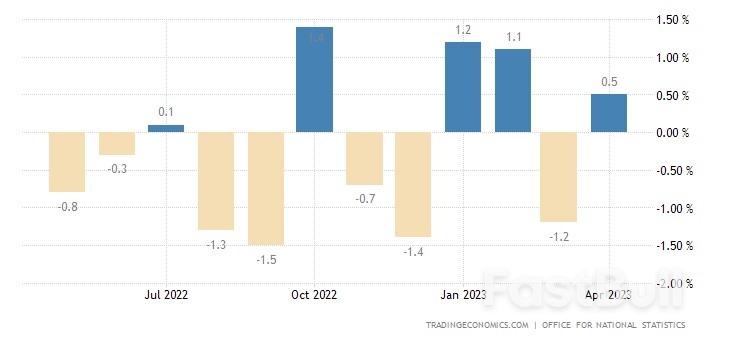
          The United Kingdom's retail sector showcased signs of recovery in April 2023, as retail sales volumes increased by 0.5 percent compared to the previous month. This rebound follows a decline in March and surpassed market expectations, highlighting the resilience of the industry. Non-food stores, particularly in the watches and jewelry as well as sports equipment segments, witnessed a notable recovery, contributing to the overall positive performance.
          UK Retail Sales Rebound in April, Indicating Economic Recovery_1Non-Food Stores Lead the Recovery
          Non-food stores experienced a significant rebound in April, with sales rising by 1.0 percent. This growth comes as a relief after a decline of 1.8 percent in March, which was mainly attributed to adverse weather conditions negatively impacting sales during that period. The strong performance in non-food stores indicates improved consumer sentiment and increased spending in discretionary categories.
          Resilience in the Online Retail Sector
          The online retail sector demonstrated resilience in April, registering a 0.2 percent increase in trade. This growth indicates that consumers continue to embrace online shopping as a convenient and safe alternative, despite the gradual reopening of physical stores. The ability of online retailers to adapt to changing consumer preferences and provide seamless shopping experiences has contributed to their sustained success.
          Food Stores Recover from Previous Dip
          Following a drop of 0.8 percent in March, food stores rebounded in April with a 0.7 percent increase in trade. This recovery suggests that consumer spending on essential goods such as groceries returned to normal levels after the temporary setback observed the previous month. The stability in food store sales indicates the resilience of this sector, which tends to be less susceptible to economic fluctuations.
          Fuel Sales Encounter Setback
          Despite a simultaneous decrease in fuel prices, fuel sales encountered a setback in April, declining by 2.2 percent. The decline in sales volume may be attributed to other factors such as reduced travel and commuting due to ongoing restrictions or changing consumer preferences, including a shift towards electric vehicles. The decline in fuel sales highlights the need for the industry to adapt to changing market dynamics and explore alternative revenue streams.
          Positive Outlook with Strong Quarterly Growth
          Looking at the broader picture, retail trade in the United Kingdom rose by 0.8 percent in the three months leading up to April 2023, compared to the previous three months. This growth rate represents the highest since August 2021, indicating an overall positive trajectory for the retail sector. The sustained quarterly growth suggests that the recovery is gaining momentum and bodes well for the economic outlook of the country.
          The rebound in UK retail sales in April 2023, particularly in non-food stores and the online retail sector, signals a promising recovery for the industry. Despite the setback in fuel sales, the overall growth in the retail sector, coupled with strong quarterly performance, paints a positive outlook for the UK economy. The ongoing resilience of the retail sector highlights the adaptability of businesses and the enduring consumer demand.
          Risk Warnings and Disclaimers
          You understand and acknowledge that there is a high degree of risk involved in trading. Following any strategies or investment methods may lead to potential losses. The content on the site is provided by our contributors and analysts for information purposes only. You are solely responsible for determining whether any trading assets, securities, strategy, or any other product is suitable for investing based on your own investment objectives and financial situation.
          Comments
          Add to Favorites
          Share

          Inflows Into Unloved European Telecoms Signal Brighter Future

          Cohen

          Stocks

          Investors have poured money back into unloved European telecoms stocks on expectations that costly investments have peaked and that a resurgence in mergers and acquisitions could lead to fatter returns.
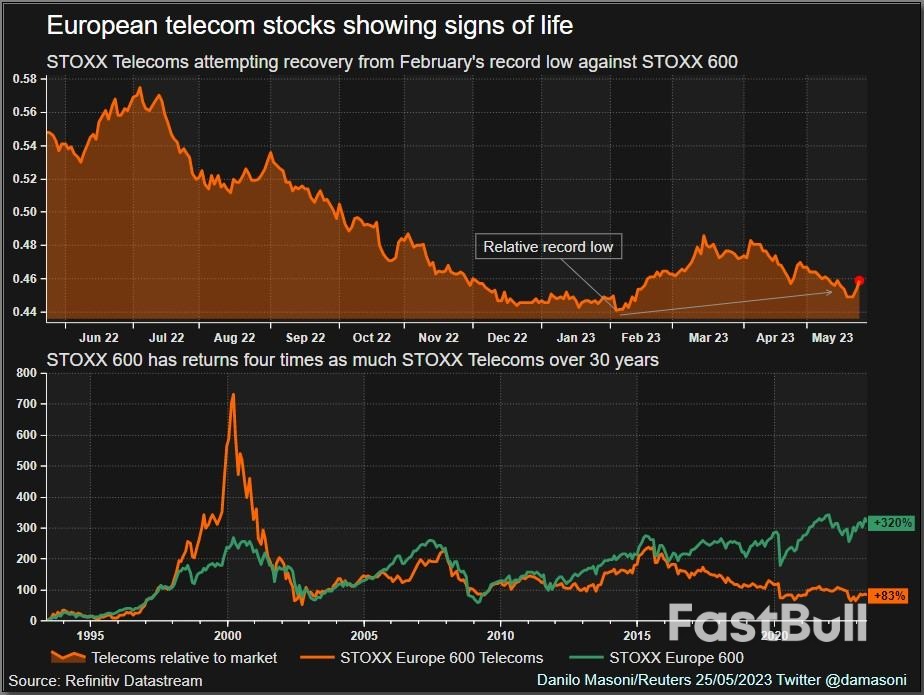
          The return of inflows could signal a turning point for a sector that as recently as February logged its worst underperformance against the market in more than three decades.
          Telecoms' high debt levels are one factor that deter many fund managers. But growing cash flows and a potential softening in the European Union's historically tough stance on mergers in the sector means prospects for these shares look brighter.
          "Some of the historical headwinds are fading away," said Luca Finà, head of equity at Generali Insurance Asset Management, which is now selectively overweight in telecoms, having been underweight in 2021 and neutral last year.
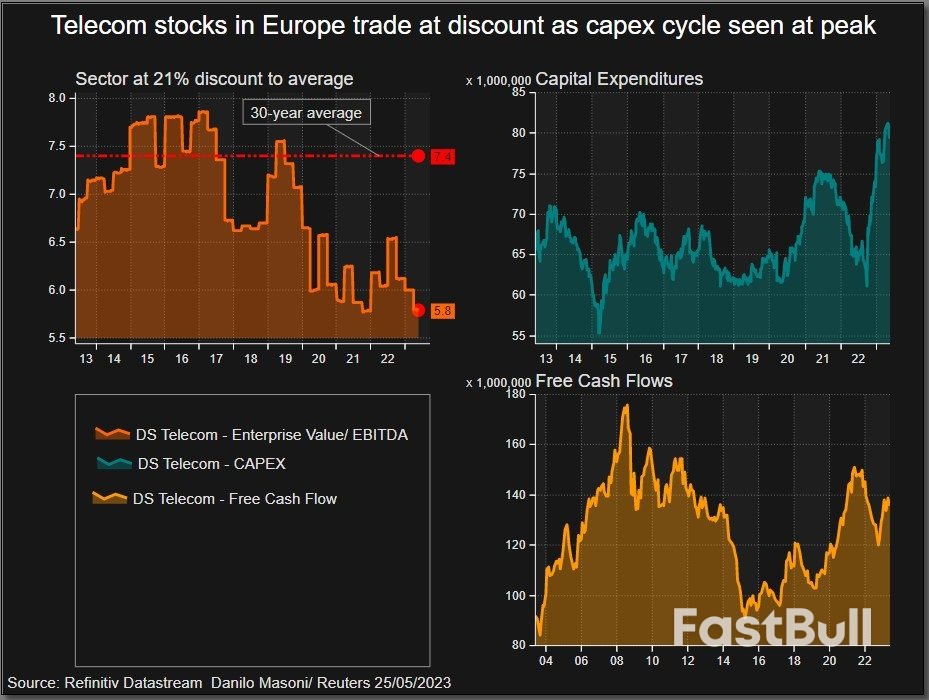
          "The capex cycle is mostly behind us, leading to an improved free cash flow generation, inflation is leading to price increases and (there's) an apparent more favourable stance from regulators on consolidation," he added.
          So far in 2023, telecom sector funds have seen $1.8 billion worth of net inflows, recovering more than 80% of last year's outflows, data from fund tracker EPFR showed.
          Finland, Italy, Norway, Austria, Germany and France rank among the top 10 countries for the biggest rises in telecoms inflows this year.
          Since February's record low relative to the broader market, the sector has staged a recovery and the STOXX Telecoms index is up 11% year-to-date, having risen as much as 17%. That compares to a 10.7% peak gain for the region-wide STOXX Europe 600.
          Inflows Into Unloved European Telecoms Signal Brighter Future_1M&A Test and Pricing Power
          Investors are also eagerly waiting to hear whether the European Commission will approve the 18.6 billion-euro ($20.47 billion) merger between Orange and MasMovil in Spain. The ruling, expected in September, is seen as a test case that may even prompt sceptics to rethink their negative view on the industry.
          "We don't see much value in the sector. The only opportunity would be market consolidation," said Ludovic Labal, portfolio manager of Eric Sturdza Investments' Strategic Europe Quality Fund.
          His fund does not invest in telecoms because of concerns about high leverage and slow growth.
          Others are already becoming more positive, including the equity research team at Amundi, Europe's largest asset manager, which has recommended an overweight allocation since the second half of 2022.
          Luca Corona, Amundi senior telco analyst, said price increases for telecoms services do not appear to have been followed by smaller players taking the opportunity to undercut their larger rivals, as has been seen in the past.
          He also noted that France and Italy are two other markets that would both benefit from consolidation.
          At an enterprise value of 5.8 times core earnings, European telecoms trade at a 21% discount to their 30-year average valuation, according to Refinitiv Datastream. Relative to the market, they trade at a 31% discount on the same metric.
          Telecoms is a highly fragmented industry, with four players competing in many domestic markets. Price wars have squeezed margins over the years, just as fixed and mobile networks needed huge investment to meet booming demand for data.
          But the investment cycle is turning. France's Orange has completed more than 90% of its fibre rollout and is reducing capital expenditure. Spain's Telefonica and Norway's Telenor have said they are past, or near, peak capex.
          That is supporting margins, along with price hikes put in place in the face of soaring inflation, which could help gradually change the downbeat narrative.
          "The sector is no more perceived as a 'no pricing power' one," said Olivier Baduel, director of European equity management at Ofi Invest Asset Management.
          Also on the horizon is a potential windfall from a European Commission consultation, launched in February, on who should foot the bill for billions of euros of investments in Europe's telecoms network. Operators have lobbied for decades for leading technology companies to contribute to 5G and broadband roll-out.
          UBS analyst Polo Tang estimates that could raise up to 4 billion euros or ease pressure on capex by optimising network traffic.Inflows Into Unloved European Telecoms Signal Brighter Future_2
          ($1 = 0.9084 euros)

          Source: Reuters

          Risk Warnings and Disclaimers
          You understand and acknowledge that there is a high degree of risk involved in trading. Following any strategies or investment methods may lead to potential losses. The content on the site is provided by our contributors and analysts for information purposes only. You are solely responsible for determining whether any trading assets, securities, strategy, or any other product is suitable for investing based on your own investment objectives and financial situation.
          Comments
          Add to Favorites
          Share
          FastBull
          Copyright © 2025 FastBull Ltd

          728 RM B 7/F GEE LOK IND BLDG NO 34 HUNG TO RD KWUN TONG KLN HONG KONG

          TelegramInstagramTwitterfacebooklinkedin
          App Store Google Play Google Play
          Products
          Charts

          Chats

          Q&A with Experts
          Screeners
          Economic Calendar
          Data
          Tools
          Membership
          Features
          Function
          Markets
          Copy Trading
          Latest Signals
          Contests
          News
          Analysis
          24/7
          Columns
          Education
          Company
          Careers
          About Us
          Contact Us
          Advertising
          Help Center
          Feedback
          User Agreement
          Privacy Policy
          Business

          White Label

          Data API

          Web Plug-ins

          Poster Maker

          Affiliate Program

          Risk Disclosure

          The risk of loss in trading financial instruments such as stocks, FX, commodities, futures, bonds, ETFs and crypto can be substantial. You may sustain a total loss of the funds that you deposit with your broker. Therefore, you should carefully consider whether such trading is suitable for you in light of your circumstances and financial resources.

          No decision to invest should be made without thoroughly conducting due diligence by yourself or consulting with your financial advisors. Our web content might not suit you since we don't know your financial conditions and investment needs. Our financial information might have latency or contain inaccuracy, so you should be fully responsible for any of your trading and investment decisions. The company will not be responsible for your capital loss.

          Without getting permission from the website, you are not allowed to copy the website's graphics, texts, or trademarks. Intellectual property rights in the content or data incorporated into this website belong to its providers and exchange merchants.

          Not Logged In

          Log in to access more features

          FastBull Membership

          Not yet

          Purchase

          Become a signal provider
          Help Center
          Customer Service
          Dark Mode
          Price Up/Down Colors

          Log In

          Sign Up

          Position
          Layout
          Fullscreen
          Default to Chart
          The chart page opens by default when you visit fastbull.com