• Trade
  • Markets
  • Copy
  • Contests
  • News
  • 24/7
  • Calendar
  • Q&A
  • Chats
Trending
Screeners
SYMBOL
LAST
BID
ASK
HIGH
LOW
NET CHG.
%CHG.
SPREAD
SPX
S&P 500 Index
6827.42
6827.42
6827.42
6899.86
6801.80
-73.58
-1.07%
--
DJI
Dow Jones Industrial Average
48458.04
48458.04
48458.04
48886.86
48334.10
-245.98
-0.51%
--
IXIC
NASDAQ Composite Index
23195.16
23195.16
23195.16
23554.89
23094.51
-398.69
-1.69%
--
USDX
US Dollar Index
97.950
98.030
97.950
98.500
97.950
-0.370
-0.38%
--
EURUSD
Euro / US Dollar
1.17394
1.17409
1.17394
1.17496
1.17192
+0.00011
+ 0.01%
--
GBPUSD
Pound Sterling / US Dollar
1.33707
1.33732
1.33707
1.33997
1.33419
-0.00148
-0.11%
--
XAUUSD
Gold / US Dollar
4299.39
4299.39
4299.39
4353.41
4257.10
+20.10
+ 0.47%
--
WTI
Light Sweet Crude Oil
57.233
57.485
57.233
58.011
56.969
-0.408
-0.71%
--

Community Accounts

Signal Accounts
--
Profit Accounts
--
Loss Accounts
--
View More

Become a signal provider

Sell trading signals to earn additional income

View More

Guide to Copy Trading

Get started with ease and confidence

View More

Signal Accounts for Members

All Signal Accounts

Best Return
  • Best Return
  • Best P/L
  • Best MDD
Past 1W
  • Past 1W
  • Past 1M
  • Past 1Y

All Contests

  • All
  • Trump Updates
  • Recommend
  • Stocks
  • Cryptocurrencies
  • Central Banks
  • Featured News
Top News Only
Share

Ukraine Says It Received 114 Prisoners From Belarus

Share

USA Embassy In Lithuania: Maria Kalesnikava Is Not Going To Vilnius

Share

USA Embassy In Lithuania: Other Prisoners Are Being Sent From Belarus To Ukraine

Share

Ukraine President Zelenskiy: Five Ukrainians Released By Belarus In US-Brokered Deal

Share

USA Vilnius Embassy: USA Stands Ready For "Additional Engagement With Belarus That Advances USA Interests"

Share

USA Vilnius Embassy: Belarus, USA, Other Citizens Among The Prisoners Released Into Lithuania

Share

USA Vilnius Embassy: USA Will Continue Diplomatic Efforts To Free The Remaining Political Prisoners In Belarus

Share

USA Vilnius Embassy: Belarus Releases 123 Prisoners Following Meeting Of President Trump's Envoy Coale And Belarus President Lukashenko

Share

USA Vilnius Embassy: Masatoshi Nakanishi, Aliaksandr Syrytsa Are Among The Prisoners Released By Belarus

Share

USA Vilnius Embassy: Maria Kalesnikava And Viktor Babaryka Are Among The Prisoners Released By Belarus

Share

USA Vilnius Embassy: Nobel Peace Prize Laureate Ales Bialiatski Is Among The Prisoners Released By Belarus

Share

Belarusian Presidential Administration Telegram Channel: Lukashenko Has Pardoned 123 Prisoners As Part Of Deal With US

Share

Two Local Syrian Officials: Joint US-Syrian Military Patrol In Central Syria Came Under Fire From Unknown Assailants

Share

Israeli Military Says It Targeted 'Key Hamas Terrorist' In Gaza City

Share

Rwanda's Actions In Eastern Drc Are A Clear Violation Of Washington Accords Signed By President Trump - Secretary Of State Rubio

Share

Israeli Military Issues Evacuation Warning In Southern Lebanon Village Ahead Of Strike - Spokesperson On X

Share

Belarusian State Media Cites US Envoy Coale As Saying He Discussed Ukraine And Venezuela With Lukashenko

Share

Belarusian State Media Cites US Envoy Coale As Saying That US Removes Sanctions On Belarusian Potassium

Share

Thai Prime Minister: No Ceasefire Agreement With Cambodia

Share

US, Ukraine To Discuss Ceasefire In Berlin Ahead Of European Summit

TIME
ACT
FCST
PREV
U.K. Trade Balance Non-EU (SA) (Oct)

A:--

F: --

P: --

U.K. Trade Balance (Oct)

A:--

F: --

P: --

U.K. Services Index MoM

A:--

F: --

P: --

U.K. Construction Output MoM (SA) (Oct)

A:--

F: --

P: --

U.K. Industrial Output YoY (Oct)

A:--

F: --

P: --

U.K. Trade Balance (SA) (Oct)

A:--

F: --

P: --

U.K. Trade Balance EU (SA) (Oct)

A:--

F: --

P: --

U.K. Manufacturing Output YoY (Oct)

A:--

F: --

P: --

U.K. GDP MoM (Oct)

A:--

F: --

P: --

U.K. GDP YoY (SA) (Oct)

A:--

F: --

P: --

U.K. Industrial Output MoM (Oct)

A:--

F: --

P: --

U.K. Construction Output YoY (Oct)

A:--

F: --

P: --

France HICP Final MoM (Nov)

A:--

F: --

P: --

China, Mainland Outstanding Loans Growth YoY (Nov)

A:--

F: --

P: --

China, Mainland M2 Money Supply YoY (Nov)

A:--

F: --

P: --

China, Mainland M0 Money Supply YoY (Nov)

A:--

F: --

P: --

China, Mainland M1 Money Supply YoY (Nov)

A:--

F: --

P: --

India CPI YoY (Nov)

A:--

F: --

P: --

India Deposit Gowth YoY

A:--

F: --

P: --

Brazil Services Growth YoY (Oct)

A:--

F: --

P: --

Mexico Industrial Output YoY (Oct)

A:--

F: --

P: --

Russia Trade Balance (Oct)

A:--

F: --

P: --

Philadelphia Fed President Henry Paulson delivers a speech
Canada Building Permits MoM (SA) (Oct)

A:--

F: --

P: --

Canada Wholesale Sales YoY (Oct)

A:--

F: --

P: --

Canada Wholesale Inventory MoM (Oct)

A:--

F: --

P: --

Canada Wholesale Inventory YoY (Oct)

A:--

F: --

P: --

Canada Wholesale Sales MoM (SA) (Oct)

A:--

F: --

P: --

Germany Current Account (Not SA) (Oct)

A:--

F: --

P: --

U.S. Weekly Total Rig Count

A:--

F: --

P: --

U.S. Weekly Total Oil Rig Count

A:--

F: --

P: --

Japan Tankan Large Non-Manufacturing Diffusion Index (Q4)

--

F: --

P: --

Japan Tankan Small Manufacturing Outlook Index (Q4)

--

F: --

P: --

Japan Tankan Large Non-Manufacturing Outlook Index (Q4)

--

F: --

P: --

Japan Tankan Large Manufacturing Outlook Index (Q4)

--

F: --

P: --

Japan Tankan Small Manufacturing Diffusion Index (Q4)

--

F: --

P: --

Japan Tankan Large Manufacturing Diffusion Index (Q4)

--

F: --

P: --

Japan Tankan Large-Enterprise Capital Expenditure YoY (Q4)

--

F: --

P: --

U.K. Rightmove House Price Index YoY (Dec)

--

F: --

P: --

China, Mainland Industrial Output YoY (YTD) (Nov)

--

F: --

P: --

China, Mainland Urban Area Unemployment Rate (Nov)

--

F: --

P: --

Saudi Arabia CPI YoY (Nov)

--

F: --

P: --

Euro Zone Industrial Output YoY (Oct)

--

F: --

P: --

Euro Zone Industrial Output MoM (Oct)

--

F: --

P: --

Canada Existing Home Sales MoM (Nov)

--

F: --

P: --

Euro Zone Total Reserve Assets (Nov)

--

F: --

P: --

U.K. Inflation Rate Expectations

--

F: --

P: --

Canada National Economic Confidence Index

--

F: --

P: --

Canada New Housing Starts (Nov)

--

F: --

P: --

U.S. NY Fed Manufacturing Employment Index (Dec)

--

F: --

P: --

U.S. NY Fed Manufacturing Index (Dec)

--

F: --

P: --

Canada Core CPI YoY (Nov)

--

F: --

P: --

Canada Manufacturing Unfilled Orders MoM (Oct)

--

F: --

P: --

Canada Manufacturing New Orders MoM (Oct)

--

F: --

P: --

Canada Core CPI MoM (Nov)

--

F: --

P: --

Canada Manufacturing Inventory MoM (Oct)

--

F: --

P: --

Canada CPI YoY (Nov)

--

F: --

P: --

Canada CPI MoM (Nov)

--

F: --

P: --

Canada CPI YoY (SA) (Nov)

--

F: --

P: --

Canada Core CPI MoM (SA) (Nov)

--

F: --

P: --

Q&A with Experts
    • All
    • Chatrooms
    • Groups
    • Friends
    Connecting
    .
    .
    .
    Type here...
    Add Symbol or Code

      No matching data

      All
      Trump Updates
      Recommend
      Stocks
      Cryptocurrencies
      Central Banks
      Featured News
      • All
      • Russia-Ukraine Conflict
      • Middle East Flashpoint
      • All
      • Russia-Ukraine Conflict
      • Middle East Flashpoint
      Search
      Products

      Charts Free Forever

      Chats Q&A with Experts
      Screeners Economic Calendar Data Tools
      Membership Features
      Data Warehouse Market Trends Institutional Data Policy Rates Macro

      Market Trends

      Market Sentiment Order Book Forex Correlations

      Top Indicators

      Charts Free Forever
      Markets

      News

      News Analysis 24/7 Columns Education
      From Institutions From Analysts
      Topics Columnists

      Latest Views

      Latest Views

      Trending Topics

      Top Columnists

      Latest Update

      Signals

      Copy Rankings Latest Signals Become a signal provider AI Rating
      Contests
      Brokers

      Overview Brokers Assessment Rankings Regulators News Claims
      Broker listing Forex Brokers Comparison Tool Live Spread Comparison Scam
      Q&A Complaint Scam Alert Videos Tips to Detect Scam
      More

      Business
      Events
      Careers About Us Advertising Help Center

      White Label

      Data API

      Web Plug-ins

      Affiliate Program

      Awards Institution Evaluation IB Seminar Salon Event Exhibition
      Vietnam Thailand Singapore Dubai
      Fans Party Investment Sharing Session
      FastBull Summit BrokersView Expo
      Recent Searches
        Top Searches
          Markets
          News
          Analysis
          User
          24/7
          Economic Calendar
          Education
          Data
          • Names
          • Latest
          • Prev

          View All

          No data

          Scan to Download

          Faster Charts, Chat Faster!

          Download App
          English
          • English
          • Español
          • العربية
          • Bahasa Indonesia
          • Bahasa Melayu
          • Tiếng Việt
          • ภาษาไทย
          • Français
          • Italiano
          • Türkçe
          • Русский язык
          • 简中
          • 繁中
          Open Account
          Search
          Products
          Charts Free Forever
          Markets
          News
          Signals

          Copy Rankings Latest Signals Become a signal provider AI Rating
          Contests
          Brokers

          Overview Brokers Assessment Rankings Regulators News Claims
          Broker listing Forex Brokers Comparison Tool Live Spread Comparison Scam
          Q&A Complaint Scam Alert Videos Tips to Detect Scam
          More

          Business
          Events
          Careers About Us Advertising Help Center

          White Label

          Data API

          Web Plug-ins

          Affiliate Program

          Awards Institution Evaluation IB Seminar Salon Event Exhibition
          Vietnam Thailand Singapore Dubai
          Fans Party Investment Sharing Session
          FastBull Summit BrokersView Expo

          Russia-Ukraine Tensions Add to Oil Supply Risks

          Owen Li

          Commodity

          Russia-Ukraine Conflict

          Summary:

          The Ukrainian drone attacks on Russian oil tankers in the Black Sea region have added to supply risks for the crude oil market. Meanwhile, the Joint Ministerial Monitoring Committee (JMMC) meeting of OPEC+ countries ended without any recommendation to change oil output levels for now.

          Energy – Ukrainian drone attacks on Russian oil tankers
          ICE Brent settled above US$86/bbl on Friday as tensions in the Black Sea region increased further after Ukraine declared Russian ports in the Black Sea as 'war risk' areas and cautioned ships against using them. Ukrainian drones also attacked a Russian oil tanker over the weekend reflecting heightened tension within the region. The Black Sea route accounts for nearly 15-20% of the oil that Russia sells daily on global markets and is also a major transit corridor for Kazakh crude.
          In the recent JMMC meeting, the OPEC+ group noted its satisfaction regarding the compliance with the output levels by member countries and made no recommendation for any change in production strategy at this stage. The committee recognised the additional voluntary cuts from Saudi Arabia and Russia to balance the oil market. The group has changed the frequency of meetings from once a month to once every two months, with the next meeting scheduled for the first week of October.
          Saudi Arabia increased its official selling price for Asia and Europe for September deliveries following its decision to also extend the output cuts for the month. Saudi Aramco has increased the premium of Arab Light crude for Asian buyers by US$0.30/bbl to US$3.5/bbl for September deliveries. The increment was much steeper for European buyers with the new premium set at US$5.8/bbl compared to US$3.8/bbl for August deliveries. The premium for US buyers was left unchanged at US$7.25/bbl.
          The latest data from Baker Hughes shows that the US oil rig count declined by four for an eighth consecutive week to 525 over the last week. This is the lowest number of active rigs seen since 18 March 2022. The recent strength in oil prices should have seen higher capital expenditure and increasing rig count in the country, however, the oil exploration companies appear to still be assessing the stability of the current market strength.
          Lastly, the latest positioning data from CFTC show that speculators increased their net long position in NYMEX WTI for a fifth consecutive week by 13,855 lots over the last week, leaving them with net longs of 205,959 lots as of 1 August 2023, the highest since the week ending on 18 April 2023. Meanwhile, money managers increased their net longs in ICE Brent by 18,728 lots over the last week for a second consecutive week, leaving them with 215,368 lots as of last Tuesday.
          Metals – China's copper exchange inventories drop further
          Weekly data from Shanghai Futures Exchange (ShFE) show that inventories for base metals remained mixed over the last week. Copper stocks fell by 9,138 tonnes (-15% week-on-week) for a third consecutive week to 52,152 tonnes (the lowest since the week ending on 30 September 2022) as of last Friday. In contrast, inventories of other major metals reported inflows, with aluminium inventories rising by 1,811 tonnes (+1.8% WoW) to 112,807 tonnes at the end of last week. Meanwhile, weekly exchange inventories for zinc, lead and nickel rose by 1.1%, 5.7% and 9.7% respectively as of Friday.
          Meanwhile, the latest CFTC data show that speculators increased their bullish bets in COMEX copper by 8,011 lots for a third consecutive week over the last reporting week, leaving them with a net long position of 21,513 lots as of last Tuesday. Moving to precious metals, speculators decreased their bullish bets in COMEX gold by 16,954 for a second straight week, to leave them with a net long of 99,337 lots, while increasing their net long in silver by 7,487 lots as of last Tuesday.
          Agriculture – Wheat gains on escalating Ukraine-Russia tensions
          CBOT wheat futures edged higher with the most active contract rising more than 2% this morning due to increasing tensions in the Black Sea region following the Ukrainian attack on Russian ships. According to recent updates about the Ukraine and Russia conflict, Ukrainian drone strikes near the Black Sea port of Novorossiysk, a key hub for Russian grain and oil shipments, led to the closure of the port for several hours. The move was in retaliation for the numerous attacks by Russia on Ukrainian ports. Meanwhile, the latest reports from the Ukrainian Agriculture Ministry showed that the nation's grain shipments rose 29% YoY to 2.4mt as of 4 August. The exports included around 1.2mt of corn (- 3.7% YoY), whilst wheat shipments surged twofold against last year and stood at 880kt.
          The French agriculture ministry's initial estimates for the season show that the nation's corn harvest for the year is expected to rise to 11.2mt, compared to 10.9mt a year ago. Meanwhile, soft-wheat crop output is now seen slightly higher at 35.6mt, compared to the July estimate of 35mt. Despite the drop in planting, the improvement in harvest projections reflects the better yield after the drought-stricken 2022 which damaged crops.
          In its latest report, the European Commission reported the EU's soft wheat exports for the ongoing season at 2.35mt this year as of 30 July, down from 2.7mt reported in a similar period a year ago. The major destinations for these shipments were Morocco, Algeria, and South Africa. The commission added that the nation's corn imports in a similar period stood at 1.17mt, down 28% compared to a year ago.
          The latest CFTC data show that money managers reduced their net bullish bets in CBOT corn by 9,862 lots to 16,741 lots as of 1 August. The fall was led by an increase in gross shorts by 25,065 lots, taking the total to 168,281 lots. Similarly, speculators decreased their net bullish bets in soybean by 26,246 lots to 94,493 lots. The move was fueled by a drop in gross longs by 22,583 lots, taking the total gross longs to 123,815 lots. Meanwhile, the net speculative short positions in CBOT wheat rose by 10,096 lots to 50,428 lots over the last reporting week following an increase in gross shorts.

          Source: ING

          Risk Warnings and Disclaimers
          You understand and acknowledge that there is a high degree of risk involved in trading. Following any strategies or investment methods may lead to potential losses. The content on the site is provided by our contributors and analysts for information purposes only. You are solely responsible for determining whether any trading assets, securities, strategy, or any other product is suitable for investing based on your own investment objectives and financial situation.
          Comments
          Add to Favorites
          Share

          Yuan Loses Core Support as Firms Leave China

          Thomas

          Economic

          Forex

          Since China opened to foreign investment in 1978 under Deng Xiaoping, global firms have ploughed in hundreds of billions of dollars to buy and build factories for market access and cheap labour, bolstering the Chinese currency.
          A gentle downtrend in foreign direct investment gave way to a steep drop last quarter and inflows to China slammed to their lowest since records began 25 years ago, raising the prospect that the long-term trend is turning.
          Corporate leaders and their advisers say a shift is under way and the political concerns behind investment decisions are long term, which leaves the yuan facing pressure from what was long one of its staunchest supports.
          "FDI has historically not been a huge swing factor in the exchange rate's value, because you typically had surpluses of $50 to $100 billion a year," said Logan Wright, director of China Markets Research at analytics firm Rhodium Group.
          "But when that swings to a deficit, which is where it is right now ... that's a pretty big adjustment."
          Foreign direct investment (FDI) inflow slowed to less than $4.9 billion for the second quarter, while Chinese companies' investments abroad sent net direct investment to a record deficit of $34.1 billion, figures published last week by China's State Administration of Foreign Exchange (SAFE) showed.
          Investors and analysts say the decline is the result of firms' nervousness over the direction of competitive and political friction between China and the West which has already led to trade and investment restrictions and a diplomatic chill.
          Sources have told Reuters the Biden administration is likely to adopt new outbound investment restrictions on China in the coming weeks. Japan, the U.S. and Europe have already restricted the sale of high-tech chipmaking tools to Chinese companies while China has hit back by throttling exports of raw materials.
          Diplomatic tensions aside, business confidence had already been eroded by three years of Beijing's strict "zero-COVID" policy of quarantines and lockdowns that disrupted manufacturing and supply chains.
          China's regulatory crackdowns on some industries and raids on U.S. consulting firms have also been unnerving, leading businesses to fret over when and where the next hit was coming.
          "I don't have one client wanting to invest in China. Not a single client," said John Ramig, partner at law firm Buchalter, who specialises in international business deals and structuring of manufacturing.
          "Everyone is looking to either sell their Chinese operation, or if they're sourcing products in China, they're looking for an alternative place to do that," he said. "That's dramatically different from what it was even five years ago."
          Oxford Economics' analysts say greenfield flows into new production capacities, probably best capture the forward-looking sentiment and have been sliding for years to total just $18 billion in 2022 from running around $100 billion a year in 2010-2011.
          Yuan Loses Core Support as Firms Leave China_1Big Decisions
          The slide in China FDI has been eye-catching because it has for so long been taken for granted as a fact of global trade and its unravelling portends deeper shifts.
          Unlike more fickle portfolio flows from investors, companies' spending, while cyclical, tends to be stickier and steadier as firms establish and expand production -- meaning economic consequences are likely as it unravels.
          Pressure on the exchange rate is already being felt.
          Dollar purchases via Chinese banks for outbound direct investment has consistently exceeded yuan purchases for foreign inbound investment this year, resulting in six consecutive months of outflows, according to latest SAFE data.
          That trend was also captured by Ministry of Commerce data, which showed that paid-in FDI fell 5.6% during the first five months of the year, the biggest decline in three years.
          The yuan is down about 4% on the dollar this year, even as the U.S. currency has fallen elsewhere, and has only found support as the central bank has guided its trading range off lows and state banks have been buying in the spot market.
          To be sure, investment flows often fluctuate and many firms aren't leaving China completely or aren't leaving at all.
          Daniel Seeff, whose sockmaking business Foot Cardigan was hit by tariffs and COVID logistical snags looked into shifting production from Haining in the Yangtze River delta to Peru, but wasn't able to match the quality and price of his China factory.
          "For now, I don't think that China has lost this edge for us," he said. And Chi Lo, senior investment strategist at BNP Paribas Asset Management in Hong Kong, said such flows are only one part of the yuan's direction and that it can stay strong.
          Still, the data shows enough firms are taking decisions to either quit or avoid adding to capacity in China that will set the tone for capital flows for years to come.
          "The political atmosphere is incentivising western companies away from China ... because the benefits of being in China are not outweighing the risks," said Lee Smith, global trade attorney at Baker Donelson.
          "A lot of our clients are worried about their exposure to China as a sole country of supply."

          Source: Reuters

          To stay updated on all economic events of today, please check out our Economic calendar
          Risk Warnings and Disclaimers
          You understand and acknowledge that there is a high degree of risk involved in trading. Following any strategies or investment methods may lead to potential losses. The content on the site is provided by our contributors and analysts for information purposes only. You are solely responsible for determining whether any trading assets, securities, strategy, or any other product is suitable for investing based on your own investment objectives and financial situation.
          Comments
          Add to Favorites
          Share

          Crypto's Fear and Loathing: Will TradFi Take Over?

          Kevin Du

          Cryptocurrency

          The crypto industry is experiencing its longest bear market in history, but the potential for institutional adoption represents a light at the end of the tunnel. While some regulatory hurdles remain, institutional adoption will make the industry more appealing to mainstream investors, laying the groundwork for the next bull run. At the same time, some worry that this marks the beginning of a takeover by traditional finance, with institutions posing a threat to crypto-native firms. Instead of an industry takeover, however, institutions' crypto debut will present an opportunity for collaboration.
          Crypto's core values
          Crypto was created to address a lack of trust with regard to major financial institutions in addition to global financial inequality. The 2008 recession, which just barely preceded the crypto industry's birth, only further emphasized the need for this new form of currency. In contrast to the exclusive institutions of traditional finance, cryptocurrency firms have aimed to provide an accessible, decentralized, peer-to-peer method of transaction.
          However, the traditional financial world was largely opposed to this new financial system, driving a wedge between the two. Now, the same TradFi leaders who once called Bitcoin “an index of money laundering” are singing its praise, prompting fears within the crypto space that TradFi will infiltrate, rather than support, the industry and its goals.
          While recent crypto initiatives from major institutions such as the Bitcoin ETF filings made by BlackRock and Fidelity are contributing to mounting concerns, the reality is that backing by players such as these will help propel crypto into the traditional finance world. In effect, their support will provide the necessary resources and reputational support to sustain the crypto industry through difficult macroeconomic conditions, namely, rising interest rates and a looming recession.
          Behind the growth of institutional support
          The crypto industry continues to mature, revealing to its critics in the TradFi world that it's not all memecoins and unicorns. On the contrary, crypto has become a diverse and sophisticated industry that is able to provide institutional-grade services to its customers.
          The underlying blockchain technology offers a number of use cases to improve existing trade systems, such as tokenization, which can be used to streamline inefficient settlement processes, and immutable storage, which allows for more transparent and efficient data management. A recent EY study found that over half (57%) of investors surveyed were interested in tokenization.
          In the same EY study, 90% of investors stated they would engage with a traditional institution for crypto custody. This speaks to a broader issue of trust in the crypto industry. As the new kids on the block, we have to prove ourselves to users. Recent scandals like the FTX bankruptcy have made this difficult, but partnering with institutions that have fostered good relationships with investors can help regain public trust.
          This surge in demand from their customers is in large part what led to the significant shift in interest from institutions we're seeing today. Whereas in previous years institutional investors would not go near the industry, they now see it as part of a wider strategy to diversify their assets and capitalize on emerging technology; indeed, a recent Laser Digital survey found that 96% of investors view digital assets as an opportunity to diversify their portfolio.
          Institutional interest will help ease regulatory pressure
          Despite growing TradFi support, the lack of clear regulatory guidelines has been a challenge for the crypto industry, especially in the United States.
          While some fear regulation, given recent regulatory battles have rocked the industry and caused uncertainty for users and firms, the truth is that it has the potential to wipe out bad actors, bring about better consumer protection and safeguard the industry from scandals like FTX, which cause more turmoil in the long term.
          Institutional players could be the trojan horse crypto needs to sway regulators. Because the latter is used to working with institutions and trusting their expertise, they may be more likely to grant them approval for innovative products like Bitcoin ETFs, which they've been hesitant to do so far.
          Crypto firms have long sought to introduce Bitcoin ETFs in the U.S., with the Winklevoss twins — the founders of Gemini — applying for a Bitcoin fund as early as 2013, but have faced numerous hurdles in getting regulatory approval for a fund. The hope is that institutional backing will give regulators more faith in the value of this product, opening the doors for crypto-native firms to establish their place in the ETF market, which they have previously struggled to do.
          TradFi interest and crypto's public perception
          Furthermore, interest from large-scale institutions appears to create a ripple effect, wherein more firms enter the industry as they see major players getting into crypto.
          For example, the announcement from BlackRock that it would file for a Bitcoin ETF was followed by a partnership between Fidelity, Charles Schwab and Citadel will launch EDX Markets, a new crypto exchange geared towards institutional investors, and will file for their own Bitcoin exchange-traded fund. Together these announcements caused Bitcoin to rally to reach new highs for 2023, indicating a positive response from investors.
          Crypto's new era
          The entry of large-scale institutions into crypto this year marks a new era for the crypto industry, bringing much-needed capital and reputational support to see crypto out of the bear market. Going forward, it is important that crypto-native firms keep core principles in mind, ensuring that TradFi backing does not undermine the democratic structure of crypto projects. With these core values in mind, long-lasting partnerships can endure.

          Source: Forkast

          Risk Warnings and Disclaimers
          You understand and acknowledge that there is a high degree of risk involved in trading. Following any strategies or investment methods may lead to potential losses. The content on the site is provided by our contributors and analysts for information purposes only. You are solely responsible for determining whether any trading assets, securities, strategy, or any other product is suitable for investing based on your own investment objectives and financial situation.
          Comments
          Add to Favorites
          Share

          Forex and Cryptocurrencies Forecast

          Kevin Du

          Cryptocurrency

          Forex

          EUR/USD: Dollar Bulls Disappointed by NFP

          Throughout the past week, leading up to Thursday, August 3, the dollar continued to strengthen its position and build on the offensive that began on July 18. It appears that markets, wary of the global economic condition, have once again turned to the American currency as a safe haven.
          Interestingly, the dollar seemed to benefit from Fitch's first downgrade of the long-term U.S. credit rating in 12 years. The agency reduced the rating by one notch from the highest AAA to AA+, a move that seems more of a reputational hit than a trigger for market collapse. However, in such situations, investors tend to shed the weakest and most risky assets in their portfolio, opting for more liquid U.S. treasury bonds and the dollar instead. It's worth recalling 2011 when the U.S. rating downgrade by Standard & Poor's triggered a stock market fall and multi-year dollar growth as it turned out that other countries were in even worse conditions. The shaky state of high-risk corporate bonds doesn't need to be mentioned, as it is self-evident.
          A number of analysts do not rule out the possibility that a similar situation could repeat this time around. The key level of the DXY Dollar Index at 100.0 points could serve as a launching pad for further growth. (Round levels like 80.0 during the periods from 1990 to 1995 and in 2014, and 90.0 from 2017 to 2021 played a similar role.).
          The macroeconomic data released last week for the United States proved to be rather mixed. On one hand, the Purchasing Managers' Index (PMI) in the country's manufacturing sector grew month-over-month from 46.0 to 46.4 points, but on the other hand, it fell short of the forecast of 46.8. Conversely, the PMI in the services sector declined from 53.9 to 52.7, against a forecast of 53.0. Despite the index remaining in the recovery zone (above 50), the figures suggest that this sector of the economy is also grappling with the consequences of the Federal Reserve's hawkish policy and decreasing consumer demand. The increase in initial jobless claims from 221K to 227K also put pressure on the dollar.
          As for the Eurozone, preliminary data shows that inflation, albeit slowly, is beginning to recede. The Consumer Price Index (CPI) fell from 5.5% to 5.3%, which fully met market expectations. The rate of decline in retail sales volumes also slowed, moving from -2.4% to -1.4%, beating the forecast of -1.7%.
          Following such statistics, everything was set to be decided on Friday, August 4. The market was awaiting fresh data from the U.S. labour market, including indicators such as wage levels, unemployment rates, and Non-Farm Payrolls (NFP): the number of new jobs created outside the agricultural sector. These figures play a special role as the state of the labour market, alongside inflation, influences the Federal Reserve's decisions regarding future monetary policy.
          In the end, the figures didn't change significantly. However, market participants decided that they were more indicative of a bearish than bullish sentiment for the dollar. The increase in average hourly earnings (month over month) remained at the previous level of 0.4%, the unemployment rate dropped slightly from 3.6% to 3.5% (forecast was 3.6%). The NFP figure also remained relatively unchanged, registering at 187K compared to 185K a month earlier. However, this number fell short of expectations of 200K.
          The NFP is a key barometer of potential cooling in the U.S. economy. A decline in NFP suggests that the 'screws' have been tightened too much, the economy is stagnating, and perhaps further tightening of monetary policy needs to be paused. At the very least. Or maybe it's time to end the cycle of monetary restriction altogether. This logic drove the DXY down and pushed EUR/USD up. As a result, the pair ended the five-day period at a mark of 1.1008.
          As for the near-term prospects, at the time of writing this review on the evening of August 4, only 25% of analysts voted for the pair's growth and further dollar weakening, with 75% taking the opposite stance. The picture is similar among the oscillators on D1: 75% point south (15% are in the oversold zone), 15% point north, and 10% are in the neutral zone. The trend indicators present the opposite situation: 75% recommend buying, and the remaining 25% recommend selling.
          The pair's nearest support is located around 1.0985, then 1.0945, 1.0895-1.0925, 1.0845-1.0865, 1.0780-1.0805, 1.0740, 1.0665-1.0680, and 1.0620-1.0635. The bulls will meet resistance around 1.1045, then 1.1090-1.1110, 1.1150-1.1170, 1.1230, 1.1275-1.1290, 1.1355, 1.1475, and 1.1715.
          We've already mentioned that the state of the labour market and inflation are the defining factors for Central Banks' monetary policy formation. While we received plenty of statistics on the former last week, the coming week will bring data on the latter. On Monday, August 8, we'll find out what's happening with inflation in Germany, and on Thursday, August 10th, the U.S. Consumer Price Index (CPI) values will be made public. Also, on this day, unemployment statistics in the U.S. will be released. To round off the work week, on Friday, August 11, another important inflation indicator, the U.S. Producer Price Index (PPI), will be revealed.

          GBP/USD: Was the BoE Right or Wrong?

          The intrigue regarding how much the Bank of England (BoE) would raise the key interest rate on August 3, by 50 or 25 basis points (bps), ended in favour of a more cautious step. The rate increased from 5.00% to 5.25%, returning the GBP/USD pair to the zone of five-week lows, with the local bottom found at the level of 1.2620.
          Economists at Commerzbank commented on the decision by the British regulator as follows: "The Bank of England is trying to restore its authority," they write. "However, it is still unclear how successful it will be." Commerzbank believes that the BoE's decision to slow the pace of rate hikes, based only on the fact that June's inflation surprised with a smaller figure, does not necessarily indicate that the Central Bank has changed its overall approach. "If inflationary conditions in the UK continue to improve," the bank's economists believe, "the current rate decision may turn out to be adequate. But if the June inflation report turns out to be an isolated case, then the Bank of England will most likely seem too hesitant again, which will put pressure on the pound.".
          In June, the Consumer Price Index (CPI) in the United Kingdom decreased from 8.7% to 7.9% (with a forecast of 8.2%). However, inflation in the country remains the highest among developed nations. Considering that it significantly exceeds the target benchmark of 2%, the British regulator, according to some experts, will still have to maintain a more active stance and continue raising the rate, despite the growing risks of recession.
          After the fall of DXY due to disappointing labour market data in the U.S., GBP/USD ended the week at 1.2748. The median forecast of experts for the near future looks quite neutral. Bears were backed by 45%, bulls by 30%, and the remaining 25% preferred to abstain. Among the oscillators on D1, 10% are coloured green, 15% are neutral grey, and 75% are red (a quarter of them signal oversold). The ratio of green and red for trend indicators remains 50% to 50%, as a week ago. If the pair moves south, it will encounter support levels and zones at 1.2675-1.2695, 1.2575-1.2600, 1.2435-1.2450, 1.2300-1.2330. 1.2190-1.2210, 1.2085, 1.1960, and 1.1800. In case of the pair's growth, it will meet resistance at the levels of 1.2800-1.2815, then 1.2880, 1.2940, 1.2980-1.3000, 1.3050-1.3060, 1.3125-1.3140, 1.3185-1.3210, 1.3300-1.3335, 1.3425, 1.3605.
          It's noteworthy that the UK's GDP data is set to be released on Friday, August 11, offering some insight into the country's economic health. However, you can expect more significant volatility in the exchange rate on Thursday, August 10, when the U.S. inflation (CPI) data will be published. These economic indicators wield a significant influence on the exchange rate, and will be closely scrutinized by traders and investors. The outcome could potentially influence the Bank of England's future monetary policy decisions and, in turn, impact the value of GBP/USD.

          USD/JPY: Inflation Decides Everything

          During the first half of the week, the yen, like other currencies in the DXY basket, retreated under the pressure of the dollar, and the USD/JPY pair reached a high of 143.88. However, then the Bank of Japan (BoJ) came to the aid of the national currency.
          We reported in our last review that for the first time in many years, the new head of the Bank, Kazuo Ueda, decided to turn the rigid targeting of the yield curve into a flexible one. The target level of yield on Japanese 10-year government bonds (JGB) remained the same, 0%. The allowable yield fluctuation range of +/-0.5% was also maintained. But from now on, this limit was no longer to be seen as a rigid boundary but became more flexible. Of course, within certain limits – the Bank of Japan drew a "red line" at the 1.0% level and announced that it would conduct purchase operations to keep the yield from rising above this mark.
          And now, less than a week after this revolutionary step for the BoJ, the yield on JGB reached nine-year highs near the 0.65% mark. As a result, the central bank hurried to intervene, and to avoid further growth, it conducted an intervention by buying these securities, thereby supporting the yen.
          The Japanese currency received further support on Friday, August 4th, due to weak data on the NFP in the USA. As a result, the week's finish for USD/JPY was at the level of 141.73.
          There is no doubt that inflation data will be crucial for central banks and, in turn, for currency markets. At the moment, there is much evidence that inflation in Japan will continue to rise. A few days ago, the country's government recommended a 4% increase in the minimum wage, and spring wage negotiations secured the highest wage growth in the last three decades. Against this backdrop, there is increasing evidence that businesses are ready to pass this growth on to consumers, leading to a rise in the Consumer Price Index (CPI). This trend reflects a willingness among Japanese companies to respond to growing labour costs by increasing prices, potentially fuelling inflation. In turn, this may have an impact on the Bank of Japan's policy decisions and influence the value of the yen in currency markets. The situation clearly highlights the interconnectedness of labour markets, monetary policy, and currency value, and underscores the importance of closely monitoring economic indicators and central bank actions.
          To combat rising prices, the Bank of Japan's (BoJ) counterparts in the U.S. and Europe are tightening monetary policy and raising interest rates. Analysts at the Dutch Rabobank are hoping that the BoJ will finally follow suit and gradually move away from its ultra-soft policy. As a result, they anticipate that the USD/JPY exchange rate could return to the 138.00 mark within a three-to-six-month period.
          The view of strategists at Japan's MUFG Bank is less optimistic. They write, "Currently, we forecast the first rate hike by the Bank of Japan in the first half of next year. The shift towards tightening BoJ policy supports our forecast of yen strengthening in the coming year." As for the recent change in the yield curve control policy, MUFG believes that it alone is insufficient to cause a recovery of the Japanese currency.
          Economists at Germany's Commerzbank and Finland's Nordea Bank agree that if the Japanese regulator manages to tame inflation, the yen's exchange rate should rise. However, changes in the Bank of Japan's policy will not happen quickly. Therefore, according to many specialists, significant shifts can only be expected around 2024.
          The various views and forecasts presented highlight the complexity of the economic environment and the challenges of predicting monetary policy changes and currency movements. The situation in Japan is particularly nuanced, given the BoJ's long-standing struggle with deflation and its commitment to an extremely accommodative monetary stance. Market participants and policymakers will need to pay close attention to a range of economic indicators, central bank signals, and global economic trends to navigate the evolving landscape.
          As for the analysts' short-term forecast, it offers no clear direction. A third of them believe the USD/JPY pair will move north in the coming days, a third expect it to move south, and the final third anticipate a sideways or "east" movement. The indicators on the D1 timeframe look as follows:
          Oscillators: 75% are coloured green, and 25% are neutral grey. Trend indicators: The greens have a clear advantage, with 85%, and the reds account for only 15%.
          The nearest support level is positioned at 141.40, followed by 140.60-140.75, 139.85, 138.95-139.05, 138.05-138.30, 137.25-137.50, 135.95, 133.75-134.15, 132.80-133.00, 131.25, 130.60, 129.70, 128.10, and 127.20. The nearest resistance stands at 141.20, then 142.90-143.05, 143.75-144.04, 145.05-145.30, 146.85-147.15, 148.85, and finally, the October 2022 high of 151.95.
          Given the divergent opinions of analysts and the varying readings of the technical indicators, market participants should approach this currency pair with caution. A careful examination of upcoming economic data releases, central bank statements, and other fundamental factors could provide additional insights into the likely direction of USD/JPY.
          No significant information concerning the Japanese economy is expected in the upcoming week. Traders should be aware that Friday, August 11, is a holiday in Japan, as the country observes Mountain Day.

          CRYPTOCURRENCIES: ETH/BTC – Who Will Win?

          Last week's crypto review was titled "In Search of a Lost Trigger." Over the past week, the trigger has still not been found. After the decline on July 23-24, BTC/USD moved to another phase of sideways movement, vigorously resisting the strengthening dollar. The surge on August 1-2 to $30,000 looked very much like a bull trap and ended with the pair hesitating and returning to the Pivot Point around $29,200. Digital gold, unlike physical gold, hardly reacted to the publication of labour market data in the U.S. on August 4.
          Some analysts believe that the crisis in DeFi is putting additional pressure on Bitcoin, and even predict a significant decline for the leading cryptocurrency in the near future. However, in our view, what they call a "crisis" is not actually one. Everything comes down to the vulnerabilities in early versions of the Vyper programming language, which is used to write smart contracts on which decentralized exchanges (DEX) operate. On July 30, liquidity pools in four pairs (CRV/ETH, alETH/ETH, msETH/ETH, pETH/ETH) using early Vyper versions 0.2.15-0.3.0 were hacked on the Curve Finance exchange. Other pools, the total number of which exceeds two hundred, were unaffected. The total loss amounted to about $52 million.
          According to CertiK experts, traders lost digital assets worth $303 million as a result of hacking attacks in July. According to PeckShield data, from January to June 2023, the crypto industry faced at least 395 hacks, resulting in the theft of about $480 million. So, the hacking of Curve Finance is certainly unpleasant, but nothing extraordinary. It's far from the scale of last year's crashes in Terra (LUNA) and FTX.
          Perhaps in order to feel more or less at ease, one should not put all their eggs in one basket. This was the message from the CEO of Galaxy Investment Partners, Michael Novogratz, in an interview with Bloomberg. "If an investor was young and took risks calmly, I would advise him to buy Alibaba shares," the billionaire said. "I would also advise investing in silver, gold, bitcoin, and Ethereum. That would be my portfolio."
          Novogratz's confidence in bitcoin's future was bolstered after the largest investment company, BlackRock, filed an application for a spot bitcoin ETF. The businessman noted that BlackRock's CEO, Larry Fink, never believed in bitcoin, but has now changed his mind. "Now he says that BTC will be a global currency, and people around the world will trust it. He took the orange pill. He believes in bitcoin," Michael Novogratz stated.
          Peter Brandt, a legendary trader and veteran of the financial industry, has also "taken the orange pill." He believes that over time, the first cryptocurrency will "come out of the shadow" of more traditional investment assets, such as stocks and gold, and in the future, it will be bitcoin that sets the tone in the financial market.
          Peter Brandt emphasized that U.S. regulators will surely approve the launch of spot bitcoin ETFs. However, in his opinion, this approval will not be news, just as the halving will not be an event. After them, the price of BTC may even go down instead of up. "In 48 years of speculation," Brandt writes, "I have always found that markets take into account events before they happen." Always follow the saying "Buy on the rumour, sell on the fact," advises the Wall Street legend.
          Moderate pessimism regarding the consequences of the halving was also expressed by analysts at CME Group. They noted that the demand for crypto assets, which was very strong during the first eight years of bitcoin's existence, has noticeably slowed down over the past five years. Therefore, in their opinion, there is no guarantee that the halving will lead to an appreciation of either BTC or altcoins.
          Despite the warnings, many influencers and crypto enthusiasts continue to compete in forecasting how much bitcoin will grow in the coming years. Here are some opinions, sorted in ascending order. An analyst going by the nickname TechDev forecasts the price of BTC by relying on the behaviour of traditional financial markets, including the price of 10-year Chinese bonds, the dynamics of the Dollar Index, as well as the balances of the central banks of major countries, etc. According to him, the coin's rate closely follows the indicators of global liquidity, and the current economic cycle should once again conclude with massive growth in the money supply. Therefore, bitcoin is preparing for growth. In the analyst's view, the logarithmic growth curve indicator, which ignores short-term asset fluctuations, indicates that the leading cryptocurrency will reach a level of $140,000 by 2025.
          "I will note that this is a very rough approximation, based on specific parameters of the indicator and the steepness of the momentum," warned TechDev. The analyst also noted that such an indicator as Bollinger Bands is in a very narrow range. The last time bitcoin exited such a range, a full-scale bull trend began.
          Next in our top 3 is venture capitalist and billionaire Tim Draper, who stated in an interview with FOX Business that sooner or later, the entire world will embrace the first cryptocurrency. "It's only a matter of time before retailers realize they can save 2% by accepting bitcoin. They don't have to pay banks and credit card manufacturers," he explained. Draper repeated his forecast for the first cryptocurrency's growth to $250,000, predicting this would happen by 2025. (It's worth noting that the investor had already mentioned this price back in 2018, though at that time he referred to 2022 as the "Hour X." As we can see, the billionaire was mistaken.)
          And finally, the gold step of the podium of honor this time goes to BitMEX co-founder Arthur Hayes. He published an article in which he forecasted the flagship cryptocurrency's surge to $760,000. In his opinion, the integration of Artificial Intelligence (AI) projects into the BTC blockchain will sharply increase the coin's appeal as a foundational asset of the ecosystem.
          Hayes believes that ethereum should demonstrate a similar development model. If AI-based projects are integrated into this altcoin, the investment attractiveness of ETH, the main transaction instrument in the network, will sharply intensify. In this case, the altcoin may appreciate by 1,556%. In other words, the BitMEX co-founder does not rule out that ETH may soar to $31,063.
          Another factor stimulating the growth of ETH over the next five years, according to Hayes, will be the expansion of the decentralized finance (DeFi) market. Most protocols of this ecosystem are based on ethereum, and their popularity continues to grow. An increase in the number of users of decentralized exchanges (DEX) will lead to a growth in transaction volumes with ETH and, consequently, to a rise in the price of the altcoin.
          A survey was conducted among industry experts on the financial platform Finder to assess the future prospects of ethereum. The experts forecasted that ETH would be valued at an average of $2,400 by the end of 2023. They also predict that the price of ethereum will reach $5,845 by the end of 2025, and $16,414 by the end of 2030. It's worth noting that 56% of the experts believe that now is the most opportune time to buy ETH, while 41% advise holding the cryptocurrency, and a mere 4% recommend selling it.
          PwC, the world's second-largest consulting firm, conducted a survey involving representatives from both cryptocurrency and traditional hedge funds. 93% of those surveyed believe that the market has already hit bottom, and they expect the cryptocurrency market to grow by the end of 2023. Among cryptocurrencies, they continue to favour bitcoin and ethereum. However, 72% think that ethereum has no chance of ever surpassing bitcoin in market capitalization. Of the remaining 28% who believe in the altcoin's victory, the majority expect that it will occur within the next 2 to 5 years.
          A recent report from CME Group showed that ETH/BTC exhibits almost zero correlation with changes in interest rates, gold futures, and crude oil. However, it is significantly influenced by factors such as the strength of the dollar, changes in the market supply of bitcoin, and the dynamics of technology company stocks. The research indicates that ETH is more vulnerable to the strength of the USD, and changes in BTC supply have more influence on ETH/BTC than changes in ETH supply. At the same time, ETH often grows relative to BTC on days when technology company stocks (S&P 500 and Nasdaq-100 Tech indices) are on the rise.
          As of the time of writing this overview, on the evening of Friday, August 4, BTC/USD is trading around $28,950, ETH/USD is around $1,820, and ETH/BTC is at 0.0629. The total market capitalization of the crypto market continues to decline and stands at $1.157 trillion ($1.183 trillion a week ago). The Crypto Fear & Greed Index remains in the Neutral zone at a mark of 54 points (52 points a week ago).

          Source: NordFX

          Risk Warnings and Disclaimers
          You understand and acknowledge that there is a high degree of risk involved in trading. Following any strategies or investment methods may lead to potential losses. The content on the site is provided by our contributors and analysts for information purposes only. You are solely responsible for determining whether any trading assets, securities, strategy, or any other product is suitable for investing based on your own investment objectives and financial situation.
          Comments
          Add to Favorites
          Share

          Waiting Game Keeps the Dollar in Demand

          Samantha Luan

          Forex

          USD: CPI and quarterly refunding will be the highlights
          Friday's release of a mixed U.S. July jobs report was enough to deliver some calm to the U.S. bond market. Recall that the sharp sell-off at the long end of the curve had upset benign market conditions on Wednesday and Thursday last week. Lower headline employment in July saw 10-year Treasury yields drop nearly 15bp on Friday and investors jump back into their preferred high-yielding currencies such as the Mexican peso.
          Looking ahead, we see two key U.S. highlights this week. The main event will be Thursday's release of July CPI figures. Despite base effects nudging the YoY rate higher, MoM readings should deliver another benign 0.2% outcome at the core level and provide another piece of disinflation evidence for the Fed. The problem for FX markets is that it seems that disinflation is not enough to get the dollar lower. Instead, we also need to see signs of softening activity - especially in the labour markets. Unless initial claims spike on Thursday or consumer sentiment falls sharply on Friday, there are few real signs of softer activity coming through just yet.
          The second highlight of the week will be the U.S. Treasury's quarterly refunding, where a collective $103bn of three, ten, and thirty-year U.S. Treasuries are auctioned Tuesday through Thursday. It is very rare to have a bad Treasury refunding - e.g. consistently low bid to cover ratios or other such metrics. But the risk is that dealers build concessions into bond prices ahead of the auctions - keeping U.S. yields firm and the investment environment mixed.
          On the face of it then, this week looks unlikely to trigger the kind of benign dollar decline around which the Rest of the World currencies can rally. Additionally, events in the Black Sea and what they could mean for food and energy prices could keep investors nervous about embracing disinflation trends. For today, we doubt Fed speakers will have a meaningful impact on the dollar and can see DXY trading well within a 101.80-102.80 range.
          EUR: 100 day moving average seems to be holding EUR/USD
          The softer headline U.S. employment figure provided something of a reprieve to EUR/USD on Friday. The pair also seemed to find support around the 100-day Moving Average - which is now just above 1.0920. Whilst that holds, some trend followers will be able to hang onto their bullish EUR/USD views.
          As mentioned above, it looks like another mixed week for FX markets. This suggests EUR/USD should largely be range-bound around 1.10. Locally we have some second-tier European data and an ECB consumer expectations survey (Tuesday) as inputs. However, these look unlikely to move the needle on market pricing for one final ECB hike by year-end. Currently the market prices around 18bp of tightening by December.
          GBP: Sterling has not moved much since BoE
          The sterling trade-weighted index is only marginally weaker since the Bank of England 'only' hiked by 25bp last Thursday. Market interest rates are slightly lower, but investors have not given up pricing two further 25bp hikes by early next year. At present, we look for one more hike to 5.50% in the Bank Rate (probably at the September meeting) before the BoE is prepared to go into a formal pause. This all points to a range-bound sterling over the next couple of months, but we retain an upside bias in EUR/GBP into year-end.
          On the UK calendar, this week will be BoE Chief Economist, Huw Pill, speaking at 1815CET today and then not much data until Friday's release of 2Q GDP numbers. For Cable, we see 1.2590/2620 as important support and what should be the lower boundary of this week's range.
          CEE: No change in rates or tone in Romania
          Another busy week in the CEE region. Today, the Czech Republic's industrial production, foreign trade, and construction numbers will be released. Industry is showing signs of recovery. However, the only growing sector is automotive. Later today, we will see a decision from the National Bank of Romania. A rate change is not on the table, however, a new forecast will be published and we would like to hear some comments on the current inflation and leu developments. Inflation and budget numbers will be released tomorrow in Hungary. We expect a massive drop in July inflation from 20.1% to 17.3% YoY. The central bank expects 17.5% and the market 17.7% YoY. We don't expect much change from June for the state budget, which would be good news for Hungarian bonds. Then on Thursday, the Czech Republic's July inflation will be released. We expect a further decline from 9.7% to 8.7% YoY, in line with the market. The Czech National Bank expects 8.9% here.
          In the FX market, we have seen high volatility and weakness in the region driven mainly by the U.S. dollar and we do not expect much change this week. EUR/CZK has moved to 24.25 after the CNB intervention regime ended and the market does not seem to want to test higher levels for now. However, we think Thursday's inflation release has the potential to surprise to the downside, which should raise the bets for a central bank rate cut, and the market may test weaker CZK levels again. In the meantime, we expect a rather stable CZK of around 24.25 EUR /CZK.
          The Hungarian forint finally rebounded and erased some losses on Friday. However, the main driver still seems to be the U.S. dollar, which cannot offer much positive for EM FX this week either. So maybe we can see some recovery in the forint today, but a strong USD and a big jump in inflation down for HUF is not a positive factor.

          Source: ING

          Risk Warnings and Disclaimers
          You understand and acknowledge that there is a high degree of risk involved in trading. Following any strategies or investment methods may lead to potential losses. The content on the site is provided by our contributors and analysts for information purposes only. You are solely responsible for determining whether any trading assets, securities, strategy, or any other product is suitable for investing based on your own investment objectives and financial situation.
          Comments
          Add to Favorites
          Share

          Brexit Is the Villain in Accidental Death of the Economy

          Cohen

          Economic

          At the beginning of the first Thatcher government (1979-83), the economist John Kenneth Galbraith wrote that Britain was the perfect place to conduct the dubious monetarist experiment recommended by his fellow economist Milton Friedman. This was because although Galbraith (rightly) thought the policy was crazy, British “phlegm” would see us through, and the tolerant nation would not “take to the streets”.
          This memory came to mind recently when I was at the revival of that great 1970s classic Accidental Death of an Anarchist. Dario Fo and Franca Rame's farce has been updated by Tom Basden, and is a five-star triumph. The memory was evoked by the central character, the “maniac”, declaring: “Scandal is to society what confession is to the sinner. It's a catharsis [that] fixes nothing: the hostile environments, the sewage in the seas, the peerages for political donors. And what's the result? Do we arrest anyone? Can we change anything? Of course not … In glorious democracies such as ours, we get to moan about it instead.”
          The most glaring example of this public tolerance and moaning is of course – wait for it – Brexit. The damage mounts, but there has been nothing in the shape of a public inquiry or a royal commission into what is indubitably the biggest and most damaging political and economic scandal of our time.
          As the “maniac” observes: “The actors change, of course, but the roles remain the same.” The miscreants who conned the nation – Boris Johnson; Michael “People have had enough of experts” Gove; Nigel “How I love the limelight” Farage; Daniel “Brexit will not mean leaving the single market, and thanks for the peerage” Hannan; and a cast of thousands – just carry on shamelessly, while their replacements, Rishi Sunak and co, take up the banner and Keir Starmer, once a noble remainer, offends his natural followers by ruling out rejoining the EU or even the single market.
          Oh, don't worry, I am told. Once they are in – if, as widely expected, they win – Labour will mend relations with the EU. But, hang on a minute: unless some amazing event occurs, there is unlikely to be an election for at least another year, during which time Brexit will wreak more and more damage, not least to the country's fiscal position.
          Which brings us to the topic that has been dominating the economic news in the past week: the high level of interest rates we are promised for the foreseeable future on account of the government's and Bank of England's determination to bring the rate of inflation down to 2% within what is known as the “forecast period” – 18 months to two years – even at the cost of recession.
          Now, when they are not tying themselves up in statistical knots, my fellow economists from time to time remind us that what economics should really be about is the quality of life. My friend Amos Witztum, in his monumental work The Betrayal of Liberal Economics, argues forcefully that too much attention is paid to economic growth, and not enough to a fair distribution of economic resources. “Distribution” has of course been the stuff of political debate for decades, but life is not going to get any easier if output stagnates or falls, which, by definition, it does during a recession.
          The terrible thing is that after embarking on a needless policy of austerity from 2010, and then being browbeaten into a referendum they ought to regret for the rest of their lives, even the non-maniacal Tories have done much to diminish the quality of life in this country.
          Why is inflation so much greater a threat here than in the US and the EU? Because of Brexit and its impact on the cost of living. Indeed, impending further increases in the cost of importing food from the EU are already frightening the government into delaying the next bout of bureaucratic regulations required by the folly of Brexit.
          One final, non-Brexit, example of needless interference in the quality of life. In common with many people of a certain age, I like booking train tickets from a real person in a real ticket office. Indeed, I am much impressed by the continual flow of research which indicates that such social interchanges are good for one's quality of life.
          But there is another point: in an age when corporations have fooled “consumers” into thinking that they should do the work on the internet, it is much more satisfying – and efficient – to rely on experts to advise one with travel arrangements. Yet we are told that the government has instructed the train companies to begin closing all their ticket offices.
          I even heard an official saying on the Today programme that this would be an improvement in efficiency, and would free staff to be on the platform to help “customers” with queries. How passengers would be able to get on to the platform without a ticket from the closed ticket office was not explained.

          Source: The Guardian

          To stay updated on all economic events of today, please check out our Economic calendar
          Risk Warnings and Disclaimers
          You understand and acknowledge that there is a high degree of risk involved in trading. Following any strategies or investment methods may lead to potential losses. The content on the site is provided by our contributors and analysts for information purposes only. You are solely responsible for determining whether any trading assets, securities, strategy, or any other product is suitable for investing based on your own investment objectives and financial situation.
          Comments
          Add to Favorites
          Share

          Market Awaits Clear Direction Amid Market Lull

          Samantha Luan

          Forex

          As we are now in the traditional summer quiet period, market activities appear largely subdued, a pattern expected to persist into first half of the week. U.S. Dollar is attempting to gain momentum to revive its recent rally, but it's still kept way off last week's peak against other major currencies. Definitive direction for the greenback might only materialize after Thursday's release of U.S. CPI data, unless a notable surge in risk market volatility precedes this.
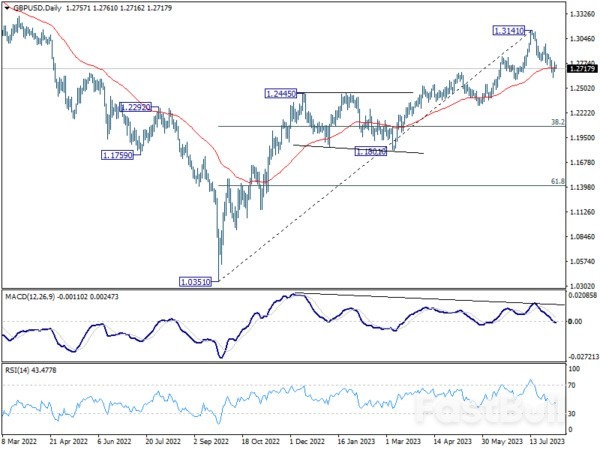
          GBP/USD is in the spotlight this week, considering the anticipation surrounding U.S. inflation and UK GDP data releases. From a technical viewpoint, the pair is currently seeking support from the 55 D EMA. A robust rebound from the current level would indicate that the pullback from 1.3141 is merely a correction to the rise from 1.1801.
          However, sustained trading period below 55 D EMA could signal that the pair is correcting the overall uptrend from 1.0351, thereby increasing the risk of a sharp fall back into the 1.1801/2445 support zone.Market Awaits Clear Direction Amid Market Lull_1
          In Asia, Nikkei closed up 0.19%. Hong Kong HSI is down -0.14%. China Shanghai SSE is down -0.84%. Singapore Strait Times is up 0.50%. Japan 10-year JGB yield is down -0.0124 at 0.634.

          Fed Bowman: Additional rate hikes likely needed

          Fed Governor Michelle Bowman projected the necessity of further rate hikes during a weekend speech, asserting they are likely needed to push inflation back down to the Fed's 2% target.
          Bowman expressed her support for Fed's rate hike in July and stated, "I also expect that additional rate increases will likely be needed to get inflation on a path down to the FOMC's 2 percent target."
          However, Bowman was careful to emphasize that Fed policy is "not on a preset course". Further decisions will be based on "incoming data and its implications for the economic outlook," she stated.
          She said, "We should remain willing to raise the federal funds rate at a future meeting if the incoming data indicate that progress on inflation has stalled."
          While recent lower inflation reading was seen as positive, Bowman asserted the necessity of consistent evidence of inflation moving meaningfully toward the 2% goal when contemplating additional rate hikes and the duration of restrictive federal funds rates.

          BoJ opinions: Flexible YCC needed while maintaining monetary easing

          In the Summary of Opinions at the July 27-28 meeting, BoJ reinforced its commitment to monetary easing but highlighted a pressing need for more "flexibility" in its yield curve control approach policy.
          The bank's primary stance was evident among board members: Achieving a 2% price stability target "has not yet come in sight", necessitating continued monetary easing and the preservation of the current YCC framework.
          "There is still a significantly long way to go before revising the negative interest rate policy, and the framework of yield curve control needs to be maintained," one member noted.
          However, there will be potential market disruptions by strictly capping 10-year JGB yields at 0.5%, another opinion noted.
          Also, given the "increasingly significant upside and downside risks" to prices outlook, flexible YCC is needed for allowing market-driven interest rates, ensuring liquidity, and preventing abrupt rate shifts.
          The bank also remarked on the current inflation trends, suggesting they primarily stem from import inflation. A rise in earning power, especially for small and medium-sized firms, was emphasized as crucial before instituting broader YCC flexibility.
          At the meeting, BoJ permitted a rise in the 10-year yield beyond its usual 0.5% limit, reaching up to 1%.

          U.S. inflation data in the spotlight

          As we move into a new week, U.S. inflation data emerges as a critical highlight, with implications for Fed's monetary policy. In a shift of focus, Fed officials are anticipated to pay closer attention to the monthly core CPI gains, besides the headline numbers. This measure, which strips out the volatile components of food and energy, is considered a more pertinent indicator of the underlying inflation trend, offering a clearer view devoid of base effect distortions.
          Currently, Fed funds futures are pricing in a less than 30% likelihood of further Fed rate hikes going forward. Market participants will be closely eyeing the forthcoming CPI data, hoping for solid evidence to reinforce these expectations.
          However, the week's economic calendar isn't just confined to U.S. inflation data. Other significant indicators on the radar will include UK's GDP figures and Eurozone's Sentix investor confidence index.
          Down Under, Australian consumer sentiment and business confidence figures are due for release. Meanwhile, New Zealand's inflation expectations will be another focal point. Lastly, investors will be keeping an eye on China's CPI and PPI data too.
          Here are some highlights for the week:
          • Monday: BoJ Summary of Opinions, Japan leading indicators; Swiss unemployment rate, foreign currency reserves; Germany industrial production; Eurozone Sentix investor confidence.
          • Tuesday: Japan average cash earnings, household spending, current account; Australia Westpac consumer sentiment, NAB business confidence; China trade balance; Germany CPI final; France trade balance; Canada trade balance; U.S. trade balance.
          • Wednesday: China CPI, PPI; New Zealand inflation expectations; Canada building permits.
          • Thursday: Japan PPI; ECB monthly bulletin; U.S. CPI, jobless claims;
          • Friday: New Zealand BusinessNZ manufacturing index; UK GDP, production, trade balance; U.S. PPI, U of Michigan consumer sentiment.</li

          AUD/USD Daily Report

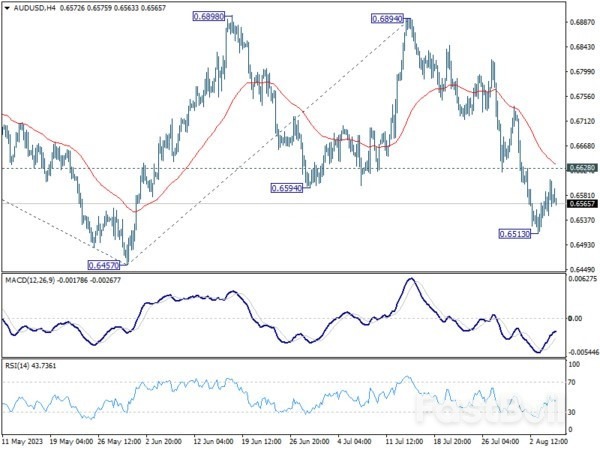
          Intraday bias in AUD/USD remains neutral for consolidation above 0.6513. Current development argues that larger fall from 0.7156 is still in progress. Below 0.6513 will bring retest of 0.6457 support first. Firm break there will confirm this case and target 100% projection of 0.7156 to 0.6457 from 0.6894 at 0.6195. Nevertheless, on the upside, above 0.6628 minor resistance will mix up the outlook and turn bias back to the upside for stronger rebound.Market Awaits Clear Direction Amid Market Lull_2
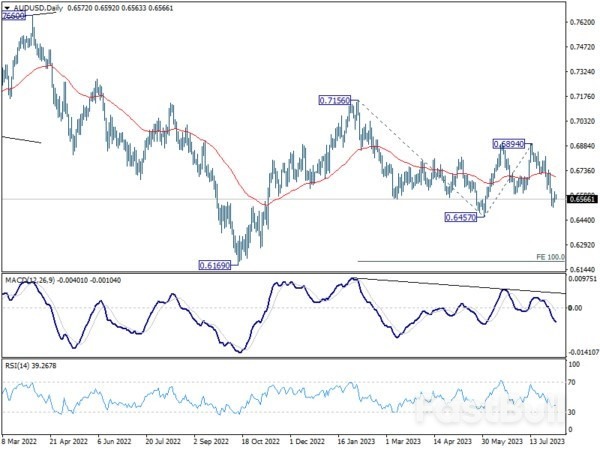
          In the bigger picture, outlook is mixed for now as AUD/USD failed to sustain above both 55 D EMA (now at 0.6696) and 55 W EMA (now at 0.6769). On the upside, break of 0.6894 resistance will solidify the case that down trend from 0.8006 (2021 high) has already completed, and target 0.7156 resistance for confirmation. However, break of 0.6457 will likely resume the down trend through 0.6169 (2022 low).Market Awaits Clear Direction Amid Market Lull_3

          Source: ActionForex

          Risk Warnings and Disclaimers
          You understand and acknowledge that there is a high degree of risk involved in trading. Following any strategies or investment methods may lead to potential losses. The content on the site is provided by our contributors and analysts for information purposes only. You are solely responsible for determining whether any trading assets, securities, strategy, or any other product is suitable for investing based on your own investment objectives and financial situation.
          Comments
          Add to Favorites
          Share
          FastBull
          Copyright © 2025 FastBull Ltd

          728 RM B 7/F GEE LOK IND BLDG NO 34 HUNG TO RD KWUN TONG KLN HONG KONG

          TelegramInstagramTwitterfacebooklinkedin
          App Store Google Play Google Play
          Products
          Charts

          Chats

          Q&A with Experts
          Screeners
          Economic Calendar
          Data
          Tools
          Membership
          Features
          Function
          Markets
          Copy Trading
          Latest Signals
          Contests
          News
          Analysis
          24/7
          Columns
          Education
          Company
          Careers
          About Us
          Contact Us
          Advertising
          Help Center
          Feedback
          User Agreement
          Privacy Policy
          Business

          White Label

          Data API

          Web Plug-ins

          Poster Maker

          Affiliate Program

          Risk Disclosure

          The risk of loss in trading financial instruments such as stocks, FX, commodities, futures, bonds, ETFs and crypto can be substantial. You may sustain a total loss of the funds that you deposit with your broker. Therefore, you should carefully consider whether such trading is suitable for you in light of your circumstances and financial resources.

          No decision to invest should be made without thoroughly conducting due diligence by yourself or consulting with your financial advisors. Our web content might not suit you since we don't know your financial conditions and investment needs. Our financial information might have latency or contain inaccuracy, so you should be fully responsible for any of your trading and investment decisions. The company will not be responsible for your capital loss.

          Without getting permission from the website, you are not allowed to copy the website's graphics, texts, or trademarks. Intellectual property rights in the content or data incorporated into this website belong to its providers and exchange merchants.

          Not Logged In

          Log in to access more features

          FastBull Membership

          Not yet

          Purchase

          Become a signal provider
          Help Center
          Customer Service
          Dark Mode
          Price Up/Down Colors

          Log In

          Sign Up

          Position
          Layout
          Fullscreen
          Default to Chart
          The chart page opens by default when you visit fastbull.com