

Markets
News
Analysis
User
24/7
Economic Calendar
Education
Data
- Names
- Latest
- Prev



Signal Accounts for Members
All Signal Accounts
All Contests
 France Industrial Output MoM (SA) (Nov)
A:--
F: --
P: --
 Italy Retail Sales MoM (SA) (Nov)
A:--
F: --
P: --
 Euro Zone Retail Sales MoM (Nov)
A:--
F: --
Euro Zone Retail Sales YoY (Nov)A:--
F: --
Italy 12-Month BOT Auction Avg. YieldA:--
F: --
P: --
 India Deposit Gowth YoY
A:--
F: --
P: --
 Brazil IPCA Inflation Index YoY (Dec)
A:--
F: --
P: --
 Mexico Industrial Output YoY (Nov)
A:--
F: --
P: --
Brazil CPI YoY (Dec)A:--
F: --
P: --
 U.S. Building Permits Revised YoY (SA) (Oct)
--
F: --
P: --
U.S. Building Permits Revised MoM (SA) (Oct)--
F: --
P: --
U.S. Average Hourly Wage MoM (SA) (Dec)A:--
F: --
U.S. Average Weekly Working Hours (SA) (Dec)A:--
F: --
P: --
U.S. New Housing Starts Annualized MoM (SA) (Oct)A:--
F: --
P: --
U.S. Total Building Permits (SA) (Oct)A:--
F: --
P: --
U.S. Building Permits MoM (SA) (Oct)A:--
F: --
P: --
U.S. Annual New Housing Starts (SA) (Oct)A:--
F: --
P: --
U.S. U6 Unemployment Rate (SA) (Dec)A:--
F: --
P: --
U.S. Manufacturing Employment (SA) (Dec)A:--
F: --
U.S. Labor Force Participation Rate (SA) (Dec)A:--
F: --
P: --
U.S. Private Nonfarm Payrolls (SA) (Dec)A:--
F: --
U.S. Unemployment Rate (SA) (Dec)A:--
F: --
U.S. Nonfarm Payrolls (SA) (Dec)A:--
F: --
U.S. Average Hourly Wage YoY (Dec)A:--
F: --
 Canada Full-time Employment (SA) (Dec)
A:--
F: --
P: --
Canada Part-Time Employment (SA) (Dec)A:--
F: --
P: --
Canada Unemployment Rate (SA) (Dec)A:--
F: --
P: --
Canada Labor Force Participation Rate (SA) (Dec)A:--
F: --
P: --
U.S. Government Employment (Dec)A:--
F: --
P: --
Canada Employment (SA) (Dec)A:--
F: --
P: --
U.S. UMich Consumer Expectations Index Prelim (Jan)--
F: --
P: --
U.S. UMich Consumer Sentiment Index Prelim (Jan)--
F: --
P: --
U.S. UMich Current Economic Conditions Index Prelim (Jan)--
F: --
P: --
U.S. UMich 1-Year-Ahead Inflation Expectations Prelim (Jan)--
F: --
P: --
U.S. UMich 5-Year-Ahead Inflation Expectations Prelim YoY (Jan)--
F: --
P: --
U.S. 5-10 Year-Ahead Inflation Expectations (Jan)--
F: --
P: --
U.S. Weekly Total Oil Rig Count--
F: --
P: --
U.S. Weekly Total Rig Count--
F: --
P: --
 Germany Current Account (Not SA) (Nov)
--
F: --
P: --
 Indonesia Retail Sales YoY (Nov)
--
F: --
P: --
Euro Zone Sentix Investor Confidence Index (Jan)--
F: --
P: --
India CPI YoY (Dec)--
F: --
P: --
















No matching data

Latest Views
Latest Views
Trending Topics
Top Columnists
Latest Update
White Label
Data API
Web Plug-ins
Affiliate Program
View All
No data
An oil tanker with links to Russia was hit by a drone in the Black Sea, Turkish media reported.
WASHINGTON, Jan 8 (Reuters) - U.S. worker productivity grew at its fastest pace in two years in the third quarter as businesses invested heavily in artificial intelligence, depressing labor costs.
Nonfarm productivity, which measures hourly output per worker, accelerated at a 4.9% annualized rate, the Labor Department's Bureau of Labor Statistics said on Thursday.
That was the quickest pace since the third quarter of 2023 and followed an upwardly revised 4.1% growth rate in the second quarter. Economists polled by Reuters had forecast productivity would grow at a 3.0% rate after a previously reported 3.3% pace of expansion in the April-June quarter.
The report was delayed by the 43-day federal government shutdown.

Productivity grew at a 1.9% rate from a year ago. Businesses are spending on AI, which economists said could further boost productivity. The jump in productivity helps to explain the gap between strong gross domestic product growth and a lackluster labor market. The economy grew at a robust 4.3% rate in the third quarter. In contrast, private job gains averaged 55,000 per month in the three months through October.
Unit labor costs - the price of labor per single unit of output - decreased at a 1.9% rate in the third quarter. That followed a 2.9% pace of decline in the April-June quarter. Labor costs increased at a 1.2% rate from a year ago.
The U.S. Supreme Court is poised to rule on the legality of President Donald Trump's sweeping tariffs, with a decision possible as soon as January 9. This high-stakes verdict will determine the fate of a cornerstone of Trump's economic agenda after lower courts found the import taxes were imposed illegally.
The tariffs have remained in effect while the Trump administration appealed to the nation's highest court. During a hearing on November 5, justices expressed skepticism about the president's authority to unilaterally impose these levies under a 1977 emergency law. A ruling against the administration would mark Trump’s most significant legal defeat since returning to the presidency and could trigger complex legal battles over billions of dollars in refunds.
The core of the case revolves around the constitutional separation of powers. Article 1 of the U.S. Constitution explicitly grants Congress the authority to levy taxes and regulate foreign commerce. Over the years, lawmakers have delegated limited trade powers to the president through various laws.
In his first term, Trump tested the limits of these powers. This time, he invoked the International Emergency Economic Powers Act (IEEPA) of 1977, claiming it gave him nearly unlimited authority. The administration cited U.S. trade deficits and cross-border drug trafficking as national emergencies, using IEEPA to justify the tariffs through executive orders.
This move was unprecedented. The IEEPA, which is typically used for sanctions, does not mention tariffs. Lower courts, including the U.S. Court of International Trade, ruled that the law does not delegate "an unbounded tariff authority to the President," a decision later affirmed by the U.S. Court of Appeals for the Federal Circuit. The judges clarified that their ruling was not on the wisdom of the policy but on its legality, stating the president's actions were "impermissible... because [the law] does not allow it."
The Supreme Court's decision specifically targets the "Liberation Day" tariffs announced on April 2. These levies are structured in several layers:
• A minimum baseline tariff of 10% on most imports, with some exceptions.
• "Reciprocal tariffs" ranging from 10% to 41% on goods from nations that did not secure trade deals with the U.S.
• Additional levies on certain imports from Mexico, China, and Canada, which Trump justified by citing the fentanyl crisis.
It is important to note that this case does not affect all of Trump's tariffs. Levies on steel, aluminum, automobiles, copper products, and lumber were imposed using a different legal basis—Section 232 of the 1962 Trade Expansion Act—which allows for tariffs if imports are deemed a national security risk by the Commerce Department.
If the Supreme Court strikes down the IEEPA-based tariffs, the administration would not only lose the ability to collect them but would also face demands to refund duties already paid. More than 1,000 companies have already lined up in court seeking reimbursement.
This potential unraveling of a major revenue stream could worsen concerns about U.S. public finances. The administration had previously pointed to increased tariff revenue as a way to offset tax cuts from a bill Trump signed on July 4. A sudden reversal could amplify questions from bond market investors about the country's growing debt load.
In a separate but related case, a federal judge in Washington also declared some of Trump's tariffs unlawful, though the ruling was limited to the two family-owned toy manufacturers that filed the lawsuit.
Even a loss at the Supreme Court wouldn't completely disarm Trump's push to reshape global trade. The administration has other tools at its disposal, though they are generally more limited than the broad powers it sought under IEEPA. These alternatives include:
• Section 232: Continuing to use national security investigations to justify tariffs on specific product categories.
• Trade Act Provisions: Imposing temporary import taxes of up to 15% for 150 days, but only in the event of a "large and serious" balance-of-payments crisis or to prevent a significant depreciation of the dollar.
• Section 301 Investigations: Launching investigations into unfair trade practices by other countries, although this process is slower to implement.
The justices are set to return from a four-week holiday recess on January 9, which is scheduled as their first "opinion day," making it the earliest possible date for a ruling in this landmark case.
A December survey from the Federal Reserve Bank of New York reveals a growing disconnect in the American economic outlook, with consumers expecting higher inflation while their confidence in the job market has fallen to its lowest point in over a decade.
These conflicting signals highlight the complex challenge facing the Federal Reserve as it weighs its next move on interest rates.
According to the New York Fed’s monthly Survey of Consumer Expectations, Americans see prices rising by 3.4% over the next year, an increase from the 3.2% expectation reported in November.
At the same time, the survey painted a grim picture of the labor market. The perceived probability of finding a new job after a layoff dropped to 43.1%. This marks the lowest level of confidence recorded since the survey began in mid-2013, signaling significant anxiety about job security.
Longer-term inflation expectations, however, remained stable, with both the three-year and five-year outlooks holding steady at 3%.
This data captures the core debate within the central bank. Some Fed officials remain focused on taming inflation, while others see rising unemployment as the more immediate risk. The divergence between rising price expectations and falling job market confidence is likely to keep the Fed on hold, making an interest rate adjustment at its upcoming policy meeting improbable.
The survey's findings were released just ahead of key economic data, including the Bureau of Labor Statistics' monthly employment report and the upcoming consumer price index figures, which will provide a clearer picture of the economy's direction.
The report also uncovered conflicting views on personal financial health.
Consumers reported a higher probability of missing a minimum debt payment over the next three months, which climbed to 15.3%—the highest level since the economic turmoil of April 2020.
Despite this near-term financial pressure, a surprising wave of optimism emerged. The share of respondents who expect their personal financial situations to improve over the next year rose to its highest point since February 2025.
The U.S. Senate is scheduled to vote Thursday on a resolution to curb President Donald Trump's authority to use military force in Venezuela without getting a green light from Congress.
The vote follows a military strike ordered by the president less than a week ago that led to the capture of Venezuelan leader Nicolás Maduro. That operation was launched without prior legislative authorization.
The measure, a War Powers Resolution, is being brought forward by a bipartisan effort from Democratic Senator Tim Kaine and Republican Senator Rand Paul. It needs only a simple majority to pass the Republican-controlled Senate and would force the president to seek congressional approval before committing to further military action in Venezuela.
The resolution cuts to a core constitutional debate over which branch of government has the power to commit the nation to war.
"Make no mistake, bombing another nation's capital and removing their leader is an act of war plain and simple," Senator Paul said in a statement. "No provision in the Constitution provides such power to the presidency."
While the Constitution vests Congress with the power to declare war, the Trump administration and its allies have argued that the strike against Maduro did not require congressional approval. They have characterized the mission as a law enforcement operation, noting that Maduro is now facing drug-related charges in New York.
Securing enough votes for the resolution will be a challenge. Republicans currently hold a 53-47 majority in the Senate, meaning at least four Republican senators must join all Democrats for the measure to pass.
A similar resolution was voted down in November, with only two Republicans—Paul and Senator Lisa Murkowski of Alaska—siding with the Democrats.
If the resolution clears the Senate, it would then move to the House of Representatives for approval, where Republicans also hold a razor-thin majority.
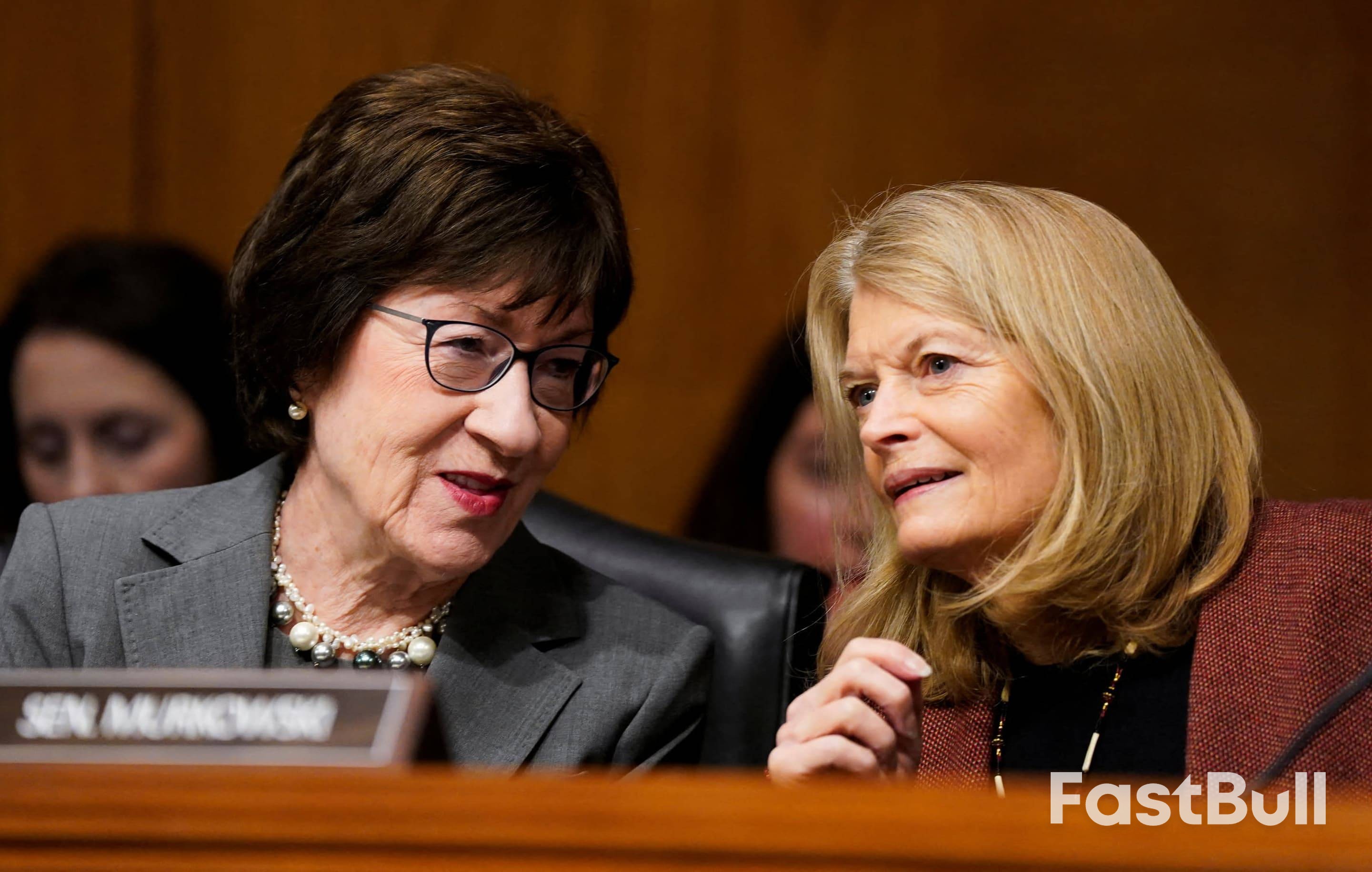
There are signs that more Republicans may be willing to support the measure this time. On Thursday, Senator Susan Collins of Maine announced she would vote for the resolution.
"While I support the operation to seize Nicolas Maduro, which was extraordinary in its precision and complexity, I do not support committing additional U.S. forces or entering into any long-term military involvement in Venezuela or Greenland without specific congressional authorization," Collins stated.
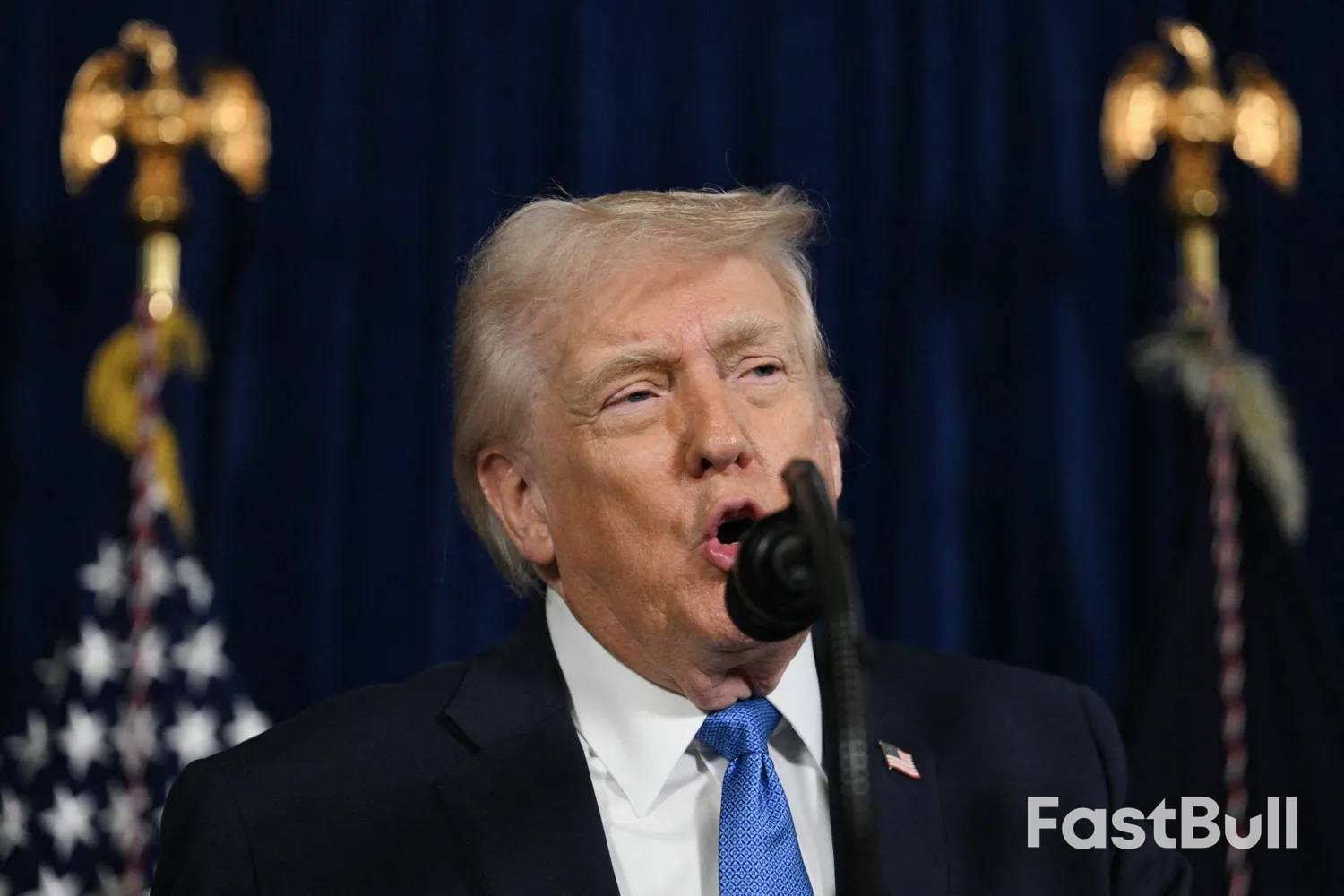
Defense sector stocks led the S&P 500 on Thursday after former President Donald Trump called for a massive increase in U.S. military spending. The proposal, shared on his Truth Social platform, immediately boosted the shares of major defense contractors.
In his post, Trump outlined a vision for a significantly larger military budget. "For the Good of our Country, especially in these very troubled and dangerous times, our Military Budget for the year 2027 should not be $1 Trillion Dollars, but rather $1.5 Trillion Dollars," he stated.
This proposed $1.5 trillion figure represents a dramatic jump from current and projected levels. For fiscal year 2025, the Department of Defense budget stands at $850 billion. The White House had previously proposed an increase to nearly $1 trillion for fiscal 2026. Trump's plan would amount to an approximately 50% increase over that projection.
The market reacted swiftly to the prospect of increased government contracts. Several defense giants saw their stock prices climb, placing them among the top performers in the S&P 500.
• Lockheed Martin (LMT), Huntington Ingalls (HII), and L3 Harris (LHX) each gained more than 7%.
• General Dynamics (GD) and Northrop Grumman (NOC) shares rose by more than 4%.
• RTX Corp. (RTX), the parent company of Raytheon, added 2%.
Thursday's rally marked a sharp reversal from the previous day's trading session. On Wednesday, defense stocks had suffered losses after Trump criticized the companies for spending on stock buybacks and dividends. He argued they should instead focus their resources on accelerating and improving their manufacturing capabilities.
The call for higher spending comes amid heightened military activity under the Trump administration. Recent actions include last weekend's strike that resulted in the capture of Venezuelan President Nicolás Maduro. The White House has also renewed discussion about controlling Greenland for strategic purposes, suggesting the military could be utilized in such an effort.

U.S. President Donald Trump on Wednesday said his administration is moving to ban Wall Street firms from buying up single-family homes in a bid to reduce home prices, a potential blow for private-equity landlords that also pressured homebuilder stocks.
In a post on Truth Social, Trump said he was immediately taking steps to implement the ban, which he would also call on Congress to codify in law. It was not clear what steps he would take.
"For a very long time, buying and owning a home was considered the pinnacle of the American Dream," Trump wrote, adding that inflation had put that dream out of reach for many Americans.
"People live in homes, not corporations," said Trump, who is under growing pressure to address voter anxiety over the cost of living ahead of this year's congressional midterm elections.
A Republican move to target Wall Street landlords would, perversely, align the party with Democrats, who for years have criticized corporate homebuying, claiming it has helped stoke housing costs, and have unsuccessfully pushed bills to crack down on the trend.
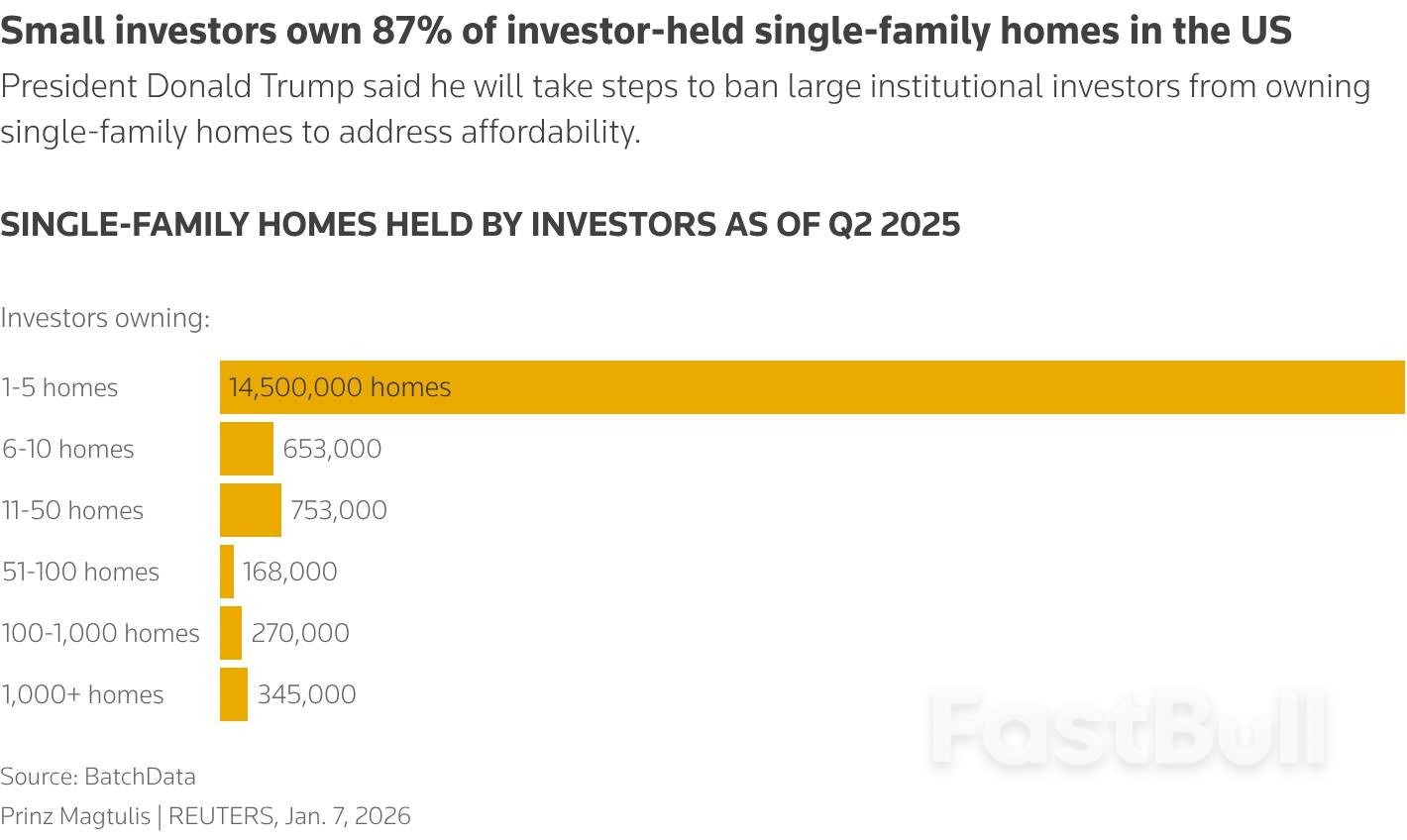 A bar chart showing the number of single-family homes held by investors, by the number of home units held by each investor as of the second quarter of 2025.
Wall Street institutions such as Blackstone (BX.N), American Homes 4 Rent (AMH.N) and Progress Residential have bought thousands of single-family homes since the financial crisis of 2008 led to a wave of home foreclosures.
By June 2022, institutional investors owned around 450,000 homes, or about 3%, of all single-family rental homes nationally, according to a 2024 study by the Government Accountability Office.
American Homes 4 Rent (AMH.N) dropped to a near three-year low of $28.84 and was halted for volatility before trading resumed. Its shares closed down 4% at $31.01.
Blackstone shares hit a one-month low of $147.52 and closed down about 5.6% at $153.59. The PHLX housing index (.HGX) fell 2.6%.
A spokesperson for Blackstone said their ownership of such homes represented a small portion of their overall business, and that they had been a net seller of homes for the prior decade.
"That said, we believe our current portfolio is poised to continue to perform quite well and operate at the highest standards for residents," the spokesperson said.
American Homes 4 Rent and Progress Residential did not immediately respond to a request for comment.
Wall Street landlords dispute that their investments have stoked inflation. In a January 2025 research note, Blackstone said institutional home purchases have declined 90% since 2022 and that supply shortage is the reason for house price increases.
The GAO study found that the effect of institutional homebuying on homeownership opportunities was unclear in part due to limited data.
Critics say Wall Street firms are also bad landlords, skimping on upkeepto keep investors happy, and wrongly evicted tenants during the COVID-19 pandemic.
"Resident experience is hurting as a result," said Jeff Holzmann, COO of RREAF Holdings, a Dallas-based real estate investment firm with over $5 billion in assets.
"Instead of you calling your landlord to discuss a problem, you're calling a call center that gives you the runaround."
Trump, who has occasionally dismissed affordability concerns and blamed inflation on his Democratic predecessor, has seen his own public approval mostly sag since his inauguration as Americans worry about the economy.
It was not immediately clear what authority Trump would draw upon to impose a ban, and he did not outline the changes he was seeking from Congress.
The White House did not respond to a request for comment.
Since Trump's first electoral victory, U.S. home prices have risen 75%, more than double the increase in overall consumer prices tracked by CPI. But home sales price increases have eased substantially over the past year.
The Federal Housing Finance Agency last week reported that national home sales prices had risen just 1.7% in October, from a year earlier, the lowest in more than 13 years. That's less than half the rate by which they were climbing when Trump came back into office last January and a fraction of their peak gains of nearly 20% in 2021 and 2022.
A big factor in home price inflation has been a lack of properties for sale, although that has also been slowly improving over the last year or so, according to National Association of Realtors data.
As of November, annual shelter-cost inflation, which had shot to as high as 8.2% in the COVID-19 pandemic aftermath, had also eased to 3.0%, the lowest in more than four years, according to the Labor Department's Consumer Price Index.
728 RM B 7/F GEE LOK IND BLDG NO 34 HUNG TO RD KWUN TONG KLN HONG KONG


White Label
Data API
Web Plug-ins
Poster Maker
Affiliate Program
The risk of loss in trading financial instruments such as stocks, FX, commodities, futures, bonds, ETFs and crypto can be substantial. You may sustain a total loss of the funds that you deposit with your broker. Therefore, you should carefully consider whether such trading is suitable for you in light of your circumstances and financial resources.
No decision to invest should be made without thoroughly conducting due diligence by yourself or consulting with your financial advisors. Our web content might not suit you since we don't know your financial conditions and investment needs. Our financial information might have latency or contain inaccuracy, so you should be fully responsible for any of your trading and investment decisions. The company will not be responsible for your capital loss.
Without getting permission from the website, you are not allowed to copy the website's graphics, texts, or trademarks. Intellectual property rights in the content or data incorporated into this website belong to its providers and exchange merchants.
Not Logged In
Log in to access more features

FastBull Membership
Not yet
Purchase


Log In
Sign Up


