• Trade
  • Markets
  • Copy
  • Contests
  • News
  • 24/7
  • Calendar
  • Q&A
  • Chats
Trending
Screeners
SYMBOL
LAST
BID
ASK
HIGH
LOW
NET CHG.
%CHG.
SPREAD
SPX
S&P 500 Index
6827.42
6827.42
6827.42
6899.86
6801.80
-73.58
-1.07%
--
DJI
Dow Jones Industrial Average
48458.04
48458.04
48458.04
48886.86
48334.10
-245.98
-0.51%
--
IXIC
NASDAQ Composite Index
23195.16
23195.16
23195.16
23554.89
23094.51
-398.69
-1.69%
--
USDX
US Dollar Index
97.950
98.030
97.950
98.500
97.950
-0.370
-0.38%
--
EURUSD
Euro / US Dollar
1.17394
1.17409
1.17394
1.17496
1.17192
+0.00011
+ 0.01%
--
GBPUSD
Pound Sterling / US Dollar
1.33707
1.33732
1.33707
1.33997
1.33419
-0.00148
-0.11%
--
XAUUSD
Gold / US Dollar
4299.39
4299.39
4299.39
4353.41
4257.10
+20.10
+ 0.47%
--
WTI
Light Sweet Crude Oil
57.233
57.485
57.233
58.011
56.969
-0.408
-0.71%
--

Community Accounts

Signal Accounts
--
Profit Accounts
--
Loss Accounts
--
View More

Become a signal provider

Sell trading signals to earn additional income

View More

Guide to Copy Trading

Get started with ease and confidence

View More

Signal Accounts for Members

All Signal Accounts

Best Return
  • Best Return
  • Best P/L
  • Best MDD
Past 1W
  • Past 1W
  • Past 1M
  • Past 1Y

All Contests

  • All
  • Trump Updates
  • Recommend
  • Stocks
  • Cryptocurrencies
  • Central Banks
  • Featured News
Top News Only
Share

Ukraine Says It Received 114 Prisoners From Belarus

Share

USA Embassy In Lithuania: Maria Kalesnikava Is Not Going To Vilnius

Share

USA Embassy In Lithuania: Other Prisoners Are Being Sent From Belarus To Ukraine

Share

Ukraine President Zelenskiy: Five Ukrainians Released By Belarus In US-Brokered Deal

Share

USA Vilnius Embassy: USA Stands Ready For "Additional Engagement With Belarus That Advances USA Interests"

Share

USA Vilnius Embassy: Belarus, USA, Other Citizens Among The Prisoners Released Into Lithuania

Share

USA Vilnius Embassy: USA Will Continue Diplomatic Efforts To Free The Remaining Political Prisoners In Belarus

Share

USA Vilnius Embassy: Belarus Releases 123 Prisoners Following Meeting Of President Trump's Envoy Coale And Belarus President Lukashenko

Share

USA Vilnius Embassy: Masatoshi Nakanishi, Aliaksandr Syrytsa Are Among The Prisoners Released By Belarus

Share

USA Vilnius Embassy: Maria Kalesnikava And Viktor Babaryka Are Among The Prisoners Released By Belarus

Share

USA Vilnius Embassy: Nobel Peace Prize Laureate Ales Bialiatski Is Among The Prisoners Released By Belarus

Share

Belarusian Presidential Administration Telegram Channel: Lukashenko Has Pardoned 123 Prisoners As Part Of Deal With US

Share

Two Local Syrian Officials: Joint US-Syrian Military Patrol In Central Syria Came Under Fire From Unknown Assailants

Share

Israeli Military Says It Targeted 'Key Hamas Terrorist' In Gaza City

Share

Rwanda's Actions In Eastern Drc Are A Clear Violation Of Washington Accords Signed By President Trump - Secretary Of State Rubio

Share

Israeli Military Issues Evacuation Warning In Southern Lebanon Village Ahead Of Strike - Spokesperson On X

Share

Belarusian State Media Cites US Envoy Coale As Saying He Discussed Ukraine And Venezuela With Lukashenko

Share

Belarusian State Media Cites US Envoy Coale As Saying That US Removes Sanctions On Belarusian Potassium

Share

Thai Prime Minister: No Ceasefire Agreement With Cambodia

Share

US, Ukraine To Discuss Ceasefire In Berlin Ahead Of European Summit

TIME
ACT
FCST
PREV
U.K. Trade Balance Non-EU (SA) (Oct)

A:--

F: --

P: --

U.K. Trade Balance (Oct)

A:--

F: --

P: --

U.K. Services Index MoM

A:--

F: --

P: --

U.K. Construction Output MoM (SA) (Oct)

A:--

F: --

P: --

U.K. Industrial Output YoY (Oct)

A:--

F: --

P: --

U.K. Trade Balance (SA) (Oct)

A:--

F: --

P: --

U.K. Trade Balance EU (SA) (Oct)

A:--

F: --

P: --

U.K. Manufacturing Output YoY (Oct)

A:--

F: --

P: --

U.K. GDP MoM (Oct)

A:--

F: --

P: --

U.K. GDP YoY (SA) (Oct)

A:--

F: --

P: --

U.K. Industrial Output MoM (Oct)

A:--

F: --

P: --

U.K. Construction Output YoY (Oct)

A:--

F: --

P: --

France HICP Final MoM (Nov)

A:--

F: --

P: --

China, Mainland Outstanding Loans Growth YoY (Nov)

A:--

F: --

P: --

China, Mainland M2 Money Supply YoY (Nov)

A:--

F: --

P: --

China, Mainland M0 Money Supply YoY (Nov)

A:--

F: --

P: --

China, Mainland M1 Money Supply YoY (Nov)

A:--

F: --

P: --

India CPI YoY (Nov)

A:--

F: --

P: --

India Deposit Gowth YoY

A:--

F: --

P: --

Brazil Services Growth YoY (Oct)

A:--

F: --

P: --

Mexico Industrial Output YoY (Oct)

A:--

F: --

P: --

Russia Trade Balance (Oct)

A:--

F: --

P: --

Philadelphia Fed President Henry Paulson delivers a speech
Canada Building Permits MoM (SA) (Oct)

A:--

F: --

P: --

Canada Wholesale Sales YoY (Oct)

A:--

F: --

P: --

Canada Wholesale Inventory MoM (Oct)

A:--

F: --

P: --

Canada Wholesale Inventory YoY (Oct)

A:--

F: --

P: --

Canada Wholesale Sales MoM (SA) (Oct)

A:--

F: --

P: --

Germany Current Account (Not SA) (Oct)

A:--

F: --

P: --

U.S. Weekly Total Rig Count

A:--

F: --

P: --

U.S. Weekly Total Oil Rig Count

A:--

F: --

P: --

Japan Tankan Large Non-Manufacturing Diffusion Index (Q4)

--

F: --

P: --

Japan Tankan Small Manufacturing Outlook Index (Q4)

--

F: --

P: --

Japan Tankan Large Non-Manufacturing Outlook Index (Q4)

--

F: --

P: --

Japan Tankan Large Manufacturing Outlook Index (Q4)

--

F: --

P: --

Japan Tankan Small Manufacturing Diffusion Index (Q4)

--

F: --

P: --

Japan Tankan Large Manufacturing Diffusion Index (Q4)

--

F: --

P: --

Japan Tankan Large-Enterprise Capital Expenditure YoY (Q4)

--

F: --

P: --

U.K. Rightmove House Price Index YoY (Dec)

--

F: --

P: --

China, Mainland Industrial Output YoY (YTD) (Nov)

--

F: --

P: --

China, Mainland Urban Area Unemployment Rate (Nov)

--

F: --

P: --

Saudi Arabia CPI YoY (Nov)

--

F: --

P: --

Euro Zone Industrial Output YoY (Oct)

--

F: --

P: --

Euro Zone Industrial Output MoM (Oct)

--

F: --

P: --

Canada Existing Home Sales MoM (Nov)

--

F: --

P: --

Euro Zone Total Reserve Assets (Nov)

--

F: --

P: --

U.K. Inflation Rate Expectations

--

F: --

P: --

Canada National Economic Confidence Index

--

F: --

P: --

Canada New Housing Starts (Nov)

--

F: --

P: --

U.S. NY Fed Manufacturing Employment Index (Dec)

--

F: --

P: --

U.S. NY Fed Manufacturing Index (Dec)

--

F: --

P: --

Canada Core CPI YoY (Nov)

--

F: --

P: --

Canada Manufacturing Unfilled Orders MoM (Oct)

--

F: --

P: --

Canada Manufacturing New Orders MoM (Oct)

--

F: --

P: --

Canada Core CPI MoM (Nov)

--

F: --

P: --

Canada Manufacturing Inventory MoM (Oct)

--

F: --

P: --

Canada CPI YoY (Nov)

--

F: --

P: --

Canada CPI MoM (Nov)

--

F: --

P: --

Canada CPI YoY (SA) (Nov)

--

F: --

P: --

Canada Core CPI MoM (SA) (Nov)

--

F: --

P: --

Q&A with Experts
    • All
    • Chatrooms
    • Groups
    • Friends
    Connecting
    .
    .
    .
    Type here...
    Add Symbol or Code

      No matching data

      All
      Trump Updates
      Recommend
      Stocks
      Cryptocurrencies
      Central Banks
      Featured News
      • All
      • Russia-Ukraine Conflict
      • Middle East Flashpoint
      • All
      • Russia-Ukraine Conflict
      • Middle East Flashpoint
      Search
      Products

      Charts Free Forever

      Chats Q&A with Experts
      Screeners Economic Calendar Data Tools
      Membership Features
      Data Warehouse Market Trends Institutional Data Policy Rates Macro

      Market Trends

      Market Sentiment Order Book Forex Correlations

      Top Indicators

      Charts Free Forever
      Markets

      News

      News Analysis 24/7 Columns Education
      From Institutions From Analysts
      Topics Columnists

      Latest Views

      Latest Views

      Trending Topics

      Top Columnists

      Latest Update

      Signals

      Copy Rankings Latest Signals Become a signal provider AI Rating
      Contests
      Brokers

      Overview Brokers Assessment Rankings Regulators News Claims
      Broker listing Forex Brokers Comparison Tool Live Spread Comparison Scam
      Q&A Complaint Scam Alert Videos Tips to Detect Scam
      More

      Business
      Events
      Careers About Us Advertising Help Center

      White Label

      Data API

      Web Plug-ins

      Affiliate Program

      Awards Institution Evaluation IB Seminar Salon Event Exhibition
      Vietnam Thailand Singapore Dubai
      Fans Party Investment Sharing Session
      FastBull Summit BrokersView Expo
      Recent Searches
        Top Searches
          Markets
          News
          Analysis
          User
          24/7
          Economic Calendar
          Education
          Data
          • Names
          • Latest
          • Prev

          View All

          No data

          Scan to Download

          Faster Charts, Chat Faster!

          Download App
          English
          • English
          • Español
          • العربية
          • Bahasa Indonesia
          • Bahasa Melayu
          • Tiếng Việt
          • ภาษาไทย
          • Français
          • Italiano
          • Türkçe
          • Русский язык
          • 简中
          • 繁中
          Open Account
          Search
          Products
          Charts Free Forever
          Markets
          News
          Signals

          Copy Rankings Latest Signals Become a signal provider AI Rating
          Contests
          Brokers

          Overview Brokers Assessment Rankings Regulators News Claims
          Broker listing Forex Brokers Comparison Tool Live Spread Comparison Scam
          Q&A Complaint Scam Alert Videos Tips to Detect Scam
          More

          Business
          Events
          Careers About Us Advertising Help Center

          White Label

          Data API

          Web Plug-ins

          Affiliate Program

          Awards Institution Evaluation IB Seminar Salon Event Exhibition
          Vietnam Thailand Singapore Dubai
          Fans Party Investment Sharing Session
          FastBull Summit BrokersView Expo

          Russia Says it Thwarted Major Ukrainian Offensive, Killed Hundreds

          Thomas

          Russia-Ukraine Conflict

          Summary:

          Russia said on Monday its forces had thwarted a major Ukrainian offensive at five points along the front in the southern Ukrainian region of Donetsk and killed hundreds of pro-Kyiv troops.

          Russia said on Monday its forces had thwarted a major Ukrainian offensive at five points along the front in the southern Ukrainian region of Donetsk and killed hundreds of pro-Kyiv troops.
          It was not immediately clear whether or not the reported attack represented the start of a Ukrainian counteroffensive which Kyiv has been promising for months to recapture territory taken by Russian forces after the invasion of February 2022.
          Russia's defence ministry said Ukraine had attacked with six mechanised and two tank battalions in southern Donetsk, where Moscow has long suspected Ukraine would seek to drive a wedge through Russian-controlled territory.
          "On the morning of June 4, the enemy launched a large-scale offensive in five sectors of the front in the South Donetsk direction," the defence ministry said in a statement posted on Telegram at 1:30 a.m. Moscow time (2230 GMT).
          "The enemy's goal was to break through our defences in the most vulnerable, in its opinion, sector of the front," it said. "The enemy did not achieve its tasks, it had no success."
          Reuters was unable to immediately verify the Russian statement and the Ukrainian defence ministry and military did not immediately respond to written requests for comment.
          The daily report from Ukraine's General Staff said only that there were 29 combat clashes in the Donetsk and Luhansk regions.
          Ukrainian Defence Minister Oleksii Reznikov published a cryptic message on Twitter on Sunday, quoting Depeche Mode's track "Enjoy the Silence".
          "Words are very unnecessary They can only do harm," his tweet said.
          Ukraine last week published a flashy video depicting troops preparing for battle and reciting a rousing blessing, which was later aired as a recruiting clip.
          Russia's defence ministry released video of what it said showed several Ukrainian armoured vehicles in a field blowing up after being hit.
          Russian forces killed 250 Ukrainian troops as well as destroying 16 tanks, three infantry fighting vehicles and 21 armoured combat vehicles, the ministry said.
          Russian Chief of the General Staff Valery Gerasimov, who is in charge of Moscow's military operation in Ukraine, was in the area of the Ukrainian attack, the ministry said.
          Some prominent Russian military bloggers, including Semyon Pegov, who blogs under the name War Gonzo, reported heavy fighting early on Monday in areas controlled by Russia. Pegov said that Ukrainian forces are attacking near Velyka Novosilka in the Donetsk region.
          "There is a tough fight going on."
          Other Russian military bloggers reported also heavy fighting on Monday morning near Bakhmut, nearby Soledar and Vuhledar in the Donetsk region. Reuters could not independently verify the reports.
          Counter-offensive?
          For months, Ukraine has been preparing for a counter-offensive against Russian forces which officials in Kyiv and CIA Director William Burns have said will pierce Russian President Vladimir Putin's hubris.
          Ukrainian President Volodymyr Zelenskiy told the Wall Street Journal in an interview published on Saturday that he was ready to launch the counteroffensive but tempered a forecast of success with a warning that it could take some time and come at a heavy cost.
          "I don't know how long it will take," he told The Journal. "To be honest, it can go a variety of ways, completely different. But we are going to do it, and we are ready."
          After seeking tens of billions of dollars of Western weapons to fight Russian forces, the success or failure of the counter-offensive is likely to influence the shape of future Western diplomatic and military support for Ukraine.
          Ukraine has in recent weeks sought to weaken Russian positions but its specific plans have been shrouded in secrecy as it seeks to strike yet another blow against the much larger military of Russia.
          Moscow was last month struck by drones which Russia said was a Ukrainian terrorist attack while pro-Ukrainian forces have repeatedly crossed into Russia proper in recent days in the Belgorod region.
          After a two-month lull, Russia has launched hundreds of drones and missiles on Ukraine since early May, chiefly on Kyiv, with Ukraine saying the targets were its military and critical infrastructure facilities.
          War In Ukraine
          Putin sent troops into Ukraine on February 24 last year in what the Kremlin expected to be swift operation but its forces suffered a series of defeats and had to move back and regroup in swathes of eastern Ukraine.
          Russia now controls at least 18% of what is internationally recognised to be Ukrainian territory, and has claimed four regions of Ukraine as Russian territory.
          For months, tens of thousands of Russian troops have been digging in along a front line which stretches for around 600 miles (1,000km), bracing for a Ukrainian attack which is expected to try to cut Russia's so-called land bridge to the Crimean peninsula, which Russia annexed in 2014.
          Ukraine says it will not rest until it has ejected every last Russian soldier from its territory, and casts the invasion as an imperial-style land grab by Russia, the world's biggest nuclear power.
          Russia says the war is escalating and says the West is fighting what amounts to a hybrid war against Russia which is aimed at sowing discord and ultimately carving up Russia's vast natural resources.
          The West says it wants Ukraine to defeat Russia but denies that it wants to destroy Russia. U.S. President Joe Biden said last year that a direct confrontation between NATO and Russia would mean World War Three.

          Source: Reuters

          Risk Warnings and Disclaimers
          You understand and acknowledge that there is a high degree of risk involved in trading. Following any strategies or investment methods may lead to potential losses. The content on the site is provided by our contributors and analysts for information purposes only. You are solely responsible for determining whether any trading assets, securities, strategy, or any other product is suitable for investing based on your own investment objectives and financial situation.
          Comments
          Add to Favorites
          Share

          Services PMIs the Next Focus after Last Week's Bumper U.S. Jobs Report

          Devin

          Forex

          While U.S. markets finished the week on a high, after another bumper jobs report and a positive week across the board, markets in Europe, while finishing the week on a high, struggled to match the exuberance of investors on the other side of the Atlantic.
          The Nasdaq 100 once again led the way, finishing higher for the sixth week in a row, while the S&P500 closed at its highest levels since August last year. European markets on the other hand, while finishing the week strongly higher, had a more mixed weekly performance.
          The reason was a jobs report that painted a picture of a resilient U.S. economy that continues to add jobs at a solid pace, as for the 14th month in a row the number of jobs added comfortably beat economic forecasts. 339k new jobs were added in May, with a 92k upward revision to the previous 2 months, although the unemployment rate ticked up to 3.7%, a number that wasn't matched by an uptick in the participation rate. Wage growth slowed modestly to 4.3% but not by enough to suggest that the labour market is loosening. Every labour market data item the market was exposed to last week showed that U.S. businesses are still hiring, and vacancy rates are showing little sign of slowing.
          This in turn presents the Federal Reserve with a problem, having so clearly suggested they might pause or skip a rate hike at this month's meeting, a lot of the economic data suggests that rate hikes thus far have had little effect. U.S. 2-year yields reacted accordingly, closing almost 16bps higher on the day, even though they still finished the week lower.
          With the latest U.S. inflation numbers due out the day before next week's Fed meeting, U.S. policymakers will have a challenging job to spin the idea of holding rates while at the same time keeping the option open for a July rate move. It may well be easier to hike in June and leave one's options open for July. The messaging would undoubtedly be simpler, however the splits on the FOMC are already showing and there are differences of opinion starting to emerge on what comes next.
          2-year rates did finish last week down from their peaks of the previous week, however the way they closed off their lows suggest that bond markets remain unconvinced that they will come down quicker than the rate at which they have risen over the past few weeks.
          The U.S. dollar also finished the day higher on Friday in anticipation that rates would stay higher for longer, albeit modestly lower on the week.
          What was clear from last week's economic data was the dire state of the manufacturing sector globally, stuck permanently in contraction with little prospect of a rebound in the short term.
          The services sector on the other hand has been much more buoyant, a fact that should be borne out by today's services PMIs from Spain, Italy, France Germany, the UK and U.S., and which are expected to show resilience to the tune of 57, 57, 52.8, 57.8, 55.1 and 55.1 respectively, all performing strongly despite higher costs, although all are expected to be weaker than their April numbers.
          If anything, Friday's jobs report had something for the bulls and the bears, and while European markets underperformed last week, there is a feeling that central banks are quite close to the end game when it comes to rate hikes, and that while rates shot up at the end of last week, they are holding below their recent peaks.
          Inflation does appear to be coming down on the headline level, as are producer prices at a faster rate and these tend to be leading indicators, even with core prices being sticky. That would suggest that core prices will come down, albeit at a much slower rate than originally thought.
          Today's EU PPI numbers for April ought to add further insight into that trend, with an expectation that on a month-on-month basis we could see the -1.6% decline in March accelerate in April to a -3.1% fall.
          With China PPI also in negative territory to the tune of -3.6% year on year for the same month, the global economy could be about to undergo a wider wave of disinflation.
          The wider question is whether the Saudi's attempts to underpin the oil price with further production cuts, which were announced over the weekend, make the current situation worse and push Brent crude prices back above $80 a barrel at a time when consumer sentiment remains incredibly fragile.
          More question marks remain over the Chinese economy after whispers last week that the authorities there were looking at measures to support its property market, which saw a rebound in metals prices.
          EUR/USD – the failure at the 1.0780 area has seen the euro slip back, with support back at the recent lows at 1.0635. We need to see a break of this range with broader resistance at the 1.0820/30 level.
          GBP/USD – slipped back from the 1.2540 area last week, but remains in a broader uptrend with support at the 1.2300 area and trend line resistance from the 2021 highs at 1.2630. This, along with the May highs at 1.2680 is a key barrier for a move towards the 1.3000 area.
          EUR/GBP – found support at the 0.8560 level last week, just above the December 2022 lows at 0.8558. A break of 0.8550 targets 0.8480. The 0.8620 area now becomes resistance with major resistance behind that at the 0.8720 area.
          USD/JPY – last week's decline from the 140.95 area found support at the 138.40 area, and rallied back to the 140.00 level. While above the 137.00 area the risk remains for a move towards 142.50.

          Source: CMC

          Risk Warnings and Disclaimers
          You understand and acknowledge that there is a high degree of risk involved in trading. Following any strategies or investment methods may lead to potential losses. The content on the site is provided by our contributors and analysts for information purposes only. You are solely responsible for determining whether any trading assets, securities, strategy, or any other product is suitable for investing based on your own investment objectives and financial situation.
          Comments
          Add to Favorites
          Share

          Dogecoin Investors Accuse Elon Musk of Insider Trading and Market Manipulation in Lawsuit

          Warren Takunda

          Cryptocurrency

          Traders' Opinions

          In a shocking turn of events, a group of Dogecoin investors has filed a lawsuit against renowned entrepreneur Elon Musk, alleging insider trading and market manipulation of the popular cryptocurrency, Dogecoin (DOGE). The investors claim that Musk, through a series of calculated actions, leveraged his influence to artificially boost the price of DOGE for personal gain.
          According to the lawsuit, Musk utilized various means to manipulate DOGE's price, including his active presence on Twitter, his appearance on Saturday Night Live (SNL), and other attention-grabbing publicity stunts. The investors assert that Musk strategically utilized his vast online following to promote DOGE, thereby inflating its value, only to sell off significant amounts of the cryptocurrency for substantial profits.
          The allegations point to an incident in April when Musk changed his Twitter profile picture to DOGE's logo. This seemingly innocuous act allegedly caused a significant surge in DOGE's price, leading to a 30% increase. The investors claim that during this price spike, Musk offloaded approximately $124 million worth of DOGE from wallets under his control or those of Tesla, the electric vehicle company he heads.
          Moreover, the lawsuit argues that Dogecoin should be considered a security under the regulatory framework established by the U.S. Securities and Exchange Commission (SEC). By promoting and manipulating DOGE's value, Musk is accused of violating federal securities laws, which could have far-reaching consequences for both the entrepreneur and the cryptocurrency market as a whole.
          In response to the allegations, Musk and Tesla have vehemently denied any wrongdoing, dismissing the lawsuit as a "fanciful work of fiction." They maintain that Musk's involvement with DOGE has been lighthearted and intended for entertainment purposes rather than financial gain.
          This legal battle between Dogecoin investors and Elon Musk has drawn significant attention, underscoring the growing need for regulatory clarity in the cryptocurrency space. The outcome of this case may set important precedents regarding the responsibilities and limitations of influential figures in shaping the value of digital assets.
          While the lawsuit continues to unfold, the allegations against Elon Musk serve as a reminder that even in the world of decentralized cryptocurrencies, accountability and transparency remain essential for investor confidence and the overall stability of the market.
          Risk Warnings and Disclaimers
          You understand and acknowledge that there is a high degree of risk involved in trading. Following any strategies or investment methods may lead to potential losses. The content on the site is provided by our contributors and analysts for information purposes only. You are solely responsible for determining whether any trading assets, securities, strategy, or any other product is suitable for investing based on your own investment objectives and financial situation.
          Comments
          Add to Favorites
          Share

          Funds Cling to CBOT Soybean Long and Heavily Cover Corn Shorts

          Owen Li

          Commodity

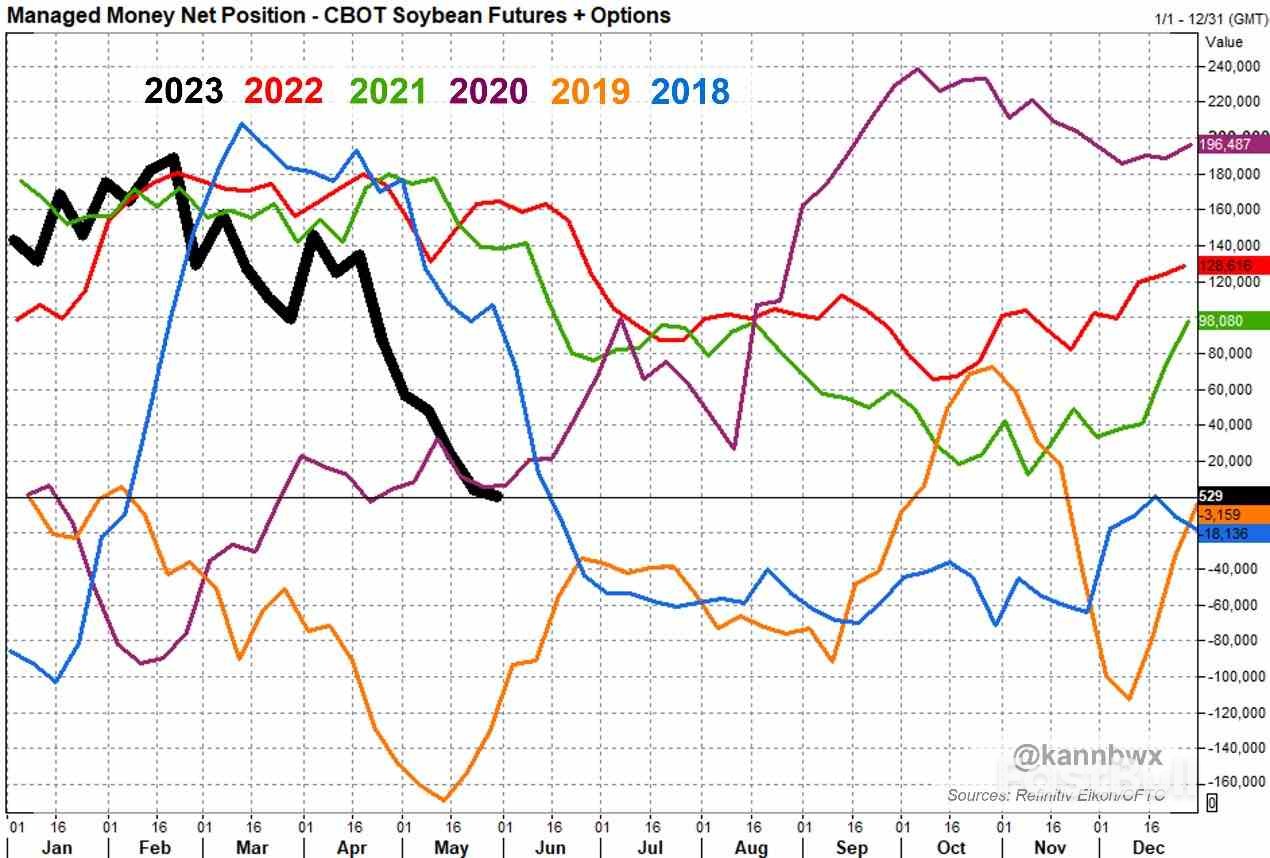
          Chicago-traded soybean futures last week closed below $13 per bushel for the first time in a year-and-a-half, though speculators are still hanging on to the net long position they have maintained since April 2020.
          Meanwhile, an unusually dry end to May across the U.S. Corn Belt and the possible continuation of that pattern into mid-June sparked funds' biggest weekly round of short covering in CBOT corn in nearly three years.
          Most-active CBOT soybean futures tumbled 2% in the week ended May 30, seemingly cementing funds into bearish territory. May 30 featured most-active beans' first settle below $13 per bushel since December 2021, and November soybeans lost nearly 3% during the four-day trading week.
          As of May 30, money managers' net long in CBOT soybeans stood at just 529 futures and options contracts versus 4,147 the week before. Exiting longs were more prominent, but funds also covered soybean shorts, the first such instance in eight weeks.
          Funds Cling to CBOT Soybean Long and Heavily Cover Corn Shorts_1Most-active CBOT corn futures rose nearly 3% and new-crop December futures gained 1.6% in the week ended May 30, motivated by unfavorable U.S. weather. Money managers slashed their net corn short by nearly 47,000 contracts to 51,065 futures and options contracts.
          That was entirely on short covering, the largest such round since August 2020, though speculators started padding their short positions only in late February.
          Funds Cling to CBOT Soybean Long and Heavily Cover Corn Shorts_2Both soybean meal and soybean oil futures shed more than 3% in the week ended May 30, though funds were notable sellers only in meal. Money managers cut their net long in CBOT soybean meal futures and options to 59,676 contracts, the lightest in a year. That compares with 73,789 a week earlier.
          Soybean oil had been gaining throughout that week but plunged on May 30 along with other global vegoils and crude oil on broad economic concerns.
          Money managers expanded their net short in CBOT soybean oil futures and options by 572 contracts to 37,449 as of May 30, their most bearish oil view since July 2019. They have been net sellers of the vegoil in 22 of the last 28 weeks.
          Most-active CBOT wheat futures fell 5% in the week ended May 30, finishing it off with the first settle below $6 per bushel since December 2020. Money managers extended their net short to 126,998 futures and options contracts, the largest since January 2018, up more than 8,200 on the week.
          They also cut nearly 7,000 contracts from their net long in Kansas City wheat futures and options, which fell to 9,628 contracts. Funds increased their net short in Minneapolis wheat to 7,703 contracts from 6,402 a week earlier.
          The 2.5-year low in CBOT wheat combined with China's waterlogged crop and strength in corn lifted most-active wheat futures 4.7% between Wednesday and Friday. Most-active corn on Friday hit the highest levels since April 26, rising 2.5% over the three sessions and possibly erasing more fund shorts.
          December corn rose 3% over that period as forecasts still showed dryness for parts of the U.S. Corn Belt through at least next week. November beans were up 2.6% and most-active beans rose more than 4%, meaning funds are likely still long.
          Most-active soymeal added 1.3% between Wednesday and Friday, but soyoil surged over 7%.
          In the livestock sector, benchmark CME lean hog futures set contract lows on May 26, though both August live cattle and feeder cattle set contract highs on Friday.
          Money managers as of May 30 held a record net short in lean hogs of 31,110 futures and options contracts, up from 24,129 a week earlier. They held a net long in live cattle of 107,835 contracts as of May 30, up from 101,990 in the prior week and their most bullish since early March.
          Funds' record net long in live cattle is 154,550 contracts from April 2019.

          Source: Market Screener

          Risk Warnings and Disclaimers
          You understand and acknowledge that there is a high degree of risk involved in trading. Following any strategies or investment methods may lead to potential losses. The content on the site is provided by our contributors and analysts for information purposes only. You are solely responsible for determining whether any trading assets, securities, strategy, or any other product is suitable for investing based on your own investment objectives and financial situation.
          Comments
          Add to Favorites
          Share

          Weekly Financial Outlook: Macro Data and Central Bank Decisions Dominate the Week Ahead - June 5th

          Warren Takunda

          Traders' Opinions

          After the recent resolution of the debt ceiling issue in the United States, the upcoming week is expected to be relatively calm on the domestic front. However, global investors will have their eyes on several key economic indicators and monetary policy meetings taking place around the world. Additionally, inflation rates and trade data from major economies will provide further insights into the current state of the global economy. In the coming week, keep an eye out for:
          United States
          In the United States, the primary focus will be on the release of the ISM Services PMI, factory orders, and trade data. The ISM survey for May is anticipated to reveal an expansion in the service sector, indicating a strengthening in overall economic activity. Investors will be particularly interested in the gauge that measures price pressures, as concerns about service-led inflation persist. Additionally, the trade deficit is expected to widen due to a decline in exports and an increase in imports, while factory orders are forecasted to rise for the second consecutive month.
          Canada
          The Bank of Canada is scheduled to announce its monetary policy decision, and market expectations suggest no change in the key interest rate, which is projected to remain at 4.5%. In addition, important economic data to watch includes Canada's foreign trade and Ivey PMI. Mexico's CPI data and consumer morale, as well as Brazil's inflation rate and services PMI, will also be closely monitored.
          Euro Area
          In the Euro Area, a downward revision to a modest 0.1% Q1 GDP growth figure is expected, indicating a second consecutive quarter of economic stagnation. However, retail sales in the Eurozone are anticipated to rebound, and Germany's industrial activity is set to recover following a significant drop, aided by a rebound in factory orders. Other releases to watch for include Germany's balance of trade, as well as the inflation rates of Switzerland, Turkey, and Russia. The UK's Halifax house price index and updated Services PMI will also provide insights into the British economy. A benchmark reference rate of 6.75% is expected to be maintained by the National Bank of Poland.
          China
          In China, attention will be on the trade balance and inflation rate for May, offering further insight into the country's economic recovery post-COVID. Recent data has cast doubt on previous recovery expectations, making these releases crucial for assessing the current state of the Chinese economy.
          India
          The Reserve Bank of India is anticipated to keep its interest rate unchanged for a second consecutive meeting, signaling a cautious approach to monetary policy. The release of industrial and manufacturing output data for April by MOSPI will provide additional clarity on the country's economic performance.
          Other Countries
          Australia's Reserve Bank is expected to maintain its cash rate following last month's unexpected hike. Australia's GDP growth figures for Q1 and the trade balance for April will shed light on the country's economic trajectory. Inflation rates for May will be released by South Korea, the Philippines, and Indonesia, providing an indication of price pressures in these respective economies.
          Overall, the week ahead will be defined by macroeconomic data releases and central bank decisions. Investors will closely monitor the performance of major economies and analyze the potential impact on global financial markets. With concerns about inflation lingering, the data will be crucial in shaping future monetary policy decisions and investment strategies.
          Risk Warnings and Disclaimers
          You understand and acknowledge that there is a high degree of risk involved in trading. Following any strategies or investment methods may lead to potential losses. The content on the site is provided by our contributors and analysts for information purposes only. You are solely responsible for determining whether any trading assets, securities, strategy, or any other product is suitable for investing based on your own investment objectives and financial situation.
          Comments
          Add to Favorites
          Share

          UK Property Market Lacks Spring Bounce but A Crash Is Unlikely

          Devin

          Economic

          April is supposed to herald the start of a British ritual: the house-buying season. Traditionally, it is the time when demand for homes picks up and the property supplements in the weekend papers are full of suggestions for sellers bidding to attract the interest of buyers.
          But not this year. According to the latest bulletin from the Bank of England, repayments on existing mortgages in April were £1.4bn higher than new loans. This is unusual. Apart from during lockdown, it was the lowest figure since records began in 1993. The number of new mortgage approvals – loans agreed but not yet advanced – fell in April and were well below the average in the five years leading up to the pandemic.
          There are a number of reasons for the lack of spring bounce in the property market. The availability of mortgages at ultra-low rates meant prices soared in the two years after the start of the pandemic, making it harder for new buyers to afford their first home. The inevitable pause for breath then happened to coincide with rising interest rates and a slowdown in the economy.
          These two factors – rising borrowing costs and sluggish growth – will continue to affect the market over the coming months. The Bank has raised interest rates from 0.1% to 4.5% in the space of 18 months – and looks certain to raise them further given the failure of inflation to fall as quickly as expected. Financial markets are pricing in three more quarter-point increases from Threadneedle Street by the end of the year. Mortgage lenders have responded to higher rates by raising mortgage rates and pulling some of their more attractive products.
          So far, falls in house prices have been modest, with the average cost of a home down 3.4% on a year ago, according to the Nationwide building society. Even so, this was the biggest annual decline recorded since 2009, during the global financial crisis – and there is more to come. Activity in the housing market is likely to remain subdued for at least the rest of this year, and perhaps longer if – as seems probable – the first cuts in interest rates from the Bank don't materialise until well into 2024.
          A full-blown housing market crash of the sort seen in the early 1990s looks unlikely, though. Net migration stood at more than 600,000 last year, and that will underpin demand. What's more, the low level of unemployment means there are few forced sellers. The five-year slump in the first half of the 90s was caused by the dovetailing of 15% interest rates and a jobless total in excess of 3 million. The economy may still fall into recession this year as a result of interest rates staying higher for longer than previously envisaged, but there is no immediate prospect of a wave of newly unemployed owner-occupiers having to sell up.
          All that said, it would be reasonable to expect a peak-to-trough fall in nominal house prices of at least 10%, which would amount to a real terms fall of more than 20% once inflation is accounted for. That's a chunky fall. It's also a welcome one.
          Even though it's been said before, it's worth repeating that the UK is a country wrongly convinced that inflation-busting increases in house prices are a good thing. They are not. The flip side to over-investment in bricks and mortar is under-investment in other more productive uses of capital. The regular booms in the economy driven by consumers extracting and spending equity from the rising value of their homes are invariably followed by busts.
          Those who benefit from rising prices tend to be better off people in older age groups. Those who lose out tend to be two over-lapping categories: renters and the young. Anybody under 35 who is saving up for a deposit on a flat will be glad of a drop in house prices.
          Housing is likely to be a central issue at the next general election, with the two main parties each backing a different side. The Conservatives – who have all but dropped housebuilding targets – are lining up behind existing owner-occupiers. Labour has said it would impose targets and be prepared to build on parts of the green belt. It is also drawing up plans that would force landowners to sell plots of land for less than their potential market price in an attempt to stop land hoarding and so increase the supply of new homes.
          Even if Labour actually goes ahead with its plan, it looks certain to be challenged in the courts. Currently, if a council wants to compulsory purchase a piece of farmland for housing development it has to pay a "hope" value. That's the value not of the farmland but of the value of the farmland adjusted for planning permission, which is substantially higher.
          What is certain is that Labour's approach makes more sense than the government's. The current levels of housebuilding are incompatible with a rising population, and increasing the supply of homes requires reform of the planning system.
          The politics are also interesting. Onward, a right of centre thinktank, produced a report last week in which it said the current crop of 25- to 40-year-olds was the first not to become more rightwing as it grew older, and housing is one reason for this.
          Current Conservative housing policy will help those in their 50s and 60s who have already benefited from house-price inflation rather than those in their 20s and 30s struggling to get on the housing ladder. If Labour has concluded this is dumb economics and dumb politics, it is right on both counts.

          Source: The Guardian

          To stay updated on all economic events of today, please check out our Economic calendar
          Risk Warnings and Disclaimers
          You understand and acknowledge that there is a high degree of risk involved in trading. Following any strategies or investment methods may lead to potential losses. The content on the site is provided by our contributors and analysts for information purposes only. You are solely responsible for determining whether any trading assets, securities, strategy, or any other product is suitable for investing based on your own investment objectives and financial situation.
          Comments
          Add to Favorites
          Share

          OPEC and Allies Consider Deeper Production Cuts Amidst Lingering Concerns of Oversupply

          Warren Takunda
          In response to mounting concerns over a potential new supply glut and the recent decline in oil prices towards the $70 per barrel mark, OPEC and its allies are reportedly engaged in discussions regarding the deepening of oil production cuts. According to reliable sources, these cuts could amount to as much as 1 million barrels per day (bpd), supplementing the existing cuts of 2 million bpd and voluntary cuts of 1.6 million bpd that were unexpectedly announced in April.
          The Organization of the Petroleum Exporting Countries (OPEC) and its allies, collectively known as OPEC+, collectively account for approximately 40 percent of global crude oil production. Therefore, any policy decisions made by this alliance can have a significant impact on oil prices worldwide.
          While OPEC+ ministers are scheduled to gather in Vienna at 2 pm on Sunday to discuss various options, including potential production cuts, OPEC ministers will convene at 11 am on Saturday to lay the groundwork for these discussions.
          If the proposed cuts are approved, they would result in a total reduction of 4.66 million bpd, which represents approximately 4.5 percent of global demand. This move comes as Western nations accuse OPEC of manipulating oil prices and thereby impeding global economic growth due to high energy costs. In response, OPEC officials and insiders argue that the West's extensive money-printing practices in recent years have contributed to inflation, necessitating actions to safeguard the value of oil exports.
          Iraq's Oil Minister Hayan Abdel-Ghani emphasized their commitment to achieving global oil market stability, stating, "We will never hesitate to take any decision to achieve more balance and stability (on) the global oil market."
          The surprise announcement of production cuts in April initially drove oil prices up by approximately $9 per barrel to exceed $87. However, market concerns over global economic growth and demand have since exerted downward pressure on prices. As of Friday, the international benchmark Brent crude was trading around $76 per barrel.
          Saudi Arabia's Energy Minister Prince Abdulaziz previously warned investors who were shorting the oil price to "watch out," which many interpreted as a signal for potential additional supply cuts. Conversely, Russian Deputy Prime Minister Alexander Novak indicated that he did not anticipate any further measures from OPEC+ during the Vienna meeting, according to Russian media reports.
          The International Energy Agency predicts a potential increase in global oil demand in the second half of 2023, which could help bolster oil prices. However, analysts at JP Morgan have criticized OPEC for not responding quickly enough to adjust supply levels in light of substantial US fuel output.
          In a note, JP Morgan analysts stated, "Demand growth continues to be robust. Rather, there is simply too much supply... The alliance waited too long to reduce supply. The alliance - or at least some members - would likely need to cut more."
          Analysts at Rapidan Energy Group estimate a 40 percent likelihood of further production cuts, emphasizing the ministers' determination to prevent a repeat of the 2008 scenario. During that period, a sudden collapse in global economic and financial stability caused crude prices to plummet from over $140 to $35 per barrel within six months.
          As the OPEC+ meetings unfold in Vienna, market participants will closely monitor the decisions and announcements made by the alliance. The potential deepening of production cuts holds the key to rebalancing the global oil market and stabilizing oil prices in the face of prevailing concerns of oversupply.
          Risk Warnings and Disclaimers
          You understand and acknowledge that there is a high degree of risk involved in trading. Following any strategies or investment methods may lead to potential losses. The content on the site is provided by our contributors and analysts for information purposes only. You are solely responsible for determining whether any trading assets, securities, strategy, or any other product is suitable for investing based on your own investment objectives and financial situation.
          Comments
          Add to Favorites
          Share
          FastBull
          Copyright © 2025 FastBull Ltd

          728 RM B 7/F GEE LOK IND BLDG NO 34 HUNG TO RD KWUN TONG KLN HONG KONG

          TelegramInstagramTwitterfacebooklinkedin
          App Store Google Play Google Play
          Products
          Charts

          Chats

          Q&A with Experts
          Screeners
          Economic Calendar
          Data
          Tools
          Membership
          Features
          Function
          Markets
          Copy Trading
          Latest Signals
          Contests
          News
          Analysis
          24/7
          Columns
          Education
          Company
          Careers
          About Us
          Contact Us
          Advertising
          Help Center
          Feedback
          User Agreement
          Privacy Policy
          Business

          White Label

          Data API

          Web Plug-ins

          Poster Maker

          Affiliate Program

          Risk Disclosure

          The risk of loss in trading financial instruments such as stocks, FX, commodities, futures, bonds, ETFs and crypto can be substantial. You may sustain a total loss of the funds that you deposit with your broker. Therefore, you should carefully consider whether such trading is suitable for you in light of your circumstances and financial resources.

          No decision to invest should be made without thoroughly conducting due diligence by yourself or consulting with your financial advisors. Our web content might not suit you since we don't know your financial conditions and investment needs. Our financial information might have latency or contain inaccuracy, so you should be fully responsible for any of your trading and investment decisions. The company will not be responsible for your capital loss.

          Without getting permission from the website, you are not allowed to copy the website's graphics, texts, or trademarks. Intellectual property rights in the content or data incorporated into this website belong to its providers and exchange merchants.

          Not Logged In

          Log in to access more features

          FastBull Membership

          Not yet

          Purchase

          Become a signal provider
          Help Center
          Customer Service
          Dark Mode
          Price Up/Down Colors

          Log In

          Sign Up

          Position
          Layout
          Fullscreen
          Default to Chart
          The chart page opens by default when you visit fastbull.com