

Markets
News
Analysis
User
24/7
Economic Calendar
Education
Data
- Names
- Latest
- Prev



Signal Accounts for Members
All Signal Accounts
All Contests
 U.K. Retail Sales MoM (SA) (Dec)
A:--
F: --
P: --
 France Manufacturing PMI Prelim (Jan)
A:--
F: --
P: --
France Services PMI Prelim (Jan)A:--
F: --
P: --
France Composite PMI Prelim (SA) (Jan)A:--
F: --
P: --
 Germany Manufacturing PMI Prelim (SA) (Jan)
A:--
F: --
P: --
Germany Services PMI Prelim (SA) (Jan)A:--
F: --
P: --
Germany Composite PMI Prelim (SA) (Jan)A:--
F: --
P: --
 Euro Zone Composite PMI Prelim (SA) (Jan)
A:--
F: --
P: --
Euro Zone Manufacturing PMI Prelim (SA) (Jan)A:--
F: --
P: --
Euro Zone Services PMI Prelim (SA) (Jan)A:--
F: --
P: --
U.K. Composite PMI Prelim (Jan)A:--
F: --
P: --
U.K. Manufacturing PMI Prelim (Jan)A:--
F: --
P: --
U.K. Services PMI Prelim (Jan)A:--
F: --
P: --
 Mexico Economic Activity Index YoY (Nov)
A:--
F: --
P: --
 Russia Trade Balance (Nov)
A:--
F: --
P: --
 Canada Core Retail Sales MoM (SA) (Nov)
A:--
F: --
P: --
Canada Retail Sales MoM (SA) (Nov)A:--
F: --
 U.S. IHS Markit Manufacturing PMI Prelim (SA) (Jan)
A:--
F: --
P: --
U.S. IHS Markit Services PMI Prelim (SA) (Jan)A:--
F: --
P: --
U.S. IHS Markit Composite PMI Prelim (SA) (Jan)A:--
F: --
P: --
U.S. UMich Consumer Sentiment Index Final (Jan)A:--
F: --
P: --
U.S. UMich Current Economic Conditions Index Final (Jan)A:--
F: --
P: --
U.S. UMich Consumer Expectations Index Final (Jan)A:--
F: --
P: --
U.S. Conference Board Leading Economic Index MoM (Nov)A:--
F: --
P: --
U.S. Conference Board Coincident Economic Index MoM (Nov)A:--
F: --
P: --
U.S. Conference Board Lagging Economic Index MoM (Nov)A:--
F: --
P: --
U.S. UMich 1-Year-Ahead Inflation Expectations Final (Jan)A:--
F: --
P: --
U.S. Conference Board Leading Economic Index (Nov)A:--
F: --
P: --
U.S. Weekly Total Rig CountA:--
F: --
P: --
U.S. Weekly Total Oil Rig CountA:--
F: --
P: --
Germany Ifo Business Expectations Index (SA) (Jan)--
F: --
P: --
Germany IFO Business Climate Index (SA) (Jan)--
F: --
P: --
Germany Ifo Current Business Situation Index (SA) (Jan)--
F: --
P: --
U.S. Dallas Fed PCE Price Index YoY (Nov)--
F: --
P: --
 Brazil Current Account (Dec)
--
F: --
P: --
Mexico Unemployment Rate (Not SA) (Dec)A:--
F: --
P: --
Canada National Economic Confidence Index--
F: --
P: --
U.S. Non-Defense Capital Durable Goods Orders MoM (Excl. Aircraft) (Nov)--
F: --
P: --
U.S. Durable Goods Orders MoM (Excl. Defense) (SA) (Nov)--
F: --
P: --
U.S. Durable Goods Orders MoM (Excl.Transport) (Nov)--
F: --
P: --
U.S. Durable Goods Orders MoM (Nov)--
F: --
P: --
U.S. Chicago Fed National Activity Index (Nov)--
F: --
P: --
U.S. Dallas Fed New Orders Index (Jan)--
F: --
P: --
U.S. Dallas Fed General Business Activity Index (Jan)--
F: --
P: --
U.K. BRC Shop Price Index YoY (Jan)--
F: --
P: --
 China, Mainland Industrial Profit YoY (YTD) (Dec)
--
F: --
P: --
Mexico Trade Balance (Dec)--
F: --
P: --
U.S. S&P/CS 20-City Home Price Index YoY (Not SA) (Nov)--
F: --
P: --
U.S. S&P/CS 20-City Home Price Index MoM (SA) (Nov)--
F: --
P: --
U.S. FHFA House Price Index MoM (Nov)--
F: --
P: --
U.S. FHFA House Price Index (Nov)--
F: --
P: --
U.S. Richmond Fed Manufacturing Composite Index (Jan)--
F: --
P: --
U.S. Conference Board Present Situation Index (Jan)--
F: --
P: --
U.S. Conference Board Consumer Expectations Index (Jan)--
F: --
P: --
U.S. Richmond Fed Manufacturing Shipments Index (Jan)--
F: --
P: --
U.S. Richmond Fed Services Revenue Index (Jan)--
F: --
P: --
U.S. Conference Board Consumer Confidence Index (Jan)--
F: --
P: --
 Australia RBA Trimmed Mean CPI YoY (Q4)
--
F: --
P: --
Australia CPI YoY (Q4)--
F: --
P: --
Australia CPI QoQ (Q4)--
F: --
P: --


















No matching data

Latest Views
Latest Views
Trending Topics
Top Columnists
Latest Update
White Label
Data API
Web Plug-ins
Affiliate Program
View All
No data
Reliance Industries Ltd. has placed orders for non-sanctioned Russian crude for delivery in February and March, according to a person familiar with the matter.
Reliance Industries Ltd. has placed orders for non-sanctioned Russian crude for delivery in February and March, according to a person familiar with the matter.
The barrels were attractively priced, prompting India's largest private refiner to return to the market, said the person, who asked not to be identified because the matter is sensitive.
Russian crude deliveries to India slumped in December to about 1.2 million barrels a day from 1.78 million in November, vessel-tracking data compiled by Bloomberg show, after US sanctions drove refiners — including Reliance — to scale back purchases.
Reliance, controlled by billionaire Mukesh Ambani, has been the biggest Indian buyer of Russian oil, but halted purchases for its export-oriented refinery in November and last received a cargo for its domestically focused unit in the third week of December. Reliance's return could help stabilize the country's imports of Russian crude in the coming months.
The company operates two refineries at its Jamnagar complex with a combined capacity of about 1.4 million barrels a day. Last year, it imported about 1.3 million barrels a day of crude, with almost 45% sourced from Russia.
Earlier, Reuters reported that Reliance is set to receive sanctions-compliant Russian oil in February and March after a one-month pause.
The global economy faces a severe systemic risk from its overwhelming reliance on Taiwan for advanced semiconductors, U.S. Treasury Secretary Scott Bessent warned on January 20. He stated that any disruption to the island's manufacturing could spark an "economic apocalypse."
Speaking at the World Economic Forum in Davos, Bessent highlighted a critical vulnerability: "the single biggest point of failure is that 97 percent of the high-end chips are made in Taiwan." He added, "If that island were blockaded, that capacity were destroyed, it would be an economic apocalypse."
This warning comes as the Trump administration accelerates efforts to reshore critical supply chains. The focus is on semiconductors and critical minerals like rare earths, driven by ongoing tensions with China and the potential for trade disruption from a major military conflict in Asia.

Bessent confirmed in Davos that Washington is prioritizing the relocation of more semiconductor manufacturing to the United States as a matter of national security and economic stability. "We are reshoring the semiconductor industry to the U.S. with the defense contractors," he said.
A Call for Defense Contractors to Invest
Bessent compared major U.S. defense contractors to systemically important banks, which receive special government support to prevent their failure from destabilizing the financial system. He argued that these contractors have a responsibility to invest in domestic production rather than returning capital to shareholders.
"The defense contractors are no different than the systemically important banks," Bessent asserted, noting they benefit from similar government oversight and support. He accused the contractors of failing to meet their obligations.
"They have let down the American people. They are five, six, seven years behind on fulfillment of their contracts," Bessent stated. "So I do not think it is unreasonable to tell them that until further notice, you need to build more factories and buy back less stock."
The disruptions caused by the COVID-19 pandemic served as a crucial warning, Bessent explained. "I think the only good thing that came from COVID was it was a test run for what would happen if our supply chains were ever broken due to a kinetic war," he said.
The pandemic exposed vulnerabilities in about a half-dozen industries essential to U.S. national and economic security. "So we saw that there are five, six, seven key industries that we have to reshore," he noted, specifically naming rare earth magnets and semiconductors.
Bessent detailed a plan for the United States to coordinate with allies to reduce its dependence on China for critical minerals. He warned that Beijing has weaponized its market position to undermine industrial projects in the U.S. and allied nations.
"We have seen what happens when the free markets get kind of perverted," he said, citing instances where U.S. companies attempting to launch critical mineral facilities were bankrupted by Chinese competitors intentionally lowering prices.
To combat this, the Trump administration plans to implement pricing mechanisms to support domestic producers. "We are going to put in a system, price floor, price ceilings," he announced.
The Treasury Department is helping to form a "critical minerals block" that includes the G7 nations along with Australia, India, Mexico, and South Korea. "We are working at warp speed to create a critical minerals block where we can mine, process, and refine critical minerals, and China won't have this sword over our heads," Bessent said.
When asked about a timeline for U.S. independence in refining critical minerals, Bessent estimated it would take "18 to 24 months." He pointed to recent progress, such as a new facility in his home state of South Carolina that is producing rare earth magnets for the first time in 25 years. He said producers believe they can meet most of the nation's needs within two years, adding, "And then we also want to help our allies, because the supply chain is important."
Bessent's comments in Davos are consistent with previous warnings he has made about the risks posed by Taiwan's chip dominance. His renewed focus on the issue follows a recent announcement by the U.S. Commerce Department of a major U.S.–Taiwan chips deal designed to expand manufacturing investment in the United States.
Germany's coal-fired power plants have become profitable to operate once more, driven by a combination of surging electricity demand during a cold snap and a significant drop in European carbon prices. This marks the first time since November that coal generation has returned to profitability in Europe's largest economy.
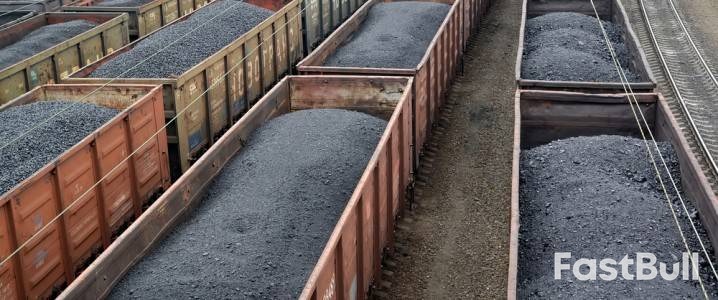
The key driver behind this shift is the falling cost of carbon permits. According to analysts at Energy Aspects Ltd and LSEG, carbon prices slumped by approximately 8% this week, reversing a jump from the previous week.
This price plunge has made it more economical to burn coal for electricity than to use natural gas. In particular, power plants running on lignite—the most polluting type of coal—are now back in the black.
The resurgence of coal profitability highlights Germany's ongoing reliance on fossil fuels, especially during winter. A cold snap has caused electricity demand to soar while renewable energy output, particularly from solar, has faltered.
Data from Fraunhofer ISE shows that coal and gas plants have been called upon to meet nearly half of Germany's total electricity demand this week, filling the gap left by intermittent renewable sources.
This short-term reliance on coal creates a challenge for Germany's long-term climate goals. The country is officially aiming to phase out all coal-fired power capacity by 2030, a target that now appears more complex.
To manage the transition, Germany is looking to new natural gas plants to provide flexible backup for its wind and solar infrastructure. However, the government recently scaled back its ambitions, slashing its planned tender for new gas-fired capacity in half. The ruling coalition will now seek to tender 10 GW of new gas capacity by 2032, a significant reduction from the previously planned 20 GW.
This policy adjustment is part of a compromise to balance national energy security with decarbonization objectives, a task made more difficult after Germany closed its remaining nuclear power plants in 2023.
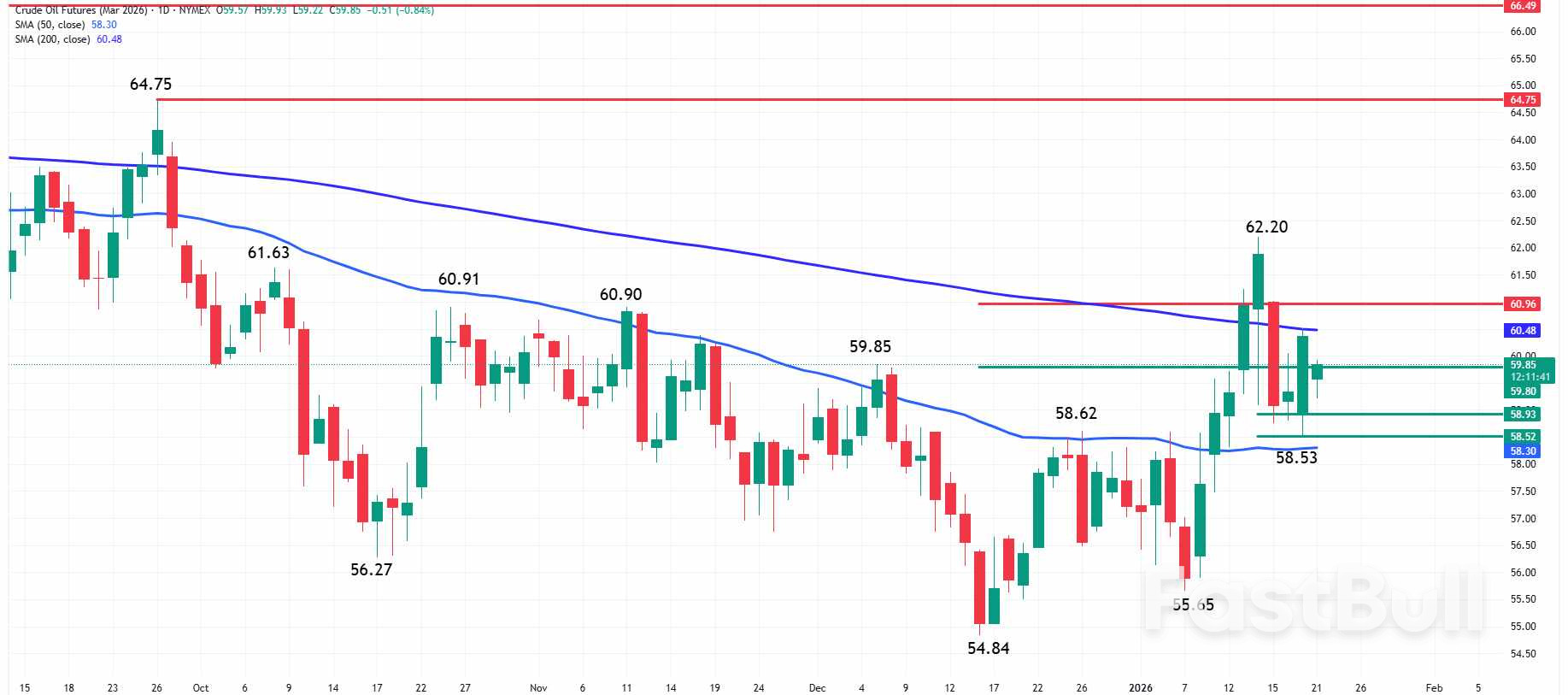 Daily March Crude Oil Futures
JPMorgan Chase CEO Jamie Dimon delivered a stark warning from the World Economic Forum in Davos, labeling a proposed 10% cap on credit card interest rates an "economic disaster." While acknowledging his bank would survive the policy, Dimon argued it would devastate American consumers and businesses.
The core of Dimon's argument is that the cap would effectively cut off a critical financial lifeline for the majority of the population. "It would remove credit from 80% of Americans, and that is their back-up credit," the head of the largest U.S. bank stated.
Credit cards are a key source of revenue for banks, which use high interest rates to offset the risk associated with unsecured loans. A government-mandated cap would fundamentally alter this business model.
According to Dimon, the real victims of such a policy wouldn't be financial institutions. He warned that the impact would cascade through the entire economy, hurting everyday businesses that rely on consumer spending.
"People crying the most will not be the credit card companies; it will be the restaurants, retailers, travel companies, the schools, the municipalities," he explained. Dimon painted a picture where consumers struggle with essential payments, stating, "People will miss their water payments, this payment and that payment."
As a challenge, he suggested lawmakers first test the policy's viability in smaller markets like Vermont and Massachusetts.
The proposal for a rate cap was floated by U.S. President Donald Trump on social media, catching the industry by surprise and causing bank stocks to fall. The move is widely seen as an attempt to address voter concerns about the cost of living ahead of congressional elections.
However, industry leaders and analysts are skeptical the plan could become law. Banking organizations have pushed back strongly, and Wall Street analysts note that implementing such a cap would require new legislation with a low probability of passing.
Citigroup CEO Jane Fraser, also speaking from Davos, echoed this sentiment. While agreeing with the president's focus on affordability, she stated, "Capping rates would not be good for the U.S. economy." Fraser told CNBC she does not expect Congress to approve the measure.
In response to a potential cap, analysts believe card issuers might introduce alternative products, such as:
• No-frills cards with a 10% rate but no rewards.
• Lower credit limits for customers.
• Specialized lower rates for certain consumer segments.
Venezuela's leading business association has endorsed the interim government's new economic measures, including a critical injection of foreign currency from oil revenues. The group, Fedecamaras, believes the move will help stabilize the country's volatile exchange rate and rein in rampant price increases.
The announcement comes as Venezuelans continue to navigate a severe economic crisis defined by shortages, triple-digit inflation, and the collapse of the local bolivar currency. The monthly minimum wage is now equivalent to just $0.37, and while public sector workers can earn around $120 with bonuses, analysts estimate a family's basic monthly needs cost approximately $500. Even private sector employees with higher salaries are often paid in bolivars in an economy that has become overwhelmingly dollarized.
Felipe Capozzolo, president of Fedecamaras, stated that the private sector supports the government's efforts to bring order to the currency market. "We welcome steps aimed at regularizing and stabilizing the exchange system," he said, noting that the gap between official and unofficial exchange rates directly fuels price instability.
"Businesspeople are the first to want price stability in Venezuela," Capozzolo added. "We will support any measure taken by the government aimed at stabilizing the economy."
The supply of U.S. dollars, essential for businesses to import materials, tightened significantly at the end of 2025. This occurred after the U.S. seized Venezuelan oil tankers, disrupting the nation's primary source of revenue and stoking inflation.
The new strategy is backed by fresh funds. On Tuesday, acting president Delcy Rodriguez confirmed that the country had received $300 million from recent oil sales. These are the first proceeds from a 50-million-barrel supply agreement announced by U.S. President Donald Trump, which followed the capture of former president Nicolas Maduro earlier this month.
While significant hurdles such as inflation, tax pressures, and financing restrictions persist, Capozzolo noted that economic expectations are beginning to shift. Renewed activity in the oil sector and the potential for increased investment are fueling cautious optimism.
"A different perception is beginning to take shape about what our economic performance might be," he said.
The government reported that the economy grew by 9% in 2025, although it has not released official inflation figures. In contrast, local analyst firms estimate a far more modest economic expansion of around 3% for last year, with consumer price inflation exceeding 400%.
For the average citizen, the hope is that rising oil exports can translate into a stronger economy and better wages.
"Venezuelans want to earn a decent income. Our wages are worthless, on the floor," said Moises Figueredo, a 56-year-old security guard shopping in Caracas. "We need investors to come, because there are no good jobs. I hope things improve."
That sentiment was echoed by others. "I worked at a ministry but left because the situation was tough; my salary wasn't enough even for transport," said Celis Chirinos, a 44-year-old fruit vendor. "What we want is to work, to see things improve."
An escalating dispute between the United States and Europe over Greenland is raising the risk of sanctions that could directly impact EU holders of U.S. Treasury bonds, according to an analyst at Commerzbank AG.
While no sanctions have been threatened and officials hope for a compromise, the fact that analysts are now discussing such scenarios highlights how deteriorating trans-Atlantic relations are creating new tail risks for the market.
According to Michael Pfister, a currency analyst at the German bank, the consequences of such a move could be severe.
"If Trump allows the conflict to escalate further, it will become increasingly risky for affected countries to hold US government bonds, as investors risk being unable to sell these investments," Pfister explained. "But if they sell these holdings, the US dollar will also suffer."
The conflict over Greenland, a semi-autonomous territory of Denmark, intensified after President Donald Trump threatened to impose new tariffs on goods from eight European countries.
Such a step would represent a sharp and unexpected escalation in America's economic foreign policy. U.S. sanctions programs, administered by the Office of Foreign Assets Control, are typically broad and reserved for nations like North Korea and Iran. These financial sanctions can involve freezing assets, cutting entities out of the U.S. financial system, and prohibiting trade.
Pfister noted that past U.S. sanctions have not shaken European confidence in dollar-denominated assets. However, a move against a European Union member could be a different story.
"My old boss always told an interesting anecdote about the status of the US dollar as the world's reserve currency: when sanctions were imposed on Iran, a move that the Europeans did not support, the conflict was not great enough to prompt a departure," he said. "But what about sanctions against an EU country?"
Pfister's analysis depends on a further escalation of tensions, which remains a possibility for investors. Greenland's prime minister stated Tuesday that the Arctic island, while considering it unlikely, needs to prepare for a potential military invasion.
The idea of Europe "weaponizing" its holdings of U.S. assets—a concept previously flagged in a note by Deutsche Bank AG—is gaining traction among market analysts.
In a tangible move, the Danish pension fund AkademikerPension announced on Tuesday that it would sell its approximately $100 million in U.S. Treasuries by the end of the month.
Pfister clarified that this doesn't signal an immediate crisis for the dollar. "I am not suggesting that a shift away from the US dollar is imminent, nor that the decision by the Danish pension fund could trigger a chain reaction," he said.
Instead, the move serves as a clear warning. "The market's reaction to such announcements could possibly make the US government aware of the high costs of a Greenland takeover," he concluded.
728 RM B 7/F GEE LOK IND BLDG NO 34 HUNG TO RD KWUN TONG KLN HONG KONG


White Label
Data API
Web Plug-ins
Poster Maker
Affiliate Program
The risk of loss in trading financial instruments such as stocks, FX, commodities, futures, bonds, ETFs and crypto can be substantial. You may sustain a total loss of the funds that you deposit with your broker. Therefore, you should carefully consider whether such trading is suitable for you in light of your circumstances and financial resources.
No decision to invest should be made without thoroughly conducting due diligence by yourself or consulting with your financial advisors. Our web content might not suit you since we don't know your financial conditions and investment needs. Our financial information might have latency or contain inaccuracy, so you should be fully responsible for any of your trading and investment decisions. The company will not be responsible for your capital loss.
Without getting permission from the website, you are not allowed to copy the website's graphics, texts, or trademarks. Intellectual property rights in the content or data incorporated into this website belong to its providers and exchange merchants.
Not Logged In
Log in to access more features


Log In
Sign Up


