• Trade
  • Markets
  • Copy
  • Contests
  • News
  • 24/7
  • Calendar
  • Q&A
  • Chats
Trending
Screeners
SYMBOL
LAST
BID
ASK
HIGH
LOW
NET CHG.
%CHG.
SPREAD
SPX
S&P 500 Index
6827.42
6827.42
6827.42
6899.86
6801.80
-73.58
-1.07%
--
DJI
Dow Jones Industrial Average
48458.04
48458.04
48458.04
48886.86
48334.10
-245.98
-0.51%
--
IXIC
NASDAQ Composite Index
23195.16
23195.16
23195.16
23554.89
23094.51
-398.69
-1.69%
--
USDX
US Dollar Index
97.810
97.890
97.810
98.070
97.810
-0.140
-0.14%
--
EURUSD
Euro / US Dollar
1.17595
1.17602
1.17595
1.17596
1.17262
+0.00201
+ 0.17%
--
GBPUSD
Pound Sterling / US Dollar
1.33913
1.33923
1.33913
1.33940
1.33546
+0.00206
+ 0.15%
--
XAUUSD
Gold / US Dollar
4336.39
4336.82
4336.39
4350.16
4294.68
+37.00
+ 0.86%
--
WTI
Light Sweet Crude Oil
57.096
57.126
57.096
57.601
56.878
-0.137
-0.24%
--

Community Accounts

Signal Accounts
--
Profit Accounts
--
Loss Accounts
--
View More

Become a signal provider

Sell trading signals to earn additional income

View More

Guide to Copy Trading

Get started with ease and confidence

View More

Signal Accounts for Members

All Signal Accounts

Best Return
  • Best Return
  • Best P/L
  • Best MDD
Past 1W
  • Past 1W
  • Past 1M
  • Past 1Y

All Contests

  • All
  • Trump Updates
  • Recommend
  • Stocks
  • Cryptocurrencies
  • Central Banks
  • Featured News
Top News Only
Share

Mexico's Economy Ministry Announces Start Of Anti-Dumping Investigation And Anti-Subsidy Investigations Into USA Pork Imports

Share

Canada Nov CPI Common +2.8%, CPI Median +2.8%, CPI Trim +2.8% On Year

Share

NY Fed's Empire State Prices Paid Index +37.6 In December Versus+49.0 In November

Share

Canada Nov Consumer Prices +0.1% On Month, +2.2% On Year

Share

Canada Nov CPI Core -0.1% On Month, +2.9% On Year

Share

Canada Nov Core CPI, Seasonally Adjusted +0.2% On Month, Oct +0.3% (Unrevised)

Share

UK Health Minister Streeting On Doctors' Strike: Vote To Go Ahead Reveals The Bma's Shocking Disregard For Patient Safety

Share

Venezuelan State Oil Company Pdvsa Says Was Subject To Cyber Attack But Operations Unaffected

Share

Russia Central Bank Says January-October Current Account Surplus At $37.1 Billion

Share

Polish Current Account Balance At +1924 Million Euros In October Versus+130 Million Euros Seen In Reuters Poll

Share

Statement: Germany, Ukraine Propose 10-Point Plan To Strengthen Armament Cooperation

Share

London Metal Exchange Three Month Copper Falls More Than 3% To $11541.50 A Metric Ton

Share

[Market Update] Spot Silver Surged $2.00 During The Day, Returning To $64/ounce, A Gain Of 3.23%

Share

European Central Bank: Italy's Recurrent Ad Hoc Tax Provisions Cause Uncertainty, Damage Investor Confidence, And May Affect Banks' Funding Costs

Share

Stats Office: Nigeria Consumer Inflation At 14.45% Year-On-Year In November

Share

European Central Bank: Italy's Budget Measures Weighing On Domestic Banks Could Have "Negative Implications" On Their Credit Liquidity

Share

Azerbaijan's January-November Oil Exports Via Btc Pipeline Down 7.1% Year-On-Year Data Shows

Share

Azerbaijan's Aliyev Plans A Large-Scale Prisoner Amnesty, Azertac Reports

Share

EU Commission Chief Von Der Leyen, NATO's Rutte Join Ukraine Talks In Berlin

Share

EU Announces Sanctions On Companies, Individuals For Moving Russian Oil

TIME
ACT
FCST
PREV
Japan Tankan Small Manufacturing Outlook Index (Q4)

A:--

F: --

P: --

Japan Tankan Large Non-Manufacturing Outlook Index (Q4)

A:--

F: --

P: --

Japan Tankan Large Manufacturing Outlook Index (Q4)

A:--

F: --

P: --

Japan Tankan Small Manufacturing Diffusion Index (Q4)

A:--

F: --

P: --

Japan Tankan Large Manufacturing Diffusion Index (Q4)

A:--

F: --

P: --

Japan Tankan Large-Enterprise Capital Expenditure YoY (Q4)

A:--

F: --

P: --

U.K. Rightmove House Price Index YoY (Dec)

A:--

F: --

P: --

China, Mainland Industrial Output YoY (YTD) (Nov)

A:--

F: --

P: --

China, Mainland Urban Area Unemployment Rate (Nov)

A:--

F: --

P: --

Saudi Arabia CPI YoY (Nov)

A:--

F: --

P: --

Euro Zone Industrial Output YoY (Oct)

A:--

F: --

P: --

Euro Zone Industrial Output MoM (Oct)

A:--

F: --

P: --

Canada Existing Home Sales MoM (Nov)

A:--

F: --

P: --

Canada National Economic Confidence Index

A:--

F: --

P: --

Canada New Housing Starts (Nov)

A:--

F: --

P: --
U.S. NY Fed Manufacturing Employment Index (Dec)

A:--

F: --

P: --

U.S. NY Fed Manufacturing Index (Dec)

A:--

F: --

P: --

Canada Core CPI YoY (Nov)

A:--

F: --

P: --

Canada Manufacturing Unfilled Orders MoM (Oct)

A:--

F: --

P: --

U.S. NY Fed Manufacturing Prices Received Index (Dec)

A:--

F: --

P: --

U.S. NY Fed Manufacturing New Orders Index (Dec)

A:--

F: --

P: --

Canada Manufacturing New Orders MoM (Oct)

A:--

F: --

P: --

Canada Core CPI MoM (Nov)

A:--

F: --

P: --

Canada Trimmed CPI YoY (SA) (Nov)

A:--

F: --

P: --

Canada Manufacturing Inventory MoM (Oct)

A:--

F: --

P: --

Canada CPI YoY (Nov)

A:--

F: --

P: --

Canada CPI MoM (Nov)

A:--

F: --

P: --

Canada CPI YoY (SA) (Nov)

--

F: --

P: --

Canada Core CPI MoM (SA) (Nov)

A:--

F: --

P: --

Canada CPI MoM (SA) (Nov)

A:--

F: --

P: --

Federal Reserve Board Governor Milan delivered a speech
U.S. NAHB Housing Market Index (Dec)

--

F: --

P: --

Australia Composite PMI Prelim (Dec)

--

F: --

P: --

Australia Services PMI Prelim (Dec)

--

F: --

P: --

Australia Manufacturing PMI Prelim (Dec)

--

F: --

P: --

Japan Manufacturing PMI Prelim (SA) (Dec)

--

F: --

P: --

U.K. 3-Month ILO Employment Change (Oct)

--

F: --

P: --

U.K. Unemployment Claimant Count (Nov)

--

F: --

P: --

U.K. Unemployment Rate (Nov)

--

F: --

P: --

U.K. 3-Month ILO Unemployment Rate (Oct)

--

F: --

P: --

U.K. Average Weekly Earnings (3-Month Average, Including Bonuses) YoY (Oct)

--

F: --

P: --

U.K. Average Weekly Earnings (3-Month Average, Excluding Bonuses) YoY (Oct)

--

F: --

P: --

France Services PMI Prelim (Dec)

--

F: --

P: --

France Composite PMI Prelim (SA) (Dec)

--

F: --

P: --

France Manufacturing PMI Prelim (Dec)

--

F: --

P: --

Germany Services PMI Prelim (SA) (Dec)

--

F: --

P: --

Q&A with Experts
    • All
    • Chatrooms
    • Groups
    • Friends
    Connecting
    .
    .
    .
    Type here...
    Add Symbol or Code

      No matching data

      All
      Trump Updates
      Recommend
      Stocks
      Cryptocurrencies
      Central Banks
      Featured News
      • All
      • Russia-Ukraine Conflict
      • Middle East Flashpoint
      • All
      • Russia-Ukraine Conflict
      • Middle East Flashpoint
      Search
      Products

      Charts Free Forever

      Chats Q&A with Experts
      Screeners Economic Calendar Data Tools
      Membership Features
      Data Warehouse Market Trends Institutional Data Policy Rates Macro

      Market Trends

      Market Sentiment Order Book Forex Correlations

      Top Indicators

      Charts Free Forever
      Markets

      News

      News Analysis 24/7 Columns Education
      From Institutions From Analysts
      Topics Columnists

      Latest Views

      Latest Views

      Trending Topics

      Top Columnists

      Latest Update

      Signals

      Copy Rankings Latest Signals Become a signal provider AI Rating
      Contests
      Brokers

      Overview Brokers Assessment Rankings Regulators News Claims
      Broker listing Forex Brokers Comparison Tool Live Spread Comparison Scam
      Q&A Complaint Scam Alert Videos Tips to Detect Scam
      More

      Business
      Events
      Careers About Us Advertising Help Center

      White Label

      Data API

      Web Plug-ins

      Affiliate Program

      Awards Institution Evaluation IB Seminar Salon Event Exhibition
      Vietnam Thailand Singapore Dubai
      Fans Party Investment Sharing Session
      FastBull Summit BrokersView Expo
      Recent Searches
        Top Searches
          Markets
          News
          Analysis
          User
          24/7
          Economic Calendar
          Education
          Data
          • Names
          • Latest
          • Prev

          View All

          No data

          Scan to Download

          Faster Charts, Chat Faster!

          Download App
          English
          • English
          • Español
          • العربية
          • Bahasa Indonesia
          • Bahasa Melayu
          • Tiếng Việt
          • ภาษาไทย
          • Français
          • Italiano
          • Türkçe
          • Русский язык
          • 简中
          • 繁中
          Open Account
          Search
          Products
          Charts Free Forever
          Markets
          News
          Signals

          Copy Rankings Latest Signals Become a signal provider AI Rating
          Contests
          Brokers

          Overview Brokers Assessment Rankings Regulators News Claims
          Broker listing Forex Brokers Comparison Tool Live Spread Comparison Scam
          Q&A Complaint Scam Alert Videos Tips to Detect Scam
          More

          Business
          Events
          Careers About Us Advertising Help Center

          White Label

          Data API

          Web Plug-ins

          Affiliate Program

          Awards Institution Evaluation IB Seminar Salon Event Exhibition
          Vietnam Thailand Singapore Dubai
          Fans Party Investment Sharing Session
          FastBull Summit BrokersView Expo

          Reimagining the foundations of finance

          Jason

          Economic

          Summary:

          DLT has the potential to create a more adaptable and resilient monetary system.

          In today’s environment, where most corporate and bank budgets are not allocated to innovation but rather to maintaining compliance with an expanding portfolio of regulatory requirements, market transformation often happens through regulatory disruption. One of the most significant developments in financial market infrastructure is the rise of distributed ledger technologies, with blockchain being the most prominent implementation.
          By distributing copies of the ledger across a network of nodes, blockchain eliminates single points of failure, enhancing resilience. Consensus mechanisms ensure that each node maintains an identical, validated record of accepted transactions. As the Bank for International Settlements observed in 2022 in ‘The future monetary system’, this technology has the potential to create a ‘more adaptable and resilient’ future monetary system.
          A wide-scale rollout of a global unified ledger or a network of ledgers existing in various linked areas such as industry consortiums, arbitration pools and markets has the potential to change how businesses operate. Even more intriguing is how contracts (whether business-to-business, business-to-consumer or person-to-person) could become more reliable and executable, where parties are bound to fulfil their obligations based on conditions with defined outcomes and subsequent actions.
          A cross-industry adoption of a shared ledger infused with dedicated smart contracts presents a significant opportunity not only to save processing time but also to reduce risk, remove costs and increase overall trust throughout the entire contract life cycle.

          Use cases

          Let’s envision a reality where such a network of global cross-industry ledgers is operational and explore how businesses and private consumers might interact. Even a simple scenario demonstrates the potential value.
          Consider a person leaving early for work whose car won’t start. They contact their mobility service provider, who triggers a tow company to collect the car, deliver it to the garage and potentially return it to its owner within hours or days. Throughout this process chain, various smart contracts could be triggered and executed, releasing instant partial payments of the total service cost until the process is completed.
          Such scenarios could be secured with various conditions governing payment release, timing and outcomes. For instance, before returning the car to its owner, a third-party arbitrator from the insurer could play a crucial role in accepting the repair and confirming contractual execution, which would trigger instant payment for the completed work.
          This straightforward example can be scaled up and applied to more complex contexts where dozens of smart contracts and network validations execute within seconds or at desired intervals. Global trade business could benefit immensely, where the provision of letters of credit (along with necessary know-your-customer and various checks) would become a straight-through process.
          For instance, global trade of fast-moving consumer goods requiring stable cold-chain confirmation throughout shipping could be validated and, if necessary, automatically rerouted to the sender in case of interruption and goods become unusable. All that happens in an automated way based on the information from sensors and position trackers and stored in a replicated, permissioned ledger with clear consensus, immutability and finality.

          Balancing regulation with innovation

          Considering the potential use cases and their impact on the global economy, we must return to the fundamental role of regulators. Examining current technologies, solutions and new compliance requirements – from work on central bank digital currencies (both wholesale and retail) to the introduction of the Digital Operational Resilience Act and the research conducted by the BIS in its fascinating exploratory work – provides a potential blueprint for an interconnected multijurisdictional economy. While significant progress has been made, considerable work remains.
          Although the G20 Financial Stability Board had already identified and begun addressing vulnerabilities in the global financial system, the pandemic and the war in Ukraine have underscored the urgent need for more resilient financial infrastructures. Even if businesses would be ready to adopt ledger technology, a chain is only as strong as its weakest link. A universal, globally interconnected ledger could offer greater stability in times of crisis, but its feasibility faces complex challenges in international coordination, regulatory harmonisation and data privacy.
          Ursula von der Leyen, president of the European Commission, emphasised in her 2025 special address at the World Economic Forum that Europe must adapt to a ‘new era of harsh geostrategic competition’. She stressed the need for deep and liquid capital markets and reduced bureaucracy, highlighting Europe’s capacity for technological leadership and strong governance. These principles naturally extend to the design of future financial ledgers, ensuring they serve both efficiency and stability goals.
          The journey towards reimagined financial infrastructure represents a critical intersection of technological innovation, regulatory evolution and market transformation. Our observations of DLT experimentation within the banking industry suggest that years of conducting proofs of concept have yielded valuable insights, with many financial industry participants now awaiting clear regulatory frameworks and official endorsement.
          The strong political messages delivered at WEF 2025 signal that the coming years may be transformative for the global economy. Success will depend on our ability to adopt these technological advances while maintaining the delicate balance between innovation and stability, ultimately creating a more resilient, efficient and inclusive financial system for the future.

          Source:Piotr Romaniuk

          To stay updated on all economic events of today, please check out our Economic calendar
          Risk Warnings and Disclaimers
          You understand and acknowledge that there is a high degree of risk involved in trading. Following any strategies or investment methods may lead to potential losses. The content on the site is provided by our contributors and analysts for information purposes only. You are solely responsible for determining whether any trading assets, securities, strategy, or any other product is suitable for investing based on your own investment objectives and financial situation.
          Add to Favorites
          Share

          Democracy in decline: the impact on financial markets

          Devin

          Economic

          Research from Deutsche Bank has found that the average age of world leaders has jumped markedly in the past decade. The average age of G20 leaders is now 64 – five years higher than it was a decade ago. The leaders of the nine most populous countries in the world are older still, at an average of 76. One reason for this is that leaders are not stepping down.
          Elderly leaders who are hanging on to power are contributing to a drift towards autocracy and, with it, an increased potential for political and economic dislocation when change eventually arrives. The bigger a political upheaval, the larger the potential for volatility across financial markets.

          Democracies are backsliding

          Three separate measures of global democracy have been sliding backwards in recent years. The Economist Intelligence Unit has calculated democracy scores for more than 160 nations since 2006. In 2024, 61% of 137 nations had a deteriorating score versus the previous year, and only 22% had an improving score.
          The V-Dem Institute concluded in 2024 that the wave of rising autocracy ‘is not cresting or even slowing down’. It calculated that the world has fewer democracies (88) than autocracies (90) for the first time in more than two decades.
          The Bertelsmann Transformation Index tells a similar story. Its measure of democracies versus autocracies has swung almost 10% towards autocracies in only four years, meaning that, by the index’s metrics, autocracies now outnumber democracies.
          Part of this trend is due to the Covid-19-related restrictions imposed in 2020. The end of lockdowns has not led to a return to previous scores in many nations at the lower end of the league table of democracy.
          This global trend also has an element of contagion built into it: autocratic nations are more likely to interfere in the electoral process of other nations. As Russia’s score has declined, it appears to have embarked upon electoral interference with increased regularity and in a wider range of countries. These actions impact the score of the nation that has been the victim of interference, contributing to the wider global slide in democracy scores.

          Is there a connection and what are the implications?

          There is evidence that some older leaders are taking their nations in the direction of autocracy to preserve their own tenure. China, Russia, Türkiye, India and Iran are all examples of nations where long-term incumbents are presiding over consistently deteriorating democracy scores. The lower the score, the easier it is for the leader to control the levers of power and shore up their incumbency.
          In the Financial Times, Gideon Rachman observed that the longer a ‘strongman ruler’ is in power (and they are usually men), the harder it is for the nation to resist the creep towards autocracy. He specifically highlighted that such a ruler uses their extended tenure to attempt to control the media, tame the judiciary and bring the military to heel – in short, to cement their position.
          We should ask what will happen when change finally comes. Autocratic leaders may have success in preventing change via the ballot box, but inevitably their reign will at some point end.

          What happens then?

          Succession planning is less likely in an autocratic country than in a democracy. History teaches us that strong leaders prefer an air of uncertainty around succession for fear of undermining their position of dominance. The consequence is that, when change comes, the greater the chance that it is a major rupture.
          A change of leadership in nations such as Russia, China, Iran, Türkiye and (perhaps) India could precipitate internal struggles, a period of uncertainty and even involvement by third-party nations.
          Should we have similar concerns on succession planning for countries that have worsening scores but currently do not sit in the autocratic category? Perhaps.
          Countries that have slipped from democracy to flawed democracy in the EIU scoring system in the past decade include France and the US. Italy has been classified in that category for some time. In all three nations elections have become more fractious.
          In France and Italy, new political parties and groupings are an indication of a less predictable electoral outcome, and the possibility of an exit from the euro currency, or even the European Union, are topics for discussion. Moreover, it can be argued that a worsening score in France or Italy may increase the likelihood of future Russian, Chinese or even US electoral interference. A vicious circle.
          Declining democracy scores around the world reflect the potential for wrenching regime change when succession eventually occurs. Against this increasingly uncertain backdrop, the chance of future financial market dislocations will be higher.
          We believe active management is the best way to navigate a bumpy investment landscape, with volatility and opportunities expected in yield levels, curve shapes, cross-market spreads, swap spreads and currencies. In a changing world, as investors we must be ready to adapt to it.

          Source:Gary Smith

          To stay updated on all economic events of today, please check out our Economic calendar
          Risk Warnings and Disclaimers
          You understand and acknowledge that there is a high degree of risk involved in trading. Following any strategies or investment methods may lead to potential losses. The content on the site is provided by our contributors and analysts for information purposes only. You are solely responsible for determining whether any trading assets, securities, strategy, or any other product is suitable for investing based on your own investment objectives and financial situation.
          Add to Favorites
          Share

          Rethinking public spending for long-term prosperity

          Thomas

          Economic

          UK Chancellor Rachel Reeves’ spring statement showcased an adherence to existing fiscal rules, raising questions about the long-term strategic vision for the economy and public finances. While the chancellor’s measures focused on fixing the country’s tight public finances, the fiscal headroom remains unchanged.
          The government’s non-negotiable commitment to its fiscal rules suggests a cautious approach, prioritising short-term compliance over transformative investments. The current fiscal rules state that the government’s day-to-day budget should be in a surplus and that the public sector net financial liabilities should be falling by the 2029/30 fiscal year.
          The announcement of fiscal measures, such as an additional £13bn allocated for capital spending and a £2.2bn increase in defence funding, along with welfare and planning reforms, support the government’s desire to enhance public sector productivity and improve services for working citizens. However, the big announcements were the £4.8bn cuts to welfare payments and £3.6bn reductions to departmental spending, which aimed to maintain the fiscal headroom and secured the compliance with the fiscal targets. According to analysis by the Resolution Foundation, these cuts could result in lower-income households becoming £500 a year poorer over the parliament.

          Fiscal challenges across Europe

          An OMFIF event with the Office for Budget Responsibility on the UK economic outlook touched upon the challenging scenario that the UK is now facing. Although the economy should see recoveries by 2026, it is in a fragile state, and it would take very little change in the fiscal outlook to lose the headroom right now.
          The most recent forecast for the UK economy was plagued by US President Donald Trump’s tariffs and disruption of the trading environment, increase in defence spending across Europe following Trump’s softening towards Russia and criticism of Nato, the modest growth in the UK economy and the business concerns around taxes and wage increases.
          European governments are facing similar fiscal challenges. The looming fiscal crisis, characterised by slower productivity growth and growing expenditure pressures, necessitates re-evaluating public spending approaches. In Germany, for example, the government announced a massive fiscal package, with a €1tn spending plan for military and infrastructure, that includes easing the borrowing rules to allow higher spending on defence. But this has led to a surge in the euro area government borrowing costs, which can intensify debt pressures.
          On the other side of the Atlantic, the US Department of Government Efficiency set a goal of $1tn in deficit reduction by financial year 2026. However, due to legal and procedural obstacles, what it can actually achieve in terms of cutting government spending is likely to be far less than that.
          Most importantly, these goals miss a key focus on the outcome of spending plans. The long-term fiscal projections around the globe indicate escalating deficits and public debt levels, highlighting the urgency for reforms that prioritise sustainable and impactful investments. Without a clear framework on how spending can be done more effectively, economies will remain weak, public debt will remain under pressure and economic growth will stay stagnant.

          Looking for fiscal alternatives

          OMFIF and EY have previously emphasised the necessity for governments to rethink public spending frameworks. ‘The future of public money’ advocates for integrating long-term considerations into fiscal policy, adopting new fiscal frameworks and leveraging technology to enhance public finance management.
          The intended and actual outcomes for the real economy should be at the centre of the spending allocation decision, rather than solely focusing on their impact on revenues, expenditures and debt. Addressing short-term thinking in budget decisions is key to ensuring valuable public investment and long-term economic growth. This would involve changing the fiscal objectives that traditionally focus on public debt and budget targets and incorporating other measures such as intertemporal public sector net worth into policy decisions. These recommendations are particularly relevant as governments worldwide grapple with constrained public finances and increasing demands on expenditure due to factors such as ageing populations, climate change and infrastructure needs.​
          While the UK’s spring statement introduces measures aimed at enhancing public sector productivity and services, the adherence to existing fiscal rules raises concerns about the government’s long-term strategic vision. The current economic landscape, marked by external trade pressures and tricky geopolitical movements, calls for a more ambitious and forward-thinking approach to public spending.
          At a pivotal moment for governments around the world, the forthcoming OMFIF-EY ‘The future of public money: investing in public value’ roundtable presents an opportunity to explore innovative strategies for redirecting public funds towards investments that deliver substantial public value, ensuring fiscal sustainability and societal well-being in the years to come.

          Source:Andrea Correa

          To stay updated on all economic events of today, please check out our Economic calendar
          Risk Warnings and Disclaimers
          You understand and acknowledge that there is a high degree of risk involved in trading. Following any strategies or investment methods may lead to potential losses. The content on the site is provided by our contributors and analysts for information purposes only. You are solely responsible for determining whether any trading assets, securities, strategy, or any other product is suitable for investing based on your own investment objectives and financial situation.
          Add to Favorites
          Share

          Central banking is still a man’s job – except in Serbia

          Damon

          Central Bank

          In my third six-year term as governor of the National Bank of Serbia, I’ve remained steadfast in my belief that true strength lies in the individual, regardless of whether they are a woman or a man. While it is wrong not to promote someone only because that person is a woman, I believe it is equally wrong to offer an opportunity only because that person is a woman.
          Statistically speaking, central banking is still a man’s job. Yet, in Serbia, the situation is much better. I take pride in being recognised as an institution that has made equality a cornerstone of its success. At the NBS, equal rights, equal opportunity and mutual respect for everyone are not just values, they are the foundation of career advancement.
          Having this commitment to gender equality has made the NBS a standout example of both a women-led and women-dominated central bank. This did not come as a consequence of gender quotas. It is the outcome of a merit-based system where women have proven themselves to be equally, if not more efficient than their male counterparts. But what are the numbers telling us?
          The number of women at the NBS has been steadily on the rise since 2013. Today, women make up over 57% of our workforce. A great number of women hold senior positions, including that of governor and vice-governor, making up 60% of the executive board. Close to 59% of the total number of managers are women, up by 8 percentage points compared to end-2013.
          In 2024, we saw an impressive rise in women actively pursuing professional development and training in order to broaden their expertise. Equality of opportunity is also evident in the average job coefficients for both genders, with employees and managing staff equally represented. In accordance with the Law on Gender Equality, we also introduced the Risk Management Plan for Violations of the Gender Equality Principle.
          But equality goes far beyond that. When hiring and promoting, we assess candidates based on all aspects – including their qualifications and potential – not their gender. Whether you’re a woman or a man, the work is the same. At NBS, we have cultivated a healthy, inclusive working environment, where everyone is encouraged to share their ideas and know that their word matters.
          Our policies are crucial in nurturing this positive work culture. For instance, the bank provides a one-time financial assistance in case of a childbirth or child adoption. We also offer options such as remote work and flexible hours, which have proven vital in helping women achieve a better balance between their work and family obligations.
          After 13 years at the helm of the NBS, I have some advice on achieving gender balance in financial institutions. First, gender is only one of the many dimensions of diversity that we must all value. Second, society should not make a simple choice between men and women – we should be supporting the best in each other, regardless of gender. Third, while the world should do more to empower women, opportunities must be granted to those who have the right knowledge and skills. And lastly, society can reach its full potential when we fully leverage the talent and diversity around us. Institutions cannot thrive if hard-working and talented people cannot imagine themselves in senior leadership positions.
          At the NBS, as well as in Serbia, our regulations are gender-supportive. There are many opportunities available, but we must recognise and use them. The system cannot do that on our behalf – we must take the initiative and create the opportunities ourselves. Each of us has the power to motivate and inspire others with our own experiences – and for that, we do not need regulations.
          As for central banks, the best contribution we can make is delivering stability and predictability. At the NBS, the dominance of women in key roles is a reflection of their capability and performance. Through generations, much has been done to raise social awareness about the importance of basic human rights, not just special women’s rights. It is the collective responsibility of society, and each individual, to uphold these principles.

          Source:Jorgovanka Tabaković

          Risk Warnings and Disclaimers
          You understand and acknowledge that there is a high degree of risk involved in trading. Following any strategies or investment methods may lead to potential losses. The content on the site is provided by our contributors and analysts for information purposes only. You are solely responsible for determining whether any trading assets, securities, strategy, or any other product is suitable for investing based on your own investment objectives and financial situation.
          Add to Favorites
          Share

          Capital crunch stifles entrepreneurs in low-income economies

          Saif

          Economic

          In a vulnerable low-income country, what an entrepreneur typically lacks is not ideas, ability or demand – but financing. Local banks are often undercapitalised, ill-prepared or unwilling to take on risks and capital markets, where they exist, are thin, shallow or inaccessible. The absence of reliable, scalable financing channels thus continues to constrain the entry and growth of new firms and start-ups limiting their economic role to drive structural transformation.
          The World Bank’s recent report, ‘Financing Firm Growth: The Role of Capital Markets in Low- and Middle-Income Countries’, sheds light on the scale of this challenge. Drawing on firm-level data from over 100 countries, the report finds that when firms raise capital through markets, their physical investment rises by 8-16% in the following year. Markets, it argues, are not substitutes for banks – they complement them by freeing up credit for smaller borrowers and supporting longer-term investment behaviour.
          This message is timely. As concessional finance declines, vulnerabilities mount and aid priorities shift, vulnerable low-income countries must increasingly rely on domestic sources of funding. Efficient capital markets are not a luxury – they are foundational infrastructure for economic growth. Critically, the shift has to be for firms and entrepreneurs – not governments – to borrow to invest, scale and create jobs.

          Scope and limits of the evidence

          While the report appropriately limits itself to assessing firm-level effects, its findings raise important questions about institutional feasibility. In many vulnerable low-income economies, the legal, supervisory and macroeconomic preconditions required for capital markets to function remain weak or missing. The challenge is not in demonstrating the benefits of markets, but in understanding how such markets might emerge and endure.
          The report’s methodology provides valuable cross-country evidence. Yet the analysis could have examined variation across country contexts further, particularly those where markets are still nascent.

          Missing institutional architecture

          Will capital markets ever become a reality in vulnerable low-income countries? And if not, then what are the alternatives?
          After all, the multilateral technical market building efforts from the International Monetary Fund and the World Bank have been active for several decades. The policy frameworks of these vulnerable low-income economies have placed financial systems and capital markets as a reform priority. Yet, these countries are far from meeting their day-to-day financing needs from the local markets.
          Could one avenue lie in regional approaches towards capital markets? For small economies, developing national capital markets may be economically inefficient. Regional platforms, such as the West African Bourse Régionale des Valeurs Mobilières, allow participating countries to pool listings, liquidity and infrastructure. They offer scale that no individual country could achieve alone. However, such arrangements would still depend on legal harmonisation, supervisory coordination and sustained macroeconomic discipline – preconditions that cannot be assumed.
          A related issue is prioritisation. The World Bank’s report does not differentiate among countries based on structural vulnerability, nor does it tailor its insights accordingly. Yet such distinctions matter. The United Nations identifies 46 least developed countries, the World Bank’s International Development Association lists 75 recipients of concessional finance and the IMF’s Poverty Reduction and Growth Trust supports 69 low-income economies. These classifications, though widely used in development finance, are rarely employed to shape capital market and broader financial sector reform or to calibrate expectations – despite vast differences in institutional and fiscal capacity.

          Learning from practice, not just principle

          Some are attempting to bridge the gap between evidence and implementation. The African Development Bank, through its Capital Markets Development Trust Fund, has provided tailored legal reform and technical support in over a dozen vulnerable countries. OMFIF’s Absa Africa Financial Markets Index has also grown into a useful regional benchmark, tracking progress in regulatory effectiveness, settlement infrastructure and investor participation. The IMF and World Bank continue to assist countries who wish to implement market development and macroeconomic stabilisation strategies.
          Private-sector contributions, by contrast, have been more limited. While some international consulting firms have produced capital market scorecards and diagnostics, many of these rely on assumptions of macroeconomic stability and institutional maturity – conditions often absent in vulnerable economies. These efforts also tend to understate the role of political economy constraints and the hybrid structures through which finance actually flows.
          Most documented case studies of success in capital market development focus on upper-middle-income countries. The experiences of smaller and more vulnerable economies – where reforms have been incomplete or politically constrained – remain underexplored. These cases may not yield clean narratives, but they better reflect the institutional realities many countries face. They also suggest the need for more creative, non-traditional policy approaches.

          Beyond markets

          The international community must move beyond blueprint-based thinking. Capital market development is not a linear process. Political volatility, external shocks and capacity gaps frequently disrupt reform efforts. In such environments, success depends less on ideal models and more on adaptive strategies – ones that allow countries to experiment, iterate and ‘fail forward’ while building institutional confidence over time.
          In the near term, policy-makers in vulnerable economies may need to prioritise alternative financial architectures. Public development banks could anchor long-term finance; regional liquidity facilities could underwrite infrastructure investment; and mobile financial ecosystems could broaden access for smaller firms. In many cases, reinforcing informal or semi-formal channels may offer greater development impact than prematurely attempting to engineer deep capital markets.
          Ultimately, the hardest policy questions lie not in reaffirming the value of capital markets, but in charting viable, politically and institutionally grounded pathways towards them. For vulnerable low-income economies, where capital market emergence remains uncertain, the priority must be not just vision – but realism.

          Source:Udaibir Das

          To stay updated on all economic events of today, please check out our Economic calendar
          Risk Warnings and Disclaimers
          You understand and acknowledge that there is a high degree of risk involved in trading. Following any strategies or investment methods may lead to potential losses. The content on the site is provided by our contributors and analysts for information purposes only. You are solely responsible for determining whether any trading assets, securities, strategy, or any other product is suitable for investing based on your own investment objectives and financial situation.
          Add to Favorites
          Share

          The tariff crisis is a chance for the UK to reset policy

          Devin

          Economic

          The UK government’s macroeconomic policy was already off track before President Donald Trump’s tariff shocks damaged financial markets, worsened prospects for growth of trade and output and enormously increased uncertainty. It is now highly unlikely that the government’s original aspirations for borrowing, public spending and taxation can all be achieved.
          Rather than tying itself in knots vainly trying to demonstrate fulfillment of its manifesto pledges and other earlier commitments, it should view the current crisis as an opportunity to reset macroeconomic policy. This would involve being candid about growth and the poor fiscal prospect over the rest of this parliament while keeping borrowing under control.

          Getting borrowing under control

          The UK shares low growth and difficult public finances with some other European economies. Rather than indulging in a political blame game over responsibility for low growth and fiscal ‘black holes’, the government should be honest about constraints that low growth causes for fiscal policy and the fact that any benefits of a growth strategy will occur in the next parliament and beyond.
          It is essential in the post-Trump turmoil that the government takes no risks with the bond and foreign exchange markets. The dangers are obvious. In the course of 2025, the UK has become the G7 economy with the highest cost of government long-term borrowing, a message from the markets it would be unwise to ignore.
          To be best placed to cope with external shocks and to reassure financial markets, the government will need to show that it is prepared to take the necessary decisions to control borrowing. These could include a tight control of public spending but also increases in VAT or income tax. As soon as possible, government borrowing should be solely for investment.
          The constraint on public investment will be the willingness of the markets to absorb gilts. In this context, the government should revisit the relationship with the Bank of England to stop its sales of gilts to the market, an unnecessary and damaging process in current circumstances. Gilt sales should be used to refinance maturities and finance investment.

          The UK should look outside of itself

          The debate about the UK’s low growth of gross domestic product and productivity in recent years has been unnecessarily insular. Currently the underlying growth of productivity is probably lower in Germany than in the UK. In contrast, in the 25 years before the second Trump administration, the US economy with its massive tech sector and world-dominating companies grew significantly more than Europe.
          The explanation of and cure for the UK’s low growth is not helped by attributing it largely to the policies of political opponents. Trump’s tariffs and the general uncertainty that they cause could lead to lower UK growth. Depending on the outlook for inflation there may be scope for short-term interest rates being reduced more rapidly and more often.
          Where there are crises in individual sectors, the government may come under irresistible pressure to provide financial help, as is already happening in the steel sector. The balance of probability is that the fiscal prospect will be worse than in the spring statement and the government will have to decide how to react.

          Reframing fiscal policy

          The main constraint on fiscal policy will be the government’s ability to finance its borrowing through gilt sales. Fiscal rules are simply one way by which governments seek to reassure markets that they will act responsibly. Criticism of fiscal rules as being arbitrary and of the role of the Office for Budget Responsibility in showing whether and by how much the rules are likely to be kept is wide of the mark. Without rules it would probably be even more difficult to convince markets of the soundness of government finances.
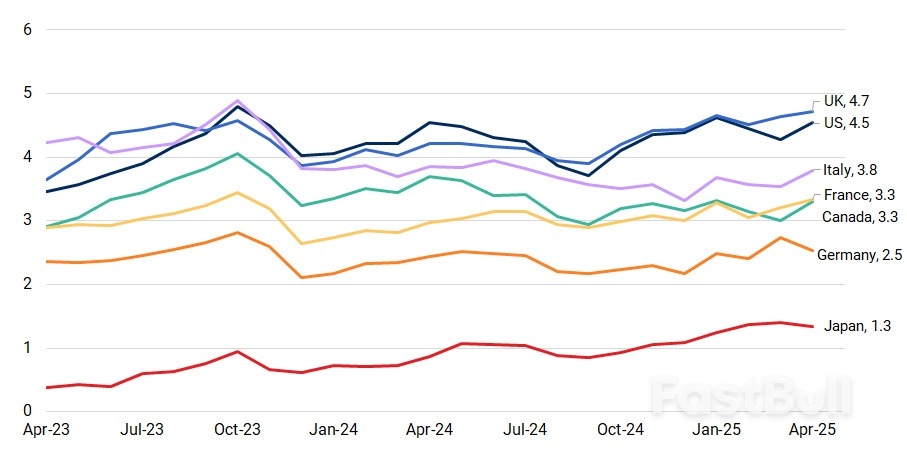
          Any significant rise in projected government borrowing, even if it were all for investment, would be a huge risk at a time when UK borrowing rates are the highest in the G7 and higher than in most European Union economies, including Greece (Figure 1). At first sight it is puzzling that economies like France and Italy, which have larger debt burdens than the UK, have lower long-term interest rates. It may be that lower EU borrowing rates reflect a market expectation that in a crisis the European Central Bank would find ways of purchasing member states’ debt.
          The Bank of England is currently engaged in unnecessary monetary tightening. The Bank selling gilts in the market is a monetary policy operation, but it directly impinges on the operation of fiscal policy and should be subject to the same decision-making processes that govern fiscal policy. This is particularly the case at a time when the UK has high long-term borrowing costs by international standards. It would be unwise in the extreme to ignore the message from the markets.

          Figure 1. UK has the highest borrowing rates in the G7

          Long-term interest rates, % per annum
          The tariff crisis is a chance for the UK to reset policy_1

          Source: OMFIFanalysis. Data as of 11 April.

          Against this economic and market background, the government should reframe fiscal policy. It should move quickly to a position where borrowing is solely to finance investment by reducing the current deficit. In addition, it should vigorously pursue ways to finance investment other than through the bond market. One obvious way to do this is through a revitalised private finance initiative for large infrastructure projects. There are signs that this is happening, such as the Lower Thames Crossing.
          The scope for controlling fiscal policy in a low-growth economy solely by cuts in spending plans will be limited, particularly if the government feels obliged to help sectors damaged by the tariff crisis or to provide relief to those parts of the private sector badly affected by the simultaneous higher employers’ national insurance charges, an increased minimum wage and the forthcoming employment legislation.
          The firm intention should be that the departmental spending plans for the later years of this parliament – which are unhelpfully due to be published in June rather than with the spring statement or the autumn budget – should not be liable to substantial revision in the autumn fiscal event if lower growth causes forecast borrowing to be higher than the fiscal rules allow. A less damaging response would be a broadly based increase in income tax or VAT.

          Source:Peter Sedgwick

          To stay updated on all economic events of today, please check out our Economic calendar
          Risk Warnings and Disclaimers
          You understand and acknowledge that there is a high degree of risk involved in trading. Following any strategies or investment methods may lead to potential losses. The content on the site is provided by our contributors and analysts for information purposes only. You are solely responsible for determining whether any trading assets, securities, strategy, or any other product is suitable for investing based on your own investment objectives and financial situation.
          Add to Favorites
          Share

          Panic exaggerated? Dissent emerges on Wall Street: US economy can withstand tariff shock

          James Riley

          Political

          Wall Street has been abuzz with ominous warnings lately about the economy: Trump’s tariffs are bound to trigger a downturn, perhaps even a recession.

          Torsten Slok, an economist at Apollo Global Management, puts the probability of a recession in 2025 at 90%, while warning that Americans could soon be facing empty store shelves.

          Even Federal Reserve Chairman Jerome Powell has suggested that tariffs could trigger a bout of stagflation, which could force the Fed to delay its next rate cut.

          But in a note shared with MarketWatch on Thursday, some Wall Street strategists offered a different, data-driven view, arguing that much of the fear surrounding the trade situation may be overblown.

          “We believe markets may be overstating the risks to U.S. growth from tariffs,” Steve Englander and Dan Pan, head of global G-10 FX research and head of North American macroeconomic strategy at Standard Chartered, wrote in a note.

          First, the Trump administration exempted 22% of Chinese goods (probably the most important ones) from tariffs. Some Chinese goods may remain competitive even with tariffs. Others may be easily sourced elsewhere.

          Moreover, the imposition of tariffs was not entirely unexpected, and U.S. importers had plenty of time to prepare. Import data showed that U.S. companies had accumulated large inventories of goods before the end of the first quarter. This inventory buffer should give them plenty of time to weather any potential shocks.

          Trump team has avoided a true doomsday scenario for now

          Some on Wall Street have pointed to a sharp drop in containerized freight volumes from China to the U.S. as evidence that Trump’s tariffs will soon lead to shortages.

          Data does show that container freight volumes heading to the U.S. from China have fallen 50% since mid-April.

          But focusing solely on the absolute level of change misses a key context: freight activity levels in mid-April were already quite high, and the levels after the decline are still consistent with freight activity levels for most of 2023.

          So far this year, tonnage of cargo shipped from China to the United States is 40% higher than in 2023 and 9% higher than in 2024, largely because of a surge in shipments before the tariffs were implemented.

          Englander and Pan calculated that even if the freight pace of early May continued into June, cumulative freight volumes from China to the United States in the first half of 2025 would still be 18% higher than in the first half of 2023 and only 5% lower than in the first half of 2024.

          In this case, any decline in imports would amount to only 0.25% of gross domestic product (GDP) relative to 2023 and 0.5% relative to 2024.

          “This tariff shock has little precedent, but we judge that the U.S. economy can handle it,” Englander and Pan wrote. “The benefits of the tariffs are uncertain, and they are likely to cause a lot of disruption, but this is not a catastrophic event for the economy.”

          Chinese exporters have demonstrated their ability to circumvent tariffs by routing goods through other economies, such as Vietnam, and some goods are likely to remain competitive even with tariffs, Englander said.

          “Our biggest concern is that the price increases from tariffs do not have the intended domestic import substitution effect and that the tariffs morph into quantity restrictions — a far worse scenario, in our view,” Englander and Pan wrote in the report.

          The U.S. economy has dealt with modest price shocks in the past

          Englander and Penn’s final point is that sudden spikes in the price of imported goods have dealt modest blows to economic growth in the past. But most of the time, the economy has weathered such shocks without falling into a painful recession — or, if it has, it has been caused by other factors.

          The post-pandemic wave of inflation that hit the U.S. and much of the world in 2022 is one example. Englander and Pan focus on two types of price shocks: those caused by a surge in oil prices, and those caused by a surge in import prices. 2022 is the former.

          But there have been periods in the recent past when import prices have risen sharply, whether due to a weak dollar or other factors.

          Englander and Penn note that U.S. import prices grew by more than 10% annually before and just after the financial crisis, and they also surged in 2000, just as the dot-com bubble began to burst.

          While such price spikes may have been unsettling to many consumers, they did not trigger a recession in either period.

          Englander said there is no doubt that tariffs may cause disruptions. But unless the trade war escalates seriously, the US economy should not be hit too hard. He said: "Tariffs may not be a good idea, but as long as only price mechanisms are used, the damage caused by tariffs may be limited."

          Source: Jinshi Data

          To stay updated on all economic events of today, please check out our Economic calendar
          Risk Warnings and Disclaimers
          You understand and acknowledge that there is a high degree of risk involved in trading. Following any strategies or investment methods may lead to potential losses. The content on the site is provided by our contributors and analysts for information purposes only. You are solely responsible for determining whether any trading assets, securities, strategy, or any other product is suitable for investing based on your own investment objectives and financial situation.
          Add to Favorites
          Share
          FastBull
          Copyright © 2025 FastBull Ltd

          728 RM B 7/F GEE LOK IND BLDG NO 34 HUNG TO RD KWUN TONG KLN HONG KONG

          TelegramInstagramTwitterfacebooklinkedin
          App Store Google Play Google Play
          Products
          Charts

          Chats

          Q&A with Experts
          Screeners
          Economic Calendar
          Data
          Tools
          Membership
          Features
          Function
          Markets
          Copy Trading
          Latest Signals
          Contests
          News
          Analysis
          24/7
          Columns
          Education
          Company
          Careers
          About Us
          Contact Us
          Advertising
          Help Center
          Feedback
          User Agreement
          Privacy Policy
          Business

          White Label

          Data API

          Web Plug-ins

          Poster Maker

          Affiliate Program

          Risk Disclosure

          The risk of loss in trading financial instruments such as stocks, FX, commodities, futures, bonds, ETFs and crypto can be substantial. You may sustain a total loss of the funds that you deposit with your broker. Therefore, you should carefully consider whether such trading is suitable for you in light of your circumstances and financial resources.

          No decision to invest should be made without thoroughly conducting due diligence by yourself or consulting with your financial advisors. Our web content might not suit you since we don't know your financial conditions and investment needs. Our financial information might have latency or contain inaccuracy, so you should be fully responsible for any of your trading and investment decisions. The company will not be responsible for your capital loss.

          Without getting permission from the website, you are not allowed to copy the website's graphics, texts, or trademarks. Intellectual property rights in the content or data incorporated into this website belong to its providers and exchange merchants.

          Not Logged In

          Log in to access more features

          FastBull Membership

          Not yet

          Purchase

          Become a signal provider
          Help Center
          Customer Service
          Dark Mode
          Price Up/Down Colors

          Log In

          Sign Up

          Position
          Layout
          Fullscreen
          Default to Chart
          The chart page opens by default when you visit fastbull.com