• Trade
  • Markets
  • Copy
  • Contests
  • News
  • 24/7
  • Calendar
  • Q&A
  • Chats
Trending
Screeners
SYMBOL
LAST
BID
ASK
HIGH
LOW
NET CHG.
%CHG.
SPREAD
SPX
S&P 500 Index
6827.42
6827.42
6827.42
6899.86
6801.80
-73.58
-1.07%
--
DJI
Dow Jones Industrial Average
48458.04
48458.04
48458.04
48886.86
48334.10
-245.98
-0.51%
--
IXIC
NASDAQ Composite Index
23195.16
23195.16
23195.16
23554.89
23094.51
-398.69
-1.69%
--
USDX
US Dollar Index
97.920
98.000
97.920
98.070
97.810
-0.030
-0.03%
--
EURUSD
Euro / US Dollar
1.17460
1.17467
1.17460
1.17596
1.17262
+0.00066
+ 0.06%
--
GBPUSD
Pound Sterling / US Dollar
1.33855
1.33862
1.33855
1.33961
1.33546
+0.00148
+ 0.11%
--
XAUUSD
Gold / US Dollar
4334.25
4334.66
4334.25
4350.16
4294.68
+34.86
+ 0.81%
--
WTI
Light Sweet Crude Oil
56.858
56.888
56.858
57.601
56.789
-0.375
-0.66%
--

Community Accounts

Signal Accounts
--
Profit Accounts
--
Loss Accounts
--
View More

Become a signal provider

Sell trading signals to earn additional income

View More

Guide to Copy Trading

Get started with ease and confidence

View More

Signal Accounts for Members

All Signal Accounts

Best Return
  • Best Return
  • Best P/L
  • Best MDD
Past 1W
  • Past 1W
  • Past 1M
  • Past 1Y

All Contests

  • All
  • Trump Updates
  • Recommend
  • Stocks
  • Cryptocurrencies
  • Central Banks
  • Featured News
Top News Only
Share

Fed Data - USA Effective Federal Funds Rate At 3.64 Percent On 12 December On $102 Billion In Trades Versus 3.64 Percent On $99 Billion On 11 December

Share

Brazil's Petrobras Says No Impact Seen On Oil, Petroleum Products Output As Workers Start Planned Strike

Share

Statement: US Travel Group Warns New Proposed Trump Administration Requirements For Foreign Tourists To Provide Social Media Histories Could Mean Millions Of People Opting Not To Visit

Share

Blackrock: Kerry White Will Become Head Of Citi Investment Management At Citi Wealth

Share

Blackrock: Rob Jasminski, Head Of Citi Investment Management, Has Joined With Team

Share

Blackrock: Effective Dec 15, Citi Investment Management Employees Will Join Blackrock

Share

Blackrock: Formally Launch Citi Portfolio Solutions Powered By Blackrock

Share

According To Data From The Federal Reserve Bank Of New York, The Secured Overnight Funding Rate (Sofr) Was 3.67% On The Previous Trading Day (December 15), Compared To 3.66% The Day Before

Share

Peru Energy And Mines Ministry: Copper Production Up 4.8% Year-On-Year In October To 248192 Metric Tons

Share

Security Source: Ukrainian Drones Hits Russian Oil Infrastructure In Caspian Sea For Third Time

Share

Spot Palladium Extends Gains, Last Up 5% To $1562.7/Oz

Share

Mexico's Economy Ministry Announces Start Of Anti-Dumping Investigation And Anti-Subsidy Investigations Into USA Pork Imports

Share

Canada Nov CPI Common +2.8%, CPI Median +2.8%, CPI Trim +2.8% On Year

Share

NY Fed's Empire State Prices Paid Index +37.6 In December Versus+49.0 In November

Share

Canada Nov Consumer Prices +0.1% On Month, +2.2% On Year

Share

Canada Nov CPI Core -0.1% On Month, +2.9% On Year

Share

Canada Nov Core CPI, Seasonally Adjusted +0.2% On Month, Oct +0.3% (Unrevised)

Share

UK Health Minister Streeting On Doctors' Strike: Vote To Go Ahead Reveals The Bma's Shocking Disregard For Patient Safety

Share

Venezuelan State Oil Company Pdvsa Says Was Subject To Cyber Attack But Operations Unaffected

Share

Russia Central Bank Says January-October Current Account Surplus At $37.1 Billion

TIME
ACT
FCST
PREV
Japan Tankan Small Manufacturing Outlook Index (Q4)

A:--

F: --

P: --

Japan Tankan Large Non-Manufacturing Outlook Index (Q4)

A:--

F: --

P: --

Japan Tankan Large Manufacturing Outlook Index (Q4)

A:--

F: --

P: --

Japan Tankan Small Manufacturing Diffusion Index (Q4)

A:--

F: --

P: --

Japan Tankan Large Manufacturing Diffusion Index (Q4)

A:--

F: --

P: --

Japan Tankan Large-Enterprise Capital Expenditure YoY (Q4)

A:--

F: --

P: --

U.K. Rightmove House Price Index YoY (Dec)

A:--

F: --

P: --

China, Mainland Industrial Output YoY (YTD) (Nov)

A:--

F: --

P: --

China, Mainland Urban Area Unemployment Rate (Nov)

A:--

F: --

P: --

Saudi Arabia CPI YoY (Nov)

A:--

F: --

P: --

Euro Zone Industrial Output YoY (Oct)

A:--

F: --

P: --

Euro Zone Industrial Output MoM (Oct)

A:--

F: --

P: --

Canada Existing Home Sales MoM (Nov)

A:--

F: --

P: --

Canada National Economic Confidence Index

A:--

F: --

P: --

Canada New Housing Starts (Nov)

A:--

F: --

P: --
U.S. NY Fed Manufacturing Employment Index (Dec)

A:--

F: --

P: --

U.S. NY Fed Manufacturing Index (Dec)

A:--

F: --

P: --

Canada Core CPI YoY (Nov)

A:--

F: --

P: --

Canada Manufacturing Unfilled Orders MoM (Oct)

A:--

F: --

P: --

U.S. NY Fed Manufacturing Prices Received Index (Dec)

A:--

F: --

P: --

U.S. NY Fed Manufacturing New Orders Index (Dec)

A:--

F: --

P: --

Canada Manufacturing New Orders MoM (Oct)

A:--

F: --

P: --

Canada Core CPI MoM (Nov)

A:--

F: --

P: --

Canada Trimmed CPI YoY (SA) (Nov)

A:--

F: --

P: --

Canada Manufacturing Inventory MoM (Oct)

A:--

F: --

P: --

Canada CPI YoY (Nov)

A:--

F: --

P: --

Canada CPI MoM (Nov)

A:--

F: --

P: --

Canada CPI YoY (SA) (Nov)

A:--

F: --

P: --

Canada Core CPI MoM (SA) (Nov)

A:--

F: --

P: --

Canada CPI MoM (SA) (Nov)

A:--

F: --

P: --

Federal Reserve Board Governor Milan delivered a speech
U.S. NAHB Housing Market Index (Dec)

--

F: --

P: --

Australia Composite PMI Prelim (Dec)

--

F: --

P: --

Australia Services PMI Prelim (Dec)

--

F: --

P: --

Australia Manufacturing PMI Prelim (Dec)

--

F: --

P: --

Japan Manufacturing PMI Prelim (SA) (Dec)

--

F: --

P: --

U.K. 3-Month ILO Employment Change (Oct)

--

F: --

P: --

U.K. Unemployment Claimant Count (Nov)

--

F: --

P: --

U.K. Unemployment Rate (Nov)

--

F: --

P: --

U.K. 3-Month ILO Unemployment Rate (Oct)

--

F: --

P: --

U.K. Average Weekly Earnings (3-Month Average, Including Bonuses) YoY (Oct)

--

F: --

P: --

U.K. Average Weekly Earnings (3-Month Average, Excluding Bonuses) YoY (Oct)

--

F: --

P: --

France Services PMI Prelim (Dec)

--

F: --

P: --

France Composite PMI Prelim (SA) (Dec)

--

F: --

P: --

France Manufacturing PMI Prelim (Dec)

--

F: --

P: --

Germany Services PMI Prelim (SA) (Dec)

--

F: --

P: --

Germany Manufacturing PMI Prelim (SA) (Dec)

--

F: --

P: --

Germany Composite PMI Prelim (SA) (Dec)

--

F: --

P: --

Euro Zone Composite PMI Prelim (SA) (Dec)

--

F: --

P: --

Euro Zone Services PMI Prelim (SA) (Dec)

--

F: --

P: --

Euro Zone Manufacturing PMI Prelim (SA) (Dec)

--

F: --

P: --

U.K. Services PMI Prelim (Dec)

--

F: --

P: --

U.K. Manufacturing PMI Prelim (Dec)

--

F: --

P: --

U.K. Composite PMI Prelim (Dec)

--

F: --

P: --

Euro Zone ZEW Economic Sentiment Index (Dec)

--

F: --

P: --

Germany ZEW Current Conditions Index (Dec)

--

F: --

P: --

Germany ZEW Economic Sentiment Index (Dec)

--

F: --

P: --

Euro Zone Trade Balance (Not SA) (Oct)

--

F: --

P: --

Euro Zone ZEW Current Conditions Index (Dec)

--

F: --

P: --

Euro Zone Trade Balance (SA) (Oct)

--

F: --

P: --

U.S. Retail Sales MoM (Excl. Automobile) (SA) (Oct)

--

F: --

P: --

Q&A with Experts
    • All
    • Chatrooms
    • Groups
    • Friends
    Connecting
    .
    .
    .
    Type here...
    Add Symbol or Code

      No matching data

      All
      Trump Updates
      Recommend
      Stocks
      Cryptocurrencies
      Central Banks
      Featured News
      • All
      • Russia-Ukraine Conflict
      • Middle East Flashpoint
      • All
      • Russia-Ukraine Conflict
      • Middle East Flashpoint
      Search
      Products

      Charts Free Forever

      Chats Q&A with Experts
      Screeners Economic Calendar Data Tools
      Membership Features
      Data Warehouse Market Trends Institutional Data Policy Rates Macro

      Market Trends

      Market Sentiment Order Book Forex Correlations

      Top Indicators

      Charts Free Forever
      Markets

      News

      News Analysis 24/7 Columns Education
      From Institutions From Analysts
      Topics Columnists

      Latest Views

      Latest Views

      Trending Topics

      Top Columnists

      Latest Update

      Signals

      Copy Rankings Latest Signals Become a signal provider AI Rating
      Contests
      Brokers

      Overview Brokers Assessment Rankings Regulators News Claims
      Broker listing Forex Brokers Comparison Tool Live Spread Comparison Scam
      Q&A Complaint Scam Alert Videos Tips to Detect Scam
      More

      Business
      Events
      Careers About Us Advertising Help Center

      White Label

      Data API

      Web Plug-ins

      Affiliate Program

      Awards Institution Evaluation IB Seminar Salon Event Exhibition
      Vietnam Thailand Singapore Dubai
      Fans Party Investment Sharing Session
      FastBull Summit BrokersView Expo
      Recent Searches
        Top Searches
          Markets
          News
          Analysis
          User
          24/7
          Economic Calendar
          Education
          Data
          • Names
          • Latest
          • Prev

          View All

          No data

          Scan to Download

          Faster Charts, Chat Faster!

          Download App
          English
          • English
          • Español
          • العربية
          • Bahasa Indonesia
          • Bahasa Melayu
          • Tiếng Việt
          • ภาษาไทย
          • Français
          • Italiano
          • Türkçe
          • Русский язык
          • 简中
          • 繁中
          Open Account
          Search
          Products
          Charts Free Forever
          Markets
          News
          Signals

          Copy Rankings Latest Signals Become a signal provider AI Rating
          Contests
          Brokers

          Overview Brokers Assessment Rankings Regulators News Claims
          Broker listing Forex Brokers Comparison Tool Live Spread Comparison Scam
          Q&A Complaint Scam Alert Videos Tips to Detect Scam
          More

          Business
          Events
          Careers About Us Advertising Help Center

          White Label

          Data API

          Web Plug-ins

          Affiliate Program

          Awards Institution Evaluation IB Seminar Salon Event Exhibition
          Vietnam Thailand Singapore Dubai
          Fans Party Investment Sharing Session
          FastBull Summit BrokersView Expo

          RBNZ 'Absolutely' Prepared to Hike Rates If Necessary, Silk Says

          Thomas

          Economic

          Central Bank

          Summary:

          New Zealand's central bank is prepared to raise interest rates if economic developments mean current policy settings aren't restrictive enough to bring inflation back to target, Assistant Governor Karen Silk said.

          New Zealand's central bank is prepared to raise interest rates if economic developments mean current policy settings aren't restrictive enough to bring inflation back to target, Assistant Governor Karen Silk said.
          “There are risks still to the upside in the near term” and the bank is “absolutely” prepared to act if they were to “come to fruition in a meaningful way,” Silk said in an interview Friday in Wellington. “Right now we are saying that the level of restrictiveness is there, but we are awake at the wheel.”
          The Reserve Bank left the Official Cash Rate at 5.5% this week but surprised markets by saying it considered a hike and that policy needs to stay restrictive for longer because of domestic inflation pressures. The bank's forecast rate track implies a 60% chance of an increase this year and no pivot to easing until the second half of 2025.
          After the RBNZ's rate decision, investors reduced bets on a rate cut this year while most local economists now see no easing until next year.
          To be sure, Silk said there are also risks to the downside.
          New Zealand's economy was in recession in the second half of 2023 and the RBNZ expects just 0.4% annual average growth this year. That has implications for company earnings and unemployment, which could cool inflation.
          “The labor market could unwind faster if business profitability is squeezed and they stop hoarding labor,” Silk said.
          The RBNZ's central projection is that headline inflation will fall back into its 1-3% target band by the fourth quarter this year, though it now doesn't see it reaching its 2% goal until mid-2026.
          “If we don't continue to see inflation come back at a reasonable pace, what does that mean for inflation expectations?” Silk said.
          Silk said domestic inflation is more persistent than expected while it appears the economy has less capacity to grow without putting pressure on prices.
          “Our concern is in that near term, around what are we really seeing in terms of domestic aligned inflation,” she said. “Is it going to come back at the pace that we need it to?”
          The RBNZ has underestimated non-tradables inflation, the best measure of domestic price pressures, for four straight quarters.
          Silk said the most significant miss was last quarter, when non-tradables inflation was 5.8% compared with the RBNZ's 5.3% projection.
          She said the mis-read reflected small discrepancies across the board, which “is more concerning than if it had been any one particular thing.”
          RBNZ officials have now assessed that there were more capacity pressures in the economy than they had previously realized and have adjusted their modeling accordingly.
          The RBNZ projects non-tradables inflation will be 5.3% in the current quarter and sees it gradually slowing to 2.8% by the end of 2025. A fifth straight mis-read wouldn't necessarily be a problem, Silk said.
          “We don't look at just one thing,” she said. “It will be in the context of a broader mix of measures. But it is an important measure that we will be watching. And we will be watching labor market data as well. We need to see that continue to soften.”

          Source: Bloomberg

          To stay updated on all economic events of today, please check out our Economic calendar
          Risk Warnings and Disclaimers
          You understand and acknowledge that there is a high degree of risk involved in trading. Following any strategies or investment methods may lead to potential losses. The content on the site is provided by our contributors and analysts for information purposes only. You are solely responsible for determining whether any trading assets, securities, strategy, or any other product is suitable for investing based on your own investment objectives and financial situation.
          Add to Favorites
          Share

          US Stocks Sink As Robust Economic Data Offsets Nvidia Cheer

          Samantha Luan

          Economic

          Stocks

          US stocks reversed early gains, as signs of an uptick in business activity in the world’s biggest economy countered another set of blockbuster results from chipmaker Nvidia.
          Wall Street’s S&P 500 closed 0.7 per cent lower in New York on Thursday, having made small gains to reach a record intraday high earlier in the session. The Nasdaq Composite dropped 0.4 per cent, also retracing an earlier advance.
          The reversal followed early or “flash” indices from S&P Global showing signs of acceleration in manufacturing and services industries in the US economy, with a composite index reading coming in at 54.4 for May. That was higher than consensus forecasts of 51.1 and above April’s reading of 51.3. Any figure above 50 signals expansion.
          Jobs data released earlier on Thursday showed initial applications for US unemployment fell by 8,000 to 215,000 for the week ending May 18, versus a Reuters consensus estimate of 220,000.
          The figures — although better than expected — suggest the labour market remains relatively tight, and sparked a sell-off in US government debt. Yields on interest rate-sensitive two-year Treasuries was up 0.06 percentage points to 4.94 per cent.
          Investors have been scrutinising labour market and business survey data for clues about the strength of the US economy, with signs of resilience typically weighing on bets about the probability of Federal Reserve interest rate cuts this year.
          As of Thursday afternoon, just one quarter-point rate cut was fully priced in for 2024, in December.
          The minutes of the May 1 Federal Open Market Committee meeting, which were released on Wednesday, revealed US officials would be ready to raise interest rates if inflation began to creep higher again.
          “The fact that Fed minutes showed a hypothetical openness to hiking rates again, should inflation remain too high, was a bit of a wake-up call,” said Mike Zigmont, head of trading and research at Harvest Volatility Management.
          Kristina Hooper, chief global market strategist at Invesco, said the FOMC minutes “threw some cold water” on Wall Street on Wednesday, only for that to be countered by the strong Nvidia results.
          “But that was shortlived,” she said, with Thursday’s data serving as a reminder of the hawkishness of the Fed minutes. “I’m not surprised by the reversal . . . It is to be expected given the data. But I am confident the disinflationary process is continuing. No matter how hawkish Fed rhetoric gets, I am still confident the Fed will cut this year.”
          Elsewhere, Nvidia shares closed more than 9 per cent higher after the chipmaker announced late on Wednesday stronger than expected earnings, a 10-for-1 stock split and bullish forward guidance.
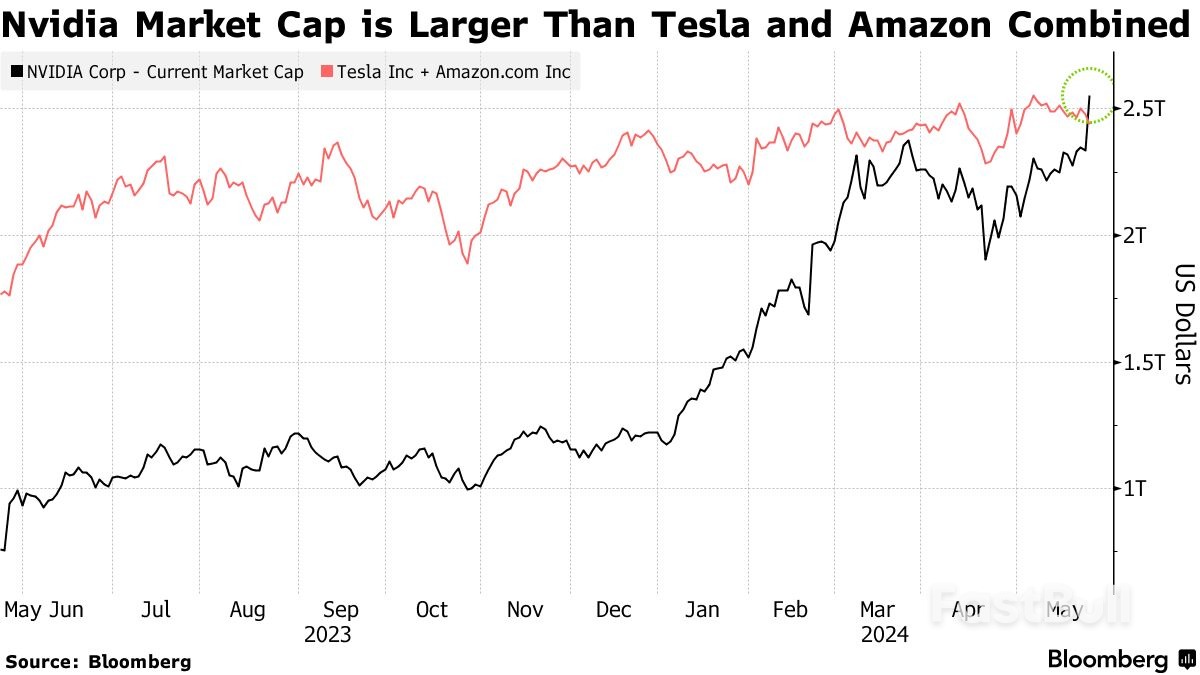
          Nvidia’s update helped push its market value above $2.5tn for the first time.
          Investors closely watch Nvidia as the company — now a stock market heavyweight — has repeatedly blown past analysts’ revenue and margin forecasts and emerged as the dominant provider of the graphics processing units that power generative artificial intelligence.
          The tech giant’s results on Wednesday were “perfect”, said Charles-Henry Monchau, chief investment officer at Bank Syz. “There was a lot of hype ahead of earnings and the stock price has already doubled since the start of the year [but] they managed to beat by all counts,” he added.

          Source:Financial Times

          To stay updated on all economic events of today, please check out our Economic calendar
          Risk Warnings and Disclaimers
          You understand and acknowledge that there is a high degree of risk involved in trading. Following any strategies or investment methods may lead to potential losses. The content on the site is provided by our contributors and analysts for information purposes only. You are solely responsible for determining whether any trading assets, securities, strategy, or any other product is suitable for investing based on your own investment objectives and financial situation.
          Add to Favorites
          Share

          SEC Opens Door for US Spot-Ether ETFs in Landmark for Crypto

          Samantha Luan

          Cryptocurrency

          Stocks

          The SEC signed off on a proposal by venues run by Cboe Global Markets Inc., Nasdaq and the New York Stock Exchange to list products tied to the second-biggest digital asset — a step that had seemed unlikely through last week.
          Thursday's events remove a key hurdle for US spot-Ether ETF trading. Issuers now need a separate sign-off from the agency. No deadline has been set for that decision. Ether rose 1.5% to $3,810 as of 8:56 a.m. on Friday in Singapore amid a 24% surge this week driven by signs that approvals were on the way.
          The latest developments are a major milestone for crypto, said Rich Rosenblum, president of liquidity provider GSR Markets Ltd. Referring to the abrupt pivot toward approval, Rosenblum said “in the 12 years I've been trading this space, this is the most incredible thematic whipsaw I can remember.”

          First-Mover Advantage

          Firms such as VanEck, ARK Investment Management, BlackRock Inc. and Fidelity Investments are vying for first-mover advantage in the race to launch a spot-Ether ETF. Their interest has been piqued by the $58 billion amassed by Bitcoin ETFs since the SEC's green light for those products at the start of 2024.
          The SEC's order echoed the one it issued in January clearing exchanges to list Bitcoin ETFs, including a lengthy discussion of correlations between the Ether spot market and futures tracking it that are hosted by CME Group Inc. in Chicago. How closely the two markets move is a crucial point for regulators who want CME surveillance systems to spot trading anomalies before they spiral.
          Coinbase Global Inc. proffered a study showing correlations among spot and futures markets for Ether were about 85% over one-minute intervals between March 2021 and January 2024, which it said was higher than the one cited in the Bitcoin review. The SEC said it replicated that and other studies and found they “provide empirical evidence that prices generally move in close (although not perfect) alignment” between the spot and CME Ether futures markets.

          Wider Implications

          Beyond ETFs, the latest developments may have wider policy implications. SEC Chair Gary Gensler has been ambiguous on whether Ether is a security, and crypto enthusiasts are worried about the token — and potentially projects based on the Ethereum blockchain — falling under the agency's tough and costly rules.
          The Commodity Futures Trading Commission, the US regulator with jurisdiction over derivatives, has signaled that it doesn't view Ether as a security. The CFTC has for years allowed trading in Ether futures by CME Group.
          Lee Reiners, policy director of the Duke Financial Economics Center at Duke University, said that exchange bids to list the products were based on Ether being a commodity and not a security. An SEC decision to green light the plan bolsters the view that the SEC still considers Ether not to be a security, he said.
          As recently as last week, companies expected the SEC to reject the Cboe plan — and potentially others — by Thursday's deadline. Additional SEC approval is still needed for the issuers. Backers hope eventual listings will woo money from retail and institutional investors who are reassured by the ETF wrapper.
          In a note of caution, Lara Crigger of data provider VettaFi said she doubts Ether ETFs can attract the same scale of inflow as Bitcoin products. “Although Ether has more use cases, it's a much smaller market than Bitcoin, with lower awareness and name recognition among the general investing public,” she said.

          Chequered History

          The digital-asset industry has been recovering over the past year or so from a 2022 market rout and a spate of scandals, such as the huge fraud at Sam Bankman-Fried's collapsed FTX exchange and his subsequent jailing. Demand for US Bitcoin ETFs helped drive the cryptocurrency to a record high in March.
          Some of that rally is due to optimism that a US crackdown may be waning. The Republican-led House this week advanced sweeping crypto legislation despite opposition from the White House and Gensler. The Senate isn't expected to approve the measure but it garnered some Democratic support in the House.
          Asset managers have been making concessions to win SEC approval, notably on so-called staking — the process of earning rewards for blockchain maintenance. Fidelity Investments said it will keep the Ether it buys as part of the ETF out of such programs.
          Staking is a key issue for Ether because it raises questions about whether the token should be treated as a security. Last year, the SEC in a lawsuit accused Coinbase of breaking its rules by offering staking services.

          Source: Bloomberg

          Risk Warnings and Disclaimers
          You understand and acknowledge that there is a high degree of risk involved in trading. Following any strategies or investment methods may lead to potential losses. The content on the site is provided by our contributors and analysts for information purposes only. You are solely responsible for determining whether any trading assets, securities, strategy, or any other product is suitable for investing based on your own investment objectives and financial situation.
          Add to Favorites
          Share

          AUD to USD Forecast: Aussie Dollar Awaits Key U.S. Stats Amid RBA Rate Cut Bets

          Cohen

          Forex

          Economic

          Market Risk Sentiment and RBA Rate Cut Bets
          On Friday (May 24), market risk sentiment and commodity price trends will likely influence buyer demand for the AUD/USD.
          Iron ore spot price falls on Thursday (May 23), and downward trends in the futures market could pressure the AUD/USD early in the Friday session. Moreover, the Asian market reaction to overnight economic indicators from the US could also limit the appetite of dip buyers.
          Recent economic indicators from Australia have raised investor expectations of an RBA rate cut. Wage growth slowed, unemployment rose, and private sector PMI numbers disappointed on Thursday. The stats suggest that the higher inflation and interest rate environment impacted households more.
          With private consumption contributing over 50% to the Australian economy, deteriorating labor market conditions would be a headwind for the Aussie dollar. Higher unemployment levels would affect consumer confidence, wage growth, and household spending. Downward trends in consumer spending could dampen demand-driven inflationary pressures.

          US Economic Calendar: Durable Goods Orders, Consumer Sentiment, and the Fed

          Later in the Friday session, durable goods orders and the finalized University of Michigan Survey of Consumers will warrant investor attention.
          Economists forecast core durable goods orders to increase by 0.1% in April after rising by 0.2% in March. Better-than-expected numbers would signal an improving demand environment and align with the recent private sector PMI figures.
          However, revisions to the Michigan Consumer Sentiment and Inflation Expectations Indexes also need consideration.
          According to preliminary numbers, the Michigan Consumer Sentiment Index declined from 77.2 to 67.5 in May. The Michigan Inflation Expectations Index increased from 3.2% to 3.5%.
          While the numbers will influence buyer demand for the US dollar, investors should track FOMC member speeches.
          FOMC member Christopher Waller is on the calendar to speak. Reaction to the recent private sector PMI numbers require monitoring. This week, the Fed Governor supported an interest rate cut at the end of the year if data continued to soften. A shift in views toward the timing of a Fed rate cut would influence buyer appetite for the AUD/USD.

          Short-Term Forecast

          Near-term AUD/USD trends could hinge on the FOMC member speeches. Hotter-than-expected US Services PMI data sank investor bets on a September Fed rate cut. Hawkish Fed commentary could impact buyer demand for the AUD/USD further.

          AUD/USD Price Action

          Daily Chart
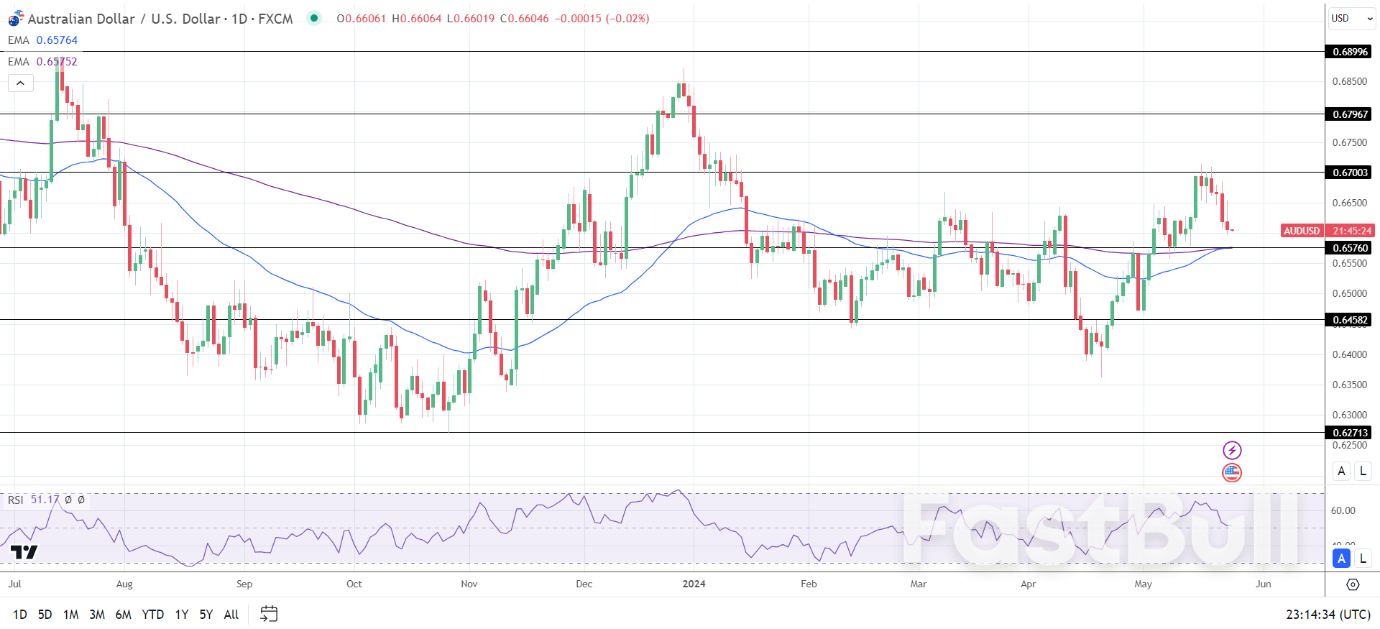
          AUD to USD Forecast: Aussie Dollar Awaits Key U.S. Stats Amid RBA Rate Cut Bets_1
          The AUD/USD remained above the 50-day and 200-day EMAs, sending bullish price signals.
          An Aussie dollar return to the $0.66500 handle could give the bulls a run at the $0.67003 resistance level. Furthermore, a breakout from the $0.67003 resistance level could bring the $0.67500 handle into play.
          US core durable goods orders, the University of Michigan Survey, and FOMC member chatter need consideration.
          Conversely, an AUD/USD drop below the 50-day EMA, the $0.65760 support level, and the 200-day EMA could signal a fall toward the $0.64582 support level. Buying pressure may increase at the $0.65760 support level. The EMAs are confluent with the support level.
          With a 14-period Daily RSI reading of 51.17, the AUD/USD could move to the $0.67003 resistance level before entering overbought territory.

          Source: FX Empire

          To stay updated on all economic events of today, please check out our Economic calendar
          Risk Warnings and Disclaimers
          You understand and acknowledge that there is a high degree of risk involved in trading. Following any strategies or investment methods may lead to potential losses. The content on the site is provided by our contributors and analysts for information purposes only. You are solely responsible for determining whether any trading assets, securities, strategy, or any other product is suitable for investing based on your own investment objectives and financial situation.
          Add to Favorites
          Share

          USD/JPY: Japanese Disinflationary Pressures Build Casting Doubt over Future BOJ Hikes

          FOREX.com

          Economic

          Forex

          Inflation not moving in the right direction for BOJ

          Prospects for a sustained lift in inflationary pressures in Japan looks to be slowly slipping away, unless large wage increases from employers can permanently boost aggregate demand. Because looking at the trajectory for price pressures right now, it's difficult to see the virtuous cycle between higher wages and inflation continuing beyond the short-term. Be it headline or underlying price pressures, both are experiencing deep disinflation, casting doubt over the ability for the Bank of Japan to deliver more than the one rate hike already delivered.

          Japanese disinflation intensifies

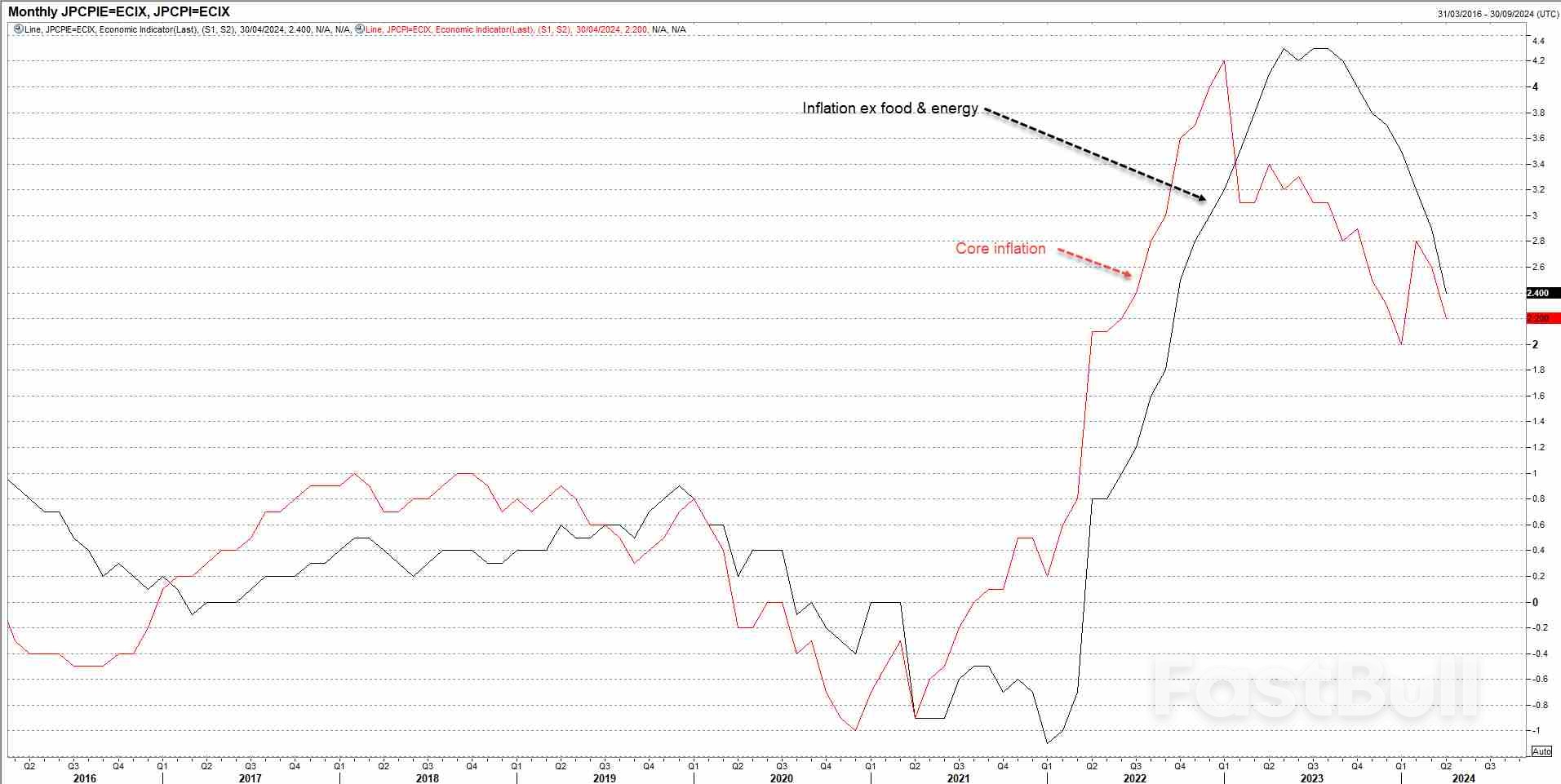
          Consumer price inflation slowed to 2.5% in the year to April, according to data released by the Japanese government, down from 2.7% reported in the 12 months to March. Core inflation which excludes fresh food prices was even softer, easing to 2.2% from 2.6%. That's important as it's the inflation figure targeted by the BOJ.
          While the core reading was in line with expectation and remains above the BOJ's 2% target, it's now down a two full percentage points from the highs hit in early 2023 and is trending lower. It's a similar story for CPI ex-energy and food which slowed sharply in the past year, coming in at 2.4% from 2.9% in March.
          USD/JPY: Japanese Disinflationary Pressures Build Casting Doubt over Future BOJ Hikes_1
          With the Japanese economy shrinking in the first three months of the year, hopes for a sustained lift in inflation rest largely on the household sector, with positive real wages growth set to provide tailwinds for flagging household spending. If it doesn't, it's incredibly difficult to see the BOJ delivering further rate hikes. Even with the weaker Japanese yen, there's little evidence in upstream price measures to suggest that's flowing through to broadly higher consumer prices.
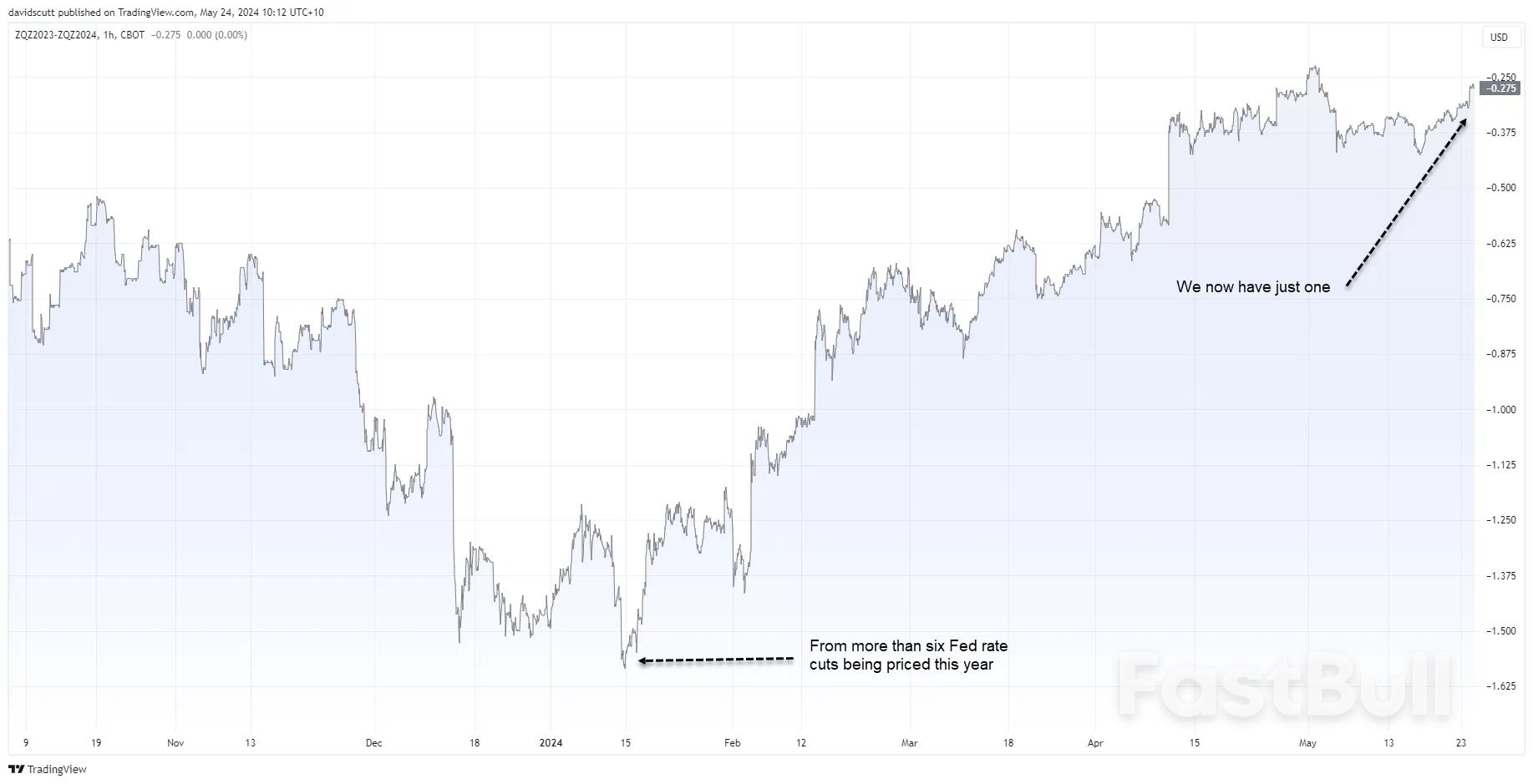
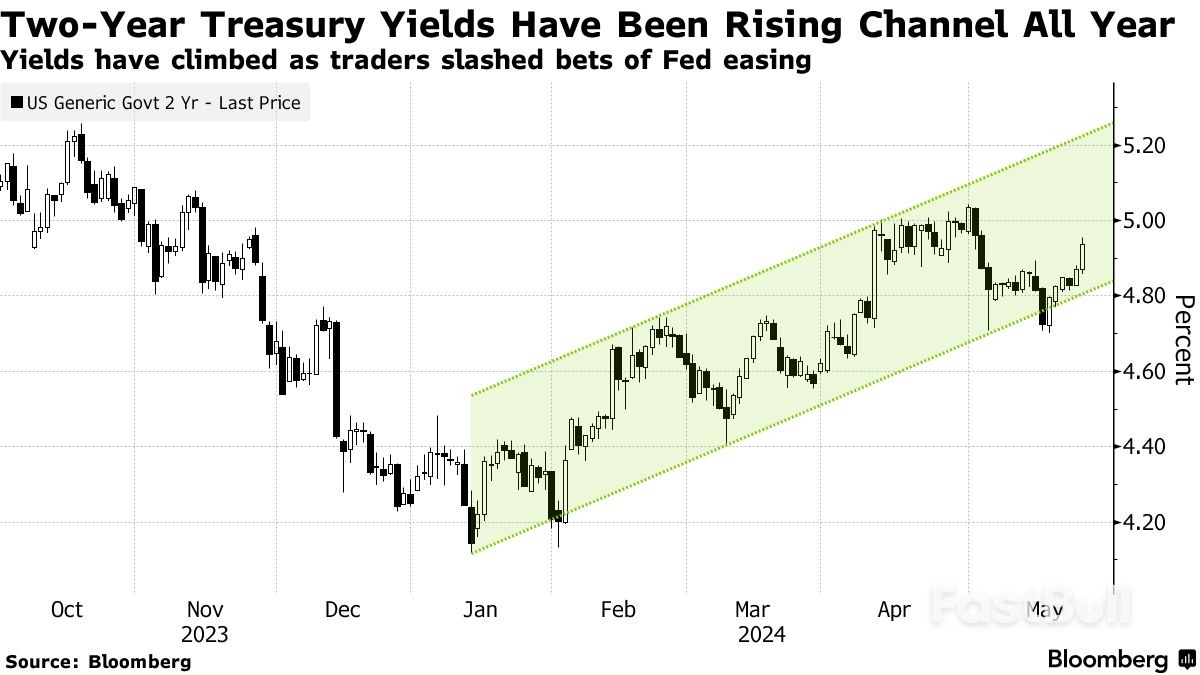
          That's problematic for the BOJ and markets who still have around 15 basis points of hikes priced from the bank over the next year. With resilient US economic data seeing Fed rate cut bets dwindle to less than 30 basis points this year, yield differentials between the two nations remain at historically elevated levels, incentivising traders to continue buying dips in USD/JPY.
          USD/JPY: Japanese Disinflationary Pressures Build Casting Doubt over Future BOJ Hikes_2

          USD/JPY grinding towards 158

          Having managed to clear resistance at 156.55 and the high of 156.78 on Thursday, USD/JPY looks like it may retest the high of 158 set at the start of May. One trade option would be to initiate longs here with a stop below 156.55, providing a risk-reward of two to one for those targeting 158. In a perfect world, the trade would be more appealing if we saw a dip back towards 156.55, improving the risk reward of the trade.
          One thing for traders to consider is the likelihood that market activity will slow today given the proximity to Memorial Day in the US on Monday. While lower volumes often encourage a risk-on environment, something that would usually assist USD/JPY gains, it can also amplify volatility. Make sure you have stops in place.
          USD/JPY: Japanese Disinflationary Pressures Build Casting Doubt over Future BOJ Hikes_3
          To stay updated on all economic events of today, please check out our Economic calendar
          Risk Warnings and Disclaimers
          You understand and acknowledge that there is a high degree of risk involved in trading. Following any strategies or investment methods may lead to potential losses. The content on the site is provided by our contributors and analysts for information purposes only. You are solely responsible for determining whether any trading assets, securities, strategy, or any other product is suitable for investing based on your own investment objectives and financial situation.
          Add to Favorites
          Share

          Asian Stocks Slide as Fed’s Rate Cuts Seen Delayed

          Alex

          Economic

          Stocks

          Asian stocks tracked Wall Street lower following activity data that signaled the Federal Reserve may keep rates on hold for most of this year.
          Stocks fell in Australia and Japan, while equity futures in Hong Kong pointed to losses of more than 1% at the open Friday. The Golden Dragon Index of US-listed Chinese shares fell 3.7% Thursday, the most in six weeks. US contracts were steady after the S&P 500 fell the most this month and the Dow Jones Industrial Average lost 1.5%.
          Swaps now fully price the Fed’s first full quarter-point rate cut in December, versus November a day earlier. Growth in activity at service providers was the fastest in a year and manufacturing output expanded at a quicker pace. Such resilience is making it difficult for inflation to cool, helping explain why the Fed is intent on keeping rates higher for longer.
          “For central banks that have a responsibility for optimizing economic welfare, the growth climate is welcome,” Australia & New Zealand Banking Group economists including Henry Russell wrote in a note to clients. “Therefore, the primary uncertainty for rate setters continues to be whether inflation will continue to progress toward target despite economies operating strongly.”
          Asian Stocks Slide as Fed’s Rate Cuts Seen Delayed_1
          Emerging Asian currencies, including South Korea’s won and Malaysia’s ringgit, fell on the back of a stronger dollar.
          In Japan, inflation eased for a second month as investors continued to weigh whether the Bank of Japan has capacity to raise interest rates further this year. The yield on 10-year Japanese government bonds topped 1% this week as markets almost fully price a 10 basis point hike at the July meeting, according to data compiled by Bloomberg. The yen is trading around 157 per dollar.
          The cooling in prices, however, won’t “deter financial markets from speculating on further Bank of Japan policy tightening,” said Kristina Clifton, a senior economist at Commonwealth Bank of Australia in Sydney. “At this stage, we expect the BOJ to wait until around October before increasing interest rates again,” which could place further pressure on the yen, she added.

          Higher For Longer

          Atlanta Fed President Raphael Bostic on Thursday reiterated the chorus from officials this week that the central bank needs to be patient on its next move as there is still considerable upward pressure on prices. Minutes of the Fed’s May meeting released this week showed policy makers coalesced around a desire to hold rates higher for longer and “many” questioned whether policy was restrictive enough to bring inflation down to their target.
          “The minutes are a reminder that while the Fed does not see another rate hike as likely — and certainly does not see it as a base-case — it will not rule out hikes if inflation does not behave,” said Chris Low at FHN Financial.
          Treasuries steadied after falling on bets on higher-for-longer US interest rate. An index tracking greenback strength was little changed in Friday Asian trading, after strengthening for a fourth day following higher Treasury yields.
          Meantime, following another round of blowout earnings from artificial-intelligence darling Nvidia Corp, the chipmaker jumped over 9% on a solid outlook and topped the historic $1,000 mark. Together with the economy’s steady advance, the S&P 500 likely has further room to rise, according to JPMorgan Chase & Co.’s trading desk.
          “With the AI theme still delivering and the macro hypothesis intact, we are likely to continue to make new all-time highs,” the team including Head of US Market Intelligence Andrew Tyler wrote in a note to clients.
          Asian Stocks Slide as Fed’s Rate Cuts Seen Delayed_2
          In commodities, oil steadied on Friday after slipping in its previous session as traders weighed signs of a weakening physical market ahead of the start of the US summer driving season. Elsewhere, gold held Thursday’s loss following the US economic data.

          Source:Bloomberg

          To stay updated on all economic events of today, please check out our Economic calendar
          Risk Warnings and Disclaimers
          You understand and acknowledge that there is a high degree of risk involved in trading. Following any strategies or investment methods may lead to potential losses. The content on the site is provided by our contributors and analysts for information purposes only. You are solely responsible for determining whether any trading assets, securities, strategy, or any other product is suitable for investing based on your own investment objectives and financial situation.
          Add to Favorites
          Share

          US Stock Changes Push FX Trades into Asia's 'Twilight Zone'

          Alex

          Economic

          Stocks

          Forex

          A shortening of U.S. stock settlement window next week is expected to upend trading for Asian money managers, pushing some to secure funds in the early hours of their mornings when currency markets are at their thinnest and most jumpy.
          From May 28, investors from Singapore, Tokyo or Seoul who buy U.S. shares during the Wall Street Day will have just 24 hours to validate their trades and convert their funds into dollars to complete the deals, down from two days previously.
          While the new U.S. rules are designed to reduce counterparty risks, dealers and regulators are watching to see if the changes ruffle prices or flows in the $7.5-trillion-a-day forex market.
          In Asia, traders are all too familiar with the sudden moves that happen when big trades hit in low liquidity hours of their mornings, such as dives in sterling in 2016 or dollar/yen in 2019, which created global market ripples.
          "That New York 5 p.m. to Tokyo, say, seven or eight, is usually what we refer to as a twilight zone," said Bart Wakabayashi, Tokyo branch manager at State Street, a custodian bank involved in settling U.S. stock trades.
          "There's not a lot of clients trading at that time...(and) not a lot of banks supplying liquidity," he said.
          "So, if there's an imbalance, there could be an adverse impact on markets...bigger swings than traditionally."
          Under the changes, the deadline for affirming trades, where brokers, investors and custodians check and agree on all the details, moves from 12.30 p.m. New York time on the day after a trade to 9 p.m. on the day of the trade, according to the Depository Trust & Clearing Corporation (DTCC), which provides clearing and settlement for U.S. securities.
          That's 9 a.m. in Hong Kong and means investors there need to be available well before then to fix problems, or risk failed trades and higher processing fees.
          Gerard Walsh, head of client solutions for banking and markets at Northern Trust, said tighter timetables could mean a shift in FX flows towards early opening times in Asia's financial centres.
          "That's one of the many permutations that we think might happen...this needs careful attention for what could be years, until markets are in sync again," Walsh said.

          Money Moving

          Investors and their broker-dealers have been preparing for the change by planning for increased staffing, automation, extra cash buffers and, in some cases, pre-funding trades.
          Most of that adds cost, ultimately borne by the investor.
          "When you do T+2 or T+1 or same day FX, the liquidity conditions can vary quite significantly based on the currency and time of day of execution, which can have an impact to the overall transaction cost," said Phillip Van Dine, head of banks and market infrastructure sales for Citi Securities Services in Asia.
          Ironically, settlement risks could also rise in currency trade as a cut-off for submitting trades to CLS, a large settlement platform run by big banks, is not moving from midnight Central European Time (6 a.m. in Hong Kong).
          The changes will also leave the U.S. out of step with most other currency and global stock markets, which settle in two days.
          That means an investor selling, for example, an Australian stock to fund a U.S. purchase will need either a line of credit or to carefully manage cash and currency flows, since it will take two business days for the Australian dollars to arrive.
          The juggling act will be even more acute over weekends or market holidays, and in markets such as South Korea where currency trading stops on holidays. Retail brokers must also position for unpredictable client demand for currencies.
          "(Fund managers) can anticipate the demand beforehand and purchase dollars on Friday to have them ready," said Cho Jung-oh, digital innovation department head of Mirae Asset Global Investment.
          "However, for securities firms, it's challenging to predict how much individuals will buy, making it difficult to secure dollars in advance."
          To be sure, most participants welcome shorter settlement and believe uncertainties can be mitigated.
          Trades that miss the CLS cut-off can still be submitted as late as 6.30 am CET, or settled outside CLS.
          Singapore's central bank and other market participants noted increased morning trade should also deepen the market.
          Large banks and custodians such as Citi, State Street, J.P. Morgan and BNY Mellon, among others, say they are able to automate much of the process, including foreign exchange, to ensure Asia-based investors get dollars in time.
          It's also not the first time this has happened. The U.S. settlement cycle has shrunk over the years from five days in 1987, without incident. India moved smoothly to T+1 in 2023.
          Still, the shift highlights some of the inflexibility in the cumbersome infrastructure that underpins global markets and moves trillions daily.
          "We have a transaction bank that expects money moving 24/7 and we have a foreign exchange market that only works 5-1/2 days a week, with cut-off times," said Paul van Sint Fiet, head of cross-currency solutions for Asia at J.P. Morgan.

          Source: Reuters

          To stay updated on all economic events of today, please check out our Economic calendar
          Risk Warnings and Disclaimers
          You understand and acknowledge that there is a high degree of risk involved in trading. Following any strategies or investment methods may lead to potential losses. The content on the site is provided by our contributors and analysts for information purposes only. You are solely responsible for determining whether any trading assets, securities, strategy, or any other product is suitable for investing based on your own investment objectives and financial situation.
          Add to Favorites
          Share
          FastBull
          Copyright © 2025 FastBull Ltd

          728 RM B 7/F GEE LOK IND BLDG NO 34 HUNG TO RD KWUN TONG KLN HONG KONG

          TelegramInstagramTwitterfacebooklinkedin
          App Store Google Play Google Play
          Products
          Charts

          Chats

          Q&A with Experts
          Screeners
          Economic Calendar
          Data
          Tools
          Membership
          Features
          Function
          Markets
          Copy Trading
          Latest Signals
          Contests
          News
          Analysis
          24/7
          Columns
          Education
          Company
          Careers
          About Us
          Contact Us
          Advertising
          Help Center
          Feedback
          User Agreement
          Privacy Policy
          Business

          White Label

          Data API

          Web Plug-ins

          Poster Maker

          Affiliate Program

          Risk Disclosure

          The risk of loss in trading financial instruments such as stocks, FX, commodities, futures, bonds, ETFs and crypto can be substantial. You may sustain a total loss of the funds that you deposit with your broker. Therefore, you should carefully consider whether such trading is suitable for you in light of your circumstances and financial resources.

          No decision to invest should be made without thoroughly conducting due diligence by yourself or consulting with your financial advisors. Our web content might not suit you since we don't know your financial conditions and investment needs. Our financial information might have latency or contain inaccuracy, so you should be fully responsible for any of your trading and investment decisions. The company will not be responsible for your capital loss.

          Without getting permission from the website, you are not allowed to copy the website's graphics, texts, or trademarks. Intellectual property rights in the content or data incorporated into this website belong to its providers and exchange merchants.

          Not Logged In

          Log in to access more features

          FastBull Membership

          Not yet

          Purchase

          Become a signal provider
          Help Center
          Customer Service
          Dark Mode
          Price Up/Down Colors

          Log In

          Sign Up

          Position
          Layout
          Fullscreen
          Default to Chart
          The chart page opens by default when you visit fastbull.com