Markets
News
Analysis
User
24/7
Economic Calendar
Education
Data
- Names
- Latest
- Prev



Signal Accounts for Members
All Signal Accounts
All Contests


Nymex March Gasoline Futures Closed At $1.9652 Per Gallon, And Nymex March Heating Oil Futures Closed At $2.47 Per Gallon
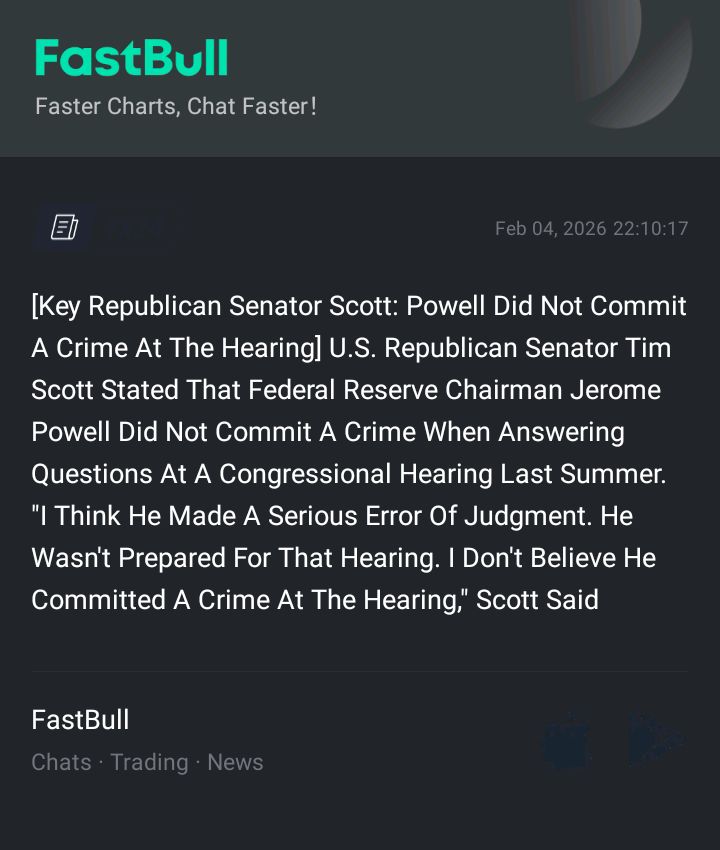
[Key Republican Senator Scott: Powell Did Not Commit A Crime At The Hearing] U.S. Republican Senator Tim Scott Stated That Federal Reserve Chairman Jerome Powell Did Not Commit A Crime When Answering Questions At A Congressional Hearing Last Summer. "I Think He Made A Serious Error Of Judgment. He Wasn't Prepared For That Hearing. I Don't Believe He Committed A Crime At The Hearing," Scott Said
US Nuclear Regulatory Commission Says It Is Undergoing Reorganization In Line With Trump's Push On Licensing Of Nuclear Reactors
Ukraine President Zelenskiy: Ukraine's Western Partners Must Be Prepared To Put Pressure On Russia And Provide Guarantees For Kyiv
Ukraine President Zelenskiy: Talks Must Lead To Real Peace And Not Provide Russia With An Opportunity To Continue The War
Ukraine President Zelenskiy: After Start Of Latest Three-Sided Talks That Ukraine Expects A Prisoner Swap
General Motors CFO: We Hope That The U.S.-Mexico-Canada Trade Agreement (USMCA) Will Preserve North America As A (complete) Trade Area
French President's Top Diplomat Was In Moscow On Tuesday For Talks With Russian Officials - Source Aware Of The Matter
New York Fed Accepts $2.414 Billion Of $2.414 Billion Submitted To Reverse Repo Facility On Feb 04
Russian Foreign Ministry: USA Approach To Russia's Initiative On New Start Treaty Is Misguided And Regrettable
Russian Foreign Ministry On Expiring New Start Arms Treaty: We Assume That We And USA Are No Longer Bound By Central Quantitative Indicators Under The Treaty And Are Free To Choose Their Next Steps
Russian Foreign Ministry On Expiring New Start Arms Treaty: Russia Is Ready To Take Decisive Military-Technical Countermeasures To Counter Potential Additional Threats To National Security

Euro Zone Services PMI Final (Jan)A:--
F: --
P: --
U.K. Composite PMI Final (Jan)A:--
F: --
P: --
U.K. Total Reserve Assets (Jan)A:--
F: --
P: --
U.K. Services PMI Final (Jan)A:--
F: --
P: --
U.K. Official Reserves Changes (Jan)A:--
F: --
P: --
Euro Zone Core CPI Prelim YoY (Jan)A:--
F: --
P: --
Euro Zone Core HICP Prelim YoY (Jan)A:--
F: --
P: --
Euro Zone HICP Prelim YoY (Jan)A:--
F: --
P: --
Euro Zone PPI MoM (Dec)A:--
F: --
Euro Zone Core HICP Prelim MoM (Jan)A:--
F: --
P: --
Italy HICP Prelim YoY (Jan)A:--
F: --
P: --
Euro Zone Core CPI Prelim MoM (Jan)A:--
F: --
P: --
Euro Zone PPI YoY (Dec)A:--
F: --
U.S. MBA Mortgage Application Activity Index WoWA:--
F: --
P: --
Brazil IHS Markit Composite PMI (Jan)A:--
F: --
P: --
Brazil IHS Markit Services PMI (Jan)A:--
F: --
P: --
U.S. ADP Employment (Jan)A:--
F: --
The U.S. Treasury Department released its quarterly refinancing statement.
U.S. IHS Markit Composite PMI Final (Jan)A:--
F: --
P: --
U.S. IHS Markit Services PMI Final (Jan)A:--
F: --
P: --
U.S. ISM Non-Manufacturing Price Index (Jan)A:--
F: --
P: --
U.S. ISM Non-Manufacturing Employment Index (Jan)A:--
F: --
P: --
U.S. ISM Non-Manufacturing New Orders Index (Jan)A:--
F: --
P: --
U.S. ISM Non-Manufacturing Inventories Index (Jan)A:--
F: --
P: --
U.S. ISM Non-Manufacturing PMI (Jan)A:--
F: --
P: --
U.S. EIA Weekly Crude Oil Imports ChangesA:--
F: --
P: --
U.S. EIA Weekly Heating Oil Stock ChangesA:--
F: --
P: --
U.S. EIA Weekly Crude Demand Projected by ProductionA:--
F: --
P: --
U.S. EIA Weekly Gasoline Stocks ChangeA:--
F: --
P: --
U.S. EIA Weekly Crude Stocks ChangeA:--
F: --
P: --
U.S. EIA Weekly Cushing, Oklahoma Crude Oil Stocks ChangeA:--
F: --
P: --
Australia Trade Balance (SA) (Dec)--
F: --
P: --
Australia Exports MoM (SA) (Dec)--
F: --
P: --
Japan 30-Year JGB Auction Yield--
F: --
P: --
Indonesia Annual GDP Growth--
F: --
P: --
Indonesia GDP YoY (Q4)--
F: --
P: --
France Industrial Output MoM (SA) (Dec)--
F: --
P: --
Italy IHS Markit Construction PMI (Jan)--
F: --
P: --
Euro Zone IHS Markit Construction PMI (Jan)--
F: --
P: --
Germany Construction PMI (SA) (Jan)--
F: --
P: --
Italy Retail Sales MoM (SA) (Dec)--
F: --
P: --
U.K. Markit/CIPS Construction PMI (Jan)--
F: --
P: --
France 10-Year OAT Auction Avg. Yield--
F: --
P: --
Euro Zone Retail Sales YoY (Dec)--
F: --
P: --
Euro Zone Retail Sales MoM (Dec)--
F: --
P: --
U.K. BOE MPC Vote Cut (Feb)--
F: --
P: --
U.K. BOE MPC Vote Hike (Feb)--
F: --
P: --
U.K. BOE MPC Vote Unchanged (Feb)--
F: --
P: --
U.K. Benchmark Interest Rate--
F: --
P: --
MPC Rate Statement
U.S. Challenger Job Cuts (Jan)--
F: --
P: --
U.S. Challenger Job Cuts MoM (Jan)--
F: --
P: --
U.S. Challenger Job Cuts YoY (Jan)--
F: --
P: --
Bank of England Governor Bailey held a press conference on monetary policy.
Euro Zone ECB Marginal Lending Rate--
F: --
P: --
Euro Zone ECB Deposit Rate--
F: --
P: --


No matching data
View All

No data
Nomura predicts Turkey's central bank will pause rate cuts, citing stubborn inflation and revising economic forecasts higher.
Nomura Holdings Inc. predicts Turkey's central bank will need to pause its cycle of interest rate cuts at its next meeting, citing stubbornly high inflation that limits the room for further monetary easing.
According to Nomura economist Zumrut Imamoglu, elevated core inflation and a high headline figure are key reasons for the central bank to hold rates steady.
Recent data showed that Turkey's annual consumer price growth slowed only marginally to 30.7% from 30.9% the previous month. This figure was higher than analyst forecasts, which had anticipated a rate just below 30%.
The persistence of high prices prompted Nomura to become the first major bank to call for an end to the rate-cutting cycle that began in July of last year. In its most recent move, the monetary authority reduced its policy rate by 100 basis points to 37% in January.
This view contrasts with other market participants. JPMorgan Chase & Co. economist Fatih Akcelik, for example, still anticipates another 100-basis-point cut in March.
Imamoglu noted that annual inflation is likely to increase in February, as the month coincides with Ramadan, a period when food prices typically rise.
Reflecting this outlook, Nomura has adjusted its economic projections for Turkey:
• Year-end inflation forecast: Raised to 23% from a previous estimate of 21.5%.
• Central bank target: This compares to the official target of 16%.
• Year-end policy rate forecast: Increased by 100 basis points to 29%.
Despite the call for an immediate pause, Nomura anticipates that the central bank could resume easing later in the year. "We think that food prices will ease in May-June and services inflation will be softer over the summer, allowing the Turkish central bank to increase the pace of its rate cuts," Imamoglu said.
The call for caution follows a sharp acceleration in monthly inflation, which hit 4.8% in January, up from 0.9% the prior month. Driven by food prices and seasonal wage adjustments, this was the highest monthly rate recorded in a year.
The Trump administration is pushing to establish a critical minerals trading bloc with allied nations, using tariffs to set price floors and counter China's dominance over the global supply chain.
The plan aims to prevent China from flooding the market with low-cost materials to undermine potential competitors, a tactic highlighted during the recent trade war.
U.S. Vice President JD Vance articulated the strategy at a State Department meeting, emphasizing the goal of creating a resilient and cooperative supply zone.
"We want members to form a trading bloc among allies and partners, one that guarantees American access to American industrial might while also expanding production across the entire zone," Vance said. "What is before all of us is an opportunity at self-reliance that we never have to rely on anybody else except for each other."
Critical minerals are essential components in everything from smartphones to jet engines. The trade disputes over the past year exposed how heavily most economies depend on these materials, a market overwhelmingly controlled by China.
"I think a lot of us have learned the hard way... how much our economies depend on these critical minerals," Vance stated at the meeting, which Secretary of State Marco Rubio hosted for officials from dozens of nations.
This initiative follows President Donald Trump's recent announcement of "Project Vault," a plan to create a national stockpile of rare earth elements. The project is backed by a $10 billion loan from the U.S. Export-Import Bank and nearly $1.67 billion in private capital.
The administration's assertive move comes after China, which controls 70% of the world's rare earths mining and 90% of its processing, restricted supplies in response to U.S. tariffs. While Trump and Chinese President Xi Jinping agreed to a one-year truce in October, China's export limits remain tighter than before the trade conflict began.
"We don't want to ever go through what we went through a year ago," Trump said when announcing the project.
Pini Althaus, founder of USA Rare Earth, believes other Western nations will join the effort, having recognized their vulnerability to China's supply chain leverage.
To jumpstart domestic production, the U.S. government has begun making direct investments in American producers. Last week, it extended $1.6 billion to USA Rare Earth in exchange for stock and a repayment plan.
Althaus noted that securing government funding has become as rigorous as meeting with private equity investors, with officials demanding terms that ensure a financial return for taxpayers.
Meanwhile, the U.S. Export-Import Bank's board approved the $10 billion loan—the largest in its history—to help establish the U.S. Strategic Critical Minerals Reserve. The reserve is designed to guarantee access for key manufacturers, including:
• Battery maker Clarios
• Energy firm GE Vernova
• Digital storage company Western Digital
• Aerospace giant Boeing
Bank President John Jovanovic described the project as a public-private partnership where "there are no free riders." He explained that manufacturers who benefit most are making long-term financial commitments, while the government's loan helps attract private investment.
Industry experts believe the stockpile strategy could foster a "more organic" pricing model that operates independently of China. Wade Senti, president of magnet company AML, said this would directly counter Beijing's practice of using its market dominance to squeeze out competitors with artificially low prices.
The Trump administration is also injecting public funds elsewhere. The Pentagon has spent nearly $5 billion over the past year to secure its own access to critical materials after the trade war exposed the nation's dependence on China.
The administration's focus on mineral supply chains has garnered support across the political aisle. A bipartisan group of lawmakers last month proposed creating a new agency with a $2.5 billion budget to spur domestic production of rare earths and other critical minerals.
"It's a clear sign that there is bipartisan support for securing a robust domestic supply of critical minerals," Senators Jeanne Shaheen and Todd Young said in a joint statement.
However, experts caution that success will not be immediate. David Abraham, a rare earths specialist and author of "The Elements of Power," said building up a sufficient stockpile will be a long-term effort, especially while China's export restrictions keep materials scarce.
Abraham also pointed to a potential contradiction in the administration's policy. While working to secure the supply of critical minerals, it has simultaneously cut incentives for electric vehicles and wind turbines—key sectors that drive demand for these very elements in the United States.
The U.S. services sector remained stable in January, but a significant jump in business costs is signaling renewed inflationary pressure, potentially reversing a recent cooling trend.
The Institute for Supply Management (ISM) reported that its non-manufacturing PMI was unchanged at 53.8 last month. This figure, which indicates expansion, beat economists' forecasts of 53.5 and suggests the economy started the first quarter on steady footing. The services sector is a critical barometer, accounting for over two-thirds of all U.S. economic activity.
While the headline number was stable, a closer look reveals mounting cost pressures. The ISM survey's measure of prices paid by businesses climbed to 66.6 in January from 65.1 in December.
This increase coincided with signs of supply chain strain. The supplier deliveries index rose to 54.2, its highest level since October 2024. A reading above 50 signifies slower delivery times, which may have been worsened by frigid temperatures and heavy snow across the country.
This development presents a challenge to the view that inflation is firmly under control. Federal Reserve Chair Jerome Powell recently described the impact of import tariffs as a likely "one-time price increase." The central bank left its benchmark interest rate unchanged in the 3.50%-3.75% range last week.
Growth in new business moderated, with the new orders gauge falling to 53.1 from 56.5. A sharp contraction in foreign demand was a primary driver of this slowdown. The measure for export orders collapsed to 45.0, its lowest reading since March 2023, down from 54.2 in the prior month.
This slump in exports may be linked to geopolitical friction. Respondents in the ISM's January manufacturing survey noted that U.S. tensions are fueling "anti-American" sentiment among buyers. President Donald Trump has implemented broad tariffs and last month announced temporary American control over Venezuela after capturing President Nicolas Maduro. He also threatened new tariffs against European allies over the sale of Greenland before retracting the statement.
The employment picture in the services sector also softened. The ISM's employment index slipped to 50.3 from 51.7 in December, indicating a much slower pace of hiring.
A more comprehensive view of the labor market remains pending, as the Department of Labor's official employment report for January has been delayed following the partial government shutdown that ended on Tuesday.
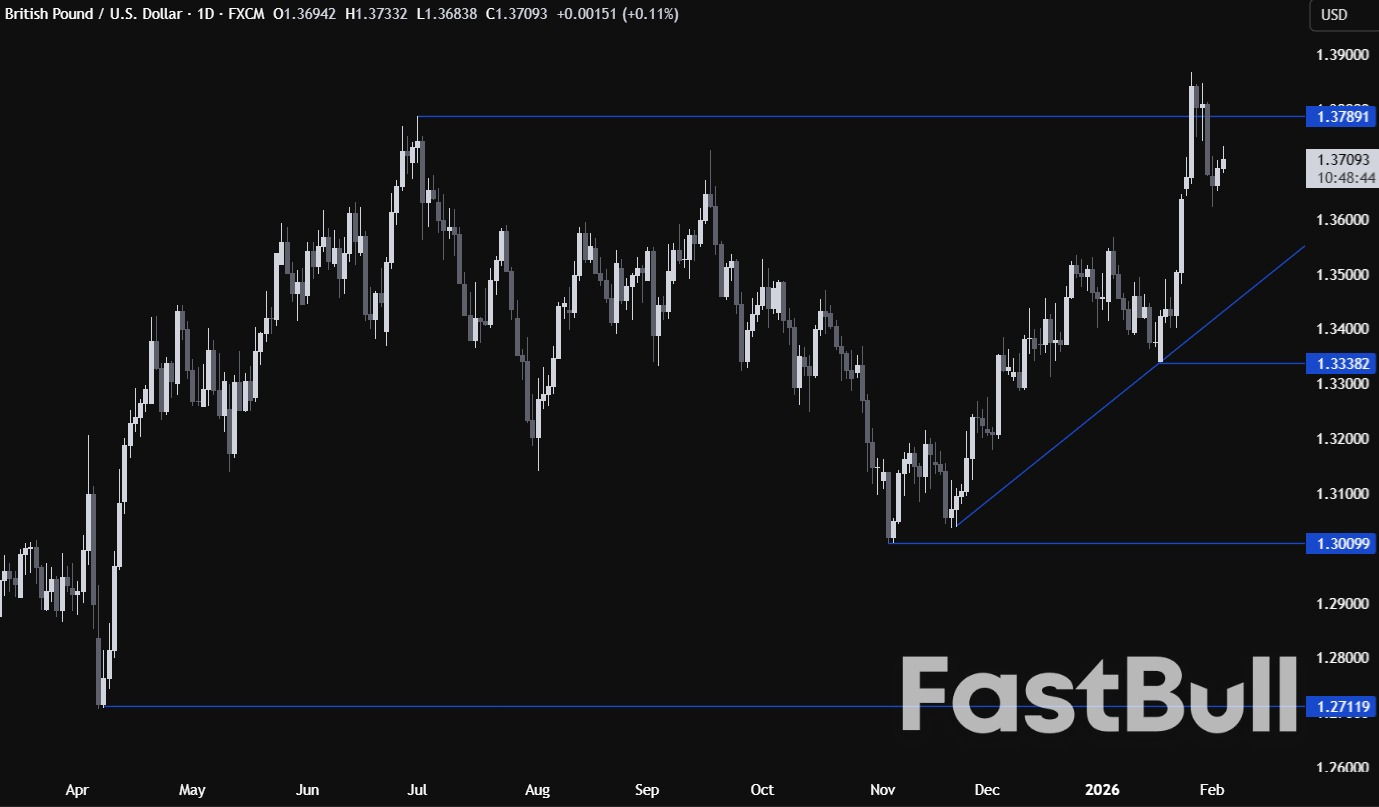
GBPUSD - daily
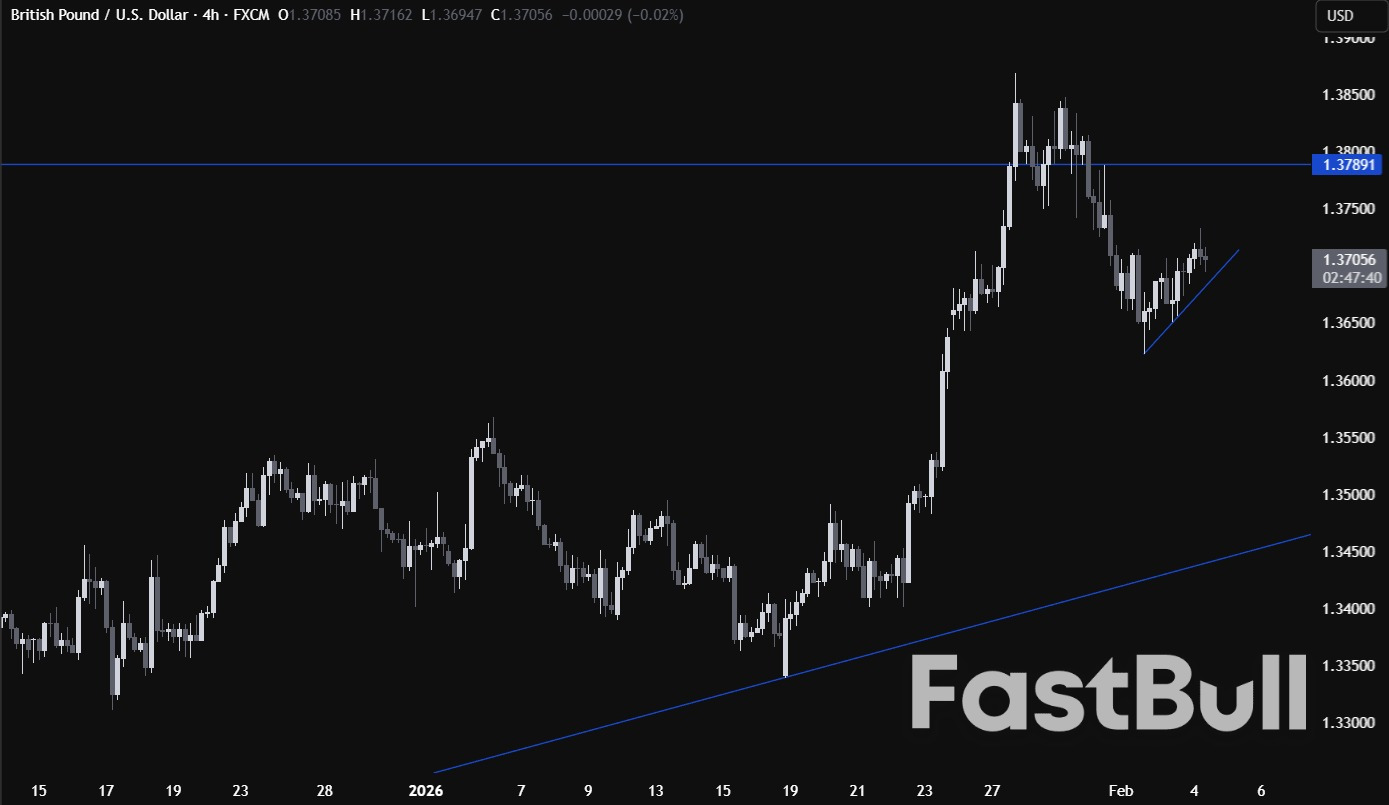
GBPUSD - 4 hour
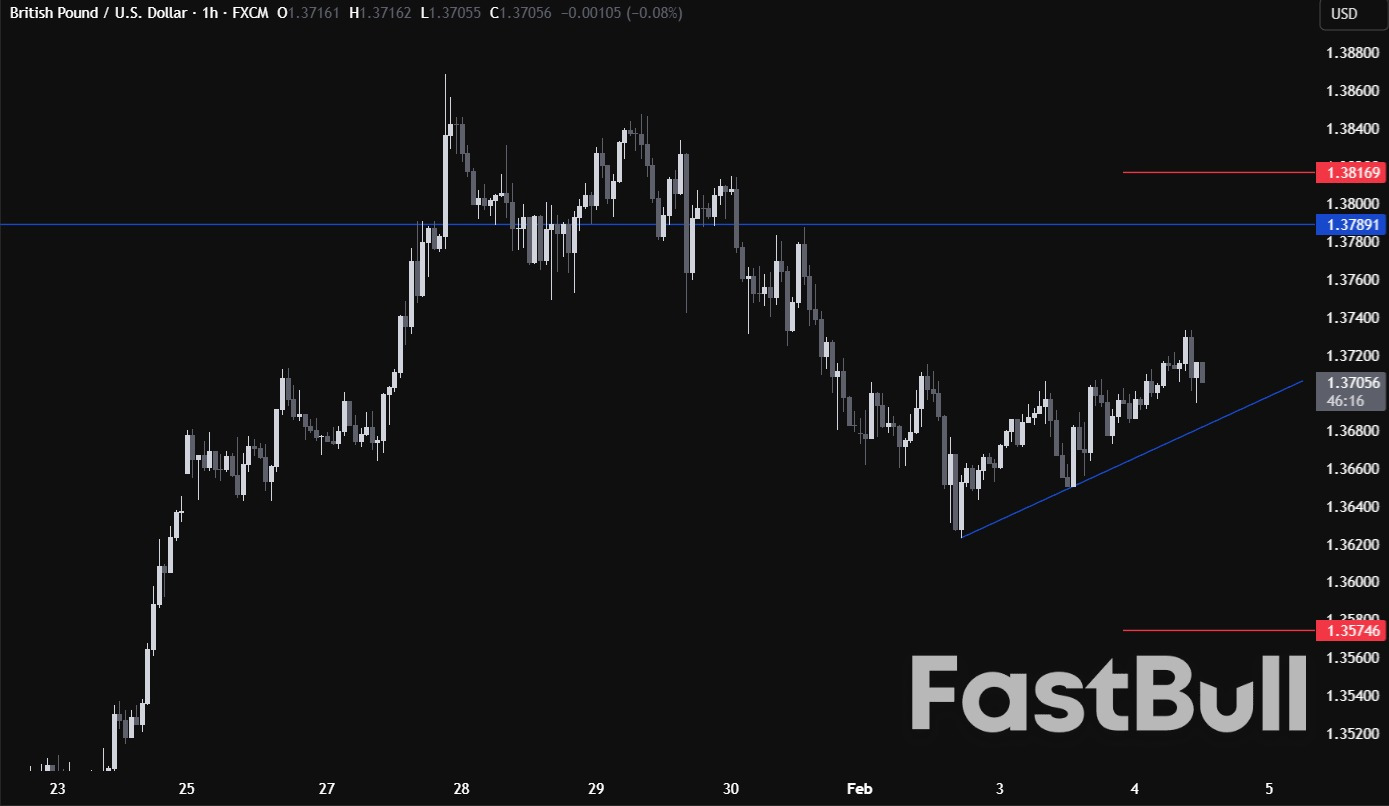
GBPUSD - 1 hour
Peace talks between Ukraine and Russia, facilitated by the United States, have started in the United Arab Emirates, even as Russian forces launched another wave of strikes across Ukraine.
Direct negotiations involving Ukrainian, Russian, and U.S. representatives resumed in Abu Dhabi on January 23-24. These meetings are a rare occurrence since Russia's full-scale invasion in February 2022.
Ukraine's lead negotiator, Rustem Umerov, confirmed the commencement of the talks on X, stating that the meeting began in a trilateral format.
"Next comes work in separate groups by specific tracks, after which a follow-up joint synchronization of positions is planned," he explained.
According to media reports citing a White House official, Steve Witkoff, special envoy for US President Donald Trump, is representing the United States in the negotiations.
Hopes for a significant breakthrough are low as the war nears its fourth anniversary. Kremlin spokesman Dmitry Peskov told reporters on February 4 that Russia's stance remains unchanged. He stated that Moscow's position is "absolutely clear and well understood by both Kyiv and the American negotiators."
This diplomatic effort is shadowed by what Ukrainian officials call a familiar Kremlin tactic: using talks to buy time while escalating military assaults in Europe's deadliest conflict since World War II.
Ukrainian political analyst Ihor Reiterovych warned that the United States might be underestimating Russia's territorial ambitions. Speaking to Current Time, he said there is "absolutely no guarantee" that Putin would stop after securing parts of Ukraine.
Reiterovych also stressed the need for stronger security guarantees for Ukraine, insisting they must be "written not like the Budapest Memorandum." He referred to the 1994 agreement where the U.S., Russia, and the U.K. guaranteed Ukraine's territorial integrity in exchange for the country giving up its nuclear arsenal.
The negotiations began just hours after Russia launched a massive barrage of missiles and drones, hitting the Ukrainian capital and other regions across the country.
The Ukrainian Air Forces reported on February 4 that Russian forces had launched over 100 drones at Ukraine overnight.
Regional authorities reported the following impacts from the attacks:
• Dnipropetrovsk Region: A drone attack resulted in two deaths—a 68-year-old woman and a 38-year-old man—and left two others wounded, according to Mykola Lukashuk, head of the regional administration.
• Odesa Region: An overnight Russian attack injured at least five people. Local authorities also reported damage to houses, kindergartens, and a school.
President Trump stated that Russian President Vladimir Putin honored a temporary ceasefire agreement, a deal that came to a close just as a major new wave of air strikes hit Ukraine.
Speaking to reporters on Tuesday, Trump confirmed that a one-week pause in attacks, which he personally requested from Putin, had expired on Sunday. "It was Sunday to Sunday, and it opened up and he hit them hard last night," Trump said. "He kept his word on that… we'll take anything, because it's really, really cold over there."
The agreement was first announced by Trump on Thursday, January 29. He explained that he had asked Putin to refrain from firing on Kyiv and other cities for a week due to the extreme cold weather, a request to which the Russian president reportedly agreed.
Despite the brief pause, Russia launched what Ukraine's largest private energy company, DTEK, has called the biggest air attack since the beginning of 2026. The overnight assault on Tuesday targeted power generation and distribution facilities, leaving thousands of people without electricity.

The attack involved over 70 missiles and several hundred drones, which damaged power and thermal plants already undergoing slow and costly repairs.
This escalation coincides with a new round of trilateral peace talks. American, Ukrainian, and Russian representatives gathered in the United Arab Emirates on Wednesday for discussions expected to continue until Thursday in Abu Dhabi.
Ukrainian President Volodymyr Zelenskyy challenged the timeline of the truce, stating it only began last Friday, a day after Trump's public announcement, and therefore did not last a full week.
In a statement Tuesday night, Zelenskyy directly addressed the renewed attacks. "We await the reaction of America to the Russian strikes," he said. "It was the U.S. proposal to halt strikes on energy during diplomacy and severe winter weather. The president of the United States made the request personally. Russia responded with a record number of ballistic missiles."
Zelenskyy urged international partners to impose further consequences on Russia:
• U.S. Action: He called for progress on a new sanctions bill currently being worked on by the U.S. Congress.
• European Measures: He pushed for European partners to take "decisive steps" regarding the earnings Russia generates from its oil tankers.
"Russia must feel pressure so that it moves in negotiations toward peace," he added.
The latest assault has intensified the humanitarian crisis, with Ukrainian officials describing it as a "winter genocide." The strikes occurred as temperatures in the capital dropped to -20°C (-4°F).
In the aftermath of the attack, more than 1,000 residential tower blocks in Kyiv were left without heating, marking a severe end to the short-lived truce negotiated by Trump and Putin.
The risk of loss in trading financial instruments such as stocks, FX, commodities, futures, bonds, ETFs and crypto can be substantial. You may sustain a total loss of the funds that you deposit with your broker. Therefore, you should carefully consider whether such trading is suitable for you in light of your circumstances and financial resources.
No decision to invest should be made without thoroughly conducting due diligence by yourself or consulting with your financial advisors. Our web content might not suit you since we don't know your financial conditions and investment needs. Our financial information might have latency or contain inaccuracy, so you should be fully responsible for any of your trading and investment decisions. The company will not be responsible for your capital loss.
Without getting permission from the website, you are not allowed to copy the website's graphics, texts, or trademarks. Intellectual property rights in the content or data incorporated into this website belong to its providers and exchange merchants.
Not Logged In
Log in to access more features
Log In
Sign Up