• Trade
  • Markets
  • Copy
  • Contests
  • News
  • 24/7
  • Calendar
  • Q&A
  • Chats
Trending
Screeners
SYMBOL
LAST
BID
ASK
HIGH
LOW
NET CHG.
%CHG.
SPREAD
SPX
S&P 500 Index
6846.50
6846.50
6846.50
6878.28
6827.18
-23.90
-0.35%
--
DJI
Dow Jones Industrial Average
47739.31
47739.31
47739.31
47971.51
47611.93
-215.67
-0.45%
--
IXIC
NASDAQ Composite Index
23545.89
23545.89
23545.89
23698.93
23455.05
-32.22
-0.14%
--
USDX
US Dollar Index
99.000
99.080
99.000
99.000
99.000
+0.050
+ 0.05%
--
EURUSD
Euro / US Dollar
1.16364
1.16387
1.16364
1.16364
1.16322
0.00000
0.00%
--
GBPUSD
Pound Sterling / US Dollar
1.33168
1.33294
1.33168
1.33178
1.33140
-0.00037
-0.03%
--
XAUUSD
Gold / US Dollar
4189.70
4190.14
4189.70
4218.85
4175.92
-8.21
-0.20%
--
WTI
Light Sweet Crude Oil
58.555
58.807
58.555
60.084
58.495
-1.254
-2.10%
--

Community Accounts

Signal Accounts
--
Profit Accounts
--
Loss Accounts
--
View More

Become a signal provider

Sell trading signals to earn additional income

View More

Guide to Copy Trading

Get started with ease and confidence

View More

Signal Accounts for Members

All Signal Accounts

Best Return
  • Best Return
  • Best P/L
  • Best MDD
Past 1W
  • Past 1W
  • Past 1M
  • Past 1Y

All Contests

  • All
  • Trump Updates
  • Recommend
  • Stocks
  • Cryptocurrencies
  • Central Banks
  • Featured News
Top News Only
Share

SPDR Gold Holdings Down 0.11%, Or 1.14 Tonnes

Share

On Monday (December 8), In Late New York Trading, S&P 500 Futures Fell 0.21%, Dow Jones Futures Fell 0.43%, NASDAQ 100 Futures Fell 0.08%, And Russell 2000 Futures Fell 0.04%

Share

Morgan Stanley: Data Center ABS Spreads Are Expected To Widen In 2026

Share

(US Stocks) The Philadelphia Gold And Silver Index Closed Down 2.34% At 311.01 Points. (Global Session) The NYSE Arca Gold Miners Index Closed Down 2.17%, Hitting A Daily Low Of 2235.45 Points; US Stocks Remained Slightly Down Before The Opening Bell—holding Steady Around 2280 Points—before Briefly Rising Slightly

Share

IMF: IMF Executive Board Approves Extension Of The Extended Credit Facility Arrangement With Nepal

Share

Trump: Same Approach Will Apply To Amd, Intel, And Other Great American Companies

Share

Trump: Department Of Commerce Is Finalizing Details

Share

Trump: $25% Will Be Paid To United States Of America

Share

Trump: President Xi Responded Positively

Share

[Consumer Discretionary ETFs Fell Over 1.4%, Leading The Decline Among US Sector ETFs; Semiconductor ETFs Rose Over 1.1%] On Monday (December 8), The Consumer Discretionary ETF Fell 1.45%, The Energy ETF Fell 1.09%, The Internet ETF Fell 0.18%, The Regional Banks ETF Rose 0.34%, The Technology ETF Rose 0.70%, The Global Technology ETF Rose 0.93%, And The Semiconductor ETF Rose 1.13%

Share

Trump: I Have Informed President Xi, Of China, That United States Will Allow Nvidia To Ship Its H200 Products To Approved Customers In China

Share

Argentina's Merval Index Closed Up 0.02% At 3.047 Million Points. It Rose To A New Daily High Of 3.165 Million Points In Early Trading In Buenos Aires Before Gradually Giving Back Its Gains

Share

US Stock Market Closing Report | On Monday (December 8), The Magnificent 7 Index Fell 0.20% To 208.33 Points. The "mega-cap" Tech Stock Index Fell 0.33% To 405.00 Points

Share

Pentagon - USA State Dept Approves Potential Sale Of Hellfire Missiles To Belgium For An Estimated $79 Million

Share

Toronto Stock Index .GSPTSE Unofficially Closes Down 141.44 Points, Or 0.45 Percent, At 31169.97

Share

The Nasdaq Golden Dragon China Index Closed Up Less Than 0.1%. Nxtt Rose 21%, Microalgo Rose 7%, Daqo New Energy Rose 4.3%, And 21Vianet, Baidu, And Miniso All Rose More Than 3%

Share

The S&P 500 Initially Closed Down More Than 0.4%, With The Telecom Sector Down 1.9%, And Materials, Consumer Discretionary, Utilities, Healthcare, And Energy Sectors Down By As Much As 1.6%, While The Technology Sector Rose 0.7%. The NASDAQ 100 Initially Closed Down 0.3%, With Marvell Technology Down 7%, Fortinet Down 4%, And Netflix And Tesla Down 3.4%

Share

IMF: Review Pakistan Authorities To Draw The Equivalent Of About US$1 Billion

Share

President Trump Is Committed To The Continued Cessation Of Violence And Expects The Governments Of Cambodia And Thailand To Fully Honor Their Commitments To End This Conflict - Senior White House Official

Share

[Water Overflows From Spent Fuel Pool At Japanese Nuclear Facility] According To Japan's Nuclear Waste Management Company, Following A Strong Earthquake Off The Coast Of Aomori Prefecture Late On December 8th, Workers At The Nuclear Waste Treatment Plant In Rokkasho Village, Aomori Prefecture, Discovered "at Least 100 Liters Of Water" On The Ground Around The Spent Fuel Pool During An Inspection. Analysis Suggests This Water "may Have Overflowed Due To The Earthquake's Shaking." However, It Is Reported That The Overflowed Water "remains Inside The Building And Has Not Affected The External Environment."

TIME
ACT
FCST
PREV
France Trade Balance (SA) (Oct)

A:--

F: --

P: --
Euro Zone Employment YoY (SA) (Q3)

A:--

F: --

P: --
Canada Part-Time Employment (SA) (Nov)

A:--

F: --

P: --

Canada Unemployment Rate (SA) (Nov)

A:--

F: --

P: --

Canada Full-time Employment (SA) (Nov)

A:--

F: --

P: --

Canada Labor Force Participation Rate (SA) (Nov)

A:--

F: --

P: --

Canada Employment (SA) (Nov)

A:--

F: --

P: --

U.S. PCE Price Index MoM (Sept)

A:--

F: --

P: --

U.S. Personal Income MoM (Sept)

A:--

F: --

P: --

U.S. Core PCE Price Index MoM (Sept)

A:--

F: --

P: --

U.S. PCE Price Index YoY (SA) (Sept)

A:--

F: --

P: --

U.S. Core PCE Price Index YoY (Sept)

A:--

F: --

P: --

U.S. Personal Outlays MoM (SA) (Sept)

A:--

F: --

P: --
U.S. 5-10 Year-Ahead Inflation Expectations (Dec)

A:--

F: --

P: --

U.S. Real Personal Consumption Expenditures MoM (Sept)

A:--

F: --

P: --
U.S. Weekly Total Rig Count

A:--

F: --

P: --

U.S. Weekly Total Oil Rig Count

A:--

F: --

P: --

U.S. Consumer Credit (SA) (Oct)

A:--

F: --

P: --
China, Mainland Foreign Exchange Reserves (Nov)

A:--

F: --

P: --

Japan Trade Balance (Oct)

A:--

F: --

P: --

Japan Nominal GDP Revised QoQ (Q3)

A:--

F: --

P: --

China, Mainland Imports YoY (CNH) (Nov)

A:--

F: --

P: --

China, Mainland Exports (Nov)

A:--

F: --

P: --

China, Mainland Imports (CNH) (Nov)

A:--

F: --

P: --

China, Mainland Trade Balance (CNH) (Nov)

A:--

F: --

P: --

China, Mainland Exports YoY (USD) (Nov)

A:--

F: --

P: --

China, Mainland Imports YoY (USD) (Nov)

A:--

F: --

P: --

Germany Industrial Output MoM (SA) (Oct)

A:--

F: --

P: --
Euro Zone Sentix Investor Confidence Index (Dec)

A:--

F: --

P: --

Canada National Economic Confidence Index

A:--

F: --

P: --

U.K. BRC Like-For-Like Retail Sales YoY (Nov)

--

F: --

P: --

U.K. BRC Overall Retail Sales YoY (Nov)

--

F: --

P: --

Australia Overnight (Borrowing) Key Rate

--

F: --

P: --

RBA Rate Statement
RBA Press Conference
Germany Exports MoM (SA) (Oct)

--

F: --

P: --

U.S. NFIB Small Business Optimism Index (SA) (Nov)

--

F: --

P: --

Mexico 12-Month Inflation (CPI) (Nov)

--

F: --

P: --

Mexico Core CPI YoY (Nov)

--

F: --

P: --

Mexico PPI YoY (Nov)

--

F: --

P: --

U.S. Weekly Redbook Index YoY

--

F: --

P: --

U.S. JOLTS Job Openings (SA) (Oct)

--

F: --

P: --

China, Mainland M1 Money Supply YoY (Nov)

--

F: --

P: --

China, Mainland M0 Money Supply YoY (Nov)

--

F: --

P: --

China, Mainland M2 Money Supply YoY (Nov)

--

F: --

P: --

U.S. EIA Short-Term Crude Production Forecast For The Year (Dec)

--

F: --

P: --

U.S. EIA Natural Gas Production Forecast For The Next Year (Dec)

--

F: --

P: --

U.S. EIA Short-Term Crude Production Forecast For The Next Year (Dec)

--

F: --

P: --

EIA Monthly Short-Term Energy Outlook
U.S. API Weekly Gasoline Stocks

--

F: --

P: --

U.S. API Weekly Cushing Crude Oil Stocks

--

F: --

P: --

U.S. API Weekly Crude Oil Stocks

--

F: --

P: --

U.S. API Weekly Refined Oil Stocks

--

F: --

P: --

South Korea Unemployment Rate (SA) (Nov)

--

F: --

P: --

Japan Reuters Tankan Non-Manufacturers Index (Dec)

--

F: --

P: --

Japan Reuters Tankan Manufacturers Index (Dec)

--

F: --

P: --

Japan Domestic Enterprise Commodity Price Index MoM (Nov)

--

F: --

P: --

Japan Domestic Enterprise Commodity Price Index YoY (Nov)

--

F: --

P: --

China, Mainland PPI YoY (Nov)

--

F: --

P: --

China, Mainland CPI MoM (Nov)

--

F: --

P: --

Italy Industrial Output YoY (SA) (Oct)

--

F: --

P: --

Q&A with Experts
    • All
    • Chatrooms
    • Groups
    • Friends
    Connecting
    .
    .
    .
    Type here...
    Add Symbol or Code

      No matching data

      All
      Trump Updates
      Recommend
      Stocks
      Cryptocurrencies
      Central Banks
      Featured News
      • All
      • Russia-Ukraine Conflict
      • Middle East Flashpoint
      • All
      • Russia-Ukraine Conflict
      • Middle East Flashpoint
      Search
      Products

      Charts Free Forever

      Chats Q&A with Experts
      Screeners Economic Calendar Data Tools
      Membership Features
      Data Warehouse Market Trends Institutional Data Policy Rates Macro

      Market Trends

      Market Sentiment Order Book Forex Correlations

      Top Indicators

      Charts Free Forever
      Markets

      News

      News Analysis 24/7 Columns Education
      From Institutions From Analysts
      Topics Columnists

      Latest Views

      Latest Views

      Trending Topics

      Top Columnists

      Latest Update

      Signals

      Copy Rankings Latest Signals Become a signal provider AI Rating
      Contests
      Brokers

      Overview Brokers Assessment Rankings Regulators News Claims
      Broker listing Forex Brokers Comparison Tool Live Spread Comparison Scam
      Q&A Complaint Scam Alert Videos Tips to Detect Scam
      More

      Business
      Events
      Careers About Us Advertising Help Center

      White Label

      Data API

      Web Plug-ins

      Affiliate Program

      Awards Institution Evaluation IB Seminar Salon Event Exhibition
      Vietnam Thailand Singapore Dubai
      Fans Party Investment Sharing Session
      FastBull Summit BrokersView Expo
      Recent Searches
        Top Searches
          Markets
          News
          Analysis
          User
          24/7
          Economic Calendar
          Education
          Data
          • Names
          • Latest
          • Prev

          View All

          No data

          Scan to Download

          Faster Charts, Chat Faster!

          Download App
          English
          • English
          • Español
          • العربية
          • Bahasa Indonesia
          • Bahasa Melayu
          • Tiếng Việt
          • ภาษาไทย
          • Français
          • Italiano
          • Türkçe
          • Русский язык
          • 简中
          • 繁中
          Open Account
          Search
          Products
          Charts Free Forever
          Markets
          News
          Signals

          Copy Rankings Latest Signals Become a signal provider AI Rating
          Contests
          Brokers

          Overview Brokers Assessment Rankings Regulators News Claims
          Broker listing Forex Brokers Comparison Tool Live Spread Comparison Scam
          Q&A Complaint Scam Alert Videos Tips to Detect Scam
          More

          Business
          Events
          Careers About Us Advertising Help Center

          White Label

          Data API

          Web Plug-ins

          Affiliate Program

          Awards Institution Evaluation IB Seminar Salon Event Exhibition
          Vietnam Thailand Singapore Dubai
          Fans Party Investment Sharing Session
          FastBull Summit BrokersView Expo

          Natural Gas and Oil Forecast: Middle East Risks Elevate Bullish Oil Trends

          Zi Cheng

          Commodity

          Summary:

          Oil surge driven by robust demand from China and the U.S., Middle East tensions raise supply concerns.

          Market Overview

          Oil prices experienced a surge, driven by promising demand indicators from China and the U.S., alongside escalating Middle East tensions impacting supply concerns. Improved manufacturing activity in China and the U.S. hints at a robust demand rebound for oil.
          Meanwhile, the conflict in Gaza, with Iran’s involvement, raises apprehensions about potential disruptions in oil supply. Upcoming OPEC+ meetings will be crucial in determining future supply cuts and production policies.
          The compounded effect of geopolitical risks and demand recovery is poised to push oil prices higher, potentially affecting the broader energy market, including natural gas, as market dynamics shift.

          Natural Gas Price Forecast

          Natural Gas and Oil Forecast: Middle East Risks Elevate Bullish Oil Trends_1

          Natural Gas (NG) trades at $1.8950, marking a 0.68% decline, with a bearish outlook below the $1.9128 pivot point. Key resistance levels are at $1.9396, $1.9720, and $2.0068, while immediate support is found at $1.8797, followed by $1.8587 and $1.8257, coinciding with Fibonacci retracement levels.
          The 50 EMA and 200 EMA, at $1.8198 and $1.8235 respectively, suggest a potential downward trend continuation. A shift above the pivot could introduce a bullish sentiment, but current indicators and Fibonacci levels emphasize a bearish trend for Natural Gas.

          WTI Oil Price Forecast

          Natural Gas and Oil Forecast: Middle East Risks Elevate Bullish Oil Trends_2
          USOIL stands at $84.09, a slight increase of 0.21%. The pivot point is $83.54, acting as a vital marker for trend direction. Resistance levels are identified at $84.53, $85.26, and $86.10, while support levels are at $82.89, $82.14, and $81.45. The 50-day EMA at $81.99 and the 200-day EMA at $79.62 provide foundational support, hinting at a bullish trend.
          However, the market remains sensitive to shifts, with a potential downturn if it falls below the pivot. The overall sentiment is bullish, but with a keen eye on the pivotal $83.54 mark to sustain momentum.

          Brent Oil Price Forecast

          Natural Gas and Oil Forecast: Middle East Risks Elevate Bullish Oil Trends_3
          UKOIL is trading at $87.81, marking a modest increase of 0.08%. The pivotal price is set at $87.56. Resistance levels ascend at $88.46, $89.35, and $90.06, while support tiers descend at $86.84, $85.76, and $84.80.
          The 50-day EMA at $86.09 and the 200-day EMA at $84.01 bolster a bullish sentiment, further confirmed by a bullish engulfing candle pattern.
          The technical landscape leans towards an upward trajectory, maintaining bullishness above the $87.56 threshold. However, a dip beneath this pivot could catalyze a sell-off, urging traders to monitor closely.

          Source: FX Empire

          Risk Warnings and Disclaimers
          You understand and acknowledge that there is a high degree of risk involved in trading. Following any strategies or investment methods may lead to potential losses. The content on the site is provided by our contributors and analysts for information purposes only. You are solely responsible for determining whether any trading assets, securities, strategy, or any other product is suitable for investing based on your own investment objectives and financial situation.
          Add to Favorites
          Share

          Xi’s Cryptic Bond Comments Hint At PBOC Becoming More Like Fed

          Samantha Luan

          Central Bank

          A resurfaced speech from Chinese President Xi Jinping suggests policymakers may start trading government bonds to regulate liquidity in the market, pushing the nation toward strategies used by the Federal Reserve and other major central banks around the world.
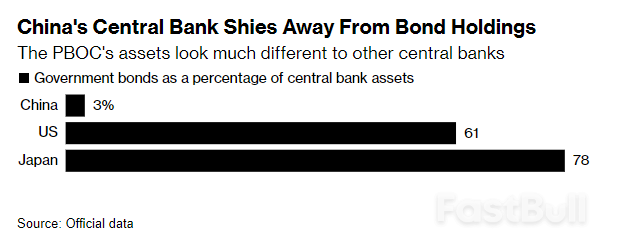
          Xi’s call for the People’s Bank of China to “gradually increase the buying and selling of government bonds” in its open market operations sparked a frenzy of speculation among traders last week. The remarks — made in October but publicized recently in a new book and newspaper article — may hint at a policy pivot for a central bank that hasn’t made a significant bond purchase since 2007.
          “Central banks in other countries generally use government bonds, or sovereign credit, as a basis to issue money,” said Liu Lei, a researcher at the National Institution for Finance and Development, a state think tank advising government agencies in China. “This is a necessary path for China’s central bank and monetary system to move into modern times.”Xi’s Cryptic Bond Comments Hint At PBOC Becoming More Like Fed_1
          The vague comments from the Chinese leader led some traders to initially argue that Beijing may be considering quantitative easing — an unconventional form of stimulus that involves purchasing sovereign bonds and other assets to push down yields and boost economic activity. First adopted by the Bank of Japan more than two decades ago, the tactic was later used by the Fed and other policymakers after the global financial crisis and the coronavirus pandemic.
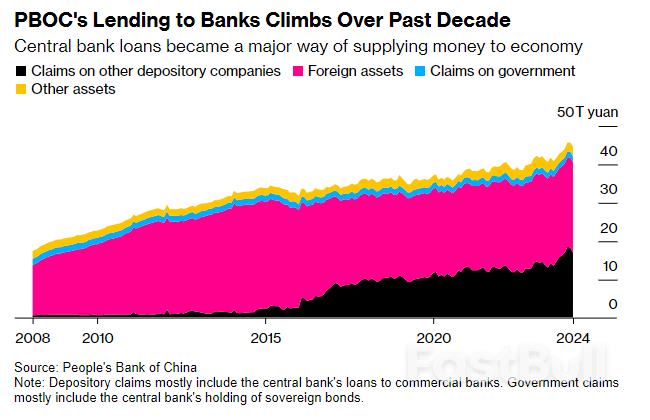
          China’s economic woes have stirred debate in recent months about whether the world’s second-largest economy would consider drastic policies to shore up some sectors, like property. The PBOC has already been using targeted lending programs that some analysts liken to QE because they expand the central bank’s balance sheet.
          Several economists demurred from interpreting Xi’s appeal for government bond trading as a revolutionary shift in policy.
          For one thing, Xi specifically mentioned both buying and selling — a notable distinction from QE, which generally involves buying and holding government bonds and other assets, especially at a large scale. Interest rates in China are also still well above zero, giving less reason for the PBOC to consider a tactic that’s usually regarded as an emergency tool to spur demand when short-term rates have flatlined.Xi’s Cryptic Bond Comments Hint At PBOC Becoming More Like Fed_2
          The PBOC didn’t respond to a faxed request for comment from Bloomberg News late last week about Xi’s speech. In the past, it has signaled disapproval over QE: Former governors have pointed to potential risks from US-led QE and warned that asset purchases would damage markets, hurt the reputation of central banks and create “moral hazards.”
          Instead, the trading of sovereign bonds may be best viewed as an additional tool for the PBOC to pump liquidity into the market and ensure rates are stable.
          The central bank already has several ways to provide money to the economy. It can inject funds through its monthly medium-term lending facility to support commercial bank lending, or lower the amount of cash banks need to keep in reserve.
          Those methods have shortcomings, though. Economists see shrinking space for further cuts to the reserve requirement ratio. Loans need to be renewed. And any misjudgment of demand for liquidity risks leading to a serious cash crunch.
          The PBOC “needs more flexibilities in managing liquidity and more tools to expand its balance sheet,” UBS Group AG economists Nina Zhang and Wang Tao wrote in a Thursday note. Because the size of the government bond market has expanded over the years, central bank bond trading has become “more necessary and feasible,” they added.
          While the directive from the most important man in China certainly indicates the central bank may start buying up bonds, the actual timing of any purchase remains up for debate.
          Central bank bond buying will likely be a “very slow process,” said NIFD’s Liu, adding that the shift is still in its “design phase.”
          Others suggest forthcoming fiscal stimulus may mean the PBOC pulls the trigger on purchases sometime this year. That would help alleviate liquidity pressure from an upcoming surge in bond supply resulting from the planned issuance of 1 trillion yuan ($138 billion) worth of special sovereign debt in 2024, according to a report from Goldman Sachs Group Inc. economists on Thursday.
          It’s also not clear how ramped up bond purchases would impact Chinese yields. They’d likely fall in the short term, according to Citigroup Inc. strategist Philip Yin, since the central bank’s debt purchases “should help improve market confidence about liquidity and digesting future government bond supply.”
          The longer-term effects may be mixed. If China combines the use of more liquidity tools with further policies to stabilize economic growth, investors may shy away from safe haven assets in favor of riskier ones.
          Whatever China’s strategy, there’s a reason Xi’s comments have created such a stir: Once a central bank decides to start trading government bonds, things can snowball quickly.
          The Bank of Japan, for example, intended to limit the scope of its initial program in 2001 before ramping up the amount of bonds it bought. When it embarked on a second round of QE in 2013, Japanese policymakers folded their regular bond trading program, called rinban, into their massive new asset purchasing plan.
          In other words, there’s sometimes little real difference between buying bonds as a liquidity tool versus doing so to stimulate the economy.

          Source:Bloomberg

          Risk Warnings and Disclaimers
          You understand and acknowledge that there is a high degree of risk involved in trading. Following any strategies or investment methods may lead to potential losses. The content on the site is provided by our contributors and analysts for information purposes only. You are solely responsible for determining whether any trading assets, securities, strategy, or any other product is suitable for investing based on your own investment objectives and financial situation.
          Add to Favorites
          Share

          Goldilocks at Chifley Square

          Westpac

          Economic

          Central Bank

          The minutes of the late-March meeting of the RBA Board (the last in the Martin Place building) recorded that the data had turned out broadly as expected, and that this supported keeping the cash rate on hold. Unlike the February minutes, there was no mention of multiple policy options. While the Board endorsed the language of not ruling anything in or out, it seems that policy actions other than keeping rates unchanged were not on the table at this meeting. The current level of the cash rate is assessed as being just right, at least for the time being.
          The minutes noted that the staff assessed that demand still exceeded supply, but the gap was diminishing quickly. A slowing in labour demand was called out, and growth in labour costs was assessed to have peaked. The Board nonetheless remains concerned that domestic costs could continue to rise quickly. The recent turnaround in productivity was noted, as was the role of the pandemic and economic cycle in driving the recent slump. However, the Board is uncertain whether this turnaround will continue. The possibility of a faster snapback in productivity than expected was not mentioned.
          The ongoing decline in inflation was highlighted, with the three-month-ended rate for the monthly indicator used as a timelier metric. Monthly inflation was expected to rebound in coming months as special factors such as electricity rebates unwind. The pace of decline in goods prices was also expected to slow, though the minutes did not elaborate on the reasoning for this view. The minutes highlighted the bumpiness of the decline in inflation in other countries and noted that something similar could happen in Australia.
          Policy was still assessed as restrictive, so at some point the policy rate will need to decline to prevent inflation from declining so far that it starts undershooting the target. But unlike its peers overseas, the Board is not ready to talk about this decision yet. The minutes again highlighted that interest rates had peaked at a lower level than in some peer economies, and that this reflected the Board’s intention to preserve the gains on employment made since the pandemic period.
          A related difference that the minutes did not highlight is the varying squeeze on household sectors across peer economies. Debt-servicing as a share of household income is well above average in Australia at present. By contrast, the financial stability section of the minutes noted that it is below historical averages in many peer economies – despite higher policy rates.
          The global outlook was seen as supporting risk sentiment. The chance of a significant downturn had fallen, while interest rates were still expected to decline later in the year. This combination is seen as boosting prices of risk assets and contributing to a more ‘risk on’ tone in markets. This has also been supportive of the Australian dollar exchange rate despite narrower interest differentials and a decline in key commodity prices. Improved risk sentiment also underpins Westpac Economics’ expectation of further upward pressure on the AUD/USD exchange rate later this year; the declines in commodity prices were largely expected and so already priced in.
          We expect the RBA to reach the required level of assurance about the path of inflation later in the year, after the full suite of data for the first half of 2024 are released. We continue to expect the first rate cut to occur at the late-September Board meeting.

          Ample considerations of a happy medium

          The other main decision recorded in the minutes related to the operational arrangements for monetary policy. This decision was further elaborated in a speech this morning by Assistant Governor (Financial Markets) Chris Kent.
          The background to this decision is that the policy interest rate that the RBA focuses on is the interest rate that banks (and other deposit-taking institutions) charge each other to borrow unsecured overnight in the cash market. The asset that is being borrowed and repaid is exchange settlement funds – that is, banks’ deposits with the RBA, also known as reserves. These deposits are remunerated at a rate that is set below the policy target rate; currently, the spread is 10 basis points.
          Prior to the pandemic, the RBA ran a ‘scarce reserves’ regime. Its balance sheet was small, and the staff needed to forecast daily liquidity flows into and out of the system – for example from tax payments and government spending – to keep the amount of reserves at whatever level would keep the cash rate at target. When the pandemic hit, banks wanted more liquidity, so the RBA switched to a regime of excess reserves.
          This was also a by-product of the various asset purchase programs introduced during that period. The RBA’s balance sheet expanded, and the actual interest rate banks transacted at in the cash market drifted below the published cash rate target, while remaining above the remuneration rate on exchange settlement balances.
          Other central banks, including the Federal Reserve, Bank of Canada and RBNZ, have decided to stick with the excess reserves model even as they wind down their asset purchase programs. Others, including the Bank of England and European Central Bank, have instead settled on a happy medium of ‘ample’, but not excess, reserves. A key distinction between this operating model and its alternatives is that it is managed with full-allotment repo at a pre-specified interest rate, which fixes the price (interest rate) and accepts whatever quantity of reserves is needed to achieve this.
          By contrast, in both the ‘scarce’ and ‘excess’ reserve regimes, it is up to the central bank to determine the quantity of reserves that it thinks will achieve the desired price. Still to be determined is the composition of assets the RBA will hold under repurchase agreements on the other side of its balance sheet.
          As both the speech and minutes emphasise, this is an operational decision with no implications for the stance of monetary policy. Relative to reverting to the pre-pandemic scarce-reserves regime, though, the RBA’s balance sheet will be larger, with implications for the average size of future earnings to be distributed to the government. It will also mean that the RBA continues to hold some fraction of the government bonds on issue. These will not be available to banks and other deposit takers to meet their prudential liquidity requirements (the Liquidity Coverage Ratio).
          To stay updated on all economic events of today, please check out our Economic calendar
          Risk Warnings and Disclaimers
          You understand and acknowledge that there is a high degree of risk involved in trading. Following any strategies or investment methods may lead to potential losses. The content on the site is provided by our contributors and analysts for information purposes only. You are solely responsible for determining whether any trading assets, securities, strategy, or any other product is suitable for investing based on your own investment objectives and financial situation.
          Add to Favorites
          Share

          Why Bitcoin, Ethereum, and Bonk Plunged Today

          Samantha Luan

          Cryptocurrency

          As of 1:45 p.m. ET, the value of Bitcoin (CRYPTO: BTC) has dropped 2.8%, Ethereum (CRYPTO: ETH) is down 5.2%, and Bonk (CRYPTO: BONK) has fallen 9.4%. The move was impacted by a long holiday weekend in parts of the world, but 24/7 trading in crypto kept market speculation moving.

          Inflation strikes again

          The biggest data point impacting the market today is the ISM factory index, which improved by 2.5% in March to 50.3%. A reading over 50% indicates that manufacturing managers think the manufacturing market is expanding. This followed 16 straight months of expected declines.
          Investors take this reading as a sign the economy is doing fine, despite higher interest rates over the past few years. If inflation is under control and the Federal Reserve doesn't need to cut rates to help the economy, it may not cut rates at all.
          Bond traders are now pricing odds at a rate cut in June 2024 at less than 50%, which would have been a shock coming into the year. Investors were expecting as much as six rate cuts and they may get through two quarters with none.

          Crypto's decline today

          There's a correlation between technology and high-growth stocks and cryptocurrencies and part of the move higher over the past six months has been an anticipation of lower interest rates. As that thesis falls apart it's not unusual to see cryptocurrencies drop.
          Bitcoin exchange-traded funds (ETFs) were another catalyst and that brought billions of dollars into the industry. But last week they started to see outflows, although those turned into inflows again late in the week.
          Ethereum has also gotten a boost from speculation that it will get ETFs approved over the next few months. But that's not certain in the current regulatory environment.
          If ETFs aren't a catalyst because more aren't approved, crypto values may slide.
          Bonk's move is just a mirror of the others with some extra volatility added in. This is a meme coin that's become a popular alternative to Dogecoin, but its main value is speculation rather than being a blockchain currency like Bitcoin or Ethereum.

          Where does crypto go from here?

          I think the major catalysts of 2024 are already behind us. Bitcoin's ETFs have helped increase awareness and investment in crypto and that pulled the entire industry higher. And speculation based on the economic environment and a potential cut in rates seems to have been overdone.
          That leaves fundamentals driving the crypto market and that's not a great place to be. Bitcoin may have value as a "digital gold," but I think it's more of a speculative asset than anything. Ethereum's promise was always that it would provide real-world use cases in finance and digital assets, but it's so slow and so much more expensive that other blockchains are gaining popularity.
          Bonk's meme pop has been nice, but the meme coins never seem to last. And without a catalyst, I could see all three cryptos falling over the next few months as investors look for more fundamental value on the market.

          Source: The Motley Fool

          Risk Warnings and Disclaimers
          You understand and acknowledge that there is a high degree of risk involved in trading. Following any strategies or investment methods may lead to potential losses. The content on the site is provided by our contributors and analysts for information purposes only. You are solely responsible for determining whether any trading assets, securities, strategy, or any other product is suitable for investing based on your own investment objectives and financial situation.
          Add to Favorites
          Share

          Australia To Switch To New System For Monetary Policy Implementation

          Alex

          Economic

          The Reserve Bank will shift to having “ample reserves” as the balance sheet shrinks back toward pre-pandemic levels, Kent said in a speech at the Bloomberg Australia Briefing on Tuesday.
          “I want to emphasize that this decision has no implications for the current or future stance of monetary policy,” said Kent, who oversees financial markets at the RBA.
          “Rather, it is only relevant to the way in which we will achieve the desired stance of monetary policy through our operations. Nor does it have a bearing on the board’s current approach to quantitative tightening.”
          The Bank of England, the European Central Bank and the Swedish Riksbank have announced plans to make a similar pivot of operational frameworks as bonds they purchased during the pandemic to support financial markets mature. The ECB said its review of operational framework preserves its current system of steering interest rates while giving banks more say over how much liquidity they need to operate.
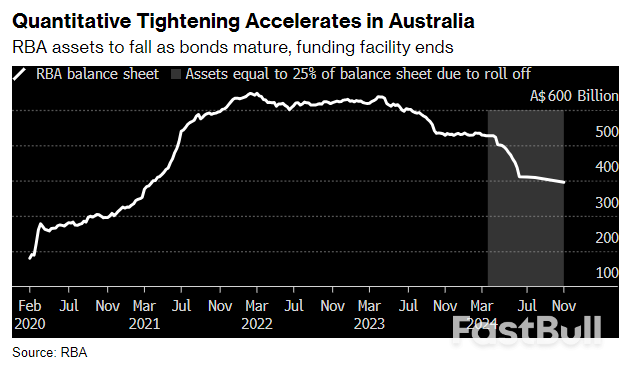
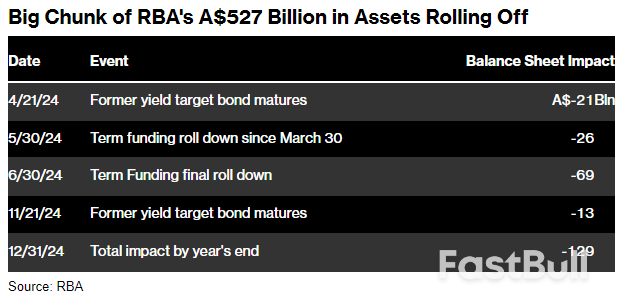
          Kent’s remarks come as the RBA’s balance sheet is set to shrink by more than A$100 billion ($65 billion) with bonds purchased during the Covid-era now maturing. A cheap funding facility provided to lenders during the pandemic expires at the end of June while a bond used for the yield-target program during Covid will mature this month.
          Under this framework, which the RBA board favored over the current “floor” system or returning to a “corridor” approach, the RBA will provide a full allotment repurchase agreement or repo auctions for open market operations, Kent said.
          The next steps the RBA will decide on include the pricing, frequency and other aspects of the repos, as well as what other instruments it might use to supply reserves, the assistant governor said.
          The RBA signaled at its meeting last month that it has likely concluded its policy tightening campaign after raising the cash rate to a 12-year high of 4.35% in a series of steps since May 2022. When asked about monetary policy, Kent on Tuesday reiterated that “the interest-rate path that will best bring inflation down in a timely manner is uncertain.”
          Australia To Switch To New System For Monetary Policy Implementation_1
          The RBA’s transition to “ample reserves” reflects a fundamental shift in how central banks implement monetary policy as they try to strike a balance between operating with a smaller balance sheet and reducing their footprint in financial markets, while avoiding liquidity shortages that may hurt financial stability and impair monetary transmission.
          Huge amounts of cash are still sloshing around – excess liquidity in Australia is still more than A$300 billion, according to the RBA.
          As the transition to the new system occurs, the RBA expects to see cash market activity increase, perhaps with some rise in the cash rate, and potentially some pressure in other money markets, Kent said.
          “By design, however, any such pressures should, to a large extent, be tempered as banks naturally respond to higher market interest rates by borrowing more at OMO repo at the price set by the RBA,” he added.Australia To Switch To New System For Monetary Policy Implementation_2
          The RBA raised rates 13 times between May 2022 and November last year. At the same time, its balance sheet remains sizable, mainly due to the unconventional policy deployed to support the economy during the pandemic.
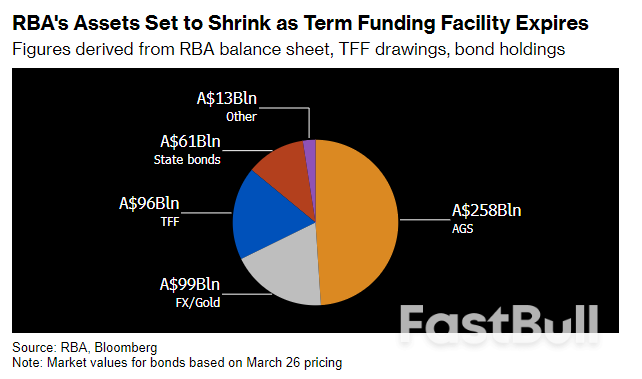
          But a large proportion of the central bank’s A$527 billion in assets is now gradually rolling off — as the table below shows.Australia To Switch To New System For Monetary Policy Implementation_3
          Kent said the RBA board sees a number of advantages with the planned new approach:
          Since the supply of reserves from the RBA will respond to changes in demand, it does not need to accurately estimate demand nor control the quantity of reserves; in short, it is simpler to operate than a scarce reserves or excess reserves system.
          An ample reserves system reduces the risk of unnecessary volatility or disruption to conditions in money markets.
          It is more resilient to any future expansion in the RBA’s balance sheet.
          With the supply of reserves just sufficient to satisfy underlying demand, the RBA’s balance sheet will be no larger than it needs to be in order to implement monetary policy, and its footprint in financial markets will be smaller than in an excess reserves system.

          Source:Bloomberg

          To stay updated on all economic events of today, please check out our Economic calendar
          Risk Warnings and Disclaimers
          You understand and acknowledge that there is a high degree of risk involved in trading. Following any strategies or investment methods may lead to potential losses. The content on the site is provided by our contributors and analysts for information purposes only. You are solely responsible for determining whether any trading assets, securities, strategy, or any other product is suitable for investing based on your own investment objectives and financial situation.
          Add to Favorites
          Share

          Wedge Issue: What’s Driving the Gap Between CPI and PCE Inflation?

          WELLS FARGO

          Economic

          How Much Has Inflation Improved? Depends on How You Measure It
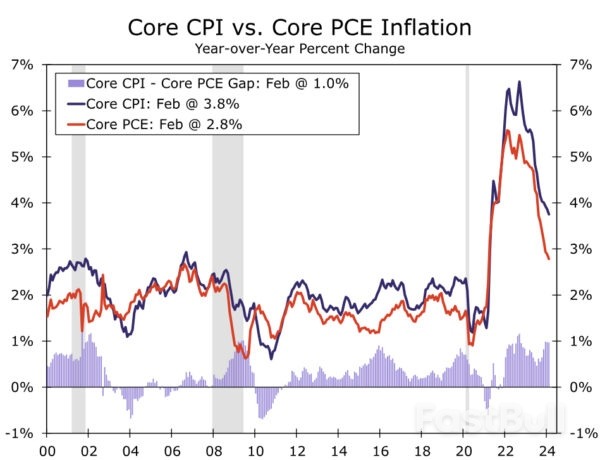
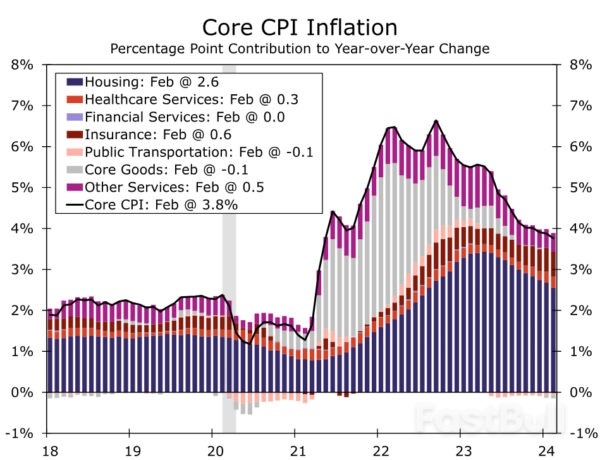
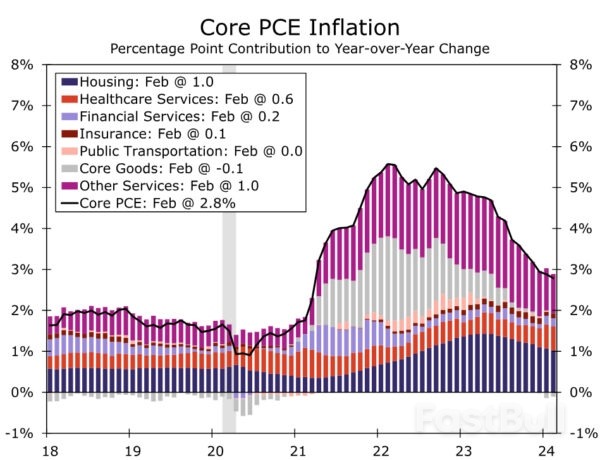
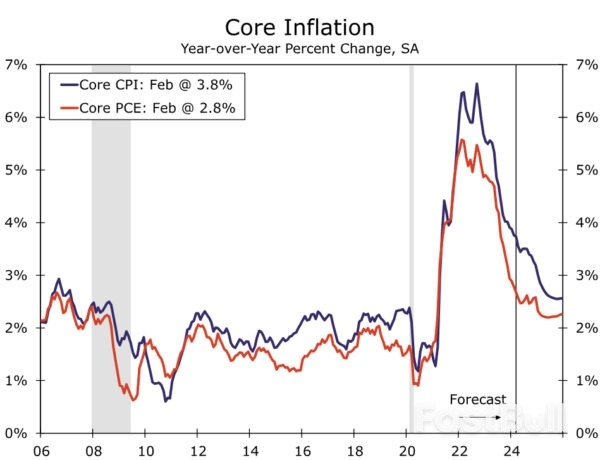
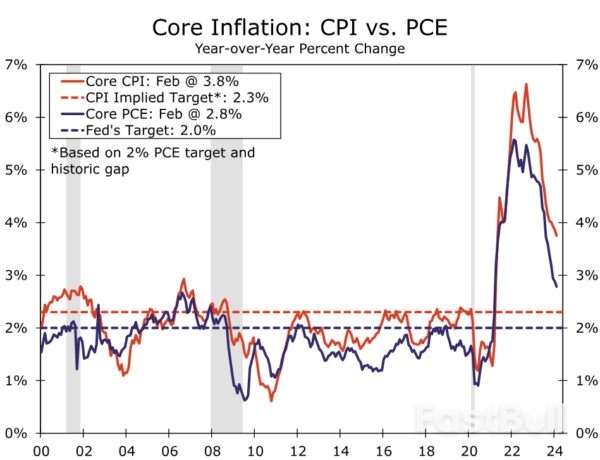
          Inflation has fallen sharply since the fever-pitch reached in the summer of 2022. However, progress in fully quieting inflation is further along by some measures relative to others. The Consumer Price Index in the 12 months through February rose 3.2%, a full percentage point faster than its average pace from 2000-2019. Excluding the volatile categories of food and energy, the core CPI has made less progress in settling down, having increased 3.8% year-over-year in February. In comparison, the core PCE deflator has fallen back below 3%. The more marked improvement in PCE inflation over the past year relative to CPI has led to an unusually wide gap between the two most prominent measures of U.S. inflation (Figure 1). Since 2000, the core CPI deflator has run an average of 0.3 percentage points higher than the core PCE deflator, but the gap currently stands at 1.0 percentage point—near the top end of its range in recent decades. What’s driving the wedge, and what could it mean for the path of interest rates and broader economy ahead?
          Wedge Issue: What’s Driving the Gap Between CPI and PCE Inflation?_1

          Different Strokes for Different Folks: Uses of the CPI and PCE Deflator

          There is no shortage of ways to look at inflation in the U.S. economy. Government agencies publish an array of price indices for goods and services consumed by different end users (e.g., businesses, households and the government), as well as sold by different types of producers (e.g., domestic or foreign). Among the various gauges of inflation, the Consumer Price Index (CPI) and Personal Consumption Expenditure Price Index (PCE deflator) are the most closely watched.
          The CPI has a long history of being in the limelight and tends to be the most familiar measure of inflation. The CPI measures price changes for a representative basket of items purchased directly by consumers. Its focus on consumers’ out-of-pocket costs leads it to align more closely with consumers’ perceived inflation experience. The CPI is also widely used in wage contracts and by the government. For example, Social Security’s annual cost of living adjustment (COLA) is based on the CPI while income eligibility for many government programs and federal tax brackets are adjusted with the CPI. Further, the nearly $2 trillion market for Treasury Inflation-Protected Securities (TIPS) adjusts principal returns for inflation using the CPI, tying the CPI directly to a large segment of the financial market.
          The PCE deflator also has a key tie to financial markets and the economy writ large: the FOMC benchmarks its 2% inflation target to the PCE deflator. As the preferred inflation gauge of the Fed, the PCE deflator is more relevant for the path of U.S. monetary policy. While over time the CPI and PCE move closely together, unusually wide divergences, like that of today, may send different messages about price pressures in the economy and what may lie ahead for the setting of interest rates.

          Why the Fed’s a Fan of PCE Inflation

          The Fed’s preference for the PCE deflator can be chalked up to two primary attributes. First, it is wider in scope than the CPI and as a result, generates a more encompassing picture of inflation in the U.S. economy. Whereas the CPI measures the change in out-of-pocket costs to consumers, the PCE price index includes the cost of items purchased on behalf of households, such as medical care paid for by the government or employer-sponsored health insurance. The PCE deflator also incorporates implicit prices of items not directly purchased on the market or “furnished without payment.” Examples include the cost of financial services like “free” checking accounts, brokerage fees, or nonprofit services.
          Notably, the wider scope of the PCE can lead to significant differences in categorical weightings. Items not purchased directly by consumers or items that are also purchased on behalf of households carry a bigger weight in the PCE (e.g., financial services and medical care). In contrast, goods and services purchased directly by consumers bear a higher weight in the CPI (e.g., gasoline, vehicles and shelter).
          Second, the PCE deflator and CPI are constructed using different statistical formulas. The PCE formula better accounts for the tendency of consumers to substitute away from products whose prices rise relatively quickly. A common example of this dynamic is if the price of beef is rising more quickly than chicken, consumers will substitute chicken for beef. This substitution effect leads to overall living costs rising more slowly than if measured by the fixed consumption basket in the CPI. As a result, policymakers view the PCE deflator as a more accurate barometer of the overall change in the economy’s price level. The CPI “basket” is updated annually based on the Consumer Expenditure Survey to account for shifts in consumption, and the relative importance of CPI categories adjust monthly based on comparative price changes; however, the PCE method captures substitution effects more quickly by leveraging the expenditure data available for the same period. This “formula effect” leads to the CPI typically running higher than the PCE deflator.

          Gap Accounting

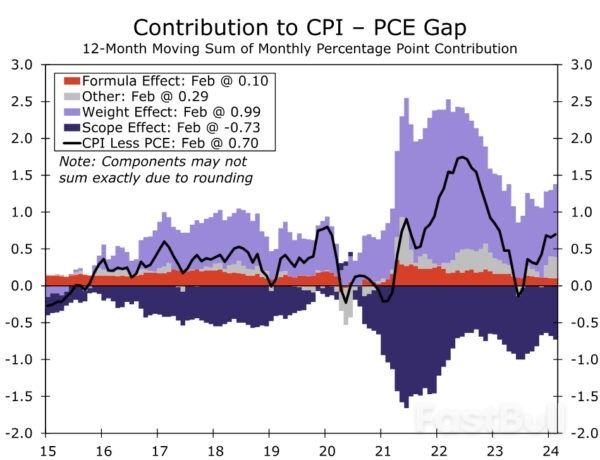
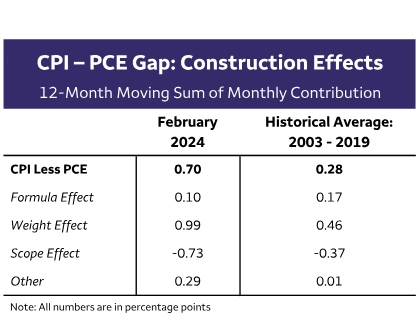
          The unique scope, weighting and formulas of the CPI and PCE all influence the gap between the two inflation measures. The formula effect tends to be a persistent, but relatively small and stable source of the wedge (Figure 2). Over the past year, the formula difference has contributed 0.1 percentage point to the 0.7 point gap between the year-over-year rates of CPI and PCE inflation, fairly similar to its average since 2003 (Figure 3). Weighting has played by far the largest role in keeping the CPI running hotter than the PCE the past year, primarily due to the ongoing strength in shelter inflation. Other differences, such as seasonal adjustment or source of pricing data, historically have had little bearing on the gap, but over the past year have been another meaningful contributor (+0.3 points) to the wedge between CPI and PCE. The broader scope of the PCE deflator, in contrast, has helped to narrow the gap with CPI inflation over the past year by a historically large degree.
          Wedge Issue: What’s Driving the Gap Between CPI and PCE Inflation?_2
          Wedge Issue: What’s Driving the Gap Between CPI and PCE Inflation?_3
          To help think about how the gap between the CPI and PCE deflator will evolve, we find it useful to also look at it on a categorical basis. We focus on the core indices given FOMC officials place greater emphasis on price growth excluding food and gas when considering the near-term outlook for interest rates.

          Housing and Motor Vehicle Insurance Driving Historically Wide Wedge

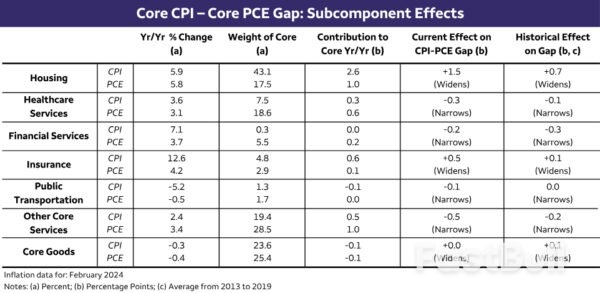
          As shown in Figures 4 and 5, housing more than accounts for the 1.0 percentage point gap between core CPI and core PCE the past year. The PCE uses the CPI’s primary rent and owners’ equivalent rent measures as source data, so housing’s more sizable contribution to core CPI boils down entirely to its larger weight (43% versus 18% in the core PCE index).
          Wedge Issue: What’s Driving the Gap Between CPI and PCE Inflation?_4
          Wedge Issue: What’s Driving the Gap Between CPI and PCE Inflation?_5
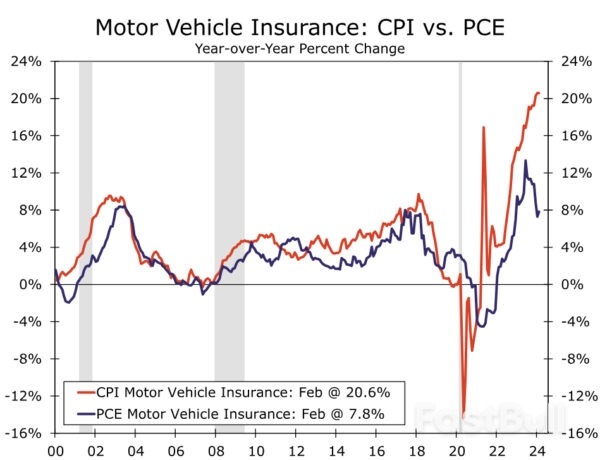
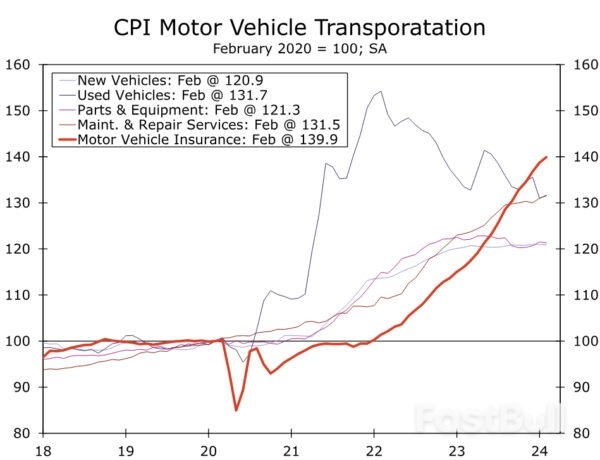
          Rapidly rising costs for motor vehicles have also contributed to the relatively hotter rate of core CPI inflation recently. Motor vehicle insurance carries nearly four times the weight in the core CPI (3.5% versus 0.7% in PCE). In the CPI, insurance costs reflect the premiums paid by consumers, but not claims paid out by insurers on behalf of motorists. The PCE’s net-revenue approach has contributed to motor vehicle insurance costs rising less dramatically since insurers’ costs to cover claims have risen rapidly alongside higher vehicle repair and replacement costs (Figure 6). This pricing difference (part of the “other” category in Figure 5) in conjunction with a lower weighting, has led motor vehicle insurance over the past year to add less than 0.1 points to core PCE, compared to 0.7 points to the core CPI. Health and home insurance are also measured differently in the CPI and PCE but, in contrast to motor vehicle insurance, have narrowed the core CPI–PCE gap by a tenth over the past year.
          Wedge Issue: What’s Driving the Gap Between CPI and PCE Inflation?_6
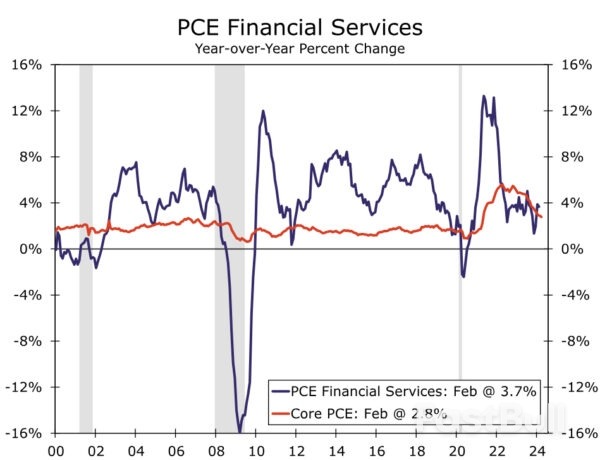
          Further, financial services usually narrows the wedge between the two inflation measures, but recently this category has limited the wedge by less than normal. Financial services account for more than 5% of the core PCE deflator, compared to just a few tenths in the CPI as the cost of many financial service products are not paid for out of pocket. Over the past year, the PCE index for financial services has outpaced the broader core PCE, but by a smaller degree than exhibited over the past decade (Figure 7). Accordingly, it has provided less of a leg-up to PCE inflation than usual.
          Wedge Issue: What’s Driving the Gap Between CPI and PCE Inflation?_7

          Healthcare and Other Services Limiting A Blowout

          Healthcare services costs (ex-insurance) have grown more quickly in the CPI than in the PCE index over the past year. However, the PCE’s greater weighting nevertheless leaves healthcare providing a bigger lift to the year-over-year rate of core PCE inflation, and thus has helped to narrow the current gap with the CPI. Healthcare services historically have contributed 0.1 point more to the year-over-year rate of core PCE than core CPI, but over the past year have added 0.2 points more.
          Different methods for measuring airline fares, the lion’s share of public transportation, also have whittled down the gap in core CPI and core PCE. The CPI sample consists largely of discount fares for non-business travel scheduled for either the same month or a month or two out. The corresponding PCE index uses Producer Price Index data for domestic airfare, which measures the change in average revenue per passenger (including business travelers) for flights departing during the reference month. Airfares as measured by the CPI are down just over 6% year-over-year, but are essentially flat per the PCE deflator.
          Finally, an array of other services have offered a significant counterbalance to the wedge that shelter and motor vehicle insurance have driven between the core CPI and core PCE. These include categories out of scope of the CPI, like social services or nonprofit institutions serving households, both of which are running higher than the broader core PCE and effectively bringing it more in line with the core CPI. Core PCE inflation also includes food services, which is up 4.4% over the past year and is included in the headline CPI but excluded from the core CPI. A summary of the differences in current category contributions versus their historical effects on the core CPI–PCE gap is shown in Figure 8.
          Wedge Issue: What’s Driving the Gap Between CPI and PCE Inflation?_8

          When the Dust Settles

          Looking ahead, we expect the gap between core CPI and core PCE when measured on a year-ago basis to remain uncharacteristically wide through the first half of next year (Figure 9). On a quarterly annualized basis, the return to the ~0.3% realm should occur somewhat earlier; we estimate around the first quarter of 2025.
          Wedge Issue: What’s Driving the Gap Between CPI and PCE Inflation?_9
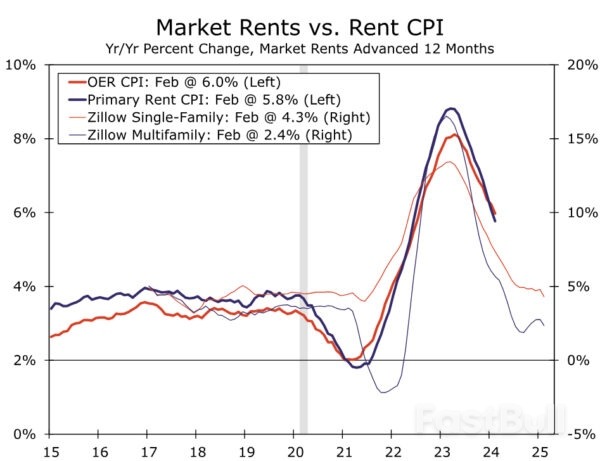
          The timing and extent to which the gap between core CPI and core PCE settles back down hinges heavily on the path of shelter inflation given its current hefty contribution. While the moderation in official measures of shelter inflation has been painstakingly slow to materialize, we expect housing disinflation to continue this year with the year-over-year pace of primary shelter resembling its pre-pandemic pace of 3.0-3.5% by next spring. A host of private sector measures suggest apartment rent growth has already settled down, with rents for single family units having also slowed materially (Figure 10). That said, primary shelter has grown to account for an even larger share of CPI since 2019 (+2.5 pts), while the PCE share is little changed. As such, weighting effects are likely to continue to play somewhat of a bigger role on the CPI–PCE gap unless shelter inflation undershoots broader core inflation, an outcome that is plausible but unlikely in our view.
          Wedge Issue: What’s Driving the Gap Between CPI and PCE Inflation?_10
          We also anticipate that the chasm stemming from motor vehicle insurance will narrow over the course of the year. Insurers have had to play catch-up to the spike in vehicle and repair costs following severe supply shortages in the auto industry, a process drawn out by the need for regulatory approval to raise premiums in most states. However, motor vehicle insurance premiums per the CPI have now risen more than the price of vehicles, equipment and repair services since the start of 2020, suggesting a diminishing need for premiums to continue rising at the past years’ eye-watering pace (Figure 11). Recent months’ data show tentative signs of the CPI for motor vehicle insurance already beginning to cool, with prices up 17% on a three-month annualized basis compared to 21% on a 12-month basis.
          Wedge Issue: What’s Driving the Gap Between CPI and PCE Inflation?_11
          The expected narrowing of the inflation gap as shelter and motor vehicle insurance inflation slows is likely to be partially offset, however, by cooler price growth in categories currently providing an unusually-large boost to core PCE. As inflation pressures ease from more tepid demand and a balanced labor market, we expect slower price growth for healthcare, food services and other sundry services to reduce the outsized contribution “other core services” are currently providing to core PCE. Public transportation is also unlikely to reduce the inflation gap ahead as the CPI for airfares recovers from last summer’s swoon.

          Monetary Policy Implications: The Fed’s Not Sweating the Gap

          The relatively higher rate of CPI compared to the PCE deflator likely goes some way in explaining why consumers continue to reel from the current inflation environment, but Fed officials see enough progress to expect some policy easing later this year. Even as consumer sentiment has improved over the past year, it remains low relative to the strength of the jobs market as prices paid by consumers continue to rise at an unfamiliar speed.
          Yet, while core inflation as measured by both the CPI and PCE price indexes remains too high, it has fallen more sharply over the past year when measured by the PCE deflator and is closer to the pace consistent with the Fed’s inflation target (Figure 12). Furthermore, although the gap currently remains large, it is not unprecedented. A similarly sized wedge opened up in the late 1990s and in 2001 and 2009. As the pricing environment cools from its extreme state, the gap should diminish as well.
          Wedge Issue: What’s Driving the Gap Between CPI and PCE Inflation?_12
          We doubt the Fed is too bothered by the CPI–PCE gap. The elevated rate of shelter inflation is the largest contributor to the wedge at present, but officials continue to espouse optimism that shelter inflation will ease further ahead. In the March 20 FOMC press conference, Chair Powell said that “There’s a little bit of uncertainty about when that will happen but there’s real confidence that [lower market rents] will show up eventually over time.”
          While the wedge between CPI and PCE inflation does not appear to be a major source of consternation among Fed officials, it could make the FOMC’s job of returning PCE inflation to 2% a little harder on the margin with cost of living adjustments and price contracts more likely to be based off of the stronger CPI inflation rate. In addition, the Fed does not solely look at the PCE deflator when assessing the current state of inflation. If the gap persists at recent levels and the drivers shift away from housing, it could contribute to some unease among policymakers about the risk of cutting the fed funds rate too early.
          Nevertheless, we do not believe the current gap between the two most ubiquitous measures of U.S. inflation is causing any particular misgivings among the FOMC participants about the path of inflation ahead. With the Fed’s preferred inflation measure continuing to grind lower, some easing of policy this year likely remains in the cards.
          To stay updated on all economic events of today, please check out our Economic calendar
          Risk Warnings and Disclaimers
          You understand and acknowledge that there is a high degree of risk involved in trading. Following any strategies or investment methods may lead to potential losses. The content on the site is provided by our contributors and analysts for information purposes only. You are solely responsible for determining whether any trading assets, securities, strategy, or any other product is suitable for investing based on your own investment objectives and financial situation.
          Add to Favorites
          Share

          Dollar Ascendant As Fed Cut Bets Pared, Jawboning Props Up Yen

          Cohen

          Forex

          The US dollar hovered near a 4-1/2-month high against major peers on Tuesday as traders rushed to push back bets for the Federal Reserve's first interest rate cut this year. The dollar held close to a six-week peak versus the euro and sterling reached on Monday, after US data unexpectedly showed the first expansion in manufacturing since September 2022.
          Fears of intervention by Japanese officials limited dollar gains against the yen, even as long-term US Treasury yields - which the currency pair tends to track - jumped more than 14 basis points to a two-week top at 4.337 per cent overnight.
          Gold, which performs best when yields are falling, was knocked back from a record peak. The US rate futures market now factors in 61.3 per cent odds of a Fed rate cut in June, down from about 70.1 per cent probability a week ago, according to the CME's FedWatch tool.
          "The divergence of solid growth dynamics for the US and waning Fed rate cut risk against sluggish growth for other FX majors suggests that any DXY dips should be seen as buying opportunities," said Westpac's head of currency strategy, Richard Franulovich, referring to the dollar index.
          The dollar index , which measures the currency against the yen, euro, sterling and three other peers, edged 0.02 per cent higher to 105.02, following a 0.51 per cent rally to as high as 105.07 on Monday.
          The euro slipped 0.08 per cent to $1.0733, sticking close to the overnight low of 1.0731. Sterling was 0.04 per cent lower at $1.25455 after sliding to $1.2540 in the prior session. The Japanese yen firmed slightly on Tuesday to 151.565 per dollar , after dipping to 151.77 the previous day.
          It reached a 34-year trough of 151.975 last week, spurring Japan to step up warnings of intervention. On Tuesday, Finance Minister Shunichi Suzuki reiterated that he wouldn't rule out any options to respond to disorderly currency moves.
          Japanese authorities intervened in 2022 when the yen slid toward a 32-year low of 152 to the dollar. The yen's slide has come despite the Bank of Japan's first interest rate hike since 2007 last month, with officials cautious about further tightening amid a fragile exit from decades of deflation.
          "Despite heightened risk of intervention, the BOJ's policy stance remains very accommodative and Japanese data continue to show the fragility of their 'virtuous cycle' economic recovery," said Westpac's Franulovich.
          "If intervention occurs, resultant flushes in USD/JPY below 150.00 could be relatively deep given the recent surge in leveraged shorts in JPY. However, they are still likely to be seen as buying opportunities once positioning has become more balanced."
          Elsewhere, the Australian dollar was flat at $0.6489, after skidding to a nearly one-month low of $0.64815 on Monday. New Zealand's kiwi dollar eased 0.07 per cent to $0.5949, edging back toward the 4-1/2-month trough at $0.59395 from overnight.
          Spot gold edged up 0.11 per cent to $2,253.09, after dropping back from a record high at $2,265.49 in the previous session. Leading cryptocurrency bitcoin declined 0.87 per cent to $69,158, but was well within its relatively narrow trading range of the past week.

          Source:zeebiz

          Risk Warnings and Disclaimers
          You understand and acknowledge that there is a high degree of risk involved in trading. Following any strategies or investment methods may lead to potential losses. The content on the site is provided by our contributors and analysts for information purposes only. You are solely responsible for determining whether any trading assets, securities, strategy, or any other product is suitable for investing based on your own investment objectives and financial situation.
          Add to Favorites
          Share
          FastBull
          Copyright © 2025 FastBull Ltd

          728 RM B 7/F GEE LOK IND BLDG NO 34 HUNG TO RD KWUN TONG KLN HONG KONG

          TelegramInstagramTwitterfacebooklinkedin
          App Store Google Play Google Play
          Products
          Charts

          Chats

          Q&A with Experts
          Screeners
          Economic Calendar
          Data
          Tools
          Membership
          Features
          Function
          Markets
          Copy Trading
          Latest Signals
          Contests
          News
          Analysis
          24/7
          Columns
          Education
          Company
          Careers
          About Us
          Contact Us
          Advertising
          Help Center
          Feedback
          User Agreement
          Privacy Policy
          Business

          White Label

          Data API

          Web Plug-ins

          Poster Maker

          Affiliate Program

          Risk Disclosure

          The risk of loss in trading financial instruments such as stocks, FX, commodities, futures, bonds, ETFs and crypto can be substantial. You may sustain a total loss of the funds that you deposit with your broker. Therefore, you should carefully consider whether such trading is suitable for you in light of your circumstances and financial resources.

          No decision to invest should be made without thoroughly conducting due diligence by yourself or consulting with your financial advisors. Our web content might not suit you since we don't know your financial conditions and investment needs. Our financial information might have latency or contain inaccuracy, so you should be fully responsible for any of your trading and investment decisions. The company will not be responsible for your capital loss.

          Without getting permission from the website, you are not allowed to copy the website's graphics, texts, or trademarks. Intellectual property rights in the content or data incorporated into this website belong to its providers and exchange merchants.

          Not Logged In

          Log in to access more features

          FastBull Membership

          Not yet

          Purchase

          Become a signal provider
          Help Center
          Customer Service
          Dark Mode
          Price Up/Down Colors

          Log In

          Sign Up

          Position
          Layout
          Fullscreen
          Default to Chart
          The chart page opens by default when you visit fastbull.com