• Trade
  • Markets
  • Copy
  • Contests
  • News
  • 24/7
  • Calendar
  • Q&A
  • Chats
Trending
Screeners
SYMBOL
LAST
BID
ASK
HIGH
LOW
NET CHG.
%CHG.
SPREAD
SPX
S&P 500 Index
6827.42
6827.42
6827.42
6899.86
6801.80
-73.58
-1.07%
--
DJI
Dow Jones Industrial Average
48458.04
48458.04
48458.04
48886.86
48334.10
-245.98
-0.51%
--
IXIC
NASDAQ Composite Index
23195.16
23195.16
23195.16
23554.89
23094.51
-398.69
-1.69%
--
USDX
US Dollar Index
97.950
98.030
97.950
98.500
97.950
-0.370
-0.38%
--
EURUSD
Euro / US Dollar
1.17394
1.17409
1.17394
1.17496
1.17192
+0.00011
+ 0.01%
--
GBPUSD
Pound Sterling / US Dollar
1.33707
1.33732
1.33707
1.33997
1.33419
-0.00148
-0.11%
--
XAUUSD
Gold / US Dollar
4299.39
4299.39
4299.39
4353.41
4257.10
+20.10
+ 0.47%
--
WTI
Light Sweet Crude Oil
57.233
57.485
57.233
58.011
56.969
-0.408
-0.71%
--

Community Accounts

Signal Accounts
--
Profit Accounts
--
Loss Accounts
--
View More

Become a signal provider

Sell trading signals to earn additional income

View More

Guide to Copy Trading

Get started with ease and confidence

View More

Signal Accounts for Members

All Signal Accounts

Best Return
  • Best Return
  • Best P/L
  • Best MDD
Past 1W
  • Past 1W
  • Past 1M
  • Past 1Y

All Contests

  • All
  • Trump Updates
  • Recommend
  • Stocks
  • Cryptocurrencies
  • Central Banks
  • Featured News
Top News Only
Share

USA Embassy In Lithuania: Maria Kalesnikava Is Not Going To Vilnius

Share

USA Embassy In Lithuania: Other Prisoners Are Being Sent From Belarus To Ukraine

Share

Ukraine President Zelenskiy: Five Ukrainians Released By Belarus In US-Brokered Deal

Share

USA Vilnius Embassy: USA Stands Ready For "Additional Engagement With Belarus That Advances USA Interests"

Share

USA Vilnius Embassy: Belarus, USA, Other Citizens Among The Prisoners Released Into Lithuania

Share

USA Vilnius Embassy: USA Will Continue Diplomatic Efforts To Free The Remaining Political Prisoners In Belarus

Share

USA Vilnius Embassy: Belarus Releases 123 Prisoners Following Meeting Of President Trump's Envoy Coale And Belarus President Lukashenko

Share

USA Vilnius Embassy: Masatoshi Nakanishi, Aliaksandr Syrytsa Are Among The Prisoners Released By Belarus

Share

USA Vilnius Embassy: Maria Kalesnikava And Viktor Babaryka Are Among The Prisoners Released By Belarus

Share

USA Vilnius Embassy: Nobel Peace Prize Laureate Ales Bialiatski Is Among The Prisoners Released By Belarus

Share

Belarusian Presidential Administration Telegram Channel: Lukashenko Has Pardoned 123 Prisoners As Part Of Deal With US

Share

Two Local Syrian Officials: Joint US-Syrian Military Patrol In Central Syria Came Under Fire From Unknown Assailants

Share

Israeli Military Says It Targeted 'Key Hamas Terrorist' In Gaza City

Share

Rwanda's Actions In Eastern Drc Are A Clear Violation Of Washington Accords Signed By President Trump - Secretary Of State Rubio

Share

Israeli Military Issues Evacuation Warning In Southern Lebanon Village Ahead Of Strike - Spokesperson On X

Share

Belarusian State Media Cites US Envoy Coale As Saying He Discussed Ukraine And Venezuela With Lukashenko

Share

Belarusian State Media Cites US Envoy Coale As Saying That US Removes Sanctions On Belarusian Potassium

Share

Thai Prime Minister: No Ceasefire Agreement With Cambodia

Share

US, Ukraine To Discuss Ceasefire In Berlin Ahead Of European Summit

Share

Incoming Czech Prime Minister Babis: Czech Republic Will Not Take On Guarantees For Ukraine Financing, European Commission Must Find Alternatives

TIME
ACT
FCST
PREV
U.K. Trade Balance Non-EU (SA) (Oct)

A:--

F: --

P: --

U.K. Trade Balance (Oct)

A:--

F: --

P: --

U.K. Services Index MoM

A:--

F: --

P: --

U.K. Construction Output MoM (SA) (Oct)

A:--

F: --

P: --

U.K. Industrial Output YoY (Oct)

A:--

F: --

P: --

U.K. Trade Balance (SA) (Oct)

A:--

F: --

P: --

U.K. Trade Balance EU (SA) (Oct)

A:--

F: --

P: --

U.K. Manufacturing Output YoY (Oct)

A:--

F: --

P: --

U.K. GDP MoM (Oct)

A:--

F: --

P: --

U.K. GDP YoY (SA) (Oct)

A:--

F: --

P: --

U.K. Industrial Output MoM (Oct)

A:--

F: --

P: --

U.K. Construction Output YoY (Oct)

A:--

F: --

P: --

France HICP Final MoM (Nov)

A:--

F: --

P: --

China, Mainland Outstanding Loans Growth YoY (Nov)

A:--

F: --

P: --

China, Mainland M2 Money Supply YoY (Nov)

A:--

F: --

P: --

China, Mainland M0 Money Supply YoY (Nov)

A:--

F: --

P: --

China, Mainland M1 Money Supply YoY (Nov)

A:--

F: --

P: --

India CPI YoY (Nov)

A:--

F: --

P: --

India Deposit Gowth YoY

A:--

F: --

P: --

Brazil Services Growth YoY (Oct)

A:--

F: --

P: --

Mexico Industrial Output YoY (Oct)

A:--

F: --

P: --

Russia Trade Balance (Oct)

A:--

F: --

P: --

Philadelphia Fed President Henry Paulson delivers a speech
Canada Building Permits MoM (SA) (Oct)

A:--

F: --

P: --

Canada Wholesale Sales YoY (Oct)

A:--

F: --

P: --

Canada Wholesale Inventory MoM (Oct)

A:--

F: --

P: --

Canada Wholesale Inventory YoY (Oct)

A:--

F: --

P: --

Canada Wholesale Sales MoM (SA) (Oct)

A:--

F: --

P: --

Germany Current Account (Not SA) (Oct)

A:--

F: --

P: --

U.S. Weekly Total Rig Count

A:--

F: --

P: --

U.S. Weekly Total Oil Rig Count

A:--

F: --

P: --

Japan Tankan Large Non-Manufacturing Diffusion Index (Q4)

--

F: --

P: --

Japan Tankan Small Manufacturing Outlook Index (Q4)

--

F: --

P: --

Japan Tankan Large Non-Manufacturing Outlook Index (Q4)

--

F: --

P: --

Japan Tankan Large Manufacturing Outlook Index (Q4)

--

F: --

P: --

Japan Tankan Small Manufacturing Diffusion Index (Q4)

--

F: --

P: --

Japan Tankan Large Manufacturing Diffusion Index (Q4)

--

F: --

P: --

Japan Tankan Large-Enterprise Capital Expenditure YoY (Q4)

--

F: --

P: --

U.K. Rightmove House Price Index YoY (Dec)

--

F: --

P: --

China, Mainland Industrial Output YoY (YTD) (Nov)

--

F: --

P: --

China, Mainland Urban Area Unemployment Rate (Nov)

--

F: --

P: --

Saudi Arabia CPI YoY (Nov)

--

F: --

P: --

Euro Zone Industrial Output YoY (Oct)

--

F: --

P: --

Euro Zone Industrial Output MoM (Oct)

--

F: --

P: --

Canada Existing Home Sales MoM (Nov)

--

F: --

P: --

Euro Zone Total Reserve Assets (Nov)

--

F: --

P: --

U.K. Inflation Rate Expectations

--

F: --

P: --

Canada National Economic Confidence Index

--

F: --

P: --

Canada New Housing Starts (Nov)

--

F: --

P: --

U.S. NY Fed Manufacturing Employment Index (Dec)

--

F: --

P: --

U.S. NY Fed Manufacturing Index (Dec)

--

F: --

P: --

Canada Core CPI YoY (Nov)

--

F: --

P: --

Canada Manufacturing Unfilled Orders MoM (Oct)

--

F: --

P: --

Canada Manufacturing New Orders MoM (Oct)

--

F: --

P: --

Canada Core CPI MoM (Nov)

--

F: --

P: --

Canada Manufacturing Inventory MoM (Oct)

--

F: --

P: --

Canada CPI YoY (Nov)

--

F: --

P: --

Canada CPI MoM (Nov)

--

F: --

P: --

Canada CPI YoY (SA) (Nov)

--

F: --

P: --

Canada Core CPI MoM (SA) (Nov)

--

F: --

P: --

Q&A with Experts
    • All
    • Chatrooms
    • Groups
    • Friends
    Connecting
    .
    .
    .
    Type here...
    Add Symbol or Code

      No matching data

      All
      Trump Updates
      Recommend
      Stocks
      Cryptocurrencies
      Central Banks
      Featured News
      • All
      • Russia-Ukraine Conflict
      • Middle East Flashpoint
      • All
      • Russia-Ukraine Conflict
      • Middle East Flashpoint
      Search
      Products

      Charts Free Forever

      Chats Q&A with Experts
      Screeners Economic Calendar Data Tools
      Membership Features
      Data Warehouse Market Trends Institutional Data Policy Rates Macro

      Market Trends

      Market Sentiment Order Book Forex Correlations

      Top Indicators

      Charts Free Forever
      Markets

      News

      News Analysis 24/7 Columns Education
      From Institutions From Analysts
      Topics Columnists

      Latest Views

      Latest Views

      Trending Topics

      Top Columnists

      Latest Update

      Signals

      Copy Rankings Latest Signals Become a signal provider AI Rating
      Contests
      Brokers

      Overview Brokers Assessment Rankings Regulators News Claims
      Broker listing Forex Brokers Comparison Tool Live Spread Comparison Scam
      Q&A Complaint Scam Alert Videos Tips to Detect Scam
      More

      Business
      Events
      Careers About Us Advertising Help Center

      White Label

      Data API

      Web Plug-ins

      Affiliate Program

      Awards Institution Evaluation IB Seminar Salon Event Exhibition
      Vietnam Thailand Singapore Dubai
      Fans Party Investment Sharing Session
      FastBull Summit BrokersView Expo
      Recent Searches
        Top Searches
          Markets
          News
          Analysis
          User
          24/7
          Economic Calendar
          Education
          Data
          • Names
          • Latest
          • Prev

          View All

          No data

          Scan to Download

          Faster Charts, Chat Faster!

          Download App
          English
          • English
          • Español
          • العربية
          • Bahasa Indonesia
          • Bahasa Melayu
          • Tiếng Việt
          • ภาษาไทย
          • Français
          • Italiano
          • Türkçe
          • Русский язык
          • 简中
          • 繁中
          Open Account
          Search
          Products
          Charts Free Forever
          Markets
          News
          Signals

          Copy Rankings Latest Signals Become a signal provider AI Rating
          Contests
          Brokers

          Overview Brokers Assessment Rankings Regulators News Claims
          Broker listing Forex Brokers Comparison Tool Live Spread Comparison Scam
          Q&A Complaint Scam Alert Videos Tips to Detect Scam
          More

          Business
          Events
          Careers About Us Advertising Help Center

          White Label

          Data API

          Web Plug-ins

          Affiliate Program

          Awards Institution Evaluation IB Seminar Salon Event Exhibition
          Vietnam Thailand Singapore Dubai
          Fans Party Investment Sharing Session
          FastBull Summit BrokersView Expo

          Morning Bid: China's positive PMIs set bullish tone

          Devin

          Economic

          Summary:

          A look at the day ahead in Asian markets.
          Asian markets are primed for a positive start to the new quarter following more evidence of the U.S. "soft landing" on Friday and figures on Sunday that showed manufacturing and service sector activity in China last month accelerated in tandem.
          Trading volume on Monday will be lighter than usual with much of Europe still closed for the Easter holiday, but U.S. stock and bond markets are open again.
          Asia's economic calendar is packed with key indicators — manufacturing purchasing managers index reports from several countries including Japan; South Korean trade; Indonesian inflation; and Japan's quarterly tankan business conditions surveys.
          The exchange rates of Asia's two largest economies will once again be under the spotlight - Japan's yen remains in "intervention" territory, and while China's yuan is also under pressure against the dollar but is at a 30-year high against the yen.
          The yuan last week slipped in spot trading to its weakest level this year around 7.22 per dollar but the People's Bank of China has kept the daily fixing rate virtually unchanged around 7.0950 for the past four days.
          This suggests the PBOC doesn't want any volatility or abrupt weakness. But Beijing's predicament is exacerbated by the yuan's exchange rate with the yen — it is at 30-year high against the Japanese currency, giving Tokyo a competitive advantage on the world trade stage.
          But Beijing will have welcomed the latest earnings from tech giant Huawei, and official PMI figures that showed manufacturing activity expanding for the first time in six months.
          The manufacturing PMI rose to 50.8 from 49.1 a month earlier and export orders also picked up. The official services PMI rose to its highest since June and the composite PMI its highest since April — numbers that could give Chinese and global markets a lift on Monday.
          China's unofficial Caixin manufacturing PMI figures will be released on Monday.
          Investors will also be looking to see whether Japan's first quarter tankan business conditions surveys shows evidence of economic momentum and recovery in domestic demand. Capex plans of large firms could also signal whether Japan's stock market boom has more upside.
          Another market-mover on Monday could be Indonesian consumer inflation. Rising meat and food prices are expected to lift the annual rate to 2.91% in March from 2.75%, which would be the highest since August although still within Bank Indonesia's 1.5%-3.5% target.
          The central bank left its policy rate unchanged at 6% for the fourth consecutive meeting in February and is likely to wait for the Fed to cut rates before easing.
          Regional highlights later include more PMIs, inflation from South Korea and the Philippines, and the latest monetary policy decision and guidance from the Reserve Bank of India.

          Source: Reuters

          To stay updated on all economic events of today, please check out our Economic calendar
          Risk Warnings and Disclaimers
          You understand and acknowledge that there is a high degree of risk involved in trading. Following any strategies or investment methods may lead to potential losses. The content on the site is provided by our contributors and analysts for information purposes only. You are solely responsible for determining whether any trading assets, securities, strategy, or any other product is suitable for investing based on your own investment objectives and financial situation.
          Add to Favorites
          Share

          China IPO Slowdown Pits Startups Against Investors

          Alex

          Economic

          China’s depressed stock markets and a slowdown in IPO registration by regulators have sent a chill through the world of private equity (PE) and venture capital (VC) firms, whose funds have traditionally chosen listing as the most popular exit channel for their Chinese investments.
          The market downturn has spelled trouble for many IPO hopefuls and created a rift between them and their PE/VC investors that is increasingly leading to arbitration or litigation when companies fail to follow an agreed timetable to go public and allow funds to exit.
          When the promised IPO doesn’t happen, the two sides sometimes try to renegotiate their deal, but the PE/VC firm usually has the upper hand because of the nature of the original bet-on agreement (对赌协议), or valuation-adjustment mechanism. This has become a popular arrangement in China and gives investors the right to adjust the valuation of the portfolio company or to redeem their investment and receive a pre-agreed interest rate on the capital when the company’s performance doesn’t meet the conditions set out in the agreement. For Chinese PE/VC firms, the conditions usually include a deadline for an IPO.
          “In the past, there were too many myths about getting rich through IPOs, with investment returns often amounting to dozens of, or even more than 100, times the original capital,” the head of investor relations at a PE firm in Beijing told Caixin. “Limited partners (LPs) only wanted to exit through IPOs and didn’t consider anything else,” he said, referring to investors in PE/VC funds. But in the current environment, LPs “are being realistic,” he said. “If an IPO is hopeless, then they opt for a buyback exit and could start by freezing the founder’s assets in court.”
          Bet-on agreements help mitigate the risks and uncertainties that PE/VC investors face when they invest in a startup and incentivize company management to improve the performance of the business to help meet IPO requirements. But they also expose startups to a potential financial meltdown because most don’t have the resources to compensate investors by buying back their equity, leaving them with little alternative but to accept a large drop in the valuation of the company to compensate the PE/VC firms.
          “Founders just don’t have that kind of money,” the investor relations head said. “Even if they are asked to buy back investors’ shares, they can’t afford it, so they would rather accept a lower valuation.”

          Wanda wipe-out

          The consequences of signing a bet-on agreement with an IPO deadline were laid bare in a high-profile deal involving an established company — Dalian Wanda Commercial Management Group Co. Ltd. (DWCM), a major subsidiary of Dalian Wanda Group Co. Ltd., the entertainment-to-property conglomerate headed by billionaire entrepreneur Wang Jianlin.
          In 2021, DWCM signed an agreement with 16 investors to repay their 38 billion yuan ($5.9 billion) investment plus an 8% annual return should a subsidiary, Zhuhai Wanda Commercial Management Group Co. Ltd., fail to list in Hong Kong by the end of 2023.
          On Dec. 12, 2023, as the deadline approached and Zhuhai Wanda still hadn’t completed its IPO, DWCM announced that it had reached a new agreement with the investors, who would re-invest in Zhuhai Wanda after receiving their repayments.
          The new deal lowered Zhuhai Wanda’s valuation by almost 40%, and forced DWCM to transfer some of its stake in the company to investors, sources with knowledge of the matter told Caixin. Despite the loss, the new agreement was a relief for the group, which was struggling with liquidity problems amid the property market slump.
          However, for the vast majority of companies with PE/VC investment who plan to go public, following Zhuhai Wanda’s example could be tough because they don’t want to swallow such a significant cut in their valuation.

          IPO slump

          Traditionally, IPOs have been the main channel for PE/VC funds in China to realize their investment. A report by consultancy Deloitte published in January 2023 found that among the investments exited by VC and growth funds in China, more than 90% were via IPOs. In contrast, in the more mature U.S. market, only 5% of the projects exited by PE funds used this channel, with the majority, 52%, exiting through mergers or acquisitions, and 43% through a takeover by another investor, usually another PE fund.
          “Back in the days when we were managing U.S. dollar funds, bet-on agreements that stipulated IPOs were rare, with most conditional on company performance,” a source who works for an investment firm that manages both U.S. dollar and yuan funds told Caixin. That was not only because exiting an investment through an overseas IPO was easier, but also because an IPO was neither the only nor the optimal channel for exit, he said.
          But the market for IPOs overseas entered a deep freeze in 2021 amid a row between regulators in Washington and Beijing over access to the auditing work papers of Chinese companies listed in the U.S. Chinese authorities’ tightened scrutiny of overseas listings due to concerns over data security fueled the decline.
          In 2022, the number of Chinese companies newly listed in the U.S. dropped 62% to just 16, and the combined amount of funds raised sank 96% to $540 million, according to Deloitte’s report. The number of companies that went public in Hong Kong that year fell 15% to 82, with the amount of money raised dropping 69% to HK$102 billion ($13 billion), it said.
          The Chinese mainland IPO environment also cooled in 2023 as the stock market slumped and the China Securities Regulatory Commission (CSRC) suggested in August that it would limit the number of new listings as part of a package of measures to arrest the slide. The number of IPO registrations has slumped since then.
          For the whole of 2023, the number of mainland IPOs and the total amount raised dropped 30% and 40%, respectively, according to data compiled by KPMG China. Listings in the U.S. by Chinese companies showed some signs of recovery in 2023 after almost grinding to a halt in July 2021, with 37 new IPOs raising $827 million, according to data compiled by Deloitte and published in December. But that amount of funds pales in comparison with 2020, when 35 Chinese companies raised $13.7 billion through U.S. IPOs, a December 2020 report by Deloitte shows.
          That year, IPOs by Chinese companies in the investment portfolios of PE/VC firms made up just 54% of total exits, compared with 62% in 2022, according to data compiled by Zero2IPO Research, a Beijing-based service provider for the industry.
          Bet-on agreements have become a prerequisite for many PE/VC investors, especially state-backed ones, lawyers at Zhong Lun Law Firm said in an article published in August.
          And the terms have become increasingly stringent, with shorter timeframes for IPOs and higher interest rates on repayments from portfolio companies if they fail to list within the timeframe.
          The annualized interest rates in bet-on agreements usually range from 8% to 10%, with some as high as 20%, industry insiders told Caixin. Buybacks are sometimes priced against the company’s valuation in the latest round of funding.
          “Unless the project is excellent or the founder is particularly assertive in negotiations, many LPs insist on signing bet-on agreements, especially given that fundraising has become more challenging in recent years,” a source who works in an investment institution focusing on the consumer goods sector told Caixin, noting that this is especially true for local government-backed funds.
          In earlier days, bet-on agreements were more like “gentlemen’s agreements” and weren’t usually enforced, the source whose firm manages both yuan and dollar funds said. That has changed because the industry is facing more difficulty, and investment firms desperately need to be able to show successful exits in order to raise new funds, he said.
          Some investors used to talk about long-term investment and partnerships with portfolio companies, but as soon as it becomes likely the IPO deadline can’t be met, they immediately demand repayment, said a Beijing-based lawyer who specializes in solving transaction disputes.

          Ticking time bombs

          For many startups, bet-on agreements have turned into a ticking time bomb since the CSRC, China’s top securities regulator, vowed to slow the pace of IPOs to help prop up the slumping stock market.
          Companies that signed bet-on agreements have found themselves in a dilemma where they can’t fulfill the IPO requirement on time but don’t have enough capital to buy back shares from their PE/VC investors.
          Adding to entrepreneurs’ plight, bet-on agreements in China usually obligate both the company and its founding shareholders to pay for buybacks when IPO conditions can’t be met, according to a 2022 report by Han Kun Law Offices.
          Many PE/VC firms are increasingly turning to litigation to exit their investments. Keyword searches on China Judgements Online, a database containing judgment documents from Chinese courts, show that in 2023 alone, there were hundreds of rulings containing the keywords “IPO,” “buyback” and “bet-on.” These rulings show that in most cases, investors win their claims for repayment.
          In 2017, Smartisan Technology Co. Ltd. signed a bet-on agreement that stipulated that should the smartphone-maker fail to complete an IPO in five years, it would have to buy back its equity from investors and pay them interest. The agreement also stipulated that founder Luo Yonghao, who is also a media personality, had liability for repaying investors should the company be unable to.
          After the IPO deadline was missed, Zheng Gang, the founder of one of Smartisan’s investors, Shanghai Purplesky Capital Co. Ltd., started a public spat with Luo in early 2023. Zheng claimed that Luo wanted to swap the repayment set out in the agreement for shares in Luo’s new venture without proper communcation, while Luo fired back that investors had the choice to accept or refuse the new plan.
          In September, Zheng said he would initiate arbitration proceedings, screenshots of his social media post show.
          Bet-on agreements have been abused in China, a source who used to work in the regulatory sector told Caixin. Many investors blindly bet on projects, and hope to either exit through an IPO and make a fortune, or use bet-on agreements as a form of hedging against investment risks, the source said. They aren’t conducive to the innovation and development of small and midsize companies, he added.
          There are growing calls for clauses in bet-on agreements that contain IPO conditions to be scrapped. Bai Lituan, a senior partner with Shanghai-based DeBund Law Offices, put forward such a proposal in a recent article.
          “Investment is inherently an act of sharing profits and bearing risks together,” he wrote. “Clauses that condition repayment on IPOs essentially get transformed into a form of risk-free fixed-income investment, which deviates from the essence of investing and should be considered invalid.”

          Source:Caixin

          To stay updated on all economic events of today, please check out our Economic calendar
          Risk Warnings and Disclaimers
          You understand and acknowledge that there is a high degree of risk involved in trading. Following any strategies or investment methods may lead to potential losses. The content on the site is provided by our contributors and analysts for information purposes only. You are solely responsible for determining whether any trading assets, securities, strategy, or any other product is suitable for investing based on your own investment objectives and financial situation.
          Add to Favorites
          Share

          Foreign Buying of Korean Stocks Hit Record High in Q1

          Kevin Du

          Stocks

          Economic

          Foreign investors gobbled up record-high 15.8 trillion won ($11.7 billion) worth of stocks listed in South Korea in the first three months of this year, largely driven by the AI-triggered semiconductor boom but whether they will remain bullish hinges on earnings results and US rate decisions.
          According to the Korea Exchange (KRX) on Saturday, overseas investors net purchased 15.8 trillion won worth of Korean stocks listed on the main bourse Kospi in the January-March period.
          This is their biggest-ever quarterly net buying in the market since the related data started to be compiled in 1998. The previous record was 14.8 trillion won marked in the third quarter of 2009.
          By month, foreigners net purchased Korean stocks worth 3.5 trillion won in January, 7.8 trillion won in February and 4.4 trillion won in March.
          They mainly bought Korean chip stocks amid the growing artificial intelligence boom and some lower valuation stocks expected to benefit from the Korean government’s so-called value-up program designed to bolster the value of local stocks with a price-to-book ratio (PBR) of less than 1.
          Their most-favorite stock was bellwether Samsung Electronics Co., the world’s largest memory chip seller, as they net bought 5.5 trillion won worth of the stock in the first quarter.
          Korea’s largest carmaker Hyundai Motor Co. and SK Hynix Inc., the world’s No. 2 memory chip maker and No. 1 high bandwidth memory (HBM) chip supplier, were their second and third top picks, respectively, with net purchases of 2.1 trillion won and 1.7 trillion won, each.
          Of their top 10 picks, three were chip stocks and five were auto and financial stocks considered low PBR stocks. They all climbed from the end of last year with an average gain of 22.6%, outperforming Korea’s benchmark stock index Kospi’s 3.4% increase over the same period.
          SHIFT TO GROWTH STOCKS
          In the upcoming months, investors are expected to bet on growth stocks more than undervalued stocks as the earning season is approaching.
          “In February, low-PBR stocks were in the limelight but attention has been shifted to growth stocks in March,” said Kim Dae-wook, an analyst at Hana Securities Co. “Heading into the April earnings season, investors are expected to cherry-pick the best stocks among growth stocks.”Investors are expected to keep a close eye on heavyweight Samsung Electronics’ first-quarter earnings result, said Lee Kyung-min, an analyst at Daishin Securities Co.
          The company will announce its first-quarter earnings guidance on April 5. After chip stocks including Samsung’s crosstown rival SK Hynix galloped recently on the AI-driven chip boom, investors are projected to decide on their next investment move after confirming whether their expectations have turned into reality, Lee added.
          Samsung Electronics and SK Hynix are top players in the global HBM chip market. HBM chips are essential in running AI chips, mostly graphics processing units (GPU) whose demand is skyrocketing amid the worldwide generative AI frenzy.
          Investors have recently turned bullish on the two Korean chip giants on surging demand for HBM chips despite a slow recovery in overall memory and NAND chip demand.Global HBM leader SK Hynix shares jumped nearly 30% from the end of last year to 183,000 won on Friday. Samsung Electronics shares have also recently gained a further boost from growing expectations that it would soon strike a deal to supply its latest HBM chips to Nvidia Corp.
          On Friday, the stock ended up 2% from the previous session at 82,400 won, breaching the 80,000 threshold for the first time in more than two years. After the recent rally, these stocks, however, could take a breather, some other analysts said.
          Foreign investors may take profits from the stocks if the US Federal Reserve finally cuts policy rates after the second quarter, a move highly anticipated.A slowdown in foreign buying could put a cap on the Kospi’s overall gain later, according to analysts.

          Source: The Korea Economic Daily

          To stay updated on all economic events of today, please check out our Economic calendar
          Risk Warnings and Disclaimers
          You understand and acknowledge that there is a high degree of risk involved in trading. Following any strategies or investment methods may lead to potential losses. The content on the site is provided by our contributors and analysts for information purposes only. You are solely responsible for determining whether any trading assets, securities, strategy, or any other product is suitable for investing based on your own investment objectives and financial situation.
          Add to Favorites
          Share

          Asian Stocks Gain as Data Reinforce Fed Rate Path: Markets Wrap

          Kevin Du

          Stocks

          Asian equities rose on Monday as US inflation figures did little to alter views that the Federal Reserve will cut interest rates this year.
          South Korean stocks advanced while Japanese shares traded in a narrow range after a report showed confidence among the country’s large manufacturers weakened slightly for the first time in four quarters. Contracts for US equities gained while markets in Australia and Hong Kong remained shut for a holiday.
          In China, the official manufacturing purchasing managers index expanded in March for the first time since September. The reading suggests that the world’s second-largest economy has maintained traction after a solid start to the year and may give policymakers more time to assess the impact of previous stimulus measures.
          “The industrial sector seems to be resilient, partly helped by strong exports," said Zhang Zhiwei, chief economist at Pinpoint Asset Management. “If fiscal spending rises and exports remain strong, the economic momentum may improve."
          Treasury yields dropped slightly Monday in Asia after Fed Chair Jerome Powell said Friday the central bank’s preferred gauge of inflation was “pretty much in line with our expectations." Powell added that it wouldn’t be appropriate to lower rates until officials are sure inflation is in check. Investors are betting the US central bank will make that first cut in June. The dollar edged lower, weakening against most currencies in a Group-of-10 peers.
          The core personal consumption expenditures price index — which excludes volatile food and energy costs — rose 0.3% in February after climbing in the previous month, marking its biggest back-to-back gain in a year. The measure is up 2.8% from a year earlier, still above the Fed’s 2% target.
          “You have a Fed that at the moment is highly data dependent," said Matthew Luzzetti, chief US economist at Deutsche Bank. “Until we get either confirmation or a different view on what the data are going to be, it’s kind of hard to gauge exactly where we end up from a Fed policy perspective."
          Wall Street traders sent the S&P 500 to its 22nd high this year late last week. A $4 trillion surge in US equity values in just three months has startled doomsayers, while leaving a host of strategists scrambling to update their 2024 targets.
          In commodities, gold climbed while oil was largely steady. Meantime, Bitcoin traded above $71,000. The largest digital currency has jumped almost 70% this year amid persistent demand for US exchange-traded funds holding the token.

          Source: Bloomberg

          Risk Warnings and Disclaimers
          You understand and acknowledge that there is a high degree of risk involved in trading. Following any strategies or investment methods may lead to potential losses. The content on the site is provided by our contributors and analysts for information purposes only. You are solely responsible for determining whether any trading assets, securities, strategy, or any other product is suitable for investing based on your own investment objectives and financial situation.
          Add to Favorites
          Share

          Foreigners Flocking To Indian Bonds Make A Splash Across Markets

          Samantha Luan

          Bond

          Cash pouring into India from its watershed inclusion into key global bond indexes is already reshaping markets in a country long keen to insulate itself from hot money flows.
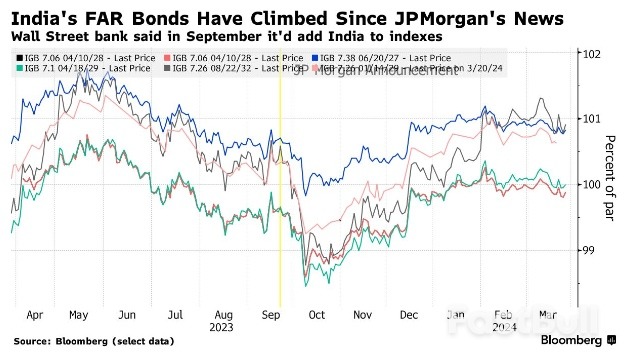
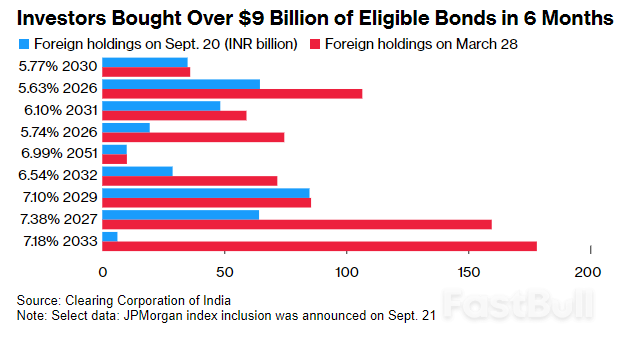
          Foreign investors have pumped roughly 780 billion rupees ($9.4 billion) into eligible sovereign bonds since JPMorgan Chase & Co.’s landmark announcement in September and are beginning to climb up the ownership list. Corporate bonds are outperforming peers, foreign exchange reserves hit a record high and the rupee has shrugged off the impact of a broad strengthening in the dollar.
          Foreigners Flocking To Indian Bonds Make A Splash Across Markets_1
          Here are some charts showing the state of play in Indian markets ahead of the key index change at the end of June.
          “This is a significant event. The long-awaited inclusion of India in the index should open the door for increased participation by foreign investors,” said Chidu Narayanan, head of the macro strategy Asia-Pacific at Wells Fargo & Co. Inflows of roughly $25 billion for Indian bonds by the middle of next year are set to support the rupee, he said.

          Big Inflows

          The flood of money has helped Indian Fully Accessible Route bonds, known as FAR for short and set to join the gauges, to return 2.76% this year in dollar terms, data compiled by Bloomberg show. They have outperformed a global index of emerging sovereign debt as well as a gauge of corporate and sovereign notes in emerging Asia.
          Foreigners Flocking To Indian Bonds Make A Splash Across Markets_2
          The inflows have helped make them one of the best performers in local currency emerging market government debt in 2024.

          Currency Effect

          “You’re seeing a bit of frontrunning,” ahead of the June deadline, said Radhika Rao, senior economist at DBS Group Holdings Ltd. “The bulk of the flows is still to come, which we think will come as the inclusion starts” and when the JPMorgan index reflects the full 10% weight for India toward the end of the year.

          India's Rupee Lost Less Than Other Asia EM CurrenciesForeigners Flocking To Indian Bonds Make A Splash Across Markets_3

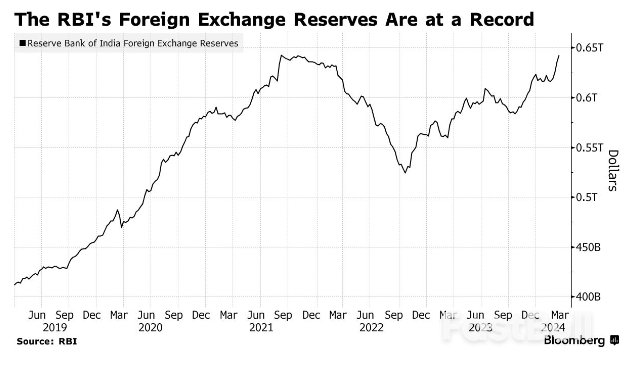
          One outcome of the big inflows has been accelerated intervention by the Reserve Bank of India, which has been buying the incoming dollar flows, resulting in its foreign reserves rising to a record $642.5 billion. The intervention is largely aimed at shielding the rupee from volatile moves.

          Record Reserves

          The Reserve Bank of India stepped up purchases in recent weeks, buying a total of $20 billion since the start of February, according to Bloomberg Economics.Foreigners Flocking To Indian Bonds Make A Splash Across Markets_4

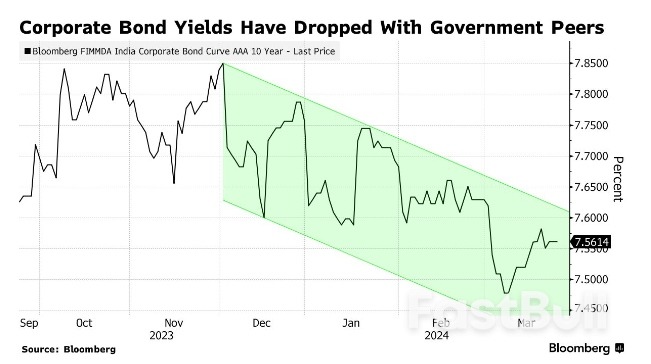
          Corporate Bonds

          Corporate bonds have also benefited from flows into government debt as the former is largely priced off sovereign notes. The yield on top-rated 10-year notes has declined about 30 basis points since the index announcement.Foreigners Flocking To Indian Bonds Make A Splash Across Markets_5
          Bloomberg Index Services Ltd. will also include some Indian bonds in its emerging market local currency index starting next year. Bloomberg LP is the parent company of Bloomberg Index Services Ltd., which administers indexes that compete with those from other service providers.

          Source:Bloomberg

          Risk Warnings and Disclaimers
          You understand and acknowledge that there is a high degree of risk involved in trading. Following any strategies or investment methods may lead to potential losses. The content on the site is provided by our contributors and analysts for information purposes only. You are solely responsible for determining whether any trading assets, securities, strategy, or any other product is suitable for investing based on your own investment objectives and financial situation.
          Add to Favorites
          Share

          Dollar Steady As Pce Data Sets up June Rate Cut Bets; Yen in Focus

          Thomas

          Economic

          Forex

          The personal consumption expenditures (PCE) price index rose 0.3% in February, the Commerce Department's Bureau of Economic Analysis said on Friday, compared with the 0.4% rise that economists polled by Reuters had forecast.
          The report also showed consumer spending rising by the most in just over a year last month, underscoring the economy's resilience. Most markets across the globe were closed on Friday.
          Federal Reserve Chair Jerome Powell on Friday said the latest U.S. inflation data was "along the lines of what we would like to see," in comments that tallied with his remarks after the Fed's policy meeting last month.
          Markets are now pricing in 68.5% chance of the Fed cutting rates in June versus 57% chance at the end of last week, the CME FedWatch tool showed. Traders are also pricing in 75 basis points of cuts this year.
          Citi strategists said the Fed remains on track to begin cutting rates in June. "If activity holds up, the Fed might deliver three rate cuts this year. But a further softening in labour markets has us expecting five rate cuts this year."
          The euro was 0.06% higher at $1.07945, hovering near its more-than-one-month low of $1.0769 touched last week. Sterling was at $1.2637, up 0.12% on the day.
          The dollar index , which measures the U.S. currency against six rivals, eased 0.038% to 104.42 but remained close to the six-week high of 104.73 it touched last week.
          The spotlight in the currency market has been on the yen as its move toward levels last seen in 1990 revives the threat of intervention by Japanese authorities.
          The yen touched a 34-year low against the dollar of 151.975 on Wednesday and was last at 151.315 per dollar, a shade stronger, on Monday.
          Japan intervened in the currency market in 2022, first in September and again in October, as the yen slid toward a 32-year low of 152 to the dollar.
          Japan's plans for the yen remain difficult to predict. Its fiscal year has ended, meaning the Bank of Japan does not need to worry about sudden yen movement impacting balance sheets.
          But news of last week's emergency meeting of the three monetary authorities - the Ministry of Finance (MOF), BOJ and Financial Services Agency - and jawboning from officials seem to have worked to bring the yen back from 34-year lows.
          Finance Minister Shunichi Suzuki said on Monday he would not rule out options against excessive currency movement and would respond appropriately, reiterating his warning on rapid yen moves.
          Citi analysts still expect the Japanese authorities to intervene somewhere in the 152–155 per dollar zone, pointing out that the yen has weakened against the Chinese yuan as well.
          "We do not expect the MOF to intervene in the CNY, but a further rise in this currency pair could be one factor that encourages FX intervention by Japan," they said in a client note on Friday.
          In other currencies, the Australian dollar rose 0.21% to $0.654, while the New Zealand dollar was 0.20% higher at $0.599.
          In cryptocurrencies, bitcoin last rose 1.83% to $70,927.00. Ether last rose 3.46% to $3,619.20.

          Source: Reuters

          To stay updated on all economic events of today, please check out our Economic calendar
          Risk Warnings and Disclaimers
          You understand and acknowledge that there is a high degree of risk involved in trading. Following any strategies or investment methods may lead to potential losses. The content on the site is provided by our contributors and analysts for information purposes only. You are solely responsible for determining whether any trading assets, securities, strategy, or any other product is suitable for investing based on your own investment objectives and financial situation.
          Add to Favorites
          Share

          USD/JPY Forecast: BoJ Chatter, US Manufacturing, and the Fed in Focus

          Samantha Luan

          Forex

          Economic

          The Japanese Manufacturing Sector in Focus
          On Monday, manufacturing sector data from Japan put the USD/JPY in focus. The Tankan Large Manufacturing Index fell from 13 to 11 in Q1. Economists forecast a decline to 10.
          However, the Jibun Bank Manufacturing PMI increased from 47.2 to 48.2 in March.
          According to the finalized survey,
          • Employment rose at the most marked pace since July 2023.
          • New orders and output declined at more modest rates.
          • Factory gate prices increased at the fastest pace in three months. However, input prices increased at the softest pace since February 2021.
          • Business sentiment remained positive, with firms hoping for a domestic and overseas demand recovery.
          The Bank of Japan is focused on the services sector and its contribution to demand-driven inflation. Nonetheless, the macroeconomic environment must be conducive to further monetary policy tightening. The manufacturing PMI data suggested demand conditions could be improving.
          With the Japanese economy in the spotlight, investors must track Bank of Japan chatter. Recent speeches have impacted buyer demand for the Yen. A change in narrative amidst ongoing intervention threats could pressure the USD/JPY pairing.

          US Manufacturing and Fed Speakers

          Later in the session, US manufacturing sector data also needs consideration. The manufacturing sector contributes less than 30% to the US economy. Nonetheless, investors will likely respond to manufacturing sector activity trends. Better-than-expected numbers could support rising expectations of the US avoiding an economic recession.
          Economists forecast the ISM Manufacturing PMI to increase from 47.8 to 48.4. Beyond the headline PMI, investors should consider the employment, new orders, and price sub-components.
          Investors must track FOMC member commentary at the start of the week. FOMC member Lisa Cook is on the calendar to speak. Reaction to the Personal Income and Outlays Report could influence investor bets on a June 2024 Fed rate cut.
          The US Core PCE Price Index increased by 2.8% year-on-year in March after rising by 2.9% in February. Personal income and spending signaled an improving backdrop that could fuel demand-driven inflation. An improving demand environment could cut bets on a June Fed rate cut.

          Short-term Forecast

          Near-term trends for the USD/JPY will hinge on services PMIs, central bank commentary, and the US Jobs Report. A pickup in US service sector activity and a better-than-expected US Jobs Report could drive buyer demand for the USD/JPY. However, intervention threats could limit the upside for the USD/JPY pairing.

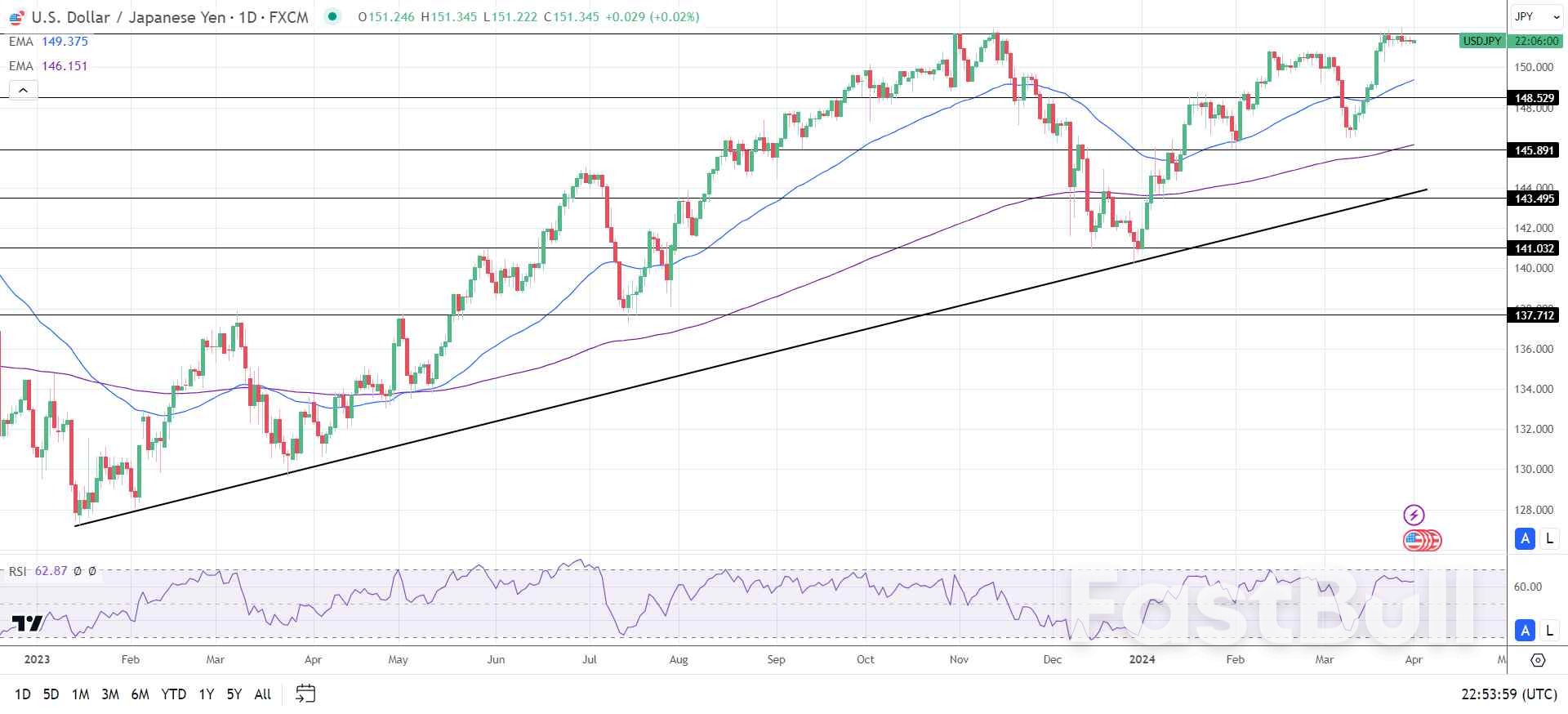
          USD/JPY Price Action

          Daily Chart

          USD/JPY Forecast: BoJ Chatter, US Manufacturing, and the Fed in Focus_1
          The USD/JPY remained well above the 50-day and 200-day EMAs, sending bullish price signals.
          A USD/JPY break above the 151.685 resistance level would give bulls a run at the 152 handle.
          Intervention chatter, the BoJ, manufacturing sector PMI numbers, and central bank commentary need consideration.
          Conversely, a USD/JPY fall through the 151 handle could bring the 50-day EMA into play. A drop below the 50-day EMA could give the bears a run at the 148.529 support level.
          The 14-day RSI at 62.87 indicates a USD/JPY move to the 152 handle before entering overbought territory.

          Source: FX Empire

          To stay updated on all economic events of today, please check out our Economic calendar
          Risk Warnings and Disclaimers
          You understand and acknowledge that there is a high degree of risk involved in trading. Following any strategies or investment methods may lead to potential losses. The content on the site is provided by our contributors and analysts for information purposes only. You are solely responsible for determining whether any trading assets, securities, strategy, or any other product is suitable for investing based on your own investment objectives and financial situation.
          Add to Favorites
          Share
          FastBull
          Copyright © 2025 FastBull Ltd

          728 RM B 7/F GEE LOK IND BLDG NO 34 HUNG TO RD KWUN TONG KLN HONG KONG

          TelegramInstagramTwitterfacebooklinkedin
          App Store Google Play Google Play
          Products
          Charts

          Chats

          Q&A with Experts
          Screeners
          Economic Calendar
          Data
          Tools
          Membership
          Features
          Function
          Markets
          Copy Trading
          Latest Signals
          Contests
          News
          Analysis
          24/7
          Columns
          Education
          Company
          Careers
          About Us
          Contact Us
          Advertising
          Help Center
          Feedback
          User Agreement
          Privacy Policy
          Business

          White Label

          Data API

          Web Plug-ins

          Poster Maker

          Affiliate Program

          Risk Disclosure

          The risk of loss in trading financial instruments such as stocks, FX, commodities, futures, bonds, ETFs and crypto can be substantial. You may sustain a total loss of the funds that you deposit with your broker. Therefore, you should carefully consider whether such trading is suitable for you in light of your circumstances and financial resources.

          No decision to invest should be made without thoroughly conducting due diligence by yourself or consulting with your financial advisors. Our web content might not suit you since we don't know your financial conditions and investment needs. Our financial information might have latency or contain inaccuracy, so you should be fully responsible for any of your trading and investment decisions. The company will not be responsible for your capital loss.

          Without getting permission from the website, you are not allowed to copy the website's graphics, texts, or trademarks. Intellectual property rights in the content or data incorporated into this website belong to its providers and exchange merchants.

          Not Logged In

          Log in to access more features

          FastBull Membership

          Not yet

          Purchase

          Become a signal provider
          Help Center
          Customer Service
          Dark Mode
          Price Up/Down Colors

          Log In

          Sign Up

          Position
          Layout
          Fullscreen
          Default to Chart
          The chart page opens by default when you visit fastbull.com