Markets
News
Analysis
User
24/7
Economic Calendar
Education
Data
- Names
- Latest
- Prev


Signal Accounts for Members
All Signal Accounts
All Contests


France Industrial Output MoM (SA) (Oct)A:--
F: --
France Trade Balance (SA) (Oct)A:--
F: --
Euro Zone Employment YoY (SA) (Q3)A:--
F: --
Canada Part-Time Employment (SA) (Nov)A:--
F: --
P: --
Canada Unemployment Rate (SA) (Nov)A:--
F: --
P: --
Canada Full-time Employment (SA) (Nov)A:--
F: --
P: --
Canada Labor Force Participation Rate (SA) (Nov)A:--
F: --
P: --
Canada Employment (SA) (Nov)A:--
F: --
P: --
U.S. PCE Price Index MoM (Sept)A:--
F: --
P: --
U.S. Personal Income MoM (Sept)A:--
F: --
P: --
U.S. Core PCE Price Index MoM (Sept)A:--
F: --
P: --
U.S. PCE Price Index YoY (SA) (Sept)A:--
F: --
P: --
U.S. Core PCE Price Index YoY (Sept)A:--
F: --
P: --
U.S. Personal Outlays MoM (SA) (Sept)A:--
F: --
U.S. 5-10 Year-Ahead Inflation Expectations (Dec)A:--
F: --
P: --
U.S. Real Personal Consumption Expenditures MoM (Sept)A:--
F: --
U.S. Weekly Total Rig CountA:--
F: --
P: --
U.S. Weekly Total Oil Rig CountA:--
F: --
P: --
U.S. Consumer Credit (SA) (Oct)A:--
F: --
China, Mainland Foreign Exchange Reserves (Nov)A:--
F: --
P: --
Japan Trade Balance (Oct)A:--
F: --
P: --
Japan Nominal GDP Revised QoQ (Q3)A:--
F: --
P: --
China, Mainland Imports YoY (CNH) (Nov)A:--
F: --
P: --
China, Mainland Exports (Nov)A:--
F: --
P: --
China, Mainland Imports (CNH) (Nov)A:--
F: --
P: --
China, Mainland Trade Balance (CNH) (Nov)A:--
F: --
P: --
China, Mainland Exports YoY (USD) (Nov)A:--
F: --
P: --
China, Mainland Imports YoY (USD) (Nov)A:--
F: --
P: --
Germany Industrial Output MoM (SA) (Oct)A:--
F: --
Euro Zone Sentix Investor Confidence Index (Dec)A:--
F: --
P: --
Canada National Economic Confidence Index--
F: --
P: --
U.K. BRC Like-For-Like Retail Sales YoY (Nov)--
F: --
P: --
U.K. BRC Overall Retail Sales YoY (Nov)--
F: --
P: --
Australia Overnight (Borrowing) Key Rate--
F: --
P: --
RBA Rate Statement
RBA Press Conference
Germany Exports MoM (SA) (Oct)--
F: --
P: --
U.S. NFIB Small Business Optimism Index (SA) (Nov)--
F: --
P: --
Mexico 12-Month Inflation (CPI) (Nov)--
F: --
P: --
Mexico Core CPI YoY (Nov)--
F: --
P: --
Mexico PPI YoY (Nov)--
F: --
P: --
U.S. Weekly Redbook Index YoY--
F: --
P: --
U.S. JOLTS Job Openings (SA) (Oct)--
F: --
P: --
China, Mainland M1 Money Supply YoY (Nov)--
F: --
P: --
China, Mainland M0 Money Supply YoY (Nov)--
F: --
P: --
China, Mainland M2 Money Supply YoY (Nov)--
F: --
P: --
U.S. EIA Short-Term Crude Production Forecast For The Year (Dec)--
F: --
P: --
U.S. EIA Natural Gas Production Forecast For The Next Year (Dec)--
F: --
P: --
U.S. EIA Short-Term Crude Production Forecast For The Next Year (Dec)--
F: --
P: --
EIA Monthly Short-Term Energy Outlook
U.S. API Weekly Gasoline Stocks--
F: --
P: --
U.S. API Weekly Cushing Crude Oil Stocks--
F: --
P: --
U.S. API Weekly Crude Oil Stocks--
F: --
P: --
U.S. API Weekly Refined Oil Stocks--
F: --
P: --
South Korea Unemployment Rate (SA) (Nov)--
F: --
P: --
Japan Reuters Tankan Non-Manufacturers Index (Dec)--
F: --
P: --
Japan Reuters Tankan Manufacturers Index (Dec)--
F: --
P: --
Japan Domestic Enterprise Commodity Price Index MoM (Nov)--
F: --
P: --
Japan Domestic Enterprise Commodity Price Index YoY (Nov)--
F: --
P: --
China, Mainland PPI YoY (Nov)--
F: --
P: --
China, Mainland CPI MoM (Nov)--
F: --
P: --


No matching data
Latest Views
Latest Views
Trending Topics
Top Columnists
Latest Update
White Label
Data API
Web Plug-ins
Affiliate Program
View All

No data
Chinese companies appear eager to embrace humanoid robots even as today's machines remain far from commercially ready, according to a new Morgan Stanley AlphaWise survey.
It was the bank's first AlphaWise survey with C-suites across various industries in China.
Analyst Sheng Zhong told investors in a note that the firm found that "62% of respondents are likely to adopt in the next 3 years," a result it says is both strong and, in some cases, surprising.
However, the technology has a long way to go. Morgan Stanley reports that "products are not ready," with only 23% of respondents "satisfied with current products."
Executives are said to have cited shortcomings in dexterity, functionality, and pricing. Cost is also a major barrier, as "92% of respondents" said robots must fall "sub-RMB200K" (about US$28,000) for mass adoption to become viable.
According to the survey, "Unitree is the most engaged brand, followed by DeepRobotics, UBTECH, and Midea."
Still, most companies remain in a holding pattern, with the report noting that "only ~10% of respondents are currently evaluating or launching pilot projects."
Even so, expectations for long-term labor substitution are substantial. Respondents believe "11% and 28% of jobs [could be] replaced by robots in the next 5 and 10 years, respectively."
Morgan Stanley says the 62% adoption likelihood "may be optimistic," given that the sample consists of large enterprises that already use robotics.
Yet the findings reinforce its constructive view of the sector. The firm writes that the survey "strengthens our positive long-term view on humanoid robots," while cautioning that volume ramp-up will take time.
New models, government subsidies and potential IPOs could keep the theme prominent in 2026. Morgan Stanley highlights components as the earliest beneficiaries, naming Inovance, Leaderdrive, Hesai and Hengli Hydraulic.
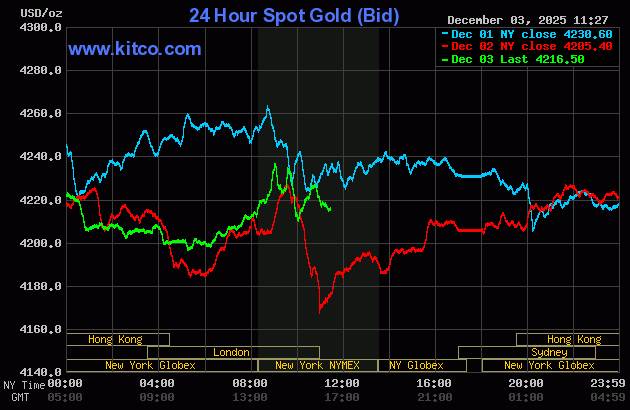
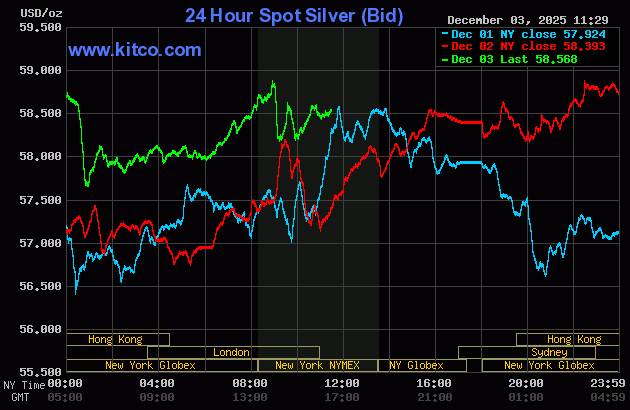
Gold and silver prices are higher in midday U.S. trading Wednesday, with silver hitting another record high and closing in on $60.00 an ounce. Silver held its overnight gains and gold added to its modest overnight gains following a U.S. economic report that was weaker than market expectations. Technical buying from the speculators is also featured at mid-week, as the near-term chart postures for both markets are firmly bullish. February gold was last up $30.00 at $4,250.80. March silver prices were up $0.347 at $59.06.
The monthly ADP jobs report for November showed a 32,000 decline in jobs, versus expectations for a rise of 40,000. The data has taken on added importance with official government releases still delayed. Today's ADP report falls into the camp of the U.S. monetary policy doves, who want to see lower U.S. interest rates sooner.
The yield on the benchmark 10-year U.S. Treasury note held around 4.08%, pausing a recent rise as investors weigh the outlook for Federal Reserve policy. Markets are currently pricing in an 89% chance of a 0.25% rate cut next week at the Fed's FOMC meeting, with about 0.9% of total Fed easing priced in for 2026. Expectations that White House economic adviser Kevin Hassett will likely be nominated as the next Fed chair have added to the dovish marketplace sentiment. Hassett is known for supporting faster rate reductions in line with President Trump's stance.
The key outside markets today see the U.S. dollar index lower and at a three-week low. Crude oil prices are higher and trading around $59.50 a barrel.
The gold market operates through two primary pricing mechanisms. The first is the spot market, which quotes prices for on-the-spot purchase and immediate delivery. The second is the futures market, which sets prices for delivery at a future date. Due to year-end positioning market liquidity, the December gold futures contract is currently the most actively traded on the CME.

Technically, February gold futures bulls' next upside price objective is to produce a close above solid resistance at the contract/record high of $4,433.00. Bears' next near-term downside price objective is pushing futures prices below solid technical support at $4,100.00. First resistance is seen at $4,300.00 and then at $4,350.00. First support is seen at $4,200.00 and then at Tuesday's low of $4,194.00. Wyckoff's Market Rating: 7.5.

March silver futures bulls have the strong overall near-term technical advantage. Their next upside price objective is closing prices above solid technical resistance at $60.00. The next downside price objective for the bears is closing prices below solid support at $55.00. First resistance is seen at today's contract high of $59.655 and then at $60.00. Next support is seen at $58.00 and then at this week's low of $56.85. Wyckoff's Market Rating: 9.0.
U.S. Treasury yields fell on Wednesday after data showed a surprise decrease in private-sector payrolls in November, adding to worries about labor market weakness and cementing expectations of a rate cut by the Federal Reserve next week.
In late morning trading, the benchmark 10-year yield dipped 1.3 basis points (bps) to 4.075%, while the 30-year yield was flat at 4.744% (US30YT=RR).
On the front end of the curve, the two-year yield, which reflects interest rate moves by the Fed, was down 1.6 bps at 3.499% (US2YT=RR).
Data showed that U.S. private employment decreased by 32,000 jobs last month after an upwardly revised 47,000 increase in October. Economists polled by Reuters had forecast private employment rising by 10,000 jobs after a previously reported 42,000 rebound in October.
Following the data, U.S. rate futures have priced in an 89% chance of a 25-bp cut next week, up from 83.4% a week ago, CME FedWatch showed.
"The labor market is going to be the driver of Fed policy right now because if we're looking at what the risks are, the risk of inflation accelerating from here seems pretty low to us and most economists, and for the Fed, the risk of the labor market deteriorating more than expected is going to be the focus," said Collin Martin, head of fixed income research and strategy at the Schwab Center for Financial Research in New York.
"So when we get any sort of negative reading on the labor market, like we got...with the ADP report, expectations about the path of Fed policy are going to shift. If it seems like the labor market is going to pivot from just gradually cooling to actually deteriorating sharply, that would imply a greater number of cuts over the next 12 months or so."
Separately, the U.S. services sector activity held steady in November, with employment still subdued and prices for inputs elevated, a survey showed on Wednesday. The report added to expectations of Fed easing next week.
The Institute for Supply Management said its nonmanufacturing purchasing managers index was little changed at 52.6 last month from 52.4 in October. Economists polled by Reuters had forecast the services PMI slipping to 52.1.
In other parts of the bond market, the yield curve, which reflects monetary policy expectations, was last little changed, with the spread between U.S. two-year and 10-year yields at 57.5 bps (US2US10=TWEB), from 57.4 bps on Tuesday. The curve steepened to as high 58.3 bps earlier in the session, and hit 59 bps on Tuesday, the widest spread since September.
The curve exhibited a moderate bull-steepening pattern, a scenario in which shorter-dated yields are falling faster than those on long maturities. It's mostly a reflection of market expectations that the Fed will cut interest rates imminently.
Bitcoin experienced a dramatic turnaround after plummeting to $84,000 recently, rapidly rebounding to approximately $93,000. This sudden surge signifies not only a significant price movement but also marks a historic moment with the return of institutional investors to the market. Analyses reveal that the strongest buying trend in three years has been observed in the perpetual contracts market.
According to data shared by crypto analyst CoinCare, on December 2, the buy-sell ratio on perpetual futures exchanges rose to 1.17, hitting its highest value since January 2023. This ratio indicates that aggressive buying volumes have surpassed selling volumes, confirming that buyers are taking the lead in the current bullish cycle. CoinCare regards this as a significant sign that the markets are entering an expansion phase, emphasizing that structural capital flows have started to increase.
A major catalyst for this rise was investment giant Vanguard offering its over 50 million brokerage clients the opportunity to trade spot in Bitcoin, Ethereum , XRP, and Solana ETFs. This move, led by former BlackRock executive and new CEO Salim Ramji, considerably widened the potential capital pool. Bloomberg analyst Eric Balchunas pointed out that Vanguard clients have "immediately and collectively" moved to buy. Additionally, improved macro liquidity conditions are creating a more favorable environment for risky assets like Bitcoin.
Bitcoin's swift recovery not only influenced BTC's price but also pushed Ethereum's price above $3,000 and generated double-digit gains for major altcoins like Solana and Cardano . XWIN Research Japan analysts suggest that even a small portion of Vanguard's $11 trillion assets under management flowing into crypto ETFs could inject tens of billions of dollars of liquidity into the sector. This amount could surpass the total inflows of US spot ETFs in their first year and symbolize the transition of crypto from a niche investment area to an institutionally recognized market.
Nevertheless, analysts emphasize that systemic risks in the market are still being monitored despite the uptrend, as evidenced by the recent slight pullback. Particularly, financial stress in Japan emerges as a risk element that needs careful attention. All these indicators combined suggest that the current bullish cycle is far from over, with institutional ETFs, increased participation, and improving liquidity conditions supporting the expansion process.
In summary, Bitcoin and the crypto market are currently at a crucial turning point. The growing interest of institutional investors and new ETF implementations indicate that the market has potential for further growth in the coming months. For investors, this process presents an opportunity that necessitates a careful balance of risk and observation.
U.S. Treasury Secretary Janet Yellen, highlighting economic frailties, suggests a rate cut might be necessary, Jinshi reports indicate.
This stance could influence crypto markets, potentially boosting BTC and ETH as investors seek higher-risk assets amid expected monetary easing.
Yellen identified weaknesses in certain economic sectors, suggesting rate reductions to boost growth. With her experience as a former Federal Reserve Chair, she highlighted similar strategies used in past economic downturns. This proposal aims to stimulate economic activity, supporting sectors experiencing slack. Transitioning to a looser monetary policy could invigorate segments reliant on low-interest environments, impacting liquidity. Market observers anticipate reactions from investors, possibly increasing demand for cryptocurrencies like Ethereum and Bitcoin. However, no official comments have been made by influential figures from the crypto community regarding her recent remarks. Financial markets are expected to adjust as analysts weigh potential outcomes of this policy adjustment.
Ethereum (ETH), according to CoinMarketCap, trades at $3,088.63, reflecting a 6.69% increase over 24 hours. Its 90-day trend shows a 28.88% decrease, highlighting recent volatility. Market cap stands at formatNumber(372783776803, 2), and its 24-hour trading volume is formatNumber(30707241570, 2). These fluctuations align with typical responses to macroeconomic signals.
"Janet Yellen, U.S. Treasury Secretary, recognizes signs of economic weakness in parts of the economy, emphasizing the potential need for a rate cut."
President Vladimir Putin is set to visit India this week for the first time since Russia's invasion of Ukraine, a rare trip that underscores the countries' defense and energy ties as New Delhi seeks to finalize a trade deal with Washington.
The Russian leader is eager to show that Moscow still has strong relationships that matter beyond the West – and large markets it can trade with. For India, whose close economic and political ties with Russia date back to the Soviet period, the visit comes as sanctions and US pressure curb an energy trade that has been expedient for its economy and vital for Russia. It is also an opportunity to demonstrate Prime Minister Narendra Modi's continued ability to chart out an independent geopolitical path.
"As the US under Trump has become more isolationist and transactional, and relations with China remain poor, India is ensuring that its ties with middle powers like Russia — or Japan, UAE and the EU — are deepened," said Pramit Pal Chaudhuri, head of Eurasia Group's South Asia practice. "It helps India that President Trump has already ended Putin's pariah status by holding his Alaska Summit."
Both sides have formally framed the visit around trade, though deeper questions remain over energy and defense — two areas that have put India in the crosshairs of Trump. The US leader has doubled India's tariffs to 50% to punish the country for buying oil from Russia, and has pressured New Delhi to buy more American arms. Modi's government is in talks with the Trump administration over trade and close to a deal — a goal that could prove more distant after a show of closer India-Russia ties.
Putin's visit comes against the backdrop of his talks on Tuesday with US envoy Steve Witkoff and Jared Kushner, Trump's son-in-law, on a new peace plan that Washington is pushing hard for Russia and Ukraine to accept. India has maintained a cautious position in relation to the war in Ukraine, calling for a halt to fighting, while also refusing to damage its relationship with Moscow. Modi hugged Putin and called him "my friend" in his first visit to Moscow in five years in 2024, just a day after a deadly Russian missile strike on the main children's hospital in Kyiv provoked international outrage.
The European ambassadors of Germany, France and Britain in New Delhi wrote a joint op-ed in the Times of India on Monday, criticizing Russia's war against Ukraine, and signaling — albeit indirectly — India's long-held view that the conflict should be resolved through negotiations.
On the eve of his visit, Putin hailed his country's ties with India and China, and pledged to boost relations to a "qualitatively new level." He told a business forum in Moscow on Tuesday he'll discuss trade with Modi, including "increasing the import of Indian goods into our market."
India is keen to discuss with Russia the purchase of Su-57 fighter jets and the advanced missile defense shield S-500. Russia remains its largest supplier of military hardware, even after a significant drop in purchases in the recent years, as New Delhi turns more frequently to the US and European countries. The Modi government has indicated it will continue to take both US and Russian equipment.
India already has over 200 Russian fighter jets and several batteries of the earlier generation of air-defense systems, used during a four-day clash with Pakistan in May — a flare-up that has only added to New Delhi's urgency. India's military is also short on advanced aircraft.
Any sale would have to overcome complications thrown up by sanctions and Russia's own wartime demand.
Another major concern for the two leaders will be the oil trade, a key source of revenue for the Kremlin. India will seek to balance its need for inexpensive crude, given the weight of its import bill, with a desire to avoid punitive US tariffs and sanctions.
Historically, it has not been a significant importer of Russian oil, depending more heavily on the Middle East. That changed in 2022, after the invasion of Ukraine and a price cap imposed by the Group of Seven nations that aimed to limit the Kremlin's oil revenues. The surge in purchases — to the point where India became the largest buyer of seaborne Russian crude — was tacitly supported by a Biden administration eager to keep oil flowing, and prices down.
Trump turned that into a pressure campaign this year, berating India and its refiners and eventually sanctioning Russia's two largest oil producers, Rosneft PJSC and Lukoil PJSC, in an effort to push Putin to the negotiating table. That has dramatically reduced Russian shipments, even in the face of steep discounts – exporters are already offering the nation's flagship Urals crude to India with a discount of as much as $7 a barrel to Brent benchmark on a delivered basis, for cargoes loading in December and arriving in January. That brings the price for India to the lowest in at least two years.
That's a loss Putin will almost certainly seek to reverse. The delegation arriving on Thursday is expected to include senior oil industry executives, along with defense and other officials.
Both leaders will also use the visit to attempt to expand their trade beyond Russian oil and weapons, addressing a business forum on Friday to woo private companies.
India is seeking to gain more access to the Russian market for its exporters hit by US tariffs, with a likely agreement announced on the shipment of marine products and agricultural goods, an official from India's Ministry of External Affairs told reporters in a background briefing on Tuesday. The two sides are also expected to agree on a pact to facilitate Indian workers traveling to Russia for jobs, the official said.
Russia, meanwhile, locked out from markets like Europe, is also on the lookout for alternatives.
"The idea is simple — to get more goods from India and pay for them with the rupees that Russia earns by selling India its oil," said Tatiana Shaumyan, the head of the Center for Indian Studies at the Institute of Oriental Studies in Moscow.
Putin and Modi are expected to discuss raising bilateral trade from the current $68 billion to $100 billion by 2030, and also improve systems to settle transactions in their own currencies, Kremlin spokesman Dmitry Peskov told local media Tuesday.
For India, breaking into the Russian market won't be easy, though. Local and Chinese goods are widely available and competitively priced, leaving Indian exporters with a "quite small" list of viable products, said Alexey Kupriyanov, head of the Center of the Indo-Pacific Region at the state-run IMEMO institute in Moscow.
The U.S. services sector activity held steady in November, with employment still subdued and prices for inputs elevated, a survey showed on Wednesday.
The Institute for Supply Management said its nonmanufacturing purchasing managers index was little changed at 52.6 last month from 52.4 in October. Economists polled by Reuters had forecast the services PMI slipping to 52.1.
The services sector accounts for more than two-thirds of U.S. economic activity. The PMI suggested economic activity was on a firmer footing halfway through the fourth quarter.
Economists say activity is being driven by higher-income households, though recent stock market volatility could curtail their spending.
Lower-income households have been disproportionately impacted by higher prices, mostly from import tariffs, creating what economists have called a K-shaped economy. This phenomenon has been evident in consumer sentiment surveys.
The government will publish its delayed initial estimate of gross domestic product for the third quarter later this month. The Atlanta Federal Reserve estimates GDP increased at a 3.9% annualized rate in the third quarter. The economy grew at a 3.8% pace in the April-June quarter.
BACKLOG ORDERS EYE RECOVERY
The ISM survey's measure of new orders received by services businesses dropped to 52.9 in November from 56.2 in the prior month. Backlog orders remained weak, though the pace of decline slowed considerably. Prices paid by services businesses for inputs cooled to still-high levels, indicating inflation could remain above the Federal Reserve's 2% target for some time.
U.S. central bank officials will meet next week to decide on interest rates. As many as five of the 12 voting policymakers on the central bank's rate-setting Federal Open Market Committee have voiced opposition to or skepticism about cutting rates further, while a core of three members of the Washington-based Board of Governors wants rates to fall.
The ISM's measure of prices paid by businesses fell to a still-elevated 65.4 from 70.0 in October. Services employment improved, likely reflecting holiday hiring.
Overall, employers remain hesitant to boost hiring amid lingering uncertainty stemming from tariffs and the integration of artificial intelligence for some job roles, economists say. The ISM previously noted that some businesses had reported they "have not replaced employees who have left through attrition."
The survey's gauge of services sector employment rose to 48.9 from 48.2 in October. It has now contracted for six consecutive months. A reduction in supply because of raids on undocumented immigrants is also restraining the labor market.
A survey from the Conference Board last month showed consumers' perceptions of the labor market worsened in November.
White Label
Data API
Web Plug-ins
Poster Maker
Affiliate Program
The risk of loss in trading financial instruments such as stocks, FX, commodities, futures, bonds, ETFs and crypto can be substantial. You may sustain a total loss of the funds that you deposit with your broker. Therefore, you should carefully consider whether such trading is suitable for you in light of your circumstances and financial resources.
No decision to invest should be made without thoroughly conducting due diligence by yourself or consulting with your financial advisors. Our web content might not suit you since we don't know your financial conditions and investment needs. Our financial information might have latency or contain inaccuracy, so you should be fully responsible for any of your trading and investment decisions. The company will not be responsible for your capital loss.
Without getting permission from the website, you are not allowed to copy the website's graphics, texts, or trademarks. Intellectual property rights in the content or data incorporated into this website belong to its providers and exchange merchants.
Not Logged In
Log in to access more features

FastBull Membership
Not yet
Purchase
Log In
Sign Up