• Trade
  • Markets
  • Copy
  • Contests
  • News
  • 24/7
  • Calendar
  • Q&A
  • Chats
Trending
Screeners
SYMBOL
LAST
BID
ASK
HIGH
LOW
NET CHG.
%CHG.
SPREAD
SPX
S&P 500 Index
6846.50
6846.50
6846.50
6878.28
6827.18
-23.90
-0.35%
--
DJI
Dow Jones Industrial Average
47739.31
47739.31
47739.31
47971.51
47611.93
-215.67
-0.45%
--
IXIC
NASDAQ Composite Index
23545.89
23545.89
23545.89
23698.93
23455.05
-32.22
-0.14%
--
USDX
US Dollar Index
99.000
99.080
99.000
99.000
99.000
+0.050
+ 0.05%
--
EURUSD
Euro / US Dollar
1.16388
1.16396
1.16388
1.16389
1.16322
+0.00024
+ 0.02%
--
GBPUSD
Pound Sterling / US Dollar
1.33237
1.33245
1.33237
1.33237
1.33140
+0.00032
+ 0.02%
--
XAUUSD
Gold / US Dollar
4193.24
4193.68
4193.24
4193.80
4189.64
+3.54
+ 0.08%
--
WTI
Light Sweet Crude Oil
58.651
58.693
58.651
58.676
58.543
+0.096
+ 0.16%
--

Community Accounts

Signal Accounts
--
Profit Accounts
--
Loss Accounts
--
View More

Become a signal provider

Sell trading signals to earn additional income

View More

Guide to Copy Trading

Get started with ease and confidence

View More

Signal Accounts for Members

All Signal Accounts

Best Return
  • Best Return
  • Best P/L
  • Best MDD
Past 1W
  • Past 1W
  • Past 1M
  • Past 1Y

All Contests

  • All
  • Trump Updates
  • Recommend
  • Stocks
  • Cryptocurrencies
  • Central Banks
  • Featured News
Top News Only
Share

KCNA: North Korea's Supreme Leader Kim Jong UN Sends Condolences To Russian Embassy For Ambassador's Death

Share

Japan Prime Minister Takaichi: 30 Injuries Reported So Far From Monday Earthquake

Share

USA Senate Committee Votes To Advance Nomination Of Jared Isaacman To Head Nasa

Share

Singapore Post - New Rate For Standard Regular Mail & Standard Large Mail Will Be S$0.62 And S$0.90 Respectively

Share

Australia's S&P/ASX 200 Index Down 0.27% At 8601.10 Points In Early Trade

Share

Trump: The USA Needs Mexico To Release 200000 Acre-Feet Of Water Before December 31St, And The Rest Must Come Soon After

Share

Trump: I Have Authorized Documentation To Impose A 5% Tariff On Mexico If This Water Isn't Released

Share

Brazil's Sao Paulo State Governor Tarcisio De Freitas Says Flavio Bolsonaro Will Have His Support - Cnn Brasil

Share

Ukraine's Security Must Be Guaranteed, In The Long Term, As A First Line Of Defence For Our Union, Says European Commission President

Share

Ukraine's Sovereignty Must Be Respected, Says European Commission President

Share

The Goal Is A Strong Ukraine, On The Battlefield And At The Negotiating Table, Says European Commission President

Share

As Peace Talks Are Ongoing, The EU Remains Ironclad In Its Support For Ukraine, Says European Commission President

Share

Pepsico: Asking USA-Based Pepna Employees As Well As Pbus Division Offices And Pfus Region Offices To Work Remotely This Week

Share

A U.S. Judge Ruled That President Trump’s Ban On Several Wind Power Projects Was Illegal

Share

Senior USA Administration Official: We Continue To Monitor Drc-Rwanda Situation Closely, Continue To Work With All Sides To Ensure Commitments Are Honored

Share

Israeli Military Says It Has Struck Infrastructure Belonging To Hezbollah In Several Areas In Southern Lebanon

Share

SPDR Gold Holdings Down 0.11%, Or 1.14 Tonnes

Share

On Monday (December 8), In Late New York Trading, S&P 500 Futures Fell 0.21%, Dow Jones Futures Fell 0.43%, NASDAQ 100 Futures Fell 0.08%, And Russell 2000 Futures Fell 0.04%

Share

Morgan Stanley: Data Center ABS Spreads Are Expected To Widen In 2026

Share

(US Stocks) The Philadelphia Gold And Silver Index Closed Down 2.34% At 311.01 Points. (Global Session) The NYSE Arca Gold Miners Index Closed Down 2.17%, Hitting A Daily Low Of 2235.45 Points; US Stocks Remained Slightly Down Before The Opening Bell—holding Steady Around 2280 Points—before Briefly Rising Slightly

TIME
ACT
FCST
PREV
France Trade Balance (SA) (Oct)

A:--

F: --

P: --
Euro Zone Employment YoY (SA) (Q3)

A:--

F: --

P: --
Canada Part-Time Employment (SA) (Nov)

A:--

F: --

P: --

Canada Unemployment Rate (SA) (Nov)

A:--

F: --

P: --

Canada Full-time Employment (SA) (Nov)

A:--

F: --

P: --

Canada Labor Force Participation Rate (SA) (Nov)

A:--

F: --

P: --

Canada Employment (SA) (Nov)

A:--

F: --

P: --

U.S. PCE Price Index MoM (Sept)

A:--

F: --

P: --

U.S. Personal Income MoM (Sept)

A:--

F: --

P: --

U.S. Core PCE Price Index MoM (Sept)

A:--

F: --

P: --

U.S. PCE Price Index YoY (SA) (Sept)

A:--

F: --

P: --

U.S. Core PCE Price Index YoY (Sept)

A:--

F: --

P: --

U.S. Personal Outlays MoM (SA) (Sept)

A:--

F: --

P: --
U.S. 5-10 Year-Ahead Inflation Expectations (Dec)

A:--

F: --

P: --

U.S. Real Personal Consumption Expenditures MoM (Sept)

A:--

F: --

P: --
U.S. Weekly Total Rig Count

A:--

F: --

P: --

U.S. Weekly Total Oil Rig Count

A:--

F: --

P: --

U.S. Consumer Credit (SA) (Oct)

A:--

F: --

P: --
China, Mainland Foreign Exchange Reserves (Nov)

A:--

F: --

P: --

Japan Trade Balance (Oct)

A:--

F: --

P: --

Japan Nominal GDP Revised QoQ (Q3)

A:--

F: --

P: --

China, Mainland Imports YoY (CNH) (Nov)

A:--

F: --

P: --

China, Mainland Exports (Nov)

A:--

F: --

P: --

China, Mainland Imports (CNH) (Nov)

A:--

F: --

P: --

China, Mainland Trade Balance (CNH) (Nov)

A:--

F: --

P: --

China, Mainland Exports YoY (USD) (Nov)

A:--

F: --

P: --

China, Mainland Imports YoY (USD) (Nov)

A:--

F: --

P: --

Germany Industrial Output MoM (SA) (Oct)

A:--

F: --

P: --
Euro Zone Sentix Investor Confidence Index (Dec)

A:--

F: --

P: --

Canada National Economic Confidence Index

A:--

F: --

P: --

U.K. BRC Like-For-Like Retail Sales YoY (Nov)

--

F: --

P: --

U.K. BRC Overall Retail Sales YoY (Nov)

--

F: --

P: --

Australia Overnight (Borrowing) Key Rate

--

F: --

P: --

RBA Rate Statement
RBA Press Conference
Germany Exports MoM (SA) (Oct)

--

F: --

P: --

U.S. NFIB Small Business Optimism Index (SA) (Nov)

--

F: --

P: --

Mexico 12-Month Inflation (CPI) (Nov)

--

F: --

P: --

Mexico Core CPI YoY (Nov)

--

F: --

P: --

Mexico PPI YoY (Nov)

--

F: --

P: --

U.S. Weekly Redbook Index YoY

--

F: --

P: --

U.S. JOLTS Job Openings (SA) (Oct)

--

F: --

P: --

China, Mainland M1 Money Supply YoY (Nov)

--

F: --

P: --

China, Mainland M0 Money Supply YoY (Nov)

--

F: --

P: --

China, Mainland M2 Money Supply YoY (Nov)

--

F: --

P: --

U.S. EIA Short-Term Crude Production Forecast For The Year (Dec)

--

F: --

P: --

U.S. EIA Natural Gas Production Forecast For The Next Year (Dec)

--

F: --

P: --

U.S. EIA Short-Term Crude Production Forecast For The Next Year (Dec)

--

F: --

P: --

EIA Monthly Short-Term Energy Outlook
U.S. API Weekly Gasoline Stocks

--

F: --

P: --

U.S. API Weekly Cushing Crude Oil Stocks

--

F: --

P: --

U.S. API Weekly Crude Oil Stocks

--

F: --

P: --

U.S. API Weekly Refined Oil Stocks

--

F: --

P: --

South Korea Unemployment Rate (SA) (Nov)

--

F: --

P: --

Japan Reuters Tankan Non-Manufacturers Index (Dec)

--

F: --

P: --

Japan Reuters Tankan Manufacturers Index (Dec)

--

F: --

P: --

Japan Domestic Enterprise Commodity Price Index MoM (Nov)

--

F: --

P: --

Japan Domestic Enterprise Commodity Price Index YoY (Nov)

--

F: --

P: --

China, Mainland PPI YoY (Nov)

--

F: --

P: --

China, Mainland CPI MoM (Nov)

--

F: --

P: --

Italy Industrial Output YoY (SA) (Oct)

--

F: --

P: --

Q&A with Experts
    • All
    • Chatrooms
    • Groups
    • Friends
    Connecting
    .
    .
    .
    Type here...
    Add Symbol or Code

      No matching data

      All
      Trump Updates
      Recommend
      Stocks
      Cryptocurrencies
      Central Banks
      Featured News
      • All
      • Russia-Ukraine Conflict
      • Middle East Flashpoint
      • All
      • Russia-Ukraine Conflict
      • Middle East Flashpoint
      Search
      Products

      Charts Free Forever

      Chats Q&A with Experts
      Screeners Economic Calendar Data Tools
      Membership Features
      Data Warehouse Market Trends Institutional Data Policy Rates Macro

      Market Trends

      Market Sentiment Order Book Forex Correlations

      Top Indicators

      Charts Free Forever
      Markets

      News

      News Analysis 24/7 Columns Education
      From Institutions From Analysts
      Topics Columnists

      Latest Views

      Latest Views

      Trending Topics

      Top Columnists

      Latest Update

      Signals

      Copy Rankings Latest Signals Become a signal provider AI Rating
      Contests
      Brokers

      Overview Brokers Assessment Rankings Regulators News Claims
      Broker listing Forex Brokers Comparison Tool Live Spread Comparison Scam
      Q&A Complaint Scam Alert Videos Tips to Detect Scam
      More

      Business
      Events
      Careers About Us Advertising Help Center

      White Label

      Data API

      Web Plug-ins

      Affiliate Program

      Awards Institution Evaluation IB Seminar Salon Event Exhibition
      Vietnam Thailand Singapore Dubai
      Fans Party Investment Sharing Session
      FastBull Summit BrokersView Expo
      Recent Searches
        Top Searches
          Markets
          News
          Analysis
          User
          24/7
          Economic Calendar
          Education
          Data
          • Names
          • Latest
          • Prev

          View All

          No data

          Scan to Download

          Faster Charts, Chat Faster!

          Download App
          English
          • English
          • Español
          • العربية
          • Bahasa Indonesia
          • Bahasa Melayu
          • Tiếng Việt
          • ภาษาไทย
          • Français
          • Italiano
          • Türkçe
          • Русский язык
          • 简中
          • 繁中
          Open Account
          Search
          Products
          Charts Free Forever
          Markets
          News
          Signals

          Copy Rankings Latest Signals Become a signal provider AI Rating
          Contests
          Brokers

          Overview Brokers Assessment Rankings Regulators News Claims
          Broker listing Forex Brokers Comparison Tool Live Spread Comparison Scam
          Q&A Complaint Scam Alert Videos Tips to Detect Scam
          More

          Business
          Events
          Careers About Us Advertising Help Center

          White Label

          Data API

          Web Plug-ins

          Affiliate Program

          Awards Institution Evaluation IB Seminar Salon Event Exhibition
          Vietnam Thailand Singapore Dubai
          Fans Party Investment Sharing Session
          FastBull Summit BrokersView Expo

          Morgan Stanley Warns US Stocks at Risk in ‘Dollar Regime Shift’

          Thomas

          Economic

          Forex

          Stocks

          Summary:

          The chief investment officer of Morgan Stanley Wealth Management has a warning for stock bulls: the structural forces weighing on the dollar are threatening to spread to US equities in turn.
          Morgan Stanley Warns US Stocks at Risk in ‘Dollar Regime Shift’_1
          The chief investment officer of Morgan Stanley Wealth Management has a warning for stock bulls: the structural forces weighing on the dollar are threatening to spread to US equities in turn.
          “Consider preparing for a US dollar regime shift,” cautioned Lisa Shalett. Deteriorating relations with China, the end of yield curve management in Japan and rising Bitcoin and commodity prices suggest the currency’s run “might be hitting its limit.”
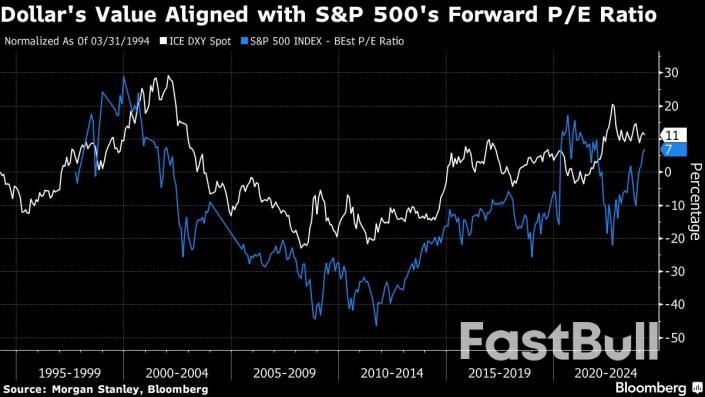
          “While correlation is not causation, the correlation of US dollar strength to P/E ratios is worth monitoring now that the greenback’s bull market cycle may be maturing,” she wrote in a note Monday.
          According to Shalett, that dollar strength has been at the “heart of an easy money regime” in the US — by pushing down import-related inflation and pressuring energy prices lower — that has boosted the performance of the equity market of late.
          Shalett recently encouraged investors to look abroad for future stock returns as a hedge against a potential correction in US equities. She, along with a handful of others on Wall Street have cautioned on the latest bull run in stocks even as US benchmarks continue to reach new milestones.
          After falling nearly 3% in 2023, the greenback got off to a hot start this year as traders rapidly dialed back expectations of monetary easing from the Federal Reserve. But those gains have stalled even as bets on the pace of rate cuts were further reined in. A Bloomberg gauge of the dollar has slipped 0.5% this March while Bitcoin and gold prices traded to recent, record highs.
          Pressuring the dollar is the prospect of Bank of Japan tightening its policy even as major Group-of-10 peers cut interest rates, that should boost the yen and Japanese rates and repatriation flows out of US equities, Shalett said. Fractured US-China relations, especially in the midst of the US presidential election, also threaten to accelerate de-dollarization — a move perhaps reflected in rising gold prices — she said.
          A broader downtrend in the dollar would then flow through to US stocks via earnings multiples, the expansion of which has been responsible for much of the market’s recent gains.
          “If global policy starts rebalancing toward a pre-GFC mix, or market euphoria ushers in a capital markets bust and a weaker dollar, investors may benefit from more asset and geographic diversification,” Shalett said.

          Source: Bloomberg

          To stay updated on all economic events of today, please check out our Economic calendar
          Risk Warnings and Disclaimers
          You understand and acknowledge that there is a high degree of risk involved in trading. Following any strategies or investment methods may lead to potential losses. The content on the site is provided by our contributors and analysts for information purposes only. You are solely responsible for determining whether any trading assets, securities, strategy, or any other product is suitable for investing based on your own investment objectives and financial situation.
          Add to Favorites
          Share

          Cryptocurrency Market Sees 5% Decline as Investors Take Profits

          Ukadike Micheal

          Economic

          Cryptocurrency

          In a notable downturn, Bitcoin experienced its most significant one-day decline in two weeks, dropping by as much as 5.7% on Tuesday, alongside a broader sell-off impacting cryptocurrencies and other high-risk assets such as stocks. The cryptocurrency's price dipped to $63,806, marking a 5.25% decrease from its recent highs and hitting a two-week low of $63,555. Ether, the second-largest cryptocurrency by market capitalization, followed suit, witnessing a 5.1% decline to $3,326.
          Despite this recent decline, Bitcoin's year-to-date performance still boasts a substantial 52% gain, reflecting the ongoing interest of investors who have turned to U.S. exchange-traded funds backed by spot bitcoin. This surge in investment underscores the continued allure of cryptocurrencies as a lucrative asset class amidst broader market volatility.
          From a technical standpoint, Bitcoin's sharp downturn highlights the inherent volatility that characterizes the cryptocurrency market. Market sentiment, regulatory developments, and macroeconomic factors can all contribute to rapid price fluctuations, necessitating close attention from investors to navigate market dynamics effectively.
          The sell-off in Bitcoin and other cryptocurrencies may be attributed to a variety of factors, including profit-taking by investors who have benefited from the recent price rally. Moreover, concerns surrounding regulatory scrutiny and geopolitical tensions can exacerbate market uncertainty, prompting some investors to adopt a risk-averse approach and divest from high-risk assets like cryptocurrencies.
          The impact of Bitcoin's price decline extends beyond the cryptocurrency market, potentially influencing sentiment in broader financial markets. Cascading sell-offs across different digital assets could occur as market participants reassess their risk tolerance and investment strategies in response to heightened volatility.
          Despite short-term fluctuations, many analysts maintain a positive outlook on the long-term prospects of Bitcoin and other cryptocurrencies. The underlying blockchain technology continues to drive innovation and disrupt traditional financial systems, offering unique opportunities for investors seeking exposure to the digital economy.
          The recent downturn in Bitcoin underscores the inherent volatility and uncertainty inherent in the cryptocurrency market. While short-term price fluctuations may dampen investor sentiment, the long-term outlook for Bitcoin remains optimistic, underpinned by increasing adoption and technological advancements. Investors are advised to exercise caution, conduct thorough research, and diversify their portfolios to mitigate risks associated with investing in cryptocurrencies amidst market fluctuations

          Source: Reuters

          To stay updated on all economic events of today, please check out our Economic calendar
          Risk Warnings and Disclaimers
          You understand and acknowledge that there is a high degree of risk involved in trading. Following any strategies or investment methods may lead to potential losses. The content on the site is provided by our contributors and analysts for information purposes only. You are solely responsible for determining whether any trading assets, securities, strategy, or any other product is suitable for investing based on your own investment objectives and financial situation.
          Add to Favorites
          Share

          BOJ Ends Era Of Negative Rates With Few Clues On More Hikes

          Samantha Luan

          Economic

          Central Bank

          The Bank of Japan ended the most aggressive monetary stimulus program in modern history, scrapping the world’s last negative interest rate while keeping financial conditions easy for now — a dovish tone that weakened the yen after the widely expected decision.
          The central bank set a new policy rate range of between 0% and 0.1%, shifting from a -0.1% short-term interest rate, according to a statement after a two-day board gathering that concluded Tuesday. The BOJ also scrapped the yield curve control program while pledging to keep buying long-term government bonds as needed. It also ended its purchases of exchange-traded funds.
          The bank’s indication that financial conditions will remain accommodative suggests this isn’t the beginning of an aggressive tightening cycle of the sort seen in US and Europe in recent years. That stance appeared to disappoint some market players looking for a more aggressive rate outlook. The vote for the rate hike was 7-2.
          The yen fell against the dollar from 149.29 just before the announcement to as weak as 150 afterwards. The move was relatively modest, with similarly subdued reaction in other markets. The broad Topix stock index rose about 0.4% while the Nikkei 225 Stock Average was little changed. Benchmark 10-year government bond yields edged lower.
          In ending the negative rate, Governor Kazuo Ueda makes history by turning the page on the BOJ’s experimental monetary easing program after years in which Japan’s central bank was a global outlier. The policy gap now becomes even more stark as the BOJ makes its first upward move in close to 17 years just as its peers around the world are mulling cutting their rates after historically aggressive tightening campaigns.
          Some investors were looking for a more concrete indication that rates would continue rising as Japan returned toward a conventional policy stance. Others may also have seen the majority vote as showing a degree of resistance to upward moves.
          The BOJ couldn’t say anything about the policy path toward additional hikes because it will depend on incoming data, said economist Yuichi Kodama at Meiji Yasuda Research Institute.
          “But I think we should be ready for possibilities that the rate hike pace will happen faster than expected because wages are rising this much, which is likely to support consumer spending,” he said.BOJ Ends Era Of Negative Rates With Few Clues On More Hikes_1
          The BOJ’s move comes as other major central banks are set to hold policy rates this month. The Federal Reserve is expected to hold interest rates at a two-decade high for a fifth month as officials meet later this week. The Bank of England is set to leave its key rate at a 16-year high of 5.25% at its March 21 meeting and the European Central Bank earlier this month left interest rates unchanged for a fourth meeting. The Reserve Bank of Australia announced earlier Tuesday that its cash rate target will remain at 4.35%.
          High rates and a strong currency in the US have kept Japan’s 10-year yields and the yen under pressure. The yield slipped as low as 0.725% after the decision, contrary to some expectations that it would rise with a rate hike and the removal of yield curve control.
          The dynamic between Japanese and US rates is set to continue despite the BOJ’s hike given ongoing strength in the US economy and resilient consumer spending there.
          “This is a little bit like the party has started - but when are you coming next? Markets will push the BOJ,” said Alicia Garcia Herrero, Natixis SA’s chief Asia Pacific economist.
          The BOJ said its stable inflation target of 2% has come into sight as a virtuous cycle of wages feeding demand-led inflation is solidifying. Rengo, Japan’s biggest umbrella group for labor unions, reported Friday that wage talks resulted in an initial deal for 5.28% increases, the best outcome since 1991. That fueled market speculation that the conditions were finally in place for a rate move after Ueda had repeatedly emphasized the importance of wage trends.
          Some 38% of 50 economists surveyed by Bloomberg had expected the March rate liftoff, while another 54% predicted the move would come a month later. The survey was conducted before the strong results from annual wage negotiations that fueled widespread speculation the central bank wouldn’t wait.
          As part of its policy shift, the central bank said it would ditch its buying of real estate investment trusts, too. The BOJ adopted the highly unusual measure of buying risk assets like ETFs in 2010, ultimately becoming the biggest single holder of Japanese stocks, before buying operations slowed to only three instances last year. The optics of using the measure became increasingly awkward as Japanese stocks hit a record high this month, begging the question of why the equity market needed support.

          What Bloomberg Economics Says...

          “In our view, the BOJ moving even after recent data depicted wobbly growth and slack inflation hints at a strong resolve to normalize its policy even if the economy isn’t in top shape.”
          — Taro Kimura, economist
          Ueda, the first former academic to take the helm at the BOJ, had previously adjusted aspects of the ultra-easy policy settings he inherited when he became governor in April, tweaking the parameters of YCC in both July and October. Few analysts predicted Ueda would be able to unwind within a year so many policies that had become a headache for the central bank.
          Ueda’s predecessor Haruhiko Kuroda launched a shock-and-awe stimulus bazooka in April 2013 with the aim of achieving 2% inflation in two years. As that goal stayed out of reach, Kuroda adopted the negative rate and then the YCC program in 2016. His focus thereafter increasingly fell on enhancing the sustainability of these monetary settings with policy tweaks.
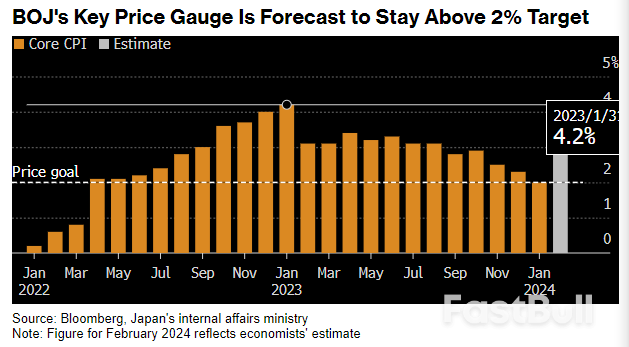
          The prolonged monetary easing led to an expansion of the BOJ’s balance sheet to the point where it’s now worth 127% of the annual economy, four times bigger than the Federal Reserve’s assets-to-economy ratio. Even so, inflation didn’t really kick in until the supply shocks triggered by Covid-19 and Russia’s war in Ukraine. Japan’s key inflation gauge has stayed at or above the 2% target for 22 months, and that stretch is forecast to continue with national price data due Friday.
          Ueda’s post-decision press conference will begin at 3:30 p.m. in Tokyo. At that event he will elaborate on the thinking behind Tuesday’s policy decisions.

          Source:Bloomberg

          To stay updated on all economic events of today, please check out our Economic calendar
          Risk Warnings and Disclaimers
          You understand and acknowledge that there is a high degree of risk involved in trading. Following any strategies or investment methods may lead to potential losses. The content on the site is provided by our contributors and analysts for information purposes only. You are solely responsible for determining whether any trading assets, securities, strategy, or any other product is suitable for investing based on your own investment objectives and financial situation.
          Add to Favorites
          Share

          Swiss Central Bank Eases Efforts to Support Franc by the Conclusion of 2023

          Ukadike Micheal

          Economic

          Forex

          In response to the franc's surge against the euro, the Swiss National Bank (SNB) scaled back its foreign exchange sales in the fourth quarter, amounting to 20.3 billion francs, down from 37.6 billion francs in the previous quarter. This adjustment reflects a shift in the SNB's intervention strategy, announced in mid-December, allowing actions in both directions to stabilize the exchange rate and reduce its substantial balance sheet.
          Throughout 2023, the SNB sold a total of 132.9 billion francs, a significant increase from 2022's 22.3 billion francs in sales and 2021's 21.1 billion francs in purchases. This sales surge came amid the Swiss franc's 4% appreciation against the euro in the fourth quarter, reaching its highest level in almost a decade by the end of 2023. However, since the beginning of the current year, the franc has experienced a sharp decline, nearly erasing its quarterly gains against the euro amidst speculation that the SNB may consider interest rate cuts before mid-year.
          The SNB's decision to ease off on currency sales effectively stalls the process of reducing its inflated balance sheet. This development has raised concerns, with the OECD warning that the central bank's asset reserves have become uncomfortably large. Despite this, official confirmation is pending until March 28, when the SNB is expected to provide an update.
          From a technical perspective, the SNB's reduced intervention in the foreign exchange market could have significant implications for currency traders and investors. The Swiss franc's recent volatility against the euro and other major currencies underscores the challenges faced by central banks in managing exchange rates amidst global economic uncertainties.
          The SNB's intervention strategy not only influences currency markets but also has broader implications for Switzerland's economy. By stabilizing the exchange rate, the SNB aims to support Swiss exporters and maintain price stability. However, excessive intervention can distort market dynamics and create risks, such as asset bubbles and inflationary pressures.
          The SNB's decision to scale back its foreign exchange sales reflects a nuanced approach to managing currency markets amidst shifting economic conditions. While this adjustment may temporarily alleviate pressure on the franc, it also raises questions about the sustainability of the SNB's monetary policy. Investors and analysts will closely monitor future developments, including potential interest rate adjustments, to gauge the impact on currency markets and the broader Swiss economy.

          Source: Bloomberg

          To stay updated on all economic events of today, please check out our Economic calendar
          Risk Warnings and Disclaimers
          You understand and acknowledge that there is a high degree of risk involved in trading. Following any strategies or investment methods may lead to potential losses. The content on the site is provided by our contributors and analysts for information purposes only. You are solely responsible for determining whether any trading assets, securities, strategy, or any other product is suitable for investing based on your own investment objectives and financial situation.
          Add to Favorites
          Share

          Bitcoin Price Shows Weakness, But New BTC Whales Have Created Solid Support At $56,400

          Samantha Luan

          Cryptocurrency

          Bitcoin (BTC) price downside momentum continues to gain strength, giving sidelined and late bulls a chance to buy the dip. The market remains focussed on the oncoming halving, expected to kick off the next bull cycle. For the meantime, however, spot BTC ETFs remain the main play in the market.

          New Bitcoin whales have created solid support at $56,400

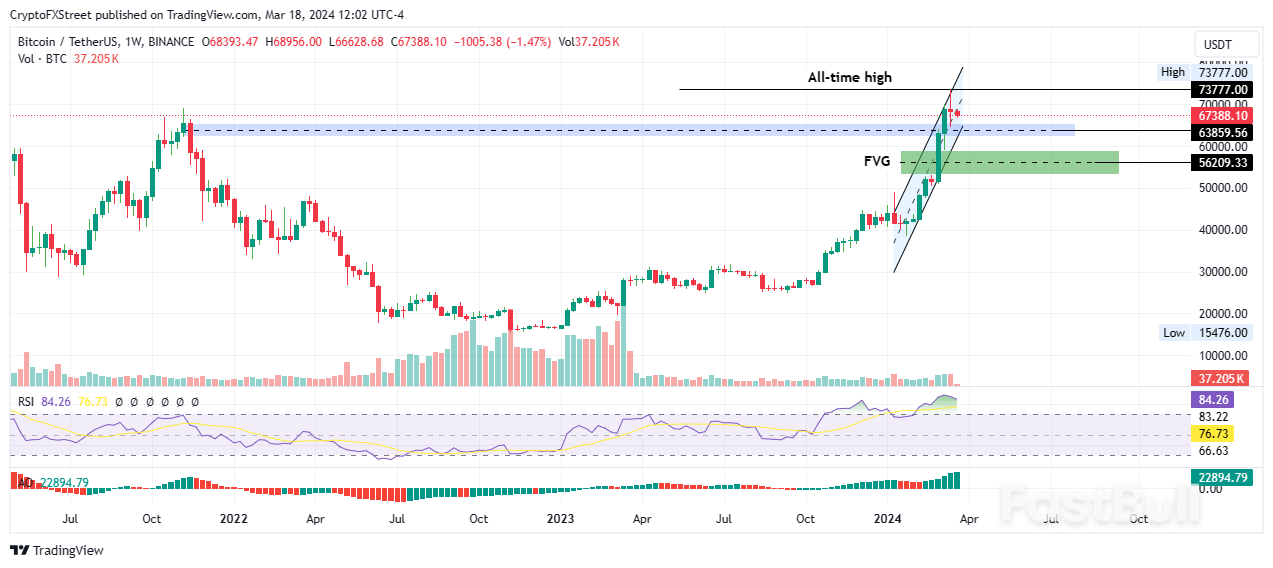
          Bitcoin price is down a fraction in the last day with trading volume dropping nearly 20%. It continues to slide lower after losing critical support due to the midline of the ascending parallel channel. Amid falling buying pressure, BTC is likely to provide a lower buying opportunity before the next leg up.
          With reports that spot BTC exchange-traded funds (ETFs) raked in more than $2.5 billion dollars in net inflows last week alone, ascribed to institutional FOMO, their buyer congestion level could be the pivot BTC is looking for before a trend reversal.
          Ki Young Ju, founder and CEO at CryptoQuant, indicates the new whales bought Bitcoin at $56,400 on average mostly via spot ETFs, whereas the old whales, who acquired BTC pre- spot Bitcoin ETFs, entered near $21,300.
          The new TradFi whales include customers of BlackRock and Fidelity. As different generations of whales foray into the BTC market at various price points, the diversity in investment strategies and perspectives within the crypto space becomes apparent.
          In a March 17 report by CryptoQuant, researchers determined, “The enthusiasm and accumulation of Bitcoin by new investors have sharply increased” during the recent month, with short-term holders only holding just about 48% of the Realized Cap distribution in the Bitcoin market.
          While this increase is bullish for BTC, it also points to the likelihood of a correction once these short-term holders decide it is time to sell.

          Bitcoin price outlook with BTC fate in the hands of short-term holders

          Bitcoin price has breached a key support, flipping the midline of the ascending channel into resistance. The market is leaning toward the downside in the short term, providing sidelined investors a low entry point as the countdown to the halving continues, approximately 31 days out.
          The Relative Strength Index (RSI) is leaning south, forming a dome to signify falling momentum. Coupled with the dwindling size of the volume indicator, this shows that the upward trajectory is losing steam.
          Nevertheless, Welles Wilders, the father of several technical indicators, says an asset is only ripe for selling when the RSI crosses below 70. Traders with current open long positions for BTC should probably leave them open as the upside potential remains viable.
          Those looking to open new long positions, however, should probably exercise caution as the overbought status, seen with the RSI above 70, puts Bitcoin price in high risk of an extended fall.
          If BTC price slips below the $63,859 mean threshold, it could roll over to the weekly imbalance extending from $59,005 to $52,985. Notice that Young Ju’s $56,400 buyer congestion level falls within this range.Bitcoin Price Shows Weakness, But New BTC Whales Have Created Solid Support At $56,400_1
          Conversely, if traders looking to buy the correction decide it is now time to enter, the ensuing buying pressure could send Bitcoin price north. Flipping the midline of the channel back into support could set the tone for a continuation, with Bitcoin price likely to reclaim the $73,777 peak on Binance Exchange.
          In a highly bullish case, the gains could extend to $75,000 or higher to set a new all-time high at $80,000. Such a move would denote a 20% move above current levels.
          Even as the $80,000 target seems likely for Bitcoin price with the oncoming halving, Standard Chartered has presented an overly ambitious target of $150,000 for BTC this year and $250,000 by 2025.

          Source:FXStreet

          Risk Warnings and Disclaimers
          You understand and acknowledge that there is a high degree of risk involved in trading. Following any strategies or investment methods may lead to potential losses. The content on the site is provided by our contributors and analysts for information purposes only. You are solely responsible for determining whether any trading assets, securities, strategy, or any other product is suitable for investing based on your own investment objectives and financial situation.
          Add to Favorites
          Share

          Closing Gap: Japan's Benchmark Index Aligns with Nikkei 225 as Era of Negative Rates Concludes

          Ukadike Micheal

          Economic

          Stocks

          Following the decision to raise interest rates for the first time since 2007, Japan's benchmark Topix index surged by 0.6 percent on Tuesday, narrowing the gap with its exporter-oriented counterpart, the Nikkei 225 index. This move, announced by the country's central bank, signified a notable shift in monetary policy after years of ultra-low interest rates aimed at stimulating economic growth. Investors, both domestic and international, closely watched the market reaction, anticipating potential impacts on various sectors of the Japanese economy.
          The Topix index, representing a broader spectrum of Japanese stocks, experienced gains as investors responded positively to the central bank's decision. Conversely, the Nikkei 225 index, comprised predominantly of export-driven companies, remained flat, reflecting concerns about the potential impact of higher borrowing costs on these sectors.
          The yen, which has maintained multi-decade lows, depreciated further against the US dollar, dropping by 0.6 percent to ¥150.02. This decline in the currency value continues to benefit Japan's exporters, which are predominantly represented in the Nikkei 225 index. A weaker yen makes Japanese goods more competitive in international markets, boosting the profitability of export-oriented companies.
          From a technical perspective, the decision by Japan's central bank to raise interest rates marks a significant shift in monetary policy. For years, the bank pursued an accommodative monetary stance, including negative interest rates and large-scale asset purchases, to combat deflationary pressures and stimulate economic growth. However, with signs of inflationary pressures building and concerns about financial stability, the bank deemed it necessary to begin tightening monetary policy.
          The move is likely to have implications for various sectors of the economy, particularly those sensitive to changes in borrowing costs and exchange rates. Export-oriented industries, which have thrived in the low-interest-rate environment and favorable currency conditions, may face challenges adjusting to higher borrowing costs. The cost of financing operations and capital investments could increase, potentially impacting profit margins and investment decisions.
          However, a stronger domestic economy driven by increased consumer spending could offset some of these effects. Higher interest rates may encourage saving and investment, leading to a more balanced market environment. Domestic-focused sectors such as retail, real estate, and services could benefit from improved consumer confidence and spending, contributing to overall economic growth.
          Investors are closely monitoring the impact of this policy change on stock market dynamics, particularly the performance of the Nikkei 225 index relative to the broader Topix index. While exporters may experience short-term volatility as they adapt to changing conditions, the long-term outlook for Japan's equity market remains positive, supported by improving economic fundamentals.
          The narrowing gap between Japan's benchmark indices following the central bank's decision reflects the complex interplay between monetary policy, currency dynamics, and sectoral performance. While challenges lie ahead for export-driven industries, the broader market sentiment remains optimistic, underscoring the resilience of Japan's economy in the face of changing global conditions. Investors should remain vigilant and adapt their strategies accordingly to navigate the evolving market landscape.

          Source: Financial Times

          To stay updated on all economic events of today, please check out our Economic calendar
          Risk Warnings and Disclaimers
          You understand and acknowledge that there is a high degree of risk involved in trading. Following any strategies or investment methods may lead to potential losses. The content on the site is provided by our contributors and analysts for information purposes only. You are solely responsible for determining whether any trading assets, securities, strategy, or any other product is suitable for investing based on your own investment objectives and financial situation.
          Add to Favorites
          Share

          [RBA] March Rate Decision: Keeping Interest Rates Unchanged for Three Consecutive Times

          FastBull Featured

          Remarks of Officials

          The Reserve Bank of Australia (RBA) decided to leave the cash rate target unchanged at 4.35% at its March policy meeting on March 19, local time. The Monetary Policy Statement showed:
          Inflation continues to moderate but remains high. Driven by moderating goods inflation, the headline inflation was eased over recent months, but services inflation remains elevated. At present, there is a continuous surplus of economic demand, and the cost pressure on domestic labor and non-labor input is greater.
          Conditions in the labor market continue to ease gradually, although they remain tight. Wages growth appears to have peaked with indications it will moderate over the year ahead. Inflation is still weighing on people’s real incomes and household consumption growth is weak.
          Although inflation is moderating, the economic outlook remains uncertain. After recent declines, real incomes have stabilized and are expected to grow from here, which is expected to support growth in consumption later in the year. Growth in unit labor costs remains very high. It has begun to moderate slightly as measured productivity growth has picked up but whether this trend will be sustained is uncertain.
          The central forecasts are for inflation to return to the target range of 2–3 per cent in 2025, and to the midpoint in 2026. Services price inflation is expected to decline gradually as demand moderates and growth in labor and non-labor costs eases. Employment is expected to continue to grow moderately, and the unemployment rate is expected to increase a bit further.
          To date, medium-term inflation expectations have been consistent with the inflation target, but the rate path of returning inflation to target within a reasonable timeframe remains uncertain. The Board is not ruling anything in or out. The Board will rely upon the data and the evolving assessment of risks.

          RBA March Rate Decision

          Risk Warnings and Disclaimers
          You understand and acknowledge that there is a high degree of risk involved in trading. Following any strategies or investment methods may lead to potential losses. The content on the site is provided by our contributors and analysts for information purposes only. You are solely responsible for determining whether any trading assets, securities, strategy, or any other product is suitable for investing based on your own investment objectives and financial situation.
          Add to Favorites
          Share
          FastBull
          Copyright © 2025 FastBull Ltd

          728 RM B 7/F GEE LOK IND BLDG NO 34 HUNG TO RD KWUN TONG KLN HONG KONG

          TelegramInstagramTwitterfacebooklinkedin
          App Store Google Play Google Play
          Products
          Charts

          Chats

          Q&A with Experts
          Screeners
          Economic Calendar
          Data
          Tools
          Membership
          Features
          Function
          Markets
          Copy Trading
          Latest Signals
          Contests
          News
          Analysis
          24/7
          Columns
          Education
          Company
          Careers
          About Us
          Contact Us
          Advertising
          Help Center
          Feedback
          User Agreement
          Privacy Policy
          Business

          White Label

          Data API

          Web Plug-ins

          Poster Maker

          Affiliate Program

          Risk Disclosure

          The risk of loss in trading financial instruments such as stocks, FX, commodities, futures, bonds, ETFs and crypto can be substantial. You may sustain a total loss of the funds that you deposit with your broker. Therefore, you should carefully consider whether such trading is suitable for you in light of your circumstances and financial resources.

          No decision to invest should be made without thoroughly conducting due diligence by yourself or consulting with your financial advisors. Our web content might not suit you since we don't know your financial conditions and investment needs. Our financial information might have latency or contain inaccuracy, so you should be fully responsible for any of your trading and investment decisions. The company will not be responsible for your capital loss.

          Without getting permission from the website, you are not allowed to copy the website's graphics, texts, or trademarks. Intellectual property rights in the content or data incorporated into this website belong to its providers and exchange merchants.

          Not Logged In

          Log in to access more features

          FastBull Membership

          Not yet

          Purchase

          Become a signal provider
          Help Center
          Customer Service
          Dark Mode
          Price Up/Down Colors

          Log In

          Sign Up

          Position
          Layout
          Fullscreen
          Default to Chart
          The chart page opens by default when you visit fastbull.com