• Trade
  • Markets
  • Copy
  • Contests
  • News
  • 24/7
  • Calendar
  • Q&A
  • Chats
Screeners
SYMBOL
LAST
ASK
BID
HIGH
LOW
NET CHG.
%CHG.
SPREAD
SPX
S&P 500 Index
6872.77
6872.77
6872.77
6936.08
6838.79
-45.04
-0.65%
--
DJI
Dow Jones Industrial Average
49326.26
49326.26
49326.26
49649.86
49112.43
+85.26
+ 0.17%
--
IXIC
NASDAQ Composite Index
22847.46
22847.46
22847.46
23270.07
22684.51
-407.71
-1.75%
--
USDX
US Dollar Index
97.520
97.600
97.520
97.560
97.140
+0.320
+ 0.33%
--
EURUSD
Euro / US Dollar
1.17987
1.17996
1.17987
1.18377
1.17901
-0.00188
-0.16%
--
GBPUSD
Pound Sterling / US Dollar
1.36477
1.36487
1.36477
1.37328
1.36419
-0.00487
-0.36%
--
XAUUSD
Gold / US Dollar
4937.60
4938.01
4937.60
5091.84
4855.00
-8.65
-0.17%
--
WTI
Light Sweet Crude Oil
64.921
64.951
64.921
65.221
62.601
+1.287
+ 2.02%
--

Community Accounts

Signal Accounts
--
Profit Accounts
--
Loss Accounts
--
View More

Become a signal provider

Sell trading signals to earn additional income

View More

Guide to Copy Trading

Get started with ease and confidence

View More

Signal Accounts for Members

All Signal Accounts

Best Return
  • Best Return
  • Best P/L
  • Best MDD
Past 1W
  • Past 1W
  • Past 1M
  • Past 1Y

All Contests

  • All
  • Trump Updates
  • Recommend
  • Stocks
  • Cryptocurrencies
  • Central Banks
  • Featured News
Top News Only
Share

Venezuelan Official Alex Saab, Formerly Held In USA, Arrested In Venezuela-Colombian Media

Share

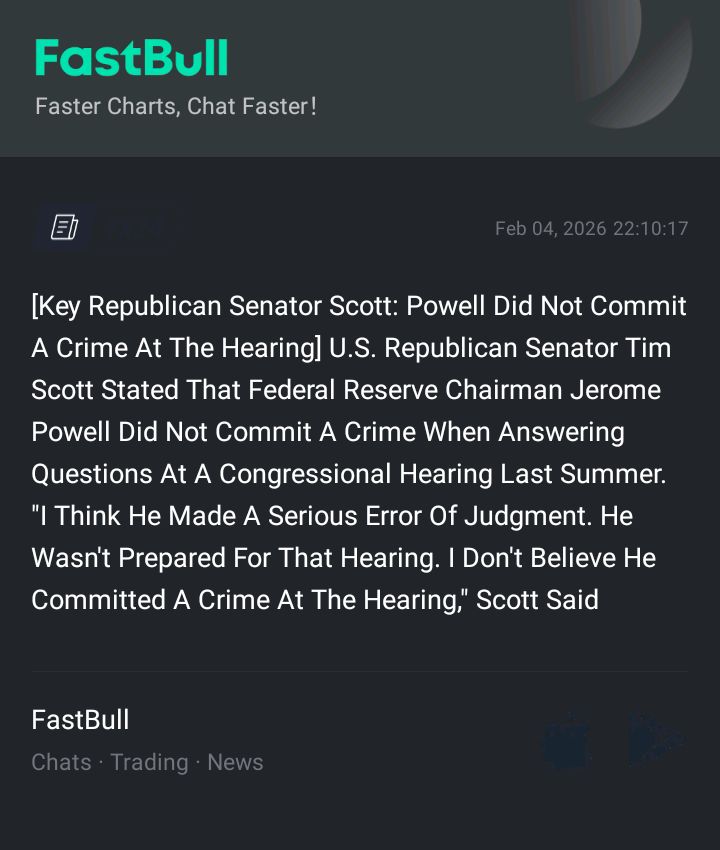
[Key Republican Senator Scott: Powell Did Not Commit A Crime At The Hearing] U.S. Republican Senator Tim Scott Stated That Federal Reserve Chairman Jerome Powell Did Not Commit A Crime When Answering Questions At A Congressional Hearing Last Summer. "I Think He Made A Serious Error Of Judgment. He Wasn't Prepared For That Hearing. I Don't Believe He Committed A Crime At The Hearing," Scott Said

Share

US Used Cyber Weapons To Disrupt Iranian Air Defenses During 2025 Strikes - The Record

Share

Trump Says Iran's Supreme Leader Should Be Worried

Share

Trump Says "Not Much" Doubt That Interest Rates Will Be Lowered

Share

US Nuclear Regulatory Commission Says It Is Undergoing Reorganization In Line With Trump's Push On Licensing Of Nuclear Reactors

Share

Ukraine President Zelenskiy: Ukraine's Western Partners Must Be Prepared To Put Pressure On Russia And Provide Guarantees For Kyiv

Share

Ukraine President Zelenskiy: Talks Must Lead To Real Peace And Not Provide Russia With An Opportunity To Continue The War

Share

Ukraine President Zelenskiy: After Start Of Latest Three-Sided Talks That Ukraine Expects A Prisoner Swap

Share

General Motors CFO: We Hope That The U.S.-Mexico-Canada Trade Agreement (USMCA) Will Preserve North America As A (complete) Trade Area

Share

French President's Top Diplomat Was In Moscow On Tuesday For Talks With Russian Officials - Source Aware Of The Matter

Share

New York Fed Accepts $2.414 Billion Of $2.414 Billion Submitted To Reverse Repo Facility On Feb 04

Share

U.S. Treasury Secretary Bessenter: Credit Risk Transfer (Crt) Is Very Important

Share

Dow Turns Negative, Last Down 0.1%

Share

Russian Foreign Ministry: USA Approach To Russia's Initiative On New Start Treaty Is Misguided And Regrettable

Share

Russian Foreign Ministry On Expiring New Start Arms Treaty: We Assume That We And USA Are No Longer Bound By Central Quantitative Indicators Under The Treaty And Are Free To Choose Their Next Steps

Share

Russian Foreign Ministry On Expiring New Start Arms Treaty: Russia Is Ready To Take Decisive Military-Technical Countermeasures To Counter Potential Additional Threats To National Security

Share

Bessent: The Fed Has To Maintain Credibility And Operate Beyond Reproach

Share

Bessent: Says Has No Opinion On Whether Trump Has Authority To Fire Fed Chair Or Board Member Over A Policy Disagreement

Share

Mexico's Pemex Supplied $496 Million Of Oil To Cuba In 2025

TIME
ACT
FCST
PREV
Euro Zone Services PMI Final (Jan)

A:--

F: --

P: --

U.K. Composite PMI Final (Jan)

A:--

F: --

P: --

U.K. Total Reserve Assets (Jan)

A:--

F: --

P: --

U.K. Services PMI Final (Jan)

A:--

F: --

P: --

U.K. Official Reserves Changes (Jan)

A:--

F: --

P: --

Euro Zone Core CPI Prelim YoY (Jan)

A:--

F: --

P: --

Euro Zone Core HICP Prelim YoY (Jan)

A:--

F: --

P: --

Euro Zone HICP Prelim YoY (Jan)

A:--

F: --

P: --

Euro Zone PPI MoM (Dec)

A:--

F: --

P: --
Euro Zone Core HICP Prelim MoM (Jan)

A:--

F: --

P: --

Italy HICP Prelim YoY (Jan)

A:--

F: --

P: --

Euro Zone Core CPI Prelim MoM (Jan)

A:--

F: --

P: --

Euro Zone PPI YoY (Dec)

A:--

F: --

P: --
U.S. MBA Mortgage Application Activity Index WoW

A:--

F: --

P: --

Brazil IHS Markit Composite PMI (Jan)

A:--

F: --

P: --

Brazil IHS Markit Services PMI (Jan)

A:--

F: --

P: --

U.S. ADP Employment (Jan)

A:--

F: --

P: --
The U.S. Treasury Department released its quarterly refinancing statement.
U.S. IHS Markit Composite PMI Final (Jan)

A:--

F: --

P: --

U.S. IHS Markit Services PMI Final (Jan)

A:--

F: --

P: --

U.S. ISM Non-Manufacturing Price Index (Jan)

A:--

F: --

P: --

U.S. ISM Non-Manufacturing Employment Index (Jan)

A:--

F: --

P: --

U.S. ISM Non-Manufacturing New Orders Index (Jan)

A:--

F: --

P: --

U.S. ISM Non-Manufacturing Inventories Index (Jan)

A:--

F: --

P: --

U.S. ISM Non-Manufacturing PMI (Jan)

A:--

F: --

P: --

U.S. EIA Weekly Crude Oil Imports Changes

A:--

F: --

P: --

U.S. EIA Weekly Heating Oil Stock Changes

A:--

F: --

P: --

U.S. EIA Weekly Crude Demand Projected by Production

A:--

F: --

P: --

U.S. EIA Weekly Gasoline Stocks Change

A:--

F: --

P: --

U.S. EIA Weekly Crude Stocks Change

A:--

F: --

P: --

U.S. EIA Weekly Cushing, Oklahoma Crude Oil Stocks Change

A:--

F: --

P: --

Australia Trade Balance (SA) (Dec)

--

F: --

P: --

Australia Exports MoM (SA) (Dec)

--

F: --

P: --

Japan 30-Year JGB Auction Yield

--

F: --

P: --

Indonesia Annual GDP Growth

--

F: --

P: --

Indonesia GDP YoY (Q4)

--

F: --

P: --

France Industrial Output MoM (SA) (Dec)

--

F: --

P: --

Italy IHS Markit Construction PMI (Jan)

--

F: --

P: --

Euro Zone IHS Markit Construction PMI (Jan)

--

F: --

P: --

Germany Construction PMI (SA) (Jan)

--

F: --

P: --

Italy Retail Sales MoM (SA) (Dec)

--

F: --

P: --

U.K. Markit/CIPS Construction PMI (Jan)

--

F: --

P: --

France 10-Year OAT Auction Avg. Yield

--

F: --

P: --

Euro Zone Retail Sales YoY (Dec)

--

F: --

P: --

Euro Zone Retail Sales MoM (Dec)

--

F: --

P: --

U.K. BOE MPC Vote Cut (Feb)

--

F: --

P: --

U.K. BOE MPC Vote Hike (Feb)

--

F: --

P: --

U.K. BOE MPC Vote Unchanged (Feb)

--

F: --

P: --

U.K. Benchmark Interest Rate

--

F: --

P: --

MPC Rate Statement
U.S. Challenger Job Cuts (Jan)

--

F: --

P: --

U.S. Challenger Job Cuts MoM (Jan)

--

F: --

P: --

U.S. Challenger Job Cuts YoY (Jan)

--

F: --

P: --

Bank of England Governor Bailey held a press conference on monetary policy.
Euro Zone ECB Marginal Lending Rate

--

F: --

P: --

Euro Zone ECB Deposit Rate

--

F: --

P: --

Q&A with Experts
    • All
    • Chatrooms
    • Groups
    • Friends
    Nawhdir Øt flag
    john
    @john2:15
    john flag
    Nawhdir Øt
    @Nawhdir Øtam ?
    Nawhdir Øt flag
    john
    @johntherefore, that's the real best, currently BTC behavior is 50-50.
    Sean flag
    john
    @johnMarginal slowdown matters more than baseline strength
    john flag
    Nawhdir Øt
    @Nawhdir Øtand you normally trade the Asian session which means that you will sleep for less than 4 hrs
    Nawhdir Øt flag
    john
    6 o'clock@john
    john flag
    Nawhdir Øt
    @Nawhdir Øtwhat timeframe are you watching btc
    john flag
    Nawhdir Øt
    @Nawhdir ØtI normally sleep for 6 hours
    john flag
    Sean
    @Sean That is how positioning works especially in macro-driven pairs.
    Sean flag
    john
    @johnlike USD/CNH and USD/JPY correlations
    john flag
    Sean
    @Sean Yes, and also gold reacts indirectly through risk sentiment.
    Sean flag
    john
    @johnweak domestic demand keeps deflation risk alive
    Nawhdir Øt flag
    john
    @johneverything.
    john flag
    Sean
    @Sean Yes and deflation risk keeps global central banks cautious.
    Sean flag
    john
    @johnwhich limits coordinated tightening
    john flag
    we all know this,,,,trump is only turnishing Powell name
    john flag
    john flag
    Sean
    @Sean Exactly, so liquidity remains relatively loose.
    EuroTrader flag
    Sean
    @Seanthats the first time i am getting to hear of this pair ever I'll do a little research on it
    Sean flag
    john
    @johnthat supports risk assets but unevenly
    Type here...
    Add Symbol or Code

      No matching data

      All
      Trump Updates
      Recommend
      Stocks
      Cryptocurrencies
      Central Banks
      Featured News
      • All
      • Russia-Ukraine Conflict
      • Middle East Flashpoint
      • All
      • Russia-Ukraine Conflict
      • Middle East Flashpoint
      Search
      Products

      Charts Free Forever

      Chats Q&A with Experts
      Screeners Economic Calendar Data Tools
      Membership Features
      Data Warehouse Market Trends Institutional Data Policy Rates Macro

      Market Trends

      Market Sentiment Order Book Forex Correlations

      Top Indicators

      Charts Free Forever
      Markets

      News

      News Analysis 24/7 Columns Education
      From Institutions From Analysts
      Topics Columnists

      Latest Views

      Latest Views

      Trending Topics

      Top Columnists

      Latest Update

      Signals

      Copy Rankings Latest Signals Become a signal provider AI Rating
      Contests
      Brokers

      Overview Brokers Assessment Rankings Regulators News Claims
      Broker listing Forex Brokers Comparison Tool Live Spread Comparison Scam
      Q&A Complaint Scam Alert Videos Tips to Detect Scam
      More

      Business
      Events
      Careers About Us Advertising Help Center

      White Label

      Broker API

      Data API

      Web Plug-ins

      Affiliate Program

      Awards Institution Evaluation IB Seminar Salon Event Exhibition
      Vietnam Thailand Singapore Dubai
      Fans Party Investment Sharing Session
      FastBull Summit BrokersView Expo
      Recent Searches
        Top Searches
          Markets
          News
          Analysis
          User
          24/7
          Economic Calendar
          Education
          Data
          • Names
          • Latest
          • Prev

          View All

          No data

          Scan to Download

          Faster Charts, Chat Faster!

          Download App
          English
          • English
          • Español
          • العربية
          • Bahasa Indonesia
          • Bahasa Melayu
          • Tiếng Việt
          • ภาษาไทย
          • Français
          • Italiano
          • Türkçe
          • Русский язык
          • 简中
          • 繁中
          Open Account
          Search
          Products
          Charts Free Forever
          Markets
          News
          Signals

          Copy Rankings Latest Signals Become a signal provider AI Rating
          Contests
          Brokers

          Overview Brokers Assessment Rankings Regulators News Claims
          Broker listing Forex Brokers Comparison Tool Live Spread Comparison Scam
          Q&A Complaint Scam Alert Videos Tips to Detect Scam
          More

          Business
          Events
          Careers About Us Advertising Help Center

          White Label

          Broker API

          Data API

          Web Plug-ins

          Affiliate Program

          Awards Institution Evaluation IB Seminar Salon Event Exhibition
          Vietnam Thailand Singapore Dubai
          Fans Party Investment Sharing Session
          FastBull Summit BrokersView Expo

          Mark Rutte's NATO Plan Is a Strategic Mistake

          King Ten

          Remarks of Officials

          Political

          Summary:

          Mark Rutte's NATO strategy prioritizing U.S. dependence is a flawed approach, weakening European security.

          Mark Rutte, NATO's new Secretary-General, is an experienced and energetic politician. As the longest-serving prime minister in Dutch history, his political instincts would have been a perfect fit for the job in a previous era. But in today's geopolitical landscape, his worldview and approach are precisely what NATO does not need.

          Rutte's Bet: Keeping America First in NATO

          Since taking the helm, Rutte's primary goal has been clear: keep the United States unconditionally committed to European security. To achieve this, he appears willing to flatter U.S. President Donald Trump and discourage European efforts toward greater strategic autonomy. While the motive is understandable—relying on the U.S. as a first responder is a comfortable arrangement—his assessment of the strategic situation is deeply flawed.

          Rutte recently told the European Parliament that Europe simply cannot defend itself without significant U.S. assistance, dismissing any alternative as a "dream." This statement serves as a direct rebuttal to Canadian Prime Minister Mark Carney's widely praised Davos speech, which called for medium powers to unite against the predatory behavior of great powers—a group that now includes the United States.

          While Carney avoided naming Trump, his audience understood the message. Rutte, however, is doubling down on a policy of dependence, seemingly convinced that NATO allies have no choice but to follow the United States, no matter how erratic its leadership becomes.

          Four Flaws in the Dependency Doctrine

          This conclusion is built on at least four serious miscalculations that undermine European security and the future of the alliance.

          1. Europe Can Defend Itself

          First, Rutte is fundamentally wrong about Europe's defense capabilities. While the continent is currently over-reliant on the United States, this is a solvable problem, not a permanent state of weakness. European nations do not need to match America's global power projection. They simply need the capacity to deter or defeat an attack on their own territory.

          The only significant military threat to Europe comes from Russia, which is not in a strong position itself. Consider the raw numbers:

          • NATO's European members have a combined population more than three times that of Russia.

          • Their collective GDP is nearly ten times larger.

          • They already outspend Russia on defense annually.

          The problem isn't a lack of resources but inefficient spending and coordination. Combined with the defensive advantages offered by modern technologies like drone warfare, a robust European defense independent of heavy U.S. support is well within reach, a point made by numerous defense analysts.

          2. Appeasing Trump Is a Failed Tactic

          Second, the strategy of appeasement isn't working. Rutte has gone to great lengths to flatter Trump, once even comparing him to a "daddy." The return on this effort has been minimal.

          The Trump administration's National Security Strategy portrayed Europe as a collection of decadent nations in decline. Furthermore, Washington renewed its push to take over Greenland. History has repeatedly shown the dangers of appeasement, and Trump's actions demonstrate that the tactic often fails to produce the desired results.

          3. Weakness Only Invites Contempt

          Third, constantly highlighting European weakness and dependence reinforces the MAGA movement's contempt for democratic allies. This narrative paints them as strategic burdens, fueling arguments for abandoning the alliance altogether.

          Trump respects strength and exploits weakness. A more capable Europe would be a more valuable partner, better positioned to push back against dangerous U.S. policies. By insisting on a position of compliance, Rutte is inadvertently making Europe an easier target for an administration that bullies the weak and backs down only when faced with resolve.

          4. The Secretary-General's Role Has Changed

          Finally, the job of the NATO Secretary-General has evolved. In the past, the role centered on managing American preferences. Today, it requires preparing the alliance for a future where the United States is less central or potentially even absent.

          Instead of working to overcome the collective action problems that hinder European defense, Rutte's approach reinforces them. He is trying to preserve an outdated status quo at a time when the alliance needs to adapt urgently.

          A New Global Reality Demands a New NATO

          Mark Rutte has not yet grasped the structural shifts in global politics. During the Cold War, U.S. support for Europe was guaranteed by the shared goal of containing the Soviet Union. In the unipolar moment that followed, the risk of war seemed low, and Washington was willing to handle the heavy lifting.

          That world is gone. The Trump administration has no commitment to liberal values and treats both allies and adversaries with a transactional, predatory approach. China has emerged as a major economic and military power, pulling U.S. attention away from Europe. In this new multipolar world, Europe is no longer Washington's primary focus and must learn to chart its own course.

          The Path Forward: A Rebalanced Alliance

          Preserving NATO's old formula of U.S. dominance and European submission is an increasingly risky bet. The safest path forward is a new division of labor within the alliance.

          European members must build up their defense capabilities as quickly as possible. The United States should transition from being Europe's "first responder" to its "ally of last resort." This shift won't happen overnight, but a more unified and capable Europe would command more respect from Washington and be better prepared for a future where it may have to stand on its own. Doubling down on an erratic and increasingly hostile United States is the last thing NATO should be doing right now.

          Risk Warnings and Disclaimers
          You understand and acknowledge that there is a high degree of risk involved in trading. Following any strategies or investment methods may lead to potential losses. The content on the site is provided by our contributors and analysts for information purposes only. You are solely responsible for determining whether any trading assets, securities, strategy, or any other product is suitable for investing based on your own investment objectives and financial situation.
          Add to Favorites
          Share

          Trump's Foreign Policy: The 'Spheres of Influence' Myth

          King Ten

          Russia-Ukraine Conflict

          Political

          A popular theory claims Donald Trump’s foreign policy is built on a simple premise: carve up the world into "spheres of influence" with autocratic rivals. Pundits and social media influencers circulate maps dividing the globe between Trump, China’s Xi Jinping, and Russia’s Vladimir Putin.

          Headlines warn of this new world order, suggesting a grand bargain is in the works. But a closer look at the evidence reveals a different strategy entirely.

          While Trump is fiercely protective of American dominance in the Western Hemisphere, he shows no interest in granting similar power to his main competitors. His approach looks less like a global carve-up and more like a traditional U.S. strategy: secure the homeland's neighborhood while preventing adversaries from dominating key geopolitical regions.

          Defining the Debate: Spheres of Influence

          The term "spheres of influence" carries heavy baggage. Historically, it was a pragmatic way to manage great power rivalries. After World War II, for example, Washington and Moscow tacitly accepted each other's control over their respective parts of Europe to maintain a tense peace during the Cold War.

          Today, the concept is viewed negatively. In a modern liberal system, smaller nations are expected to choose their own alliances and policies without coercion from powerful neighbors. Granting Russia a sphere of influence over Eastern Europe or China one over East Asia would mean consigning nations like Lithuania or Taiwan to subjugation.

          When critics accuse Trump of pursuing this model, it’s an accusation, not a neutral observation. But the facts don't support the charge.

          The "Donroe Doctrine": America's Backyard First

          To be clear, Trump is unambiguous about one region: the Americas. His administration has explicitly called for restoring U.S. "dominance" in the Western Hemisphere, a policy some have dubbed the "Donroe Doctrine."

          This isn't just rhetoric. His administration has actively worked to:

          • Eject Chinese companies from operating ports in the Panama Canal.

          • Seek the removal of President Nicolás Maduro in Venezuela.

          • Apply pressure on the Communist regime in Cuba.

          Trump's desire for an American sphere of influence is clear. The real question is whether he is willing to grant the same privilege to Russia and China in Eurasia. The evidence says no.

          Confronting Putin: Why Trump Isn't Ceding Europe

          If Trump truly intended to grant Vladimir Putin a sphere of influence, the playbook would be straightforward. He would withdraw the U.S. from NATO, cut off military aid to Ukraine, and negotiate a peace deal that effectively hands Kyiv to Moscow.

          Instead, his administration has done the opposite:

          • Strengthened NATO: He has aggressively pushed allies to increase defense spending to as high as 5% of GDP.

          • Armed Ukraine: He has provided weapons to Ukraine (with Europe footing the bill) and approved their use on Russian territory.

          • Sanctioned Russia: He has ramped up economic pressure on Russia's critical energy sector.

          This strategy is far more consistent with containing Putin and preventing a hostile power from dominating a critical region—a core tenet of long-standing U.S. policy.

          Containing Xi: The Real U.S. Strategy in Asia

          The same pattern holds true in East Asia. A genuine plan to concede the region to Xi Jinping would involve cutting off arms to Taiwan, downgrading diplomatic relations, and weakening U.S. alliances with regional partners.

          Again, Trump's actions point in the opposite direction:

          • Prioritizing the Indo-Pacific: The National Defense Strategy identifies deterring conflict in the region—a clear euphemism for containing China—as the second-highest priority after defending the homeland.

          • Boosting Military Spending: The administration passed the largest U.S. defense budget in history, focusing on capabilities designed for a potential conflict with China.

          • Supporting Taiwan: Trump approved the largest arms package to Taiwan in history and the State Department dropped language opposing Taiwanese independence.

          • Pressuring Allies: As in Europe, the administration is urging Asian allies to spend more on their own defense.

          If this is a plan to grant China a sphere of influence, Xi Jinping is likely both perplexed and displeased. Elsewhere, from bombing Iran's nuclear program to amassing a naval armada in the Middle East, the policy is one of containment, not concession.

          A Pragmatic Power Play, Not a Global Carve-Up

          Some argue that Trump’s assertiveness in the Western Hemisphere gives a "permission slip" for Putin and Xi to do the same. This misunderstands geopolitics. Putin has already invaded his neighbors, and Xi considers Taiwan part of China; neither is waiting for an excuse. Precedent matters in a courtroom, not in the raw calculus of international security.

          While Trump may not be as hard-line as some critics wish—he might seek a trade deal with China or avoid pursuing Putin for war crimes—these nuances are not evidence of a plan to cede entire regions to dictators.

          Ultimately, Trump is not an international relations theorist remaking the global order. He is a pragmatist pursuing American self-interest. That pursuit is leading his administration down a well-worn path: ejecting hostile powers from the Americas while working to contain them in their own regions. This has been a central pillar of American grand strategy for decades.

          Risk Warnings and Disclaimers
          You understand and acknowledge that there is a high degree of risk involved in trading. Following any strategies or investment methods may lead to potential losses. The content on the site is provided by our contributors and analysts for information purposes only. You are solely responsible for determining whether any trading assets, securities, strategy, or any other product is suitable for investing based on your own investment objectives and financial situation.
          Add to Favorites
          Share

          Russia's Oil Revenue Plunges to a Five-Year Low

          Dark Current

          Russia-Ukraine Conflict

          Energy

          Economic

          Commodity

          Political

          Russia's government oil revenues crashed to their lowest level in over five years in January, as a combination of weaker global prices, steepening discounts for its crude, and a stronger ruble hammered the national budget.

          According to finance ministry data, oil-related tax revenues were slashed in half to 281.7 billion rubles ($3.7 billion) compared to the previous year. When combined with gas, total energy revenue also fell by 50% to 393.3 billion rubles.

          This sharp decline in proceeds from oil and gas—which together account for roughly a quarter of the budget—intensifies the financial strain on the Kremlin as the war in Ukraine approaches its fifth year. The January oil revenue figure marks the lowest point since June 2020.

          The Double Squeeze of Prices and Sanctions

          While global Brent oil futures were down 15% year-on-year for the fiscal period, the market downturn was far more severe for Russia due to US sanctions.

          The nation's flagship Urals grade traded at a discount of about $26 per barrel below the Dated Brent benchmark at its export point. This is a dramatic widening from the discount of just over $12 a barrel seen a year earlier, according to data from Argus Media.

          These discounts expanded significantly after the US blacklisted Russia's two largest producers, Rosneft PJSC and Lukoil PJSC, in October. Further pressure could be on the horizon, as US President Donald Trump announced plans to cut import tariffs for India—a major buyer of Russian crude—if New Delhi stops purchasing oil from Moscow. The practical extent of India's cutbacks remains to be seen.

          A Budget Under Mounting Pressure

          The revenue collapse starkly contrasts with the government's fiscal planning. Russia's finance ministry based its January revenue calculations on an average Urals price of $39.18 per barrel in December, which was a 38% drop from a year earlier. This price is far below the government's own budget forecast, which anticipated an average crude price of $59 per barrel in 2026.

          According to Sergey Vakulenko, a senior fellow at the Carnegie Endowment for International Peace and a former Russian oil executive, the government’s take is highly sensitive to price. He estimates that Russia's budget receives 57 cents from every dollar of the oil price above $13.60 a barrel.

          Based on this model, the government received only about $14.50 per barrel in taxes last month. Meanwhile, oil companies kept around $24.70, with an estimated $14-$18 of that going toward the costs of pumping crude and delivering it for export.

          The Unexpected Challenge of a Stronger Ruble

          Adding to the fiscal pain is the appreciation of the Russian ruble. In December, the currency averaged 78.4368 rubles to the dollar, making it nearly 25% stronger than it was a year ago.

          "What really hurts both the companies and the government is the exchange rate," explained Vakulenko, noting that their expenses are primarily denominated in rubles and are tied to domestic inflation. A stronger ruble means dollar-denominated oil revenues convert into fewer rubles, squeezing budgets further.

          However, there was one minor positive side effect from the market dynamics. The lower global prices for crude and oil products allowed the Russian government to significantly reduce the subsidies it pays to domestic refiners. In January, these subsidy payments fell by almost 90% year-on-year to just 16.9 billion rubles, the lowest outlay since payments were paused in October 2023.

          To stay updated on all economic events of today, please check out our Economic calendar
          Risk Warnings and Disclaimers
          You understand and acknowledge that there is a high degree of risk involved in trading. Following any strategies or investment methods may lead to potential losses. The content on the site is provided by our contributors and analysts for information purposes only. You are solely responsible for determining whether any trading assets, securities, strategy, or any other product is suitable for investing based on your own investment objectives and financial situation.
          Add to Favorites
          Share

          EU Plans Critical Minerals Stockpile to Counter China

          King Ten

          Energy

          Remarks of Officials

          Economic

          Commodity

          Political

          The European Union is advancing a plan to build a strategic stockpile of critical raw materials, with France, Germany, and Italy slated to spearhead the effort. This move is designed to slash the bloc's heavy reliance on China for resources essential to its industrial and defense sectors.

          The initiative, known as RESourceEU, was introduced in December to create a joint reserve of key materials and manage the export of reusable metal scrap and rare earth waste. While the European Commission has not yet released full details, the plan is a direct response to growing supply chain vulnerabilities.

          Why Europe Needs a Strategic Minerals Reserve

          China's position as the world's top producer of industrial metals gives it significant leverage over global supply chains. Since 2023, Beijing's export controls on materials such as gallium, germanium, tungsten, and heavy rare earths like dysprosium have created significant disruptions for manufacturers outside the country.

          With limited domestic refining capacity and long timelines required to develop new supply sources, Europe sees a strategic stockpile as a critical buffer. Such a reserve is considered one of the few immediate tools available to:

          • Protect the European economy from sudden supply shocks.

          • Safeguard production for its defense and aerospace industries.

          • Secure the raw materials needed for its green and digital transitions.

          EU's Stockpiling Plan: France, Germany, and Italy Take the Lead

          Sources familiar with the matter confirm that concrete roles are being defined for the EU's largest economies. Following a December meeting with EU officials, an agreement was reached for a clear division of labor:

          • France will manage the financing for purchasing the minerals.

          • Germany will be responsible for sourcing the materials from producers.

          • Italy will oversee the logistics and storage of the stockpile.

          This collaboration builds on an existing pledge between Italy and Germany to work together on securing vital raw material supply chains for their industries.

          Progress and Hurdles in Building the Stockpile

          A European Commission spokesperson confirmed that a pilot project is underway with 10 member states. "The European Commission is working closely with several member states on a pilot project to strengthen the EU's stockpiling of critical raw materials," the spokesperson stated.

          These countries have been organized into working groups to assess the required mineral volumes, logistical frameworks, and financing needed to cover long-term costs. The December meeting specifically discussed potential storage facilities, including those operated by Italy-based Pacorini Global Services and Netherlands-based C. Steinweg. Both companies declined to comment.

          However, not everyone is satisfied with the pace. One source expressed frustration over slow progress, noting that while there are many working groups and discussions, concrete action is lacking. Details on which banks France is consulting or which producers Germany has approached have not been made public.

          An Italian source confirmed the country was in "coordination talks with the Commission, and, at a technical level, with other member states, including Germany and France."

          Beyond Stockpiling: Diversifying Global Supply Chains

          The EU's strategy extends beyond creating a reserve. The bloc has identified 34 critical raw materials, designating 17 of them as "Strategic" due to their importance for green technology, digital infrastructure, defense, and aerospace.

          To reduce its long-term dependency, the EU is also actively pursuing international partnerships. In October, Commission President Ursula von der Leyen announced plans to accelerate raw materials agreements with countries including Australia, Canada, Chile, Greenland, Kazakhstan, Uzbekistan, and Ukraine.

          To stay updated on all economic events of today, please check out our Economic calendar
          Risk Warnings and Disclaimers
          You understand and acknowledge that there is a high degree of risk involved in trading. Following any strategies or investment methods may lead to potential losses. The content on the site is provided by our contributors and analysts for information purposes only. You are solely responsible for determining whether any trading assets, securities, strategy, or any other product is suitable for investing based on your own investment objectives and financial situation.
          Add to Favorites
          Share

          EU Restarts US Trade Deal After Greenland Spat

          James Riley

          Economic

          Remarks of Officials

          Political

          European Union lawmakers are restarting work on a trade deal with the United States after halting the process in protest of President Donald Trump’s comments about acquiring Greenland and his related threats of new tariffs.

          The European Parliament's trade committee is now set to resume its efforts to implement the agreement, which aims to lower many EU import duties on American goods.

          Why the Trade Deal Was Paused

          The deal, originally struck with Trump in July, also includes maintaining zero duties on U.S. lobsters, a provision agreed upon in 2020. However, a key vote was suspended last month after Trump threatened new tariffs against European countries that opposed his goal of annexing Greenland, a semi-autonomous territory of Denmark.

          The tariff threat was withdrawn after several days, but the pause in negotiations highlighted the tense political backdrop. A significant delay from the European side could have provoked a reaction from the U.S. president, who recently threatened to raise tariffs on South Korean exports over what he described as a failure to implement its side of a trade agreement.

          New Safeguards and Next Steps

          Work on the trade deal will now resume, with the committee potentially voting on February 24, according to Social Democrat lawmaker Bernd Lange, who chairs the trade committee.

          To protect against future volatility, Lange confirmed that EU lawmakers would support new conditions to the agreement, including:

          • A Suspension Clause: This would allow the EU to suspend the deal if the United States threatens the security or territorial integrity of any member state. It would also apply in the case of new U.S. tariff threats.

          • A Sunset Clause: Lawmakers also agreed to add a clause that would set an expiration date for the deal, although the exact time frame has not yet been determined.

          Following the committee vote, the proposals must be approved by the full European Parliament and EU governments. This process involves negotiating a common text, which means final approval is likely still one to two months away.

          Lingering Concerns Over a 'Lopsided' Agreement

          Even before the recent political friction, many EU lawmakers had expressed concerns that the trade deal was unbalanced. Critics point out that the agreement requires the EU to cut most of its import duties while the U.S. largely maintains a broad tariff rate of 15%. Despite these reservations, lawmakers had previously appeared willing to accept the deal with certain conditions attached.

          To stay updated on all economic events of today, please check out our Economic calendar
          Risk Warnings and Disclaimers
          You understand and acknowledge that there is a high degree of risk involved in trading. Following any strategies or investment methods may lead to potential losses. The content on the site is provided by our contributors and analysts for information purposes only. You are solely responsible for determining whether any trading assets, securities, strategy, or any other product is suitable for investing based on your own investment objectives and financial situation.
          Add to Favorites
          Share

          Nomura Calls for Halt to Turkey's Interest Rate Cuts

          Michael Ross

          Economic

          Traders' Opinions

          Central Bank

          Data Interpretation

          Nomura Holdings Inc. predicts Turkey's central bank will need to pause its cycle of interest rate cuts at its next meeting, citing stubbornly high inflation that limits the room for further monetary easing.

          According to Nomura economist Zumrut Imamoglu, elevated core inflation and a high headline figure are key reasons for the central bank to hold rates steady.

          Stubborn Inflation Defies Expectations

          Recent data showed that Turkey's annual consumer price growth slowed only marginally to 30.7% from 30.9% the previous month. This figure was higher than analyst forecasts, which had anticipated a rate just below 30%.

          The persistence of high prices prompted Nomura to become the first major bank to call for an end to the rate-cutting cycle that began in July of last year. In its most recent move, the monetary authority reduced its policy rate by 100 basis points to 37% in January.

          This view contrasts with other market participants. JPMorgan Chase & Co. economist Fatih Akcelik, for example, still anticipates another 100-basis-point cut in March.

          Revised Forecasts Signal Higher Inflation Ahead

          Imamoglu noted that annual inflation is likely to increase in February, as the month coincides with Ramadan, a period when food prices typically rise.

          Reflecting this outlook, Nomura has adjusted its economic projections for Turkey:

          • Year-end inflation forecast: Raised to 23% from a previous estimate of 21.5%.

          • Central bank target: This compares to the official target of 16%.

          • Year-end policy rate forecast: Increased by 100 basis points to 29%.

          Despite the call for an immediate pause, Nomura anticipates that the central bank could resume easing later in the year. "We think that food prices will ease in May-June and services inflation will be softer over the summer, allowing the Turkish central bank to increase the pace of its rate cuts," Imamoglu said.

          The call for caution follows a sharp acceleration in monthly inflation, which hit 4.8% in January, up from 0.9% the prior month. Driven by food prices and seasonal wage adjustments, this was the highest monthly rate recorded in a year.

          To stay updated on all economic events of today, please check out our Economic calendar
          Risk Warnings and Disclaimers
          You understand and acknowledge that there is a high degree of risk involved in trading. Following any strategies or investment methods may lead to potential losses. The content on the site is provided by our contributors and analysts for information purposes only. You are solely responsible for determining whether any trading assets, securities, strategy, or any other product is suitable for investing based on your own investment objectives and financial situation.
          Add to Favorites
          Share

          US Moves to Build Critical Minerals Bloc Against China

          James Riley

          China–U.S. Trade War

          Remarks of Officials

          Economic

          Commodity

          Political

          The Trump administration is pushing to establish a critical minerals trading bloc with allied nations, using tariffs to set price floors and counter China's dominance over the global supply chain.

          The plan aims to prevent China from flooding the market with low-cost materials to undermine potential competitors, a tactic highlighted during the recent trade war.

          A New Alliance to Secure High-Tech Resources

          U.S. Vice President JD Vance articulated the strategy at a State Department meeting, emphasizing the goal of creating a resilient and cooperative supply zone.

          "We want members to form a trading bloc among allies and partners, one that guarantees American access to American industrial might while also expanding production across the entire zone," Vance said. "What is before all of us is an opportunity at self-reliance that we never have to rely on anybody else except for each other."

          Critical minerals are essential components in everything from smartphones to jet engines. The trade disputes over the past year exposed how heavily most economies depend on these materials, a market overwhelmingly controlled by China.

          "I think a lot of us have learned the hard way... how much our economies depend on these critical minerals," Vance stated at the meeting, which Secretary of State Marco Rubio hosted for officials from dozens of nations.

          Project Vault: Building a Strategic Stockpile

          This initiative follows President Donald Trump's recent announcement of "Project Vault," a plan to create a national stockpile of rare earth elements. The project is backed by a $10 billion loan from the U.S. Export-Import Bank and nearly $1.67 billion in private capital.

          The administration's assertive move comes after China, which controls 70% of the world's rare earths mining and 90% of its processing, restricted supplies in response to U.S. tariffs. While Trump and Chinese President Xi Jinping agreed to a one-year truce in October, China's export limits remain tighter than before the trade conflict began.

          "We don't want to ever go through what we went through a year ago," Trump said when announcing the project.

          Pini Althaus, founder of USA Rare Earth, believes other Western nations will join the effort, having recognized their vulnerability to China's supply chain leverage.

          Public-Private Partnerships Drive the Strategy

          To jumpstart domestic production, the U.S. government has begun making direct investments in American producers. Last week, it extended $1.6 billion to USA Rare Earth in exchange for stock and a repayment plan.

          Althaus noted that securing government funding has become as rigorous as meeting with private equity investors, with officials demanding terms that ensure a financial return for taxpayers.

          Meanwhile, the U.S. Export-Import Bank's board approved the $10 billion loan—the largest in its history—to help establish the U.S. Strategic Critical Minerals Reserve. The reserve is designed to guarantee access for key manufacturers, including:

          • Battery maker Clarios

          • Energy firm GE Vernova

          • Digital storage company Western Digital

          • Aerospace giant Boeing

          Bank President John Jovanovic described the project as a public-private partnership where "there are no free riders." He explained that manufacturers who benefit most are making long-term financial commitments, while the government's loan helps attract private investment.

          Reshaping the Global Market

          Industry experts believe the stockpile strategy could foster a "more organic" pricing model that operates independently of China. Wade Senti, president of magnet company AML, said this would directly counter Beijing's practice of using its market dominance to squeeze out competitors with artificially low prices.

          The Trump administration is also injecting public funds elsewhere. The Pentagon has spent nearly $5 billion over the past year to secure its own access to critical materials after the trade war exposed the nation's dependence on China.

          Bipartisan Support and Long-Term Hurdles

          The administration's focus on mineral supply chains has garnered support across the political aisle. A bipartisan group of lawmakers last month proposed creating a new agency with a $2.5 billion budget to spur domestic production of rare earths and other critical minerals.

          "It's a clear sign that there is bipartisan support for securing a robust domestic supply of critical minerals," Senators Jeanne Shaheen and Todd Young said in a joint statement.

          However, experts caution that success will not be immediate. David Abraham, a rare earths specialist and author of "The Elements of Power," said building up a sufficient stockpile will be a long-term effort, especially while China's export restrictions keep materials scarce.

          Abraham also pointed to a potential contradiction in the administration's policy. While working to secure the supply of critical minerals, it has simultaneously cut incentives for electric vehicles and wind turbines—key sectors that drive demand for these very elements in the United States.

          To stay updated on all economic events of today, please check out our Economic calendar
          Risk Warnings and Disclaimers
          You understand and acknowledge that there is a high degree of risk involved in trading. Following any strategies or investment methods may lead to potential losses. The content on the site is provided by our contributors and analysts for information purposes only. You are solely responsible for determining whether any trading assets, securities, strategy, or any other product is suitable for investing based on your own investment objectives and financial situation.
          Add to Favorites
          Share
          FastBull
          Copyright © 2026 FastBull Ltd

          728 RM B 7/F GEE LOK IND BLDG NO 34 HUNG TO RD KWUN TONG KLN HONG KONG

          TelegramInstagramTwitterfacebooklinkedin
          App Store Google Play Google Play
          Products
          Charts

          Chats

          Q&A with Experts
          Screeners
          Economic Calendar
          Data
          Tools
          Membership
          Features
          Function
          Markets
          Copy Trading
          Latest Signals
          Contests
          News
          Analysis
          24/7
          Columns
          Education
          Company
          Careers
          About Us
          Contact Us
          Advertising
          Help Center
          Feedback
          User Agreement
          Privacy Policy
          Personal Information Protection Statement
          Business

          White Label

          Broker API

          Data API

          Web Plug-ins

          Poster Maker

          Affiliate Program

          Risk Disclosure

          The risk of loss in trading financial instruments such as stocks, FX, commodities, futures, bonds, ETFs and crypto can be substantial. You may sustain a total loss of the funds that you deposit with your broker. Therefore, you should carefully consider whether such trading is suitable for you in light of your circumstances and financial resources.

          No decision to invest should be made without thoroughly conducting due diligence by yourself or consulting with your financial advisors. Our web content might not suit you since we don't know your financial conditions and investment needs. Our financial information might have latency or contain inaccuracy, so you should be fully responsible for any of your trading and investment decisions. The company will not be responsible for your capital loss.

          Without getting permission from the website, you are not allowed to copy the website's graphics, texts, or trademarks. Intellectual property rights in the content or data incorporated into this website belong to its providers and exchange merchants.

          Not Logged In

          Log in to access more features

          Connect Broker
          Become a signal provider
          Help Center
          Customer Service
          Dark Mode
          Price Up/Down Colors

          Log In

          Sign Up

          Position
          Layout
          Fullscreen
          Default to Chart
          The chart page opens by default when you visit fastbull.com