• Trade
  • Markets
  • Copy
  • Contests
  • News
  • 24/7
  • Calendar
  • Q&A
  • Chats
Trending
Screeners
SYMBOL
LAST
BID
ASK
HIGH
LOW
NET CHG.
%CHG.
SPREAD
SPX
S&P 500 Index
6794.26
6794.26
6794.26
6796.39
6778.05
+72.83
+ 1.08%
--
DJI
Dow Jones Industrial Average
48291.69
48291.69
48291.69
48310.27
48101.18
+405.73
+ 0.85%
--
IXIC
NASDAQ Composite Index
23034.23
23034.23
23034.23
23048.62
23004.96
+340.90
+ 1.50%
--
USDX
US Dollar Index
97.920
98.000
97.920
98.170
97.780
-0.030
-0.03%
--
EURUSD
Euro / US Dollar
1.17395
1.17404
1.17395
1.17626
1.17122
-0.00006
-0.01%
--
GBPUSD
Pound Sterling / US Dollar
1.34228
1.34237
1.34228
1.34461
1.33407
+0.00488
+ 0.36%
--
XAUUSD
Gold / US Dollar
4339.27
4339.70
4339.27
4343.02
4314.53
+1.10
+ 0.03%
--
WTI
Light Sweet Crude Oil
56.297
56.329
56.297
56.795
55.704
-0.299
-0.53%
--

Community Accounts

Signal Accounts
--
Profit Accounts
--
Loss Accounts
--
View More

Become a signal provider

Sell trading signals to earn additional income

View More

Guide to Copy Trading

Get started with ease and confidence

View More

Signal Accounts for Members

All Signal Accounts

Best Return
  • Best Return
  • Best P/L
  • Best MDD
Past 1W
  • Past 1W
  • Past 1M
  • Past 1Y

All Contests

  • All
  • Trump Updates
  • Recommend
  • Stocks
  • Cryptocurrencies
  • Central Banks
  • Featured News
Top News Only
Share

European Central Bank Governor Lagarde: Too Much Uncertaintyy At Present To Identify Natural Rate Of Interest

Share

Toronto Stock Index .GSPTSE Rises 117.45 Points, Or 0.38 Percent, To 31367.47 At Open

Share

[JPMorgan: Emerging Market Bonds' Boom Is Not Over Yet] Bob Michele Of JPMorgan Asset Management Stated That Investing In Emerging Markets (Em) Remains Their Preferred Strategy As They Head Into 2026, Given The "very High" Real Yields. Driven By A Weaker Dollar And Federal Reserve Rate Cuts, The Bloomberg Emerging Market Local Currency Government Bond Index Has Returned Over 15% This Year. Michele Favors Local Currency Bonds Over Hard Currency Bonds, Specifically Highlighting Brazil, South Africa, And Indonesia As Investment Opportunities

Share

White House Adviser Hassett Welcomes Lower-Than-Expected Inflation Data

Share

ECB President Christine Lagarde: The Digital Euro Is Now An Issue That The European Council And The European Parliament Should Be Concerned About/address

Share

Hassett: Fed Needs To Be 100% More Transparent

Share

European Central Bank Governor Lagarde: Past Determination Is That A Sitting Member Of Executive Board Cannot Be Appointed President But It Needs To Be Looked At Again

Share

[Apple Announces Significant Reduction Of "Apple Tax" In Japan, Opens Third-Party App Store And Payment Channels For IPhone! Experts: China Is Treated Differently, With Commission Rates Higher Than In The US, Europe, Japan, And South Korea] On December 17, Apple Announced On Its Official Website That, In Order To Comply With Japan's "Specific Smartphone Software Competition Promotion Law," It Has Opened Third-party App Stores And External Payment Channels For IPhones In The Japanese Market

Share

Hassett: Will See Big Refunds For Taxpayers

Share

European Central Bank Governor Lagarde: We Anticipate That Wages Will Follow Slightly Declining Trend

Share

European Central Bank Governor Lagarde: Services Balanced Out By Goods

Share

Czech Central Bank Governor Michl: On Rates, All Options Still Open, Equal Chance For Cut Or Hike As Next Move

Share

Hassett: Wages Are Growing Faster Than Prices

Share

Chief Of General Staff Of Russia's Armed Forces Gerasimov: Russia Has Formed Brigade Equipped With Oreshnik Missile System This Year

Share

European Central Bank Governor Lagarde: Wages Have Surprised To Upside

Share

European Central Bank Governor Lagarde: Services Inflation Clearly One Domain We'll Be Attentive To

Share

White House Adviser Hassett: CPI Report Is Astonishingly Good

Share

White House Adviser Hassett: Not Going To Declare Victory Yet On Price Problem

Share

White House Adviser Hassett: Core Inflation Is Only 1.6%

Share

European Central Bank Governor Lagarde: We Look Carefully At Appreciation Of Euro

TIME
ACT
FCST
PREV
U.S. EIA Weekly Crude Stocks Change

A:--

F: --

P: --

U.S. EIA Weekly Heating Oil Stock Changes

A:--

F: --

P: --

U.S. EIA Weekly Gasoline Stocks Change

A:--

F: --

P: --

U.S. EIA Weekly Crude Demand Projected by Production

A:--

F: --

P: --

Russia PPI YoY (Nov)

A:--

F: --

P: --

Russia PPI MoM (Nov)

A:--

F: --

P: --

Australia Consumer Inflation Expectations

A:--

F: --

P: --

South Africa PPI YoY (Nov)

A:--

F: --

P: --

Euro Zone Construction Output MoM (SA) (Oct)

A:--

F: --

P: --
Euro Zone Construction Output YoY (Oct)

A:--

F: --

P: --

U.K. BOE MPC Vote Unchanged (Dec)

A:--

F: --

P: --

Mexico Retail Sales MoM (Oct)

A:--

F: --

P: --

U.K. Benchmark Interest Rate

A:--

F: --

P: --

U.K. BOE MPC Vote Cut (Dec)

A:--

F: --

P: --

U.K. BOE MPC Vote Hike (Dec)

A:--

F: --

P: --

MPC Rate Statement
Euro Zone ECB Deposit Rate

A:--

F: --

P: --

Euro Zone ECB Marginal Lending Rate

A:--

F: --

P: --

Euro Zone ECB Main Refinancing Rate

A:--

F: --

P: --

ECB Monetary Policy Statement
Canada Average Weekly Earnings YoY (Oct)

A:--

F: --

P: --
U.S. Core CPI YoY (Not SA) (Nov)

A:--

F: --

P: --

U.S. Weekly Initial Jobless Claims (SA)

A:--

F: --

P: --
U.S. Weekly Continued Jobless Claims (SA)

A:--

F: --

P: --
U.S. Real Income MoM (SA) (Nov)

--

F: --

P: --

U.S. CPI YoY (Not SA) (Nov)

A:--

F: --

P: --

U.S. Initial Jobless Claims 4-Week Avg. (SA)

A:--

F: --

P: --
U.S. Philadelphia Fed Business Activity Index (SA) (Dec)

A:--

F: --

P: --

U.S. Philadelphia Fed Manufacturing Employment Index (Dec)

A:--

F: --

P: --

U.S. Core CPI (SA) (Nov)

A:--

F: --

P: --

ECB Press Conference
U.S. EIA Weekly Natural Gas Stocks Change

--

F: --

P: --

U.S. Kansas Fed Manufacturing Production Index (Dec)

--

F: --

P: --

U.S. Cleveland Fed CPI MoM (Nov)

--

F: --

P: --

Russia PPI MoM (Nov)

--

F: --

P: --

Russia PPI YoY (Nov)

--

F: --

P: --

U.S. Cleveland Fed CPI MoM (SA) (Nov)

--

F: --

P: --

U.S. Kansas Fed Manufacturing Composite Index (Dec)

--

F: --

P: --

Mexico Policy Interest Rate

--

F: --

P: --

Argentina Trade Balance (Nov)

--

F: --

P: --

Argentina Unemployment Rate (Q3)

--

F: --

P: --

South Korea PPI MoM (Nov)

--

F: --

P: --

U.S. Weekly Treasuries Held by Foreign Central Banks

--

F: --

P: --

Japan National CPI MoM (Not SA) (Nov)

--

F: --

P: --

Japan CPI MoM (Nov)

--

F: --

P: --

Japan National Core CPI YoY (Nov)

--

F: --

P: --

Japan CPI YoY (Excl. Fresh Food & Energy) (Nov)

--

F: --

P: --

Japan National CPI MoM (Excl. Food & Energy) (Nov)

--

F: --

P: --

Japan National CPI YoY (Excl. Food & Energy) (Nov)

--

F: --

P: --

Japan National CPI YoY (Nov)

--

F: --

P: --

Japan National CPI MoM (Nov)

--

F: --

P: --

U.K. GfK Consumer Confidence Index (Dec)

--

F: --

P: --

Japan Benchmark Interest Rate

--

F: --

P: --

BOJ Monetary Policy Statement
Australia Commodity Price YoY

--

F: --

P: --

BOJ Press Conference
Turkey Consumer Confidence Index (Dec)

--

F: --

P: --

U.K. Retail Sales YoY (SA) (Nov)

--

F: --

P: --

U.K. Core Retail Sales YoY (SA) (Nov)

--

F: --

P: --

Germany PPI YoY (Nov)

--

F: --

P: --

Germany PPI MoM (Nov)

--

F: --

P: --

Q&A with Experts
    • All
    • Chatrooms
    • Groups
    • Friends
    Connecting
    .
    .
    .
    Type here...
    Add Symbol or Code

      No matching data

      All
      Trump Updates
      Recommend
      Stocks
      Cryptocurrencies
      Central Banks
      Featured News
      • All
      • Russia-Ukraine Conflict
      • Middle East Flashpoint
      • All
      • Russia-Ukraine Conflict
      • Middle East Flashpoint
      Search
      Products

      Charts Free Forever

      Chats Q&A with Experts
      Screeners Economic Calendar Data Tools
      Membership Features
      Data Warehouse Market Trends Institutional Data Policy Rates Macro

      Market Trends

      Market Sentiment Order Book Forex Correlations

      Top Indicators

      Charts Free Forever
      Markets

      News

      News Analysis 24/7 Columns Education
      From Institutions From Analysts
      Topics Columnists

      Latest Views

      Latest Views

      Trending Topics

      Top Columnists

      Latest Update

      Signals

      Copy Rankings Latest Signals Become a signal provider AI Rating
      Contests
      Brokers

      Overview Brokers Assessment Rankings Regulators News Claims
      Broker listing Forex Brokers Comparison Tool Live Spread Comparison Scam
      Q&A Complaint Scam Alert Videos Tips to Detect Scam
      More

      Business
      Events
      Careers About Us Advertising Help Center

      White Label

      Data API

      Web Plug-ins

      Affiliate Program

      Awards Institution Evaluation IB Seminar Salon Event Exhibition
      Vietnam Thailand Singapore Dubai
      Fans Party Investment Sharing Session
      FastBull Summit BrokersView Expo
      Recent Searches
        Top Searches
          Markets
          News
          Analysis
          User
          24/7
          Economic Calendar
          Education
          Data
          • Names
          • Latest
          • Prev

          View All

          No data

          Scan to Download

          Faster Charts, Chat Faster!

          Download App
          English
          • English
          • Español
          • العربية
          • Bahasa Indonesia
          • Bahasa Melayu
          • Tiếng Việt
          • ภาษาไทย
          • Français
          • Italiano
          • Türkçe
          • Русский язык
          • 简中
          • 繁中
          Open Account
          Search
          Products
          Charts Free Forever
          Markets
          News
          Signals

          Copy Rankings Latest Signals Become a signal provider AI Rating
          Contests
          Brokers

          Overview Brokers Assessment Rankings Regulators News Claims
          Broker listing Forex Brokers Comparison Tool Live Spread Comparison Scam
          Q&A Complaint Scam Alert Videos Tips to Detect Scam
          More

          Business
          Events
          Careers About Us Advertising Help Center

          White Label

          Data API

          Web Plug-ins

          Affiliate Program

          Awards Institution Evaluation IB Seminar Salon Event Exhibition
          Vietnam Thailand Singapore Dubai
          Fans Party Investment Sharing Session
          FastBull Summit BrokersView Expo

          LG Energy Solution Shares Plunge After Ford Scraps EV Battery Contract Amid Policy Shifts

          Gerik

          Economic

          Stocks

          Summary:

          Shares of LG Energy Solution fell over 7% after Ford Motor Company terminated a major EV battery supply deal, citing shifting policies and a deteriorating EV demand outlook...

          Ford’s EV Pullback Delivers Blow to Korean Battery Giant

          On Thursday, shares in South Korea’s LG Energy Solution (LGES) dropped as much as 7.6% in morning trading following the announcement that Ford Motor Company had unilaterally cancelled a previously signed EV battery supply agreement. The deal, initially scheduled to commence in January 2027, was terminated after Ford notified LGES of its decision to suspend production of certain electric vehicle models. This move reflects a broader strategic pivot away from aggressive EV expansion, influenced by shifting market dynamics and policy recalibrations in the United States.
          The stock decline also weighed on broader investor sentiment, with the benchmark KOSPI index falling 1.4% during the same session, indicating that the news had ripple effects across the South Korean equity market, particularly among firms exposed to the EV value chain.

          Contract Cancellation Reflects Evolving EV Policy and Demand Landscape

          Ford’s decision to cancel the contract stems from two core developments: changes in government policy related to EV incentives and a declining outlook for consumer demand in the electric vehicle segment. While specific policy drivers were not disclosed, analysts point to recent delays and rollbacks in EV subsidies across major markets such as the U.S. and Europe, as well as increasing competition from Chinese manufacturers.
          This termination highlights a causal relationship between macro-level policy shifts and downstream supplier disruption. The evaporation of expected demand has directly impaired LGES' production outlook, particularly at its European plant, which was banking on the Ford deal to anchor capacity expansion and improve factory utilization rates from 2027 onward.

          Utilization Headwinds for LGES’s European Operations

          Industry analysts note that the cancelled contract will be difficult to replace in the short term, primarily due to the long lead time and technical customizations typically involved in EV battery procurement cycles. As a result, the timeline for utilization ramp-up at LGES’s European operations is now expected to be delayed. The absence of this anchor client introduces uncertainty into capital expenditure planning, potential margin compression, and risk of underutilized infrastructure in the near term.
          Although LGES maintains a diversified client portfolio including General Motors, Hyundai, and Stellantis the Ford cancellation underscores the volatility embedded in the EV sector, especially as legacy automakers recalibrate electrification timelines amid rising costs and uncertain policy environments.
          The market’s reaction to the terminated Ford-LGES battery deal reflects more than just a lost order. It serves as a stark indicator of the fragile state of global EV supply chains, where policy uncertainty and demand volatility can swiftly undermine years of planning. For LG Energy Solution, the path forward involves not only finding new clients to replace the lost volume but also navigating a sector where aggressive electrification assumptions are no longer guaranteed. The situation marks a warning sign for battery suppliers globally, as client commitments grow increasingly contingent on shifting regulatory and macroeconomic winds.

          Source: Reuters

          To stay updated on all economic events of today, please check out our Economic calendar
          Risk Warnings and Disclaimers
          You understand and acknowledge that there is a high degree of risk involved in trading. Following any strategies or investment methods may lead to potential losses. The content on the site is provided by our contributors and analysts for information purposes only. You are solely responsible for determining whether any trading assets, securities, strategy, or any other product is suitable for investing based on your own investment objectives and financial situation.
          Add to Favorites
          Share

          EUR/USD Forecast: Bulls Hold Control Above 1.1728 As Price Consolidates

          ACY

          Forex

          Economic

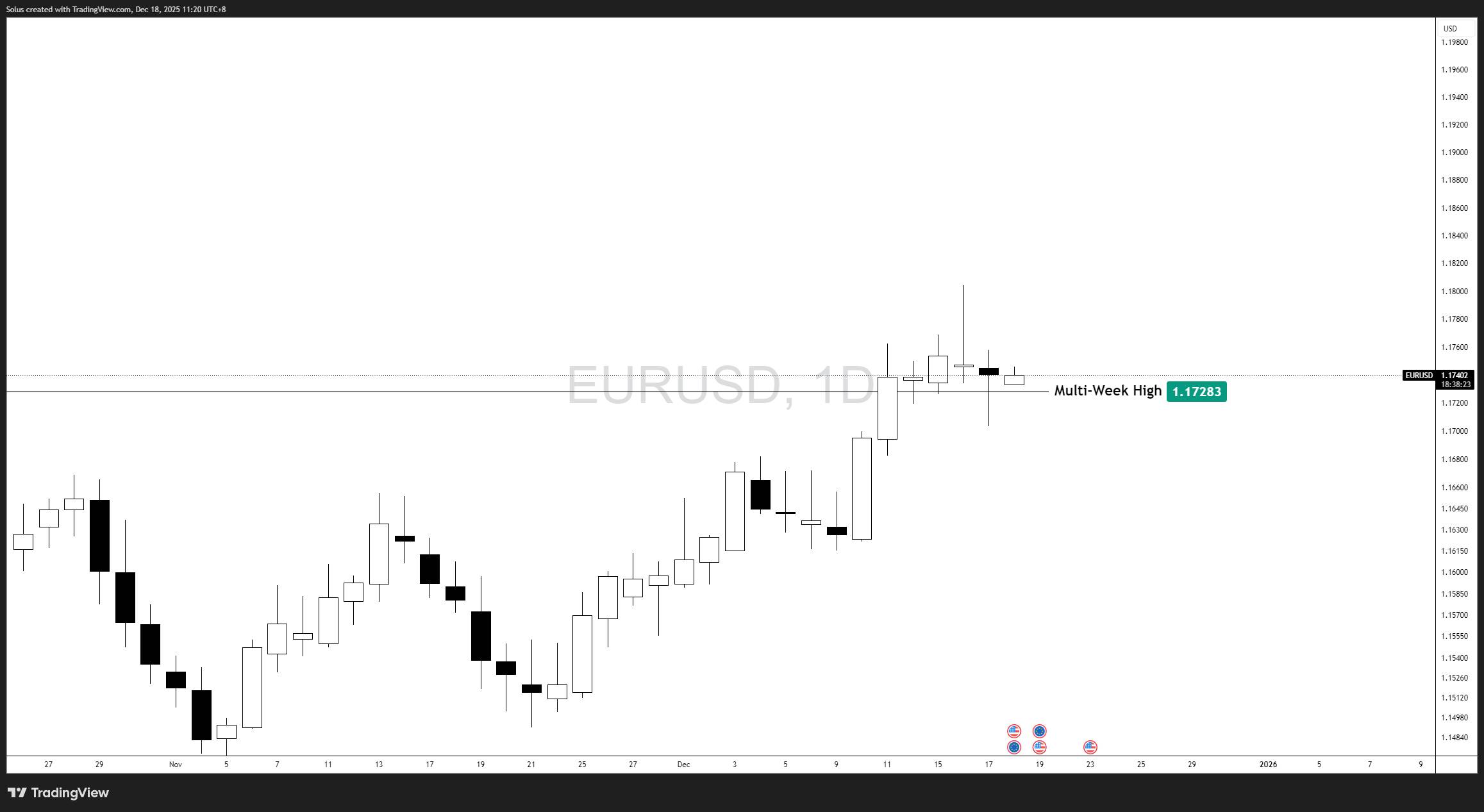
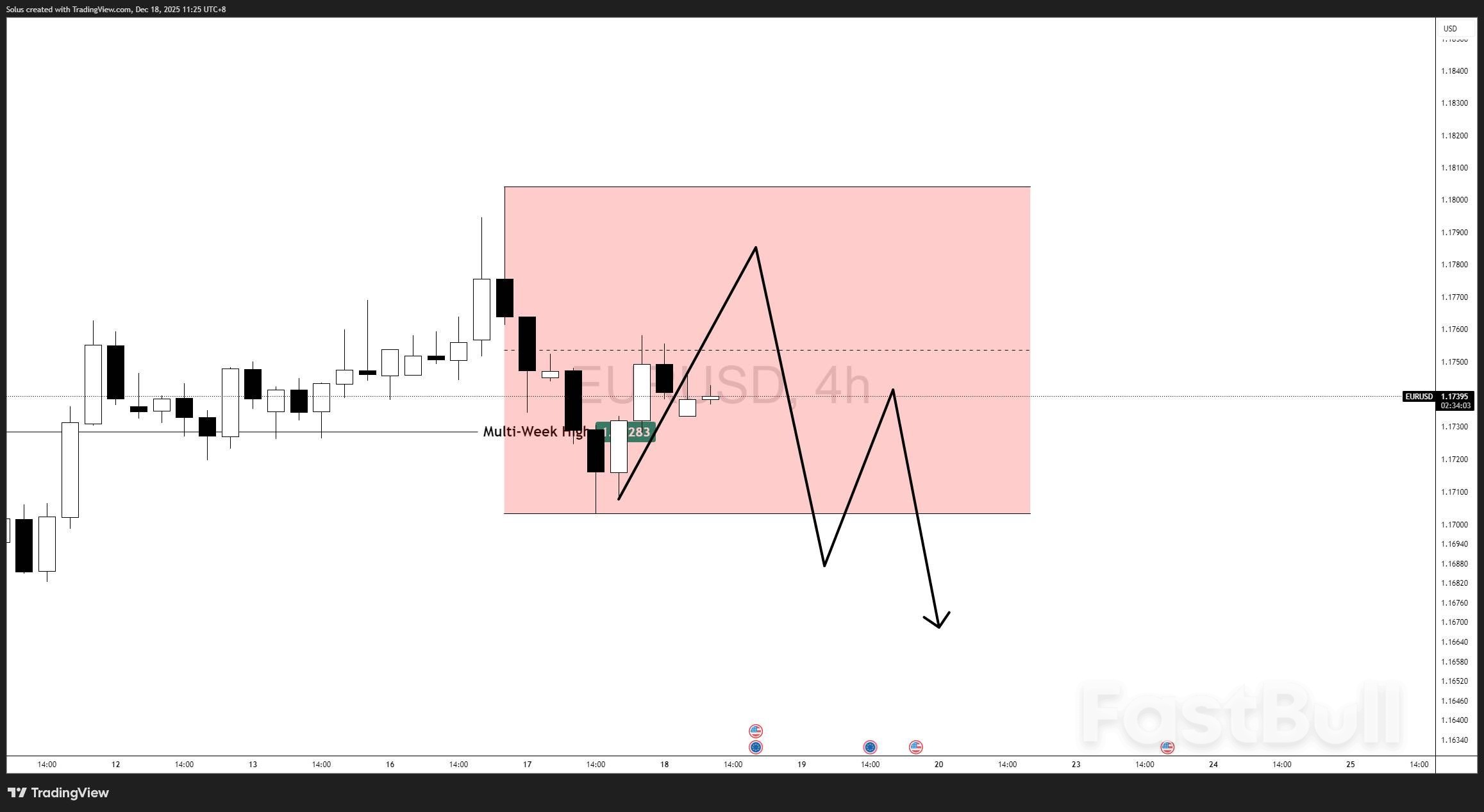
          · EUR/USD remains structurally bullish, holding above the 1.1728 multi-week high despite entering a consolidation phase.
          · Dollar softness and narrowing Fed-ECB policy divergence continue to provide a supportive backdrop for euro strength.
          · Technical bias favors continuation, with strength expected to return if price reclaims and holds above equilibrium (range midpoint).

          EUR/USD Market Narrative – Consolidation, Not Reversal

          EUR/USD is currently transitioning from impulsive expansion into balance, consolidating above the 1.1728 multi-week high. This behavior reflects acceptance at higher prices, rather than exhaustion or trend failure.

          After reclaiming a key structural level, the market has paused to allow two-sided trade — a natural and healthy process in trending environments. Importantly, price has not collapsed back below prior resistance, nor has it shown aggressive distribution. Instead, EUR/USD is oscillating within a defined range, signaling re-pricing rather than rejection.

          From a macro perspective, this consolidation is occurring against a backdrop of persistent USD softness. The Federal Reserve's shift toward rate cuts and a more data-dependent stance has reduced the dollar's yield advantage, while expectations for aggressive ECB easing remain restrained. This narrowing policy divergence continues to favor EUR/USD on a medium-term basis.

          As a result, the current price action should be viewed as digesting gains, not undoing them.

          How the Previous EUR/USD Forecast Materialized

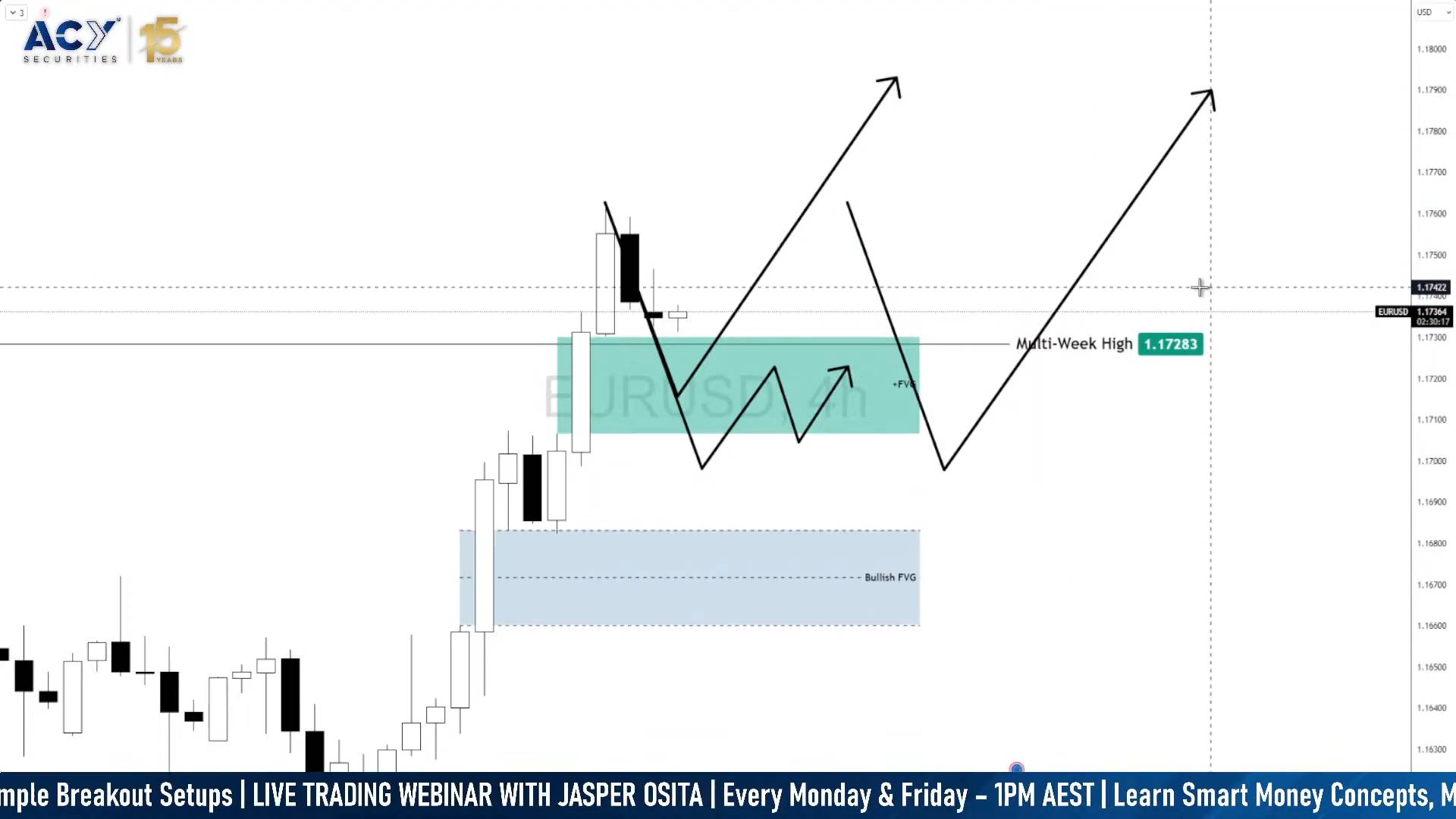
          The prior EUR/USD forecast did not call for immediate continuation higher. Instead, it emphasized that acceptance above the multi-week high would be more important than chasing momentum.

          Specifically, the expectation was for:

          · A pullback or consolidation above 1.1728
          · Shallow retracements rather than structural failure
          · A pause that allows the market to rebalance before the next move

          That scenario has materialized cleanly.

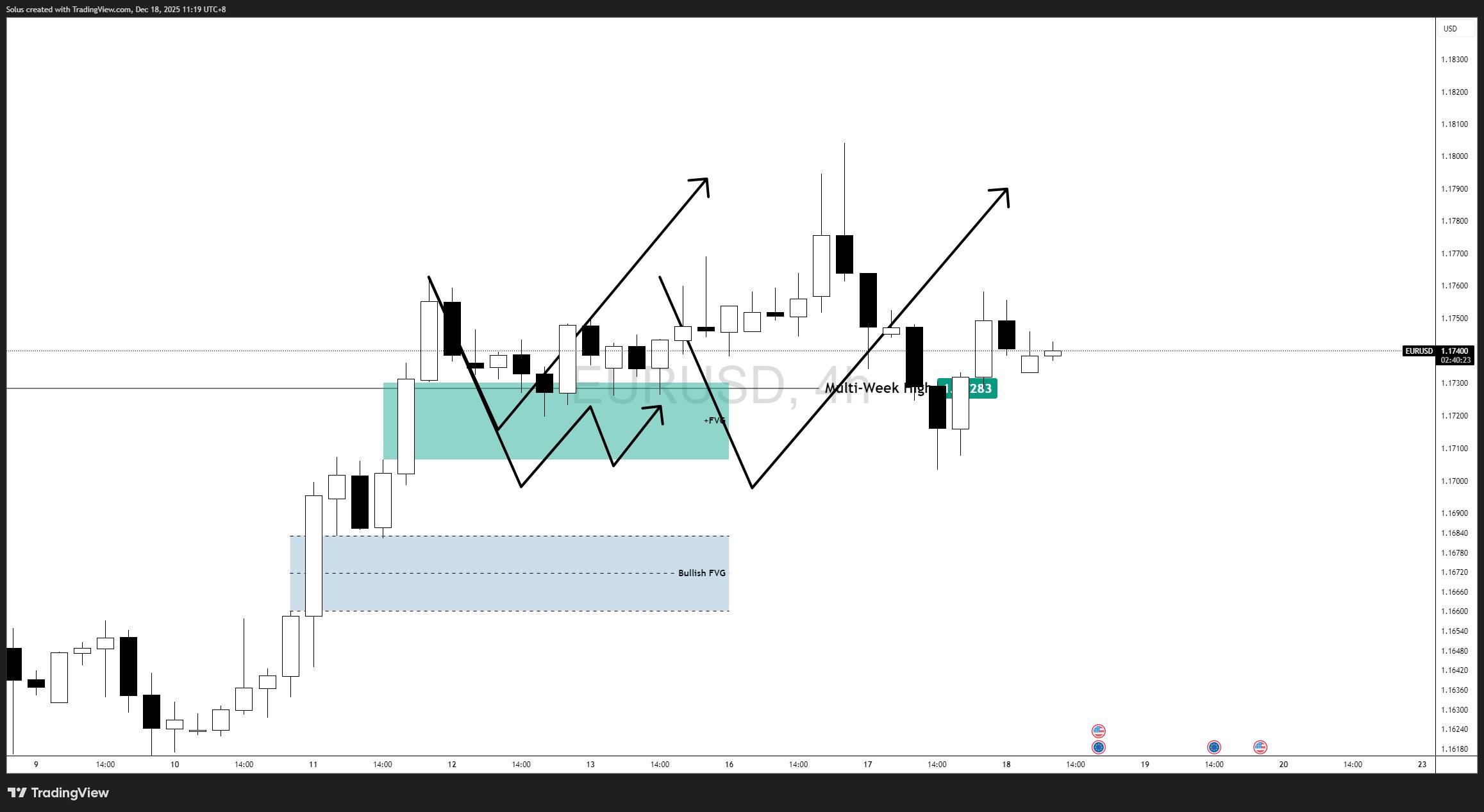
          Following the breakout, EUR/USD pulled back into the highlighted re-pricing zone, held above the multi-week high, and formed higher lows rather than accelerating lower. Sellers failed to force acceptance back below prior resistance, while buyers consistently absorbed downside pressure.

          This confirms that the breakout was structural, not false. The current consolidation reflects controlled digestion, aligning with the original expectation that the market would pause before determining its next expansion leg.

          In short, the market followed process, not prediction — rewarding patience and structural alignment rather than aggressive positioning.

          Technical Structure – Balance Around Key Levels

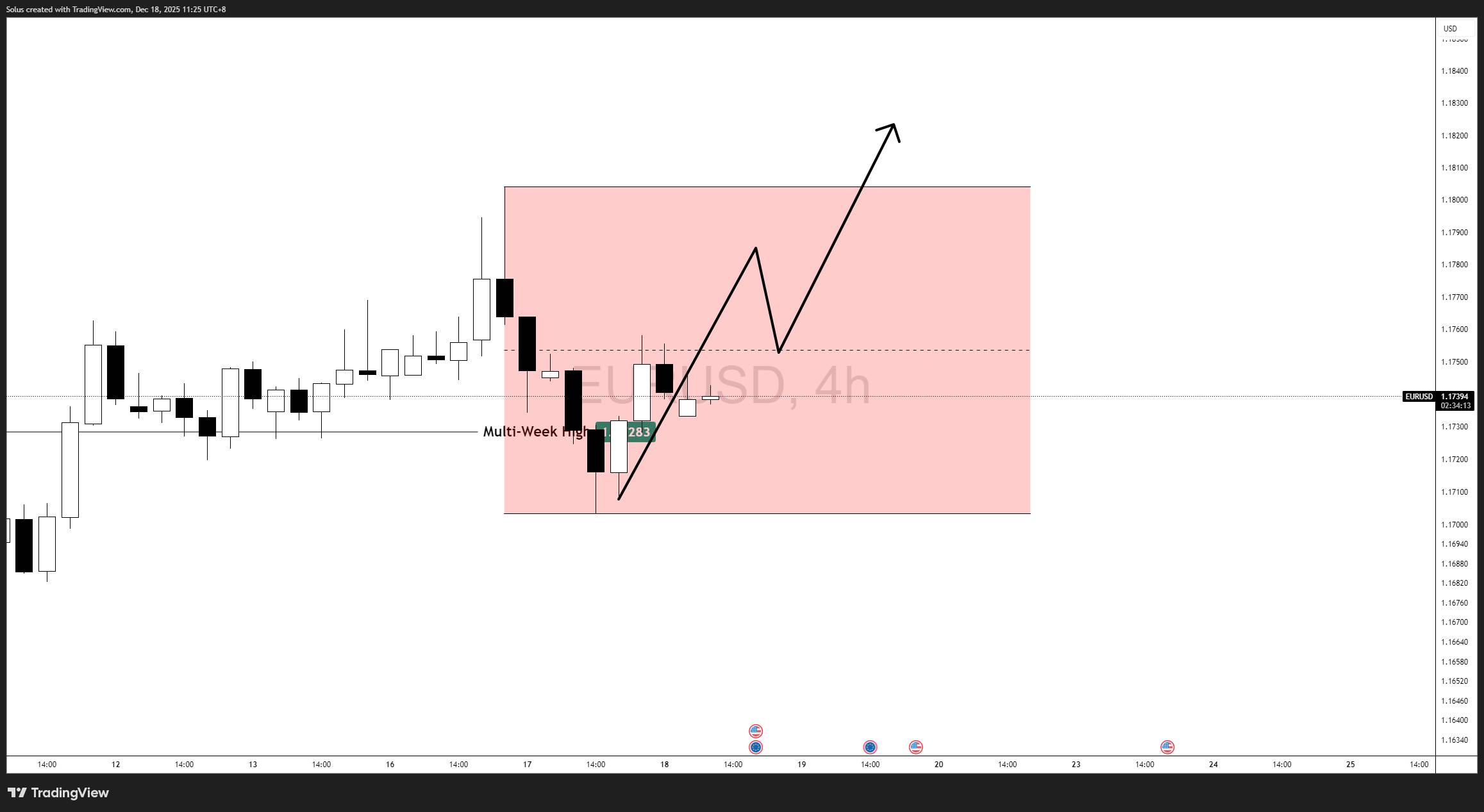
          EUR/USD is now trading inside a defined range, with both buyers and sellers actively participating. In this environment, the most important reference is no longer the highs or lows — but equilibrium, or the middle of the range.

          Equilibrium represents fair value. How price behaves around this level reveals intent.

          Bullish Scenario – Strength Returns Above Equilibrium

          The bullish scenario re-engages if EUR/USD breaks above the equilibrium level and holds above it.

          Acceptance above the midpoint of the range signals that buyers are willing to transact at premium prices, not just defend the lows. In strong trends, equilibrium often acts as a launchpad, not resistance.

          If price reclaims equilibrium and stays above it:

          · Higher-timeframe bullish structure remains intact
          · Liquidity below has already been absorbed
          · Momentum can re-expand without revisiting range lows
          · USD weakness and narrowing rate differentials reinforce upside pressure
          Bullish expectation:

          Rotation toward the range high, followed by a potential continuation toward new multi-week highs if momentum builds.

          Bearish Scenario – Deeper Rebalancing Below Equilibrium

          The bearish scenario develops if EUR/USD fails to reclaim equilibrium and consistently trades below the midpoint of the range.

          In this case, equilibrium acts as resistance, suggesting sellers control fair value. This would likely lead to:

          · Further rotation toward the lower boundary of the range
          · A deeper corrective move into prior demand
          · Short-term bearish momentum

          However, it is critical to distinguish correction from reversal. Even a sustained move below equilibrium would still be considered rebalancing, unless broader daily structure breaks decisively.

          Final Thoughts

          EUR/USD is not weakening — it is pausing with structure intact.

          The market is currently balanced, and equilibrium is the line that separates continuation from deeper correction. Acceptance above it favors renewed strength, while failure keeps price rotational.

          Until that decision is made, patience remains the edge.

          Source: ACY

          To stay updated on all economic events of today, please check out our Economic calendar
          Risk Warnings and Disclaimers
          You understand and acknowledge that there is a high degree of risk involved in trading. Following any strategies or investment methods may lead to potential losses. The content on the site is provided by our contributors and analysts for information purposes only. You are solely responsible for determining whether any trading assets, securities, strategy, or any other product is suitable for investing based on your own investment objectives and financial situation.
          Add to Favorites
          Share

          China's CICC Shares Jump After Plan To Buy Two Rivals In $16 Billion Stock-swap Deal

          Justin

          Stocks

          China International Capital Corpshares jumped as much as 10% on Thursday after it detailed plans to buy two rivals in a share-swap deal worth about $16 billion, potentially creating China's fourth-biggest investment bank by assets.

          Shares of acquisition targets Dongxing Securitiesand Cinda Securitiesalso surged.

          State-owned CICC said the acquisitions would help broaden its business network, expand its client base and strengthen capital as it seeks to become a top-tier investment bank.

          They would also answer a government call to build globally competitive investment banks through industry consolidation.

          The acquisitions would create China's fourth-largest investment bank, with total assets of more than 1 trillion yuan ($142 billion), showed an estimate from Soochow Securities.

          "The combined entity will have much bigger capital strength and will be more resilient operationally," China Merchants Securities said in a client note. The deals "could rekindle expectations of further industry consolidation," it said.

          In an exchange filing late on Wednesday, CICC said it will issue 3 billion shares at 36.91 yuan ($5.24) each in exchange for all outstanding shares of Dongxing and Cinda.

          That price is 6% higher than CICC's closing share price of 34.89 yuan on November 19, when trading of its shares was suspended pending details of the transaction.

          The deal values Dongxing at 16.14 yuan a share, 23% above its market price of 13.13 yuan, and Cinda at 19.15 yuan, a premium of 8%.

          CICC shares in Shanghai jumped 10% early on Thursday after the trading suspension was lifted, before paring gains to 5%. The bank is also listed in Hong Kongwhere its shares rose 4% on the resumption of trade.

          Dongxing Securities shares jumped by their daily upper limit of 10%, while those of Cinda Securities climbed 5%.

          All three companies are controlled by sovereign fund Central Huijin Investment (SASAWH.UL).

          The government has been eager for consolidation to foster globally competitive investment banks. Domestically, about 150 participants make up a $1.6 trillion industry.

          CICC said the acquisitions would boost outlets by nearly 80% to 436, increase retail clients and strengthen business in southern Fujian and northern Liaoning provinces.

          "The restructuring would help the company develop into a globally competitive, first-rate investment bank," CICC said. It also said it will "support China's capital market reform and high-quality growth of the securities industry".

          ($1 = 7.0440 Chinese yuan renminbi)

          Source: TradingView

          Risk Warnings and Disclaimers
          You understand and acknowledge that there is a high degree of risk involved in trading. Following any strategies or investment methods may lead to potential losses. The content on the site is provided by our contributors and analysts for information purposes only. You are solely responsible for determining whether any trading assets, securities, strategy, or any other product is suitable for investing based on your own investment objectives and financial situation.
          Add to Favorites
          Share

          US Minerals Quest Steps Into Korea Governance Mess

          Winkelmann

          Commodity

          Political

          When U.S. President Donald Trump signed an executive order to rebrand the Department of Defense as the Department of War, he was probably not thinking of corporate governance battles in South Korea. Nevertheless, his administration's decision to build a new zinc refinery stateside has dragged it into one of the country's messiest takeover feuds. The saga is another reminder of the pitfalls of state meddling in private firms.

          There's little to fault the strategic rationale of joining forces with Korea Zincin a $7.4 billion refining project. The United States is keen to cut its reliance on China for materials vital to chips, electronics and weapons. The $18 billion Korean company is the world's top zinc smelter and produces 14 of the 54 critical minerals designated by Washington as essential to national and economic security. The latest agreement envisages Korea Zinc building and operating a large-scale facility in Tennessee that will begin producing zinc, lead and copper before expanding to strategic minerals like antimony and germanium. Commerce Secretary Howard Lutnick hailedthe initiative as a "big win for America".

          The financial small print is messier. Korea Zinc will get access to up to $4.7 billion of loans plus $210 million in subsidies for the project. But in an odd move, it is also creating a joint venture that will inject $1.9 billion into Korea Zinc in return for a roughly 10% stake. The company will in turn take a similar shareholding in the joint venture, in which the Department of Defense will hold a 40% voting stake. The new unit will not directly own or operate the U.S. refinery, which will be wholly owned by Korea Zinc.

          The company has yet to explain the reason for diluting investors or for creating a new circular shareholding of the type that many of South Korea's family-controlled conglomerates are unwinding. True, this joint venture would allow Korea Zinc to keep full control of the U.S. smelter, according to someone familiar with the matter. But the biggest beneficiary may be Chair Yun B. Choi, who since October last year has been locked in a fierce battle for control with the company's top shareholders, Young Poong and private equity giant MBK Partners. Issuing shares to a potential ally might tip the balance of power in Choi's favour.

          It's not clear that the U.S. government realised it was potentially picking sides in a bitter corporate dispute. The Department of Defense did not respond to a request for comment. However, Young Poong and MBK are legally challenging the share issue, partly on grounds that it is designed to "preserve" Choi's grip over the company. The project's fate will now be decided by a court in Seoul.

          The outcome could be an embarrassing hitch for Trump's administration, which is eager to buy shares in companies it deems strategic. In August, for example, the government took a 10% stake in ailing chipmaker Intel. Korea Zinc is a reminder that sometimes the art of the deal is not so different from the art of war.

          CONTEXT NEWS

          Korea Zinc's two major shareholders, Young Poong and MBK Partners, announced on December 16 that they have filed for an injunction with the Seoul District Court to block the company's plan to issue new shares as part of a $7.4 billion critical minerals project with the United States government.

          The pair, which together holds roughly 46% of Korea Zinc, said they were not opposed to the company's decision to build a new U.S. smelter but objected to the proposed issuance of new shares worth $1.9 billion to a joint venture backed by the U.S. government and unnamed U.S.-based strategic investors. The joint venture would own roughly 10% of Korea Zinc, diluting the two shareholders' holdings and helping the company's chairman cement control of the firm, the pair said.

          Young Poong and MBK have been trying to wrest control of the company from current management led by Chairman Yun B. Choi. He and his backers have a 32% stake in Korea Zinc but have 11 members on the 15-strong board.

          Korea Zinc on December 15 unveiled a joint venture with the U.S. Department of Defense and other unnamed investors. The company will issue 2.2 million new shares to the joint venture. It will also inject $89.99 million in capital in exchange for a 9.99% equity stake in the entity, in which the Department of Defense will hold a 40% voting right, according to filings.

          Korea Zinc will then inject $2.5 billion into a wholly owned U.S. subsidiary that will build and operate a smelter in Tennessee. The Department of Defense and other financial institutions will contribute up to $4.7 billion in loans, while the Department of Commerce will contribute $210 million in subsidies under the CHIPS and Science Act. Besides zinc, the project also aims to refine copper and a range of other minerals considered critical by the U.S. government, including antimony and germanium.

          As of mid-morning on December 18, Korea Zinc shares had fallen roughly 16% to 1,337,000 won since December 15. The Department of Defense did not respond to a request for comment.

          Source: TradingView

          Risk Warnings and Disclaimers
          You understand and acknowledge that there is a high degree of risk involved in trading. Following any strategies or investment methods may lead to potential losses. The content on the site is provided by our contributors and analysts for information purposes only. You are solely responsible for determining whether any trading assets, securities, strategy, or any other product is suitable for investing based on your own investment objectives and financial situation.
          Add to Favorites
          Share

          Japanese Bonds Draw Largest Foreign Inflow In Eight Months

          Winkelmann

          Forex

          Bond

          Foreign investors bought the most Japanese bonds in eight months last week as rising yields attracted overseas demand.

          Net purchases totaled ¥1.41 trillion ($9.1 billion), the largest since the period ended April 11, preliminary Ministry of Finance data showed Thursday. Demand was also evident in the Dec. 11 auction of 20-year notes, where the bid-to-cover ratio climbed to a five-year high.

          Overseas funds are on track to purchase the most Japanese government bonds this year since at least 2005, lured by multi-decade-high yields and extra returns from hedging against the yen. With the Bank of Japan stepping back through quantitative tightening, foreign investors have increasingly filled the gap — a shift that could introduce more volatility into what was once a placid market.

          "Overseas investors' demand for Japanese bonds has increased now that yields have reached sufficiently high levels," said Akira Moroga, chief market strategist at Aozora Bank Ltd. in Tokyo. "Even if the BOJ continues to raise interest rates, it may be the case that super-long yields are sufficiently high too."

          The BOJ is expected to raise its policy rate by 25 basis points to 0.75% on Friday, according to economists' forecasts. Overnight-indexed swaps suggest the central bank will lift rates once more by October 2026.

          The ministry's weekly data do not include details by bond type, investor category or geographic location.

          Source: Bloomberg Europe

          Risk Warnings and Disclaimers
          You understand and acknowledge that there is a high degree of risk involved in trading. Following any strategies or investment methods may lead to potential losses. The content on the site is provided by our contributors and analysts for information purposes only. You are solely responsible for determining whether any trading assets, securities, strategy, or any other product is suitable for investing based on your own investment objectives and financial situation.
          Add to Favorites
          Share

          Rate Cut Expectations and Geopolitical Tensions Raised, Markets Focus on Central Bank Decisions and Energy Risks

          FastBull Featured

          Daily News

          [Quick Facts]

          1. The U.S. prepares new sanctions on Russia if Putin rejects the Ukraine-Russia Peace Deal.
          2. Venezuela's largest refinery restarts production.
          3. Waller: Still room for a 50–100 bps rate cut.
          4. Trump orders a full blockade of sanctioned oil tankers entering or leaving Venezuela.
          5. UK inflation unexpectedly falls to an 8-month low, fueling rate cut expectations.
          6. ECB expected to hold rates steady Thursday; Economic resilience may close the door on cuts.
          7. U.S. President Trump may take military action against Venezuela.
          8. New Zealand Q3 GDP rebounds more than expected, showing the effect of rate cuts.

          [News Details]

          The U.S. prepares new sanctions on Russia if Putin rejects the Ukraine-Russia Peace Deal
          According to informed sources, the United States is preparing a new round of sanctions targeting Russia’s energy sector should Russian President Vladimir Putin reject a Ukraine-Russia peace agreement, in order to increase pressure on Moscow. Sources say the U.S. is considering various options, such as targeting vessels in the so-called "shadow fleet" used to transport Russian crude, as well as traders facilitating related transactions. Some sources indicate that new measures could be announced as early as this week.
          Sources reveal that U.S. Treasury Secretary Scott Bessent discussed the plans earlier this week during meetings with ambassadors from European countries. After the meetings, he posted on the social media platform X that President Trump is a president for peace, and reiterated that under his leadership, the U.S. will continue focusing on ending the Russia-Ukraine conflict. Sources note that the final decision rests with Trump. Agencies are tasked with preparing different options for the president to execute, according to a White House statement. The president has not yet made any new decisions on sanctions.
          Citing Interfax, Kremlin spokesman Dmitry Peskov told reporters Wednesday that the Kremlin is aware some U.S. officials are considering new sanctions on Russia. He noted that any sanctions would clearly hinder the process of rebuilding bilateral relations.
          Venezuela's largest refinery restarts production
          Venezuela's largest refinery, the Amuay Refinery, has resumed operations after a power outage. The facility is a key part of PDVSA's Paraguana Refining Center, with a daily capacity of 645,000 barrels. Its stable operation is critical for domestic fuel supply and oil exports.
          Waller: Still room for a 50–100 bps rate cut
          Federal Reserve Governor Christopher Waller stated at a Yale University event on Wednesday that, following last week's 25-basis-point rate cut, the current interest rate level remains slightly restrictive, leaving room for a further reduction of 50–100 basis points to bring the federal funds rate below 3%. This, he believes, is a neutral level that would not drag on the economy.
          He expressed little concern about inflation remaining above the Fed's 2% target, believing tariffs will not sustainably push up prices, and expects inflation to start falling over the next 3–4 months. However, he is worried about short-term labor market conditions but thinks jobs will still grow next year. Overall economic prospects mean there is no need to rush cuts; they can proceed steadily.
          Waller is scheduled to meet with President Trump on Wednesday afternoon for an interview to determine whether he will be nominated as the next Fed Chair. He emphasized he will stress in person the importance of the Fed's independent decision-making, something he has worked toward during his 20 years at the Fed. He also believes having breakfast with the Treasury Secretary every two weeks is an appropriate communication channel between the White House and the Fed.
          Trump orders a full blockade of sanctioned oil tankers entering or leaving Venezuela
          President Trump has ordered a full blockade of sanctioned oil tankers entering or leaving Venezuela. Markets worry that Venezuela's oil storage capacity is increasingly strained, which could force state oil company PDVSA — producing nearly 1 million barrels per day — to shut down some wells.
          Consultancy Rapidan Energy Group estimates the chance of U.S. military action against Venezuela has risen from 40% to 60%, and the probability of a regime change next year has increased from 60% to 70%. However, Venezuela's output is far below its level a decade ago; last month it unloaded nearly 590,000 barrels per day onto tankers, compared with global daily consumption of over 100 million barrels. ING commodity strategy head Warren Patterson notes that, given expectations of severe oil oversupply next year, markets are less concerned about supply risks.
          UK inflation unexpectedly falls to an 8-month low, fueling rate cut expectations
          UK November CPI rose 3.2% YoY, the smallest increase in eight months (vs. market forecast 3.5%, previous reading 3.6%). MoM decline was 0.2% (previous reading +0.1%). Core CPI rose 3.2% YoY (forecast 3.4%, previous reading 3.4%).
          Following the data release, expectations for Bank of England rate cuts rose sharply. Besides fully pricing in a 0.25% cut tomorrow, Bloomberg data shows investors previously expected another 0.68%+ of cuts next year, about 0.1% higher than before the release — equivalent to a 72% chance of three cuts. Sterling fell from near 2-month highs, briefly dropping below 1.34 vs USD.
          ECB expected to hold rates steady Thursday; Economic resilience may close the door on cuts
          Markets widely expect the ECB to keep rates unchanged at Thursday's meeting and signal clearly that rate cuts are not on the table in the near term. The backdrop is that the eurozone economy has shown resilience amid global trade shocks, while inflation remains stable near the central bank's target.
          Latest data show eurozone growth slightly better than ECB forecasts, mainly due to exporters effectively countering U.S. tariffs and German domestic spending offsetting manufacturing weakness. Meanwhile, inflation has remained near the ECB's 2% target, supported by rising services prices. Analysts believe the ECB may upgrade growth and inflation forecasts at this meeting, effectively signaling the end of its easing cycle.
          Although some traders have begun betting on future rate hikes, and comments from certain ECB officials have fueled speculation, most analysts think discussing hikes is premature, given significant spare capacity in manufacturing. Economists expect the ECB to keep rates steady through 2026 and 2027. Stable labor markets, expanding services, and Germany's fiscal stimulus will continue to support the eurozone economy in the coming months.
          U.S. President Trump may take military action against Venezuela
          Reports say the U.S. aircraft carrier strike group USS Gerald R. Ford is approaching Venezuela and within range for rapid air strikes. Earlier Wednesday, after Trump threatened Venezuela, three Boeing F/A-18E/F Super Hornet and two Boeing EA-18G Growler aircraft were sent toward Venezuela's coast. U.S. journalist Tucker Carlson cited a member of Congress saying President Trump may declare war on Venezuela at 10 a.m. Beijing time on December 18th. Geopolitical tensions could boost precious metals and oil prices in the short term.
          New Zealand Q3 GDP rebounds more than expected, showing the effect of rate cuts
          Latest data show New Zealand's economy recovered more strongly than expected in Q3. The effects of interest rate cuts are beginning to show, helping the economy rebound after the contraction in Q2.
          Statistics New Zealand reported Thursday that Q3 GDP grew 1.1% QoQ, above economists' forecast of 0.9%. After a notable recession last year, the economy is finally responding positively to the central bank's aggressive rate cuts, with improvements seen in retail spending, manufacturing, and construction.
          Analysts note that with substantial spare capacity remaining in the economy, this recovery is unlikely to stoke inflation pressures effectively over the next year.

          [Today's Focus]

          UTC+8 20:00 BoE December Interest Rate Decision
          UTC+8 21:15 ECB December Interest Rate Decision
          UTC+8 21:30 US November CPI
          UTC+8 21:45 ECB President Lagarde holds monetary policy press conference
          Risk Warnings and Disclaimers
          You understand and acknowledge that there is a high degree of risk involved in trading. Following any strategies or investment methods may lead to potential losses. The content on the site is provided by our contributors and analysts for information purposes only. You are solely responsible for determining whether any trading assets, securities, strategy, or any other product is suitable for investing based on your own investment objectives and financial situation.
          Add to Favorites
          Share

          China Seeks To Mediate Thai-Cambodia Clash Trump Says He Ended

          Justin

          Political

          Economic

          China is dispatching a diplomat to Cambodia and Thailand as a new bout of violence between the two Southeast Asian nations threatens to derail a ceasefire brokered by President Donald Trump.

          Deng Xijun, China's Special Envoy for Asian Affairs, will travel to Cambodia and Thailand on Thursday to conduct mediation, the Foreign Ministry in Beijing said in a statement.

          "China closely follows the ongoing border conflict between the two countries," according to the statement. "Through its own way, China has been working actively for deescalation."

          Trump has pushed for peace since the conflict spiked in July and has threatened both with trade retaliation if either nation violates the terms of an October peace declaration he orchestrated. While Deng has traveled at least twice to seek mediation, this is his first since the so-called Kuala Lumpur Peace Accords were signed.

          Clashes along the 800-kilometer (497-mile) border resumed earlier this month, including Thai airstrikes on Cambodian military targets. More than two dozen people have been killed, including 16 Thai soldiers and 12 Cambodian civilians, and over half a million people have fled the area because of the fighting.

          China has engaged with both sides since the start of the violence, but has kept a much lower profile than the US as Beijing generally avoids publicly intervening in conflicts, beyond seeking to facilitate discussions.

          The Trump administration has sought to highlight that China hasn't played a role in the peace process. The White House didn't immediately respond to a request for comment sent outside normal working hours.

          Trump called both leaders last week to push again for a ceasefire, although the fighting has since continued.

          Malaysia's Prime Minister Anwar Ibrahim, who chairs Asean this year, said Wednesday that he's been in contact with the leaders as well, and that both told him they want to resolve their border clashes as soon as possible.

          Deng's trip also comes as Cambodia's use of Chinese weapons comes into focus, following reports that the Thai military seized a large number of Chinese-made weapons from Cambodian soldiers.

          China's Foreign Ministry spokesman Guo Jiakun didn't confirm nor deny the news at a press briefing Wednesday, but reiterated that Beijing has had "normal defense cooperation" with both countries and that such cooperation doesn't target any third party.

          Thailand, which is a treaty ally with the US, has far larger and more sophisticated armed forces than Cambodia. Its attacks on Cambodia have included the use of American F-16 fighter jets.

          Source: Bloomberg Europe

          To stay updated on all economic events of today, please check out our Economic calendar
          Risk Warnings and Disclaimers
          You understand and acknowledge that there is a high degree of risk involved in trading. Following any strategies or investment methods may lead to potential losses. The content on the site is provided by our contributors and analysts for information purposes only. You are solely responsible for determining whether any trading assets, securities, strategy, or any other product is suitable for investing based on your own investment objectives and financial situation.
          Add to Favorites
          Share
          FastBull
          Copyright © 2025 FastBull Ltd

          728 RM B 7/F GEE LOK IND BLDG NO 34 HUNG TO RD KWUN TONG KLN HONG KONG

          TelegramInstagramTwitterfacebooklinkedin
          App Store Google Play Google Play
          Products
          Charts

          Chats

          Q&A with Experts
          Screeners
          Economic Calendar
          Data
          Tools
          Membership
          Features
          Function
          Markets
          Copy Trading
          Latest Signals
          Contests
          News
          Analysis
          24/7
          Columns
          Education
          Company
          Careers
          About Us
          Contact Us
          Advertising
          Help Center
          Feedback
          User Agreement
          Privacy Policy
          Personal Information Protection Statement
          Business

          White Label

          Data API

          Web Plug-ins

          Poster Maker

          Affiliate Program

          Risk Disclosure

          The risk of loss in trading financial instruments such as stocks, FX, commodities, futures, bonds, ETFs and crypto can be substantial. You may sustain a total loss of the funds that you deposit with your broker. Therefore, you should carefully consider whether such trading is suitable for you in light of your circumstances and financial resources.

          No decision to invest should be made without thoroughly conducting due diligence by yourself or consulting with your financial advisors. Our web content might not suit you since we don't know your financial conditions and investment needs. Our financial information might have latency or contain inaccuracy, so you should be fully responsible for any of your trading and investment decisions. The company will not be responsible for your capital loss.

          Without getting permission from the website, you are not allowed to copy the website's graphics, texts, or trademarks. Intellectual property rights in the content or data incorporated into this website belong to its providers and exchange merchants.

          Not Logged In

          Log in to access more features

          FastBull Membership

          Not yet

          Purchase

          Become a signal provider
          Help Center
          Customer Service
          Dark Mode
          Price Up/Down Colors

          Log In

          Sign Up

          Position
          Layout
          Fullscreen
          Default to Chart
          The chart page opens by default when you visit fastbull.com