• Trade
  • Markets
  • Copy
  • Contests
  • News
  • 24/7
  • Calendar
  • Q&A
  • Chats
Trending
Screeners
SYMBOL
LAST
BID
ASK
HIGH
LOW
NET CHG.
%CHG.
SPREAD
SPX
S&P 500 Index
6836.20
6836.20
6836.20
6878.28
6827.18
-34.20
-0.50%
--
DJI
Dow Jones Industrial Average
47678.38
47678.38
47678.38
47971.51
47611.93
-276.60
-0.58%
--
IXIC
NASDAQ Composite Index
23502.70
23502.70
23502.70
23698.93
23455.05
-75.42
-0.32%
--
USDX
US Dollar Index
99.020
99.100
99.020
99.160
98.730
+0.070
+ 0.07%
--
EURUSD
Euro / US Dollar
1.16388
1.16395
1.16388
1.16717
1.16162
-0.00038
-0.03%
--
GBPUSD
Pound Sterling / US Dollar
1.33259
1.33268
1.33259
1.33462
1.33053
-0.00053
-0.04%
--
XAUUSD
Gold / US Dollar
4192.66
4193.10
4192.66
4218.85
4175.92
-5.25
-0.13%
--
WTI
Light Sweet Crude Oil
58.629
58.659
58.629
60.084
58.495
-1.180
-1.97%
--

Community Accounts

Signal Accounts
--
Profit Accounts
--
Loss Accounts
--
View More

Become a signal provider

Sell trading signals to earn additional income

View More

Guide to Copy Trading

Get started with ease and confidence

View More

Signal Accounts for Members

All Signal Accounts

Best Return
  • Best Return
  • Best P/L
  • Best MDD
Past 1W
  • Past 1W
  • Past 1M
  • Past 1Y

All Contests

  • All
  • Trump Updates
  • Recommend
  • Stocks
  • Cryptocurrencies
  • Central Banks
  • Featured News
Top News Only
Share

President Trump Is Committed To The Continued Cessation Of Violence And Expects The Governments Of Cambodia And Thailand To Fully Honor Their Commitments To End This Conflict - Senior White House Official

Share

[Water Overflows From Spent Fuel Pool At Japanese Nuclear Facility] According To Japan's Nuclear Waste Management Company, Following A Strong Earthquake Off The Coast Of Aomori Prefecture Late On December 8th, Workers At The Nuclear Waste Treatment Plant In Rokkasho Village, Aomori Prefecture, Discovered "at Least 100 Liters Of Water" On The Ground Around The Spent Fuel Pool During An Inspection. Analysis Suggests This Water "may Have Overflowed Due To The Earthquake's Shaking." However, It Is Reported That The Overflowed Water "remains Inside The Building And Has Not Affected The External Environment."

Share

Trump Says Netflix, Paramount Are Not His Friends As Warner Bros Fight Heats Up

Share

On Monday (December 8), The ICE Dollar Index Rose 0.11% To 99.102 In Late New York Trading, Trading Between 98.794 And 99.227, Following A Significant Rally After The US Stock Market Opened. The Bloomberg Dollar Index Rose 0.12% To 1213.90, Trading Between 1210.34 And 1214.88

Share

Trump: Has Not Spoken To Kushner About Paramount Bid

Share

US President Trump: I Don’t Know Much About Paramount’s Hostile Takeover Bid For Warner Bros. Discovery

Share

Trump: I Want To Do What's Right

Share

Trump On Bids For Warner Bros: I'd Have To See Netflix, Paramount Percentages Of Market

Share

Trump On Vaccines: We Are Looking At A Lot Of Things

Share

Trump: EU Fine On X A “Nasty One”

Share

Trump: I Don't Want To Pay Insurance Companies, They Are Owned By Democrats

Share

Trump: On Healthcare, I Want The Money To Be Paid To The People

Share

US Treasury Secretary Bessenter: We Are Still Working Towards A Trade Agreement With India

Share

US Natural Gas Futures Drop 7% On Less Cold Forecasts, Near-Record Output

Share

[Trump: The US Will Not Experience Deflation] US President Trump Believes That US Inflation Will Decline Slightly Further, But There Will Be No Deflation

Share

Trump: We Will End Up Putting Severe Tariffs On Fertilizer From Canada If We Have To

Share

Bessent: We Are Still Working On India Trade Deal

Share

Brent Crude Futures Settle At $62.49/Bbl, Down $1.26, 1.98 Percent

Share

Trump: Farming Equipment Has Gotten Too Expensive

Share

Trump: We Will Take Off A Lot Of Environment Rules That Affect Tractor Companies

TIME
ACT
FCST
PREV
France Trade Balance (SA) (Oct)

A:--

F: --

P: --
Euro Zone Employment YoY (SA) (Q3)

A:--

F: --

P: --
Canada Part-Time Employment (SA) (Nov)

A:--

F: --

P: --

Canada Unemployment Rate (SA) (Nov)

A:--

F: --

P: --

Canada Full-time Employment (SA) (Nov)

A:--

F: --

P: --

Canada Labor Force Participation Rate (SA) (Nov)

A:--

F: --

P: --

Canada Employment (SA) (Nov)

A:--

F: --

P: --

U.S. PCE Price Index MoM (Sept)

A:--

F: --

P: --

U.S. Personal Income MoM (Sept)

A:--

F: --

P: --

U.S. Core PCE Price Index MoM (Sept)

A:--

F: --

P: --

U.S. PCE Price Index YoY (SA) (Sept)

A:--

F: --

P: --

U.S. Core PCE Price Index YoY (Sept)

A:--

F: --

P: --

U.S. Personal Outlays MoM (SA) (Sept)

A:--

F: --

P: --
U.S. 5-10 Year-Ahead Inflation Expectations (Dec)

A:--

F: --

P: --

U.S. Real Personal Consumption Expenditures MoM (Sept)

A:--

F: --

P: --
U.S. Weekly Total Rig Count

A:--

F: --

P: --

U.S. Weekly Total Oil Rig Count

A:--

F: --

P: --

U.S. Consumer Credit (SA) (Oct)

A:--

F: --

P: --
China, Mainland Foreign Exchange Reserves (Nov)

A:--

F: --

P: --

Japan Trade Balance (Oct)

A:--

F: --

P: --

Japan Nominal GDP Revised QoQ (Q3)

A:--

F: --

P: --

China, Mainland Imports YoY (CNH) (Nov)

A:--

F: --

P: --

China, Mainland Exports (Nov)

A:--

F: --

P: --

China, Mainland Imports (CNH) (Nov)

A:--

F: --

P: --

China, Mainland Trade Balance (CNH) (Nov)

A:--

F: --

P: --

China, Mainland Exports YoY (USD) (Nov)

A:--

F: --

P: --

China, Mainland Imports YoY (USD) (Nov)

A:--

F: --

P: --

Germany Industrial Output MoM (SA) (Oct)

A:--

F: --

P: --
Euro Zone Sentix Investor Confidence Index (Dec)

A:--

F: --

P: --

Canada National Economic Confidence Index

A:--

F: --

P: --

U.K. BRC Like-For-Like Retail Sales YoY (Nov)

--

F: --

P: --

U.K. BRC Overall Retail Sales YoY (Nov)

--

F: --

P: --

Australia Overnight (Borrowing) Key Rate

--

F: --

P: --

RBA Rate Statement
RBA Press Conference
Germany Exports MoM (SA) (Oct)

--

F: --

P: --

U.S. NFIB Small Business Optimism Index (SA) (Nov)

--

F: --

P: --

Mexico 12-Month Inflation (CPI) (Nov)

--

F: --

P: --

Mexico Core CPI YoY (Nov)

--

F: --

P: --

Mexico PPI YoY (Nov)

--

F: --

P: --

U.S. Weekly Redbook Index YoY

--

F: --

P: --

U.S. JOLTS Job Openings (SA) (Oct)

--

F: --

P: --

China, Mainland M1 Money Supply YoY (Nov)

--

F: --

P: --

China, Mainland M0 Money Supply YoY (Nov)

--

F: --

P: --

China, Mainland M2 Money Supply YoY (Nov)

--

F: --

P: --

U.S. EIA Short-Term Crude Production Forecast For The Year (Dec)

--

F: --

P: --

U.S. EIA Natural Gas Production Forecast For The Next Year (Dec)

--

F: --

P: --

U.S. EIA Short-Term Crude Production Forecast For The Next Year (Dec)

--

F: --

P: --

EIA Monthly Short-Term Energy Outlook
U.S. API Weekly Gasoline Stocks

--

F: --

P: --

U.S. API Weekly Cushing Crude Oil Stocks

--

F: --

P: --

U.S. API Weekly Crude Oil Stocks

--

F: --

P: --

U.S. API Weekly Refined Oil Stocks

--

F: --

P: --

South Korea Unemployment Rate (SA) (Nov)

--

F: --

P: --

Japan Reuters Tankan Non-Manufacturers Index (Dec)

--

F: --

P: --

Japan Reuters Tankan Manufacturers Index (Dec)

--

F: --

P: --

Japan Domestic Enterprise Commodity Price Index MoM (Nov)

--

F: --

P: --

Japan Domestic Enterprise Commodity Price Index YoY (Nov)

--

F: --

P: --

China, Mainland PPI YoY (Nov)

--

F: --

P: --

China, Mainland CPI MoM (Nov)

--

F: --

P: --

Italy Industrial Output YoY (SA) (Oct)

--

F: --

P: --

Q&A with Experts
    • All
    • Chatrooms
    • Groups
    • Friends
    Connecting
    .
    .
    .
    Type here...
    Add Symbol or Code

      No matching data

      All
      Trump Updates
      Recommend
      Stocks
      Cryptocurrencies
      Central Banks
      Featured News
      • All
      • Russia-Ukraine Conflict
      • Middle East Flashpoint
      • All
      • Russia-Ukraine Conflict
      • Middle East Flashpoint
      Search
      Products

      Charts Free Forever

      Chats Q&A with Experts
      Screeners Economic Calendar Data Tools
      Membership Features
      Data Warehouse Market Trends Institutional Data Policy Rates Macro

      Market Trends

      Market Sentiment Order Book Forex Correlations

      Top Indicators

      Charts Free Forever
      Markets

      News

      News Analysis 24/7 Columns Education
      From Institutions From Analysts
      Topics Columnists

      Latest Views

      Latest Views

      Trending Topics

      Top Columnists

      Latest Update

      Signals

      Copy Rankings Latest Signals Become a signal provider AI Rating
      Contests
      Brokers

      Overview Brokers Assessment Rankings Regulators News Claims
      Broker listing Forex Brokers Comparison Tool Live Spread Comparison Scam
      Q&A Complaint Scam Alert Videos Tips to Detect Scam
      More

      Business
      Events
      Careers About Us Advertising Help Center

      White Label

      Data API

      Web Plug-ins

      Affiliate Program

      Awards Institution Evaluation IB Seminar Salon Event Exhibition
      Vietnam Thailand Singapore Dubai
      Fans Party Investment Sharing Session
      FastBull Summit BrokersView Expo
      Recent Searches
        Top Searches
          Markets
          News
          Analysis
          User
          24/7
          Economic Calendar
          Education
          Data
          • Names
          • Latest
          • Prev

          View All

          No data

          Scan to Download

          Faster Charts, Chat Faster!

          Download App
          English
          • English
          • Español
          • العربية
          • Bahasa Indonesia
          • Bahasa Melayu
          • Tiếng Việt
          • ภาษาไทย
          • Français
          • Italiano
          • Türkçe
          • Русский язык
          • 简中
          • 繁中
          Open Account
          Search
          Products
          Charts Free Forever
          Markets
          News
          Signals

          Copy Rankings Latest Signals Become a signal provider AI Rating
          Contests
          Brokers

          Overview Brokers Assessment Rankings Regulators News Claims
          Broker listing Forex Brokers Comparison Tool Live Spread Comparison Scam
          Q&A Complaint Scam Alert Videos Tips to Detect Scam
          More

          Business
          Events
          Careers About Us Advertising Help Center

          White Label

          Data API

          Web Plug-ins

          Affiliate Program

          Awards Institution Evaluation IB Seminar Salon Event Exhibition
          Vietnam Thailand Singapore Dubai
          Fans Party Investment Sharing Session
          FastBull Summit BrokersView Expo

          KuCoin Crypto Exchange and Founders Charged by DOJ for $9B Laundering, Anti-Money Laundering Violations

          Chandan Gupta

          Cryptocurrency

          Summary:

          PROMINENT GLOBAL CRYPTOCURRENCY EXCHANGE KUCOIN AND TWO OF ITS FOUNDERS CRIMINALLY CHARGED WITH BANK SECRECY ACT AND UNLICENSED MONEY TRANSMISSION OFFENSES

          KuCoin Crypto Exchange and Founders Charged by DOJ for $9B Laundering, Anti-Money Laundering Violations_1
          Crypto exchange KuCoin and two of its founders just got charged by US authorities for operating as an illegal exchange in the USA, as well as for failing to implement anti-money laundering protocols.
          The Department of Justice (DoJ) charged KuCoin and two of its founders Chun Gan and Ke Tang with violating the Bank Secrecy Act and operating as an unlicensed money transmitter business.
          As per the DoJ’s claim, KuCoin didn’t implement any know-your-customer (KYC) or anti-money laundering controls until 2023. Even then, these controls didn’t apply to existing customers.
          The lack of controls allowed more than $9 billion in suspicious transactions to take place.
          The Commodity Futures and Trade Commission (CFTC) also charged KuCoin with multiple violations of the Commodity Exchange Act.
          The CFTC is seeking to impose fines and trading bans. The DoJ is seeking forfeiture and to pursue criminal penalties.
          US Attorney Damien Williams said KuCoin tried to hide that it was being used by “substantial numbers of U.S. users”.
          “In failing to implement even basic anti-money laundering policies, the defendants allowed KuCoin to operate in the shadows of the financial markets and be used as a haven for illicit money laundering, with KuCoin receiving over $5 billion and sending over $4 billion of suspicious and criminal funds”.

          CFTC Hits Back At SEC’s Claim That Ether (ETH) Is a Commodity

          Tuesday dual action against KuCoin by the DoJ and CFTC comes a few months after US regulators settled similar charges against Binance. And nestled into its lawsuit against KuCoin, the CFTC is once again staking its claim to regulatory authority over Ether.
          “During the Relevant Period, KuCoin solicited and accepted orders…involving digital assets that are commodities including bitcoin (BTC), ether (ETH), and litecoin (LTC)”, the CFTC said.
          That statement comes after news broke last week that the SEC is campaigning to classify ETH as a security. That news only had a short-lived impact on the Ether price.
          ETH dipped to just above $3,000 last week. But it has since recovered to above $3,500. That’s helped in part by a broad crypto market rally that has seen Bitcoin retake $70,000. But its also helped by BlackRock’s first foray into the asset tokenization world. The world’s largest asset manager just launched its first tokenized money market fund BUIDL on Ethereum.

          Source: cryptonews

          Risk Warnings and Disclaimers
          You understand and acknowledge that there is a high degree of risk involved in trading. Following any strategies or investment methods may lead to potential losses. The content on the site is provided by our contributors and analysts for information purposes only. You are solely responsible for determining whether any trading assets, securities, strategy, or any other product is suitable for investing based on your own investment objectives and financial situation.
          Add to Favorites
          Share

          Gold prices shine amid a strong US Dollar despite pullback from daily highs

          Chandan Gupta

          Traders' Opinions

          Commodity

          Gold price trades in the green but is off the day's highs of $2,200 reached during the overnight session for North American traders amid a weaker US Dollar. At the opening of Wall Street, the Greenback extended its recovery while a fall in US Treasury yields maintained the yellow metal in the green. At the time of writing, XAU/USD trades at $2,177, up 0.31%.
          The US Dollar Index (DXY), which measures the Greenback’s performance against the other six currencies, trades flat at 104.30, a headwind for the non-yielding metal. Nevertheless, the US 10-year benchmark note rate edged down one basis point to 4.243%, boosting the precious metal.
          The US economic docket showed that Durable Goods Orders rose to their highest level since 2022. In the meantime, the Conference Board suggested that Consumer Confidence declined further in March, reaching its lowest level in four months.

          Daily digest market movers: Gold advances amidst strong Durable Goods Orders

          US Durable Goods Orders for February rose by 1.4% MoM, exceeding estimates of 1.1% and January’s -0.9% plunge. The core Durable Goods Orders stood at 0.4% MoM, up from -0.3% and above the consensus of 0.4%.
          The Conference Board (CB) revealed Americans' confidence was steady in March, yet it ticked down to 104.7 from 104.8, a downward revision from the previous month. This was blamed on higher prices and soaring borrowing costs.
          Federal Reserve officials remain set to cut rates, but there’s division among the Federal Open Market Committee (FOMC) board. Atlanta Fed President Raphael Bostic noted that he expects one rate cut instead of two in 2024. Meanwhile, Fed Governor Lisa Cook echoed Bostic’s comments and added that easing policy too soon increases the risk of inflation becoming entrenched.
          Chicago Fed President Austan Goolsbee remains dovish, expecting three cuts, though he said he needs more evidence of inflation “coming down.”
          Money market traders predict a 70% chance that the Federal Reserve would slash rates by a quarter of a percentage point, setting the federal funds rate (FFR) at 5.00% - 5.25%.
          Gold traders are awaiting the release of the Federal Reserve’s preferred gauge for inflation, the Core Personal Consumption Expenditure (PCE) Price Index. The index is estimated to grow 2.8% YoY in February, with monthly figures expected to slow from 0.4% to 0.3% MoM.

          Technical analysis: Gold price stays above $2,170 amid strong US Dollar

          Gold prices shine amid a strong US Dollar despite pullback from daily highs_1
          Gold price dips toward $2,167, spurring a leg up toward the $2,170 area at around the same time the Relative Strength Index (RSI) made a U-turn and aimed upwards. Nevertheless, buyers must reclaim the $2,200 figure to keep the uptrend unchanged. That will pave the way for re-testing the all-time high of $2,223.
          On the flip side, if sellers push prices below the December 4 high, which turned support at $2,146, that could exacerbate a sell-off and send XAU/USD prices diving toward $2,100. The next support would be the December 28 high, which is $2,088.

          Source: fxstreet

          Risk Warnings and Disclaimers
          You understand and acknowledge that there is a high degree of risk involved in trading. Following any strategies or investment methods may lead to potential losses. The content on the site is provided by our contributors and analysts for information purposes only. You are solely responsible for determining whether any trading assets, securities, strategy, or any other product is suitable for investing based on your own investment objectives and financial situation.
          Add to Favorites
          Share

          Wind And Sun Are Free, But It’s Harder to Get Renewable Energy Projects Built These Days. Here’s Why

          Samantha Luan

          Economic

          Energy

          The wind gusting across north German farm country brings much to the village of Sprakebuell: fog and rain from the sea, the occasional migrating stork, the faint smell of manure in the newly fertilized fields.
          And perhaps best of all, money — from selling the electricity generated by the wind turbines studding the flat green fields stretching out to the North Sea. A slice of the cash goes to the villagers themselves, with the local buy-in making this windy farming enclave near the border with Denmark a showcase for ways to push ahead with renewable energy projects.
          It’s not easy when headwinds from the post-pandemic global economy — including high interest rates and inflation — are holding back often costly investment in wind, solar and other forms of clean power.
          That is slowing the growth in renewables needed to fend off climate change, just as it needs to speed up to meet an ambitious goal reached at the U.N. climate summit to boost clean energy capacity.
          But Sprakebuell, a three-street cluster of neat one-story houses where tractor traffic outnumbers cars, has seen new life and added prosperity thanks to renewable energy. Small as it is, some of the German town’s practices offer lessons that could resonate globally.
          The dividends from citizen-owned wind parks don’t make the recipients rich. Instead, the money is a little extra jingle, a financial buffer “that’s very important for us because it gives us a certain freedom,” said Astrid Nissen, 44, who with her husband manages a 150-cow dairy farm on the village’s outskirts.
          Milk prices fluctuate wildly, but the steadier income from the wind parks is “something we can rely on, something we can use to plan,” she said, occasional moos coming from the barn behind her.
          The whoosh, whoosh, whoosh from the turbines — inaudible in the village center but noisy up close — contribute some 400,000 euros (over $432,000) a year in taxes. That paid for a new playground, a bike path and even free piano lessons for Sprakebuell’s children.
          When it comes to new projects, global hurdles include higher borrowing costs that make it more costly to fund projects, high prices and clogged supply chains for wind turbines and blades, and “not in my backyard” resistance to wind farms.
          Interest rate hikes from the U.S. Federal Reserve, the European Central Bank and others have economists at University College London warning of “green collateral damage” and calling high borrowing costs meant to fight inflation “terrible news for the green transition.”
          Consultancy Wood Mackenzie found that “clean energy has witnessed one of the toughest years in its short history” with government calls for more generating capacity going unfilled in Germany, Spain, the U.K. and Italy.
          The situation is even more serious for lower-income countries in places like Africa, where borrowing costs for the higher up-front investment needed for renewables were already high and have risen even further.
          In Sprakebuell, the number of family farms shrank from 26 in 1960 to three larger ones today, and it was on the verge of being merged with a neighboring village 30 years ago. These days, it’s home not just to farmers, but people who work a half-hour away in the city of Flensburg.
          Sprakebuell’s residents put in the 20% down payment on building a wind park and local banks lent the remaining 80%. The first wind park had 24 participants; the latest one had more than 150 as word spread.
          Nissen and her husband started with an investment of the equivalent of just over 5,000 euros ($5,560) more than 20 years ago. The dividends helped pay for a new calf stall, a front-end loader to shovel out animal feed and two workers.
          “That means we sometimes have a free weekend, sometimes a vacation — and without employees, that’s impossible,” she said.
          Not everyone takes part, but all residents see benefits. There’s a shared electric car in the middle of town that anyone can book by smartphone app for 2.50 euros an hour. A small grocery store has opened with an attached cafe, and a restaurant serves lunch daily — signs of new purchasing power. Some similar-sized villages in the region have neither.
          “Renewable energy projects are visible in the landscape, and for me, it’s very important that local people can identify with these projects,” said Christian Andresen, whose company, Solar-Energie Andresen GmbH, developed the wind farms and solar installations.
          Andresen’s projects illustrate factors that can move renewables forward. One is the German government’s guaranteed price for electricity over 20 years, which gives banks confidence they can lend and get paid back.
          Another is low interest rate loans from the government development bank, the KfW. But even those rates have risen, from 1% a few years ago to over 5%, Andresen said.
          High interest rates hold back renewables far more than fossil fuel projects. Most of the cost for renewables is up-front in the price of buying the wind turbines or solar panels, while costs to operate them going forward are negligible — the wind blows and sun shines for free.
          That makes the cost of borrowing a much more important factor in whether the project will be profitable.
          It’s the other way around with fossil fuels: a natural gas-fired electricity plant is relatively cheaper to build, while the real costs come later in buying the gas.
          On top of that is inflation, which has raised the cost of building facilities, and equipment shortages due to jammed supply chains.
          Those were some reasons Danish company Orsted cited when it canceled two large wind installations off New Jersey. Swedish utility Vattenfall also halted an offshore project in the U.K.
          The S&P Global Clean Energy Index of shares in companies with clean energy-related businesses has fallen 26% over the past year, even as broader market indexes have surged to records.
          In the U.S. higher rates have been a “speed bump” for some renewables projects, said David Shepheard, North American energy and utilities partner at global consultancy Baringa. “The returns are squeezed in the current rate environment” but are brightening, he said, with the Fed expected to cut rates three times this year. The overall picture is nuanced, with a slowdown in renewables by oil majors easing supplier logjams, while domestic content requirements for U.S. subsidies increase supply chain delays for some projects.
          In sub-Saharan Africa, where half the population lacks access to electricity, renewable projects face even steeper challenges with financing. With lots of sunshine, solar is an obvious option, but Africa’s 1.2 billion people have one-fifth the solar power of cloudy Germany.
          Borrowing costs there are far higher than in rich countries, while government subsidies are uncertain because of political upheavals and countries already deep in debt.
          In Nigeria, where blackouts are an everyday event for about half of the country’s 213 million people, some 14 solar projects have stalled because the finances don’t add up.
          The government has been leery of World Bank credit guarantees that would make the projects bankable, concerned about being required to pay for the power even if the grid can’t deliver it.
          But without that, “nobody will develop or finance a project with a government subsidy because it can dry off,” said Edu Okeke, managing director of energy company Azura, a stakeholder in the Nova solar project in Nigeria’s northern Katsina state.
          The answer can be to raise the price of electricity — which the German government did last year by 25%. That also helps secure financing. Another is subsidized interest rates or credit guarantees as part of developed countries’ efforts to help poorer nations combat climate change.
          And where locals are the owners instead of big energy companies, objections to wind towers’ appearance, shadows or whooshing tend to fade, said Andresen, the wind developer.
          “When I have a share in it, it’s a nice noise and a nice view,” he said.

          Source: AP

          To stay updated on all economic events of today, please check out our Economic calendar
          Risk Warnings and Disclaimers
          You understand and acknowledge that there is a high degree of risk involved in trading. Following any strategies or investment methods may lead to potential losses. The content on the site is provided by our contributors and analysts for information purposes only. You are solely responsible for determining whether any trading assets, securities, strategy, or any other product is suitable for investing based on your own investment objectives and financial situation.
          Add to Favorites
          Share

          China Pushes Banks To Speed Up Approvals Of New Loans To Private Developers

          Alex

          Economic

          Chinese regulators are pushing banks to speed up approvals of new loans to cash-starved private property developers, people with knowledge of the matter said, a bid to revive homebuyer sentiment that risks denting lenders’ asset quality.
          The effort uses the “whitelist” mechanism, Beijing’s latest support measure aimed at easing the sector’s unprecedented liquidity squeeze and spurring home purchases, as new home prices fell in February for an eighth straight month.
          Most top domestic banks have so far shied away from significantly bolstering credit exposure to the crisis-hit sector despite repeated nudges from Beijing, dashing hopes of a revival in an industry crucial for the economy.
          The property sector in the world’s second-largest economy has lurched from one crisis to another since 2021, after a regulatory crackdown on developers’ high leverage led to a liquidity crisis.
          Now the banking regulator wants faster loan approvals for residential projects under the “whitelist” mechanism, with effect from last week, the sources said, a demand that Reuters is reporting for the first time.
          The sources spoke on condition of anonymity because they were not authorized to speak to the media on the subject.
          The banking regulator, the National Financial Regulatory Administration, or NFRA, did not respond to a Reuters request for comment.
          Developers and bank statements say banks have been reluctant to grant new loans to property projects, while mostly extending maturity and lowering interest rates of existing loans.
          The “whitelist” program covers projects of state-backed and private developers that need fresh financing of 1.5 trillion yuan ($207.51 billion), one of the sources said.
          In last week’s directive, the regulator gave banks until the end of June to finish approval and issuance of all loans, the second source said.
          “It reiterated that banks should treat projects backed by private and state-owned developers equally,” the source added.
          The instruction followed statements by some bankers that they preferred to “The banks are very much aware that they could lose money on these (property) loans. But the decision isn’t entirely up to them,” said Christopher Beddor, deputy director of China research at Gavekal Dragonomics.
          Launched in January, the “whitelist” enables city governments to recommend suitable residential projects to banks for financial support, and to coordinate with them to meet project needs.
          Chinese banks’ aversion to extending fresh credit to the ailing property sector stems from worries over the impact on their asset quality and profitability, which has already been hit by tepid loan demand and the sputtering economy.
          Three of the nation’s top five state-owned lenders are set to report shrinking net income in 2023 when the sector kicks off its earnings parade this week, while the other two are expected to report subdued profit growth, LSEG data shows.
          A key gauge of profitability, net interest margins, or NIM, are estimated to be further squeezed to record lows ranging from 1.29% to 1.74%, the data showed, below a threshold of 1.8% that regulators see as necessary to reasonable profitability.
          Faced with profitability pressure, initially, as part of the “whitelist” mechanism, banks just adjusted repayment plans on existing loans, three private developers said, and all the loans were issued only to projects in bigger cities.
          But in a change of attitude after the regulator’s instruction, an executive at a private developer, speaking on condition of anonymity, said the firm was told by banks that new credit could be granted as soon as by the end of this month.

          Source:Reuters

          To stay updated on all economic events of today, please check out our Economic calendar
          Risk Warnings and Disclaimers
          You understand and acknowledge that there is a high degree of risk involved in trading. Following any strategies or investment methods may lead to potential losses. The content on the site is provided by our contributors and analysts for information purposes only. You are solely responsible for determining whether any trading assets, securities, strategy, or any other product is suitable for investing based on your own investment objectives and financial situation.
          Add to Favorites
          Share

          Bitcoin Surpasses $71K, Nearing Highs for Potential Retest Amidst Strong Performance

          Chandan Gupta

          Cryptocurrency

          Traders' Opinions

          Cryptocurrency Market Gains 5% Within 24 Hours, Sets Sights on Achieving New All-Time Highs

          The cryptocurrency market has been on a rollercoaster ride, experiencing significant ups and downs in recent weeks. However, within the past 24 hours, there has been a notable rebound, with the market capitalization reclaiming another 5%. This surge has propelled the total market cap to $2.7 trillion, marking a significant milestone in the ongoing recovery process.
          It's worth noting that this recent peak of $2.7 trillion comes in the wake of a previous high of 2.7 trillion in mid-March and a staggering $3 trillion at the end of 2021. The fact that the market has managed to regain lost ground at such a rapid pace is indicative of its resilience and the underlying strength of investor sentiment.
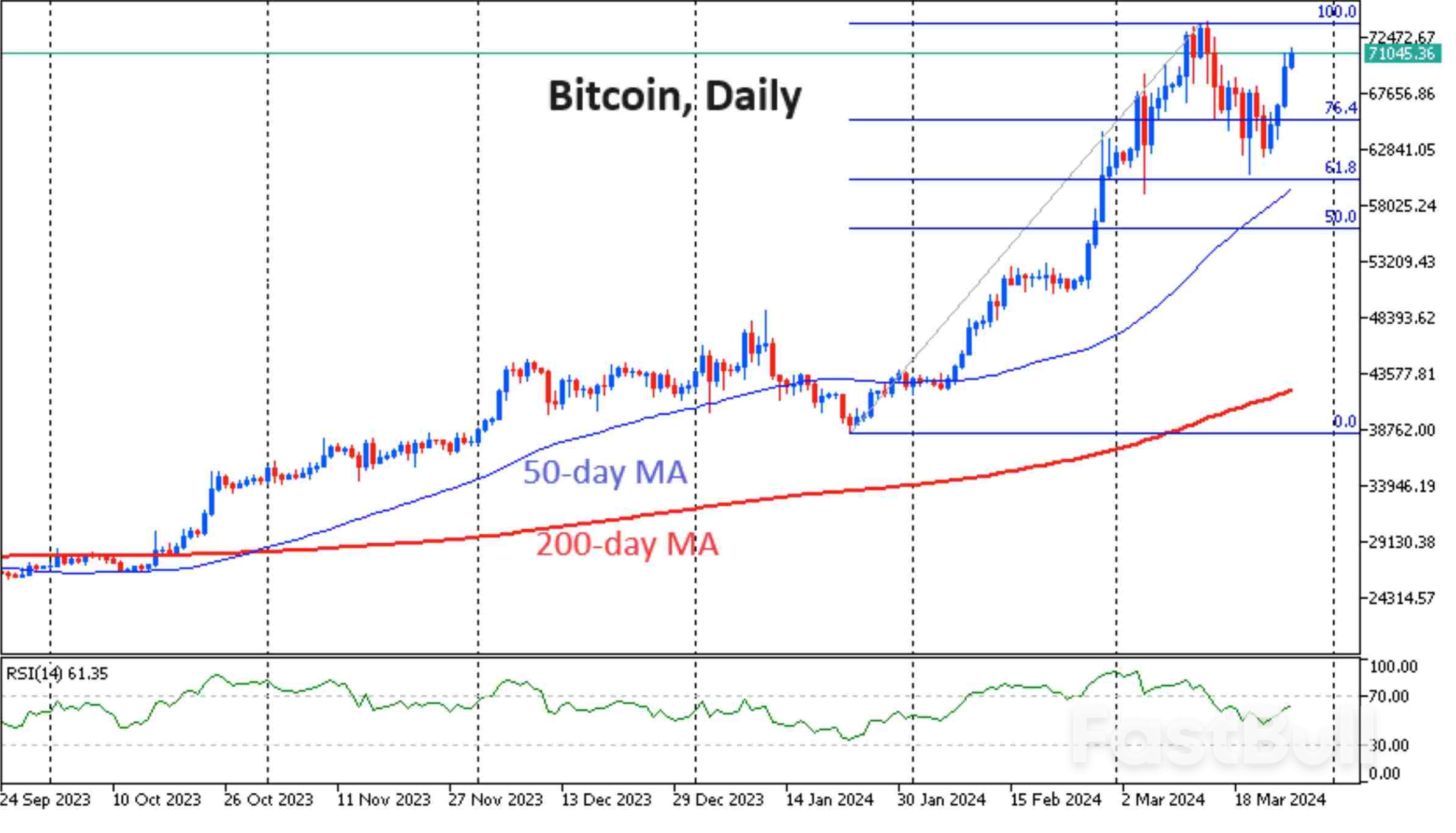
          At the forefront of this resurgence is Bitcoin, the flagship cryptocurrency, which has once again surpassed the psychologically important milestone of $71,000. Bitcoin's ability to reclaim this key level signals renewed confidence among investors and sets the stage for further price appreciation in the days ahead.
          Looking ahead, all eyes are on whether Bitcoin can overcome its previous highs at $73,700. Achieving this feat would not only validate the current uptrend but also pave the way for further gains. In particular, strengthening above the $75,000 mark would make the bullish scenario, with a target of $95,500, more viable.
          However, despite the optimism surrounding Bitcoin's recent performance, it's essential to remain cautious. Until Bitcoin can firmly establish itself above the $75,000 threshold, there is a risk of a resurgence in selling pressure. As history has shown, the cryptocurrency market can be highly volatile, with sharp price swings occurring unexpectedly.
          In addition to Bitcoin's price action, other factors are contributing to the market's recovery and potential for future growth. One such factor is the broader adoption of cryptocurrencies, both as an investment asset and as a means of payment. With more institutions and individuals embracing digital currencies, the overall demand for cryptocurrencies is expected to continue rising.

          Cryptocurrency Market Updates

          In recent developments in the cryptocurrency market, CoinShares reported a significant downturn in investments in crypto funds, marking a record decline of $942 million last week. This downturn comes on the heels of two consecutive weeks of setting all-time highs in inflows. Notably, investments in Bitcoin saw a substantial drop of $904 million, while Ethereum and Solana experienced declines of $34 million and $5.6 million, respectively. Additionally, investments in funds allowing for bitcoin shorts declined by $4 million.
          Amidst this downturn, Goldman Sachs highlighted a surge in client interest in cryptocurrencies, particularly driven by the approval of spot bitcoin exchange-traded funds (ETFs) in the United States. Traditional hedge funds have shown significant demand for cryptocurrency exposure. However, Goldman Sachs aims to expand its client base to include asset managers, banks, and select cryptocurrency-focused companies, signaling a broader adoption of digital assets within the financial industry.
          In light of market volatility, Anthony Scaramucci, founder of Skybridge Capital, offered advice to bitcoin investors, urging them not to sell their cryptocurrency holdings. Despite fluctuations in the market, Scaramucci emphasized the long-term potential of bitcoin as a valuable asset class.
          Meanwhile, the cryptocurrency exchange CommEX made headlines with an unexpected announcement of a complete shutdown scheduled for May 10th. Binance, another major player in the cryptocurrency exchange landscape, stated that CommEX had failed to fulfill its obligations as part of a deal to sell its Russian business to Binance. This development underscores the challenges and risks inherent in the cryptocurrency exchange sector, highlighting the importance of due diligence and regulatory compliance.
          Overall, these developments underscore the dynamic nature of the cryptocurrency market, characterized by rapid shifts in investor sentiment, regulatory developments, and technological advancements. Despite short-term fluctuations, growing institutional interest and regulatory approvals signal increasing acceptance and integration of cryptocurrencies into the global financial system.
          As investors navigate the evolving landscape of digital assets, it's crucial to remain informed, exercise caution, and conduct thorough research before making investment decisions. While market volatility and regulatory uncertainties may present challenges, they also offer opportunities for growth and innovation in the burgeoning cryptocurrency ecosystem.Bitcoin Surpasses $71K, Nearing Highs for Potential Retest Amidst Strong Performance_1
          Risk Warnings and Disclaimers
          You understand and acknowledge that there is a high degree of risk involved in trading. Following any strategies or investment methods may lead to potential losses. The content on the site is provided by our contributors and analysts for information purposes only. You are solely responsible for determining whether any trading assets, securities, strategy, or any other product is suitable for investing based on your own investment objectives and financial situation.
          Add to Favorites
          Share

          NASDAQ 100's Upward Momentum Persists Despite Drifting Lower in Price

          Chandan Gupta

          Traders' Opinions

          Stocks

          Let's take a closer look at the recent performance of the NASDAQ 100, a market that has displayed strong bullish momentum throughout most of the week. However, Friday saw a somewhat lackluster session, prompting us to reassess the current landscape and potential opportunities.
          At present, the 17,750 level stands out as a significant support level for the NASDAQ 100. This suggests that we may see some back-and-forth movement as market participants strive to identify value on short-term charts. Given the recent upward momentum, it's not surprising to see the market consolidate a bit, allowing for a breather before potentially resuming its ascent.
          Looking ahead, breaking above the high of the past week could signal further upside potential for the NASDAQ 100. In such a scenario, the market could have its sights set on the 19,000 level, with the possibility of reaching as high as 20,000 over time. It's worth noting that I have no interest in shorting this market, given its bullish trajectory.
          Reflecting on the start of the week, we did observe a slight pullback. However, with limited impactful economic news driving market movements, we may see the NASDAQ 100 grind sideways for a period. While this may test the patience of bullish traders, it's a natural part of market dynamics, preventing excessive upward momentum that could lead to a destabilizing correction.
          Maintaining a watchful eye on the NASDAQ 100, I'm particularly attuned to any signs of a pullback that could present buying opportunities. The 17,775 level currently serves as a key floor, with the 50-day Exponential Moving Average (EMA) converging towards that level, reinforcing its significance as a support zone. Even without considering technical indicators, it's evident from past price action that this level has played a pivotal role in the market's movements.
          Looking ahead, the trajectory of the NASDAQ 100 will likely be influenced by speculation surrounding the Federal Reserve's next moves. While the economic calendar may lack major events until Friday, which could impact the Fed's decisions, it's essential to remain vigilant. However, given the prevailing uptrend, the focus should primarily be on buying opportunities on dips rather than attempting to time the market for short-term gains.
          A breakout above the shooting star observed during Thursday's session would be a bullish signal, potentially paving the way for a move towards the 19,000 level over time. As always, patience and a keen awareness of market dynamics are crucial for navigating the NASDAQ 100's upward trajectory.
          In conclusion, while the NASDAQ 100 may experience periods of consolidation and minor pullbacks, the overall trend remains firmly bullish. With strategic buying opportunities presenting themselves on dips, traders should approach the market with a long-term perspective, capitalizing on potential upside moves while exercising caution against short-term fluctuations.NASDAQ 100's Upward Momentum Persists Despite Drifting Lower in Price_1
          Risk Warnings and Disclaimers
          You understand and acknowledge that there is a high degree of risk involved in trading. Following any strategies or investment methods may lead to potential losses. The content on the site is provided by our contributors and analysts for information purposes only. You are solely responsible for determining whether any trading assets, securities, strategy, or any other product is suitable for investing based on your own investment objectives and financial situation.
          Add to Favorites
          Share

          Russia’s Crude Shipments Rebound Even As Sanctions Snare Tankers

          Samantha Luan

          Commodity

          Russia’s seaborne crude exports clawed back about half of the previous week’s losses even though there’s growing evidence that sanctions are finally starting to stymie Moscow’s oil supply chain.
          The rebound came after maintenance work ended at Russia’s most important Baltic export terminal and storms that had repeatedly hit its main Pacific port in recent weeks began to abate. Those earlier disruptions left four-week average flows slightly below Russia’s first-quarter export target, tanker-tracking data compiled by Bloomberg show.
          Indian oil refiners — Moscow’s second-biggest customers after China since the 2022 invasion of Ukraine — will no longer accept tankers owned by state-run Sovcomflot PJSC because of the risks posed by recently intensified sanctions. That appears to have led to several vessels hauling Russian crude getting held up off the Asian nation’s coast, with others diverting to China.
          None of the ships designated by the US Treasury as carrying oil in breach of a Group of Seven price cap has loaded a cargo since it was added to a list of sanctioned vessels. Many have diverted to the Black Sea, where they have disappeared from tracking screens. Others are anchored near ports on Russia’s Baltic and Pacific coasts.
          Still, for now, overall crude flows have not been reduced on any significant scale, with shipments in the week to March 24 rising by about 360,000 barrels a day. With a shadow fleet of tankers willing to haul Russian oil numbering at least 600 vessels, there are still plenty of ships to keep the oil flowing.Russia’s Crude Shipments Rebound Even As Sanctions Snare Tankers_1
          The rebound in shipments has helped boost Moscow’s oil earnings. The gross value of crude exports recouped about half of the previous week’s drop, rising to $1.68 billion in the seven days to March 24 from $1.48 billion in the period to March 17. Four-week average income was also up, rising by about $15 million to $1.62 billion a week.
          Most of the backlog of Russia’s Sokol crude that built up after being turned away by Indian refiners has now been discharged. About 8.4 million barrels have been delivered to plants in China, with some 3.5 million barrels eventually finding their way back to India. One cargo was delivered to Pakistan.
          That leaves about 5.5 million barrels yet to discharge, about half of which is also heading back toward India. All of the Sokol cargoes loaded so far this month have headed directly to China.

          Flows by Destination

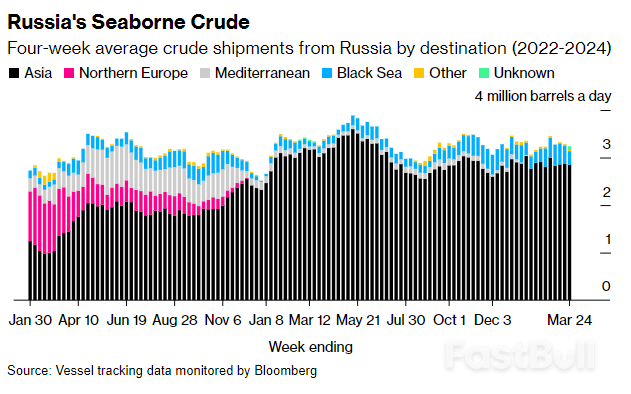
          Russia’s seaborne crude flows in the week to March 24 rose to 3.32 million barrels a day. However, the less volatile four-week average slipped for a second week, dropping by about 40,000 barrels a day to 3.24 million barrels a day.
          Weekly shipments were about 260,000 barrels a day below the average seen in May and June, or about 40,000 barrels a day above Russia’s first quarter target that is part of the OPEC+ alliance’s broader effort to curb supplies and support prices. The four-week average was about the same amount below the target.Russia’s Crude Shipments Rebound Even As Sanctions Snare Tankers_2
          All figures exclude cargoes identified as Kazakhstan’s KEBCO grade. Those are shipments made by KazTransoil JSC that transit Russia for export through the Black Sea port of Novorossiysk and the Baltic’s Ust-Luga and are not subject to European Union sanctions or a price cap.
          The Kazakh barrels are blended with crude of Russian origin to create a uniform export grade. Since Russia’s invasion of Ukraine, Kazakhstan has rebranded its cargoes to distinguish them from those shipped by Russian companies.

          Asia

          Observed shipments to Russia’s Asian customers, including those showing no final destination, edged higher to 2.93 million barrels a day in the four weeks to March 24, up from a revised 2.86 million in the previous four-week period.
          About 1.21 million barrels a day of crude was loaded onto tankers heading to China. The Asian nation’s seaborne imports are boosted by about 800,000 barrels a day of crude delivered from Russia by pipeline, either directly, or via Kazakhstan.
          Flows on ships signaling destinations in India averaged about 1.22 million barrels a day.
          Both the Chinese and Indian figures will rise as the discharge ports become clear for vessels that are not currently showing final destinations.
          The equivalent of about 385,000 barrels a day was on vessels signaling Port Said or Suez in Egypt, or are expected to be transferred from one ship to another off the South Korean port of Yeosu. Those voyages typically end at ports in India or China and show up in the chart below as “Unknown Asia” until a final destination becomes apparent. This figure includes stranded Sokol crude cargoes that are still waiting to discharge after failing to find homes in India since mid-December.
          The “Other Unknown” volumes, running at about 80,000 barrels a day in the four weeks to March 24, are those on tankers showing no clear destination. Most of those cargoes originate from Russia’s western ports and go on to transit the Suez Canal, but some could end up in Turkey. Others could be moved from one vessel to another, with most such transfers now taking place in the Mediterranean, off the coast of Greece.Russia’s Crude Shipments Rebound Even As Sanctions Snare Tankers_3

          Europe and Turkey

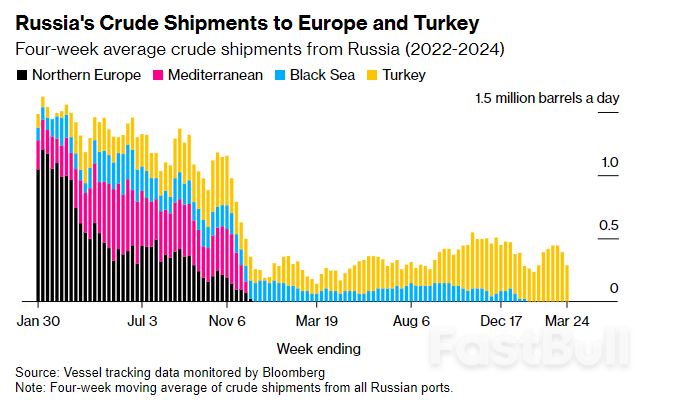
          Russia’s seaborne crude exports to European countries have ceased.
          With flows to Bulgaria halted at the end of last year, Turkey is now the only short-haul market for shipments from Russia’s western ports.Russia’s Crude Shipments Rebound Even As Sanctions Snare Tankers_4
          Exports to Turkey slipped to about 290,000 barrels a day in the four weeks to March 24. That’s the lowest in six weeks and down from a revised 390,000 barrels a day in the period to March 17.
          Vessel-tracking data are cross-checked against port agent reports as well as flows and ship movements reported by other information providers including Kpler and Vortexa Ltd.

          Export Value

          Following the abolition of export duty on Russian crude, we have begun to track the gross value of seaborne crude exports, using Argus Media price data and our own tanker tracking.
          The gross value of Russia’s crude exports recouped about half of the previous week’s drop, rising to $1.68 billion in the seven days to March 24 from $1.48 billion in the period to March 17. Four-week average income was also up, rising by about $15 million to $1.62 billion a week. The four-week average is still well off its peak of $2.17 billion a week, reached in the period to June 19, 2022. The highest it reached last year was $2 billion a week in the period to Oct. 22.
          During the first four weeks after the Group of Seven nations’ price cap on Russian crude exports came into effect in early December 2022, the value of seaborne flows fell to a low of $930 million a week, but soon recovered.Russia’s Crude Shipments Rebound Even As Sanctions Snare Tankers_5
          The chart above shows a gross value of Russia’s seaborne oil exports on a weekly and four-week average basis. The value is calculated by multiplying the average weekly crude price from Argus Media Group by the weekly export flow from each port. For shipments from the Baltic and Arctic ports we use the Urals FOB Primorsk dated, London close, midpoint price. For shipments from the Black Sea we use the Urals Med Aframax FOB Novorossiysk dated, London close, midpoint price. For Pacific shipments we use the ESPO blend FOB Kozmino prompt, Singapore close, midpoint price.
          Export duty was abolished at the end of 2023 as part of Russia’s long-running tax reform plans.

          Ships Leaving Russian Ports

          The following table shows the number of ships leaving each export terminal.
          A total of 31 tankers loaded 23.2 million barrels of Russian crude in the week to March 24, vessel-tracking data and port agent reports show. That was up by about 2.5 million barrels from the previous week.
          High winds at the start of the week may have hampered shipments from Russia’s Pacific terminal at Kozmino. Winds were gusting above 30 miles per hour on two of the first three days of the period, according to data from visualcrossing.com.Russia’s Crude Shipments Rebound Even As Sanctions Snare Tankers_6
          All figures exclude cargoes identified as Kazakhstan’s KEBCO grade. One cargo of KEBCO was loaded at Novorossiysk and one at Ust-Luga during the week.

          Source:Bloomberg

          Risk Warnings and Disclaimers
          You understand and acknowledge that there is a high degree of risk involved in trading. Following any strategies or investment methods may lead to potential losses. The content on the site is provided by our contributors and analysts for information purposes only. You are solely responsible for determining whether any trading assets, securities, strategy, or any other product is suitable for investing based on your own investment objectives and financial situation.
          Add to Favorites
          Share
          FastBull
          Copyright © 2025 FastBull Ltd

          728 RM B 7/F GEE LOK IND BLDG NO 34 HUNG TO RD KWUN TONG KLN HONG KONG

          TelegramInstagramTwitterfacebooklinkedin
          App Store Google Play Google Play
          Products
          Charts

          Chats

          Q&A with Experts
          Screeners
          Economic Calendar
          Data
          Tools
          Membership
          Features
          Function
          Markets
          Copy Trading
          Latest Signals
          Contests
          News
          Analysis
          24/7
          Columns
          Education
          Company
          Careers
          About Us
          Contact Us
          Advertising
          Help Center
          Feedback
          User Agreement
          Privacy Policy
          Business

          White Label

          Data API

          Web Plug-ins

          Poster Maker

          Affiliate Program

          Risk Disclosure

          The risk of loss in trading financial instruments such as stocks, FX, commodities, futures, bonds, ETFs and crypto can be substantial. You may sustain a total loss of the funds that you deposit with your broker. Therefore, you should carefully consider whether such trading is suitable for you in light of your circumstances and financial resources.

          No decision to invest should be made without thoroughly conducting due diligence by yourself or consulting with your financial advisors. Our web content might not suit you since we don't know your financial conditions and investment needs. Our financial information might have latency or contain inaccuracy, so you should be fully responsible for any of your trading and investment decisions. The company will not be responsible for your capital loss.

          Without getting permission from the website, you are not allowed to copy the website's graphics, texts, or trademarks. Intellectual property rights in the content or data incorporated into this website belong to its providers and exchange merchants.

          Not Logged In

          Log in to access more features

          FastBull Membership

          Not yet

          Purchase

          Become a signal provider
          Help Center
          Customer Service
          Dark Mode
          Price Up/Down Colors

          Log In

          Sign Up

          Position
          Layout
          Fullscreen
          Default to Chart
          The chart page opens by default when you visit fastbull.com