• Trade
  • Markets
  • Copy
  • Contests
  • News
  • 24/7
  • Calendar
  • Q&A
  • Chats
Trending
Screeners
SYMBOL
LAST
BID
ASK
HIGH
LOW
NET CHG.
%CHG.
SPREAD
SPX
S&P 500 Index
6857.13
6857.13
6857.13
6865.94
6827.13
+7.41
+ 0.11%
--
DJI
Dow Jones Industrial Average
47850.93
47850.93
47850.93
48049.72
47692.96
-31.96
-0.07%
--
IXIC
NASDAQ Composite Index
23505.13
23505.13
23505.13
23528.53
23372.33
+51.04
+ 0.22%
--
USDX
US Dollar Index
98.830
98.910
98.830
98.980
98.810
-0.150
-0.15%
--
EURUSD
Euro / US Dollar
1.16590
1.16598
1.16590
1.16613
1.16408
+0.00145
+ 0.12%
--
GBPUSD
Pound Sterling / US Dollar
1.33485
1.33495
1.33485
1.33519
1.33165
+0.00214
+ 0.16%
--
XAUUSD
Gold / US Dollar
4225.21
4225.62
4225.21
4229.22
4194.54
+18.04
+ 0.43%
--
WTI
Light Sweet Crude Oil
59.303
59.340
59.303
59.469
59.187
-0.080
-0.13%
--

Community Accounts

Signal Accounts
--
Profit Accounts
--
Loss Accounts
--
View More

Become a signal provider

Sell trading signals to earn additional income

View More

Guide to Copy Trading

Get started with ease and confidence

View More

Signal Accounts for Members

All Signal Accounts

Best Return
  • Best Return
  • Best P/L
  • Best MDD
Past 1W
  • Past 1W
  • Past 1M
  • Past 1Y

All Contests

  • All
  • Trump Updates
  • Recommend
  • Stocks
  • Cryptocurrencies
  • Central Banks
  • Featured News
Top News Only
Share

Russian President Putin: India Is Not Neutral, India Is On The Side Of Peace

Share

Russian President Putin: We Support Every Effort Towards Peace

Share

Russian President Putin: The World Should Return To Peace

Share

India Prime Minister Modi: We Should All Pursue Peace Together

Share

Ukmto Says A Vessel Reports Sighting Small Craft At A Range Of 1-2 Cables And They Are Under Fire

Share

Ukmto Says It Received Reports Of An Incident 15 Nm West Of Yemen

Share

Dollar/Yen Falls To 154.46, Lowest Since November 17

Share

Citigroup Sets 2026 STOXX 600 Target At 640 On Fiscal Tailwinds

Share

Reserve Bank Of India Chief Malhotra On Rupee: Fluctuations Can Happen, Effort Is To Reduce Undue Volatility

Share

Reserve Bank Of India Chief Malhotra On Rupee: Allow Markets To Determine Levels On Currency

Share

Sri Lanka's CSE All Share Index Down 1.2%

Share

Iw Institute: German Economy Faces Tepid Growth In 2026 Due To Global Trade Slowdown

Share

Stats Office - Seychelles November Inflation At 0.02% Year-On-Year

Share

[Market Update] Spot Silver Prices Rose 2.00% Intraday, Currently Trading At $58.27 Per Ounce

Share

S.Africa's Gross Reserves At $72.068 Billion At End November - Central Bank

Share

[Market Update] Spot Silver Broke Through $58/ounce, Up 1.56% On The Day

Share

Dollar/Yen Down 0.33% To 154.61

Share

Kremlin Says No Plans For Putin-Trump Call For Now

Share

Kremlin Says Moscow Is Waiting For USA Reaction After Putin-Witkoff Meeting

Share

Cctv - China, France: Say Both Sides Support All Efforts For A Ceasefire, Restore Peace According To Intl Law

TIME
ACT
FCST
PREV
Turkey Trade Balance

A:--

F: --

P: --

Germany Construction PMI (SA) (Nov)

A:--

F: --

P: --

Euro Zone IHS Markit Construction PMI (Nov)

A:--

F: --

P: --

Italy IHS Markit Construction PMI (Nov)

A:--

F: --

P: --

U.K. Markit/CIPS Construction PMI (Nov)

A:--

F: --

P: --

France 10-Year OAT Auction Avg. Yield

A:--

F: --

P: --

Euro Zone Retail Sales MoM (Oct)

A:--

F: --

P: --

Euro Zone Retail Sales YoY (Oct)

A:--

F: --

P: --

Brazil GDP YoY (Q3)

A:--

F: --

P: --

U.S. Challenger Job Cuts (Nov)

A:--

F: --

P: --

U.S. Challenger Job Cuts MoM (Nov)

A:--

F: --

P: --

U.S. Challenger Job Cuts YoY (Nov)

A:--

F: --

P: --

U.S. Initial Jobless Claims 4-Week Avg. (SA)

A:--

F: --

P: --

U.S. Weekly Initial Jobless Claims (SA)

A:--

F: --

P: --

U.S. Weekly Continued Jobless Claims (SA)

A:--

F: --

P: --

Canada Ivey PMI (SA) (Nov)

A:--

F: --

P: --

Canada Ivey PMI (Not SA) (Nov)

A:--

F: --

P: --

U.S. Non-Defense Capital Durable Goods Orders Revised MoM (Excl. Aircraft) (SA) (Sept)

A:--

F: --

P: --
U.S. Factory Orders MoM (Excl. Transport) (Sept)

A:--

F: --

P: --

U.S. Factory Orders MoM (Sept)

A:--

F: --

P: --

U.S. Factory Orders MoM (Excl. Defense) (Sept)

A:--

F: --

P: --

U.S. EIA Weekly Natural Gas Stocks Change

A:--

F: --

P: --

Saudi Arabia Crude Oil Production

A:--

F: --

P: --

U.S. Weekly Treasuries Held by Foreign Central Banks

A:--

F: --

P: --

Japan Foreign Exchange Reserves (Nov)

A:--

F: --

P: --

India Repo Rate

A:--

F: --

P: --

India Benchmark Interest Rate

A:--

F: --

P: --

India Reverse Repo Rate

A:--

F: --

P: --

India Cash Reserve Ratio

A:--

F: --

P: --

Japan Leading Indicators Prelim (Oct)

A:--

F: --

P: --

U.K. Halifax House Price Index YoY (SA) (Nov)

--

F: --

P: --

U.K. Halifax House Price Index MoM (SA) (Nov)

--

F: --

P: --

France Current Account (Not SA) (Oct)

--

F: --

P: --

France Trade Balance (SA) (Oct)

--

F: --

P: --

France Industrial Output MoM (SA) (Oct)

--

F: --

P: --

Italy Retail Sales MoM (SA) (Oct)

--

F: --

P: --

Euro Zone Employment YoY (SA) (Q3)

--

F: --

P: --

Euro Zone GDP Final YoY (Q3)

--

F: --

P: --

Euro Zone GDP Final QoQ (Q3)

--

F: --

P: --

Euro Zone Employment Final QoQ (SA) (Q3)

--

F: --

P: --

Euro Zone Employment Final (SA) (Q3)

--

F: --

P: --
Brazil PPI MoM (Oct)

--

F: --

P: --

Mexico Consumer Confidence Index (Nov)

--

F: --

P: --

Canada Unemployment Rate (SA) (Nov)

--

F: --

P: --

Canada Labor Force Participation Rate (SA) (Nov)

--

F: --

P: --

Canada Employment (SA) (Nov)

--

F: --

P: --

Canada Part-Time Employment (SA) (Nov)

--

F: --

P: --

Canada Full-time Employment (SA) (Nov)

--

F: --

P: --

U.S. Dallas Fed PCE Price Index YoY (Sept)

--

F: --

P: --

U.S. PCE Price Index YoY (SA) (Sept)

--

F: --

P: --

U.S. PCE Price Index MoM (Sept)

--

F: --

P: --

U.S. Personal Outlays MoM (SA) (Sept)

--

F: --

P: --

U.S. Core PCE Price Index MoM (Sept)

--

F: --

P: --

U.S. UMich 5-Year-Ahead Inflation Expectations Prelim YoY (Dec)

--

F: --

P: --

U.S. Core PCE Price Index YoY (Sept)

--

F: --

P: --

U.S. 5-10 Year-Ahead Inflation Expectations (Dec)

--

F: --

P: --

U.S. UMich Current Economic Conditions Index Prelim (Dec)

--

F: --

P: --

U.S. UMich Consumer Sentiment Index Prelim (Dec)

--

F: --

P: --

U.S. UMich 1-Year-Ahead Inflation Expectations Prelim (Dec)

--

F: --

P: --

U.S. UMich Consumer Expectations Index Prelim (Dec)

--

F: --

P: --

Q&A with Experts
    • All
    • Chatrooms
    • Groups
    • Friends
    Connecting
    .
    .
    .
    Type here...
    Add Symbol or Code

      No matching data

      All
      Trump Updates
      Recommend
      Stocks
      Cryptocurrencies
      Central Banks
      Featured News
      • All
      • Russia-Ukraine Conflict
      • Middle East Flashpoint
      • All
      • Russia-Ukraine Conflict
      • Middle East Flashpoint
      Search
      Products

      Charts Free Forever

      Chats Q&A with Experts
      Screeners Economic Calendar Data Tools
      Membership Features
      Data Warehouse Market Trends Institutional Data Policy Rates Macro

      Market Trends

      Market Sentiment Order Book Forex Correlations

      Top Indicators

      Charts Free Forever
      Markets

      News

      News Analysis 24/7 Columns Education
      From Institutions From Analysts
      Topics Columnists

      Latest Views

      Latest Views

      Trending Topics

      Top Columnists

      Latest Update

      Signals

      Copy Rankings Latest Signals Become a signal provider AI Rating
      Contests
      Brokers

      Overview Brokers Assessment Rankings Regulators News Claims
      Broker listing Forex Brokers Comparison Tool Live Spread Comparison Scam
      Q&A Complaint Scam Alert Videos Tips to Detect Scam
      More

      Business
      Events
      Careers About Us Advertising Help Center

      White Label

      Data API

      Web Plug-ins

      Affiliate Program

      Awards Institution Evaluation IB Seminar Salon Event Exhibition
      Vietnam Thailand Singapore Dubai
      Fans Party Investment Sharing Session
      FastBull Summit BrokersView Expo
      Recent Searches
        Top Searches
          Markets
          News
          Analysis
          User
          24/7
          Economic Calendar
          Education
          Data
          • Names
          • Latest
          • Prev

          View All

          No data

          Scan to Download

          Faster Charts, Chat Faster!

          Download App
          English
          • English
          • Español
          • العربية
          • Bahasa Indonesia
          • Bahasa Melayu
          • Tiếng Việt
          • ภาษาไทย
          • Français
          • Italiano
          • Türkçe
          • Русский язык
          • 简中
          • 繁中
          Open Account
          Search
          Products
          Charts Free Forever
          Markets
          News
          Signals

          Copy Rankings Latest Signals Become a signal provider AI Rating
          Contests
          Brokers

          Overview Brokers Assessment Rankings Regulators News Claims
          Broker listing Forex Brokers Comparison Tool Live Spread Comparison Scam
          Q&A Complaint Scam Alert Videos Tips to Detect Scam
          More

          Business
          Events
          Careers About Us Advertising Help Center

          White Label

          Data API

          Web Plug-ins

          Affiliate Program

          Awards Institution Evaluation IB Seminar Salon Event Exhibition
          Vietnam Thailand Singapore Dubai
          Fans Party Investment Sharing Session
          FastBull Summit BrokersView Expo

          Key Events This Holiday-Shortened Week: PPI, Retial Sales, Jobless Claims, And Ukraine Ultimatum

          Devin

          Economic

          Summary:

          It should be another busy, holiday-shortened, week after a volatile one last week as markets whipsawed around big moves in Fed pricing and AI bubble risk fears.

          It should be another busy, holiday-shortened, week after a volatile one last week as markets whipsawed around big moves in Fed pricing and AI bubble risk fears. Before we get to Thanksgiving, DB's Jim Reid writes that in the US, delayed post-shutdown data will be compressed into the first three days because of the holiday. Tomorrow brings September's retail sales and PPI, followed on Wednesday by jobless claims and durable goods orders. The claims data will be particularly important as they cover the November survey week, and the Federal Reserve is expected to lean heavily on these figures and other alternative indicators ahead of its December meeting, given there'll be no more payroll data prior to the FOMC.

          Globally, attention will turn to inflation reports from Europe and Japan, as well as the long-awaited UK Budget, which could prove pivotal for the country's fragile fiscal outlook. Perhaps the most significant geopolitical development will be Ukraine's response to the US ultimatum to accept the 28-point peace plan agreed with Russia, with an ultimatum set for before Thanksgiving on Thursday, although the US seem to have indicated over the weekend that there is some room for negotiation.

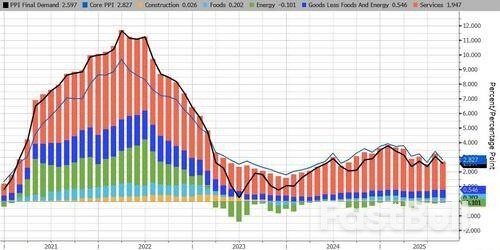
          Let's start with the US, and for tomorrow's September PPI data, benign prints are expected by DB economists for headline (+0.2% vs -0.1% last) and core (+0.2% vs -0.1%), echoing recent CPI trends. Categories feeding into core PCE will be in focus, with forecasts pointing to a 0.26% monthly gain, keeping the annual rate near 2.9%. This will be the last inflation update before the Fed's December decision, as October CPI and November CPI have been pushed back to mid-December.
          Retail sales are forecast by DB economists to show modest gains after strong summer spending: headline +0.1% (vs +0.6% last), ex-auto +0.2% (vs +0.7%), while retail control may dip slightly (-0.1% vs +0.7%). Even so, Q3 retail control growth is tracking at 6.8% annualized —the strongest since early 2023—supporting expectations for robust goods spending once GDP data is published. Factory sector updates arrive Wednesday with durable goods orders for September and the Chicago PMI for November (45.0 vs 43.8). Headline orders are expected to fall (-2.4% vs +2.9%), but ex-transportation (+0.2% vs +0.4%) and core orders (+0.2% vs +0.6%) should post moderate gains, implying a solid 5.3% annualised increase for Q3. Don't forget Black Friday where we will start to see early evidence of how strong consumer spending is into the important Christmas period.

          No Fed speakers are scheduled at this stage. The blackout period begins on Saturday ahead of the December meeting but with Thanksgiving on Thursday, it will start a lot earlier than it normally would.

          European data highlights include preliminary November CPI prints for Germany (2.6% YoY expected), France (0.92%) and Italy (1.23%) on Friday, alongside Q3 GDP releases for Norway, Sweden and Switzerland. Germany's Ifo survey kicks off the week today, followed by consumer confidence on Thursday and retail sales Friday. France will also report confidence and spending data that day. In the UK, the Autumn Budget on Wednesday will be the main event. Expectations point to roughly £35bn in fiscal consolidation, marking a second historic tax-raising budget under Chancellor Reeves. See our economist Sanjay Raja's preview here in what is one of the most hotly anticipated UK budgets in recent memory. Sanjay may need a lie down in a dark room after Wednesday as it's fair to say he's been in high demand of late.

          From central banks, the ECB will publish its October meeting account on Thursday and its consumer expectations survey Friday. In New Zealand, the RBNZ meets Wednesday, with a 25bps rate cut anticipated. Elsewhere, Australia reports October CPI (Wednesday), Canada releases Q3 GDP, and China publishes October industrial profits. Japan's focus will be on November Tokyo CPI and October activity data (Friday).

          Source: Zero Hedge

          To stay updated on all economic events of today, please check out our Economic calendar
          Risk Warnings and Disclaimers
          You understand and acknowledge that there is a high degree of risk involved in trading. Following any strategies or investment methods may lead to potential losses. The content on the site is provided by our contributors and analysts for information purposes only. You are solely responsible for determining whether any trading assets, securities, strategy, or any other product is suitable for investing based on your own investment objectives and financial situation.
          Add to Favorites
          Share

          Australia’s Teen Social Media Ban Pushes Content Creators To Look Abroad

          Winkelmann

          Political

          Economic

          Key points:

          · With incomes threatened, content creators turn abroad
          · Some eye US, British markets as law worries advertisers
          · Smaller domestic players face severe losses

          Australia is home for YouTube star Jordan Barclay, the place where he was born, went to school and built a company worth $50 million by age 23 that produces gaming content for 23 million subscribers.

          Now, with a world-first social media ban on Australian children younger than 16 set to take effect on December 10, he is thinking of leaving his Melbourne studio and moving abroad.

          "We're going to move overseas because that's where the money is going to be," said Barclay, whose seven YouTube channels include EYstreem, Chip and Milo, and Firelight.

          "We can't afford to keep doing business if advertisers leave Australia."

          Nine participants interviewed by Reuters in Australia's social media industry, estimated to generate annual revenue of A$9 billion ($5.82 billion), did not put a dollar figure on the ban's impact but agreed it could lead to a drop in advertisers and views.

          YouTubers, who get paid 55% of ad revenue and up to 18 Australian cents per 1,000 views, could be hit hardest, said social media researcher Susan Grantham at Griffith University.

          "If it is one clean sweep and all these accounts disappear, then instantaneously, it's going to be detrimental to the influencer economy."

          The law requires companies to block the accounts of more than a million people under the cut-off age, punishing "systemic breaches" with penalties of up to A$49.5 million.

          While teenagers can still watch YouTube without an account, the site's algorithm will fail to drive traffic to popular posts, reducing views.

          Equally, creators on YouTube, TikTok and Meta'sInstagram stand to lose earnings through promotions if the number of their followers fall, Grantham said.

          Advertisers are also on edge about campaigns targeting younger audiences, said Stephanie Scicchitano, general manager at Sydney-based talent agency Born Bred Talent.

          FEWER SPONSORSHIP DEALS AS BAN DEADLINE NEARS

          Barclay's company Spawnpoint Media sells advertising to companies such as Lego and Microsoft, but clients' interest in sponsorship deals has declined as the ban approaches, he said.

          "They're worried about what the ban could mean later," he said. "If it expands, if it grows ... it makes sense for us to invest overseas and not here."

          The United States could be among his options, he said, pointing to more favourable laws and government support in such markets.

          Some creators are already leaving to avoid the curbs, such as influencers the Empire Family, who told followers in October they were relocating to Britain.

          The careers of those creating content featuring children younger than 16, such as family vloggers and child influencers, were particularly at risk, said Crystal Abidin, the director of the Influencer Ethnography Research Lab.

          "They agree that in order to continue, it's an easy decision to immigrate," she said.

          Children's musicians Tina and Mark Harris, whose Lah-Lah YouTube channel has 1.4 million subscribers, said, "Any negative impact on income is going to hurt."

          CONCERN ABOUT LASTING REPUTATIONAL HARM

          But their main concern was lasting reputational damage from the government's description of YouTube's harm to children.

          "Parents will get the jitters and stay away from YouTube in droves," Mark Harris said.

          "Maybe that's hyperbole, we just don't know."

          Initially exempted from the ban, Alphabet-ownedYouTube was added later at the urging of Australia's internet regulator, which said 37% of minors reported seeing harmful content on YouTube, the worst showing for a platform.

          The ban "does a disservice" to creators of high-quality content for children, said Shannon Jones, who runs Australia's largest YouTube channel, Bounce Patrol, with more than 33 million subscribers.

          Byron Bay creator Junpei Zaki, 28, whose output is mostly drawn from interactions with 22 million followers across TikTok and YouTube, expects the ban to cause a "guaranteed drop" in likes and comments from Australia.

          "It ... does feel like I'm ignoring my Australian audience that helped get me here, because they can't interact."

          HIT MAGNIFIED FOR SMALLER CREATORS

          Zaki estimates he will lose 100,000 followers to the ban, a blip in his global reach, but warned that smaller creators with domestic audiences would be hit harder.

          At the House of Lim food stall in Sydney's west, 15-year-old owner Dimi Heryxlim has built a following by posting vlogs of his routine running the kitchen after school.

          Losing access to his TikTok and Instagram accounts "will be a bad thing", he said, as some customers recognise him from his videos, but he plans to return as soon as he turns 16.

          "If I can't get my account back, I'll just get a new account and start everything from scratch," said Heryxlim.

          Source: TradingView

          To stay updated on all economic events of today, please check out our Economic calendar
          Risk Warnings and Disclaimers
          You understand and acknowledge that there is a high degree of risk involved in trading. Following any strategies or investment methods may lead to potential losses. The content on the site is provided by our contributors and analysts for information purposes only. You are solely responsible for determining whether any trading assets, securities, strategy, or any other product is suitable for investing based on your own investment objectives and financial situation.
          Add to Favorites
          Share

          Bank Of Israel Cuts Rates For First Time Since January 2024 As Inflation Eases After Gaza Truce

          Daniel Carter

          Economic

          Central Bank

          Key points:
          ● Benchmark rate cut to 4.25% from 4.5%.
          ● Rate cut follows global trend and U.S.-brokered Gaza ceasefire.
          ● Inflation steady at 2.5%, within target range.
          The Bank of Israel cut interest rates by a quarter-point on Monday, its first reduction in nearly two years, citing a moderation in inflation following the ceasefire in Gaza while expressing caution over the prospect of future cuts.
          The cut in the benchmark rate (ILINR=ECI) to 4.25% from 4.5%, widely expected by analysts and financial markets, came after other global central banks had already begun to ease monetary policy and last month's U.S.-brokered truce between Israel and Palestinian militant group Hamas took hold.
          "The Monetary Committee's policy is focusing on price stability, support for economic activity, and stability of the markets," the central bank said in a statement.
          "The interest rate path will be determined in accordance with the development of inflation, economic activity, geopolitical uncertainty, and fiscal developments," it said.
          The committee lowered the key rate by a quarter-point in January 2024 at the outset of the Gaza war but has taken a conservative stance since then, opting for caution during the two-year conflict while price pressures rose, largely due to supply constraints.
          But Israel's inflation rate has eased, and held steady at 2.5% in October to stay within an official 1-3% annual target range.
          The central bank acknowledged inflation has moderated in the past two months but that "forecasters project that there will be some increase in inflation at the end of the year, and that it will then decline and stabilize around the midpoint of the target range."
          It added that the labour market remains tight and wage pressures continue to rise while home prices are declining.
          At the same time, the Bank of Israel pointed to a sharp rebound in economic activity in the third quarter, gaining an annualised 12.4%, but that "its level remains lower than its long-term trend."
          Since the prior rates decision in late September, the shekel also has appreciated versus the dollar, euro and other trading partners.
          "The data from recent months have... created a clear need for a cut," said Ron Tomer, president of the Manufacturers' Association.
          "The Bank of Israel's decision to lower the interest rate is a responsible step that helps curb the appreciation and restore competitiveness to the economy," said Tomer, who called on the bank to cut again before its next meeting in early January.
          The October 10 ceasefire in the two-year Gaza war has eased the conflict and, although looking increasingly fragile, has for now reduced geopolitical risk and eased price pressures.
          "Today's interest rate cut joins a series of steps and clear signs — Israel is on the path to tremendous economic growth," said finance minister Bezalel Smotrich.

          Source: Reuters

          To stay updated on all economic events of today, please check out our Economic calendar
          Risk Warnings and Disclaimers
          You understand and acknowledge that there is a high degree of risk involved in trading. Following any strategies or investment methods may lead to potential losses. The content on the site is provided by our contributors and analysts for information purposes only. You are solely responsible for determining whether any trading assets, securities, strategy, or any other product is suitable for investing based on your own investment objectives and financial situation.
          Add to Favorites
          Share

          US Dollar: Stage Set for a Test of Key Resistance Zone at 100.20 in the Week Ahead

          Adam

          Forex

          The US dollar strengthened again last week. The US dollar index (DXY) moved higher and approached the 100.2 resistance level. This momentum came from more careful messaging from the Fed, softer US data that still signalled the economy is holding steady without recession pressure, and a slight easing in geopolitical tensions.
          Overall, this shows that the US dollar has reached a short-term support level, and the Fed’s shift in tone has lifted market demand for the currency.

          Fed Signals: Cautious, if Not Hawkish, Stance Returns

          The key headline last week came from the Fed’s October meeting minutes. Many in the market expected a signal that another rate cut would come before the year’s end. The minutes showed a split inside the Fed instead. Several members remained highly careful about inflation and resisted any move toward early easing.
          The plan to end balance sheet reduction on December 1 created a sense of progress, yet the overall message showed a Fed that prefers a slow and steady pace rather than a rush.
          When Powell said that a December cut carries no guarantee and Jefferson added that the Fed is close to neutral and must slow its pace, the message showed that the Fed pressed the brakes again after the first steps on interest in September and October. Waller took a different line and continued to push for a December cut, pointing to weaker labor data.
          This divide inside the committee created a tone that felt more hawkish for the market. That shift became a major reason why the dollar index held firm through the week. A single strong hawkish signal usually lifts the DXY, and this time the influence grew even stronger because more members showed clear resistance to easing.

          Moderate Slowdown in US Data: Dollar Finds Support as Fed Gains Space

          Last week’s jobless claims showed that layoffs stayed low, which signalled that the labor market still holds firm without any sharp decline. Continuing jobless claims moved higher, which pointed to softer hiring. This two-sided picture lowered the chance of a fast Fed rate cut and created a supportive backdrop for the dollar, since the economy is cooling yet far from collapse.
          September non-farm employment data arrived late. The headline number came in above expectations while the unemployment rate climbed to 4.4%. This created a mixed yet steady outlook and limited any large swings in the DXY. The key takeaway for the market was that the data offered no hint of recession. This helped the dollar because it gave the Fed more room to ease away from heavy discount pressure.
          There was no fresh inflation data last week, yet falling energy prices and lower tariffs on several food items showed that price pressure stayed moderate. This created a neutral effect on the dollar. Inflation remains too firm to push the Fed toward quick easing and too mild to push the Fed back into heavy hawkish signals.

          Geopolitical Balances: Oil Pressure Eases, Risk Appetite Recovers

          The ceasefire in the Middle East and early moves toward a new peace plan between the US and Ukraine lifted global risk sentiment. Such an improvement usually lowers safe-haven demand for the dollar. Even so, the slide in oil prices played a larger role in recent days.
          Expectations of higher Russian supply pushed oil lower, and this acted as a catalyst that helped ease global inflation pressure. This shift created a smoother path for the Fed, yet the dollar stayed firm because the Fed’s cautious tone carried more weight.
          The very weak USD/JPY and the rising chance of a possible intervention also supported the DXY. The absence of any move from the BoJ allowed the US dollar to hold its strong position against the yen and added fresh upward energy to the index.
          The dollar index gained close to 1% last week, mainly because the Fed pressed the brakes in its easing cycle and gave no clear signal of softer policy ahead. US data helped calm recession fears, while the easing in geopolitical tensions reduced any rush for panic trades. Together, these factors created a strong rebound in the DXY through the combined influence of Fed signals, economic indicators and global developments.
          This overall setup still holds and points to steady support for the dollar in the short term. Upcoming data before the December Fed meeting may influence this path. Even so, the Fed’s cautious tone remains the central force guiding the dollar index right now..

          US Dollar Technical Outlook

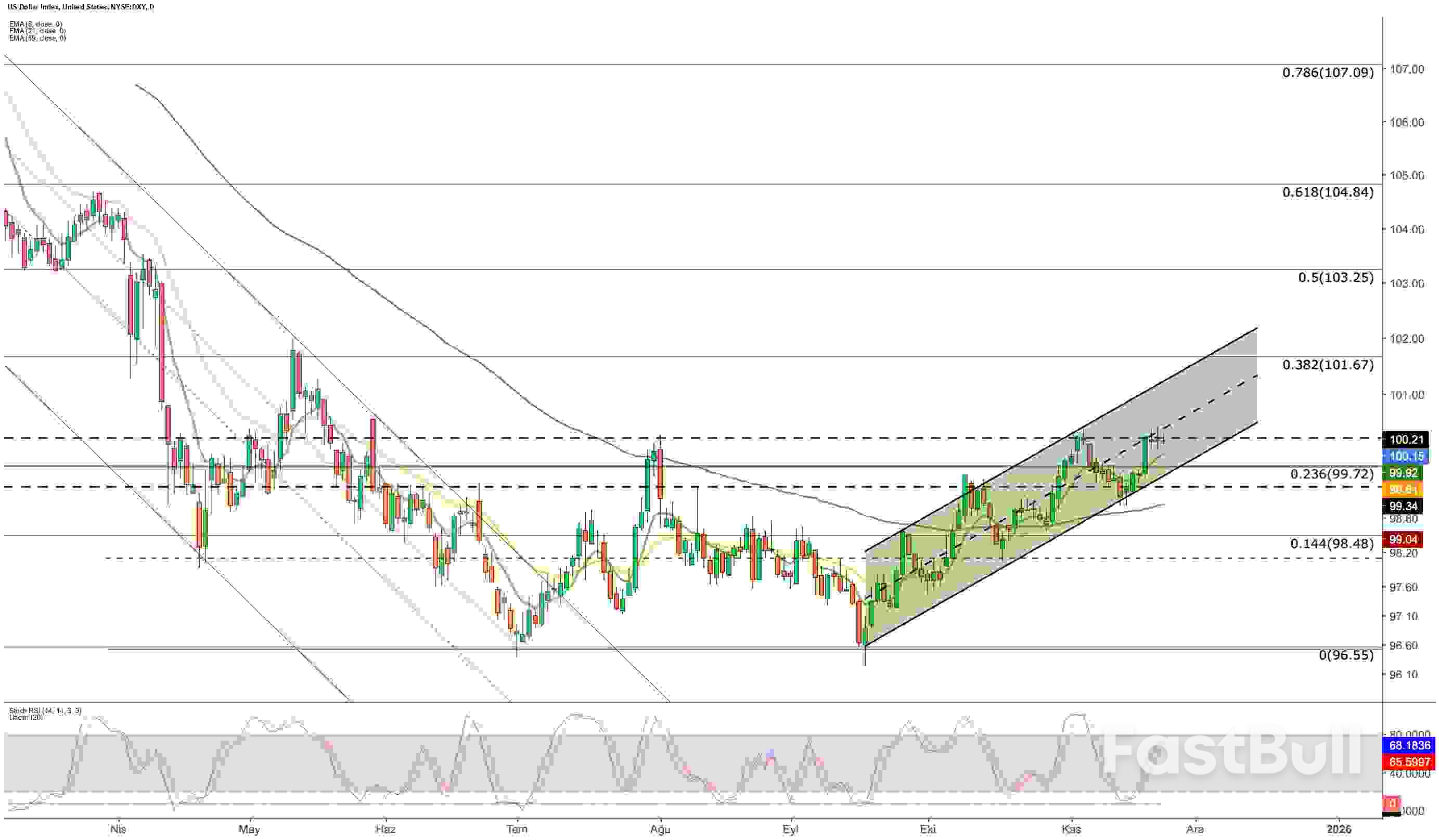
          US Dollar: Stage Set for a Test of Key Resistance Zone at 100.20 in the Week Ahead_1
          The US dollar index continues to move inside an ascending channel on the daily chart that has been in place since September. The week began with a firm technical stance as the price moved toward the middle band of this channel. The key short-term level is the 100.20 resistance zone, which also carries psychological weight. A clean move above this area can create fresh upward momentum and open a path toward 101.67, the level that aligns with the Fib 0.382 correction.
          The first support in any pullback sits at the 99.70 pivot. This area acts as both horizontal support and the Fib 0.236 retracement, which serves as the main shield for the short-term trend. A price above 99.70 signals that the upward structure remains intact. The 99.30 region, shaped by EMA values and the lower band of the channel, forms the second support layer.
          A hold above this zone keeps the broader trend structure in place and signals continued strength in the DXY. Short-term exponential moving averages are also in ideal alignment, another factor supporting the upside.
          The price reacts to these averages on every pullback, strengthening the in-channel structure. On the momentum side, the Stochastic RSI heading towards the overbought zone confirms that a new area of movement may occur if the 100.20 resistance is exceeded.
          Overall, the technical picture shows that the dollar index holds a positive short-term trend with steady support and clear upward attempts. The main level for an upward breakout sits at 100.20. A close below 99.30 would signal weakness on the downside and mark the start of a softer structure.

          Source: investing

          Risk Warnings and Disclaimers
          You understand and acknowledge that there is a high degree of risk involved in trading. Following any strategies or investment methods may lead to potential losses. The content on the site is provided by our contributors and analysts for information purposes only. You are solely responsible for determining whether any trading assets, securities, strategy, or any other product is suitable for investing based on your own investment objectives and financial situation.
          Add to Favorites
          Share

          Trump Weighing Advanced Nvidia Chip Sales To China, Lutnick Says

          Justin

          Commodity

          President Donald Trump is weighing whether to allow Nvidia Corp to sell advanced artificial intelligence chips to China and will be the one to make a final decision on the matter, US Commerce Secretary Howard Lutnick said.

          The president is hearing from "lots of different advisers" in deciding on the potential exports, Lutnick said in a Bloomberg TV interview on Monday, noting that Trump understands Chinese President Xi Jinping "the best." Bloomberg News had reported on Friday that US officials are having early discussions on whether Nvidia can sell its H200 artificial intelligence chips to China.

          "That kind of decision sits right on the desk of Donald Trump," Lutnick said in the interview. "He will decide whether we go forward with that or not."

          At the same time, Lutnick acknowledged the tensions between promoting economic expansion and protecting national security. "Do you want to sell China some chips and keep them using our tech and tech stack, or do you say to them, 'Look, we're not going to sell you our best chips. We're just going to hold off on that, and we're going to compete in the AI race ourselves,'" he said.

          Allowing H200 sales to China would mark a significant easing of restrictions first imposed in 2022 to prevent Beijing and its military from accessing the most powerful US technologies. Any move to sell a higher-calibre processor to China would provoke sharp opposition from national-security hawks in Washington, where some lawmakers are backing legislation to prevent such a move.

          Nvidia chief executive officer Jensen Huang, who has forged a close relationship with Trump and calls him often, is eager to sell his products to China. The company remains shut out of the Chinese market for AI chips after authorities in Beijing told local companies not to buy the less-advanced H20 chips that Trump approved for sale earlier this year.

          Lutnick said on Monday that Huang has "good reasons" for wanting to sell to China, adding that there are an "enormous number of other people" who agree it should be considered.

          "It's a really interesting question," Lutnick said. "He's got all the information. He's got lots and lots of experts talking to him, and he's going to decide which way to go forward."

          Source: Theedgemarkets

          Risk Warnings and Disclaimers
          You understand and acknowledge that there is a high degree of risk involved in trading. Following any strategies or investment methods may lead to potential losses. The content on the site is provided by our contributors and analysts for information purposes only. You are solely responsible for determining whether any trading assets, securities, strategy, or any other product is suitable for investing based on your own investment objectives and financial situation.
          Add to Favorites
          Share

          Toxic Mines Put Southeast Asia's Rivers, People At Risk, Study Says

          Justin

          Political

          Economic

          Key points:

          · New research shows over 2,400 mines along mainland Southeast Asia rivers
          · Mines may be releasing deadly chemicals into river water, says Stimson Center think-tank
          · Many rare earths mines operate with China's support - expert
          · Situation poses health risk to millions of residents in region and consumers globally

          For most of her life, 59-year-old farmer Tip Kamlue has irrigated her fields in northern Thailand with the waters of the Kok River, which flows down from neighbouring Myanmar before joining with the Mekong River that cuts through Southeast Asia.

          But since April, after authorities warned residents to stop using the Kok's water because of concerns over contamination, Tip has been using groundwater to grow pumpkins, garlic, sweet corn and okra.

          "It's like half of me has died," Tip said, standing by her fields in Tha Ton sub-district, and looking out at the river that she is now forced to shun.

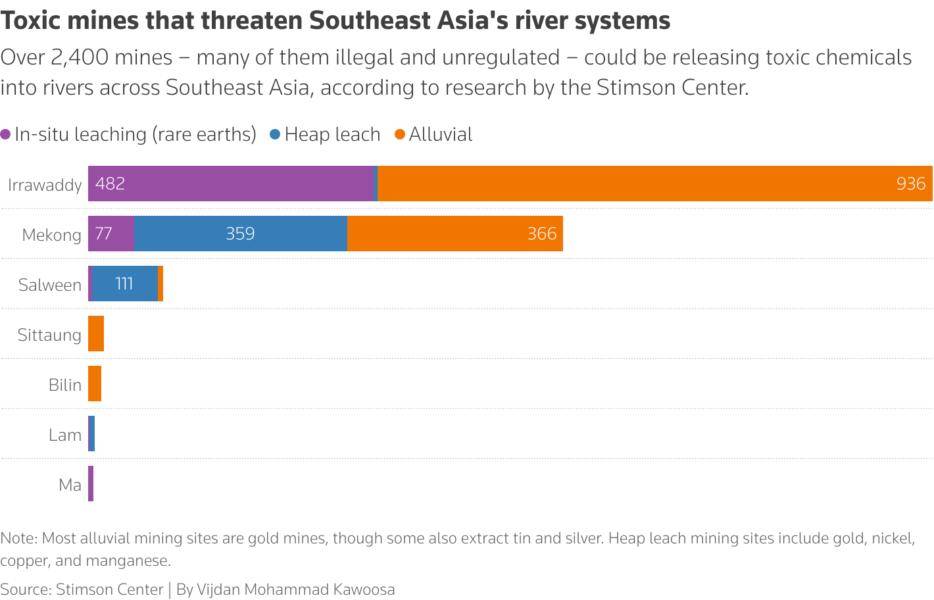
          Across mainland Southeast Asia, more than 2,400 mines - many of them illegal and unregulated - could be releasing deadly chemicals such as cyanide and mercury into river water, according to research from the U.S.-based Stimson Center think tank released on Monday.

          "The scale is something that's striking to me," said Brian Eyler, senior fellow at Stimson, pointing to scores of tributaries of major rivers, like the Mekong, the Salween and the Irrawaddy that are probably highly contaminated.

          Thomson ReutersToxic mines that threaten Southeast Asia's river systems

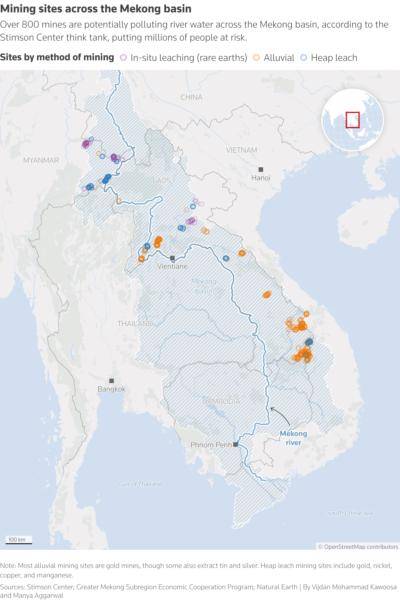
          The Stimson report marks the first comprehensive study of potentially polluting mines in mainland Southeast Asia. Researchers analysed satellite imagery to identify mining activity including 366 alluvial mining sites, 359 heap leach sites and 77 rare earth mines draining into the Mekong basin.

          Most alluvial mining sites are gold mines, though some also extract tin and silver. Heap leach mining sites include those for gold, nickel, copper, and manganese extraction.

          The Mekong is Asia's third-largest river and supports the livelihood of more than 70 million people as well as the global export of farm and fisheries products. It was previously perceived to be a clean river system, said Eyler.

          "Because so much of the Mekong Basin is essentially ungoverned by national laws and sensible regulations, the basin is unfortunately ripe for this kind of unregulated activity to occur at a high level of intensity and the huge scale that our data reveals," he said.

          Thomson ReutersMining sites across the Mekong basin

          The toxic chemicals released through unregulated rare earths mining include ammonium sulphate, and sodium cyanide and mercury that are used for two different types of gold mining, according to Stimson researchers.

          That exposes not only the millions of people who live along the Mekong in Southeast Asia to health risks, but also consumers elsewhere.

          "There is not a major supermarket in the U.S. that doesn't have products from the Mekong Basin, including shrimp, rice and fish," said Eyler.

          The emergence of new China-backed rare earth mines in eastern Myanmar, not far from the mountainous border with Thailand, initially set off concerns among researchers of the danger of downstream pollution along the Kok River, including areas like Tha Ton.

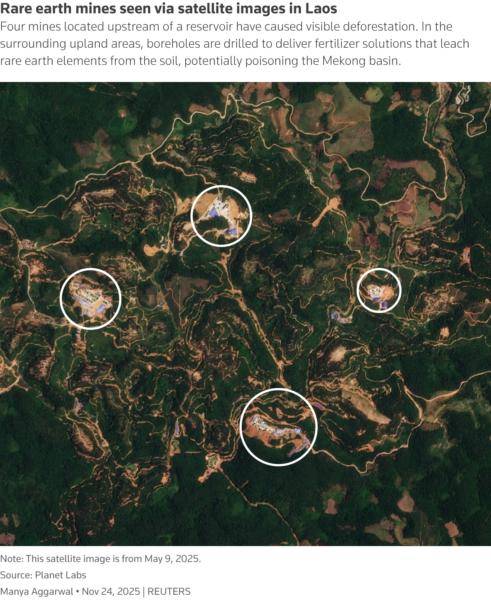
          Thomson ReutersPage title for search: Rare earth mines seen via satellite images in Laos

          The contamination pattern on samples from the Kok River shows the presence of arsenic - linked to rare earth and gold mining - alongside heavy rare earths like dysprosium and terbium, said Tanapon Phenrat of Thailand Science Research and Innovation, a Thai government research agency.

          "It has only been two years since the rise of rare earth and gold mining in Myanmar at the Kok River's source," said Tanapon, who conducted testing of the waters this year and warns of a sharp rise in contamination levels unless mining is stopped. Tanapon was not involved in the Stimson study.

          Myanmar, which erupted in conflict after the military seized power in 2021, is one of the world's largest producers of heavy rare earths, critical minerals infused into magnets that power the likes of wind turbines, electric vehicles and defence systems.

          From mining sites in Myanmar, the raw material is transported for processing to China, which has a near-monopoly over production of these vital magnets, with Beijing deploying rare earths as leverage in its tariff war with the U.S.

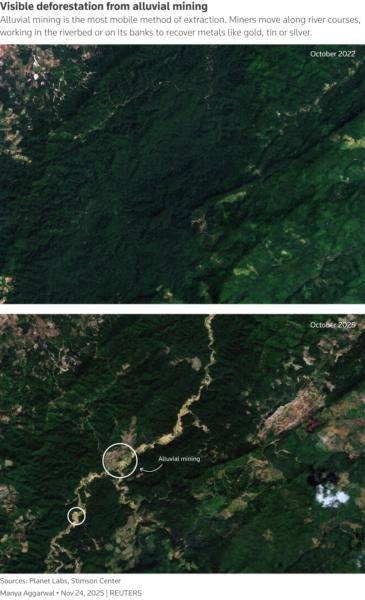
          Thomson ReutersPage title for search: Visible deforestation from alluvial mining

          Mines across Myanmar and Laos use in-situ leaching for rare earth elements that was initially developed within China, according to Stimson's Eyler.

          "In general, Chinese nationals work on these mines as managers and technical experts," he said.

          In response to questions from Reuters, China's foreign ministry said it was not aware of the situation.

          "The Chinese side has consistently required overseas Chinese enterprises to conduct their production and business operations in accordance with local laws and regulations, and to adopt stringent measures to protect the environment," it said.

          The Thai government has established three new task forces to coordinate international cooperation, monitor the mines' health impact and secure alternative supplies for communities along the Kok, Sai, Mekong and Salween rivers, said Deputy Prime Minister Suchart Chomklin.

          In northern Tha Ton, signs still hang on a bridge over the Kok River, calling for authorities to shut down the rare earths mines upriver, and farmers like Tip are desperate for an intervention.

          "I just want the Kok River to be the way it used to be - where we could eat from it, bathe in it, play in it, and use it for farming," she said.

          "I hope someone will help make that happen."

          Source: TradingView

          To stay updated on all economic events of today, please check out our Economic calendar
          Risk Warnings and Disclaimers
          You understand and acknowledge that there is a high degree of risk involved in trading. Following any strategies or investment methods may lead to potential losses. The content on the site is provided by our contributors and analysts for information purposes only. You are solely responsible for determining whether any trading assets, securities, strategy, or any other product is suitable for investing based on your own investment objectives and financial situation.
          Add to Favorites
          Share

          S&P 500 Technical Analysis: December rate cut hopes boost the stock market

          Adam

          Stocks

          Fundamental Overview

          The uncertainty about a December cut has been weighing on the stock market ever since Powell delivered his infamous line saying that a December cut was not a foregone conclusion. The lack of official US data and cautious stance from Fed members didn’t help either.
          On Friday though, Fed’s Williams suggested that he would support a rate cut in December and the market pricing jumped immediately to 60%, giving the stock market a boost. As things stand, a rate cut in December is now more likely and that should support the stock market heading into the meeting.
          Moreover, we got also the news that Trump administration was considering selling the H200 Nvidia chips to China, which was another positive catalyst for the market.
          This week, we have a holiday-shortened week due to Thanksgiving on Thursday, but we will still get two important economic data like the weekly ADP report tomorrow and the most recent US Jobless Claims on Wednesday.

          S&P 500 Technical Analysis – Daily Timeframe

          S&P 500 Technical Analysis: December rate cut hopes boost the stock market_1S&P 500 daily

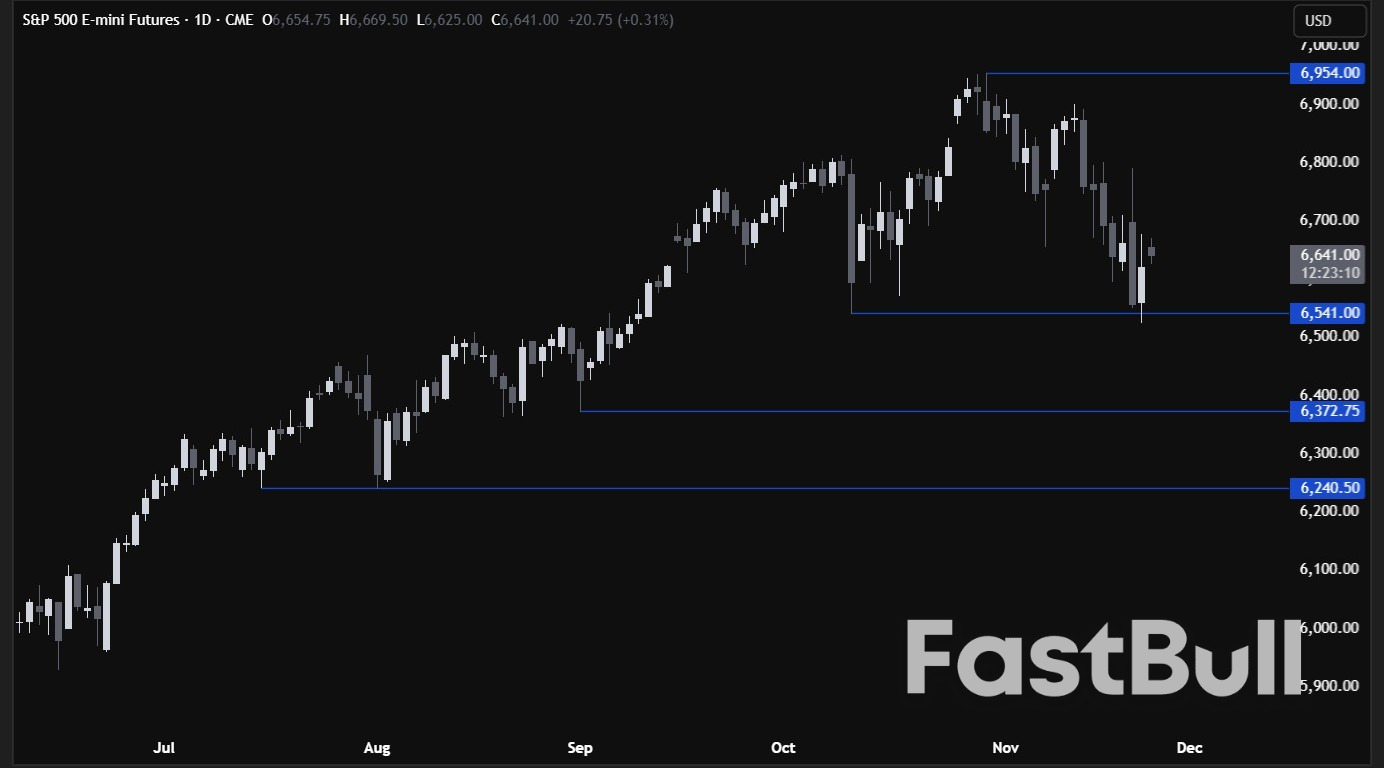
          On the daily chart, we can see that the S&P 500 bounced from the key swing point around the 6,541 level. The buyers stepped in there with a defined risk below the lows to position for a rally back into the all-time highs. The sellers, on the other hand, will want to see the price breaking lower to increase the bearish bets into the 6,372 level next.

          S&P 500 Technical Analysis – 4 hour Timeframe

          S&P 500 Technical Analysis: December rate cut hopes boost the stock market_2S&P 500 4 hour

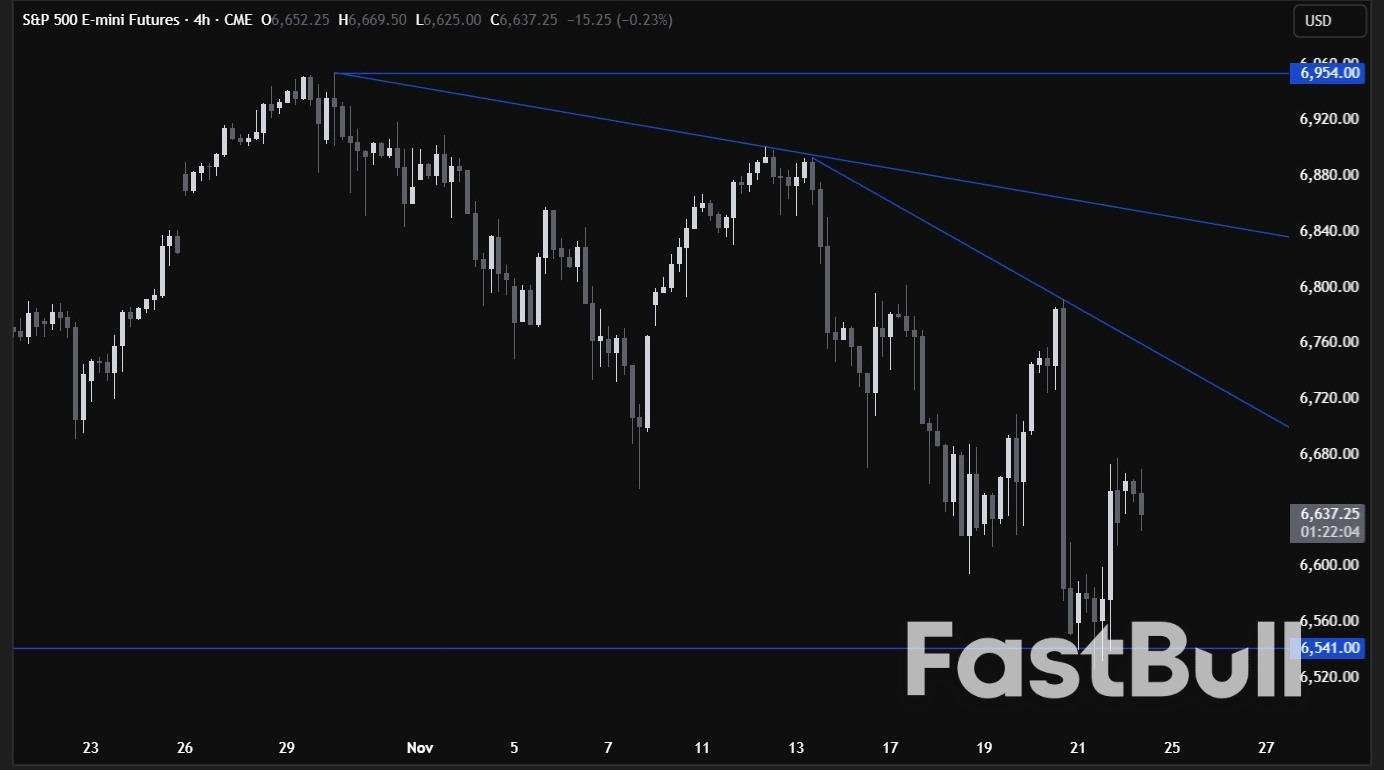
          On the 4 hour chart, we can see that we have a downward trendline defining the bearish momentum. If we get a pullback into the trendline, we can expect the sellers to lean on it with a defined risk above it to position for a drop into new lows. The buyers, on the other hand, will look for a break higher to increase the bullish bets into the next trendline around the 6,840 level.

          S&P 500 Technical Analysis – 1 hour Timeframe

          S&P 500 Technical Analysis: December rate cut hopes boost the stock market_3S&P 500 1 hour

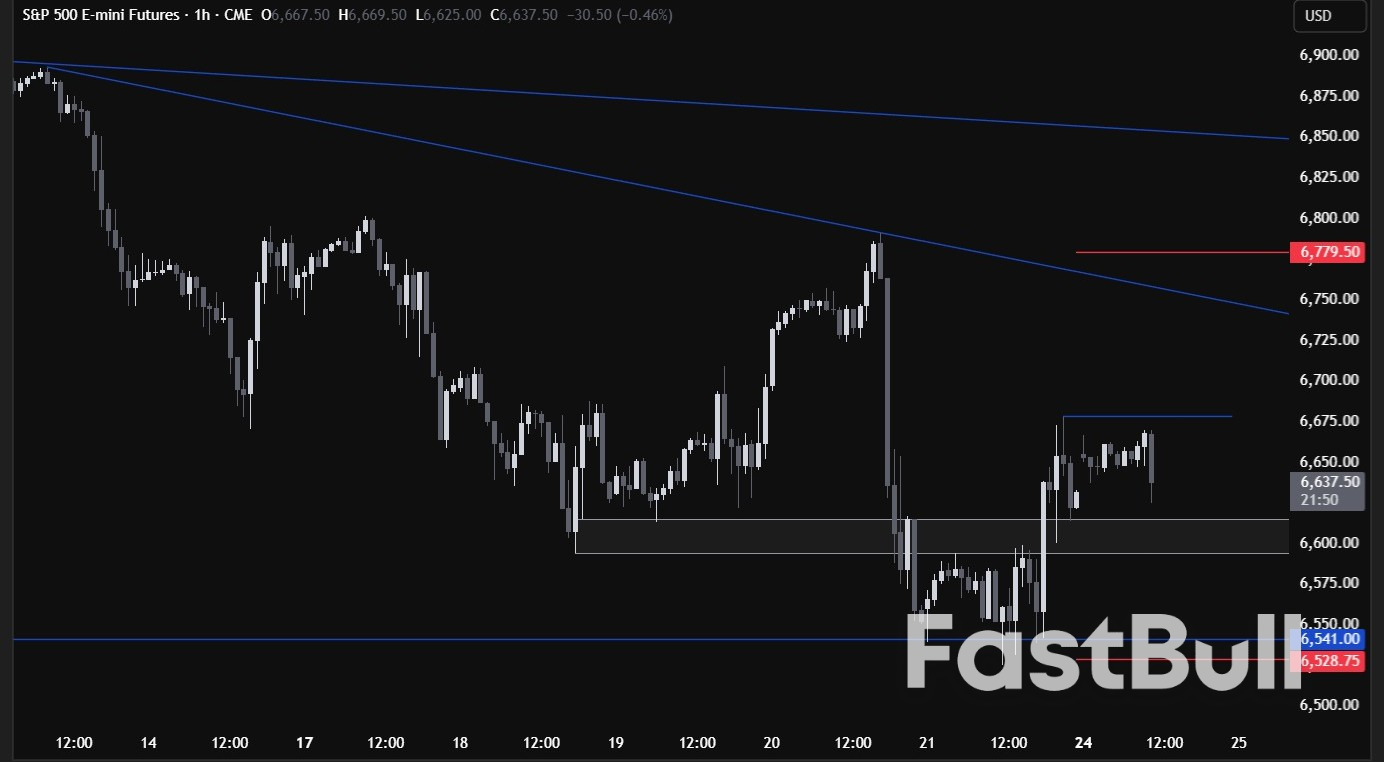
          On the 1 hour chart, we can see that we have a minor support zone around the 6,600 level. If the price gets there, we can expect the buyers to step in with a defined risk below the support to position for a rally into the trendline. The sellers, on the other hand, will look for a break lower to pile in for a drop into new lows. The red lines define the average daily range for today.

          Upcoming Catalysts

          Tomorrow we get the weekly ADP jobs data and the US Consumer Confidence report. We will also get the September US PPI and Retail Sales reports. On Wednesday, we get the most recent US Jobless Claims figures and the September Durable Goods Orders report. On Thursday, we have the US Thanksgiving holiday, so the final part of the week will likely see a rangebound market.

          Source: investinglive

          Risk Warnings and Disclaimers
          You understand and acknowledge that there is a high degree of risk involved in trading. Following any strategies or investment methods may lead to potential losses. The content on the site is provided by our contributors and analysts for information purposes only. You are solely responsible for determining whether any trading assets, securities, strategy, or any other product is suitable for investing based on your own investment objectives and financial situation.
          Add to Favorites
          Share
          FastBull
          Copyright © 2025 FastBull Ltd

          728 RM B 7/F GEE LOK IND BLDG NO 34 HUNG TO RD KWUN TONG KLN HONG KONG

          TelegramInstagramTwitterfacebooklinkedin
          App Store Google Play Google Play
          Products
          Charts

          Chats

          Q&A with Experts
          Screeners
          Economic Calendar
          Data
          Tools
          Membership
          Features
          Function
          Markets
          Copy Trading
          Latest Signals
          Contests
          News
          Analysis
          24/7
          Columns
          Education
          Company
          Careers
          About Us
          Contact Us
          Advertising
          Help Center
          Feedback
          User Agreement
          Privacy Policy
          Business

          White Label

          Data API

          Web Plug-ins

          Poster Maker

          Affiliate Program

          Risk Disclosure

          The risk of loss in trading financial instruments such as stocks, FX, commodities, futures, bonds, ETFs and crypto can be substantial. You may sustain a total loss of the funds that you deposit with your broker. Therefore, you should carefully consider whether such trading is suitable for you in light of your circumstances and financial resources.

          No decision to invest should be made without thoroughly conducting due diligence by yourself or consulting with your financial advisors. Our web content might not suit you since we don't know your financial conditions and investment needs. Our financial information might have latency or contain inaccuracy, so you should be fully responsible for any of your trading and investment decisions. The company will not be responsible for your capital loss.

          Without getting permission from the website, you are not allowed to copy the website's graphics, texts, or trademarks. Intellectual property rights in the content or data incorporated into this website belong to its providers and exchange merchants.

          Not Logged In

          Log in to access more features

          FastBull Membership

          Not yet

          Purchase

          Become a signal provider
          Help Center
          Customer Service
          Dark Mode
          Price Up/Down Colors

          Log In

          Sign Up
          Position
          Layout
          Fullscreen
          Default to Chart
          The chart page opens by default when you visit fastbull.com