• Trade
  • Markets
  • Copy
  • Contests
  • News
  • 24/7
  • Calendar
  • Q&A
  • Chats
Trending
Screeners
SYMBOL
LAST
BID
ASK
HIGH
LOW
NET CHG.
%CHG.
SPREAD
SPX
S&P 500 Index
6827.42
6827.42
6827.42
6899.86
6801.80
-73.58
-1.07%
--
DJI
Dow Jones Industrial Average
48458.04
48458.04
48458.04
48886.86
48334.10
-245.98
-0.51%
--
IXIC
NASDAQ Composite Index
23195.16
23195.16
23195.16
23554.89
23094.51
-398.69
-1.69%
--
USDX
US Dollar Index
97.950
98.030
97.950
98.500
97.950
-0.370
-0.38%
--
EURUSD
Euro / US Dollar
1.17394
1.17409
1.17394
1.17496
1.17192
+0.00011
+ 0.01%
--
GBPUSD
Pound Sterling / US Dollar
1.33707
1.33732
1.33707
1.33997
1.33419
-0.00148
-0.11%
--
XAUUSD
Gold / US Dollar
4299.39
4299.39
4299.39
4353.41
4257.10
+20.10
+ 0.47%
--
WTI
Light Sweet Crude Oil
57.233
57.485
57.233
58.011
56.969
-0.408
-0.71%
--

Community Accounts

Signal Accounts
--
Profit Accounts
--
Loss Accounts
--
View More

Become a signal provider

Sell trading signals to earn additional income

View More

Guide to Copy Trading

Get started with ease and confidence

View More

Signal Accounts for Members

All Signal Accounts

Best Return
  • Best Return
  • Best P/L
  • Best MDD
Past 1W
  • Past 1W
  • Past 1M
  • Past 1Y

All Contests

  • All
  • Trump Updates
  • Recommend
  • Stocks
  • Cryptocurrencies
  • Central Banks
  • Featured News
Top News Only
Share

US Envoy John Coale Says Around 1000 Remaining Political Prisoners In Belarus Could Be Released In Coming Months

Share

US Defense Secretary Hegseth: Attacker Was Killed By Partner Forces

Share

Pentagon Says Two USA Army Soldiers And One Civilian USA Interpreter Were Killed, And Three Were Wounded In Syria

Share

Israel Says It Kills Senior Hamas Commander Raed Saed In Gaza

Share

Ukraine's Navy Says Russian Drone Attack Hit Civilian Turkish Vessel Carrying Sunflower Oil To Egypt On Saturday

Share

Israeli Military Says It Put Planned Strike On South Lebanon Site On Hold After Lebanese Army Requested Access

Share

Norwegian Nobel Committee: Calls On The Belarusian Authorities To Release All Political Prisoners

Share

Norwegian Nobel Committee: His Freedom Is A Deeply Welcome And Long-Awaited Moment

Share

Ukraine Says It Received 114 Prisoners From Belarus

Share

USA Embassy In Lithuania: Maria Kalesnikava Is Not Going To Vilnius

Share

USA Embassy In Lithuania: Other Prisoners Are Being Sent From Belarus To Ukraine

Share

Ukraine President Zelenskiy: Five Ukrainians Released By Belarus In US-Brokered Deal

Share

USA Vilnius Embassy: USA Stands Ready For "Additional Engagement With Belarus That Advances USA Interests"

Share

USA Vilnius Embassy: Belarus, USA, Other Citizens Among The Prisoners Released Into Lithuania

Share

USA Vilnius Embassy: USA Will Continue Diplomatic Efforts To Free The Remaining Political Prisoners In Belarus

Share

USA Vilnius Embassy: Belarus Releases 123 Prisoners Following Meeting Of President Trump's Envoy Coale And Belarus President Lukashenko

Share

USA Vilnius Embassy: Masatoshi Nakanishi, Aliaksandr Syrytsa Are Among The Prisoners Released By Belarus

Share

USA Vilnius Embassy: Maria Kalesnikava And Viktor Babaryka Are Among The Prisoners Released By Belarus

Share

USA Vilnius Embassy: Nobel Peace Prize Laureate Ales Bialiatski Is Among The Prisoners Released By Belarus

Share

Belarusian Presidential Administration Telegram Channel: Lukashenko Has Pardoned 123 Prisoners As Part Of Deal With US

TIME
ACT
FCST
PREV
U.K. Trade Balance Non-EU (SA) (Oct)

A:--

F: --

P: --

U.K. Trade Balance (Oct)

A:--

F: --

P: --

U.K. Services Index MoM

A:--

F: --

P: --

U.K. Construction Output MoM (SA) (Oct)

A:--

F: --

P: --

U.K. Industrial Output YoY (Oct)

A:--

F: --

P: --

U.K. Trade Balance (SA) (Oct)

A:--

F: --

P: --

U.K. Trade Balance EU (SA) (Oct)

A:--

F: --

P: --

U.K. Manufacturing Output YoY (Oct)

A:--

F: --

P: --

U.K. GDP MoM (Oct)

A:--

F: --

P: --

U.K. GDP YoY (SA) (Oct)

A:--

F: --

P: --

U.K. Industrial Output MoM (Oct)

A:--

F: --

P: --

U.K. Construction Output YoY (Oct)

A:--

F: --

P: --

France HICP Final MoM (Nov)

A:--

F: --

P: --

China, Mainland Outstanding Loans Growth YoY (Nov)

A:--

F: --

P: --

China, Mainland M2 Money Supply YoY (Nov)

A:--

F: --

P: --

China, Mainland M0 Money Supply YoY (Nov)

A:--

F: --

P: --

China, Mainland M1 Money Supply YoY (Nov)

A:--

F: --

P: --

India CPI YoY (Nov)

A:--

F: --

P: --

India Deposit Gowth YoY

A:--

F: --

P: --

Brazil Services Growth YoY (Oct)

A:--

F: --

P: --

Mexico Industrial Output YoY (Oct)

A:--

F: --

P: --

Russia Trade Balance (Oct)

A:--

F: --

P: --

Philadelphia Fed President Henry Paulson delivers a speech
Canada Building Permits MoM (SA) (Oct)

A:--

F: --

P: --

Canada Wholesale Sales YoY (Oct)

A:--

F: --

P: --

Canada Wholesale Inventory MoM (Oct)

A:--

F: --

P: --

Canada Wholesale Inventory YoY (Oct)

A:--

F: --

P: --

Canada Wholesale Sales MoM (SA) (Oct)

A:--

F: --

P: --

Germany Current Account (Not SA) (Oct)

A:--

F: --

P: --

U.S. Weekly Total Rig Count

A:--

F: --

P: --

U.S. Weekly Total Oil Rig Count

A:--

F: --

P: --

Japan Tankan Large Non-Manufacturing Diffusion Index (Q4)

--

F: --

P: --

Japan Tankan Small Manufacturing Outlook Index (Q4)

--

F: --

P: --

Japan Tankan Large Non-Manufacturing Outlook Index (Q4)

--

F: --

P: --

Japan Tankan Large Manufacturing Outlook Index (Q4)

--

F: --

P: --

Japan Tankan Small Manufacturing Diffusion Index (Q4)

--

F: --

P: --

Japan Tankan Large Manufacturing Diffusion Index (Q4)

--

F: --

P: --

Japan Tankan Large-Enterprise Capital Expenditure YoY (Q4)

--

F: --

P: --

U.K. Rightmove House Price Index YoY (Dec)

--

F: --

P: --

China, Mainland Industrial Output YoY (YTD) (Nov)

--

F: --

P: --

China, Mainland Urban Area Unemployment Rate (Nov)

--

F: --

P: --

Saudi Arabia CPI YoY (Nov)

--

F: --

P: --

Euro Zone Industrial Output YoY (Oct)

--

F: --

P: --

Euro Zone Industrial Output MoM (Oct)

--

F: --

P: --

Canada Existing Home Sales MoM (Nov)

--

F: --

P: --

Euro Zone Total Reserve Assets (Nov)

--

F: --

P: --

U.K. Inflation Rate Expectations

--

F: --

P: --

Canada National Economic Confidence Index

--

F: --

P: --

Canada New Housing Starts (Nov)

--

F: --

P: --

U.S. NY Fed Manufacturing Employment Index (Dec)

--

F: --

P: --

U.S. NY Fed Manufacturing Index (Dec)

--

F: --

P: --

Canada Core CPI YoY (Nov)

--

F: --

P: --

Canada Manufacturing Unfilled Orders MoM (Oct)

--

F: --

P: --

Canada Manufacturing New Orders MoM (Oct)

--

F: --

P: --

Canada Core CPI MoM (Nov)

--

F: --

P: --

Canada Manufacturing Inventory MoM (Oct)

--

F: --

P: --

Canada CPI YoY (Nov)

--

F: --

P: --

Canada CPI MoM (Nov)

--

F: --

P: --

Canada CPI YoY (SA) (Nov)

--

F: --

P: --

Canada Core CPI MoM (SA) (Nov)

--

F: --

P: --

Q&A with Experts
    • All
    • Chatrooms
    • Groups
    • Friends
    Connecting
    .
    .
    .
    Type here...
    Add Symbol or Code

      No matching data

      All
      Trump Updates
      Recommend
      Stocks
      Cryptocurrencies
      Central Banks
      Featured News
      • All
      • Russia-Ukraine Conflict
      • Middle East Flashpoint
      • All
      • Russia-Ukraine Conflict
      • Middle East Flashpoint
      Search
      Products

      Charts Free Forever

      Chats Q&A with Experts
      Screeners Economic Calendar Data Tools
      Membership Features
      Data Warehouse Market Trends Institutional Data Policy Rates Macro

      Market Trends

      Market Sentiment Order Book Forex Correlations

      Top Indicators

      Charts Free Forever
      Markets

      News

      News Analysis 24/7 Columns Education
      From Institutions From Analysts
      Topics Columnists

      Latest Views

      Latest Views

      Trending Topics

      Top Columnists

      Latest Update

      Signals

      Copy Rankings Latest Signals Become a signal provider AI Rating
      Contests
      Brokers

      Overview Brokers Assessment Rankings Regulators News Claims
      Broker listing Forex Brokers Comparison Tool Live Spread Comparison Scam
      Q&A Complaint Scam Alert Videos Tips to Detect Scam
      More

      Business
      Events
      Careers About Us Advertising Help Center

      White Label

      Data API

      Web Plug-ins

      Affiliate Program

      Awards Institution Evaluation IB Seminar Salon Event Exhibition
      Vietnam Thailand Singapore Dubai
      Fans Party Investment Sharing Session
      FastBull Summit BrokersView Expo
      Recent Searches
        Top Searches
          Markets
          News
          Analysis
          User
          24/7
          Economic Calendar
          Education
          Data
          • Names
          • Latest
          • Prev

          View All

          No data

          Scan to Download

          Faster Charts, Chat Faster!

          Download App
          English
          • English
          • Español
          • العربية
          • Bahasa Indonesia
          • Bahasa Melayu
          • Tiếng Việt
          • ภาษาไทย
          • Français
          • Italiano
          • Türkçe
          • Русский язык
          • 简中
          • 繁中
          Open Account
          Search
          Products
          Charts Free Forever
          Markets
          News
          Signals

          Copy Rankings Latest Signals Become a signal provider AI Rating
          Contests
          Brokers

          Overview Brokers Assessment Rankings Regulators News Claims
          Broker listing Forex Brokers Comparison Tool Live Spread Comparison Scam
          Q&A Complaint Scam Alert Videos Tips to Detect Scam
          More

          Business
          Events
          Careers About Us Advertising Help Center

          White Label

          Data API

          Web Plug-ins

          Affiliate Program

          Awards Institution Evaluation IB Seminar Salon Event Exhibition
          Vietnam Thailand Singapore Dubai
          Fans Party Investment Sharing Session
          FastBull Summit BrokersView Expo

          Jobs Glow, Crude Pops, Dollar Lifts

          Damon

          Stocks

          Summary:

          A look at the day ahead in U.S. and global markets from Mike Dolan.
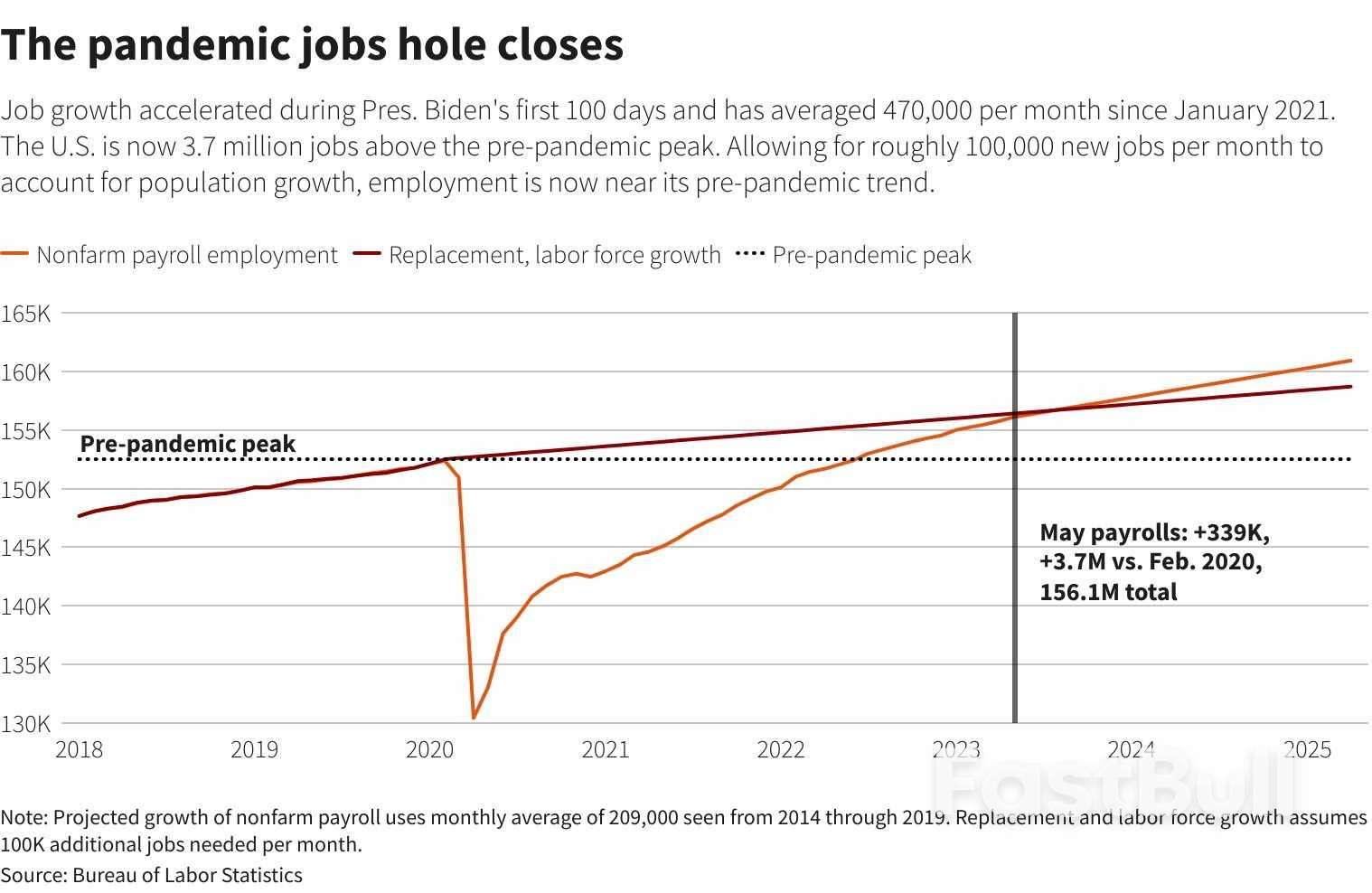
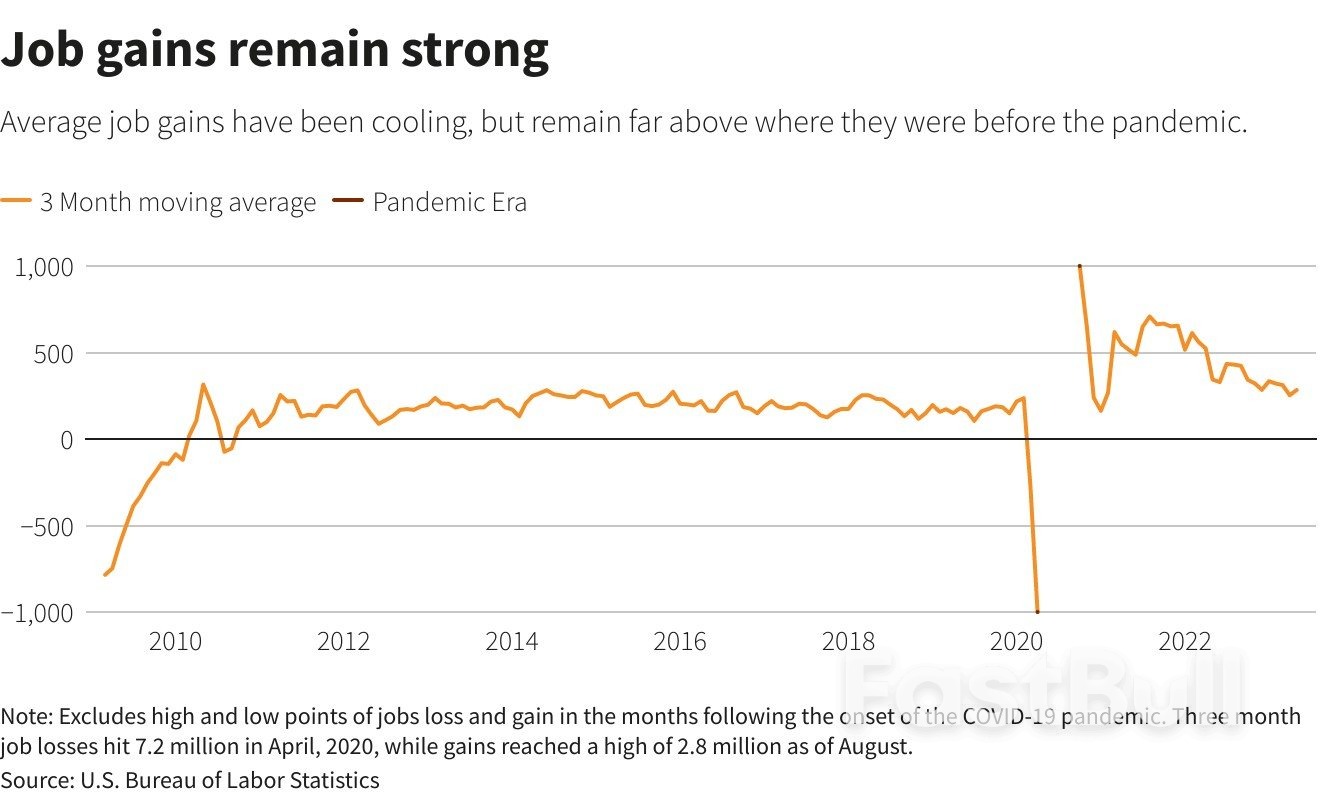
          World markets retained a warm afterglow from Friday's shining U.S. employment reading, with only minor gains in crude oil prices on Saudi Arabia's output cut clouding the picture.
          A forecast-busting May payrolls gain, coupled with signs of cooling wage growth, provided investors with a "soft landing" economic narrative that complemented relief over last week's government debt ceiling resolution.
          With the Federal Reserve moving into a blackout period ahead of a June 14 policy decision, futures markets only see just over a one-in-four chance of another rate hike this month - though one final quarter point rise in July is still largely priced.
          The combined picture was enough to lift the S&P500 and Nasdaq to their highest in almost 10 months on Friday - with S&P futures retaining those gains ahead of Monday's open.
          Remarkably, Wall St's "fear index", the VIX gauge of implied equity volatility, recorded its lowest close since before the pandemic hit more than three years ago.
          While Big Tech stocks have led the way this year with gains of more than 65% - and Apple coming within a whisker of reclaiming record highs last week - stock gains showed some sign of broadening at last.
          The Russell 2000 Index of small cap stocks outperformed both the S&P500 and Nasdaq and is now up some 4% for the year so far.
          MSCI's all-country index hit its highest in more than a year on Monday.
          And the dollar climbed across the board.
          While Brent crude oil prices popped up about $1 per barrel on the Saudi output cut plans, the move was limited and year-on-year crude losses continue to clock some 35%.
          May U.S. service sector readings dominate the Monday diary, as does the likely start of Treasury rebuilding its depleted coffers with 3- and 6-month bill auctions. U.S. 2-year Treasury yields nudged higher to 3.75% on Monday.
          Soundings from China's service sector earlier helped partly to offset fears that dour factory readings questioned its post-COVID recovery. European equivalents were more downbeat.
          As midyear investment outlooks stream in, Morgan Stanley's global take sees developed market government bonds, Asia equities and the dollar all outperforming over the remainder of the year - but it spotlighted "front loaded" risk to growth, earnings and policy that make it something of a "crunch time".
          Elsewhere, U.S. regulators are preparing to tighten rules for large banks, which could raise their capital requirements by 20% on average after a spate of midsize bank failures this year, the Wall Street Journal reported on Monday.
          Turkey's lira slid almost 1% on Monday to weaken past 21 per dollar, in a shaky initial reaction to the appointment of highly-regarded Mehmet Simsek as finance minister.
          Events to watch for later on Monday:
          * U.S. ISM and S&P Global May service sector surveys, April factory goods orders
          * European Central Bank President Christine Lagarde speaks to European Parliament; Cleveland Federal Reserve President Loretta Mester speaks at conference opening
          * U.S. Treasury auctions 3- and 6-month billsJobs Glow, Crude Pops, Dollar Lifts_1Jobs Glow, Crude Pops, Dollar Lifts_2Jobs Glow, Crude Pops, Dollar Lifts_3

          Jobs Glow, Crude Pops, Dollar Lifts_4Source: Yahoo

          Risk Warnings and Disclaimers
          You understand and acknowledge that there is a high degree of risk involved in trading. Following any strategies or investment methods may lead to potential losses. The content on the site is provided by our contributors and analysts for information purposes only. You are solely responsible for determining whether any trading assets, securities, strategy, or any other product is suitable for investing based on your own investment objectives and financial situation.
          Comments
          Add to Favorites
          Share

          Strong Growth and Optimism Continue in UAE and Saudi Arabian Non-Oil Sectors

          Warren Takunda

          Traders' Opinions

          The private non-oil sectors of the United Arab Emirates (UAE) and Saudi Arabia have showcased robust growth in May 2023, as indicated by the latest Purchasing Managers' Index (PMI) reports. Despite a slight dip in the UAE's PMI, both countries' economies remain on a positive trajectory, with strong demand, increased employment, and optimistic outlooks for the future.
          UAE Non-Oil SectorStrong Growth and Optimism Continue in UAE and Saudi Arabian Non-Oil Sectors_1
          The S&P Global UAE PMI declined marginally from 56.6 to 55.5 in May 2023, still surpassing the critical 50 mark, indicating expansion. The non-oil sector continues to drive growth, with notable improvements in both activity and new orders. The pace of new business intakes moderated slightly but remained high, thanks to a rise in domestic demand. Additionally, employment growth reached its second-fastest rate since July 2016, while backlogs of work continued to accumulate, underscoring the sustained momentum in the sector. One encouraging factor is the subdued cost pressures, primarily attributed to improved supply chains. Moreover, business optimism soared to its highest level since October 2021, with firms anticipating the continuation of strong demand in the foreseeable future.
          Saudi Arabian Non-Oil SectorStrong Growth and Optimism Continue in UAE and Saudi Arabian Non-Oil Sectors_2
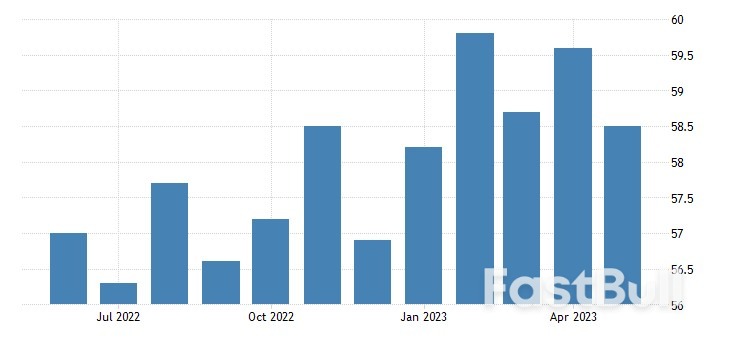
          In Saudi Arabia, the PMI stood at a healthy 58.5 in May 2023, although it experienced a minor drop from the previous month's 59.6. Despite this decline, the index remained above its long-run average, indicating sustained growth in the non-oil private sector. The rising market demand conditions propelled new order inflows to expand at their fastest pace in eight and a half years, while output also increased significantly, albeit at a slower rate compared to the previous months. Consequently, firms stepped up their purchasing activity, albeit at a relatively lower level compared to earlier this year. Employment growth in Saudi Arabia advanced at its fastest rate since 2018, reflecting a positive outlook for the labor market. However, some firms mentioned the challenges of labor shortages and higher living costs, resulting in increased staff expenses. The rise in wages, in turn, contributed to a broad increase in input costs, leading to a sharp rise in output charges, the highest since August 2020. Despite these challenges, overall business sentiment remained positive, although the degree of optimism declined due to rising competition.

          Outlook

          The sustained growth and positive sentiment in the non-oil sectors of both the UAE and Saudi Arabia are encouraging signs for their respective economies. While the UAE experienced a slight moderation in its PMI, the overall performance remains strong. The UAE's focus on diversifying its economy away from oil and investing in non-oil sectors continues to yield positive results. In Saudi Arabia, the expansion of the non-oil sector and strong market demand highlight the country's economic resilience. However, challenges such as labor shortages and rising costs need to be addressed to sustain growth and maintain a competitive edge.
          The UAE and Saudi Arabian non-oil sectors demonstrated resilience and strong growth in May 2023, supported by robust activity, increased employment, and positive outlooks. Despite a marginal dip in the UAE's PMI, the sector remains on a growth trajectory, benefiting from domestic demand and improved supply chains. Saudi Arabia experienced a slight decline in its PMI as well but continues to exhibit positive expansion, driven by rising market demand and strong output. Both countries should focus on addressing challenges such as labor shortages and cost pressures to sustain growth and capitalize on the optimistic business sentiment. Overall, these developments bode well for the economic diversification efforts and long-term stability of the UAE and Saudi Arabian economies.
          Risk Warnings and Disclaimers
          You understand and acknowledge that there is a high degree of risk involved in trading. Following any strategies or investment methods may lead to potential losses. The content on the site is provided by our contributors and analysts for information purposes only. You are solely responsible for determining whether any trading assets, securities, strategy, or any other product is suitable for investing based on your own investment objectives and financial situation.
          Comments
          Add to Favorites
          Share

          FOMO Regime Change for U.S. Stock Market

          Alex

          Stocks

          On Friday, 2 June, we witnessed a significant flow of rotation among the benchmark U.S. stock indices ahead of the key 16 June "Triple Witching" U.S. options expiration; prior laggards, the Dow Jones Industrial Average and Russell 2000 have recorded one of the best single day outperformance in at least three months against the leading mega-cap tech & AI concentrated Nasdaq 100.

          Dow Jones Industrial Average & Russell 2000 recorded their highest single-day outperformance against Nasdaq 100 since February 2023 & October 2022

          The ongoing medium-term uptrend of the Nasdaq 100 started on 13 October 2022, outperforming the Dow Jones Industrial Average and Russell 2000 in the past seven months. Interestingly, the Dow Jones Industrial Average / Nasdaq 1000 ratio recorded its strongest single-day performance on Friday since 3 Feb 2023 (1.38) while the Russell 2000 / Nasdaq 1000 ratio notched its strongest single-day performance since 26 October 2022 (2.81) supported by strong rallies seen in cyclical, industrial and banking stocks such as 3M (+8.7%), Caterpillar (+8.4%) and U.S. regional banks (KRE ETF +6.2%) on Friday.

          FOMO Regime Change for U.S. Stock Market_1Fig 1: Performances of DJIA & Russell 2000 against Nasdaq 100 measured by their respective ratios as of 2 June 2023 (Source: TradingView, click to enlarge chart)

          On the surface, these positive observations can be considered as an improvement in market breadth as rotation is being spread from the high-flying eight mega-cap tech stocks (FAANG plus MNT; Facebook/Meta, Apple, Amazon, Netflix, Google/Alphabet, Microsoft, Nvidia, and Tesla) that are leading the rally since late October 2022 towards the cyclical laggards.

          A higher cost of funding environment cannot be ruled out

          However, a higher cost of funding environment amid a lingering risk of stagflation may put a damper on earnings growth. The 10-year U.S. Treasury yield has recovered above its 200-day moving ex-post U.S. debt ceiling deal and is looking for a test on a key resistance at 3.90% with positive momentum.

          FOMO Regime Change for U.S. Stock Market_2Fig 2: 10-year U.S. Treasury yield trend as of 5 Jun 2023 (Source: TradingView, click to enlarge chart)

          The leading inverted U.S. Treasury yield curve is pointing to a potential imminent global recession

          In addition, we cannot rule out an impending global recession as the leading U.S. Treasury yield curve, the difference between the 10-year and 2-year is now at -0.81%; it's the most inverted state in almost 42 years.

          FOMO Regime Change for U.S. Stock Market_3Fig 3: U.S. Treasury yield curve (10-year over 2-year) trend as of 5 June 2023 (Source: TradingView, click to enlarge chart)

          However, in a nutshell, the trend is always your friend until its ends so do not be surprised by such positive FOMO irrational behaviour that can persist in the short to medium-term time horizons which in turn may take the U.S. stock market higher due to a relatively low level of positioning, exposure, and sentiment since the start of the year.

          Source: MarketPulse

          Risk Warnings and Disclaimers
          You understand and acknowledge that there is a high degree of risk involved in trading. Following any strategies or investment methods may lead to potential losses. The content on the site is provided by our contributors and analysts for information purposes only. You are solely responsible for determining whether any trading assets, securities, strategy, or any other product is suitable for investing based on your own investment objectives and financial situation.
          Comments
          Add to Favorites
          Share

          China: Second Economic Transformation Calls for Greater Domestic Consumption

          Cohen

          Economic

          China has successfully transformed from a major agricultural country into the world's top manufacturer through reform and opening-up, and has become the world's second-largest economy.
          However, the country is in urgent need of a second economic transformation, given its rapidly aging population and bottlenecks in a growth model driven by exports and real estate.
          China's transition to high-quality growth will require an economic rebalancing of its previous growth pattern — from heavy reliance on investment, exports and property toward domestic consumption, advanced manufacturing and the digital economy.
          Compared to its global peers, the contribution of investment to China's GDP has been about twice the global average from 2008. The contribution rate has remained at around 42 percent while the global average has only been about 21 percent for the same period.
          However, as the return on investment declines, greater investment means more debt. Investments are mainly channeled to sectors such as manufacturing, real estate and infrastructure.
          Investment into China's real estate development, for example, shrunk by nearly 10 percent year-on-year in 2022, and is expected to post negative growth this year. Even though the fall in the property sector could narrow, the upward trend of the long real estate cycle of more than 20 years has come to an end.
          Further, the overall return on infrastructure investment, which acts as a countercyclical policy tool to stabilize investment, is dropping on a sustained basis, as evidenced by the fact that the median return on invested capital of local government financing vehicles has dropped from 3.1 percent in 2011 to 1.3 percent in 2020.
          As the prospect of exports and real estate has a direct bearing on the growth of manufacturing investment, it is no surprise that manufacturing investment will experience a long-term downward trend.
          Exports face pressure
          Exports have also faced mounting pressure due to stagnant external demand, rising trade frictions and increasing domestic labor costs.
          Since 1990, China's exports have continued to grow, and the country has long been the world's top exporter. China's exports accounted for more than 15 percent of the global total in 2021, but a falling trend emerged since the second half of 2022 and continues to unfold.
          Japan's share of global exports, after reaching 9.55 percent in 1993, began to go downhill, accounting for less than 3 percent in 2022. The decline of Japanese exports was not caused by the significant appreciation of the yen after the Plaza Accord in 1985 but by the dramatic rise in Japanese labor costs starting in the late 1980s.
          Lessons from Japan show that it is almost impossible for a country to sustain a booming export share permanently. A rise of economies is accompanied by increasing labor costs, which will undermine exports' cost advantage.
          As China's manufacturing labor costs are now over four times that of Vietnam and over three times that of Thailand, it is difficult to stop enterprises from moving low-end production lines out of China.
          Besides the two aforementioned factors, the fast-growing aging population in China has fueled an urgency to push forward its second economic transformation. China entered a period of negative population growth in 2022, and its population is aging faster than that of developed countries.
          China has encountered a challenge similar to that of Japan and the Republic of Korea with their population aging at a rapid pace, and is estimated to become a super-aged country by 2030. This means that the potential growth rate of China's economy may decline as a result. Researches show that Japan's average annual GDP growth rate was only 1.26 percent during its rapidly aging population period.
          From 2012 till now, the workforce in China has decreased by more than 30 million. The number of retirees will surge significantly from 2022 to 2035 as people born during the second baby boom will be past retirement age. Such changes are partly attributable to China's downward economic trend.
          China: Second Economic Transformation Calls for Greater Domestic Consumption_1Second transformation
          The second transformation of China's economy, with less dependence on real estate and export and more efforts toward expanding consumption, has taken on a new urgency.
          In the case of Japan and South Korea, their global industrial output ratios had declined sharply or flattened since mid-1990s, due to rising wage levels. China's wage levels are also rising rapidly, which explains for the transfer of some of its low-end manufacturing capacities to Southeast Asia and other regions.
          To achieve a real economic transformation, China must improve both scale and strength of its manufacturing. It needs to increase research and development inputs and better leverage the roles of both the market and the government in accelerating industrial mergers and acquisitions.
          China's manufacturing industry, with a low industrial concentration, generally relies on market-based ways to carry out mergers and acquisitions, which is less efficient and takes longer. The synergy of an effective and facilitating State can be brought to integrate industry resources in a more efficient way.
          An array of measures, therefore, should be employed to optimize the institutions and mechanisms for China to become a manufacturing powerhouse to guard against falling into the trap of economic stagnation.
          It must be very patient in encouraging growth and upgrading its manufacturing enterprises.
          China should also uphold the principle that "housing is for living in, not for speculation".
          China's society-wide net worth, according to a McKinsey study, has soared to $120 trillion in 2020 from $7 trillion in 2000, while the United States has only doubled its net worth to $90 trillion over the same period. Such rapid asset growth in China is closely related to the rapid expansion of real estate.
          By the end of April, China's M2, a broad measure of money supply, which covers cash in circulation and all deposits, reached 281 trillion yuan ($39.71 trillion), twice that of the United States. This is also related to the huge scale of real estate.
          The long-term upward channel of the real estate cycle has come to an end in China. It means that the transformation of China's economy from an investment-led model to a consumption-driven one is imminent. However, it takes a long time for consumption to take the place, and economic transformation is also a long-range process.
          Greater efforts, therefore, will be needed to advance reform, with a key focus on shoring up residential incomes and especially expanding the proportion of middle-income groups. Only by expanding consumption can the country maintain a well-functioning domestic economy and create a new development dynamic.
          It is also worth mentioning that China's overall leverage ratio is around 100 percent, which is not high compared to 144.5 percent in the United States and 260 percent in Japan. But the proportion of local government debt is relatively high and poses greater credit risk.
          With revenues from the sale of land-use rights on the wane, the local governments are facing debt-repaying risks.
          Therefore, it is imperative to promote the reform of State-owned enterprises, with the view of better mobilizing State-owned assets through mergers, acquisitions and restructuring and increasing local fiscal revenues through dividends and sales of listed State-owned company shares.
          The scale of central government debt should be raised to ensure economic transformation while achieving stable overall economic growth.
          Sustained efforts must also be pursued for wider opening-up to combat "de-Sinicization" and bringing in foreign technology and equipment in a proactive manner.

          Source: China Daily

          To stay updated on all economic events of today, please check out our Economic calendar
          Risk Warnings and Disclaimers
          You understand and acknowledge that there is a high degree of risk involved in trading. Following any strategies or investment methods may lead to potential losses. The content on the site is provided by our contributors and analysts for information purposes only. You are solely responsible for determining whether any trading assets, securities, strategy, or any other product is suitable for investing based on your own investment objectives and financial situation.
          Comments
          Add to Favorites
          Share

          Yen and Yuan Slip on Mounting Speculation of Fed Rate Increase

          Warren Takunda

          Forex

          Traders' Opinions

          The recent performance of the Japanese yen and Chinese yuan has been marked by a weakening trend as investor sentiment shifts in response to hawkish expectations surrounding the US Federal Reserve's monetary policy. A robust US payrolls report has fueled speculations of prolonged higher interest rates, impacting these Asian currencies. In this article, we will explore the factors behind the weakening of the Japanese yen and Chinese yuan, while considering the implications for their respective economies and possible future developments.
          Japanese Yen Weakens Amid Divergent Monetary PoliciesYen and Yuan Slip on Mounting Speculation of Fed Rate Increase_1
          The Japanese yen has recently slid below the 140 per dollar mark, nearing its lowest levels in six months. This depreciation can be attributed to the growing belief among market participants that the Federal Reserve will extend its period of higher interest rates. Currently, there is a 25% chance of a 25 basis point rate hike by the Fed this month, with a pause in the tightening cycle being the prevailing expectation. In stark contrast, the Bank of Japan has maintained its policy of ultra-low interest rates, despite market pressure and persistent inflation. This divergence in monetary policies has contributed to the weakening of the yen.
          Furthermore, the yen's depreciation has raised concerns within the Japanese government. The country's top currency diplomat has highlighted the need to closely monitor currency market movements and respond accordingly. It is evident that Japan aims to ensure the yen's weakness remains within manageable limits to safeguard its export-oriented economy and maintain competitiveness in international markets.
          Chinese Yuan Faces Similar Pressures
          Yen and Yuan Slip on Mounting Speculation of Fed Rate Increase_2Similar to the Japanese yen, the Chinese yuan has also experienced depreciation, falling below 7.1 per dollar and nearing its six-month lows. The main driver behind this trend is the hawkish sentiment surrounding the Federal Reserve's monetary policy, fueling expectations of higher interest rates in the United States. The market currently assigns a 25% probability to a 25 basis point rate hike by the Fed in the near term.
          While China's services sector has exhibited accelerated growth in May, indicating a continued post-pandemic recovery, other economic data, such as mixed manufacturing indicators, have presented a more uneven recovery trajectory. This uncertainty has reinforced speculations that the People's Bank of China may opt to lower interest rates once again to stimulate the world's second-largest economy. The absence of direct intervention by the central bank to support the yuan, despite major state-owned banks selling dollars in the spot market, has added downward pressure on the currency.
          The weakening of the Japanese yen and Chinese yuan can be attributed to hawkish bets on the Federal Reserve's monetary policy stance, which anticipate prolonged higher interest rates in the United States. Japan's yen has weakened against the backdrop of a divergent monetary policy between the Bank of Japan and the Federal Reserve, prompting the Japanese government to closely monitor currency market movements. Meanwhile, China's yuan faces similar pressures, as mixed economic data and the potential for interest rate cuts weigh on the currency. Market participants will be closely monitoring future developments, including any shifts in monetary policies, to assess the impact on these Asian currencies and their respective economies.
          Risk Warnings and Disclaimers
          You understand and acknowledge that there is a high degree of risk involved in trading. Following any strategies or investment methods may lead to potential losses. The content on the site is provided by our contributors and analysts for information purposes only. You are solely responsible for determining whether any trading assets, securities, strategy, or any other product is suitable for investing based on your own investment objectives and financial situation.
          Comments
          Add to Favorites
          Share

          Trading the 50-50 Risk

          Samantha Luan

          Forex

          USD: Not enough to price in a June hike
          The blowout May headline payroll number added fuel to the narrative of an extra tight U.S. labour market, but the coincidental rebound in unemployment to 3.7% and slowdown in wage growth kept markets from going all-in on a June rate hike by the Federal Reserve. As discussed in this note by our U.S. economist, payrolls and the unemployment rate are calculated through different surveys: the former by employers, and the latter by households. In practice, firms and households conveyed very different messages about the direction of the U.S. labour market in May.
          We think that, when adding the cooling off in wage inflation, and considering the diverging views within the FOMC, the case for a pause at the 14 June meeting should prevail. The last big risk event before the rate announcement is the 13 June CPI reading, while today's ISM services figures (the consensus expects a mild improvement) might have a somewhat contained impact on rate expectations, barring major diversions from expectations. The FOMC has already entered the black-out period.
          Markets are currently pricing in a 25-30% implied probability of a hike in June, while 21bp are factored in by the end-July meeting. We suspect that the pricing may not vary considerably, or that the narrative of a "50-50" chance of a hike in June may prevail until the CPI numbers next Tuesday – and barring a surprise there – into the FOMC announcement itself.
          With markets not having received enough compelling evidence from the May jobs report to price in more than a 50% probability of a June hike, we feel that two-year USD swap rates, which rebounded to 4.73% after having declined to 4.51% on Friday, may struggle to find much more support this week.
          Add in a period of potential market sentiment stabilisation now that the debt-ceiling saga has ended and we think the dollar's bullish momentum may dwindle into the FOMC meeting. We see a higher chance of DXY stabilising around 104.00 or pulling back to 103.00. Some pro-cyclical currencies could emerge as outperformers in this period: the Canadian dollar, for example, may stay supported now that Saudi Arabia announced another one million barrels a day of oil production cuts and even if the Bank of Canada stays on hold on Wednesday, as long as it keeps the door open for a potential hike down the road.
          EUR: Lagarde's rhetoric facing a test
          The main highlight of the day in the eurozone is the testimony by European Central Bank President Christine Lagarde before the Committee on Economic and Monetary Affairs of the European Parliament. The quite consistent hawkish rhetoric we have heard from Lagarde and the majority of ECB speakers since the latest ECB meeting will now need to face the evidence that eurozone inflation is declining more rapidly than expected.
          It does not seem highly likely that Lagarde will signal a U-turn in her communication only 10 days before the ECB meeting, and markets are still pricing in two more hikes before the peak, meaning that the bar for a dovish surprise is still set quite low. Later in the day, the hawkish message should be reinforced by a speech from Bundesbank Governor Joachim Nagel.
          Our point in the USD section about a potential halt in the rebound in USD short-term swap rates means that the two-year EUR-USD swap rate gap may also find some respite after having collapsed from -62bp to -116bp in the past four weeks. We feel that EUR/USD could find some support around 1.0650/1.0700 and even stage a rebound back to 1.0800/1.0850 this week.
          AUD: RBA hike is a 50-50 affair
          The Reserve Bank of Australia has had a tendency to surprise markets in recent months. As it prepares to announce monetary policy tomorrow, markets (40% implied probability of a hike) and consensus are split between a 25bp rate increase and a hold after a set of contrasting data in Australia. We agree that the chances of a hike are very close to 50-50: 1Q wage data pointed to more tightening in our view, but April jobs figures were dismal. When April CPI data was released last week and surprised with a jump to 6.8% year-on-year, and Governor Philip Lowe sounded open to all options by reiterating data-dependency, the probability of a June hike jumped again.
          In theory, data dependency means that the prospect of a "hawkish hold" or "dovish hike" should not be on the spectrum of possibilities, and even though the shades of central bank communication can admittedly be quite varied and creative (Lowe will speak Wednesday morning), we see tomorrow's risk event as quite binary for the Australian dollar. A hike could see AUD/USD initiate a move that can take it to stabilise around 0.6700 towards the end of this week; a hold raises the risk of sub-0.6500 lows being tested again soon, even though we think less USD strength can favour stabilisation in the pair regardless of a hawkish surprise by the RBA.
          CEE: Dovish tone to put pressure on FX
          The Czech Republic's 1Q wage data will be published today, which is perhaps a more important number for the central bank these days than inflation itself. The Czech National Bank expects 9.1% YoY, monthly data and national accounts point to a higher number, but it should remain below 10%, the pain threshold mentioned by the board. Tomorrow, we will see industrial data in the Czech Republic and retail data in Hungary. Later, the decision by the National Bank of Poland will be announced. In line with the market, we expect rates to remain unchanged. The main focus will be the governor's press conference, which we expect to be dovish in tone, supported by a fall in inflation. Hungary's industrial production will be released on Wednesday, and we expect a 6.5% YoY decline, well below market expectations. Then on Thursday, we will see May inflation in Hungary, which is expected to fall further from 24.0% to 22.1% YoY, slightly below market expectations. Hungary's state budget result and Romania's second estimate of 1Q GDP will also be released.
          In the FX market, we will be watching the echoes of Friday's U.S. labour numbers, which bring positive sentiment, but also higher dollar rates. However, a stronger dollar will still keep pressure on CEE FX and we remain bearish. Moreover, local numbers across the region should favour a dovish tone this week, pushing interest rate differentials lower. After rallying in recent days, we think the Polish zloty and Hungarian forint are most at risk. The market has built large long positions in both currencies and the dovish tone this week should lead to some market rebalancing. Thus, we should see a return closer to 4,520 EUR/PLN and 372 EUR/HUF.

          Source: ING

          Risk Warnings and Disclaimers
          You understand and acknowledge that there is a high degree of risk involved in trading. Following any strategies or investment methods may lead to potential losses. The content on the site is provided by our contributors and analysts for information purposes only. You are solely responsible for determining whether any trading assets, securities, strategy, or any other product is suitable for investing based on your own investment objectives and financial situation.
          Comments
          Add to Favorites
          Share

          China's Yuan May Slip Further to Aid Economic Recovery

          Thomas

          Forex

          China's yuan has skidded to six-month lows against the dollar and analysts say it could weaken further as investors fret over a bumpy pandemic recovery in the world's second-largest economy.
          Disappointing economic data, widening yield differentials with the United States, upcoming corporate dividend payments and continued capital outflows through foreign selling of stocks and bonds have combined to drag the currency down to levels last seen in November.
          The yuan has depreciated more than 5% against the surging dollar since the highs hit in January, when global markets embraced China's border reopening, and is one of the worst performing Asian currencies this year. It last traded at 7.0585 per dollar on Friday.
          "The yuan suffers as China's reopening story is less appealing than before, and there is no sign of further stimulus," said Gary Ng, senior economist for Asia Pacific at Natixis.
          "A weaker currency at the current juncture can help export performance, especially as global trade is shrinking this year."
          Exports have been one of the few bright spots for the Chinese economy over the past few years but new orders have been falling in recent months amid softening global demand.
          Sources told Reuters that the commerce ministry has asked exporters, importers and banks recently about their currency strategies and how a weakening yuan could affect their businesses.
          To be sure, the central bank has ample policy tools to prevent excess currency movements. The People's Bank of China (PBOC) said last month that it will resolutely curb large fluctuations in the exchange rate and study the strengthening of self-regulation of dollar deposits.
          "Expectations of financial institutions, enterprises and residents on the exchange rate are generally stable, which is a solid foundation and strong guarantee for the smooth operation of the foreign exchange market," the central bank said in the statement.
          However, despite the yuan's quickening tumble over the past month, traders have only reported a few occasions when state banks have been suspected of stepping in to support the currency.
          The PBOC did not immediately respond to Reuters request for comments.
          "The PBOC essentially appears content to let the rising U.S. dollar buoy USD/CNY higher, amid China's fading growth momentum," said Alvin Tan, head of Asia FX strategy at RBC Capital Markets.
          "After all, currency depreciation is a form of monetary easing," Tan said, maintaining his forecasts for the yuan to trade at 7.1 at the end of the third quarter before finishing the year at 7.05.
          Tommy Wu, senior China economist at Commerzbank, also said the central bank "appears to tolerate a weaker yuan," noting its recent daily official yuan midpoint guidance rates have all came in line with market expectations.
          Still, economists and analysts don't expect sharp falls from here on. Among half of a dozen of global investment houses surveyed by Reuters this week, all said they don't foresee the yuan weakening beyond 7.3 this year, the lows hit in 2022 as strict anti-virus curbs battered the economy.
          "A weaker yuan helps exporters when they convert the dollar receivables to yuan," said Barclays' FX strategist Lemon Zhang. "But a weak currency expectation going forward is not helping capital flows, as investors are concerned about FX losses when they look at yuan-denominated assets."
          A weaker yuan might also temper deflationary pressures being seen in parts of the economy due to weak domestic demand.
          However, implied volatility for the currency, an options market gauge of future volatility, has been fairly stable. The one-month tenor stood at 4.5, the highest since April. And six-month yuan traded in forwards market was priced at 6.96 per dollar.
          Some market watchers suspect the PBOC could set a cap on dollar deposit rates, a move that could encourage companies to liquidate their large dollar positions to ease downside pressure on the yuan.
          "Chinese officials will not step in unless the spot yuan weakens quickly through 7.2," said Serena Zhou, senior China economist at Mizuho Securities.
          "Note that the PBOC has not intervened with any of its policy tools, such as the 'counter-cyclical factor' in pricing the yuan fixing rate or FX risk reserve ratio, to shore up the yuan."

          Source: Yahoo

          Risk Warnings and Disclaimers
          You understand and acknowledge that there is a high degree of risk involved in trading. Following any strategies or investment methods may lead to potential losses. The content on the site is provided by our contributors and analysts for information purposes only. You are solely responsible for determining whether any trading assets, securities, strategy, or any other product is suitable for investing based on your own investment objectives and financial situation.
          Comments
          Add to Favorites
          Share
          FastBull
          Copyright © 2025 FastBull Ltd

          728 RM B 7/F GEE LOK IND BLDG NO 34 HUNG TO RD KWUN TONG KLN HONG KONG

          TelegramInstagramTwitterfacebooklinkedin
          App Store Google Play Google Play
          Products
          Charts

          Chats

          Q&A with Experts
          Screeners
          Economic Calendar
          Data
          Tools
          Membership
          Features
          Function
          Markets
          Copy Trading
          Latest Signals
          Contests
          News
          Analysis
          24/7
          Columns
          Education
          Company
          Careers
          About Us
          Contact Us
          Advertising
          Help Center
          Feedback
          User Agreement
          Privacy Policy
          Business

          White Label

          Data API

          Web Plug-ins

          Poster Maker

          Affiliate Program

          Risk Disclosure

          The risk of loss in trading financial instruments such as stocks, FX, commodities, futures, bonds, ETFs and crypto can be substantial. You may sustain a total loss of the funds that you deposit with your broker. Therefore, you should carefully consider whether such trading is suitable for you in light of your circumstances and financial resources.

          No decision to invest should be made without thoroughly conducting due diligence by yourself or consulting with your financial advisors. Our web content might not suit you since we don't know your financial conditions and investment needs. Our financial information might have latency or contain inaccuracy, so you should be fully responsible for any of your trading and investment decisions. The company will not be responsible for your capital loss.

          Without getting permission from the website, you are not allowed to copy the website's graphics, texts, or trademarks. Intellectual property rights in the content or data incorporated into this website belong to its providers and exchange merchants.

          Not Logged In

          Log in to access more features

          FastBull Membership

          Not yet

          Purchase

          Become a signal provider
          Help Center
          Customer Service
          Dark Mode
          Price Up/Down Colors

          Log In

          Sign Up

          Position
          Layout
          Fullscreen
          Default to Chart
          The chart page opens by default when you visit fastbull.com