Markets
News
Analysis
User
24/7
Economic Calendar
Education
Data
- Names
- Latest
- Prev


Signal Accounts for Members
All Signal Accounts
All Contests


Brazil IPCA Inflation Index YoY (Nov)A:--
F: --
P: --
Brazil CPI YoY (Nov)A:--
F: --
P: --
U.S. MBA Mortgage Application Activity Index WoWA:--
F: --
P: --
U.S. Labor Cost Index QoQ (Q3)A:--
F: --
P: --
Canada Overnight Target RateA:--
F: --
P: --
BOC Monetary Policy Report
U.S. EIA Weekly Gasoline Stocks ChangeA:--
F: --
P: --
U.S. EIA Weekly Crude Demand Projected by ProductionA:--
F: --
P: --
U.S. EIA Weekly Cushing, Oklahoma Crude Oil Stocks ChangeA:--
F: --
P: --
U.S. EIA Weekly Crude Stocks ChangeA:--
F: --
P: --
U.S. EIA Weekly Crude Oil Imports ChangesA:--
F: --
P: --
U.S. EIA Weekly Heating Oil Stock ChangesA:--
F: --
P: --
U.S. Refinitiv/Ipsos Primary Consumer Sentiment Index (PCSI) (Dec)A:--
F: --
P: --
China, Mainland M1 Money Supply YoY (Nov)--
F: --
P: --
China, Mainland M0 Money Supply YoY (Nov)--
F: --
P: --
China, Mainland M2 Money Supply YoY (Nov)--
F: --
P: --
Russia CPI YoY (Nov)A:--
F: --
P: --
U.S. Federal Funds Rate Projections-Longer Run (Q4)A:--
F: --
P: --
U.S. Federal Funds Rate Projections-1st Year (Q4)A:--
F: --
P: --
U.S. Target Federal Funds Rate Lower Limit (Overnight Reverse Repo Rate)A:--
F: --
P: --
U.S. Federal Funds Rate Projections-2nd Year (Q4)A:--
F: --
P: --
U.S. Budget Balance (Nov)A:--
F: --
P: --
U.S. Target Federal Funds Rate Upper Limit (Excess Reserves Ratio)A:--
F: --
P: --
U.S. Interest Rate On Reserve BalancesA:--
F: --
P: --
U.S. Federal Funds Rate Projections-Current (Q4)A:--
F: --
P: --
U.S. Federal Funds Rate TargetA:--
F: --
P: --
U.S. Federal Funds Rate Projections-3rd Year (Q4)A:--
F: --
P: --
FOMC Statement
FOMC Press Conference
Brazil Selic Interest RateA:--
F: --
P: --
U.K. 3-Month RICS House Price Balance (Nov)--
F: --
P: --
Australia Employment (Nov)--
F: --
P: --
Australia Full-time Employment (SA) (Nov)--
F: --
P: --
Australia Unemployment Rate (SA) (Nov)--
F: --
P: --
Australia Labor Force Participation Rate (SA) (Nov)--
F: --
P: --
Turkey Retail Sales YoY (Oct)--
F: --
P: --
South Africa Mining Output YoY (Oct)--
F: --
P: --
South Africa Gold Production YoY (Oct)--
F: --
P: --
Italy Quarterly Unemployment Rate (SA) (Q3)--
F: --
P: --
IEA Oil Market Report
Turkey 1-Week Repo Rate--
F: --
P: --
South Africa Refinitiv/Ipsos Primary Consumer Sentiment Index (PCSI) (Dec)--
F: --
P: --
Turkey Overnight Lending Rate (O/N) (Dec)--
F: --
P: --
Turkey Late Liquidity Window Rate (LON) (Dec)--
F: --
P: --
U.K. Refinitiv/Ipsos Primary Consumer Sentiment Index (PCSI) (Dec)--
F: --
P: --
Brazil Retail Sales MoM (Oct)--
F: --
P: --
U.S. Weekly Continued Jobless Claims (SA)--
F: --
P: --
U.S. Exports (Sept)--
F: --
P: --
U.S. Trade Balance (Sept)--
F: --
P: --
U.S. Weekly Initial Jobless Claims (SA)--
F: --
P: --
Canada Imports (SA) (Sept)--
F: --
P: --
U.S. Initial Jobless Claims 4-Week Avg. (SA)--
F: --
P: --
Canada Trade Balance (SA) (Sept)--
F: --
P: --
Canada Exports (SA) (Sept)--
F: --
P: --
U.S. Wholesale Sales MoM (SA) (Sept)--
F: --
P: --
U.S. EIA Weekly Natural Gas Stocks Change--
F: --
P: --
U.S. 30-Year Bond Auction Avg. Yield--
F: --
P: --
Argentina CPI MoM (Nov)--
F: --
P: --
Argentina National CPI YoY (Nov)--
F: --
P: --
Argentina 12-Month CPI (Nov)--
F: --
P: --
U.S. Weekly Treasuries Held by Foreign Central Banks--
F: --
P: --


No matching data
Latest Views
Latest Views
Trending Topics
Top Columnists
Latest Update
White Label
Data API
Web Plug-ins
Affiliate Program
View All

No data
Japanese authorities lifted tsunami warnings on Tuesday hours after a powerful 7.5-magnitude earthquake shook northeastern regions, injuring at least 30 people and forcing about 90,000 residents to evacuate their homes.




Japanese authorities lifted tsunami warnings on Tuesday hours after a powerful 7.5-magnitude earthquake shook northeastern regions, injuring at least 30 people and forcing about 90,000 residents to evacuate their homes.
The earthquake struck off the coast at 11:15 p.m. (1415 GMT) on Monday, and the Japan Meteorological Agency said a tsunami as high as 3 metres (10 feet) could hit the country's northeastern coast. Warnings were issued for the prefectures of Hokkaido, Aomori and Iwate, and tsunamis from 20 to 70 cm (7 to 27 inches) high were observed at several ports, JMA said.
By the early hours of Tuesday, the JMA downgraded the warnings to advisories, and later lifted all advisories. There were no reports of major damage.
The epicentre of the quake was 80 km (50 miles) off the coast of Aomori prefecture, at a depth of 54 km.
On Japan's 1-7 scale of seismic intensity, the tremor registered as an "upper 6" in Hachinohe city, Aomori prefecture - a quake strong enough to make it impossible to keep standing or move without crawling.
"As of now, I have received reports of 30 people being injured and one fire," Prime Minister Sanae Takaichi told reporters.
East Japan Railway (9020.T), opens new tab suspended some services in the area, which was also hit by a massive 9.0-magnitude quake in March 2011. Other train services are facing delays in northern Japan, the operator said.
Following the tremor, the JMA issued an advisory for a wide region from the northernmost island of Hokkaido down to Chiba prefecture, east of Tokyo, calling on residents to be on alert for the possibility of a powerful earthquake hitting again within a week.
"There is a possibility that further powerful and stronger earthquakes could occur over the next several days," a JMA official said at a briefing.
No irregularities were reported at nuclear power plants in the region run by Tohoku Electric Power (9506.T), opens new tab and Hokkaido Electric Power (9509.T), opens new tab, the utilities said. Thousands of households had lost power immediately following the quake, but service resumed by Tuesday morning.
The yen weakened against major currencies after news of the tremor, with the dollar and euro both touching session highs.
Japan is one of the world's most earthquake-prone countries, with a tremor occurring at least every five minutes. Located in the "Ring of Fire" of volcanoes and oceanic trenches partly encircling the Pacific Basin, Japan accounts for about 20% of the world's earthquakes of magnitude 6.0 or greater.
The northeastern region suffered one of the country's deadliest earthquakes on March 11, 2011, when a 9.0-magnitude tremor struck under the ocean off the coast of the northern city of Sendai. It was the most powerful ever recorded in Japan and set off a series of massive tsunami that devastated a wide swathe of the Pacific coastline and killed nearly 20,000 people.
Drawing on lessons from that disaster, when a magnitude 7-level earthquake had struck two days beforehand, the government now issues a one-week "megaquake" advisory whenever a significant earthquake occurs in the region.
The 2011 tsunami also damaged the Fukushima Daiichi nuclear plant, leading to a series of explosions and meltdowns in the world's worst nuclear disaster for 25 years.
A measure of Australian business conditions pulled back in November as sales and profits both eased after a couple of strong months, a survey showed on Tuesday, while many firms still reported limited spare capacity.
The survey from National Australia Bank showed its index of business conditions fell 3 points to +7 in November, coming off its highest level since March 2024. The survey's volatile measure of business confidence slid 5 points to +1.
The result could point to some cooling in consumer demand after a very strong October, though the lack of spare capacity fits with recent high readings on inflation.
The Reserve Bank of Australia holds its last meeting of the year on Tuesday and is considered certain to hold rates at 3.60%, and likely signal caution on further easing.
"Overall, the survey continues to tell us that businesses are capacity constrained and that if economic growth accelerates further from the current starting point, we may quickly see additional pressure on prices," said NAB Chief Economist Sally Auld.

The survey's measure of business sales dropped 6 points to +12 in November, while profitability fell 5 points to +4. Its measure of employment edged up 1 point to +4.
Capacity utilisation ticked up to 83.6%, the highest reading in 18 months. Price indicators in the survey were mostly higher, with growth in purchase costs running at a quarterly rate of 1.3% and retail prices at 0.8%.

XRP-spot ETF hype, a broadening investor base, and increasing XRP utility boosted buyer demand for XRP. US XRP-spot ETF inflows edged closer to $1 billion on Friday, December 5, tilting the supply-demand balance in XRP's favor.
Meanwhile, increasing real-world XRP utility has likely fueled institutional demand for XRP-spot ETFs. XRP-spot ETF inflows have outperformed inflows into the US BTC-spot ETF market despite fewer ETFs.
Last week, the Monetary Authority of Singapore expanded Ripple's Asian footprint, granting an expanded scope of payment activities for its Major Payment Institution (MPI) license. According to Ripple, the approval enables the delivery of end-to-end, fully licensed payment services to its customers in the region.
Resilient institutional appetite and greater utility are two key ingredients for a bullish price trajectory for XRP.
Below, I will explore the key drivers behind recent price trends, the medium-term (4-8 week) outlook, and the key technical levels traders should watch.
The US XRP-spot ETF market has seen total net inflows of $897.35 million since launch to Friday, December 5. Just four spot ETFs have drawn almost $1 billion in less than a month, underscoring robust institutional demand. $1 billion in inflows for the first month would align with JPMorgan's pre-launch forecast of $8 billion in net inflows for year one.
Sustained inflows are likely to benefit XRP, setting up a bullish short- to medium-term price outlook.
Last week, the Vanguard Group unlocked the door to crypto assets, allowing brokerage clients to invest in crypto-spot ETFs. Vanguard's repositioning on digital assets came off the back of the launch of XRP-spot ETFs, widening the investor base.
The resolution of the SEC vs. Ripple case and Ripple's continued expansion on Main Street may accelerate the XRP-BTC decoupling, evidenced in spot ETF flows. US BTC-spot ETFs reported net outflows of $87.7 million in the reporting week ending December 5, while US XRP-spot ETFs saw net inflows of $230.73 million.
Flows for Monday, December 8, are expected later today.
SoSoValue – XRP-Spot ETF Flows – 091225On Monday, December 8, 21Shares filed an amended S-1 for its XRP-spot ETF, ticker TOXR, amid strong inflows. An imminent launch could further tilt the supply-demand balance in XRP's favor, supporting the bullish short- to medium-term outlook.
Market bets on a 25-basis point Fed rate cut on Wednesday, December 10, bolstered investor appetite for XRP and the broader market. However, uncertainty lingers over the Fed's rate path through 2026. A more dovish Fed rate path, with multiple rate cuts in 2026, would likely lift sentiment.
Given the uncertainty, the FOMC Economic Projections, out after the interest rate decision, will likely influence XRP's short-term price outlook. Softer US inflation in September may give the doves a stronger footing in Wednesday's decision.
Beyond the Fed, several scenarios may boost buyer appetite for XRP, including:
In my view, these potential tailwinds support a near-term (1-4 weeks) move to $2.35 and a medium-term (4-8 weeks) rise toward $2.5.
While the short- to medium-term outlook remains bullish, several events could derail the bullish outlook. These include:
These events would likely push XRP below $2, exposing the November low of $1.82.
However, in my opinion, strong demand for XRP-spot ETFs, progress toward crypto-friendly regulations, a broadening investor base, and a dovish Fed will likely support a longer-term move toward $3.
In summary, the short-term outlook remains cautiously bullish, while the medium- to longer-term outlook is constructive.
Technical Outlook: EMAs Signal Caution
XRP rose 1.35% on Monday, December 8, following the previous day's 0.68% gain, closing at $2.0733. The token outperformed the broader crypto market, which advanced 0.67%.
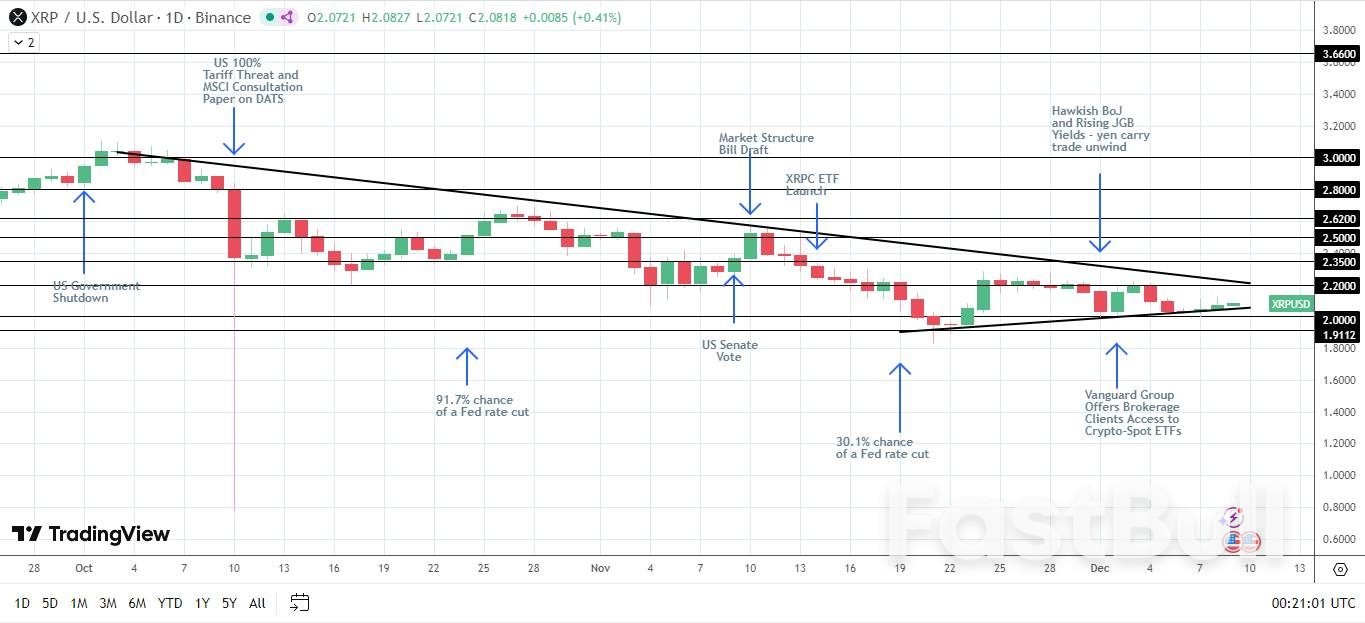
Despite Monday's gain, XRP remained below the 50-day and 200-day Exponential Moving Averages (EMAs), signaling a bearish bias. However, fundamentals are shifting from the technical trend, supporting a bullish outlook.
Key technical levels to watch include:
Avoiding a drop below the $2.0 psychological support level would support a move toward the 50-day EMA. A sustained breakout above the 50-day EMA would open the door to testing the $2.35 resistance level. Significantly, a break above the 50-day EMA would indicate a near-term bullish trend reversal. A bullish trend reversal would support a medium-term (4-8 weeks) climb to the 200-day EMA and the $2.5 level.
XRPUSD – Daily Chart – 091225 – EMAsNear-term price drivers include:
Holding above the lower trendline and $2.0 would pave the way to the upper trendline. A sustained move through the upper trendline would align with the $2.5 medium-term and $3 longer-term (8-12 weeks) price targets.
However, a move below $1.8239 would invalidate the medium-term bullish structure.
XRPUSD – Daily Chart – 091225 – Bullish StructureXRP-spot ETF flows will face scrutiny on Tuesday, December 9, with Vanguard's crypto U-turn and increased XRP utility expected to boost institutional demand. However, speculation about Wednesday's FOMC Economic Projections and updates from Capitol Hill on the Market Structure Bill's progress may increase volatility.
To summarize, robust XRP-spot ETF inflows and a dovish Fed rate cut support a short-term move to $2.35. Progress toward crypto-friendly legislation and wider XRP adoption would align with the medium-term (4-8 weeks) and longer-term (8-12 weeks) $2.5 and $3.0 price targets.
British consumers kept a tight rein on their spending in November as they awaited finance minister Rachel Reeves' budget, while retailers said Black Friday sales disappointed, according to surveys on Tuesday.
Barclays said spending on its credit and debit cards fell by 1.1% in annual terms in November, the biggest drop since February 2021 when the COVID-19 pandemic still raged.
A separate survey from the British Retail Consortium (BRC) trade body showed spending at big retailers rose by 1.4% in annual terms last month, the slowest growth since May.
The surveys chimed with other indicators showing a weakening consumer economy. Official data showed retail sales fell sharply in October and the Confederation of British Industry said confidence among chains of stores hit a 17-year low last month.
"November was a month marked by uncertainty, as consumers were awaiting seasonal discounts and the details of the Autumn Budget," said Karen Johnson, head of retail at Barclays.
Reeves announced 26 billion pounds ($35 billion) of tax increases in her November 27 budget, although there was no increase to the main rates of income tax as had been expected for much of the month.
The BRC said computing and household appliance sales looked better than last year's Black Friday promotion period, but non-food sales growth was minimal overall.
"Rising household costs and nervousness about the economy continue to impact discretionary buying," said Linda Ellett, UK head of consumer, retail and leisure at accountants KPMG, who sponsor the BRC survey.
"But retailers will be hoping that budget clarity has now provided more certainty for consumers about their ability to spend in the months ahead," she added.

The Barclays data covered card spending between October 25 and November 21, while the BRC survey spanned November 2 to November 29. Black Friday fell on November 28.

President Donald Trump on Monday threatened to impose an additional 5% tariff on Mexico if it doesn't immediately provide additional water to help U.S. farmers, accusing the country of violating a treaty that outlines water sharing between the neighbors.
Under the treaty, Mexico must send 1.75 million acre-feet of water to the U.S. from the Rio Grande through a network of interconnected dams and reservoirs every five years.
Trump said in a social media post that Mexico "owes" the U.S. 800,000 acre-feet of water due to violations of the treaty over the past five years.
He demanded Mexico release 200,000 acre-feet of water before December 31, and more "soon after."
The lack of water was hurting crops and livestock in Texas, Trump said.
"As of now, Mexico is not responding, and it is very unfair to our U.S. Farmers who deserve this much needed water," Trump said. "That is why I have authorized documentation to impose a 5% Tariff on Mexico if this water isn't released, IMMEDIATELY."
A spokesperson for Mexico's economy ministry did not immediately respond to a request for comment.
In April, U.S. Agriculture Secretary Brooke Rollins said that Mexico had agreed to increase its water shipments to Texas to help make up a shortfall under the 1944 treaty.
Mexico has argued that it is under drought conditions that have strained the country's water resources.
Michael Burry, the money manager made famous in The Big Short, says he holds sizable positions in both Fannie Mae and Freddie Mac common stock and believes a re-listing of the US housing-finance giants is "nearly upon us."
In a 6,000-word blog post Monday, Burry outlined why he's now bullish on the government-sponsored enterprises, the political and regulatory hurdles that still stand in the way of a public offering, and the steps he says Washington must take before the pair can stage a comeback on Wall Street.
Burry earned renown for predicting the collapse of the US housing market before the 2008 financial crisis. In the post, he shared excerpts from an old note in which he dubbed the company "Frauddie Mac," and said that he had bought the company's five-year credit-default swaps in the years leading up to its meltdown, which led to government conservatorship. While some investors have famously held Fannie and Freddie positions for over a decade, Burry said he became bullish on the shares only after President Donald Trump's election last year.
"I personally own both Fannie Mae and Freddie Mac common stock in good size," Burry wrote in the post, in which he examined the current political dynamics and how shares may be valued in a sale and beyond. The offering price "is a key determinant of the intrinsic value of these companies, and I will certainly revisit this thesis as those numbers come into focus."
Shares of Fannie Mae rose 2% Monday, while Freddie Mac climbed 2.4%. The pair, which trade over-the-counter and are prone to volatile swings, have added about 12% since late November.
For a public offering to occur, Burry argues that regulators will need to ease Fannie and Freddie's capital requirements, convert certain preferred shares into common stock, and scale back the government's claim on the companies, warning that without the latter, their common shares are "worthless."
Still, he noted "there remains a final steep, windy and rocky climb to IPO for both."
Burry's Scion Asset Management last month terminated its registration status with the SEC, raising the possibility that he is shuttering his hedge fund or closing it to outside investors.
His post comes less than a month after billionaire investor and long-time Fannie and Freddie shareholder Bill Ackman took to social media to outline a proposal that calls for relisting Fannie and Freddie on the New York Stock Exchange.
The U.S. Bureau of Labor Statistics announced a delay in the release of October 2025 Producer Price Index data due to funding issues, rescheduled for January 14, 2026.
The delay heightens uncertainty in economic indicators, impacting Federal Reserve policies and potentially influencing cryptocurrency volatility. No direct on-chain data links to this delay yet.
The U.S. Bureau of Labor Statistics has announced a postponement of the October 2025 Producer Price Index release due to a lapse in federal appropriations. The data for October will now be released in January 2026, alongside November data, per a bureau announcement and economic calendars highlighting the delay.
This disruption in data collection arises from a governmental shutdown, affecting economic assessments and predicting potential ramifications for Federal Reserve policy. The PPI delay implies higher uncertainty concerning inflation expectations, creating a more challenging environment for timely monetary decisions.
"The October and November PPI, or wholesale inflation reports will now be delayed until January 14th…We don't have very good alternate data when it comes to inflation…So the official data is very important."
White Label
Data API
Web Plug-ins
Poster Maker
Affiliate Program
The risk of loss in trading financial instruments such as stocks, FX, commodities, futures, bonds, ETFs and crypto can be substantial. You may sustain a total loss of the funds that you deposit with your broker. Therefore, you should carefully consider whether such trading is suitable for you in light of your circumstances and financial resources.
No decision to invest should be made without thoroughly conducting due diligence by yourself or consulting with your financial advisors. Our web content might not suit you since we don't know your financial conditions and investment needs. Our financial information might have latency or contain inaccuracy, so you should be fully responsible for any of your trading and investment decisions. The company will not be responsible for your capital loss.
Without getting permission from the website, you are not allowed to copy the website's graphics, texts, or trademarks. Intellectual property rights in the content or data incorporated into this website belong to its providers and exchange merchants.
Not Logged In
Log in to access more features

FastBull Membership
Not yet
Purchase
Log In
Sign Up