• Trade
  • Markets
  • Copy
  • Contests
  • News
  • 24/7
  • Calendar
  • Q&A
  • Chats
Trending
Screeners
SYMBOL
LAST
BID
ASK
HIGH
LOW
NET CHG.
%CHG.
SPREAD
SPX
S&P 500 Index
6827.42
6827.42
6827.42
6899.86
6801.80
-73.58
-1.07%
--
DJI
Dow Jones Industrial Average
48458.04
48458.04
48458.04
48886.86
48334.10
-245.98
-0.51%
--
IXIC
NASDAQ Composite Index
23195.16
23195.16
23195.16
23554.89
23094.51
-398.69
-1.69%
--
USDX
US Dollar Index
97.950
98.030
97.950
98.500
97.950
-0.370
-0.38%
--
EURUSD
Euro / US Dollar
1.17394
1.17409
1.17394
1.17496
1.17192
+0.00011
+ 0.01%
--
GBPUSD
Pound Sterling / US Dollar
1.33707
1.33732
1.33707
1.33997
1.33419
-0.00148
-0.11%
--
XAUUSD
Gold / US Dollar
4299.39
4299.39
4299.39
4353.41
4257.10
+20.10
+ 0.47%
--
WTI
Light Sweet Crude Oil
57.233
57.485
57.233
58.011
56.969
-0.408
-0.71%
--

Community Accounts

Signal Accounts
--
Profit Accounts
--
Loss Accounts
--
View More

Become a signal provider

Sell trading signals to earn additional income

View More

Guide to Copy Trading

Get started with ease and confidence

View More

Signal Accounts for Members

All Signal Accounts

Best Return
  • Best Return
  • Best P/L
  • Best MDD
Past 1W
  • Past 1W
  • Past 1M
  • Past 1Y

All Contests

  • All
  • Trump Updates
  • Recommend
  • Stocks
  • Cryptocurrencies
  • Central Banks
  • Featured News
Top News Only
Share

Ukraine Says It Received 114 Prisoners From Belarus

Share

USA Embassy In Lithuania: Maria Kalesnikava Is Not Going To Vilnius

Share

USA Embassy In Lithuania: Other Prisoners Are Being Sent From Belarus To Ukraine

Share

Ukraine President Zelenskiy: Five Ukrainians Released By Belarus In US-Brokered Deal

Share

USA Vilnius Embassy: USA Stands Ready For "Additional Engagement With Belarus That Advances USA Interests"

Share

USA Vilnius Embassy: Belarus, USA, Other Citizens Among The Prisoners Released Into Lithuania

Share

USA Vilnius Embassy: USA Will Continue Diplomatic Efforts To Free The Remaining Political Prisoners In Belarus

Share

USA Vilnius Embassy: Belarus Releases 123 Prisoners Following Meeting Of President Trump's Envoy Coale And Belarus President Lukashenko

Share

USA Vilnius Embassy: Masatoshi Nakanishi, Aliaksandr Syrytsa Are Among The Prisoners Released By Belarus

Share

USA Vilnius Embassy: Maria Kalesnikava And Viktor Babaryka Are Among The Prisoners Released By Belarus

Share

USA Vilnius Embassy: Nobel Peace Prize Laureate Ales Bialiatski Is Among The Prisoners Released By Belarus

Share

Belarusian Presidential Administration Telegram Channel: Lukashenko Has Pardoned 123 Prisoners As Part Of Deal With US

Share

Two Local Syrian Officials: Joint US-Syrian Military Patrol In Central Syria Came Under Fire From Unknown Assailants

Share

Israeli Military Says It Targeted 'Key Hamas Terrorist' In Gaza City

Share

Rwanda's Actions In Eastern Drc Are A Clear Violation Of Washington Accords Signed By President Trump - Secretary Of State Rubio

Share

Israeli Military Issues Evacuation Warning In Southern Lebanon Village Ahead Of Strike - Spokesperson On X

Share

Belarusian State Media Cites US Envoy Coale As Saying He Discussed Ukraine And Venezuela With Lukashenko

Share

Belarusian State Media Cites US Envoy Coale As Saying That US Removes Sanctions On Belarusian Potassium

Share

Thai Prime Minister: No Ceasefire Agreement With Cambodia

Share

US, Ukraine To Discuss Ceasefire In Berlin Ahead Of European Summit

TIME
ACT
FCST
PREV
U.K. Trade Balance Non-EU (SA) (Oct)

A:--

F: --

P: --

U.K. Trade Balance (Oct)

A:--

F: --

P: --

U.K. Services Index MoM

A:--

F: --

P: --

U.K. Construction Output MoM (SA) (Oct)

A:--

F: --

P: --

U.K. Industrial Output YoY (Oct)

A:--

F: --

P: --

U.K. Trade Balance (SA) (Oct)

A:--

F: --

P: --

U.K. Trade Balance EU (SA) (Oct)

A:--

F: --

P: --

U.K. Manufacturing Output YoY (Oct)

A:--

F: --

P: --

U.K. GDP MoM (Oct)

A:--

F: --

P: --

U.K. GDP YoY (SA) (Oct)

A:--

F: --

P: --

U.K. Industrial Output MoM (Oct)

A:--

F: --

P: --

U.K. Construction Output YoY (Oct)

A:--

F: --

P: --

France HICP Final MoM (Nov)

A:--

F: --

P: --

China, Mainland Outstanding Loans Growth YoY (Nov)

A:--

F: --

P: --

China, Mainland M2 Money Supply YoY (Nov)

A:--

F: --

P: --

China, Mainland M0 Money Supply YoY (Nov)

A:--

F: --

P: --

China, Mainland M1 Money Supply YoY (Nov)

A:--

F: --

P: --

India CPI YoY (Nov)

A:--

F: --

P: --

India Deposit Gowth YoY

A:--

F: --

P: --

Brazil Services Growth YoY (Oct)

A:--

F: --

P: --

Mexico Industrial Output YoY (Oct)

A:--

F: --

P: --

Russia Trade Balance (Oct)

A:--

F: --

P: --

Philadelphia Fed President Henry Paulson delivers a speech
Canada Building Permits MoM (SA) (Oct)

A:--

F: --

P: --

Canada Wholesale Sales YoY (Oct)

A:--

F: --

P: --

Canada Wholesale Inventory MoM (Oct)

A:--

F: --

P: --

Canada Wholesale Inventory YoY (Oct)

A:--

F: --

P: --

Canada Wholesale Sales MoM (SA) (Oct)

A:--

F: --

P: --

Germany Current Account (Not SA) (Oct)

A:--

F: --

P: --

U.S. Weekly Total Rig Count

A:--

F: --

P: --

U.S. Weekly Total Oil Rig Count

A:--

F: --

P: --

Japan Tankan Large Non-Manufacturing Diffusion Index (Q4)

--

F: --

P: --

Japan Tankan Small Manufacturing Outlook Index (Q4)

--

F: --

P: --

Japan Tankan Large Non-Manufacturing Outlook Index (Q4)

--

F: --

P: --

Japan Tankan Large Manufacturing Outlook Index (Q4)

--

F: --

P: --

Japan Tankan Small Manufacturing Diffusion Index (Q4)

--

F: --

P: --

Japan Tankan Large Manufacturing Diffusion Index (Q4)

--

F: --

P: --

Japan Tankan Large-Enterprise Capital Expenditure YoY (Q4)

--

F: --

P: --

U.K. Rightmove House Price Index YoY (Dec)

--

F: --

P: --

China, Mainland Industrial Output YoY (YTD) (Nov)

--

F: --

P: --

China, Mainland Urban Area Unemployment Rate (Nov)

--

F: --

P: --

Saudi Arabia CPI YoY (Nov)

--

F: --

P: --

Euro Zone Industrial Output YoY (Oct)

--

F: --

P: --

Euro Zone Industrial Output MoM (Oct)

--

F: --

P: --

Canada Existing Home Sales MoM (Nov)

--

F: --

P: --

Euro Zone Total Reserve Assets (Nov)

--

F: --

P: --

U.K. Inflation Rate Expectations

--

F: --

P: --

Canada National Economic Confidence Index

--

F: --

P: --

Canada New Housing Starts (Nov)

--

F: --

P: --

U.S. NY Fed Manufacturing Employment Index (Dec)

--

F: --

P: --

U.S. NY Fed Manufacturing Index (Dec)

--

F: --

P: --

Canada Core CPI YoY (Nov)

--

F: --

P: --

Canada Manufacturing Unfilled Orders MoM (Oct)

--

F: --

P: --

Canada Manufacturing New Orders MoM (Oct)

--

F: --

P: --

Canada Core CPI MoM (Nov)

--

F: --

P: --

Canada Manufacturing Inventory MoM (Oct)

--

F: --

P: --

Canada CPI YoY (Nov)

--

F: --

P: --

Canada CPI MoM (Nov)

--

F: --

P: --

Canada CPI YoY (SA) (Nov)

--

F: --

P: --

Canada Core CPI MoM (SA) (Nov)

--

F: --

P: --

Q&A with Experts
    • All
    • Chatrooms
    • Groups
    • Friends
    Connecting
    .
    .
    .
    Type here...
    Add Symbol or Code

      No matching data

      All
      Trump Updates
      Recommend
      Stocks
      Cryptocurrencies
      Central Banks
      Featured News
      • All
      • Russia-Ukraine Conflict
      • Middle East Flashpoint
      • All
      • Russia-Ukraine Conflict
      • Middle East Flashpoint
      Search
      Products

      Charts Free Forever

      Chats Q&A with Experts
      Screeners Economic Calendar Data Tools
      Membership Features
      Data Warehouse Market Trends Institutional Data Policy Rates Macro

      Market Trends

      Market Sentiment Order Book Forex Correlations

      Top Indicators

      Charts Free Forever
      Markets

      News

      News Analysis 24/7 Columns Education
      From Institutions From Analysts
      Topics Columnists

      Latest Views

      Latest Views

      Trending Topics

      Top Columnists

      Latest Update

      Signals

      Copy Rankings Latest Signals Become a signal provider AI Rating
      Contests
      Brokers

      Overview Brokers Assessment Rankings Regulators News Claims
      Broker listing Forex Brokers Comparison Tool Live Spread Comparison Scam
      Q&A Complaint Scam Alert Videos Tips to Detect Scam
      More

      Business
      Events
      Careers About Us Advertising Help Center

      White Label

      Data API

      Web Plug-ins

      Affiliate Program

      Awards Institution Evaluation IB Seminar Salon Event Exhibition
      Vietnam Thailand Singapore Dubai
      Fans Party Investment Sharing Session
      FastBull Summit BrokersView Expo
      Recent Searches
        Top Searches
          Markets
          News
          Analysis
          User
          24/7
          Economic Calendar
          Education
          Data
          • Names
          • Latest
          • Prev

          View All

          No data

          Scan to Download

          Faster Charts, Chat Faster!

          Download App
          English
          • English
          • Español
          • العربية
          • Bahasa Indonesia
          • Bahasa Melayu
          • Tiếng Việt
          • ภาษาไทย
          • Français
          • Italiano
          • Türkçe
          • Русский язык
          • 简中
          • 繁中
          Open Account
          Search
          Products
          Charts Free Forever
          Markets
          News
          Signals

          Copy Rankings Latest Signals Become a signal provider AI Rating
          Contests
          Brokers

          Overview Brokers Assessment Rankings Regulators News Claims
          Broker listing Forex Brokers Comparison Tool Live Spread Comparison Scam
          Q&A Complaint Scam Alert Videos Tips to Detect Scam
          More

          Business
          Events
          Careers About Us Advertising Help Center

          White Label

          Data API

          Web Plug-ins

          Affiliate Program

          Awards Institution Evaluation IB Seminar Salon Event Exhibition
          Vietnam Thailand Singapore Dubai
          Fans Party Investment Sharing Session
          FastBull Summit BrokersView Expo

          Japan Bond Slump Puts More Pressure on BOJ to Tweak Policy

          Damon

          Economic

          Bond

          Summary:

          Japanese government bonds fell further on Wednesday, increasing pressure on the central bank to raise its yield-curve cap and prepare for an end to its negative interest-rate policy.
          Japanese government bonds fell further on Wednesday, increasing pressure on the central bank to raise its yield-curve cap and prepare for an end to its negative interest-rate policy.
          Market expectations that the Bank of Japan is getting closer to lifting interest rates have pushed bond yields to the highest in a decade. Five-year yields climbed to levels last seen in 2013 and the 10-year equivalent reached 0.8% for the first time since August that year, following similar moves for longer-maturity debt in recent days.
          The BOJ said late Wednesday it would conduct an operation to supply funds to banks on Oct 6, signalling its intent to keep interest rates in check.
          Swap rates used to hedge against or bet on bond yield shifts have also surged. Meanwhile, debt yields in the US are rising even faster than those in Japan, adding to the turmoil and sparking concern that investors will demand higher rates to keep their money in Japanese bonds.
          Investors worldwide are watching developments intently given the risk that upticks in Japan’s yields may spur institutions from life insurers to pension funds to cut back their massive holdings of overseas debt, including US Treasuries.
          The yen’s slide toward multi-decade lows against the dollar is making the BOJ’s job more difficult because holding yields down tends to weaken the currency. It depreciated past 150 to the dollar on Tuesday, raising alarm in the government and speculation that Japan may have entered the market to arrest the move.
          “It looks like the ground is being set up in rates markets to prey on the vulnerability of the BOJ, the finance ministry and the government,” said Shoki Omori, chief desk strategist at Mizuho Securities Co. “Policy rates that will stay higher for longer and political disorder in the US will push not only Treasury yields higher but JGBs as well and it’s not easy for the BOJ to stop it.”
          Japan’s 10-year overnight indexed swaps touched 1% on Wednesday, the highest level since January, suggesting that investors are hedging against the risk that the benchmark 10-year yield will reach the central bank’s effective ceiling. That’s even after governor Kazuo Ueda has insisted that the central bank remains far from a policy shift.
          Five-year JGB yields rose two basis points to 0.34%, following US Treasury rates higher during the Asian day, and Japan’s 10-year counterpart traded at 0.8%.
          The rise in JGB yields is largely due to US Treasury yields increasing, and also speculation that the BOJ may revise the negative rate policy and YCC early, said Jun Ishii, a senior bond strategist at Mitsubishi UFJ Morgan Stanley Securities Co. “Overnight-indexed swaps will also depend upon these factors.”
          The message from US markets, which is resonating around the world, is one of higher rates for longer. Federal Reserve vice chair for supervision Michael Barr said the biggest question before central bankers was how long to leave rates elevated, while known hawk Michelle Bowman reiterated her call for multiple hikes. Global government bonds lost 4.2% in the July-September period, the biggest quarterly drop in a year.

          Source: Bloomberg

          To stay updated on all economic events of today, please check out our Economic calendar
          Risk Warnings and Disclaimers
          You understand and acknowledge that there is a high degree of risk involved in trading. Following any strategies or investment methods may lead to potential losses. The content on the site is provided by our contributors and analysts for information purposes only. You are solely responsible for determining whether any trading assets, securities, strategy, or any other product is suitable for investing based on your own investment objectives and financial situation.
          Comments
          Add to Favorites
          Share

          Understanding the Surge in Bond Yields: Term Premium, not “Higher for Longer”

          SAXO

          Economic

          Bond

          The Surge in Treasury Yields

          After the latest Federal Open Market Committee (FOMC) meeting on September 20, 2023, the 10-year Treasury yield saw a remarkable surge of 47 bps, reaching 4.82% as of October 4. This spike came after it closed at 4.36% the day before the FOMC meeting. Many market pundits attributed this sudden and substantial sell-off in the Treasury market to the hawkish stance adopted by Fed officials. This shift in rhetoric was further underscored by the removal of 50 bps of rate cuts for 2024 from the FOMC's Summary of Economic Projections compared to the June projections. Some claimed that the Federal Reserve was signaling a commitment to keeping the target Fed Fund rate "higher for longer."

          Unpacking the Term Premium

          To comprehend the factors driving the Treasury market's sell-off, it's essential to dissect the concept of the term premium. The term premium, as succinctly explained by the New York Fed, consists of two elements: expectations regarding the future path of short-term Treasury yields and the term premium itself. The term premium can be seen as the compensation investors demand for bearing the risk that interest rates may change during the bond's lifespan. Essentially, it serves as an insurance premium against the uncertainty of future yields compared to current expectations.

          Analyzing Historical Patterns

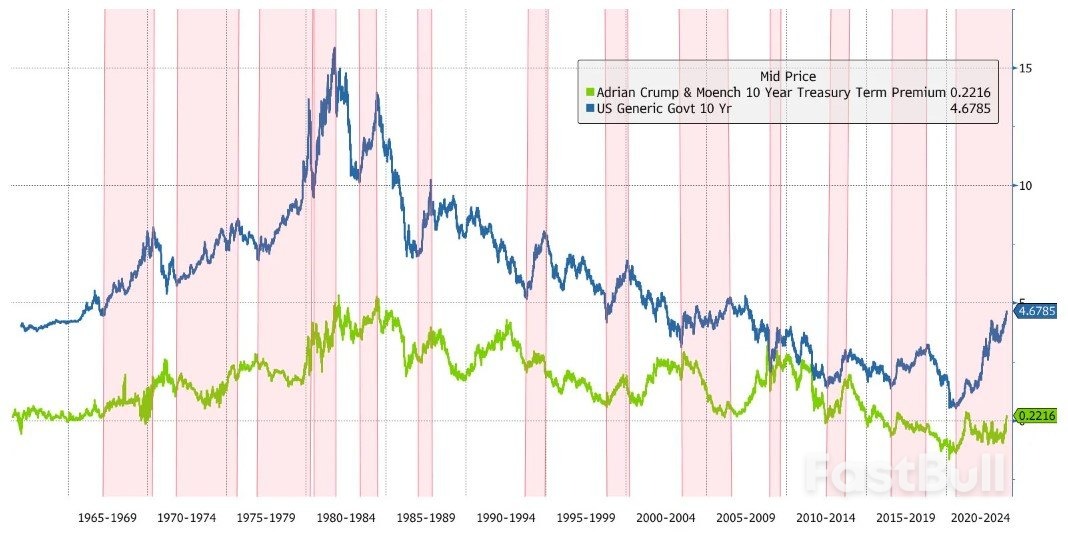
          To better understand whether the sell-off in US Treasuries is predominantly due to a rise in short-term interest rates or an increase in term premiums, we can turn to historical data. The New York Fed has employed the Adrian, Crump, and Moench (ACM) model to estimate the term premia of Treasury securities with maturities ranging from 12 months to 10 years, dating back to 1961. Figure 1 depicts this historical data, with the blue line representing the 10-year Treasury note yield and the green line illustrating the estimated term premium using the ACM model.Understanding the Surge in Bond Yields: Term Premium, not “Higher for Longer”_1
          A noticeable pattern emerges from this analysis. During specific periods, such as March 1967 to May 1970, March 1971 to September 1975, December 1976 to February 1980, June 1980 to September 1981, and June 2003 to June 2004, surges in yields were primarily driven by expectations of a higher interest rate path. In contrast, during other periods like August 1986 to October 1987, October 1998 to January 2000, December 2008 to June 2009, and July 2012 to December 2013, surges in yields were more influenced by substantial increases in term premiums.
          Recent Market Dynamics
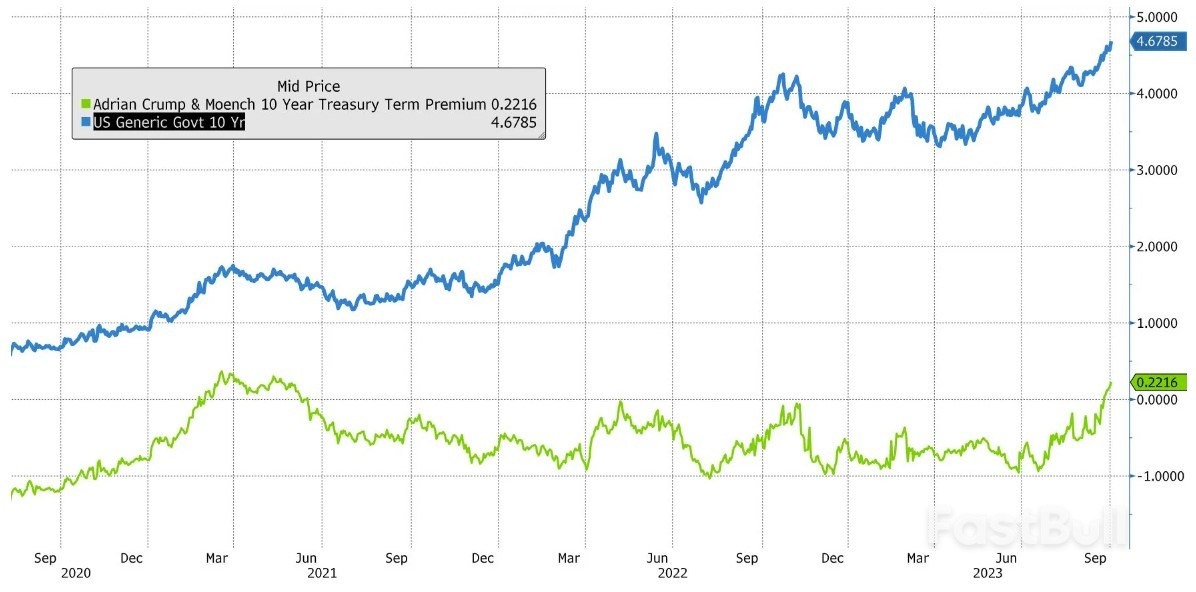
          Turning our attention to recent market dynamics, the current bond bear market, which commenced in August 2020, initially witnessed the 10-year Treasury yield rising due to an increase in the term premium. However, from September 2021 onwards, the surge in yields was primarily driven by a significant upward adjustment in expectations of interest rate hikes. During this period, the term premium remained relatively subdued, fluctuating within a range between zero and minus 100 bps (Figure 2).Understanding the Surge in Bond Yields: Term Premium, not “Higher for Longer”_2
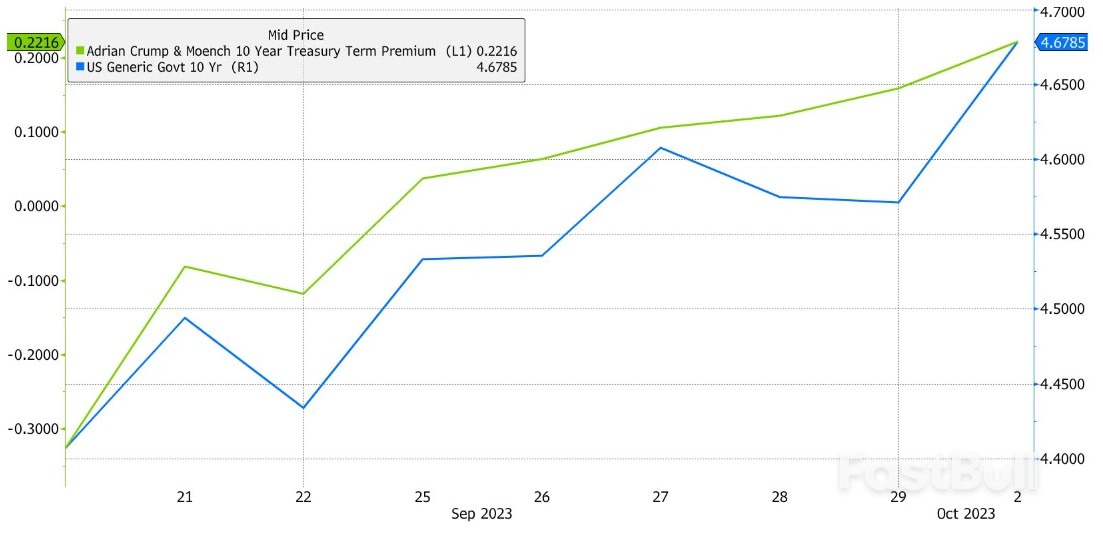
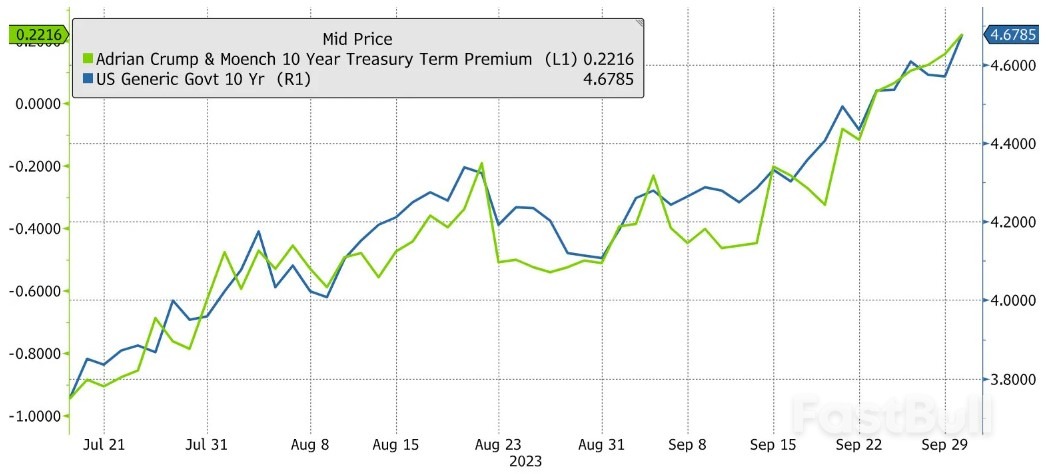
          Notably, a shift occurred in July of the current year. The 10-year Treasury note experienced a 95 basis point increase in yield, climbing to 4.68% on October 2, 2023, from 3.75% on July 19, 2023. This surge was entirely attributed to a substantial 117 basis point increase in the term premium over the same period (as illustrated in Figure 3). Similarly, following the September FOMC meeting, the 10-year yield rose by 27 bps to 4.68% as of Oct 2 from 4.41%, with the term premium increasing by 55 bps, transitioning from -33 bps to +22 bps. Contrary to media headlines and pundit commentaries suggesting expectations of a "higher for longer" interest rate path, the ACM model's estimate indicates a decrease in interest rate expectations over the life of the 10-year Treasury notes since the September FOMC meeting.Understanding the Surge in Bond Yields: Term Premium, not “Higher for Longer”_3Understanding the Surge in Bond Yields: Term Premium, not “Higher for Longer”_4

          Factors Influencing Term Premium

          Adrian, Crump, and Moench's study suggests that term premiums tend to rise during specific economic conditions. These conditions include periods when the economy is entering a downturn, when professional forecasters disagree on future bond yields, and when investors become increasingly uncertain about future Treasury yields. Currently, these conditions seem to be in place.
          Additionally, one can conjecture that the increase in uncertainty about the future trajectory of inflation, the Federal Reserve's tolerance for deviations of inflation from the 2% target, speculation about the Fed potentially resetting the inflation target, questions about the long-term level of the Fed's neutral rate, uncertainty surrounding the demand for upcoming large Treasury issuance, a rise in the risks of a liquidity event in the Treasury market, and concerns about of rising fiscal dominance are all contributing factors.

          Historical Perspective on Term Premium

          Over the past six decades, the term premium for the 10-year Treasury note has typically been positive, with only a brief departure from this pattern occurring since 2015. This period of negativity in term premiums was an anomaly. The mean average term premium over this historical period was +151 bps, while the median stood at +154 bps.
          Though the term premium has recently returned to positive territory, registering at 22 bps as of October 2, 2023, it still falls below the mean and median levels observed over the past six decades. This suggests the potential for a mean reversion of the term premium to higher levels, especially given the various factors previously discussed.

          Investment Implications

          In light of the aforementioned analysis, certain investment implications become apparent. We recommend focusing on the short end of the Treasury curve as opposed to the long end. This preference is grounded in the anticipation that the Fed will implement rate cuts in the first half of 2024, even amid what might seem like hawkish rhetoric. These rate cuts are expected to materialize as signs of a weakening US economy emerge. Furthermore, the Fed's efforts to prevent a liquidity event in the Treasury market may lead to reductions in policy rates.
          Additionally, the Fed may consider discontinuing interest payments of 5.4% on reserve balances and terminating fixed rate Temporary Open Market Operations that offer 5.3% on overnight reverse repos. This could result in annual savings of USD250 billion for the Fed and incentivize banks to withdraw a substantial portion of their USD3.2 trillion deposits at the Fed to invest in Treasury securities, including T-bills, which are close substitutes for interest-bearing reserves. Money market funds may also transition their USD1.4 trillion reverse repos into purchasing T-bills. This collective action could generate significant demand, amounting to USD4 trillion, for short-term Treasury securities. These factors collectively suggest a potential for lower yields and higher prices for short-term Treasury securities.
          For traders looking to capitalize on these dynamics, a steepening trade strategy could be considered. This involves shorting the 10-year T-note futures while simultaneously going long on the 2-year T-note futures. This strategy leverages the anticipated yield curve dynamics resulting from the factors discussed. Readers interested in pursuing this strategy can find more information on how to create duration-neutral contract sizes here.
          In conclusion, the recent surge in bond yields is not simply a consequence of the Fed signaling a "higher for longer" interest rate stance. It is, in fact, a complex interplay of factors, including expectations of interest rate hikes and term premiums. Understanding these dynamics and their historical context is crucial for making informed investment decisions in the Treasury market. As we navigate these uncertain financial waters, being mindful of the term premium and its potential for mean reversion provides valuable insight into the future trajectory of bond yields and their implications for investors and traders alike.
          To stay updated on all economic events of today, please check out our Economic calendar
          Risk Warnings and Disclaimers
          You understand and acknowledge that there is a high degree of risk involved in trading. Following any strategies or investment methods may lead to potential losses. The content on the site is provided by our contributors and analysts for information purposes only. You are solely responsible for determining whether any trading assets, securities, strategy, or any other product is suitable for investing based on your own investment objectives and financial situation.
          Comments
          Add to Favorites
          Share

          Overhauling Bank Regulation Will Boost Liquidity of Government Bonds

          Justin

          Central Bank

          Economic

          Liquidity in the European government bond market has returned to levels from before the Covid-19 pandemic, but it could be improved further. The biggest barrier to this is the heavy regulation and balance sheet constraints that have been imposed on financial institutions since the financial crisis of 2008.
          Liquidity was a central topic of discussion at the European sovereign, supranational and agency forum hosted by OMFIF’s Sovereign Debt Institute in Luxembourg. This exclusive event brought together leading European sovereign debt management offices and issuers, along with banks, investors and other market participants, to discuss the key issues facing this market.
          One head of a western European debt management office said at the forum that liquidity levels were back to around 2019 levels, but the regulation of banks was a key factor in hindering even stronger liquidity conditions in the European government bond market. He said that, while greater regulation in the wake of the financial crisis had ‘brought a lot more solidity to the banking system’, it had also ‘moved part of the risk from the banking system and intermediaries to the markets’, which has affected the level of liquidity.
          ‘In this respect, an analysis of how some of these regulations should be adjusted is probably worth looking at,’ he added.
          Bankers at the forum echoed the impact of bank regulation on the ability to provide strong levels of liquidity in the European government bond market.
          ‘If you look at the growth of the European debt markets, in particular the government bond market, we’re talking about 130% since the financial crisis,’ said a head of SSA debt capital markets. ‘That is basically an average growth rate of 7% per year. At the same time, the collective balance sheet that is committed to trading this debt has, at best, remained constant but in many cases, it has actually declined.’
          An SSA debt capital markets head said regulation was the reason liquidity provisions from balance sheets had not kept up with the growth of the European government bond market, highlighting the leverage ratio of banks. ‘The most painful is the leverage ratio, which is a very crude measure that does not differentiate between the riskiness of your assets on the book,’ he said.
          It does seem odd that, as a business opportunity grows, banks are being forced to cut back on their ability to take advantage of it. This has particularly affected banks with smaller balance sheets, causing them to quit their roles as primary dealers. ‘Overall, the cost of regulation and complying with regulation has set a very high barrier for small institutions to be active,’ said the banker. ‘Trading government bonds is not profitable enough for them anymore’.
          Another DCM official echoed these concerns. ‘Warehousing is becoming a lot more expensive. Regulation is really becoming a problem for us, whether it’s the leverage ratio or incremental risk capital models that are being introduced,’ he said.
          As a result, banks are stuck between trying to serve both regulators and issuers. ‘We find a disconnect between our clients at the DMOs asking us to provide more liquidity but, on the flip side, the regulators are putting more costs on providing that liquidity,’ said the DCM official.
          Another option to overhaul the regulation of banks is to allow non-banks, such as hedge funds and fast money accounts, to enter the European government bond market as primary dealers. In a poll of attendees at the OMFIF forum, 70% said this was a good idea to boost liquidity in the market.
          Currently, only financial institutions with a banking licence can act as primary dealers in the European government bond market. However, hedge funds have been boosting their involvement with the US Treasury market since the financial crisis as traditional banks have pulled back due to heavy regulation. Hedge funds are now an essential part of the US Treasury market in providing prices and market-making activities. The European government bond market could take note.

          Source:Burhan Khadbai

          To stay updated on all economic events of today, please check out our Economic calendar
          Risk Warnings and Disclaimers
          You understand and acknowledge that there is a high degree of risk involved in trading. Following any strategies or investment methods may lead to potential losses. The content on the site is provided by our contributors and analysts for information purposes only. You are solely responsible for determining whether any trading assets, securities, strategy, or any other product is suitable for investing based on your own investment objectives and financial situation.
          Comments
          Add to Favorites
          Share

          Republicans Seeking a Government Shutdown Were Playing a Self-Defeating Game

          Alex

          Political

          "There has to be an adult in the room," declared House Speaker Kevin McCarthy, explaining why he finally decided to ignore the handful of extremists within his Republican House of Representatives caucus and partner with Democrats to continue to fund the U.S. government for another 45 days.
          Republicans were going to face a huge blowback for an unnecessary shutdown because a small group of them simply would not agree with anyone, or even each other, about what they wanted. Their endless grievances changed daily. It was, as I noted in these pages last week, a government shut down over nothing.
          Such a total meltdown within Republican ranks, would undermine claims that the House should remain in Republican hands, let alone the Senate or the White House.
          Mr McCarthy, and almost all Republicans, are aware that historically the party forcing the shutdown has paid the political price. As Representative Patrick T McHenry of North Carolina, a staunch ally of the Speaker, explained with evident exasperation: "It's been tried before."
          The extremists, however, were utterly unmoved. While Democrats naturally spun the 45-day funding extension as a victory, Republican extremists painted it as a pathetic cave-in by Mr McCarthy and most other Republicans, and a victory for the "uni-party", which they claim unites other Republicans and all Democrats in a de facto coalition representing the wealthy and elites.
          The Republican extremist fringe was so outraged that they've decided the Speaker hast to go. It's a confrontation they've been longing for.
          Mr McCarthy agreed that any individual House member could bring a "motion to vacate", which could remove him from the Speaker's chair. One of his most voluble detractors, Representative Matt Gaetz of Florida, has vowed to do just that. Yet party establishment figures and their media allies are now asking if Mr Gaetz is secretly working for the Democratic Party.
          The most substantive issue in this sorry spectacle is increased aid to Ukraine, which is anathema to pro-Moscow Republicans. Mr Gaetz accused Mr McCarthy of making a secret deal with Democrats for additional aid for Ukraine in the near future, which the Speaker flatly denies. But this strongly pro-Russia sentiment among Maga Republicans is why Mr McCarthy inexcusably barred Ukrainian President Volodymyr Zelenskyy from addressing the House last month. Yet most Republicans, even in the House, and certainly in the Senate, and the overwhelming majority of Democrats favour the funding that the Biden administration has prepared to provide to Ukraine.
          The 45-day stopgap spending bill is an obvious victory for U.S. President Joe Biden and the Democrats and seems to usher Mr McCarthy into the realm of governance-minded American leaders, aka "the adults". The conclusion is unmistakable: not only did he find it impossible to work with the radical fringe of the Republicans, but he also ultimately preferred to partner with Democrats to keep the government funded and prevent the Republican Party from incurring yet another brutal self-inflicted wound.
          The outcome raises two important questions. Can Mr McCarthy remain in power? And what will happen in 45 days when the stopgap spending measure expires?
          If Mr McCarthy remains Speaker, he has a solid coalition of Democrats and Republicans that do not wish to see a shutdown in 45 days or at any other time. But preventing a replay of the bizarre near-miss last week depends on a Republican Speaker being willing to partner with Democrats in passing rational spending bills acceptable to the Senate and the White House.
          Mr McCarthy will effectively be at the mercy of Democrats if the extremists present a motion to vacate. Democrats might vote to keep him in place in order to repeat avoiding a shutdown when the next deadline approaches. However, Mr McCarthy has caved to the extreme right at every stage, including recently launching a baseless impeachment inquiry into Mr Biden. So, there are ample reasons for Democrats to relish watching him suffer the disaster he allowed to be baked into his, from their perspective, corrupted at birth, speakership.
          But the national interest, and the agenda of the administration, militates towards keeping Mr McCarthy in place, rather than allowing the extremists to oust him and sending the House into even greater chaos. Nonetheless, Mr McCarthy may be even more disliked by most Democrats than his internal Republican opposition. So, even if Mr Biden pushes for it, as he likely will, it might be difficult for House minority leader Hakeem Jefferies to get Democrats to support Mr McCarthy even if that's what the party hierarchy decides it wants.
          But even if Mr McCarthy remains in place, with an overwhelming majority of Republicans and Democrats who wish to see the U.S. government continue to function without a shutdown, nonetheless the biggest bone of contention remains aid to Ukraine. That's categorically opposed by the proto-fascist Maga Republicans, plus a handful of neo-isolationist leftist Democrats and Republican libertarians who oppose almost all U.S. international engagement.
          Both parties, particularly Republicans, walked right to the edge of a shutdown last week but ultimately concluded they wanted no part of it because of the political consequences, not to mention the national interest involved. The U.S. economy has recovered to an amazing extent, but most credible economists agree that the recovery is fragile. The country simply cannot afford a shutdown at this crucial stage, which could, especially if it were protracted, send the whole economy into a tailspin and ruin a remarkable comeback.
          Do the Republican extremists really deliberately intend to sabotage the national economy for political purposes, either to attack their own party leadership and/or try to bring down Mr Biden and help their hero, Donald Trump? Alas, even such cynical machinations may be beyond the infantile calculations of these nihilistic radicals, who simply seem bent on pointlessly defying everyone else and demagoguing in their own personal interests as much as possible.
          Thus, the most likely scenario going forward is that Mr McCarthy will remain Speaker with some Democratic support to defend the coalition that prevented the absurd Seinfeld-like "shut down over nothing" and keep the status quo alive in the interest of both the Republican Party establishment, and Mr McCarthy, as well as Mr Biden, the White House, and, ironically, the President's re-election bid. The old adage holds that "politics makes strange bedfellows". But it becomes even stranger when the strangest characters make a plausible, narrowly averted bid to take over America's national political theatre.

          Source: The National News

          Risk Warnings and Disclaimers
          You understand and acknowledge that there is a high degree of risk involved in trading. Following any strategies or investment methods may lead to potential losses. The content on the site is provided by our contributors and analysts for information purposes only. You are solely responsible for determining whether any trading assets, securities, strategy, or any other product is suitable for investing based on your own investment objectives and financial situation.
          Comments
          Add to Favorites
          Share

          Why A Rout in Government Bonds Is Worrying

          Damon

          Bond

          Economic

          The world's biggest bond markets are in the throes of another rout as a new era of higher for longer interest rates takes hold.
          In the U.S. Treasury market, the bedrock of the global financial system, 10-year bond yields have shot up to 16-year highs. In Germany, they touched their highest since the 2011-euro zone debt crisis. Even in Japan, where official rates are still below 0 per cent, bond yields are back at levels seen in 2013.
          Because government borrowing costs influence everything from mortgage rates for homeowners to loan rates for corporates, there's plenty of reason for angst.
          Here's a look at why the bond rout matters.
          Why are global bond yields rising?
          Markets are increasingly reckoning with interest rates staying high.
          With inflation excluding food and energy prices elevated and the U.S. economy resilient, central banks are pushing back against rate cut bets.
          Traders now see the Fed cutting rates to only 4.7 per cent from 5.25 per cent-5.50 per cent currently, up from the 4.3 per cent they anticipated in late August.
          That's compounding worries about the fiscal outlook following August's Fitch U.S. rating downgrade citing high deficit levels. Highly-indebted Italy raised its deficit target last week.
          Higher deficits mean more bond sales just as central banks offload their vast holdings, so longer-dated yields are rising as investors demand more compensation.
          Many investors were also betting bond yields would drop, so are extra sensitive to moves in the opposite direction, analysts say.
          How far could the selloff go?
          U.S. data remains resilient with Monday's upbeat manufacturing survey pushing Treasury yields up again.
          That is no surprise, and analysts do not rule out a rise in 10-year Treasury yields to 5 per cent, from 4.7 per cent now.
          When a bond yield rises, its price falls.
          But Europe's economy has deteriorated, so selling should be more limited there, as bonds typically do better when an economy weakens, and most big central banks have signalled they are done with rate increases.
          Germany's 10-year yield, at 2.9 per cent, could soon hit 3 per cent - another milestone considering yields were below 0 per cent in early 2022.
          Why does it matter and should we worry?
          U.S. 10-year Treasury yields have risen to their 230-year average for the first time since 2007, Deutsche Bank data shows, highlighting the challenge of adjusting to higher rates.
          Bond yields determine governments' funding costs, so the longer they stay high, the more they feed into the interest costs countries pay.
          That's bad news as government funding needs remain high. In Europe, slowing economies will limit how much governments can unwind fiscal support.
          But higher yields are welcome to central bankers, doing some of their work for them by raising market borrowing costs.
          U.S. financial conditions are at their most restrictive in nearly a year, a closely-watched Goldman Sachs index shows.
          What does it mean for global markets?
          The ripple effects are broad.
          First, rising yields set the stage for a third straight year of losses on global government bonds, hurting investors long betting on a turnaround.
          As for equities, the bond yield surge is starting to suck money away from buoyant markets. The S&P 500 is down roughly 7.5 per cent from more than one-year peaks hit in July.
          Focus could turn back to banks, big holders of government bonds sitting on unrealised losses, a risk put on the radar by Silicon Valley Bank's March collapse.
          "(The bond selloff) will have a strong impact on banks that hold long end Treasuries," said Mahmood Pradhan, head of macro at Amundi Investment Institute. "The longer it persists the more sectors it will hit."
          Higher U.S. yields also mean an ever stronger dollar, piling pressure on other currencies, especially Japan's yen.
          Should emerging markets be worried?
          Yes. Rising global yields have ramped up the pressure on emerging markets, especially higher-yielding riskier economies.
          The additional yield junk-rated governments pay on their hard-currency debt on top of safe-haven U.S. Treasuries has risen to over 800 basis points, according to JPMorgan, more than 70 bps higher from their Aug. 1 trough. "The intensification of the higher-for-longer narrative, along with the rise in oil prices, has also been the primary driver of broad U.S. dollar strength," said Andrea Kiguel, head of FX and EM macro strategy, Americas at Barclays.
          "The speed of the move has lead to weaker currencies within the region, a violent sell-off in local rates and wider EM credit spreads."

          Source: Reuters

          To stay updated on all economic events of today, please check out our Economic calendar
          Risk Warnings and Disclaimers
          You understand and acknowledge that there is a high degree of risk involved in trading. Following any strategies or investment methods may lead to potential losses. The content on the site is provided by our contributors and analysts for information purposes only. You are solely responsible for determining whether any trading assets, securities, strategy, or any other product is suitable for investing based on your own investment objectives and financial situation.
          Comments
          Add to Favorites
          Share

          As US Yields Surge, How High Can They Go?

          XM

          Economic

          Bond

          Yields heeding the higher for longer message
          Yields on government bonds are flying again as central banks are all singing from the same hymn sheet lately, flagging that interest rates will stay high for a longer period of time. This isn't exactly a new revelation for investors but more recently, the message has started to sink in deeper as the combination of persistent price pressures and resilient economies has taken everyone by surprise.
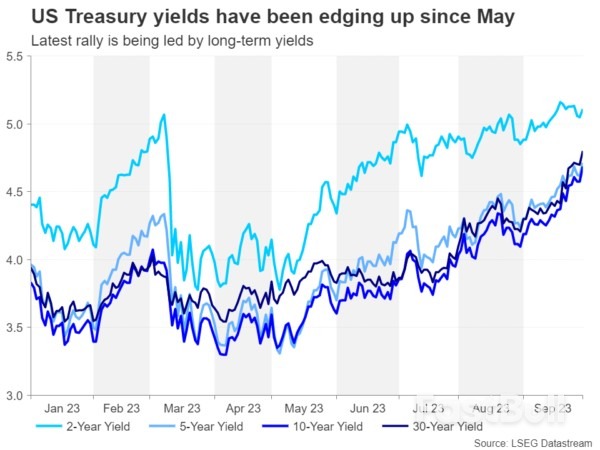
          As US Yields Surge, How High Can They Go?_1With rates potentially yet to peak in the United States and elsewhere, government bond yields have been rallying since May when the U.S. banking turmoil began to dissipate. However, this latest leg of the rally isn't so much driven by expectations of where interest rates will peak but more about how long they will stay at elevated levels.
          There may be more tightening to come
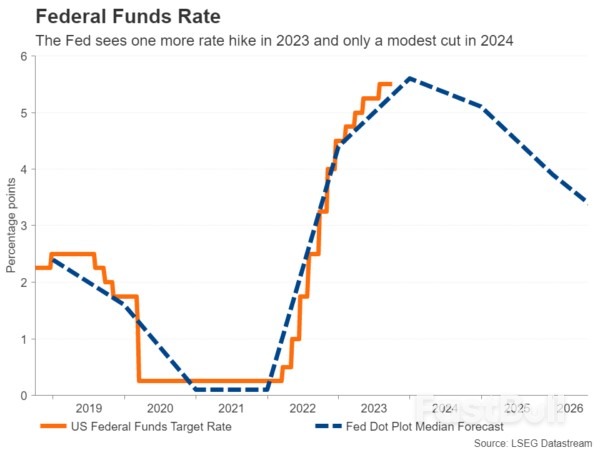
          The Federal Reserve and even the European Central Bank may yet have to tighten further, but it's unlikely this would involve anything more than a 25-basis-point hike. What's gotten markets so jittery is the prospect of rates staying near current levels for an extended duration. That is why long-dated government bonds have borne the brunt of the latest selloff, pushing 10-year yields to more-than-decade highs.
          The last time the 10-year Treasury yield was above 4.8% was at the onset of the global financial crisis in the summer of 2007. Not long after that, rock-bottom rates became the norm. This highlights just how markedly the inflation picture has altered since the pandemic, with the supply and energy shocks irreversibly lifting prices.
          Job not done yet on inflation
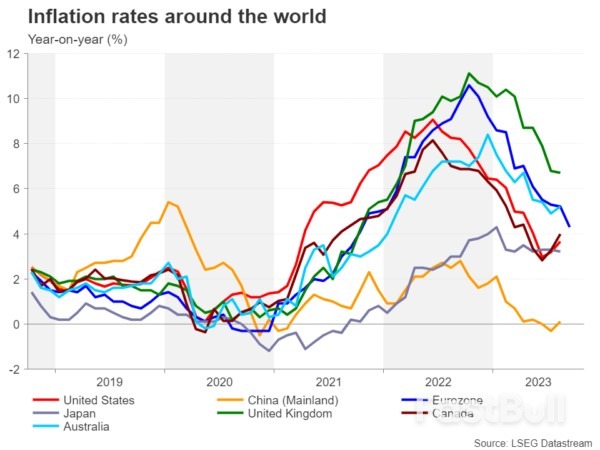
          However, falling inflation has been the big story of 2023 – so why are the Fed and other central banks still thinking about hiking further? The problem is that despite good progress, inflation in most places has some distance to cover before reaching the 2% target. In the U.S., the core PCE measure of inflation stood at 3.9% in August – almost double the Fed's objective.
          As US Yields Surge, How High Can They Go?_2Inflation may have come down sharply over the past year as the energy crisis subsided, but the next phase may take a lot longer. There are several factors that could prevent inflation from dropping all the way down to 2% in a quick manner and they vary in each country. In America, it is the tight labour market and robust consumer spending.
          The elusive soft landing
          The Fed is in a tricky spot at the moment when it comes to correctly gauging how restrictive policy has become. It risks tightening more than it has to should it act solely on the actual data, or doing too little should its caution on the basis that there are transmission lags in monetary policy prove to be a miscalculation. With various measures of inflation expectations converging slightly above 2% and hiring slowing down lately, the Fed seems to be taking its chances with the latter option.
          But this is not the entire explanation. The Fed is desperate to engineer a soft landing for the economy, which comes at a price as it would necessitate taking a more patient approach to hitting the 2% target in a sustainable manner. Policymakers are thus effectively making a conscious decision to let inflation run above target for longer so as not to choke off economic growth.
          What this means for monetary policy, however, is that whilst rates would peak somewhat lower, they're less likely to be cut sooner. For the U.S. where the economy continues to display remarkable resilience, this is even more significant as any cut would risk fuelling renewed inflationary pressures.
          Is the only way up for yields?
          The recent gains in Treasury yields may be a reflection of this realisation by investors. The question now is, can yields rise further, and if so, at what point will higher yields inflict some serious damage on the economy?
          For the moment, neither consumption nor the labour market are showing any major signs of cracks. Should this still be the case by December, the Fed may well end the year with another rate increase. Not only that, but the Fed might also lift its projected rate path again, spurring another rally in long-term yields.
          As US Yields Surge, How High Can They Go?_3Assuming that the outlook in Europe and elsewhere doesn't improve, the U.S. dollar would be in a position to appreciate further, while there could be more pain in store for U.S. equities. So far though, the upside surprises in the economic data, the artificial intelligence (AI) mania as well as the defensive nature of many tech stocks have all contributed to driving Wall Street indices higher even as financial conditions have tightened.
          Small cracks are appearing in the economy
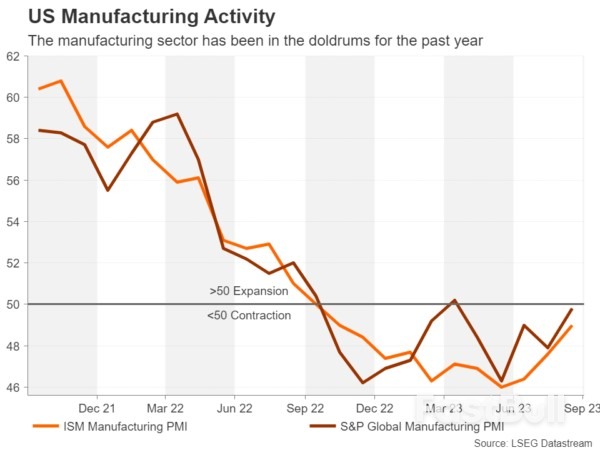
          But it's hard to see this picture lasting once the 10-year yield nears the 5.0% level. Looking under the hood, there are several signs of trouble brewing. The manufacturing sector is contracting, and banks are lending less, hitting struggling businesses and new investment. Households have almost drawn down on their excess savings and this coincides with an increase in the number of households unable to pay their credit card debts. In addition, Americans will soon have to start repaying their student loans as the pandemic support expires.
          As US Yields Surge, How High Can They Go?_4Resurgent oil prices are another worry as they threaten to push up costs again just as the pain was easing. Not to forget the slowdown in Europe and China that's bound to affect the earnings for U.S. multinationals, all this could yet kill any momentum in the economy, if not tip it into recession.
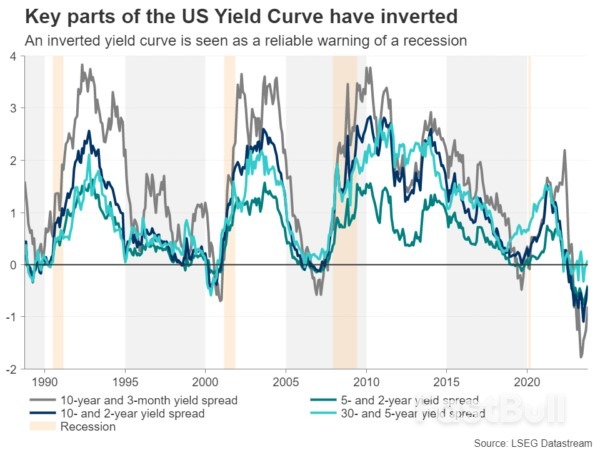
          Is a recession only delayed, not cancelled?
          For now, the expectation of a soft landing is maintaining the upward pressure on yields, while the deluge of new debt issuance by the Treasury Department is worsening the rout in the bond market. Unless there's a sharp deterioration in the outlook, it is difficult to envisage bond yields retreating substantially in the near future.
          As US Yields Surge, How High Can They Go?_5The danger is that the risk of a recession may not be as low as policymakers and investors would like to believe. The inverted yield curve continues to flash red even though the gap between long- and short-term yields has narrowed over the last few months. The other cause of concern is that in the past, calls for a soft landing have often tended to precede recessions and what may be happening now is simply the timing of one being pushed further and further back.
          Yields vs stocks
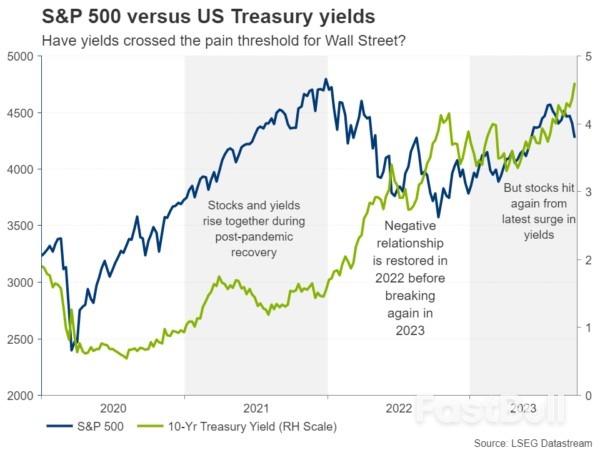
          Adding to the confusion is the broken negative relationship between Treasury yields and the stock market. When yields reach a cycle peak, stocks traditionally enter a bear market. However, during the post-pandemic recovery, the S&P 500 and the 10-year yield rallied in tandem.As US Yields Surge, How High Can They Go?_6
          The negative relationship corrected itself last year when Wall Street declined and yields kept rising, but it broke again in the first half of 2023. Since September, however, yields and stocks have gone their opposite ways once more, in a possible sign that yields may have already reached the pain threshold for Wall Street. Does this hold true for the economy as well?
          To stay updated on all economic events of today, please check out our Economic calendar
          Risk Warnings and Disclaimers
          You understand and acknowledge that there is a high degree of risk involved in trading. Following any strategies or investment methods may lead to potential losses. The content on the site is provided by our contributors and analysts for information purposes only. You are solely responsible for determining whether any trading assets, securities, strategy, or any other product is suitable for investing based on your own investment objectives and financial situation.
          Comments
          Add to Favorites
          Share

          Global Bond Rout Upending Markets Shows No Signs of Abating

          Thomas

          Economic

          Bond

          A sell-off in global bond markets gathered pace, driving yields to the highest level in more than a decade, as traders braced for an extended period of tight monetary policy.
          The yield on 30-year U.S. Treasuries hit 5% for the first time since 2007 on Wednesday, while the German 10-year benchmark rate climbed to 3% — a level unseen since 2011. In Japan, the 10-year overnight-indexed swaps jumped to 1% for the first time since January.
          Investors are demanding ever higher compensation to hold long-dated debt after major central banks made clear they were unlikely to ease policy any time soon. Concerns about increased Treasury issuance to fund swelling budget deficits have also weighed on longer securities.
          "U.S. yields at highs for the year are starting to look disruptive for other regions and sectors in global fixed income," HSBC Holdings plc strategist Steven Major wrote in a note to clients.
          The volatility has also spilled over into equities and is spreading to corporate notes, with at least two borrowers standing down from issuing on Tuesday, as blue-chip yields reached a 2023 high of 6.15%. The largest speculative-grade bond exchange traded fund was hit by the biggest two-day slump this year.
          "These moves are starting to cause worries across all asset classes," said James Wilson, a money manager at Jamieson Coote Bonds Pty in Melbourne. "There's a buyer's strike at the moment, and no one wants to step in front of rising yields, despite getting to quite oversold levels."
          Bond losses accelerated on Tuesday after an unexpected jump in job openings reinforced speculation that the U.S. Federal Reserve isn't done raising interest rates. The term premium on 10-year U.S. notes turned positive for the first time since June 2021.
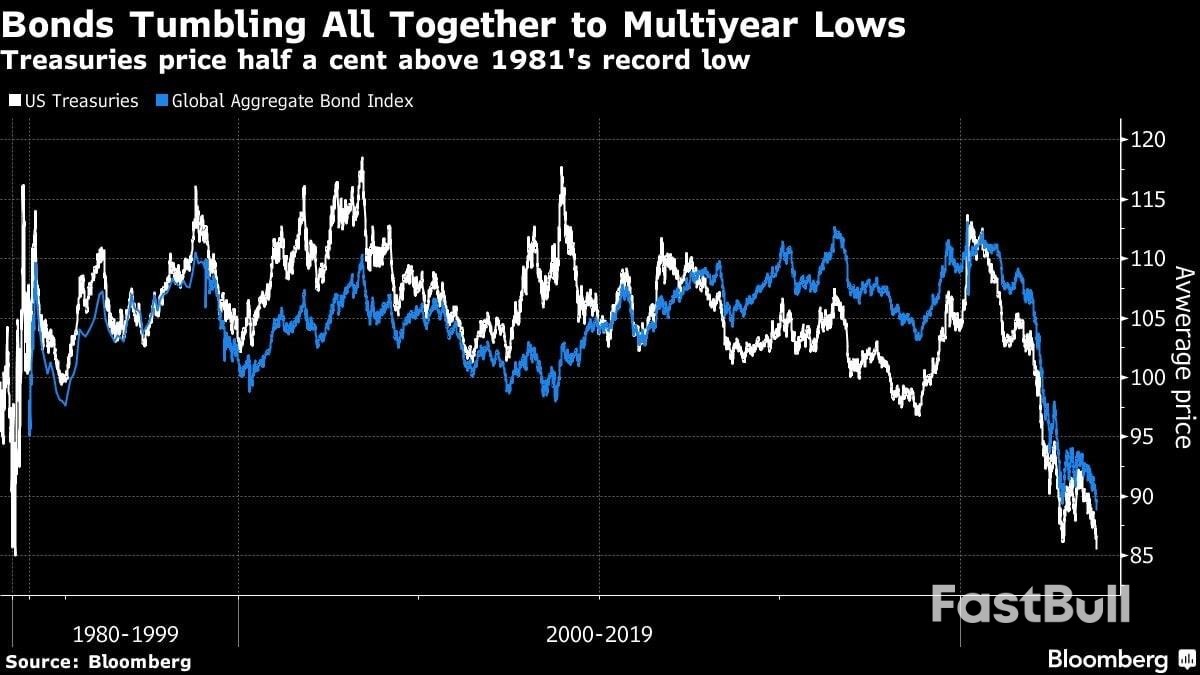
          Global bonds are now down 3.5% in 2023, while ICE's BofA MOVE Index for Treasuries volatility jumped to the highest since May on Tuesday. The average price of bonds in the Bloomberg U.S. Treasury Index has tumbled to 85.5 cents on the dollar, half a cent above the record low in 1981.
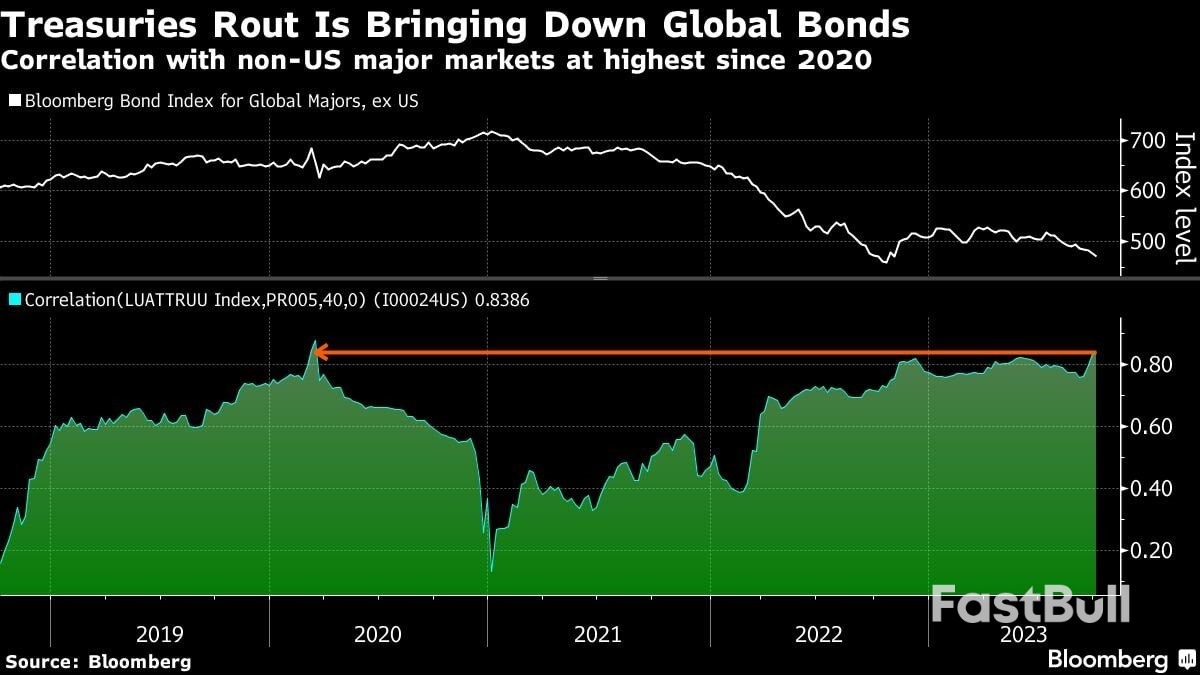
          Global Bond Rout Upending Markets Shows No Signs of Abating_1European yields followed their U.S. counterparts higher, with the correlation between Bloomberg's gauge of global securities and an index of Treasuries reaching the highest since March 2020.
          "U.S. treasury and European sovereigns are correlated," says Althea Spinozzi, a senior fixed income strategist at Saxo Bank. "A move higher in U.S. yields will push higher European sovereign yields as well, despite Europe's recession deepening."
          Yields on some of Asia's emerging-market bonds were also dragged higher. The Indonesian benchmark climbed to levels last seen in November.
          "Long emerging-market durations are a pain trade for most real money investors," analysts including Min Dai, the head of Asia macro strategy at Morgan Stanley, wrote in a note. Such positioning "increases the vulnerability of the market, especially if U.S. Treasury rates continue to march higher".
          Global Bond Rout Upending Markets Shows No Signs of Abating_2But the very shortest end of the Treasury market still looks attractive to some. An enlarged 52-week bill sale on Tuesday attracted record demand from non-dealers, as investors locked in a yield above 5% for the next year.
          Current yield levels will "suck capital away from the more risky asset classes, as investors do not need to move along the risk spectrum to generate attractive returns", Wilson from Jamieson Coote said.
          "Ultimately, we believe in the path higher, but it's unlikely to be linear," said Scott Solomon, a money manager at T Rowe Price, who last week flagged the potential for 10-year yields to test 5.5%. "There's a bit of a back and forth between some traditional bond buyers who have been forced into a bit of a buyers' strike when it comes to duration versus those who view the yield levels as a good long-term opportunity."
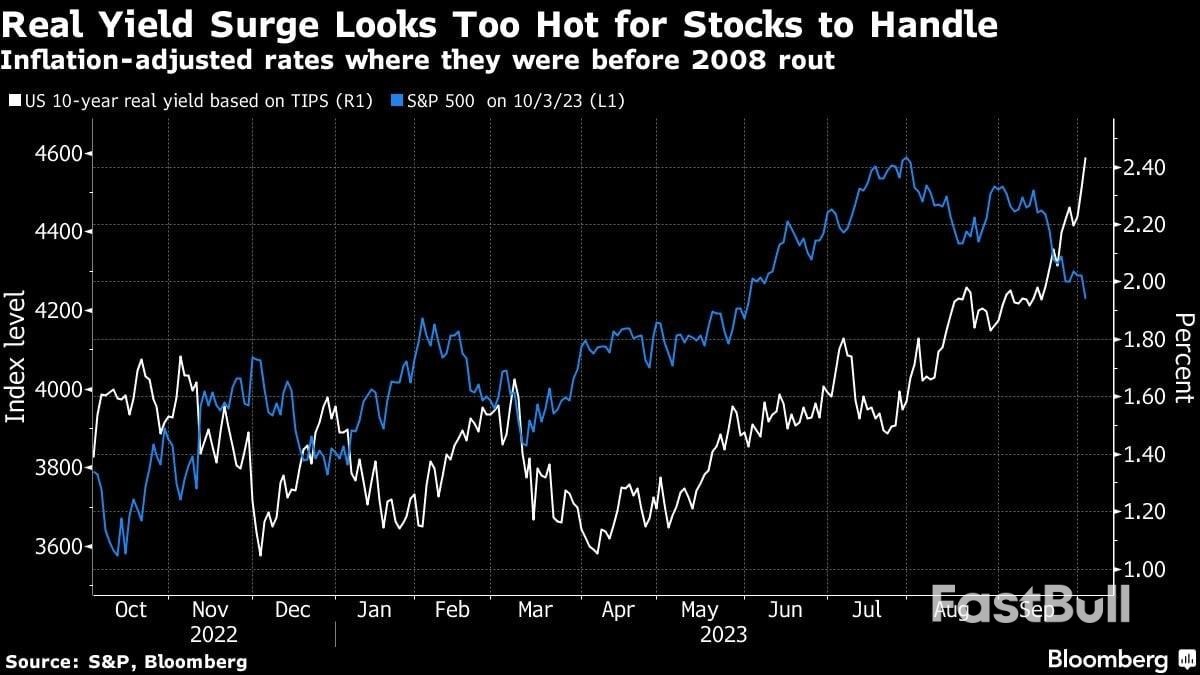
          Global Bond Rout Upending Markets Shows No Signs of Abating_3The rout has also sent so-called real yields to multi-year highs, with the 10-year U.S. inflation-adjusted rate climbing above 2.4% to the sort of levels reached in 2007 just before U.S. equities topped out.
          "Sharp moves upwards in real yields always lead to deratings of the equity market," said Amy Xie Patrick, the head of income strategies at Pendal Group in Sydney. Cash is the best place to seek protection, she said.

          Source: Bloomberg

          To stay updated on all economic events of today, please check out our Economic calendar
          Risk Warnings and Disclaimers
          You understand and acknowledge that there is a high degree of risk involved in trading. Following any strategies or investment methods may lead to potential losses. The content on the site is provided by our contributors and analysts for information purposes only. You are solely responsible for determining whether any trading assets, securities, strategy, or any other product is suitable for investing based on your own investment objectives and financial situation.
          Comments
          Add to Favorites
          Share
          FastBull
          Copyright © 2025 FastBull Ltd

          728 RM B 7/F GEE LOK IND BLDG NO 34 HUNG TO RD KWUN TONG KLN HONG KONG

          TelegramInstagramTwitterfacebooklinkedin
          App Store Google Play Google Play
          Products
          Charts

          Chats

          Q&A with Experts
          Screeners
          Economic Calendar
          Data
          Tools
          Membership
          Features
          Function
          Markets
          Copy Trading
          Latest Signals
          Contests
          News
          Analysis
          24/7
          Columns
          Education
          Company
          Careers
          About Us
          Contact Us
          Advertising
          Help Center
          Feedback
          User Agreement
          Privacy Policy
          Business

          White Label

          Data API

          Web Plug-ins

          Poster Maker

          Affiliate Program

          Risk Disclosure

          The risk of loss in trading financial instruments such as stocks, FX, commodities, futures, bonds, ETFs and crypto can be substantial. You may sustain a total loss of the funds that you deposit with your broker. Therefore, you should carefully consider whether such trading is suitable for you in light of your circumstances and financial resources.

          No decision to invest should be made without thoroughly conducting due diligence by yourself or consulting with your financial advisors. Our web content might not suit you since we don't know your financial conditions and investment needs. Our financial information might have latency or contain inaccuracy, so you should be fully responsible for any of your trading and investment decisions. The company will not be responsible for your capital loss.

          Without getting permission from the website, you are not allowed to copy the website's graphics, texts, or trademarks. Intellectual property rights in the content or data incorporated into this website belong to its providers and exchange merchants.

          Not Logged In

          Log in to access more features

          FastBull Membership

          Not yet

          Purchase

          Become a signal provider
          Help Center
          Customer Service
          Dark Mode
          Price Up/Down Colors

          Log In

          Sign Up

          Position
          Layout
          Fullscreen
          Default to Chart
          The chart page opens by default when you visit fastbull.com