

Markets
News
Analysis
User
24/7
Economic Calendar
Education
Data
- Names
- Latest
- Prev



Signal Accounts for Members
All Signal Accounts
All Contests
 U.K. Trade Balance Non-EU (SA) (Oct)
A:--
F: --
P: --
U.K. Trade Balance (Oct)A:--
F: --
P: --
U.K. Services Index MoMA:--
F: --
P: --
U.K. Construction Output MoM (SA) (Oct)A:--
F: --
P: --
U.K. Industrial Output YoY (Oct)A:--
F: --
P: --
U.K. Trade Balance (SA) (Oct)A:--
F: --
P: --
U.K. Trade Balance EU (SA) (Oct)A:--
F: --
P: --
U.K. Manufacturing Output YoY (Oct)A:--
F: --
P: --
U.K. GDP MoM (Oct)A:--
F: --
P: --
U.K. GDP YoY (SA) (Oct)A:--
F: --
P: --
U.K. Industrial Output MoM (Oct)A:--
F: --
P: --
U.K. Construction Output YoY (Oct)A:--
F: --
P: --
 France HICP Final MoM (Nov)
A:--
F: --
P: --
 China, Mainland Outstanding Loans Growth YoY (Nov)
A:--
F: --
P: --
China, Mainland M2 Money Supply YoY (Nov)A:--
F: --
P: --
China, Mainland M0 Money Supply YoY (Nov)A:--
F: --
P: --
China, Mainland M1 Money Supply YoY (Nov)A:--
F: --
P: --
 India CPI YoY (Nov)
A:--
F: --
P: --
India Deposit Gowth YoYA:--
F: --
P: --
 Brazil Services Growth YoY (Oct)
A:--
F: --
P: --
 Mexico Industrial Output YoY (Oct)
A:--
F: --
P: --
 Russia Trade Balance (Oct)
A:--
F: --
P: --
 Philadelphia Fed President Henry Paulson delivers a speech
 Canada Building Permits MoM (SA) (Oct)
A:--
F: --
P: --
Canada Wholesale Sales YoY (Oct)A:--
F: --
P: --
Canada Wholesale Inventory MoM (Oct)A:--
F: --
P: --
Canada Wholesale Inventory YoY (Oct)A:--
F: --
P: --
Canada Wholesale Sales MoM (SA) (Oct)A:--
F: --
P: --
 Germany Current Account (Not SA) (Oct)
A:--
F: --
P: --
U.S. Weekly Total Rig CountA:--
F: --
P: --
U.S. Weekly Total Oil Rig CountA:--
F: --
P: --
 Japan Tankan Large Non-Manufacturing Diffusion Index (Q4)
--
F: --
P: --
Japan Tankan Small Manufacturing Outlook Index (Q4)--
F: --
P: --
Japan Tankan Large Non-Manufacturing Outlook Index (Q4)--
F: --
P: --
Japan Tankan Large Manufacturing Outlook Index (Q4)--
F: --
P: --
Japan Tankan Small Manufacturing Diffusion Index (Q4)--
F: --
P: --
Japan Tankan Large Manufacturing Diffusion Index (Q4)--
F: --
P: --
Japan Tankan Large-Enterprise Capital Expenditure YoY (Q4)--
F: --
P: --
U.K. Rightmove House Price Index YoY (Dec)--
F: --
P: --
China, Mainland Industrial Output YoY (YTD) (Nov)--
F: --
P: --
China, Mainland Urban Area Unemployment Rate (Nov)--
F: --
P: --
 Saudi Arabia CPI YoY (Nov)
--
F: --
P: --
 Euro Zone Industrial Output YoY (Oct)
--
F: --
P: --
Euro Zone Industrial Output MoM (Oct)--
F: --
P: --
Canada Existing Home Sales MoM (Nov)--
F: --
P: --
Euro Zone Total Reserve Assets (Nov)--
F: --
P: --
U.K. Inflation Rate Expectations--
F: --
P: --
Canada National Economic Confidence Index--
F: --
P: --
Canada New Housing Starts (Nov)--
F: --
P: --
U.S. NY Fed Manufacturing Employment Index (Dec)--
F: --
P: --
U.S. NY Fed Manufacturing Index (Dec)--
F: --
P: --
Canada Core CPI YoY (Nov)--
F: --
P: --
Canada Manufacturing Unfilled Orders MoM (Oct)--
F: --
P: --
Canada Manufacturing New Orders MoM (Oct)--
F: --
P: --
Canada Core CPI MoM (Nov)--
F: --
P: --
Canada Manufacturing Inventory MoM (Oct)--
F: --
P: --
Canada CPI YoY (Nov)--
F: --
P: --
Canada CPI MoM (Nov)--
F: --
P: --
Canada CPI YoY (SA) (Nov)--
F: --
P: --
Canada Core CPI MoM (SA) (Nov)--
F: --
P: --


No matching data

Latest Views
Latest Views
Trending Topics
Top Columnists
Latest Update
White Label
Data API
Web Plug-ins
Affiliate Program
View All
No data
India’s current account returned a better than expected surplus in the January-March quarter as trade deficit narrowed following the revision of gold import data.
India’s current account returned a better than expected surplus in the January-March quarter as trade deficit narrowed following the revision of gold import data.
The surplus in the broadest measure of trade in goods and services was $13.5 billion, or 1.3% of gross domestic product in the period, according to Reserve Bank of India data released Friday.
That compares with a median forecast of a $8.9 billion surplus by analysts in a Bloomberg survey, and a deficit of $11.3 billion in the October-December period.
The trade deficit for the quarter was at $59.5 billion, narrower than $79.3 billion in the October-December period. However, it was higher than the $52 billion in the year ago quarter.
The current account benefited from revisions in gold import data, but non-trade components, such as lower payments of investment income was a surprise, said Madhavi Arora, economist with Emkay Global Financial Services Ltd.
A current account surplus will ease pressure on the rupee that has been volatile in the past few weeks following rise in geopolitical conflicts.
Services exports increased year-on-year in major categories such as business services and computer services.
For the full fiscal year 2024-25, India’s current account deficit was $23.3 billion, or 0.6% of GDP, lower than $26 billion seen during fiscal 2023-24.
The head of Denmark's Arctic command said the prospect of a U.S. takeover of Greenland was not keeping him up at night after talks with a senior U.S. general last week but that more must be done to deter any Russian attack on the Arctic island.
U.S. President Donald Trump has repeatedly suggested the United States might acquire Greenland, a vast semi-autonomous Danish territory on the shortest route between North America and Europe vital for the U.S. ballistic missile warning system.
Trump has not ruled out taking the territory by force and, at a congressional hearing this month, Defence Secretary Pete Hegseth did not deny that such contingency plans exist.
Such a scenario "is absolutely not on my mind," Soren Andersen, head of Denmark's Joint Arctic Command, told Reuters in an interview, days after what he said was his first meeting with the general overseeing U.S. defence of the area.
"I sleep perfectly well at night," Anderson said. "Militarily, we work together, as we always have."
U.S. General Gregory Guillot visited the U.S. Pituffik Space Base in Greenland on June 19-20 for the first time since the U.S. moved Greenland oversight to the Northern command from its European command, the Northern Command said on Tuesday.
Andersen's interview with Reuters on Wednesday were his first detailed comments to media since his talks with Guillot, which coincided with Danish military exercises on Greenland involving one of its largest military presences since the Cold War.
Russian and Chinese state vessels have appeared unexpectedly around Greenland in the past and the Trump administration has accused Denmark of failing to keep it safe from potential incursions. Both countries have denied any such plans.
Andersen said the threat level to Greenland had not increased this year. "We don't see Russian or Chinese state ships up here," he said.
Denmark's permanent presence consists of four ageing inspection vessels, a small surveillance plane, and dog sled patrols tasked with monitoring an area four times the size of France.
Previously focused on demonstrating its presence and civilian tasks like search and rescue, and fishing inspection, the Joint Arctic Command is now shifting more towards territorial defence, Andersen said.
"In reality, Greenland is not that difficult to defend," he said. "Relatively few points need defending, and of course, we have a plan for that. NATO has a plan for that."
As part of the military exercises this month, Denmark has deployed a frigate, F-16s, special forces and extra troops, and increased surveillance around critical infrastructure. They would leave next week when the exercises end, Andersen said, adding that he would like to repeat them in the coming months.
"To keep this area conflict-free, we have to do more, we need to have a credible deterrent," he said. "If Russia starts to change its behaviour around Greenland, I have to be able to act on it."
In January, Denmark pledged over $2 billion to strengthen its Arctic defence, including new Arctic navy vessels, long-range drones, and satellite coverage. France offered to deploy troops to Greenland and EU's top military official said it made sense to station troops from EU countries there.
Around 20,000 people live in the capital Nuuk, with the rest of Greenland's 57,000 population spread across 71 towns, mostly on the west coast. The lack of infrastructure elsewhere is a deterrent in itself, Andersen said.
"If, for example, there were to be a Russian naval landing on the east coast, I think it wouldn't be long before such a military operation would turn into a rescue mission," he said.
The German government is examining measures that could help it stop a potential sale of the Nord Stream 2 pipeline after speculation emerged earlier this year over reviving pipeline gas deliveries from Russia.
Berlin is considering amending the legal basis for investment screening, the economy ministry said in response to a parliamentary inquiry from Green party lawmakers including Michael Kellner, which was first reported by Der Spiegel magazine on Friday.
Germany’s Foreign Trade and Payments Act wouldn’t currently allow Germany to block a sale of struggling Nord Stream 2 AG as it’s a Swiss-based company, it said. Under the regulation, an investment screening is only triggered when it concerns a company that is not part of the European Union or the European Free Trade Association, which Switzerland is a member of.
Speculation about the future of the pipelines started swirling after US President Donald Trump began to push for an end to the war between Russia and Ukraine earlier this year, with some industry officials in east Germany openly supporting the country’s return to the cheaper pipeline gas. Earlier media reports pointed to interest from a US investor in the pipeline assets.
The government has pushed back against calls to revive the pipeline project that links Germany and Russia, with Chancellor Friedrich Merz recently supporting European Union efforts to include the partially damaged links in sanctions against Russia.
While Wall Street continues to break records, the dollar is collapsing at an unprecedented rate since 1973. This wide gap is no coincidence. It reflects a global shift fueled by geopolitical tensions, a Federal Reserve under political pressure, and macroeconomic uncertainties. Benchmarks are eroding, markets are seeking safe havens. In this silent but brutal reshuffling, cryptos are once again asserting themselves in the strategic field, driven by their decentralized logic amid the instability of state currencies.
Wall Street Soars, Driven by Tech and a Geopolitical Resurgence
Despite market fragility amid economic uncertainty, the S&P 500 rose 0.80% to reach 6,141.02 points, a spectacular surge of more than 23% since its April low at the close on Thursday, June 26. The Nasdaq jumped 0.97% to 20,167.91 points, while the Dow Jones gained 0.94% to 43,386.84.
This recovery, beginning amid extreme uncertainty, accelerated thanks to an unexpected diplomatic easing in the Middle East. A ceasefire between Israel and Iran was announced after nearly two weeks of military tensions, under the aegis of American mediation.
Following this easing, markets regained a pronounced appetite for risk. Traders are pouring into technology, growth stocks, and the riskiest market segments, fueled by hope that President Trump will adopt a more moderate stance on the trade front.
Beyond stock indices, other economic indicators have also reacted to this more favorable environment. Notably observed are:
These movements reflect a rapid repositioning by operators, seeing in this geopolitical lull an opportunity to re-expose themselves to risky assets. However, this surge relies on still fragile fundamentals: neither the Iran issue nor trade tensions are truly resolved. The risk of reversal remains very much present.
Start your crypto adventure safely with Coinhouse This link uses an affiliate program.
While the spotlight is on the stock market rally, another, quieter movement — yet potentially heavy with consequences — is underway: the dollar’s collapse.
The DXY index, measuring the greenback against a basket of major currencies, lost 0.43% during the day and has now fallen over 10% since the start of the year. If this trend continues, it will mark the worst first half for the dollar since the adoption of floating exchange rates in the early 1970s.
The context of this decline is far from trivial. President Trump is reportedly considering replacing Jerome Powell, the current Federal Reserve chair, before his term ends next May. Such a scenario would directly call into question the independence of the U.S. central bank, a fundamental principle in the eyes of international investors.
Wasif Latif, Chief Investment Officer at Sarmaya Partners, summarizes the situation: “The market recognizes that, sooner or later, Powell will leave the stage and his successor will probably be more accommodative, or even politically aligned.”
The prospect of a more conciliatory Fed chair, i.e., one favoring quicker rate cuts, fuels expectations of monetary easing. Bond yields already reflect this dynamic: the 10-year U.S. yield has dropped to 4.248%, its lowest level in seven weeks, while the 2-year yield has fallen to 3.721%.
This decline in yields, combined with waning confidence in the dollar, prompts some investors to reposition into safe havens like bitcoin or gold, whose futures are trading at $3,348 an ounce.
The impact of this shift on the crypto market could be significant. If doubts persist about the Fed’s credibility, especially regarding a possible Powell dismissal, decentralized assets like bitcoin could regain their appeal as a monetary alternative. Recent history has shown that periods of dollar weakness coupled with negative real rates create fertile ground for cryptos.
China-founded fast-fashion retailer Shein plans to file a draft prospectus confidentially for its Hong Kong listing, marking a rare departure from the usual practice of companies making public filings of IPO documents, three sources with knowledge of the matter said.
Shein aims to submit the filing confidentially as soon as this week, one of the sources said. A second source said the filing was expected to be made by Monday.
Shein's confidential filing, if approved, would represent a waiver of one of the main listing rules by the Hong Kong exchange for one of the world's most closely-watched IPO candidates, and possibly the largest in the city this year, two of the sources said.
The filing will come as the company, which sells low-priced apparel such as $5 dresses and $10 jeans in around 150 countries, makes its third attempt to go public, more than 18 months after it first filed for a U.S. IPO in late 2023.
Confidential filings enable companies to keep vital operational and financial information under wraps for longer and allow them to go through the regulatory review process without public disclosure.
Hong Kong's listing rules permit confidential filings for secondary listings by companies already listed on recognised overseas exchanges, such as the New York Stock Exchange or Nasdaq.
The exchange could also waive or modify the publication requirements in a spinoff from an overseas listed parent upon application by a new applicant, the listing rules show.
While this practice is common for IPO applicants in the U.S., it remains relatively rare in Hong Kong, where high-profile IPOs have included Chinese tech giants Xiaomi (1810.HK), opens new tab and Meituan (3690.HK), opens new tab, which both filed publicly for their floats.
The sources spoke to Reuters on the condition of anonymity as they were not authorised to speak to the media.
Shein, founded by China-born entrepreneur Sky Xu, did not reply to a request for comment. The Hong Kong stock exchange declined to comment on individual companies.
Documents, including financials, related to Shein's IPO will remain undisclosed until the company passes a hearing with the Hong Kong stock exchange, which is the final step in the city's regulatory approval process.
Prior to that final step, Shein must secure an approval from the China Securities Regulatory Commission (CSRC) to go ahead with the Hong Kong IPO. It is not known if Shein has already secured a verbal nod from the Chinese securities regulator.
The CSRC did not respond to Reuters request for comment.
Reuters first reported last month, citing sources, that Shein was working towards a listing in Hong Kong after its proposed London IPO failed to secure the green light from Chinese regulators.
The New York attempt also did not receive CSRC approval, Reuters previously reported.
Shein's confidential submission of the prospectus enables Hong Kong and mainland Chinese regulators to assess the IPO application, raise their questions to Shein and prepare it for regulatory approval privately, the sources said.
The regulators would be able to do that before public, including potential institutional investors', scrutiny of its application materials, including risk factors, they added.
The filing would come against the backdrop of Shein grappling with the knock-on impacts of the Sino-U.S. trade war after U.S. President Donald Trump ended duty-free treatment of ecommerce parcels and hiked tariffs on Chinese goods, hurting its business in the U.S., its biggest market.
Shein was valued at $66 billion during its pre-IPO fundraising round in 2023, down by a third from a funding round one year earlier. Its eventual IPO valuation will hinge on the impact of the tariff changes, sources have said.
A Shein listing would help Hong Kong, which saw $12.8 billion worth of IPOs and second listings in the first half, re-establish its credibility as a global fundraising centre at a time of major volatility stoked by U.S. trade policy changes.
Shein, founded in mainland China in 2012, is hoping to succeed in Hong Kong after failed attempts to list in New York and then London, where Britain's financial regulator approved the listing.
Shein will have to file with the CSRC within three working days after submitting its IPO application in Hong Kong, in line with Beijing's rules for Chinese firms seeking offshore listings.
Shein shifted headquarters from China to Singapore in 2022 and does not own or operate any factories, but remains subject to Chinese IPO rules because its products are mostly made by a network of 7,000 third-party suppliers in China, sources have said.
The CSRC applies the rules on a "substance over form" basis, granting it discretion on when and how to implement them.
A draft prospectus would normally disclose key risks to a company including those linked to its supply chain.
Shein has faced allegations from politicians and campaigners that its supply chain in China is linked to forced labour of Uyghur minorities in Xinjiang, a highly contentious issue for Beijing, which denies any abuses in the cotton-producing province.
The U.S. has a ban in place on imports of products made using forced labour from Xinjiang, and Shein has said it does not allow its suppliers to use Chinese cotton in U.S.-bound products.
Shein has said its supplier code of conduct prohibiting forced labour applies worldwide.
The US might be on the brink of its biggest crypto moment yet, but it is coming with a full dose of political theater, stablecoins, and Trump-branded urgency. House Republicans are reportedly prepping to deliver the Senate’s landmark GENIUS Act to President Trump’s desk as early as the week of July 7.
At the same time, they’re eyeing a vote on the long-awaited crypto market structure bill, CLARITY Act. It is anticipated that the House might package both bills together in a single procedural vote. This can be a legislative two-for-one special voting, which is now turbocharged by Trump’s all-caps tweet, “LIGHTNING FAST.”
The GENIUS Act is not a small bill, as it might sound. This is the first serious attempt to give US dollar-pegged stablecoins proper federal guardrails and a legal backup to private digital dollar issuers. It passed the Senate with a strong bipartisan 68-30 vote and sent a clear signal that crypto’s moving to Washington.
Trump’s digital asset empire and 2024 campaign have been powered by some big crypto players, meme coins, and David Sacks. In an X post, the Crypto Czar stated that “July will be a big month, with a bill signing for GENIUS, and CLARITY going to the Senate!”
Sacks even thanked Senate Banking Committee Chair Tim Scott and Digital Assets Subcommittee Chair Senator Cynthia Lummis for laying down a clear timeline and plan for crypto market structure legislation. This includes introducing the bill before August recess, marking it up in the first week of September, and getting it done by the end of the month.
He added that President Trump supports CLARITY on market structure as well as GENIUS on stablecoins.
July will be a big month, with a bill signing for GENIUS, and CLARITY going to the Senate!
The strategy here seems clear: ride the bipartisan momentum of stablecoin regulation to pull the broader market structure bill across the finish line. It’s a political high-wire act because while GENIUS has Senate traction, the CLARITY Act faces a rockier path, with agriculture and banking committees still weighing in. However, if anyone can turn regulatory chaos into a political showstopper, it’s Trump.
According to reports, Capitol Hill aides say conversations are still underway on how to move both bills forward. Committee chairs like French Hill and Tim Scott are threading the needle to make sure the crypto industry, which poured $250 million into this election cycle, gets the clarity it’s been asking for.
Meanwhile, the White House Council on Digital Assets, helmed by Bo Hines, is talking openly about making the US “welcoming” again for innovators. That’s a serious pivot from the “Operation Chokepoint 2.0” just a year ago.
If the House moves fast in July, Trump could be signing the first federal crypto law in US history before summer ends and setting the stage for a regulatory framework that turns the US into the next crypto capital.
The digital assets market is still stuck in turbulence, while Bitcoin is sailing the high waves alone. As all the major altcoins printed red indexes, BTC price is slowly moving towards its recent all-time high. Despite fresh pullbacks, Bitcoin is trading over $107k. The cumulative crypto market cap hovers around $3.28 trillion, with a trading volume of $100 billion.
The stablecoin market saw some bullish updates lately and its total market cap moved to breach the $260 billion mark. Tether’s USDT is still the king of the category as it holds $157.5 billion of the market cap with a trading volume of over $38 billion. USDC stands second in the tally with a cap of $61.6 billion.
As the chart shows, the Nikkei 225 stock index (Japan 225 on FXOpen) has risen above the psychological level of 40,000 points — for the first time in five months.
Bullish drivers include:
Reduced geopolitical risks. A ceasefire between Iran and Israel has boosted market sentiment, with stock indices rising both on Wall Street (yesterday the Nasdaq 100 hit a new all-time high) and in Japan.
Easing fears of a prolonged trade war. White House Press Secretary Karoline Leavitt noted that the timeline for implementing tariffs is flexible and could be extended.
Economic news. Recent data shows that inflation in Japan has slowed for the first time in four months: the core consumer price index fell to 3.1% from 3.6% in May.
Technical Analysis of the Nikkei 225 Chart
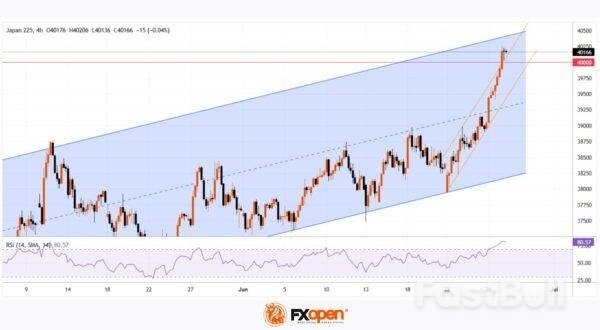
Price movements are forming an upward channel (highlighted in blue), but the market appears vulnerable to a pullback, as suggested by:
proximity to the upper boundary of the channel;
overbought conditions indicated by the RSI.
If a pullback develops, it will provide yet another example of how the price failed to hold above the psychological level of 40,000 — something we’ve seen repeatedly since October 2024, and we’ve been pointing out this pattern for quite some time.
Therefore, we might witness another false breakout above the 40K level on the Nikkei 225 (Japan 225 on FXOpen), followed by a retreat deeper into the blue channel — potentially towards its median line.
Trade global index CFDs with zero commission and tight spreads. Open your FXOpen account now or learn more about trading index CFDs with FXOpen.
This article represents the opinion of the Companies operating under the FXOpen brand only. It is not to be construed as an offer, solicitation, or recommendation with respect to products and services provided by the Companies operating under the FXOpen brand, nor is it to be considered financial advice.
728 RM B 7/F GEE LOK IND BLDG NO 34 HUNG TO RD KWUN TONG KLN HONG KONG


White Label
Data API
Web Plug-ins
Poster Maker
Affiliate Program
The risk of loss in trading financial instruments such as stocks, FX, commodities, futures, bonds, ETFs and crypto can be substantial. You may sustain a total loss of the funds that you deposit with your broker. Therefore, you should carefully consider whether such trading is suitable for you in light of your circumstances and financial resources.
No decision to invest should be made without thoroughly conducting due diligence by yourself or consulting with your financial advisors. Our web content might not suit you since we don't know your financial conditions and investment needs. Our financial information might have latency or contain inaccuracy, so you should be fully responsible for any of your trading and investment decisions. The company will not be responsible for your capital loss.
Without getting permission from the website, you are not allowed to copy the website's graphics, texts, or trademarks. Intellectual property rights in the content or data incorporated into this website belong to its providers and exchange merchants.
Not Logged In
Log in to access more features

FastBull Membership
Not yet
Purchase


Log In
Sign Up


