• Trade
  • Markets
  • Copy
  • Contests
  • News
  • 24/7
  • Calendar
  • Q&A
  • Chats
Trending
Screeners
SYMBOL
LAST
BID
ASK
HIGH
LOW
NET CHG.
%CHG.
SPREAD
SPX
S&P 500 Index
6846.50
6846.50
6846.50
6878.28
6827.18
-23.90
-0.35%
--
DJI
Dow Jones Industrial Average
47739.31
47739.31
47739.31
47971.51
47611.93
-215.67
-0.45%
--
IXIC
NASDAQ Composite Index
23545.89
23545.89
23545.89
23698.93
23455.05
-32.22
-0.14%
--
USDX
US Dollar Index
99.000
99.080
99.000
99.000
99.000
+0.050
+ 0.05%
--
EURUSD
Euro / US Dollar
1.16336
1.16393
1.16336
1.16365
1.16322
-0.00028
-0.02%
--
GBPUSD
Pound Sterling / US Dollar
1.33181
1.33282
1.33181
1.33213
1.33140
-0.00024
-0.02%
--
XAUUSD
Gold / US Dollar
4189.70
4190.14
4189.70
4218.85
4175.92
-8.21
-0.20%
--
WTI
Light Sweet Crude Oil
58.555
58.807
58.555
60.084
58.495
-1.254
-2.10%
--

Community Accounts

Signal Accounts
--
Profit Accounts
--
Loss Accounts
--
View More

Become a signal provider

Sell trading signals to earn additional income

View More

Guide to Copy Trading

Get started with ease and confidence

View More

Signal Accounts for Members

All Signal Accounts

Best Return
  • Best Return
  • Best P/L
  • Best MDD
Past 1W
  • Past 1W
  • Past 1M
  • Past 1Y

All Contests

  • All
  • Trump Updates
  • Recommend
  • Stocks
  • Cryptocurrencies
  • Central Banks
  • Featured News
Top News Only
Share

Senior USA Administration Official: We Continue To Monitor Drc-Rwanda Situation Closely, Continue To Work With All Sides To Ensure Commitments Are Honored

Share

Israeli Military Says It Has Struck Infrastructure Belonging To Hezbollah In Several Areas In Southern Lebanon

Share

SPDR Gold Holdings Down 0.11%, Or 1.14 Tonnes

Share

On Monday (December 8), In Late New York Trading, S&P 500 Futures Fell 0.21%, Dow Jones Futures Fell 0.43%, NASDAQ 100 Futures Fell 0.08%, And Russell 2000 Futures Fell 0.04%

Share

Morgan Stanley: Data Center ABS Spreads Are Expected To Widen In 2026

Share

(US Stocks) The Philadelphia Gold And Silver Index Closed Down 2.34% At 311.01 Points. (Global Session) The NYSE Arca Gold Miners Index Closed Down 2.17%, Hitting A Daily Low Of 2235.45 Points; US Stocks Remained Slightly Down Before The Opening Bell—holding Steady Around 2280 Points—before Briefly Rising Slightly

Share

IMF: IMF Executive Board Approves Extension Of The Extended Credit Facility Arrangement With Nepal

Share

Trump: Same Approach Will Apply To Amd, Intel, And Other Great American Companies

Share

Trump: Department Of Commerce Is Finalizing Details

Share

Trump: $25% Will Be Paid To United States Of America

Share

Trump: President Xi Responded Positively

Share

[Consumer Discretionary ETFs Fell Over 1.4%, Leading The Decline Among US Sector ETFs; Semiconductor ETFs Rose Over 1.1%] On Monday (December 8), The Consumer Discretionary ETF Fell 1.45%, The Energy ETF Fell 1.09%, The Internet ETF Fell 0.18%, The Regional Banks ETF Rose 0.34%, The Technology ETF Rose 0.70%, The Global Technology ETF Rose 0.93%, And The Semiconductor ETF Rose 1.13%

Share

Trump: I Have Informed President Xi, Of China, That United States Will Allow Nvidia To Ship Its H200 Products To Approved Customers In China

Share

Argentina's Merval Index Closed Up 0.02% At 3.047 Million Points. It Rose To A New Daily High Of 3.165 Million Points In Early Trading In Buenos Aires Before Gradually Giving Back Its Gains

Share

US Stock Market Closing Report | On Monday (December 8), The Magnificent 7 Index Fell 0.20% To 208.33 Points. The "mega-cap" Tech Stock Index Fell 0.33% To 405.00 Points

Share

Pentagon - USA State Dept Approves Potential Sale Of Hellfire Missiles To Belgium For An Estimated $79 Million

Share

Toronto Stock Index .GSPTSE Unofficially Closes Down 141.44 Points, Or 0.45 Percent, At 31169.97

Share

The Nasdaq Golden Dragon China Index Closed Up Less Than 0.1%. Nxtt Rose 21%, Microalgo Rose 7%, Daqo New Energy Rose 4.3%, And 21Vianet, Baidu, And Miniso All Rose More Than 3%

Share

The S&P 500 Initially Closed Down More Than 0.4%, With The Telecom Sector Down 1.9%, And Materials, Consumer Discretionary, Utilities, Healthcare, And Energy Sectors Down By As Much As 1.6%, While The Technology Sector Rose 0.7%. The NASDAQ 100 Initially Closed Down 0.3%, With Marvell Technology Down 7%, Fortinet Down 4%, And Netflix And Tesla Down 3.4%

Share

IMF: Review Pakistan Authorities To Draw The Equivalent Of About US$1 Billion

TIME
ACT
FCST
PREV
France Trade Balance (SA) (Oct)

A:--

F: --

P: --
Euro Zone Employment YoY (SA) (Q3)

A:--

F: --

P: --
Canada Part-Time Employment (SA) (Nov)

A:--

F: --

P: --

Canada Unemployment Rate (SA) (Nov)

A:--

F: --

P: --

Canada Full-time Employment (SA) (Nov)

A:--

F: --

P: --

Canada Labor Force Participation Rate (SA) (Nov)

A:--

F: --

P: --

Canada Employment (SA) (Nov)

A:--

F: --

P: --

U.S. PCE Price Index MoM (Sept)

A:--

F: --

P: --

U.S. Personal Income MoM (Sept)

A:--

F: --

P: --

U.S. Core PCE Price Index MoM (Sept)

A:--

F: --

P: --

U.S. PCE Price Index YoY (SA) (Sept)

A:--

F: --

P: --

U.S. Core PCE Price Index YoY (Sept)

A:--

F: --

P: --

U.S. Personal Outlays MoM (SA) (Sept)

A:--

F: --

P: --
U.S. 5-10 Year-Ahead Inflation Expectations (Dec)

A:--

F: --

P: --

U.S. Real Personal Consumption Expenditures MoM (Sept)

A:--

F: --

P: --
U.S. Weekly Total Rig Count

A:--

F: --

P: --

U.S. Weekly Total Oil Rig Count

A:--

F: --

P: --

U.S. Consumer Credit (SA) (Oct)

A:--

F: --

P: --
China, Mainland Foreign Exchange Reserves (Nov)

A:--

F: --

P: --

Japan Trade Balance (Oct)

A:--

F: --

P: --

Japan Nominal GDP Revised QoQ (Q3)

A:--

F: --

P: --

China, Mainland Imports YoY (CNH) (Nov)

A:--

F: --

P: --

China, Mainland Exports (Nov)

A:--

F: --

P: --

China, Mainland Imports (CNH) (Nov)

A:--

F: --

P: --

China, Mainland Trade Balance (CNH) (Nov)

A:--

F: --

P: --

China, Mainland Exports YoY (USD) (Nov)

A:--

F: --

P: --

China, Mainland Imports YoY (USD) (Nov)

A:--

F: --

P: --

Germany Industrial Output MoM (SA) (Oct)

A:--

F: --

P: --
Euro Zone Sentix Investor Confidence Index (Dec)

A:--

F: --

P: --

Canada National Economic Confidence Index

A:--

F: --

P: --

U.K. BRC Like-For-Like Retail Sales YoY (Nov)

--

F: --

P: --

U.K. BRC Overall Retail Sales YoY (Nov)

--

F: --

P: --

Australia Overnight (Borrowing) Key Rate

--

F: --

P: --

RBA Rate Statement
RBA Press Conference
Germany Exports MoM (SA) (Oct)

--

F: --

P: --

U.S. NFIB Small Business Optimism Index (SA) (Nov)

--

F: --

P: --

Mexico 12-Month Inflation (CPI) (Nov)

--

F: --

P: --

Mexico Core CPI YoY (Nov)

--

F: --

P: --

Mexico PPI YoY (Nov)

--

F: --

P: --

U.S. Weekly Redbook Index YoY

--

F: --

P: --

U.S. JOLTS Job Openings (SA) (Oct)

--

F: --

P: --

China, Mainland M1 Money Supply YoY (Nov)

--

F: --

P: --

China, Mainland M0 Money Supply YoY (Nov)

--

F: --

P: --

China, Mainland M2 Money Supply YoY (Nov)

--

F: --

P: --

U.S. EIA Short-Term Crude Production Forecast For The Year (Dec)

--

F: --

P: --

U.S. EIA Natural Gas Production Forecast For The Next Year (Dec)

--

F: --

P: --

U.S. EIA Short-Term Crude Production Forecast For The Next Year (Dec)

--

F: --

P: --

EIA Monthly Short-Term Energy Outlook
U.S. API Weekly Gasoline Stocks

--

F: --

P: --

U.S. API Weekly Cushing Crude Oil Stocks

--

F: --

P: --

U.S. API Weekly Crude Oil Stocks

--

F: --

P: --

U.S. API Weekly Refined Oil Stocks

--

F: --

P: --

South Korea Unemployment Rate (SA) (Nov)

--

F: --

P: --

Japan Reuters Tankan Non-Manufacturers Index (Dec)

--

F: --

P: --

Japan Reuters Tankan Manufacturers Index (Dec)

--

F: --

P: --

Japan Domestic Enterprise Commodity Price Index MoM (Nov)

--

F: --

P: --

Japan Domestic Enterprise Commodity Price Index YoY (Nov)

--

F: --

P: --

China, Mainland PPI YoY (Nov)

--

F: --

P: --

China, Mainland CPI MoM (Nov)

--

F: --

P: --

Italy Industrial Output YoY (SA) (Oct)

--

F: --

P: --

Q&A with Experts
    • All
    • Chatrooms
    • Groups
    • Friends
    Connecting
    .
    .
    .
    Type here...
    Add Symbol or Code

      No matching data

      All
      Trump Updates
      Recommend
      Stocks
      Cryptocurrencies
      Central Banks
      Featured News
      • All
      • Russia-Ukraine Conflict
      • Middle East Flashpoint
      • All
      • Russia-Ukraine Conflict
      • Middle East Flashpoint
      Search
      Products

      Charts Free Forever

      Chats Q&A with Experts
      Screeners Economic Calendar Data Tools
      Membership Features
      Data Warehouse Market Trends Institutional Data Policy Rates Macro

      Market Trends

      Market Sentiment Order Book Forex Correlations

      Top Indicators

      Charts Free Forever
      Markets

      News

      News Analysis 24/7 Columns Education
      From Institutions From Analysts
      Topics Columnists

      Latest Views

      Latest Views

      Trending Topics

      Top Columnists

      Latest Update

      Signals

      Copy Rankings Latest Signals Become a signal provider AI Rating
      Contests
      Brokers

      Overview Brokers Assessment Rankings Regulators News Claims
      Broker listing Forex Brokers Comparison Tool Live Spread Comparison Scam
      Q&A Complaint Scam Alert Videos Tips to Detect Scam
      More

      Business
      Events
      Careers About Us Advertising Help Center

      White Label

      Data API

      Web Plug-ins

      Affiliate Program

      Awards Institution Evaluation IB Seminar Salon Event Exhibition
      Vietnam Thailand Singapore Dubai
      Fans Party Investment Sharing Session
      FastBull Summit BrokersView Expo
      Recent Searches
        Top Searches
          Markets
          News
          Analysis
          User
          24/7
          Economic Calendar
          Education
          Data
          • Names
          • Latest
          • Prev

          View All

          No data

          Scan to Download

          Faster Charts, Chat Faster!

          Download App
          English
          • English
          • Español
          • العربية
          • Bahasa Indonesia
          • Bahasa Melayu
          • Tiếng Việt
          • ภาษาไทย
          • Français
          • Italiano
          • Türkçe
          • Русский язык
          • 简中
          • 繁中
          Open Account
          Search
          Products
          Charts Free Forever
          Markets
          News
          Signals

          Copy Rankings Latest Signals Become a signal provider AI Rating
          Contests
          Brokers

          Overview Brokers Assessment Rankings Regulators News Claims
          Broker listing Forex Brokers Comparison Tool Live Spread Comparison Scam
          Q&A Complaint Scam Alert Videos Tips to Detect Scam
          More

          Business
          Events
          Careers About Us Advertising Help Center

          White Label

          Data API

          Web Plug-ins

          Affiliate Program

          Awards Institution Evaluation IB Seminar Salon Event Exhibition
          Vietnam Thailand Singapore Dubai
          Fans Party Investment Sharing Session
          FastBull Summit BrokersView Expo

          India Overtakes Hong Kong to Become the World's Seventh Largest Stock Market

          Glendon

          Stocks

          Economic

          Summary:

          As of the end of November, the National Stock Exchange of India was valued at $3.989 trillion versus Hong Kong's $3.984 trillion. Hong Kong's benchmark Hang Seng index has plunged 18% year to date, making it the worst performing major Asia-Pacific market.

          India Overtakes Hong Kong to Become the World's Seventh Largest Stock Market_1

          Pedestrians walk towards the Chhatrapati Shivaji Terminus train station at dusk in Mumbai, India, on Wednesday, Oct. 4, 2023.

          India's stock market value has overtaken Hong Kong's to become the seventh largest in the world as optimism about the country's economic prospects grows.
          As of the end of November, the total market capitalization of the National Stock Exchange of India was $3.989 trillion versus Hong Kong's $3.984 trillion, according to data from the World Federation of Exchanges.
          India's Nifty 50 index reached another record high on Monday. It has jumped nearly 16% so far this year and is headed for its eighth straight year of gains. In contrast, Hong Kong's benchmark Hang Seng index has plunged 18% year to date.
          India has been a standout market this year in the Asia-Pacific region. Increased liquidity, more domestic participation and improving dynamics in the global macro environment in the form of falling U.S. Treasury yields have all boosted the country's stock markets.
          India Overtakes Hong Kong to Become the World's Seventh Largest Stock Market_2
          The world's most populous country also heads into general elections next year, which analysts predict could be another victory for the ruling nationalist Bharatiya Janata Party.
          “For the general election, opinion polls and recent state elections indicate that the incumbent BJP-led government may secure a decisive win, which could trigger a bull run in the first three to four months of the year on expectations of policy continuity,” HSBC strategists said in a client note.
          HSBC said banks, health care and energy are the best positioned sectors for next year.
          Sectors such as autos, retailers, real estate and telecoms are also relatively well positioned for 2024, while fast-moving consumer goods, utilities and chemicals are among those HSBC categorized as unfavorable.

          Hong Kong lags

          Hong Kong's Hang Seng index is poised to notch a fourth year of declines and is the worst performer among major Asia-Pacific equity markets.
          Last week, Moody's cut its outlook for Hong Kong from stable to negative, citing the city's financial, political, institutional and economic ties to mainland China. That downgrade came soon after Moody's reduced its outlook for China's government credit ratings to negative to stable.
          In early November, the Hong Kong government said it expects the economy to grow 3.2% in 2023, trimming its GDP growth outlook from the 4% to 5% forecast in August.
          The city's government has warned that increasing geopolitical tensions and tight financial conditions continue to weigh on investments, exports of goods and consumption sentiment. Consumer confidence has also suffered in Hong Kong.
          “Hong Kong's economy is poised for a soft landing in 2024 as annual real GDP growth moderates to around 2% from 2023′s 3.5%,” said economists at DBS.
          “Central to this recovery is mainland tourism revival, fortifying retail and catering sectors.”
          China has set a growth target of 5% for 2023. Its third quarter-GDP came in at 4.9%, lifting hopes that the world's second-largest economy will meet or even exceed expectations.

          Source: CNBC

          To stay updated on all economic events of today, please check out our Economic calendar
          Risk Warnings and Disclaimers
          You understand and acknowledge that there is a high degree of risk involved in trading. Following any strategies or investment methods may lead to potential losses. The content on the site is provided by our contributors and analysts for information purposes only. You are solely responsible for determining whether any trading assets, securities, strategy, or any other product is suitable for investing based on your own investment objectives and financial situation.
          Comments
          Add to Favorites
          Share

          December 12th Financial News

          FastBull Featured

          Daily News

          [Quick Facts]

          1. Argentina restricts dollar access until the new president unveils policy.
          2. EU nears deal on 12th Russia sanctions package, softens tanker sale ban.
          3. U.S. year-head inflation expectations drop to the lowest since April 2021.
          4. With big divisions, the conclusion of COP28 may be postponed.
          5. U.K. PM Sunak faces a critical week when leadership may be threatened.
          6. Oil extends longest one-week decline in 5 years on oversupply concerns.

          [News Details]

          Argentina restricts dollar access until the new president unveils policy
          Argentina's central bank said on Monday morning, local time, that the country's official currency market would operate with limited transactions to give President Milei's team time to comply with administrative procedures and implement its policy. Argentina's economy minister will announce the first economic measures on Tuesday. Investors expect the official exchange rate of the Argentine peso to depreciate by about 44% in the coming days. It is currently trading at 385 pesos to one dollar, and by contrast, the parallel exchange rate is nearly 1,000 pesos per dollar.
          EU nears deal on 12th Russia sanctions package, softens tanker sale ban
          EU countries are close to reaching a deal on the 12th round of sanctions against Russia, which focuses on a ban on imports of Russian diamond and new measures to block Russian oil exports, according to four sources familiar with the matter. In addition, the EU has been seeking to make it more difficult for Russia to circumvent existing sanctions, including the G7's oil price cap. The EU originally wanted to prohibit the sale of old tankers to Russian entities or for their use in Russia, as well as to entities that might use them to circumvent the G7 oil price cap, but this provision has been dropped. Mediterranean countries to which the big shipping companies belong are concerned that these measures could put them at a competitive disadvantage, one of the sources said.
          U.S. year-head inflation expectations drop to the lowest since April 2021
          U.S. consumers' year-head inflation expectations dropped in November to the lowest level since April 2021, according to the New York Fed's Survey of Consumer Expectations. The median expectation for inflation one year ahead fell for the second consecutive month, with November's 3.4% lower than October's 3.6%. Inflation expectations for the three- and five-year ahead stabilized at 3% and 2.7%, respectively. The retreat in near-term inflation expectations was due to many factors, including a pullback in expected increases in gasoline prices and a drop in expected increases in the price of rent and college tuition to the lowest level since January 2021. Inflation expectations by population over 60 fell to a nearly three-year low. Consumer views of the labor market deteriorated. The average expectation of the likelihood of being unemployed in the next 12 months rose nearly 1% to 13.6%. The expected probability of finding a job after losing one fell to a seven-month low of 55.2%. Respondents in the Midwest were the least confident that they would find a new job.
          With big divisions, the conclusion of COP28 may be postponed
          The negotiations at the UN Climate Change Conference has entered the twelfth day. According to the Chinese delegation, there are still big divisions among the parties, and the conference may be postponed.
          Now only a quarter of the more than 20 major issues have been or are nearly reached, some issues have been postponed to next year, and probably more than 50% of the issues have not yet been concluded. The parties have yet to agree on core issues such as fossil energy.
          U.K. PM Sunak faces a critical week when leadership may be threatened
          U.K. Prime Minister Rishi Sunak defended Britain's handling of the COVID-19 pandemic on Monday. Two groups of Conservative MPs were meeting, separately, to discuss the Rwanda bill which will be voted on in Parliament on Tuesday. The bill, which aims to send asylum seekers to Rwanda, is a centerpiece of Sunak's immigration policy and also his preparation for next year's general election. However, left and right Conservatives are deeply divided over the bill, putting its legislation in plight. There has been growing discussion within the party of plotting to remove the prime minister before the election. The Mail on Sunday reported that some Conservative critics are planning to shake up his leadership before Christmas, but some left MPs don't want the temporary appointment of another prime minister who does not go through a general election.
          Oil extends longest one-week decline in 5 years on oversupply concerns
          Oil prices slumped further, marking the longest one-week decline in five years, on concerns that supply is outstripping demand. Brent oil futures prices fell below $76 a barrel after seven consecutive weeks of decline, as traders ignored the latest OPEC+ announcement of further production cuts. Monthly contract spreads continued to show weakness, with Brent and WTI oil futures maintaining a bearish contango structure. Oil prices have fallen by about one-fifth since late September as production from the U.S. and other major producers surges, while the market forecasts lingering risks of a U.S. recession. Meanwhile, production cuts by Saudi Arabia and Russia, and promises to extend them if necessary, have failed to halt the slide in oil prices.

          [Focus of the Day]

          UTC+8 15:00 U.K. ILO Unemployment Rate (Oct)
          UTC+8 21:30 U.S. CPI (Nov)
          UTC+8 01:00 Next Day: EIA Monthly Short-Term Energy Outlook
          UTC+8 01:00 Next Day: ECB Governing Council Member Villeroy Speaks
          Risk Warnings and Disclaimers
          You understand and acknowledge that there is a high degree of risk involved in trading. Following any strategies or investment methods may lead to potential losses. The content on the site is provided by our contributors and analysts for information purposes only. You are solely responsible for determining whether any trading assets, securities, strategy, or any other product is suitable for investing based on your own investment objectives and financial situation.
          Comments
          Add to Favorites
          Share

          Inflation Expected to Have Cooled Further Last Month As Energy Prices Tick Down

          Michelle

          Central Bank

          Economic

          On Tuesday, investors will digest one of the most important data points the Federal Reserve will consider in its next interest rate decision: November's Consumer Price Index (CPI).
          The inflation report, set for release at 8:30 a.m. ET, is expected to show headline inflation of 3.1%, a slight deceleration from October's 3.2% annual gain in prices, according to estimates from Bloomberg. Over the prior month, consumer prices are expected to remain flat for the second straight month.
          Lower energy costs are likely to have held the headline figures to a smaller gain in annual prices, according to Bank of America.
          The bank anticipates a 3.5% month-over-month drop in energy prices after dropping 2.5% in October. The dip will be driven by lower gas prices, which fell sharply during the month of November.
          Inflation Expected to Have Cooled Further Last Month As Energy Prices Tick Down_1
          On a "core" basis, which strips out the more volatile costs of food and gas, prices in November are expected to have risen 4.0% over last year — matching the annual increase seen in October, according to Bloomberg data. Monthly core prices are expected to have climbed 0.3%, slightly higher than October's 0.2% monthly rise.
          Bank of America US economist Michael Gapen said higher prices for "volatile" categories like lodging away from home and used cars should lead to a "firmer core" after both of those categories saw prices decline in October.
          "We expect used car prices to increase because wholesale prices temporarily rose in both August and September amid concerns over the UAW strike. Meanwhile, we are looking for an increase in lodging away from home largely due to expectations for reversion to the mean after a large drop in October," Gapen wrote in a note on Monday ahead of the report.
          Still, "aside from these swing factors, we expect the data to be relatively supportive of disinflation," the analyst said.

          To hike or not to hike?

          Although inflation has remained significantly above the Federal Reserve's 2% target, investors are largely betting the Federal Reserve won't raise rates in December — especially after recent dovish rhetoric from Federal Reserve officials.
          Fed governor Christopher Waller said late last month he's "increasingly confident" interest rates are at the right level to fend off inflation.
          As of Monday afternoon, markets were pricing in a nearly 100% chance the Federal Reserve keeps rates unchanged in December, according to data from the CME Group.
          Inflation Expected to Have Cooled Further Last Month As Energy Prices Tick Down_2
          The market expects the central bank to begin cutting rates at its March meeting, pricing in a roughly 40% chance of a rate cut.
          Bank of America, however, does not expect the first Fed rate cut to come until June.
          "In recent days, the market has priced in a high likelihood of the first cut being in March, particularly after comments from Governor Waller that were perceived to be dovish," Gapen wrote.
          "We think that this is likely too early given our labor market and inflation outlook. Of course, if data (labor, activity, and inflation) come in materially weaker than we expect, then a cut as soon as March is a possibility."

          Source: Yahoo Finance

          To stay updated on all economic events of today, please check out our Economic calendar
          Risk Warnings and Disclaimers
          You understand and acknowledge that there is a high degree of risk involved in trading. Following any strategies or investment methods may lead to potential losses. The content on the site is provided by our contributors and analysts for information purposes only. You are solely responsible for determining whether any trading assets, securities, strategy, or any other product is suitable for investing based on your own investment objectives and financial situation.
          Comments
          Add to Favorites
          Share

          US Public's Downbeat View of Economy Is Real, Chicago Fed Research Shows

          Glendon

          Central Bank

          Economic

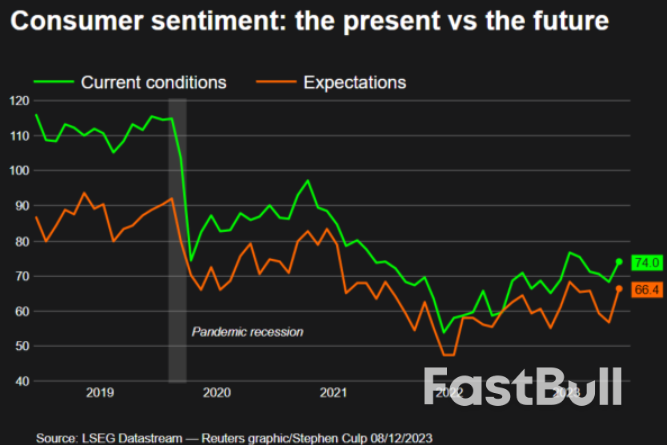
          Whether it's the "collective trauma" cited by the American Psychological Association (APA) or the bad "vibes" noted by internet analysts, there has been a clear break between the U.S. economy's performance and public attitudes about it, according to new research from the Chicago Federal Reserve.
          Researchers at the regional Fed bank studied measures of consumer and business sentiment and found a schism occurred in the spring of 2020 when the onset of the coronavirus pandemic posed mortal risk to the entire country and reordered the economy in ways that are still not fully understood.
          Jacob S. Herbstman, a research assistant at the Chicago Fed, and Scott A. Brave, a senior economist at the bank, found the post-pandemic years have seen "a decline in the average level of optimism" for any given set of economic outcomes - a mood shortfall that could influence the country's economy as well as its politics.
          "Historically, a tight link existed between consumer and small business sentiment in the U.S. and economic conditions" with measures like the unemployment rate and income able to explain much of the variation in household and business surveys conducted by the University of Michigan, the National Federation of Independent Business, and the Conference Board, they wrote. "That link appears to have been severed after the pandemic recession," an explanation for why a sub-4% unemployment rate and wage gains that are outpacing inflation have not registered more deeply with the public.
          The researchers don't pinpoint a reason for the shift, though their top culprits are the price level - not so much the rate of inflation but the fact that prices remain higher than they were - or the possibility that lower rates of unemployment have come to be expected as the norm.
          The shock of the pandemic could itself play a role, and U.S. central bank officials have been closely attuned in the aftermath of the crisis to how expectations about the economy and particularly inflation have performed.
          US Public's Downbeat View of Economy Is Real, Chicago Fed Research Shows_1

          'MAJOR STRESSOR'

          Attitudes about the economy can influence economic behavior, something the Fed was particularly worried about last year when rising prices and broad talk of recession sparked concerns about the country talking itself into a downturn - a moment economics commentator Kyla Scanlon dubbed the "vibecession," and which Robert Shiller, a Nobel Prize winner in economics, connected to his theories about the power of economic narratives.
          The ill feelings may cut even deeper than that. In its Stress in America 2023 report last month, the APA said the country was "recovering from collective trauma" that may be rooted in the pandemic but has sources far beyond it, including economic ones.
          "The COVID-19 pandemic, global conflicts, racism and racial injustice, inflation, and climate-related disasters are all weighing on the collective consciousness of Americans," the group said.
          Survey responses showed about two-thirds of respondents cited health, money and the economy as top day-to-day sources of stress. It also showed big jumps since 2019, before the pandemic, in the share of people citing the economy as a "major stressor." About half of those aged 18 to 44, for example, saw the economy that way before the pandemic, versus more than 70% now.
          With their prime earning years still to come, along with important decisions about education, family formation and home purchases, members of that age group are important to the macroeconomy, while the competition to motivate and earn the support of younger voters is seen as critical to the outcome of the presidential election next November.
          That leaves less than a year for the economic mood to shift if, as the Fed expects, inflation continues to fall, but alongside weaker wage and job growth.
          Recent reports on sentiment have shown an improvement, in fact. The outlook for inflation has gotten better, and the University of Michigan's preliminary reading of consumer sentiment in December jumped by the most in about two and a half years.
          "Consumer sentiment soared 13% in December, erasing all declines from the previous four months, primarily on the basis of improvements in the expected trajectory of inflation," Joanne Hsu, the director of the University of Michigan's Surveys of Consumers, said in a statement accompanying the data on Friday.
          US Public's Downbeat View of Economy Is Real, Chicago Fed Research Shows_2

          Source: REUTERS

          To stay updated on all economic events of today, please check out our Economic calendar
          Risk Warnings and Disclaimers
          You understand and acknowledge that there is a high degree of risk involved in trading. Following any strategies or investment methods may lead to potential losses. The content on the site is provided by our contributors and analysts for information purposes only. You are solely responsible for determining whether any trading assets, securities, strategy, or any other product is suitable for investing based on your own investment objectives and financial situation.
          Comments
          Add to Favorites
          Share

          Central Banks and the Revival of Gold

          Justin

          Commodity

          Economic

          One of the most significant changes in the world of money has been happening by stealth rather than through any policy announcement. Gold has regained a solid yet unofficial role in the world’s monetary system in a barely noticed, gradual process that cannot now be overlooked.
          This is the result of several interlinked reasons. The last few years have seen central banks run into gold, accelerated by declining trust in the dollar following western countries’ freezing of $300bn of Russian foreign exchange reserves after the Ukrainian invasion.
          The sharp rise in interest rates since the end of 2021 has led to significant losses for worldwide bondholders. This applies not just to commercial banks and asset managers but also, crucially, to many internationally operating central banks that acquired large stocks of government bonds in successive rounds of quantitative easing. This has damaged the validity of government bonds as a core element of central banks’ reserves.
          This has had a significant side effect. Gold-holding central banks in Europe seem likely to resort (either formally or informally) to using their gold revaluation accounts to plug balance sheet losses to be unveiled in coming years. They find this a more palatable option than the alternative – asking their governments to recapitalise them during a budget squeeze.
          Recapitalisation would undermine central banking independence by exposing the need for bail-out measures. However, the option they seem most likely to choose could have uncomfortable effects. By demonstrating the new-found monetary importance of gold, which has been slumbering unused in their reserves for decades, central banks could endanger confidence in the national currencies they issue and guarantee. They could provoke further moves out of fiduciary currencies and into gold by emerging market central banks seeking to emulate their more established European counterparts.

          The fight against inflation

          In their latest anti-inflation assault, central banks worldwide have raised interest rates by the fastest in decades, comprehensively breaking the bull market. Since 2020, 30-year US treasuries have declined by over 50% in value, while shorter-term treasuries have lost between 10% and 15% on average. Banks’ balance sheets have been hammered, and five US banks collapsed in 2023 – the most in seven years. Total unrealised losses on commercial banks’ bond holdings have already reached $650bn.
          Central banks face unprecedented losses on their bond holdings as well. Since the 2008 financial crisis, they have accumulated $21tn of assets during a decade-long wave of market support though QE. As a result of efforts to lower balance states, including through quantitative tightening, this number is currently down to $16tn. In the last 15 years, the balance sheets of the Federal Reserve, European Central Bank and Bank of Japan have risen by $6.5tn, $5.8tn and $3.6tn, respectively.
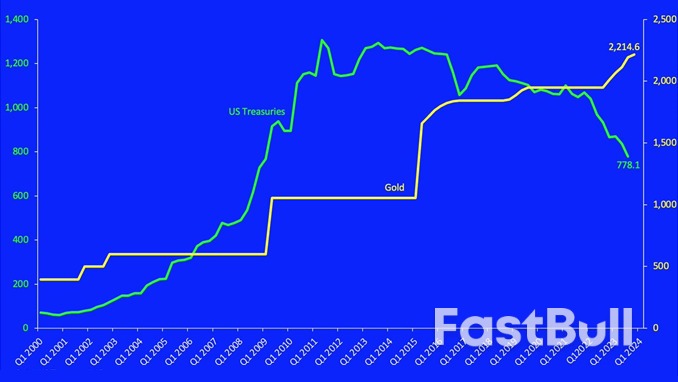
          Partly as a reaction to QE-induced currency debasement, many countries, primarily east of Germany, started accumulating gold in the last decade. The rise in the People’s Bank of China’s gold reserves is particularly noteworthy since it has coincided with a sharp fall in officially reported Chinese holdings of US Treasury securities (Figure 1).

          Figure 1. China’s gold reserves overtake holdings of US treasuries

          $bn (LHS), tonnes (RHS)
          Central Banks and the Revival of Gold_1
          According to US Treasury statistics on China’s official depositary holdings (which undoubtedly understate the level of China’s overall Treasury investments), China stopped adding to its treasuries in 2014, after the first US sanctions on Russia were imposed in reaction to the takeover of the Crimea. China has prioritised alternative instruments in recent years and now owns less than $780bn in Treasury holdings. This is down 40% from nine years ago, though these figures do not include dollar investments made via European depositories.
          Russia has been much more aggressive and sold all its Treasury securities in the last 15 years. The $300bn asset freeze confirmed President Vladimir Putin’s belief that gold was a safer reserve asset.

          Gold rush

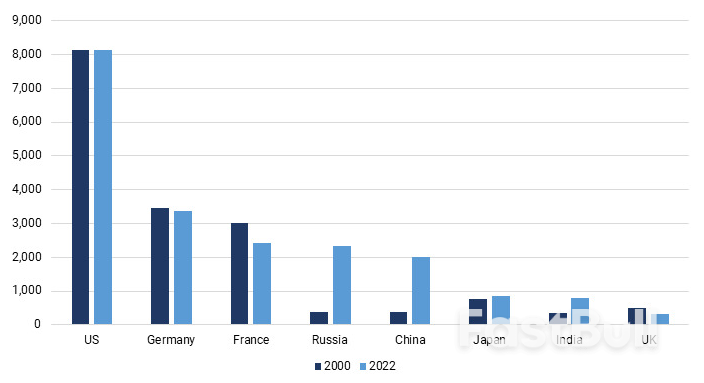
          The extension of western sanctions across the financial system, which some have termed ‘dollar weaponisation’, has given many large emerging market economies an incentive to divert foreign holdings into gold. This is seen (depending on the places where it is stored) as less susceptible to confiscation. Brazil, Russia, India, China and South Africa have bought almost 5,000 tonnes of gold for their official reserves in the last 15 years. China and Russia both added more than 1,500 tonnes, while India has added around 450 tonnes (Figure 2).
          Central Banks and the Revival of Gold_2
          Even some European Union countries joined the gold rush. Poland more than tripled its gold holdings to 333.7 tonnes in 2023 from 102.8 tonnes in 2000. After Czech National Bank Governor Aleš Michl declared he would like to increase the bank’s gold reserves by approximately ‘tenfold’, the bank’s gold holdings have increased by 37.5% since January. The Hungarian central bank had similar ambitions, increasing its gold reserves to 94.5 tonnes in 2021, from just 3 tonnes in 2018.
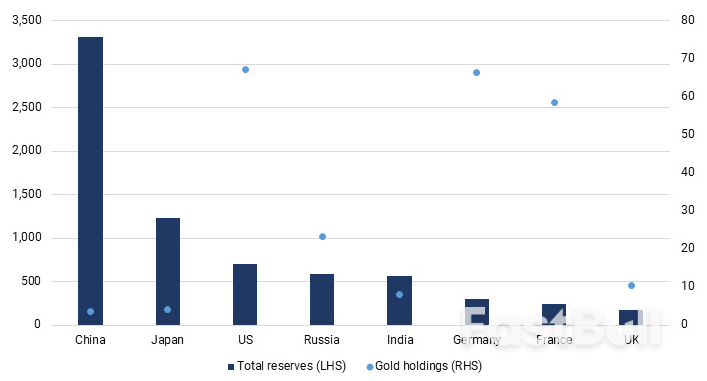
          2022 saw the highest central bank gold purchases since 1968. The US, Germany, and France have gold reserves surpassing the 50% level of all financial reserves, but have not increased their physical gold holdings in recent years (Figure 3).

          Figure 3. The percentage of overall reserves now held in gold

          Central Banks and the Revival of Gold_3
          After bottoming out around 1999, the gold price has increased by almost 10% on average per year. This revaluation of gold brings some advantages for central banks. De Nederlandsche Bank President Klaas Knot remarked in a November 2022 interview that the current gold revaluation accounts can be used to restore central bank balance sheets: ‘The balance sheet of the Dutch central banks is solid because we also have gold reserves and the gold revaluation account is more than €20bn, which we may not count as capital, but it is there.’
          Earlier this year, Bundesbank executive board member Joachim Wuermeling agreed gold revaluation accounts could be used to cover losses on the balance sheet: ‘The most important revaluation item is the reserve for 3,355 tonnes of gold. In fact, the value is about €180bn above the cost of purchasing it, so this is a reserve for us… The balance sheet of Deutsche Bundesbank is on firm ground, and this certainly makes it easier for us to bear losses over a certain period.’
          For technical and accounting reasons, central banks are more likely to turn to the GRAs as a psychological cushion, rather than use them formally to reinforce their capital. There is an opportunity for the US as it still values gold at its historical cost price of $42.22 per ounce. The gold reserve held by the Treasury is partially offset by a liability for gold certificates issued to the regional Feds at the statutory rate, which the Treasury may redeem at any time. This means that 8,000 tonnes of gold is used for both balance sheets.
          International market participants as well as central bankers around the world will be watching whether – perhaps after the presidential election in less than 12 months – the US will move towards any explicit or implicit gold revaluation. That would mark a further step in gold’s long journey back towards the centre of the monetary stage.

          Souace: Willem Middelkoop

          To stay updated on all economic events of today, please check out our Economic calendar
          Risk Warnings and Disclaimers
          You understand and acknowledge that there is a high degree of risk involved in trading. Following any strategies or investment methods may lead to potential losses. The content on the site is provided by our contributors and analysts for information purposes only. You are solely responsible for determining whether any trading assets, securities, strategy, or any other product is suitable for investing based on your own investment objectives and financial situation.
          Comments
          Add to Favorites
          Share

          India's IPO Boom: A Red Flag or A Sign of Robust Investor Confidence?

          Thomas

          Economic

          Stocks

          Ravi Agarwal describes the decision to list his company, Cellecor Gadgets, on India's stock markets as a "monumental moment".
          For founder and managing director of the consumer electronics brand, the move not only reflected the rise of his company, but also India's growth story.
          New Delhi-based Cellecor made its debut on the National Stock Exchange SME index on September 28 and it is one of the companies that has contributed to India's record-breaking year in terms of the number of initial public offerings.
          "This year's IPO boom in India is a testament to the nation's economic resilience and dynamism," says Mr. Agarwal. "Factors such as robust fundamentals, a growing middle class, and an appetite for innovation are driving this surge."
          Like Cellecor, most of the listings in 2023 took place on SME – or small and medium-sized enterprise – exchanges.
          India has emerged on top globally as well in terms of the IPO volumes so far this year, helped by the number of equity market deals during the third quarter, a report by global professional services firm EY said.
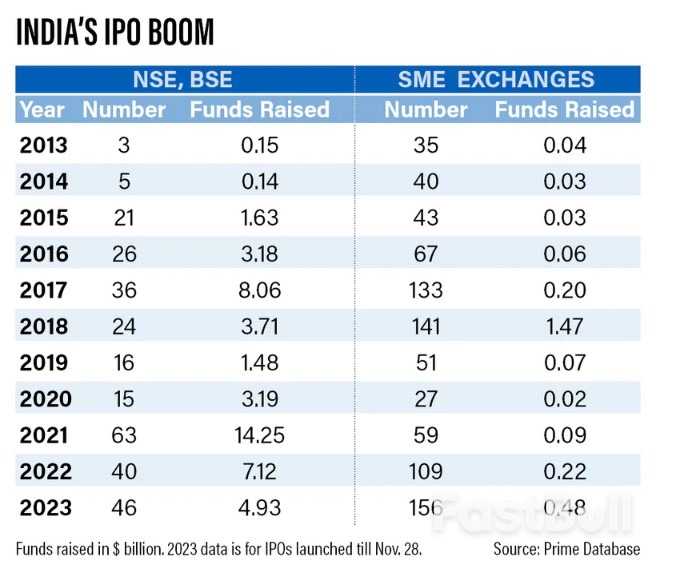
          A total of 69 IPOs took place in India in the three months to the end of September, including 48 listings on SME exchanges and 21 in the main market. The volume of deals is up 425 per cent compared to the same period last year, EY's figures show.
          The value, however, is more modest this year when compared to the past couple of years. Data from Prime Database shows funds raised so far this year totalled $5.41 billion through more than 200 IPOs.
          That compares to $7.34 billion in 2022 and a record high of $14.34 billion in 2021.
          Still, analysts see the rise in the number of listings as a positive development.
          IPOs launched this year include a broad range of companies. Among the companies that have gone public are Mankind Pharma, Tata Technologies and drone maker ideaForge.
          The biggest listings in the third quarter included wire and cable manufacturer RR Kabel and biotechnology company Concord Biotech.
          "The surge in retail investors' participation, coupled with daily market highs, has infused newfound liquidity into the public market," says Teja Ramineni, co-founder of Avenue Holdings, a financial services company.
          "This influx of funds provides companies with a robust platform to access capital, serving as a pivotal driver behind the flourishing IPO landscape."
          This can be "attributed to a confluence of factors, including a robust stock market, favourable economic conditions, progressive regulatory reforms, and the rise of unicorn start-ups", he says.
          India's IPO Boom: A Red Flag or A Sign of Robust Investor Confidence?_1India's economy grew by a robust 7.6 per cent in the September quarter from a year earlier, according to the official data.
          The fact that listings are more modest in size on the main market is reflective of investors becoming more discerning about how they deploy their capital, Mr. Ramineni explains.
          In 2021, a number of high-profile start-ups went public, including Paytm and PolicyBazaar. However, these companies hit the markets at overvalued prices, leaving investors sitting on shares that are below their listing prices even today.
          Last year, Life Insurance Corporation's IPO was the biggest the country had ever seen, but its share price tumbled after the market debut and has yet to fully recover.
          "There is a preference for profitable enterprises with established track records, and global market volatility has contributed to moderating IPO sizes."
          He believes the trend is much more sustainable and is indicative of "a robust IPO environment".
          This comes as India's stock markets have hit multiple record highs following a slump in October. Last week, the benchmark S&P BSE Sensex and the NSE Nifty 50, posted their best weekly gain since July 2022.
          The country's equity markets have been rising for six consecutive weeks, helped by factors, including strong economic data, a decline in oil prices, and the ruling Bharatiya Janata Party's victory in recent state elections.
          These developments have fuelled both foreign fund inflows as well as strong domestic investor demand, strengthening optimism about a booming IPO market into the new year.
          "The future of IPOs seems to be very promising, and it is expected that there will be a continued surge in the coming months, which will extend into the following year," says Kulbhushan Parashar, founder and managing director, Corporate Capital Ventures, a capital markets advisory firm.
          "This growth is driven by the expansion of businesses in India, which aligns with the country's rapid economic development."
          Companies are trying to file for IPOs before the 2024 general elections in the country, expected to be held between April and May.
          More than 25 companies have filed their Draft Red Herring Prospectus (DRHP) in the third quarter, "demonstrating a strong intent to raise funds in the upcoming quarters", analysts at EY write in their report.
          "The markets continue to reward companies with robust, scalable, and well-governed business models," they add.
          "Companies from various industries in India are actively pursuing listings in the current IPO surge," says Mr. Parashar.
          "The spectrum of companies seeking listings is broad, ranging from well-established conventional businesses to cutting-edge technology firms and innovative start-ups."
          Sona Machinery, a manufacturer of agro-processing machinery, is one of the companies that is planning to go public.
          It has already filed its DRHP and it is aiming to launch its IPO soon after completing the required regulatory processes.
          "This will be a ‘fresh issue' of up to 3.62 million shares with a face value of 10 rupees per share on NSE Emerge, the SME platform of the National Stock Exchange of India," says Vasu Naren, chairman and managing director, Sona Machinery.
          The company plans to use the capital generated to expand its manufacturing operations.
          "The market scenario has been quite volatile in the recent past," he says, adding that he is not worried about the volatility because of growth prospects in the industry and the strong fundamentals of the Indian economy.
          "This is a compounding effect from the market, investor confidence, and increase in customer spending", while the business landscape is also getting a boost from government policies and a supportive regulatory environment, he says.
          Despite the optimism, observers warn there are some risks that could dampen the current market euphoria.
          "Positive sentiments from both domestic and foreign investors toward India suggest that this momentum will likely persist until mid-2024," says Mr. Ramineni, but he adds that any "slump in US and global markets, along with geopolitical instability ... could contribute to a slowdown in the IPO momentum".
          The global economy and the elections are risk factors that have the potential to affect investor sentiment, said Mr. Parashar.
          But he doesn't see these as major threats currently.
          "We do not anticipate any other significant obstacles that could hinder the ongoing positive momentum in the IPO space," says Mr. Parashar.
          Similarly, Mr. Agarwal at Cellecor remains upbeat on the future following his company's IPO, as the brand uses the funds to boost its innovation and widen its product range.
          "The outlook is optimistic, reflecting sustained interest and confidence in the market," he says. "It's an exciting time for companies like ours."

          Source: The National News

          To stay updated on all economic events of today, please check out our Economic calendar
          Risk Warnings and Disclaimers
          You understand and acknowledge that there is a high degree of risk involved in trading. Following any strategies or investment methods may lead to potential losses. The content on the site is provided by our contributors and analysts for information purposes only. You are solely responsible for determining whether any trading assets, securities, strategy, or any other product is suitable for investing based on your own investment objectives and financial situation.
          Comments
          Add to Favorites
          Share

          Wall Street's Last Recession Holdouts

          Alex

          Economic

          Central Bank

          Calling for recession is contrarian now
          At the start of 2023, it was banal to forecast a near-term recession. Today, it's a risky call. Most economists now see a soft landing as the likeliest way this cycle ends, for good reason. Inflation keeps surprising to the downside. Consumption has powered through high rates. Behind it all is a rock-solid labour market, which added another 200,000 net jobs in November, 50,000 above consensus estimates. As Claudia Sahm argued in our latest Friday interview, supply improvements foiled recession calls.
          Nonetheless, a few stragglers on Wall Street remain in the recession camp. And though their arguments proved wrong earlier this year, they are worth considering, if only to understand the risks to the soft landing. With that in mind, where does the case for recession stand?
          For Don Rissmiller, economist at Strategas, his 50 per cent recession probability estimate (versus 40 per cent for a soft landing) comes from an unease with the soft landing story. He nicely sums up why:" There remain 5 key elements of the current US soft-landing story that we can't yet fully subscribe to: 1) The economy can take higher interest rates & grow indefinitely; 2) The lagged effects of prior policy & bank tightening have been fully digested; 3) Continued US unemployment < 4% will be accompanied with acceptable wage inflation; 4) The local labour market is moving to a state of balance by cutting only job openings vs. jobs; 5) Markets (bonds, equities, housing, etc) can easily handle higher interest rates lasting from here."
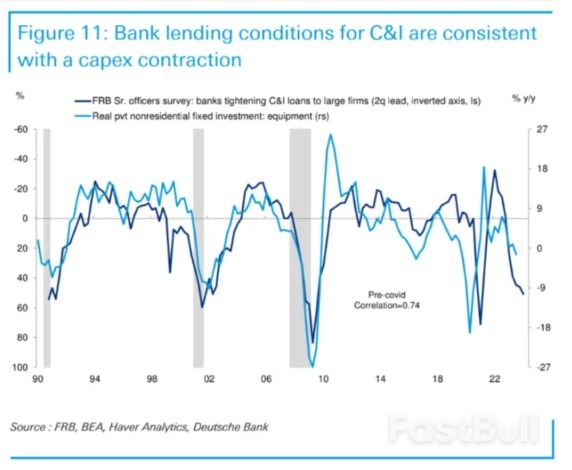
          The affirmative case for a (mild) recession was recently made by Matthew Luzzetti, Deutsche Bank's chief US economist, a longstanding recessionista. He makes three broad points. First, tighter financing is weighing on consumer spending through higher delinquencies and business investment through reduced capex. Luzzetti's measure of manufacturers' capex intentions, drawn from regional Fed surveys, is verging on contraction territory. Some broader measures, such as real private-sector equipment investment in the GDP data, are already shrinking year over year, in line with tight financial conditions:
          Wall Street's Last Recession Holdouts_1Second, fiscal policy is acting against growth. In 2023, fiscal spending either added to or mildly subtracted from growth, but in 2024 it is likely to shave some 0.6 percentage points off headline real GDP growth, according to a Brookings Institution measure. That is in keeping with projections that the US fiscal deficit will shrink next year, in part due to higher expected revenue from capital gains taxes.
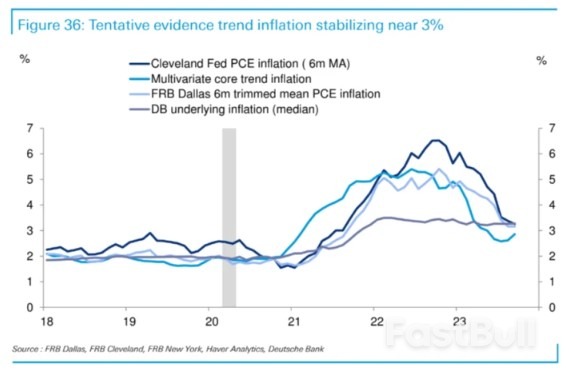
          Third, underlying trend inflation is not necessarily stabilising at 2 per cent, limiting how many pre-emptive rate cuts the Fed can do. Luzzetti notes that several Fed measures of underlying inflation are closer to 3 per cent, and have stopped rapidly declining:
          Wall Street's Last Recession Holdouts_2Nomura's US economists, Aichi Amemiya and Jeremy Schwartz, share Luzzetti's view of the risks to business investment from tight financial and credit conditions. They add another point: labour market strength may be overstated. They note several signs of declining labour demand, including falling job openings, more surveyed workers saying jobs are “hard to get" and the rising duration of unemployment-benefit use.
          What about the relentless pace of job growth? After Friday's payroll report, the US economy appears to have gained 186,000 jobs for each of the past six months, including an average of 175,000 in October and November. That is well above the 75,000 or so needed to keep up with baseline population growth. But Amemiya and Schwartz argue that after excluding the effects of recent autoworker and Hollywood strikes, which lift payroll gains as striking workers re-enter employment, the past two months of payroll gains drop to 120,000. Six-month average monthly job growth is probably closer to 130,000, calculates Omair Sharif of Inflation Insights, still strong but suggesting less of a job market buffer.
          Lastly, JPMorgan's Marko Kolanovic, who is not in the recession camp but believes recession risk is underestimated, reminds us that the yield curve is still inverted. Recessions have nearly always followed inversions historically, but with a lag time up to two years. That window extends through the back half of 2024, meaning that higher recession risk would be consistent with history. Kolanovic wrote last week: "...it is becoming consensus thinking that a recession will be avoided. We see the arguments such as no landing, goldilocks, election year seasonality, labour market resiliency, uprating of valuations, Fed put, etc, as various versions of “this time is different." Going back to basics and the relatively small number of recessions we can study — signalling from yield curve inversion indicates that recession risk is highest between 14 and 24 months following the onset of inversion. That period will cover most of 2024 ."
          These arguments, especially Kolanovic's point about the yield curve, need to be tempered with a recognition that this supply-dominated cycle looks different. Supply disruptions and the goods-to-services spending shift were largely responsible for inflation's rise, and improvements in labour supply for its fall, making the historical record an imperfect guide.
          Still, Wall Street's last few recession holdouts are highlighting a real weakness in the soft-landing story: that it requires everything to go right simultaneously. In particular, softening in business investment and low-end consumption need to stay contained while the labour market returns to normal. But with the ratio of job vacancies to unemployed workers still 12 per cent higher than 2019 levels, it will take at least a few more months to normalise — enough time for something to go wrong. The consensus bet on soft landing is a good one, but by no means bulletproof.

          Source: FT

          To stay updated on all economic events of today, please check out our Economic calendar
          Risk Warnings and Disclaimers
          You understand and acknowledge that there is a high degree of risk involved in trading. Following any strategies or investment methods may lead to potential losses. The content on the site is provided by our contributors and analysts for information purposes only. You are solely responsible for determining whether any trading assets, securities, strategy, or any other product is suitable for investing based on your own investment objectives and financial situation.
          Comments
          Add to Favorites
          Share
          FastBull
          Copyright © 2025 FastBull Ltd

          728 RM B 7/F GEE LOK IND BLDG NO 34 HUNG TO RD KWUN TONG KLN HONG KONG

          TelegramInstagramTwitterfacebooklinkedin
          App Store Google Play Google Play
          Products
          Charts

          Chats

          Q&A with Experts
          Screeners
          Economic Calendar
          Data
          Tools
          Membership
          Features
          Function
          Markets
          Copy Trading
          Latest Signals
          Contests
          News
          Analysis
          24/7
          Columns
          Education
          Company
          Careers
          About Us
          Contact Us
          Advertising
          Help Center
          Feedback
          User Agreement
          Privacy Policy
          Business

          White Label

          Data API

          Web Plug-ins

          Poster Maker

          Affiliate Program

          Risk Disclosure

          The risk of loss in trading financial instruments such as stocks, FX, commodities, futures, bonds, ETFs and crypto can be substantial. You may sustain a total loss of the funds that you deposit with your broker. Therefore, you should carefully consider whether such trading is suitable for you in light of your circumstances and financial resources.

          No decision to invest should be made without thoroughly conducting due diligence by yourself or consulting with your financial advisors. Our web content might not suit you since we don't know your financial conditions and investment needs. Our financial information might have latency or contain inaccuracy, so you should be fully responsible for any of your trading and investment decisions. The company will not be responsible for your capital loss.

          Without getting permission from the website, you are not allowed to copy the website's graphics, texts, or trademarks. Intellectual property rights in the content or data incorporated into this website belong to its providers and exchange merchants.

          Not Logged In

          Log in to access more features

          FastBull Membership

          Not yet

          Purchase

          Become a signal provider
          Help Center
          Customer Service
          Dark Mode
          Price Up/Down Colors

          Log In

          Sign Up

          Position
          Layout
          Fullscreen
          Default to Chart
          The chart page opens by default when you visit fastbull.com