• Trade
  • Markets
  • Copy
  • Contests
  • News
  • 24/7
  • Calendar
  • Q&A
  • Chats
Trending
Screeners
SYMBOL
LAST
BID
ASK
HIGH
LOW
NET CHG.
%CHG.
SPREAD
SPX
S&P 500 Index
6827.42
6827.42
6827.42
6899.86
6801.80
-73.58
-1.07%
--
DJI
Dow Jones Industrial Average
48458.04
48458.04
48458.04
48886.86
48334.10
-245.98
-0.51%
--
IXIC
NASDAQ Composite Index
23195.16
23195.16
23195.16
23554.89
23094.51
-398.69
-1.69%
--
USDX
US Dollar Index
97.950
98.030
97.950
98.500
97.950
-0.370
-0.38%
--
EURUSD
Euro / US Dollar
1.17394
1.17409
1.17394
1.17496
1.17192
+0.00011
+ 0.01%
--
GBPUSD
Pound Sterling / US Dollar
1.33707
1.33732
1.33707
1.33997
1.33419
-0.00148
-0.11%
--
XAUUSD
Gold / US Dollar
4299.39
4299.39
4299.39
4353.41
4257.10
+20.10
+ 0.47%
--
WTI
Light Sweet Crude Oil
57.233
57.485
57.233
58.011
56.969
-0.408
-0.71%
--

Community Accounts

Signal Accounts
--
Profit Accounts
--
Loss Accounts
--
View More

Become a signal provider

Sell trading signals to earn additional income

View More

Guide to Copy Trading

Get started with ease and confidence

View More

Signal Accounts for Members

All Signal Accounts

Best Return
  • Best Return
  • Best P/L
  • Best MDD
Past 1W
  • Past 1W
  • Past 1M
  • Past 1Y

All Contests

  • All
  • Trump Updates
  • Recommend
  • Stocks
  • Cryptocurrencies
  • Central Banks
  • Featured News
Top News Only
Share

USA Embassy In Lithuania: Maria Kalesnikava Is Not Going To Vilnius

Share

USA Embassy In Lithuania: Other Prisoners Are Being Sent From Belarus To Ukraine

Share

Ukraine President Zelenskiy: Five Ukrainians Released By Belarus In US-Brokered Deal

Share

USA Vilnius Embassy: USA Stands Ready For "Additional Engagement With Belarus That Advances USA Interests"

Share

USA Vilnius Embassy: Belarus, USA, Other Citizens Among The Prisoners Released Into Lithuania

Share

USA Vilnius Embassy: USA Will Continue Diplomatic Efforts To Free The Remaining Political Prisoners In Belarus

Share

USA Vilnius Embassy: Belarus Releases 123 Prisoners Following Meeting Of President Trump's Envoy Coale And Belarus President Lukashenko

Share

USA Vilnius Embassy: Masatoshi Nakanishi, Aliaksandr Syrytsa Are Among The Prisoners Released By Belarus

Share

USA Vilnius Embassy: Maria Kalesnikava And Viktor Babaryka Are Among The Prisoners Released By Belarus

Share

USA Vilnius Embassy: Nobel Peace Prize Laureate Ales Bialiatski Is Among The Prisoners Released By Belarus

Share

Belarusian Presidential Administration Telegram Channel: Lukashenko Has Pardoned 123 Prisoners As Part Of Deal With US

Share

Two Local Syrian Officials: Joint US-Syrian Military Patrol In Central Syria Came Under Fire From Unknown Assailants

Share

Israeli Military Says It Targeted 'Key Hamas Terrorist' In Gaza City

Share

Rwanda's Actions In Eastern Drc Are A Clear Violation Of Washington Accords Signed By President Trump - Secretary Of State Rubio

Share

Israeli Military Issues Evacuation Warning In Southern Lebanon Village Ahead Of Strike - Spokesperson On X

Share

Belarusian State Media Cites US Envoy Coale As Saying He Discussed Ukraine And Venezuela With Lukashenko

Share

Belarusian State Media Cites US Envoy Coale As Saying That US Removes Sanctions On Belarusian Potassium

Share

Thai Prime Minister: No Ceasefire Agreement With Cambodia

Share

US, Ukraine To Discuss Ceasefire In Berlin Ahead Of European Summit

Share

Incoming Czech Prime Minister Babis: Czech Republic Will Not Take On Guarantees For Ukraine Financing, European Commission Must Find Alternatives

TIME
ACT
FCST
PREV
U.K. Trade Balance Non-EU (SA) (Oct)

A:--

F: --

P: --

U.K. Trade Balance (Oct)

A:--

F: --

P: --

U.K. Services Index MoM

A:--

F: --

P: --

U.K. Construction Output MoM (SA) (Oct)

A:--

F: --

P: --

U.K. Industrial Output YoY (Oct)

A:--

F: --

P: --

U.K. Trade Balance (SA) (Oct)

A:--

F: --

P: --

U.K. Trade Balance EU (SA) (Oct)

A:--

F: --

P: --

U.K. Manufacturing Output YoY (Oct)

A:--

F: --

P: --

U.K. GDP MoM (Oct)

A:--

F: --

P: --

U.K. GDP YoY (SA) (Oct)

A:--

F: --

P: --

U.K. Industrial Output MoM (Oct)

A:--

F: --

P: --

U.K. Construction Output YoY (Oct)

A:--

F: --

P: --

France HICP Final MoM (Nov)

A:--

F: --

P: --

China, Mainland Outstanding Loans Growth YoY (Nov)

A:--

F: --

P: --

China, Mainland M2 Money Supply YoY (Nov)

A:--

F: --

P: --

China, Mainland M0 Money Supply YoY (Nov)

A:--

F: --

P: --

China, Mainland M1 Money Supply YoY (Nov)

A:--

F: --

P: --

India CPI YoY (Nov)

A:--

F: --

P: --

India Deposit Gowth YoY

A:--

F: --

P: --

Brazil Services Growth YoY (Oct)

A:--

F: --

P: --

Mexico Industrial Output YoY (Oct)

A:--

F: --

P: --

Russia Trade Balance (Oct)

A:--

F: --

P: --

Philadelphia Fed President Henry Paulson delivers a speech
Canada Building Permits MoM (SA) (Oct)

A:--

F: --

P: --

Canada Wholesale Sales YoY (Oct)

A:--

F: --

P: --

Canada Wholesale Inventory MoM (Oct)

A:--

F: --

P: --

Canada Wholesale Inventory YoY (Oct)

A:--

F: --

P: --

Canada Wholesale Sales MoM (SA) (Oct)

A:--

F: --

P: --

Germany Current Account (Not SA) (Oct)

A:--

F: --

P: --

U.S. Weekly Total Rig Count

A:--

F: --

P: --

U.S. Weekly Total Oil Rig Count

A:--

F: --

P: --

Japan Tankan Large Non-Manufacturing Diffusion Index (Q4)

--

F: --

P: --

Japan Tankan Small Manufacturing Outlook Index (Q4)

--

F: --

P: --

Japan Tankan Large Non-Manufacturing Outlook Index (Q4)

--

F: --

P: --

Japan Tankan Large Manufacturing Outlook Index (Q4)

--

F: --

P: --

Japan Tankan Small Manufacturing Diffusion Index (Q4)

--

F: --

P: --

Japan Tankan Large Manufacturing Diffusion Index (Q4)

--

F: --

P: --

Japan Tankan Large-Enterprise Capital Expenditure YoY (Q4)

--

F: --

P: --

U.K. Rightmove House Price Index YoY (Dec)

--

F: --

P: --

China, Mainland Industrial Output YoY (YTD) (Nov)

--

F: --

P: --

China, Mainland Urban Area Unemployment Rate (Nov)

--

F: --

P: --

Saudi Arabia CPI YoY (Nov)

--

F: --

P: --

Euro Zone Industrial Output YoY (Oct)

--

F: --

P: --

Euro Zone Industrial Output MoM (Oct)

--

F: --

P: --

Canada Existing Home Sales MoM (Nov)

--

F: --

P: --

Euro Zone Total Reserve Assets (Nov)

--

F: --

P: --

U.K. Inflation Rate Expectations

--

F: --

P: --

Canada National Economic Confidence Index

--

F: --

P: --

Canada New Housing Starts (Nov)

--

F: --

P: --

U.S. NY Fed Manufacturing Employment Index (Dec)

--

F: --

P: --

U.S. NY Fed Manufacturing Index (Dec)

--

F: --

P: --

Canada Core CPI YoY (Nov)

--

F: --

P: --

Canada Manufacturing Unfilled Orders MoM (Oct)

--

F: --

P: --

Canada Manufacturing New Orders MoM (Oct)

--

F: --

P: --

Canada Core CPI MoM (Nov)

--

F: --

P: --

Canada Manufacturing Inventory MoM (Oct)

--

F: --

P: --

Canada CPI YoY (Nov)

--

F: --

P: --

Canada CPI MoM (Nov)

--

F: --

P: --

Canada CPI YoY (SA) (Nov)

--

F: --

P: --

Canada Core CPI MoM (SA) (Nov)

--

F: --

P: --

Q&A with Experts
    • All
    • Chatrooms
    • Groups
    • Friends
    Connecting
    .
    .
    .
    Type here...
    Add Symbol or Code

      No matching data

      All
      Trump Updates
      Recommend
      Stocks
      Cryptocurrencies
      Central Banks
      Featured News
      • All
      • Russia-Ukraine Conflict
      • Middle East Flashpoint
      • All
      • Russia-Ukraine Conflict
      • Middle East Flashpoint
      Search
      Products

      Charts Free Forever

      Chats Q&A with Experts
      Screeners Economic Calendar Data Tools
      Membership Features
      Data Warehouse Market Trends Institutional Data Policy Rates Macro

      Market Trends

      Market Sentiment Order Book Forex Correlations

      Top Indicators

      Charts Free Forever
      Markets

      News

      News Analysis 24/7 Columns Education
      From Institutions From Analysts
      Topics Columnists

      Latest Views

      Latest Views

      Trending Topics

      Top Columnists

      Latest Update

      Signals

      Copy Rankings Latest Signals Become a signal provider AI Rating
      Contests
      Brokers

      Overview Brokers Assessment Rankings Regulators News Claims
      Broker listing Forex Brokers Comparison Tool Live Spread Comparison Scam
      Q&A Complaint Scam Alert Videos Tips to Detect Scam
      More

      Business
      Events
      Careers About Us Advertising Help Center

      White Label

      Data API

      Web Plug-ins

      Affiliate Program

      Awards Institution Evaluation IB Seminar Salon Event Exhibition
      Vietnam Thailand Singapore Dubai
      Fans Party Investment Sharing Session
      FastBull Summit BrokersView Expo
      Recent Searches
        Top Searches
          Markets
          News
          Analysis
          User
          24/7
          Economic Calendar
          Education
          Data
          • Names
          • Latest
          • Prev

          View All

          No data

          Scan to Download

          Faster Charts, Chat Faster!

          Download App
          English
          • English
          • Español
          • العربية
          • Bahasa Indonesia
          • Bahasa Melayu
          • Tiếng Việt
          • ภาษาไทย
          • Français
          • Italiano
          • Türkçe
          • Русский язык
          • 简中
          • 繁中
          Open Account
          Search
          Products
          Charts Free Forever
          Markets
          News
          Signals

          Copy Rankings Latest Signals Become a signal provider AI Rating
          Contests
          Brokers

          Overview Brokers Assessment Rankings Regulators News Claims
          Broker listing Forex Brokers Comparison Tool Live Spread Comparison Scam
          Q&A Complaint Scam Alert Videos Tips to Detect Scam
          More

          Business
          Events
          Careers About Us Advertising Help Center

          White Label

          Data API

          Web Plug-ins

          Affiliate Program

          Awards Institution Evaluation IB Seminar Salon Event Exhibition
          Vietnam Thailand Singapore Dubai
          Fans Party Investment Sharing Session
          FastBull Summit BrokersView Expo

          In Latin America, Data Center Plans Fuel Water Worries

          Alex

          Economic

          Summary:

          Google plans second Latin America data center in Uruguay. Proposals cause anger as drought hits domestic supplies. Global data center boom sparks protest over resources.

          Uruguay's devastating drought was at its peak when President Luis Lacalle Pou took an unexpected question from a young student during a visit to a primary school in the capital: "Why is the water so salty?"
          "We have to wait for the rain," Lacalle Pou replied. "We must save our water only for essential needs."
          Recent rainfall has eased the parched conditions that prompted the government to mix water supplies with a brackish source in parts of Montevideo, and the capital's depleted reservoirs have started to recover.
          But many Uruguayans unable to afford bottled water say the government has prioritized industrial uses during this year's drought, stirring anger over plans by Google to build a data center using millions of liters every day to cool its servers.
          "These companies consume vast volumes of water, which are, in turn, our reserves," said Daniel Pena, a sociologist and researcher at the Republic University in Montevideo.
          "Now, with the drought, it's as if someone emptied your bank account. Your savings just aren't there anymore," said Pena, who has campaigned against growing use of potable water by industry as a member of the Coordination for Water civil group.
          Alphabet-owned Google has acquired land in the western department of Canelones to build its second data center in Latin America. In 2015, it opened its first in the region in a suburb of Chile's capital, Santiago, announcing three years later that it would triple its size to meet growing demand.
          The company's plans to build a second project in Chile - which has been gripped by drought for more than a decade - have faced delays since 2020 as local communities filed environmental complaints.
          Squandered water supplies?
          According to Google's sustainability data, the company's more than 20 data centers consumed approximately 5.22 billion gallons (19.8 billion liters) of water in 2022, or more than 14 million gallons (53 million liters) per day.
          That is equivalent to the domestic water consumption of nearly 175,000 people in the United States, as per the latest estimates from the U.S. Environmental Protection Agency.
          It is still much less than other industries, such as Uruguay's key pulp and paper sector, but it poses a further strain on increasingly limited water supplies as climate change increases the frequency and severity of droughts.
          Surging internet use in recent years has accelerated demand for new data centers around the world, increasing competition for land and raising concerns about the use of resources - including water.
          Data center growth is underpinned by how the pandemic supercharged online and especially video activity, triggering a surge in Zoom calls, photo-sharing and social media use. Novel technologies such as artificial intelligence and autonomous driving could spur further expansion.
          Google's planned data center in Canelones would power user requests for its array of internet services, such as YouTube, Gmail and Search.
          Initial plans for the facility envisaged daily water use of 7.6 million liters (about 2 million gallons), according to information obtained by Pena following a freedom of information request last year.
          That is equivalent to the daily water consumption of 55,000 people in Montevideo, a city of 1.4 million people. Most of the water used in cooling evaporates, meaning it can not be retained for other uses.
          Running a soup kitchen that offers meals to children in the poor Nuevo Comienzo neighborhood just outside the capital, Fabiana Molina, 50, said she feared the poor would bear the brunt of growing competition for limited water resources.
          "The 7.6 million liters that Google will use are 7.6 million squandered," she said.
          Uruguay's industry ministry said the original project had been withdrawn by the company, and that it was now working with an alternative plan that would use less energy and water.
          A Google official told the Thomson Reuters Foundation the project is still in the "exploratory phase" and must undergo environmental approval, for which final figures may differ from initial estimates.
          Global Pushback
          The pushback against Google's plans in Uruguay comes amid growing opposition to data centers around the world - from Europe to the United States and elsewhere in Latin America.
          In Chile, local residents and authorities filed a formal complaint against Google's second planned data center at the country's environmental court in 2020, prompting Google to commit to adopting alternative cooling methods. But the project remains on hold.
          A data center project planned by Microsoft in Quilicura, close to Google's existing Chilean facility, has encountered similar opposition, delaying the approvals process amid concerns from the local community about its potential impact on an ecosystem already suffering from dry weather.
          The project, however, is moving forward as the U.S. company undergoes the environmental permitting process. An additional amendment, in which Microsoft committed not to draw water from nearby sources, led to approval from most local public bodies.
          Tech companies highlight the positive economic impact of data centers. Google said its Chilean data center required a $290-million investment and helped boost gross domestic product (GDP).
          When Google announced in 2018 it would invest an additional $140 million to expand it, then President Sebastian Pinera hailed it as showing Chile was part of the "fourth industrial revolution".
          But critics say data centers create few jobs and give little back in exchange for the resources they use, compounding public anger as water scarcity impacts daily life.
          At her home in El Tobogan, a slum area on the outskirts of Montevideo, pensioner Lita Leite said she had to use salty water to prepare her mate, a traditional infused herbal drink drank widely in parts of South America.
          "It was extremely foul-tasting ... (but) for me, it was impossible to afford bottled water daily," said Leite, 67, accusing Lacalle Pou's conservative government of having "handed over control of our natural water."
          "Big companies take millions of liters of water yearly, but it seems like us Uruguayans have lost our rights," she said.
          ($1 = 38.1500 Uruguayan pesos)

          Source: Reuters

          To stay updated on all economic events of today, please check out our Economic calendar
          Risk Warnings and Disclaimers
          You understand and acknowledge that there is a high degree of risk involved in trading. Following any strategies or investment methods may lead to potential losses. The content on the site is provided by our contributors and analysts for information purposes only. You are solely responsible for determining whether any trading assets, securities, strategy, or any other product is suitable for investing based on your own investment objectives and financial situation.
          Comments
          Add to Favorites
          Share

          Week Ahead – Dollar Shines ahead of Nonfarm Payrolls

          Justin

          Forex

          Central Bank

          Economic

          Dollar goes on a rampage

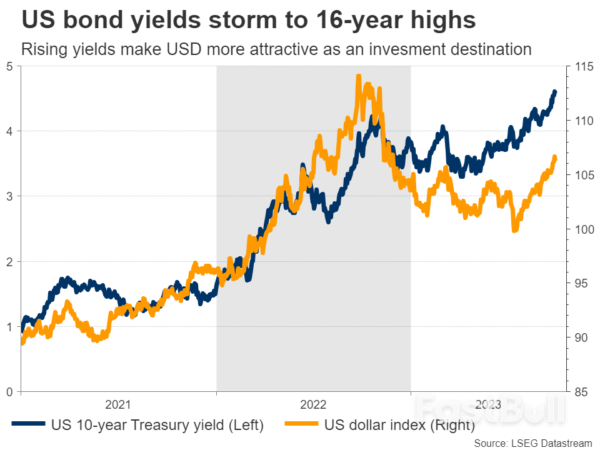
          The US dollar rally has gone into overdrive lately. Empowered by a stunning rise in US yields, solid economic fundamentals, and safe haven flows, the dollar has charged higher to record 11 consecutive weeks of gains against the euro.
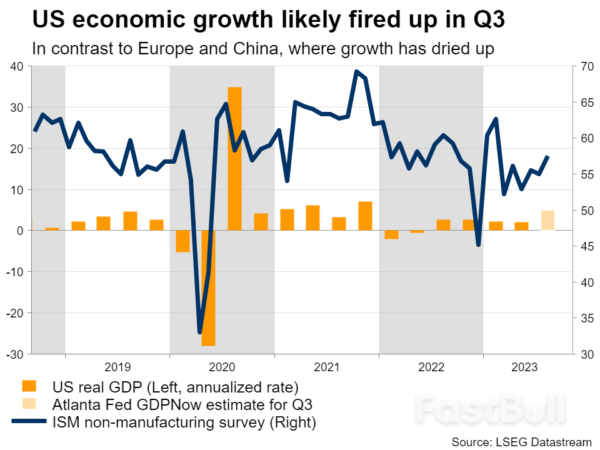
          In a nutshell, the United States appears much more resilient than any other region. Incoming data releases continue to reaffirm the strength of the US economy, while in contrast, Europe is suffering a sharp slowdown in economic growth and China is still dealing with the implosion of its property sector.
          This differential in economic growth is increasingly pushing investors towards the United States, and the impressive rally in US yields lately has made the dollar even more attractive from an interest rate perspective.
          Week Ahead – Dollar Shines ahead of Nonfarm Payrolls_1
          Hence, the dollar offers the ‘full package’ at the moment – the highest real rates among the major economies, the strongest economic growth, and safe haven qualities thanks to its reserve currency status. Meanwhile, there’s a lack of attractive alternatives in the FX arena, as every other major currency is dealing with its own problems.
          Next week’s data releases will either add more fuel to this rally or trigger a correction, with the main event being the US employment report on Friday. Forecasts suggest nonfarm payrolls rose by 150k in September, less than the previous month but still a decent number overall.
          Meanwhile, the unemployment rate is projected to have ticked back down to 3.7%, while wage growth is expected to have picked up some steam in monthly terms. If the forecasts are met, this would be yet another dataset reinforcing the Fed’s message that interest rates could remain higher for longer.
          As for any surprises, most early indicators point to another solid month for the US labor market. Applications for unemployment benefits fell sharply in September, so there were no signs of any mass worker layoffs. Similarly, business surveys from S&P Global signaled a reacceleration in employment growth.
          Week Ahead – Dollar Shines ahead of Nonfarm Payrolls_2
          Speaking of business surveys, the ISM manufacturing index is due on Monday, ahead of the non-manufacturing PMI on Wednesday. In the political scene, the government will shut down this weekend unless a funding deal is reached in Congress. That said, markets usually ignore these shutdowns, as investors view them as political theater. For markets to care, it would need to be a prolonged shutdown that dampens economic growth.

          RBA and RBNZ decisions

          Crossing into Australia, the Reserve Bank will conclude its meeting early on Tuesday, the first one under the new Governor, Michelle Bullock. Even though data releases have been rather strong lately, with the labor market enjoying a substantial recovery in August and inflation reaccelerating, markets assign less than a 10% probability to a rate increase.
          That’s mostly because the latest signals from the central bank itself show a preference for keeping rates unchanged. The latest RBA minutes preached patience, as rates have already risen quickly and the full impact of all this tightening has not been felt yet.
          Week Ahead – Dollar Shines ahead of Nonfarm Payrolls_3
          A decision to keep rates unchanged would argue for a negative reaction in the Australian dollar, but nothing dramatic, as this is the market’s baseline scenario already.
          In neighboring New Zealand, the central bank will announce its own decision on Wednesday. The market-implied probability for a rate increase is also around 10%, but it might still be an exciting event as the economy has outperformed expectations lately. Hence, the question is whether the RBNZ will set the stage for another rate hike in November.
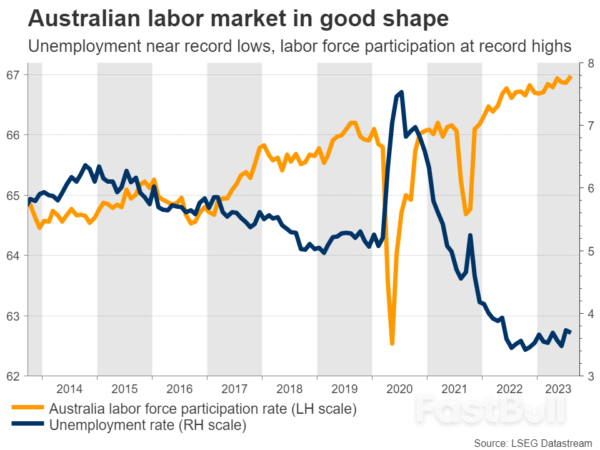
          Inflation seems to be gaining momentum again. Even though inflation cooled a little in the second quarter, the jobs market remained very tight, with record levels of labor force participation and an explosion in population growth helping to boost demand. In addition, the depreciation of the New Zealand dollar in recent months coupled with the sharp rise in oil prices will also help to refuel inflation.
          Against this backdrop, the RBNZ will likely keep rates unchanged, but perhaps signal that a rate increase in November is a real possibility. Markets assign a 60% chance to that scenario, and if this probability moves any higher in the aftermath, it could lift the currency somewhat.
          Week Ahead – Dollar Shines ahead of Nonfarm Payrolls_4
          That said, there’s an election in two weeks, so the risk is that the RBNZ does not deliver any clear signals, to avoid interfering. Either way, the general outlook for the kiwi dollar seems grim, even if the currency spikes higher after the RBNZ. The slowdown in global growth and the deterioration in risk sentiment will likely keep a lid on any rallies.
          Chinese data releases will be in focus too. China is the largest trading partner of both Australia and New Zealand, so these currencies are very sensitive to developments in China, where the latest business surveys will be released over the weekend.
          Elsewhere, Japan’s Tankan business survey for Q3 will hit the markets on Monday, while in Canada, the employment report for September will see the light on Friday.

          Source: XM

          To stay updated on all economic events of today, please check out our Economic calendar
          Risk Warnings and Disclaimers
          You understand and acknowledge that there is a high degree of risk involved in trading. Following any strategies or investment methods may lead to potential losses. The content on the site is provided by our contributors and analysts for information purposes only. You are solely responsible for determining whether any trading assets, securities, strategy, or any other product is suitable for investing based on your own investment objectives and financial situation.
          Comments
          Add to Favorites
          Share

          Inside Vietnam's Plans to Dent China's Rare Earths Dominance

          Thomas

          Economic

          Vietnam plans to restart its biggest rare-earths mine next year with a Western-backed project that could rival the world's largest, according to two companies involved, as part of a broader push to dent China's dominance in a sector that helps power advanced technologies.
          The move would be a step toward the Southeast Asian country's aim of building up a rare-earths supply chain, including developing its capacity to refine ores into metals used in magnets for electric vehicles, smartphones and wind turbines.
          As an initial step, Vietnam's government intends to launch tenders for multiple blocks of its Dong Pao mine before the year's end, said Tessa Kutscher, an executive at Australia's Blackstone Minerals Ltd, which plans to bid for at least one concession. She cited unpublished information from Vietnam's Ministry of Natural Resources and Environment, which did not respond to requests for comment.
          The auction's timing could change but the government plans to restart the mine next year, said Luu Anh Tuan, chairman of Vietnam Rare Earth JSC (VTRE), the country's main refiner and Blackstone's partner in the project.
          The proposed restart of Dong Pao - whose timeline, scale and degree of foreign financial support have not been reported previously - comes as many nations fret about their vulnerability to supply disruptions due to China's stranglehold on strategic minerals and its disputes with the U.S. and its allies. Beijing this year-imposed export curbs on minor metals used in semiconductors, which an influential Chinese policy adviser warned was "just a start".
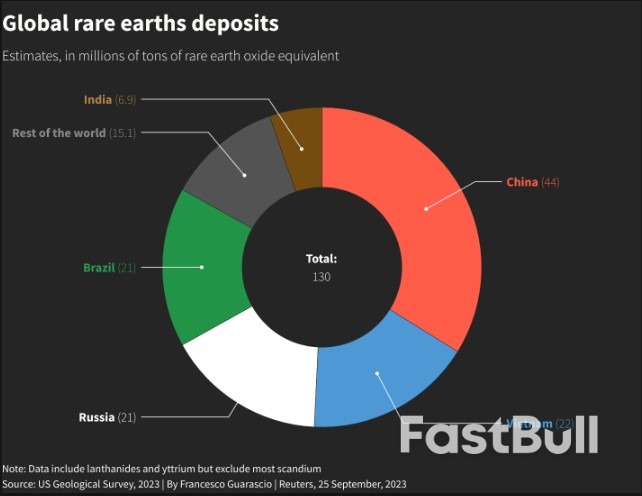
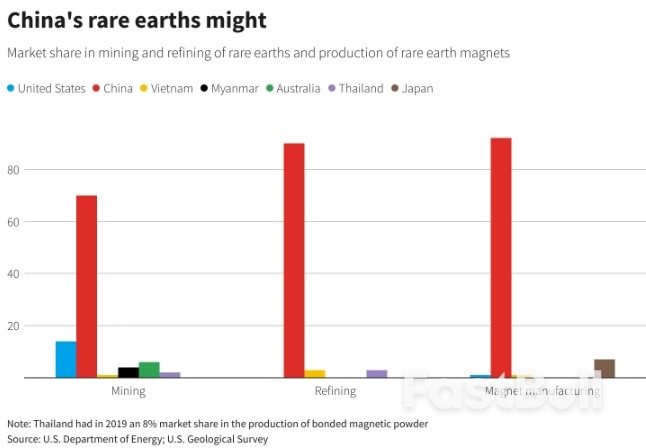
          Vietnam has the second-largest rare-earth deposits, according to the U.S. Geological Survey. But they have remained largely untapped, with investment discouraged by low prices that are effectively set by China because of its near-monopoly on the global market. Visiting Hanoi this month to upgrade bilateral relations, U.S. President Joe Biden signed an agreement to boost Vietnam's ability to lure investors for its rare-earth reserves.
          In interviews with Reuters, 12 industry executives, investors, analysts and foreign officials described plans for Vietnam, including investments they said showed how talk of derisking supply chains to reduce reliance on China is translating into action. Some acknowledged the difficulties of forging a rare-earths hub but said the gambit could make Vietnam a viable player while assuaging strategic worries, even if China remained dominant.
          Kutscher said Blackstone's investment in the project would be worth around $100 million if it wins. She added that the company was talking to potential clients, including electric car makers VinFast and Rivian, about possible contracts with set prices that would shield suppliers from fluctuations and guarantee buyers a secure supply chain.
          Sealing such deals would address a hurdle faced by developers in Vietnam. In recent years, Japanese investors Toyota Tsusho and Sojitz abandoned projects at Dong Pao after China ramped up supply, pummelling prices. The Japanese firms did not respond to requests for comment.
          Yet despite the focus on derisking, it is unclear whether clients would be ready to pay a premium for Vietnam, said Dylan Kelly, of investment firm Terra Capital, noting the market in general was opaque.
          Asked about VinFast's potential involvement, a spokesperson for parent company Vingroup said the group's entity in charge of raw-material procurement, VinES, had no current plans with Blackstone involving rare earths. He did not address subsequent questions about VinFast specifically.
          Rivian did not reply to a request for comment.
          Rivalling Mountain Pass
          Effective exploitation of Dong Pao - which has sat dormant for at least seven years, according to an official at state-controlled miner Lavreco, which owns a concession - would propel Vietnam into the top league of rare-earths producers.
          But refining rare earths is complex, and China controls many processing technologies. Dong Pao's estimated deposits also need to be reassessed with modern methods, according to Blackstone.
          Inside Vietnam's Plans to Dent China's Rare Earths Dominance_1Still, rare earths at Dong Pao are relatively easy to access and are mostly concentrated in bastnaesite ores, according to the Hanoi University of Mining and Geology.
          These are typically rich in cerium, used in flat screens, and lanthanides, such as praseodymium and neodymium, which go into magnets.
          Tuan said VTRE hoped to win a concession that would allow it to extract about 10,000 metric tons of rare-earth oxide (REO) equivalent a year, roughly one-third of the mine's expected annual output. Production could start around the end of 2024, he said.
          That would put Dong Pao's output slightly below that of California's Mountain Pass, one of the world's largest mines, which produced 43,000 metric tons of REO equivalent in 2022, according to the USGS.
          Vietnam also plans to develop additional mines. In July, Hanoi set a target to produce up to 60,000 tons of REO equivalent a year by 2030. China set a domestic quota of 210,000 tons last year.
          Those goals would see Vietnam producing 5% to 15% of China's projected output by the decade's end, said David Merriman, a research analyst at consultancy Project Blue, who expects China to increase production over that period.
          Vietnam's targets were "ambitious, though they are not entirely out of the question", he said.
          U.S. Encouragement
          The U.S. agreed during Biden's visit to help Vietnam better map its rare-earths resources and "attract quality investment", according to a White House fact sheet, a move that could encourage U.S. investors to bid for Vietnam's new concessions.
          Reuters could not determine whether concrete plans involving U.S. investors exist at this stage. Officials at the U.S. embassy in Hanoi, the White House and Department of Commerce did not reply to requests for comment.
          But recent U.S. attempts to gain a foothold in the Vietnamese industry did not succeed, said John Rockhold, a consultant to the rare-earths sector and president of the Hanoi chapter of the U.S. Chamber of Commerce, adding that one such plan involving VTRE collapsed this year.
          That plan would have involved the shipment to the U.S. of rare earths refined by VTRE and possible future investment in Vietnam of $200 million, according to a non-public report for unspecified U.S. investors seen by Reuters.
          VTRE confirmed the shipment deal had foundered.
          Instead, VTRE in April announced a deal to supply 100 metric tons of rare-earth oxides this year to Australian Strategic Materials. ASM declined to comment on Dong Pao's exploitation.
          Blackstone, which is a partner in that deal, operates a nickel mine in Vietnam and has determined that its processing facility in the country could handle ore from Dong Pao, according to a company statement.
          From Ore to Magnet
          Ultimately, VTRE plans to play a role in the whole rare-earth industry from ore extraction to the final products, said Tuan, who with his wife owns most VTRE shares, according to a list of shareholders he showed to Reuters. Blackstone said the ownership information accorded with its assessment following due diligence.
          This is not an easy feat. The U.S. currently exports its rare-earth ores to China for processing as it lacks its own facilities.Inside Vietnam's Plans to Dent China's Rare Earths Dominance_2
          An existing VTRE factory in northern Vietnam specialises in separating rare-earth oxides from the extracted ore. The plant has capacity to process 5,000 tons of REO a year but the company plans to treble that to accommodate input from Dong Pao, Tuan said.
          Once separated, oxides are turned into metals for use in magnets and other industrial applications. The metallization process is controlled by China, which produces 90% of rare-earth metals, according to the U.S. Department of Energy.
          But VTRE is running a pilot project to build a metallization factory with South Korea's Setopia, said Setopia, which has no previous experience in the sector.
          The initial combined investment would be around $4 million, mostly from Setopia, a Setopia official told Reuters, with a plant possibly ready next year.
          In the downstream industry, South Korean and Chinese magnet firms are set to open factories in Vietnam, Reuters reported in August.
          Dudley Kingsnorth, a professor at the Western Australian School of Mines at Curtin University, said Vietnam had some way to go, including in improving environmental practices, to realise its rare-earth goals.
          Still, he said, Vietnam "has the resources, the mining and processing expertise to provide alternatives to China".

          Source: Yahoo

          To stay updated on all economic events of today, please check out our Economic calendar
          Risk Warnings and Disclaimers
          You understand and acknowledge that there is a high degree of risk involved in trading. Following any strategies or investment methods may lead to potential losses. The content on the site is provided by our contributors and analysts for information purposes only. You are solely responsible for determining whether any trading assets, securities, strategy, or any other product is suitable for investing based on your own investment objectives and financial situation.
          Comments
          Add to Favorites
          Share

          U.S. Thermal Coal Exports Jump to 5-Year Highs on Asian Demand

          Kevin Du

          Economic

          Energy

          United States thermal coal exports hit their highest levels since 2018 during the first eight months of 2023, climbing 20% from the same period in 2022 thanks to strong demand from key consumers including China, India and South Korea.
          Total U.S. exports of coal used for power generation hit 22.5 million tonnes through August, up from 18.3 million in the same period in 2022, according to ship tracking data from Kpler.
          In percentage terms, the increase in U.S. exports was the largest among all major thermal coal exporters, surpassing even the 15.7% expansion seen from top coal exporter Indonesia.
          U.S. Thermal Coal Exports Jump to 5-Year Highs on Asian Demand_1The strong gains in U.S. coal exports contrast with the declines seen in domestic coal use for power generation, with U.S. coal-fired power production down over 50% since 2010 as part of efforts to reduce national fossil-fuel emissions.
          The diverging trends in coal use and exports leave the United States vulnerable to accusations that it contributes to harmful global emissions trends by sustaining high exports of coal even as it reduces coal consumption at home.
          But the strong exports pace also highlights the enduring demand for U.S. coal even as domestic power producers steadily reduce coal's share of the power generation mix.
          Top Markets
          Asia accounted for 48% of total U.S. exports, or around 10.6 million tonnes, with 7 million tonnes going to India, 1.3 million tonnes to Japan, 1.1 million tonnes to China and 600,000 tonnes to South Korea.
          U.S. Thermal Coal Exports Jump to 5-Year Highs on Asian Demand_2Europe accounted for 26.6% of U.S. exports, with the Netherlands the second-largest buyer overall with 3.2 million tonnes of imports. Germany, Spain and Poland were other notable European buyers, bringing in 1 million, 712,000 and 217,000 tonnes, respectively.
          Elsewhere, Egypt (1.9 million tonnes), Morocco (1.0 million tonnes) and the Dominican Republic (662,000 tonnes) were other large buyers, underscoring a wide geographic span of markets for U.S. coal so far in 2023.
          Pollution Impact
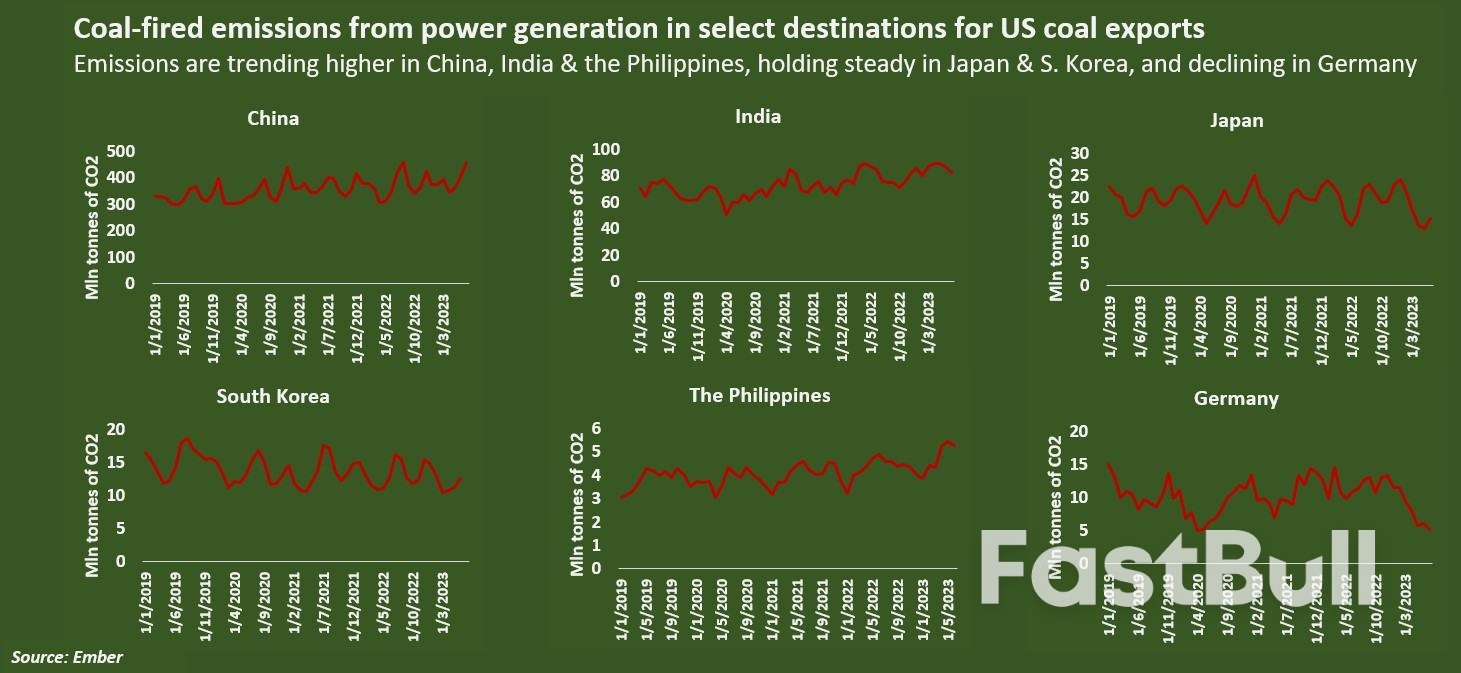
          While China and India, the world's two largest coal consumers, secure a majority of their coal needs from domestic production, imported coal contributes to total emissions from power plants.
          In 2022, those two countries accounted for just over 70% of total global power emissions from coal use, discharging over 5.4 billion tonnes of carbon dioxide and equivalent gases, data from think tank Ember shows.
          Japan, South Korea, the Philippines, Germany and Poland accounted for a further 8%.U.S. Thermal Coal Exports Jump to 5-Year Highs on Asian Demand_3
          Over the near term, the wide range of coal importing markets bodes well for U.S. coal exporters, and outbound shipments should climb again over the winter months as long as U.S. prices remain competitive to other suppliers.
          But over the longer term, U.S. coal exporters may start to struggle to profitably find willing buyers for their production, as a growing number of power generation companies have pledged to boost renewable energy supplies and will cut back on coal imports.
          In addition, some major coal producers, including China, may increase coal exports over time even as power producers there follow the U.S. lead and reduce coal use in their own generation mixes.
          That may lead to greater competition with the U.S. for coal export market share, and lead to steady declines in U.S. export potential over time.

          Source: ET EnergyWorld

          To stay updated on all economic events of today, please check out our Economic calendar
          Risk Warnings and Disclaimers
          You understand and acknowledge that there is a high degree of risk involved in trading. Following any strategies or investment methods may lead to potential losses. The content on the site is provided by our contributors and analysts for information purposes only. You are solely responsible for determining whether any trading assets, securities, strategy, or any other product is suitable for investing based on your own investment objectives and financial situation.
          Comments
          Add to Favorites
          Share

          US Inflation Slows, but Higher Savings Mean a Resilient Consumer

          Justin

          Economic

          Central Bank

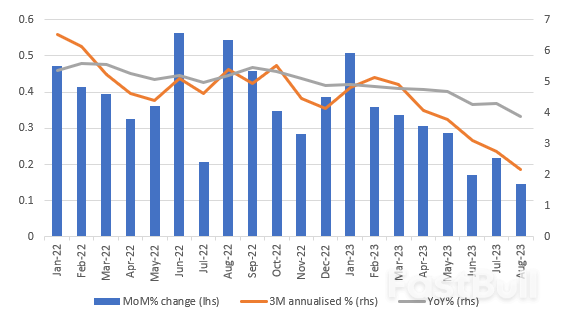
          The US personal income and spending report contains lots of numbers, but the August 0.1% month-on-month core PCE deflator print catches the eye. The consensus was 0.2% and we had been fearing a 0.3% outcome given what we saw from core CPI. There are quite a lot of revisions, but now we have three consecutive 0.2% or 0.1% MoM prints for what is the Fed's favoured measure of inflation. That should argue against the need for a fourth quarter rate hike, especially if we aren't going to get much data over the next month due to the strong likelihood of a government shutdown.
          The year-on-year rate remains elevated at 3.9%, but we are hopeful of ongoing declines over the next few months given we have 0.5% MoM and 0.4% MoM readings from September and October 2022 dropping out of the annual comparison. The three-month annualised rates are already getting close to the Fed's 2% target and assuming we see 0.2% MoM prints for the rest of the year we would have annual core inflation near to 3% YoY by year-end, which should calm some of the fears of the hawks on the Fed.

          US core personal consumer expenditure deflator (% change)

          US Inflation Slows, but Higher Savings Mean a Resilient Consumer_1

          Huge revisions to income and spending mean households have more residual savings than thought

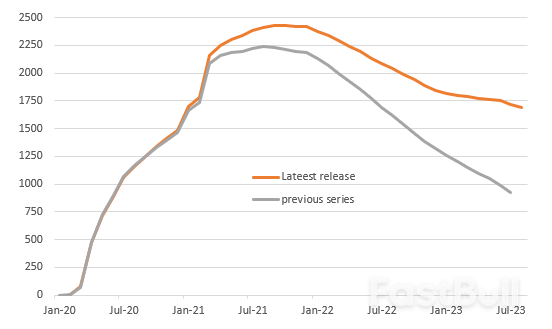
          Meanwhile household incomes rose 0.4% MoM and spending increased 0.4%, but for GDP growth we are interested in the real, inflation-adjusted numbers. This had real spending increase 0.1% MoM after a 0.6% gain in July, meaning we are on track for real consumer spending growth of around 3.7% annualised in the third quarter, which would help to get GDP growth of around 3.5%.
          There were significant revisions to the history though with incomes revised higher and consumer spending revised lower. This is important as it suggests that the household sector accrued more savings during the pandemic and have run down less than previously thought. These aren’t insignificant numbers either. We are talking upwards of $700bn of pandemic-era accrued savings being available to households over and above what we previously thought, which could keep consumer spending more resilient than we had been thinking.

          Stock of excess savings accrued since the pandemic ($bn)

          US Inflation Slows, but Higher Savings Mean a Resilient Consumer_2

          No fourth quarter hike, but interest rates could indeed be higher for longer

          The proviso is we don’t have a breakdown on who has these savings and the assumption has to be that many low-income households have already burnt through most of them. This was an assertion made within the Federal Reserve’s Beige book which stated that “some Districts highlighted reports suggesting consumers may have exhausted their savings and are relying more on borrowing to support spending”.
          The challenges being faced by the household sector are growing, be it from low real income growth, difficulty obtaining credit, rising gasoline prices eroding spending power, student loan repayments restarting and strike/government shutdowns hitting paychecks. But if there are residual savings out there then consumer spending could end up being more resilient, which would justify the market’s belief in Federal Reserve monetary policy staying tighter for longer.

          Source: ING

          To stay updated on all economic events of today, please check out our Economic calendar
          Risk Warnings and Disclaimers
          You understand and acknowledge that there is a high degree of risk involved in trading. Following any strategies or investment methods may lead to potential losses. The content on the site is provided by our contributors and analysts for information purposes only. You are solely responsible for determining whether any trading assets, securities, strategy, or any other product is suitable for investing based on your own investment objectives and financial situation.
          Comments
          Add to Favorites
          Share

          Has Britain Lost Its Climate Crown?

          Devin

          Economic

          Britain, which was quick to set ambitious climate goals, is now stumbling on the path to reach net zero emissions by 2050 and facing hurdles that could resonate with nations trying to balance their targets with politics and the cost of action.
          After setting world-leading CO2-cutting targets into law in 2019, Britain has struggled to get on track to make them happen. Electric vehicle charging points are being installed slower than targeted, and despite early success in rolling out offshore wind, the government’s latest renewable energy auction awarded zero contracts to wind developers.
          Analysts and politicians say that the British government’s move last week to delay targets for green vehicles and heating systems ahead of a looming election reflects a crunch point that other countries may face as they attempt to turn far-off climate goals into concrete measures - with costs for companies and consumers as soon as this decade.
          "The UK has been one of the real leaders in climate diplomacy and in their own emissions reductions," Ireland’s climate minister Eamon Ryan told Reuters. "As a friend and a neighbour, I’d have to say some of that has been put at risk."
          Britain, which hosted the United Nations annual climate conference COP26 in 2021, still leads the G7 when it comes to slashing output of climate-warming gases — reducing emissions by 49% between 1990 and 2022 with cutting down on coal the biggest driver.
          But according to the Climate Change Committee’s June 2023 progress report to parliament, to hit mid-way climate targets, Britain must quadruple its annual emissions reductions outside the electricity supply sector by 2030.
          The committee, an independent body set up under Britain's climate change law, had already said in 2022 that the country's strategy "will not deliver net zero".
          Prime Minister Rishi Sunak said last week he remained committed to the legally binding target of reaching net zero by 2050 but said Britain could afford to make slower progress in getting there because it was "so far ahead of every other country in the world".
          He said he was changing the policy because previous governments had moved too quickly to set net zero targets, without securing the support of the public.
          Delaying net zero transition investments could prove politically popular, analysts observed, if an election was on the horizon.
          But "this framing only works if you think climate policy is a burden", said Bob Ward, a climate policy researcher at the London School of Economics and Political Science, adding that avoiding short-term costs was likely to lead to a greater bill for taxpayers down the road.
          Rollback or reality?
          Sunak's own Conservatives defended his decision as advocating for consumers facing a cost-of-living crisis.
          "It's right we tweak as, at the moment, these green policies and targets hurt those worse off," one conservative lawmaker told Reuters.
          Global gas prices rocketed last year following Russia’s invasion of Ukraine. Although they have fallen in recent months, average British household energy bills are expected to remain high in part due to the country’s reliance on gas for home heating.
          Charging infrastructure lags behind what is needed for a growing fleet of electric vehicles and a target of some 600,000 heat pump installations by 2028 looks distant due to a lack of skilled engineers, with only 72,000 installed in 2022.
          Britain's move comes as climate change policies come under threat from politicians in other European nations – even as countries face mounting costs from intensifying wildfires, deadly heat and floods fuelled by climate change.
          With Poland, Slovakia, the Netherlands, and the European Union's Parliament all holding elections in the coming months, analysts said political pushback could intensify as countries consider policies that - unless coupled with more support to incentivise greener choices - would hit citizens' wallets.
          "Transport and buildings are going to be our major problem because that's where climate policy becomes visible to people in their daily life," said Simone Tagliapietra, senior fellow at Brussels-based think tank Bruegel.
          Governments not on track to deliver their green targets face a choice: either cut back on commitments, or strengthen policies and financing to deliver them. The U.S., with its Inflation Reduction Act, is offering nearly $400 billion in federal funding for clean energy and technologies.
          The German government said on Sunday it would put on hold plans to require more stringent building insulation standards to help the building industry - even after passing new energy-saving targets for 2030 last week.
          While Sunak’s move rattled investors and companies, some said the prime minister’s announcement was aligned with reality.
          "Delaying the ban on the sale of new petrol and diesel cars is disappointing, but reflects the reality that this is where most of the major car manufacturing nations are," said Britain's environmental audit committee chairman Philip Dunne.

          Source: Reuters

          To stay updated on all economic events of today, please check out our Economic calendar
          Risk Warnings and Disclaimers
          You understand and acknowledge that there is a high degree of risk involved in trading. Following any strategies or investment methods may lead to potential losses. The content on the site is provided by our contributors and analysts for information purposes only. You are solely responsible for determining whether any trading assets, securities, strategy, or any other product is suitable for investing based on your own investment objectives and financial situation.
          Comments
          Add to Favorites
          Share

          What CPI Means for Investors and Traders

          IG

          Economic

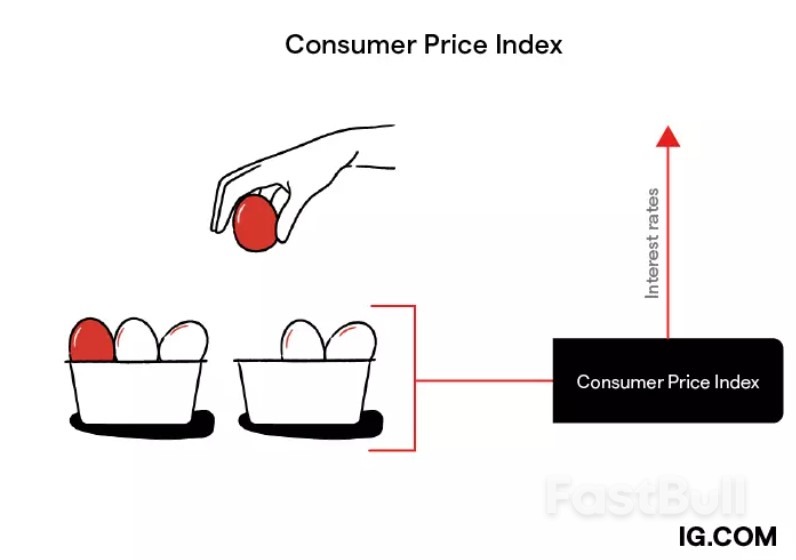
          Inflation is when the cost of living goes up over time. The Consumer Price Index, or CPI, measures inflation by tracking changes in the prices of common goods and services.
          When the CPI rises, it usually means inflation is happening. How prices come to rise can happen in a number of ways. Here are the main ones:
          • Demand-pull - When demand is higher than supply, prices go up.
          • Cost-push - When supply falls but demand stays the same, prices go up.
          • Expectations - When people expect inflation, they act in ways that cause it. For example, if a café chain expects the coffee price to rise, they could raise the price per cup of coffee to pre-empt the expected price increase. By doing that they raise the price of a cup of coffee even though there hasn't been any other inflationary factors at play.
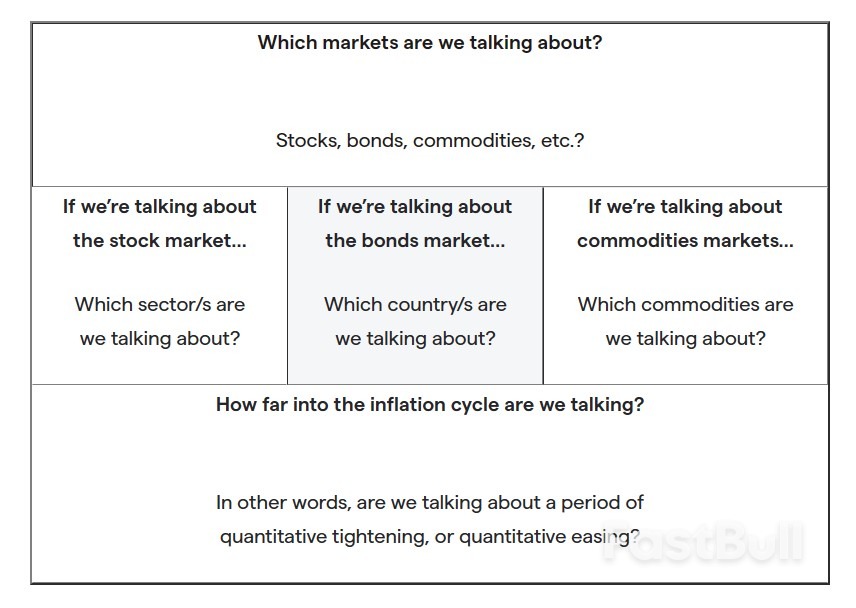
          As investors and traders it's important to understand how CPI affects markets. The table below suggests some questions to consider to help get to the answer:
          As you can see, there's no one-size-fits-all answer – each market has its unique context. Let's look at three historical examples to try to understand how inflation might impact markets.What CPI Means for Investors and Traders_1
          Stocks in the '70s
          In the early 1970s, prices for goods and services rose very quickly in the United States due to events like oil shortages and government spending. This made the dollar weaker, so people could buy less with their money. The cost of living went up
          To try to slow inflation down, the Federal Reserve raised interest rates a lot. With higher rates, it was more expensive for companies to borrow money. This hurt their profits and made investors worried, causing the stock market to crash badly - one of its worst declines since the Great Depression long before.
          Some people think the stock market goes up when inflation rises. But this shows that when prices rise too fast, eventually it damages markets. What climbs quickly can come down even faster. The 1970s showed that sudden, massive inflation can crush the markets.
          What CPI Means for Investors and Traders_2Gold in the 2000s
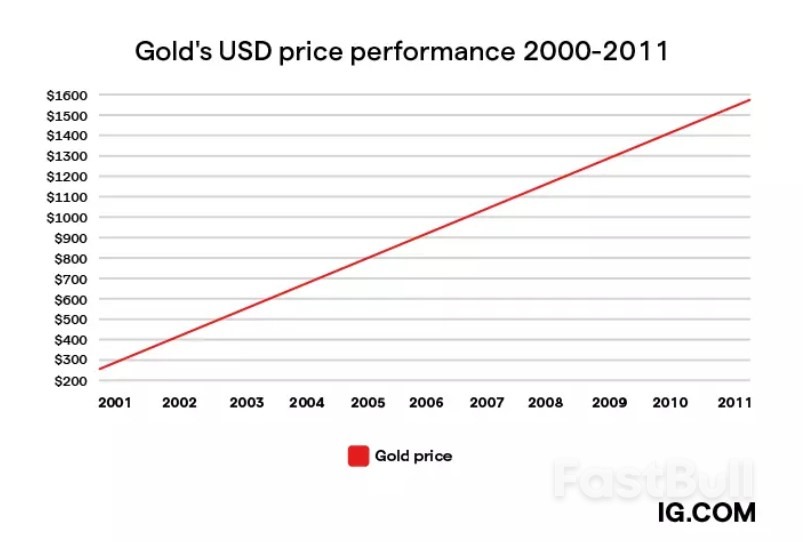
          In the 2000s, rising inflation helped gold prices a lot. Investors saw gold as a hedge against inflation and dollar weakness. However, gold prices don't rise in isolation. The rise in gold prices in the 2000s didn't just happen because of inflation expectations. Other major factors were also at play. These included:
          • After 9/11, the war in Afghanistan, and the war in Iraq all drove investors toward gold as a safe haven.
          • Central banks like those in China and Russia boosted their gold reserves to diversify away from U.S. dollars.
          • New gold exchange-traded funds (ETFs) made it easier for mainstream investors to buy gold.
          While inflation concerns did play a role, gold's strong performance in the 2000s resulted from a combination of factors like geopolitics, central bank demand, and financial innovation. The financial markets are complex, with many interrelated forces driving prices up or down. It's important to keep the global context in mind while keeping an eye on CPI numbers.What CPI Means for Investors and Traders_3
          Bonds during Japan's "lost decades"
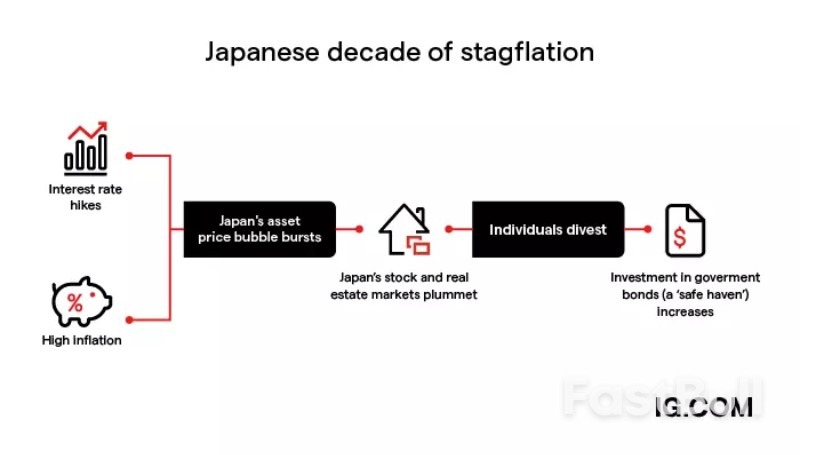
          In the 1980s, Japan experienced an economic boom that led to an unsustainable asset bubble. To control speculation and prevent a collapse, the Bank of Japan raised interest rates. Unfortunately, this caused the bubble to burst. Japan's stock and real estate markets crashed, kicking off a long period of stagnation and very low inflation.
          With stocks and real estate in decline, investors shifted to Japanese government bonds (JGBs) as a safe haven, driving up bond prices. Note that bond prices didn't directly rise because of low inflation. Rather, low inflation was a symptom of broader economic stagnation.
          Inflation and bond prices were correlated, but inflation did not directly cause the increase in bond prices. The low CPI figure reflected the weak economic conditions that led investors toward bonds in the first place. This example shows that CPI is intertwined with the overall economy. It is often a symptom, not a key driver, of economic shifts.
          What CPI Means for Investors and Traders_4How can investors and traders use this information?
          CPI can impact markets, but it doesn't drive markets on its own. If you would like to understand how the market behaves around CPI announcements, here are two things to keep an eye on:
          • If you think CPI will be higher than the market expected (known as a 'positive surprise'), keep an eye on the performance of value stocks. These are companies that are considered undervalued or "cheap" compared to their intrinsic value. These types of companies tend to outperform during inflationary periods.
          • If you think CPI will be lower than the market expected (known as a 'negative surprise'), keep an eye on the country's key commodity. Low CPI sometimes suggests lower commodity prices.
          Remember, one indicator doesn't provide enough information to make complex financial decisions. In addition to the CPI number, look at price charts, how much risk you can afford to take on, and fundamental indicators.
          To stay updated on all economic events of today, please check out our Economic calendar
          Risk Warnings and Disclaimers
          You understand and acknowledge that there is a high degree of risk involved in trading. Following any strategies or investment methods may lead to potential losses. The content on the site is provided by our contributors and analysts for information purposes only. You are solely responsible for determining whether any trading assets, securities, strategy, or any other product is suitable for investing based on your own investment objectives and financial situation.
          Comments
          Add to Favorites
          Share
          FastBull
          Copyright © 2025 FastBull Ltd

          728 RM B 7/F GEE LOK IND BLDG NO 34 HUNG TO RD KWUN TONG KLN HONG KONG

          TelegramInstagramTwitterfacebooklinkedin
          App Store Google Play Google Play
          Products
          Charts

          Chats

          Q&A with Experts
          Screeners
          Economic Calendar
          Data
          Tools
          Membership
          Features
          Function
          Markets
          Copy Trading
          Latest Signals
          Contests
          News
          Analysis
          24/7
          Columns
          Education
          Company
          Careers
          About Us
          Contact Us
          Advertising
          Help Center
          Feedback
          User Agreement
          Privacy Policy
          Business

          White Label

          Data API

          Web Plug-ins

          Poster Maker

          Affiliate Program

          Risk Disclosure

          The risk of loss in trading financial instruments such as stocks, FX, commodities, futures, bonds, ETFs and crypto can be substantial. You may sustain a total loss of the funds that you deposit with your broker. Therefore, you should carefully consider whether such trading is suitable for you in light of your circumstances and financial resources.

          No decision to invest should be made without thoroughly conducting due diligence by yourself or consulting with your financial advisors. Our web content might not suit you since we don't know your financial conditions and investment needs. Our financial information might have latency or contain inaccuracy, so you should be fully responsible for any of your trading and investment decisions. The company will not be responsible for your capital loss.

          Without getting permission from the website, you are not allowed to copy the website's graphics, texts, or trademarks. Intellectual property rights in the content or data incorporated into this website belong to its providers and exchange merchants.

          Not Logged In

          Log in to access more features

          FastBull Membership

          Not yet

          Purchase

          Become a signal provider
          Help Center
          Customer Service
          Dark Mode
          Price Up/Down Colors

          Log In

          Sign Up

          Position
          Layout
          Fullscreen
          Default to Chart
          The chart page opens by default when you visit fastbull.com