• Trade
  • Markets
  • Copy
  • Contests
  • News
  • 24/7
  • Calendar
  • Q&A
  • Chats
Trending
Screeners
SYMBOL
LAST
BID
ASK
HIGH
LOW
NET CHG.
%CHG.
SPREAD
SPX
S&P 500 Index
6827.42
6827.42
6827.42
6899.86
6801.80
-73.58
-1.07%
--
DJI
Dow Jones Industrial Average
48458.04
48458.04
48458.04
48886.86
48334.10
-245.98
-0.51%
--
IXIC
NASDAQ Composite Index
23195.16
23195.16
23195.16
23554.89
23094.51
-398.69
-1.69%
--
USDX
US Dollar Index
97.870
97.950
97.870
98.070
97.810
-0.080
-0.08%
--
EURUSD
Euro / US Dollar
1.17516
1.17523
1.17516
1.17596
1.17262
+0.00122
+ 0.10%
--
GBPUSD
Pound Sterling / US Dollar
1.33903
1.33912
1.33903
1.33961
1.33546
+0.00196
+ 0.15%
--
XAUUSD
Gold / US Dollar
4340.47
4340.88
4340.47
4350.16
4294.68
+41.08
+ 0.96%
--
WTI
Light Sweet Crude Oil
56.825
56.855
56.825
57.601
56.789
-0.408
-0.71%
--

Community Accounts

Signal Accounts
--
Profit Accounts
--
Loss Accounts
--
View More

Become a signal provider

Sell trading signals to earn additional income

View More

Guide to Copy Trading

Get started with ease and confidence

View More

Signal Accounts for Members

All Signal Accounts

Best Return
  • Best Return
  • Best P/L
  • Best MDD
Past 1W
  • Past 1W
  • Past 1M
  • Past 1Y

All Contests

  • All
  • Trump Updates
  • Recommend
  • Stocks
  • Cryptocurrencies
  • Central Banks
  • Featured News
Top News Only
Share

According To Data From The Federal Reserve Bank Of New York, The Secured Overnight Funding Rate (Sofr) Was 3.67% On The Previous Trading Day (December 15), Compared To 3.66% The Day Before

Share

Peru Energy And Mines Ministry: Copper Production Up 4.8% Year-On-Year In October To 248192 Metric Tons

Share

Security Source: Ukrainian Drones Hits Russian Oil Infrastructure In Caspian Sea For Third Time

Share

Spot Palladium Extends Gains, Last Up 5% To $1562.7/Oz

Share

Mexico's Economy Ministry Announces Start Of Anti-Dumping Investigation And Anti-Subsidy Investigations Into USA Pork Imports

Share

Canada Nov CPI Common +2.8%, CPI Median +2.8%, CPI Trim +2.8% On Year

Share

NY Fed's Empire State Prices Paid Index +37.6 In December Versus+49.0 In November

Share

Canada Nov Consumer Prices +0.1% On Month, +2.2% On Year

Share

Canada Nov CPI Core -0.1% On Month, +2.9% On Year

Share

Canada Nov Core CPI, Seasonally Adjusted +0.2% On Month, Oct +0.3% (Unrevised)

Share

UK Health Minister Streeting On Doctors' Strike: Vote To Go Ahead Reveals The Bma's Shocking Disregard For Patient Safety

Share

Venezuelan State Oil Company Pdvsa Says Was Subject To Cyber Attack But Operations Unaffected

Share

Russia Central Bank Says January-October Current Account Surplus At $37.1 Billion

Share

Polish Current Account Balance At +1924 Million Euros In October Versus+130 Million Euros Seen In Reuters Poll

Share

Statement: Germany, Ukraine Propose 10-Point Plan To Strengthen Armament Cooperation

Share

London Metal Exchange Three Month Copper Falls More Than 3% To $11541.50 A Metric Ton

Share

[Market Update] Spot Silver Surged $2.00 During The Day, Returning To $64/ounce, A Gain Of 3.23%

Share

European Central Bank: Italy's Recurrent Ad Hoc Tax Provisions Cause Uncertainty, Damage Investor Confidence, And May Affect Banks' Funding Costs

Share

Stats Office: Nigeria Consumer Inflation At 14.45% Year-On-Year In November

Share

European Central Bank: Italy's Budget Measures Weighing On Domestic Banks Could Have "Negative Implications" On Their Credit Liquidity

TIME
ACT
FCST
PREV
Japan Tankan Small Manufacturing Outlook Index (Q4)

A:--

F: --

P: --

Japan Tankan Large Non-Manufacturing Outlook Index (Q4)

A:--

F: --

P: --

Japan Tankan Large Manufacturing Outlook Index (Q4)

A:--

F: --

P: --

Japan Tankan Small Manufacturing Diffusion Index (Q4)

A:--

F: --

P: --

Japan Tankan Large Manufacturing Diffusion Index (Q4)

A:--

F: --

P: --

Japan Tankan Large-Enterprise Capital Expenditure YoY (Q4)

A:--

F: --

P: --

U.K. Rightmove House Price Index YoY (Dec)

A:--

F: --

P: --

China, Mainland Industrial Output YoY (YTD) (Nov)

A:--

F: --

P: --

China, Mainland Urban Area Unemployment Rate (Nov)

A:--

F: --

P: --

Saudi Arabia CPI YoY (Nov)

A:--

F: --

P: --

Euro Zone Industrial Output YoY (Oct)

A:--

F: --

P: --

Euro Zone Industrial Output MoM (Oct)

A:--

F: --

P: --

Canada Existing Home Sales MoM (Nov)

A:--

F: --

P: --

Canada National Economic Confidence Index

A:--

F: --

P: --

Canada New Housing Starts (Nov)

A:--

F: --

P: --
U.S. NY Fed Manufacturing Employment Index (Dec)

A:--

F: --

P: --

U.S. NY Fed Manufacturing Index (Dec)

A:--

F: --

P: --

Canada Core CPI YoY (Nov)

A:--

F: --

P: --

Canada Manufacturing Unfilled Orders MoM (Oct)

A:--

F: --

P: --

U.S. NY Fed Manufacturing Prices Received Index (Dec)

A:--

F: --

P: --

U.S. NY Fed Manufacturing New Orders Index (Dec)

A:--

F: --

P: --

Canada Manufacturing New Orders MoM (Oct)

A:--

F: --

P: --

Canada Core CPI MoM (Nov)

A:--

F: --

P: --

Canada Trimmed CPI YoY (SA) (Nov)

A:--

F: --

P: --

Canada Manufacturing Inventory MoM (Oct)

A:--

F: --

P: --

Canada CPI YoY (Nov)

A:--

F: --

P: --

Canada CPI MoM (Nov)

A:--

F: --

P: --

Canada CPI YoY (SA) (Nov)

A:--

F: --

P: --

Canada Core CPI MoM (SA) (Nov)

A:--

F: --

P: --

Canada CPI MoM (SA) (Nov)

A:--

F: --

P: --

Federal Reserve Board Governor Milan delivered a speech
U.S. NAHB Housing Market Index (Dec)

--

F: --

P: --

Australia Composite PMI Prelim (Dec)

--

F: --

P: --

Australia Services PMI Prelim (Dec)

--

F: --

P: --

Australia Manufacturing PMI Prelim (Dec)

--

F: --

P: --

Japan Manufacturing PMI Prelim (SA) (Dec)

--

F: --

P: --

U.K. 3-Month ILO Employment Change (Oct)

--

F: --

P: --

U.K. Unemployment Claimant Count (Nov)

--

F: --

P: --

U.K. Unemployment Rate (Nov)

--

F: --

P: --

U.K. 3-Month ILO Unemployment Rate (Oct)

--

F: --

P: --

U.K. Average Weekly Earnings (3-Month Average, Including Bonuses) YoY (Oct)

--

F: --

P: --

U.K. Average Weekly Earnings (3-Month Average, Excluding Bonuses) YoY (Oct)

--

F: --

P: --

France Services PMI Prelim (Dec)

--

F: --

P: --

France Composite PMI Prelim (SA) (Dec)

--

F: --

P: --

France Manufacturing PMI Prelim (Dec)

--

F: --

P: --

Germany Services PMI Prelim (SA) (Dec)

--

F: --

P: --

Q&A with Experts
    • All
    • Chatrooms
    • Groups
    • Friends
    Connecting
    .
    .
    .
    Type here...
    Add Symbol or Code

      No matching data

      All
      Trump Updates
      Recommend
      Stocks
      Cryptocurrencies
      Central Banks
      Featured News
      • All
      • Russia-Ukraine Conflict
      • Middle East Flashpoint
      • All
      • Russia-Ukraine Conflict
      • Middle East Flashpoint
      Search
      Products

      Charts Free Forever

      Chats Q&A with Experts
      Screeners Economic Calendar Data Tools
      Membership Features
      Data Warehouse Market Trends Institutional Data Policy Rates Macro

      Market Trends

      Market Sentiment Order Book Forex Correlations

      Top Indicators

      Charts Free Forever
      Markets

      News

      News Analysis 24/7 Columns Education
      From Institutions From Analysts
      Topics Columnists

      Latest Views

      Latest Views

      Trending Topics

      Top Columnists

      Latest Update

      Signals

      Copy Rankings Latest Signals Become a signal provider AI Rating
      Contests
      Brokers

      Overview Brokers Assessment Rankings Regulators News Claims
      Broker listing Forex Brokers Comparison Tool Live Spread Comparison Scam
      Q&A Complaint Scam Alert Videos Tips to Detect Scam
      More

      Business
      Events
      Careers About Us Advertising Help Center

      White Label

      Data API

      Web Plug-ins

      Affiliate Program

      Awards Institution Evaluation IB Seminar Salon Event Exhibition
      Vietnam Thailand Singapore Dubai
      Fans Party Investment Sharing Session
      FastBull Summit BrokersView Expo
      Recent Searches
        Top Searches
          Markets
          News
          Analysis
          User
          24/7
          Economic Calendar
          Education
          Data
          • Names
          • Latest
          • Prev

          View All

          No data

          Scan to Download

          Faster Charts, Chat Faster!

          Download App
          English
          • English
          • Español
          • العربية
          • Bahasa Indonesia
          • Bahasa Melayu
          • Tiếng Việt
          • ภาษาไทย
          • Français
          • Italiano
          • Türkçe
          • Русский язык
          • 简中
          • 繁中
          Open Account
          Search
          Products
          Charts Free Forever
          Markets
          News
          Signals

          Copy Rankings Latest Signals Become a signal provider AI Rating
          Contests
          Brokers

          Overview Brokers Assessment Rankings Regulators News Claims
          Broker listing Forex Brokers Comparison Tool Live Spread Comparison Scam
          Q&A Complaint Scam Alert Videos Tips to Detect Scam
          More

          Business
          Events
          Careers About Us Advertising Help Center

          White Label

          Data API

          Web Plug-ins

          Affiliate Program

          Awards Institution Evaluation IB Seminar Salon Event Exhibition
          Vietnam Thailand Singapore Dubai
          Fans Party Investment Sharing Session
          FastBull Summit BrokersView Expo

          Has Bitcoin Risen from The Dead - Again?

          Kevin Du

          Cryptocurrency

          Summary:

          What can you do with a volatile and speculative asset class that has no proven end-use but refuses to do the polite thing and die?

          What can you do with a volatile and speculative asset class that has no proven end-use but refuses to do the polite thing and die?
          Buy it, maybe?
          Even Bitcoin's biggest sceptics may be throwing up their hands in surrender as the crypto bellwether soaks up everything the last turbulent year could throw at it, and starts climbing once again.
          Those who thought — or hoped — it would be wiped out by a turbulent 2022 look set to be disappointed, again.
          If a peak-to-trough crash from $68,000 to $16,000 can't kill it off, then what can, exactly?
          Incredibly, Bitcoin is now 2023's best-performing asset class, up 67.59 per cent year-to-date and trading at a nine-month high of around $28,000 at the time of writing.
          It might be time to admit defeat and accept that Bitcoin, Ethereum, Dogecoin and the rest are here to stay, like it or not.
          Bitcoin is still dirty, polluting, volatile and not much use, unless you're a scammer, gangster or trafficker.
          It is also a money destruction machine for naive traders who reckon they can get rich overnight, only to waste their lives glued to an app that destroys their wealth before their delusions.
          Last year destroyed the claim that Bitcoin was digital gold, a safe haven in times of economic trouble.
          It sold off last year along with tech stocks, bonds, real estate, emerging markets and other key asset classes. The end of the cheap money era, as inflation and interest rates rocketed, was always going to hurt more speculative assets like this one.
          It couldn't kill it, though.
          As they say, hope springs eternal and Bitcoin is swinging back into favour as investors look forward to the US Federal Reserve's "pivot", when it signals that the war on inflation is won and it will start cutting interest rates rather than hiking them.
          Trading platform eToro has just seen a 78 per cent jump in newly opened Bitcoin positions over the past month, as investors wake up to the opportunity, says the site's crypto analyst Simon Peters.
          "Although inflation remains sticky, the headline numbers are coming down. As a result, we're seeing the opposite of what we saw in 2022 and the pressure is easing off crypto."
          Now, the collapse of Silicon Valley Bank in the US and the takeover of Credit Suisse in Switzerland have given it another lift.
          Crypto was a child of the 2007-2008 global financial crisis, appearing shortly after the world's central bankers started to debase fiat currencies by printing trillions of virtual money through quantitative easing.
          But it could come of age in the latest banking meltdown, as traders calculate the Fed and others will be forced to cut interest rates and deliver more QE to prevent systemic meltdown.
          Loose monetary policy is good for crypto, says Vijay Valecha, chief market analyst at Century Financial.
          "When the Fed tightens, Bitcoin tends to fall. If it eases, then crypto could rise."
          Gabriella Kusz, chief executive of the Global Digital Asset and Cryptocurrency Association, says investors are moving towards Bitcoin and other forms of crypto "as a reflection of their potential value as a hedge and alternative store of value during such times".
          Lower interest rates will boost all zero-yielding assets, including Bitcoin, gold, silver and US stocks, as investors will get a poorer return on cash and bonds, says Fawad Razaqzada, market analyst at City Index and Forex.com.
          The gold price is menacing $2,000 an ounce again after jumping almost 10 per cent in a month, while silver and tech stocks are also up.
          Mr Razaqzada says Bitcoin has faced resistance around the $28,000 mark but the Fed's "dovish rate hike" of just 0.25 per cent at last week's meeting helped push it over the threshold.
          "Investors are starting to price in interest rate cuts for later this year or early 2024," Mr Razaqzada says.
          Falling interest rate expectations have also hit the US dollar, giving Bitcoin a further boost because it is priced in dollars, and this makes it cheaper for buyers in other currencies.
          Crypto investors are renowned for their short memories and many will have forgotten that as recently as February, this sector was in crisis.
          It has suffered a string of crashes over the past year, starting with the supposedly stablecoin Luna in May, which was swiftly followed by Singapore-based crypto hedge fund Three Arrows Capital in June, platforms Celsius Network and Voyager in July, and Bitfront and BlockFi in November.
          Losses topped $2 trillion and some thought Sam Bankman-Fried's FTX scandal might be the final nail in the crypto coffin, but it has risen from the dead yet again.
          Calls for effective regulation are growing louder, particularly in Europe and the UK, says Nils Bulling, head of strategic innovation at digital bank Avaloq.
          Some fear regulation will sink crypto, but he reckons it will boost the sector rather than sink it.
          "Investors still seem interested in crypto assets and currencies. This should be even more true if the investment partners are trustworthy and subject to meaningful regulation," Mr Bulling says.
          Bitcoin is what it has always been, a high-risk play on volatility. Yet the longer it survives, the harder it is to ignore.
          In fact, its lack of correlation with other asset classes — or anything, really — may ultimately turn out to be its strength.
          Despite its failings, there is a growing argument for having some exposure in a balanced portfolio.
          If tempted, the old rules apply, so diversify by investing the majority of your invested wealth in traditional asset classes, such as shares, bonds, gold, property, commodities and cash.
          Resist short-term profit grabbing, overtrading, impulse buying (and selling), extreme hype, crazy forecasters and ever-present crypto scammers. Never borrow money to buy it and never, ever invest what you cannot afford to lose.
          If you can do all that, you might find an acceptable role for Bitcoin, even if you don't understand or like it.

          Source: The National News

          Risk Warnings and Disclaimers
          You understand and acknowledge that there is a high degree of risk involved in trading. Following any strategies or investment methods may lead to potential losses. The content on the site is provided by our contributors and analysts for information purposes only. You are solely responsible for determining whether any trading assets, securities, strategy, or any other product is suitable for investing based on your own investment objectives and financial situation.
          Comments
          Add to Favorites
          Share

          Forex Markets Grapple with Uncertainty and Ambiguity, Sterling Ready for Breakout?

          Devin

          Forex

          Forex markets are currently navigating a landscape of uncertainty, as mixed currency performance contributes to a lack of clear direction. Dollar has experienced a decline in Asian session, but still hovers within familiar boundaries against other major currencies. Meanwhile, Euro has managed to strengthen against the greenback but appears less robust in other pairs.
          Yen, on the other hand, has emerged as a strong contender for the day, recouping some of its yesterday's pullback. In addition, Sterling has found firmer footing after BoE Governor Andrew Bailey's remarks indicated that the Monetary Policy Committee can concentrate on inflation while the Financial Policy Committee maintains financial stability. Interestingly, Australian Dollar has managed to hold its ground despite disappointing retail sales data.
          Looking ahead, the market may experience subdued trading due to a relatively light economic calendar. However, the upcoming release of US consumer confidence data could introduce an element of volatility, as traders and investors alike look for potential opportunities in the midst of uncertainty.
          Technically, GBP/USD could now be eyeing 1.2342 temporary top with this week's rebound. Break there will resume the near term rally to 1.2445/6 resistance zone. Decisive break there will resume larger up trend from 1.0351 (2022 low) to 1.2759 fibonacci level. Let's see if the Pound has enough buying to back the breakout.Forex Markets Grapple with Uncertainty and Ambiguity, Sterling Ready for Breakout?_1
          In Asia, at the time of writing, Nikkei is up 0.15%. Hong Kong HSI is up 1.37%. China Shanghai SSE is up 0.18%. Singapore Strait Times is up 0.73%. Japan 10-year JGB yield is up 0.0220 at 0.317. Overnight DOW rose 0.60%. S&P 500 rose 0.16%. NASDAQ dropped -0.47%. 10-year yield rose 0.148 to 3.528.

          Fed Jefferson on balancing inflation and economic stability

          Fed Philip Jefferson stated yesterday that the current inflation rate is too high, emphasizing the FOMC's goal to reduce it to 2% as quickly as possible. Speaking at Washington and Lee University in Lexington, Virginia, he acknowledged that the process may take some time due to persistent inflation components such as services excluding housing.
          Jefferson said, "I would like to say that inflation will return to 2% soon, but we have to do it in a way that does not damage the economy any more than is necessary. That's what we are trying to do." Fed is grappling with the challenge of ensuring price stability amid high inflation while also maintaining financial stability in the wake of the second-largest bank failure in US history.
          In his speech, Jefferson also noted that although inflation has begun to decline, it remains unclear whether this decrease is due to higher interest rates, easing pandemic-induced supply strains, or falling energy prices.
          He highlighted the uncertainty surrounding the full impact of the Fed's tightening measures, saying, "Monetary policy affects the economy and inflation with long, variable, and highly uncertain lags, and we are still learning about the full effect of our tightening thus far."

          Australia retail sales turnover up 0.2% mom in Feb, appeared to have levelled out

          Australia retail sales turnover rose 0.2% mom to AUD 35.14B in February, matched expectations. Through the year, retail sales rose 6.4% yoy.
          Ben Dorber, ABS head of retail statistics, said retail sales rose modestly in February and appear to have levelled out after a period of increased volatility over November, December and January.
          "On average, retail spending has been flat through the end of 2022 and to begin the new year."
          Retail turnover rose modestly across most of the states and territories, with rises at 1.0% or less. Queensland recorded the only fall in turnover, down -0.4%.

          Looking ahead

          BOE will release quarterly bulletin. Later in the day, US will publish goods trade balance, housing index and consumer confidence.

          Source: ActionForex.Com

          Risk Warnings and Disclaimers
          You understand and acknowledge that there is a high degree of risk involved in trading. Following any strategies or investment methods may lead to potential losses. The content on the site is provided by our contributors and analysts for information purposes only. You are solely responsible for determining whether any trading assets, securities, strategy, or any other product is suitable for investing based on your own investment objectives and financial situation.
          Comments
          Add to Favorites
          Share

          Funds Dump Copper Amid Financial Market Turbulence

          Owen Li

          Commodity

          Funds have dumped their bets on higher copper prices as the turbulence triggered by the collapse of Silicon Valley Bank continues to roil financial markets.
          Early-year enthusiasm for copper as a proxy for China's re-opening from stringent lockdown has succumbed to the contagious fear spreading from the banking sector to other risk asset classes.
          The investment community has turned net short of CME copper for the first time in five months, while funds have cut their long exposure on the London Metal Exchange (LME).
          Investors' negativity towards Doctor Copper contrasts with the bullish headlines generated by the FT Commodities Global Summit.
          Copper, currently trading in London around $8,900 per tonne, could surpass its previous March 2022 price peak of $10,845 and hit $12,000 this year, according to Kostas Bintas, co-head of metals at trade house Trafigura.
          Goldman Sachs is also expecting higher prices, arguing that the pace of global inventory draws could reduce visible stocks to an all-time low of 125,000 tonnes by the end of the second quarter.
          Fund managers, however, are having none of it. Right now macro fear is overwhelming the micro picture.

          Funds Dump Copper Amid Financial Market Turbulence_1Sell Out

          The CFTC Commitments of Traders reports are now fully up to date after the delays caused by the February cyber incident at ION Cleared Derivatives.
          They show fund managers turning net short of the CME copper contract in early March for the first time since October last year.
          The collective bear call flexed out to 9,837 contracts in the middle of the month before being trimmed back to 6,967 contracts as of March 21.
          Driving that shift in positioning has been a sharp reduction in outright long positions, which have slumped from a January high of 78,429 contracts to a current 37,173. Short positions have built by only a relatively modest 6,823 contracts to 40,140 over the same time-frame.
          The early-year bullish exuberance has clearly evaporated.
          The LME's positioning reports paint the same picture. Investment funds bought into copper in January, the net long position expanding from 11,830 to 32,397 contracts at the end of the month. By the middle of March it had shrunk back to 13,978 contracts.
          If there are any copper bulls in the investor community, they are currently lurking in the "other financial" category of the LME's reports, where positioning has gone from neutral at the start of January to a net long 7,819 contracts.

          Funds Dump Copper Amid Financial Market Turbulence_2No Buy-In

          The speed of the positioning reversal in copper suggests short-term players are currently in the ascendant, trading copper against the dollar and gold, which has rallied strongly as a safe-haven bet.
          Copper "remains dominated by the fx (foreign exchange) with HFT (high frequency traders) leaving a heavy footprint", according to a Monday market update from LME broker Marex.
          Conspicuous by its absence is any significant investor buy-in to the longer-term bull narrative in copper as an enabler of the energy transition.
          "Although under-appreciated in the market today, green demand is here and already impacting fundamentals," according to Goldman Sachs. ("Commodity Views," March 23, 2023)
          The bank expects clean energy demand for copper to rise by 30% year-on-year to 2.6 million tonnes in 2023, powered by an expanding electric vehicle sector and investment in solar energy.
          Funds don't appear to have heard the message.
          Outright long positions on both London and U.S. exchanges are small relative to 2020, when the copper price was rallying as first China and then the rest of the world emerged from the initial round of COVID lockdown.

          China Recovery (Again)

          Fast forward three years and China is again coming out of lockdown after the lifting of zero-COVID restrictions.
          It's been a stop-start recovery because it's coincided with the national Lunar New Year holiday period, a seasonal low point for China's manufacturing sector.
          China's net imports of refined copper were down by 13% year-on-year over the first two months of 2023. Inventory registered with the Shanghai Futures Exchange (ShFE) and its international branch, the International Energy Exchange (INE), mushroomed by 235,000 tonnes to 320,000 tonnes during January and February.
          However, INE stocks have since stopped rising and ShFE inventory has fallen by 91,300 tonnes since the start of March.
          Headline LME stocks are just 41,875 tonnes, excluding metal awaiting load-out. CME stocks last Thursday hit a nine-year low of 14,627 tons.
          Bulls such as Trafigura and Goldman Sachs contend it's a very thin inventory cushion if China rediscovers its copper mojo.
          Funds bought into that bull narrative at the start of the year but have evidently switched focus to the dangers flowing from the banking crisis to Western metals demand.
          Which, ironically, doesn't mean that copper's next major price move can't still be generated by China.

          Source: Reuters

          Risk Warnings and Disclaimers
          You understand and acknowledge that there is a high degree of risk involved in trading. Following any strategies or investment methods may lead to potential losses. The content on the site is provided by our contributors and analysts for information purposes only. You are solely responsible for determining whether any trading assets, securities, strategy, or any other product is suitable for investing based on your own investment objectives and financial situation.
          Comments
          Add to Favorites
          Share

          Europe Set to Open Higher as Bank Fears Continue to Ease

          Samantha Luan

          Forex

          After the big sell-off at the end of last week, European markets started the week in a positive fashion as the banking sector angst of the last few days eased slightly.
          Most sectors of the markets saw a modest rebound, helped by events on the other side of the Atlantic as reports emerged that Citizens Bank in the US had agreed on a deal to acquire Silicon Valley Bank's loans and deposits book.
          US markets had a more mixed session with the S&P500 finishing higher for the 3rd day in a row, however, the Nasdaq found life slightly more difficult, finishing the session slightly lower, after US 2-year yields pushed back above 4%
          This sharp rebound in 2-year yields on both sides of the Atlantic, appears to be a decent corrective to last week's sharp plunge, as markets look to reprice some of the more dire recession scenarios that were being priced at the end of last week.
          The rebound in yields also suggested that a calmer tone was starting to prevail in the short term, even as sentiment seems likely to remain on the cautious side over the next few days.
          This caution was reflected in the extent of yesterday's rebound in bank stocks given that none of the gains seen yesterday came close to reversing the losses seen from last Friday.
          Therein lies the rub, that for all of yesterday's quieter session, the fact remains that markets are still one negative headline away from another sharp tumble.
          This week's price action is also likely to be susceptible to month and quarter-end flows, which may well assign a misleading skew when it comes to what the market may look to do next.
          One thing that was notable yesterday was that a number of ECB policymakers, while still making the case that inflation was still too high, started to temper their remarks with nods to concerns about financial stability, with Spain's De Cos and Portugal's Centeno making reference to these issues when making future policy decisions.
          This more nuanced approach was welcomed in contrast to ECB President Lagarde's rather tone-deaf comments last week that there was no trade-off between financial stability and price stability.
          Yesterday's more positive tone looks set to carry into today's European market open with a modestly higher open.
          The pound could well be in focus today with Bank of England governor Andrew Bailey set to brief MPs later this morning on the Silicon Valley Bank situation with respect to its UK operations. Yesterday, Bailey made a number of comments with respect to the central bank's inflation outlook, indicating that further rate hikes may well be limited. His comments to the London School of Economics also reiterated the remarks he made last week, post rate decision, that the bank expected headline inflation to fall sharply in H2.
          EUR/USD – still feels toppy anywhere above the 1.0900 area after last week' s failure at 1.0930. Feels rangebound with support at the 50-day SMA at 1.0730. Below 1.0730 opens up the 1.0520 level.
          GBP/USD – edging above the 1.2300 area again but needs to push through the previous highs at 1.2345 to kick on towards the previous peaks at 1.2445. The pound continues to feel vulnerable to slipping back towards the 1.2170 area while below the highs of last week. A move below the support at the 1.2170 area, opens up the potential for a move towards 1.2020.
          EUR/GBP – slipped back to the support at 0.8770/80 area. A break below here opens up the risk of a move towards strong trend line support at 0.8720, from the lows last August. On the upside we have trend line resistance at the 0.8870/80 area.
          USD/JPY – feels like we may have put in a short-term base after last week's failure below the 130.00 area. We need to see a move through the 132.00 area to signal a deeper move towards 133.20.

          Source: CMC

          Risk Warnings and Disclaimers
          You understand and acknowledge that there is a high degree of risk involved in trading. Following any strategies or investment methods may lead to potential losses. The content on the site is provided by our contributors and analysts for information purposes only. You are solely responsible for determining whether any trading assets, securities, strategy, or any other product is suitable for investing based on your own investment objectives and financial situation.
          Comments
          Add to Favorites
          Share

          Buoyant Bitcoin's Losing Its Liquidity

          Kevin Du

          Cryptocurrency

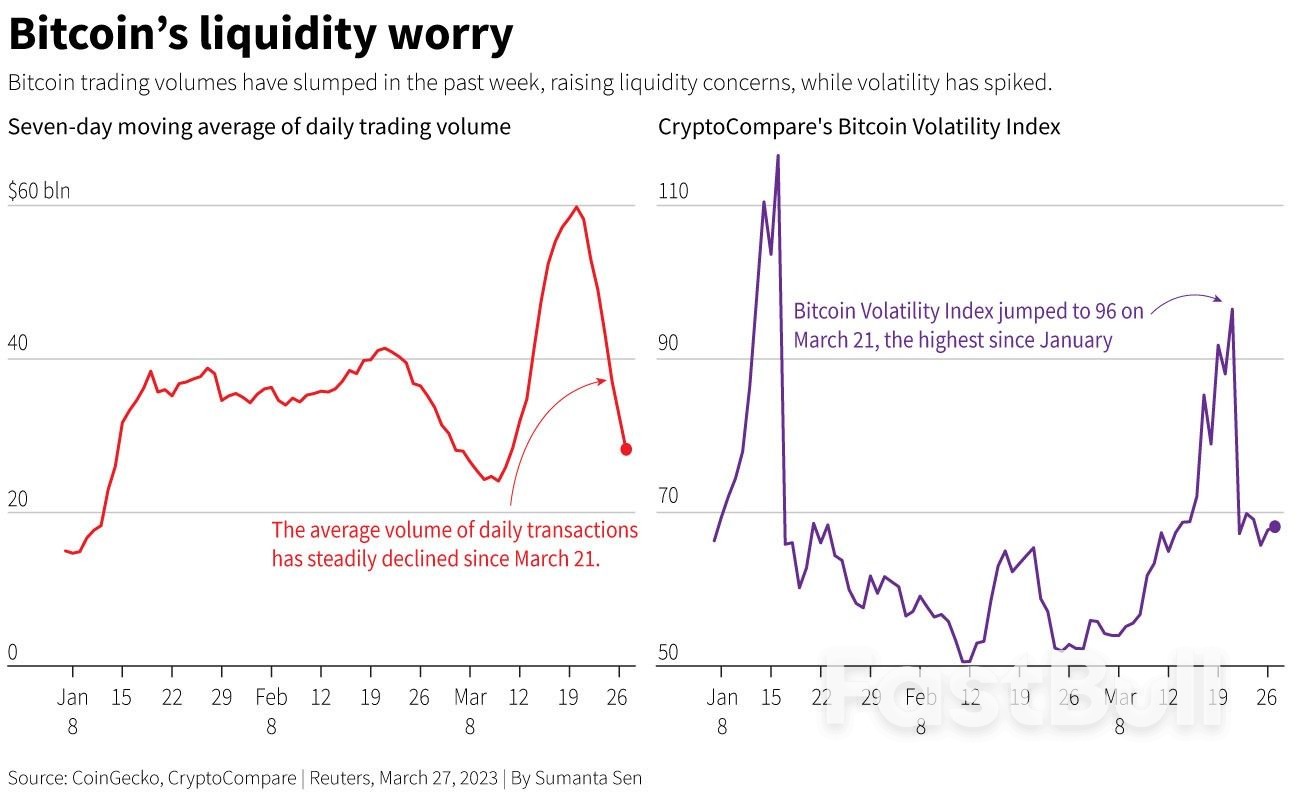
          Bullish bitcoin has been a surprise winner of the banking blowout. Yet investors aiming to ramp up their bets face an ominous obstacle: a lack of liquidity that could trigger wild price swings.
          The price of the No.1 cryptocurrency has jumped 40% to around $27,700 since March 10, when the failure of Silicon Valley Bank (SVB) careered into mainstream markets.
          On the flip side, though, its liquidity is drying up.
          Bitcoin's market depth indicates the asset is at its lowest level of liquidity in 10 months, even lower than in the aftermath of the FTX collapse in November, according to data provider Kaiko. The market depth for the two leading trading pairs - bitcoin-dollar and bitcoin-tether - stands at 5,600 bitcoin, the equivalent of about $155 million, Kaiko said.
          "As a market maker we try to provide liquidity where we can but we're facing a difficult situation," said Kevin de Patoul, CEO of Keyrock. "There is a big network effect here. In the short term at least, liquidity will remain a challenge."
          Slippage, a liquidity measure describing how much prices change between the placement and execution of a trade, has also increased. Slippage for buying bitcoin with U.S. dollars on the Coinbase exchange is 2.5 times higher than it was at the start of March, said Conor Ryder, research analyst at Kaiko.
          The slippage for a simulated $100,000 sell order has doubled in the past month, meaning the average price you get for each bitcoin is worse than a month ago, Kaiko said.
          The network effect de Patoul referred to was the collapses of Silvergate Capital and Signature Bank, whose networks had long been used by market makers - which expand liquidity by rapidly buying and selling tokens - to transact with exchanges.
          Lower liquidity typically translates to more volatile markets, especially in crypto. Kaiko's Ryder said this was possibly one factor behind bitcoin's leap this month.
          CryptoCompare's Bitcoin Volatility Index spiked to 96 last week, way higher than the range of 52 to 65 it saw last month as the cryptocurrency held its footing despite broader market turmoil. The index is currently hovering around 68.

          Buoyant Bitcoin's Losing Its Liquidity_1The alameda factor

          Further crimping liquidity, Binance - the world's most liquid crypto exchange - ended zero-fee trading for nearly all its bitcoin trading pairs last week, hitting market makers' ability to charge higher fees for executing trades on the platform.
          Liquidity for the bitcoin-tether pair on Binance has dropped 70% since the announcement, while trading volumes have fallen 90%, according to Kaiko data.
          The vanishing liquidity can be traced back to the collapse of Sam Bankman-Fried's FTX exchange and hedge fund Alameda Research. Alameda was one of the biggest liquidity providers in the crypto industry, and its bankruptcy left a void that has been exacerbated by the banking sector turmoil of 2023.
          While most market participants expect new contenders to gradually emerge to perform the network functions of Silvergate and Signature, they say complete replacements are unlikely to pop up overnight.
          Until then, "liquidity is probably going to get worse and worse", said Joseph Edwards, investment adviser at Enigma Securities.
          Furthermore, it's not just market-maker trouble that's crunching crypto liquidity; Despite bitcoin's recent rally following a lengthy downturn, many investors are still trading cautiously in the wake of the banking crises and rising interest rates, some specialists say.
          "Even if some players haven't left the place, they are on the sidelines right now because of what's happening with banking turmoil," Edwards said.

          Source: The Economic Times

          Risk Warnings and Disclaimers
          You understand and acknowledge that there is a high degree of risk involved in trading. Following any strategies or investment methods may lead to potential losses. The content on the site is provided by our contributors and analysts for information purposes only. You are solely responsible for determining whether any trading assets, securities, strategy, or any other product is suitable for investing based on your own investment objectives and financial situation.
          Comments
          Add to Favorites
          Share

          China's 2023 Crude Oil Imports Set for 6.2% Rise, But Risks Prevail

          Thomas

          Commodity

          China's crude oil imports will average 10.8 million barrels per day (bpd) in 2023, matching the previous record high from 2020, according to the think tank of the country's leading energy group.
          Imports will rise 6.2% from last year to 540 million tonnes, while refinery processing will gain 7.8% to 733 million tonnes, equivalent to 14.66 million bpd, China National Petroleum Corporation's Economics and Technology Research Institute (ETRI) said in its annual industry outlook released on Monday.
          The forecasts are largely in line with those of private analysts, who have tipped a rebound in China's fuel consumption as the world's second-largest economy reopens after ending its strict zero-COVID policy late last year.
          The ETRI forecast is for crude oil imports to rise by 630,000 bpd in 2023, which is below the 900,000 bpd expected by the International Energy Agency, but above estimates from some analysts, such as Wood Mackenzie and S&P Global Commodity Insights.
          Forecasts are useful insofar as they provide insight into the expectations of participants in the market, but it's also useful to look at some of the risks around the estimates.
          What is interesting with the ETRI forecasts is that they would seem to show that China's refiners are still expecting to add crude oil to stockpiles over 2023.
          Assuming domestic oil production remains relatively steady over 2023 at the 4.23 million bpd achieved in the first two months of the year, it implies that a total of 15.03 million bpd will be available to refiners from imports and local output.
          This is some 370,000 bpd more than the ETRI forecast for refinery throughput of 14.66 million bpd.
          If these sort of volumes are added to inventories in 2023, it would be lower than the 740,000 bpd added to storage tanks in 2022.
          China doesn't disclose the volumes of crude flowing into or out of strategic and commercial stockpiles, but an estimate can be made by deducting the amount of crude processed from the total of crude available from imports and domestic output.
          New Refineries
          It's likely that some of the oil heading for storage will go to build working inventories for new plants expected to be commissioned this year.
          Two new refineries - PetroChina's Guangdong Petrochemical and Jiangsu Shenghong Petrochemical with a combined capacity of 520,000 bpd - are expected to enter commercial operation in the coming months, industry sources said last month.
          A third new plant, Shandong Yulong Petrochemical's 400,000 bpd project, may also begin crude imports for possible test runs by the end of the year, a company source told Reuters.
          Flows in, or indeed out of, either commercial or strategic reserves are the biggest X-factor for China's crude oil imports.
          The assumption of modest inventory builds as part of the commissioning of new refining units is a safe choice, but it's worth noting that China's refiners and the authorities in Beijing tend to use stockpiles to smooth out prices, even if they don't talk about this in public.
          Imports could rise by more than expected if crude oil prices drop and remain low, a situation that is possible if the world economy goes into recession, or a banking crisis ensues after the collapse of two U.S. lenders and the forced sale of Credit Suisse.
          Conversely, if global oil demand growth is robust and prices head higher, Chinese refiners may choose to reduce imports and dip into their reserves.
          Another factor that isn't subject to market imperatives is the level of fuel exports, which is set by the government through the issuing of permits.
          Exports of refined products ramped up in recent months as Beijing sought quick economic stimulus and allowed refiners to take advantage of strong margins in Asia for fuels, especially diesel.
          But there is no guarantee this policy will persist over the whole of 2023, and if domestic demand does rebound, then it's likely fuel exports will be curbed.

          Source: Reuters

          Risk Warnings and Disclaimers
          You understand and acknowledge that there is a high degree of risk involved in trading. Following any strategies or investment methods may lead to potential losses. The content on the site is provided by our contributors and analysts for information purposes only. You are solely responsible for determining whether any trading assets, securities, strategy, or any other product is suitable for investing based on your own investment objectives and financial situation.
          Comments
          Add to Favorites
          Share

          March 28th Financial News

          FastBull Featured

          Daily News

          【Quick Facts】

          1. Bailey: Inflation control should be considered ahead of banking worries.
          2. First Citizens Bank's acquisition of Silicon Valley Bank is settled.
          3. The Hungarian parliament approved Finland's accession to NATO.
          4. SNB has taken emergency liquidity.
          5. Interest rate swaps show that the Fed is likely to raise interest rates in May by more than fifty percent.

          【News Details】

          1. Bailey: Inflation control should be considered ahead of banking worries.
          As the successive "collapses" of banks such as SVB and Credit Suisse have sparked market concerns, some investors believe that central banks should not separate monetary policy from financial stability at a time when worries that banking woes could lead to a widespread financial crisis have intensified.
          Bank of England Governor Andrew Bailey countered this view in a speech at the London School of Economics on Monday. He said rate-setters will focus on fighting inflation and should not be unduly influenced by concerns about the health of the global banking system. Britain's banks are resilient and able to support the economy.
          2. First Citizens Bank's acquisition of Silicon Valley Bank is settled.
          First Citizens Bank, a regional U.S. bank, said Monday it acquired the assets of the previously failed Silicon Valley Bank. The Federal Deposit Insurance Corporation (FDIC) has been given the right to increase the bank's equity worth up to $500 million, thereby acquiring all of Silicon Valley Bank's loans and deposits. Including $110 billion in assets, $56 billion in deposits and $72 billion in loans, with expansion in California. the FDIC retained about $90 billion in securities pending disposition.
          The First Citizens deal boosted the shares of other smaller regional banks, including First Republic Bank, which has been the one that has kept investors most on their toes, whose shares jumped about 12 percent on Monday. And it eased fears of systemic stress in the banking sector.
          3. The Hungarian parliament approved Finland's accession to NATO.
          Hungary's parliament approved a bill on Monday to allow Finland to join NATO. Hungary's ruling party, the Federation of Young Democrats (Fidesz), has reportedly been dragging its feet on the issue for months. Sweden's bill to apply for NATO membership is still lingering in the Hungarian parliament. Finland and Sweden requested NATO membership last year in response to Russia's special military operation against Ukraine, but the process has been blocked by Turkey and Hungary.
          4. SNB has taken emergency liquidity.
          Data show that the SNB's demand deposits rose sharply last week, with commercial banks' demand deposits with the SNB jumping to 567 billion Swiss francs ($619 billion) from 515 billion a week earlier. 52 billion Swiss francs was the second highest increase on record, second only to the 52.4 billion Swiss francs in August 2011, when the SNB sold a large number of Swiss francs to ease the pressure on the safe-haven currency The Swiss franc was under pressure. This suggests that Credit Suisse and UBS may have taken on significant emergency liquidity to ensure the completion of the merger.
          5. Interest rate swaps show that the Fed is likely to raise interest rates in May by more than fifty percent.
          Interest rates on swap contracts rose to about 4.96% on Monday, about 13 bps higher than the current federal funds rate. This suggests that the Fed is more likely to raise rates by 25 bps at its May meeting than to leave them unchanged. The likelihood of a rate hike is more than 50%.

          【Focus of the Day】

          UTC+8 16:00 ECB Governing Council member Muller to speak
          UTC+8 20:30 U.S. Monthly Wholesale Inventories Preliminary Rate (Feb)
          UTC+8 22:00 U.S. Conference Board Consumer Confidence Index (Mar)
          UTC+8 04:30 U.S. API Data
          UTC+8 [TBD] U.S. Senate Banking Committee hearing on Silicon Valley Bank incident, Fed Governor Barr will attend
          Risk Warnings and Disclaimers
          You understand and acknowledge that there is a high degree of risk involved in trading. Following any strategies or investment methods may lead to potential losses. The content on the site is provided by our contributors and analysts for information purposes only. You are solely responsible for determining whether any trading assets, securities, strategy, or any other product is suitable for investing based on your own investment objectives and financial situation.
          Comments
          Add to Favorites
          Share
          FastBull
          Copyright © 2025 FastBull Ltd

          728 RM B 7/F GEE LOK IND BLDG NO 34 HUNG TO RD KWUN TONG KLN HONG KONG

          TelegramInstagramTwitterfacebooklinkedin
          App Store Google Play Google Play
          Products
          Charts

          Chats

          Q&A with Experts
          Screeners
          Economic Calendar
          Data
          Tools
          Membership
          Features
          Function
          Markets
          Copy Trading
          Latest Signals
          Contests
          News
          Analysis
          24/7
          Columns
          Education
          Company
          Careers
          About Us
          Contact Us
          Advertising
          Help Center
          Feedback
          User Agreement
          Privacy Policy
          Business

          White Label

          Data API

          Web Plug-ins

          Poster Maker

          Affiliate Program

          Risk Disclosure

          The risk of loss in trading financial instruments such as stocks, FX, commodities, futures, bonds, ETFs and crypto can be substantial. You may sustain a total loss of the funds that you deposit with your broker. Therefore, you should carefully consider whether such trading is suitable for you in light of your circumstances and financial resources.

          No decision to invest should be made without thoroughly conducting due diligence by yourself or consulting with your financial advisors. Our web content might not suit you since we don't know your financial conditions and investment needs. Our financial information might have latency or contain inaccuracy, so you should be fully responsible for any of your trading and investment decisions. The company will not be responsible for your capital loss.

          Without getting permission from the website, you are not allowed to copy the website's graphics, texts, or trademarks. Intellectual property rights in the content or data incorporated into this website belong to its providers and exchange merchants.

          Not Logged In

          Log in to access more features

          FastBull Membership

          Not yet

          Purchase

          Become a signal provider
          Help Center
          Customer Service
          Dark Mode
          Price Up/Down Colors

          Log In

          Sign Up

          Position
          Layout
          Fullscreen
          Default to Chart
          The chart page opens by default when you visit fastbull.com