• Trade
  • Markets
  • Copy
  • Contests
  • News
  • 24/7
  • Calendar
  • Q&A
  • Chats
Trending
Screeners
SYMBOL
LAST
BID
ASK
HIGH
LOW
NET CHG.
%CHG.
SPREAD
SPX
S&P 500 Index
6870.39
6870.39
6870.39
6895.79
6858.28
+13.27
+ 0.19%
--
DJI
Dow Jones Industrial Average
47954.98
47954.98
47954.98
48133.54
47871.51
+104.05
+ 0.22%
--
IXIC
NASDAQ Composite Index
23578.12
23578.12
23578.12
23680.03
23506.00
+72.99
+ 0.31%
--
USDX
US Dollar Index
98.870
98.950
98.870
98.960
98.730
-0.080
-0.08%
--
EURUSD
Euro / US Dollar
1.16545
1.16552
1.16545
1.16717
1.16341
+0.00119
+ 0.10%
--
GBPUSD
Pound Sterling / US Dollar
1.33220
1.33229
1.33220
1.33462
1.33136
-0.00092
-0.07%
--
XAUUSD
Gold / US Dollar
4208.36
4208.77
4208.36
4218.85
4190.61
+10.45
+ 0.25%
--
WTI
Light Sweet Crude Oil
59.428
59.458
59.428
60.084
59.291
-0.381
-0.64%
--

Community Accounts

Signal Accounts
--
Profit Accounts
--
Loss Accounts
--
View More

Become a signal provider

Sell trading signals to earn additional income

View More

Guide to Copy Trading

Get started with ease and confidence

View More

Signal Accounts for Members

All Signal Accounts

Best Return
  • Best Return
  • Best P/L
  • Best MDD
Past 1W
  • Past 1W
  • Past 1M
  • Past 1Y

All Contests

  • All
  • Trump Updates
  • Recommend
  • Stocks
  • Cryptocurrencies
  • Central Banks
  • Featured News
Top News Only
Share

Russian Defence Ministry: Russian Forces Take Control Of Novodanylivka In Ukraine's Zaporizhzhia Region

Share

Russian Defence Ministry: Russian Forces Take Control Of Chervone In Ukraine's Donetsk Region

Share

French Finance Ministry: Government Started Process To Block Temporarily Shein Platform

Share

Finance Minister: Indonesia To Impose Coal Export Tax Of Up To 5% Next Year

Share

[Trump Considering Fired Homeland Security Secretary Noem? White House Denies] According To Reports From US Media Outlets Such As The Daily Beast And The UK's Independent, The White House Has Denied Reports That US President Trump Is Considering Firing Homeland Security Secretary Noem. White House Spokesperson Abigail Jackson Posted On Social Media On The 7th Local Time, Calling The Claims "fake News" And Stating That "Secretary Noem Has Done An Excellent Job Implementing The President's Agenda And 'making America Safe Again'."

Share

HKEX: Standard Chartered Bought Back 571604 Total Shares On Other Exchanges For Gbp9.5 Million On Dec 5

Share

Morgan Stanley Reiterates Bullish Outlook On US Stocks Due To Fed Rate Cut Expectations. Morgan Stanley Strategists Believe That The US Stock Market Faces A "bullish Outlook" Given Improved Earnings Expectations And Anticipated Fed Rate Cuts. They Expect Strong Corporate Earnings By 2026, And Anticipate The Fed Will Cut Rates Based On Lagging Or Mildly Weak Labor Markets. They Expect The US Consumer Discretionary Sector And Small-cap Stocks To Continue To Outperform

Share

China's National Development And Reform Commission Announced That Starting From 24:00 On December 8, The Retail Price Limit For Gasoline And Diesel In China Will Be Reduced By 55 Yuan Per Ton, Which Translates To A Reduction Of 0.04 Yuan Per Liter For 92-octane Gasoline, 0.05 Yuan Per Liter For 95-octane Gasoline, And 0.05 Yuan Per Liter For 0# Diesel

Share

Tkms CEO: US Security Strategy Highlights Need For Europe To Take Care Of Its Own Defences

Share

USA S&P 500 E-Mini Futures Up 0.1%, NASDAQ 100 Futures Up 0.18%, Dow Futures Down 0.02%

Share

London Metal Exchange (LME): Copper Inventories Increased By 2,000 Tons, Aluminum Inventories Decreased By 2,500 Tons, Nickel Inventories Increased By 228 Tons, Zinc Inventories Increased By 2,375 Tons, Lead Inventories Decreased By 3,725 Tons, And Tin Inventories Decreased By 10 Tons

Share

Swiss Sight Deposits Of Domestic Banks At 440.519 Billion Sfr In Week Ending December 5 Versus 437.298 Billion Sfr A Week Earlier

Share

Czech November Jobless Rate 4.6% Versus Mkt Fcast 4.7%

Share

Czech Jobless Rate Unchanged At 4.6% In November

Share

Singapore Central Bank Data: November Foreign Exchange Reserves At $400.0 Billion

Share

Fitch On EMEA Homebuilders Says Weak Demand Is Likely To Constrain Completions And New Starts, Despite Easing Inflation And Gradual Rate Cuts

Share

French Otc Day-Ahead Baseload Power Price At 22.50 EUR/Mwh, Down 35.3% From The Price Paid Friday For Monday Delivery - Lseg Data

Share

Cambodia Information Minister: 4 Cambodian Civilians Killed, 9 Injured Amid Conflict With Thailand

Share

Tkms CEO: With Meko Frigates We Are Offering To German Government An Alternative To Delayed F126 Frigates

Share

Tkms CEO: Expect Decision On Canadian Submarine Order In 2026

TIME
ACT
FCST
PREV
France Industrial Output MoM (SA) (Oct)

A:--

F: --

P: --
France Trade Balance (SA) (Oct)

A:--

F: --

P: --
Euro Zone Employment YoY (SA) (Q3)

A:--

F: --

P: --
Canada Part-Time Employment (SA) (Nov)

A:--

F: --

P: --

Canada Unemployment Rate (SA) (Nov)

A:--

F: --

P: --

Canada Full-time Employment (SA) (Nov)

A:--

F: --

P: --

Canada Labor Force Participation Rate (SA) (Nov)

A:--

F: --

P: --

Canada Employment (SA) (Nov)

A:--

F: --

P: --

U.S. PCE Price Index MoM (Sept)

A:--

F: --

P: --

U.S. Personal Income MoM (Sept)

A:--

F: --

P: --

U.S. Core PCE Price Index MoM (Sept)

A:--

F: --

P: --

U.S. PCE Price Index YoY (SA) (Sept)

A:--

F: --

P: --

U.S. Core PCE Price Index YoY (Sept)

A:--

F: --

P: --

U.S. Personal Outlays MoM (SA) (Sept)

A:--

F: --

P: --
U.S. 5-10 Year-Ahead Inflation Expectations (Dec)

A:--

F: --

P: --

U.S. Real Personal Consumption Expenditures MoM (Sept)

A:--

F: --

P: --
U.S. Weekly Total Rig Count

A:--

F: --

P: --

U.S. Weekly Total Oil Rig Count

A:--

F: --

P: --

U.S. Consumer Credit (SA) (Oct)

A:--

F: --

P: --
China, Mainland Foreign Exchange Reserves (Nov)

A:--

F: --

P: --

Japan Trade Balance (Oct)

A:--

F: --

P: --

Japan Nominal GDP Revised QoQ (Q3)

A:--

F: --

P: --

China, Mainland Imports YoY (CNH) (Nov)

A:--

F: --

P: --

China, Mainland Exports (Nov)

A:--

F: --

P: --

China, Mainland Imports (CNH) (Nov)

A:--

F: --

P: --

China, Mainland Trade Balance (CNH) (Nov)

A:--

F: --

P: --

China, Mainland Exports YoY (USD) (Nov)

A:--

F: --

P: --

China, Mainland Imports YoY (USD) (Nov)

A:--

F: --

P: --

Germany Industrial Output MoM (SA) (Oct)

A:--

F: --

P: --
Euro Zone Sentix Investor Confidence Index (Dec)

A:--

F: --

P: --

Canada National Economic Confidence Index

--

F: --

P: --

U.K. BRC Like-For-Like Retail Sales YoY (Nov)

--

F: --

P: --

U.K. BRC Overall Retail Sales YoY (Nov)

--

F: --

P: --

Australia Overnight (Borrowing) Key Rate

--

F: --

P: --

RBA Rate Statement
RBA Press Conference
Germany Exports MoM (SA) (Oct)

--

F: --

P: --

U.S. NFIB Small Business Optimism Index (SA) (Nov)

--

F: --

P: --

Mexico 12-Month Inflation (CPI) (Nov)

--

F: --

P: --

Mexico Core CPI YoY (Nov)

--

F: --

P: --

Mexico PPI YoY (Nov)

--

F: --

P: --

U.S. Weekly Redbook Index YoY

--

F: --

P: --

U.S. JOLTS Job Openings (SA) (Oct)

--

F: --

P: --

China, Mainland M1 Money Supply YoY (Nov)

--

F: --

P: --

China, Mainland M0 Money Supply YoY (Nov)

--

F: --

P: --

China, Mainland M2 Money Supply YoY (Nov)

--

F: --

P: --

U.S. EIA Short-Term Crude Production Forecast For The Year (Dec)

--

F: --

P: --

U.S. EIA Natural Gas Production Forecast For The Next Year (Dec)

--

F: --

P: --

U.S. EIA Short-Term Crude Production Forecast For The Next Year (Dec)

--

F: --

P: --

EIA Monthly Short-Term Energy Outlook
U.S. API Weekly Gasoline Stocks

--

F: --

P: --

U.S. API Weekly Cushing Crude Oil Stocks

--

F: --

P: --

U.S. API Weekly Crude Oil Stocks

--

F: --

P: --

U.S. API Weekly Refined Oil Stocks

--

F: --

P: --

South Korea Unemployment Rate (SA) (Nov)

--

F: --

P: --

Japan Reuters Tankan Non-Manufacturers Index (Dec)

--

F: --

P: --

Japan Reuters Tankan Manufacturers Index (Dec)

--

F: --

P: --

Japan Domestic Enterprise Commodity Price Index MoM (Nov)

--

F: --

P: --

Japan Domestic Enterprise Commodity Price Index YoY (Nov)

--

F: --

P: --

China, Mainland PPI YoY (Nov)

--

F: --

P: --

Q&A with Experts
    • All
    • Chatrooms
    • Groups
    • Friends
    Connecting
    .
    .
    .
    Type here...
    Add Symbol or Code

      No matching data

      All
      Trump Updates
      Recommend
      Stocks
      Cryptocurrencies
      Central Banks
      Featured News
      • All
      • Russia-Ukraine Conflict
      • Middle East Flashpoint
      • All
      • Russia-Ukraine Conflict
      • Middle East Flashpoint
      Search
      Products

      Charts Free Forever

      Chats Q&A with Experts
      Screeners Economic Calendar Data Tools
      Membership Features
      Data Warehouse Market Trends Institutional Data Policy Rates Macro

      Market Trends

      Market Sentiment Order Book Forex Correlations

      Top Indicators

      Charts Free Forever
      Markets

      News

      News Analysis 24/7 Columns Education
      From Institutions From Analysts
      Topics Columnists

      Latest Views

      Latest Views

      Trending Topics

      Top Columnists

      Latest Update

      Signals

      Copy Rankings Latest Signals Become a signal provider AI Rating
      Contests
      Brokers

      Overview Brokers Assessment Rankings Regulators News Claims
      Broker listing Forex Brokers Comparison Tool Live Spread Comparison Scam
      Q&A Complaint Scam Alert Videos Tips to Detect Scam
      More

      Business
      Events
      Careers About Us Advertising Help Center

      White Label

      Data API

      Web Plug-ins

      Affiliate Program

      Awards Institution Evaluation IB Seminar Salon Event Exhibition
      Vietnam Thailand Singapore Dubai
      Fans Party Investment Sharing Session
      FastBull Summit BrokersView Expo
      Recent Searches
        Top Searches
          Markets
          News
          Analysis
          User
          24/7
          Economic Calendar
          Education
          Data
          • Names
          • Latest
          • Prev

          View All

          No data

          Scan to Download

          Faster Charts, Chat Faster!

          Download App
          English
          • English
          • Español
          • العربية
          • Bahasa Indonesia
          • Bahasa Melayu
          • Tiếng Việt
          • ภาษาไทย
          • Français
          • Italiano
          • Türkçe
          • Русский язык
          • 简中
          • 繁中
          Open Account
          Search
          Products
          Charts Free Forever
          Markets
          News
          Signals

          Copy Rankings Latest Signals Become a signal provider AI Rating
          Contests
          Brokers

          Overview Brokers Assessment Rankings Regulators News Claims
          Broker listing Forex Brokers Comparison Tool Live Spread Comparison Scam
          Q&A Complaint Scam Alert Videos Tips to Detect Scam
          More

          Business
          Events
          Careers About Us Advertising Help Center

          White Label

          Data API

          Web Plug-ins

          Affiliate Program

          Awards Institution Evaluation IB Seminar Salon Event Exhibition
          Vietnam Thailand Singapore Dubai
          Fans Party Investment Sharing Session
          FastBull Summit BrokersView Expo

          Google's Stock Splits: Mastering Market Accessibility and Investor Attraction

          Glendon

          Economic

          Summary:

          The piece examines Google’s history of stock splits, including the notable 20-for-1 split in 2022 and an earlier 2-for-1 split in 2014, discussing their impact on shareholder value and stock accessibility. 

          Alphabet Inc., the tech giant behind Google, has strategically employed stock splits as a tool to maintain investor interest and ensure its shares remain affordable to a broad spectrum of investors. The company's notable 20-for-1 stock split in 2022, following an earlier 2-for-1 split in 2014, underscores its proactive approach to managing share accessibility and market capitalization.

          Understanding the Strategy Behind Stock Splits

          A stock split is a financial maneuver used by companies to increase the number of their outstanding shares, thereby reducing the price per share. This action does not affect the company's overall market value but makes the stock more accessible to retail investors. Essentially, it's like slicing a pie into more pieces—the size of the pie doesn't change, but more people can have a piece.
          For example, if a stock is priced at $1,000 with a total market capitalization of $100,000,000, a 5-for-1 stock split results in each shareholder owning five times the number of shares, with each share now priced at around $200. This maintains the total investment value but lowers the entry cost for new investors.

          Google's Stock Split History: A Closer Look

          2014 Split: This unique approach not only doubled the number of shares but also introduced a new class of non-voting stock (GOOG), diversifying the types of shares available without diluting existing shareholders' voting power.
          2022 Split: The 20-for-1 split significantly increased the total number of shares, drastically reducing the share price from $2,255.34 to $112.64. This move was aimed at making the stock even more accessible, following a steep rise in Alphabet's share price due to the company's robust growth.

          Market Response and Alphabet's Stock Performance

          Following the 2022 split, Alphabet's Class A shares initially surged by over 7.5%, reflecting positive investor sentiment. However, later in the year, shares dipped due to macroeconomic factors, though they recovered to show a 19% gain year-to-date by April 2023. This volatility highlights the external factors influencing stock prices beyond company-specific actions.

          Financial Insights and Alphabet's Strategic Focus

          In 2022, Alphabet reported a 10% increase in revenue to $283 billion, despite a decrease in operating income and diluted EPS. The company also made significant cuts to its workforce in January 2023, aligning with its strategic realignment towards optimizing operational efficiencies.
          Alphabet continues to heavily invest in key growth areas like artificial intelligence and cloud computing. These investments are intended to bolster future growth and maintain Alphabet's competitive edge in the tech sector.
          Comparative Analysis: Stock Splits Across the Tech Industry
          Stock splits are a common strategy among tech giants:
          Apple: Has split its stock five times to maintain its marketability and share accessibility.
          Amazon: Similar to Alphabet, Amazon implemented a 20:1 split in 2022, indicating a trend among large tech companies to keep their shares within reach of retail investors.
          Netflix and Tesla: Both companies have utilized stock splits as a means to manage their rapidly increasing share prices and attract a broader investor base.

          Conclusion

          Alphabet’s strategic use of stock splits highlights a deliberate effort to keep its shares accessible and attractive to investors, ensuring broad participation in its growth trajectory. This approach not only supports retail investment but also stabilizes Alphabet's presence in the volatile tech market, encouraging long-term investment and shareholder loyalty. Through these financial strategies, Alphabet effectively balances shareholder interests with its ambitious expansion and innovation goals, securing its position as a dominant force in the global tech landscape.
          To stay updated on all economic events of today, please check out our Economic calendar
          Risk Warnings and Disclaimers
          You understand and acknowledge that there is a high degree of risk involved in trading. Following any strategies or investment methods may lead to potential losses. The content on the site is provided by our contributors and analysts for information purposes only. You are solely responsible for determining whether any trading assets, securities, strategy, or any other product is suitable for investing based on your own investment objectives and financial situation.
          Add to Favorites
          Share

          Dollar Sideways, Yen Under Watch Ahead of Key CPI Release

          Owen Li

          Economic

          Forex

          The main market focus on Wednesday is U.S. consumer price inflation for March, which traders have been eagerly awaiting for hints on the Fed's policy outlook.
          The inflation data follows a strong jobs report last Friday that blew past forecasts, stirring more questions on how soon and how much the central bank will cut rates this year.
          Futures traders reduced bets to the lowest level since October, around 60 basis points in rate cuts this year, LSEG data showed on Monday, amid evidence of continued strength in the U.S. economy.
          Ahead of the data, U.S. interest rate futures set the odds of the first cut occurring in June at about 60%, up from 51% on Monday, according to CME Group's FedWatch tool, although the possibility of a hold has bumped up to 40%.
          A solid CPI number will likely have markets pricing out a June cut, which could see the dollar rising sharply, said Carol Kong, a currency strategist at Commonwealth Bank of Australia.
          "A strong core CPI of 0.3% (month-to-month) or above will likely break the case for a June rate cut because there are two more CPI readings ahead of the meeting which are likely not sufficient to show a pattern of slowing inflation."
          On the other hand, even if the data comes in below expectations, June bets will probably remain little changed as hurdles remain, meaning the dollar may only dip modestly, she said.
          "The U.S. CPI will be a big test for Japanese authorities," Kong added.
          The U.S. dollar index, which measures the greenback against six rivals, held firm at 104.10.
          The yen remained close to its 34-year low versus the dollar ahead of the data, after it received some support as the Bank of Japan Governor Kazuo Ueda on Tuesday signalled the chance of another interest rate hike later this year in line with market bets.
          The Japanese currency strengthened 0.06% to 151.70 per dollar as the BOJ chief spoke again in the Asian morning.
          Elsewhere, the euro was steady at $1.085575, as the European Central Bank meeting on Thursday fast approaches. The ECB is expected to hold rates this week, although traders betting the central bank will start cutting in June will be looking for signals from policymakers.
          Sterling was mostly flat at $1.26760.
          Ahead of the U.S. CPI, the Reserve Bank of New Zealand is expected to leave rates at 5.5% at its monetary policy meeting on Wednesday. Focus will be on the tone of the RBNZ's statement for clues on the outlook.
          The kiwi rose 0.07% versus the greenback to $0.60655.
          The Australian dollar ticked up 0.05% to $0.6630.

          Source: Reuters

          To stay updated on all economic events of today, please check out our Economic calendar
          Risk Warnings and Disclaimers
          You understand and acknowledge that there is a high degree of risk involved in trading. Following any strategies or investment methods may lead to potential losses. The content on the site is provided by our contributors and analysts for information purposes only. You are solely responsible for determining whether any trading assets, securities, strategy, or any other product is suitable for investing based on your own investment objectives and financial situation.
          Add to Favorites
          Share

          New Zealand Interest Rate Decision: RBNZ Set To Stand Pat As Markets Look For Hints About Cuts

          Samantha Luan

          Economic

          Central Bank

          The Reserve Bank of New Zealand (RBNZ) is widely expected to maintain the Official Cash Rate (OCR) at 5.50% for the sixth consecutive meeting in a row following the conclusion of its monetary policy meeting on Wednesday.
          The New Zealand Dollar (NZD) is primed for a big market reaction to the RBNZ policy announcements despite the absence of RBNZ Governor Adrian Orr’s press conference and the publication of updated economic projections.

          What to expect from the RBNZ interest rate decision?

          As a rates on-hold decision is fully priced in, markets will closely scrutinize the language and the tone in the Reserve Bank of New Zealand’s Monetary Policy Statement (MPS).
          After extending the pause in February, the RBNZ policy statement stated, “conditional on our central economic outlook, we expect the OCR will need to remain around current levels for an extended period for the Monetary Policy Committee to meet its inflation target.”
          Speaking at the post-policy meeting press conference, Reserve Bank of New Zealand’s (RBNZ) Governor Adrian Orr noted that “we did discuss a hike in rates”, adding that there was a “strong consensus that rates were sufficient.”
          Orr said that he is “still concerned about underlying inflation, how grown inflation is easing.”
          Since the February meeting, little data of note has been released from New Zealand to help gauge the timing of the RBNZ’s likely policy pivot. However, with New Zealand’s economy facing its second recession in 18 months and consumer confidence dipping sharply, markets may not be surprised by a dovish hold.
          New Zealand’s Gross Domestic Product (GDP) growth contracted 0.1% in the fourth quarter of 2023, following a 0.3% contraction in the third quarter. Meanwhile, ANZ-Roy Morgan New Zealand Consumer Confidence fell by 8.1 points in March to 86.4.
          Markets are currently pricing in the first RBNZ’s rate cut in August, with a 75 bps of total easing this year, per BBH Analysts.
          On the other hand, the RBNZ could stick to its language from the February MPS, awaiting the first-quarter Consumer Price Index (CPI) report and the labor market data before contemplating any change in its policy outlook.
          Data published by Stats NZ showed that New Zealand’s annual Consumer Price Index (CPI) increased by 4.7% for the December quarter, the smallest annual rise in more than two years. However, the figure still remains much above the RBNZ target of 1.0%-3.0%.
          Previewing the RBNZ policy announcement, analysts at TD Securities noted: “The RBNZ is expected to keep the OCR on hold at 5.50%. Limited data flow since the February MPS suggests the Bank delivers a similarly worded Statement again.”
          “GDP released a week after the February MPS missed the Bank's forecast by a whisker but higher oil prices, weaker NZD, monthly survey releases with price and employment data suggest the inflation outlook still looks challenging,” the analysts added.

          How will the RBNZ interest decision impact the New Zealand Dollar?

          Risks appear skewed to the downside for the NZD/USD pair heading into the RBNZ showdown on Wednesday, as the US Dollar keeps the upper hand across the board following robust Nonfarm Payrolls data that prompted investors to dial down expectations for a June US Federal Reserve (Fed) rate cut.
          Furthermore, expectations of an RBNZ status quo also leave the Kiwi Dollar in the back seat, with a fresh sell-off likely on the cards should the RBNZ policy statement hint toward an earlier-than-expected rate cut.
          Conversely, if the MPS suggests that the RBNZ could stick to its “higher for longer” interest rate view amid elevated inflation level, the NZD/USD pair could regain the recovery momentum from five-month lows of 0.5939.
          Dhwani Mehta, FXStreet’s Senior Analyst, offers a brief technical outlook for trading the New Zealand Dollar on the RBNZ policy announcements: “The NZD/USD pair is challenging the critical 21-day Simple Moving Average (SMA) at 0.6036 on its road to recovery. The 14-day Relative Strength Index (RSI) indicator, however, is still holding below the 50 level, suggesting that sellers are likely to hold the reins.”
          “The immediate upside hurdle is seen at the horizontal 200-day SMA at 0.6068, above which the 0.6100 round level will come into play. NZD buyers will then target the 100-day SMA at 0.6138. Conversely, a sustained move below the 0.6000 level could open doors for a test of the April 5 low at 0.5985. Further south, the five-month kow of 0.5939 could be a tough nut to crack for NZD/USD sellers,” Dhwani adds.

          Source:FXStreet

          To stay updated on all economic events of today, please check out our Economic calendar
          Risk Warnings and Disclaimers
          You understand and acknowledge that there is a high degree of risk involved in trading. Following any strategies or investment methods may lead to potential losses. The content on the site is provided by our contributors and analysts for information purposes only. You are solely responsible for determining whether any trading assets, securities, strategy, or any other product is suitable for investing based on your own investment objectives and financial situation.
          Add to Favorites
          Share

          Hang Seng Index, ASX 200, Nikkei Index: Inflation, the BoJ, and Interventions

          Thomas

          Economic

          Commodity

          Stocks

          US Equity Markets: US RCM/TIPP Economic Optimism Index
          Investors should consider overnight US equity market moves early in the Wednesday session. US economic indicators had a limited impact on US investor sentiment. The focus remained on the US CPI Report and the earnings season.
          The RCM/TIPP Economic Optimism Index declined from 43.5 to 43.2 in April. Economists forecast an increase to 44.2. The Index is a leading indicator of consumer confidence and spending.
          10-year US Treasury yields fell by 1.27%, ending the Tuesday session at 4.366%. On Tuesday, the Dow slipped by 0.02%. The Nasdaq Composite Index and the S&P 500 advanced by 0.32% and 0.14%, respectively.

          Asian Economic Calendar: Inflation Numbers from Japan and the BoJ in Focus

          On Wednesday, producer price numbers from Japan warrant investor attention early in the session. An upward trend in producer prices could raise expectations of a BoJ move away from negative rates. Producer prices raise prices in a higher-demand environment, passing costs onto consumers.
          Economists forecast producer prices to increase by 0.8% year-on-year in March after rising by 0.6% in February. Higher-than-expected numbers could drive demand for the Yen and impact Nikkei-listed export stocks.
          With inflation in the spotlight, investors should consider Bank of Japan commentary. BoJ Governor Kazuo Ueda is on the calendar to speak. Views on the economic outlook, inflation, and interest rates could move the dial.

          Commodities: Crude Oil, Gold, and Iron Ore Price Trends

          Commodity price movements also need investor consideration. Central bank purchases of gold, the Middle East influence on Crude oil, and iron ore demand from China are common themes.
          On Tuesday, crude oil ended the session in negative territory, while gold hit new highs. Iron ore prices continued to recover on Tuesday. Reasons for the upswing in iron ore prices could include hopes of a rebound in demand from China and improving US-China relations.

          The USD/JPY, the Intervention Zone, and the Nikkei

          The USD/JPY hovered within the intervention zone at 151.757 on Wednesday. The markets expect 152 to be the line in the sand for the Japanese government. Government threats to intervene could affect the USD/JPY and Nikkei-listed export stocks.

          The Futures Markets

          On Wednesday, the ASX 200 was up 24 points, while the Nikkei was down by 100 points.
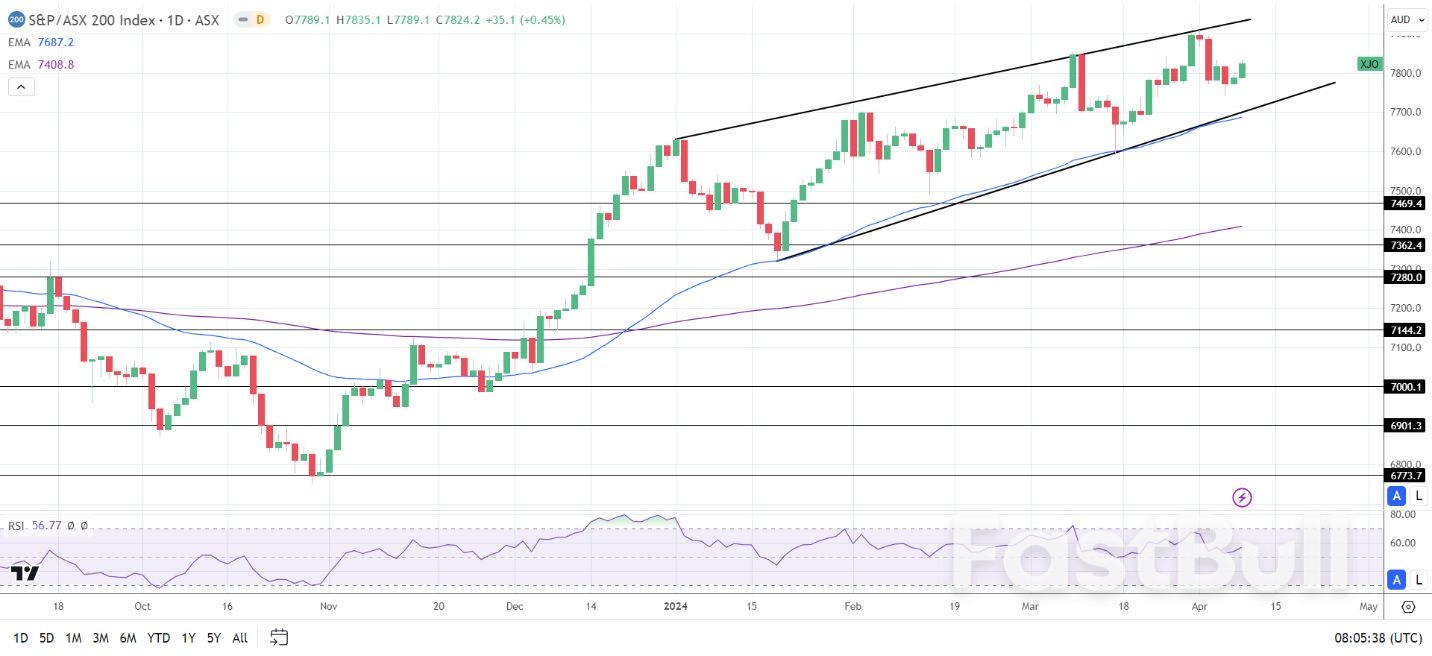
          ASX 200
          Hang Seng Index, ASX 200, Nikkei Index: Inflation, the BoJ, and Interventions_1
          The ASX 200 gained 0.45% on Tuesday. Bank, gold (XAU/USD), mining, and tech stocks ended the session in positive territory. The S&P ASX All Technology Index (XTX) advanced by 0.56% on a pullback in US 10-year Treasury yields.
          Gold stocks Northern Star Resources Ltd. (NST) and Evolution Mining Ltd (EVN) rose by 0.40% and 0.77%, respectively. Gold spot climbed higher on Monday.
          Rio Tinto Ltd. (RIO) and BHP Group Ltd (BHP) rallied 2.96% and 1.99%, respectively, as iron ore prices rebounded. Fortescue Metals Group Ltd. (FMG) gained 1.61%.
          Commonwealth Bank of Australia (CBA) and Westpac Banking Corp. (WBC) saw gains of 0.81% and 1.15%, respectively. ANZ Group Holdings Ltd. (ANZ) and National Australia Bank Ltd. (NAB) ended the day up 0.65% and 0.52%, respectively.
          However, Woodside Energy Group Ltd (WDS) advanced by 0.47%, while Santos Ltd (STO) slid by 2.04%.
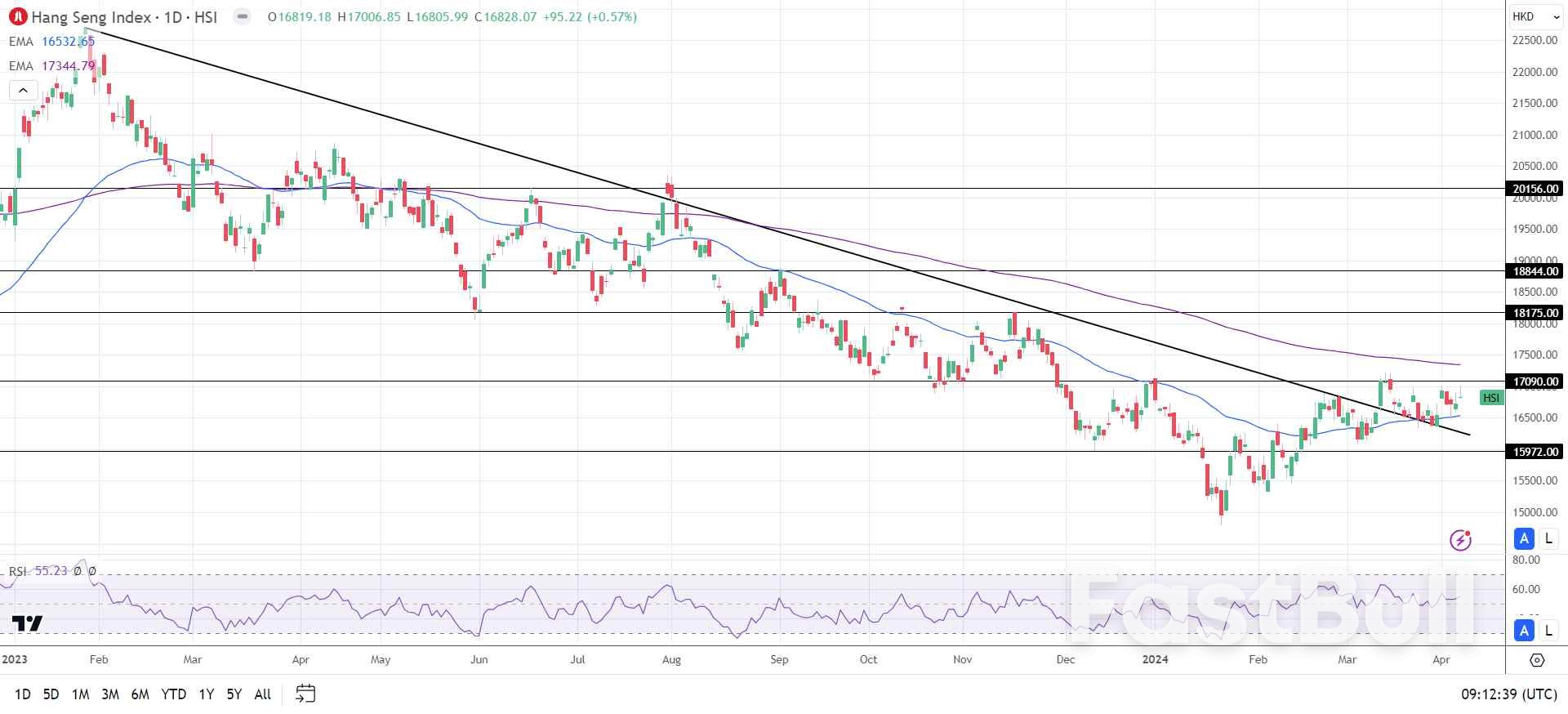
          Hang Seng Index
          Hang Seng Index, ASX 200, Nikkei Index: Inflation, the BoJ, and Interventions_2
          On Tuesday, the Hang Seng Index ended the session up 0.57%. Tech stocks and property stocks reversed the losses from Monday. The Hang Seng Tech Index (HSTECH) and Hang Seng Mainland Properties Index (HSMPI) advanced by 0.44% and 0.98%, respectively.
          Tencent (0700) declined by 0.13%, while Alibaba (9988) gained 0.14%.
          Bank stocks had a mixed session. HSBC (0005) rallied 1.11%, with China Construction Bank (0939) gaining 0.62%. Industrial Commercial Bank (1398) ended the session flat.
          The Nikkei 225
          Hang Seng Index, ASX 200, Nikkei Index: Inflation, the BoJ, and Interventions_3
          The Nikkei ended Tuesday up 1.08%. USD/JPY trends influenced buyer appetite for Nikkei-listed export stocks.
          Bank stocks had a mixed Tuesday session. Sumitomo Mitsui Financial Group Inc. (8316) advanced by 0.52%, while Mitsubishi UFJ Financial Group Inc. (8306) ended the session flat.
          It was also a mixed session for the main components of the Nikkei.
          Tokyo Electron Ltd. (8035) rallied 3.53%, with Sony Group Corporation (6758) gaining 0.63%.
          KDDI Corp. (9433) and Fast Retailing Co. Ltd. (9983) ended the day up 0.43% and 0.02%, respectively. Softbank Group Corp. (9948) bucked the trend, falling 0.29%.
          For upcoming economic events, refer to our economic calendar.

          Source: FX Empire

          To stay updated on all economic events of today, please check out our Economic calendar
          Risk Warnings and Disclaimers
          You understand and acknowledge that there is a high degree of risk involved in trading. Following any strategies or investment methods may lead to potential losses. The content on the site is provided by our contributors and analysts for information purposes only. You are solely responsible for determining whether any trading assets, securities, strategy, or any other product is suitable for investing based on your own investment objectives and financial situation.
          Add to Favorites
          Share

          Will Friday’s Data Add To Hopes Of UK Exit From Recession?

          XM

          Economic

          Investors add to June rate cut bets after BoE decision

          With inflation in the UK coming down faster than previously expected, the Bank of England (BoE) appeared more dovish than expected at its latest gathering, on March 21. Once again, officials kept interest rates unchanged, but this time, there were no members voting for a hike. There was only one dissenting vote, and that was for a 25bps reduction.
          On top of that, Governor Bailey reiterated that they are not yet at the point where they can cut interest rates, but he added that with inflation coming down, things are moving in the right direction.
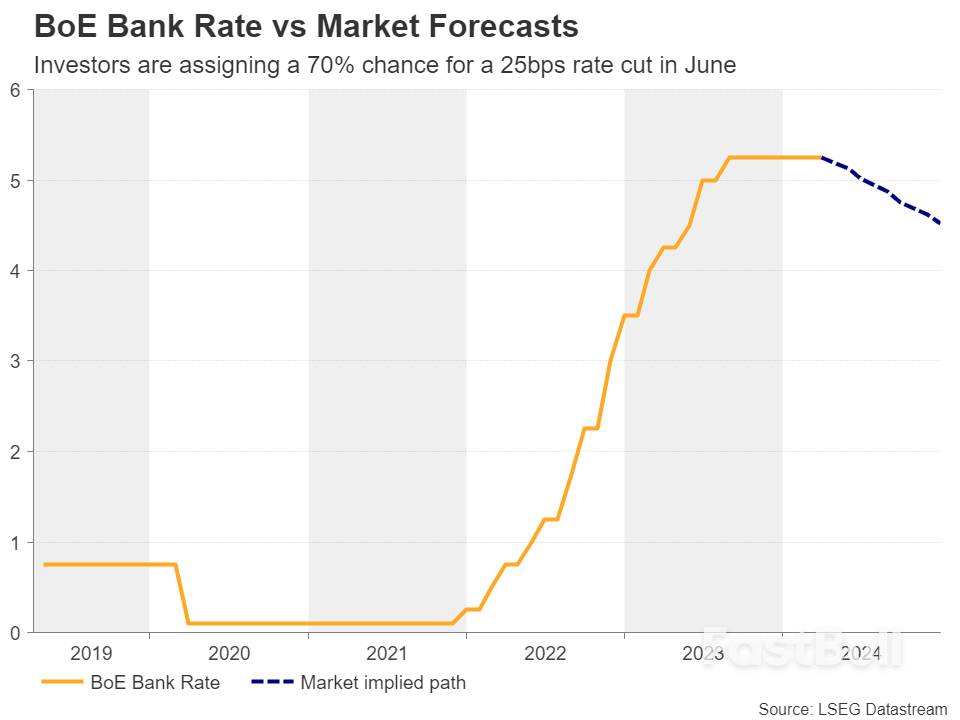
          This has led market participants to bring forward their BoE rate cut bets, with the overnight index swaps (OIS) market suggesting a 25% probability for a quarter point reduction at the Bank’s upcoming gathering in May, and chance for a cut in June rising to around 70%. The quick repricing has been weighing on the pound, with Cable tumbling from 1.2800 to near the 1.2600 area.Will Friday’s Data Add To Hopes Of UK Exit From Recession?_1

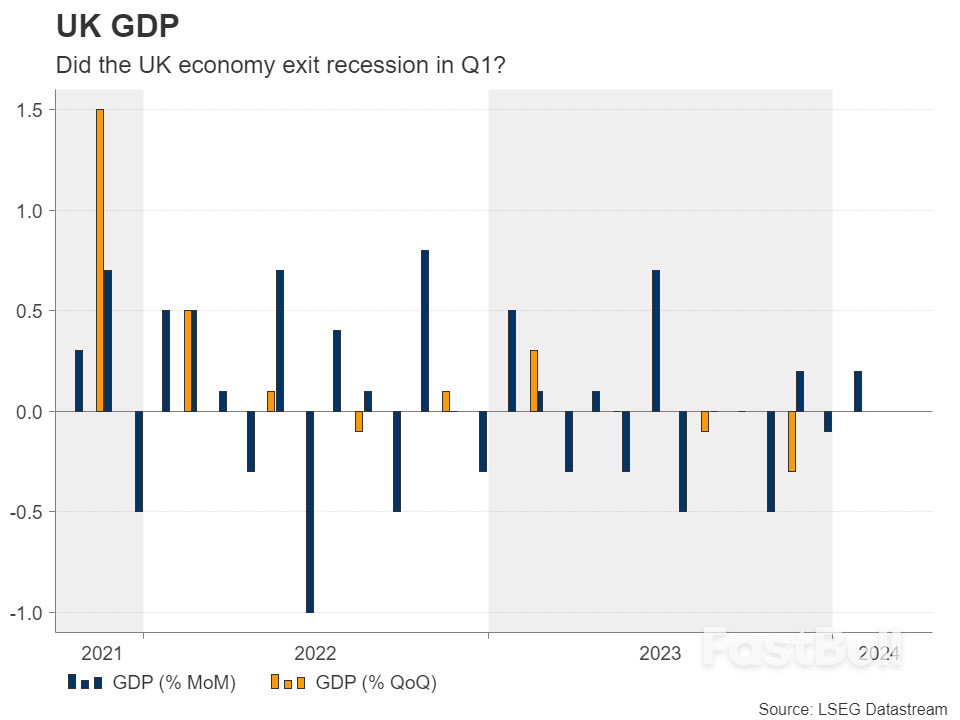
          Did the UK economy exit recession in Q1?

          For pound traders, this week may not be as busy as for dollar and euro traders, but they will still have the opportunity to reassess their view with regards to the BoE’s future course of action on Friday when the monthly GDP estimate for February is coming out, alongside the industrial and manufacturing production figures for the month.
          Given that the UK economy slipped into recession in the second half of 2024, market participants may be eager to find out whether it entered growth mode again during the first quarter of the new year. The monthly GDP rate for January clocked in at 0.2% m/m, while the composite PMIs for both January and February pointed to improvement, although the March print pointed to a mild slowdown.Will Friday’s Data Add To Hopes Of UK Exit From Recession?_2
          The aforementioned numbers suggest that the UK economy started the new year on a stronger footing, but that remains to be confirmed by Friday’s numbers. The forecast points to a slowdown to 0.1% m/m, which could revive some concerns regarding the performance of the UK economy, despite not entering contraction territory.
          The NIESR GDP tracker points to a 0.3% q/q for the first quarter of 2024, but a soft monthly rate for February could bring that forecast into question, especially after the March PMIs pointed to a slowdown in business activity during the last month of the quarter.

          Too early for conclusions as CPI data loom next week

          Therefore, investors may remain convinced that there is a strong chance for the BoE to begin cutting interest rates in June, which could weigh somewhat on the pound. However, calling for a bearish outlook may still be premature, especially ahead of next week’s CPI data for March.
          Despite the slowdown, the March PMIs also revealed that output prices across the UK private sector rose at the fastest pace in eight months, which tilts the risks surrounding next week’s inflation data to the upside. Therefore, even if the pound slips somewhat this week, it could bounce back up next week.Will Friday’s Data Add To Hopes Of UK Exit From Recession?_3
          To stay updated on all economic events of today, please check out our Economic calendar
          Risk Warnings and Disclaimers
          You understand and acknowledge that there is a high degree of risk involved in trading. Following any strategies or investment methods may lead to potential losses. The content on the site is provided by our contributors and analysts for information purposes only. You are solely responsible for determining whether any trading assets, securities, strategy, or any other product is suitable for investing based on your own investment objectives and financial situation.
          Add to Favorites
          Share

          Russian Oil Is Once Again Trading Far Above The G-7’s Price Cap Everywhere

          Samantha Luan

          Commodity

          Economic

          Russian oil is trading far in excess of a Group of Seven price cap that’s supposed to deprive Moscow of revenue for its war in Ukraine, suggesting significant non-compliance with the measure.
          The country’s flagship Urals grade is fetching about $75 a barrel at the point it leaves ports in the Baltic Sea and Black Sea, according to data from Argus Media, whose price assessments are followed by some G-7 nations involved in the cap. US officials are tracking the price increase, which they attribute to broader geopolitical dynamics, according to a senior Treasury official.
          The cap requires that any western company involved in transporting Russian oil receives a so-called attestation, a document vouching that the cargo cost $60-a barrel or less. If it doesn’t, they’re not allowed to provide their services. The fact that Argus’s prices are so far above that level creates a dissonance.Russian Oil Is Once Again Trading Far Above The G-7’s Price Cap Everywhere_1
          While Urals has been above $60 almost all year, this month’s surge to well above $70 will make stretch the credibility of those attestations for traders wanting to keep using western services.
          In March, 23% of the nation’s crude oil shipments had insurance against spills and collisions provided by members of the International Group of P&I Clubs, data compiled by Bloomberg show. That means traders would have vouched that the cargoes cost well below where Argus assessed the Urals price to be. A smaller proportion moved on Greek tankers, all of which had cover from IG clubs, also requiring attestation.
          The US official said that cap is still having its intended effect, reducing the amount of money the Kremlin receives from oil sales by forcing the commodity to either be sold under the cap via western services, or through Russia’s shadow fleet. The US plans to continue the enforcement of the cap by sanctioning vessels operating in the shadow fleet, but will not do so in response to any specific market moves, the official said, requesting anonymity to discuss internal deliberations.
          The European Commission didn’t immediately reply to request for comment.

          Delivered Prices

          By the time Urals cargoes get to India, the grade is trading at $88 a barrel — just $3.80 below than the global benchmark for physical cargoes, Dated Brent, Argus data show. When the nation’s ESPO crude leaves the port of Kozmino in eastern Russia, it is at $84 a barrel. It hasn’t been close to the price cap for about a year.
          Even so, there is still a large freight cost that is directly attributable to sanctions, according to Argus, suggesting at least some impact on Moscow. In addition to that, delivering to Asia is significantly more expensive than it would be to Europe — Russia’s main market before the war began. That all feeds into depressing export prices.
          When it comes to moving Urals cargoes from the Baltic to India or China, the price reporting agency estimates that sanctions add $7.12 a barrel and $8.79 a barrel respectively to the cost of delivery. Both figures, while high, are below where they were a month ago.
          Russian Oil Is Once Again Trading Far Above The G-7’s Price Cap Everywhere_2
          Since October, the US Treasury has shown it’s prepared to punish companies for breaches of the price cap that happened in the past.
          However, given its desire to avoid any actions that disrupt the flow of crude — and risk higher prices — the rally in headline Brent futures to around $90 a barrel may temper any push to do so at this time.

          Source:Bloomberg

          To stay updated on all economic events of today, please check out our Economic calendar
          Risk Warnings and Disclaimers
          You understand and acknowledge that there is a high degree of risk involved in trading. Following any strategies or investment methods may lead to potential losses. The content on the site is provided by our contributors and analysts for information purposes only. You are solely responsible for determining whether any trading assets, securities, strategy, or any other product is suitable for investing based on your own investment objectives and financial situation.
          Add to Favorites
          Share

          BOJ’s Timing For Next Hike In Focus As Ueda Starts Second Year

          Alex

          Central Bank

          Economic

          Governor Kazuo Ueda marks his first anniversary at the helm of the Bank of Japan having dismantled one of the most ambitious stimulus experiments in central bank history with an approach that surprised analysts both for its speed and its success avoiding market ructions.
          When Ueda began his five-year term on April 9 last year, analysts warned of severe risks to financial markets if the new governor failed to tiptoe a fine line. At the time, the BOJ was a global outlier on policy, with its negative rate, massive asset purchases and yield curve control program. Ueda’s predecessor Haruhiko Kuroda had shown that the bank could jolt global markets with a mere tweak to the YCC mechanism.
          In a steady and understated manner belying the magnitude of the task at hand, Ueda began making changes early in his tenure, starting with small alterations to YCC in July and October. Then he ended the most aggressive monetary easing program in modern history in one final act last month, restoring interest rates as the BOJ’s main policy tool with its first hike in 17 years.
          “I will give him a passing score of 70” on a scale of 0-100, said Shinichiro Kobayashi, chief economist at Mitsubishi UFJ Research & Consulting. “He deserves praise, as he didn’t trigger any big shock to markets.”
          Nobuyasu Atago, chief economist at Rakuten Securities, goes much further, lauding Ueda’s ability to keep markets well informed to avoid shocks.BOJ’s Timing For Next Hike In Focus As Ueda Starts Second Year_1
          “I would give him a score of 100. His communication was very good, and it was so easy to understand,” said Atago. “The key is to take what he said without second guessing.”
          Ueda’s BOJ has shown it will seize opportunities to act when they arise. While Ueda started out seemingly having inherited Kuroda’s dovish attitude, he wound up changing forward guidance or monetary policy at half of the eight policy meetings he oversaw.
          “When I took this role, I felt the BOJ’s policy framework had become extremely difficult technically for various reasons,” Ueda said in parliament on Monday. “I hoped to simplify it as much as possible if economic conditions allowed. Fortunately, the economic performance last year was good, so my hopes were fulfilled to some extent.”
          Ueda’s first steps laid the foundation for what came later. In tweaking YCC in July and October, he transformed the program into a flexible form of insurance against sharp increases in yields. Those steps made it almost certain the BOJ could exit the policy without triggering the sort of market mayhem that ensued when the Reserve Bank of Australia discontinued its target for three-year bond yields in 2021.
          Just days before the March policy meeting, the board was said to be divided on whether to end the negative rate immediately or wait. Then the nation’s largest umbrella for unions announced results of annual wage negotiations that far exceeded expectations, and Ueda didn’t hesitate.
          Overwhelmed by his hectic schedule, Ueda has said he wished the days were longer. He longs for more time to think things over, and he’s content to do so for hour upon hour. A trans-Pacific flight is a chance for a good think rather than a good movie.
          “My favorite way of spending time is thinking,” Ueda said in an interview published March 25 in the BOJ’s public relations magazine. “I’ve been so busy after taking the governor position. I always wish a day had 36 hours.”
          After the momentous achievements of the last 12 months, the first anniversary of Ueda’s term in office begs the question: What’s next?
          Over the next four years, Ueda has plenty to do. The BOJ has the biggest balance sheet as a ratio to the size of the economy among central banks. The bank is the biggest single holder of Japanese stocks, and it owns half of the government debt market. Ueda will need to find a strategy to shrink the balance sheet without destabilizing financial markets.BOJ’s Timing For Next Hike In Focus As Ueda Starts Second Year_2
          The weak yen is quickly emerging as another challenge. The currency hit the lowest level versus the dollar in about 34 years late last month. Half of BOJ watchers see a chance of the bank being forced to raise rates to put a floor under Japan’s currency by helping to narrow US-Japan interest rate differentials.
          In Ueda’s first year, the Nikkei stock index rose about 43% and the yen weakened by about 12%.
          “The yen is a wild card,” Kobayashi said. “That could push the BOJ to consider a rate hike even as it would prefer to take time to decide the timing given the anemic economic recovery.”BOJ’s Timing For Next Hike In Focus As Ueda Starts Second Year_3
          Many economists estimate that the economy contracted last quarter, as consumer spending continued to swoon due to sticky inflation. Data Monday showed that Japan’s real wages fell for a 23rd month in February.
          Tsutomu Watanabe, an economics professor who was on the shortlist of candidates to become BOJ governor last year, said the bank has regained its ability to respond to the economy. That’s in sharp contrast to Kuroda’s aggressive efforts to change economic dynamics through taking drastic BOJ steps.
          “Kuroda devoted his life entirely to creating discontinuity in order to move the economy,” Watanabe said. “Ueda’s BOJ is basically saying it won’t do that. Instead it will react to the economy. It’s very different from the Kuroda era.”
          Ueda, 72, has said he is trying to maintain his health by eating “a mountain of vegetables.” To refresh himself, he does radio calisthenics in the morning and afternoon. He also stretches for 15 minutes after taking bath at night. His health and endurance are going to be critical as he navigates the rest of his governorship.
          In ending the negative rate, the BOJ raised rates to between 0% and 0.1%. Lifting the policy rate further could face opposition, as doing so might harm the economy, according to Hideo Kumano, executive economist at Dai-Ichi Life Research Institute.
          “His job is only a half done,” said Kumano, also a former BOJ official. “There could be strong criticism of the normalization process once the economy gets worse. Then he’ll face a real test.”

          Source:Bloomberg

          To stay updated on all economic events of today, please check out our Economic calendar
          Risk Warnings and Disclaimers
          You understand and acknowledge that there is a high degree of risk involved in trading. Following any strategies or investment methods may lead to potential losses. The content on the site is provided by our contributors and analysts for information purposes only. You are solely responsible for determining whether any trading assets, securities, strategy, or any other product is suitable for investing based on your own investment objectives and financial situation.
          Add to Favorites
          Share
          FastBull
          Copyright © 2025 FastBull Ltd

          728 RM B 7/F GEE LOK IND BLDG NO 34 HUNG TO RD KWUN TONG KLN HONG KONG

          TelegramInstagramTwitterfacebooklinkedin
          App Store Google Play Google Play
          Products
          Charts

          Chats

          Q&A with Experts
          Screeners
          Economic Calendar
          Data
          Tools
          Membership
          Features
          Function
          Markets
          Copy Trading
          Latest Signals
          Contests
          News
          Analysis
          24/7
          Columns
          Education
          Company
          Careers
          About Us
          Contact Us
          Advertising
          Help Center
          Feedback
          User Agreement
          Privacy Policy
          Business

          White Label

          Data API

          Web Plug-ins

          Poster Maker

          Affiliate Program

          Risk Disclosure

          The risk of loss in trading financial instruments such as stocks, FX, commodities, futures, bonds, ETFs and crypto can be substantial. You may sustain a total loss of the funds that you deposit with your broker. Therefore, you should carefully consider whether such trading is suitable for you in light of your circumstances and financial resources.

          No decision to invest should be made without thoroughly conducting due diligence by yourself or consulting with your financial advisors. Our web content might not suit you since we don't know your financial conditions and investment needs. Our financial information might have latency or contain inaccuracy, so you should be fully responsible for any of your trading and investment decisions. The company will not be responsible for your capital loss.

          Without getting permission from the website, you are not allowed to copy the website's graphics, texts, or trademarks. Intellectual property rights in the content or data incorporated into this website belong to its providers and exchange merchants.

          Not Logged In

          Log in to access more features

          FastBull Membership

          Not yet

          Purchase

          Become a signal provider
          Help Center
          Customer Service
          Dark Mode
          Price Up/Down Colors

          Log In

          Sign Up

          Position
          Layout
          Fullscreen
          Default to Chart
          The chart page opens by default when you visit fastbull.com