• Trade
  • Markets
  • Copy
  • Contests
  • News
  • 24/7
  • Calendar
  • Q&A
  • Chats
Trending
Screeners
SYMBOL
LAST
BID
ASK
HIGH
LOW
NET CHG.
%CHG.
SPREAD
SPX
S&P 500 Index
6827.42
6827.42
6827.42
6899.86
6801.80
-73.58
-1.07%
--
DJI
Dow Jones Industrial Average
48458.04
48458.04
48458.04
48886.86
48334.10
-245.98
-0.51%
--
IXIC
NASDAQ Composite Index
23195.16
23195.16
23195.16
23554.89
23094.51
-398.69
-1.69%
--
USDX
US Dollar Index
97.950
98.030
97.950
98.500
97.950
-0.370
-0.38%
--
EURUSD
Euro / US Dollar
1.17394
1.17409
1.17394
1.17496
1.17192
+0.00011
+ 0.01%
--
GBPUSD
Pound Sterling / US Dollar
1.33707
1.33732
1.33707
1.33997
1.33419
-0.00148
-0.11%
--
XAUUSD
Gold / US Dollar
4299.39
4299.39
4299.39
4353.41
4257.10
+20.10
+ 0.47%
--
WTI
Light Sweet Crude Oil
57.233
57.485
57.233
58.011
56.969
-0.408
-0.71%
--

Community Accounts

Signal Accounts
--
Profit Accounts
--
Loss Accounts
--
View More

Become a signal provider

Sell trading signals to earn additional income

View More

Guide to Copy Trading

Get started with ease and confidence

View More

Signal Accounts for Members

All Signal Accounts

Best Return
  • Best Return
  • Best P/L
  • Best MDD
Past 1W
  • Past 1W
  • Past 1M
  • Past 1Y

All Contests

  • All
  • Trump Updates
  • Recommend
  • Stocks
  • Cryptocurrencies
  • Central Banks
  • Featured News
Top News Only
Share

Thai Leader Anutin: Landmine Blast That Killed Thai Soldiers 'Not A Roadside Accident'

Share

Thai Leader Anutin: Thailand To Continue Military Action Until 'We Feel No More Harm'

Share

Cambodian Prime Minister Hun Manet Says He Had Phone Calls With Trump And Malaysian Leader Anwar About Ceasefire

Share

Cambodia's Hun Manet Says USA, Malaysia Should Verify 'Which Side Fired First' In Latest Conflict

Share

Cambodia's Hun Manet: Cambodia Maintains Its Stance In Seeking Peaceful Resolution Of Disputes

Share

Nasdaq Companies: Allergan, Ferrovia, Insmed, Monolithic Power Systems, Seagate Technology, And Western Digital Will Be Added To The NASDAQ 100 Index. Biogen, CdW, GlobalFoundries, Lululemon, ON Semiconductor, And Tradedesk Will Be Removed From The NASDAQ 100 Index

Share

Witkoff Headed To Berlin This Weekend To Meet With Zelenskiy, European Leaders -Wsj Reporter On X

Share

Russia Attacks Two Ukrainian Ports, Damaging Three Turkish-Owned Vessels

Share

[Historic Flooding Occurs In At Least Four Rivers In Washington State Due To Days Of Torrential Rains] Multiple Areas In Washington State Have Been Hit By Severe Flooding Due To Days Of Torrential Rains, With At Least Four Rivers Experiencing Historic Flooding. Reporters Learned On The 12th That The Floods Caused By The Torrential Rains In Washington State Have Destroyed Homes And Closed Several Highways. Experts Warn That Even More Severe Flooding May Occur In The Future. A State Of Emergency Has Been Declared In Washington State

Share

Trump Says Proposed Free Economic Zone In Donbas Would Work

Share

Trump: I Think My Voice Should Be Heard

Share

Trump Says Will Be Choosing New Fed Chair In Near Future

Share

Trump Says Proposed Free Economic Zone In Donbas Complex But Would Work

Share

Trump Says Land Strikes In Venezuela Will Start Happening

Share

US President Trump: Thailand And Cambodia Are In A Good Situation

Share

State Media: North Korean Leader Kim Hails Troops Returning From Russia Mission

Share

The 10-year Treasury Yield Rose About 5 Basis Points During The "Fed Rate Cut Week," And The 2/10-year Yield Spread Widened By About 9 Basis Points. On Friday (December 12), In Late New York Trading, The Yield On The Benchmark 10-year US Treasury Note Rose 2.75 Basis Points To 4.1841%, A Cumulative Increase Of 4.90 Basis Points For The Week, Trading Within A Range Of 4.1002%-4.2074%. It Rose Steadily From Monday To Wednesday (before The Fed Announced Its Rate Cut And Treasury Bill Purchase Program), Subsequently Exhibiting A V-shaped Recovery. The 2-year Treasury Yield Fell 1.82 Basis Points To 3.5222%, A Cumulative Decrease Of 3.81 Basis Points For The Week, Trading Within A Range Of 3.6253%-3.4989%

Share

Trump: Lots Of Progress Being Made On Russia-Ukraine

Share

NOPA November US Soybean Crush Estimated At 220.285 Million Bushels

Share

SPDR Gold Trust Reports Holdings Up 0.22%, Or 2.28 Tonnes, To 1053.11 Tonnes By Dec 12

TIME
ACT
FCST
PREV
U.K. Trade Balance Non-EU (SA) (Oct)

A:--

F: --

P: --

U.K. Trade Balance (Oct)

A:--

F: --

P: --

U.K. Services Index MoM

A:--

F: --

P: --

U.K. Construction Output MoM (SA) (Oct)

A:--

F: --

P: --

U.K. Industrial Output YoY (Oct)

A:--

F: --

P: --

U.K. Trade Balance (SA) (Oct)

A:--

F: --

P: --

U.K. Trade Balance EU (SA) (Oct)

A:--

F: --

P: --

U.K. Manufacturing Output YoY (Oct)

A:--

F: --

P: --

U.K. GDP MoM (Oct)

A:--

F: --

P: --

U.K. GDP YoY (SA) (Oct)

A:--

F: --

P: --

U.K. Industrial Output MoM (Oct)

A:--

F: --

P: --

U.K. Construction Output YoY (Oct)

A:--

F: --

P: --

France HICP Final MoM (Nov)

A:--

F: --

P: --

China, Mainland Outstanding Loans Growth YoY (Nov)

A:--

F: --

P: --

China, Mainland M2 Money Supply YoY (Nov)

A:--

F: --

P: --

China, Mainland M0 Money Supply YoY (Nov)

A:--

F: --

P: --

China, Mainland M1 Money Supply YoY (Nov)

A:--

F: --

P: --

India CPI YoY (Nov)

A:--

F: --

P: --

India Deposit Gowth YoY

A:--

F: --

P: --

Brazil Services Growth YoY (Oct)

A:--

F: --

P: --

Mexico Industrial Output YoY (Oct)

A:--

F: --

P: --

Russia Trade Balance (Oct)

A:--

F: --

P: --

Philadelphia Fed President Henry Paulson delivers a speech
Canada Building Permits MoM (SA) (Oct)

A:--

F: --

P: --

Canada Wholesale Sales YoY (Oct)

A:--

F: --

P: --

Canada Wholesale Inventory MoM (Oct)

A:--

F: --

P: --

Canada Wholesale Inventory YoY (Oct)

A:--

F: --

P: --

Canada Wholesale Sales MoM (SA) (Oct)

A:--

F: --

P: --

Germany Current Account (Not SA) (Oct)

A:--

F: --

P: --

U.S. Weekly Total Rig Count

A:--

F: --

P: --

U.S. Weekly Total Oil Rig Count

A:--

F: --

P: --

Japan Tankan Large Non-Manufacturing Diffusion Index (Q4)

--

F: --

P: --

Japan Tankan Small Manufacturing Outlook Index (Q4)

--

F: --

P: --

Japan Tankan Large Non-Manufacturing Outlook Index (Q4)

--

F: --

P: --

Japan Tankan Large Manufacturing Outlook Index (Q4)

--

F: --

P: --

Japan Tankan Small Manufacturing Diffusion Index (Q4)

--

F: --

P: --

Japan Tankan Large Manufacturing Diffusion Index (Q4)

--

F: --

P: --

Japan Tankan Large-Enterprise Capital Expenditure YoY (Q4)

--

F: --

P: --

U.K. Rightmove House Price Index YoY (Dec)

--

F: --

P: --

China, Mainland Industrial Output YoY (YTD) (Nov)

--

F: --

P: --

China, Mainland Urban Area Unemployment Rate (Nov)

--

F: --

P: --

Saudi Arabia CPI YoY (Nov)

--

F: --

P: --

Euro Zone Industrial Output YoY (Oct)

--

F: --

P: --

Euro Zone Industrial Output MoM (Oct)

--

F: --

P: --

Canada Existing Home Sales MoM (Nov)

--

F: --

P: --

Euro Zone Total Reserve Assets (Nov)

--

F: --

P: --

U.K. Inflation Rate Expectations

--

F: --

P: --

Canada National Economic Confidence Index

--

F: --

P: --

Canada New Housing Starts (Nov)

--

F: --

P: --

U.S. NY Fed Manufacturing Employment Index (Dec)

--

F: --

P: --

U.S. NY Fed Manufacturing Index (Dec)

--

F: --

P: --

Canada Core CPI YoY (Nov)

--

F: --

P: --

Canada Manufacturing Unfilled Orders MoM (Oct)

--

F: --

P: --

Canada Manufacturing New Orders MoM (Oct)

--

F: --

P: --

Canada Core CPI MoM (Nov)

--

F: --

P: --

Canada Manufacturing Inventory MoM (Oct)

--

F: --

P: --

Canada CPI YoY (Nov)

--

F: --

P: --

Canada CPI MoM (Nov)

--

F: --

P: --

Canada CPI YoY (SA) (Nov)

--

F: --

P: --

Canada Core CPI MoM (SA) (Nov)

--

F: --

P: --

Q&A with Experts
    • All
    • Chatrooms
    • Groups
    • Friends
    Connecting
    .
    .
    .
    Type here...
    Add Symbol or Code

      No matching data

      All
      Trump Updates
      Recommend
      Stocks
      Cryptocurrencies
      Central Banks
      Featured News
      • All
      • Russia-Ukraine Conflict
      • Middle East Flashpoint
      • All
      • Russia-Ukraine Conflict
      • Middle East Flashpoint
      Search
      Products

      Charts Free Forever

      Chats Q&A with Experts
      Screeners Economic Calendar Data Tools
      Membership Features
      Data Warehouse Market Trends Institutional Data Policy Rates Macro

      Market Trends

      Market Sentiment Order Book Forex Correlations

      Top Indicators

      Charts Free Forever
      Markets

      News

      News Analysis 24/7 Columns Education
      From Institutions From Analysts
      Topics Columnists

      Latest Views

      Latest Views

      Trending Topics

      Top Columnists

      Latest Update

      Signals

      Copy Rankings Latest Signals Become a signal provider AI Rating
      Contests
      Brokers

      Overview Brokers Assessment Rankings Regulators News Claims
      Broker listing Forex Brokers Comparison Tool Live Spread Comparison Scam
      Q&A Complaint Scam Alert Videos Tips to Detect Scam
      More

      Business
      Events
      Careers About Us Advertising Help Center

      White Label

      Data API

      Web Plug-ins

      Affiliate Program

      Awards Institution Evaluation IB Seminar Salon Event Exhibition
      Vietnam Thailand Singapore Dubai
      Fans Party Investment Sharing Session
      FastBull Summit BrokersView Expo
      Recent Searches
        Top Searches
          Markets
          News
          Analysis
          User
          24/7
          Economic Calendar
          Education
          Data
          • Names
          • Latest
          • Prev

          View All

          No data

          Scan to Download

          Faster Charts, Chat Faster!

          Download App
          English
          • English
          • Español
          • العربية
          • Bahasa Indonesia
          • Bahasa Melayu
          • Tiếng Việt
          • ภาษาไทย
          • Français
          • Italiano
          • Türkçe
          • Русский язык
          • 简中
          • 繁中
          Open Account
          Search
          Products
          Charts Free Forever
          Markets
          News
          Signals

          Copy Rankings Latest Signals Become a signal provider AI Rating
          Contests
          Brokers

          Overview Brokers Assessment Rankings Regulators News Claims
          Broker listing Forex Brokers Comparison Tool Live Spread Comparison Scam
          Q&A Complaint Scam Alert Videos Tips to Detect Scam
          More

          Business
          Events
          Careers About Us Advertising Help Center

          White Label

          Data API

          Web Plug-ins

          Affiliate Program

          Awards Institution Evaluation IB Seminar Salon Event Exhibition
          Vietnam Thailand Singapore Dubai
          Fans Party Investment Sharing Session
          FastBull Summit BrokersView Expo

          Gold Rallies, Stocks Ease As Rate Cut Optimism Fades

          Thomas

          Economic

          Central Bank

          Stocks

          Summary:

          Gold prices hit fresh all-time peaks on Monday with stocks on Wall Street closing mixed as optimism that the Federal Reserve was near to cutting interest rates faded due to a strong U.S. economy that rebuts the need for cuts anytime soon.

          Chinese shares led a rally around most of Asia overnight amid a broadly optimistic global economic backdrop, while the dollar rose after data showed the U.S. manufacturing sector grew in March for the first time since September 2022.
          What had been an optimistic reading of key U.S. inflation last week soon darkened as the market weighed the strength of the U.S. economy versus the need for immediate rate cuts.
          The three government measures of U.S. inflation – CPI, PPI and PCE – show improvement has leveled off, leading to questions about when and by how much the Fed cuts, said Kevin Flanagan, head of fixed income strategy at WisdomTree in New York.
          "The markets are reassessing what they thought was going to be a very aggressive rate-cut episode," Flanagan said.
          "Whether they go in June or July, whatever, what is it going to look like? Right now, the data would be showing you that it's not going to be uniform."
          Oil prices stayed near five-month highs as markets expect tighter supply due to OPEC+ cuts and after attacks on Russian refineries, with Chinese manufacturing data supporting a stronger demand outlook.
          The dollar index , a measure of the U.S. currency against six major peers, rose 0.47%.
          MSCI's gauge of stocks across the globe fell 0.36%.
          On Wall Street, the Dow Jones Industrial Average fell 0.6% and the S&P 500 lost 0.20%, but the Nasdaq Composite added 0.11%.
          European markets were closed on Monday and most markets across the globe were closed on Friday.
          Fed Chair Jerome Powell said on Friday that inflation data released that day "is what we were expecting" and that "you won't see us over-reacting," suggesting the U.S. central bank is content to remain in wait-and-see mode.
          Tim Ghriskey, senior portfolio strategist at Ingalls & Snyder in New York, said the Fed does not want to relive the 1970s when it cut too soon and inflation reignited.
          "The potential for a cut keeps getting pushed off because Powell says almost with a giddy tone that this is a great environment. Interest rates are above average, not wildly above, but above average.
          "It's better to keep those cuts in your pocket."
          Friday's report on personal consumption expenditures (PCE) price index data earlier drove expectations for easier U.S. monetary policy, lifting gold to a fresh record high.
          Gold pared gains as the dollar and bond yields rose. Gold prices tend to move inversely with interest rates because as rates rise, gold becomes relatively less attractive.
          Spot gold hit an all-time high of $2,265.49 an ounce earlier in the session. U.S. gold futures settled 0.9% higher at $2,236.50 an ounce.
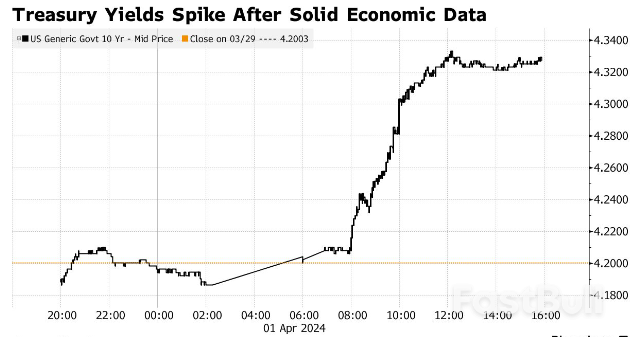
          U.S. Treasury yields rose as the stronger-than-expected manufacturing data raised doubts on whether the Fed can deliver on the three interest rate cuts outlined in its forecast at its last policy meeting.
          The yield on two-year Treasury notes, which reflects interest rate expectations, rose 9.2 basis points to 4.712%. The 10-year's yield rose 12.3 basis points to 4.317%, after earlier touching a two-week high of 4.337%.
          Japanese shares earlier tumbled with the yen pinned near levels that kept traders on guard for a currency intervention. The yen loitered below 152 per dollar.
          Japan's Nikkei fell 1.4% as of the close, weighed down by worries about yen-buying intervention that would hurt exporter profit outlooks and returns for foreign investors.
          Brent rose 42 cents to settle at $87.42 a barrel, while U.S. crude settled up 54 cents to $83.71 a barrel.

          Source: Reuters

          To stay updated on all economic events of today, please check out our Economic calendar
          Risk Warnings and Disclaimers
          You understand and acknowledge that there is a high degree of risk involved in trading. Following any strategies or investment methods may lead to potential losses. The content on the site is provided by our contributors and analysts for information purposes only. You are solely responsible for determining whether any trading assets, securities, strategy, or any other product is suitable for investing based on your own investment objectives and financial situation.
          Add to Favorites
          Share

          Treasury Yields Climb After Stubborn US Inflation Data

          Zi Cheng

          Economic

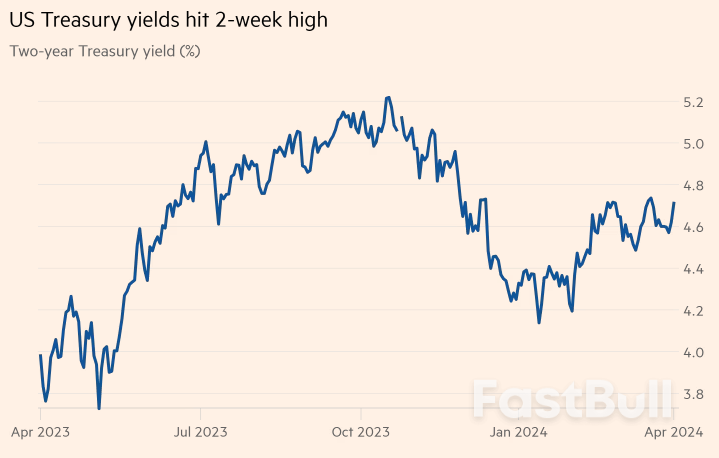
          Yields on US government debt rose to their highest levels in two weeks on Monday as stubborn inflation and a jump in manufacturing activity tempered expectations for interest rate cuts in 2024.
          Benchmark 10-year Treasury note yields rose 0.13 percentage points to 4.32 per cent, while those on two-year Treasuries, which are sensitive to interest rate policy, rose 0.09 percentage points to 4.71 per cent.
          At current levels, the jump in yields — which move inversely to price — would respectively rank as 2024’s third- and fifth-largest increases for the two-year and 10-year bonds, according to LSEG data.
          The moves came after data released on Friday showed year-on-year US inflation hit 2.5 per cent in February, according to the headline personal consumption expenditure metric tracked closely by policymakers at the Federal Reserve, up slightly from January’s figure. Data released earlier on Monday showed a jump in the ISM manufacturing index in March.
          Traders reacted by slightly scaling back expectations for US rates coming down. Markets are now pricing in two or three quarter-point cuts by the end of the year, down from five or six at the start of 2024.
          Monday’s Treasury market moves were likely to have been caused by “a combination of the stronger PCE spending print on Friday and strong ISM”, said Gennadiy Goldberg, head of US rates strategy at TD Securities.
          “Trading is also relatively thin today” because of the Easter holiday in London, “so that may explain some of [the moves]”, he added.

          Treasury Yields Climb After Stubborn US Inflation Data_1Source: LSEG

          Stephen Brown, Capital Economics’ deputy chief North America economist, wrote that ISM data showing a rise in the prices-paid index to a 20-month high “looks somewhat concerning for the Federal Reserve” but “appears to largely reflect higher oil prices rather than a renewed rise in core goods inflation pressures”.
          After notching their strongest first quarter in five years, US stock prices on Monday followed Treasuries lower in early-afternoon trading in New York.
          The benchmark S&P 500 index was down 0.2 per cent, with 290 stocks lower on the day. The tech-heavy Nasdaq Composite stood 0.1 per cent higher. European equity markets were closed.
          Asian stocks began the quarter on the front foot. China’s CSI 300 and Hong Kong’s Hang Seng indices added 1.6 per cent and 0.9 per cent, respectively, after a rebound in China’s manufacturing activity added to hopes of improving economic growth.
          In commodity markets, gold hit a fresh record high on the first day of the second quarter, extending a multi-month rally.
          The metal was trading at $2,239.3 a troy ounce in New York on Monday, according to LSEG data, after hitting an intraday high of $2,265.49 earlier.
          Brent crude, the international oil benchmark, rose 0.8 per cent to $87.73 a barrel.

          Source: Financial Times

          To stay updated on all economic events of today, please check out our Economic calendar
          Risk Warnings and Disclaimers
          You understand and acknowledge that there is a high degree of risk involved in trading. Following any strategies or investment methods may lead to potential losses. The content on the site is provided by our contributors and analysts for information purposes only. You are solely responsible for determining whether any trading assets, securities, strategy, or any other product is suitable for investing based on your own investment objectives and financial situation.
          Add to Favorites
          Share

          National Bank of Romania Preview: We Could See Hints of A Cautious Easing Cycle ahead

          ING

          Forex

          Central Bank

          Economic

          The NBR will most likely hold rates steady in April and leave the beginning of the cutting cycle for the May meeting. Policymakers could still keep a relatively hawkish tone due to a number of factors: inflation surprised mildly to the upside so far in the year, private consumption seems to be picking up nicely, the fiscal slippage is official, and oil prices have been going up.
          When it comes to growth concerns, the Bank is likely to emphasise the lagged effects of the tightening done so far and potential hiccups in EU funds inflows. The stark and significant drop showed by the construction activity data for January could also find its way among the Bank’s perceived weak points, although question marks regarding the soundness of the data might make the Bank temporarily overlook the January print.
          Overall, we think that the Bank is preparing the ground for a cautious easing cycle ahead. In the short run, the inflation print for March due on 11 April is now the key factor to watch ahead. We have pencilled in a deceleration of inflation to 6.7%, from 7.2% in February, especially due to lower growth in food prices.
          Governor Isarescu hinted in his latest Inflation Report presentation that the Bank needs a couple of down-trending inflation prints before policymakers can commit to begin the easing cycle. As such, conditional on a well-behaved inflation outturn for March and a confident-enough estimate for the April inflation (which will be published the day after NBR’s May meeting), the first rate cut of the easing cycle in May is likely to come even though the NBR might remain reserved in hinting towards any dovishness in this week’s policy decision statement.
          The NBR is also likely to keep a cautious tone concerning the path of the policy rate for the rest of the year. The now official fiscal slippage will almost certainly rank high on the policymakers’ risks agenda, especially as the path towards a lower budget deficit is currently uncertain in the short run. Further increases in the tax burden, wage growth, higher oil prices and geopolitical developments will also likely be among the causes of upside risks in the longer run.
          Among the few downside pressures, the government decision to extend the markup caps for selected food items until the end of the year should be chiefly mentioned. Moreover, we think that the behaviour of the regional central banks, particularly the National Bank of Poland (NBP) will also play an important role in calibrating NBR’s easing cycle, since it would be difficult to imagine NBR’s effective rate (i.e., the deposit facility, 6.00% now) falling below the NBP’s key rate (currently at 5.75%).
          Overall, in our view, starting with May, the above context sets the stage for a series of small, and possibly non-linear rate cuts ahead, with risks to our 6.00% year-end forecast for the key rate tilted to the upside. Interruptions in the rate cutting cycle are likely to be data dependent, especially as the ingredients for sticky inflation are still there and the Bank will want to fine-tune the level of policy restrictiveness in the coming quarters rather than risk turning growth supportive too early.

          FX and Markets

          In Romanian government bonds (ROMGBs), on the supply side, everything is going according to plan so far since the beginning of the year. The Ministry of Finance (MinFin) covered about 32% of the planned issuance in the first quarter according to our calculations, so we do not see frontloading like last year, but at the same time, MinFin is meeting sufficient demand so far. Therefore, we can expect a similar monthly issuance pace in the second quarter or potentially higher if we see higher demand given MinFin's flexible approach. On the other hand, fiscal risks are to the upside, which would lead to higher borrowing needs.
          On the demand side, we continue to see the ROMGBs position as neutral in the CEE space. Peer spread valuations in the region look neutral and given the risks mentioned, ROMGBs would be more attractive at higher yield levels in our view, which is what we saw when 10y ROMGBs jumped above 6.70% in the middle of March, triggering market demand and pushing yields back to 6.55%. On the other hand, the positive carry with FX implied yields compressed well below the NBR base rate still speaks in favour of ROMGBs.
          FX-wise, the EUR/RON continues to be very stable within a tight range just below 4.98. With inflation still printing slightly above expectations and demand-side pressures building up in the economy, even a marginal shift higher doesn’t look imminent. Moreover, the possible increase in the tax burden next year, at a time of projected growth acceleration, adds to the medium-term inflationary risks and, by extension, FX stability will be needed further down the line. All told, we maintain our 5.04 year-end estimate, but – as usual lately – we underline that the chances for an essentially flat nominal FX rate this year are considerable.
          To stay updated on all economic events of today, please check out our Economic calendar
          Risk Warnings and Disclaimers
          You understand and acknowledge that there is a high degree of risk involved in trading. Following any strategies or investment methods may lead to potential losses. The content on the site is provided by our contributors and analysts for information purposes only. You are solely responsible for determining whether any trading assets, securities, strategy, or any other product is suitable for investing based on your own investment objectives and financial situation.
          Add to Favorites
          Share

          Hong Kong Leads Asian Stocks Higher, Bonds Fall: Markets Wrap

          Zi Cheng

          Economic

          Shares in Asia rose as Hong Kong stocks rallied in catch-up trade, while bonds in the region fell after strong US data supported the view that the Federal Reserve will be slow to cut rates.
          Hong Kong stocks jumped after a two-session holiday, tracking Monday’s gains in their mainland counterparts. Xiaomi Corp. contributed the most to the Hong Kong benchmark’s advance following its debut electric vehicle.
          Japanese shares also climbed, helped by a soft yen. The currency steadied after weakening on Monday against the greenback to around the lowest levels of the year. The decline has increased the risk that Japanese officials may intervene in the market.
          US equity futures inched lower after the S&P 500 fell 0.2% Monday while the Nasdaq rose by the same margin.
          In the bond market, Australian and New Zealand yields climbed, echoing moves in Treasuries. US bonds steadied in Asian trading, after falling across the curve Monday — with 10-year yields climbing over 10 basis points — as manufacturing unexpectedly expanded for the first time since September 2022 and input costs climbed.
          Following the report, the amount of Fed easing priced into swap contracts for this year slid to around 65 basis points — less than forecast by policymakers.
          “Investors are indeed front-running the possibility of yet another hawkish pivot from the Fed,” said Jose Torres at Interactive Brokers. “The Fed’s first rate cut may arrive in the second half of the year after all — with probabilities of a reduction this June inching closer to coin-flip odds.”

          Hong Kong Leads Asian Stocks Higher, Bonds Fall: Markets Wrap_1Source: Bloomberg

          Later this week, data is expected to show employment gains continued in March while wage growth moderated. Fed Chair Jerome Powell — who is set to speak Wednesday — said Friday that officials are awaiting more evidence prices are contained, adding that it wouldn’t be appropriate to lower rates until officials are sure inflation is in check.
          While the market appears “content” to point toward the manufacturing release as the trigger for the move in Treasuries, there was already a bond selloff underway prior to the headlines, said Ian Lyngen and Vail Hartman at BMO Capital Markets.
          “Monday’s price action in the futures space suggests the pendulum of sentiment in US rates may be shifting toward the hawkish direction — although it goes without saying there remains ample room for expectations to meaningfully shift as more data is revealed,” they noted.

          Hong Kong Leads Asian Stocks Higher, Bonds Fall: Markets Wrap_2Source: Institute for Supply Management

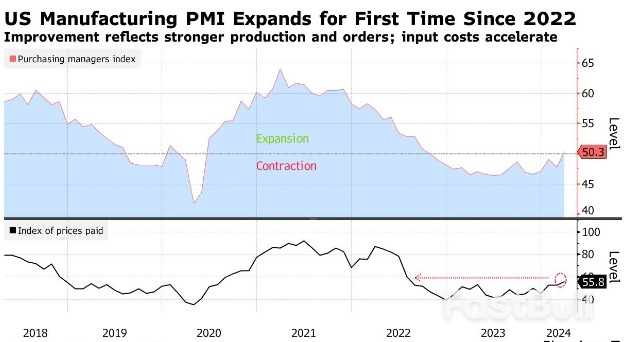
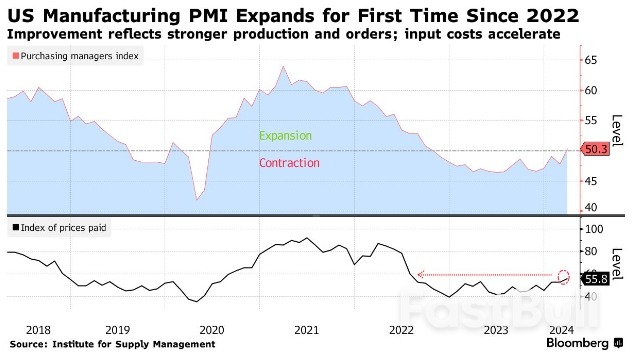
          The Institute for Supply Management’s manufacturing gauge rose to 50.3 last month. While barely above the level of 50 that separates expansion and contraction, it halted 16 straight months of shrinking activity. At the same time, the group’s index of prices paid rose to 55.8, the highest since July 2022.
          Perhaps “most troubling” was the jump in the prices paid, according to Michael Shaoul at Marketfield Asset Management. “This indicates that some of the ‘transitory’ relief from reflationary forces is starting to reverse.”
          In Asia, data set for release Tuesday includes PMIs for India. Australia’s central bank will switch to a new system for the implementation of monetary policy as passive quantitative tightening leads to a decline in reserves in the banking system, RBA Assistant Governor Christopher Kent said on Tuesday.
          In commodities, oil held near a five-month high with heightened geopolitical risks in the Middle East and tighter supply from Mexico helping to buoy prices. Gold pared gains after hitting an all-time high Monday.

          Source: Bloomberg

          To stay updated on all economic events of today, please check out our Economic calendar
          Risk Warnings and Disclaimers
          You understand and acknowledge that there is a high degree of risk involved in trading. Following any strategies or investment methods may lead to potential losses. The content on the site is provided by our contributors and analysts for information purposes only. You are solely responsible for determining whether any trading assets, securities, strategy, or any other product is suitable for investing based on your own investment objectives and financial situation.
          Add to Favorites
          Share

          India Wants To Become The Top Manufacturing Alternative To China. But First It Needs To Beat Vietnam

          Alex

          Economic

          India wants to be the top manufacturer in Asia as companies shift away from China, but first it needs to lower taxes and improve supply chain efficiency if it wants to dethrone Vietnam.
          The U.S. has pursued a “friendshoring” agenda as competition with China increases. The Biden administration has encouraged American companies to move electronics and technology manufacturing operations out of China and into friendlier countries, particularly Vietnam and India in Asia-Pacific.
          “Both Democrats and Republicans see China as a challenge. And every boardroom in the U.S. is asking a CEO what their derisking strategy from China is,” said Mukesh Aghi, president and CEO of the U.S.-India Strategic Partnership Forum.

          Vietnam’s head start

          India and Vietnam are attractive manufacturing alternatives for foreign investors and companies, due in part to low labor costs. Between the two, however, Vietnam is still way ahead with 2023 exports totaling $96.99 billion, compared with India’s $75.65 billion.
          “Vietnam has been known for their ability to manufacture electronics. India is just getting into that game, so that provides Vietnam with a competitive advantage,” said Samir Kapadia, CEO of India Index and managing principal at Vogel Group.
          While India’s relationship with the U.S. has warmed, especially after Prime Minister Narendra Modi’s state visit to the White House in June, Vietnam has had a trade and investment deal with Washington since 2007.
          Another key advantage for Vietnam is a more simple proposition compared with India, which Aghi noted has “29 states and every state has a policy which may be different.”
          “Vietnam has an upper hand when it comes to economies of scale manufacturing where its mostly manual labor,” Nari Viswanathan, senior director of supply chain strategy at software firm Coupa.
          Sectors that require intensive manual labor and have low profit margins such as apparel manufacturing are “not going to move the needle” for India,” Viswanathan noted.
          U.S. tech giants are increasingly bringing part of their supply chains to the South Asian country. The Financial Times reported in December that Apple told component suppliers it will source batteries from Indian factories for its upcoming iPhone 16. The company has weighed expanding operations in India since 2016, when CEO Tim Cook visited Indian Prime Minister Narendra Modi. Google is also set to begin Pixel phone production in India by the second quarter.

          Import taxes remain high

          One hurdle for India’s manufacturing hub ambitions is the country’s 10% import duty for information and communication technologies. This is higher than Vietnam’s average import duties of around 5%, according to Andy Ho, chief investment officer at VinaCapital.
          India’s import taxes were intended to protect domestic manufacturers, but lowering those duties will be part of the government’s efforts to attract foreign firms to manufacture goods within the country.
          “2024 will be a year of Prime Minister Modi winding down many of these tariffs, but he’s going to do it focused on an industry by industry basis, and not a country by country basis,” Kapadia added.
          For example, India in January lowered import taxes for certain metal and plastic parts used in manufacturing mobile phones from 15% to 10%. That benefits companies like Apple and Dixon Technologies, which manufactures phones for Xiaomi, Samsung and Motorola.
          “Given Vietnam’s stronghold over electronics manufacturing and exports to the United States, that’s where we will see the most traction early on as India attempts to take market share. This includes all kinds of plastics, metal componentry and mechanical items,” Kapadia said.
          India’s electronics exports to the U.S. reached $6.6 billion between January and September last year compared with $2.6 billion for the same period in 2022, according to a LinkedIn post by Pankaj Mahindroo, chairman of the India Cellular and Electronics Association.
          But VinaCapital’s Ho warned that lowering import duties is “not a source of sustainable advantage in attracting FDI investment over the long-term.”
          “What foreign investors tend to be more concerned about is ease-of-doing business issues — especially the flexibility to hire and fire workers — than taxes and tariffs. This is Vietnam’s main source of long-term advantage over India,” Ho told CNBC in an email.

          Efficiency is key

          Although India wants to be a developed economy by 2047, its infrastructure is still lacking, leading to lengthy shipment and road delivery times.
          “A ship in Singapore can be unloaded in eight hours and be on a truck to prospective factories, but the same ship in India will be stuck in a custom warehouse for days,” Aghi said, warning these delays lower the South Asian nation’s appeal to foreign companies.
          “China is probably 10 years ahead of India on its infrastructure, so the country needs to work harder to make sure infrastructure continues to get built,” he added.
          India’s interim budget estimated that the federal government is set to spend 2.55 trillion rupees ($30.7 billion) to improve India’s railway system.
          “India is well on that path of modernizing systems in logistics to enhance on-demand supply chain models for importers and exporters and this factors in all kinds of new roads and ports. I think that will be a priority before automation,” Kapadia said.

          Vietnam’s warming relations with China

          Vietnam’s warm relationship with China, however, offers India a key advantage, Kapadia highlighted.
          “Vietnam could not be closer to China in so many different ways. And I think that will concern supply chain managers and U.S. corporates for the next 10 to 15 years,” he warned.
          China’s President Xi Jinping visited Vietnam just three months after U.S. President Joe Biden did, signing agreements with Vietnam on areas like infrastructure, and trade and security.
          ″[China and Vietnam are] constantly shaking hands and handing each other medals every time they see each other,” Kapadia said.
          “I think the bigger players are going to be factoring in some of the political calculus regarding China’s relationship with Vietnam, and holding back their decision making until India can prove that they can really compete in electronics manufacturing to date,” he added.

          Source:CNBC

          To stay updated on all economic events of today, please check out our Economic calendar
          Risk Warnings and Disclaimers
          You understand and acknowledge that there is a high degree of risk involved in trading. Following any strategies or investment methods may lead to potential losses. The content on the site is provided by our contributors and analysts for information purposes only. You are solely responsible for determining whether any trading assets, securities, strategy, or any other product is suitable for investing based on your own investment objectives and financial situation.
          Add to Favorites
          Share

          RBA Didn't Consider Case to Raise Rates in March, Minutes Show

          Zi Cheng

          Economic

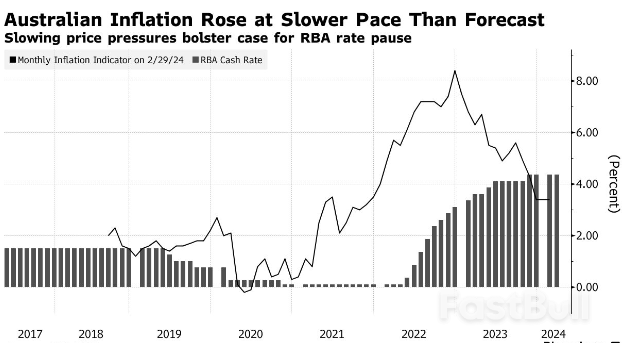
          Australia’s central bank didn’t consider the case for raising interest rates at its last meeting, opting simply to stand pat at a 12-year high of 4.35%, minutes of its March 18-19 board discussion showed.
          The Reserve Bank’s March minutes on Tuesday made no mention of whether a rate hike was discussed, unlike previous releases when it set out the options considered by the board. The central bank has reviewed the case for raising rates at every meeting since it embarked on its tightening cycle in May 2022.
          Members said risks around the economic outlook were “a little more even” when they decided to hold rates and agreed that “it was appropriate to characterize the policy outlook as one in which it was difficult to either rule in or out future changes” to the cash rate.
          “Members agreed that returning inflation to target remained the board’s highest priority and that it would take some time before they could have sufficient confidence that this would occur within a reasonable timeframe,” the minutes showed. “At the same time, members noted the importance of preserving as many of the gains in the labor market as possible.”

          The RBA targets inflation of 2-3% and is aiming for the midpoint of the band.RBA Didn't Consider Case to Raise Rates in March, Minutes Show_1Source: ABS, RBA

          The minutes cover a meeting that was held in a week where central banks from Japan to the US and UK made policy decisions. The Bank of Japan raised rates and scrapped its yield curve program, the Swiss National Bank unexpectedly cut rates, while Federal Reserve chief Jerome Powell charted a steady course.
          The RBA board also discussed a paper on three options for the future framework that the RBA could use to implement monetary policy. The board endorsed transitioning to a new system of “ample reserves.”The board also discussed the RBA’s half-yearly assessment of financial stability risks, noting that Australian households remain able to service their debts and meet essential expenses and this was expected to remain true even if inflation were to prove more persistent.
          So far, broader economic data has generally moved in-line with the RBA’s forecasts — GDP growth has eased, inflation is moderating, retail sales are slowing and unemployment remains low.
          Most economists and money markets believe the RBA is all but done with rate hikes and the next move will be down, though an easing cycle is unlikely to begin in the near term. The RBA next meets on May 6-7 when it’s likely to again leave its key rate unchanged.

          Source: Bloomberg

          To stay updated on all economic events of today, please check out our Economic calendar
          Risk Warnings and Disclaimers
          You understand and acknowledge that there is a high degree of risk involved in trading. Following any strategies or investment methods may lead to potential losses. The content on the site is provided by our contributors and analysts for information purposes only. You are solely responsible for determining whether any trading assets, securities, strategy, or any other product is suitable for investing based on your own investment objectives and financial situation.
          Add to Favorites
          Share

          US Manufacturing Activity Expands For First Time Since 2022

          Cohen

          Economic

          US factory activity unexpectedly expanded in March for the first time since September 2022 on a sharp rebound in production and stronger demand, while input costs climbed.
          The Institute for Supply Management’s manufacturing gauge rose 2.5 points to 50.3 last month, according to data released Monday. While barely above the level of 50 that separates expansion and contraction, it halted 16 straight months of shrinking activity.
          The March index exceeded all estimates in a Bloomberg survey of economists. US Manufacturing Activity Expands For First Time Since 2022_1
          Production snapped back sharply from a month earlier with a gain of 6.2 points that was the largest since mid-2020. At 54.6, output growth was the strongest since June 2022.
          The group’s measure of new orders also returned to expansion territory after contracting in February. The factory employment gauge shrank less in March than a month earlier.
          “Demand remains at the early stages of recovery, with clear signs of improving conditions. Production execution surged compared to January and February, as panelists’ companies reenter expansion,” Timothy Fiore, chair of the ISM Manufacturing Business Survey Committee, said in a statement.
          Nine industries reported growth in March, led by textile mills, nonmetallic minerals, paper products and petroleum. Six contracted, including furniture, plastics and rubber products, and electrical equipment.

          More Optimism

          The nation’s purchasing and supply management executives have recently expressed optimism about the outlook for manufacturing. Firmer orders growth illustrates resilient consumer demand and business investment, and suggests companies have made strides getting inventory levels in line with sales.
          The ISM data showed factory stockpiles contracted at a slower rate last month than in February, while a measure of customer inventories shrank at a faster pace.
          “Customers’ inventory levels decreased at a faster rate in March, with the index retreating a bit more into ‘too low’ territory. Panelists report their companies’ customers continue to have a shortage of their products in inventory, which is considered positive for future new orders and production,” Fiore said.
          At the same time, the cost of materials and other inputs is rising, suggesting stubborn inflationary pressures. The group’s gauge of prices paid rose by 3.3 points to 55.8, the highest since July 2022.

          Source:Bloomberg

          To stay updated on all economic events of today, please check out our Economic calendar
          Risk Warnings and Disclaimers
          You understand and acknowledge that there is a high degree of risk involved in trading. Following any strategies or investment methods may lead to potential losses. The content on the site is provided by our contributors and analysts for information purposes only. You are solely responsible for determining whether any trading assets, securities, strategy, or any other product is suitable for investing based on your own investment objectives and financial situation.
          Add to Favorites
          Share
          FastBull
          Copyright © 2025 FastBull Ltd

          728 RM B 7/F GEE LOK IND BLDG NO 34 HUNG TO RD KWUN TONG KLN HONG KONG

          TelegramInstagramTwitterfacebooklinkedin
          App Store Google Play Google Play
          Products
          Charts

          Chats

          Q&A with Experts
          Screeners
          Economic Calendar
          Data
          Tools
          Membership
          Features
          Function
          Markets
          Copy Trading
          Latest Signals
          Contests
          News
          Analysis
          24/7
          Columns
          Education
          Company
          Careers
          About Us
          Contact Us
          Advertising
          Help Center
          Feedback
          User Agreement
          Privacy Policy
          Business

          White Label

          Data API

          Web Plug-ins

          Poster Maker

          Affiliate Program

          Risk Disclosure

          The risk of loss in trading financial instruments such as stocks, FX, commodities, futures, bonds, ETFs and crypto can be substantial. You may sustain a total loss of the funds that you deposit with your broker. Therefore, you should carefully consider whether such trading is suitable for you in light of your circumstances and financial resources.

          No decision to invest should be made without thoroughly conducting due diligence by yourself or consulting with your financial advisors. Our web content might not suit you since we don't know your financial conditions and investment needs. Our financial information might have latency or contain inaccuracy, so you should be fully responsible for any of your trading and investment decisions. The company will not be responsible for your capital loss.

          Without getting permission from the website, you are not allowed to copy the website's graphics, texts, or trademarks. Intellectual property rights in the content or data incorporated into this website belong to its providers and exchange merchants.

          Not Logged In

          Log in to access more features

          FastBull Membership

          Not yet

          Purchase

          Become a signal provider
          Help Center
          Customer Service
          Dark Mode
          Price Up/Down Colors

          Log In

          Sign Up

          Position
          Layout
          Fullscreen
          Default to Chart
          The chart page opens by default when you visit fastbull.com