• Trade
  • Markets
  • Copy
  • Contests
  • News
  • 24/7
  • Calendar
  • Q&A
  • Chats
Trending
Screeners
SYMBOL
LAST
BID
ASK
HIGH
LOW
NET CHG.
%CHG.
SPREAD
SPX
S&P 500 Index
6827.42
6827.42
6827.42
6899.86
6801.80
-73.58
-1.07%
--
DJI
Dow Jones Industrial Average
48458.04
48458.04
48458.04
48886.86
48334.10
-245.98
-0.51%
--
IXIC
NASDAQ Composite Index
23195.16
23195.16
23195.16
23554.89
23094.51
-398.69
-1.69%
--
USDX
US Dollar Index
97.850
97.930
97.850
98.070
97.810
-0.100
-0.10%
--
EURUSD
Euro / US Dollar
1.17548
1.17555
1.17548
1.17590
1.17262
+0.00154
+ 0.13%
--
GBPUSD
Pound Sterling / US Dollar
1.33859
1.33867
1.33859
1.33940
1.33546
+0.00152
+ 0.11%
--
XAUUSD
Gold / US Dollar
4339.23
4340.15
4339.23
4350.16
4294.68
+39.84
+ 0.93%
--
WTI
Light Sweet Crude Oil
57.117
57.139
57.117
57.601
56.878
-0.116
-0.20%
--

Community Accounts

Signal Accounts
--
Profit Accounts
--
Loss Accounts
--
View More

Become a signal provider

Sell trading signals to earn additional income

View More

Guide to Copy Trading

Get started with ease and confidence

View More

Signal Accounts for Members

All Signal Accounts

Best Return
  • Best Return
  • Best P/L
  • Best MDD
Past 1W
  • Past 1W
  • Past 1M
  • Past 1Y

All Contests

  • All
  • Trump Updates
  • Recommend
  • Stocks
  • Cryptocurrencies
  • Central Banks
  • Featured News
Top News Only
Share

UK Health Minister Streeting On Doctors' Strike: Vote To Go Ahead Reveals The Bma's Shocking Disregard For Patient Safety

Share

Venezuelan State Oil Company Pdvsa Says Was Subject To Cyber Attack But Operations Unaffected

Share

Russia Central Bank Says January-October Current Account Surplus At $37.1 Billion

Share

Polish Current Account Balance At +1924 Million Euros In October Versus+130 Million Euros Seen In Reuters Poll

Share

Statement: Germany, Ukraine Propose 10-Point Plan To Strengthen Armament Cooperation

Share

London Metal Exchange Three Month Copper Falls More Than 3% To $11541.50 A Metric Ton

Share

[Market Update] Spot Silver Surged $2.00 During The Day, Returning To $64/ounce, A Gain Of 3.23%

Share

European Central Bank: Italy's Recurrent Ad Hoc Tax Provisions Cause Uncertainty, Damage Investor Confidence, And May Affect Banks' Funding Costs

Share

Stats Office: Nigeria Consumer Inflation At 14.45% Year-On-Year In November

Share

European Central Bank: Italy's Budget Measures Weighing On Domestic Banks Could Have "Negative Implications" On Their Credit Liquidity

Share

Azerbaijan's January-November Oil Exports Via Btc Pipeline Down 7.1% Year-On-Year Data Shows

Share

Azerbaijan's Aliyev Plans A Large-Scale Prisoner Amnesty, Azertac Reports

Share

EU Commission Chief Von Der Leyen, NATO's Rutte Join Ukraine Talks In Berlin

Share

EU Announces Sanctions On Companies, Individuals For Moving Russian Oil

Share

ICE New York Cocoa Futures Fall More Than 5% To $5945 Per Metric Ton

Share

ICE London Cocoa Futures Fall More Than 5% To 4288 Pounds Per Metric Ton

Share

Pakistan Central Bank: Inflation Seen Returning To Target Range In Fy27

Share

Agrural - Brazil's 2025/26 Soybean Planting Hits 97% Of Expected Area As Of Last Thursday

Share

Pakistan Central Bank: Forex Reserves Seen At $17.8 Billion By June 2026

Share

Pakistan Central Bank: Global Headwinds Likely To Constrain Exports Going Forward

TIME
ACT
FCST
PREV
India CPI YoY (Nov)

A:--

F: --

P: --

India Deposit Gowth YoY

A:--

F: --

P: --

Brazil Services Growth YoY (Oct)

A:--

F: --

P: --

Mexico Industrial Output YoY (Oct)

A:--

F: --

P: --

Russia Trade Balance (Oct)

A:--

F: --

P: --

Philadelphia Fed President Henry Paulson delivers a speech
Canada Building Permits MoM (SA) (Oct)

A:--

F: --

P: --

Canada Wholesale Sales YoY (Oct)

A:--

F: --

P: --

Canada Wholesale Inventory MoM (Oct)

A:--

F: --

P: --

Canada Wholesale Inventory YoY (Oct)

A:--

F: --

P: --

Canada Wholesale Sales MoM (SA) (Oct)

A:--

F: --

P: --

Germany Current Account (Not SA) (Oct)

A:--

F: --

P: --

U.S. Weekly Total Rig Count

A:--

F: --

P: --

U.S. Weekly Total Oil Rig Count

A:--

F: --

P: --

Japan Tankan Small Manufacturing Outlook Index (Q4)

A:--

F: --

P: --

Japan Tankan Large Non-Manufacturing Diffusion Index (Q4)

A:--

F: --

P: --

Japan Tankan Large Non-Manufacturing Outlook Index (Q4)

A:--

F: --

P: --

Japan Tankan Large Manufacturing Outlook Index (Q4)

A:--

F: --

P: --

Japan Tankan Small Manufacturing Diffusion Index (Q4)

A:--

F: --

P: --

Japan Tankan Large Manufacturing Diffusion Index (Q4)

A:--

F: --

P: --

Japan Tankan Large-Enterprise Capital Expenditure YoY (Q4)

A:--

F: --

P: --

U.K. Rightmove House Price Index YoY (Dec)

A:--

F: --

P: --

China, Mainland Industrial Output YoY (YTD) (Nov)

A:--

F: --

P: --

China, Mainland Urban Area Unemployment Rate (Nov)

A:--

F: --

P: --

Saudi Arabia CPI YoY (Nov)

A:--

F: --

P: --

Euro Zone Industrial Output YoY (Oct)

A:--

F: --

P: --

Euro Zone Industrial Output MoM (Oct)

A:--

F: --

P: --

Canada Existing Home Sales MoM (Nov)

A:--

F: --

P: --

Canada National Economic Confidence Index

A:--

F: --

P: --

Canada New Housing Starts (Nov)

A:--

F: --

P: --
U.S. NY Fed Manufacturing Employment Index (Dec)

--

F: --

P: --

U.S. NY Fed Manufacturing Index (Dec)

--

F: --

P: --

Canada Core CPI YoY (Nov)

--

F: --

P: --

Canada Manufacturing Unfilled Orders MoM (Oct)

--

F: --

P: --

U.S. NY Fed Manufacturing Prices Received Index (Dec)

--

F: --

P: --

U.S. NY Fed Manufacturing New Orders Index (Dec)

--

F: --

P: --

Canada Manufacturing New Orders MoM (Oct)

--

F: --

P: --

Canada Core CPI MoM (Nov)

--

F: --

P: --

Canada Trimmed CPI YoY (SA) (Nov)

--

F: --

P: --

Canada Manufacturing Inventory MoM (Oct)

--

F: --

P: --

Canada CPI YoY (Nov)

--

F: --

P: --

Canada CPI MoM (Nov)

--

F: --

P: --

Canada CPI YoY (SA) (Nov)

--

F: --

P: --

Canada Core CPI MoM (SA) (Nov)

--

F: --

P: --

Canada CPI MoM (SA) (Nov)

--

F: --

P: --

Federal Reserve Board Governor Milan delivered a speech
U.S. NAHB Housing Market Index (Dec)

--

F: --

P: --

Australia Composite PMI Prelim (Dec)

--

F: --

P: --

Australia Services PMI Prelim (Dec)

--

F: --

P: --

Australia Manufacturing PMI Prelim (Dec)

--

F: --

P: --

Japan Manufacturing PMI Prelim (SA) (Dec)

--

F: --

P: --

U.K. 3-Month ILO Employment Change (Oct)

--

F: --

P: --

U.K. Unemployment Claimant Count (Nov)

--

F: --

P: --

U.K. Unemployment Rate (Nov)

--

F: --

P: --

U.K. 3-Month ILO Unemployment Rate (Oct)

--

F: --

P: --

U.K. Average Weekly Earnings (3-Month Average, Including Bonuses) YoY (Oct)

--

F: --

P: --

U.K. Average Weekly Earnings (3-Month Average, Excluding Bonuses) YoY (Oct)

--

F: --

P: --

France Services PMI Prelim (Dec)

--

F: --

P: --

France Composite PMI Prelim (SA) (Dec)

--

F: --

P: --

France Manufacturing PMI Prelim (Dec)

--

F: --

P: --

Germany Manufacturing PMI Prelim (SA) (Dec)

--

F: --

P: --

Q&A with Experts
    • All
    • Chatrooms
    • Groups
    • Friends
    Connecting
    .
    .
    .
    Type here...
    Add Symbol or Code

      No matching data

      All
      Trump Updates
      Recommend
      Stocks
      Cryptocurrencies
      Central Banks
      Featured News
      • All
      • Russia-Ukraine Conflict
      • Middle East Flashpoint
      • All
      • Russia-Ukraine Conflict
      • Middle East Flashpoint
      Search
      Products

      Charts Free Forever

      Chats Q&A with Experts
      Screeners Economic Calendar Data Tools
      Membership Features
      Data Warehouse Market Trends Institutional Data Policy Rates Macro

      Market Trends

      Market Sentiment Order Book Forex Correlations

      Top Indicators

      Charts Free Forever
      Markets

      News

      News Analysis 24/7 Columns Education
      From Institutions From Analysts
      Topics Columnists

      Latest Views

      Latest Views

      Trending Topics

      Top Columnists

      Latest Update

      Signals

      Copy Rankings Latest Signals Become a signal provider AI Rating
      Contests
      Brokers

      Overview Brokers Assessment Rankings Regulators News Claims
      Broker listing Forex Brokers Comparison Tool Live Spread Comparison Scam
      Q&A Complaint Scam Alert Videos Tips to Detect Scam
      More

      Business
      Events
      Careers About Us Advertising Help Center

      White Label

      Data API

      Web Plug-ins

      Affiliate Program

      Awards Institution Evaluation IB Seminar Salon Event Exhibition
      Vietnam Thailand Singapore Dubai
      Fans Party Investment Sharing Session
      FastBull Summit BrokersView Expo
      Recent Searches
        Top Searches
          Markets
          News
          Analysis
          User
          24/7
          Economic Calendar
          Education
          Data
          • Names
          • Latest
          • Prev

          View All

          No data

          Scan to Download

          Faster Charts, Chat Faster!

          Download App
          English
          • English
          • Español
          • العربية
          • Bahasa Indonesia
          • Bahasa Melayu
          • Tiếng Việt
          • ภาษาไทย
          • Français
          • Italiano
          • Türkçe
          • Русский язык
          • 简中
          • 繁中
          Open Account
          Search
          Products
          Charts Free Forever
          Markets
          News
          Signals

          Copy Rankings Latest Signals Become a signal provider AI Rating
          Contests
          Brokers

          Overview Brokers Assessment Rankings Regulators News Claims
          Broker listing Forex Brokers Comparison Tool Live Spread Comparison Scam
          Q&A Complaint Scam Alert Videos Tips to Detect Scam
          More

          Business
          Events
          Careers About Us Advertising Help Center

          White Label

          Data API

          Web Plug-ins

          Affiliate Program

          Awards Institution Evaluation IB Seminar Salon Event Exhibition
          Vietnam Thailand Singapore Dubai
          Fans Party Investment Sharing Session
          FastBull Summit BrokersView Expo

          Global Coal Exports and Power Generation Hit New Highs in 2023

          Damon

          Energy

          Summary:

          Worldwide electricity generation from coal hit record highs in 2023, while thermal coal exports surpassed 1 billion metric tons for the first time as coal's use in power systems continues to grow despite widespread efforts to cut back on fossil fuels.

          Worldwide electricity generation from coal hit record highs in 2023, while thermal coal exports surpassed 1 billion metric tons for the first time as coal's use in power systems continues to grow despite widespread efforts to cut back on fossil fuels.
          Coal-fired electricity generation was 8,295 terawatt hours (TWh) through October, up 1% from the same period in 2022 and the highest on record, according to environmental think tank Ember.
          Total thermal coal exports were 1.004 billion metric tons for the whole year, up by 62.5 million tons or 6.6% from 2022, ship-tracking data from Kpler shows.Global Coal Exports and Power Generation Hit New Highs in 2023_1
          Emissions from coal-fired electricity generation also hit new highs through October 2023, topping 7.85 billion tons of carbon dioxide and equivalent gases, around 66.7 million tons more than during the same period in 2022, according to Ember.Global Coal Exports and Power Generation Hit New Highs in 2023_2
          The continued expansion in coal use and emissions provides a stark reminder to climate trackers that the high-polluting power fuel remains integral in key power systems even as solar, wind and other clean energy sources are deployed at a record rate.
          Growing Asian Concentration
          The footprint of coal mining and exports and its use in power generation is overwhelmingly concentrated in Asia, as many other parts of the world including Europe and North America have adopted measures to phase down the use of coal for power.
          But even as the geographical area of coal use and trade is shrinking, the outright volumes of extraction, exports and consumption in power plants remains on a rising trajectory.
          Indonesia was the top thermal coal exporter in 2023, shipping out a record 505.4 million tons for the year, up 54 million tons or 12% from 2022's levels.
          For the first time, Indonesia accounted for more than half of all thermal coal shipments within a calendar year in 2023, Kpler data shows.
          Australia was the second largest thermal coal exporter, shipping out 198 million tons, up 12.5 million tons (7%) from the year before.
          Russia, South Africa and Colombia were also notable exporters, shipping 103 million tons, 60 million tons and 51 million tons respectively last year.
          On the import side, China was the top thermal coal buyer, taking delivery of a record 325 million tons, which is 109 million tons more than 2022's total.Global Coal Exports and Power Generation Hit New Highs in 2023_3
          India was the second biggest importer (172 million tons), followed by Japan (109 million tons), South Korea (80 million tons) and Taiwan (51 million tons).
          Other notable importers included the Philippines (37 million tons) and Vietnam (31 million tons), both notching up strong double-digit percentage increases in year-on-year imports.
          Locked In Generation
          In major coal importing nations, coal-fired electricity generation increased on the year in China, India, the Philippines, Turkey and Vietnam, Ember data shows.
          Coal-fired output declined by 8.2% in Japan and by 4% in South Korea, but those reductions were nearly offset by the increase in Vietnam alone last year.Global Coal Exports and Power Generation Hit New Highs in 2023_4
          Globally, around 82% of all coal-fired electricity generation occurred within Asia in 2023, up from an average of around 75% in 2019, according to Ember.
          Asia's share of coal use and imports should continue to climb as other regions further reduce coal consumption.Global Coal Exports and Power Generation Hit New Highs in 2023_5
          But total volumes of Asia's coal imports and consumption for power generation also look set to continue climbing, especially in major and fast-growing economies such as China, India, Vietnam, the Philippines and Indonesia, where cheap power sources remain critical for industry competitiveness.
          Those same countries are also committed to steep increases in the deployment of renewable energy sources, but over the near term they look just as liable to continue steering total coal use and emissions to further heights.

          Source: Reuters

          Risk Warnings and Disclaimers
          You understand and acknowledge that there is a high degree of risk involved in trading. Following any strategies or investment methods may lead to potential losses. The content on the site is provided by our contributors and analysts for information purposes only. You are solely responsible for determining whether any trading assets, securities, strategy, or any other product is suitable for investing based on your own investment objectives and financial situation.
          Comments
          Add to Favorites
          Share

          Why Are There Concerns about China's Pension System as Its Population Ages?

          Thomas

          Economic

          China's ageing population threatens key Beijing policy goals for the coming decade of boosting domestic consumption and reining in ballooning debt, posing a severe challenge to the economy's long-term growth prospects.
          China's population aged 60 and over reached 296.97 million in 2023, about 21.1% of its total population, up from 280.04 million in 2022, and there are widespread concerns that its pension system cannot keep up without significant reform as the country rapidly ages.
          How does China's pension system work?
          China's pension system is made up of three pillars, including the basic pension system, led by the state.
          The second is a voluntary employee pension plan from employers, and the third is private voluntary pension schemes.
          Both the corporate and private schemes remain underdeveloped, say academics, while the public scheme is already under significant financial pressure. It is mostly administered at a provincial level rather than as a nationwide scheme.
          Governments in the north of the country have the biggest pension deficits because of weaker economies and large population outflows over the years.
          China created a special fund in 2018 to shift pension funds from richer coastal provinces like Guangdong to places like Heilongjiang and Liaoning, to tackle cross-country disparities.
          About a third of the China's provincial-level jurisdictions are running pension deficits. The state-run Chinese Academy of Sciences sees the state pension system running out of money by 2035.
          China's public pension expenditure is already more than 5% of its gross domestic product, according to pension experts.
          When do Chinese collect a pension?
          Chinese citizens get their pension once they retire, at age 60 for men, 55 for white-collar women and 50 for women who work in factories.
          Yet China's life expectancy has risen from around 44 years in 1960 to 78 years as of 2021, higher than in the United States, and is projected to exceed 80 years by 2050.
          More than 20% of China's 1.409 billion people are over 60 years old.
          China has the largest social security system in the world, with about 1.05 billion people paying into or receiving payments from its national basic pension at the end of 2022, according to state media.
          The average monthly pension payment in China in 2020 was around 170 yuan ($23.62), according to the U.N.'s International Labour Organization.
          In the U.S., the government-funded social security programme paid an average of $1,907 per month as of January 2024.
          The average American worker earns more than triple the wages of the average Chinese worker, but that still leaves a major gap in retirement benefits.
          Does China plan to reform its pension system?
          China's state council unveiled a blueprint in 2022 to bolster support for its greying population, including increasing the number of nursing homes and introducing a new private pension scheme to make it easier for people to invest in a range of financial products.
          However, pension system reforms have been slow.
          China announced in 2020 and 2021 in official policies that the statutory retirement age would be raised, but no further details have been announced.
          Many citizens have expressed anger and anxiety at any potential change on social media, citing a difficult working environment currently, with high unemployment.
          Ten working-age Chinese supported 1 retiree in 2002, with the ratio falling to 5 in 2021. The ratio is forecast to drop to 4 in 2030 and 2 in 2050, said Larry Hu, chief economist at Macquarie.
          ($1 = 7.1960 Chinese yuan renminbi)

          Source: Reuters

          To stay updated on all economic events of today, please check out our Economic calendar
          Risk Warnings and Disclaimers
          You understand and acknowledge that there is a high degree of risk involved in trading. Following any strategies or investment methods may lead to potential losses. The content on the site is provided by our contributors and analysts for information purposes only. You are solely responsible for determining whether any trading assets, securities, strategy, or any other product is suitable for investing based on your own investment objectives and financial situation.
          Comments
          Add to Favorites
          Share

          The Global Economy Has Yet to Turn The Corner

          Damon

          Economic

          As 2024 begins, the outlook for the global economy seems to be improving. Major economies are emerging mostly unscathed from the fastest rise in interest rates in 40 years, without the usual scars of financial crashes or high unemployment. Countries rarely succeed in taming steep inflation rates without triggering a recession. Yet, a “soft landing” is now becoming more likely. Not surprisingly, financial markets are in a celebratory mood.
          But caution is in order. The World Bank's latest Global Economic Prospects indicates that most economies — developed as well as developing — will grow much more slowly in 2024 and 2025 than they did in the decade before Covid-19. Global growth is expected to decelerate for the third year in a row — to 2.4% — before ticking upwards to 2.7% in 2025. Per capita investment growth in 2023 and 2024 is expected to average just 3.7%, barely half the average of the previous two decades.
          The 2020s are shaping up to be an era of wasted opportunity. The end of 2024 will mark the halfway point of what was supposed to be a transformative decade for development — when extreme poverty was to be eliminated, major communicable diseases eradicated and greenhouse-gas emissions nearly halved. What looms instead is a wretched milestone: the weakest global growth performance of any half-decade since 1990, with average per capita incomes in a quarter of all developing countries set to be lower at the end of 2024 than they were on the eve of Covid-19 pandemic.
          Feeble economic growth threatens to undercut many global imperatives and make it harder for developing economies to generate the investment needed to tackle climate change, improve health and education and achieve other key
          priorities. It would leave the poorest economies stuck with paralysing debt burdens. It would prolong the misery of the nearly one in three people in developing countries who suffer food insecurity. And it would amount to a historic failure: a lost decade not just for a few countries, but for the world.
          It is still possible to turn the tide. Our analysis suggests that most developing economies' performance in the second half of the 2020s can be at least no worse than in the pre-Covid decade if they do two things. First, they must focus their policies on generating a broadly beneficial investment boom — one that drives productivity growth, rising incomes, a reduction in poverty, higher revenues and many other good things. Second, they must avoid the kinds of fiscal policies that often derail economic progress and contribute to instability.
          The evidence from advanced and developing economies since World War II shows that the right mix of policies can increase investment even when the global economy is not strong. Countries around the world have managed to generate nearly 200 windfall-producing investment booms, defined as episodes in which per capita investment growth accelerated to 4% or more and stayed there for more than six years. Both public and private investment jumped during these episodes. The secret sauce was a comprehensive policy package that consolidated government finances, expanded trade and financial flows, strengthened fiscal and financial institutions and improved the investment climate for private enterprise.
          If each developing economy that engineered such an investment boom in the 2000s and 2010s repeated the feat in the 2020s, developing economies would move one-third of the way closer to their full economic potential. And if all developing economies repeated their best
          10-year performance in improving health, education and labour force participation, that would close most of the remaining gap. Developing economies' potential growth in the 2020s would be closer to what it was during the 2010s.
          There is also an additional option available to the two-thirds of developing economies that rely on commodity exports. They can do better simply by applying the Hippocratic principle to fiscal policy: First, do no harm. These economies are already prone to debilitating boom-and-bust cycles (because commodity prices can rise or fall suddenly) and their fiscal policies usually make matters worse.
          When commodity price increases boost growth by one percentage point, for example, governments increase spending in ways that boost growth by an additional 0.2 percentage points. In general, in good times, fiscal policy tends to overheat the economy. In bad times, it deepens the slump. This “pro-cyclicality” is 30% stronger in commodity exporting developing economies than it is in other developing economies. Fiscal policies also tend to be 40% more volatile in these economies than in other developing economies.
          The result is a chronic drag on their growth prospects. This drag can be reduced by among other things establishing fiscal frameworks to discipline government spending, adopting flexible exchange rate systems and avoiding restrictions on international movements of capital. If these policy measures were instituted as a package, commodity exporting developing economies would achieve an increase in per capita gross domestic product growth of one percentage point every four to five years.
          So far, the 2020s have been a period of broken promises. Governments have fallen short of the “unprecedented” goals they promised to meet by 2030: “to end poverty and hunger everywhere; to combat inequalities within and among countries; … and to ensure the lasting protection of the planet and its natural resources.” But 2030 is still over half a decade away. That is long enough for emerging markets and developing economies to regain lost ground. Governments acting immediately to implement the necessary policies would create cause for everyone to celebrate.

          Source: The Edge Malaysis

          To stay updated on all economic events of today, please check out our Economic calendar
          Risk Warnings and Disclaimers
          You understand and acknowledge that there is a high degree of risk involved in trading. Following any strategies or investment methods may lead to potential losses. The content on the site is provided by our contributors and analysts for information purposes only. You are solely responsible for determining whether any trading assets, securities, strategy, or any other product is suitable for investing based on your own investment objectives and financial situation.
          Comments
          Add to Favorites
          Share

          Can Bitcoin ETFs Trigger a Big Bang for Cryptocurrencies?

          Kevin Du

          Cryptocurrency

          After an initial sharp rise after the SEC's approval, the digital coin quickly gave up its gains.]
          Bitcoin was expected to explode in 2024 as two transformative events sent the price rocketing to $50,000, $100,000 or even $250,000 by the end of the year, depending on who you believed.
          January was supposed to blast the cryptocurrency right into the mainstream, when the US Securities and Exchange Commission finally gave the green light to spot Bitcoin exchange-traded funds. Call it the Bitcoin big bang.
          Spot Bitcoin ETFs will open the controversial asset class to a vast new pool of investors by making it easier, cheaper and safer to track the No 1 cryptocurrency's price movements.
          The second big move is the next Bitcoin block reward “halving”, due in April, when the amount paid to miners is slashed in a pre-programmed move to reduce supply and maintain its scarcity value.
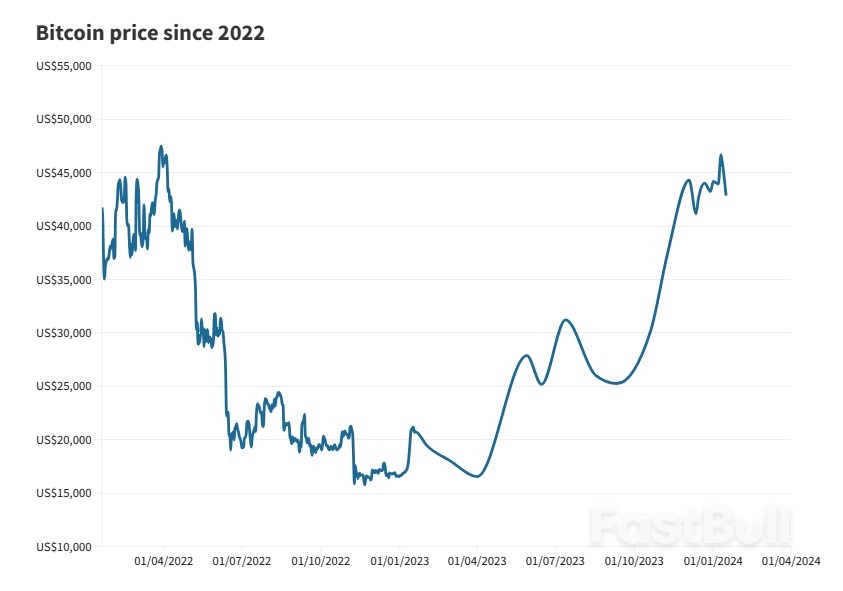
          Well, the first is in and has turned out to be a damp squib. After an initial sharp rise in interest on the SEC's approval, Bitcoin quickly gave up its gains.
          Has hype raced ahead of reality again?
          On January 10, the SEC announced the supposedly game-changing news that it was giving regulatory approval to the first spot Bitcoin ETFs in the US.
          The SEC approved 11 ETFs in total, including offerings from fund management behemoths BlackRock, Fidelity, Ark, VanEck and Invesco, plus specialists including Grayscale, Bitwise and Hashdex.
          Binance chief executive Richard Teng spoke for many by claiming the SEC move brings added credibility to the digital asset industry and “signals an exciting new era of adoption and legitimacy, not just for Bitcoin but also for the broader crypto space”.
          Trading began last Thursday and was brisk, with $4.6 billion worth of shares traded by close of day, according to London Stock Exchange Group data.
          Bitcoin soared to $48,711 on January 11, up another 15 per cent following last year's hyper-powered 150 per cent surge. It then plunged back to about $42,000 in a classic case of “buy the rumour, sell the fact”.
          Everyone knew spot Bitcoin ETFs were coming. Their arrival was priced in, as is April's Bitcoin halving.
          So much for the Bitcoin big bang. Yet, these are early days.
          BlackRock claims that its iShares Bitcoin Trust (IBIT) offers investors two main advantages.
          First, it allows investors to gain access to Bitcoin within a traditional broker's account. Second, it spares them the “operational burdens” associated with buying Bitcoin directly, such as “high trading costs and tax reporting complexities”.
          Fund manager Ark reckons its 21Shares Bitcoin ETF (ARKB) offers investors a “tool for diversification” by allowing them to add an asset with low correlation to traditional portfolio assets.
          Investors no longer have to master “arcane details of how to safely trade or store” Bitcoins, which Ark will keep in “cold storage” – secure offline environments safe from hacking and theft.
          Given that a million or so Bitcoins have been lost or stolen, these are real benefits.
          Charges are low, too. Ark has no initial fees and an annual management charge of 0.21 per cent. BlackRock charges slightly more at 0.25 per cent but with an initial 12-month reduction to 0.12 per cent on the first $5 billion.
          What spot ETFs have not done is change Bitcoin's speculative nature, says Laith Khalaf, head of investment analysis at UK-based fund platform AJ Bell.
          He notes that in 2021, London's Financial Conduct Authority banned the sale of exchange-traded notes offering Bitcoin exposure.
          “Its argument was that crypto had no inherent value, was wildly volatile, rife with financial crime and didn't fulfil a financial planning need. So, what's changed? Not much.”
          Sometimes you should be careful what you wish for, Mr Khalaf says.
          “It's hard to make a case that crypto fulfils a genuine financial planning need that can't be met by other assets, but it definitely does open up investors to the possibility of very heavy losses.”
          The new breed of spot Bitcoin ETFs are not available for sale in the UK and Europe, where regulators remain wary, Mr Khalaf adds.
          Others are more optimistic. Lukman Otunuga, senior market analyst at online trading broker FXTM, calls the SEC move a “historic moment” that will bring in fresh inflows from retail and institutional investors.
          He also rightly predicted that early price falls were likely “before investor inflows push prices higher down the road”.
          Wild price fluctuations represent a huge opportunity for traders, but they will need cool heads, Mr Otunuga adds.
          “They should be conscious that resistance may be around $47,000, then $50,000. Beyond this point is the all-time high just below $69,000.”
          It could go the other way, too. “Should prices slip back below $37,000, this may open the doors towards $30,000 and $20,000 instead,” he cautions.
          Vijay Valecha, chief investment officer at Century Financial, says Bitcoin has strong technical support around $39,000 on the downside, while warning that $48,000 still holds as a “major line of upside resistance”.
          Bitcoin's newfound respectability has done more to help smaller cryptocurrencies, with second-biggest Ether the clear winner.
          Can Bitcoin ETFs Trigger a Big Bang for Cryptocurrencies?_1While Bitcoin was trading at $42,850.09 on Tuesday morning, Ether was up almost 1 per cent at $2,532.36, driven by hopes that it will soon have a spot ETF of its own, Mr Valecha says.
          “Altcoins such as XRP, Cardano, Avalanche, Polkadot, Dogecoin, Polygon, Shiba Inu and Chainlink rose between 5 per cent and 14 per cent.”
          He expects more short-term volatility, but a longer-term boost as “leading institutions, including hedge funds, sovereign wealth funds and registered investment advisers” pile in.
          Manuel Villegas, digital assets analyst at Julius Baer, is also accentuating the positives, citing “long-term holder accumulation, slowing miner supply growth and the upcoming block-reward halving, paired with a growing conviction that the fastest and steepest US monetary tightening cycle has ended”.
          However, it will remain volatile, he warns, with a “consolidation, nevertheless, on the cards, following the steepness of the recent rally”.
          Mr Villegas predicts an ETF “fee war” as fund managers slash charges to grab market share.
          Giving that most spot Bitcoin ETFs do the same job, tracking the price, “fees are one of the only notable differences”.
          Matthew Weller, global head of research at Forex.com and City Index, says the launch of the SPDR Gold ETF in November 2004 provides a positive parallel.
          “For the first time, Americans had an easy, liquid way to invest in the precious metal and money poured in. That contributed to gold's big rally from below $500 to nearly $2,000 over the next eight years.”
          Mr Weller shrugs off the Bitcoin price pullback.
          “As long as the ETFs are attracting assets, dips may be relatively limited,” he says.
          Bitcoin spot ETFs have not put a rocket under cryptocurrencies and nor will the Bitcoin halving. Instead, 2024 could be a slow burner.

          Source: The National News

          Risk Warnings and Disclaimers
          You understand and acknowledge that there is a high degree of risk involved in trading. Following any strategies or investment methods may lead to potential losses. The content on the site is provided by our contributors and analysts for information purposes only. You are solely responsible for determining whether any trading assets, securities, strategy, or any other product is suitable for investing based on your own investment objectives and financial situation.
          Comments
          Add to Favorites
          Share

          Libya's Uphill Struggle to Attract Oil Investment

          Owen Li

          Energy

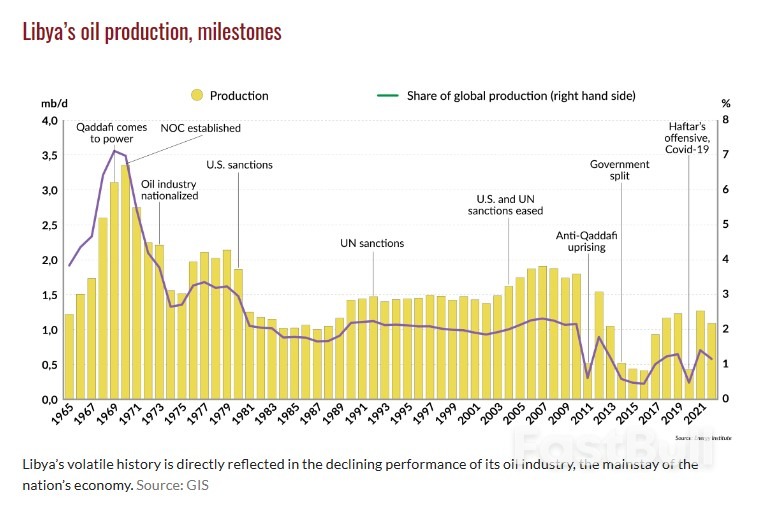
          Libya was once a very significant player in global oil markets. In 1970, at its zenith, its production reached nearly 3.4 million barrels a day (mb/d), making it the second-largest Arab oil producer after Saudi Arabia, which was then producing 3.8 million barrels per day. However, over half a century later, Libya's current production stands at only 32 percent of its peak, ranking it 18th in the world. The country now aspires to achieve an output of 2 million barrels per day by 2030.
          In 2017, Libya announced a more ambitious target of 2.2 million barrels per day by 2023, but this goal fell short – not due to a scarcity of oil. On the contrary, Libya's proven oil reserves have more than doubled in the last 40 years, making it Africa's largest holder of such reserves, constituting nearly 40 percent of the continent's total. Above-ground factors, primarily politics and poor governance, have hindered Libya from fully capitalizing on its oil wealth. The country's economy, in which oil accounts for 98 percent of its government revenues and 60 percent of gross domestic product (GDP), has been struggling as a result.
          Following the 1969 coup d'etat led by Libyan army officer Muammar Qaddafi, Libya experienced prolonged international isolation and sanctions. Just as these measures were lifted, a major popular uprising inspired by the Arab Spring revolutions in Tunisia and Egypt began in 2011. It resulted in the death of Qaddafi, the fall of his decades-long regime and a drastic overhaul of the political system. A civil war started in 2014, and although it officially concluded in 2020, the IMF continues to describe Libya as a “fragile and conflict-affected state” suffering from social and institutional frailty.
          This volatile history has had detrimental effects on the sentiment of oil-sector investors. While some hope has arisen recently, oil majors have yet to commit the capital needed to enable a significant increase in output. At current production levels, Libya's oil reserves can last nearly 340 years – the longest in the world. Unless the investment climate radically improves, Libya is bound to lose the most on the energy transition, with its potential oil riches at a high risk of becoming valueless.
          A volatile history
          In 1958, seven years after gaining independence from France and the United Kingdom, Libya made its first oil discovery, with production commencing a year later. By 1961, it inaugurated its oil exports and became a member of OPEC (Organization of the Petroleum Exporting Countries) in 1962. Between 1965 and 1969, Libyan oil production experienced remarkable growth, peaking in 1970.
          However, this success sowed trouble in the North African nation and shaped its history for decades to come. After ousting King Idris on September 1, 1969, Qaddafi set up the country's National Oil Corporation (NOC) in 1970 and three years later he nationalized the industry, which had been run primarily by foreign companies.
          Qaddafi's hostility toward Western governments and Libya's association with terrorist groups prompted the United States to impose its initial set of sanctions on the country in 1978. However, it was the December 1988 bombing of a Pan Am airliner over Lockerbie, Scotland, that led to Libya's most severe isolation. In November 1991, two Libyan intelligence operatives were indicted by Scottish and U.S. courts for their involvement in the attack. Despite the charges, Qaddafi's government refused to extradite them, resulting in the imposition of United Nations sanctions on Libya. This additional layer of international censure mainly affected investment in its oil sector.
          Until the sanctions were eased in 2004 – following Qaddafi's offers of counterterrorism cooperation after the 9/11 terror attacks on the U.S., coupled with his decision to dismantle Libya's weapons of mass destruction and long-range missile development programs – oil production struggled to exceed 1.5 million barrels per day. The relaxation of sanctions supported the return of international oil companies, which, in turn, boosted production.
          Just as things began to look better, Libya entered another period of instability following the spread of the Arab Spring from nearby countries. The overthrow of Qaddafi in 2011 left the country with a political vacuum. Warring factions attacked domestic oil production facilities, and Libya's production hit a low of 500,000 barrels per day that year.
          The country continues to be politically divided with two rival governments – one in Tripoli and the other in eastern Libya, each backed by different powers influential in the region.
          Libya's Uphill Struggle to Attract Oil Investment_1Divided nation
          The Government of National Stability (GNS), established by the Sirte-based House of Representatives (HoR), is predominantly backed by Egypt, Russia and the United Arab Emirates (UAE). It holds sway over the eastern and southwestern regions, encompassing most of Libya's oil fields, and is aligned with the self-styled Libyan National Army led by Field Marshal Khalifa Haftar.
          Meanwhile, the Government of National Unity (GNU), predominantly supported by Turkey and Western nations, and endorsed by the UN, exercises control over the capital, Tripoli, and its surrounding areas. Despite reconciliation attempts led by France, a political settlement between the two factions proved elusive. As a result, the east-west divide is likely to persist, as neither side can exert full military or political control over the country.
          The geographical distribution of oil production and export facilities accentuates this divide, with key terminals like Es Sider and Ras Lanuf comprising 42 percent of Libya's oil export capacity being located in the eastern part of the country under the GNS control. In the western part, under the influence of the GNU, two export facilities, Zawiya and Mellitah, account for 28 percent of the nation's oil exports.
          Amid this divide, both sides have staged oil blockades or production shutdowns as a tactic to demand a larger share of the oil proceeds or to achieve political gains. One such incident was the 10-month blockade in 2020 led by the eastern government, which severely curtailed the country's output. While there has been a degree of stability since then, in the absence of a unified government the prospect of such events happening again remains. The most recent occurrence took place in early January 2024, following a brief closure in July 2023; both impacted fields in the southwestern parts of the country.
          Recognizing the fragility of the situation, OPEC has exempted Libya from abiding by any quotas. The country's political troubles have exacted a high cost. In addition to the economic and human toll, Libya's influence on global oil markets has eroded, with the loss of market share from 7 percent in 1970 to a mere 1.2 percent in 2022. Other players have taken its place. Iraq, for instance, an OPEC peer and a country also classified by the IMF as fragile, in 1965 had nearly the same market share within OPEC as Libya (around 10 percent) but had managed to increase its share it to about 13 percent by 2022. Libya's share within OPEC has plunged to just 3 percent.
          Export directions
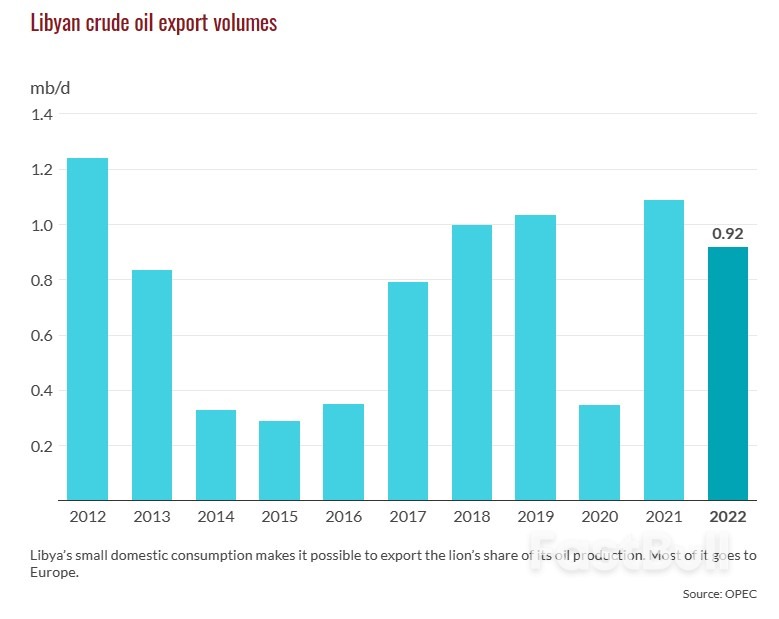
          Despite its diminished role, Libya continues to be an oil exporter that matters, particularly to Europe. The domestic market is small (about 200,000 barrels a day), allowing most Libyan production to be exported. Europe continues to be its largest market, given geographic proximity and historical ties, accounting for 71.5 percent of Libyan oil exports in 2022, while nearly 20 percent headed to Asia-Pacific and most of the remainder to North America. In that year, Libya was the sixth-biggest supplier of crude oil to the European Union after Russia, the U.S., Norway, Kazakhstan and Iraq.
          Taking advantage of Brussels' continuous search for alternative energy sources to Russia, Libya has increased its footprint in the EU, expanding its market share to nearly 8 percent and ranking as the fifth supplier of oil after Norway, the U.S., Kazakhstan and Saudi Arabia in the second quarter of 2023. Further increases, however, are contingent on Libya's ability to ramp up production.
          Libya's Uphill Struggle to Attract Oil Investment_2Investment badly needed
          Libya is keen on doing just that. Its national oil company plans to launch an oil and gas licensing round this year, the first such round in the last 17 years. Only the exploration licenses would be aimed at international oil companies. Libya's Minister of Oil and Gas Mohamed Oun explained: “We are not against international companies coming back, but they should come to conduct exploration activities, not into already discovered fields.”
          Before the civil war, Libya attracted a diverse group of investors, including European oil majors (Italy's Eni, Spanish Repsol, France's TotalEnergies), U.S. majors (such as ConocoPhillips and ExxonMobil), and other players (Algeria's Sonatrach, the Russian Gazprom and Tatneft) – with Eni being the most prominent player.
          While companies like Shell and ExxonMobil withdrew from the country after the start of the civil war (in 2012 and 2013 respectively), others have continued to play important roles. For instance, Eni has been operating in Libya since 1959 and relies on the country for approximately 10 percent of its production portfolio. Most of its stakes are in the fields in the western part of the country.

          Source: GIS

          Risk Warnings and Disclaimers
          You understand and acknowledge that there is a high degree of risk involved in trading. Following any strategies or investment methods may lead to potential losses. The content on the site is provided by our contributors and analysts for information purposes only. You are solely responsible for determining whether any trading assets, securities, strategy, or any other product is suitable for investing based on your own investment objectives and financial situation.
          Comments
          Add to Favorites
          Share

          Focus Sharpens on Fed's Disappearing Reverse Repo

          Samantha Luan

          Economic

          As the amount of cash parked at the Federal Reserve's overnight reverse repo facility (ON RRP) hurtles towards zero, the Fed's visibility on the minimum level of bank reserves needed to ensure the financial system functions smoothly also diminishes.
          Once the banking system gets close to what is considered the 'lowest comfortable level of reserves' (LCLOR), the Fed is in murkier territory where credit conditions could suddenly be adversely affected, as happened in late 2019.
          The daily RRP is sometimes seen as a gauge of excess reserves in the system and a barometer of how broader liquidity conditions are evolving. If it goes to zero, the Fed may be forced to tread more carefully in reducing its balance sheet.
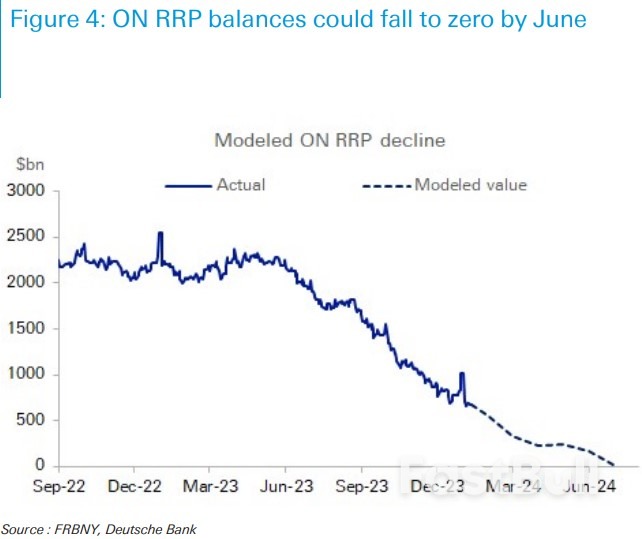
          At the current pace, the RRP balance will likely evaporate completely by the middle of the year. Many market participants and Fed officials see no problem with that, others are wary.
          Focus Sharpens on Fed's Disappearing Reverse Repo_1Two of the most influential U.S. central bankers have since addressed the issue publicly, and from slightly different angles.
          Fed Governor Christopher Waller on Tuesday showed little concern about an RRP balance of zero: "There's no reason for it to have anything in it," he said at an event hosted by the Brookings Institution.
          Dallas Fed President Lorie Logan, meanwhile, earlier this month said: "While the current level of ON RRP balances provides comfort that liquidity is ample in aggregate, there will be more uncertainty about aggregate liquidity conditions as ON RRP balances approach zero."
          The two voices carry weight. Waller's views are generally thought to be pretty closely aligned to those of Chair Jerome Powell, while Logan was recently in charge of managing the Fed's trillions of dollars of Fed assets at the New York Fed.
          Below $600 BLN and Falling
          The RRP is often considered to be a proxy for overall bank reserves and liquidity in the system, and therefore a guide post for the Fed in terms of how it views the pace of reducing its balance sheet via quantitative tightening.
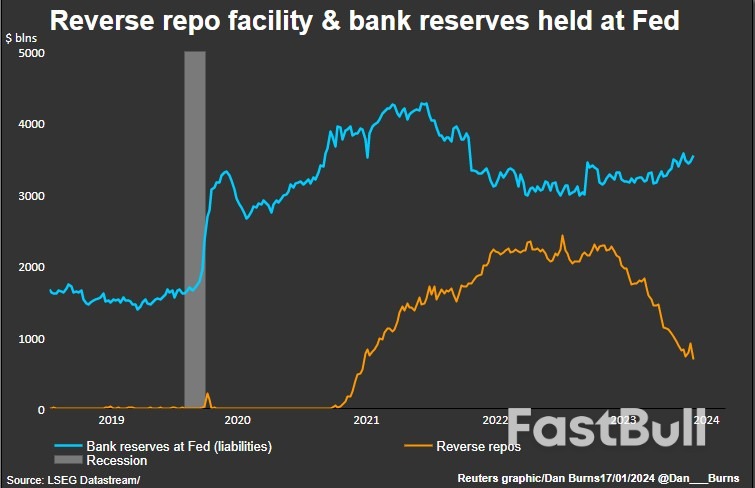
          The RRP balance on Tuesday fell to $583 billion, the lowest since June, 2021. In June last year it exceeded $2 trillion, indicating that around $1.5 trillion of liquidity has been drained from the system in seven months.
          Focus Sharpens on Fed's Disappearing Reverse Repo_2Logan's remarks are a reminder that the Fed wants to avoid a repeat of 2019.
          In September that year bank reserves dropped below the LCLOR needed to ensure the financial system plumbing functioned, repo rates shot up and the Fed was forced to halt QT and inject liquidity into the banking system.
          The LCLOR is an unknowable number until it is breached and a moving target. Total bank reserves held at the Fed stand at $3.5 trillion, more than double September 2019 levels of $1.4 trillion but down from a peak of $4.3 trillion two years ago.
          Deutsche Bank U.S. rates strategist Steven Zeng estimates that the RRP will continue falling briskly, by around $450 billion in the current quarter and down to zero by June.
          "I don't see any need for concern - Fed officials mostly expect the RRP to go to zero. But they will have to take greater care in monitoring liquidity conditions to avoid a repeat of 2019," Zeng warns.
          Cautious Approach
          A more rapid decline might bring forward the timing of discussions around QT but not necessarily a change in policy or the pace of running down the balance sheet, at least not initially.
          At the pace of contraction Zeng and others expect, it's not inconceivable that the RRP evaporates completely between Fed policy meetings. This is something officials would probably want to avoid, especially if they haven't already communicated their QT strategy to the market.
          If the Fed errs on the side of caution, it may tie the pace of QT to the RRP, effectively automatically slowing the balance sheet runoff once liquidity is no longer quite so ample.Focus Sharpens on Fed's Disappearing Reverse Repo_3
          Strategists at JP Morgan, on the other hand, believe the RRP should remain large enough in order to ensure there is no money market malfunction or liquidity shock, even if the 'LCLOR' is not under threat.
          "There's a growing consensus that RRP balances enable smooth functioning in money markets, thus allowing the continued effective transmission of monetary policy," they wrote last week.
          This is more in line with the latest New York Fed survey of primary dealers carried out before the Fed's Dec. 12-13 policy meeting.
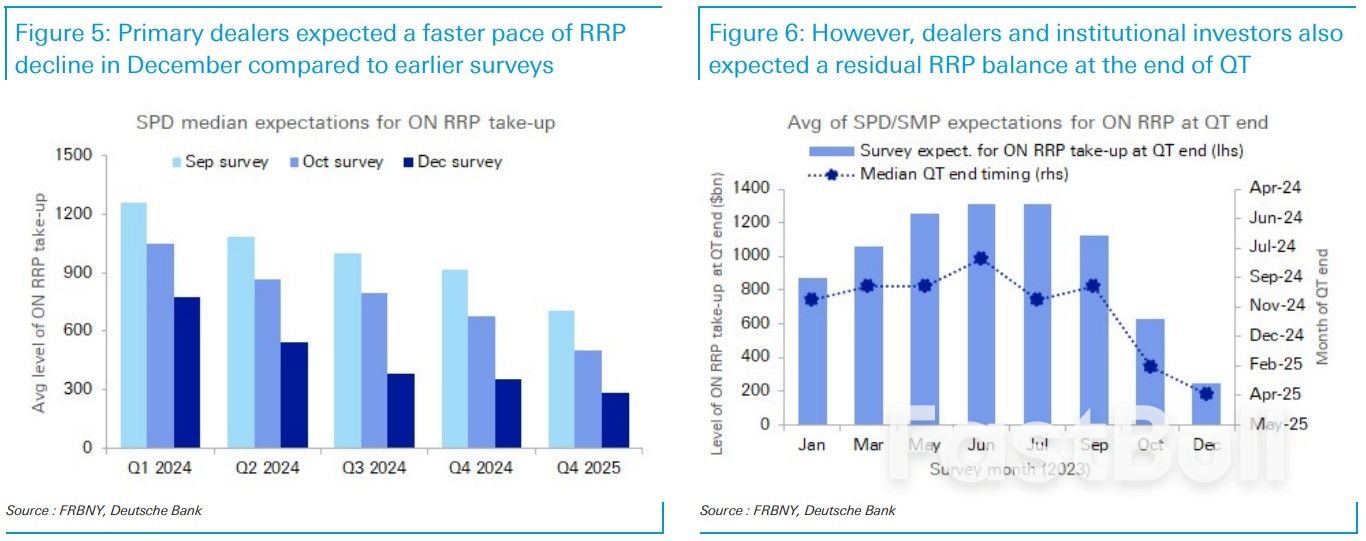
          It shows Wall Street's titans' median forecast is for the Fed to end QT in the fourth quarter this year, with total bank reserves projected to be $3.125 trillion and the RRP balance at $375 billion.
          That's down significantly from a projected $625 billion in the October survey, but still comfortably above zero. Those taking a benign stance on the RRP may have that put to the test sooner rather than later.

          Source: Reuters

          To stay updated on all economic events of today, please check out our Economic calendar
          Risk Warnings and Disclaimers
          You understand and acknowledge that there is a high degree of risk involved in trading. Following any strategies or investment methods may lead to potential losses. The content on the site is provided by our contributors and analysts for information purposes only. You are solely responsible for determining whether any trading assets, securities, strategy, or any other product is suitable for investing based on your own investment objectives and financial situation.
          Comments
          Add to Favorites
          Share

          China's Ageing Population Threatens Switch to New Economic Growth Model

          Thomas

          Economic

          China's ageing population threatens key Beijing policy goals for the coming decade of boosting domestic consumption and reining in ballooning debt, posing a severe challenge to the economy's long-term growth prospects.
          A record low birth rate in 2023 and a wave of COVID-19 deaths resulted in a second consecutive year of population decline, accelerating concerns about China's demographic downturn.
          Large groups of the 1.4 billion people living in the world's second-largest economy will exit the labour pool and age past a prime period of their lives for consumption, exacerbating structural imbalances that policymakers have vowed to address.
          Household consumption's share of economic output in China is already one of the lowest in the world, while many provincial governments - responsible for pensions and elderly care - are deep in debt as a result of decades of credit-fuelled investment-driven growth.
          "China's age structure change will slow down economic growth," said Xiujian Peng,  senior research fellow at the Centre of Policy Studies (CoPS) at Victoria University in Melbourne.
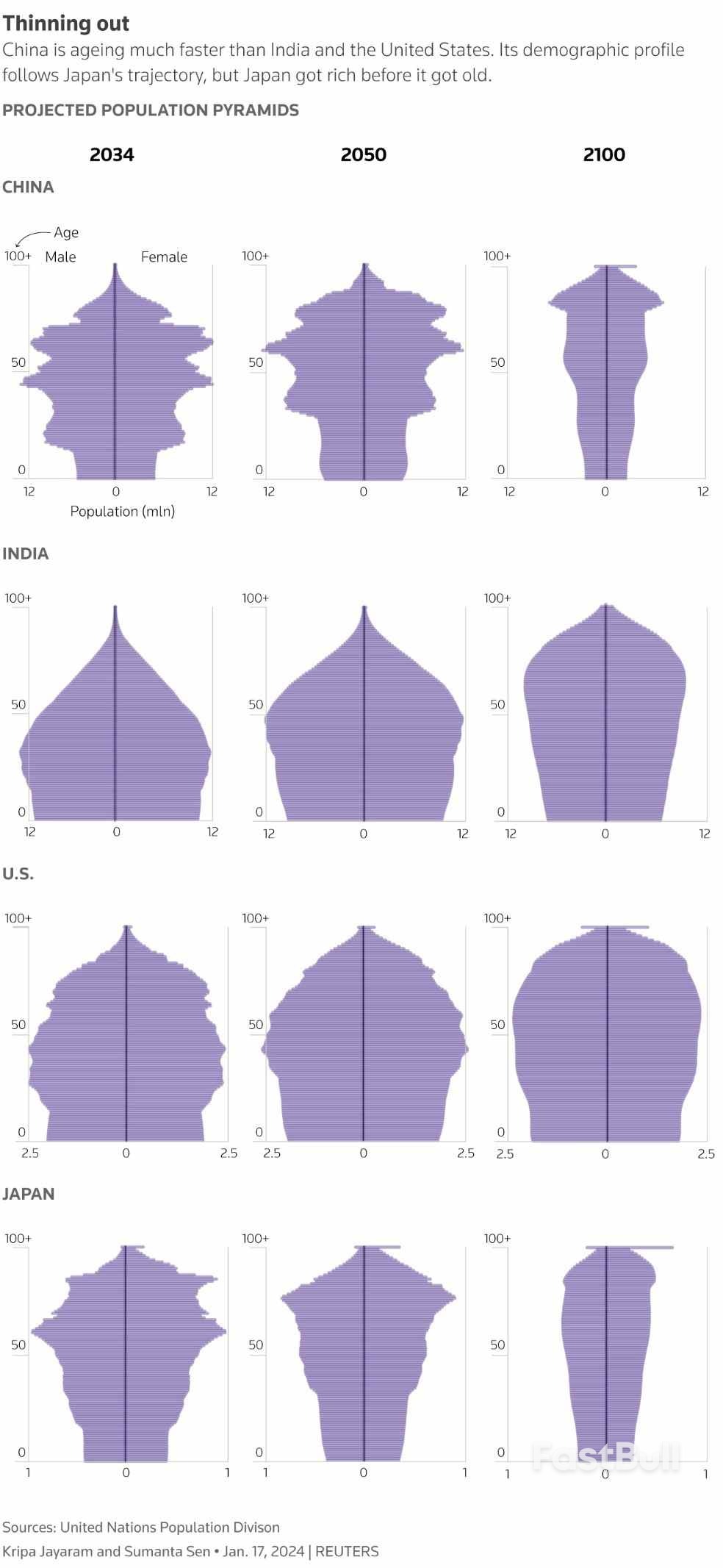
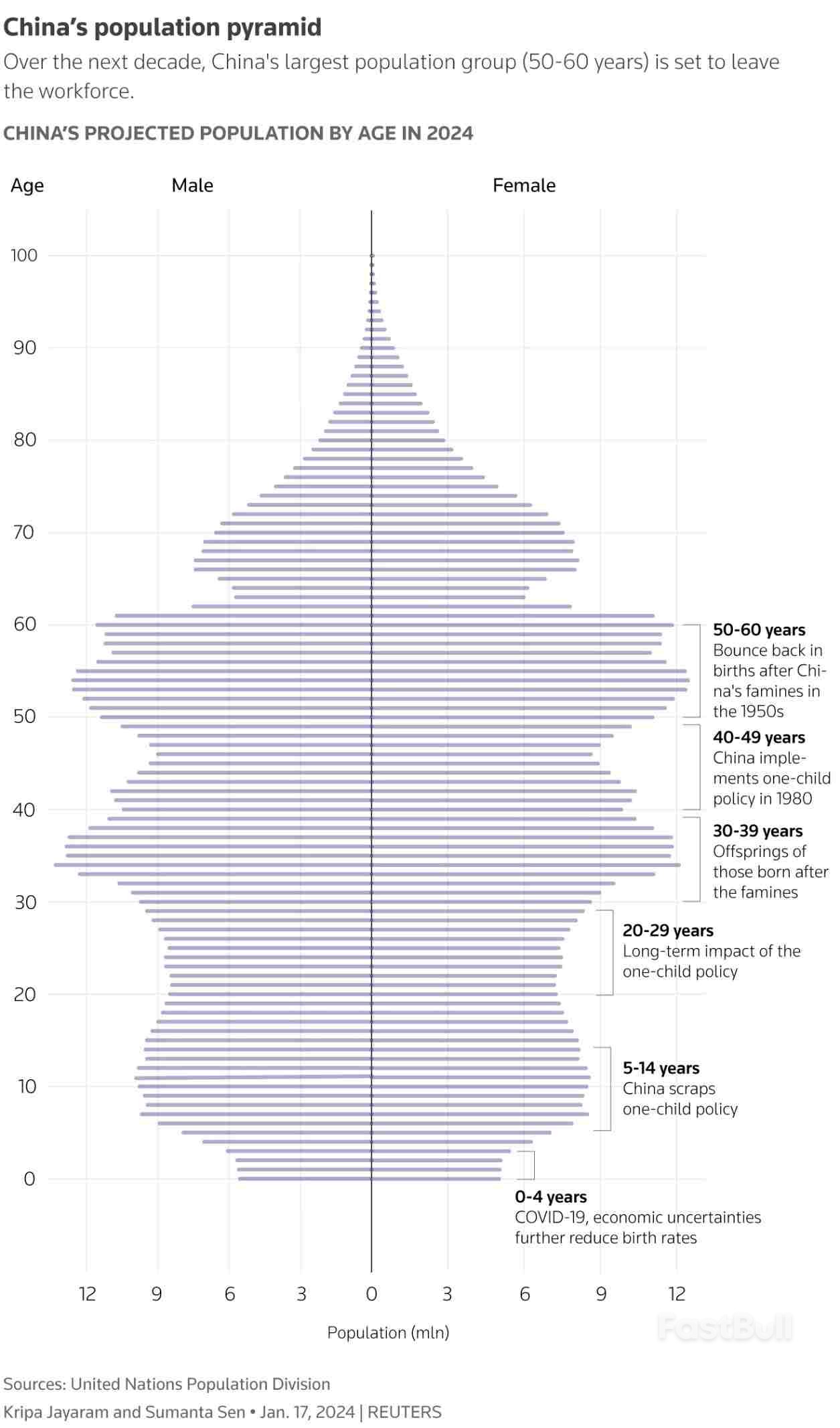
          In the next 10 years, about 300 million people currently aged 50 to 60 - China's largest demographic group, equivalent to almost the entire U.S. population - are set to leave the workforce at a time when pension budgets are already stretched.
          The state-run Chinese Academy of Sciences sees the pension system running out of money by 2035, with about a third of the country's provincial-level jurisdictions running pension budget deficits, according to finance ministry data.
          China's Ageing Population Threatens Switch to New Economic Growth Model_1Low Retirement Age
          China, which accepts few and only highly-skilled foreign workers, has one of the world's lowest retirement ages, at 60 for men, 55 for white-collar women and 50 for women who work in factories. A record 28 million people are scheduled to retire this year.
          Employees at state-owned companies are typically mandated to retire when of age, while private employers rarely keep workers longer, whereas in some Western countries the retirement age is more flexible.
          Unemployed Li Zhulin, 50, from the northwestern Shaanxi province frets about relying solely on her husband's pension of about 5,000 to 7,000 yuan ($697 to $975) per month when he retires in 2027 after a career at a state-owned company.
          Li has been cutting back on expenses and scouring the internet for financial planning tips to try to be "less of a burden" for her only daughter.
          "In addition to supporting her own family if she marries, she would also take care of four elderly people," Li said, including the husband's parents. "I can't imagine how difficult that would be."
          Chinese society has traditionally expected children to support their parents financially as they age and often by living together to care for them.
          But as in many Western countries, rapid urbanisation has shifted young people to bigger cities and away from their parents, prompting a rising number of seniors to rely on self care or government payments.
          Whereas five workers supported every Chinese retiree in 2020, the ratio will decline to 2.4 workers in 2035 and 1.6 in 2050, estimates University of Wisconsin-Madison demographer Yi Fuxian.
          "By that point, China's pension crisis will develop into a humanitarian catastrophe," Yi said.
          Japan's ratio was 2 to 1 in 2022 and is projected to hit 1.3 to 1 in 2070 according to its government. But Japan was already a high-income economy before its population's ageing accelerated.
          China's Ageing Population Threatens Switch to New Economic Growth Model_2Ageing Consumers
          China's second-largest group, about 230 million people aged 30 to 49, are in a prime period for consumption as their career is advanced enough to afford buying homes and cars and parents begin spending on child education.
          Once the group reaches their 50s, their children will finish schooling and start earning their own income, meaning the cohort is expected to participate less in domestic consumption.
          Their future replacement, currently in their 20s, is the smallest generation since the famines of the 1950s, a direct result of China's one-child policy from 1980 to 2015.
          This bodes ill for China's property sector, which accounted for about a quarter of its economic output before its bubble popped in 2021 due to over-leveraged developers and excess supply of apartments, drawing comparisons with Japan's predicament in the 1990s before its lost decades of stagnation.
          "Japan's experience shows that as the share of the working age population declines, so does demand for housing," said Larry Hu, chief China economist at Macquarie.
          Innovation Woes
          China saw a rise in births after ditching the one-child policy but the recovery was far off pre-implementation levels and also short-lived. Fewer children were born in each of the past eight years, including 2023.
          Demographers say the number of children in any economy is directly correlated with domestic consumption.
          Peng at CoPS says a shrinking domestic market will increase China's reliance on exports. With China already producing a third of the goods consumed around the world, it has redirected credit flows from property to manufacturing, in a bid to lift industries up the value chain and avoid the middle income trap.
          But, Peng says, an ageing workforce "means they have less incentives to innovate, and a slower, not faster, productivity improvement."
          ($1 = 7.1821 Chinese yuan renminbi)

          Source: Reuters

          To stay updated on all economic events of today, please check out our Economic calendar
          Risk Warnings and Disclaimers
          You understand and acknowledge that there is a high degree of risk involved in trading. Following any strategies or investment methods may lead to potential losses. The content on the site is provided by our contributors and analysts for information purposes only. You are solely responsible for determining whether any trading assets, securities, strategy, or any other product is suitable for investing based on your own investment objectives and financial situation.
          Comments
          Add to Favorites
          Share
          FastBull
          Copyright © 2025 FastBull Ltd

          728 RM B 7/F GEE LOK IND BLDG NO 34 HUNG TO RD KWUN TONG KLN HONG KONG

          TelegramInstagramTwitterfacebooklinkedin
          App Store Google Play Google Play
          Products
          Charts

          Chats

          Q&A with Experts
          Screeners
          Economic Calendar
          Data
          Tools
          Membership
          Features
          Function
          Markets
          Copy Trading
          Latest Signals
          Contests
          News
          Analysis
          24/7
          Columns
          Education
          Company
          Careers
          About Us
          Contact Us
          Advertising
          Help Center
          Feedback
          User Agreement
          Privacy Policy
          Business

          White Label

          Data API

          Web Plug-ins

          Poster Maker

          Affiliate Program

          Risk Disclosure

          The risk of loss in trading financial instruments such as stocks, FX, commodities, futures, bonds, ETFs and crypto can be substantial. You may sustain a total loss of the funds that you deposit with your broker. Therefore, you should carefully consider whether such trading is suitable for you in light of your circumstances and financial resources.

          No decision to invest should be made without thoroughly conducting due diligence by yourself or consulting with your financial advisors. Our web content might not suit you since we don't know your financial conditions and investment needs. Our financial information might have latency or contain inaccuracy, so you should be fully responsible for any of your trading and investment decisions. The company will not be responsible for your capital loss.

          Without getting permission from the website, you are not allowed to copy the website's graphics, texts, or trademarks. Intellectual property rights in the content or data incorporated into this website belong to its providers and exchange merchants.

          Not Logged In

          Log in to access more features

          FastBull Membership

          Not yet

          Purchase

          Become a signal provider
          Help Center
          Customer Service
          Dark Mode
          Price Up/Down Colors

          Log In

          Sign Up

          Position
          Layout
          Fullscreen
          Default to Chart
          The chart page opens by default when you visit fastbull.com