• Trade
  • Markets
  • Copy
  • Contests
  • News
  • 24/7
  • Calendar
  • Q&A
  • Chats
Trending
Screeners
SYMBOL
LAST
BID
ASK
HIGH
LOW
NET CHG.
%CHG.
SPREAD
SPX
S&P 500 Index
6817.03
6817.03
6817.03
6861.30
6816.32
-10.38
-0.15%
--
DJI
Dow Jones Industrial Average
48394.52
48394.52
48394.52
48679.14
48386.50
-63.52
-0.13%
--
IXIC
NASDAQ Composite Index
23097.86
23097.86
23097.86
23345.56
23095.65
-97.30
-0.42%
--
USDX
US Dollar Index
97.770
97.850
97.770
98.070
97.750
-0.180
-0.18%
--
EURUSD
Euro / US Dollar
1.17653
1.17661
1.17653
1.17686
1.17262
+0.00259
+ 0.22%
--
GBPUSD
Pound Sterling / US Dollar
1.33923
1.33930
1.33923
1.34014
1.33546
+0.00216
+ 0.16%
--
XAUUSD
Gold / US Dollar
4322.76
4323.19
4322.76
4350.16
4294.68
+23.37
+ 0.54%
--
WTI
Light Sweet Crude Oil
56.750
56.780
56.750
57.601
56.635
-0.483
-0.84%
--

Community Accounts

Signal Accounts
--
Profit Accounts
--
Loss Accounts
--
View More

Become a signal provider

Sell trading signals to earn additional income

View More

Guide to Copy Trading

Get started with ease and confidence

View More

Signal Accounts for Members

All Signal Accounts

Best Return
  • Best Return
  • Best P/L
  • Best MDD
Past 1W
  • Past 1W
  • Past 1M
  • Past 1Y

All Contests

  • All
  • Trump Updates
  • Recommend
  • Stocks
  • Cryptocurrencies
  • Central Banks
  • Featured News
Top News Only
Share

Spot Platinum Rises 3% To $1798.18/Oz

Share

Miran: Do Not Support Sales Of Mortgage-Backed Securities Because It Might At This Point Involve The Fed Realizing Losses On Its Holdings

Share

Miran: Would Prefer An All Treasury Balance Sheet Unless There Is Another Crisis Centered In The Housing Market

Share

Miran: The Standing Repo Facility Is Not As Effective As Fed Hoped It Would Be

Share

Miran: The Renewal Of Treasury Bill Purchases By The Fed Are Not QE, And Will Continue To Transfer Some Risk To Private Markets

Share

USA Attorney General Bondi: Justice Department, Fbi Foils 'Terror Plot' In California's Orange County And Los Angeles

Share

Mexico Central Bank Poll: Private Sector Analysts See End-2026 Exchange Rate At 19.23 Pesos Per USD Versus 19.26 Pesos Per USD In Previous Poll

Share

Mexico Central Bank Poll: Private Sector Analysts See End-2025 Exchange Rate At 18.50 Pesos Per USD Versus 18.70 Pesos Per USD In Previous Poll

Share

Mexico Central Bank Poll: Private Sector Analysts See 2027 Core Inflation At 3.75%

Share

Mexico Central Bank Poll: Private Sector Analysts See 2026 Core Inflation At 3.90% Versus 3.90% In Previous Poll

Share

Mexico Central Bank Poll: Private Sector Analysts See 2025 Core Inflation At 4.24% Versus 4.25% In Previous Poll

Share

French Presidential Residence Elysee: Macron Will Go To Berlin On Monday For Talks On Ukraine

Share

Mexico Central Bank Poll: Private Sector Analysts See 2026 Headline Inflation At 3.88% Versus 3.90% In Previous Poll

Share

Mexico Central Bank Poll: Private Sector Analysts See 2025 Headline Inflation At 3.75% Versus 3.74% In Previous Poll

Share

Ukraine's Sbu Says It Hit Russian Submarine In Novorossiysk

Share

Pap - Poland Had Budget Deficit Of Pln 244.9 Billion At End Nov 2025

Share

All Three Major U.S. Stock Indexes Fell

Share

Ukrainians Told USA Side That Further Discussion Needed, Territorial Question Still Unresolved On Monday, According To Official Familiar With Matter

Share

Official: USA Side Sees Territory As Central Issue For Russians

Share

Miran: Don't See Evidence Of Concern In Inflation Expectations Data

TIME
ACT
FCST
PREV
Japan Tankan Small Manufacturing Outlook Index (Q4)

A:--

F: --

P: --

Japan Tankan Large Non-Manufacturing Outlook Index (Q4)

A:--

F: --

P: --

Japan Tankan Large Manufacturing Outlook Index (Q4)

A:--

F: --

P: --

Japan Tankan Small Manufacturing Diffusion Index (Q4)

A:--

F: --

P: --

Japan Tankan Large-Enterprise Capital Expenditure YoY (Q4)

A:--

F: --

P: --

U.K. Rightmove House Price Index YoY (Dec)

A:--

F: --

P: --

China, Mainland Industrial Output YoY (YTD) (Nov)

A:--

F: --

P: --

China, Mainland Urban Area Unemployment Rate (Nov)

A:--

F: --

P: --

Saudi Arabia CPI YoY (Nov)

A:--

F: --

P: --

Euro Zone Industrial Output YoY (Oct)

A:--

F: --

P: --

Euro Zone Industrial Output MoM (Oct)

A:--

F: --

P: --

Canada Existing Home Sales MoM (Nov)

A:--

F: --

P: --

Canada National Economic Confidence Index

A:--

F: --

P: --

Canada New Housing Starts (Nov)

A:--

F: --

P: --
U.S. NY Fed Manufacturing Employment Index (Dec)

A:--

F: --

P: --

U.S. NY Fed Manufacturing Index (Dec)

A:--

F: --

P: --

Canada Core CPI YoY (Nov)

A:--

F: --

P: --

Canada Manufacturing Unfilled Orders MoM (Oct)

A:--

F: --

P: --

U.S. NY Fed Manufacturing Prices Received Index (Dec)

A:--

F: --

P: --

U.S. NY Fed Manufacturing New Orders Index (Dec)

A:--

F: --

P: --

Canada Manufacturing New Orders MoM (Oct)

A:--

F: --

P: --

Canada Core CPI MoM (Nov)

A:--

F: --

P: --

Canada Trimmed CPI YoY (SA) (Nov)

A:--

F: --

P: --

Canada Manufacturing Inventory MoM (Oct)

A:--

F: --

P: --

Canada CPI YoY (Nov)

A:--

F: --

P: --

Canada CPI MoM (Nov)

A:--

F: --

P: --

Canada CPI YoY (SA) (Nov)

A:--

F: --

P: --

Canada Core CPI MoM (SA) (Nov)

A:--

F: --

P: --

Canada CPI MoM (SA) (Nov)

A:--

F: --

P: --

Federal Reserve Board Governor Milan delivered a speech
U.S. NAHB Housing Market Index (Dec)

A:--

F: --

P: --

Australia Composite PMI Prelim (Dec)

--

F: --

P: --

Australia Services PMI Prelim (Dec)

--

F: --

P: --

Australia Manufacturing PMI Prelim (Dec)

--

F: --

P: --

Japan Manufacturing PMI Prelim (SA) (Dec)

--

F: --

P: --

U.K. 3-Month ILO Employment Change (Oct)

--

F: --

P: --

U.K. Unemployment Claimant Count (Nov)

--

F: --

P: --

U.K. Unemployment Rate (Nov)

--

F: --

P: --

U.K. 3-Month ILO Unemployment Rate (Oct)

--

F: --

P: --

U.K. Average Weekly Earnings (3-Month Average, Including Bonuses) YoY (Oct)

--

F: --

P: --

U.K. Average Weekly Earnings (3-Month Average, Excluding Bonuses) YoY (Oct)

--

F: --

P: --

France Services PMI Prelim (Dec)

--

F: --

P: --

France Composite PMI Prelim (SA) (Dec)

--

F: --

P: --

France Manufacturing PMI Prelim (Dec)

--

F: --

P: --

Germany Services PMI Prelim (SA) (Dec)

--

F: --

P: --

Germany Manufacturing PMI Prelim (SA) (Dec)

--

F: --

P: --

Germany Composite PMI Prelim (SA) (Dec)

--

F: --

P: --

Euro Zone Composite PMI Prelim (SA) (Dec)

--

F: --

P: --

Euro Zone Services PMI Prelim (SA) (Dec)

--

F: --

P: --

Euro Zone Manufacturing PMI Prelim (SA) (Dec)

--

F: --

P: --

U.K. Services PMI Prelim (Dec)

--

F: --

P: --

U.K. Manufacturing PMI Prelim (Dec)

--

F: --

P: --

U.K. Composite PMI Prelim (Dec)

--

F: --

P: --

Euro Zone ZEW Economic Sentiment Index (Dec)

--

F: --

P: --

Germany ZEW Current Conditions Index (Dec)

--

F: --

P: --

Germany ZEW Economic Sentiment Index (Dec)

--

F: --

P: --

Euro Zone Trade Balance (Not SA) (Oct)

--

F: --

P: --

Euro Zone ZEW Current Conditions Index (Dec)

--

F: --

P: --

Euro Zone Trade Balance (SA) (Oct)

--

F: --

P: --

U.S. Retail Sales MoM (Excl. Gas Stations & Vehicle Dealers) (SA) (Oct)

--

F: --

P: --

U.S. Retail Sales MoM (Excl. Automobile) (SA) (Oct)

--

F: --

P: --

Q&A with Experts
    • All
    • Chatrooms
    • Groups
    • Friends
    Connecting
    .
    .
    .
    Type here...
    Add Symbol or Code

      No matching data

      All
      Trump Updates
      Recommend
      Stocks
      Cryptocurrencies
      Central Banks
      Featured News
      • All
      • Russia-Ukraine Conflict
      • Middle East Flashpoint
      • All
      • Russia-Ukraine Conflict
      • Middle East Flashpoint
      Search
      Products

      Charts Free Forever

      Chats Q&A with Experts
      Screeners Economic Calendar Data Tools
      Membership Features
      Data Warehouse Market Trends Institutional Data Policy Rates Macro

      Market Trends

      Market Sentiment Order Book Forex Correlations

      Top Indicators

      Charts Free Forever
      Markets

      News

      News Analysis 24/7 Columns Education
      From Institutions From Analysts
      Topics Columnists

      Latest Views

      Latest Views

      Trending Topics

      Top Columnists

      Latest Update

      Signals

      Copy Rankings Latest Signals Become a signal provider AI Rating
      Contests
      Brokers

      Overview Brokers Assessment Rankings Regulators News Claims
      Broker listing Forex Brokers Comparison Tool Live Spread Comparison Scam
      Q&A Complaint Scam Alert Videos Tips to Detect Scam
      More

      Business
      Events
      Careers About Us Advertising Help Center

      White Label

      Data API

      Web Plug-ins

      Affiliate Program

      Awards Institution Evaluation IB Seminar Salon Event Exhibition
      Vietnam Thailand Singapore Dubai
      Fans Party Investment Sharing Session
      FastBull Summit BrokersView Expo
      Recent Searches
        Top Searches
          Markets
          News
          Analysis
          User
          24/7
          Economic Calendar
          Education
          Data
          • Names
          • Latest
          • Prev

          View All

          No data

          Scan to Download

          Faster Charts, Chat Faster!

          Download App
          English
          • English
          • Español
          • العربية
          • Bahasa Indonesia
          • Bahasa Melayu
          • Tiếng Việt
          • ภาษาไทย
          • Français
          • Italiano
          • Türkçe
          • Русский язык
          • 简中
          • 繁中
          Open Account
          Search
          Products
          Charts Free Forever
          Markets
          News
          Signals

          Copy Rankings Latest Signals Become a signal provider AI Rating
          Contests
          Brokers

          Overview Brokers Assessment Rankings Regulators News Claims
          Broker listing Forex Brokers Comparison Tool Live Spread Comparison Scam
          Q&A Complaint Scam Alert Videos Tips to Detect Scam
          More

          Business
          Events
          Careers About Us Advertising Help Center

          White Label

          Data API

          Web Plug-ins

          Affiliate Program

          Awards Institution Evaluation IB Seminar Salon Event Exhibition
          Vietnam Thailand Singapore Dubai
          Fans Party Investment Sharing Session
          FastBull Summit BrokersView Expo

          Gigs, Scams, Ghost Work: India Tech Sector's Dark Side

          Thomas

          Economic

          Summary:

          After finishing college in the western Indian city of Ahmedabad, Saurav hunted for work for more than four months before he came across an advertisement for jobs at a call centre. He signed up, not knowing it would one day land him in jail.

          After finishing college in the western Indian city of Ahmedabad, Saurav hunted for work for more than four months before he came across an advertisement for jobs at a call centre. He signed up, not knowing it would one day land him in jail.
          In his job, Saurav - who asked to go by one name to protect his identity - called people in the United States, enticed them to sign up for loans and insurance policies, then told them they needed to improve their credit score by paying $50-$100.
          Only, he did not work for a bank or an insurer, but a scam call centre that pitched fake products and robbed people of money that they thought would improve their credit scores.
          "I didn't realise at first. It was only much later that I realised that the job was to cheat people after speaking to other colleagues who worked there," said Saurav, 25.
          "But I was already too involved in it, and I was certain that I would not get another job where I could earn 20,000-25,000 rupees ($241-$302) a month, so I continued working there," he told the Thomson Reuters Foundation.
          The call centre was one of thousands perpetuating telefraud on millions of people every day in India, the United States, Britain and elsewhere, with employees posing as tax officials, as workers at banks and insurers, and as tech support.
          Indian police have raided hundreds of such centres in Ahmedabad, Delhi, Gurugram, Mumbai and Kolkata in recent years, and said they have charged thousands with fraud.
          Saurav and two of his colleagues were arrested last year, and he spent five months in jail.
          As he belatedly realised, was part of the dark underbelly of India's $220-billion information technology services industry that boomed as global firms outsourced customer support to cheaper workers with college degrees who spoke English.
          But these very same factors also encouraged a parallel industry of scam call centres, with American citizens alone losing more than $10 billion to phishing gangs and fraud call centre operations in India last year, according to data from the Federal Bureau of Investigation cited by local media.
          "All one needs is a computer or laptop, a phone, an internet connection, and data, which is available easily on the black market," said Ajit Rajiaan, a deputy commissioner of police in Ahmedabad, who has raided dozens of such operations in the city.
          "The call centre can be run from a house, an office, or just about any place," he said, adding that nearly all those who have been arrested at such operations are men aged 18 to 25, with either a high school education or a college degree.
          Future of Work
          India is poised to become the world's most populous country in April, overtaking China with more than 1.43 billion people, according to estimates by the United Nations.
          It also has among the youngest populations, with more than 40% under 25 years. Yet the pace of economic growth is not enough to accommodate some 12 million people joining the workforce each year.
          So educated youth - once touted as a demographic dividend - are forced to turn to the gig economy delivering food and groceries, to scam call centres, online microwork, and other low-paid jobs, analysts say.
          "We are at a critical moment," said Amit Basole at the Azim Premji University Centre for Sustainable Employment, pointing to high rates of unemployment among educated youth, low labour force participation of women, and "forced self-employment" because of the lack of productive jobs.
          "Newly created jobs are often of the precarious kind - including gig work," he added.
          Mohammed Ahmed, 21, knows this first-hand.
          He has worked part-time for more than two years for Zomato and Swiggy, the largest food delivery platforms in India, putting in about six hours a day and earning about 10,000 rupees a month while he goes to college.
          "I will not get a job with just a Bachelor's degree. I have to also do a Master's degree," he said.
          "Even then I am not sure I can get a well-paying job. So I need this job to earn a living."
          India is one of the largest and fastest-growing markets for the so-called gig economy, with nearly 8 million workers in 2020-21, and forecast to expand to 24 million workers by 2029-30, according to government think-tank Niti Aayog.
          But workers earn low wages and have few protections.
          "The government, the industry and employers pitch gig work as the future of work, glorifying it as something that is desirable," said Rikta Krishnaswamy, a coordinator at the All India Gig Workers' Union.
          "But what we are really seeing is an erosion of hard-won labour rights. With increased digitisation, gig work is only going to get bigger and worse - especially with data annotation and labelling for AI."
          Ghost Workers
          AI relies on data annotation, which is the action of tagging content such as text, photos, audio and video so that machine learning models can recognise them.
          Up to 1 million Indians could be working full-time or part-time in data annotation and labelling by 2030, estimates IT industry body NASSCOM.
          Workers in India already make up about a third of remote online workers for clients largely in the U.S. and Britain, according to the International Labour Organization.
          Several firms also provide managed services with full-time workers earning about 15,000-25,000 rupees a month.
          "Data annotation is the current outsourcing model. But clients don't pay much because it is a low-skill job," said Muzammil Hussain, founder of Tika Data in Bengaluru that has labelled more than 20 million images and 1 million words.
          "The money for this work is always going to be low because it is easy work, even if it's labour intensive," he said.
          About 50,000 freelancers operate as ghost workers, getting just a few cents to label data on platforms such as the crowdsourcing website for businesses Amazon Mechanical Turk, according to NASSCOM.
          Many are based in small towns, and have to deal with uncertain hours and wages.
          "It's hard to get an account, and there is a limited number of jobs for workers in India," said Naga Raj, 28, who has done on-demand tasks on Amazon Mechanical Turk for more than three years.
          "I may do 10-12 tasks, but only two or three may get approved, and I will only get paid for those - but I don't have a choice," he said.
          Workers like Raj are at the "bottom of the AI value chain" with no prospect of higher wages or upskilling, said Urvashi Aneja, director of Digital Futures Lab, who studies the platform economy.
          "There is a strong policy push that India can be the back-end for global AI production. But a lot of this work is very precarious, and it's not being thought through holistically, from the point of view of worker welfare or longevity," she said.
          "It's a pretty bleak outlook: a lot of the clickwork and piecework that is being outsourced now will also get automated."
          ($1 = 82.9249 Indian rupees)

          Source: bdnews24

          To stay updated on all economic events of today, please check out our Economic calendar
          Risk Warnings and Disclaimers
          You understand and acknowledge that there is a high degree of risk involved in trading. Following any strategies or investment methods may lead to potential losses. The content on the site is provided by our contributors and analysts for information purposes only. You are solely responsible for determining whether any trading assets, securities, strategy, or any other product is suitable for investing based on your own investment objectives and financial situation.
          Comments
          Add to Favorites
          Share

          What Are E-Fuels, and can They Help Make Cars CO2-Free?

          Owen Li
          Germany has declared last-minute opposition to a landmark European Union law to end sales of CO2-emitting cars in 2035, demanding that sales be allowed of new cars with internal combustion engines after that date if they run on e-fuels.
          The EU rules would require all new cars sold from 2035 to have zero CO2 emissions, making it effectively impossible to sell new fossil fuel-powered cars.
          The law - which Germany, alongside a majority of EU countries and lawmakers, previously supported - would not ban internal combustion engines (ICEs).
          But it is seen as a death knell for the technology because of a dearth of options that could enable ICE cars to operate without producing CO2.
          Here's what you need to know.
          What are E-Fuels?
          E-fuels, like e-kerosene, e-methane, or e-methanol, are made by synthesizing captured CO2 emissions and hydrogen produced using renewable or CO2-free electricity.
          The fuels release CO2 into the atmosphere when used in an engine. But the idea is that those emissions are equal to the amount taken out of the atmosphere to produce the fuel - making it CO2-neutral overall.
          Germany and Italy want clearer assurances from the EU that sales of new ICE cars can continue beyond 2035, if they run on CO2-neutral fuels.
          Who makes them?
          Most major carmakers are betting on battery-electric vehicles - a technology that is already widely available - as the main route to cut CO2 emissions from passenger cars.
          But suppliers and oil majors defend e-fuels, as well as a number of carmakers who don't want their vehicles weighed down by heavy batteries.
          E-fuels are not yet produced at scale. The world's first commercial plant opened in Chile in 2021, backed by Porsche and aiming to produce 550 million litres per year. Other planned plants include Norway's Norsk e-Fuel, due to begin producing in 2024 with a focus on aviation fuel.
          Can E-Fuels clean up cars?
          E-fuels can be used in today's ICE vehicles and transported via existing fossil fuel logistics networks - good news for ICE component makers and companies which transport petrol and diesel.
          Supporters say e-fuels offer a route to cut the CO2 emissions of our existing passenger car fleet, without replacing every vehicle with an electric one.
          Critics highlight that manufacturing e-fuels is very expensive and energy-intensive. Using e-fuels in an ICE car requires about five times more renewable electricity than running a battery-electric vehicle, according to a 2021 paper in the Nature Climate Change journal.
          Some policymakers also argue that e-fuels should be reserved for hard-to-decarbonise sectors such as shipping and aviation - which, unlike passenger cars, cannot easily run on electric batteries.
          What next for the EU law?
          Days before the final vote on the EU law, which was scheduled for March 7, German Transport Minister Volker Wissing called into question Germany's support for it.
          That has put one of Europe's core climate change policies on hold - and surprised other policymakers, because EU countries and lawmakers had already agreed the law last year.
          Alongside Germany and Italy, countries including the Czech Republic and Poland have expressed concerns about the law, raising the possibility of enough support to block it.
          But other EU lawmakers and diplomats warn that allowing one country to torpedo an already-agreed law would endanger other carefully negotiated deals on EU policies.
          Free Democratic Party member Wissing said the use of e-fuels should remain possible after 2035, and a promised European Commission proposal on this was still missing.
          In response, the European Commission has drafted a proposal, seen by Reuters , to allow carmakers to register new cars in the EU that can run on climate neutral e-fuels only. That could be a first step towards allowing their sale after 2035.
          The draft proposal said vehicles must use technology that would prevent the car from starting if it used non-carbon-neutral fuels.
          The International Council on Clean Transportation said it was doubtful technologies would be able to sense whether a vehicle is operating on pure e-fuels or a blend with fossil fuels - since e-fuels have very similar properties to the fossil fuels they are designed to replace.
          An EU official told Reuters any new proposal would be made only after countries approve the combustion engine phaseout. Germany's Transport Ministry said it was examining the draft proposal.
          What do companies want?
          Big auto component suppliers in Germany such as Bosch, ZF and Mahle are members of the eFuel Alliance, an industry lobby group, as are oil and gas majors from ExxonMobil to Repsol.
          Carmakers such as Piech, Porsche and Mazda are broadly supportive of the technology. Porsche holds a stake in e-fuel producer HIF Global.
          BMW has invested $12.5 million in e-fuel startup Prometheus Fuels, while also investing billions in battery-electric technology.
          Other carmakers including Volkswagen and Mercedes-Benz are betting on battery-electric vehicles to decarbonise. Volvo and Ford this week urged EU countries not to row back on the 2035 phaseout of new petrol and diesel cars.

          Source: CNA

          Risk Warnings and Disclaimers
          You understand and acknowledge that there is a high degree of risk involved in trading. Following any strategies or investment methods may lead to potential losses. The content on the site is provided by our contributors and analysts for information purposes only. You are solely responsible for determining whether any trading assets, securities, strategy, or any other product is suitable for investing based on your own investment objectives and financial situation.
          Comments
          Add to Favorites
          Share

          As Ramadan Arrives, Inflation Chokes Morocco, Algeria, Tunisia

          Devin
          With Ramadan starting, households in Morocco, Algeria and Tunisia will be struggling to supply their pantries. Ongoing inflation has pushed up food prices and caused shortages.
          Inflation was supercharged by the Russian invasion of Ukraine in February 2022. Morocco, Tunisia and especially Algeria are key wheat importers and saw higher prices weigh down state budgets during 2022.
          Higher prices for fertilizers and transportation have also pushed up food production costs globally. But in Morocco, Algeria and Tunisia, the weeks leading up to Ramadan typically add to inflation, as households stock up for festivities during the holy month.
          Algeria's national statistics agency reported overall annual inflation at 9.49% in January, and food inflation reached 13.53%. Algerians have been especially penalized by the price of fresh goods, which in the capital, Algiers, jumped by 23.58% year on year.
          The country spends over $10 billion yearly importing food, according to estimates by the United States Department of Agriculture. Main imports include cereals, powdered milk, cooking oil and sugar.
          But Algeria's inflation has also been driven by an injection of money into the system, after higher energy prices raised the country's oil and gas export revenues. Mourad Ouchichi, an economist and lecturer at the University of Bejaïa in Algeria, told Al-Monitor, "This money is being distributed through a nominal increase in salaries and unemployment benefits. The government is using the money to buy social peace, and this has added to inflation."
          Some key ingredients for Ramadan are especially weighing down on Algerians. The price of onions in January rose by more than 96% year on year, while orange prices jumped by 70%. Lamb meat and egg prices rose by 43% and 33% respectively, according to figures by the national statistics agency.
          Annual inflation in Tunisia reached 10.4% in February, with food prices growing by 15.6%. The country's economic crisis has devalued the currency and left the cash-strapped government often unable to pay for imports of subsidized goods. This has led to cyclical shortages and higher prices.
          On average, household consumption in Tunisia rises by 34% during Ramadan. But most Tunisians are struggling to make ends meet. The price of vegetable oils in February rose 24.6% year on year, chicken increased by 25.3%, and milk by 16.1%.
          On Thursday, Tunisia's Ministry of Commerce announced maximum sale prices and margins for basic goods such as eggs, fruits, and chicken until the end of Ramadan.
          In Morocco, annual inflation accelerated to 8.9% in January 2023, with food inflation reaching 16.8%. Besides global commodities such as wheat, Moroccan inflation is also being driven by transport costs and fragmented distribution channels.
          Since it eliminated fuel subsidies in 2015, Moroccan domestic fuel prices have fluctuated according to global prices. Because it imports over 90% of the hydrocarbons it consumes, Morocco is especially vulnerable to energy and transport price surges.
          Rachid Aourraz, an economist and a non-resident scholar at the Middle East Institute in Washington, told Al-Monitor, "If inflation continues to climb over the coming months, it is highly probable that we will see street protests."
          North African governments have long been aware of how sudden food price increases can trigger popular discontent. Faced with escalating high prices, authorities in the region have been clamping down on speculation by traders.
          In Tunisia, the government passed a law in March 2022 that includes jail terms of up to 30 years for people or groups accused of food profiteering. Tunisian media regularly shows security forces seizing food items from warehouses and detaining alleged speculators.
          Algeria, too, has jailed traders accused of buying subsidized goods such as semolina and cooking oils to sell in neighboring Tunisia at a profit.
          But speculation is the easiest aspect of inflation to deal with, rather than its biggest driver. "You cannot eliminate speculation with a law," says Mourad Ouchichi. "Governments like to showcase speculation as the main cause for inflation mostly to show they are working to fight inflation."
          Over the medium term, increasing domestic food production will increase availability and reduce food prices. But during Ramadan and in the coming months at least, citizens in Morocco, Algeria, and Tunisia will continue to face hard choices at the grocery store.

          Source: Al-Monitor

          Risk Warnings and Disclaimers
          You understand and acknowledge that there is a high degree of risk involved in trading. Following any strategies or investment methods may lead to potential losses. The content on the site is provided by our contributors and analysts for information purposes only. You are solely responsible for determining whether any trading assets, securities, strategy, or any other product is suitable for investing based on your own investment objectives and financial situation.
          Comments
          Add to Favorites
          Share

          UK Economic Resilience in March Signalled by Flash PMI

          Justin

          Central Bank

          Economic

          Further encouragement comes from new business growth accelerating further to the fastest since April of last year. More disappointingly, new orders growth was largely limited to the service sector and even here it seems that a lack of available staff meant this demand could not be fully met. The upshot of these constraints and labour shortages is of course more upward pressure on prices. Although the overall rate of inflation for goods and services has cooled further from the peaks seen in the spring of last year, in the immediate aftermath of the invasion of Ukraine, the rate of increase remains stubbornly higher than anything recorded by the survey in the two decades leading up to the pandemic.
          However, the bigger picture is that the improvement in order book growth adds to signs that a near-term recession has been avoided, and an upturn in companies' expectations for the year ahead indicates that business sentiment has been little affected so far by the banking sector woes and that firms are more focused on growth possibilities.

          Economy expands for second successive month

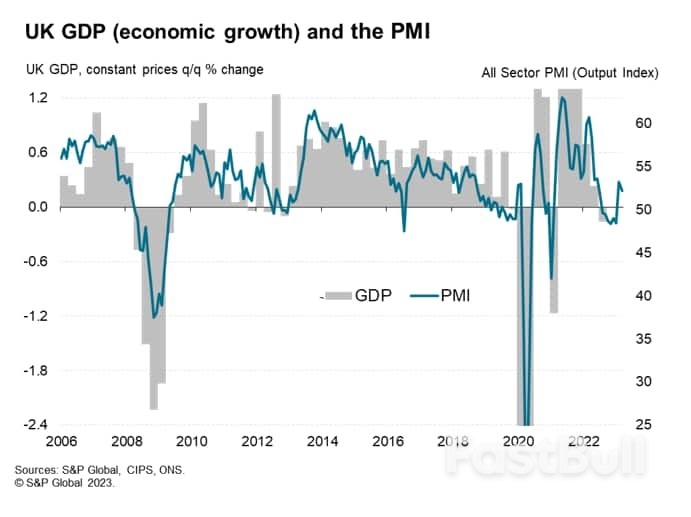
          UK business activity increased for a second successive month in March, according to the flash PMI survey data compiled by S&P Global and sponsored by CIPS, suggesting a modest growth revival after six months of continual decline prior to February. The composite PMI registered 52.2 according to the provisional data, down from 53.1 in February but nevertheless remaining above the 50.0 neutral level to indicate further expansion.
          The latest reading is consistent with GDP growing at a quarterly rate of 0.2% after a 0.3% pace had been indicated for February. Coming on the heels of a modest decline in January, the PMI readings point to an economy growing in the first quarter by just under 0.2% after having stalled in the fourth quarter of last year and having contracted in the third quarter.
          UK Economic Resilience in March Signalled by Flash PMI_1

          Service sector leads upturn but expansion constrained by staff shortages

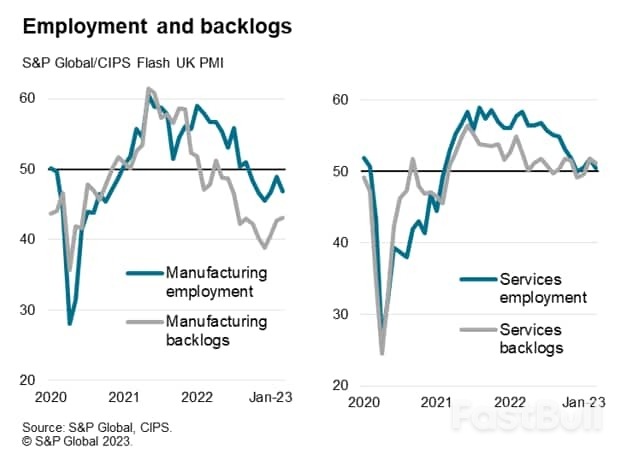
          March's upturn was led by a second consecutive monthly expansion of service sector output, albeit with the rate of increase slipping from February despite an improved rate of new orders growth. Service providers suffered a lack of staff, which held back their ability to meet demand. Although employment rose across the service sector in March, the rise was only marginal and weaker than recorded in February. Backlogs of work consequently rose in the service sector for a second month in a row, underscoring the labour market constraint on the sector's expansion.

          Manufacturing held back by paucity of demand

          In manufacturing, the principal constraint on growth was a paucity of demand rather than a lack of workers. Output fell back into decline after having briefly returned to modest growth in February, as factories reported another steep drop in their backlogs of work. New orders rose only marginally in March, albeit signalling a welcome end to nine months of decline to suggest the downturn in demand may have halted, but stronger demand growth will likely be needed in the coming months to drive production growth.
          UK Economic Resilience in March Signalled by Flash PMI_2
          UK Economic Resilience in March Signalled by Flash PMI_3

          Cost growth highest in services

          Cost divergences were also noteworthy across the sectors. Although slumping demand for raw materials and the steepest improvement in supplier delivery times since 2009 helped drive input cost inflation down in manufacturing, to the lowest since June 2020, service sector input cost inflation remained elevated, in part reflecting upward wage pressures.
          UK Economic Resilience in March Signalled by Flash PMI_4
          Although the overall rate of service sector input cost inflation eased to the lowest for 22 months, unlike manufacturing it saw the rate of inflation continue to run at one of the highest levels seen in the survey's two-decade history.
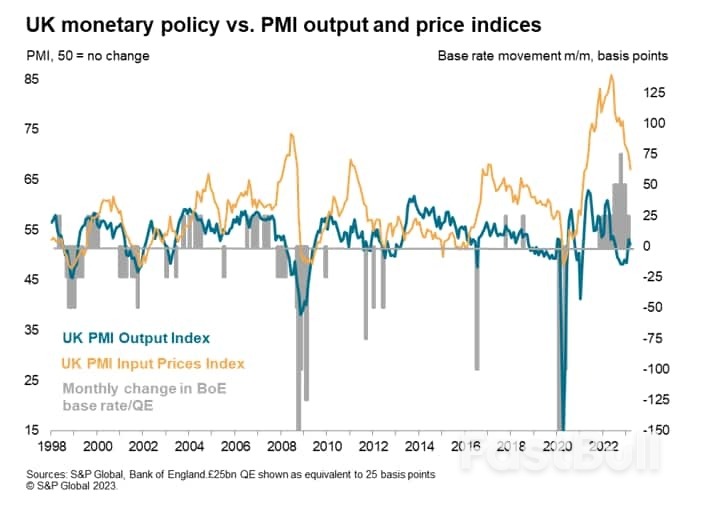
          The sustained upward pressure on costs fed through to higher prices charged for goods and services. While selling price inflation also cooled further from the peak seen in April of last year, the rate of increase remains highly elevated and indicative of consumer price inflation (CPI) running well above the Bank of England's 2% target in the near-term. However, the overall trajectory is one of slowing price increases, which should feed through to further CPI inflation moderation as the year proceeds.
          UK Economic Resilience in March Signalled by Flash PMI_5

          Resilience means more rate hikes

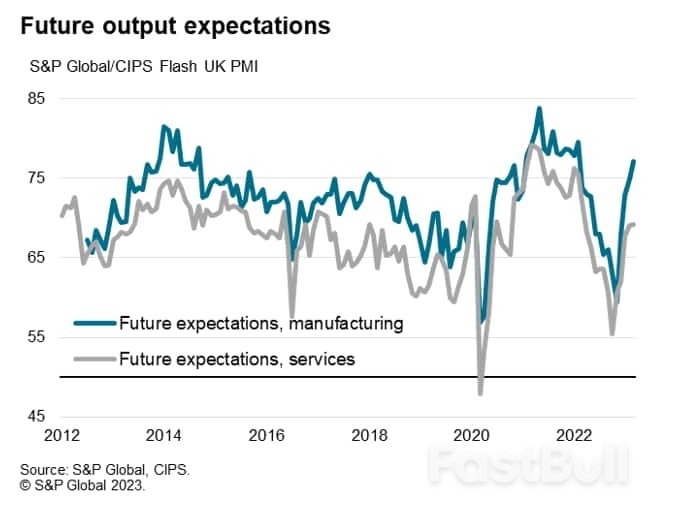
          The survey findings added to the case for the Bank of England's 25 basis point rate hike rise in March, which took the Bank Rate to 4.25%, its highest since 2008. The strength of the service sector expansion, combined with evidence of wage growth feeding through to stubbornly high service sector cost growth, likely adds to chances of further rate hikes in the coming months, especially as the survey's future output expectations indices remained resilient, and even rose further in manufacturing, despite the recent banking sector uncertainty.
          UK Economic Resilience in March Signalled by Flash PMI_6
          UK Economic Resilience in March Signalled by Flash PMI_7

          Source:S&P Global Market Intelligence

          To stay updated on all economic events of today, please check out our Economic calendar
          Risk Warnings and Disclaimers
          You understand and acknowledge that there is a high degree of risk involved in trading. Following any strategies or investment methods may lead to potential losses. The content on the site is provided by our contributors and analysts for information purposes only. You are solely responsible for determining whether any trading assets, securities, strategy, or any other product is suitable for investing based on your own investment objectives and financial situation.
          Comments
          Add to Favorites
          Share

          More Efforts Urged on Climate, Clean Energy

          Cohen

          Energy

          Experts hail Beijing's evolving role, call for US to co-lead cooperation
          Experts have said that China has been approaching the center of international clean energy cooperation over the past few decades, and its role is evolving. Also, the United States and China should and could cooperate and lead global cooperation in dealing with climate change despite rising political and economic tensions.
          The highlights of Joanna I.Lewis' new book, Cooperating for the Climate: Learning from International Partnerships in China's Clean Energy Sector, were discussed at a recent webinar titled US-China Cooperation and Leadership in Climate Change hosted by the Center for Strategic and International Studies, or CSIS.
          Lewis is a provost distinguished associate professor of energy and environment and director of the Science, Technology, and International Affairs Program at Georgetown University's Edmund A. Walsh School of Foreign Service in Washington, DC.
          According to Lewis' introduction, her book looks at how countries have been cooperating with China on clean energy and climate change over the last three decades. It created a new database that includes China's 400-plus bilateral agreements in the climate and clean energy sector with 40 countries and the European Union. The book also develops three in-depth case studies that look at three different energy research centers, providing more details about how these specific agreements play out.
          Based on the database and case studies, Lewis proposed an integrated framework combining political, economic, and technical factors to help explain the rationale behind and the structure of these cooperation mechanisms, how these different programs help cross-border clean energy research and development, and how these models are evolving.
          Tangible outcomes
          The book also provides some metrics to measure tangible outcomes from cooperation efforts, especially those with multiyear, multistakeholder investments and gave an international look at cooperation with China.
          "Because China plays such a central role in clean energy, technology, development, and dissemination, we can start to understand how these technologies are likely to evolve and the global role of innovation and cooperation in our low-carbon transition," said Lewis.
          The three case studies in the book focus on the US-China Clean Energy Research Center, or CERC, the China National Renewable Energy Center, or CNREC, with the Danish government, and the China-Brazil Center for Climate Change and Energy Technology Innovation (China-Brazil Center).
          In Lewis' analysis, the CERC is a model project of US-China cooperation in clean energy and climate change. It was built in 2009, which she described as the "banner year" for the history of US-China collaboration.
          "The US had been cooperating for decades with China, but this was really sort of the first time that this issue was elevated on the political and bilateral agenda. And there was just a record number of agreements signed that year," she said.
          "During the (Donald) Trump administration, where climate change was overall, less of a diplomatic priority, no new agreement was signed between the US and China for several years."
          The China-Brazil Center, she said, is one of the few examples of another emerging economy working with China in the clean energy space, and it is a "unique effort to bring together researchers of both countries while with a high-level diplomatic oversight".
          "We have seen this shift where the knowledge and the know-how and the technology is no longer flowing just to China, but also from China with China's really dramatic growth and experience in this sector and in many ways leading to the deployment of these technologies," Lewis noted.
          "This is shaping China's own science and technology strategy as well as sort of China's role in the world in terms of its role as a science and technology power," she added.

          Source: China Daily

          Risk Warnings and Disclaimers
          You understand and acknowledge that there is a high degree of risk involved in trading. Following any strategies or investment methods may lead to potential losses. The content on the site is provided by our contributors and analysts for information purposes only. You are solely responsible for determining whether any trading assets, securities, strategy, or any other product is suitable for investing based on your own investment objectives and financial situation.
          Comments
          Add to Favorites
          Share

          Eurozone Data Takes Centre Stage, but the Market Is on the Lookout for Banking Headlines

          Justin

          Central Bank

          Economic

          Central banks would like some quiet time

          The universe appears to have moved a few months forward in just three weeks, from the ballooning rate hike projections and the talk about a 6% Fed funds rate in the US to the current subdued rate expectations. Central bankers must have had their world turning upside down over the past weeks, but up to now they have behaved calmly and found some short-term solutions. Whether these would work in the long-term is another story, but central bankers have to remain focused on the economic situation as inflation remains a global issue, while meeting their financial stability responsibilities. A bit of quiet time is a very precious commodity from their standpoint at this juncture.
          Following on the path laid down by Lagarde et al last week, Fed chairman Powell announced a rate hike and a possible early end to the current tightening cycle. This abrupt change in the central banks’ strategy is the result of the recent banking sector woes. The collapse of three small US banking institutions and the Credit Suisse saga are expected to significantly impact the overall bank lending and borrowing appetite, potentially rendering further rate hikes unnecessary. The interesting fact from the ECB’s perspective remains that there have not been any euro area bank casualties. If the situation progresses according to the wishes of both the ECB and bank regulators, the market will have a chance next week to refocus on economic releases. At the end of the day, Lagarde laid out the revamped “data dependent” strategy and thus raised the importance of next week’s data.
          Eurozone Data Takes Centre Stage, but the Market Is on the Lookout for Banking Headlines_1

          CPI is the main dish on next week’s menu

          Inflation prints produced the strongest post-announcement volatility during 2022. This appears to have abated somewhat lately, but it is expected to escalate again going forward. On Thursday, we will get a barrage of February CPI prints for the key German states and the preliminary German number, if there are no unforeseen issues like last month. On the following day, the preliminary euro area figure will be released, and the market will be focused on both the trend and the outright level of the inflation figures. The headline number has been on a gentle downward trend, pleasing the ECB, but the same cannot be said for the core component. It has been making higher highs, and a similar print on Friday could result in a plethora of comments from the ECB hawks about the appropriate response at the next rate-setting meeting, especially if it prints above 6% on Friday. On Wednesday morning, the GfK Consumer confidence survey may give us some early hints about the current consumer appetite.

          IFO survey on Monday

          Next week, though, will start on an equally high note as the German IFO survey will be published on Monday morning. The March edition of the most closely watched leading indicator for the German GDP is unlikely to escape from the March performance of both the ZEW survey and PMIs. It is worth noting that part of the IFO survey responses might have come before the Credit Suisse saga and hence Monday’s results might not be entirely representative of the troubling sentiment on the ground. Having said that, the IFO expectations component is already pointing to a weak first quarter GDP, and another print on Monday towards the 75 area would probably cement these bearish expectations.
          Eurozone Data Takes Centre Stage, but the Market Is on the Lookout for Banking Headlines_2

          Swissie remains under pressure against the euro

          Considering the recent economic developments, the market has managed to not get carried away. Stock indices have somewhat recovered from the early March low and euro/dollar remains elevated but far from the early February high of 1.1032. Gold and Bitcoin have clearly been the main beneficiaries of the recent market rout as they continue to keep their gains. This could potentially reveal increased hesitation from investors at this stage.
          The euro/swissie pair has understandably received increasing attention recently. Since October 13, 2022, this pair has actually been trading inside the 0.9706-1.0041 range. More recently, the Credit Suisse woes allowed the swissie bears to stage a quick recovery towards the busy 0.9960 level. The area extending up to 1.0096 has been a landmine for euro bulls and, at the moment, the overall technical picture is not overly supportive of their intentions. Particularly, the developing bearish divergence between the stochastic oscillator and euro/swissie could derail their plans to aim for a new 2023 high. On the other hand, the appetite by the swissie bulls will be tested at the 50- and 100-day simple moving averages.

          Source:XM

          To stay updated on all economic events of today, please check out our Economic calendar
          Risk Warnings and Disclaimers
          You understand and acknowledge that there is a high degree of risk involved in trading. Following any strategies or investment methods may lead to potential losses. The content on the site is provided by our contributors and analysts for information purposes only. You are solely responsible for determining whether any trading assets, securities, strategy, or any other product is suitable for investing based on your own investment objectives and financial situation.
          Comments
          Add to Favorites
          Share

          As India's Population Booms, Where Are Its Working Women?

          Owen Li

          Economic

          Pinky Negi, an Indian teacher with two master's degrees, loved her old job at a public school in the Himalayan foothills. But then she did what millions of Indian women do every year - gave up her career when she got married and had children.
          "The idea of not earning pinches me the most when I have to ask for the smallest of things," said Negi, who briefly tried home tutoring before the birth of her second child led her to give up work altogether.
          "Even if I have to ask my husband, it is still asking someone else," she told the Thomson Reuters Foundation in New Delhi at an office of the Self-Employed Women's Association (SEWA), a union group that helps women find work.
          Negi's experience is common in India, where women have been dropping out of the workforce even at a time of strong growth in Asia's third-biggest economy.
          The country is set to become the world's most populous as the United Nations forecasts its population to touch 1.43 billion on April 14, overtaking China on that day.
          Economists say that means India, which is home to the highest number of working-age people, must not only create more jobs to keep its world-beating growth on track, but also foster employment conditions favourable to women.
          Less than a third of Indian women are working or actively seeking work, data shows, despite progress such as better educational attainment, improved health, falling fertility rates and more women-friendly labour policies.
          There are numerous reasons for the shortfall, researchers say, from marriage, child care and domestic work to skills and education gaps, higher household incomes, safety concerns and a lack of jobs.
          Policy changes that could rectify these problems - such as improved access to education, child care or flexible work setups - could boost the number of working women and add hundreds of billions of dollars to India's gross domestic product (GDP) by 2025, a 2018 report by the McKinsey consulting firm found.
          "The absence of women from the labour market reduces productivity and leads to income inequality," said Mayurakshi Dutta, a researcher at Oxfam India, which attributed the low labour force participation of women to gender discrimination in terms of wages and opportunities in a 2022 report.
          Women's work under-reported?
          According to the World Bank's latest data, women represented 23% of India's formal and informal workforce in 2021, down from nearly 27% in 2005. That compared with about 32% in neighbouring Bangladesh and 34.5% in Sri Lanka.
          India's labour and women's ministries did not respond to requests for comment.
          Federal government data shows the female labour force participation rate (FLFPR) rose to 25.1% in 2020/21 from 18.6% in 2018/19.
          The economic survey from earlier this year said current measuring tools were inadequate for accurately gauging the FLFPR, tending to under-report the proportion of working women.
          For example, it found that data did not reflect women's unpaid work such as running a household, farming or income-saving activities such as collecting firewood, cooking and tutoring children.
          "Women have to take care of homes and we find it difficult to find full-time jobs. If I had support (at home), I would have liked to work too," said 35-year-old Beena Tomar, who does part-time home-based needlework.
          Investing in the care economy can reduce the unpaid care burden, and also create jobs in the care sectors that are major areas for women's employment, gender specialist Aya Matsuura and Peter Buwembo, a labour statistician, at the International Labour Organization (ILO) said in emailed comments.
          COVID-19 Impact
          Improving access to quality education, training programmes and skills development is vital to boosting employment opportunities for women and girls, said Oxfam's Dutta.
          Employers should also provide gender-sensitive policies such as access to social protection, child care, parental leaves, and provision of safe and accessible transport, she added.
          Last year, Prime Minister Narendra Modi asked states to use systems such as flexible working hours to retain women in the labour force, saying the country could achieve its economic goals faster if it made use of "women power".
          Researchers point to public programmes like the government's skills development scheme, which trained more than 300,000 women in 2021/22, as promising initiatives.
          But they say more needs to be done, especially for women still feeling the economic impacts of the COVID-19 pandemic.
          Most Indian women are in low-skilled work such as farm and factory labour and domestic help, sectors hard-hit by COVID.
          While the economy has rebounded since then, it has failed to restore jobs for women, who were more likely to have lost their jobs than men and less likely to return to the workforce, a report by the Centre for Sustainable Employment at Azim Premji University found.
          Bhawna Yadav is one of them. The 23-year-old was a make-up saleswoman at a Delhi mall before the first lockdown in March 2020, when she had to move in with her in-laws in northern Haryana state after she and her husband lost their jobs.
          While he moved back to Delhi after restrictions lifted, she stayed behind.
          "I had no job to go back to despite many calls to different companies ... Plus, my husband and in-laws were against it because I was pregnant," the mother-of-two said by phone from Baroli village.
          She said her in-laws dismissed her career ambitions, telling her "being a mother is a job" or "your husband is earning", and suggesting instead that she work as a farmhand.
          "It infuriates me. I'm qualified to do more ... They don't realise how much I miss my old life - the freedom, my friends, colleagues, and having my own money," she said.
          Aspirations Ignored
          Sona Mitra, principal economist at Delhi-based IWWAGE, which works to boost the FLFPR, said women's particular career ambitions are too often dismissed in a labour market that has failed to create the jobs women want.
          "They don't want to work in agriculture nor do they want to work as domestic workers. They want some other types of jobs which are going to respect them, give them dignity and recognise them for their abilities and their educational degrees ... Where are those jobs?," said Mitra.
          She said this often led to underemployment and poor earning capacity among women.
          Negi, the school teacher, who is in her 30s and has a master's in Hindi and English, said she had repeatedly been offered low-skilled, low-paid roles when she had tentatively tried to return to work.
          That left her feeling demoralised, leading to an 11-year career break that has started to strain household finances.
          Today, she is looking for teaching jobs with flexible hours in schools close to her home.
          "A woman has to handle everything - home and outside. There are no exceptions for us," said Negi.
          "But I feel my routine will get better if I get back to work ... the more you go out, the more people you meet, the fresher your mind gets."

          Source: Bdnews24

          To stay updated on all economic events of today, please check out our Economic calendar
          Risk Warnings and Disclaimers
          You understand and acknowledge that there is a high degree of risk involved in trading. Following any strategies or investment methods may lead to potential losses. The content on the site is provided by our contributors and analysts for information purposes only. You are solely responsible for determining whether any trading assets, securities, strategy, or any other product is suitable for investing based on your own investment objectives and financial situation.
          Comments
          Add to Favorites
          Share
          FastBull
          Copyright © 2025 FastBull Ltd

          728 RM B 7/F GEE LOK IND BLDG NO 34 HUNG TO RD KWUN TONG KLN HONG KONG

          TelegramInstagramTwitterfacebooklinkedin
          App Store Google Play Google Play
          Products
          Charts

          Chats

          Q&A with Experts
          Screeners
          Economic Calendar
          Data
          Tools
          Membership
          Features
          Function
          Markets
          Copy Trading
          Latest Signals
          Contests
          News
          Analysis
          24/7
          Columns
          Education
          Company
          Careers
          About Us
          Contact Us
          Advertising
          Help Center
          Feedback
          User Agreement
          Privacy Policy
          Business

          White Label

          Data API

          Web Plug-ins

          Poster Maker

          Affiliate Program

          Risk Disclosure

          The risk of loss in trading financial instruments such as stocks, FX, commodities, futures, bonds, ETFs and crypto can be substantial. You may sustain a total loss of the funds that you deposit with your broker. Therefore, you should carefully consider whether such trading is suitable for you in light of your circumstances and financial resources.

          No decision to invest should be made without thoroughly conducting due diligence by yourself or consulting with your financial advisors. Our web content might not suit you since we don't know your financial conditions and investment needs. Our financial information might have latency or contain inaccuracy, so you should be fully responsible for any of your trading and investment decisions. The company will not be responsible for your capital loss.

          Without getting permission from the website, you are not allowed to copy the website's graphics, texts, or trademarks. Intellectual property rights in the content or data incorporated into this website belong to its providers and exchange merchants.

          Not Logged In

          Log in to access more features

          FastBull Membership

          Not yet

          Purchase

          Become a signal provider
          Help Center
          Customer Service
          Dark Mode
          Price Up/Down Colors

          Log In

          Sign Up

          Position
          Layout
          Fullscreen
          Default to Chart
          The chart page opens by default when you visit fastbull.com