
• Trade
  • Markets
  • Copy
  • Contests
  • News
  • 24/7
  • Calendar
  • Q&A
  • Chats
Trending
Screeners
SYMBOL
LAST
BID
ASK
HIGH
LOW
NET CHG.
%CHG.
SPREAD
SPX
S&P 500 Index
6827.42
6827.42
6827.42
6899.86
6801.80
-73.58
-1.07%
--
DJI
Dow Jones Industrial Average
48458.04
48458.04
48458.04
48886.86
48334.10
-245.98
-0.51%
--
IXIC
NASDAQ Composite Index
23195.16
23195.16
23195.16
23554.89
23094.51
-398.69
-1.69%
--
USDX
US Dollar Index
97.950
98.030
97.950
98.500
97.950
-0.370
-0.38%
--
EURUSD
Euro / US Dollar
1.17394
1.17409
1.17394
1.17496
1.17192
+0.00011
+ 0.01%
--
GBPUSD
Pound Sterling / US Dollar
1.33707
1.33732
1.33707
1.33997
1.33419
-0.00148
-0.11%
--
XAUUSD
Gold / US Dollar
4299.39
4299.39
4299.39
4353.41
4257.10
+20.10
+ 0.47%
--
WTI
Light Sweet Crude Oil
57.233
57.485
57.233
58.011
56.969
-0.408
-0.71%
--

Community Accounts

Signal Accounts
--
Profit Accounts
--
Loss Accounts
--
View More

Become a signal provider

Sell trading signals to earn additional income

View More

Guide to Copy Trading

Get started with ease and confidence

View More

Signal Accounts for Members

All Signal Accounts

Best Return
  • Best Return
  • Best P/L
  • Best MDD
Past 1W
  • Past 1W
  • Past 1M
  • Past 1Y

All Contests

  • All
  • Trump Updates
  • Recommend
  • Stocks
  • Cryptocurrencies
  • Central Banks
  • Featured News
Top News Only
Share

USA Embassy In Lithuania: Maria Kalesnikava Is Not Going To Vilnius

Share

USA Embassy In Lithuania: Other Prisoners Are Being Sent From Belarus To Ukraine

Share

Ukraine President Zelenskiy: Five Ukrainians Released By Belarus In US-Brokered Deal

Share

USA Vilnius Embassy: USA Stands Ready For "Additional Engagement With Belarus That Advances USA Interests"

Share

USA Vilnius Embassy: Belarus, USA, Other Citizens Among The Prisoners Released Into Lithuania

Share

USA Vilnius Embassy: USA Will Continue Diplomatic Efforts To Free The Remaining Political Prisoners In Belarus

Share

USA Vilnius Embassy: Belarus Releases 123 Prisoners Following Meeting Of President Trump's Envoy Coale And Belarus President Lukashenko

Share

USA Vilnius Embassy: Masatoshi Nakanishi, Aliaksandr Syrytsa Are Among The Prisoners Released By Belarus

Share

USA Vilnius Embassy: Maria Kalesnikava And Viktor Babaryka Are Among The Prisoners Released By Belarus

Share

USA Vilnius Embassy: Nobel Peace Prize Laureate Ales Bialiatski Is Among The Prisoners Released By Belarus

Share

Belarusian Presidential Administration Telegram Channel: Lukashenko Has Pardoned 123 Prisoners As Part Of Deal With US

Share

Two Local Syrian Officials: Joint US-Syrian Military Patrol In Central Syria Came Under Fire From Unknown Assailants

Share

Israeli Military Says It Targeted 'Key Hamas Terrorist' In Gaza City

Share

Rwanda's Actions In Eastern Drc Are A Clear Violation Of Washington Accords Signed By President Trump - Secretary Of State Rubio

Share

Israeli Military Issues Evacuation Warning In Southern Lebanon Village Ahead Of Strike - Spokesperson On X

Share

Belarusian State Media Cites US Envoy Coale As Saying He Discussed Ukraine And Venezuela With Lukashenko

Share

Belarusian State Media Cites US Envoy Coale As Saying That US Removes Sanctions On Belarusian Potassium

Share

Thai Prime Minister: No Ceasefire Agreement With Cambodia

Share

US, Ukraine To Discuss Ceasefire In Berlin Ahead Of European Summit

Share

Incoming Czech Prime Minister Babis: Czech Republic Will Not Take On Guarantees For Ukraine Financing, European Commission Must Find Alternatives

TIME
ACT
FCST
PREV
U.K. Trade Balance Non-EU (SA) (Oct)

A:--

F: --

P: --

U.K. Trade Balance (Oct)

A:--

F: --

P: --

U.K. Services Index MoM

A:--

F: --

P: --

U.K. Construction Output MoM (SA) (Oct)

A:--

F: --

P: --

U.K. Industrial Output YoY (Oct)

A:--

F: --

P: --

U.K. Trade Balance (SA) (Oct)

A:--

F: --

P: --

U.K. Trade Balance EU (SA) (Oct)

A:--

F: --

P: --

U.K. Manufacturing Output YoY (Oct)

A:--

F: --

P: --

U.K. GDP MoM (Oct)

A:--

F: --

P: --

U.K. GDP YoY (SA) (Oct)

A:--

F: --

P: --

U.K. Industrial Output MoM (Oct)

A:--

F: --

P: --

U.K. Construction Output YoY (Oct)

A:--

F: --

P: --

France HICP Final MoM (Nov)

A:--

F: --

P: --

China, Mainland Outstanding Loans Growth YoY (Nov)

A:--

F: --

P: --

China, Mainland M2 Money Supply YoY (Nov)

A:--

F: --

P: --

China, Mainland M0 Money Supply YoY (Nov)

A:--

F: --

P: --

China, Mainland M1 Money Supply YoY (Nov)

A:--

F: --

P: --

India CPI YoY (Nov)

A:--

F: --

P: --

India Deposit Gowth YoY

A:--

F: --

P: --

Brazil Services Growth YoY (Oct)

A:--

F: --

P: --

Mexico Industrial Output YoY (Oct)

A:--

F: --

P: --

Russia Trade Balance (Oct)

A:--

F: --

P: --

Philadelphia Fed President Henry Paulson delivers a speech
Canada Building Permits MoM (SA) (Oct)

A:--

F: --

P: --

Canada Wholesale Sales YoY (Oct)

A:--

F: --

P: --

Canada Wholesale Inventory MoM (Oct)

A:--

F: --

P: --

Canada Wholesale Inventory YoY (Oct)

A:--

F: --

P: --

Canada Wholesale Sales MoM (SA) (Oct)

A:--

F: --

P: --

Germany Current Account (Not SA) (Oct)

A:--

F: --

P: --

U.S. Weekly Total Rig Count

A:--

F: --

P: --

U.S. Weekly Total Oil Rig Count

A:--

F: --

P: --

Japan Tankan Large Non-Manufacturing Diffusion Index (Q4)

--

F: --

P: --

Japan Tankan Small Manufacturing Outlook Index (Q4)

--

F: --

P: --

Japan Tankan Large Non-Manufacturing Outlook Index (Q4)

--

F: --

P: --

Japan Tankan Large Manufacturing Outlook Index (Q4)

--

F: --

P: --

Japan Tankan Small Manufacturing Diffusion Index (Q4)

--

F: --

P: --

Japan Tankan Large Manufacturing Diffusion Index (Q4)

--

F: --

P: --

Japan Tankan Large-Enterprise Capital Expenditure YoY (Q4)

--

F: --

P: --

U.K. Rightmove House Price Index YoY (Dec)

--

F: --

P: --

China, Mainland Industrial Output YoY (YTD) (Nov)

--

F: --

P: --

China, Mainland Urban Area Unemployment Rate (Nov)

--

F: --

P: --

Saudi Arabia CPI YoY (Nov)

--

F: --

P: --

Euro Zone Industrial Output YoY (Oct)

--

F: --

P: --

Euro Zone Industrial Output MoM (Oct)

--

F: --

P: --

Canada Existing Home Sales MoM (Nov)

--

F: --

P: --

Euro Zone Total Reserve Assets (Nov)

--

F: --

P: --

U.K. Inflation Rate Expectations

--

F: --

P: --

Canada National Economic Confidence Index

--

F: --

P: --

Canada New Housing Starts (Nov)

--

F: --

P: --

U.S. NY Fed Manufacturing Employment Index (Dec)

--

F: --

P: --

U.S. NY Fed Manufacturing Index (Dec)

--

F: --

P: --

Canada Core CPI YoY (Nov)

--

F: --

P: --

Canada Manufacturing Unfilled Orders MoM (Oct)

--

F: --

P: --

Canada Manufacturing New Orders MoM (Oct)

--

F: --

P: --

Canada Core CPI MoM (Nov)

--

F: --

P: --

Canada Manufacturing Inventory MoM (Oct)

--

F: --

P: --

Canada CPI YoY (Nov)

--

F: --

P: --

Canada CPI MoM (Nov)

--

F: --

P: --

Canada CPI YoY (SA) (Nov)

--

F: --

P: --

Canada Core CPI MoM (SA) (Nov)

--

F: --

P: --

Q&A with Experts
    • All
    • Chatrooms
    • Groups
    • Friends
    Connecting
    .
    .
    .
    Type here...
    Add Symbol or Code

      No matching data

      All
      Trump Updates
      Recommend
      Stocks
      Cryptocurrencies
      Central Banks
      Featured News
      • All
      • Russia-Ukraine Conflict
      • Middle East Flashpoint
      • All
      • Russia-Ukraine Conflict
      • Middle East Flashpoint
      Search
      Products

      Charts Free Forever

      Chats Q&A with Experts
      Screeners Economic Calendar Data Tools
      Membership Features
      Data Warehouse Market Trends Institutional Data Policy Rates Macro

      Market Trends

      Market Sentiment Order Book Forex Correlations

      Top Indicators

      Charts Free Forever
      Markets

      News

      News Analysis 24/7 Columns Education
      From Institutions From Analysts
      Topics Columnists

      Latest Views

      Latest Views

      Trending Topics

      Top Columnists

      Latest Update

      Signals

      Copy Rankings Latest Signals Become a signal provider AI Rating
      Contests
      Brokers

      Overview Brokers Assessment Rankings Regulators News Claims
      Broker listing Forex Brokers Comparison Tool Live Spread Comparison Scam
      Q&A Complaint Scam Alert Videos Tips to Detect Scam
      More

      Business
      Events
      Careers About Us Advertising Help Center

      White Label

      Data API

      Web Plug-ins

      Affiliate Program

      Awards Institution Evaluation IB Seminar Salon Event Exhibition
      Vietnam Thailand Singapore Dubai
      Fans Party Investment Sharing Session
      FastBull Summit BrokersView Expo
      Recent Searches
        Top Searches
          Markets
          News
          Analysis
          User
          24/7
          Economic Calendar
          Education
          Data
          • Names
          • Latest
          • Prev

          View All

          No data

          Scan to Download

          Faster Charts, Chat Faster!

          Download App
          English
          • English
          • Español
          • العربية
          • Bahasa Indonesia
          • Bahasa Melayu
          • Tiếng Việt
          • ภาษาไทย
          • Français
          • Italiano
          • Türkçe
          • Русский язык
          • 简中
          • 繁中
          Open Account
          Search
          Products
          Charts Free Forever
          Markets
          News
          Signals

          Copy Rankings Latest Signals Become a signal provider AI Rating
          Contests
          Brokers

          Overview Brokers Assessment Rankings Regulators News Claims
          Broker listing Forex Brokers Comparison Tool Live Spread Comparison Scam
          Q&A Complaint Scam Alert Videos Tips to Detect Scam
          More

          Business
          Events
          Careers About Us Advertising Help Center

          White Label

          Data API

          Web Plug-ins

          Affiliate Program

          Awards Institution Evaluation IB Seminar Salon Event Exhibition
          Vietnam Thailand Singapore Dubai
          Fans Party Investment Sharing Session
          FastBull Summit BrokersView Expo

          Forex and Cryptocurrency Forecast

          Samantha Luan

          Cryptocurrency

          Forex

          Summary:

          Forex and cryptocurrency forecast...
          EUR/USD: Inflation Persists, US GDP Growth Slows

          The US economy remains the most powerful on the planet. Moreover, its share of global GDP has reached a nearly two-decade high of 26.3%. According to the IMF, from 2018, the European Union’s share decreased by 1.4%, Japan’s by 2.1%, while the United States increased by 2.3%. China’s GDP is 64% of the American figure, down from 67% five years ago. As a result, the dollar remains the undisputed leader among G10 currencies, with no contenders for its throne in the foreseeable future.
          The strength of the national economy, coupled with a robust labour market, allows the Federal Reserve to focus on combating inflation, aiming to reduce it to the target 2.0%. According to Jerome Powell, head of the US Central Bank, easing monetary policy under current conditions would have far more negative consequences for the economy than maintaining it tight over a long period. Against this backdrop, the likelihood of a dollar interest rate cut at the Fed’s June meeting, according to the FedWatch Tool, fell to 15%. Market participants believe that, at best, a decision to change the current policy may be taken in September. Some economists, including analysts from Morgan Stanley and Societe Generale, even suggest that the Fed may delay the first rate cut until early 2025. Such forecasts led to the US currency rising to five-month highs in mid-April against the euro, British pound, Australian, and New Zealand dollars, with USD/JPY once again reaching a 34-year price record and the DXY index climbing to 106.42.
          However, that was in mid-April. For the last ten days of the month, the DXY was under bearish pressure, pushing EUR/USD upward. Jerome Powell stated that decisions on rate cuts are not made in advance but depend entirely on macroeconomic statistics. The statistics released in the last few days looked ambiguous, causing doubts that the US economy could maintain its previous positive dynamics.
          Tuesday’s statistics on April 23, regarding US business activity and core durable goods orders, disappointed investors. Preliminary data from S&P Global showed that the Business Activity Index (PMI) in the US services sector unexpectedly fell from 51.7 to 50.9 points. The manufacturing sector’s indicators were even worse, where the PMI crossed the threshold, separating progress from regression. In April, this indicator fell from 51.9 to 49.9 (forecast 52.0). These data alone are not as significant as labor market or inflation reports, but two days later, on April 25, they were supplemented by equally disappointing US GDP data. The preliminary estimate showed that US economic growth in Q1 was only 1.6%, lower than the forecast 2.5% and previous 3.4%. Compared to the same quarter in 2023, GDP growth decreased from 3.1% to 3.0%. Against this backdrop, the DXY, and with it EUR/USD, underwent a correction, with the pair rising to 1.0752.
          It should be recalled that the US inflation data released on April 10 showed that the Consumer Price Index (CPI) reached 3.5% year-on-year, the highest in six months. On Friday, April 26, the Bureau of Economic Analysis reported that inflation measured by the change in the Personal Consumption Expenditures (PCE) Price Index in March rose to 2.7% (year-on-year). The core PCE, which excludes volatile food and energy prices, instead of the expected decrease to 2.6%, remained at the previous level of 2.8%.
          Thus, on the one hand, we see that inflation is resistant and does not want to go down, and on the other hand, we observe a slowdown in GDP growth. According to our forecasts, faced with such a crossroads, the Fed will still not deviate from its previous path and will choose to fight price growth. Moreover, the decrease in GDP in Q1 should not overly alarm the regulator, as the US economy had been expanding at 2% and more for seven consecutive quarters, despite the aggressively tight monetary policy of the Fed. Moreover, recent labor market data looks very positive. The number of initial unemployment claims decreased from 212K to 207K (forecast 214K) – a minimum since February.
          On Tuesday, April 23, the same day as in the US, preliminary data on business activity came out from the other side of the Atlantic. In Germany, the Manufacturing PMI rose from 41.9 to 42.2, and in the services sector – from 50.1 to 53.3, the Composite Index – from 47.7 to 50.5. Regarding the Eurozone as a whole, a positive dynamic was also noted. Thus, the Business Activity Index in the services sector rose from 51.5 to 52.9 points, the Composite Index from 50.3 to 51.4.
          The exception was the Manufacturing PMI (a decrease from 46.1 to 45.6). As for forecasts about the start of easing monetary policy by the European Central Bank, the emphasis is still on June. This was once again confirmed by the president of the German Bundesbank and a member of the ECB’s Governing Council, Joachim Nagel, who stated on April 24 that a rate cut in June does not necessarily imply a series of rate cuts. In other words, in June – yes, there will be a cut, what happens next – is still unknown.
          All of the above indicates that the fundamental indicators are still on the side of the dollar. The EUR/USD correction is likely to be limited and will not be powerful or prolonged. Last week, the pair closed at 1.0692. According to economists from the Singapore-based United Overseas Bank, it is unlikely to have the strength to break through the resistance at 1.0765. As for the forecast for the near future, as of the evening of April 26, 50% of experts expect the dollar to strengthen, 35% – its weakening, the remaining 15% maintained neutrality.
          Among the trend indicators on D1, 65% are on the side of the bears, 35% – are coloured green. Among the oscillators, a third are on the side of the bears, a third – on the side of the greens, and a third – are painted in neutral gray. The nearest support for the pair is located in the zone of 1.0680, then 1.0600-1.0620, 1.0560, 1.0495-1.0515, 1.0450, 1.0375, 1.0255, 1.0130, 1.0000. Resistance zones are located in the areas of 1.0710-1.0725, 1.0740-1.0750, 1.0795-1.0805, 1.0865, 1.0895-1.0925, 1.0965-1.0980, 1.1015, 1.1050, 1.1100-1.1140.
          The coming week promises to be quite turbulent and volatile as it is filled with various important events. On Monday, April 29, preliminary data on consumer inflation (CPI) in Germany will be released. The next day, another batch of German statistics will be released, including GDP and retail sales figures. On the same day, we will learn the preliminary volume of GDP and the level of inflation in the Eurozone as a whole. On Wednesday, May 1, Germany and many other EU countries will have a holiday – Labor Day.
          However, the United States will continue to work on this day. First, the ADP report on employment levels in the private sector of the country and indicators of business activity in the manufacturing sector will be published. The most important event will undoubtedly be the meeting of the FOMC (Federal Open Market Committee) of the US Federal Reserve on Wednesday, May 1, and the subsequent press conference of the management of this regulator.
          In addition, on Friday, May 3, we traditionally await another batch of very important statistics from the American labor market, including the unemployment rate and the number of new jobs created outside the agricultural sector (NFP), as well as revised data on business activity (PMI) in the US services sector.

          GBP/USD: US PCE Hindered the Strengthening of the Pound

          The preliminary statistics on business activity in the United Kingdom released on Tuesday, April 23, were mixed. The PMI in the manufacturing sector of the country crossed from above to below the growth/fall boundary, and with a forecast and previous value of 50.3 points, it actually fell to 48.7. In the UK services sector, on the other hand, there was growth in April – the indicator rose from 53.1 to 54.9 (market expectations 53.0). As a result, the Composite PMI reached 54.0 (52.8 a month earlier). However, all these figures did not attract much attention from investors.
          On April 22, GBP/USD fell to 1.2300. The bulls on the pair took advantage of the dollar’s overbought condition to return it to the lower boundary of the medium-term corridor of 1.2500-1.2800 in which it had been moving since the end of November last year. However, they did not have enough strength to consolidate within the corridor. The two-week maximum was recorded at 1.2540, after which, pushed by US PCE, the pair went down again and ended the five-day period at 1.2492.
          According to specialists from United Overseas Bank, as long as the support at 1.2420 is not broken, there is still a possibility of the pound breaking through the 1.2530 mark. The next resistance, according to them, is at 1.2580. The median forecast of analysts regarding the behaviour of GBP/USD in the near future looks maximally uncertain: 20% voted for the movement of the pair to the south, the same amount – to the north, and the majority (60%) simply shrugged their shoulders.
          As for technical analysis, the trend indicators on D1 point south 65% and 35% look north. Among the oscillators, the picture is mixed: 25% recommend selling, 25% – buying, and 50% are in the neutral zone. In case of further decline of the pair, it will encounter support levels and zones at 1.2450, 1.2400-1.2420, 1.2300-1.2330, 1.2185-1.2210, 1.2110, 1.2035-1.2070, 1.1960, and 1.1840. In case of growth, the pair will encounter resistance at levels 1.2530-1.2540, 1.2575-1.2610, 1.2695-1.2710, 1.2755-1.2775, 1.2800-1.2820, 1.2885-1.2900.
          No significant statistics on the state of the UK economy are planned for the week.

          USD/JPY: Reached the Moon, Next Target – Mars?

          Forex and Cryptocurrency Forecast_1
          We called the previous review “Higher and Higher”. Now, it is worth asking at what altitude will this flight into space end? When will the Bank of Japan (BoJ) finally decide on a radical change in its monetary policy?
          At the meeting on April 26, the members of the Japanese Central Bank unanimously decided to keep the key interest rate at the previous level of 0.0-0.1%. Moreover, the regulator removed from the statement the reference that it is currently buying JGB bonds for about 6 trillion yen per month. The statement after the meeting states that “the prospects for the development of the economy and prices in Japan are extremely uncertain,” “if inflation rises, the Bank of Japan will likely change the degree of easing of monetary policy,” however, “it is expected that the eased monetary policy will be maintained for some time.”
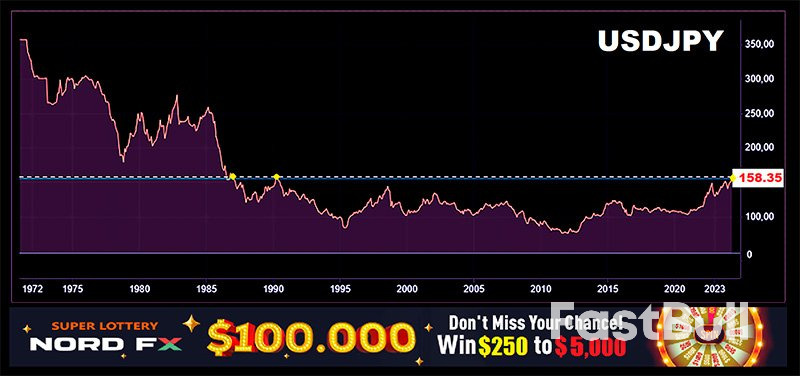
          The market predictably reacted to such decisions of the Japanese Central Bank with another Japanese candle on the chart of the USD/JPY pair. The maximum was recorded at 158.35, which corresponds to the peak values of 1990. There were no currency interventions to save the national currency, which many market participants feared.
          Recall that strategists from the Dutch Rabobank called the level of 155.00 critical for the start of such interventions by the Ministry of Finance of Japan. The same mark was called by 16 out of 21 economists surveyed by Reuters. The rest predicted such actions at levels of 156.00 (2 respondents), 157.00 (1), and 158.00 (2). USD/JPY has long exceeded the levels at which the intervention took place in October 2022 and where the market turned around about a year later. It now seems that 158.00 is not the limit. Perhaps it is worth raising the forecast bar to 160.00? Or immediately to 200.00?
          USD/JPY ended the past week at 158.32. The forecast of analysts regarding the near future of the pair looks as follows: fear of currency interventions still prevails over 60% of them, while the remaining 40% are waiting for the continuation of the flight to Mars. Technical analysis tools clearly have no concerns about interventions.
          Therefore, all 100% of trend indicators and oscillators on D1 point north, although a third of the latter are in the overbought zone. The nearest support level is located in the area of 156.25, then 153.90-154.30, 153.10, 151.00, 149.70-150.00, 148.40, 147.30-147.60, 146.50. And it is practically impossible to determine resistance levels. We only note the reversal maximum of April 1990, 160.30, although this target is quite conditional.
          No significant events regarding the state of the Japanese economy are expected in the coming week. Moreover, traders should keep in mind that Monday and Friday in Japan are holidays: April 29, the country celebrates the birthday of Hirohito (Emperor Showa), May 3 – Constitution Day.
          CRYPTOCURRENCIES: Where Will Bitcoin Fall?
          As expected, the fourth halving took place in the bitcoin network at block #840000 on April 20. The reward for finding a block was reduced from 6.25 BTC to 3.125 BTC. Recall that halving is a halving of the reward size for miners for adding a new block to the bitcoin blockchain.
          This event is embedded in the code of the first cryptocurrency and occurs every 210,000 blocks – until the moment when the mining of 21 million coins (presumably in 2040) ends the emission of cryptocurrency. It should be noted that the fourth halving will provide for the mining of approximately 95% of the entire bitcoin emission, about 99% of all coins will be mined by 2033-2036. Then, the emission will gradually move towards zero.
          In the previous review, we promised to tell how the market would react to this important event. We promised – we report: the market reaction is close to zero. For several days after the halving, there was no growth in volatility.
          The price of bitcoin slowly and lazily moved first upward, reaching $67,269 on April 23, and then returned to where it began its weekly journey: to the $64,000 zone. It seems that market participants froze in anticipation of who would be the first to start buying or, conversely, selling the main cryptocurrency massively.
          According to experts from Bitfinex, the post-halving supply restriction stabilizes the price of the first cryptocurrency and may contribute to its growth. “The reduction in the pace of bitcoin issuance after halving, which will amount to $30-40 million per day, contrasts sharply with the daily net inflow of $150 million into spot ETFs. This emphasizes a significant demand and supply imbalance, which may contribute to further price growth,” stated the Bitfinex report.
          However, analysts from QCP Capital believe that bitcoin optimists will have to wait at least two months before assessing the effect of the past fourth halving. “The spot price grew exponentially only 50-100 days after each of the three previous halvings. If this pattern repeats this time, bitcoin bulls still have weeks to create a larger long position,” their report stated.
          Anthony Pompliano, the founder of the venture company Pomp Investments, believes that within 12-18 months, the coin is expected to grow to $100,000, with chances of reaching $150,000-200,000. However, before moving to a bull rally, BTC/USD, in his opinion, is waiting for a correction down. At the same time, Pompliano believes that the price will not fall below $50,000. “I think we have already crossed this Rubicon,” – he wrote.
          The possible upcoming decline of the main cryptocurrency is probably a topic currently much more discussed than its subsequent growth. Many agree that bitcoin coins will appreciate in the long term. But how will quotes behave in the more foreseeable future? Fidelity Digital Assets, the leading issuer of one of the spot BTC ETFs, has already revised its medium-term forecast for bitcoin from positive to neutral. The reason for abandoning optimistic sentiments is several worrying trends in the crypto market. Fidelity analysts noted the growing interest in selling from long-term hodlers.
          Among them, there is currently a large percentage of profitable addresses, as noted in the company’s report. This means that holders may want to lock in profits and start selling BTC. On the other hand, on-chain data indicates that small investors, on the contrary, continue to accumulate the first cryptocurrency. Since the beginning of the year, the number of addresses on which BTC is stored for at least $1,000 has increased by 20% and reached a new historical maximum. “Such a trend may indicate the growing dissemination of bitcoin and its acceptance among ‘average’ users,” – Fidelity noted.
          Specialists from CryptoQuant examined the SOPR indicator readings for these categories of investors and made conclusions similar to those of their colleagues from Fidelity. Investments in Bitcoin by “new” whales (owners of coins “aged” less than 155 days) almost doubled the indicator of “old” large players (more than 155 days). At the same time, the increased value of the metric showed that the profits of the “old” hodlers significantly exceed the indicators of the “newcomers”. And if the “old-timers” move to fix profits, this may lead to the formation of price peaks. An analysis of the current picture, according to CEO of CryptoQuant Ki Young Ju, also speaks of the need to exercise caution in anticipation of possible corrections and increased volatility.
          Recall that earlier, specialists from JPMorgan noted that digital gold is in a state of overbought. And co-founder of CMCC Crest Willy Woo noted that if the price of the first cryptocurrency falls below the support level of short-term holders at $58,900, the market risks moving into a bearish phase.
          As of the evening of Friday, April 26, the BTC/USD pair is trading in the region of $63,950. The total capitalization of the crypto market is $2.36 trillion ($2.32 trillion a week ago). The Bitcoin Fear & Greed Index remained in the Greed zone, although it rose from 66 to 70 points.
          Finally, in conclusion of the review, our long-forgotten crypto-life-hacks column. It turns out that in order to become a crypto millionaire, it is enough to have a marker and a piece of paper. The possibility of such a way of enrichment was proven by Christian Langlois, also known as Bitcoin Sign Guy. This guy made headlines in many news outlets after showing a notebook sheet with the inscription “Buy Bitcoin” behind the back of the Chair of the Federal Reserve System Janet Yellen. At that moment, the head of the Fed was giving testimony about the state of the US economy. This image instantly spread across the network and became one of the symbols of the emerging crypto industry.
          For his misdemeanour, the 22-year-old intern Langlois was disgracefully expelled from the hearings. But after this episode was shown on television, enthusiasts sent 7 BTC to his crypto wallet to thank the guy for his bold move. Four years ago, Christian sold 21 copies of the “cult” sheet at an average price of 0.8 BTC, earning another 16.8 BTC. Thus, his total earnings reached 23.8 BTC, which is more than $1.5 million at the current exchange rate.
          And a few weeks ago, Langlois was offered another 5 bitcoins for the original, but he refused to sell the sheet. Nevertheless, Christian liked the idea of further monetizing the self-created object of “artistic and historical heritage”, and he decided to sell it at an auction, directing the proceeds to finance his startup Tirrel Corp. On April 25, 2024, the auction house Scarce.City reported that the lot, which became a popular meme, was sold for 16 BTC (more than $1 million).

          Source: NordFX

          Risk Warnings and Disclaimers
          You understand and acknowledge that there is a high degree of risk involved in trading. Following any strategies or investment methods may lead to potential losses. The content on the site is provided by our contributors and analysts for information purposes only. You are solely responsible for determining whether any trading assets, securities, strategy, or any other product is suitable for investing based on your own investment objectives and financial situation.
          Add to Favorites
          Share

          Japanese Yen Weak, USDJPY Rises Past 160 On Middling BOJ, Fed Fears

          Cohen

          Economic

          Forex

          The USDJPY pair- which pegs the number of yen required to buy one dollar, blew past the 160 level on after seeing what analysts described as a "flash crash" on Friday. Weakness in the yen came even with Japanese markets closed for a holiday.
          The USDJPY pair rose as much as 1% to a 34-year high of 160.20. It was now close to reaching highs last seen in 1986, when the U.S. had threatened Japan with trade sanctions.
          The yen’s decline came after the BOJ did not offer any concrete signals on monetary policy and weakness in the currency market during a meeting on Friday. While the central bank did hike its inflation outlook for the coming years, it also lowered its expectations for economic growth, raising questions over just how much the BOJ could potentially tighten monetary policy this year.
          The BOJ had hiked rates for the first time in 17 years in March, citing an expected increase in inflation on the back of bumper wage hikes this year. But the move provided fleeting support to the yen.
          Substantially softer-than-expected inflation data from Tokyo, which acts as a bellwether for Japan, also raised more questions over the BOJ’s forecast for higher inflation. Data on Friday showed inflation fell below the central bank’s 2% annual target rate in April.
          But in addition to negative domestic signals, the biggest point of pressure on the yen was persistent concerns over a wide gulf between U.S. and Japanese interest rates.
          U.S. PCE price index data- which is the Federal Reserve’s preferred inflation gauge- read hotter than expected for March, adding to bets that the central bank will be in no hurry to begin cutting interest rates.
          The dollar shot up after the PCE data, also pressuring the yen.
          The Fed is widely expected to keep rates on hold during a meeting later this week, and is also expected to present a hawkish outlook. The central bank is expected to only begin trimming rates by September, or the fourth quarter.

          Intervention fears do little to stem yen losses

          The USDJPY pair effectively blew past levels that traders believed would attract currency market intervention by the government. 155 was considered as the threshold until which the government would allow the yen to weaken, but this did not prove to be the case.
          While Japanese officials have continued to offer verbal warnings, a lack of action on their end potentially signals limited resources to completely stem weakness in the yen.
          A weaker yen also benefits Japan’s economy, which is heavily reliant on exports.

          Source:msn

          To stay updated on all economic events of today, please check out our Economic calendar
          Risk Warnings and Disclaimers
          You understand and acknowledge that there is a high degree of risk involved in trading. Following any strategies or investment methods may lead to potential losses. The content on the site is provided by our contributors and analysts for information purposes only. You are solely responsible for determining whether any trading assets, securities, strategy, or any other product is suitable for investing based on your own investment objectives and financial situation.
          Add to Favorites
          Share

          The US Labor Market Is Automating And Becoming More Flexible

          Goldman Sachs

          Economic

          The US labor market is being shaped by three intersecting trends: two of them long-term and the third cyclical. Generative artificial intelligence is poised to automate nearly a quarter of jobs across all industries. The effects of AI will be felt on a workforce that is already “fractionalized,” in which part-time roles supplement or replace full-time ones.
          Those two megatrends feed into a slowing job market. Goldman Sachs Research expects US unemployment to rise over the next 12 months. In combination, these three forces will profoundly change how US companies recruit and retain talent in the near future.

          How AI will transform staffing and recruiting

          Around 4% of all US firms have adopted generative AI, but Goldman Sachs Research expects that figure to rise to 7% over the next six months. The rapid clip will be led by some sectors more than others. In information services, for instance, the adoption rate is forecast to rise from 16% to 23% in that half-year period.
          The effects of this shift will be seen clearly in online job marketplaces. Some types of work, such as logo design, copywriting, translation, or voice-over artistry, could be displaced by free or cheap AI tools in those categories. “That said, it is just as likely that new types of jobs or categories will be created as a result of AI,” writes George Tong, a senior research analyst at Goldman Sachs Research, in his team’s report.
          Generative AI can also improve the efficiency of recruiters in tasks such as enhancing job descriptions, formatting resumes, ranking candidates, and conducting initial interviews. “Screening applicant information such as resumes remains inefficient, with approximately 52% of talent acquisition leaders stating that the most challenging element of recruiting is candidate identification from large pools,” Tong writes.The US Labor Market Is Automating And Becoming More Flexible_1
          Additionally, job marketplaces can use AI tools to offer private-label services of their own for tasks such as logo design, translation, and voice-over work. Some of the AI engines to perform such work already exists, and some marketplaces have started to implement them.

          A reorientation of the labor market

          Since its peak at the turn of the century, the US labor participation rate has been in steady decline, dipping from 67.3% in January 2000 to 62.7% in March 2024. Baby boomers left the workforce, labor markets weakened after the Global Financial Crisis, college enrollments increased, and early retirements rose during Covid.
          The US Labor Market Is Automating And Becoming More Flexible_2
          Labor churn, or the velocity of job changes, has been rising as well. Quit rates rose from 2010 to 2019, and the pandemic “led to inflows of millions of new gig workers as unemployment rose or work hours were reduced, and people turned to gig work to augment their incomes,” Tong and his team found.
          Companies too found value in a more flexible workforce, turning to freelancers, gig workers, and temps to supplement or replace their full-time employees. The share of US professionals who freelance increased from 34% in 2014 to 38% in 2023. Meanwhile, temp workers, typically brought on for short-term assignments at a single client, have seen their penetration rise in the US from 1.06% in January 1990 to 1.74% in March 2024. This fractionalization of the labor force is likely to continue, Goldman Sachs Research predicts.

          Where are we in the employment cycle?

          Typically, temp staffing leads the broader macro and labor market by two to four quarters, because employers generally reduce temp headcount first when downsizing ahead of a macro slowdown. At the moment, temp penetration is in decline.
          “US temp penetration contracted in March, reinforcing our negative stance on the temp staffers as well as the broader US labor market,” Goldman Sachs Research finds. Temp penetration dipped to 1.74% in March from 1.75% in February, and has been on a broader downward trajectory since March 2022, when temp penetration registered 2.1%.
          “With increasing instances of hiring freezes and corporate downsizing, we expect demand for labor to soften and the supply of labor to increase,” our analysts write.
          On the job platform Indeed, total job posting volumes year-to-date pulled back the most for blue-collar and clerical verticals, including construction, manufacturing, and retail. Volumes in white-collar and highly skilled verticals, including software development, banking, finance, and marketing showed some signs of stability after declining sharply over the past two years.
          The US Labor Market Is Automating And Becoming More Flexible_3
          Since the start of the year, job postings as a percentage of pre-Covid levels declined 18 percentage points in construction, 15 percentage points in manufacturing, and 12 percentage points in retail. The number of job openings declined 11% year-on-year in February 2024, with year-on-year declines appearing since August 2022.
          “Based on this mosaic, we conclude that the US labor market in its mid-to-late cyclical stages that will see unemployment rise and non-farm employment decline over the next four quarters,” Goldman Sachs Research writes.
          To stay updated on all economic events of today, please check out our Economic calendar
          Risk Warnings and Disclaimers
          You understand and acknowledge that there is a high degree of risk involved in trading. Following any strategies or investment methods may lead to potential losses. The content on the site is provided by our contributors and analysts for information purposes only. You are solely responsible for determining whether any trading assets, securities, strategy, or any other product is suitable for investing based on your own investment objectives and financial situation.
          Add to Favorites
          Share

          Yen Trips Past 160-per-dollar to April 1990 Lows

          Thomas

          Economic

          Forex

          The dollar rose as far as 160.245 yen in a sudden move after the yen traded in a narrow 158.05-158.15 range in early deals.
          A portfolio manager said "stops" on the pair at the key 160 level had been "taken out", meaning the yen's descent had forced those with long yen holdings and stop-loss orders around that big level to square positions, exacerbating its slide.
          The yen's move barely affected the euro and sterling, both of which stayed near the bottom of the ranges hit during Friday's volatile session.
          Markets are on guard for any intervention by Japanese authorities to contain the yen's nearly 11% fall this year.
          While the yen had its biggest drop in six months on Friday, it also briefly surged to 154.97 to the dollar, triggering speculation that Japanese authorities may have checked currency rates ahead of likely intervention. It was not immediately clear what caused the move.
          Japan's yen was at 159.105 by 0200 GMT, down 0.5%. Tokyo markets were closed for the first of the country's Golden Week holidays.
          The yen had moved nearly 3.5 yen between 158.445 and 154.97 on Friday as traders vented their disappointment after the Bank of Japan kept policy settings unchanged and offered few clues on reducing its Japanese government bond (JGB) purchases - a move that might have put a floor under the yen.
          The Federal Reserve's May 1 policy review is the prime focus for markets this week, with investors already anticipating a delay in its rate cuts after a batch of sticky U.S. inflation and as officials including Chair Jerome Powell emphasise even those plans are dependent on data.
          Vishnu Varathan, head of Asia economics and strategy at Mizuho Bank in Singapore, expects the dollar-yen pair will see more two-way action until the Federal Open Market Committee (FOMC) meeting, unlike in the past few weeks when hawkish Fed expectations had kept the dollar steadily rising against most other currencies.
          "The bar is pretty high for a sustained hawkish surprise, which would in turn lift yields," he said, referring to the Fed.
          "So, from a yield-spread perspective between U.S. Treasuries and JGBs, for that to continue to fuel further yen depreciation, the bar is really high because the Fed may not be tilting as hawkish as markets expect either."
          "The BOJ disappointment might be transcribed onto the FOMC insofar that they may be more undecided than decidedly hawkish."
          The Fed is seen holding its benchmark interest rate steady at 5.25%-to-5.5% at the April 30-May 1 meeting. Investors now see perhaps only a single cut this year, currently anticipated by November, according to the CME's FedWatch tool.
          Sterling was at $1.2522, up 0.22%, but still some distance from Friday's $1.2541 highs.

          Source: Reuters

          To stay updated on all economic events of today, please check out our Economic calendar
          Risk Warnings and Disclaimers
          You understand and acknowledge that there is a high degree of risk involved in trading. Following any strategies or investment methods may lead to potential losses. The content on the site is provided by our contributors and analysts for information purposes only. You are solely responsible for determining whether any trading assets, securities, strategy, or any other product is suitable for investing based on your own investment objectives and financial situation.
          Add to Favorites
          Share

          Dollar A Tad Softer As Markets Wait For Fed

          Alex

          Economic

          Forex

          The US dollar was a shade softer in early deals on Monday, thinned by a holiday in Japan, though the yen, euro and sterling stayed near the bottom of the ranges hit during Friday's volatile session.
          Japan's yen was at 158.05 per dollar, up nearly 0.2 per cent in quiet trading with Tokyo markets closed for the first of the country's Golden Week holidays.
          It had moved nearly 3.5 yen between 158.445 and 154.97 on Friday as traders vented their disappointment after the Bank of Japan kept policy settings unchanged and offered few clues on reducing its Japanese government bond (JGB) purchases - a move that might have put a floor under the yen.
          The Federal Reserve's May 1 policy review is the prime focus for markets this week, with investors already anticipating a delay in its rate cuts after a batch of sticky US inflation and as officials including Chair Jerome Powell emphasise even those plans are dependent on data.
          Vishnu Varathan, head of Asia economics and strategy at Mizuho Bank in Singapore, expects the dollar-yen pair will see more two-way action until the Federal Open Market Committee (FOMC) meeting, unlike in the past few weeks when hawkish Fed expectations had kept the dollar steadily rising against most other currencies.
          "The bar is pretty high for a sustained hawkish surprise, which would in turn lift yields," he said, referring to the Fed."So, from a yield-spread perspective between US Treasuries and JGBs, for that to continue to fuel further yen depreciation, the bar is really high because the Fed may not be tilting as hawkish as markets expect either.""The BOJ disappointment might be transcribed onto the FOMC insofar that they may be more undecided than decidedly hawkish."
          The Fed is seen holding its benchmark interest rate steady at 5.25 per cent-to-5.5 per cent at the April 30-May 1 meeting. Investors now see perhaps only a single cut this year, currently anticipated by November, according to the CME's FedWatch tool.Markets are also on guard for any intervention by Japanese authorities to contain the yen's nearly 11 per cent fall this year.While the yen had its biggest drop in six months on Friday, it also briefly surged to 154.97 to the dollar, triggering speculation that Japanese authorities may have checked currency rates ahead of likely intervention. It was not immediately clear what caused the move.
          Sterling was at $1.2509, up 0.15 per cent, but still some distance from Friday's $1.2541 highs.

          Source:zeebiz

          To stay updated on all economic events of today, please check out our Economic calendar
          Risk Warnings and Disclaimers
          You understand and acknowledge that there is a high degree of risk involved in trading. Following any strategies or investment methods may lead to potential losses. The content on the site is provided by our contributors and analysts for information purposes only. You are solely responsible for determining whether any trading assets, securities, strategy, or any other product is suitable for investing based on your own investment objectives and financial situation.
          Add to Favorites
          Share

          China's Transition Hampered by Flat-Lining Energy Intensity

          Cohen

          Commodity

          China's economy has become much less energy intensive over the last 40 years as its industries have modernised and the economy has shifted towards more service sector output.
          But energy intensity has flatlined for the last five years making it much harder to displace coal by renewables and meet the government's objective of capping total emissions.
          China converted 1 tonne of standard coal or its equivalent in other forms of energy (including wind and solar generation) into gross domestic product worth 21,000 yuan in 2023.
          Conversion of energy into economic output was essentially no more efficient than in 2018, after adjusting for inflation, according to estimates prepared by the National Bureau of Statistics (NBS).
          Energy consumption has roughly tracked economic growth, rather than declining in relation to output as in other major economies.
          No other country has been more active than China in deploying huge amounts of wind and solar generation in the last few years.
          Hydro, wind, solar and nuclear generation supplied 17.5% of total energy consumption in 2022 up from 13.6% in 2017.
          Most of the gains have come at the expense of coal, which supplied 56% of total energy consumption down from 61% in 2017.
          But economic output and energy consumption are growing so fast a smaller share has translated into more absolute use.
          Unless China boosts efficiency, most extra renewables will be used to meet increasing energy requirements rather than replace coal in the next few years.

          Improvement Stalls

          Before 2018, China achieved large and consistent annual reductions in energy intensity as heavy industries modernised and the economy's composition shifted from energy-intensive manufacturing to less energy-intensive services.
          The share of energy-intensive primary and secondary industries in total economic output fell to 47% in 2017 down from 57% in 2007 and 65% in 1997.
          The corresponding share of less energy-intensive services rose to 53% in 2017 from 43% in 2007 and 35% in 1997 (“China Statistical Yearbook”, NBS, 2023).
          Some of the improvement in energy efficiency before 2018 was therefore more apparent than real, reflecting a change in the composition of output rather than better equipment and practices.
          Since 2018, however, there has been no further movement away from manufacturing and towards the services sector.
          Some of the stagnation likely reflects the impact of the coronavirus epidemic and the movement controls imposed in response.
          Lockdowns and other social distancing measures hit personal services such as food, travel and entertainment particularly hard.
          At the same time, the bursting of China's real estate bubble has hit a broad range of services linked to moving home and refurbishing.
          In response, the government has focused on stimulating manufacturing to offset weakness in other parts of the economy and reduce dependence on imports from the United States and its allies.
          The result is that the composition of the economy has become more not less energy intensive, offsetting any underlying efficiency improvements.

          Regaining momentum?

          Some of these changes are likely to prove temporary, especially those associated with the pandemic, while others may be permanent, including the focus on new industries and reducing reliance on imported technology.
          If the economy resumes its gradual shift towards services, which seems likely as the pandemic effects wane, energy intensity will fall and apparent efficiency will rise again in the next few years.
          But to the extent the focus on new industries, including electric vehicles, batteries and solar manufacturing, is permanent, there will be a structural increase in intensity and corresponding fall in apparent efficiency.
          The focus on building new industries, indigenising the supply chain to reduce reliance on imported technology from the United States and its allies and boosting manufacturing exports have all resulted in higher energy consumption and pushed back the timeline for cutting coal consumption and emissions.

          Source: Reuters

          Risk Warnings and Disclaimers
          You understand and acknowledge that there is a high degree of risk involved in trading. Following any strategies or investment methods may lead to potential losses. The content on the site is provided by our contributors and analysts for information purposes only. You are solely responsible for determining whether any trading assets, securities, strategy, or any other product is suitable for investing based on your own investment objectives and financial situation.
          Add to Favorites
          Share

          Biden Stokes Inflation By Encouraging More Trump Retail Tariffs

          Thomas

          Economic

          Political

          Forex

          Retailers are asking if some Biden administration democrats are picking up cues from where Trump republicans left their mark - given President Biden’s recent comments about placing additional tariffs on Chinese steel and aluminum.
          Is it possible that former President Trump’s advisors have been floating new ideas about devaluing the U.S. dollar (to boost exports) and that has sparked Team Biden to throw out their latest mantra: ‘Stop the steel?’
          Tariffs absolutely failed for President George W. Bush when he targeted steel in 2002. They failed for President Obama when he targeted Chinese tires in 2009. They failed spectacularly in 1930, when Smoot-Hawley introduced massive tariffs to target protectionism - and America sunk into a severe economic depression.
          Now, President Biden has announced that he wants to add additional tariffs on Chinese steel and aluminum to curry favor with his rust-belt electorate and shore up support for at-risk democrats. Given most economic logic, this is a bad move and has significant trade consequences for the metal communities and also for the retail economy.
          There are other ways to deal with this problem, but Biden has chosen tariffs and that has pushed trade uncertainty up in the air. The fact is that the United States Trade Representative was supposed to do a thorough review after four years of the original Trump tariffs but, by next month, they will be two years into their preparation of the (yet unpublished) four year review!
          As everyone knows, inflation is a national problem and recent data supports the notion that we are clearly headed in the wrong economic direction. This past week the Commerce Department’s Personal Consumption Expenditures Index (PCE) came in at 2.7% for March, which is UP from 2.5% in February and, earlier this month, the Labor Department’s Consumer Price Index (CPI) came in at 3.5% for March, which is up from 3.2% in February. None of this is good.
          A few years ago, retail thought there would be significant changes in American trade policy as President Biden took the reins from President Trump. Candidate Biden, in an August 2020 interview with NPR’s Lulu Garcia-Navarro was asked about tariffs: “President Trump is not the first president to say China is ripping off the United States. President Obama made similar complaints. Some have said Trump’s stance is a good one to counter China’s influence. Would you(candidate Biden) keep the tariffs?”
          Biden responded: “NO. Hey, look, who said Trump’s idea was a good one?” He also said: “Manufacturing has gone into a recession. Agriculture lost billions of dollars that taxpayers had to pay. We’re going after China in the wrong way.”
          When President Trump was in office, retailers spoke up and warned of a coming consumer apocalypse if the proposed tariff policies were to continue. At the time, progressive retailers had an empathetic ear with Trump’s minion of Globalists, but these same retailers were completely ignored by the in-house Nationalists. Eventually, given the duration of the tariffs, shades of the dire retail predictions actually materialized, and Trump’s tariff policies caused consumer prices to rise, retail sales to drop, and retail jobs were lost as America observed rampant inflation since the implementation of the tax.
          Of course, one can also argue that a much of the retail-price irrationality transpired during COVID time, so exact cause and effect are equally hard to identify but, that being said - supply chains were clearly disrupted and multiple retail bankruptcies ensued. For sure, it was former President Trump who created the original tariff policies, but President Biden shares culpability - because he continued then and now is on the cusp of an enhancement to the program.
          At least with former President Trump (much to his credit) he had a beginning, a middle, and almost an end to the tariff program – when he attempted the China Phase One Trade Agreement. President Biden, in his 3 years and 4 months in office, has repeatedly said is that he was going to review Trump’s trade policies (which, as previously stated, is now two years delayed). Now, as President Biden is running for re-election and looking at the Pennsylvania steel industry squarely in the eye, he is proposing more tariffs which defy reality and set a dangerous precedent for the future.
          In Adam Smith’s 1776 “The Wealth of Nations” the economist wrote about ‘absolute advantage’ explaining that: “when one nation is more efficient than another in producing a product, while the other nation is more efficient at producing another product, then both nations could benefit through trade.”
          Adam Smith would be absolutely appalled that tariffs are being weaponized for political advantage. Former President Trump had already tariffed steel and aluminum back in 2018 and now President Biden is planning to do it again by targeting China at three times the current tariff of 7.5%. This potential maneuver feeds directly into the political trade -war syndrome – which, if allowed to continue, will not have a happy ending.
          Earlier this year, the Wall Street Journal Editorial Board published an article titled: Trump’s Tariffs and the Common Man. The article states that: “Trade wars invite painful retaliation, prop up politically favored industries at the expense of others, and raise prices on consumers like an invisible tax. They hurt the average worker.”
          Retailers have consistently tried to remind the administration that consumer spending still accounts for 66% of America’s GDP and more tariffs means more stress on the economy and even more inflation.
          While it is true that former President Trump once tweeted that “Trade Wars are good, and easy to win.” Now, if re-elected, the former President wants to add a 10% tariff on imports from every country and perhaps 60% on China.
          Clearly, trade wars are almost impossible to win, but it is also true that President Biden was opposed to tariffs when he first ran for office. It needs to be noted that the Biden administration has not been generally helpful to the retail consumer or to those who trade products internationally. If Team Biden really does re-enter the tariff game, this certainly doesn’t bode well for the future of the retail community.
          Fully understanding that it is election season and that anything could still happen, “Saturday Night Live” comedian Colin Jost hosted the White House Correspondents Dinner last night - where he made remarks after an excellent speech from President Biden. At one point in Colin Jost’s monologue he said: “I have to admit, it’s not easy following President Biden, I mean, it’s not always easy following what’s he’s saying.”

          Source: Forbes

          To stay updated on all economic events of today, please check out our Economic calendar
          Risk Warnings and Disclaimers
          You understand and acknowledge that there is a high degree of risk involved in trading. Following any strategies or investment methods may lead to potential losses. The content on the site is provided by our contributors and analysts for information purposes only. You are solely responsible for determining whether any trading assets, securities, strategy, or any other product is suitable for investing based on your own investment objectives and financial situation.
          Add to Favorites
          Share
          FastBull
          Copyright © 2025 FastBull Ltd

          728 RM B 7/F GEE LOK IND BLDG NO 34 HUNG TO RD KWUN TONG KLN HONG KONG

          TelegramInstagramTwitterfacebooklinkedin
          App Store Google Play Google Play
          Products
          Charts

          Chats

          Q&A with Experts
          Screeners
          Economic Calendar
          Data
          Tools
          Membership
          Features
          Function
          Markets
          Copy Trading
          Latest Signals
          Contests
          News
          Analysis
          24/7
          Columns
          Education
          Company
          Careers
          About Us
          Contact Us
          Advertising
          Help Center
          Feedback
          User Agreement
          Privacy Policy
          Business

          White Label

          Data API

          Web Plug-ins

          Poster Maker

          Affiliate Program

          Risk Disclosure

          The risk of loss in trading financial instruments such as stocks, FX, commodities, futures, bonds, ETFs and crypto can be substantial. You may sustain a total loss of the funds that you deposit with your broker. Therefore, you should carefully consider whether such trading is suitable for you in light of your circumstances and financial resources.

          No decision to invest should be made without thoroughly conducting due diligence by yourself or consulting with your financial advisors. Our web content might not suit you since we don't know your financial conditions and investment needs. Our financial information might have latency or contain inaccuracy, so you should be fully responsible for any of your trading and investment decisions. The company will not be responsible for your capital loss.

          Without getting permission from the website, you are not allowed to copy the website's graphics, texts, or trademarks. Intellectual property rights in the content or data incorporated into this website belong to its providers and exchange merchants.

          Not Logged In

          Log in to access more features

          FastBull Membership

          Not yet

          Purchase

          Become a signal provider
          Help Center
          Customer Service
          Dark Mode
          Price Up/Down Colors

          Log In

          Sign Up

          Position
          Layout
          Fullscreen
          Default to Chart
          The chart page opens by default when you visit fastbull.com