• Trade
  • Markets
  • Copy
  • Contests
  • News
  • 24/7
  • Calendar
  • Q&A
  • Chats
Trending
Screeners
SYMBOL
LAST
BID
ASK
HIGH
LOW
NET CHG.
%CHG.
SPREAD
SPX
S&P 500 Index
6827.42
6827.42
6827.42
6899.86
6801.80
-73.58
-1.07%
--
DJI
Dow Jones Industrial Average
48458.04
48458.04
48458.04
48886.86
48334.10
-245.98
-0.51%
--
IXIC
NASDAQ Composite Index
23195.16
23195.16
23195.16
23554.89
23094.51
-398.69
-1.69%
--
USDX
US Dollar Index
97.950
98.030
97.950
98.500
97.950
-0.370
-0.38%
--
EURUSD
Euro / US Dollar
1.17394
1.17409
1.17394
1.17496
1.17192
+0.00011
+ 0.01%
--
GBPUSD
Pound Sterling / US Dollar
1.33707
1.33732
1.33707
1.33997
1.33419
-0.00148
-0.11%
--
XAUUSD
Gold / US Dollar
4299.39
4299.39
4299.39
4353.41
4257.10
+20.10
+ 0.47%
--
WTI
Light Sweet Crude Oil
57.233
57.485
57.233
58.011
56.969
-0.408
-0.71%
--

Community Accounts

Signal Accounts
--
Profit Accounts
--
Loss Accounts
--
View More

Become a signal provider

Sell trading signals to earn additional income

View More

Guide to Copy Trading

Get started with ease and confidence

View More

Signal Accounts for Members

All Signal Accounts

Best Return
  • Best Return
  • Best P/L
  • Best MDD
Past 1W
  • Past 1W
  • Past 1M
  • Past 1Y

All Contests

  • All
  • Trump Updates
  • Recommend
  • Stocks
  • Cryptocurrencies
  • Central Banks
  • Featured News
Top News Only
Share

Trump Isn't Certain His Economic Policies Will Translate To Midterm Wins

Share

The United States And Mexico Have Reached An Agreement On How To Resolve The Water Dispute In The Rio Grande Basin (which Borders Texas). Starting December 15, Mexico Will Supply The U.S. With An Additional 20.2 Acre-feet (a Unit Of Volume For Irrigation). The Agreement Seeks To “strengthen Water Management In The Rio Grande Basin” Within The Framework Of The 1944 Water Treaty

Share

U.S. Transportation Secretary Duffy: The Engine Of United Airlines Flight 803 That Malfunctioned Caught Fire

Share

Ukraine President Zelenskiy: He Will Meet US, European Representatives About Peace

Share

UK Prime Minister Office: Prime Minister Starmer Spoke To The President Of The European Commission Ursula Von Der Leyen This Evening - Downing Street Spokesperson

Share

Trump: We Will Retaliate Against ISIS

Share

Trump Says We Mourn The Loss Of Three Great Patriots In Syria In An Ambush

Share

Syrian Interior Ministry Spokesperson Confirms Attacker Was Member Of Security Forces With Extremist Ideology

Share

Syrian Interior Ministry Says Attacker Did Not Have Leadership Role In Security Forces, Did Not Say If He Was Junior Member

Share

Man Who Attacked Syrian, US Military Was Member Of Syrian Security Forces -Three Local Syrian Officials

Share

US Envoy Coale Says Belarus President Lukashenko Agreed To Do All He Can To Stop Weather Balloons Flying Into Lithuania

Share

Ukraine Says Russian Drone Attack Hit Civilian Turkish Vessel

Share

Islamic State Attacker In Syria Was Lone Gunman, Who Was Killed -USA Central Command

Share

US Envoy John Coale Says Around 1000 Remaining Political Prisoners In Belarus Could Be Released In Coming Months

Share

US Defense Secretary Hegseth: Attacker Was Killed By Partner Forces

Share

Pentagon Says Two USA Army Soldiers And One Civilian USA Interpreter Were Killed, And Three Were Wounded In Syria

Share

Israel Says It Kills Senior Hamas Commander Raed Saed In Gaza

Share

Ukraine's Navy Says Russian Drone Attack Hit Civilian Turkish Vessel Carrying Sunflower Oil To Egypt On Saturday

Share

Israeli Military Says It Put Planned Strike On South Lebanon Site On Hold After Lebanese Army Requested Access

Share

Norwegian Nobel Committee: Calls On The Belarusian Authorities To Release All Political Prisoners

TIME
ACT
FCST
PREV
U.K. Trade Balance (Oct)

A:--

F: --

P: --

U.K. Services Index MoM

A:--

F: --

P: --

U.K. Construction Output MoM (SA) (Oct)

A:--

F: --

P: --

U.K. Industrial Output YoY (Oct)

A:--

F: --

P: --

U.K. Trade Balance (SA) (Oct)

A:--

F: --

P: --

U.K. Trade Balance EU (SA) (Oct)

A:--

F: --

P: --

U.K. Manufacturing Output YoY (Oct)

A:--

F: --

P: --

U.K. GDP MoM (Oct)

A:--

F: --

P: --

U.K. GDP YoY (SA) (Oct)

A:--

F: --

P: --

U.K. Industrial Output MoM (Oct)

A:--

F: --

P: --

U.K. Construction Output YoY (Oct)

A:--

F: --

P: --

France HICP Final MoM (Nov)

A:--

F: --

P: --

China, Mainland Outstanding Loans Growth YoY (Nov)

A:--

F: --

P: --

China, Mainland M2 Money Supply YoY (Nov)

A:--

F: --

P: --

China, Mainland M0 Money Supply YoY (Nov)

A:--

F: --

P: --

China, Mainland M1 Money Supply YoY (Nov)

A:--

F: --

P: --

India CPI YoY (Nov)

A:--

F: --

P: --

India Deposit Gowth YoY

A:--

F: --

P: --

Brazil Services Growth YoY (Oct)

A:--

F: --

P: --

Mexico Industrial Output YoY (Oct)

A:--

F: --

P: --

Russia Trade Balance (Oct)

A:--

F: --

P: --

Philadelphia Fed President Henry Paulson delivers a speech
Canada Building Permits MoM (SA) (Oct)

A:--

F: --

P: --

Canada Wholesale Sales YoY (Oct)

A:--

F: --

P: --

Canada Wholesale Inventory MoM (Oct)

A:--

F: --

P: --

Canada Wholesale Inventory YoY (Oct)

A:--

F: --

P: --

Canada Wholesale Sales MoM (SA) (Oct)

A:--

F: --

P: --

Germany Current Account (Not SA) (Oct)

A:--

F: --

P: --

U.S. Weekly Total Rig Count

A:--

F: --

P: --

U.S. Weekly Total Oil Rig Count

A:--

F: --

P: --

Japan Tankan Large Non-Manufacturing Diffusion Index (Q4)

--

F: --

P: --

Japan Tankan Small Manufacturing Outlook Index (Q4)

--

F: --

P: --

Japan Tankan Large Non-Manufacturing Outlook Index (Q4)

--

F: --

P: --

Japan Tankan Large Manufacturing Outlook Index (Q4)

--

F: --

P: --

Japan Tankan Small Manufacturing Diffusion Index (Q4)

--

F: --

P: --

Japan Tankan Large Manufacturing Diffusion Index (Q4)

--

F: --

P: --

Japan Tankan Large-Enterprise Capital Expenditure YoY (Q4)

--

F: --

P: --

U.K. Rightmove House Price Index YoY (Dec)

--

F: --

P: --

China, Mainland Industrial Output YoY (YTD) (Nov)

--

F: --

P: --

China, Mainland Urban Area Unemployment Rate (Nov)

--

F: --

P: --

Saudi Arabia CPI YoY (Nov)

--

F: --

P: --

Euro Zone Industrial Output YoY (Oct)

--

F: --

P: --

Euro Zone Industrial Output MoM (Oct)

--

F: --

P: --

Canada Existing Home Sales MoM (Nov)

--

F: --

P: --

Euro Zone Total Reserve Assets (Nov)

--

F: --

P: --

U.K. Inflation Rate Expectations

--

F: --

P: --

Canada National Economic Confidence Index

--

F: --

P: --

Canada New Housing Starts (Nov)

--

F: --

P: --

U.S. NY Fed Manufacturing Employment Index (Dec)

--

F: --

P: --

U.S. NY Fed Manufacturing Index (Dec)

--

F: --

P: --

Canada Core CPI YoY (Nov)

--

F: --

P: --

Canada Manufacturing Unfilled Orders MoM (Oct)

--

F: --

P: --

Canada Manufacturing New Orders MoM (Oct)

--

F: --

P: --

Canada Core CPI MoM (Nov)

--

F: --

P: --

Canada Manufacturing Inventory MoM (Oct)

--

F: --

P: --

Canada CPI YoY (Nov)

--

F: --

P: --

Canada CPI MoM (Nov)

--

F: --

P: --

Canada CPI YoY (SA) (Nov)

--

F: --

P: --

Canada Core CPI MoM (SA) (Nov)

--

F: --

P: --

Canada CPI MoM (SA) (Nov)

--

F: --

P: --

Q&A with Experts
    • All
    • Chatrooms
    • Groups
    • Friends
    Connecting
    .
    .
    .
    Type here...
    Add Symbol or Code

      No matching data

      All
      Trump Updates
      Recommend
      Stocks
      Cryptocurrencies
      Central Banks
      Featured News
      • All
      • Russia-Ukraine Conflict
      • Middle East Flashpoint
      • All
      • Russia-Ukraine Conflict
      • Middle East Flashpoint
      Search
      Products

      Charts Free Forever

      Chats Q&A with Experts
      Screeners Economic Calendar Data Tools
      Membership Features
      Data Warehouse Market Trends Institutional Data Policy Rates Macro

      Market Trends

      Market Sentiment Order Book Forex Correlations

      Top Indicators

      Charts Free Forever
      Markets

      News

      News Analysis 24/7 Columns Education
      From Institutions From Analysts
      Topics Columnists

      Latest Views

      Latest Views

      Trending Topics

      Top Columnists

      Latest Update

      Signals

      Copy Rankings Latest Signals Become a signal provider AI Rating
      Contests
      Brokers

      Overview Brokers Assessment Rankings Regulators News Claims
      Broker listing Forex Brokers Comparison Tool Live Spread Comparison Scam
      Q&A Complaint Scam Alert Videos Tips to Detect Scam
      More

      Business
      Events
      Careers About Us Advertising Help Center

      White Label

      Data API

      Web Plug-ins

      Affiliate Program

      Awards Institution Evaluation IB Seminar Salon Event Exhibition
      Vietnam Thailand Singapore Dubai
      Fans Party Investment Sharing Session
      FastBull Summit BrokersView Expo
      Recent Searches
        Top Searches
          Markets
          News
          Analysis
          User
          24/7
          Economic Calendar
          Education
          Data
          • Names
          • Latest
          • Prev

          View All

          No data

          Scan to Download

          Faster Charts, Chat Faster!

          Download App
          English
          • English
          • Español
          • العربية
          • Bahasa Indonesia
          • Bahasa Melayu
          • Tiếng Việt
          • ภาษาไทย
          • Français
          • Italiano
          • Türkçe
          • Русский язык
          • 简中
          • 繁中
          Open Account
          Search
          Products
          Charts Free Forever
          Markets
          News
          Signals

          Copy Rankings Latest Signals Become a signal provider AI Rating
          Contests
          Brokers

          Overview Brokers Assessment Rankings Regulators News Claims
          Broker listing Forex Brokers Comparison Tool Live Spread Comparison Scam
          Q&A Complaint Scam Alert Videos Tips to Detect Scam
          More

          Business
          Events
          Careers About Us Advertising Help Center

          White Label

          Data API

          Web Plug-ins

          Affiliate Program

          Awards Institution Evaluation IB Seminar Salon Event Exhibition
          Vietnam Thailand Singapore Dubai
          Fans Party Investment Sharing Session
          FastBull Summit BrokersView Expo

          Fed's Kugler Resigning From Fed Effective Aug 8

          Manuel

          Central Bank

          Political

          Summary:

          Kugler did not attend this week’s rate-setting Federal Open Market Committee meeting, which is unusual.
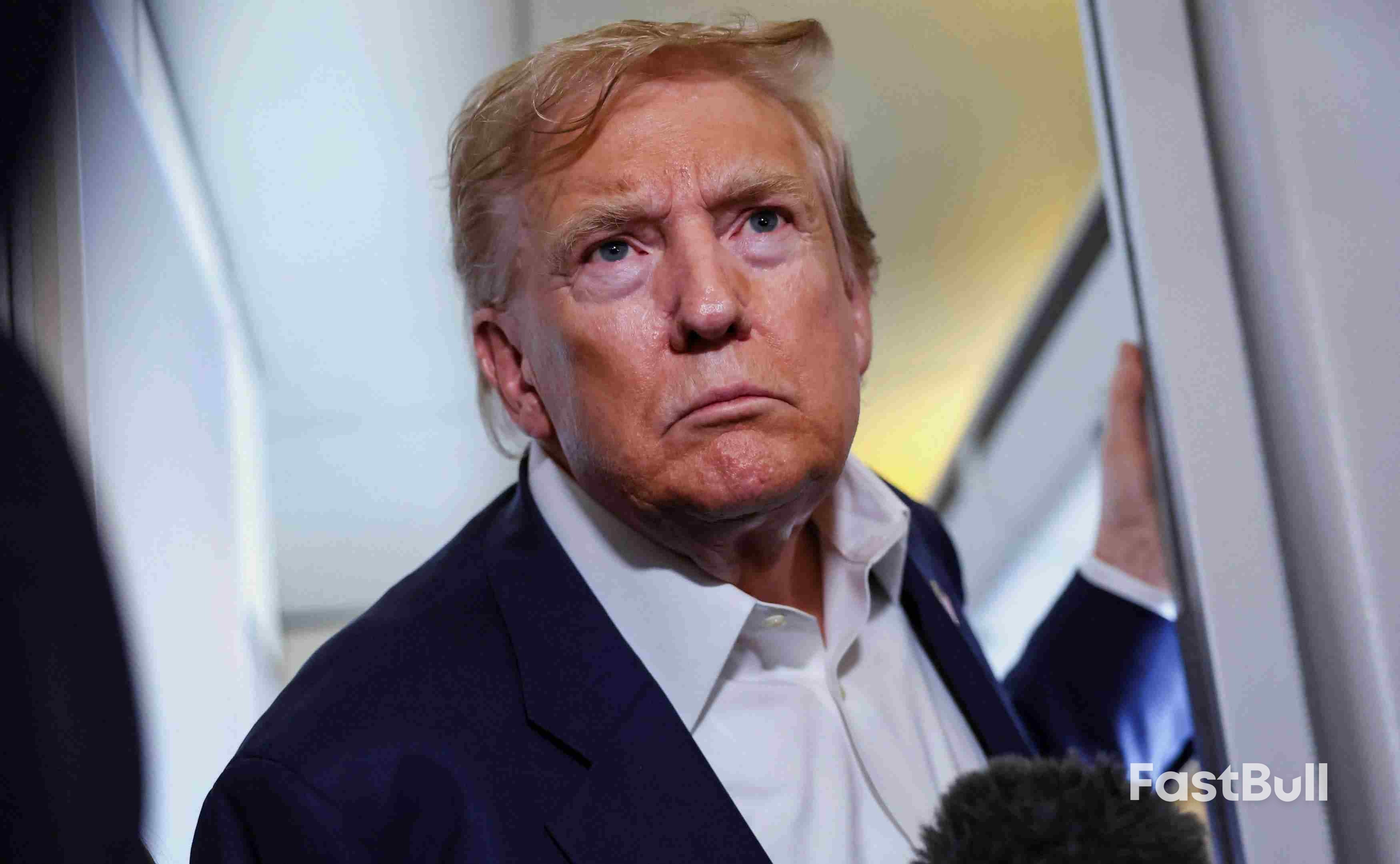
          The Federal Reserve said Friday that Governor Adriana Kugler is resigning early from her term and will exit the central bank on Aug. 8, potentially shaking up what was already a fractious succession process for Fed leadership amid difficult relations with President Donald Trump.
          The Fed said in a statement that Kugler, who became a governor in September 2023, will leave before her term’s conclusion, which was scheduled for Jan. 31, 2026. In a press release, the Fed said Kugler will return to Georgetown University as a professor next autumn.
          Kugler did not attend this week’s rate-setting Federal Open Market Committee meeting, which is unusual.
          Kugler’s early exit may shake up the timeline for the succession process now surrounding Chair Jerome Powell, whose term ends next May. Trump has threatened to fire Powell repeatedly believing interest rates should be much lower than they are.
          Trump will now get to select a Fed governor to replace Kugler and finish out her term. Some speculation had centered on the idea Trump might pick a potential future chair to fill that slot. The White House did not immediately respond to a request for comment about the Fed appointment.
          In a letter to Trump announcing her resignation, Kugler wrote “I am proud to have tackled this role with integrity, a strong commitment to serving the public, and with a data-driven approach strongly based on my expertise in labor markets and inflation.”
          Kugler’s time at the Fed was a challenging one as central bankers raised rates aggressively to combat high inflation pressures. Those high rates have put them in the crosshairs of Trump and have caused economic challenges, although inflation pressures have moved much closer to the 2% target.

          Source: Reuters

          Risk Warnings and Disclaimers
          You understand and acknowledge that there is a high degree of risk involved in trading. Following any strategies or investment methods may lead to potential losses. The content on the site is provided by our contributors and analysts for information purposes only. You are solely responsible for determining whether any trading assets, securities, strategy, or any other product is suitable for investing based on your own investment objectives and financial situation.
          Add to Favorites
          Share

          "Bad News Is Bad News": Jobs Data Shatters Wall Street´s Calm

          Manuel

          Economic

          Central Bank

          For months, Wall Street brushed off Donald Trump’s trade war and the Federal Reserve’s higher-for-longer stance — confident a resilient economy would keep propping up US markets.
          This week, that confidence began to unravel. Weak job growth and Trump’s latest volley of tariffs rattled investors, intensifying pressure on Fed Chair Jerome Powell to lower interest rates and exposing a new unease with the White House’s protectionist push.
          A three-month stretch of nearly unbroken market calm was shattered on Friday after a US report showed a sharp slowdown in the labor market. Traders rushed into the safety of government bonds — pushing down yields on two-year notes to 3.71% in the biggest drop since last August — while ramping up bets for a rate cut next month. The dollar fell and the S&P 500 Index continued its retreat from an all-time high, poised for the worst week since April.
          “Today’s release is best characterized as ‘bad news is bad news’ in our view,” said Jeff Schulze, head of economic and market strategy at ClearBridge Investments. “With job creation at stall-speed levels and the tariff headwind lying ahead, there’s a strong possibility of a negative payroll print in the coming months which may conjure up fears of a recession.”
          The lackluster jobs results prompted Trump to direct officials to remove the commissioner of the Bureau of Labor Statistics, accusing Erika McEntearfer of politicizing the data without any evidence.
          “The US public statistics represent the gold standard,” said Neil Dutta, head of economics at Renaissance Macro Research. “Calling them into question because they tell you something you don’t like undercuts market confidence.”
          Geopolitical tensions added to the risk-off tone across markets. Trump said he ordered nuclear submarines to be deployed “in the appropriate regions,” citing “highly provocative” remarks from former Russian President Dmitry Medvedev.
          The market action marked a sharp reversal from July, when the dollar rallied, haven trades were abandoned and US equities outpaced their international peers, buoyed by robust earnings and a still‑healthy economy.
          By week’s end, that narrative looks far more tenuous. Trump’s new tariffs — lifting the average US levy on global imports to 15%, the steepest since the 1930s — landed just as data showed that job growth averaged a paltry 35,000 in the last three months, the worse since the pandemic in part due to Trump’s efforts to pull back spending. The prospect for a slowdown caused traders to ratchet up the likelihood for a rate cut in September to 88%, up from 40% earlier this week.

          ‘Eyes on the Exit’

          “Lots of folks have their eyes on the exit door,” said Joe Saluzzi, co-head of equity trading at Themis Trading. “Weak job numbers should solidify the rate cut story for September, but there is some worry that the Fed is waiting too long.”
          The specter of lower rates sent the dollar down as much as 1%, the worst intraday drop since April. Economically sensitive companies led the retreat in the S&P 500 amid growth angst. The Russell 2000 Index of small-caps extended declines for a fifth day, poised for the worst week in four months.
          The latest data, which also showed that US manufacturing contracted by the most in nine months, casts into sharp relief the conundrum that Powell, and rest of the Fed’s rate-setting committee, face in the weeks and months ahead, as Trump and his administration ramp up their criticisms that the central bank isn’t moving quickly enough to lower rates.
          Many economists have noted that Trump’s punitive tariffs and his attempt to single-handedly rewrite the rules of international trade are now undermining the economy that lower rates would help support — by raising the cost of production for US companies and imposing a tax on ordinary Americans. At the same time, those very tariffs may spur a pickup in inflation, which could prevent the Fed from easing, even as the labor market weakens.
          The current state of play has undercut investor confidence in the direction of the US economy, and by extension, where asset prices are headed.
          Volatility whipped up across markets as traders re-assessed the economic reality after $15 trillion was added to equity values since April. The Cboe Volatility Index, a gauge of equity options cost, jumped above the widely watched level of 20 for the first time since April’s tariff-induced rout. Similar measures on high-yield and investment-grade bonds also climbed.
          “Investors may have gotten too complacent while waiting for the impacts of slower economic activity resulting from tariffs and higher interest rates,” said Charlie Ripley, senior investment strategist for Allianz Investment Management. “The economic cooling associated to tariffs is beginning to take hold. Softer labor conditions should raise eyebrows at the Fed and knowing they have been a reactionary organization in recent years, we should expect a higher chance of Fed action in the coming months.”
          The dual retreat in the US dollar and equities is a reminder that American assets aren’t impervious to economic and geopolitical shocks. Betting against the dollar — voted as the “most crowded trade” for the first time on record in Bank of America Corp.’s survey of money managers — turned out to be one of the biggest blunders as the greenback posted its first monthly gain since Trump took office. US skeptics, who continued to dominate in BofA’s survey, also had a setback in stocks as the S&P 500 outperformed the rest of the world for a third straight month.

          Significant Negatives

          The renewed weakness likely marked a welcome development to those who stuck to a preference in non-US assets of late. Rich Weiss, chief investment officer for multi-asset strategies at American Century Investment Management, has continued to be underweight US equities, citing stretched valuations.
          “There are significant potential negatives out there with the deficit, tariffs and inflation,” he said. “The overall volatility, which President Trump himself induces into the whole equation, indicates we still should remain somewhat cautious.”
          The whiplash between the America First trade and doubts on the strength of the US economy is creating headaches for money managers who are already struggling to keep up with fast-shifting market narratives.
          Take those who make investments based on macroeconomic and market trends. The HFRX Macro/CTA Index is down 3% this year, poised for the worst annual performance since 2018.
          “While growth had been firm and investors had become more sanguine on tariffs in recent months, the combination of today’s weak employment report and the tariff uncertainty is challenging,” said Jeffrey Palma, head of multi-asset solutions at Cohen & Steers. “This backdrop is a reminder that there are big risks ahead.”

          Source: Bloomberg

          To stay updated on all economic events of today, please check out our Economic calendar
          Risk Warnings and Disclaimers
          You understand and acknowledge that there is a high degree of risk involved in trading. Following any strategies or investment methods may lead to potential losses. The content on the site is provided by our contributors and analysts for information purposes only. You are solely responsible for determining whether any trading assets, securities, strategy, or any other product is suitable for investing based on your own investment objectives and financial situation.
          Add to Favorites
          Share

          Oil Sinks as Slew of Weak US Economic Data Revives Demand Fears

          Manuel

          Commodity

          Economic

          Oil sank as the outlook for the world’s largest economy darkened after a barrage of poor US data and tariff announcements, weighing on the prospects for energy demand growth.
          West Texas Intermediate crude fell 2.8% to settle near $67 a barrel on Friday, the biggest plunge in a single day since June 24. Prices also came under pressure as investors widely anticipate that OPEC and its allies will decide to add more supplies to the market during an upcoming weekend meeting.
          US jobs growth cooled sharply over the past three months, while factory activity contracted in July at the fastest clip in nine months, in a sign the economy is shifting into a lower gear amid widespread uncertainty. The swath of bearish data increased investor concerns that the impact of US President Donald Trump’s ever-changing tariff rates — which had so far been muted — has finally begun to weigh on economic growth.
          The weaker data come as Trump finalized plans for tariffs on several countries, including a higher rate on neighbor Canada, though oil is exempt.
          “Tariffs are now officially a part of daily life. With the catalyst in the rearview, focus must shift to the fallout,” said Daniel Ghali, a commodity strategist at TD Securities.
          Oil traders had been forced to the sidelines in recent weeks as numerous wild cards surrounding US trade policy and OPEC+ production confounded supply-and-demand outlooks. The unpredictable environment, which initially caused wild price swings earlier in the year, has dampened risk-on sentiment and sapped volatility from the market.
          The potential onset of an economic slowdown threatens to coincide with a period for oversupply widely expected for later this year. Second-quarter earnings for oil industry giants blew out expectations, with record oil production blunting the impact of lower crude prices. Exxon Mobil Corp. pumped the most oil for this time of year in a quarter century, and expressed little intention of slowing down US shale output. Meanwhile, Chevron Corp. is expected to lift output to an all-time high of almost 4 million barrels of oil equivalent a day later this year.
          Fueling further bearish sentiment, traders expect OPEC+ to agree on another 548,000 barrels-a-day boost. The cartel is scheduled to meet this weekend.
          “With those dynamics, we probably see some price pressure in the second half of the year,” Chevron Chief Financial Officer Eimear Bonner said in an interview. “We’re positioned for all price environments so if we see the softening, if it does in fact play out, we’re in a good spot.”
          Still, there are bullish factors at play. Prices eased off of intraday lows on Friday after Trump said in a social-media post that he deployed two nuclear submarines in response to “highly provocative” statements from former Russian President Dmitry Medvedev.
          “Traders appear to be taking a wait-and-see approach, as there’s still time before the negotiation deadline and this is more of a deterrent action,” said Rebecca Babin, a senior energy trader at CIBC Private Wealth Group.
          Trump’s decision to deploy the submarines is in line with his hardening stance against Russia over recent weeks. His threat to impose tariffs on nations buying barrels from Moscow had helped propel oil prices to the highest in a month earlier this week. The US President singled out India for buying Russian crude, a move that caused the nation’s state-run refiners to come up with plans to buy alternatives, a directive amounting to scenario planning, according to a person familiar with the matter.
          On Friday, one Indian refiner snapped up large volumes of supplies from the US and UAE.

          Source: Bloomberg

          To stay updated on all economic events of today, please check out our Economic calendar
          Risk Warnings and Disclaimers
          You understand and acknowledge that there is a high degree of risk involved in trading. Following any strategies or investment methods may lead to potential losses. The content on the site is provided by our contributors and analysts for information purposes only. You are solely responsible for determining whether any trading assets, securities, strategy, or any other product is suitable for investing based on your own investment objectives and financial situation.
          Add to Favorites
          Share

          Trump Says He Moved Two Nuclear Submarines After Russia's Medvedev Warns U.S.

          Devin

          Political

          President Donald Trump on Friday said that he ordered two nuclear submarines "to be positioned in the appropriate regions" in response to warnings made to the United States by top Russian official Dmitry Medvedev earlier this week.

          "Based on the highly provocative statements of the Former President of Russia, Dmitry Medvedev, who is now the Deputy Chairman of the Security Council of the Russian Federation, I have ordered two Nuclear Submarines to be positioned in the appropriate regions, just in case these foolish and inflammatory statements are more than just that," Trump said in a Truth Social post.

          "Words are very important, and can often lead to unintended consequences. I hope this will not be one of those instances. Thank you for your attention to this matter!"

          FILE PHOTO: Russia's Security Council's Deputy Chairman Dmitry Medvedev attends a meeting of the Council for Science and Education at the Joint Institute for Nuclear Research in the Moscow region's city of Dubna, Russia June 13, 2024.

          Medvedev, in a post on X on Monday, wrote, "Trump's playing the ultimatum game with Russia: 50 days or 10… He should remember 2 things."

          "1. Russia isn't Israel or even Iran. 2. Each new ultimatum is a threat and a step towards war," Medvedev wrote.

          "Not between Russia and Ukraine, but with his own country. Don't go down the Sleepy Joe road!" Medvedev added, referring to former President Joe Biden.

          Source: CNBC

          Risk Warnings and Disclaimers
          You understand and acknowledge that there is a high degree of risk involved in trading. Following any strategies or investment methods may lead to potential losses. The content on the site is provided by our contributors and analysts for information purposes only. You are solely responsible for determining whether any trading assets, securities, strategy, or any other product is suitable for investing based on your own investment objectives and financial situation.
          Add to Favorites
          Share

          Bitcoin Slips, Coinbase Stock Drops as Market's Friday Ills Hit Crypto

          Manuel

          Cryptocurrency

          Stocks

          A complex mixture of news and data is hitting stocks to close out the week. One side effect: a drag on crypto-related investments, which not long ago were riding high on big-picture optimism.
          Shares of Coinbase Global (COIN), which late Thursday reported quarterly results that missed revenue expectations (though also included signs that the current quarter's trading volume was looking better than the last), were recently down 17%, among the worst performers on the S&P 500. Robinhood Markets (HOOD), which turned in strong quarterly numbers earlier this week, was almost 2% lower Friday afternoon.
          Bitcoin, which touched $120,000 not too long ago, is now below $115,000. Leading bitcoin treasury Strategy (MSTR), formerly known as MicroStrategy, is off about 8%.
          Some of this is likely tied to a risk-off sentiment seen in Friday's broad trading, with all three major U.S. indexes down substantially amid fresh trade uncertainty and a July jobs number that—while perhaps strengthening the case for an interest-rate cut by the Federal Reserve—may also signal economic deterioration.

          Analysts Pull Back on Crypto-Stock Enthusiasm

          A recent run of strong results for tech and other stocks could also simply mean investors are taking a breather. Retail investors, according to Vanda Research, have lately pulled back from the most-speculative stocks after a short-lived meme-stock frenzy. On crypto stocks specifically, some analysts have shifted to more wait-and-see attitudes; Morgan Stanley reiterated a "neutral" rating on Robinhood Thursday.
          But some bulls are still running strong, noting recent regulatory wins and signs of future regulatory clarity that reinforce the belief that crypto's best days lie ahead.
          Oppenheimer analysts on Friday trimmed their price target on Coinbase by a few dollars to $413, holding well above the Street's roughly $383 average. They called the latest pullback "an attractive buying opportunity" and generally characterizing Thursday's results as meeting expectations.
          And Deutsche Bank on Thursday lifted its target on Robinhood to $118, which is $6 above the Street's average. "We believe our forecasts could actually be conservative given the potential upside from continued strong execution on [Robinhood's] product roadmap," they wrote.

          Source: Investopedia

          Risk Warnings and Disclaimers
          You understand and acknowledge that there is a high degree of risk involved in trading. Following any strategies or investment methods may lead to potential losses. The content on the site is provided by our contributors and analysts for information purposes only. You are solely responsible for determining whether any trading assets, securities, strategy, or any other product is suitable for investing based on your own investment objectives and financial situation.
          Add to Favorites
          Share

          US Labor Market Cracks Widen As Job Growth Hits Stall Speed

          Thomas

          Economic

          U.S. employment growth was weaker than expected in July while the nonfarm payrolls count for the prior two months was revised down by a massive 258,000 jobs, suggesting a sharp deterioration in labor market conditions that puts a September interest rate cut by the Federal Reserve back on the table.

          The Labor Department's closely watched employment report on Friday also showed the unemployment rate rose to 4.2% last month as household employment declined. Labor market resilience has shored up the economy amid headwinds from President Donald Trump's aggressive trade and immigration policies.

          Import duties are starting to boost inflation, raising the risk that the economy could experience a period of tepid growth and high prices, known as stagflation, which would put the U.S. central bank in a difficult position. Domestic demand increased at its slowest pace in 2-1/2 years in the second quarter.

          "The president's unorthodox economic agenda and policies may be starting to make a dent in the labor market," said Christopher Rupkey, chief economist at FWDBONDS. "The door to a Fed rate cut in September just got opened a crack wider. The labor market is not rolling over, but it is badly wounded and may yet bring about a reversal in the U.S. economy's fortunes."

          Nonfarm payrolls increased by 73,000 jobs last month after rising by a downwardly revised 14,000 in June, the fewest in nearly five years, the Labor Department's Bureau of Labor Statistics said. Economists polled by Reuters had forecast payrolls would increase by 110,000 jobs after rising by a previously reported 147,000 in June. Estimates ranged from no jobs added to an increase of 176,000 positions.
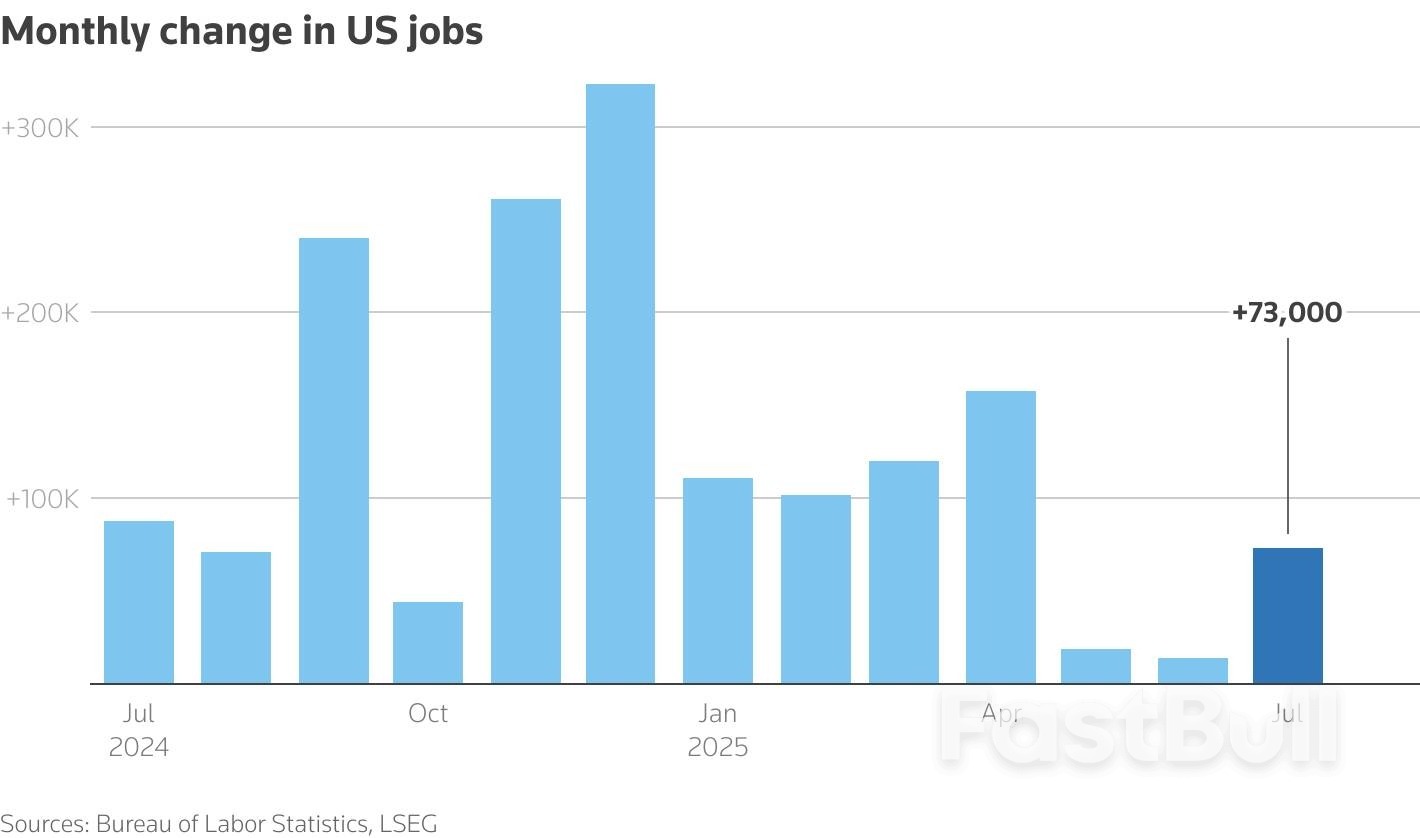
          A column chart titled "Monthly change in US jobs" that tracks the metric over the past year.

          Payrolls for May were slashed by 125,000 to only a gain of 19,000 jobs. The BLS described the revisions to May and June payrolls data as "larger than normal."

          It gave no reason for the revised data but noted that "monthly revisions result from additional reports received from businesses and government agencies since the last published estimates and from the recalculation of seasonal factors."

          Economists have raised concerns about data quality in the wake of the Trump administration's mass firings of federal workers.

          Employment gains averaged 35,000 jobs per month over the last three months compared to 123,000 a year ago. Uncertainty over where tariff levels will eventually settle has made it harder for businesses to plan long-term, economists said.

          Though more clarity has emerged as the White House announced trade deals, economists said the effective tariff rate was still the highest since the 1930s. Trump on Thursday slapped dozens of trading partners with steep tariffs, including a 35% duty on many goods from Canada.

          Trump, who has demanded the U.S. central bank lower borrowing costs, stepped up his insults aimed at Fed Chair Jerome Powell, posting on the Truth Social media platform, "Too Little, Too Late. Jerome "Too Late" Powell is a disaster."

          The Fed on Wednesday left its benchmark interest rate in the 4.25%-4.50% range. Powell's comments after the decision undercut confidence the central bank would resume its policy easing in September as had been widely anticipated by financial markets and some economists.

          Powell is focused on the unemployment rate. Financial markets now expect the Fed to resume its monetary policy easing next month after pushing back rate-cut expectations to October in the wake of Wednesday's policy decision.

          The case for a September rate cut could be reinforced by the BLS' preliminary payrolls benchmark revision next month, which is expected to project a steep drop in the employment level from April 2024 through March of this year.

          The Quarterly Census of Employment and Wages data, derived from reports by employers to the state unemployment insurance programs, has indicated a much slower pace of job growth between April 2024 and December 2024 than payrolls have suggested.

          Stocks on Wall Street were trading lower on the data and latest round of tariffs. The dollar fell against a basket of currencies. U.S. Treasury yields dropped.

          SHRINKING LABOR POOL

          Job gains in July continued to be concentrated in the healthcare and social assistance sector, which added a combined 73,300 jobs. Retail employment increased by 15,700 jobs and financial activities payrolls rose by 15,000.

          There were small job gains in the construction and leisure and hospitality industries, which economists attributed to ongoing immigration raids. Several industries, including manufacturing, professional services and wholesale trade shed jobs.

          The share of industries reporting job growth, however, rose to 51.2% from 47.2% in June. Federal government employment dropped by another 12,000 positions and is down 84,000 since peaking in January. More job losses are likely after the Supreme Court gave the White House the green light for mass firings as Trump seeks to slash spending and headcount. But the administration has also said several agencies were not planning to proceed with layoffs.
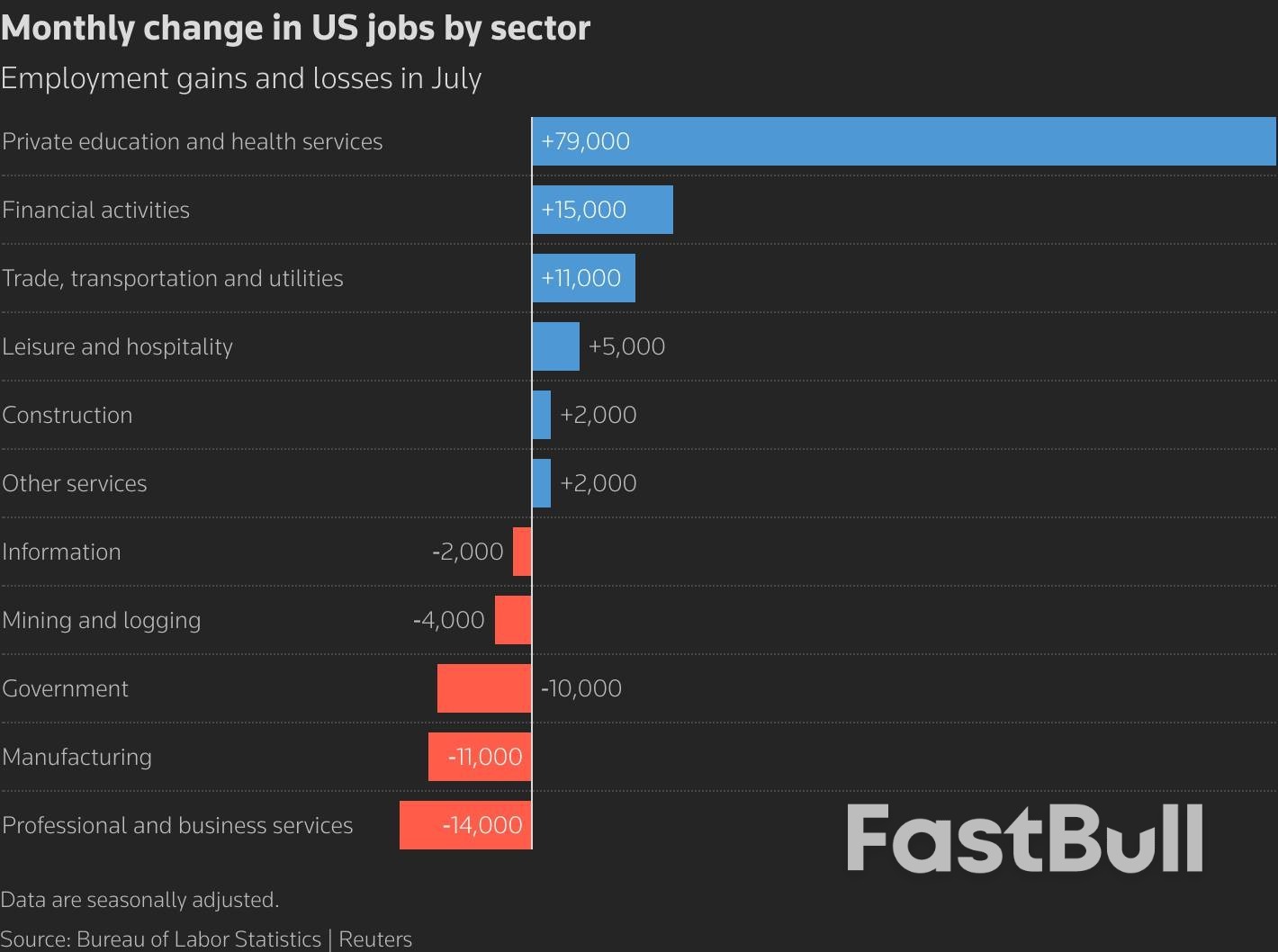
          A bar chart that ranks the number of jobs added or lost in the most recent month by sector.

          The unemployment rate increased to 4.248% before rounding last month. It declined to 4.1% in June also as people dropped out of the labor force, and remains in the narrow 4.0%-4.2% range that has prevailed since May 2024.

          The government's immigration crackdown has reduced labor supply, as has an acceleration of baby boomer retirements. Economists estimated the economy now needs to create less than 100,000 jobs per month to keep up with growth in the working-age population.
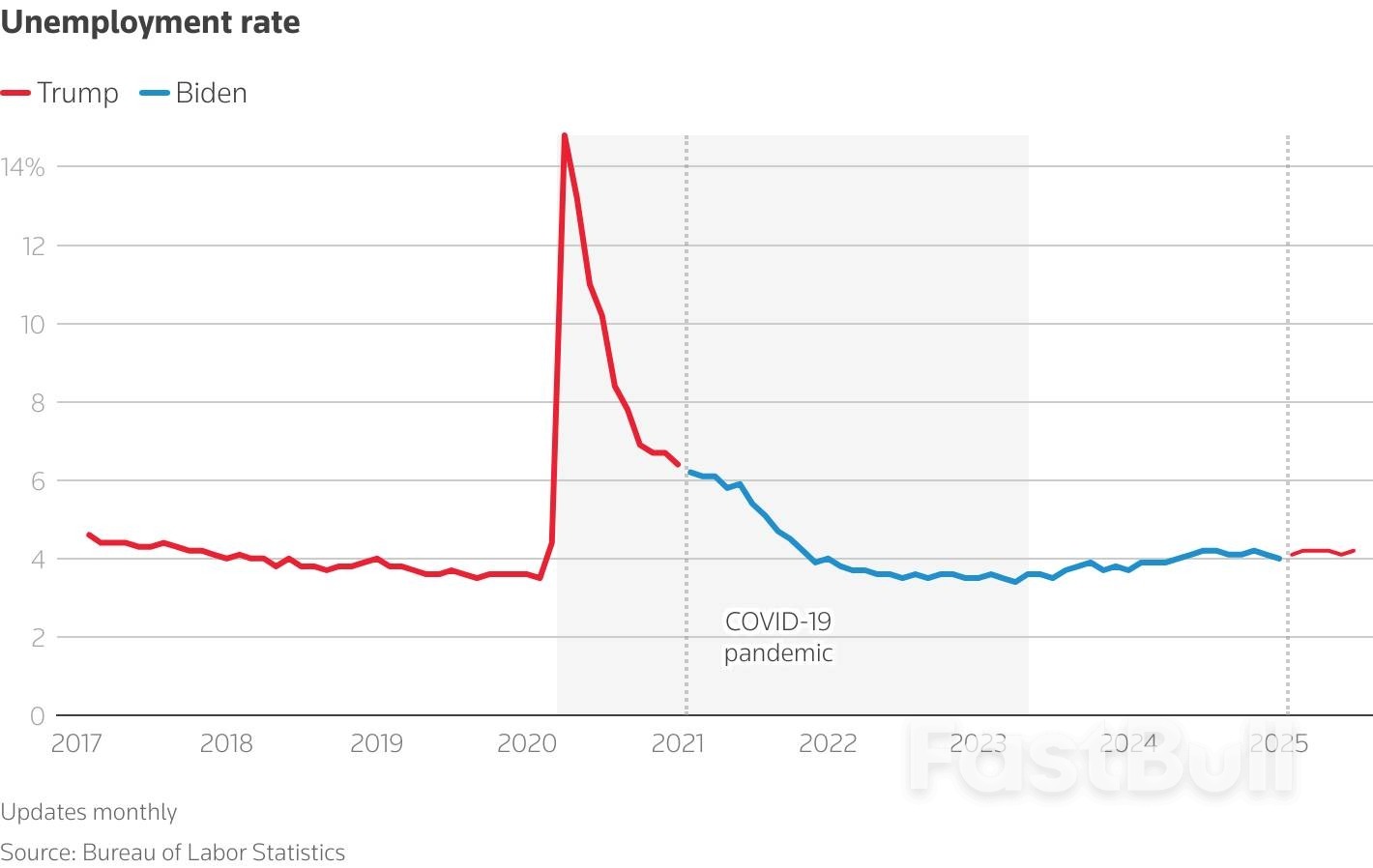
          A line chart that shows the U.S. unemployment rate by month

          About 38,000 people left the labor force, which was offset by a drop of 260,000 in household employment. The labor force participation rate fell to 62.2% from 62.3% in June, now down for three straight months and capping the rise in the jobless rate.

          "Without the participation rate decline, the unemployment rate would have added another tenth to a solid 4.3%," said Michael Gapen, chief U.S. economist at Morgan Stanley. "Immigration restrictions have and will continue to have a chilling effect on participation and will continue to add to downward pressure on the unemployment rate."

          The number of foreign-born workers fell by 341,000. Economists said this decline along with the drop in the labor force kept annual wage growth at a lofty 3.9%. There were more part-time workers and a jump in the number of people experiencing long bouts of unemployment. The median duration of unemployment increased to 10.2 weeks from 10.1 weeks in June.

          "One gets the sense that due to trade and immigration policy the domestic economy and labor market are paying a price," said Joseph Brusuelas, chief economist at RSM US. "Stagflation is the best description of the domestic economy as we enter the second half of the year."
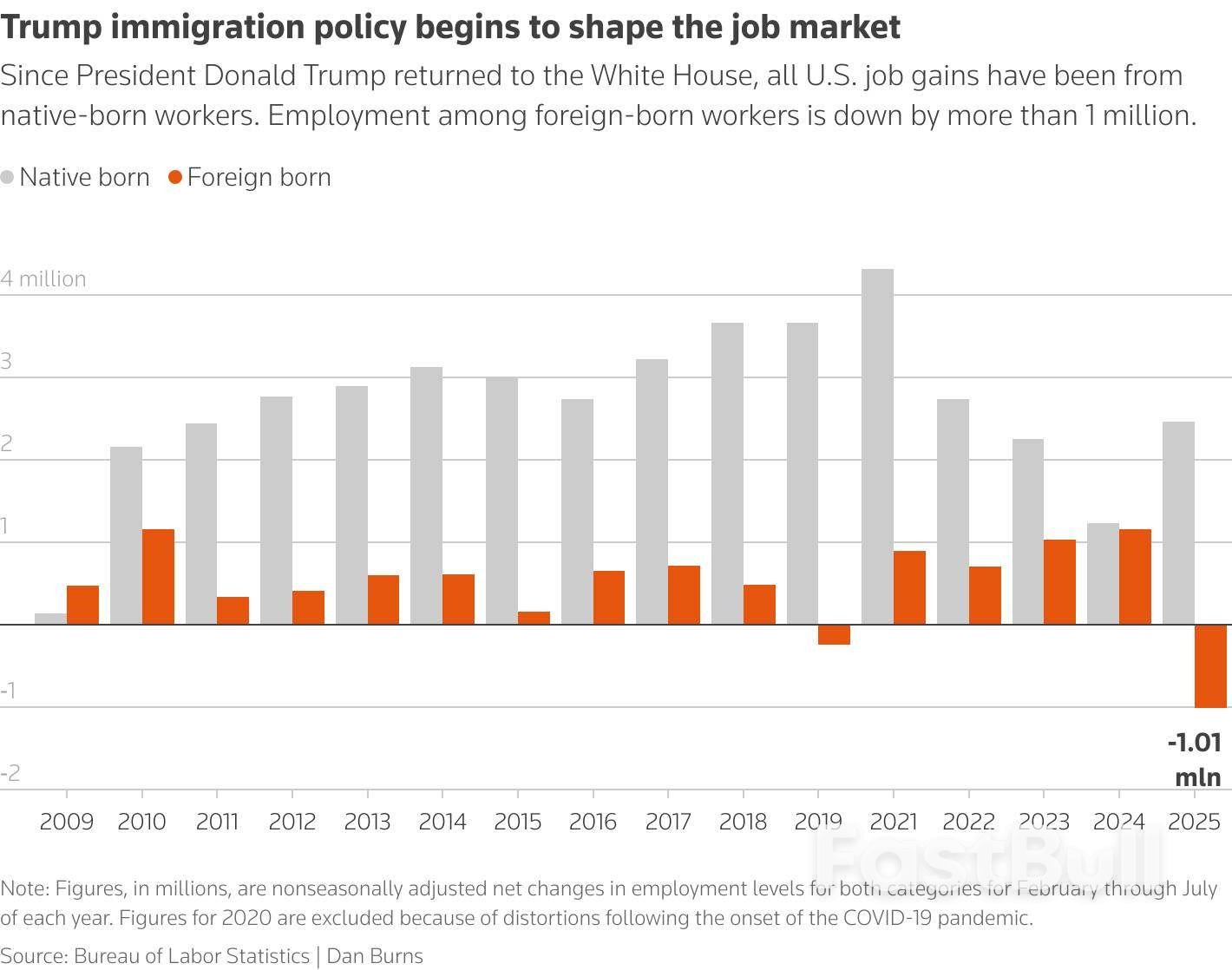
          Shows foreign born and native born employment changes

          Source: Reuters

          To stay updated on all economic events of today, please check out our Economic calendar
          Risk Warnings and Disclaimers
          You understand and acknowledge that there is a high degree of risk involved in trading. Following any strategies or investment methods may lead to potential losses. The content on the site is provided by our contributors and analysts for information purposes only. You are solely responsible for determining whether any trading assets, securities, strategy, or any other product is suitable for investing based on your own investment objectives and financial situation.
          Add to Favorites
          Share

          Wall Street’s Months-Long Truce With Washington Is Shattering

          Thomas

          Economic

          For months, Wall Street brushed off Donald Trump’s trade war and the Federal Reserve’s higher-for-longer stance — confident a resilient economy would keep propping up US markets.

          This week, that confidence began to unravel. Weak job growth and Trump’s latest volley of tariffs rattled investors, intensifying pressure on Fed Chair Jerome Powell to lower interest rates and exposing a new unease with the White House’s protectionist push.

          A three-month stretch of nearly unbroken market calm was shattered on Friday after a US report showed a sharp slowdown in the labor market. Traders rushed into the safety of government bonds — pushing down yields on two-year notes to 3.71% in the biggest drop since last August — while ramping up bets for a rate cut as soon as next month. The dollar fell and the S&P 500 Index retreated from an all-time high, poised for the worst week since May.

          Volatility whipped up across markets as traders re-assessed the economic reality after $15 trillion was added to equity values since April. The Cboe Volatility Index, a gauge of options cost, jumped to approach the widely watched level of 20 for the first time since April’s tariff-induced rout. Similar measures on high-yield and investment-grade bonds also climbed.

          “Lots of folks have their eyes on the exit door. Some frothy signs are appearing,” said Joe Saluzzi, co-head of equity trading at Themis Trading. “Weak job numbers should solidify the rate cut story for September, but there is some worry that the Fed is waiting too long.”

          Friday’s market action marked a sharp reversal from July, when the dollar rallied, haven trades were abandoned and US equities outpaced their international peers, buoyed by stronger‑than‑expected earnings and a still‑healthy economic growth.

          That narrative took a hit at the end of the week. Trump’s new tariffs — lifting the average US levy on global imports to 15%, the steepest since the 1930s — landed just as data showed job growth cooling more than expected. The prospect for a slowdown caused traders to ratchet up the likelihood for a rate cut in September to 88%, up from 40% earlier this week.

          The specter of lower rates sent the dollar down as much as 1%, the worst intraday drop since April. Economically sensitive companies led the retreat in the S&P 500 amid growth angst. The Russell 2000 Index of small-caps extended declines for a fifth day, poised for the worst week in four months.

          “Investors may have gotten too complacent while waiting for the impacts of slower economic activity resulting from tariffs and higher interest rates,” said Charlie Ripley, senior investment strategist for Allianz Investment Management. “The economic cooling associated to tariffs is beginning to take hold. Softer labor conditions should raise eyebrows at the Fed and knowing they have been a reactionary organization in recent years, we should expect a higher chance of Fed action in the coming months.”

          The duo retreat in the US dollar and equities highlights July’s fragility of the resurgence in American exceptionalism. Betting against the dollar — voted as the “most crowded trade” for the first time on record in Bank of America Corp.’s survey of money managers — turned out to be one of the biggest blunders as the greenback posed its first monthly gain since Trump took office. US skeptics, who continued to dominate in BofA’s survey, also had a setback in stocks as the S&P 500 outperformed the rest of the world for a fourth straight month.

          The renewed weakness likely marked a welcome development to those who stuck to a preference in non-US assets of late. Rich Weiss, chief investment officer for multi-asset strategies at American Century Investment Management, has continued to be underweight US equities, citing stretched valuations.

          “There are significant potential negatives out there with the deficit, tariffs and inflation,” he said. “The overall volatility, which President Trump himself deduces into the whole equation, indicates we still should remain somewhat cautious.”

          Source: Bloomberg Europe

          To stay updated on all economic events of today, please check out our Economic calendar
          Risk Warnings and Disclaimers
          You understand and acknowledge that there is a high degree of risk involved in trading. Following any strategies or investment methods may lead to potential losses. The content on the site is provided by our contributors and analysts for information purposes only. You are solely responsible for determining whether any trading assets, securities, strategy, or any other product is suitable for investing based on your own investment objectives and financial situation.
          Add to Favorites
          Share
          FastBull
          Copyright © 2025 FastBull Ltd

          728 RM B 7/F GEE LOK IND BLDG NO 34 HUNG TO RD KWUN TONG KLN HONG KONG

          TelegramInstagramTwitterfacebooklinkedin
          App Store Google Play Google Play
          Products
          Charts

          Chats

          Q&A with Experts
          Screeners
          Economic Calendar
          Data
          Tools
          Membership
          Features
          Function
          Markets
          Copy Trading
          Latest Signals
          Contests
          News
          Analysis
          24/7
          Columns
          Education
          Company
          Careers
          About Us
          Contact Us
          Advertising
          Help Center
          Feedback
          User Agreement
          Privacy Policy
          Business

          White Label

          Data API

          Web Plug-ins

          Poster Maker

          Affiliate Program

          Risk Disclosure

          The risk of loss in trading financial instruments such as stocks, FX, commodities, futures, bonds, ETFs and crypto can be substantial. You may sustain a total loss of the funds that you deposit with your broker. Therefore, you should carefully consider whether such trading is suitable for you in light of your circumstances and financial resources.

          No decision to invest should be made without thoroughly conducting due diligence by yourself or consulting with your financial advisors. Our web content might not suit you since we don't know your financial conditions and investment needs. Our financial information might have latency or contain inaccuracy, so you should be fully responsible for any of your trading and investment decisions. The company will not be responsible for your capital loss.

          Without getting permission from the website, you are not allowed to copy the website's graphics, texts, or trademarks. Intellectual property rights in the content or data incorporated into this website belong to its providers and exchange merchants.

          Not Logged In

          Log in to access more features

          FastBull Membership

          Not yet

          Purchase

          Become a signal provider
          Help Center
          Customer Service
          Dark Mode
          Price Up/Down Colors

          Log In

          Sign Up

          Position
          Layout
          Fullscreen
          Default to Chart
          The chart page opens by default when you visit fastbull.com
