Markets
News
Analysis
User
24/7
Economic Calendar
Education
Data
- Names
- Latest
- Prev



Signal Accounts for Members
All Signal Accounts
All Contests


U.S. NY Fed Manufacturing Prices Received Index (Jan)A:--
F: --
P: --
U.S. NY Fed Manufacturing New Orders Index (Jan)A:--
F: --
P: --
U.S. NY Fed Manufacturing Employment Index (Jan)A:--
F: --
P: --
U.S. Export Price Index YoY (Nov)A:--
F: --
P: --
U.S. NY Fed Manufacturing Index (Jan)A:--
F: --
U.S. Initial Jobless Claims 4-Week Avg. (SA)A:--
F: --
U.S. Export Price Index MoM (Nov)A:--
F: --
P: --
Canada Manufacturing Unfilled Orders MoM (Nov)A:--
F: --
P: --
Canada Manufacturing New Orders MoM (Nov)A:--
F: --
P: --
U.S. Philadelphia Fed Manufacturing Employment Index (Jan)A:--
F: --
P: --
Canada Wholesale Sales YoY (Nov)A:--
F: --
P: --
Canada Wholesale Inventory MoM (Nov)A:--
F: --
P: --
U.S. Philadelphia Fed Business Activity Index (SA) (Jan)A:--
F: --
P: --
U.S. EIA Weekly Natural Gas Stocks ChangeA:--
F: --
P: --
Richmond Federal Reserve President Barkin delivered a speech.
U.S. Weekly Treasuries Held by Foreign Central BanksA:--
F: --
P: --
Germany CPI Final MoM (Dec)A:--
F: --
P: --
Germany CPI Final YoY (Dec)A:--
F: --
P: --
Germany HICP Final MoM (Dec)A:--
F: --
P: --
Germany HICP Final YoY (Dec)A:--
F: --
P: --
Brazil PPI MoM (Nov)A:--
F: --
P: --
Canada New Housing Starts (Dec)A:--
F: --
U.S. Capacity Utilization MoM (SA) (Dec)A:--
F: --
U.S. Industrial Output YoY (Dec)A:--
F: --
P: --
U.S. Manufacturing Capacity Utilization (Dec)A:--
F: --
P: --
U.S. Manufacturing Output MoM (SA) (Dec)A:--
F: --
U.S. Industrial Output MoM (SA) (Dec)A:--
F: --
U.S. NAHB Housing Market Index (Jan)A:--
F: --
P: --
Russia CPI YoY (Dec)A:--
F: --
P: --
U.S. Weekly Total Rig CountA:--
F: --
P: --
U.S. Weekly Total Oil Rig CountA:--
F: --
P: --
Japan Core Machinery Orders YoY (Nov)--
F: --
P: --
Japan Core Machinery Orders MoM (Nov)--
F: --
P: --
U.K. Rightmove House Price Index YoY (Jan)--
F: --
P: --
China, Mainland GDP YoY (YTD) (Q4)--
F: --
P: --
China, Mainland Industrial Output YoY (YTD) (Dec)--
F: --
P: --
Japan Industrial Output Final MoM (Nov)--
F: --
P: --
Japan Industrial Output Final YoY (Nov)--
F: --
P: --
Euro Zone Core HICP Final MoM (Dec)--
F: --
P: --
Euro Zone HICP Final MoM (Dec)--
F: --
P: --
Euro Zone HICP Final YoY (Dec)--
F: --
P: --
Euro Zone HICP MoM (Excl. Food & Energy) (Dec)--
F: --
P: --
Euro Zone Core CPI Final YoY (Dec)--
F: --
P: --
Euro Zone Core HICP Final YoY (Dec)--
F: --
P: --
Euro Zone CPI YoY (Excl. Tobacco) (Dec)--
F: --
P: --
Euro Zone Core CPI Final MoM (Dec)--
F: --
P: --
Canada National Economic Confidence Index--
F: --
P: --
Canada CPI MoM (SA) (Dec)--
F: --
P: --
Canada Core CPI MoM (SA) (Dec)--
F: --
P: --
Canada CPI YoY (SA) (Dec)--
F: --
P: --
Canada Trimmed CPI YoY (SA) (Dec)--
F: --
P: --
Canada CPI YoY (Dec)--
F: --
P: --
Canada CPI MoM (Dec)--
F: --
P: --
Canada Core CPI YoY (Dec)--
F: --
P: --
Canada Core CPI MoM (Dec)--
F: --
P: --
South Korea PPI MoM (Dec)--
F: --
P: --
China, Mainland 1-Year Loan Prime Rate (LPR)--
F: --
P: --
China, Mainland 5-Year Loan Prime Rate--
F: --
P: --
Germany PPI YoY (Dec)--
F: --
P: --
Germany PPI MoM (Dec)--
F: --
P: --


No matching data
Latest Views
Latest Views
Trending Topics
Top Columnists
Latest Update
White Label
Data API
Web Plug-ins
Affiliate Program
View All

No data
A Fed Vice Chair urges readiness for more rate cuts due to a fragile job market, contrasting the central bank's caution.
Federal Reserve Vice Chair for Supervision Michelle Bowman stated on Friday that a fragile U.S. job market, which could weaken quickly, means the central bank must be prepared to cut interest rates again if necessary.
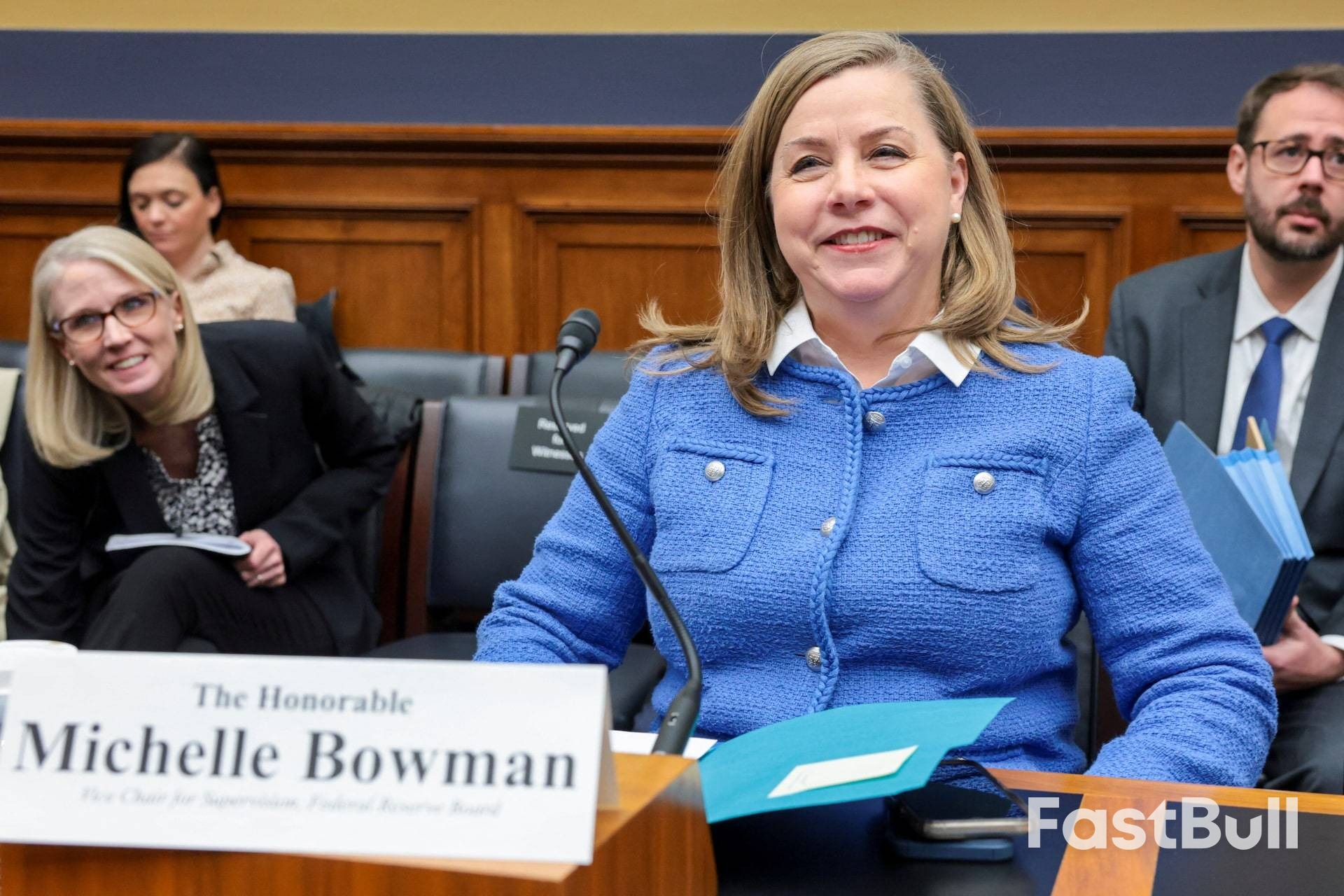
In a speech for the New England Economic Forum, Bowman argued that without a "clear and sustained improvement in labor market conditions, we should remain ready to adjust policy to bring it closer to neutral." She emphasized that while monetary policy is not on a predetermined path, the Fed "should also avoid signaling that we will pause" on more rate cuts unless economic conditions change.
Bowman described the current monetary policy stance as "moderately restrictive" and stressed that officials should be forward-looking when setting rates. She advocated for using forecasts informed by a wide range of indicators and direct engagement with businesses and communities.
Bowman’s baseline forecast is for continued solid economic expansion and a labor market stabilizing near full employment as policy becomes less restrictive. However, she noted that the risks to the Fed's dual mandate are uneven.
She believes price pressures are likely to ease as the effects of trade tariffs diminish, bringing underlying inflation closer to the Fed's 2% target. In contrast, she sees the job market as "increasingly more fragile" and warned it "could continue to deteriorate in the coming months." Given that conditions can shift rapidly, Bowman argued for the Fed to remain nimble on policy decisions.
The Federal Reserve enters 2026 with policymakers generally expecting inflation to moderate, the job market to stabilize, and economic growth to remain decent as uncertainty from President Donald Trump's policies subsides.
In the last months of 2025, the Fed cut its benchmark interest rate by three-quarters of a percentage point, bringing it to a range of 3.50%-3.75%. These cuts were intended to support a weakening job market while keeping enough restraint to lower high inflation.
At their December 9-10 meeting, Fed officials projected a single quarter-percentage-point rate cut for 2026. Since the start of the year, they have signaled no immediate urgency to act, preferring to wait for more evidence that inflation, still well above the 2% target, is on a downward path.
This cautious stance comes amid considerable pressure from President Trump to lower rates further. The president is expected to soon announce his choice to succeed Fed Chair Jerome Powell, whose term ends in May. Tensions recently escalated after it was revealed the administration is criminally targeting the Fed over costs related to its headquarters renovation, an action Powell described as a response to the central bank exercising independent judgment on rate policy.
WASHINGTON, Jan 16 (Reuters) - White House adviser Kevin Hassett played down the federal criminal investigation into Federal Reserve Chair Jerome Powell on Friday, saying he expected there would be "nothing to see here".
The Trump administration has opened a criminal investigation into Powell over cost overruns for a $2.5 billion project to renovate two historical buildings at the Fed's headquarters complex. Powell, who disclosed the probe on Sunday, denies wrongdoing, and said the unprecedented actions were a pretext to put pressure on him for not satisfying U.S. President Donald Trump's long-running demands for sharply lower interest rates.
Hassett, the director of the National Economic Council who is a candidate to replace Powell, said in an interview with Fox Business Network that he wished there had been more transparency from the Fed about cost overruns of building renovations.
"The bottom line is, I expect, you know, Jay is a good man - I expect that there's nothing to see here, that the cost overruns are related to things like asbestos, as he says. But I sure wish they had been more transparent," Hassett said.
The probe drew criticism from foreign economic officials, investors and former U.S. government officials from both political parties - as well as lawmakers in Trump's own Republican Party, as politicizing sensitive policymaking.
Powell's term as Fed chair ends in May. Trump has yet to announce a replacement.
Hassett tried to minimize the federal criminal probe as a "simple request for information".
"I'm sure the information will be forthcoming shortly, and then things will move forward," he told "Mornings with Maria."
The Trump administration is pursuing a dual-track strategy in its relationship with Venezuela, marked by high-level diplomatic meetings in both Caracas and Washington following the capture of President Nicolas Maduro earlier this year.
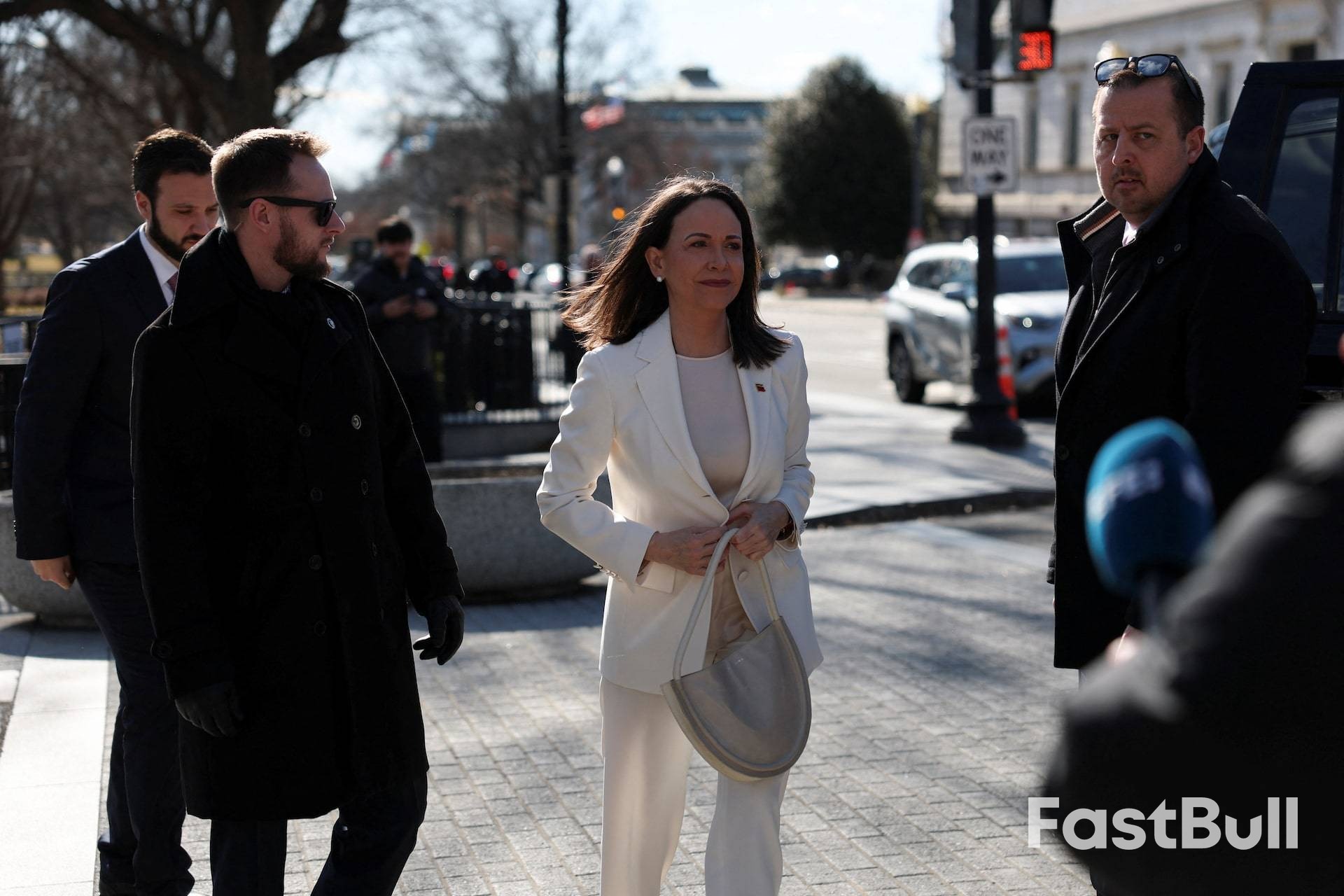
In a significant move, CIA Director John Ratcliffe met with Venezuela's acting president, Delcy Rodriguez, in Caracas. Simultaneously, Venezuelan opposition leader Maria Corina Machado held a meeting with President Donald Trump at the White House.
Maria Corina Machado, a prominent liberal opposition figure, met with President Trump on Thursday. The meeting was highlighted by a significant gesture: Machado presented Trump with the Nobel Peace Prize medal she had received the previous year.

After what she described as an "excellent" meeting, Trump publicly thanked Machado for the medal on social media, calling it "a wonderful gesture of mutual respect." Machado is scheduled to speak with reporters on Friday at the Heritage Foundation, a conservative think tank with strong connections to the Trump administration.
John Ratcliffe’s visit to Caracas makes him the most senior U.S. official known to have met with acting President Delcy Rodriguez since the U.S. attack on January 3 that resulted in the capture of Nicolas Maduro and his wife.
According to a U.S. official, the CIA chief met with Rodriguez at Trump's direction. The key objectives of the meeting were:
• To signal that the United States is seeking an improved working relationship.
• To discuss intelligence cooperation and economic stability.
• To demand assurances that Venezuela will not serve as a "safe haven for America's adversaries, especially narco-traffickers."
The diplomatic overtures are set against a backdrop of deep political friction. During her first State of the Union address on Thursday, acting President Rodriguez appeared to take a swipe at Machado's visit to Washington.
"If I should visit Washington," Rodriguez told the Venezuelan people, "I will do so with my head held high, walking, not on my knees."
President Donald Trump's recent comments on potential candidates for the Federal Reserve chairmanship have sent immediate shockwaves through financial markets, reshaping the race to lead the central bank.
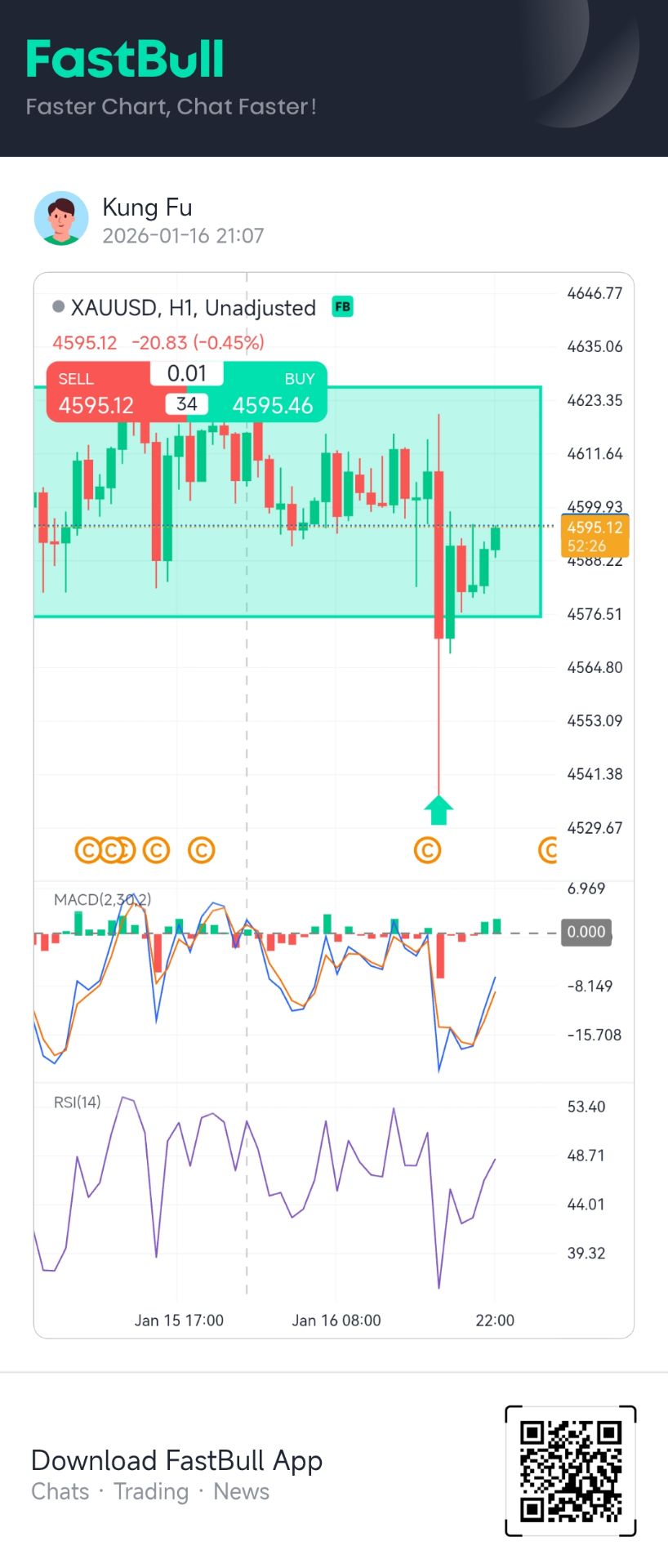
In a move that caught traders by surprise, Trump appeared to rule out Kevin Hassett, a top contender, for the position. The statement triggered a sharp rally in the U.S. dollar while sending gold and silver prices tumbling.
Speaking to reporters, President Trump indicated he prefers Hassett to remain in his current post at the White House National Economic Council (NEC).
"Hassett performs very well on television, and I want him to stay in his current position. We'll see," Trump said. He added a revealing justification: "Fed officials don't talk much, Hassett talks a lot."
This public dismissal of Hassett's candidacy for the Fed's top job had an instant impact on market sentiment and leadership odds.
The financial market response was swift and decisive. Following the president's remarks, the U.S. Dollar Index (DXY) surged by over 20 points.
Simultaneously, prices for precious metals dropped. Both spot gold and silver experienced sharp short-term declines as investors recalibrated their expectations for the future of U.S. monetary policy and leadership at the Federal Reserve.
On forecasting platforms, the probabilities for the next Fed chair shifted dramatically. Kevin Warsh saw his chances increase, while Hassett's plummeted. Other potential candidates, including Christopher Waller, Rick Rieder, and Michelle Bowman, continue to be listed with lower probabilities.
The shakeup has also intensified uncertainty around the future of the current Fed Chair, Jerome Powell. While his term as chairman ends in May, his term as a member of the Fed's Board of Governors runs until January 2028.
Recent events have fueled speculation that Powell may choose to remain on the board after stepping down as chair. A grand jury subpoena from the Justice Department, which Powell linked to his congressional testimony on renovations at the Fed building, has been interpreted by some as a political move.
In a statement on January 11, Powell characterized the subpoena within a wider context of "government pressure and threats," leading many to believe he might stay on to safeguard the central bank's institutional integrity.
Analysts Warn of a "Shadow Chairman"
If Powell remains on the board, it could significantly complicate Trump's efforts to install a Fed leadership more inclined to support interest rate cuts.
Former Cleveland Fed President Loretta Mester warned this scenario could create the perception of a "dual authority" within the Fed, potentially confusing markets.
Antulio Bomfim, Global Macro Director at Northern Trust Asset Management, noted that while Powell likely does not want a "shadow chairman" role, his continued presence on the board would inevitably serve as a strong balancing force.
Despite the leadership drama, no radical shifts in monetary policy are expected in the immediate future. The Fed recently cut its policy rate by 25 basis points—its third consecutive reduction—and has signaled a wait-and-see approach pending clearer inflation and employment data.
However, the ongoing uncertainty over the Fed's next leader and the potential for Powell to remain on the board could delay President Trump's plans to appoint new members and secure a majority more aligned with his economic agenda.

The U.S. Senate voted on Thursday to approve billions of dollars in funding for federal science agencies, rejecting deep cuts proposed by President Donald Trump in space and other areas.
The Senate bill approved significant science funding for NASA, the National Science Foundation and the National Oceanic and Atmospheric Administration above what the White House had sought. NSF will receive $8.75 billion for research efforts including in quantum information science, artificial intelligence and other areas.
The White House had sought to cut the budget by 57%.
The NSF funding is expected to support nearly 10,000 new competitive awards and more than 250,000 scientists, technicians, teachers, and students, Democratic Senator Chris Van Hollen said.
The Senate rejected nearly all of Trump's cuts to NASA. The president had sought a $6 billion cut from the $24.9 billion budget, but the Senate voted for a much smaller cut, appropriating $24.44 billion.
The bill rejected a proposal to cut NASA Science by 47% and terminate 55 operating and planned missions. The legislation also provides $1.6 billion for Astrophysics, including $300 million to complete a telescope to investigate dark energy and $500 million for the Dragonfly mission to explore the largest moon of Saturn.
This week, White House science adviser Michael Kratsios addressed criticism of proposed science budget cuts. "Even in our attempt to try to rightsize the budget, the one area where we have kept a consistent amount of proposed budget funding has been in AI," he said.
Senator Maria Cantwell, the top Democrat on the Commerce Committee that oversees many science-related agencies, said in a Reuters interview the bipartisan vote was a vote for science. "Congress won by saying, 'No, science does matter, and we're going to invest in it.'"
The bill supports big projects like creating a "permanent outpost on the Moon, developing space technology that monitors extreme weather and protects our citizens from natural disasters, and inventing the microelectronics of the future," Cantwell said.Senator Rand Paul, a Republican, said the legislation "wastes $8.75 billion on the National Science Foundation—a massive taxpayer-funded expansion with weak oversight, vague priorities, and no clear return for the public."

The Trump administration is developing a plan that would allow investors to use their 401(k) retirement funds to make a down payment on a house. White House economic adviser Kevin Hassett confirmed the proposal on Friday, stating that more details would be released next week.
In an interview with Fox Business Network, Hassett said the administration will "allow people to take money out of their 401ks and use that for down payment." He added that President Donald Trump is expected to present the final plan during the economic conference in Davos, Switzerland.
Hassett, who will be traveling with the president, noted that officials are still determining the "mechanics of it" to ensure the policy doesn't negatively impact individuals' retirement savings. The goal is to find a "simple" way to facilitate the transfer of funds.
This new initiative comes as the administration confronts economic pressures ahead of the November midterm elections. A central campaign promise was to find solutions for the high prices facing American consumers.
Housing affordability has become a major challenge across the United States. A combination of high mortgage rates and elevated home prices has pushed many potential buyers out of the market, leading to a slowdown in housing activity. Investors and would-be homeowners have been watching for policy changes or market shifts that could revive mortgage applications.
Recent consumer inflation data from the Bureau of Labor Statistics confirmed that housing inflation remains strong, underscoring the persistence of the problem.
The 401(k) proposal is the latest in a series of ideas from the Trump administration aimed at tackling the housing market. Other recent proposals include:
• Banning institutional investors from purchasing single-family homes.
• Instructing the Federal Housing Finance Agency to buy $200 billion in bonds from mortgage giants Fannie Mae and Freddie Mac to help lower mortgage rates.
• Repeatedly calling on the U.S. Federal Reserve to lower its benchmark interest rates.
While these measures are designed to stimulate demand, some economists and market analysts argue they miss the core issue: a critical lack of housing supply.
According to this view, local zoning laws and regulations are the primary constraints on building new homes. They caution that policies designed to lower rates or ease down payments could increase demand for a limited number of houses, which would likely just push prices even higher without a corresponding increase in supply.
White Label
Data API
Web Plug-ins
Poster Maker
Affiliate Program
The risk of loss in trading financial instruments such as stocks, FX, commodities, futures, bonds, ETFs and crypto can be substantial. You may sustain a total loss of the funds that you deposit with your broker. Therefore, you should carefully consider whether such trading is suitable for you in light of your circumstances and financial resources.
No decision to invest should be made without thoroughly conducting due diligence by yourself or consulting with your financial advisors. Our web content might not suit you since we don't know your financial conditions and investment needs. Our financial information might have latency or contain inaccuracy, so you should be fully responsible for any of your trading and investment decisions. The company will not be responsible for your capital loss.
Without getting permission from the website, you are not allowed to copy the website's graphics, texts, or trademarks. Intellectual property rights in the content or data incorporated into this website belong to its providers and exchange merchants.
Not Logged In
Log in to access more features

FastBull Membership
Not yet
Purchase
Log In
Sign Up