• Trade
  • Markets
  • Copy
  • Contests
  • News
  • 24/7
  • Calendar
  • Q&A
  • Chats
Trending
Screeners
SYMBOL
LAST
BID
ASK
HIGH
LOW
NET CHG.
%CHG.
SPREAD
SPX
S&P 500 Index
6827.42
6827.42
6827.42
6899.86
6801.80
-73.58
-1.07%
--
DJI
Dow Jones Industrial Average
48458.04
48458.04
48458.04
48886.86
48334.10
-245.98
-0.51%
--
IXIC
NASDAQ Composite Index
23195.16
23195.16
23195.16
23554.89
23094.51
-398.69
-1.69%
--
USDX
US Dollar Index
97.920
98.000
97.920
98.070
97.810
-0.030
-0.03%
--
EURUSD
Euro / US Dollar
1.17459
1.17466
1.17459
1.17596
1.17262
+0.00065
+ 0.06%
--
GBPUSD
Pound Sterling / US Dollar
1.33850
1.33859
1.33850
1.33961
1.33546
+0.00143
+ 0.11%
--
XAUUSD
Gold / US Dollar
4330.88
4331.31
4330.88
4350.16
4294.68
+31.49
+ 0.73%
--
WTI
Light Sweet Crude Oil
56.851
56.881
56.851
57.601
56.789
-0.382
-0.67%
--

Community Accounts

Signal Accounts
--
Profit Accounts
--
Loss Accounts
--
View More

Become a signal provider

Sell trading signals to earn additional income

View More

Guide to Copy Trading

Get started with ease and confidence

View More

Signal Accounts for Members

All Signal Accounts

Best Return
  • Best Return
  • Best P/L
  • Best MDD
Past 1W
  • Past 1W
  • Past 1M
  • Past 1Y

All Contests

  • All
  • Trump Updates
  • Recommend
  • Stocks
  • Cryptocurrencies
  • Central Banks
  • Featured News
Top News Only
Share

Portugal Treasury Expects 2026 Net Financing Needs At 29.4 Billion Euros, Up From 25.8 Billion In 2025

Share

Bank Of America Says With Indonesia's Smelter Now Ramping Up, It Expects Aluminium Supply Growth To Accelerate To 2.6% Year On Year In 2026

Share

Bank Of America Expects A Deficit In Aluminium Next Year And Sees Prices Pushing Above $3000/T

Share

Fed Data - USA Effective Federal Funds Rate At 3.64 Percent On 12 December On $102 Billion In Trades Versus 3.64 Percent On $99 Billion On 11 December

Share

Brazil's Petrobras Says No Impact Seen On Oil, Petroleum Products Output As Workers Start Planned Strike

Share

Statement: US Travel Group Warns New Proposed Trump Administration Requirements For Foreign Tourists To Provide Social Media Histories Could Mean Millions Of People Opting Not To Visit

Share

Blackrock: Kerry White Will Become Head Of Citi Investment Management At Citi Wealth

Share

Blackrock: Rob Jasminski, Head Of Citi Investment Management, Has Joined With Team

Share

Blackrock: Effective Dec 15, Citi Investment Management Employees Will Join Blackrock

Share

Blackrock: Formally Launch Citi Portfolio Solutions Powered By Blackrock

Share

According To Data From The Federal Reserve Bank Of New York, The Secured Overnight Funding Rate (Sofr) Was 3.67% On The Previous Trading Day (December 15), Compared To 3.66% The Day Before

Share

Peru Energy And Mines Ministry: Copper Production Up 4.8% Year-On-Year In October To 248192 Metric Tons

Share

Security Source: Ukrainian Drones Hits Russian Oil Infrastructure In Caspian Sea For Third Time

Share

Spot Palladium Extends Gains, Last Up 5% To $1562.7/Oz

Share

Mexico's Economy Ministry Announces Start Of Anti-Dumping Investigation And Anti-Subsidy Investigations Into USA Pork Imports

Share

Canada Nov CPI Common +2.8%, CPI Median +2.8%, CPI Trim +2.8% On Year

Share

NY Fed's Empire State Prices Paid Index +37.6 In December Versus+49.0 In November

Share

Canada Nov Consumer Prices +0.1% On Month, +2.2% On Year

Share

Canada Nov CPI Core -0.1% On Month, +2.9% On Year

Share

Canada Nov Core CPI, Seasonally Adjusted +0.2% On Month, Oct +0.3% (Unrevised)

TIME
ACT
FCST
PREV
Japan Tankan Small Manufacturing Outlook Index (Q4)

A:--

F: --

P: --

Japan Tankan Large Non-Manufacturing Outlook Index (Q4)

A:--

F: --

P: --

Japan Tankan Large Manufacturing Outlook Index (Q4)

A:--

F: --

P: --

Japan Tankan Small Manufacturing Diffusion Index (Q4)

A:--

F: --

P: --

Japan Tankan Large Manufacturing Diffusion Index (Q4)

A:--

F: --

P: --

Japan Tankan Large-Enterprise Capital Expenditure YoY (Q4)

A:--

F: --

P: --

U.K. Rightmove House Price Index YoY (Dec)

A:--

F: --

P: --

China, Mainland Industrial Output YoY (YTD) (Nov)

A:--

F: --

P: --

China, Mainland Urban Area Unemployment Rate (Nov)

A:--

F: --

P: --

Saudi Arabia CPI YoY (Nov)

A:--

F: --

P: --

Euro Zone Industrial Output YoY (Oct)

A:--

F: --

P: --

Euro Zone Industrial Output MoM (Oct)

A:--

F: --

P: --

Canada Existing Home Sales MoM (Nov)

A:--

F: --

P: --

Canada National Economic Confidence Index

A:--

F: --

P: --

Canada New Housing Starts (Nov)

A:--

F: --

P: --
U.S. NY Fed Manufacturing Employment Index (Dec)

A:--

F: --

P: --

U.S. NY Fed Manufacturing Index (Dec)

A:--

F: --

P: --

Canada Core CPI YoY (Nov)

A:--

F: --

P: --

Canada Manufacturing Unfilled Orders MoM (Oct)

A:--

F: --

P: --

U.S. NY Fed Manufacturing Prices Received Index (Dec)

A:--

F: --

P: --

U.S. NY Fed Manufacturing New Orders Index (Dec)

A:--

F: --

P: --

Canada Manufacturing New Orders MoM (Oct)

A:--

F: --

P: --

Canada Core CPI MoM (Nov)

A:--

F: --

P: --

Canada Trimmed CPI YoY (SA) (Nov)

A:--

F: --

P: --

Canada Manufacturing Inventory MoM (Oct)

A:--

F: --

P: --

Canada CPI YoY (Nov)

A:--

F: --

P: --

Canada CPI MoM (Nov)

A:--

F: --

P: --

Canada CPI YoY (SA) (Nov)

A:--

F: --

P: --

Canada Core CPI MoM (SA) (Nov)

A:--

F: --

P: --

Canada CPI MoM (SA) (Nov)

A:--

F: --

P: --

Federal Reserve Board Governor Milan delivered a speech
U.S. NAHB Housing Market Index (Dec)

--

F: --

P: --

Australia Composite PMI Prelim (Dec)

--

F: --

P: --

Australia Services PMI Prelim (Dec)

--

F: --

P: --

Australia Manufacturing PMI Prelim (Dec)

--

F: --

P: --

Japan Manufacturing PMI Prelim (SA) (Dec)

--

F: --

P: --

U.K. 3-Month ILO Employment Change (Oct)

--

F: --

P: --

U.K. Unemployment Claimant Count (Nov)

--

F: --

P: --

U.K. Unemployment Rate (Nov)

--

F: --

P: --

U.K. 3-Month ILO Unemployment Rate (Oct)

--

F: --

P: --

U.K. Average Weekly Earnings (3-Month Average, Including Bonuses) YoY (Oct)

--

F: --

P: --

U.K. Average Weekly Earnings (3-Month Average, Excluding Bonuses) YoY (Oct)

--

F: --

P: --

France Services PMI Prelim (Dec)

--

F: --

P: --

France Composite PMI Prelim (SA) (Dec)

--

F: --

P: --

France Manufacturing PMI Prelim (Dec)

--

F: --

P: --

Germany Services PMI Prelim (SA) (Dec)

--

F: --

P: --

Germany Manufacturing PMI Prelim (SA) (Dec)

--

F: --

P: --

Germany Composite PMI Prelim (SA) (Dec)

--

F: --

P: --

Euro Zone Composite PMI Prelim (SA) (Dec)

--

F: --

P: --

Euro Zone Services PMI Prelim (SA) (Dec)

--

F: --

P: --

Euro Zone Manufacturing PMI Prelim (SA) (Dec)

--

F: --

P: --

U.K. Services PMI Prelim (Dec)

--

F: --

P: --

U.K. Manufacturing PMI Prelim (Dec)

--

F: --

P: --

U.K. Composite PMI Prelim (Dec)

--

F: --

P: --

Euro Zone ZEW Economic Sentiment Index (Dec)

--

F: --

P: --

Germany ZEW Current Conditions Index (Dec)

--

F: --

P: --

Germany ZEW Economic Sentiment Index (Dec)

--

F: --

P: --

Euro Zone Trade Balance (Not SA) (Oct)

--

F: --

P: --

Euro Zone ZEW Current Conditions Index (Dec)

--

F: --

P: --

Euro Zone Trade Balance (SA) (Oct)

--

F: --

P: --

U.S. Retail Sales MoM (Excl. Automobile) (SA) (Oct)

--

F: --

P: --

Q&A with Experts
    • All
    • Chatrooms
    • Groups
    • Friends
    Connecting
    .
    .
    .
    Type here...
    Add Symbol or Code

      No matching data

      All
      Trump Updates
      Recommend
      Stocks
      Cryptocurrencies
      Central Banks
      Featured News
      • All
      • Russia-Ukraine Conflict
      • Middle East Flashpoint
      • All
      • Russia-Ukraine Conflict
      • Middle East Flashpoint
      Search
      Products

      Charts Free Forever

      Chats Q&A with Experts
      Screeners Economic Calendar Data Tools
      Membership Features
      Data Warehouse Market Trends Institutional Data Policy Rates Macro

      Market Trends

      Market Sentiment Order Book Forex Correlations

      Top Indicators

      Charts Free Forever
      Markets

      News

      News Analysis 24/7 Columns Education
      From Institutions From Analysts
      Topics Columnists

      Latest Views

      Latest Views

      Trending Topics

      Top Columnists

      Latest Update

      Signals

      Copy Rankings Latest Signals Become a signal provider AI Rating
      Contests
      Brokers

      Overview Brokers Assessment Rankings Regulators News Claims
      Broker listing Forex Brokers Comparison Tool Live Spread Comparison Scam
      Q&A Complaint Scam Alert Videos Tips to Detect Scam
      More

      Business
      Events
      Careers About Us Advertising Help Center

      White Label

      Data API

      Web Plug-ins

      Affiliate Program

      Awards Institution Evaluation IB Seminar Salon Event Exhibition
      Vietnam Thailand Singapore Dubai
      Fans Party Investment Sharing Session
      FastBull Summit BrokersView Expo
      Recent Searches
        Top Searches
          Markets
          News
          Analysis
          User
          24/7
          Economic Calendar
          Education
          Data
          • Names
          • Latest
          • Prev

          View All

          No data

          Scan to Download

          Faster Charts, Chat Faster!

          Download App
          English
          • English
          • Español
          • العربية
          • Bahasa Indonesia
          • Bahasa Melayu
          • Tiếng Việt
          • ภาษาไทย
          • Français
          • Italiano
          • Türkçe
          • Русский язык
          • 简中
          • 繁中
          Open Account
          Search
          Products
          Charts Free Forever
          Markets
          News
          Signals

          Copy Rankings Latest Signals Become a signal provider AI Rating
          Contests
          Brokers

          Overview Brokers Assessment Rankings Regulators News Claims
          Broker listing Forex Brokers Comparison Tool Live Spread Comparison Scam
          Q&A Complaint Scam Alert Videos Tips to Detect Scam
          More

          Business
          Events
          Careers About Us Advertising Help Center

          White Label

          Data API

          Web Plug-ins

          Affiliate Program

          Awards Institution Evaluation IB Seminar Salon Event Exhibition
          Vietnam Thailand Singapore Dubai
          Fans Party Investment Sharing Session
          FastBull Summit BrokersView Expo

          Factories Around The World Are Slowly Cranking Into Gear Again

          Alex

          Economic

          Summary:

          US, China lead nascent activity recovery and Germany improves.Wisconsin producer has ‘really good pipeline of work for 2024’.
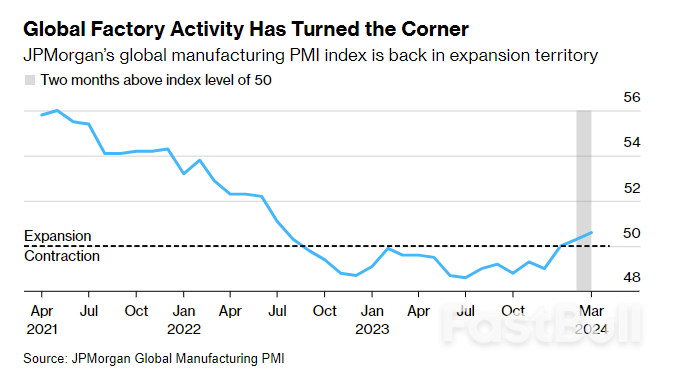
          Assembly lines around the world are starting to hum again, marking a turn in a years-long manufacturing slump.
          The nascent industrial recovery is led by the world’s two biggest economies. Chinese manufacturing has made a strong start to the year, boosting the economic outlook, and US factory activity unexpectedly expanded last month for the first time since September 2022, buoyed by rising new orders and a jump in production.
          JPMorgan/S&P Global’s manufacturing index notched a second month above expansionary territory in March and sits at the highest level since July 2022. If sustained, that’ll help catalyze a broader and stronger economic recovery that’s already spreading beyond the US.
          “Manufacturing PMIs are back to expansion in key economies including China, the UK and the US,” said Janet Mui, head of market analysis at RBC Brewin Dolphin, referring to purchasing manager indexes. “The synchronized nature of the recovery tends to be good signal for a cyclical upturn in global growth.”Factories Around The World Are Slowly Cranking Into Gear Again_1
          Greg Clement, who owns Milwaukee, Wisconsin-based Argon Industries, which makes high-end metal products used in everything from refrigerators and medical equipment to the defense sector, is among those benefiting.
          “We are seeing an uptick in projects,” he said. “Six months ago it was not good and right now we have a really good pipeline of work for 2024.”
          While it’s still early days — a surprise downturn in China’s exports suggests the recovery may be bumpy — the activity nonetheless marks a departure from the slowdown that took hold globally as consumer demand pivoted to spending more on services such as travel and dining out instead of buying more goods as pandemic-era restrictions ended.
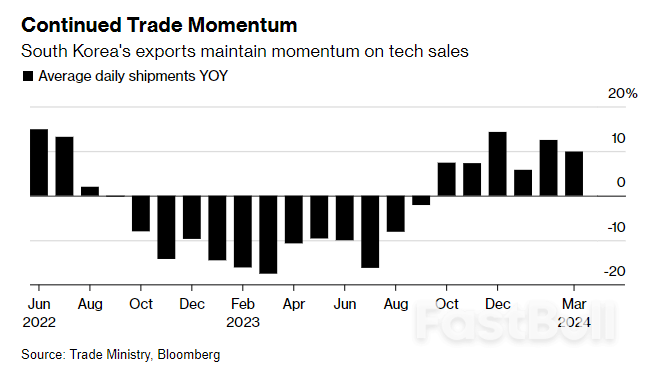
          Adding to the optimism is German industrial production that started the year on a two-month roll, underpinning hopes that Europe’s biggest economy may emerge from a recession. Asian export powerhouses including South Korea and Japan are also showing improvement.Factories Around The World Are Slowly Cranking Into Gear Again_2
          The Asian Development Bank expects a turnaround in merchandise exports starting around midyear will drive growth in Thailand, Vietnam, the Philippines and Malaysia. Leading the way for South Asia this year and next will be India, which wants to rival China as the world’s factory floor.
          That manufacturing strength will ensure the world skirts a recession and grows closer to its potential, says Moody’s Analytics Chief Economist Mark Zandi.
          “Global manufacturing activity appears to be slowly reviving,” Zandi said. “I don’t expect global manufacturing to come roaring back given continued high global interest rates, higher oil prices, and supply-chain disruptions, but I do expect continued improvement.”
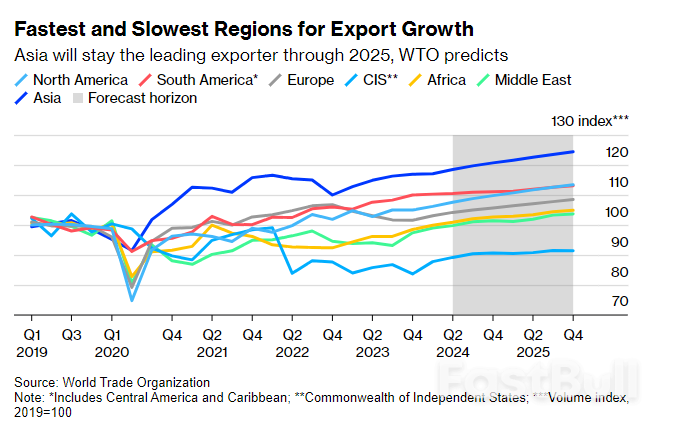
          Such uncertainty is why the World Trade Organization predicted this week that the volume of global merchandise trade will rebound only modestly this year from a rare contraction last year. Total goods trade will increase 2.6% in 2024, the WTO said, a downgrade from its 3.3% growth projection in October and in line with the average pace since 2010.
          “The lingering effects of high energy prices and inflation weighed especially heavily on demand for trade-intensive manufactured goods” in 2023, the WTO said in the report. “But this should recover gradually over the next two years as inflationary pressures ease and as real household incomes improve.”Factories Around The World Are Slowly Cranking Into Gear Again_3
          Still, any talk of a cyclical upturn needs to be distinguished from longer-term realignments. ING economists called the latest report in Germany showing higher industrial production a “balm for the German economic soul.”
          But they also warned that there’s still a way to go before declaring an end to the downturn. German factories are operating 8% below their pre-pandemic levels and industries are still undergoing strctural shifts in trade tied to geopolitical tensions.
          In the UK, a report Friday showed manufacturing jumped 1.2% last month, a much stronger than expected showing, following a March reading on factory purchasing managers that was the best since July 2022.
          Southern European economies are punching above their weight as growth drivers in the euro area. Business surveys by S&P Global released earlier this month showed Spain and Italy beat economists’ expectations with faster expansion in March.
          In the US, the consumption engine for foreign goods appears to be revving up again after companies let inventories run off last year and supply chains that got knotted up during Covid look normal again.Factories Around The World Are Slowly Cranking Into Gear Again_4
          The volume of US container imports reached 6.56 million during the first quarter, up 16% from a year earlier and well above pre-pandemic levels in 2018 and 2019, according to Descartes Datamyne.
          James Knightley, chief international economist at ING, described the improving outlook as more stabilization than rebound and the headwinds won’t be unwinding anytime soon — but it’s a turn nonetheless.
          “I would say there is some cautious optimism that the worst is over,” he said.

          Source:Bloomberg

          To stay updated on all economic events of today, please check out our Economic calendar
          Risk Warnings and Disclaimers
          You understand and acknowledge that there is a high degree of risk involved in trading. Following any strategies or investment methods may lead to potential losses. The content on the site is provided by our contributors and analysts for information purposes only. You are solely responsible for determining whether any trading assets, securities, strategy, or any other product is suitable for investing based on your own investment objectives and financial situation.
          Add to Favorites
          Share

          April 15th Financial News

          FastBull Featured

          Daily News

          [Quick Facts]

          1. Geopolitical risks may weigh on the yen in the long run.
          2. U.S. House speaker tries to pass Israel aid this week.
          3. Israel is divided on whether to launch retaliatory attacks against Iran.
          4. Summers says the Fed has no reason to cut interest rates.
          5. Risk aversion and significant upward momentum fuel the surge in gold prices.
          6. Goolsbee says PCE data is more important.
          7. U.S. consumer confidence moves sideways for the 4th straight month, with inflation expectations rising slightly in April.

          [News Details]

          Geopolitical risks may weigh on the yen in the long run
          Geopolitical risks could push up resource prices, leading to a deterioration in Japan's trade balance and weakening the yen, which is expected to put upward pressure on longer-term consumer prices. This would be similar to the developments following the Russia-Ukraine conflict. Tensions in the Middle East could heighten risk aversion in markets, prompting funds to flow to safe assets such as government bonds.
          If the stock market falls, retirement funds may rebalance their positions by selling bonds and buying stocks. Persistent inflationary pressures and rate-hike expectations by the Bank of Japan could lead to a sell-off in bonds. Uncertainty over the outlook for Middle East tensions has limited traders from building positions on the yen.
          U.S. House speaker tries to pass Israel aid this week
          U.S. House Speaker Mike Johnson said on Sunday that he would try to pass aid to Israel this week, but he did not say whether the bill would include aid to Ukraine and other allies. The White House and top Democrats and Republicans in the Senate called on Johnson to approve a $95 billion bipartisan Senate-passed package that would provide $14.1 billion in aid to Israel and $60 billion to Ukraine.
          Israel is divided on whether to launch retaliatory attacks against Iran
          Far-right members of Netanyahu's government issued strident calls for Israel to react to Iran's attack on Israel with a show of force, while other moderate members, including war cabinet Minister Benny Gantz, urged a balanced approach aimed at avoiding a spiraling escalation, the Times of Israel reported.
          While some members of the security cabinet issued vehement calls for retaliation, the security cabinet authorized the narrow war cabinet — whose only voting members are Gantz, Prime Minister Benjamin Netanyahu, and Defense Minister Yoav Gallant — to make the ultimate decision on a response. In a possible indication of how Israel will respond, Gantz on Sunday afternoon declared that Israel must strengthen the "strategic alliance and the regional cooperation" that allowed it to weather the Iranian attack.
          Summers says the Fed has no reason to cut interest rates
          The U.S. CPI surprised many observers last week, except for former U.S. Treasury Secretary Summers. He pointed out that due to low unemployment and fiscal stimulus driven by budget deficits, the U.S. "economy is growing faster than potential".
          Summers said it confirms that the so-called neutral Fed funds rate "is way above the 2.6% level that the Fed has been using as a North Star. Summers said there is no reason for the Fed to cut rates at this point, not to mention the fact that the data we saw this week were skewed by a problem with how we calculate housing costs.
          Risk aversion and significant upward momentum fuel the surge in gold prices
          Both risk aversion and significant upward momentum are driving the surge in gold prices. The currently continuous influx of funds into the gold market is actually increasing risk exposure. Retail investors, hedge funds, and other institutional investors have all joined the gold boom, trying to profit from this frenzy of "trend momentum", which drove gold prices higher. This explains why the price of gold spikes despite the low activity of ETFs, a key instrument traded by everyday investors. It also suggests that retail investors are not the main driver for the rise in the price of gold.
          Although there seems to be nothing stopping gold from continuing to move higher at the moment, investing at such historically high levels must be risky, so investors should trade with caution.
          Goolsbee says PCE data is more important
          Chicago Fed President Austan Goolsbee said in a speech on Friday that multiple inflation readings were higher than policymakers wanted for the CPI, but the PCE is the better measure. If we start getting better readings that show us inflation is coming down, that will make us feel a lot better about where we are. If PCE is reinflating, we will stabilize prices.
          Goolsbee is closely watching housing costs, which have defied policymaker expectations that an easing in shelter inflation was imminent. Shelter and rising fuel prices accounted for much of the higher-than-expected consumer inflation in March, and Goolsbee said the Fed's job of restoring price stability would be tough unless housing costs behave close to how they did before the pandemic.
          U.S. consumer confidence moves sideways for the 4th straight month, with inflation expectations rising slightly in April
          The University of Michigan's April consumer sentiment index for the U.S. came in at 77.9, which has been fluctuating in the 77-79 range for the fourth consecutive month as consumers see little meaningful progress in the economy. Expectations for personal finances, the business environment, and the labor market have remained stable over the past four months.
          However, one- and five-year inflation expectations have risen to 3.1% (from last month's 2.9%) and 3% (from last month's 2.8%), respectively, reflecting some frustration that the slowdown in inflation may have stalled. Overall, consumers are reserved about the upcoming presidential election, which in the view of many could have a significant impact on economic trends.

          [Focus of the Day]

          UTC+8 20:00 ECB Chief Economist Lane Speaks
          UTC+8 20:30 U.S. Retail Sales MoM (Mar)
          Risk Warnings and Disclaimers
          You understand and acknowledge that there is a high degree of risk involved in trading. Following any strategies or investment methods may lead to potential losses. The content on the site is provided by our contributors and analysts for information purposes only. You are solely responsible for determining whether any trading assets, securities, strategy, or any other product is suitable for investing based on your own investment objectives and financial situation.
          Add to Favorites
          Share

          Pakistan Gold Price Today: A Snapshot and Exploration of Underlying Factors

          Glendon

          Economic

          As of today, April 28, 2024, the Pakistani gold market presents a dynamic picture. This article delves into the current gold price in Pakistan, explores the factors influencing it, and offers insights for informed decision-making.

          Current Price Snapshot

          Karachi Sarafa Association (K-SAP) Benchmark: According to the Karachi Sarafa Association (K-SAP), which sets the benchmark gold price in Pakistan, the price for 24-carat gold per tola (approximately 11.66 grams) stands at approximately PKR 239,000 (Pakistani Rupees). This translates to roughly PKR 20,491 per gram.Understanding Price Variations:
          It's important to note that gold prices can vary slightly across different cities in Pakistan. Major cities like Karachi and Lahore might see slightly higher prices compared to smaller towns due to transportation costs and local market dynamics. Additionally, the price can fluctuate throughout the day based on real-time market movements.

          Factors Influencing Today's Price

          Several factors contribute to the current gold price in Pakistan:
          Global Gold Price: The international gold price plays a significant role. On April 26, 2024, there were reports of a slight increase in the global gold price, which might have a positive influence on the Pakistani market.
          Rupee-Dollar Parity: The Pakistani Rupee's exchange rate against the U.S. dollar is another crucial factor. As of today, any significant fluctuations in the Rupee-Dollar parity can impact the local gold price. A weaker Rupee tends to make dollar-denominated gold more expensive for Pakistani buyers, potentially pushing the local price upwards.
          Domestic Demand: Demand for gold in Pakistan can be influenced by various factors, including upcoming festivals like Eid or wedding seasons. While information on current demand is not readily available, it's important to consider if any such events might be exerting upward pressure on the price.
          Market Sentiment: Overall market sentiment, including local and global economic news, can also influence gold prices.

          Additional Considerations

          Gold Purity and Quality: The price can vary depending on the gold's purity (measured in carats) and craftsmanship. 24-carat gold is the purest but often used in alloys for jewelry due to its softness. The higher the carat, the more expensive the gold.
          Hallmarking: Look for hallmarked gold to ensure its quality and stated carat weight. Hallmarking is a government-regulated process that guarantees the gold's purity.

          Where to Find Updated Prices

          For the most current gold prices in Pakistan, consider these resources:
          Karachi Sarafa Association Website: The K-SAP website provides official benchmark gold prices in Karachi, updated regularly.Bullion Market Websites: Several online platforms track and display real-time gold prices in Pakistan.Newspapers and Financial Websites: These platforms often carry updates on gold prices and market trends.Looking Beyond Today:
          While this article focuses on the current gold price, understanding the broader trends is crucial. Here are some factors to consider for the future:
          Global Economic Outlook: The global economic climate can significantly impact gold prices. Uncertainty or economic downturns can drive investors towards gold as a safe haven, potentially pushing prices higher.
          Government Policies: The Pakistani government's policies on gold imports, duties, and taxes can affect its affordability and overall price.
          The Rise of Digital Gold: The emergence of digital gold platforms might offer a more accessible way for Pakistanis to invest in gold, potentially influencing demand dynamics.

          Conclusion

          The Pakistani gold market is a complex ecosystem influenced by a multitude of factors. While today's price offers a snapshot, staying informed about global trends, domestic news, and market psychology is crucial for making informed decisions about buying, selling, or investing in gold. Remember, consult with financial advisors for personalized guidance before making any significant gold-related decisions.
          To stay updated on all economic events of today, please check out our Economic calendar
          Risk Warnings and Disclaimers
          You understand and acknowledge that there is a high degree of risk involved in trading. Following any strategies or investment methods may lead to potential losses. The content on the site is provided by our contributors and analysts for information purposes only. You are solely responsible for determining whether any trading assets, securities, strategy, or any other product is suitable for investing based on your own investment objectives and financial situation.
          Add to Favorites
          Share

          Oil Shrugs Off Iranian Assault on Israel as Brent Turns Lower

          Cohen

          Economic

          Commodity

          Palestinian-Israeli conflict

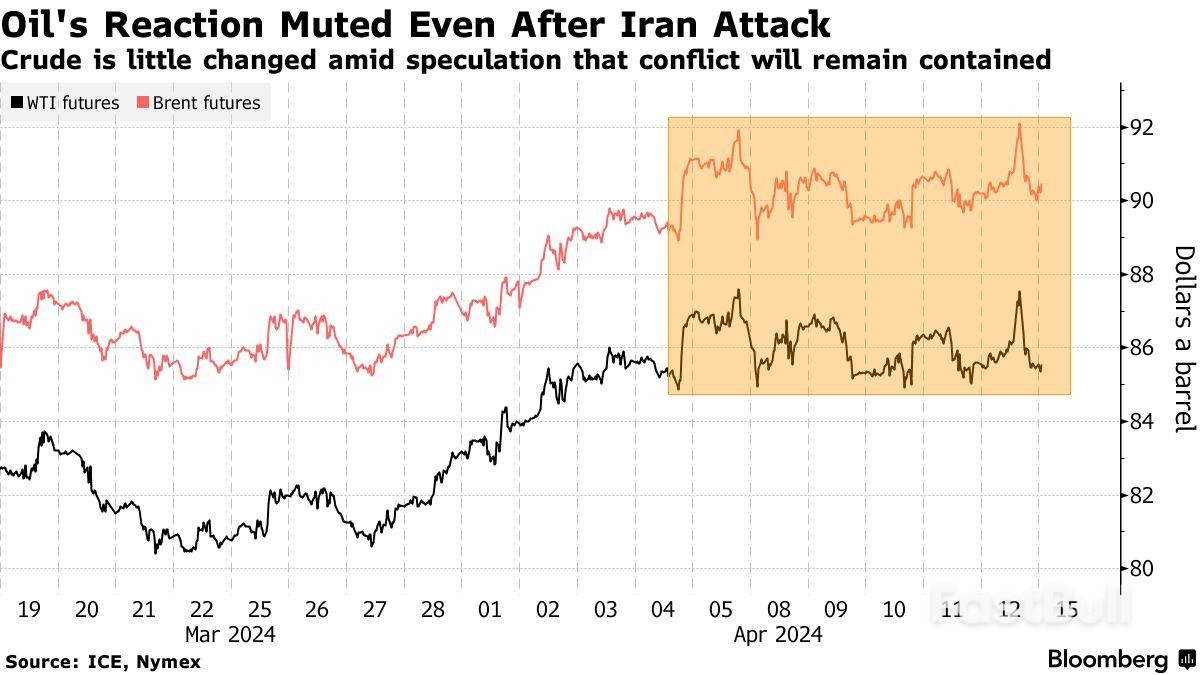
          Oil shrugged off Iran’s unprecedented attack on Israel, with prices easing on speculation that the conflict would remain contained.
          Global benchmark Brent crude initially rose just 0.7% to $91.05 a barrel, before dropping toward $90. More than 300 missiles and drones were fired by Iran at the weekend, the first time it has struck Israel from its soil, though most were intercepted. The attack — which had been expected for days — came in retaliation for a strike in Syria that killed top Iranian military officers.
          “This war may move down the escalation ladder if the Israeli government follows the advice of the White House and forgoes retaliatory action,” RBC Capital Markets LLC analysts including Helima Croft said in a note. While the Iranian action was “far more expansive than previous reprisals, it was still telegraphed in advance,” they said.
          Oil Shrugs Off Iranian Assault on Israel as Brent Turns Lower_1
          Oil has been one of the strongest performers in commodities this year as OPEC+ keeps a tight rein on supply to drain inventories and support prices. The latest attack escalates tensions in a region that produces about a third of the world’s crude, and represents the latest twist in a showdown that’s followed the assault by Tehran-backed Hamas against Israel last October. Still, the Iranian mission to the United Nations said the issue “can be deemed concluded,” reducing for now the risks of a wider conflict.
          “The situation is fluid, and if Israel signals it will not retaliate, market tensions will ease,” said Arne Lohmann Rasmussen, head of research at A/S Global Risk Management.
          Shipping risks have also been in focus after Iran seized a vessel, the MSC Aries, near the key Strait of Hormuz waterway shortly before the strikes against Israel. The ship’s beneficial owner is part of Israel-linked Zodiac Group, according to data compiled by Bloomberg. The move raises concerns over the safety of vessels in the region, adding to previous logistical disruptions.
          “The most feared scenario is the closure of the Strait of Hormuz,” said Global Risk Management’s Rasmussen. “I don’t think Iran will close the strait, but the risks are growing.”
          There’s already been a deluge of trading, with almost 70,000 lots of Brent trading by the session’s first three hours — a greater-than-usual amount. Over 5,000 lots of June $95 call options for Brent, which profit when prices gain, have also been traded in that time. Brent June option implied volatility was slightly lower for calls and higher for puts.
          Oil markets have tightened significantly in recent months, lifting energy costs and posing a headache for central bankers as they seek to drive home their push to quell inflation. Ahead of Tehran’s weekend strike, crude analysts had already been addressing the possibility that prices could once again hit $100 a barrel.
          OPEC — the producers’ cartel that counts Iran as a founding member — said last week that oil would need to be closely watched in the coming months to ensure “a sound and sustainable market balance,” according to a monthly report. There’s signs demand is ramping up. US refiners are preparing to boost fuel production for the summer driving season, while recent macroeconomic prints from China have suggested the economy may be turning the corner.

          Source:Bloomberg

          To stay updated on all economic events of today, please check out our Economic calendar
          Risk Warnings and Disclaimers
          You understand and acknowledge that there is a high degree of risk involved in trading. Following any strategies or investment methods may lead to potential losses. The content on the site is provided by our contributors and analysts for information purposes only. You are solely responsible for determining whether any trading assets, securities, strategy, or any other product is suitable for investing based on your own investment objectives and financial situation.
          Add to Favorites
          Share

          US Regional Banks Dramatically Step Up Loans to Oil and Gas

          Owen Li

          Economic

          Commodity

          The list of banks includes Citizens Financial Group Inc., BOK Financial Corp. and Truist Securities Inc., according to data compiled by Bloomberg. The companies have climbed between 13 and 40 steps up the league table for fossil-fuel lenders since the end of 2021, placing them among the world’s top 35 banks by number of deals. Fifth Third Securities Inc. and US Bancorp, already in the top 30, both ascended 10 steps in the same period.
          Since the start of 2022, the combined number of fossil-fuel loans provided by Citizens Financial, BOK Financial, Truist Securities, Fifth Third and US Bancorp rose more than 70% on an average annualized basis, compared with the preceding six years, the Bloomberg data show.
          Spokespeople for Truist, Fifth Third and US Bancorp declined to comment.
          Rory Sheehan, a spokesperson for Citizens Financial, said the bank supports initiatives enabling the transition toward a lower-carbon future. He also said the bank recognizes the role of the oil and gas industry.
          The development offers a glimpse of how the US banking landscape is being altered against a backdrop of stricter climate regulations across the Atlantic. US regional lenders — shaken by the crisis that followed Silicon Valley Bank’s meltdown — are participating in more fossil-fuel loans as banks in Europe begin to pull away for fear of getting caught on the wrong side of environmental, social and governance regulations and climate litigation.
          “Someone betting heavily that the demand for fossil fuels will keep on rising significantly is clearly taking a view that is at odds with existing forecasts,” said Jean Boissinot, head of the secretariat for the Network for Greening the Financial System, which is hosted at the Banque de France and includes officials from the world’s central banks. “I would like to be very sure that they understand the implications of this kind of bet.”
          BNP Paribas SA, the European Union’s biggest bank, and ING Groep NV, the largest lender in the Netherlands, are among banks that are in the process of expanding restrictions on fossil-fuel clients. The companies, which are both currently fighting lawsuits brought by climate nonprofits, dropped about 10 places in the ranking of oil, gas and coal lenders over the past two years.
          Wall Street’s largest banks, meanwhile, remain among the absolute biggest lenders to the fossil-fuel industry. Last year, such loans were dominated by Wells Fargo & Co., Bank of America Corp. and JPMorgan Chase & Co., according to Bloomberg data.
          Some of the US regional banks stepping up oil, gas and coal lending are based in states that have either passed or are reviewing anti-ESG laws. In Oklahoma, which enforced its Energy Discrimination Elimination Act in late 2022, local bank BOK Financial recently soared up the league table to become one of the world’s 30 busiest dealmakers in fossil fuels.
          Marisol Salazar, senior vice president and manager for energy banking at BOK Financial, says the bank is now seeing “much more opportunities” in the fossil-fuel industry.
          “We’re not just picking up customers,” she said. “We’re also picking up talent, we’re picking up engineers, we’re picking up investment bankers, we’re picking up experienced relationship managers.”
          For fossil-fuel borrowers, the development means they can continue to gain access to credit at prices that remain competitive. It’s a development that challenges some assumptions around divestment policies, amid evidence that fossil-fuel companies are finding alternative sources of finance.
          “For the smaller credits, there might be a little bit more aggressiveness in terms of pricing,” Salazar said. “But overall you’re going to see pretty common terms.”
          From its base in Ohio, whose senate also has passed anti-ESG legislation, Fifth Third was recently among three banks that replaced Barclays Plc on a $325 million loan to ProFrac Holdings, a fracking company. That’s as the UK bank places curbs on high-carbon clients as part of its climate policy.
          It’s not just smaller banks that are doing more fossil-fuel loans. Jason Kerr, a partner in the energy group at law firm White & Case, says he’s seeing commodities traders move in as some bigger banks pull back.
          In Africa, where Kerr’s work is focused, the scale of the shift is “dramatic,” he said.
          “Big international oil traders are going from fairly unsophisticated financing to quite complicated funding arrangements,” Kerr said. “They used to come into the market on a basic prepay for oil, but they’re increasingly becoming like conventional banks.”
          There’s also evidence that banks are in some cases being replaced by private credit managers eager to get a foothold in fossil-fuel deals.
          The value of private credit deals in the oil and gas industry topped $9 billion in the 24 months through 2023, up from $450 million arranged in the preceding two years, according to data provided by Preqin, an analytics company that tracks the alternative investment industry.
          The upshot is that even if banks pull away from the fossil-fuel industry, “replacements come along and the financings continue,” Kerr said.

          Source: Bloomberg

          To stay updated on all economic events of today, please check out our Economic calendar
          Risk Warnings and Disclaimers
          You understand and acknowledge that there is a high degree of risk involved in trading. Following any strategies or investment methods may lead to potential losses. The content on the site is provided by our contributors and analysts for information purposes only. You are solely responsible for determining whether any trading assets, securities, strategy, or any other product is suitable for investing based on your own investment objectives and financial situation.
          Add to Favorites
          Share

          Asian Stocks Fall As Iran Attacks, Metals Rally

          Alex

          Economic

          Commodity

          Stocks

          Shares in Asia slipped to the lowest in six weeks, tracking Friday’s drop in US equities, as markets grappled with simmering tensions in the Middle East, disappointing bank earnings and the prospect of the Federal Reserve keeping interest rates higher for longer.
          Equity benchmarks in Japan, South Korea and Australia all declined while Hong Kong stock futures also fell after the S&P 500 suffered its worst session since January on Friday amid a flight to safety.
          But global markets showed signs of stability even after unprecedented attack on Israel at the weekend. Iran said “the matter can be deemed concluded,” and President Joe Biden reportedly told Israeli Prime Minister Benjamin Netanyahu that the US won’t support an Israeli counterattack against Iran.
          Most Group-of-10 currencies strengthened against the greenback Monday while Treasures steadied in early Asian trading after yields slipped in the previous session. Gold rose amid driving demand for haven assets, while aluminum and nickel surged following new US and UK sanctions that banned deliveries of any Russian supplies after midnight on Friday.
          “The muted market response likely stems from the highly intricate sentiment in the market at this stage: market participants are certainly not giving up hope that the past weekend’s events were just a one-off occurrence, while holding their breath for what could happen next,” said Hebe Chen, an analyst at IG Markets.
          Asian Stocks Fall As Iran Attacks, Metals Rally_1
          In Asia, Chinese equities are set for a tough week after a miss in the nation’s trade data Friday. Even if the global risk mood improves and Middle East tensions subside, Chinese stocks may see headwinds of their own to overcome. Authorities may hold a key interest rate and make liquidity abundant this week when a policy loan matures.
          Elsewhere, developer China Vanke Co. said it’s making plans to resolve liquidity pressure and short-term operational difficulties as China’s top leaders have grown increasingly alarmed about the country’s protracted real estate crisis and its effect on the sluggish economy.
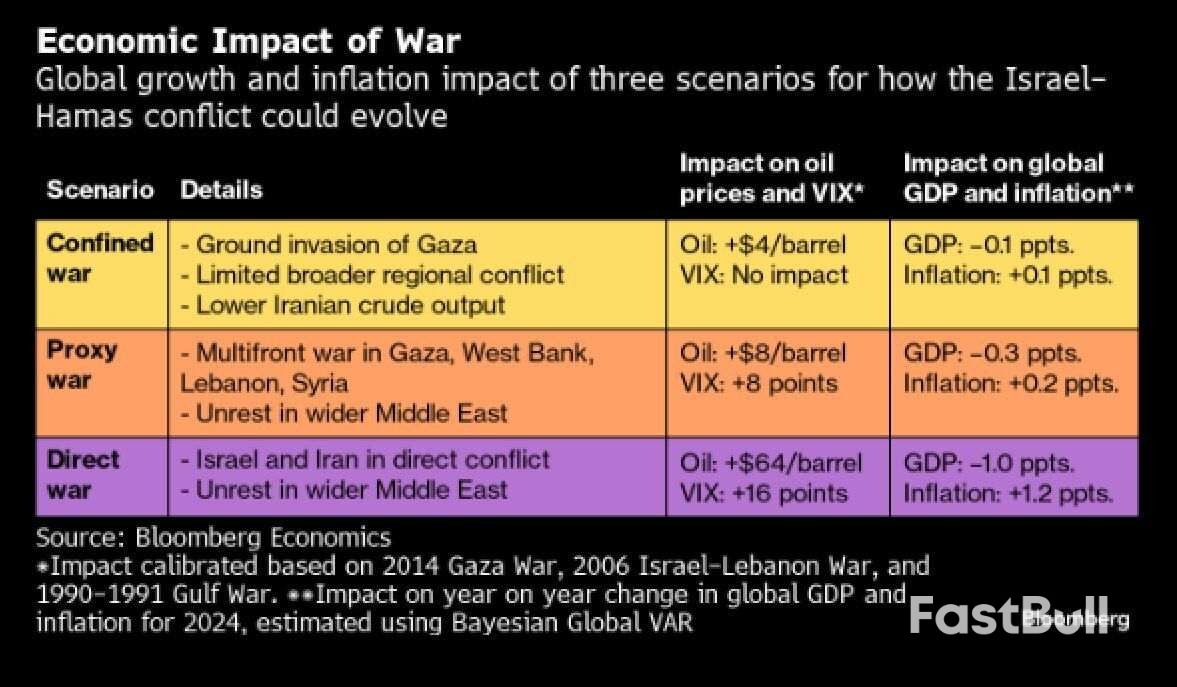
          With investors already rattled by sticky inflation and the prospect of higher-for-longer interest rates, the escalation of the Middle East crisis may inject fresh volatility into markets. As the conflict widens, many say oil could surpass $100 a barrel and expect a flight to Treasuries, gold and the dollar, along with further stock-market losses.
          Bitcoin rallied after it sank almost 9% in the wake of the attacks. Stock markets in Saudi Arabia and Qatar posted modest losses under thin trading volumes on Sunday. Israel’s equity benchmark fluctuated between gains and losses at least nine times before closing with a small gain.
          Oil mostly shrugged off the attacks, with gains held in check by speculation that the conflict would remain contained. Brent crude is already up almost 20% this year and last traded around $90 a barrel.Asian Stocks Fall As Iran Attacks, Metals Rally_2
          As Wall Street’s earnings season kicked off, big banks’ results offered the latest window into how the US economy is faring amid an interest-rate trajectory muddied by persistent inflation.
          JPMorgan Chase & Co. and Wells Fargo & Co. both reported net interest income — the earnings they generate from lending — that missed estimates amid increasing funding costs. Citigroup Inc.’s profit topped analysts’ estimates as corporations tapped markets for financing and consumers leaned on credit cards — signs that a prolonged period of elevated interest rates will benefit big banks.
          “Many economic indicators continue to be favorable. However, looking ahead, we remain alert to a number of significant uncertain forces,” JPMorgan’s Chief Executive Officer Jamie Dimon said. He cited the wars, growing geopolitical tensions, persistent inflationary pressures and the effects of quantitative tightening.
          Traders will soon shift to looming economic data as they refine bets on central bank easing cycles, as well as the International Monetary Fund and World Bank spring meetings in Washington. This week, Chinese growth data and Japan, Eurozone and UK inflation readings are due.

          Source:Bloomberg

          To stay updated on all economic events of today, please check out our Economic calendar
          Risk Warnings and Disclaimers
          You understand and acknowledge that there is a high degree of risk involved in trading. Following any strategies or investment methods may lead to potential losses. The content on the site is provided by our contributors and analysts for information purposes only. You are solely responsible for determining whether any trading assets, securities, strategy, or any other product is suitable for investing based on your own investment objectives and financial situation.
          Add to Favorites
          Share

          US Dollar, Yen, VIX, Gold, Crude Oil Analysis: COT Report

          FOREX.com

          Commodity

          Forex

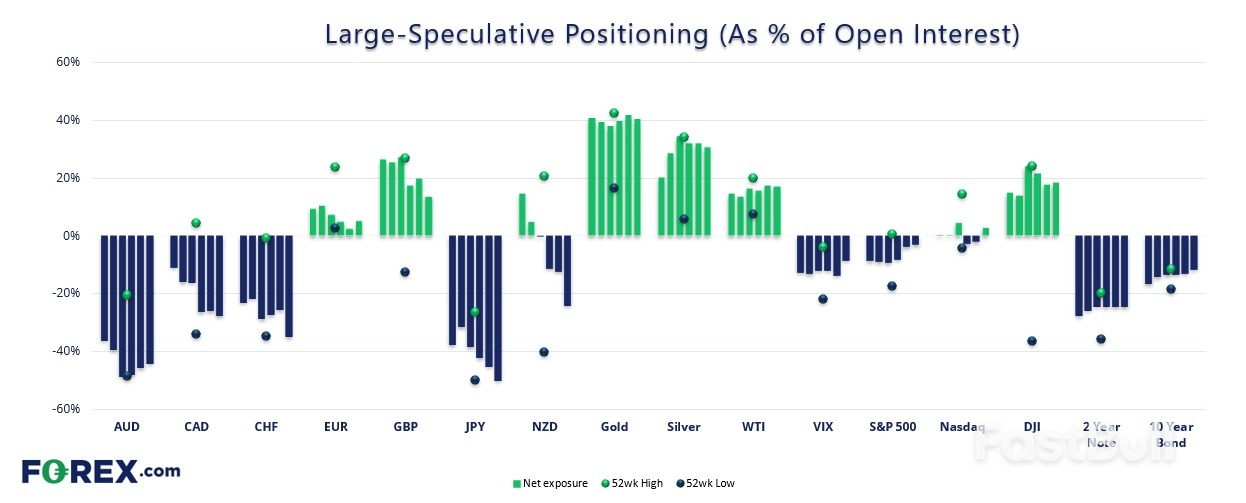
          Market positioning from the COT report - as of Tuesday March 19, 2024:

          • Net-short exposure to yen futures rose to a 16-year high among large speculators.
          • Shorting the Swiss franc remained in favour, with large speculators increasing short exposure by +11% (+4.8k contracts) and reducing longs by -21.6% (-4.6k contracts).
          • Large speculators were net-short for a fourth week and by their most bearish amount in 18 weeks.
          • Whilst net-short exposure to AUD/USD futures fell for a third week by last Tuesday, I suspect many have returned since the latest batch of Middle East headlines.
          • Large speculators increased long gold exposure by 15.7% (+10.1k contracts) and reduced shorts by -7.1% (-8.4k contracts), whereas asset managers are on the cusp of flipping to net-long exposure for the first time in nearly five months.
          • Asset managers increased long exposure to VIX futures by 14.7% (+2.2k contracts).
          • Net-long exposure to Dow Jones futures fell to a YTD low among asset managers.
          US Dollar, Yen, VIX, Gold, Crude Oil Analysis: COT Report_1

          US dollar index positioning – COT report:

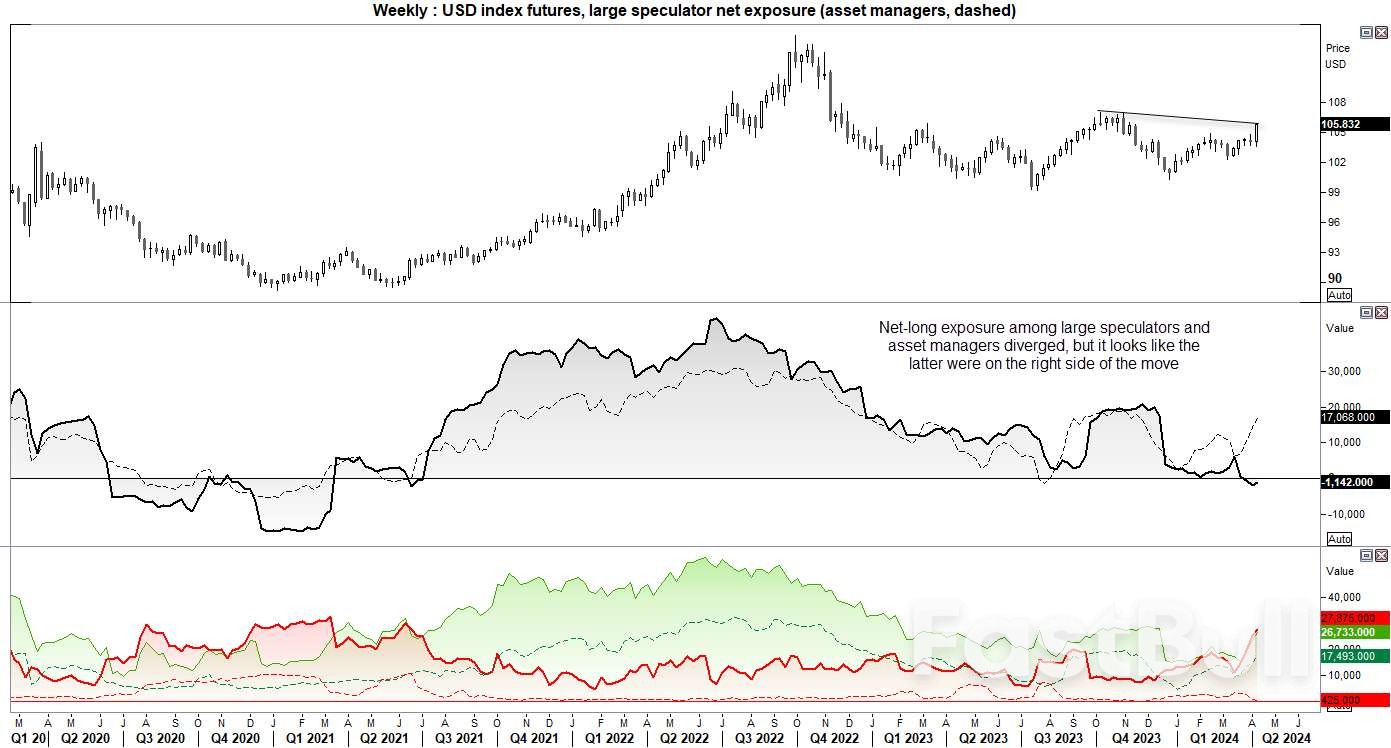
          I noted the divergence between asset managers and large speculators regarding net exposure, and with the US dollar rising it seems that asset managers were on the right side of the move. The US dollar benefitted from hot CPI, Fed members pushing back on rate cuts and safe-haven flows from Middle East tensions.
          Going forward, I now suspect large speculators will begin trimming shorts and adding to longs and flip to net-long exposure by the next COT report (assuming they haven’t already). My 106 target is now within easy reach, and a move to 108 seems feasible.
          US Dollar, Yen, VIX, Gold, Crude Oil Analysis: COT Report_2

          VIX futures positioning – COT report:

          Middle East tensions weighed on Wall Street indices on Friday and sent the VIX briefly above 19 for the first day this year. The +2.3 point rise was its most bullish day since October, so it is interesting to note that asset managers and large speculators were trimming short exposure and adding to longs ahead of Friday’s move.
          In fact, asset managers are on the cusp of flipping to net-long exposure to VIX futures for the first time since mid January. Yet just fur weeks ago, their net-short exposure was at the most bearish level since January 2020, just weeks ahead of the February 202 high all thanks to the pandemic.
          I have conflicting thoughts over how to interpret this. Perhaps asset managers flipping to net-long exposure could indeed nail a market top and we finally see Wall Street indices correct by more than a few percent. Yet looking back through history, there have been many false signals when managers flip to net-long exposure, so perhaps we should wait for large speculators to also flip to net-long exposure before getting too excited over a larger drop for US indices.
          US Dollar, Yen, VIX, Gold, Crude Oil Analysis: COT Report_3

          JPY/USD (Japanese yen futures) positioning – COT report:

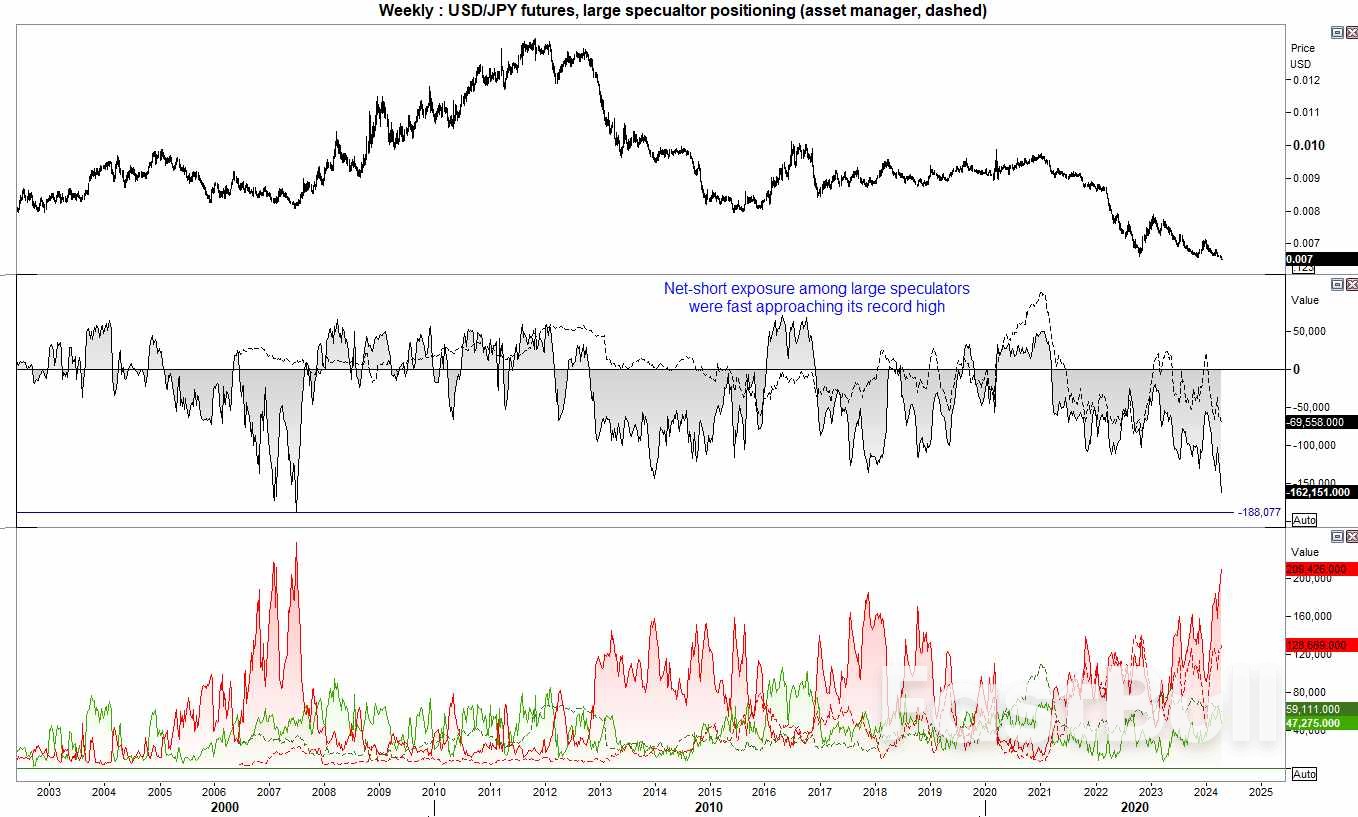
          In July 2007 yen futures reached a record level of net-short exposure. And the recent break of key support which sent USD/JPY above 152 has seen net-short exposure break above the 2013 and 2017 cycle highs, and now within striking distance of the record high ~188 net short exposure. The break above 152 was significant, and there were even some clues from an MOF official that the need to intervene was not a strong as originally though. The next obvious level for traders to keep an eye on is 155 on spot USD/JPY prices, or 0.00646 on yen futures. Yes, yen futures could be at a sentiment extreme, but if there is no threat of intervention and US data continues to justify a stronger US dollar, then the path of least resistance for USD?JPY appears to be higher.
          US Dollar, Yen, VIX, Gold, Crude Oil Analysis: COT Report_4

          Gold futures (GC) positioning – COT report:

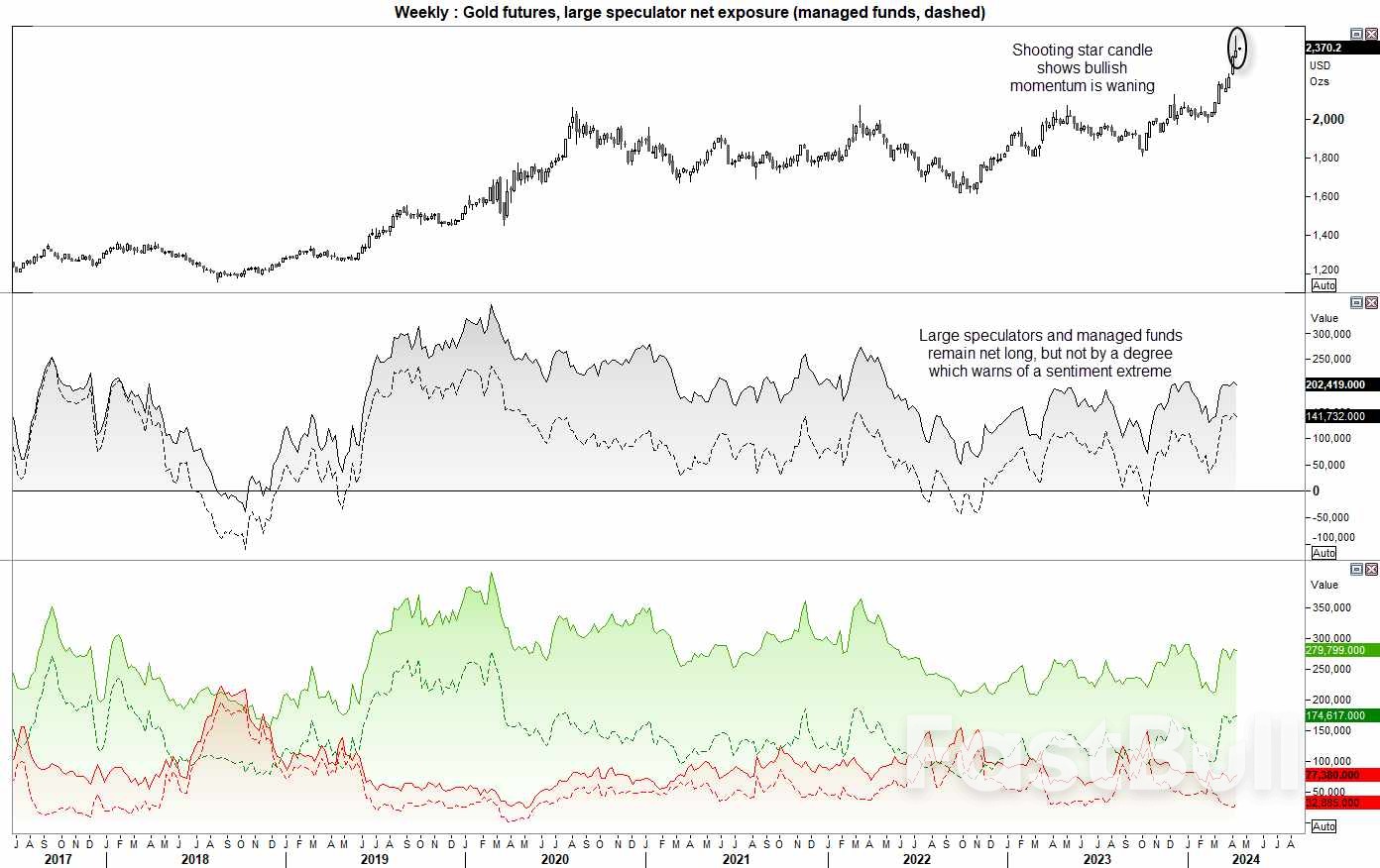
          Gold futures rose for a fourth consecutive week and briefly traded above $2400 and formed a fresh record high. A bearish pinbar formed on the weekly chart to suggest bullish momentum is waning. But it is difficult to construct a particularly bearish case from this one candlestick alone. Large speculators and managed funds remain net long, but not by an extreme amount.
          Asset managers decreased short exposure to gold by -9.4% (-7k contracts) and increased longs by 1.1% (+703 contracts), whereas large speculators increased long gold exposure by 15.7% (+10.1k contracts) and reduced shorts by -7.1% (-8.4k contracts).
          And that means gold remains on the ‘buy the dip’ watchlist, even if dips may be shallow.
          US Dollar, Yen, VIX, Gold, Crude Oil Analysis: COT Report_5

          WTI crude oil (CL) positioning – COT report:

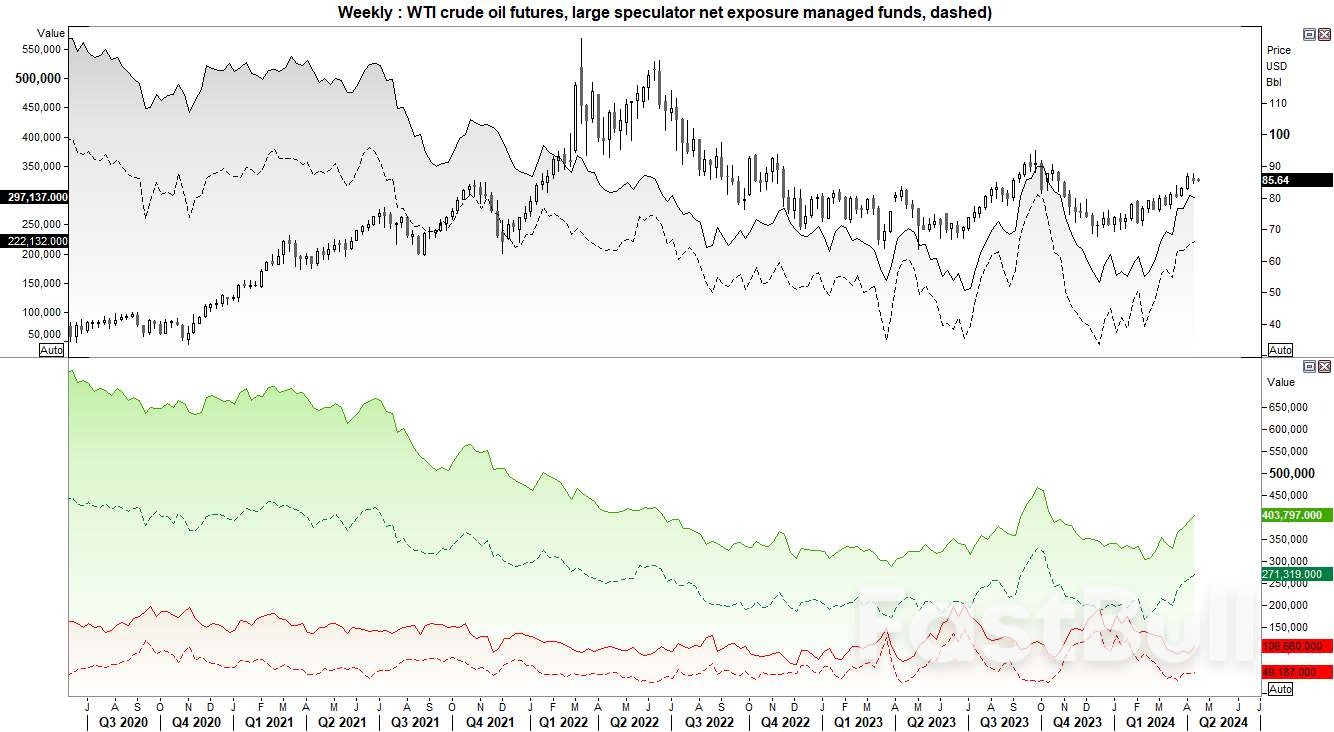
          If you consider the headlines that were released from Friday and over the weekend regarding a potential Middle East conflict, crude oil’s reaction has been relatively subdued. IN fact, all of the action seemed to be on any market except crude oil, which sent US indices and commodity FX lower, gold and the VIX higher. It could be argued much of this has been priced in, given crude oil has risen ~30% since the December low.
          Market positioning shows that large speculators and managed funds increased their net-long exposure for a second consecutive week. And like gold, exposure does not appear to be at a sentiment extreme. There was a slight increase of short bets among large speculators, but they may have since been removed given the headlines that were to follow after the COT data was compiled on Tuesday. And also like gold, WTI remains on the ‘buy the dip’ watchlist, as it is difficult to construct a convincing bearish case. Yet if oil is not rallying hard on Middle East headlines, it begs the question as to whether traders would be wise to indicate longs at these levels without waiting for a pullback first (unless tensions really do escalate).
          US Dollar, Yen, VIX, Gold, Crude Oil Analysis: COT Report_6
          Risk Warnings and Disclaimers
          You understand and acknowledge that there is a high degree of risk involved in trading. Following any strategies or investment methods may lead to potential losses. The content on the site is provided by our contributors and analysts for information purposes only. You are solely responsible for determining whether any trading assets, securities, strategy, or any other product is suitable for investing based on your own investment objectives and financial situation.
          Add to Favorites
          Share
          FastBull
          Copyright © 2025 FastBull Ltd

          728 RM B 7/F GEE LOK IND BLDG NO 34 HUNG TO RD KWUN TONG KLN HONG KONG

          TelegramInstagramTwitterfacebooklinkedin
          App Store Google Play Google Play
          Products
          Charts

          Chats

          Q&A with Experts
          Screeners
          Economic Calendar
          Data
          Tools
          Membership
          Features
          Function
          Markets
          Copy Trading
          Latest Signals
          Contests
          News
          Analysis
          24/7
          Columns
          Education
          Company
          Careers
          About Us
          Contact Us
          Advertising
          Help Center
          Feedback
          User Agreement
          Privacy Policy
          Business

          White Label

          Data API

          Web Plug-ins

          Poster Maker

          Affiliate Program

          Risk Disclosure

          The risk of loss in trading financial instruments such as stocks, FX, commodities, futures, bonds, ETFs and crypto can be substantial. You may sustain a total loss of the funds that you deposit with your broker. Therefore, you should carefully consider whether such trading is suitable for you in light of your circumstances and financial resources.

          No decision to invest should be made without thoroughly conducting due diligence by yourself or consulting with your financial advisors. Our web content might not suit you since we don't know your financial conditions and investment needs. Our financial information might have latency or contain inaccuracy, so you should be fully responsible for any of your trading and investment decisions. The company will not be responsible for your capital loss.

          Without getting permission from the website, you are not allowed to copy the website's graphics, texts, or trademarks. Intellectual property rights in the content or data incorporated into this website belong to its providers and exchange merchants.

          Not Logged In

          Log in to access more features

          FastBull Membership

          Not yet

          Purchase

          Become a signal provider
          Help Center
          Customer Service
          Dark Mode
          Price Up/Down Colors

          Log In

          Sign Up

          Position
          Layout
          Fullscreen
          Default to Chart
          The chart page opens by default when you visit fastbull.com