• Trade
  • Markets
  • Copy
  • Contests
  • News
  • 24/7
  • Calendar
  • Q&A
  • Chats
Trending
Screeners
SYMBOL
LAST
BID
ASK
HIGH
LOW
NET CHG.
%CHG.
SPREAD
SPX
S&P 500 Index
6827.42
6827.42
6827.42
6899.86
6801.80
-73.58
-1.07%
--
DJI
Dow Jones Industrial Average
48458.04
48458.04
48458.04
48886.86
48334.10
-245.98
-0.51%
--
IXIC
NASDAQ Composite Index
23195.16
23195.16
23195.16
23554.89
23094.51
-398.69
-1.69%
--
USDX
US Dollar Index
97.920
98.000
97.920
98.070
97.810
-0.030
-0.03%
--
EURUSD
Euro / US Dollar
1.17447
1.17454
1.17447
1.17596
1.17262
+0.00053
+ 0.05%
--
GBPUSD
Pound Sterling / US Dollar
1.33848
1.33857
1.33848
1.33961
1.33546
+0.00141
+ 0.11%
--
XAUUSD
Gold / US Dollar
4331.48
4331.89
4331.48
4350.16
4294.68
+32.09
+ 0.75%
--
WTI
Light Sweet Crude Oil
56.861
56.891
56.861
57.601
56.789
-0.372
-0.65%
--

Community Accounts

Signal Accounts
--
Profit Accounts
--
Loss Accounts
--
View More

Become a signal provider

Sell trading signals to earn additional income

View More

Guide to Copy Trading

Get started with ease and confidence

View More

Signal Accounts for Members

All Signal Accounts

Best Return
  • Best Return
  • Best P/L
  • Best MDD
Past 1W
  • Past 1W
  • Past 1M
  • Past 1Y

All Contests

  • All
  • Trump Updates
  • Recommend
  • Stocks
  • Cryptocurrencies
  • Central Banks
  • Featured News
Top News Only
Share

Bank Of America Expects A Deficit In Aluminium Next Year And Sees Prices Pushing Above $3000/T

Share

Fed Data - USA Effective Federal Funds Rate At 3.64 Percent On 12 December On $102 Billion In Trades Versus 3.64 Percent On $99 Billion On 11 December

Share

Brazil's Petrobras Says No Impact Seen On Oil, Petroleum Products Output As Workers Start Planned Strike

Share

Statement: US Travel Group Warns New Proposed Trump Administration Requirements For Foreign Tourists To Provide Social Media Histories Could Mean Millions Of People Opting Not To Visit

Share

Blackrock: Kerry White Will Become Head Of Citi Investment Management At Citi Wealth

Share

Blackrock: Rob Jasminski, Head Of Citi Investment Management, Has Joined With Team

Share

Blackrock: Effective Dec 15, Citi Investment Management Employees Will Join Blackrock

Share

Blackrock: Formally Launch Citi Portfolio Solutions Powered By Blackrock

Share

According To Data From The Federal Reserve Bank Of New York, The Secured Overnight Funding Rate (Sofr) Was 3.67% On The Previous Trading Day (December 15), Compared To 3.66% The Day Before

Share

Peru Energy And Mines Ministry: Copper Production Up 4.8% Year-On-Year In October To 248192 Metric Tons

Share

Security Source: Ukrainian Drones Hits Russian Oil Infrastructure In Caspian Sea For Third Time

Share

Spot Palladium Extends Gains, Last Up 5% To $1562.7/Oz

Share

Mexico's Economy Ministry Announces Start Of Anti-Dumping Investigation And Anti-Subsidy Investigations Into USA Pork Imports

Share

Canada Nov CPI Common +2.8%, CPI Median +2.8%, CPI Trim +2.8% On Year

Share

NY Fed's Empire State Prices Paid Index +37.6 In December Versus+49.0 In November

Share

Canada Nov Consumer Prices +0.1% On Month, +2.2% On Year

Share

Canada Nov CPI Core -0.1% On Month, +2.9% On Year

Share

Canada Nov Core CPI, Seasonally Adjusted +0.2% On Month, Oct +0.3% (Unrevised)

Share

UK Health Minister Streeting On Doctors' Strike: Vote To Go Ahead Reveals The Bma's Shocking Disregard For Patient Safety

Share

Venezuelan State Oil Company Pdvsa Says Was Subject To Cyber Attack But Operations Unaffected

TIME
ACT
FCST
PREV
Japan Tankan Small Manufacturing Outlook Index (Q4)

A:--

F: --

P: --

Japan Tankan Large Non-Manufacturing Outlook Index (Q4)

A:--

F: --

P: --

Japan Tankan Large Manufacturing Outlook Index (Q4)

A:--

F: --

P: --

Japan Tankan Small Manufacturing Diffusion Index (Q4)

A:--

F: --

P: --

Japan Tankan Large Manufacturing Diffusion Index (Q4)

A:--

F: --

P: --

Japan Tankan Large-Enterprise Capital Expenditure YoY (Q4)

A:--

F: --

P: --

U.K. Rightmove House Price Index YoY (Dec)

A:--

F: --

P: --

China, Mainland Industrial Output YoY (YTD) (Nov)

A:--

F: --

P: --

China, Mainland Urban Area Unemployment Rate (Nov)

A:--

F: --

P: --

Saudi Arabia CPI YoY (Nov)

A:--

F: --

P: --

Euro Zone Industrial Output YoY (Oct)

A:--

F: --

P: --

Euro Zone Industrial Output MoM (Oct)

A:--

F: --

P: --

Canada Existing Home Sales MoM (Nov)

A:--

F: --

P: --

Canada National Economic Confidence Index

A:--

F: --

P: --

Canada New Housing Starts (Nov)

A:--

F: --

P: --
U.S. NY Fed Manufacturing Employment Index (Dec)

A:--

F: --

P: --

U.S. NY Fed Manufacturing Index (Dec)

A:--

F: --

P: --

Canada Core CPI YoY (Nov)

A:--

F: --

P: --

Canada Manufacturing Unfilled Orders MoM (Oct)

A:--

F: --

P: --

U.S. NY Fed Manufacturing Prices Received Index (Dec)

A:--

F: --

P: --

U.S. NY Fed Manufacturing New Orders Index (Dec)

A:--

F: --

P: --

Canada Manufacturing New Orders MoM (Oct)

A:--

F: --

P: --

Canada Core CPI MoM (Nov)

A:--

F: --

P: --

Canada Trimmed CPI YoY (SA) (Nov)

A:--

F: --

P: --

Canada Manufacturing Inventory MoM (Oct)

A:--

F: --

P: --

Canada CPI YoY (Nov)

A:--

F: --

P: --

Canada CPI MoM (Nov)

A:--

F: --

P: --

Canada CPI YoY (SA) (Nov)

A:--

F: --

P: --

Canada Core CPI MoM (SA) (Nov)

A:--

F: --

P: --

Canada CPI MoM (SA) (Nov)

A:--

F: --

P: --

Federal Reserve Board Governor Milan delivered a speech
U.S. NAHB Housing Market Index (Dec)

--

F: --

P: --

Australia Composite PMI Prelim (Dec)

--

F: --

P: --

Australia Services PMI Prelim (Dec)

--

F: --

P: --

Australia Manufacturing PMI Prelim (Dec)

--

F: --

P: --

Japan Manufacturing PMI Prelim (SA) (Dec)

--

F: --

P: --

U.K. 3-Month ILO Employment Change (Oct)

--

F: --

P: --

U.K. Unemployment Claimant Count (Nov)

--

F: --

P: --

U.K. Unemployment Rate (Nov)

--

F: --

P: --

U.K. 3-Month ILO Unemployment Rate (Oct)

--

F: --

P: --

U.K. Average Weekly Earnings (3-Month Average, Including Bonuses) YoY (Oct)

--

F: --

P: --

U.K. Average Weekly Earnings (3-Month Average, Excluding Bonuses) YoY (Oct)

--

F: --

P: --

France Services PMI Prelim (Dec)

--

F: --

P: --

France Composite PMI Prelim (SA) (Dec)

--

F: --

P: --

France Manufacturing PMI Prelim (Dec)

--

F: --

P: --

Germany Services PMI Prelim (SA) (Dec)

--

F: --

P: --

Germany Manufacturing PMI Prelim (SA) (Dec)

--

F: --

P: --

Germany Composite PMI Prelim (SA) (Dec)

--

F: --

P: --

Euro Zone Composite PMI Prelim (SA) (Dec)

--

F: --

P: --

Euro Zone Services PMI Prelim (SA) (Dec)

--

F: --

P: --

Euro Zone Manufacturing PMI Prelim (SA) (Dec)

--

F: --

P: --

U.K. Services PMI Prelim (Dec)

--

F: --

P: --

U.K. Manufacturing PMI Prelim (Dec)

--

F: --

P: --

U.K. Composite PMI Prelim (Dec)

--

F: --

P: --

Euro Zone ZEW Economic Sentiment Index (Dec)

--

F: --

P: --

Germany ZEW Current Conditions Index (Dec)

--

F: --

P: --

Germany ZEW Economic Sentiment Index (Dec)

--

F: --

P: --

Euro Zone Trade Balance (Not SA) (Oct)

--

F: --

P: --

Euro Zone ZEW Current Conditions Index (Dec)

--

F: --

P: --

Euro Zone Trade Balance (SA) (Oct)

--

F: --

P: --

U.S. Retail Sales MoM (Excl. Automobile) (SA) (Oct)

--

F: --

P: --

Q&A with Experts
    • All
    • Chatrooms
    • Groups
    • Friends
    Connecting
    .
    .
    .
    Type here...
    Add Symbol or Code

      No matching data

      All
      Trump Updates
      Recommend
      Stocks
      Cryptocurrencies
      Central Banks
      Featured News
      • All
      • Russia-Ukraine Conflict
      • Middle East Flashpoint
      • All
      • Russia-Ukraine Conflict
      • Middle East Flashpoint
      Search
      Products

      Charts Free Forever

      Chats Q&A with Experts
      Screeners Economic Calendar Data Tools
      Membership Features
      Data Warehouse Market Trends Institutional Data Policy Rates Macro

      Market Trends

      Market Sentiment Order Book Forex Correlations

      Top Indicators

      Charts Free Forever
      Markets

      News

      News Analysis 24/7 Columns Education
      From Institutions From Analysts
      Topics Columnists

      Latest Views

      Latest Views

      Trending Topics

      Top Columnists

      Latest Update

      Signals

      Copy Rankings Latest Signals Become a signal provider AI Rating
      Contests
      Brokers

      Overview Brokers Assessment Rankings Regulators News Claims
      Broker listing Forex Brokers Comparison Tool Live Spread Comparison Scam
      Q&A Complaint Scam Alert Videos Tips to Detect Scam
      More

      Business
      Events
      Careers About Us Advertising Help Center

      White Label

      Data API

      Web Plug-ins

      Affiliate Program

      Awards Institution Evaluation IB Seminar Salon Event Exhibition
      Vietnam Thailand Singapore Dubai
      Fans Party Investment Sharing Session
      FastBull Summit BrokersView Expo
      Recent Searches
        Top Searches
          Markets
          News
          Analysis
          User
          24/7
          Economic Calendar
          Education
          Data
          • Names
          • Latest
          • Prev

          View All

          No data

          Scan to Download

          Faster Charts, Chat Faster!

          Download App
          English
          • English
          • Español
          • العربية
          • Bahasa Indonesia
          • Bahasa Melayu
          • Tiếng Việt
          • ภาษาไทย
          • Français
          • Italiano
          • Türkçe
          • Русский язык
          • 简中
          • 繁中
          Open Account
          Search
          Products
          Charts Free Forever
          Markets
          News
          Signals

          Copy Rankings Latest Signals Become a signal provider AI Rating
          Contests
          Brokers

          Overview Brokers Assessment Rankings Regulators News Claims
          Broker listing Forex Brokers Comparison Tool Live Spread Comparison Scam
          Q&A Complaint Scam Alert Videos Tips to Detect Scam
          More

          Business
          Events
          Careers About Us Advertising Help Center

          White Label

          Data API

          Web Plug-ins

          Affiliate Program

          Awards Institution Evaluation IB Seminar Salon Event Exhibition
          Vietnam Thailand Singapore Dubai
          Fans Party Investment Sharing Session
          FastBull Summit BrokersView Expo

          EUR/USD Could Rebound as Bond-Driven US Dollar Strength Looks Overdone

          Adam

          Forex

          Summary:

          EUR/USD is rebounding after a dollar surge tied to bond sell-offs. Analysts see dollar strength as overdone, with upside potential above 1.1700 if U.S. data weakens and ECB holds rates.
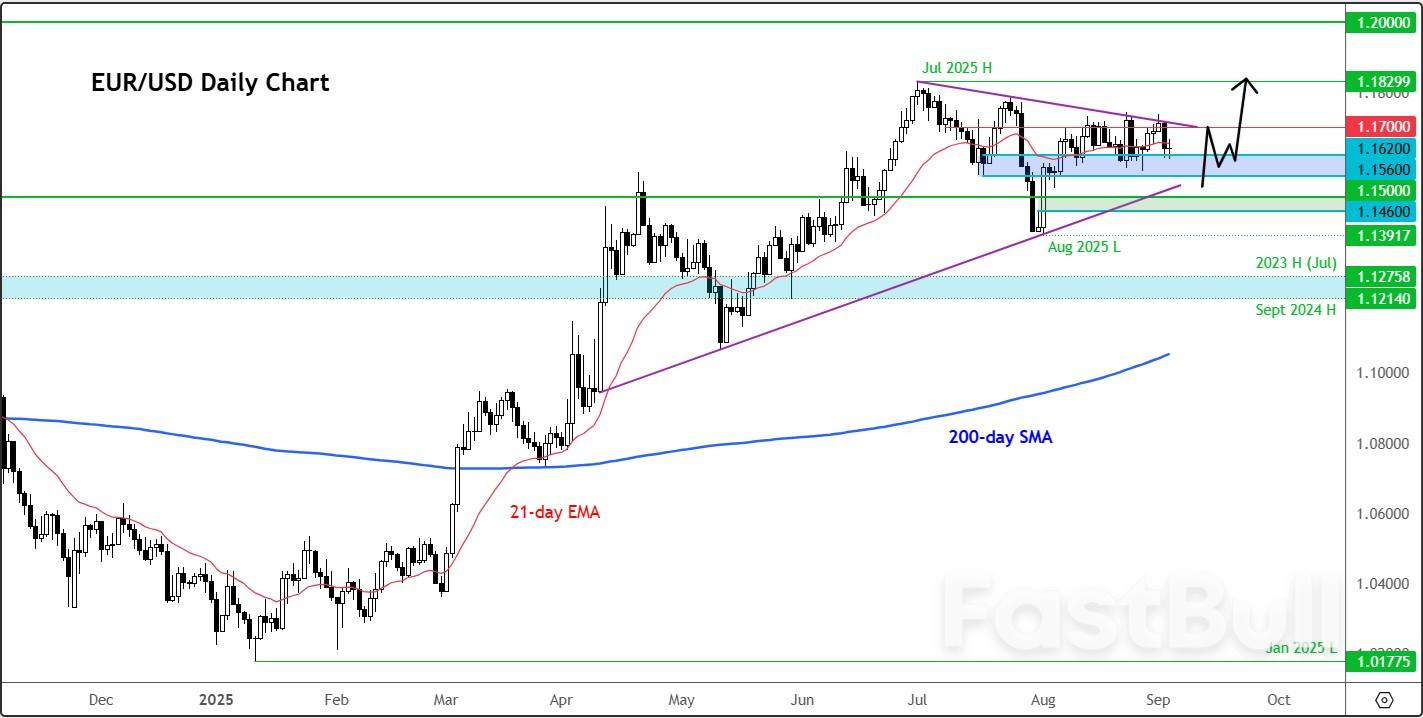
          Following Tuesday’s drop, the EUR/USD was trying to find its feet again as investors looked ahead to the release of key US data this week. The FX markets kicked off September with a punchy US dollar rally on the first full trading day for US investors, leaving plenty of traders scratching their heads.
          Much of the move seemed tied to the sell-off in long-dated bonds across the globe. But let’s be clear: this doesn’t change the bigger picture. The US dollar index (DXY)’s strength looks a touch overdone and could well fade in the coming days as markets refocus on the data and the Fed. Thus, I still expect to see a bullish breakout above 1.1700 resistance.

          ECB unlikely to cut rates despite French troubles

          The EUR/USD currency pair has been held back in recent days in part because of French political risk and the resulting underperformance of the OATs (French Treasury bonds). That said, it looks like much of that drag is already priced in, and the bar for another rate cut by the ECB is set high.
          The eurozone’s trade agreement with the US could have been far worse. What’s more, we have seen a bit of improvement in forward-looking sentiment indicators from Germany and a few other Eurozone countries. And let’s not forget that inflation has been somewhat hotter than expected.
          Indeed, the core CPI inflation reading came in hotter yesterday although that didn’t immediately lift the euro. It came in unchanged at 2.3% y/y versus 2.2% expected. But this morning, the single currency was rebounding again, perhaps in delayed reaction as yesterday it was all about the dollar and bond markets.
          What’s more, Eurozone PPI also came out slightly stronger this morning at +0.4% m/m vs. +0.2% eyed. However, the final estimates for the PMIs data were revised slightly lower, with German services for example falling below the 50.0 level at 49.3 compared to 50.1 reported initially. This kept the euro’s gains in check.
          All told, I think EUR/USD has room to claw back some of yesterday’s losses, with a push back above 1.17 looking achievable, especially if US data disappoints later this week and not to mention the fact that the ECB seems in no rush to move on interest rates again.
          Key US Data in Focus
          On the USD side of the EUR/USD, yesterday’s surge in the US dollar index chart didn’t have a convincing catalyst beyond the broader bond sell-off — and that’s hardly the stuff of lasting momentum. Rising debt jitters outside the US may have triggered some position-squaring, but with key economic data ahead and Fed easing likely later this month, I suspect the greenback will give back some ground.
          We will have some key US data to look forward to as we head into the business end of the week, starting today with JOLTS job openings. It’s taken on more significance after Powell all but admitted that labour market risks are now more pressing than inflation.
          The data is expected to reveal 7.38 million job openings in July, excluding the farming industry. Granted, the data release is a bit out-dated, but it can nonetheless impact the market because job openings are a leading indicator of overall employment.
          More significant data releases will follow on Thursday and Friday,
          The ISM Services PMI will be released on Thursday. Though the less closely-followed S&P Global’s PMI data have shown improvement, investors and traders tend to focus more on the ISM data as a more reliable forward-looking indicator about the health of the world’s largest economy.
          The ISM services PMI has stagnated around the boom-bust level of 50.0 for several months now and that trend will need to improve if the dollar has any chance of a decent comeback.
          Then it is all about the US nonfarm payrolls on Friday. Following last month’s much weaker jobs report and those big downward revision, the Fed Chair all but confirmed rate cuts were coming in September. This jobs report has the potential to dictate the pace of the next few rate cuts, or, if it comes in much higher, bring about fresh uncertainty about the near-term outlook for monetary policy direction.
          For now, I see downside risk for the US dollar into Friday’s payrolls, particularly if job openings point to cooling demand today.
          EUR/USD Technical Analysis and Levels to Watch
          EUR/USD Could Rebound as Bond-Driven US Dollar Strength Looks Overdone_1
          From a technical standpoint, the EUR/USD looks relatively steady. The single currency continues to consolidate inside a triangle pattern on the daily chart, potentially gearing up for a bullish breakout soon. Short-term support for the EUR/USD comes in around the 1.1560-1.1620 range.
          Below that 1.1500 is the next key support to watch. On the upside, resistance is seen around 1.1700 where the resistance trend of the triangle comes into focus. Above that, the July high of 1.1830 is the next target. If and when we get there, the focus will then turn to the next psychologically important 1.20 handle next.

          Source: investing

          Risk Warnings and Disclaimers
          You understand and acknowledge that there is a high degree of risk involved in trading. Following any strategies or investment methods may lead to potential losses. The content on the site is provided by our contributors and analysts for information purposes only. You are solely responsible for determining whether any trading assets, securities, strategy, or any other product is suitable for investing based on your own investment objectives and financial situation.
          Add to Favorites
          Share

          Gold and silver soar to record highs as Fed rate cuts loom

          Adam

          Commodity

          A stellar year for precious metals

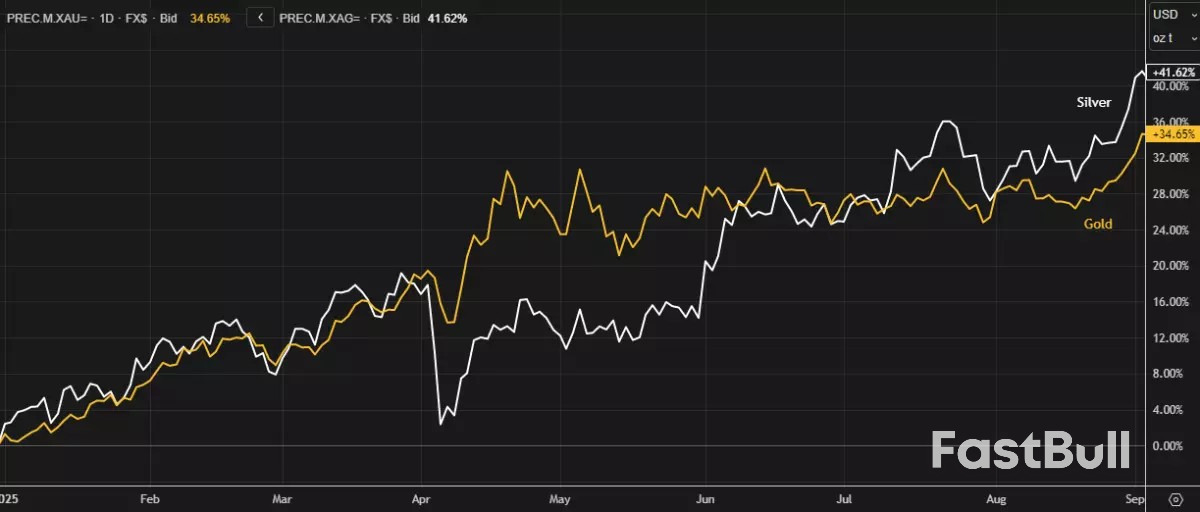
          Gold prices continue to rally after delivering 4.8% returns in August, the strongest month since April. Gold has just broke a new record at $3547 per ounce yesterday, representing a remarkable 35% year-to-date gain. This extraordinary rally has shattered multiple records, with the precious metal hitting new all-time highs throughout the year.
          Silver has been even more impressive, rising over 41% year-to-date. It surpassed $40 per ounce for the first time since 2011 on Monday. This performance has finally closed some of the performance gap between gold and silver.
          The rally in both metals has been nothing short of spectacular when viewed against broader market performance. They have both outperformed all major asset classes so far this year, including the Hang Seng Index (+27%) and Bitcoin (+19%). Higher interest rates would normally weigh on non-yielding assets like gold and silver, yet both continue to attract significant investor interest amid ongoing uncertainty.
          Figure 1: Gold and silver year-to-date performance
          Gold and silver soar to record highs as Fed rate cuts loom_1

          Performance driven by Federal Reserve rate policy

          The Federal Reserve's (Fed) monetary policy stance remains a crucial driver for precious metals prices. Market expectations of future rate cuts have provided significant tailwinds for precious metals. The bond futures market is pricing in 92% probability for a rate cut in September, and a 85% chance of two or more cuts by the end of the year, with Fed officials noting that risks of higher unemployment and inflation have risen.
          Lower interest rates reduce the opportunity cost of holding non-yielding assets like gold and silver. When central banks cut rates, the respective currency becomes less attractive, redirecting investments toward precious metals as alternative stores of value.
          US job data this week, including the Job Openings and Labour Turnover Survey (JOLTS) results tonight and the non-farm payrolls report due Friday, will play a critical role in shaping the monetary policy path ahead.

          Geopolitical uncertainties fuel safe-haven demand

          Heightened geopolitical risks continue to provide substantial support for precious metals prices. The sharp rally this year has been propelled by President Trump's tariffs, urging investors to seek refuge in tangible assets that maintain value during periods of policy uncertainty.
          Trade tensions between the US and China add another layer of uncertainty. President Trump's focus on tariffs has created additional market volatility, with investors seeking refuge in tangible assets that maintain value during periods of policy uncertainty. With the federal appeals court's ruling most of the tariffs illegal, investors are even more puzzled on what this entails for the US as tariff revenues are at stake while the bridges with allies have already been burnt.
          Another wildcard that may change the geopolitical picture is the ongoing conflicts between Russia and Ukraine. There has been little progress made on resolving the conflict since the talk between Trump and Putin. A de-escalation in the conflict may reduce interests for precious metals.

          US dollar's status questioned

          Recent political developments have raised concerns about Federal Reserve independence. The dismissal of Fed Governor Lisa Cook over alleged misconduct created uncertainty about policy stability, causing the US dollar index to slip and supporting precious metals prices.
          Mounting government debts have also reduced the dollar's appeal as a store of value given the fiscal instability. The US Dollar index (DXY) declined 9% so far this year and has been a significant catalyst for precious metals strength.
          In a recent survey conducted by the World Gold Council, 73% of the central banks respondents expect to reduce US dollar reserves in the next five years while 76% anticipate to increase gold reserves. Central bank demands remain strong with 123 tonnes of net purchases in the first half of 2025.

          Strong investment demand drives prices higher

          Silver investment demand through physical silver and ETPs is forecast to rise 9% in 2025 compared to 2024 according to the Silver Institute. Retail investors are increasingly viewing silver as an alternative to gold, attracted by its lower entry price and industrial applications. This dual appeal as both a monetary and industrial metal makes silver a unique asset class to invest in.
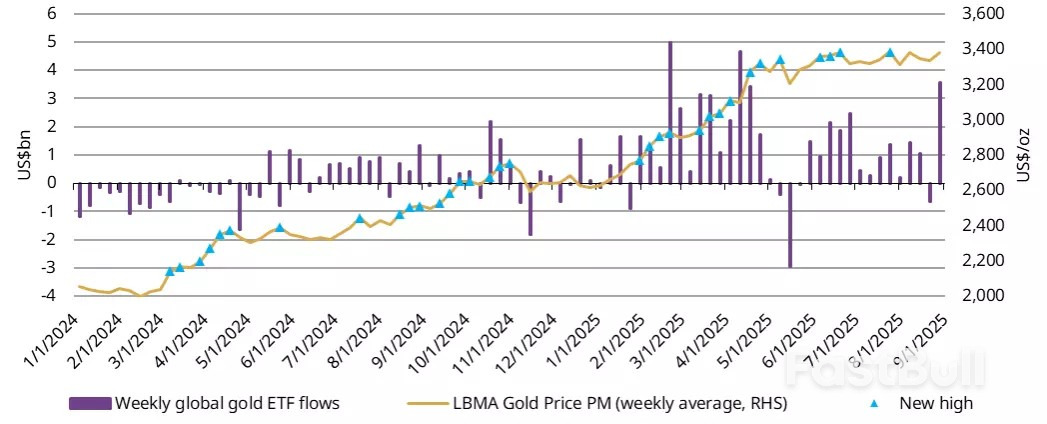
          Investment demand for gold is also robust. Global physically-backed gold exchange-traded funds (ETF) attracted over $3 billion net inflows last week, which marks the strongest weekly inflows since mid-April.
          Figure 2: Global gold ETF flows
          Gold and silver soar to record highs as Fed rate cuts loom_2

          Technical analysis shows bullish momentum continues

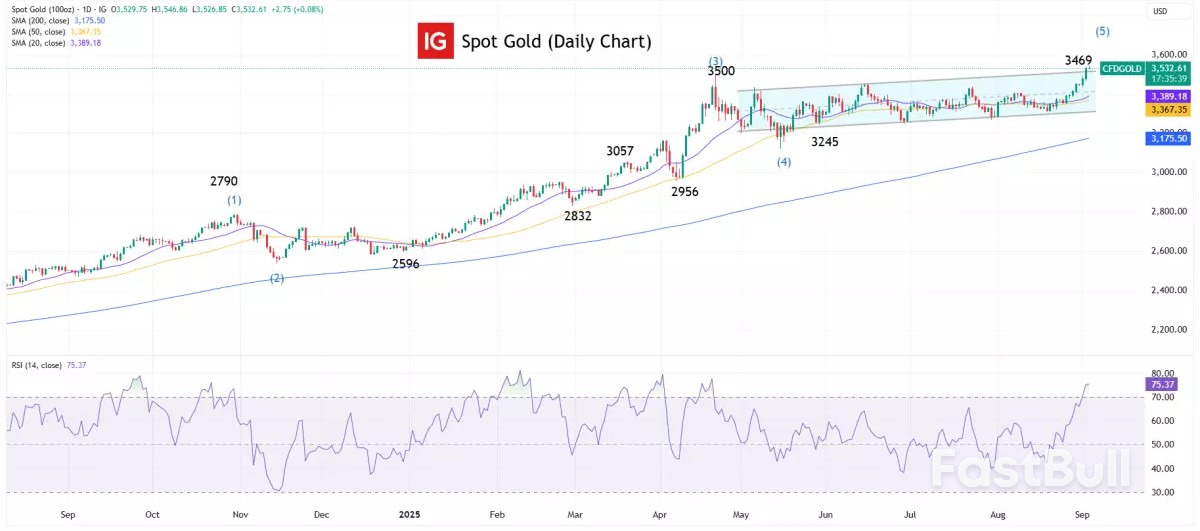
          Gold's technical picture remains compelling, with the metal supported by all major moving averages in what has been a textbook uptrend. Tuesday's decisive break above the previous peak at $3500 also cleared the upper boundary of an ascending channel, suggesting the bulls are firmly in control.
          The Elliott Wave count points to gold currently in Wave 5 of its uptrend from the May lows. A 100% Fibonacci extension of Wave 1 targets resistance around $3638, providing a logical area where significant sell-off could emerge.
          That said, the relative strength index (RSI) is flashing overbought warnings that traders should heed. While this doesn't necessarily mean the rally is over, it does suggest a period of consolidation or modest pullback could develop. Any dip should find support at the 20-day moving average around $3398.
          Figure 3: Spot gold (daily) price chart
          Gold and silver soar to record highs as Fed rate cuts loom_3
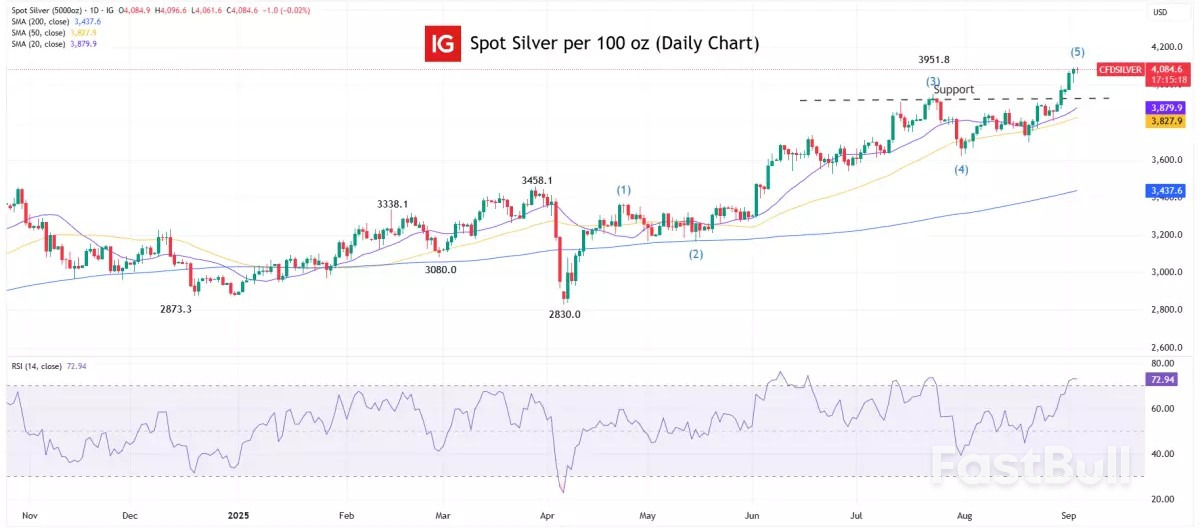
          Silver's chart tells a similar story of strength, though the white metal faces a crucial test at current levels. The $41 resistance encountered this morning aligns perfectly with the 61.8% Fibonacci extension of the July-to-August rally, making it a technically significant level.
          The Elliott Wave pattern suggests silver is also in its fifth and potentially final wave of the current advance. If this interpretation proves correct, we could see some consolidation around these levels before the next major move develops.
          Should the current resistance hold, a 38.2% retracement would target the $39.15 area, which coincides with July's resistance that has now turned support. This would represent a healthy pullback in what remains a strong uptrend. However, a clear break above $41 would open the path to $43-44, where silver last traded during August 2011.
          Figure 4: Spot silver (daily) price chart
          Gold and silver soar to record highs as Fed rate cuts loom_4

          Source: ig

          Risk Warnings and Disclaimers
          You understand and acknowledge that there is a high degree of risk involved in trading. Following any strategies or investment methods may lead to potential losses. The content on the site is provided by our contributors and analysts for information purposes only. You are solely responsible for determining whether any trading assets, securities, strategy, or any other product is suitable for investing based on your own investment objectives and financial situation.
          Add to Favorites
          Share

          Fed's Waller Repeats Call For Rate Cut In September, Pace Depends On Data

          Daniel Carter

          Central Bank

          Economic

          Federal Reserve Governor Christopher Waller on Wednesday repeated his call for an interest-rate cut in September given the weakening in the labor market, and said that how fast the central bank cuts after that will depend on what happens next in the economy.
          "I think we need to start cutting rates at the next meeting, and then we don't have to go in a locked sequence of steps," Waller said in an interview on CNBC. "We can kind of see where things are going, because people are still worried about tariff inflation ... I would say over the next three to six months, we could see multiple cuts coming in."Waller, one of two Fed governors who dissented in favor of a rate-cut in July, said he believes tariffs may push up inflation over the next several months, but said he expects that to be temporary and for inflation to resume falling back toward the Fed's 2% goal in six or seven months.
          Given the drop in labor demand, he said, the Fed should start bringing the policy rate, now in the 4.25%-4.50% range, down toward an estimated neutral rate of 3% -- with the pace of adjustments to depend on the economic data.
          Waller said he has spoken with US Treasury Secretary Scott Bessent in the past but has not had an interview for the job of Fed chair and does not yet have one scheduled. Bessent is expected to have a round of interviews for the job starting Friday, the Wall Street Journal reported.

          Source: Kitco

          To stay updated on all economic events of today, please check out our Economic calendar
          Risk Warnings and Disclaimers
          You understand and acknowledge that there is a high degree of risk involved in trading. Following any strategies or investment methods may lead to potential losses. The content on the site is provided by our contributors and analysts for information purposes only. You are solely responsible for determining whether any trading assets, securities, strategy, or any other product is suitable for investing based on your own investment objectives and financial situation.
          Add to Favorites
          Share

          Long-Run Forecasts Put US Equities, Commodities Behind Other Assets

          Adam

          Stocks

          Economic

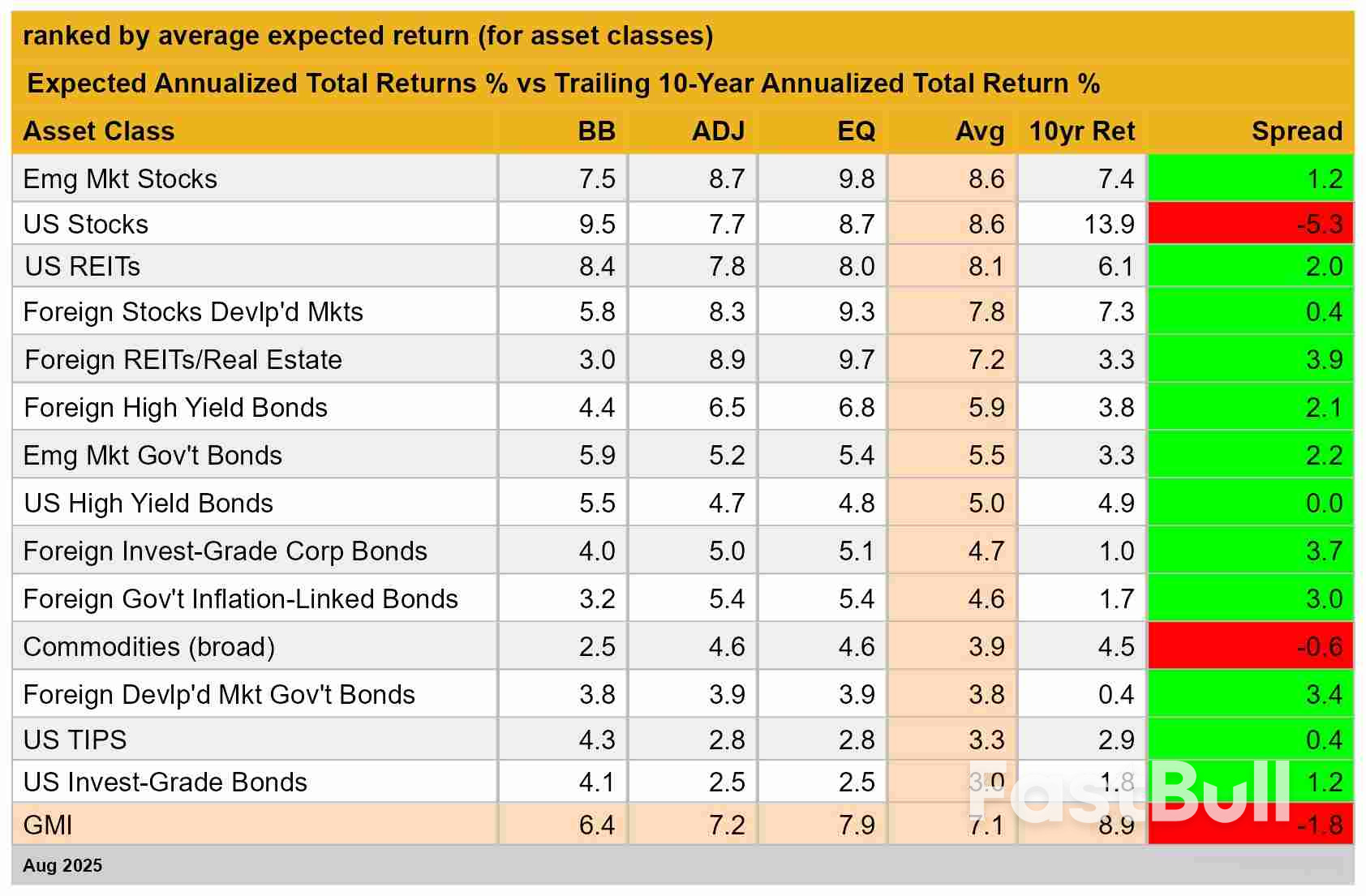
          The long-run expected total return for the Global Market Index (GMI) continued to hold in the low-7% range in August, based on the average for three models (defined below). The expected performance remains well below the trailing 10-year return for GMI, a market-value weighted mix of the major asset classes (excluding cash).
          US equities and commodities are the downside outliers for expected return in relative terms vs. their respective trailing performances over the past decade. GMI’s projected 7.1% annualized total return is also expected to deliver a softer performance vs. its trailing 8.9% gain. By comparison, the other asset classes are projected to generate returns above their performances over the previous 10 years.
          Long-Run Forecasts Put US Equities, Commodities Behind Other Assets_1
          GMI represents a theoretical benchmark for the “optimal” portfolio that’s suited for the average investor with an infinite time horizon. Accordingly, GMI is useful as a starting point for customizing asset allocation and portfolio design to match an investor’s expectations, objectives, risk tolerance, etc. GMI’s history suggests that this passive benchmark’s performance is competitive with most active asset-allocation strategies, especially after adjusting for risk, trading costs and taxes.
          It’s likely that some, most or possibly all of the forecasts above will be wide of the mark in some degree. GMI’s projections, however, are expected to be somewhat more reliable vs. the estimates for the components. Predictions for the specific markets (US stocks, commodities, etc.) are subject to greater volatility and tracking error compared with aggregating the forecasts into the GMI estimate, a process that may reduce some of the errors through time.
          Another way to view the projections above is to use the estimates as a baseline for refining expectations. For instance, the point forecasts above can be adjusted with additional modeling that accounts for other factors not used here. Customizing portfolios for a specfic investor, to reflect risk tolerance, time horizon, and so on, is also recommended.
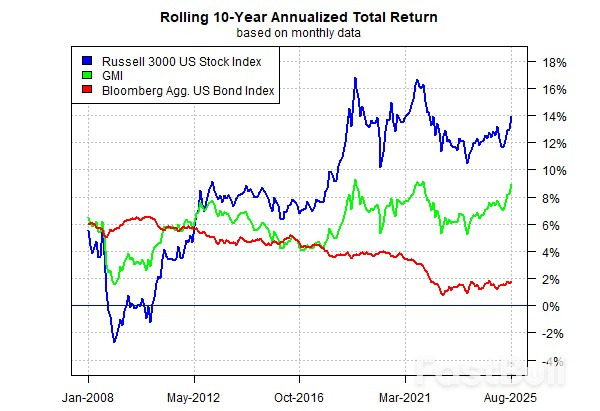
          For perspective on how GMI’s realized total return has evolved through time, consider the benchmark’s track record on a rolling 10-year annualized basis. The chart below compares GMI’s performance vs. the equivalent for US stocks and US bonds through last month. GMI’s current return for the past ten years is 8.9%, a robust performance.
          Long-Run Forecasts Put US Equities, Commodities Behind Other Assets_2
          Here’s a brief summary of how the forecasts are generated and definitions of the other metrics in the table above:
          BB: The Building Block model uses historical returns as a proxy for estimating the future. The sample period used starts in January 1998 (the earliest available date for all the asset classes listed above). The procedure is to calculate the risk premium for each asset class, compute the annualized return and then add an expected risk-free rate to generate a total return forecast.
          For the expected risk-free rate, we’re using the latest yield on the 10-year Treasury Inflation Protected Security (TIPS). This yield is considered a market estimate of a risk-free, real (inflation-adjusted) return for a “safe” asset — this “risk-free” rate is also used for all the models outlined below. Note that the BB model used here is (loosely) based on a methodology originally outlined by Ibbotson Associates (a division of Morningstar).
          EQ: The Equilibrium model reverse engineers expected return by way of risk. Rather than trying to predict return directly, this model relies on the somewhat more reliable framework of using risk metrics to estimate future performance. The process is relatively robust in the sense that forecasting risk is slightly easier than projecting return. The three inputs:
          * An estimate of the overall portfolio’s expected market price of risk, defined as the Sharpe ratio, which is the ratio of risk premia to volatility (standard deviation). Note: the “portfolio” here and throughout is defined as GMI
          * The expected volatility (standard deviation) of each asset (GMI’s market components)
          * The expected correlation for each asset relative to the portfolio (GMI)
          This model for estimating equilibrium returns was initially outlined in a 1974 paper by Professor Bill Sharpe. For a summary, see Gary Brinson’s explanation in Chapter 3 of The Portable MBA in Investment. I also review the model in my book Dynamic Asset Allocation. Note that this methodology initially estimates a risk premium and then adds an expected risk-free rate to arrive at total return forecasts. The expected risk-free rate is outlined in BB above.
          ADJ: This methodology is identical to the Equilibrium model (EQ) outlined above with one exception: the forecasts are adjusted based on short-term momentum and longer-term mean reversion factors. Momentum is defined as the current price relative to the trailing 12-month moving average. The mean reversion factor is estimated as the current price relative to the trailing 60-month (5-year) moving average.
          The equilibrium forecasts are adjusted based on current prices relative to the 12-month and 60-month moving averages. If current prices are above (below) the moving averages, the unadjusted risk premia estimates are decreased (increased). The formula for adjustment is simply taking the inverse of the average of the current price to the two moving averages.
          For example: if an asset class’s current price is 10% above its 12-month moving average and 20% over its 60-month moving average, the unadjusted forecast is reduced by 15% (the average of 10% and 20%). The logic here is that when prices are relatively high vs. recent history, the equilibrium forecasts are reduced. On the flip side, when prices are relatively low vs. recent history, the equilibrium forecasts are increased.
          Avg: This column is a simple average of the three forecasts for each row (asset class)
          10yr Ret: For perspective on actual returns, this column shows the trailing 10-year annualized total return for the asset classes through the current target month.
          Spread: Average-model forecast less trailing 10-year return.

          Source: investing

          To stay updated on all economic events of today, please check out our Economic calendar
          Risk Warnings and Disclaimers
          You understand and acknowledge that there is a high degree of risk involved in trading. Following any strategies or investment methods may lead to potential losses. The content on the site is provided by our contributors and analysts for information purposes only. You are solely responsible for determining whether any trading assets, securities, strategy, or any other product is suitable for investing based on your own investment objectives and financial situation.
          Add to Favorites
          Share

          Job Opening Data Falls To Levels Rarely Seen Since Pandemic

          Thomas

          Economic

          Job openings ticked down in July to levels rarely seen since the Covid pandemic, bolstering fears of cooling in the labor market.

          The Job Openings and Labor Turnover report showed around 7.18 million listings in July, according to data from the Bureau of Labor Statistics released Wednesday. That's only the second reading under the 7.2 million level since the end of 2020.

          Wednesday's print was the lowest since September 2024, when just over 7.1 million openings were reported. Outside of that blip lower last year, these job opening levels were last seen when the pandemic was causing an upheaval of the U.S. economy and labor force.

          The data also underscored rising concerns of weakening in the labor market, a trend that has shown up in anecdotal evidence for several months. "This is a turning point for the labor market. It's yet another crack. It's also troubling that July saw fewer health care and social assistance job openings."

          "This is yet another data point underscoring how this job market is frozen and it's difficult for anyone to get a job right now," said Heather Long, chief economist at Navy Federal Credit Union.

          Weekly jobless claims data due on Thursday will offer the next round of insight into the health of the job market. Then, attention turns to the closely followed jobs report on Friday morning.

          Source: CNBC

          To stay updated on all economic events of today, please check out our Economic calendar
          Risk Warnings and Disclaimers
          You understand and acknowledge that there is a high degree of risk involved in trading. Following any strategies or investment methods may lead to potential losses. The content on the site is provided by our contributors and analysts for information purposes only. You are solely responsible for determining whether any trading assets, securities, strategy, or any other product is suitable for investing based on your own investment objectives and financial situation.
          Add to Favorites
          Share

          Global bond sell-off reflects unease over budgets and central banks

          Adam

          Bond

          Long-dated borrowing costs around the world are back under pressure, and analysts say that’s in part thanks to broad investor unease with the path of both fiscal and monetary policy in many major economies.
          Bond markets have been on a bumpy ride this year, with massive spikes and falls at times stemming from White House policymaking, ranging from tariffs to concerns about the U.S. deficit related to the “big, beautiful tax bill.”
          Moves have been more measured this week. But several yields hit notable milestones, reigniting discussion over the opportunities and risks in government debt.
          The U.S. 30-year Treasury yield nudged above 5% on Wednesday morning for the first time since July amid questions over the future of tariff revenues following a recent court ruling. Japan’s 30-year bond yield was at a record high on Wednesday, with a 100 basis point rise this year driven by high inflation, low real rates and political uncertainty.
          The yield on U.K. 30-year bonds on Tuesday reached its highest level since 1998 ahead of a highly anticipated budget set to be delivered in the coming months, and added another 4 basis points early Wednesday. The premium on French 30-year bonds breached a level last seen in 2008 as the government is on the brink of collapse, putting the country’s deficit reduction plans at risk.
          German bonds, which benefited from a flight to safety earlier in the year, joined the rout, with the 30-year bund yield notching a 14-year high.
          Rate pressure
          Kallum Pickering, chief economist at Peel Hunt, said that while there is no crisis in the bond market, the elevated price being paid by governments, combined with high interest rates, is an economic problem across the advanced world.
          ″[High rates] constrain policy choices, they crowd out private investment, they leave us wondering every six months whether we’re going to face a bout of financial instability. These are really, really bad for the private sector,” Pickering told CNBC’s “Squawk Box Europe” on Wednesday.
          “I’m actually getting to the point now where I think that austerity would be stimulative, because you would actually give markets confidence, you would bring down these bond yields, and the private sector would just breathe a sigh of relief and start distributing some of its balance sheet strength.”
          Jonas Goltermann, deputy chief markets economist at Capital Economics, said there appears to be three overlapping drivers between the global move higher in long-end yields: fiscal concerns, monetary policy, and term premia effects such as supply-demand dynamics.
          Both the U.K. and France are facing a “tricky budget arithmetic” in which “some combination of tax increases and spending cuts are needed to keep public finances on a sustainable footing and bond markets on side,” he said in a Tuesday note.
          Market dynamics, meanwhile, suggest wavering confidence over central banks’ “ability and willingness to keep inflation under control in the medium term,” Goltermann continued, though he noted the relative resilience of U.S. yields where fears over central bank independence have become acute.
          Finally, a combination of greater bond issuance and lower demand from traditional buyers of long-dated debt — in part due to the risk of higher rates and inflation, and a weakening of the typical link between risk-off sentiment and lower bond yields — has left the chance of a “silver bullet” arriving to drive down yields looking slim, Goltermann said.
          Finally, at a time when bond issuance has increased, demand from traditional buyers of long-dated debt has decreased, Goltermann continued. The typical link between risk-off sentiment and lower bond yields has eroded this year, and traders are weighing the risk of higher rates and inflation, he said.
          Strategists at ING downplayed the idea that this week’s bond sell-off was sparked by U.S. tariff uncertainty related to an appeals court decision that most of President Donald Trump’s duties on imports from other countries are illegal.
          “There is no uncertainty. Tariffs remain and will remain,” they said in a Tuesday note, describing the Trump administration as “all in on macro management via tariffs” by whatever means.
          “The long ends of yield curves remain under upward pressure amid a mix of fiscal concerns and worries about central bank independence,” they said, particularly following the “Lisa Cook affair” — referring to Trump’s ongoing attempt to fire the Federal Reserve governor.
          “Who takes the lead on a given day seems influenced by supply activity,” they added.

          Source: cnbc

          Risk Warnings and Disclaimers
          You understand and acknowledge that there is a high degree of risk involved in trading. Following any strategies or investment methods may lead to potential losses. The content on the site is provided by our contributors and analysts for information purposes only. You are solely responsible for determining whether any trading assets, securities, strategy, or any other product is suitable for investing based on your own investment objectives and financial situation.
          Add to Favorites
          Share

          Trump Says Not Considering Lowering Tariffs On India Imports

          Winkelmann

          Economic

          Forex

          Political

          President Donald Trump says he’s not looking at lowering tariffs on India, one week after the US doubled levies on the country’s imports to 50% as punishment for its Russian oil imports.Trump responded “no” when asked by a reporter whether he is considering taking away some of the tariffs imposed on India.“We get along with India very well,” Trump added Tuesday at a White House event, but criticised what he said was an imbalanced trade relationship with New Delhi because of high Indian levies.

          “India has, you have to understand, for many years, it was a one-sided relationship,” he said. “India was charging us tremendous tariffs, about the highest in the world.”The US tariffs on India came despite months of negotiations between New Delhi and Washington and stunned officials in the Asian nation. India’s high tariffs and protectionist policies have exasperated US trade negotiators.Trump set a 25% duty on Indian exports but doubled that level to 50% last week as punishment for purchases of Russian oil. Those levies hit more than 55% of goods shipped to the US, which is India’s biggest market.

          Trump has expressed frustration over India’s continued purchases of Russian energy, which New Delhi has justified as necessary to keep its oil prices low. Critics say such energy buys by India and China help keep Russia’s economy afloat and undercut sanctions against Moscow aimed at reining in the country’s military machine and bringing an end to the war in Ukraine.The US president said he was “watching very closely” to see how Russian President Vladimir Putin addressed efforts to set up a meeting with his Ukrainian counterpart and insinuated he was considering additional measures if talks did not progress.

          Trump on Monday said that India had offered to cut its tariffs “to nothing” in a social media post, without saying when that offer was made or whether the White House plans to reopen trade talks with India.“It’s getting late. They should have done so years ago,” Trump said on Monday.

          Source: Theedgemarkets

          To stay updated on all economic events of today, please check out our Economic calendar
          Risk Warnings and Disclaimers
          You understand and acknowledge that there is a high degree of risk involved in trading. Following any strategies or investment methods may lead to potential losses. The content on the site is provided by our contributors and analysts for information purposes only. You are solely responsible for determining whether any trading assets, securities, strategy, or any other product is suitable for investing based on your own investment objectives and financial situation.
          Add to Favorites
          Share
          FastBull
          Copyright © 2025 FastBull Ltd

          728 RM B 7/F GEE LOK IND BLDG NO 34 HUNG TO RD KWUN TONG KLN HONG KONG

          TelegramInstagramTwitterfacebooklinkedin
          App Store Google Play Google Play
          Products
          Charts

          Chats

          Q&A with Experts
          Screeners
          Economic Calendar
          Data
          Tools
          Membership
          Features
          Function
          Markets
          Copy Trading
          Latest Signals
          Contests
          News
          Analysis
          24/7
          Columns
          Education
          Company
          Careers
          About Us
          Contact Us
          Advertising
          Help Center
          Feedback
          User Agreement
          Privacy Policy
          Business

          White Label

          Data API

          Web Plug-ins

          Poster Maker

          Affiliate Program

          Risk Disclosure

          The risk of loss in trading financial instruments such as stocks, FX, commodities, futures, bonds, ETFs and crypto can be substantial. You may sustain a total loss of the funds that you deposit with your broker. Therefore, you should carefully consider whether such trading is suitable for you in light of your circumstances and financial resources.

          No decision to invest should be made without thoroughly conducting due diligence by yourself or consulting with your financial advisors. Our web content might not suit you since we don't know your financial conditions and investment needs. Our financial information might have latency or contain inaccuracy, so you should be fully responsible for any of your trading and investment decisions. The company will not be responsible for your capital loss.

          Without getting permission from the website, you are not allowed to copy the website's graphics, texts, or trademarks. Intellectual property rights in the content or data incorporated into this website belong to its providers and exchange merchants.

          Not Logged In

          Log in to access more features

          FastBull Membership

          Not yet

          Purchase

          Become a signal provider
          Help Center
          Customer Service
          Dark Mode
          Price Up/Down Colors

          Log In

          Sign Up

          Position
          Layout
          Fullscreen
          Default to Chart
          The chart page opens by default when you visit fastbull.com