• Trade
  • Markets
  • Copy
  • Contests
  • News
  • 24/7
  • Calendar
  • Q&A
  • Chats
Trending
Screeners
SYMBOL
LAST
BID
ASK
HIGH
LOW
NET CHG.
%CHG.
SPREAD
SPX
S&P 500 Index
6827.42
6827.42
6827.42
6899.86
6801.80
-73.58
-1.07%
--
DJI
Dow Jones Industrial Average
48458.04
48458.04
48458.04
48886.86
48334.10
-245.98
-0.51%
--
IXIC
NASDAQ Composite Index
23195.16
23195.16
23195.16
23554.89
23094.51
-398.69
-1.69%
--
USDX
US Dollar Index
97.950
98.030
97.950
98.500
97.950
-0.370
-0.38%
--
EURUSD
Euro / US Dollar
1.17394
1.17409
1.17394
1.17496
1.17192
+0.00011
+ 0.01%
--
GBPUSD
Pound Sterling / US Dollar
1.33707
1.33732
1.33707
1.33997
1.33419
-0.00148
-0.11%
--
XAUUSD
Gold / US Dollar
4299.39
4299.39
4299.39
4353.41
4257.10
+20.10
+ 0.47%
--
WTI
Light Sweet Crude Oil
57.233
57.485
57.233
58.011
56.969
-0.408
-0.71%
--

Community Accounts

Signal Accounts
--
Profit Accounts
--
Loss Accounts
--
View More

Become a signal provider

Sell trading signals to earn additional income

View More

Guide to Copy Trading

Get started with ease and confidence

View More

Signal Accounts for Members

All Signal Accounts

Best Return
  • Best Return
  • Best P/L
  • Best MDD
Past 1W
  • Past 1W
  • Past 1M
  • Past 1Y

All Contests

  • All
  • Trump Updates
  • Recommend
  • Stocks
  • Cryptocurrencies
  • Central Banks
  • Featured News
Top News Only
Share

Incoming Czech Prime Minister Babis: Czech Republic Will Not Take On Guarantees For Ukraine Financing, European Commission Must Find Alternatives

Share

Turkey President Erdogan: Hopes To Discuss Ukraine-Russia Peace Plan With Trump After Meeting With Putin

Share

Turkey President Erdogan: Peace Is Not Far Away, Black Sea Should Not Be Used As A Battleground, Safe Navigation Needed

Share

IAEA: Ukraine's Znpp Temporarily Lost All Offsite Power Overnight Due To Widespread Military Activities Affecting The Electrical Grid

Share

Iranian Media Says 18 Crew Members Of Foreign Tanker Seized In Gulf Of Oman Over Carrying 'Smuggled Fuel' Detained

Share

Regional Governor: Two Killed In Ukrainian Drone Strike On Russia's Saratov

Share

Chinese Foreign Ministry - China Foreign Minister Met With United Arab Emirates Counterpart On Dec 12

Share

China's Central Financial And Economic Affairs Commission Deputy Director: Will Expand Export And Increase Import In 2026

Share

Thai Leader Anutin: Landmine Blast That Killed Thai Soldiers 'Not A Roadside Accident'

Share

Thai Leader Anutin: Thailand To Continue Military Action Until 'We Feel No More Harm'

Share

Cambodian Prime Minister Hun Manet Says He Had Phone Calls With Trump And Malaysian Leader Anwar About Ceasefire

Share

Cambodia's Hun Manet Says USA, Malaysia Should Verify 'Which Side Fired First' In Latest Conflict

Share

Cambodia's Hun Manet: Cambodia Maintains Its Stance In Seeking Peaceful Resolution Of Disputes

Share

Nasdaq Companies: Allergan, Ferrovia, Insmed, Monolithic Power Systems, Seagate Technology, And Western Digital Will Be Added To The NASDAQ 100 Index. Biogen, CdW, GlobalFoundries, Lululemon, ON Semiconductor, And Tradedesk Will Be Removed From The NASDAQ 100 Index

Share

Witkoff Headed To Berlin This Weekend To Meet With Zelenskiy, European Leaders -Wsj Reporter On X

Share

Russia Attacks Two Ukrainian Ports, Damaging Three Turkish-Owned Vessels

Share

[Historic Flooding Occurs In At Least Four Rivers In Washington State Due To Days Of Torrential Rains] Multiple Areas In Washington State Have Been Hit By Severe Flooding Due To Days Of Torrential Rains, With At Least Four Rivers Experiencing Historic Flooding. Reporters Learned On The 12th That The Floods Caused By The Torrential Rains In Washington State Have Destroyed Homes And Closed Several Highways. Experts Warn That Even More Severe Flooding May Occur In The Future. A State Of Emergency Has Been Declared In Washington State

Share

Trump Says Proposed Free Economic Zone In Donbas Would Work

Share

Trump: I Think My Voice Should Be Heard

Share

Trump Says Will Be Choosing New Fed Chair In Near Future

TIME
ACT
FCST
PREV
U.K. Trade Balance Non-EU (SA) (Oct)

A:--

F: --

P: --

U.K. Trade Balance (Oct)

A:--

F: --

P: --

U.K. Services Index MoM

A:--

F: --

P: --

U.K. Construction Output MoM (SA) (Oct)

A:--

F: --

P: --

U.K. Industrial Output YoY (Oct)

A:--

F: --

P: --

U.K. Trade Balance (SA) (Oct)

A:--

F: --

P: --

U.K. Trade Balance EU (SA) (Oct)

A:--

F: --

P: --

U.K. Manufacturing Output YoY (Oct)

A:--

F: --

P: --

U.K. GDP MoM (Oct)

A:--

F: --

P: --

U.K. GDP YoY (SA) (Oct)

A:--

F: --

P: --

U.K. Industrial Output MoM (Oct)

A:--

F: --

P: --

U.K. Construction Output YoY (Oct)

A:--

F: --

P: --

France HICP Final MoM (Nov)

A:--

F: --

P: --

China, Mainland Outstanding Loans Growth YoY (Nov)

A:--

F: --

P: --

China, Mainland M2 Money Supply YoY (Nov)

A:--

F: --

P: --

China, Mainland M0 Money Supply YoY (Nov)

A:--

F: --

P: --

China, Mainland M1 Money Supply YoY (Nov)

A:--

F: --

P: --

India CPI YoY (Nov)

A:--

F: --

P: --

India Deposit Gowth YoY

A:--

F: --

P: --

Brazil Services Growth YoY (Oct)

A:--

F: --

P: --

Mexico Industrial Output YoY (Oct)

A:--

F: --

P: --

Russia Trade Balance (Oct)

A:--

F: --

P: --

Philadelphia Fed President Henry Paulson delivers a speech
Canada Building Permits MoM (SA) (Oct)

A:--

F: --

P: --

Canada Wholesale Sales YoY (Oct)

A:--

F: --

P: --

Canada Wholesale Inventory MoM (Oct)

A:--

F: --

P: --

Canada Wholesale Inventory YoY (Oct)

A:--

F: --

P: --

Canada Wholesale Sales MoM (SA) (Oct)

A:--

F: --

P: --

Germany Current Account (Not SA) (Oct)

A:--

F: --

P: --

U.S. Weekly Total Rig Count

A:--

F: --

P: --

U.S. Weekly Total Oil Rig Count

A:--

F: --

P: --

Japan Tankan Large Non-Manufacturing Diffusion Index (Q4)

--

F: --

P: --

Japan Tankan Small Manufacturing Outlook Index (Q4)

--

F: --

P: --

Japan Tankan Large Non-Manufacturing Outlook Index (Q4)

--

F: --

P: --

Japan Tankan Large Manufacturing Outlook Index (Q4)

--

F: --

P: --

Japan Tankan Small Manufacturing Diffusion Index (Q4)

--

F: --

P: --

Japan Tankan Large Manufacturing Diffusion Index (Q4)

--

F: --

P: --

Japan Tankan Large-Enterprise Capital Expenditure YoY (Q4)

--

F: --

P: --

U.K. Rightmove House Price Index YoY (Dec)

--

F: --

P: --

China, Mainland Industrial Output YoY (YTD) (Nov)

--

F: --

P: --

China, Mainland Urban Area Unemployment Rate (Nov)

--

F: --

P: --

Saudi Arabia CPI YoY (Nov)

--

F: --

P: --

Euro Zone Industrial Output YoY (Oct)

--

F: --

P: --

Euro Zone Industrial Output MoM (Oct)

--

F: --

P: --

Canada Existing Home Sales MoM (Nov)

--

F: --

P: --

Euro Zone Total Reserve Assets (Nov)

--

F: --

P: --

U.K. Inflation Rate Expectations

--

F: --

P: --

Canada National Economic Confidence Index

--

F: --

P: --

Canada New Housing Starts (Nov)

--

F: --

P: --

U.S. NY Fed Manufacturing Employment Index (Dec)

--

F: --

P: --

U.S. NY Fed Manufacturing Index (Dec)

--

F: --

P: --

Canada Core CPI YoY (Nov)

--

F: --

P: --

Canada Manufacturing Unfilled Orders MoM (Oct)

--

F: --

P: --

Canada Manufacturing New Orders MoM (Oct)

--

F: --

P: --

Canada Core CPI MoM (Nov)

--

F: --

P: --

Canada Manufacturing Inventory MoM (Oct)

--

F: --

P: --

Canada CPI YoY (Nov)

--

F: --

P: --

Canada CPI MoM (Nov)

--

F: --

P: --

Canada CPI YoY (SA) (Nov)

--

F: --

P: --

Canada Core CPI MoM (SA) (Nov)

--

F: --

P: --

Q&A with Experts
    • All
    • Chatrooms
    • Groups
    • Friends
    Connecting
    .
    .
    .
    Type here...
    Add Symbol or Code

      No matching data

      All
      Trump Updates
      Recommend
      Stocks
      Cryptocurrencies
      Central Banks
      Featured News
      • All
      • Russia-Ukraine Conflict
      • Middle East Flashpoint
      • All
      • Russia-Ukraine Conflict
      • Middle East Flashpoint
      Search
      Products

      Charts Free Forever

      Chats Q&A with Experts
      Screeners Economic Calendar Data Tools
      Membership Features
      Data Warehouse Market Trends Institutional Data Policy Rates Macro

      Market Trends

      Market Sentiment Order Book Forex Correlations

      Top Indicators

      Charts Free Forever
      Markets

      News

      News Analysis 24/7 Columns Education
      From Institutions From Analysts
      Topics Columnists

      Latest Views

      Latest Views

      Trending Topics

      Top Columnists

      Latest Update

      Signals

      Copy Rankings Latest Signals Become a signal provider AI Rating
      Contests
      Brokers

      Overview Brokers Assessment Rankings Regulators News Claims
      Broker listing Forex Brokers Comparison Tool Live Spread Comparison Scam
      Q&A Complaint Scam Alert Videos Tips to Detect Scam
      More

      Business
      Events
      Careers About Us Advertising Help Center

      White Label

      Data API

      Web Plug-ins

      Affiliate Program

      Awards Institution Evaluation IB Seminar Salon Event Exhibition
      Vietnam Thailand Singapore Dubai
      Fans Party Investment Sharing Session
      FastBull Summit BrokersView Expo
      Recent Searches
        Top Searches
          Markets
          News
          Analysis
          User
          24/7
          Economic Calendar
          Education
          Data
          • Names
          • Latest
          • Prev

          View All

          No data

          Scan to Download

          Faster Charts, Chat Faster!

          Download App
          English
          • English
          • Español
          • العربية
          • Bahasa Indonesia
          • Bahasa Melayu
          • Tiếng Việt
          • ภาษาไทย
          • Français
          • Italiano
          • Türkçe
          • Русский язык
          • 简中
          • 繁中
          Open Account
          Search
          Products
          Charts Free Forever
          Markets
          News
          Signals

          Copy Rankings Latest Signals Become a signal provider AI Rating
          Contests
          Brokers

          Overview Brokers Assessment Rankings Regulators News Claims
          Broker listing Forex Brokers Comparison Tool Live Spread Comparison Scam
          Q&A Complaint Scam Alert Videos Tips to Detect Scam
          More

          Business
          Events
          Careers About Us Advertising Help Center

          White Label

          Data API

          Web Plug-ins

          Affiliate Program

          Awards Institution Evaluation IB Seminar Salon Event Exhibition
          Vietnam Thailand Singapore Dubai
          Fans Party Investment Sharing Session
          FastBull Summit BrokersView Expo

          Eurozone Growth Is Already Dwindling

          Owen Li

          Economic

          Summary:

          On the back of a weak first-quarter performance for the eurozone economy, we have downgraded our growth outlook. That said, we now pencil in two more rate hikes, as core inflation is unlikely to come down much before autumn.
          Eurozone view: weak growth with falling inflation
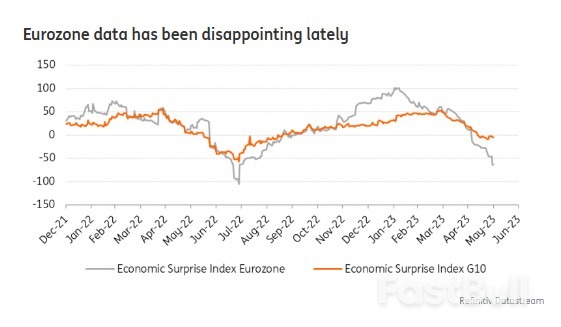
          Eurozone growth disappointed in the first quarter. While falling energy prices and rising wages should support consumption, the soft Chinese reopening, tighter monetary conditions and looming US recession will weigh on growth and bring the economy close to a standstill by year-end. It is mainly services that are currently thriving. The manufacturing sector is struggling with excess inventories while construction is hampered by higher interest rates. It is therefore not surprising to see that services inflation remains quite sticky, while there are budding deflationary pressures in the goods industry. But the further weakening of growth over the course of the year should bring inflation down towards 3% by year-end. As the ECB wants to see a clear decline in core inflation before ending the tightening cycle, 25bp rate hikes seem likely in both June and July, with an additional one in September a genuine risk.
          Eurozone Growth Is Already Dwindling_1Where we differ
          With our 0.5% GDP growth forecast for both 2023 and 2024, we are definitely below consensus (0.6% and 1.0% respectively) and far below official forecasts (for instance, the European Commission foresees 1.1% for 2023 and 1.6% for 2024, quite similar to what the ECB is pencilling in). With our 5.4% inflation forecast for 2023 and 2.5% for 2024, we are close to consensus, but below official estimates, especially for 2024. Market forwards indicate rates plateauing at a level around 50bp above today's level in the second half of the year, with a first rate cut in the second quarter of next year, exactly in line with our predictions.
          Goldilocks after all?
          We might be overly pessimistic about the growth outlook. With wages picking up and inflation coming down on the back of further falling energy prices, consumption growth could accelerate in 2024, certainly if you also pencil in a decline in the savings ratio. The weakness in manufacturing might also be short-lived: once the inventory overhang has been corrected and consumer demand for goods picks up again, manufacturing should become a driver of growth. If at the same time the US manages a soft landing and Chinese growth gathers momentum, net exports could also support the expansion.
          Finally, with the European recovery plan gaining traction, public investment should add to growth. This would be a kind of goldilocks scenario, with growth accelerating and inflation falling in 2024.
          Eurozone Growth Is Already Dwindling_2A deeper downturn is still a genuine risk
          On the other hand, it is certainly possible to come up with a stronger downturn scenario (bear in mind that we haven't pencilled in any negative growth quarters for the next two years). What we find a bit strange, is that in the official forecasts, it seems as if tighter monetary policy does have very little effect after all – even though the ECB's (admittedly somewhat discredited) models are forecasting a significative negative growth impact of monetary policy, both in 2023 and 2024. Also, in the past, it has been very hard for the eurozone to decouple from the US. Therefore, a US recession might hit the eurozone more than we currently anticipate.
          On top of this, throw in the possibility of a credit crunch: falling house prices and an inverted yield curve will make banks a lot more cautious. So, even though we are already more bearish than the consensus, we cannot dismiss the possibility that growth turns out to be even weaker. Of course, that might allow the ECB to cut back rates a bit more strongly over the course of next year.

          Source: ING

          To stay updated on all economic events of today, please check out our Economic calendar
          Risk Warnings and Disclaimers
          You understand and acknowledge that there is a high degree of risk involved in trading. Following any strategies or investment methods may lead to potential losses. The content on the site is provided by our contributors and analysts for information purposes only. You are solely responsible for determining whether any trading assets, securities, strategy, or any other product is suitable for investing based on your own investment objectives and financial situation.
          Comments
          Add to Favorites
          Share

          Asia Week Ahead: Reserve Bank of Australia to Decide on Policy Rate

          Damon

          Economic

          Persistent inflation could prompt RBA to hike again
          The June Reserve Bank of Australia (RBA) meeting is a tough one to call. The RBA recently confused markets with its reversion to a more hawkish stance, even as inflation was weakening, and now the fall in inflation has reversed, there is a reasonable argument for it to hike again this month. However, the quarterly CPI data still seem to carry more weight than the monthly series at the moment, so some forecasters expect the RBA to wait until the August meeting when it will be able to respond to second-quarter CPI inflation.
          Our forecasts are for inflation in July to have fallen to 5.2% year-on-year, but the second-quarter rate will still probably be in excess of 6%, so the RBA could well argue a further hike was needed then to ensure that inflation was falling fast enough. But with inflation rising again in April, it is going to be very hard for the RBA to sit on the sidelines in June, so a low conviction 25bp hike is our call this month, but we wouldn't be shocked if the central bank decides to pause.
          Philippine trade balance to stay in deficit on soft electronics exports
          April export data is set for release next week and we could see both imports and exports remain in negative territory. Imports are expected to drop on a year-on-year basis on shrinking energy imports, while exports could face another month of contraction due to soft demand for electronics. The Philippine export sector is dominated largely by electronics, and weak global demand for smartphones and gadgets will likely impact the overall Philippine export sector. The trade gap is forecast to remain in deep shortfall ($5.1bn) which points to pressure on the Philippine peso in the near term.
          Inflation readings from Indonesia and the Philippines
          Headline inflation numbers for both Indonesia and the Philippines will be reported next week. We believe headline inflation will continue to cool on a year-on-year basis as favourable base effects help push the headline number back toward target. Core inflation, on the other hand, could prove to be tricky as domestic demand for both countries remains robust. Core inflation in the Philippines may inch lower to 7.5%YoY (down from 7.9%) while Indonesia may even see core inflation inch up to 2.9% from 2.8% previously. Moderating headline inflation gives both Bank Indonesia and the Bangko Sentral ng Pilipinas space to maintain policy settings, however, we don't expect central banks to consider cutting rates just yet given the pressure on their respective currencies.
          Singapore retail sales could manage to post growth
          Singapore retail sales are expected to remain in expansion, although slowing from the pace reported in March. Elevated inflation is likely sapping some consumption momentum. The sustained increase in visitor arrivals however may be helping to provide retail sales a decent lift, especially for department store sales and services related to recreation. We expect retail sales to be subdued in the near term with a potential rebound should inflation decelerate towards year-end.

          Asia Week Ahead: Reserve Bank of Australia to Decide on Policy Rate_1Source: ING

          To stay updated on all economic events of today, please check out our Economic calendar
          Risk Warnings and Disclaimers
          You understand and acknowledge that there is a high degree of risk involved in trading. Following any strategies or investment methods may lead to potential losses. The content on the site is provided by our contributors and analysts for information purposes only. You are solely responsible for determining whether any trading assets, securities, strategy, or any other product is suitable for investing based on your own investment objectives and financial situation.
          Comments
          Add to Favorites
          Share

          Stronger Earnings Growth Could be Signal BoJ Has Been Waiting For

          Justin

          Central Bank

          Economic

          Forex

          What has been happening lately?

          As we have been highlighting in recent previews, the BoJ remains in an uncomfortable position. With the largest central banks being very close to completing their rate hiking cycle, the BoJ is still looking for the light at the end of the decade-long tunnel. Its outlook was looking brighter a couple of months ago but, unfortunately for the BoJ, inflationary pressures globally appear to be abating. This was also evident at the recent Tokyo CPI print for May that surprised on the downside. So, how can the BoJ embark on some sort of monetary tightening with inflation on a downwards path?
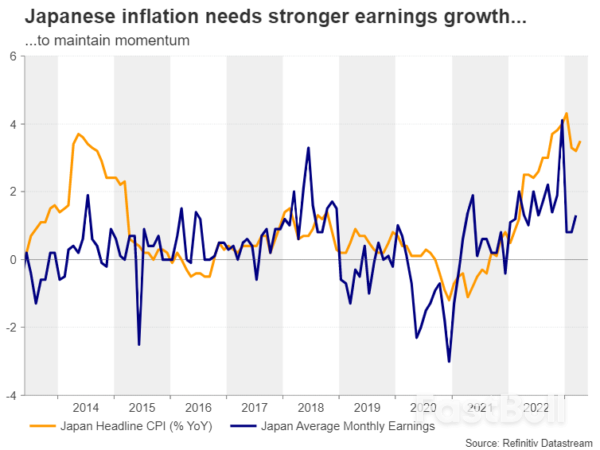
          BoJ Governor Ueda has repeatedly highlighted the fact that the Japanese inflation rise is due to external, cost-push factors. Domestic demand has been playing a secondary, much weaker role, compared to what we have seen in other countries, tying the BoJ’s hands. The way out of the current deadlock is the consumer sector, thus raising the importance of the recent strong, above-inflation wage increases. The BoJ is expecting these increases to have a material impact on consumer spending and consumer sentiment going forward.
          Amidst this challenging environment, there is increased nervousness about the BoJ’s next move. The market has gotten used to the ultra-loose monetary stance with the yen being the traditional funding currency for carry trades. Therefore, a change of policy by the BoJ or even adoption of a more hawkish stance is expected to have a stronger impact, especially on the FX markets. The ECB was quite vocal about this possibility at its most recent Financial Stability review. It was also highlighted that a wave of yen repatriation could create an investment gap in the European and US bond markets.
          Stronger Earnings Growth Could be Signal BoJ Has Been Waiting For_1

          Plethora of data but two releases stand out next week

          Understandably, next week’s focus will be on Tuesday’s figures and, to a lesser extent, on Thursday’s releases. The final GDP print for the first quarter of 2023 and the current account figures for April, both released on Thursday, are critical pieces of the economic puzzle, but as described above the focus is squarely on domestic earnings and spending.
          The year-on-year change in the labour cash earnings is forecast to moderate even further to 0.5%. If confirmed, this would be the lowest print since February 2022, and a potential signal that the optimism after the recent wage agreements might have been premature. Similarly, the overall household spending data for April is expected to show some improvement but remain in negative territory. A positive set of data figures on Tuesday would be greatly welcomed at the BoJ halls, but probably not by the bond markets.

          Can the yen finally recover some of its 2023 losses?

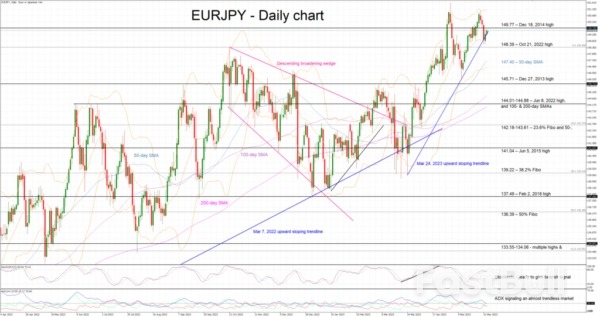
          The 15-year high at 151.61 in euro/yen appears to have somewhat energized the yen bulls as they have been trying to stop this pair’s advance. Their effort has been fruitless up to now, but the formation of a double top pattern could be the answer to their prayers.
          Should the data releases surprise to the upside and sentiment turn in favour of the yen, we would see a retreat towards the 148.39 level and a retest of the 147.22 level. A break of the neckline of the formed pattern at 146.13 could result in an even stronger correction. On the other hand, an upwards break of the 149.77 level could open the door for a higher high, above the recent 151.61.
          Stronger Earnings Growth Could be Signal BoJ Has Been Waiting For_2

          Source:XM

          To stay updated on all economic events of today, please check out our Economic calendar
          Risk Warnings and Disclaimers
          You understand and acknowledge that there is a high degree of risk involved in trading. Following any strategies or investment methods may lead to potential losses. The content on the site is provided by our contributors and analysts for information purposes only. You are solely responsible for determining whether any trading assets, securities, strategy, or any other product is suitable for investing based on your own investment objectives and financial situation.
          Comments
          Add to Favorites
          Share

          CBDC Platforms Are Revolutionising Financial Inclusion

          Justin

          Central Bank

          Economic

          For many of those involved in implementing central bank digital currency platforms, the goal is the same: financial inclusion. While most households can access some form of digital payments, there are still 2.5bn people globally who do not have bank accounts. Without a bank account and, subsequently, no payment history to show, credit for this population is not guaranteed and they may fall victim to paying high interest rates.
          By covering all three types of financial institutions engaged in wholesale and retail CBDC – central banks, commercial banks and non-bank financial institutions – GVE’s CBDC platform provides real-time gross settlement for all users. It has the capacity to make 5.8tn transactions annually, which is enough to cover the 8bn individual and 300m corporate customers around the world.
          Beyond the goals of financial inclusion, platforms like GVE also consider cost savings. Most fintech companies build light infrastructure on top of global brands like Visa and Mastercard by taking margins of between 10 and 15 basis points of the transaction value. By providing RTGS for all users, it is possible to bypass global brands, which enables platforms to substantially reduce the cost of payments.
          Credit card companies, together with card issuers in each country, typically charge a total of 2.5% brand and issuing fees on transaction value in addition to the card readers’ fee and acquirer’s fee. This increases the payment cost. As merchants and companies have accounts with banks, GVE – together with all banks co-operating with GVE – does not require acquirers, further reducing the cost of transacting.
          Another important priority for CBDC platforms is the green transition. According to Ajay Banga, president of the World Bank, central banks spend between 0.5% to 1.5% of their gross domestic product every year on printing, securing and distributing cash. To transport this cash to bank branches and ATMs, over 100,000 armoured vehicles are used by banks. New digital systems seek to eliminate the fuel consumption and carbon dioxide emissions of these cars.
          Finally, one of the most important considerations for CBDC platforms is security and privacy protection. The public key infrastructure, an encryption method used in most areas of banking, is becoming increasingly vulnerable as quantum computing technology advances. GVE has patented a key management cybersecurity platform, which manages 2,000 separate keys for each user. Such platforms have the security infrastructure that could be the solution for services that require a high level of privacy protection under data regulations, such as electronic medical records. Spending can be only monitored by the bank that has opened the account. This is the same level of privacy protection available now, but the more sophisticated system will deter bad actors.

          Source:Koji Fusa

          To stay updated on all economic events of today, please check out our Economic calendar
          Risk Warnings and Disclaimers
          You understand and acknowledge that there is a high degree of risk involved in trading. Following any strategies or investment methods may lead to potential losses. The content on the site is provided by our contributors and analysts for information purposes only. You are solely responsible for determining whether any trading assets, securities, strategy, or any other product is suitable for investing based on your own investment objectives and financial situation.
          Comments
          Add to Favorites
          Share

          Germany Energy Transition Faces Key Chemical Sector Conundrum

          Devin

          Energy

          Europe's largest economy is also one of the region's most aggressive advocates for shifting energy systems away from fossil fuels, and leads the continent in emissions reduction targets and investments in renewable energy supplies.
          However, Germany is also home to Europe's largest chemicals sector which churns out plastics, paints, acids and other key inputs that are critical to manufacturers and heavy industries that form the backbone of the German economy.
          And as most chemical plants run off natural gas or coal, and use crude oil as a major feedstock, Germany's plans to phase out use of fossil fuels over the coming decades represent a potential existential threat to the entire chemical sector.
          Ensuring the continuing viability of such an important segment of the German economy even as the country's energy system is retooled will be a key test for policymakers and business planners over the coming years.
          Critical Stability
          An ill-managed collapse of the chemicals supply chain could deal a heavy blow to the rest of Germany's manufacturing economy, which relies on an abundant array of affordable inputs to generate its own products.
          The sector is also a major employer that sustains large raw material and end-product supply chains, so any downturn could pose significant unemployment risks across Europe.
          That said, a successful shepherding of the chemicals industry through the country's energy transition, including enabling chemical producers to decarbonise their own energy supplies and outputs, would sustain a vital competitive advantage for Germany's overall economy.
          In addition, an updated and low-emitting chemicals sector that generates suites of critical products for other industries could become a vital export earner for Germany, which has ambitions to develop global leaders across the energy transition spectrum, including in the recycling of plastic waste.
          Tough 2022, Trying 2023
          Before embarking on any modernisation drives, however, Germany's chemicals sector must first recover from a torrid 2022, when surging power costs caused chemicals output to drop by 10%, petrochemical production to fall 15.5%, and for one in every four firms in the sector to incur losses, according to the German Chemicals Association (VCI).
          Sharply lower business activity also caused a drop in chemicals consumption last year, but as economic activity recovered in 2023 a lingering shortage of key chemical products has pushed German chemicals prices to near record premiums over those supplied by other producers.
          German prices of polyvinyl chloride (PVC), used for pipes, wire insulation and by the construction sector, are currently trading at nearly 90% more than the same product on offer in South East Asia, according to data from Polymerupdate.
          Germany Energy Transition Faces Key Chemical Sector Conundrum_1German high impact polystyrene, used for signs, packaging, toys and furniture, is trading at a roughly 50% premium to Asian prices, while linear low density polyethylene, used for bags and wraps, is trading around 80% above prices offered out of the United States.
          Even prices of vinyl chloride, the main base ingredient to make PVC and other products, is trading at a rare sustained premium over Chinese vinyl chloride prices, which historically have been more expensive than German prices, Polymerupdate data shows.
          Damage Done
          The sustained high prices of German chemical products over international rivals have two important damaging consequences.
          Firstly, the high price tags have had the effect of undermining the German chemical sector's hard-won reputation as a reliable and cost-competitive supplier of critical products, while showcasing the global reach and cost advantages of rival suppliers in other markets.
          Germany Energy Transition Faces Key Chemical Sector Conundrum_2Secondly, the high chemicals costs have hurt cost-sensitive consumers, including manufacturing businesses that have also been hit by high energy bills and are looking to keep costs in check in order to ensure their own survival.
          Many such businesses are in an especially delicate state in Germany, which was Europe's largest importer of Russian natural gas and which continues to wrestle with power prices that remain well above long-term averages.
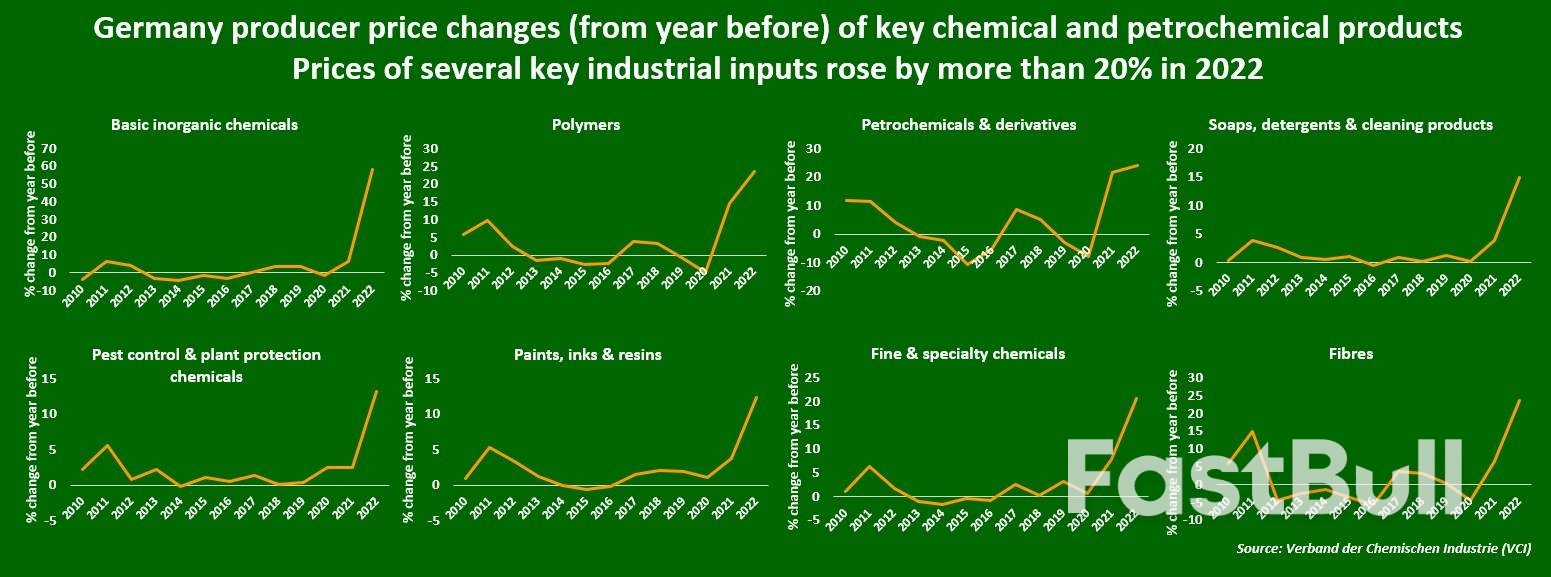
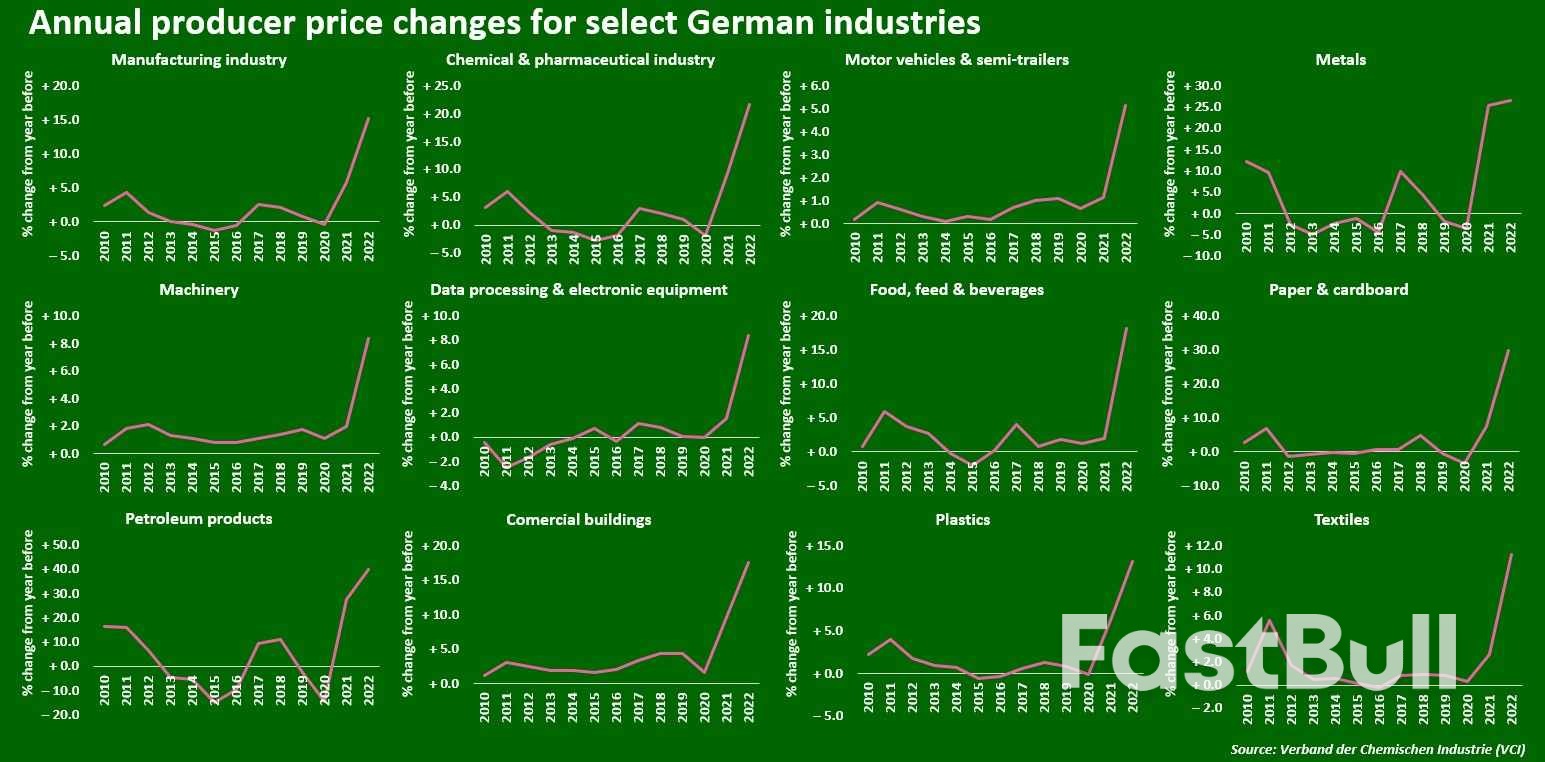
          Every major industrial segment, from basic manufacturers and machine makers to the producers of high-end cars, have been hit by steep jumps in producer prices in Germany, according to VCI data.
          Germany Energy Transition Faces Key Chemical Sector Conundrum_3Producers of bulk commodities such as metals, paper goods and petroleum products have been hit especially hard, and saw producer prices jump by 26.5%, 29.8% and 40% respectively in 2022.
          These same companies are typically major consumers of goods produced by Germany's chemicals sector, but are currently ill-equipped to pay premium prices for industrial inputs that can be easily acquired much more cheaply from other suppliers.
          If the German chemicals sector is to ensure its own long-term future, it must somehow win back any business lost among commodity manufacturers by driving product prices steadily lower relative to rival offerings.
          German chemicals makers must also develop and showcase their own green credentials so as to lock up demand from higher-margin climate-conscious customers who are under pressure from their own consumers and investors to ensure clean supply chains.
          On its own, the chemicals sector may struggle to both cut costs and clean up its own product lines and emissions footprints.
          But with strategic aid from government and industry bodies, Germany's chemical producers could undertake a major overhaul that could ensure its continued central role at the heart of the German economy even as its own and its customers' energy systems steadily shift away from fossil fuels.

          Source: TimesLIVE

          Risk Warnings and Disclaimers
          You understand and acknowledge that there is a high degree of risk involved in trading. Following any strategies or investment methods may lead to potential losses. The content on the site is provided by our contributors and analysts for information purposes only. You are solely responsible for determining whether any trading assets, securities, strategy, or any other product is suitable for investing based on your own investment objectives and financial situation.
          Comments
          Add to Favorites
          Share

          Risks Skewed Towards Higher-For-Longer U.S. Interest Rates

          Cohen

          Central Bank

          Economic

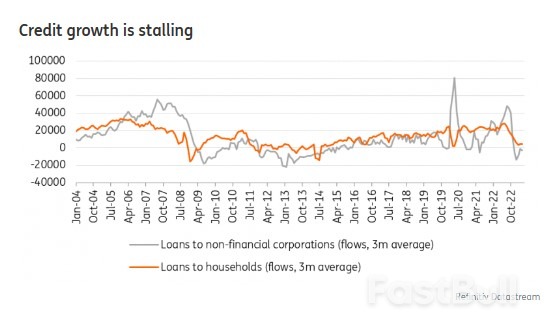
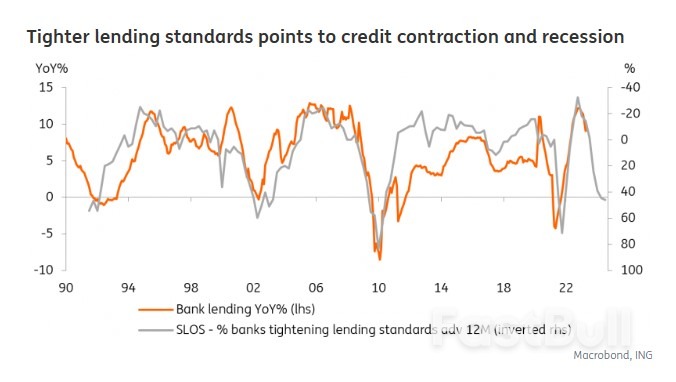
          After the most rapid and aggressive tightening of monetary policy for more than 40 years, we expected financial and economic stresses to appear sooner rather than later. The small and regional banks are where this is most evident, but even before recent failures, banks were changing their attitudes and becoming more restrictive in terms of who they lend to, how much they lend and at what rate.
          This combination of rapidly tightening lending conditions and significantly higher borrowing costs points to outstanding lending turning negative by the end of this year. For the U.S. economy, where credit is such an important driver of economic activity, this outcome has in the past always meant recession. At the same time, corporate pricing plan intentions are softening and the high weighting of shelter and vehicles in the CPI basket means inflation should drop below 3% before year-end.
          Risks Skewed Towards Higher-For-Longer U.S. Interest Rates_1Where we stand relative to the market
          Compared with the consensus, we are forecasting a slightly more V-shaped profile for GDP growth of 1.2% for 2023, 0% for 2024 and 2.2% for 2025 – consensus is 1.1%, 0.8% and 2.0%, respectively. For inflation, we are broadly in line with the consensus for 2023 and 2025 at 4.1% and 2.3%, respectively, but for 2024 our more pessimistic growth view means we forecast inflation at 2% versus market expectations of 2.6%.
          We are earlier and more aggressive in looking for Fed rate cuts, expecting a 50bp rate cut at both the November and December policy meetings with 3% rates by the end of the second quarter of 2024. The consensus is for no rate change this year before rates drop to 3.5% in 2024 and 2.75% in 2025. The market is, however, pricing modest interest rate cuts before the end of this year.
          Where we could be wrong… inflation is stickier and the Fed tightens further
          We see three key areas where our forecasts look vulnerable. First, we may be too optimistic that inflation falls rapidly. The unemployment rate is just 3.4% and labour market resilience could result in stickier wage pressures that keep service sector pricing more robust, especially if consumer spending remains firm. There are several hawks on the Federal Open Market Committee who want to see clear evidence that inflation is on a clear path to 2% before they are prepared to call time on hikes. If we see month-on-month inflation prints continuing to come in at 0.3% or 0.4%, rather than averaging 0.2%, and jobs numbers remain firm, we will probably see interest rates rise further with a Fed funds rate perhaps at 5.5% or even 5.75%.
          Or we are too early in our downturn expectations
          The second risk relates to the timing of events. Our long-held thesis is that the combination of higher borrowing costs and less credit availability weighs heavily on business and consumer spending in an environment where sentiment is already at recession levels.
          Historically, credit growth lags movements in lending conditions by 12 months and unemployment responds similarly. Given lending conditions started tightening rapidly more than 12 months ago and interest rates have risen by 500bp since March 2022, our best guess has been that the economy will be showing the effects in the second half of this year.
          However, strong household and corporate balance sheets may mitigate some of these effects and the downturn story could happen later than we are predicting. Therefore, Fed rate cuts may come later and possibly be less aggressive than we are predicting.
          But things could get even worse
          There are risks in the other direction though. We are hopeful we are almost through the debt ceiling crisis that has been unsettling for financial markets, but we can't rule out an intensification of stresses elsewhere. These could certainly resurface in the small and regional banks, most probably through their heavy exposure to the commercial real estate sector. Significant losses here could weaken balance sheets, resulting in a further tightening of lending conditions and a potential mini-credit crunch.
          Also, we need to keep an eye on the Supreme Court deliberations regarding President Joe Biden's $20,000 student debt forgiveness plan. Then there is the resumption of student loan repayments that were paused during the Covid-19 pandemic. As part of the debt ceiling deal between House Republicans and the president, it appears that interest will be charged again from September with repayments resuming from October. According to Federal Reserve data, $1.6tr is owed by more than 43 million Americans, so from the fourth quarter onward these households could end up needing to divert hundreds of dollars each month towards loan repayments. This has the potential to weigh very heavily on consumer spending.
          A worst-case scenario of a return of banking strife and the resumption of student loan repayments amid a housing market downturn and weaker general activity would heighten the chances of a recession and an even swifter, sharper response from the Federal Reserve than we are forecasting.

          Source: ING

          To stay updated on all economic events of today, please check out our Economic calendar
          Risk Warnings and Disclaimers
          You understand and acknowledge that there is a high degree of risk involved in trading. Following any strategies or investment methods may lead to potential losses. The content on the site is provided by our contributors and analysts for information purposes only. You are solely responsible for determining whether any trading assets, securities, strategy, or any other product is suitable for investing based on your own investment objectives and financial situation.
          Comments
          Add to Favorites
          Share

          Should SSA and Sovereign Markets Be Grouped Together?

          Justin

          Central Bank

          Economic

          There is an argument that grouping all European sovereign, supranational and agency debt as one would boost the availability of liquid safe assets in the continent.
          Boosting liquidity in the SSA bond market and the challenges facing issuers were discussed in detail at OMFIF’s Public sector debt summit. Around 20 global SSA borrowers, a similar number of investors as well as other key market participants explored important issues facing the public sector bond market.
          ‘We have to get rid of the split of SSA markets and sovereign markets, because this is all public debt,’ said a senior funding official at a European borrower. ‘I spoke recently to a hedge fund who said they can buy and take more positions in govvies [government bonds] because it’s a govvie and not an SSA. This doesn’t make sense if you compare smaller govvies with large SSAs.’ There are some SSA borrowers, including some German states, that have larger funding programmes than some sovereigns.
          The funding official also argued that removing the split between SSAs and sovereigns would create a larger pool of liquid safe assets in Europe and strengthen the international role of the euro. He added the classification between SSAs and sovereigns should instead be based on liquidity and credit.
          Who would be in charge of removing this classification between SSAs and sovereigns? ‘I don’t think this is a question for markets,’ said a sovereign debt portfolio manager. ‘It’s a question for the regulators.’ However, there is no legal definition of what a sovereign or an SSA is in the capital markets.

          The EU as a sovereign issuer

          Since reinventing itself as a super-sized borrower, the European Union has been working on being accepted universally as a sovereign rather than supranational issuer. However, the portfolio manager highlighted some concerns for the EU’s classification as a sovereign given its finite status as a large and sovereign-like borrower. ‘No one is sure whether the EU is going to be a permanent issuer and, because of that, if I’m buying those bonds, I’m not sure what the end game is.’
          The lack of clarity on the EU’s status as a permanent large issuer in the capital markets is perhaps the biggest challenge it faces in being accepted as a sovereign borrower. But while net funding under its Next Generation EU programme ends in 2026, the EU will still roll over debt with funding needs of €40bn-€50bn in the 2030s, which is akin to a mid-sized sovereign borrower.
          The EU will also have funding needs for its other programmes, such as its Macro-Financial Assistance programme, through which it has been disbursing loans to support Ukraine – positioning the EU as an important vehicle to support other crises in the future.
          The EU is steadily progressing towards being accepted universally as a sovereign borrower. It has adopted a unified funding approach whereby all of the issuance under its various funding programmes is classified as ‘EU bonds’ to avoid fragmentation in its curve. The EU will introduce quoting commitments for its primary dealers from the second half of the year, which will boost secondary market liquidity.
          Meanwhile, from 29 June, the EU’s bonds will be classified under haircut category I – the same as government bonds – making them more favourable for use in repurchase transactions with the European Central Bank. However, from a pricing perspective, the EU’s bonds are more similar to an SSA than a sovereign, which is a challenge the EU funding team faces.
          Another senior funding official at a European borrower said some SSAs have made themselves distinct from sovereigns in the way they issue bonds by allocating primarily to real-money investors who buy and hold bonds, which leads to lower levels of secondary trading and liquidity. ‘Have the issuers themselves created a lack of liquidity in the market?’ he asked.
          The need for more liquid safe assets in Europe was highlighted by other borrowers at the summit. ‘We strongly believe that we need more safe assets in the euro area – safe assets that can serve as a benchmark for pricing other securities or that can be used as a safe haven in case of market turbulences,’ said an official at a European SSA. ‘A large, safe asset base also contributes to good liquidity conditions. So, we really welcome the arrival of the EU because we think that there are not enough safe assets in the euro area.’
          Whether the split between SSAs and sovereigns should be removed to boost the availability of euro liquid assets is something that market participants do not agree on. In a snap poll carried out by the OMFIF Sovereign Debt Institute’s LinkedIn page between 26-30 May, results were split 50-50, for and against.

          Source:Burhan Khadbai

          To stay updated on all economic events of today, please check out our Economic calendar
          Risk Warnings and Disclaimers
          You understand and acknowledge that there is a high degree of risk involved in trading. Following any strategies or investment methods may lead to potential losses. The content on the site is provided by our contributors and analysts for information purposes only. You are solely responsible for determining whether any trading assets, securities, strategy, or any other product is suitable for investing based on your own investment objectives and financial situation.
          Comments
          Add to Favorites
          Share
          FastBull
          Copyright © 2025 FastBull Ltd

          728 RM B 7/F GEE LOK IND BLDG NO 34 HUNG TO RD KWUN TONG KLN HONG KONG

          TelegramInstagramTwitterfacebooklinkedin
          App Store Google Play Google Play
          Products
          Charts

          Chats

          Q&A with Experts
          Screeners
          Economic Calendar
          Data
          Tools
          Membership
          Features
          Function
          Markets
          Copy Trading
          Latest Signals
          Contests
          News
          Analysis
          24/7
          Columns
          Education
          Company
          Careers
          About Us
          Contact Us
          Advertising
          Help Center
          Feedback
          User Agreement
          Privacy Policy
          Business

          White Label

          Data API

          Web Plug-ins

          Poster Maker

          Affiliate Program

          Risk Disclosure

          The risk of loss in trading financial instruments such as stocks, FX, commodities, futures, bonds, ETFs and crypto can be substantial. You may sustain a total loss of the funds that you deposit with your broker. Therefore, you should carefully consider whether such trading is suitable for you in light of your circumstances and financial resources.

          No decision to invest should be made without thoroughly conducting due diligence by yourself or consulting with your financial advisors. Our web content might not suit you since we don't know your financial conditions and investment needs. Our financial information might have latency or contain inaccuracy, so you should be fully responsible for any of your trading and investment decisions. The company will not be responsible for your capital loss.

          Without getting permission from the website, you are not allowed to copy the website's graphics, texts, or trademarks. Intellectual property rights in the content or data incorporated into this website belong to its providers and exchange merchants.

          Not Logged In

          Log in to access more features

          FastBull Membership

          Not yet

          Purchase

          Become a signal provider
          Help Center
          Customer Service
          Dark Mode
          Price Up/Down Colors

          Log In

          Sign Up

          Position
          Layout
          Fullscreen
          Default to Chart
          The chart page opens by default when you visit fastbull.com