• Trade
  • Markets
  • Copy
  • Contests
  • News
  • 24/7
  • Calendar
  • Q&A
  • Chats
Trending
Screeners
SYMBOL
LAST
BID
ASK
HIGH
LOW
NET CHG.
%CHG.
SPREAD
SPX
S&P 500 Index
6827.42
6827.42
6827.42
6899.86
6801.80
-73.58
-1.07%
--
DJI
Dow Jones Industrial Average
48458.04
48458.04
48458.04
48886.86
48334.10
-245.98
-0.51%
--
IXIC
NASDAQ Composite Index
23195.16
23195.16
23195.16
23554.89
23094.51
-398.69
-1.69%
--
USDX
US Dollar Index
97.950
98.030
97.950
98.500
97.950
-0.370
-0.38%
--
EURUSD
Euro / US Dollar
1.17394
1.17409
1.17394
1.17496
1.17192
+0.00011
+ 0.01%
--
GBPUSD
Pound Sterling / US Dollar
1.33707
1.33732
1.33707
1.33997
1.33419
-0.00148
-0.11%
--
XAUUSD
Gold / US Dollar
4299.39
4299.39
4299.39
4353.41
4257.10
+20.10
+ 0.47%
--
WTI
Light Sweet Crude Oil
57.233
57.485
57.233
58.011
56.969
-0.408
-0.71%
--

Community Accounts

Signal Accounts
--
Profit Accounts
--
Loss Accounts
--
View More

Become a signal provider

Sell trading signals to earn additional income

View More

Guide to Copy Trading

Get started with ease and confidence

View More

Signal Accounts for Members

All Signal Accounts

Best Return
  • Best Return
  • Best P/L
  • Best MDD
Past 1W
  • Past 1W
  • Past 1M
  • Past 1Y

All Contests

  • All
  • Trump Updates
  • Recommend
  • Stocks
  • Cryptocurrencies
  • Central Banks
  • Featured News
Top News Only
Share

Israel Says It Kills Senior Hamas Commander Raed Saed In Gaza

Share

Ukraine's Navy Says Russian Drone Attack Hit Civilian Turkish Vessel Carrying Sunflower Oil To Egypt On Saturday

Share

Israeli Military Says It Put Planned Strike On South Lebanon Site On Hold After Lebanese Army Requested Access

Share

Norwegian Nobel Committee: Calls On The Belarusian Authorities To Release All Political Prisoners

Share

Norwegian Nobel Committee: His Freedom Is A Deeply Welcome And Long-Awaited Moment

Share

Ukraine Says It Received 114 Prisoners From Belarus

Share

USA Embassy In Lithuania: Maria Kalesnikava Is Not Going To Vilnius

Share

USA Embassy In Lithuania: Other Prisoners Are Being Sent From Belarus To Ukraine

Share

Ukraine President Zelenskiy: Five Ukrainians Released By Belarus In US-Brokered Deal

Share

USA Vilnius Embassy: USA Stands Ready For "Additional Engagement With Belarus That Advances USA Interests"

Share

USA Vilnius Embassy: Belarus, USA, Other Citizens Among The Prisoners Released Into Lithuania

Share

USA Vilnius Embassy: USA Will Continue Diplomatic Efforts To Free The Remaining Political Prisoners In Belarus

Share

USA Vilnius Embassy: Belarus Releases 123 Prisoners Following Meeting Of President Trump's Envoy Coale And Belarus President Lukashenko

Share

USA Vilnius Embassy: Masatoshi Nakanishi, Aliaksandr Syrytsa Are Among The Prisoners Released By Belarus

Share

USA Vilnius Embassy: Maria Kalesnikava And Viktor Babaryka Are Among The Prisoners Released By Belarus

Share

USA Vilnius Embassy: Nobel Peace Prize Laureate Ales Bialiatski Is Among The Prisoners Released By Belarus

Share

Belarusian Presidential Administration Telegram Channel: Lukashenko Has Pardoned 123 Prisoners As Part Of Deal With US

Share

Two Local Syrian Officials: Joint US-Syrian Military Patrol In Central Syria Came Under Fire From Unknown Assailants

Share

Israeli Military Says It Targeted 'Key Hamas Terrorist' In Gaza City

Share

Rwanda's Actions In Eastern Drc Are A Clear Violation Of Washington Accords Signed By President Trump - Secretary Of State Rubio

TIME
ACT
FCST
PREV
U.K. Trade Balance Non-EU (SA) (Oct)

A:--

F: --

P: --

U.K. Trade Balance (Oct)

A:--

F: --

P: --

U.K. Services Index MoM

A:--

F: --

P: --

U.K. Construction Output MoM (SA) (Oct)

A:--

F: --

P: --

U.K. Industrial Output YoY (Oct)

A:--

F: --

P: --

U.K. Trade Balance (SA) (Oct)

A:--

F: --

P: --

U.K. Trade Balance EU (SA) (Oct)

A:--

F: --

P: --

U.K. Manufacturing Output YoY (Oct)

A:--

F: --

P: --

U.K. GDP MoM (Oct)

A:--

F: --

P: --

U.K. GDP YoY (SA) (Oct)

A:--

F: --

P: --

U.K. Industrial Output MoM (Oct)

A:--

F: --

P: --

U.K. Construction Output YoY (Oct)

A:--

F: --

P: --

France HICP Final MoM (Nov)

A:--

F: --

P: --

China, Mainland Outstanding Loans Growth YoY (Nov)

A:--

F: --

P: --

China, Mainland M2 Money Supply YoY (Nov)

A:--

F: --

P: --

China, Mainland M0 Money Supply YoY (Nov)

A:--

F: --

P: --

China, Mainland M1 Money Supply YoY (Nov)

A:--

F: --

P: --

India CPI YoY (Nov)

A:--

F: --

P: --

India Deposit Gowth YoY

A:--

F: --

P: --

Brazil Services Growth YoY (Oct)

A:--

F: --

P: --

Mexico Industrial Output YoY (Oct)

A:--

F: --

P: --

Russia Trade Balance (Oct)

A:--

F: --

P: --

Philadelphia Fed President Henry Paulson delivers a speech
Canada Building Permits MoM (SA) (Oct)

A:--

F: --

P: --

Canada Wholesale Sales YoY (Oct)

A:--

F: --

P: --

Canada Wholesale Inventory MoM (Oct)

A:--

F: --

P: --

Canada Wholesale Inventory YoY (Oct)

A:--

F: --

P: --

Canada Wholesale Sales MoM (SA) (Oct)

A:--

F: --

P: --

Germany Current Account (Not SA) (Oct)

A:--

F: --

P: --

U.S. Weekly Total Rig Count

A:--

F: --

P: --

U.S. Weekly Total Oil Rig Count

A:--

F: --

P: --

Japan Tankan Large Non-Manufacturing Diffusion Index (Q4)

--

F: --

P: --

Japan Tankan Small Manufacturing Outlook Index (Q4)

--

F: --

P: --

Japan Tankan Large Non-Manufacturing Outlook Index (Q4)

--

F: --

P: --

Japan Tankan Large Manufacturing Outlook Index (Q4)

--

F: --

P: --

Japan Tankan Small Manufacturing Diffusion Index (Q4)

--

F: --

P: --

Japan Tankan Large Manufacturing Diffusion Index (Q4)

--

F: --

P: --

Japan Tankan Large-Enterprise Capital Expenditure YoY (Q4)

--

F: --

P: --

U.K. Rightmove House Price Index YoY (Dec)

--

F: --

P: --

China, Mainland Industrial Output YoY (YTD) (Nov)

--

F: --

P: --

China, Mainland Urban Area Unemployment Rate (Nov)

--

F: --

P: --

Saudi Arabia CPI YoY (Nov)

--

F: --

P: --

Euro Zone Industrial Output YoY (Oct)

--

F: --

P: --

Euro Zone Industrial Output MoM (Oct)

--

F: --

P: --

Canada Existing Home Sales MoM (Nov)

--

F: --

P: --

Euro Zone Total Reserve Assets (Nov)

--

F: --

P: --

U.K. Inflation Rate Expectations

--

F: --

P: --

Canada National Economic Confidence Index

--

F: --

P: --

Canada New Housing Starts (Nov)

--

F: --

P: --

U.S. NY Fed Manufacturing Employment Index (Dec)

--

F: --

P: --

U.S. NY Fed Manufacturing Index (Dec)

--

F: --

P: --

Canada Core CPI YoY (Nov)

--

F: --

P: --

Canada Manufacturing Unfilled Orders MoM (Oct)

--

F: --

P: --

Canada Manufacturing New Orders MoM (Oct)

--

F: --

P: --

Canada Core CPI MoM (Nov)

--

F: --

P: --

Canada Manufacturing Inventory MoM (Oct)

--

F: --

P: --

Canada CPI YoY (Nov)

--

F: --

P: --

Canada CPI MoM (Nov)

--

F: --

P: --

Canada CPI YoY (SA) (Nov)

--

F: --

P: --

Canada Core CPI MoM (SA) (Nov)

--

F: --

P: --

Q&A with Experts
    • All
    • Chatrooms
    • Groups
    • Friends
    Connecting
    .
    .
    .
    Type here...
    Add Symbol or Code

      No matching data

      All
      Trump Updates
      Recommend
      Stocks
      Cryptocurrencies
      Central Banks
      Featured News
      • All
      • Russia-Ukraine Conflict
      • Middle East Flashpoint
      • All
      • Russia-Ukraine Conflict
      • Middle East Flashpoint
      Search
      Products

      Charts Free Forever

      Chats Q&A with Experts
      Screeners Economic Calendar Data Tools
      Membership Features
      Data Warehouse Market Trends Institutional Data Policy Rates Macro

      Market Trends

      Market Sentiment Order Book Forex Correlations

      Top Indicators

      Charts Free Forever
      Markets

      News

      News Analysis 24/7 Columns Education
      From Institutions From Analysts
      Topics Columnists

      Latest Views

      Latest Views

      Trending Topics

      Top Columnists

      Latest Update

      Signals

      Copy Rankings Latest Signals Become a signal provider AI Rating
      Contests
      Brokers

      Overview Brokers Assessment Rankings Regulators News Claims
      Broker listing Forex Brokers Comparison Tool Live Spread Comparison Scam
      Q&A Complaint Scam Alert Videos Tips to Detect Scam
      More

      Business
      Events
      Careers About Us Advertising Help Center

      White Label

      Data API

      Web Plug-ins

      Affiliate Program

      Awards Institution Evaluation IB Seminar Salon Event Exhibition
      Vietnam Thailand Singapore Dubai
      Fans Party Investment Sharing Session
      FastBull Summit BrokersView Expo
      Recent Searches
        Top Searches
          Markets
          News
          Analysis
          User
          24/7
          Economic Calendar
          Education
          Data
          • Names
          • Latest
          • Prev

          View All

          No data

          Scan to Download

          Faster Charts, Chat Faster!

          Download App
          English
          • English
          • Español
          • العربية
          • Bahasa Indonesia
          • Bahasa Melayu
          • Tiếng Việt
          • ภาษาไทย
          • Français
          • Italiano
          • Türkçe
          • Русский язык
          • 简中
          • 繁中
          Open Account
          Search
          Products
          Charts Free Forever
          Markets
          News
          Signals

          Copy Rankings Latest Signals Become a signal provider AI Rating
          Contests
          Brokers

          Overview Brokers Assessment Rankings Regulators News Claims
          Broker listing Forex Brokers Comparison Tool Live Spread Comparison Scam
          Q&A Complaint Scam Alert Videos Tips to Detect Scam
          More

          Business
          Events
          Careers About Us Advertising Help Center

          White Label

          Data API

          Web Plug-ins

          Affiliate Program

          Awards Institution Evaluation IB Seminar Salon Event Exhibition
          Vietnam Thailand Singapore Dubai
          Fans Party Investment Sharing Session
          FastBull Summit BrokersView Expo

          Europe's Rush for Rate Cuts Shifts Global Market Power Away from US

          Devin

          Economic

          Central Bank

          Summary:

          BoE moves close to first rate cut, sterling falls. Divergence between Europe and US rate outlooks widens…
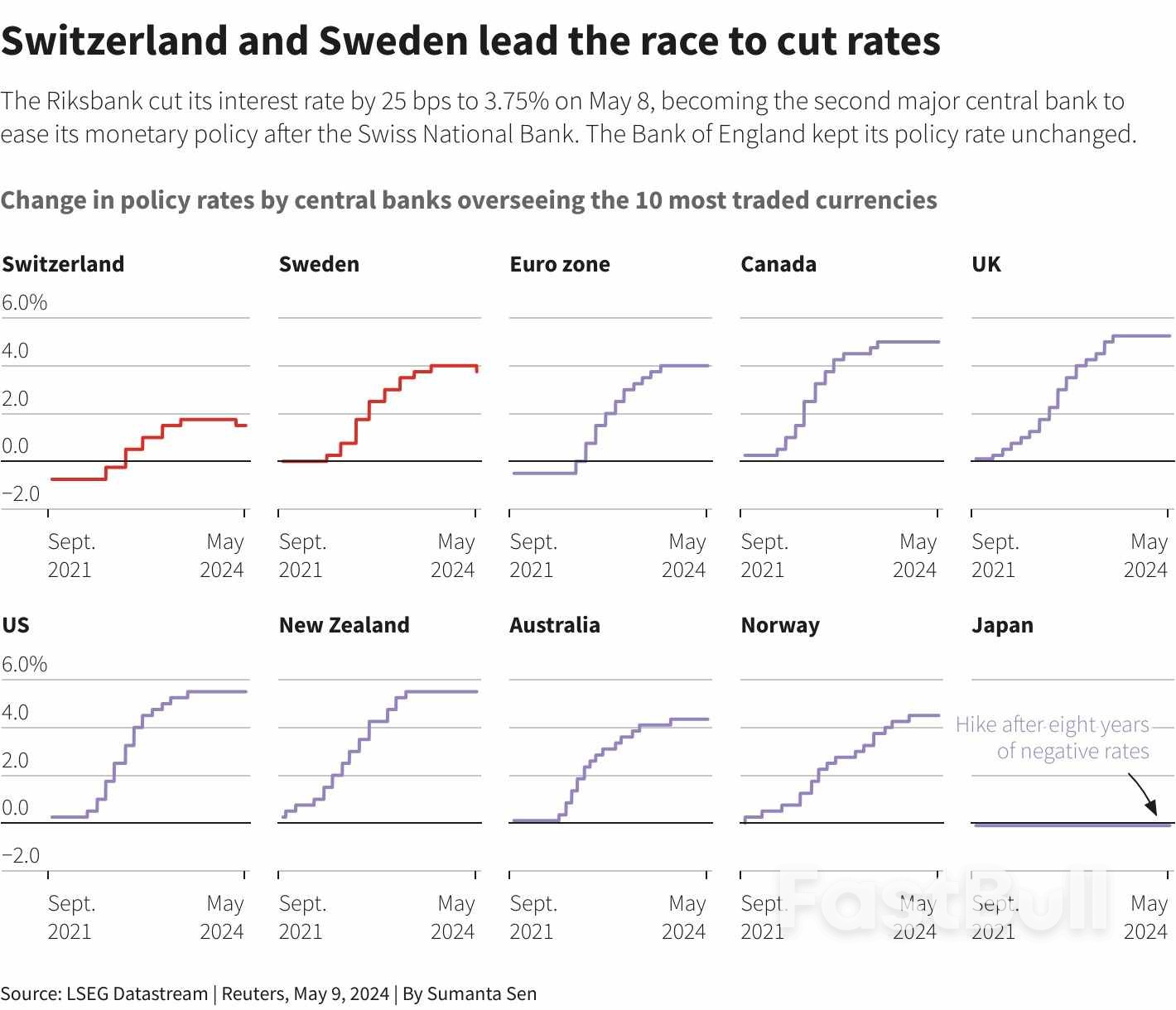
          The Bank of England has sent a new signal that borrowing costs will fall earlier and further across Europe than in the United States, setting markets up for major shifts as investors play a monetary policy divide opening up across the Atlantic.
          Investors see European stocks and debt leading global markets this year as rate cuts boost spending, softer inflation burnishes bonds and weaker currencies lift exports.
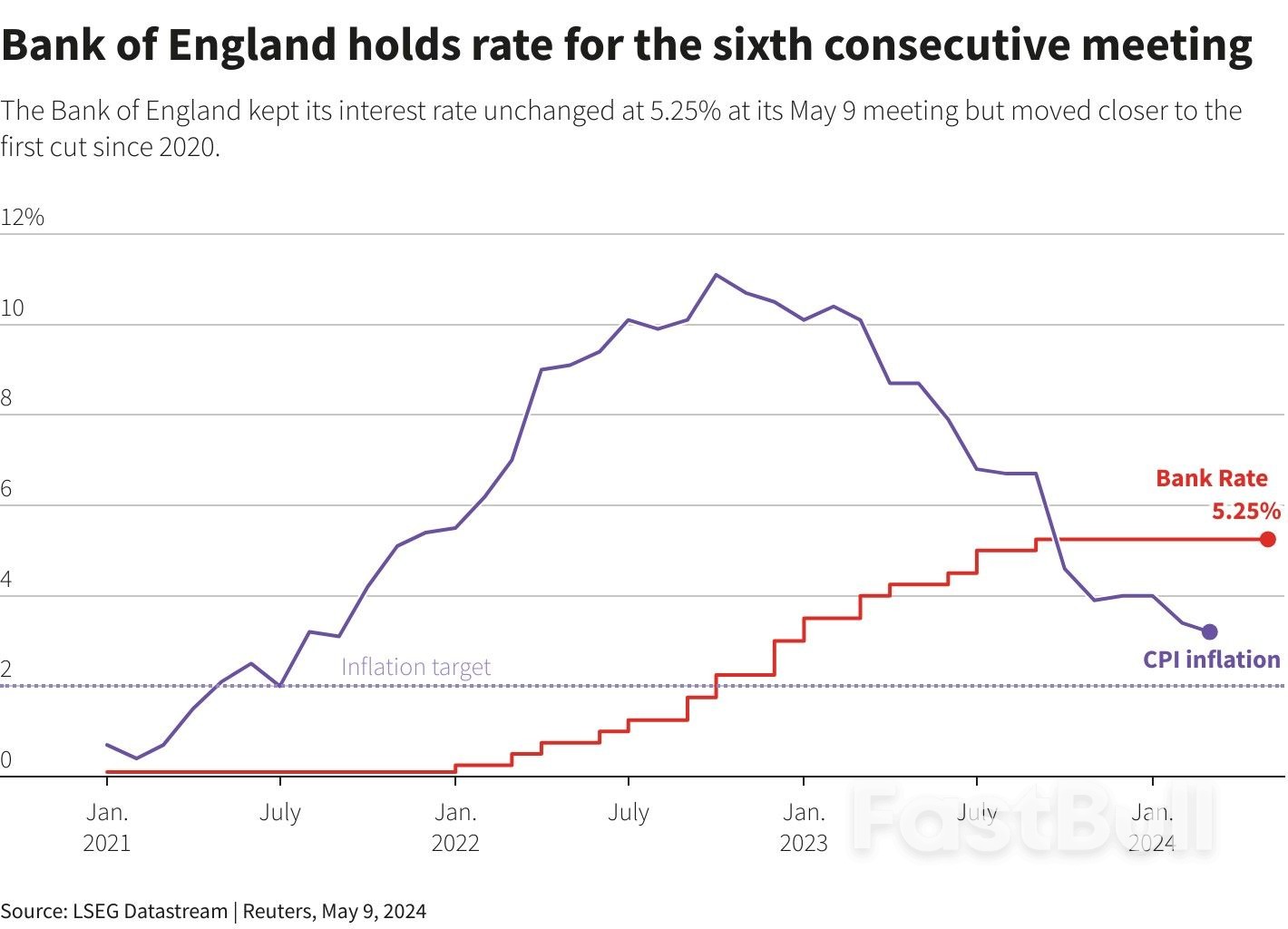
          Traders stepped up bets for UK easing after the BoE on Thursday held rates at 16-year highs of 5.25% but trimmed inflation forecasts, pushing sterling down and stocks higher.
          That came after Sweden cut rates for the first time since 2016, while Switzerland cut rates in March and the European Central Bank has flagged a June cut. In contrast, the U.S. Federal Reserve is set to keep rates high for longer.
          "This is the European pivot," said Florian Ielpo, head of macro at Switzerland's Lombard Odier Investment Management, who is positive on European and UK stocks. Since 2020, the United States has generated the lion's share of global equity gains.
          Paul Flood, multi-asset portfolio manager at Newton Investment Management, said he was buying UK stocks on valuation grounds and was positive on UK government bonds because there was more potential for BoE rate cuts ahead.

          Europe's Rush for Rate Cuts Shifts Global Market Power Away from US_1Doves Fly

          Britain's exporter-focused FTSE 100 hit a new record high after the BoE meeting. Europe's Stoxx 600 index is up 2% so far this week, poised for its best week since January.
          Money markets are pricing in around 55 basis point (bps) of BoE rate cuts in total by year-end, 70 bps from the ECB and just 43 bps from a Fed still grappling with strong inflation.
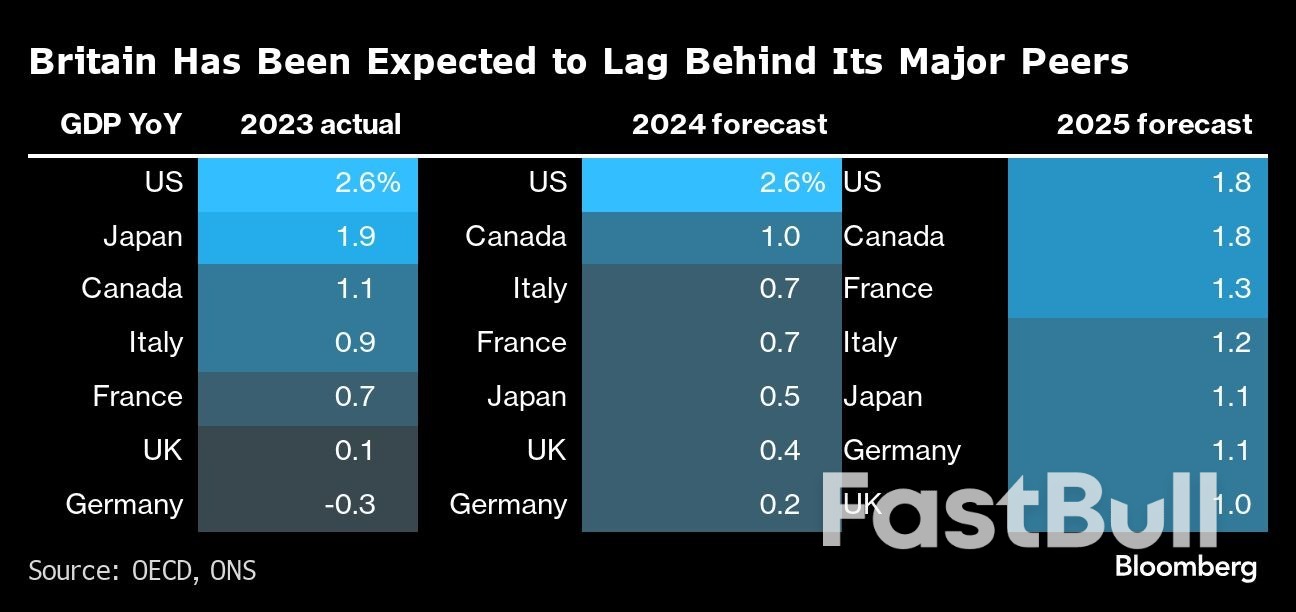
          Economists polled by Reuters expect the U.S. economy to expand by 2.5% this year, versus 0.5% in the euro zone and 0.4% in the UK, as lavish government spending dubbed "Bidenomics" spurs investment but raises debt and the deficit.
          In terms of growth momentum, investors see Europe doing better, boding well for assets in the region over the longer term.
          "Europe is really accelerating, albeit from a weaker base at a time where the U.S. economy is cooling from a stronger starting point," said Hugh Gimber, global market strategist at J.P. Morgan Asset Management.
          Investors are querying whether the U.S. will run out of steam, other strategists said.
          But in the short term, if the U.S. can run up its debt and its deficit, then rates in the US will likely stay higher than in Europe, said Societe Generale strategist Kit Juckes.

          Risky Pivots

          European government bonds could outperform the U.S. but are likely to stay volatile as the inflation path worldwide remains unpredictable, investors and analysts said.
          The BoE, the ECB and other European central banks might regret sounding too dovish too soon, Lombard Odier's Ielpo said.
          In the U.S., the Fed sent a strong signal in December that rate cuts were coming but then turned more hawkish after financial conditions became euphoric and inflation stalled above its target.
          UK gilts have lost investors 3.1%, this year, compared with 2.1% losses in the U.S. and 1.2% in the euro zone, based on LSEG data.Europe's Rush for Rate Cuts Shifts Global Market Power Away from US_2
          BlueBay Asset Management portfolio manager Neil Mehta said the firm does not like bonds in the UK, partly because of relatively high inflation.
          The yield on Britain's rate-sensitive two-year gilt slipped 3 bps after the BoE decision to 4.28% as debt prices firmed slightly.
          The BoE last diverged significantly from Fed policy in August 2016, when it cut rates by a quarter point to insulate the economy from Brexit while the Fed was on hold and preparing to raise.
          The ECB was a holdout dove with rates below zero from 2014 to 2022 but has followed the Fed since.
          The divergence theme would mostly play out in currency markets, Mehta added, with the dollar staying strong, in a further risk for inflation in Europe as import prices rise.
          The euro is down 2.6% so far this year to $1.07, Sterling is down roughly 2%.
          Matthew Swannell, economist at BNP Paribas, said this was not a particular risk for UK, whose biggest trading partner is the European Union.
          "So we do think the Bank of England can move before the Federal Reserve, and likewise the ECB (can too)," he said.

          Source: Reuters

          To stay updated on all economic events of today, please check out our Economic calendar
          Risk Warnings and Disclaimers
          You understand and acknowledge that there is a high degree of risk involved in trading. Following any strategies or investment methods may lead to potential losses. The content on the site is provided by our contributors and analysts for information purposes only. You are solely responsible for determining whether any trading assets, securities, strategy, or any other product is suitable for investing based on your own investment objectives and financial situation.
          Add to Favorites
          Share

          Economic Hard Landing Is Delayed but Not Cancelled

          Alex

          Economic

          Two years ago, central banks around the world started hiking interest rates. At the time many commentators, including this one, predicted that the end of years of easy money would cause asset prices to collapse and economies to buckle. Yet no recession arrived. Indeed U.S. economic growth picked up after 2022. Following the briefest of bear markets, American stocks hit a new high.
          In his book "Expert Political Judgment: How Good Is It? How Can We Know?", published in 2005, the political scientist Philip Tetlock argues that experts often provide rationalisations for their forecasting failures after the event. One of the most common is "it would have happened except for…". There is no shortage of such arguments to explain the absence of an economic hard landing.
          To start, it is worth pointing out that the bears did not get everything wrong. Bond markets in 2022 suffered their worst 12-month performance since the introduction of British consols in 1753, according to Professor Edward McQuarrie of Santa Clara University. Many speculative investments have crashed. Commercial property markets in many parts of the world are in distress.
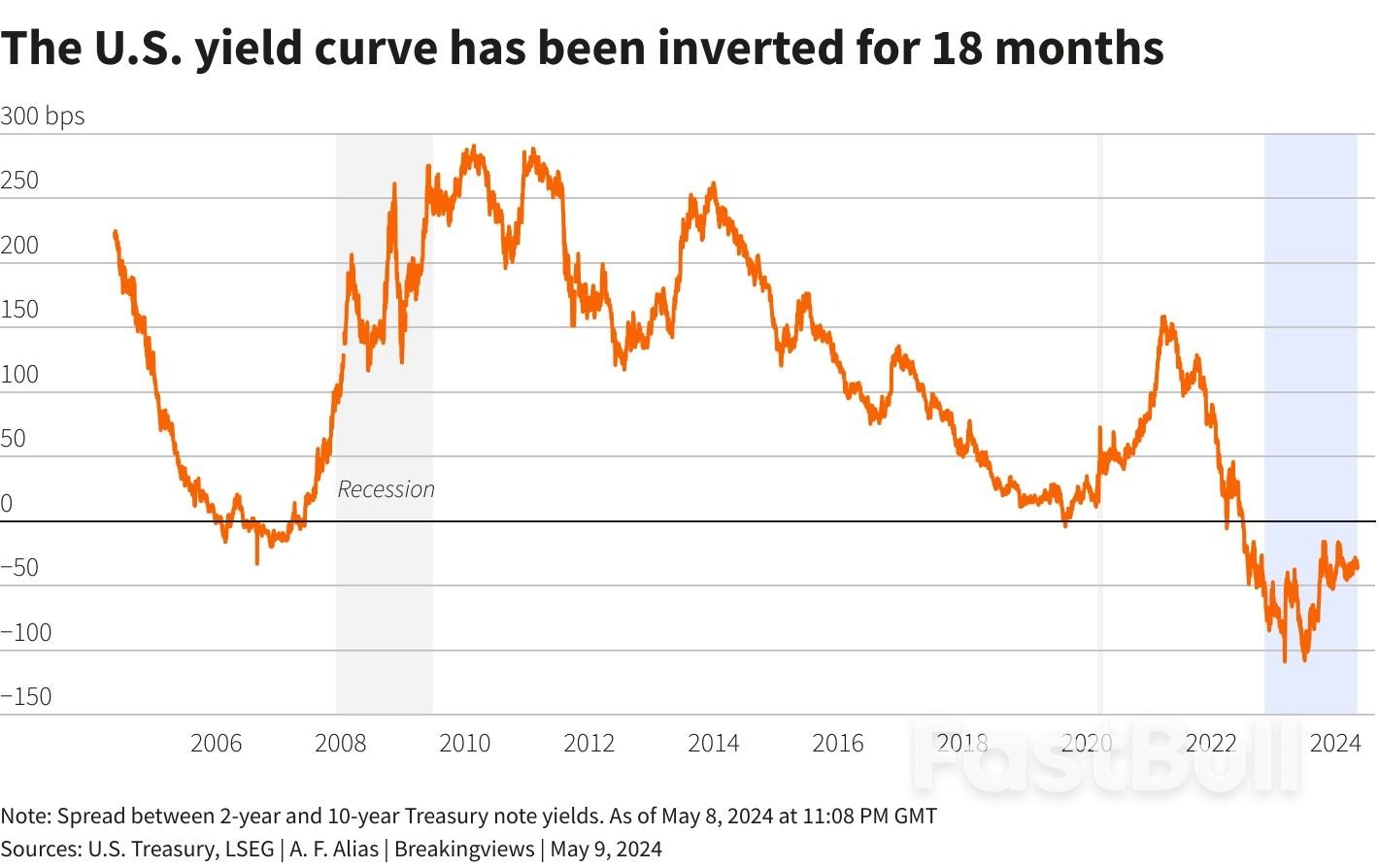
          Nevertheless, the transmission mechanism between monetary policy and the economy appears weaker than in the past. Yields on long-term U.S. government debt have been lower than short-term bond yields for 18 months. Investors formerly considered such an inverted yield curve as the most reliable leading indicator of a recession.
          Economic Hard Landing Is Delayed but Not Cancelled_1Covid-19 stimulus lingered long after the emergency was over. During the pandemic, the federal government in Washington made vast transfers to American households. Excess consumer savings peaked at $2.5 trillion in September 2021, according to Julien Garran of the Macrostrategy Partnership. The subsequent drawing down of this savings pile has boosted consumption.
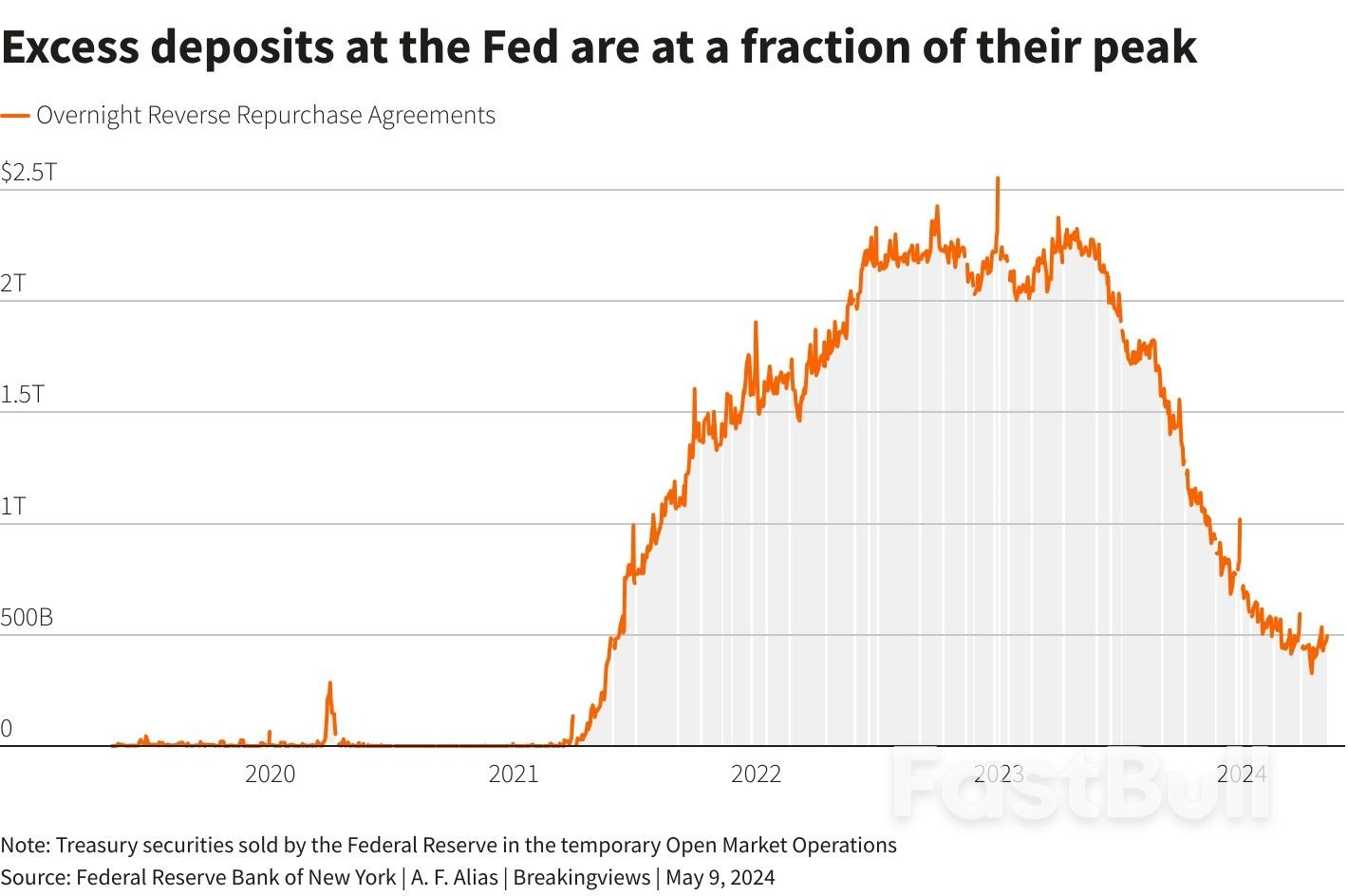
          Furthermore, much of the liquidity provided to the financial system by the Federal Reserve in 2021 and 2022 initially flowed back into the central bank's overnight reverse repo facility. Garran estimates that the recent outflow of these deposits from the Fed has pumped a net $1.25 trillion into U.S. markets, more than offsetting the impact of higher interest rates and the Fed's shrinking balance sheet.
          Jamie Lee of The Grantham Foundation has another explanation for why higher interest rates have not choked the economy. Before the financial crisis of 2008, central banks did not pay interest on excess bank reserves. As a result, commercial banks immediately felt the pain of tighter monetary policy. Lee points out that deposits at the central bank are the safest and most liquid form of money, used for settling transactions between lenders. In the past these deposits were scarce and, because they did not attract interest, expensive for banks to hold.
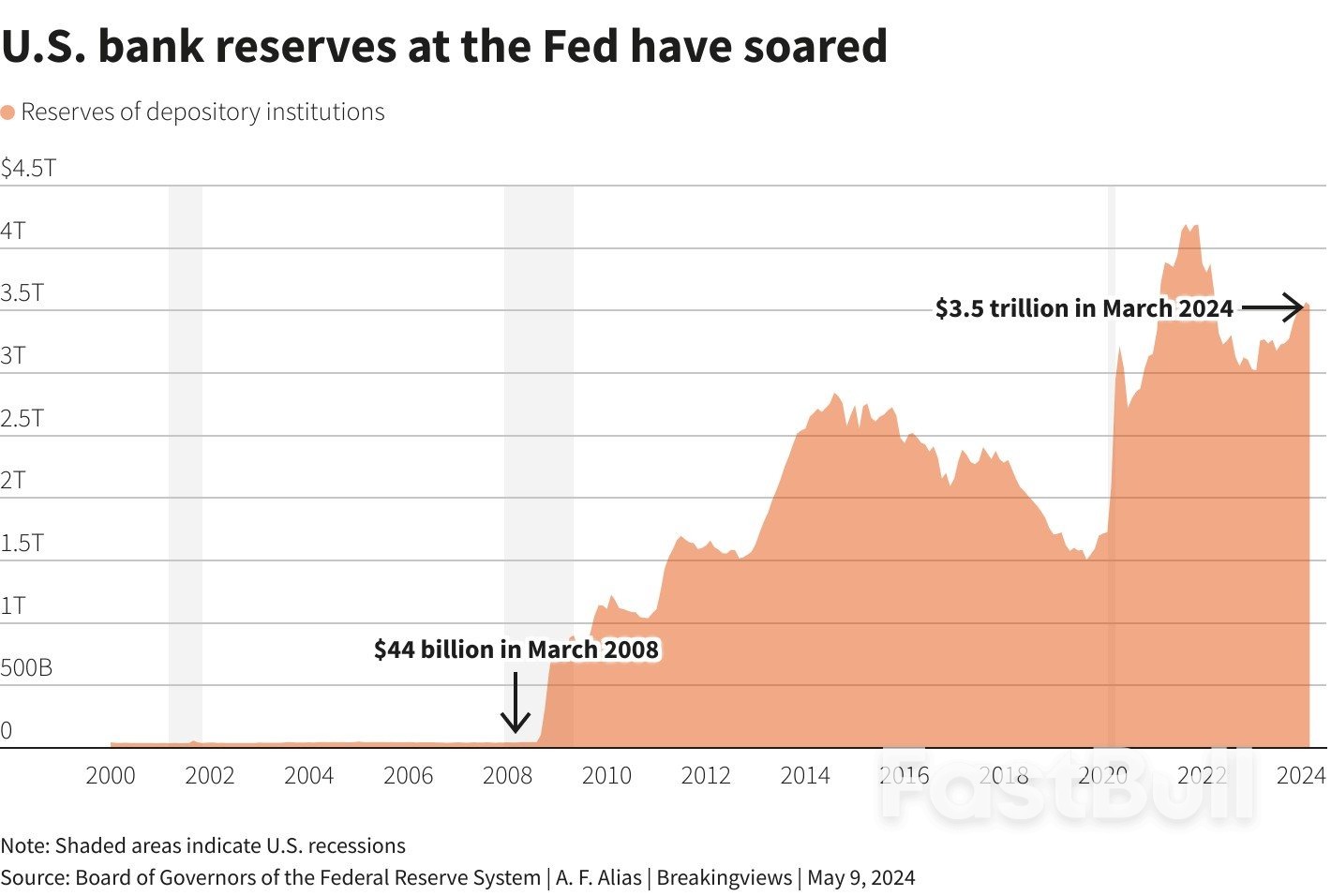
          Since 2008, however, the Fed has been paying interest on reserves. They have become super-abundant, rising from $44 billion in March 2008 to $3.5 trillion by March 2024. When the central bank hikes interest rates, it therefore creates money which is paid into the banking system, boosting liquidity. "When the Fed 'raises rates', it leaves the bid-ask spread for final settlement money unchanged, at virtually zero. Tightening is not tightening after all," Lee explains. In this sense, more restrictive monetary policy is actually easier.
          Economic Hard Landing Is Delayed but Not Cancelled_2There are two other reasons why the U.S. economy has shown itself less sensitive to higher interest rates. Torsten Slok, chief economist of Apollo Global Management, argues that both homebuyers and corporations took advantage of easy money conditions to borrow at low interest rates. Because interest payments on most U.S. residential mortgages are fixed for decades, homeowners have been insulated against rate hikes.
          Meanwhile, large U.S. corporations extended the maturity of their debt during the pandemic. With the investment-grade corporate debt market having grown from $3 trillion in 2009 to $9 trillion today, American companies have become less sensitive to short-term movements in interest rates, according to Slok.
          At the same time, large companies are now receiving more interest income on their deposits. This explains the curious fact that net corporate interest payments in the United States fell after the Fed raised interest rates.
          The second reason for the U.S. economy's resilience to monetary tightening is an extraordinary spending splurge by the government. The federal deficit in 2023 was $1.7 trillion, equal to 6.3% of GDP. This provided a strong tailwind for growth, employment, and corporate profits.
          Economic Hard Landing Is Delayed but Not Cancelled_3These various monetary and fiscal supports are now largely exhausted. U.S. aggregate demand and corporate earnings will face a squeeze when Washington reins in spending. Excess deposits in the Federal Reserve's reverse repo facility are at a fraction of their peak. Consumers have largely spent their pandemic-era excess savings.
          Meanwhile, tighter monetary policy is pinching. The U.S. commercial real estate market is a slow-motion train wreck: vacancies are sky-high and property valuations are down sharply. Hedges against higher interest rates, which typically last for three years, are expiring and are prohibitively expensive to renew. Defaults on commercial mortgage-backed securities are rising.
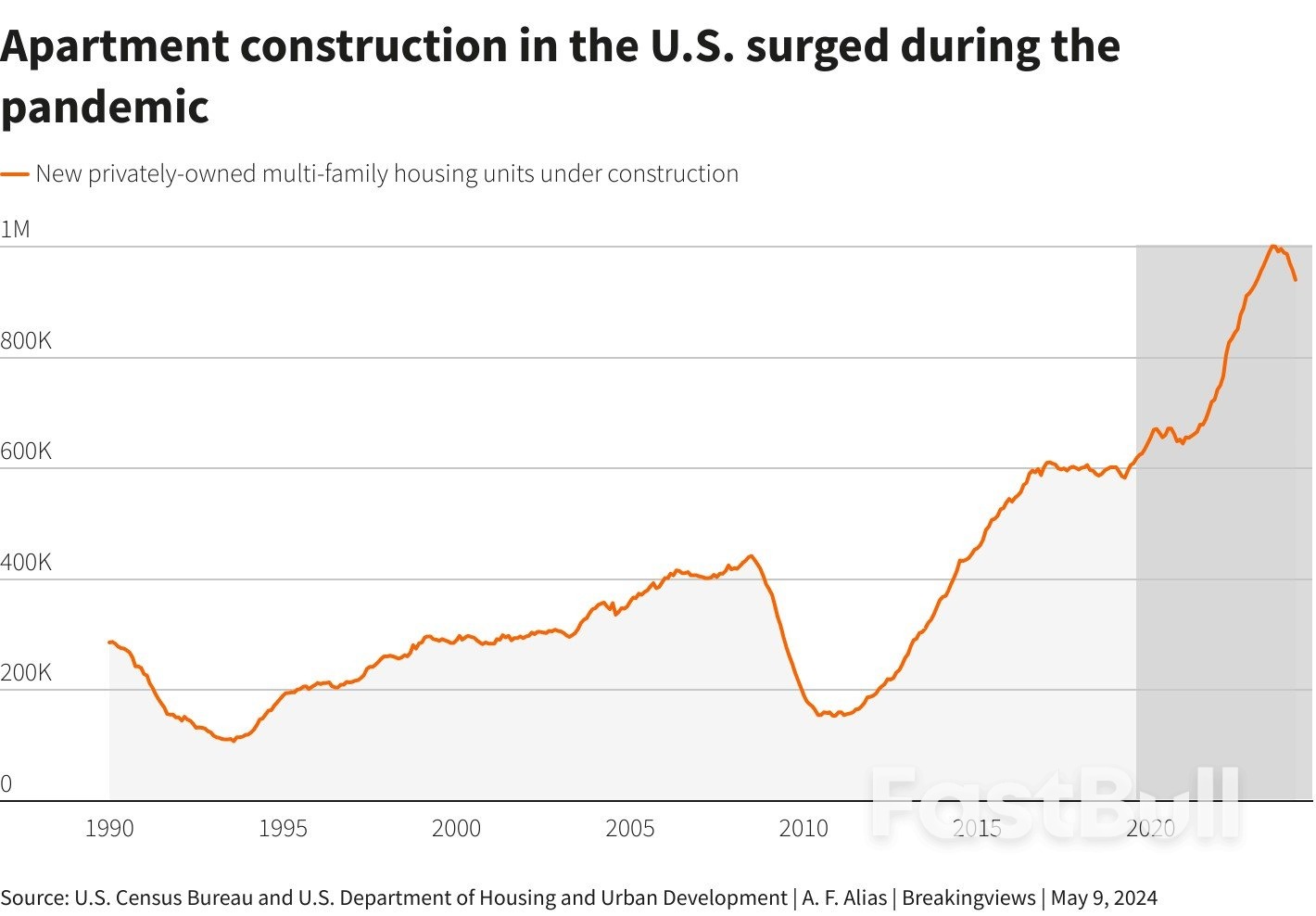
          Many real estate borrowers are seeking to amend and extend their maturing loans. Owners of multi-family apartments — buildings divided into multiple homes — are struggling to pay interest on floating-rate loans, many of which are held by collateralised loan obligations. Apartment construction in the United States surged during the pandemic: a record one million multi-family apartments were under construction last year. Oversupply may further depress prices, hurting both real estate developers and lenders.
          Economic Hard Landing Is Delayed but Not Cancelled_4The leveraged buyout industry is wilting under the heat of higher interest rates. The International Monetary Fund recently warned of systemic risks posed by the $2.1 trillion "opaque and highly inter-connected" world of private credit dominated by private equity groups. Private companies which cannot access the bond markets are also suffering from higher interest costs. Hordes of corporate zombies are slowly returning to their graves.
          The economist Milton Friedman famously said that monetary policy works with long and variable lags. Those lags may be longer and more variable today than in earlier times. But sooner or later, they end. Tetlock's experts had another favourite comeback when faced with a mistaken prediction: "it hasn't happened yet," they said. Those who foresaw a hard landing that has so far proved elusive might say the same.

          Source: Reuters

          To stay updated on all economic events of today, please check out our Economic calendar
          Risk Warnings and Disclaimers
          You understand and acknowledge that there is a high degree of risk involved in trading. Following any strategies or investment methods may lead to potential losses. The content on the site is provided by our contributors and analysts for information purposes only. You are solely responsible for determining whether any trading assets, securities, strategy, or any other product is suitable for investing based on your own investment objectives and financial situation.
          Add to Favorites
          Share

          Unconventional Economic Wisdom: Global Elections in The Shadow of Neoliberalism

          Thomas

          Political

          Around the world, populist nationalism is on the rise, often shepherded to power by authoritarian leaders. And yet the neoliberal orthodoxy — government downsizing, tax cuts, and deregulation — that took hold some 40 years ago in the West was supposed to strengthen democracy, not weaken it. What went wrong?
          Part of the answer is economic: neoliberalism simply did not deliver what it promised. In the US and other advanced economies that embraced it, per capita real (inflation-adjusted) income growth between 1980 and the Covid-19 pandemic was 40% lower than in the preceding 30 years. Worse, incomes at the bottom and in the middle largely stagnated while those at the very top increased, and the deliberate weakening of social protections has produced greater financial and economic insecurity.
          Rightly worried that climate change jeopardises their future, young people can see that countries under the sway of neoliberalism have consistently failed to enact strong regulations against pollution (or, in the US, to address the opioid crisis and the epidemic of child diabetes). Sadly, these failures come as no surprise. Neoliberalism was predicated on the belief that unfettered markets are the most efficient means of achieving optimal outcomes. Yet even in the early days of neoliberalism's ascendancy, economists had already established that unregulated markets are neither efficient nor stable, let alone conducive to generating a socially acceptable distribution of income.
          Neoliberalism's proponents never seemed to recognise that expanding the freedom of corporations curtails freedom across the rest of society. The freedom to pollute means worsening health (or even death, for those with asthma), more extreme weather and uninhabitable land. There are always trade-offs, of course, but any reasonable society would conclude that the right to live is more important than the spurious right to pollute.
          Taxation is equally anathema to neoliberalism, which frames it as an affront to individual liberty: one has the right to keep whatever one earns, regardless of how one earns it. But even when they come by their income honestly, advocates of this view fail to recognise that it was made possible by government investment in infrastructure, technology, education and public health. Rarely do they pause to consider what they would have if they had been born in one of the many countries without the rule of law (or what their portfolios would look like if the US government had not made the investments that led to the Covid-19 vaccine).
          Instead, those most indebted to the government are often the first to forget what the government did for them. Where would Elon Musk and Tesla be if not for the near-half-billion-dollar lifeline they received from President Barack Obama's Department of Energy in 2010?
          “Taxes are what we pay for civilised society,” Supreme Court Justice Oliver Wendell Holmes famously observed. That hasn't changed: taxes are what it takes to establish the rule of law or provide any of the other public goods that a 21st-century society needs to function.
          Here, we go beyond mere trade-offs, because everyone — including the rich — is made better off by an adequate supply of such goods. Coercion, in this sense, can be emancipatory. There is a broad consensus on the principle that if we are going to have essential goods, we have to pay for them and that requires taxes.
          Of course, advocates of smaller government would say that many expenditures should be cut, including government-managed pensions and publicly provided healthcare. But, again, if most people are forced to endure the insecurity and fear of not having reliable health care or incomes in old age, society has become less free. Even if multibillionaires' well-being would be somewhat crimped if each were asked to pay a little more in taxes to fund a child tax credit, consider what a difference it would make in the life of a child who doesn't have enough to eat or whose parents cannot afford a doctor's visit. Consider what it would mean for the whole country's future if fewer of its young people grew up malnourished or sick.
          All these issues should take centre stage in this year's many elections. In the US, the upcoming presidential election offers a stark choice not only between chaos and orderly government but also between economic philosophies and policies. The incumbent, Joe Biden, is committed to using the power of government to enhance the well-being of all citizens, especially those in the bottom 99%, whereas Donald Trump is more interested in maximising the welfare of the top 1%. Trump, who holds court from a luxury golf resort (when he is not in court himself), has become the champion of crony capitalists around the world.
          Trump and Biden have vastly different visions of the kind of society we should be working to create. In one scenario, dishonesty, socially destructive profiteering and rent-seeking will prevail, public trust will continue to crumble and materialism and greed will triumph; in the other, elected officials and public servants will work in good faith towards a more creative, healthy, knowledge-based society built on trust and honesty.
          Of course, politics is never as pure as this description suggests. But no one can deny that the two candidates hold fundamentally different views on freedom and the makings of a good society. Our economic system reflects and shapes who we are and what we can become. If we publicly endorse a selfish, misogynistic grifter — or dismiss these attributes as minor blemishes — our young people will absorb that message, and we will end up with even more scoundrels and opportunists in office. We will become a society without trust and, thus, without a well-functioning economy.
          Recent polls show that barely three years after Trump left the White House, the public has blissfully forgotten his administration's chaos, incompetence and attacks on the rule of law. But one need only look at the candidates' concrete positions on the issues to recognise that if we want to live in a society that values all citizens and strives to create ways for them to live full and satisfying lives, the choice is clear.

          Source: The Edge Malaysia

          Risk Warnings and Disclaimers
          You understand and acknowledge that there is a high degree of risk involved in trading. Following any strategies or investment methods may lead to potential losses. The content on the site is provided by our contributors and analysts for information purposes only. You are solely responsible for determining whether any trading assets, securities, strategy, or any other product is suitable for investing based on your own investment objectives and financial situation.
          Add to Favorites
          Share

          Gold Monthly: Gold Breaks New Highs

          Kevin Du

          Commodity

          Gold Monthly: Gold Breaks New Highs_1US Fed in focus

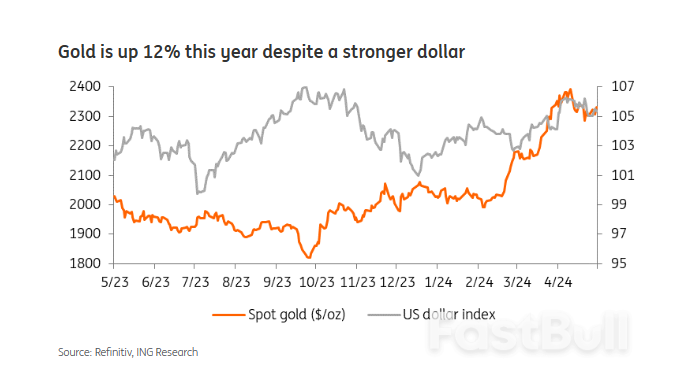
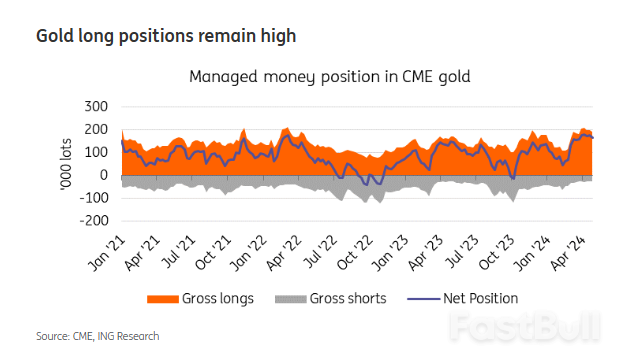
          Gold has climbed more than 12% so far this year despite the timeline for Fed cuts being pushed back. Higher rates are typically negative for gold as it doesn't pay interest.
          The key driver of the outlook for gold prices for the past year has been Federal Reserve policy. The Fed is expected to cut rates this year but has said that it needs to see more evidence of inflation easing first. Inflation data that is due next week will offer further insights into the US economy.
          Our US economist expects the first rate cut in September, followed by cuts in November and December as well.
          If the Fed continues its cautious approach to easing, gold prices risk a pullback. We expect gold prices to remain volatile in the coming months as the market reacts to macro drivers, tracking geopolitical events and Fed rate policy.Gold Monthly: Gold Breaks New Highs_2

          Central banks keep buying gold

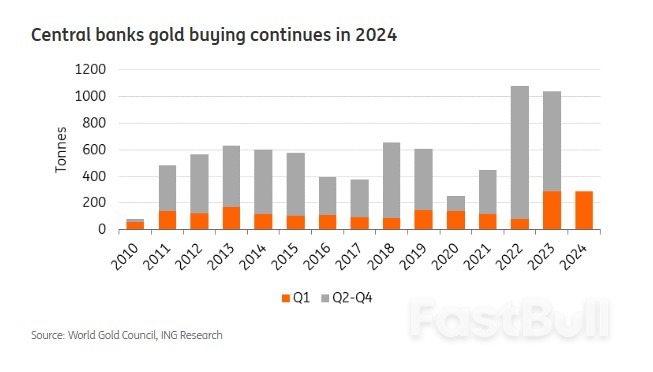
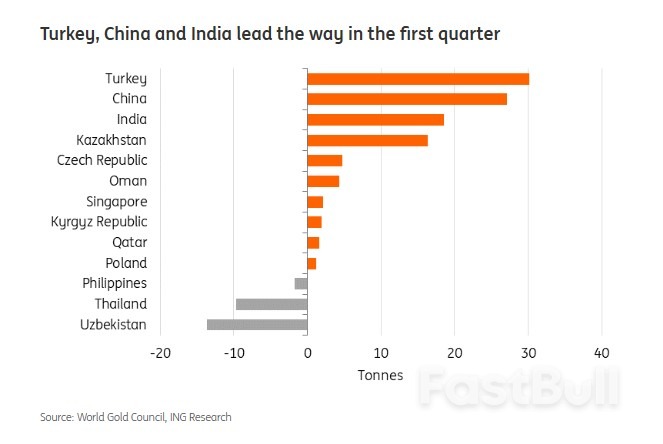
          Gold demand from central banks posted its strongest start to any year on record in the first quarter. Central banks added 290 tonnes of gold to their official holdings in the first quarter of the year, with China being the biggest buyer. The People's Bank of China added 27 tonnes to its gold reserves during the quarter.
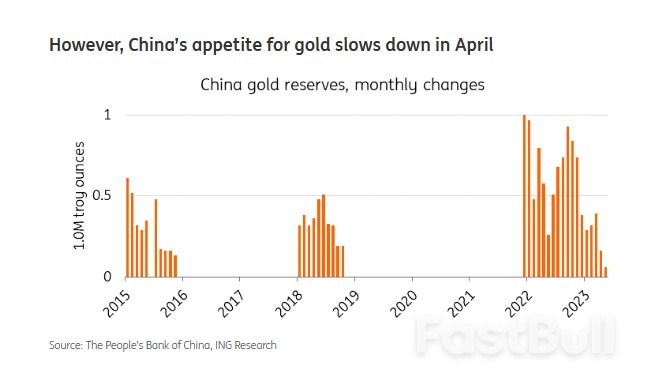
          In April, China's central bank expanded its gold reserves for an 18th straight month adding 1.87 tonnes and taking the total holdings to 2264.3 tonnes. However, the pace of buying slowed last month amid record high gold prices.
          Last year central banks bought 1,037 tonnes of gold, just shy of the all-time high of 2022. Gold tends to become more attractive in times of instability, when investors pile into safe-haven assets as a hedge against the economic climate, geopolitical tensions or inflation. Still, the record-breaking rally since mid-February might dent demand for now.Gold Monthly: Gold Breaks New Highs_3Gold Monthly: Gold Breaks New Highs_4Gold Monthly: Gold Breaks New Highs_5

          ETFs continue to see outflows

          Still, physically backed gold exchange-traded funds (ETF) flows are lagging.
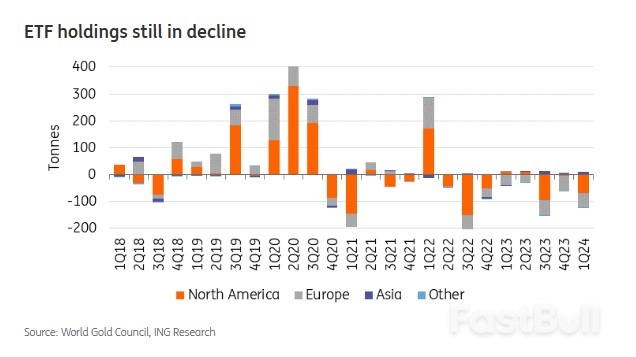
          During the Covid pandemic, ETF holdings were the driver behind gold's surge to then-record highs. Investor holdings in gold ETFs generally rise when gold prices gain, and vice versa. Gold ETF holdings have been in decline for much of 2024, while spot gold prices have hit a record after record.
          The end of April saw global gold ETF holdings fall to 3,079 tonnes, the lowest since February 2020, according to data from the World Gold Council. Although Asia and North America saw inflows, Europe continued to register outflows offsetting inflows elsewhere.Gold Monthly: Gold Breaks New Highs_6

          Gold prices risk a pullback

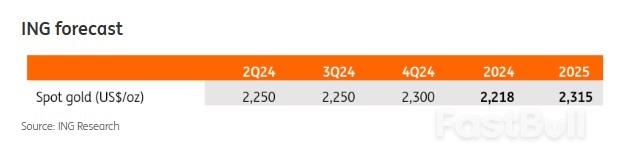
          We expect gold prices to come down slightly from its current levels this quarter as the Fed continues its cautious approach and with geopolitics already being factored into the current price. We see prices averaging $2,250/oz in the second quarter and an annual average of $2,218/oz in 2024. We see prices peaking in the fourth quarter, averaging $2,300/oz, on the assumption that the Fed starts cutting rates in the second half of the year and the dollar and yields weaken.Gold Monthly: Gold Breaks New Highs_7
          Risk Warnings and Disclaimers
          You understand and acknowledge that there is a high degree of risk involved in trading. Following any strategies or investment methods may lead to potential losses. The content on the site is provided by our contributors and analysts for information purposes only. You are solely responsible for determining whether any trading assets, securities, strategy, or any other product is suitable for investing based on your own investment objectives and financial situation.
          Add to Favorites
          Share

          UK Recession Ends with Strongest Growth Since End of Lockdown

          Devin

          Economic

          Britain bounced back strongly from a shallow recession, providing some relief for Prime Minister Rishi Sunak who has so far struggled to deliver on his promise to grow the economy.
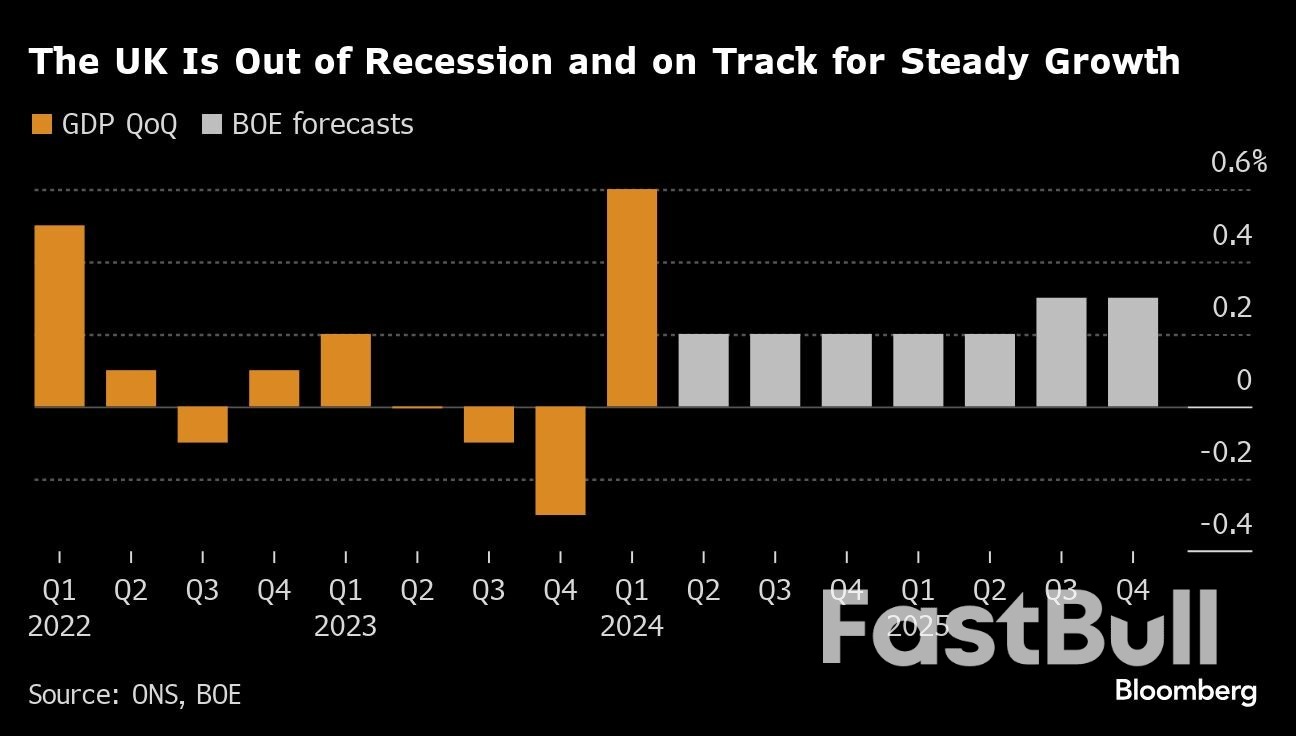
          Gross domestic product (GDP) jumped 0.6% in the first quarter compared to the previous three months, the Office for National Statistics (ONS) said Friday. That was the best reading since late 2021, when the UK loosened lockdown restrictions, and higher than the 0.4% expansion forecast by economists.
          Shoppers returned to stores, and a lack of strikes boosted transport in the first quarter. Business investment also was much stronger than expected. Growth in the month of March alone was 0.4%, well above expectations due to a bounce back in both services and manufacturing.
          "The worst is behind the UK economy," said Yael Selfin, chief economist at KPMG UK. "Forward looking indicators point to further momentum in the coming months, consistent with our view that."
          UK Recession Ends with Strongest Growth Since End of Lockdown_1The pound slightly extended gains after the data, but the move was soon pared. The currency was up less than 0.1% to US$1.2533.
          The figures marked a decisive end to the mildest recession in almost 70 years — a decline of 0.4% peak-to-trough in the second half of last year. The reading may complicate the Bank of England's (BOE) consideration about when to ease interest rates, with stronger growth potentially feeding inflationary pressures officials are still not certain are contained.
          "All the signals since the start of this year certainly suggest things are finally starting to perk up," Liz Martins, senior economist at HSBC, said on Bloomberg Radio. "The worry would be that if those rate cuts aren't delivered, then the basis for this recovery is weakened, and maybe it takes out some of the momentum."
          An upturn in economic activity is a rare bit of good news for the ruling Conservative Party after a difficult few weeks. It suffered heavy losses in the local elections, including a flagship mayoralty in the West Midlands, and has seen two of its MPs defect to the opposition Labour party.
          Chancellor of the Exchequer Jeremy Hunt said the figures were "proof that the economy is returning to full health".
          "For families who have been having a really tough time, this is an indication that difficult decisions we've taken over recent years are finally beginning to pay off, and we need to stick with them," Hunt said on Sky News.
          UK Recession Ends with Strongest Growth Since End of Lockdown_2While Sunak made spurring growth one of his key pledges after entering Number 10, the economy has struggled in the face of the worst cost of living crisis in generations and high interest rates.
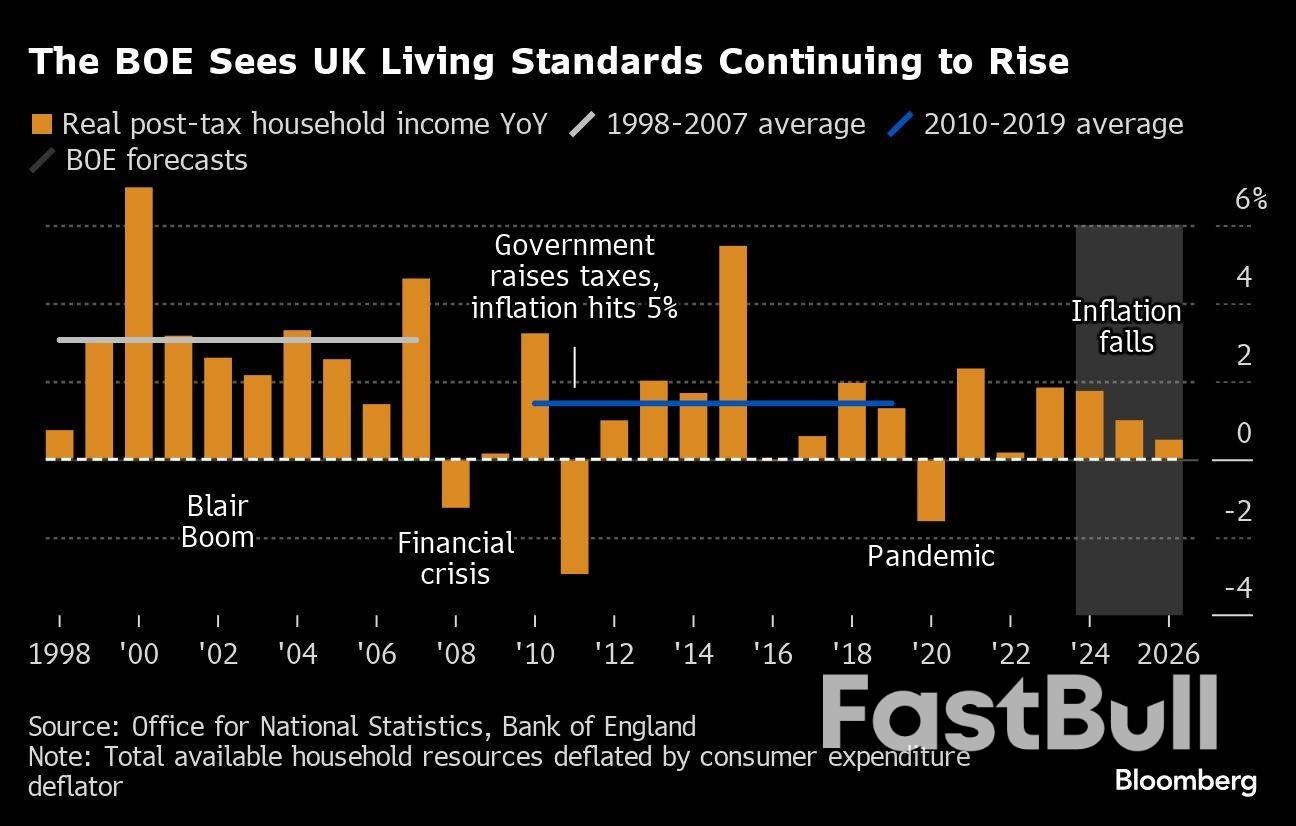
          Sunak and Hunt have claimed the economy turned the corner in early 2024 as they attempt to quell discontent among members of Parliament over the Conservatives' dire polling before a national vote. With the Tories facing a 20-point plus deficit behind the opposition Labour party, Sunak has pointed to sharp falls in inflation, lower energy bills and growing wages as signs that the economy is back on track.
          "With falling inflation boosting households' spending power, as well as opening the way for a reduction in interest rates in the months ahead, the economy should be able to sustain some momentum through the year," said Ben Jones, lead economist for CBI, Britain's biggest business lobby group.
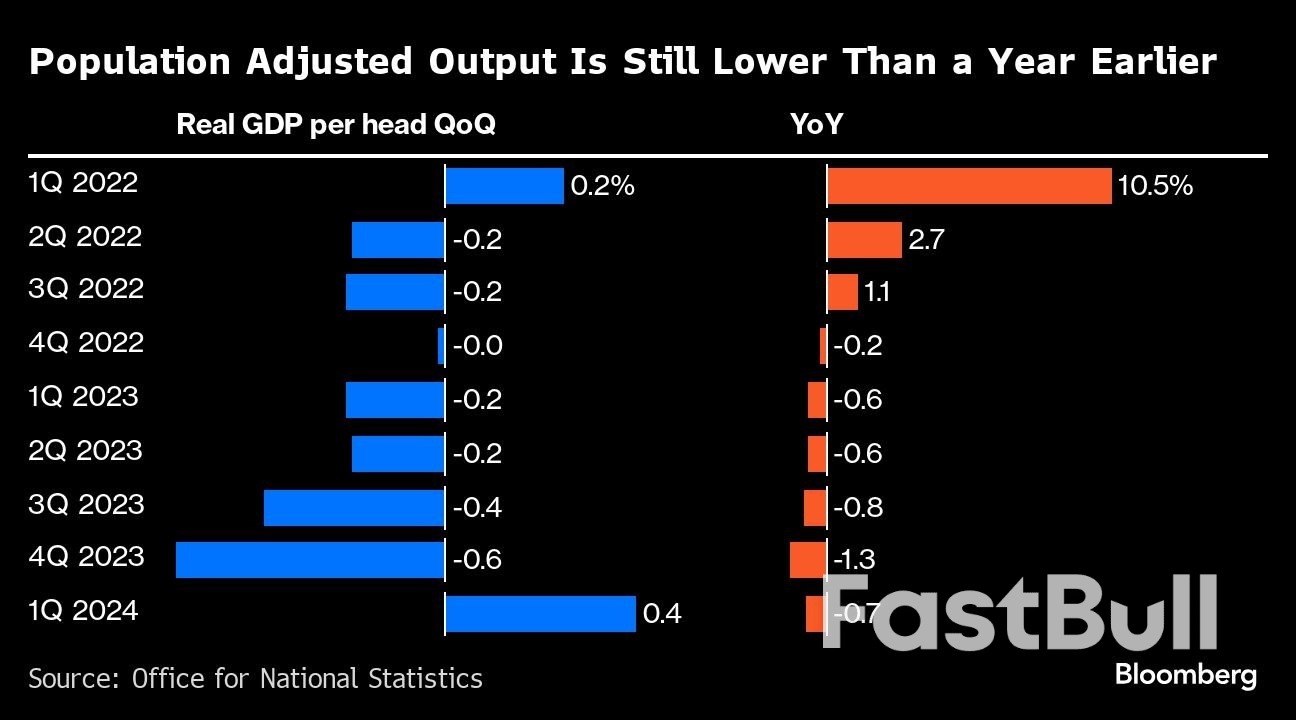
          Output per head grew 0.4% in the first three months of the year, ending a series of seven consecutive quarters without positive growth. Even so, GDP per head is estimated to be 0.7% lower than the same quarter a year ago.UK Recession Ends with Strongest Growth Since End of Lockdown_3
          A 0.7% increase in services output drove the economy's rebound in the first quarter. It ended three straight quarters of decline for the UK's largest sector with households' spending power being repaired by the the cost of living crisis fading. However, there was mixed news outside of services with industrial production growing 0.8% while construction output slipped 0.9%.
          "This is no time for Conservative ministers to be doing a victory lap and telling the British people that they have never had it so good," Labour's chancellor-in-waiting, Rachel Reeves, said in a statement. "The economy is still £300 (RM1,782) smaller per person than when Rishi Sunak became prime minister."
          UK Recession Ends with Strongest Growth Since End of Lockdown_4The ONS said imports into the UK had not been affected by disruption in the Middle East and the Red Sea. The UK's trade deficit, when excluding precious metals, narrowed in the first quarter to £7.8 billion and has been steadily declining since the start of 2022.
          "This is the start of a much brighter period for the UK economy than the last four years," said Thomas Pugh, economist at RSM UK. "Rising real earnings, tax cuts and lower interest rates will give households disposable income a significant boost in the second half of this year, and a recovery in consumer confidence will ensure that most of that increase in income is spent."

          Source: Bloomberg

          To stay updated on all economic events of today, please check out our Economic calendar
          Risk Warnings and Disclaimers
          You understand and acknowledge that there is a high degree of risk involved in trading. Following any strategies or investment methods may lead to potential losses. The content on the site is provided by our contributors and analysts for information purposes only. You are solely responsible for determining whether any trading assets, securities, strategy, or any other product is suitable for investing based on your own investment objectives and financial situation.
          Add to Favorites
          Share

          A Surprise South Korean Boom is Going Unnoticed

          Thomas

          Economic

          If only K-pop and cinema would get out of the way. South Korea has a ringside seat to the world economy, but struggles to get the attention it deserves.
          That's a pity because the view is promising and says much about upbeat global prospects. In some ways, developments are almost too positive.
          The country is often overlooked relative to mighty neighbours Japan and China. South Korea has become more famous for cultural exports - and the ebb and flow of tensions with Pyongyang - than the key components of 21st century commerce that leave its ports in encouraging numbers.
          Growth is surging, largely on the strength of demand from abroad. The bulk of the credit goes to the resilience of the US economy, and, to a lesser degree, signs that China might be past the worst of its slowdown. Washington's ringfencing of investments deserves a shoutout as well, given Seoul is a close American ally.
          What could be wrong with this? There will be no relief on interest rates soon. This, too, is a reversal. The central bank laid down an early marker in August 2021, becoming the first industrialised economy to tighten, way ahead of the Federal Reserve and before neighbourhood inflation obsessives like New Zealand.
          With the current bullish conditions, borrowing costs will be slow to retreat.

          Prospects Of a Downturn Have Diminished

          It didn't look that way a year ago; economists confidently predicted multiple cuts beginning in late 2023. There was even a chance of recession.
          Prospects of such a downturn have greatly diminished. Inflation is proving a little stubborn and a rampaging greenback has weakened Korea's currency, the won, to a degree that worries the central bank. This is an unfortunate byproduct of robust conditions in America and diminished hopes for early reductions from the Fed, a shift that has reverberated through global markets.
          "I wouldn't call it starting from scratch," Bank of Korea Governor Rhee Chang-yong told reporters recently. "But the situation has changed."
          Nor is President Yoon Suk Yeol getting any kind of dividend from this economic buoyancy. His party received a drubbing in parliamentary elections last month when voters rebelled against Yoon's hard-right policies. So great was the bloc's defeat that political scientists declared his rule over with several years left in his term.
          Investor-friendly policies championed by Yoon, like deep cuts in capital-gains tax and union busting, will struggle to get traction. The average Korean has yet to experience better times. An index of consumer sentiment has hovered either side of the divide that gauges whether optimism or pessimism prevails.
          Boom times for Samsung Electronics and SK Hynix don't necessarily translate into euphoria on the streets. High levels of debt and worries about inequality have accompanied the country's advance in recent decades - and inspired Netflix's hit Squid Game and, a few year's earlier, the Oscar-winning film Parasite.

          Good News

          But don't let that crowd out some very good news. Gross domestic product in the first quarter increased an impressive 3.4 per cent from a year earlier, beating forecasts by a handsome margin.
          Net exports were vital to this outcome. Construction, which had languished but stands to be a big beneficiary of the state's infrastructure programme, showed signs of ticking up. Household spending is slowly improving.
          Then, last week, blockbuster shipment data hit. Exports climbed more than 11 per cent in April from a year earlier.
          Purchases by US customers jumped by almost a quarter, easily surpassing the roughly 10 per cent headed to China. That marked the third consecutive month when goods dispatched to America exceeded those destined for its neighbour. Proximity to Beijing no longer automatically bankrolls regional economies.
          When many people think of Korean engagement with the world, they have in mind phenomena like BTS, the boyband sensation whose members are taking time out for military service, or more recent arrivals like NewJeans. To walk down some streets in Singapore is to wonder how many Korean BBQ places a single city can sustain. These are narrow or, at best, incomplete pictures.
          The memory chips that drive modern electronics and artificial intelligence are hot property. There is much more to this economy than its cultural exports. All you need to do is notice the wiring.

          Source: Bloomberg

          To stay updated on all economic events of today, please check out our Economic calendar
          Risk Warnings and Disclaimers
          You understand and acknowledge that there is a high degree of risk involved in trading. Following any strategies or investment methods may lead to potential losses. The content on the site is provided by our contributors and analysts for information purposes only. You are solely responsible for determining whether any trading assets, securities, strategy, or any other product is suitable for investing based on your own investment objectives and financial situation.
          Add to Favorites
          Share

          War Upends Ukraine's Economy in A Shift That May Be Permanent

          Devin

          Economic

          Within days of Russian forces invading Ukraine in early 2022, architect Oleh Drozdov made up his mind: he would move his home and business from the besieged eastern city of Kharkiv more than 1,000 km to the west, far from the fighting.
          Now, with the war in its third year, his practice may finally be returning to growth, as businesses like his adapt to the conflict and search out opportunities alongside the formidable challenges.
          "The storm is over. There are many holes in our boat but we are moving forward," Drozdov said from his offices in a historic building in the centre of Lviv, a city of some 700,000 people close to the Polish border.
          On the city's outskirts, cranes dot the skyline and industrial parks and other projects are being built.
          In some ways Drozdov & Partners is well placed to adapt to the shock of war. It is small and footloose, and, in a country where millions of people and thousands of companies are displaced, demand for buildings and renovations is high.
          "Some new opportunities have started to open up slowly," said Drozdov. "There are investments in this part of the country as businesses and people are relocating."
          His practice is among 19,000 companies that have registered in new locations within Ukraine since the invasion, according to Opendatabot, which provides data from official registries, in a mass migration of businesses from east to west that may never be reversed.
          "Thanks to the adaptability of businesses, support from partners and government programmes, Ukraine is increasingly taking on the characteristics of a wartime economy," First Deputy Prime Minister Yulia Svyrydenko told Reuters.
          "If we compare the economy's structure in 2023 with that of pre-war 2021, we clearly see this transformation. The Ukrainian economy is showing resilience and adaptability ... proving its ability to navigate through difficult times."

          West Wins for Now

          In the east of Ukraine, where fighting has raged during offensives and counteroffensives, towns and villages lie in ruins. Kharkiv is being heavily bombed.
          A study by the World Bank, United Nations, European Commission and the Ukrainian government published in February estimated the total cost of rebuilding the economy at $486 billion, a figure that continues to rise as more damage is incurred.
          Far to the west, urban centres are faring better.
          Viktor Mykyta, regional governor in Zakarpattia which borders Poland, Slovakia, Hungary and Romania, described a rush of new businesses ranging from salt production to furniture and textiles.
          Before the war, the mountainous region's economy relied heavily on tourism and remittances sent home by Ukrainians working abroad.
          "When the war broke out, a lot of businesses moved, jobs were created, the budget began to be filled," Mykyta said.
          Officials in Lviv region report a similar trend, with logistics, energy, construction and IT firms among those setting up operations there.
          Of the few wartime foreign investments announced, most are in central and western regions - in part because they stand to benefit most should Ukraine succeed in its aim of joining the European Union one day, analysts said.
          Projects include Turkish Onur Group's plans to invest $50 million in graphite mining in western Khmelnytskyi region and a further $150 million in renewables in Zakarpattia.
          Germany's Bayer said it would invest 60 million euros in its corn seed production facility in central Zhytomyr region, while Ireland's Kingspan Group has announced a $280 million investment in a facility in Lviv region.
          Back in Kharkiv, Ukraine's second city, the reality is very different. Oleh Synehubov, the region's governor, said 70% of large enterprises have been destroyed or relocated or suspended their operations.
          "Our regional and city budgets have fallen by 40%," he told Reuters.
          World Bank data shows that businesses in eastern Ukraine experienced a 70% slump in sales between the invasion and the end of 2023, and those in the south a drop of 63%. In comparison, companies' sales in the west decreased 39%.

          Need For Workers

          Official data on the impact of the war on different sectors is patchy, and recent trends could change if there are dramatic shifts on the battlefield. Russian attacks on energy infrastructure is also a major challenge for many firms.
          After the economy collapsed by a third in 2022, it rebounded by 5.3% in 2023 and the government forecasts growth of 4.6% this year. The steel industry, once Ukraine's key exporter, contracted by about 80% in 2022 and grew only 8% in 2023.
          The economy ministry said that so far in 2024, the fastest pace of growth has been in construction, processing, transport and retail.
          The defence industry has also expanded significantly. According to Ukraine's strategic industries ministry, the number of defence manufacturers has more than doubled since February, 2022.
          As some sectors have expanded, job vacancies have grown fastest in the west of the country, according to Work.ua, an employment portal which reported a record number of wartime vacancies in April.
          Vacancies were up 55% in Zakarpattia at the end of February compared with pre-war levels while Lviv region had about 8,500 vacancies open at the start of March, up 23% from before the invasion.
          A recent survey from the European Business Association, one of Ukraine's leading business groups, showed that about 74% of companies have suffered staff shortages - the result of millions of people fleeing overseas and hundreds of thousands of men serving in the military.
          Drozdov has struggled to hire enough staff at his practice and to fill vacancies at an architectural school that he also runs.
          Mindful of the long term task of rebuilding the country, Drozdov is launching a masters programme for young architects with a focus on rebuilding the shattered east. He hopes to return one day to Kharkiv.
          "When there is an opportunity we will return there physically. It will be a gradual process."

          Source: Reuters

          To stay updated on all economic events of today, please check out our Economic calendar
          Risk Warnings and Disclaimers
          You understand and acknowledge that there is a high degree of risk involved in trading. Following any strategies or investment methods may lead to potential losses. The content on the site is provided by our contributors and analysts for information purposes only. You are solely responsible for determining whether any trading assets, securities, strategy, or any other product is suitable for investing based on your own investment objectives and financial situation.
          Add to Favorites
          Share
          FastBull
          Copyright © 2025 FastBull Ltd

          728 RM B 7/F GEE LOK IND BLDG NO 34 HUNG TO RD KWUN TONG KLN HONG KONG

          TelegramInstagramTwitterfacebooklinkedin
          App Store Google Play Google Play
          Products
          Charts

          Chats

          Q&A with Experts
          Screeners
          Economic Calendar
          Data
          Tools
          Membership
          Features
          Function
          Markets
          Copy Trading
          Latest Signals
          Contests
          News
          Analysis
          24/7
          Columns
          Education
          Company
          Careers
          About Us
          Contact Us
          Advertising
          Help Center
          Feedback
          User Agreement
          Privacy Policy
          Business

          White Label

          Data API

          Web Plug-ins

          Poster Maker

          Affiliate Program

          Risk Disclosure

          The risk of loss in trading financial instruments such as stocks, FX, commodities, futures, bonds, ETFs and crypto can be substantial. You may sustain a total loss of the funds that you deposit with your broker. Therefore, you should carefully consider whether such trading is suitable for you in light of your circumstances and financial resources.

          No decision to invest should be made without thoroughly conducting due diligence by yourself or consulting with your financial advisors. Our web content might not suit you since we don't know your financial conditions and investment needs. Our financial information might have latency or contain inaccuracy, so you should be fully responsible for any of your trading and investment decisions. The company will not be responsible for your capital loss.

          Without getting permission from the website, you are not allowed to copy the website's graphics, texts, or trademarks. Intellectual property rights in the content or data incorporated into this website belong to its providers and exchange merchants.

          Not Logged In

          Log in to access more features

          FastBull Membership

          Not yet

          Purchase

          Become a signal provider
          Help Center
          Customer Service
          Dark Mode
          Price Up/Down Colors

          Log In

          Sign Up

          Position
          Layout
          Fullscreen
          Default to Chart
          The chart page opens by default when you visit fastbull.com