• Trade
  • Markets
  • Copy
  • Contests
  • News
  • 24/7
  • Calendar
  • Q&A
  • Chats
Trending
Screeners
SYMBOL
LAST
BID
ASK
HIGH
LOW
NET CHG.
%CHG.
SPREAD
SPX
S&P 500 Index
6827.42
6827.42
6827.42
6899.86
6801.80
-73.58
-1.07%
--
DJI
Dow Jones Industrial Average
48458.04
48458.04
48458.04
48886.86
48334.10
-245.98
-0.51%
--
IXIC
NASDAQ Composite Index
23195.16
23195.16
23195.16
23554.89
23094.51
-398.69
-1.69%
--
USDX
US Dollar Index
97.950
98.030
97.950
98.500
97.950
-0.370
-0.38%
--
EURUSD
Euro / US Dollar
1.17394
1.17409
1.17394
1.17496
1.17192
+0.00011
+ 0.01%
--
GBPUSD
Pound Sterling / US Dollar
1.33707
1.33732
1.33707
1.33997
1.33419
-0.00148
-0.11%
--
XAUUSD
Gold / US Dollar
4299.39
4299.39
4299.39
4353.41
4257.10
+20.10
+ 0.47%
--
WTI
Light Sweet Crude Oil
57.233
57.485
57.233
58.011
56.969
-0.408
-0.71%
--

Community Accounts

Signal Accounts
--
Profit Accounts
--
Loss Accounts
--
View More

Become a signal provider

Sell trading signals to earn additional income

View More

Guide to Copy Trading

Get started with ease and confidence

View More

Signal Accounts for Members

All Signal Accounts

Best Return
  • Best Return
  • Best P/L
  • Best MDD
Past 1W
  • Past 1W
  • Past 1M
  • Past 1Y

All Contests

  • All
  • Trump Updates
  • Recommend
  • Stocks
  • Cryptocurrencies
  • Central Banks
  • Featured News
Top News Only
Share

Iranian Media Says 18 Crew Members Of Foreign Tanker Seized In Gulf Of Oman Over Carrying 'Smuggled Fuel' Detained

Share

Regional Governor: Two Killed In Ukrainian Drone Strike On Russia's Saratov

Share

Chinese Foreign Ministry - China Foreign Minister Met With United Arab Emirates Counterpart On Dec 12

Share

China's Central Financial And Economic Affairs Commission Deputy Director: Will Expand Export And Increase Import In 2026

Share

Thai Leader Anutin: Landmine Blast That Killed Thai Soldiers 'Not A Roadside Accident'

Share

Thai Leader Anutin: Thailand To Continue Military Action Until 'We Feel No More Harm'

Share

Cambodian Prime Minister Hun Manet Says He Had Phone Calls With Trump And Malaysian Leader Anwar About Ceasefire

Share

Cambodia's Hun Manet Says USA, Malaysia Should Verify 'Which Side Fired First' In Latest Conflict

Share

Cambodia's Hun Manet: Cambodia Maintains Its Stance In Seeking Peaceful Resolution Of Disputes

Share

Nasdaq Companies: Allergan, Ferrovia, Insmed, Monolithic Power Systems, Seagate Technology, And Western Digital Will Be Added To The NASDAQ 100 Index. Biogen, CdW, GlobalFoundries, Lululemon, ON Semiconductor, And Tradedesk Will Be Removed From The NASDAQ 100 Index

Share

Witkoff Headed To Berlin This Weekend To Meet With Zelenskiy, European Leaders -Wsj Reporter On X

Share

Russia Attacks Two Ukrainian Ports, Damaging Three Turkish-Owned Vessels

Share

[Historic Flooding Occurs In At Least Four Rivers In Washington State Due To Days Of Torrential Rains] Multiple Areas In Washington State Have Been Hit By Severe Flooding Due To Days Of Torrential Rains, With At Least Four Rivers Experiencing Historic Flooding. Reporters Learned On The 12th That The Floods Caused By The Torrential Rains In Washington State Have Destroyed Homes And Closed Several Highways. Experts Warn That Even More Severe Flooding May Occur In The Future. A State Of Emergency Has Been Declared In Washington State

Share

Trump Says Proposed Free Economic Zone In Donbas Would Work

Share

Trump: I Think My Voice Should Be Heard

Share

Trump Says Will Be Choosing New Fed Chair In Near Future

Share

Trump Says Proposed Free Economic Zone In Donbas Complex But Would Work

Share

Trump Says Land Strikes In Venezuela Will Start Happening

Share

US President Trump: Thailand And Cambodia Are In A Good Situation

Share

State Media: North Korean Leader Kim Hails Troops Returning From Russia Mission

TIME
ACT
FCST
PREV
U.K. Trade Balance Non-EU (SA) (Oct)

A:--

F: --

P: --

U.K. Trade Balance (Oct)

A:--

F: --

P: --

U.K. Services Index MoM

A:--

F: --

P: --

U.K. Construction Output MoM (SA) (Oct)

A:--

F: --

P: --

U.K. Industrial Output YoY (Oct)

A:--

F: --

P: --

U.K. Trade Balance (SA) (Oct)

A:--

F: --

P: --

U.K. Trade Balance EU (SA) (Oct)

A:--

F: --

P: --

U.K. Manufacturing Output YoY (Oct)

A:--

F: --

P: --

U.K. GDP MoM (Oct)

A:--

F: --

P: --

U.K. GDP YoY (SA) (Oct)

A:--

F: --

P: --

U.K. Industrial Output MoM (Oct)

A:--

F: --

P: --

U.K. Construction Output YoY (Oct)

A:--

F: --

P: --

France HICP Final MoM (Nov)

A:--

F: --

P: --

China, Mainland Outstanding Loans Growth YoY (Nov)

A:--

F: --

P: --

China, Mainland M2 Money Supply YoY (Nov)

A:--

F: --

P: --

China, Mainland M0 Money Supply YoY (Nov)

A:--

F: --

P: --

China, Mainland M1 Money Supply YoY (Nov)

A:--

F: --

P: --

India CPI YoY (Nov)

A:--

F: --

P: --

India Deposit Gowth YoY

A:--

F: --

P: --

Brazil Services Growth YoY (Oct)

A:--

F: --

P: --

Mexico Industrial Output YoY (Oct)

A:--

F: --

P: --

Russia Trade Balance (Oct)

A:--

F: --

P: --

Philadelphia Fed President Henry Paulson delivers a speech
Canada Building Permits MoM (SA) (Oct)

A:--

F: --

P: --

Canada Wholesale Sales YoY (Oct)

A:--

F: --

P: --

Canada Wholesale Inventory MoM (Oct)

A:--

F: --

P: --

Canada Wholesale Inventory YoY (Oct)

A:--

F: --

P: --

Canada Wholesale Sales MoM (SA) (Oct)

A:--

F: --

P: --

Germany Current Account (Not SA) (Oct)

A:--

F: --

P: --

U.S. Weekly Total Rig Count

A:--

F: --

P: --

U.S. Weekly Total Oil Rig Count

A:--

F: --

P: --

Japan Tankan Large Non-Manufacturing Diffusion Index (Q4)

--

F: --

P: --

Japan Tankan Small Manufacturing Outlook Index (Q4)

--

F: --

P: --

Japan Tankan Large Non-Manufacturing Outlook Index (Q4)

--

F: --

P: --

Japan Tankan Large Manufacturing Outlook Index (Q4)

--

F: --

P: --

Japan Tankan Small Manufacturing Diffusion Index (Q4)

--

F: --

P: --

Japan Tankan Large Manufacturing Diffusion Index (Q4)

--

F: --

P: --

Japan Tankan Large-Enterprise Capital Expenditure YoY (Q4)

--

F: --

P: --

U.K. Rightmove House Price Index YoY (Dec)

--

F: --

P: --

China, Mainland Industrial Output YoY (YTD) (Nov)

--

F: --

P: --

China, Mainland Urban Area Unemployment Rate (Nov)

--

F: --

P: --

Saudi Arabia CPI YoY (Nov)

--

F: --

P: --

Euro Zone Industrial Output YoY (Oct)

--

F: --

P: --

Euro Zone Industrial Output MoM (Oct)

--

F: --

P: --

Canada Existing Home Sales MoM (Nov)

--

F: --

P: --

Euro Zone Total Reserve Assets (Nov)

--

F: --

P: --

U.K. Inflation Rate Expectations

--

F: --

P: --

Canada National Economic Confidence Index

--

F: --

P: --

Canada New Housing Starts (Nov)

--

F: --

P: --

U.S. NY Fed Manufacturing Employment Index (Dec)

--

F: --

P: --

U.S. NY Fed Manufacturing Index (Dec)

--

F: --

P: --

Canada Core CPI YoY (Nov)

--

F: --

P: --

Canada Manufacturing Unfilled Orders MoM (Oct)

--

F: --

P: --

Canada Manufacturing New Orders MoM (Oct)

--

F: --

P: --

Canada Core CPI MoM (Nov)

--

F: --

P: --

Canada Manufacturing Inventory MoM (Oct)

--

F: --

P: --

Canada CPI YoY (Nov)

--

F: --

P: --

Canada CPI MoM (Nov)

--

F: --

P: --

Canada CPI YoY (SA) (Nov)

--

F: --

P: --

Canada Core CPI MoM (SA) (Nov)

--

F: --

P: --

Q&A with Experts
    • All
    • Chatrooms
    • Groups
    • Friends
    Connecting
    .
    .
    .
    Type here...
    Add Symbol or Code

      No matching data

      All
      Trump Updates
      Recommend
      Stocks
      Cryptocurrencies
      Central Banks
      Featured News
      • All
      • Russia-Ukraine Conflict
      • Middle East Flashpoint
      • All
      • Russia-Ukraine Conflict
      • Middle East Flashpoint
      Search
      Products

      Charts Free Forever

      Chats Q&A with Experts
      Screeners Economic Calendar Data Tools
      Membership Features
      Data Warehouse Market Trends Institutional Data Policy Rates Macro

      Market Trends

      Market Sentiment Order Book Forex Correlations

      Top Indicators

      Charts Free Forever
      Markets

      News

      News Analysis 24/7 Columns Education
      From Institutions From Analysts
      Topics Columnists

      Latest Views

      Latest Views

      Trending Topics

      Top Columnists

      Latest Update

      Signals

      Copy Rankings Latest Signals Become a signal provider AI Rating
      Contests
      Brokers

      Overview Brokers Assessment Rankings Regulators News Claims
      Broker listing Forex Brokers Comparison Tool Live Spread Comparison Scam
      Q&A Complaint Scam Alert Videos Tips to Detect Scam
      More

      Business
      Events
      Careers About Us Advertising Help Center

      White Label

      Data API

      Web Plug-ins

      Affiliate Program

      Awards Institution Evaluation IB Seminar Salon Event Exhibition
      Vietnam Thailand Singapore Dubai
      Fans Party Investment Sharing Session
      FastBull Summit BrokersView Expo
      Recent Searches
        Top Searches
          Markets
          News
          Analysis
          User
          24/7
          Economic Calendar
          Education
          Data
          • Names
          • Latest
          • Prev

          View All

          No data

          Scan to Download

          Faster Charts, Chat Faster!

          Download App
          English
          • English
          • Español
          • العربية
          • Bahasa Indonesia
          • Bahasa Melayu
          • Tiếng Việt
          • ภาษาไทย
          • Français
          • Italiano
          • Türkçe
          • Русский язык
          • 简中
          • 繁中
          Open Account
          Search
          Products
          Charts Free Forever
          Markets
          News
          Signals

          Copy Rankings Latest Signals Become a signal provider AI Rating
          Contests
          Brokers

          Overview Brokers Assessment Rankings Regulators News Claims
          Broker listing Forex Brokers Comparison Tool Live Spread Comparison Scam
          Q&A Complaint Scam Alert Videos Tips to Detect Scam
          More

          Business
          Events
          Careers About Us Advertising Help Center

          White Label

          Data API

          Web Plug-ins

          Affiliate Program

          Awards Institution Evaluation IB Seminar Salon Event Exhibition
          Vietnam Thailand Singapore Dubai
          Fans Party Investment Sharing Session
          FastBull Summit BrokersView Expo

          European Fixed-Income Outlook: Fair Winds for 2024

          Glendon

          Economic

          Bond

          Summary:

          Policy easing should help euro and UK sovereign bonds, while fundamental, technical and valuation factors are all supportive for euro credit markets.
          From stubbornly high inflation through economic and geopolitical storms, 2023 brought a challenging backdrop for European bond investors. But as we approach 2024, we see attractive opportunities ahead.

          Falling Inflation Opens the Way for Rate Cuts

          Euro-area inflation is already approaching target and, with more convergence likely, rates are set to fall in mid-2024 and through 2025. Considering the eurozone's history of low economic growth, we expect rates could finish 2025 at 2.75%—45 basis points (bps) lower than markets are currently pricing in. The UK is following a similar rate-cutting path to the EU, but with lagging disinflation dictating a slower pace. Falling rates should be positive for euro and UK government bonds—and a tailwind for parts of the credit market.
          With the era of negative rates behind us, euro government 10-year AAA bonds offer positive yields of almost 3%, creating scope for yields to fall and prices to rise meaningfully. If economic growth should disappoint or a shock should cause equity and credit markets to fall, euro and UK sovereign bonds look set to perform well.

          European Yield Curves May Steepen

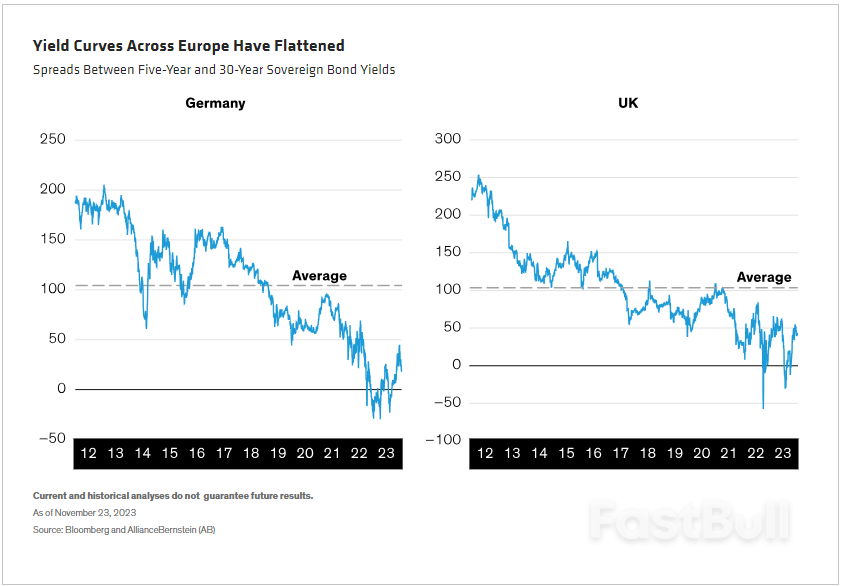
          The main worries for euro and UK treasury markets are mounting fiscal deficits leading to excess government bond supply and higher inflation risk premiums. These global pressures point to likely steepening at the long end of the euro and UK curves, where such factors tend to have most impact, and where we think investors should be underweight.
          Currently both the UK and euro government yield curves are abnormally flat, and their long ends could steepen sharply as they return to more normal levels. The spread between short and very long–dated bond yields is currently around 20 bps in Germany and 43 bps in the UK, compared with 12-year averages of around 105 bps (Display).
          European Fixed-Income Outlook: Fair Winds for 2024_1
          We prefer UK and Euro government bonds with less than five years to maturity, which will likely be the most responsive to rate cuts and the least sensitive to the longer-term factors driving long-dated treasuries.
          Several countries at the EU's periphery have improved their credit ratings lately. While the recent Moody's upgrade has boosted Italian government bond prices, we think Italy has more work to do to keep up with peers.
          UK gilts look cheap relative to German Bunds, and we expect the yield gap between them will continue to narrow. The twin benefits of higher yields and some spread tightening would give UK gilts scope to perform well over the next six to 12 months.

          Focus on Quality in European Credit Markets

          For UK and euro credit, we think a focus on quality will be important in 2024, given likely tough economic conditions. Weaker issuers will face increasing refinancing risks, while quality issuers will likely be able to refinance maturing bonds at reasonable rates.
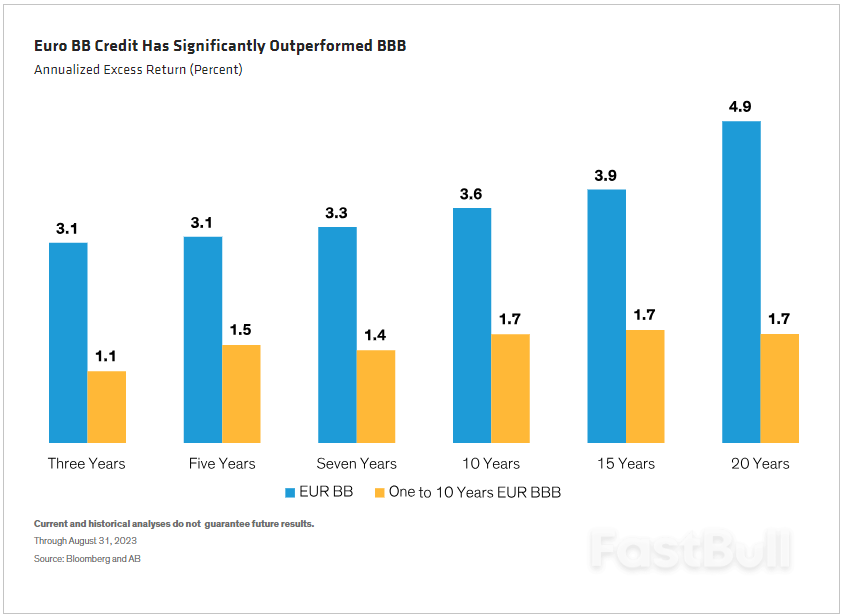
          We see the sweet spot for euro credit as the crossover zone between investment grade and high yield: BBB and BB-rated bonds. While more risk-averse investors will prefer BBB, our research shows that historically an allocation to BB has generated additional returns through the cycle in all but the worst default scenarios, with euro BBs outperforming BBBs over time by around 2% per year (Display).
          European Fixed-Income Outlook: Fair Winds for 2024_2
          Of course, euro BBB returns have been more stable. But on a risk-adjusted basis, BB still has an edge.

          Fundamental, Technical and Valuation Factors Look Favorable

          European credit fundamentals look encouraging. Corporate balance sheets started the tightening phase in good shape, and higher rates are feeding through only gradually to corporate costs. We expect euro and UK default rates will rise but stay relatively low at 3%–4% over 2024.
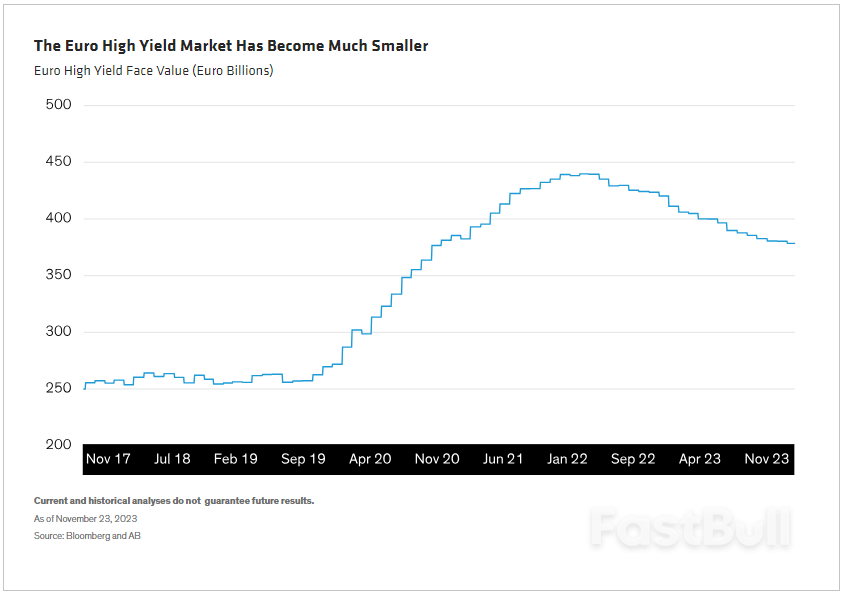
          Technical factors are also supportive across European credit markets, particularly for euro high yield. The market has shrunk by almost 15% since 2021, owing to both recent maturities and a net €10 billion of upgraded credits migrating out of high yield to investment grade (Display).
          European Fixed-Income Outlook: Fair Winds for 2024_3
          The remaining euro high-yield market is skewed 64% to BB—which is currently the segment investors favor. Around 7% of the market will mature in 2024, but we think strong demand should readily absorb any new higher-quality supply.
          In terms of current yields, valuations look supportive too. Euro BBB investment-grade bonds are yielding 5%—the same as the lowest-rated CCC bonds in 2017. And in euro high yield, a starting yield of 7.25% provides a substantial cushion against downside risks. Adjusting for interest-rate sensitivity, yields would need to increase by over 250 bps to wipe out that high income and produce negative returns. And to underperform sovereign bonds, spreads would need to widen from the current 483 bps by over 150 bps (Display).
          European Fixed-Income Outlook: Fair Winds for 2024_4

          Evaluate Downside Scenarios

          What could go wrong for a higher-quality euro credit allocation? In our view, a serious drawdown would need some combination of an imminent maturity wall, an economic shock leading to very high default rates, or big problems in an important sector. But currently, maturities are not a pressing problem, economies are stable and, in sector terms, the most troubled area is real estate, which is only 3%–4% of the high-yield market. As this whole sector has sold off, active management can have an important role to play in picking mispriced securities.
          Of course, both the UK and the eurozone are facing tough problems, including persistent low growth. But from a bond investor's perspective, high growth rates aren't necessary. Bondholders' returns won't be impaired so long as governments and corporates have enough revenue to service their interest payments and can refinance their debts. On that basis, we think conditions in 2024 for both sovereign and BBB/BB credit bondholders will be fair.

          Source: Alliance Bernstein

          To stay updated on all economic events of today, please check out our Economic calendar
          Risk Warnings and Disclaimers
          You understand and acknowledge that there is a high degree of risk involved in trading. Following any strategies or investment methods may lead to potential losses. The content on the site is provided by our contributors and analysts for information purposes only. You are solely responsible for determining whether any trading assets, securities, strategy, or any other product is suitable for investing based on your own investment objectives and financial situation.
          Comments
          Add to Favorites
          Share

          Is the World's Most Important Asset Market Broken?

          Michelle

          Economic

          Bond

          Is the World's Most Important Asset Market Broken?_1
          In 1790 america's finances were in a precarious state: debt-servicing costs were higher than revenues and government bonds traded at 20 cents on the dollar. Alexander Hamilton, the country's first treasury secretary, wanted a deep and liquid market for safe government debt. He understood the importance of investor confidence, so proposed honouring all debts, including those of states, and offering to swap old debt, at par, for new bonds with a lower interest rate. This was controversial. Shouldn't speculators who picked up cheap debt in secondary markets be paid less? Yet Hamilton could not be swayed: “When the credit of a country is in any degree questionable, it never fails to give an extravagant premium, in one shape or another, upon all the loans it has occasion to make.”
          More than two centuries later American politicians are busy undermining Hamilton's principles. Debt-ceiling brinkmanship has pushed America towards a technical default. Rising interest rates and incontinent spending have seen debt balloon: the country's total stock of it now amounts to $26.6trn (96% of gdp), up from $12.2trn (71% gdp) in 2013. Servicing costs come to a fifth of government spending. As the Federal Reserve reduces its holdings of Treasuries under quantitative tightening and issuance grows, investors must swallow ever greater quantities of the bonds.
          All this is straining a market that has malfunctioned frighteningly in the past. American government bonds are the bedrock of global finance: their yields are the “risk-free” rates upon which all asset pricing is based. Yet such yields have become extremely volatile, and measures of market liquidity look thin. Against this backdrop, regulators worry about the increasing activity in the Treasury market carried out by leveraged hedge funds, rather than less risky players, such as foreign central banks. A “flash crash” in 2014 and a spike in rates in the “repo” market, where Treasuries can be swapped for cash, in 2019, first raised alarms. The Treasury market was then overwhelmed by fire sales in 2020, as long-term holders dashed for cash, before the Fed stepped in. In November a cyberattack on icbc, a Chinese bank, disrupted settlement in Treasuries for days.
          Regulators and politicians want to find a way to minimise the potential for further mishaps. New facilities for repo markets, through which the Fed can transact directly with the private sector, were put in place in 2021. Weekly reports for market participants on secondary trading have been replaced with more detailed daily updates, and the Treasury is mulling releasing more data to the public. But these fiddles pale in comparison to reforms proposed by the Securities and Exchange Commission (sec), America's main financial regulator, which were outlined in late 2022. The sec has invited comment on these plans; it may begin to implement them from early next year.
          The result has been fierce disputes about the extent and causes of problems in the Treasury market—and the lengths regulators should go to repair them. A radical overhaul of Treasury trading comes with its own risks. Critics say that the proposed changes will needlessly push up costs for the Treasury. Do they have a point?

          Repo repair

          The modern Treasury market is a network of mind-bending complexity. It touches almost every financial institution. Short-term bills and long-term bonds, some of which pay coupons or are linked to inflation, are issued by the Treasury. They are sold to “primary dealers” (banks and broker dealers) in auctions. Dealers then sell them to customers: foreign investors, hedge funds, pension funds, firms and purveyors of money-market funds. Many buyers raise money to buy Treasuries using the overnight repo market, where bonds can be swapped for cash. In secondary markets high-frequency traders often match buyers and sellers using algorithms. Participants, in particular large asset managers, often prefer to buy Treasury futures—contracts that pay the holder the value of a specific Treasury on an agreed date—since it requires less cash up front than buying a bond outright. Each link in the chain is a potential vulnerability.
          The most important of the sec's proposals is to mandate central clearing, under which trading in the Treasury and repo markets would pass through a central counterparty, rather than occur on a bilateral basis. The counterparty would be a buyer to every seller and a seller to every buyer. This would make market positions more transparent, eliminate bilateral counterparty risk and usher in an “all to all” market structure, easing pressure on dealers to intermediate trades. Nate Wuerffel of bny Mellon, an investment bank, has written that central-clearing rules will be put in place relatively soon.
          Yet the sec's most controversial proposal concerns the so-called basis trade that links the market for Treasuries to the futures market. When buying a futures contract investors need only post “initial margin”, which represents a fraction of the face value of the Treasury. This is often easier for asset managers than financing a bond purchase through the repo market, which is more tightly regulated. As such, there can be an arbitrage between cash and futures markets for Treasuries. Hedge funds will go short, selling a contract to deliver a Treasury, in the futures market and then buy that Treasury in the cash market. They often then repo the Treasury for cash, which they use as capital to put on more and more basis trades. In some cases funds apparently rinse and repeat this to the extent that they end up levered 50 to one against their initial capital.
          At most times, this trade is pretty low risk. But in times of market stress, such as in 2020, when Treasury prices swung wildly, futures exchanges will send out calls to hedge funds for more margin. If funds cannot access cash quickly they sometimes must close their positions, prompting fire sales. The unwinding of basis trades in 2020 may have exacerbated market volatility. Therefore the sec has proposed that hedge funds which are particularly active in the Treasury market should be designated as broker-dealers and forced to comply with stricter regulations, instead of the simple disclosure requirements that they currently face. It is also considering new rules that would limit the total leverage hedge funds can access from banks.
          This has infuriated those who make money from the manoeuvre. In October Ken Griffin, boss of Citadel, the world's most profitable hedge fund, argued that the regulator was simply “searching for a problem”. He pointed out that the basis trade reduces financing costs for the Treasury by enabling demand in the futures market to drive down yields in the cash market.

          Will policymakers hold firm?

          In a sign of diverging opinions between the sec and the Treasury, Nellie Liang, an undersecretary at the finance ministry, recently suggested that the market may not be functioning as badly as is commonly believed, and that its flaws may reflect difficult circumstances rather than structural problems. After all, market liquidity and rate volatility feed into each other. Thin liquidity often fosters greater rate volatility, because even a small trade can move prices—and high volatility also causes liquidity to drop, as it becomes riskier to make markets.
          Moreover, high volatility can be caused by wider events, as has been the case in recent years, which have been unusually lively. It is far from certain that periods of extreme stress, like March 2020 or the chaos caused in the British gilt market when derivative bets made by pension funds blew up, could be avoided with an alternative market structure.
          In addition to the proposals from the sec, the Treasury is working on its own measures to improve how the market functions. These include data gathering and transparency, and beginning buybacks. Buybacks would involve the Treasury buying up older, less liquid issuance—say, ten-year bonds issued six months ago—in exchange for new and more liquid ten-years, which it is expected to start doing from 2024. The Treasury has acknowledged that leverage practices, which make the basis trade possible, warrant investigation, but Ms Liang has also said that there are upsides to the basis trade, such as increased liquidity.
          Hamilton, the father of the Treasury market, could not have envisaged the vast network of institutions that make up its modern version. Yet he did have a keen appreciation for the role of speculators, who stepped in to buy Treasuries when bondholders lost faith or needed cash. He would have been far more concerned with politicians rolling the dice on defaulting and the growing debt stock than he would have been by enthusiastic intermediators. Although plenty of his successors' suggestions have widespread support—such as buybacks and central clearing—they would do well to remember his aversion to snubbing those keen to trade.

          Source: Economist

          To stay updated on all economic events of today, please check out our Economic calendar
          Risk Warnings and Disclaimers
          You understand and acknowledge that there is a high degree of risk involved in trading. Following any strategies or investment methods may lead to potential losses. The content on the site is provided by our contributors and analysts for information purposes only. You are solely responsible for determining whether any trading assets, securities, strategy, or any other product is suitable for investing based on your own investment objectives and financial situation.
          Comments
          Add to Favorites
          Share

          As El Niño Intensifies, Natural Gas Takes a Tumble

          Glendon

          Commodity

          The El Niño weather pattern that could herald a warmer-than-normal winter in North America is gaining in intensity, with sea surface temperatures in the equatorial Pacific Ocean rising 1.5 degrees Centigrade above normal levels through the August-October three-monthly tracking period this year (Figure 1).
          As El Niño Intensifies, Natural Gas Takes a Tumble_1
          The strongest El Niño was recorded in 2015/16 when sea surface temperatures in the central and east-central Pacific Ocean rose 2.6 degrees above normal, putting pressure on natural gas and electricity prices in the United States as demand for space heating in homes and offices declined. This year's El Niño has been categorized as “strong,” with temperatures having risen by 1.5 degrees above normal. When the scale exceeds two degrees, the classification changes to “very strong.”
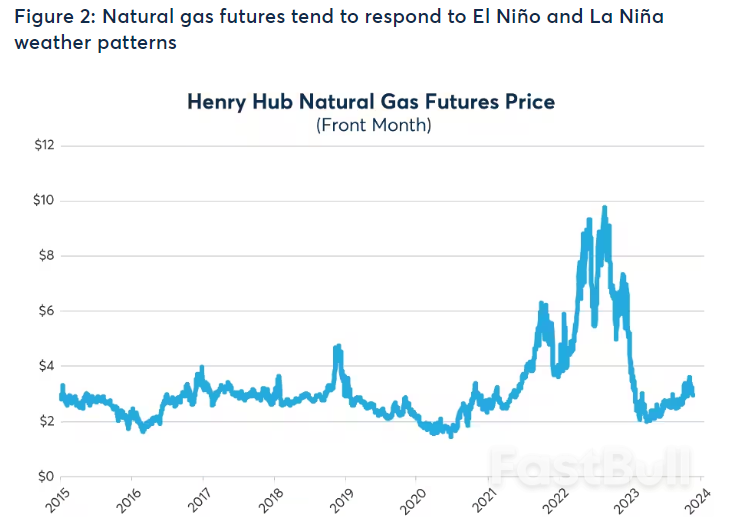
          So, how might El Niño impact the markets this time around? For starters, natural gas prices in the U.S. are down about 70% from their highs of August 2022. That's in line with market moves during the El Niño of 2015/16 when prices of natural gas tumbled by 72% from February 2014 to February 2016. The market bottomed out in March 2016 and began a five-year climb that peaked in August 2022 – a rise of 236% from the lows in 2020. This rally coincided with a La Niña, which brings cooler-than-normal temperatures, that took hold for most of 2021 and 2022 (Figure 2).
          As El Niño Intensifies, Natural Gas Takes a Tumble_2
          While the declines in natural gas prices this year could be attributed to the La Niña effect, there is another significant factor at play: stockpiles. Natural gas in storage in the Lower 48 states is running at 3.8 billion cubic feet (bcf) as of November 2023, about 5% higher than levels a year ago, and 5.2% higher than the five-year average. The Energy Department forecast in November for inventories to be even higher during the winter heating season from November to March at 21% above the five-year average (Figure 3).
          As El Niño Intensifies, Natural Gas Takes a Tumble_3
          There are also other factors for investors in the natural gas market to focus on:
          Production: U.S. natural gas production is expected by the Energy Department to hit a record high of 103.72 billion cubic feet daily (bcfd) this year and 105.13 bcfd in 2024. That compares with 99.60 bcfd in 2022. So, ample supply could keep a lid on the market, all else being equal.
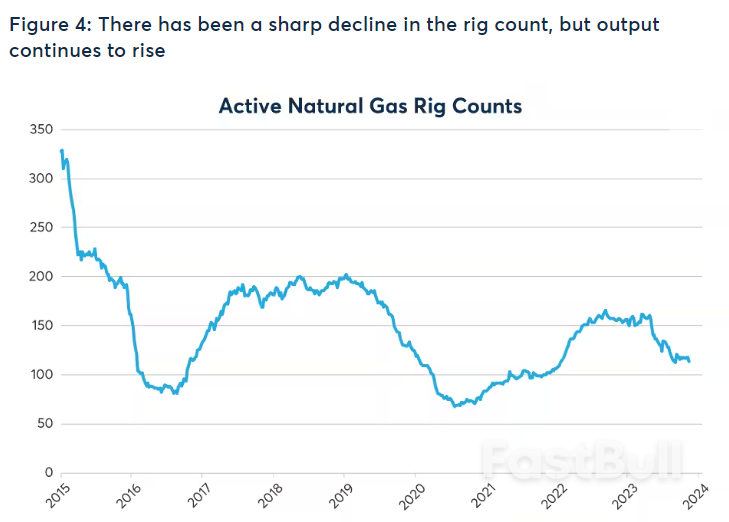
          Investment: Rig counts for natural gas have tumbled from a high of 161 in April 2023 to 118 by early November (Figure 4). This could lead to little meaningful new exploration taking place in the short term, but rigs have become more efficient, helping to bolster production even when their numbers are down.
          As El Niño Intensifies, Natural Gas Takes a Tumble_4
          Exports: Natural gas shipments in the first half of this year exceeded those for the whole of last year. Exports took off in a big way in 2016 when the Chenière Sabine Pass became operational. Exports soared 1.51 trillion cubic feet (tcf) from 2014 to 6.9 tcf in 2022. This could help underpin prices.
          Demand: Natural gas consumption by both residential and commercial users will likely be lower this year compared to 2022 due to the expected warmer-than-normal weather conditions in the northern U.S. If the El Niño is followed by a La Niña like in 2016, it could spark a rally in natural gas prices.
          Alternatives: Large amounts of alternative energy production capacity are also coming on line, but with alternatives there are two things to remember: First, capacity isn't the same thing as generation. Solar panels and wind turbines generate nothing when the sun isn't shining or the wind isn't blowing, respectively. On average, they run at about one quarter capacity whereas natural gas generation comes close to operating at full capacity.
          Secondly, investment in the solar and wind sectors depends heavily on tax subsidies, and the future of such tax subsidies depends on political outcomes in Washington that are difficult to forecast. Coal, meanwhile, is natural gas's main competitor and is in terminal decline.

          El Niño and the Midwest Grain Belt

          The El Niño is arriving at a time when low water levels are already posing challenges to transporting grain on the Mississippi River, a key artery for the shipment of a variety of commodities including oil from production centers in the Midwest and elsewhere to export points along the Gulf Coast.
          Warmer-than-normal in the northern United States coupled with reduced rainfall could aggravate the situation on the Mississippi River and impact movement of commodities along the primary waterway. But transportation during the winter months does come to a crawl as parts of the river, especially along the upper reaches of the Midwest are closed due to ice formation. The Panama canal, another important waterway that connects the Pacific and Atlantic oceans and is crucial to maritime trade is already restricting the number of vessels passing through it due to low water levels. The Baltic Dry Index, typically a measure of freight used to transport dry bulk cargoes like grains, fell 34% between mid-October and early November before recovering half the losses.
          As for crops in the U.S. Midwest, the corn and soybean crops are largely harvested by November, with planting of new crops beginning in March. The hard and soft red winter wheat crops are harvested by the summer, with new crop plantings beginning in the spring of 2024.
          While the fields lie fallow in the winter months, the amount of rain and snowfall in the Midwest through this period is important in adding to sub-soil moisture. The U.S. Department of Agriculture said in a report in November that 40% of the area growing corn is affected by drought, 42% for soybean and 44% of winter wheat. It said 48% of the rice area is affected by drought.
          While an El Niño could exacerbate drought conditions in the Midwest, does the weather phenomenon impact the price of grains? For the answer, we look to the 2015/16 El Niño, which began in 2015 with temperatures 0.5 degrees above normal. By the middle of the year, temperatures had reached 1.5-1.9 degrees above normal, peaking at 2.6 degrees above normal at the end of the year. The La Niña continued for the first five month of 2016 before fading away.
          Chicago corn futures began 2015 at $3.98 per bushel (when temperatures were 0.5 degrees above normal), fell to $3.55 by mid-year (when temperatures were 1.5-1.9 degrees above normal), climbing slightly to $3.60 by the end of 2015 (when temperatures were peaking at 2.6 degrees above normal). By March 28, 2016, corn prices were at $3.56, beginning a rally that would take prices to $4.38 by June that year (when the El Niño had faded away and four months before the start of La Niña) (Figure 5).
          As El Niño Intensifies, Natural Gas Takes a Tumble_5
          On balance, increased exports could support a rise in natural gas prices, but rising production and an expected drop in winter demand could negate any such argument to the upside – unless a La Niña follows on the heels of the El Niño like it did in 2016.

          Source: CME Group

          Risk Warnings and Disclaimers
          You understand and acknowledge that there is a high degree of risk involved in trading. Following any strategies or investment methods may lead to potential losses. The content on the site is provided by our contributors and analysts for information purposes only. You are solely responsible for determining whether any trading assets, securities, strategy, or any other product is suitable for investing based on your own investment objectives and financial situation.
          Comments
          Add to Favorites
          Share

          December 5th Financial News

          FastBull Featured

          Daily News

          [Quick Facts]

          1. Israeli forces push into southern Gaza and launch heavy airstrikes.
          2. NY Fed: Underlying U.S. inflation pressures eased in October.
          3. Goldman Sachs: Markets make excessive rate-cut pricing.
          4. Saudi Arabia says 'absolutely not' to oil phaseout at COP28 summit.
          5. U.S. October factory orders fell to a three-and-a-half-year low.
          6. The market's rate-cut bets will be challenged by the dot plot.

          [News Details]

          Israeli forces push into southern Gaza and launch heavy airstrikes
          Israeli troops and tanks began launching intensive airstrikes on the southern Gaza Strip city of Khan Yunis on Monday afternoon after largely taking control of the devastated northern region and clashing fiercely with Palestinian militants there.
          U.N. Secretary-General António Guterres called on Israel to stop actions that would lead to a further deterioration of the already dire humanitarian situation in Gaza and to avoid further civilian suffering. Israel's ally, the United States, has repeatedly urged it to do more to protect civilians, saying Israel's offensive in the south should not lead to "massive" civilian casualties like in the north.
          Health authorities in Gaza said Israeli airstrikes had killed about 900 people since the truce ended last Friday.
          NY Fed: Underlying U.S. inflation pressures eased in October
          The New York Fed released a report on Monday showing that its multivariate core trend (MCT) inflation gauge was reported at 2.6% in October, down from 2.88% in September. The October MCT reading was also in line with the six-month trend for the much-watched Personal Consumption Expenditures (PCE) price index, which rose 2.5% in October. The New York Fed said the MCT inflation is currently higher than the pre-pandemic average, due in large part to the sector-specific trends in housing and services ex-housing. The NY Fed's MCT index is designed to measure inflation persistence and how broadly price pressures are changing. The index touched a peak in June 2022 at 5.44%. The report came at a time when it was widely expected that the Fed's current interest rates appear to have peaked.
          Goldman Sachs: Markets make excessive rate-cut pricing
          Goldman Sachs said financial markets are overly optimistic about the extent of the Fed's rate cuts next year as the market expects the Fed to cut rates by 125 basis points in the next 12 months, including 50 basis points by the end of June. This is much more aggressive than Goldman's forecasts. The bank only projects one rate cut in 2024, by 25 basis points.
          Saudi Arabia says 'absolutely not' to oil phaseout at COP28 summit
          Saudi Energy Minister Abdulaziz bin Salman Al Saud said in a television interview on Monday that his country would not agree to phase out fossil fuels asked at the COP28 Summit in Dubai.
          An agreement to call for a fossil fuel phase-out or phase-down is a key demand of many countries at COP28 including the US and EU. The text must be agreed upon unanimously. Negotiations will continue through December 12. Negotiators have been considering other options, such as limiting the unmitigated fossil fuels or linking it to a just (energy) transition.
          In addition, Salman said OPEC+ oil production cuts could continue beyond the first quarter of next year if needed. About half of the production cuts by more than 2 million barrels per day (bpd) announced last week came from Saudi Arabia. It will only be canceled after market conditions are improved and will be a gradual phased out. Market watchers noted that only about half of the cuts were newly added and they questioned whether the promised cuts would actually be implemented.
          U.S. October factory orders fell to a three-and-a-half-year low
          U.S. new orders fell more than expected in October, dragged down by weak demand and high interest rates which began to weigh on spending. Data showed that U.S. factory orders posted a monthly decline of 3.6% in October, the lowest level since April 2020. The manufacturing sector, boosted by a surge in goods spending in the third quarter, is increasingly feeling the pressure of rising interest rates and there are further signs that the economy will slow sharply in the fourth quarter.
          The market's rate-cut bets will be challenged by the dot plot
          Market bets on a Fed rate cut are surging. It's easy to understand why markets are doing so despite Powell's warnings. That's because key indicators are weaker than they were in July 2019 when the Fed last shifted from tightening to easing. The Fed will update its dot plot this month, and then these market bets may be challenged. Policymakers may be reluctant to sharply lower their median rate estimate of 5.125% at the end of 2024 (25 basis points lower than now), as this would trigger further bond yield gains. In addition, the bond rally in November may have affected the economy, offsetting the Fed's efforts at restrictive policy, such as the 10-year real yield, which has fallen back below 2%. This does not support an easing of policy in the near term.

          [Focus of the Day]

          UTC+8 11:30 RBA Rate Statement
          UTC+8 23:00 U.S. ISM Non-Manufacturing PMI (Nov)
          UTC+8 23:00 U.S. JOLTS Job Openings (Oct)
          Risk Warnings and Disclaimers
          You understand and acknowledge that there is a high degree of risk involved in trading. Following any strategies or investment methods may lead to potential losses. The content on the site is provided by our contributors and analysts for information purposes only. You are solely responsible for determining whether any trading assets, securities, strategy, or any other product is suitable for investing based on your own investment objectives and financial situation.
          Comments
          Add to Favorites
          Share

          Israel Orders Evacuations as It Widens Offensive, But Palestinians Are Running out of Places to Go

          Michelle

          Political

          Palestinian-Israeli conflict

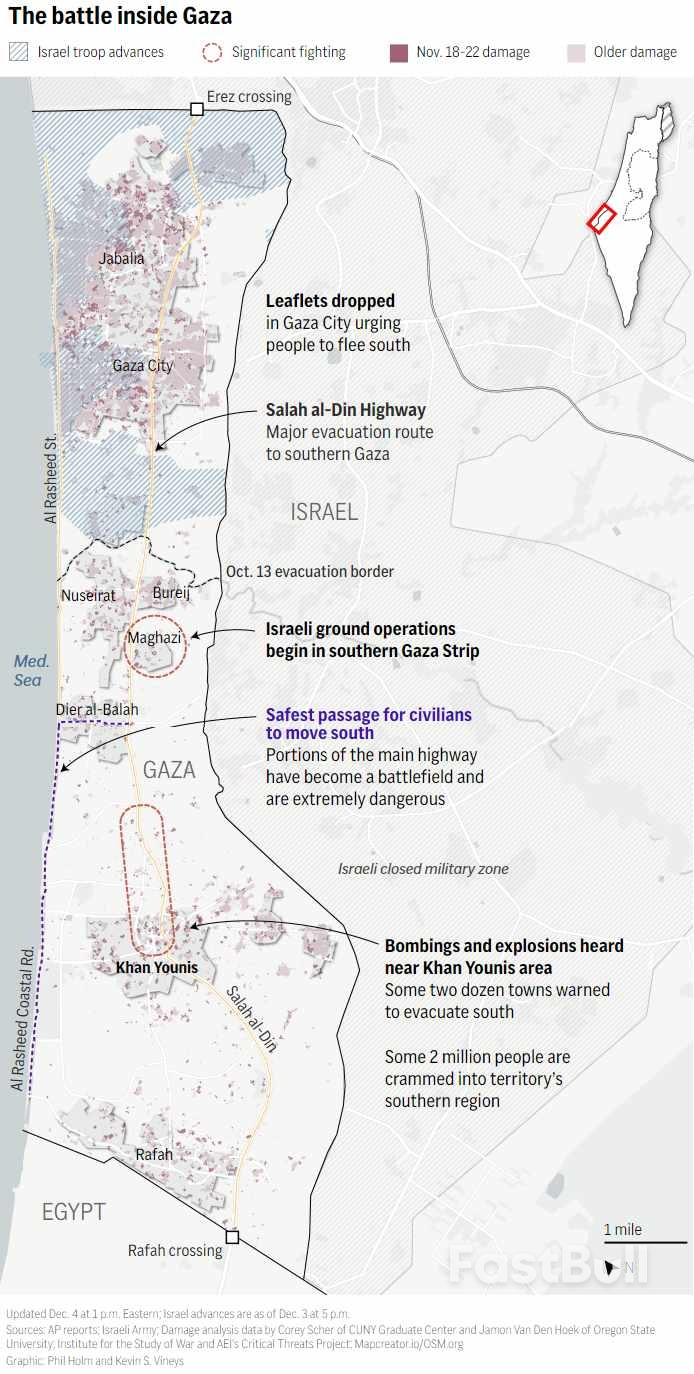
          Israeli warplanes heavily bombarded an area around Khan Younis in southern Gaza on Monday as the military ordered mass evacuations from the town in the face of a widening ground offensive that is pushing Palestinians into a progressively shrinking portion of the besieged territory.
          The expanded assault posed a deadly choice for hundreds of thousands of Palestinians — either stay in the path of Israeli forces or flee within the confines of southern Gaza with no guarantee of safety. Aid workers warned that the mass movement would worsen the already dire humanitarian catastrophe in the territory.
          “Another wave of displacement is underway, and the humanitarian situation worsens by the hour,” the Gaza chief of the U.N. agency for Palestinian refugees, Thomas White, said in a post on X.
          Israel Orders Evacuations as It Widens Offensive, But Palestinians Are Running out of Places to Go_1
          Adding to the chaos, phone and internet networks across Gaza collapsed again Monday evening, the Palestinian telecom provider PalTel reported. The network has broken down multiple times during the war, making it largely impossible for residents to communicate with each other or the outside world for hours or sometimes several days until it is repaired.
          Israel has vowed to eliminate Gaza's Hamas rulers, whose Oct. 7 attack into Israel killed some 1,200 people, mostly civilians, and triggered the deadliest Israeli-Palestinian violence in decades. The war has already killed thousands of Palestinians and displaced over three-fourths of the territory's population of 2.3 million people. Palestinian health officials say bombardment has killed several hundred civilians since a weeklong truce ended Friday.
          Already under mounting pressure from its top ally, the United States, Israel appears to be racing to strike a death blow against Hamas — if that's possible, given the group's deep roots in Palestinian society — before any new cease-fire. But the mounting toll is likely to further increase international pressure to return to the negotiating table.
          Airstrikes and the ground offensive in northern Gaza have reduced large swaths of Gaza City and nearby areas to a rubble-filled wasteland. Hundreds of thousands of residents fled south during the assault.
          Now around 2 million people — most of the territory's population — are crowded into the 230 square kilometers (90 square miles) of southern and central Gaza, where Israel's ground offensive is now moving, threatening to render even larger areas uninhabitable.
          Since the truce's collapse, the military has ordered the population out of an area of about 62 square kilometers (24 square miles) in and near Khan Younis, according to the evacuation maps issued by the Israeli military. That further reduces the space available for Palestinians by more than a quarter.

          FIGHTING IN CENTRAL GAZA

          Constant bombardment on the edges of Khan Younis, Gaza's second-largest city, lit up the sky over the town Monday evening, and a stream of ambulances carrying wounded, including several women and children, flowed to the main hospital.
          Over the past few days, Israeli strikes have been “on a ferocious scale,” said Mohammed Aghaalkurdi, an aid worker with the group Medical Aid for Palestinians in Khan Younis. “Barely has any kind of aid been delivered to the people, nor is there any food left in shops.”
          He said neighborhoods and shelters were emptying as people fled. Leaflets dropped by the Israeli military warn people to go south toward the border with Egypt, but they are unable to leave Gaza, as both Israel and neighboring Egypt have refused to accept any refugees.
          The area that Israel ordered evacuated covers about a fifth of Khan Younis. Before the war, that area was home to some 117,000 people, and now it also houses more than 50,000 people displaced from the north, living in 21 shelters, the U.N. said.
          It was not known how many were fleeing. Some Palestinians have ignored past evacuation orders, saying they do not feel any safer since areas where they are told to flee have also been bombed. Many also fear they will never be allowed back to their homes.
          It was not clear where Israeli troops have moved into southern Gaza, but the military told people to stay off the main road between Khan Younis and Deir al-Balah, suggesting forces were moving between the two towns.
          Israeli media also reported intense fighting between Israeli troops and Hamas militants in northern Gaza — in the Jabaliya refugee camp and the Gaza City district of Shijaiya, both scenes of intense bombardment and battles in recent weeks.
          Rear Adm. Daniel Hagari, the Israeli military spokesman, said the army is pursuing Hamas with “maximum force” in the north and south while trying to minimize harm to civilians.
          He pointed to a map that divides southern Gaza into dozens of blocks in order to give “precise instructions” to residents on where to evacuate. Most are urged to flee south, but, confusingly, a map posted on X by the military Monday urged people to flee into Fakhari, a district east of Khan Younis that the military ordered evacuated a day before.
          “The level of human suffering is intolerable,” Mirjana Spoljaric, the president of the International Committee of the Red Cross, said during a rare visit to Gaza. “It is unacceptable that civilians have no safe place to go in Gaza, and with a military siege in place, there is also no adequate humanitarian response currently possible.”
          She also called for the immediate release of scores of hostages still held by Palestinian militants since the Oct. 7 attack.
          In a letter to the Red Cross chief, a group of released Israeli hostages asked to meet her while she is visiting the region and called for more help from the organization to free the remaining 137 captives.
          “Every day that passes could be their last, and the suffering they endure is inhuman,” wrote the eight freed captives and 102 relatives of hostages still in captivity.

          RISING TOLL

          The Health Ministry in Gaza said the death toll in the territory since Oct. 7 has surpassed 15,890 people – 70% of them women and children — with more than 42,000 wounded. The ministry does not differentiate between civilian and combatant deaths.
          Health Ministry spokesman Ashraf al-Qidra said hundreds have been killed or wounded since the cease-fire's end, with many still trapped under rubble.
          The Al-Aqsa Martyrs Hospital in Deir al-Balah received 32 bodies overnight after Israeli strikes across central Gaza, said Omar al-Darawi, an administrative employee. Associated Press footage showed women in tears, kneeling over the bodies of loved ones and kissing them.
          The Israeli military said aircraft struck some 200 Hamas targets overnight, with ground troops operating “in parallel,” without elaborating. It said troops in northern Gaza uncovered two militant tunnel shafts that held explosives and weapons in a school after coming under attack.
          It is not possible to independently confirm battlefield reports from either side.
          Israel says it targets Hamas operatives and blames civilian casualties on the militants, accusing them of operating in residential neighborhoods. Still, it does not provide accounting for its targets in individual strikes.
          Israel claims to have killed thousands of militants, without providing evidence. The military says at least 81 of its soldiers have been killed.

          U.S. PRESSURE

          The U.S. is pressing Israel to avoid more mass displacements and civilian deaths, a message underscored by Vice President Kamala Harris during a visit to the region. She also said the U.S. would not allow the forced relocation of Palestinians out of Gaza or the occupied West Bank, or the redrawing of Gaza's borders.
          But it's unclear how far the Biden administration is willing or able to go in pressing Israel to rein in the offensive, even as the White House faces growing pressure from its allies in Congress.
          The U.S. has pledged unwavering support to Israel since the Oct. 7 attack, including rushing munitions and other aid to the country.
          Israel has rejected U.S. suggestions that control over postwar Gaza be handed over to the internationally recognized Palestinian Authority as part of a renewed effort to resolve the overall conflict by establishing a Palestinian state.

          Source: AP

          Risk Warnings and Disclaimers
          You understand and acknowledge that there is a high degree of risk involved in trading. Following any strategies or investment methods may lead to potential losses. The content on the site is provided by our contributors and analysts for information purposes only. You are solely responsible for determining whether any trading assets, securities, strategy, or any other product is suitable for investing based on your own investment objectives and financial situation.
          Comments
          Add to Favorites
          Share

          US Manufacturing Mired in Weakness, Economy Heading for Slowdown

          Glendon

          Economic

          US Manufacturing Mired in Weakness, Economy Heading for Slowdown_1
          U.S. manufacturing remained subdued in November, with factory employment declining further as hiring slowed and layoffs increased, more evidence that the economy was losing momentum after robust growth last quarter.
          The survey from the Institute for Supply Management (ISM) on Friday followed on the heels of data on Thursday showing moderate growth in consumer spending and subsiding inflation in October. Economic activity is cooling as higher interest rates crimp demand. Most economists, however, do not expect a recession next year and believe the Federal Reserve will be able to engineer the hoped-for "soft landing."
          Speaking during an event at Spelman College in Atlanta on Friday, Federal Reserve Chair Jerome Powell said "we are getting what we wanted to get" out of the economy.
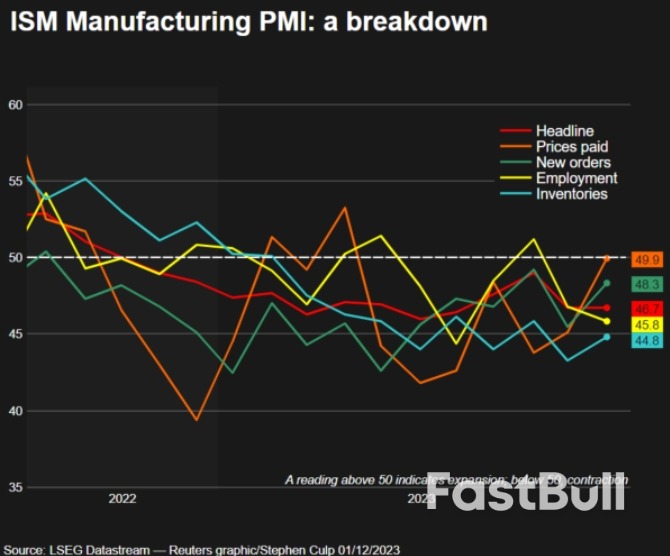
          The ISM said that its manufacturing PMI was unchanged at 46.7 last month. It was the 13th consecutive month that the PMI stayed below 50, which indicates contraction in manufacturing. That is the longest such stretch since the period from August 2000 to January 2002.
          Some economists believed that the United Auto Workers strike, which ended in late October, continued to have an impact on the PMI. A rebound anytime soon is unlikely as manufacturers in the ISM survey mostly described inventories as bloated.
          "This implies the goods sector overestimated demand and production could slow further in the next few months, though that too could reflect lingering strike effects if auto parts piled up when production was idled," said Will Compernolle, macro strategist at FHN Financial in New York.
          Economists polled by Reuters had forecast the index creeping up to 47.6. According to the ISM, a PMI reading below 48.7 over a period of time generally indicates a contraction of the overall economy. The economy, however, continues to expand, growing at a 5.2% annualized rate in the third quarter.
          Three industries - food, beverage and tobacco as well as transportation equipment and nonmetallic mineral products - reported growth last month. The 14 industries reporting contraction included paper products, electrical equipment, appliances and components, computer and electronic products, machinery and miscellaneous manufacturing.
          Comments from manufacturers were mostly downbeat and cited the need to reduce inventory levels. Makers of computer and electronic products said the "economy appears to be slowing dramatically." Miscellaneous manufacturing firms said "customer orders have pushed into the first quarter of 2024, resulting in inflated end-of-year inventory."
          Producers of food, beverage and tobacco reported that "our executives have requested that we bring down inventory levels considerably, and it has started causing customer shortages." Makers of fabricated metal products said "automotive sales (are) still impacted by (the) UAW strike," adding they were "still waiting for orders to come in."
          The persistent decline in the PMI likely overstates the weakness in manufacturing, which accounts for 11.1% of the economy. Orders for long-lasting manufactured goods are up strongly on a year-on-year basis and factory production has held up, excluding the effects of the UAW industrial action.
          "We are not inclined to infer much deterioration from the ISM composite unless it clearly drifts outside of this year's range, from a low of 46.3 in March to a short-lived high of 49.0 in September," said Jonathan Millar, a senior economist at Barclays in New York.
          Stocks on Wall Street were trading higher. The dollar fell against a basket of currencies. U.S. Treasury prices rose.
          US Manufacturing Mired in Weakness, Economy Heading for Slowdown_2

          STRONG CONSTRUCTION SPENDING

          A separate report from the Commerce Department's Census Bureau showed construction spending rising solidly in October, fueled by single-family homebuilding.
          "Despite the emerging signs of a slowdown, investors should know there are opportunities in the markets," said Jeffrey Roach, chief economist at LPL Financial in Charlotte, North Carolina. "The current state of the housing market could bode well for homebuilders."
          US Manufacturing Mired in Weakness, Economy Heading for Slowdown_3
          The ISM survey's forward-looking new orders sub-index rose to a still-weak 48.3 last month from 45.5 in October. A measure of factory inventories remained depressed last month, but the gauge of stocks at customers increased to what the ISM described as the upper end of "just right."
          "Leading indicators in the report, particularly new orders and customer inventory levels, do not point to an upturn in activity in the immediate future," said Conrad DeQuadros, senior economic advisor at Brean Capital in New York. "However, neither does the report point to the pervasive weakness in manufacturing that is typically associated with recession."
          Prices for factory inputs were subdued, though they were no longer falling at the pace seen in prior months. The survey's measure of prices paid by manufacturers increased to 49.9, the highest reading in seven months, from 45.1 in October.
          Nevertheless, price pressures in the economy are subsiding. Annual inflation increased in October at its slowest pace in more than 2-1/2 years, the government reported on Thursday.
          Cooling inflation is fanning optimism that the Fed is probably done raising rates this cycle, with financial markets even anticipating a rate cut in mid-2024.
          Factory employment declined for a second straight month, with the ISM noting an increase in "attrition, freezes and layoffs to reduce head counts."
          The survey's gauge of factory employment dropped to 45.8 last month from 46.8 in October. This measure has not been a reliable predictor of manufacturing payrolls in the government's closely watched employment report.
          Manufacturing payrolls are expected to have rebounded in November as about 33,000 striking UAW members returned to work. Factory payrolls dropped by 35,000 jobs in October.
          Overall nonfarm payrolls are expected to have increased by 170,000 jobs last month after rising 150,000 in October, according to a preliminary Reuters survey of economists.
          The government is scheduled to publish November's employment report next Friday.

          Source: Reuters

          To stay updated on all economic events of today, please check out our Economic calendar
          Risk Warnings and Disclaimers
          You understand and acknowledge that there is a high degree of risk involved in trading. Following any strategies or investment methods may lead to potential losses. The content on the site is provided by our contributors and analysts for information purposes only. You are solely responsible for determining whether any trading assets, securities, strategy, or any other product is suitable for investing based on your own investment objectives and financial situation.
          Comments
          Add to Favorites
          Share

          OPEC+ Policy Key for Oil Outlook

          Justin

          Central Bank

          Commodity

          Tighter oil market in the second half of next year

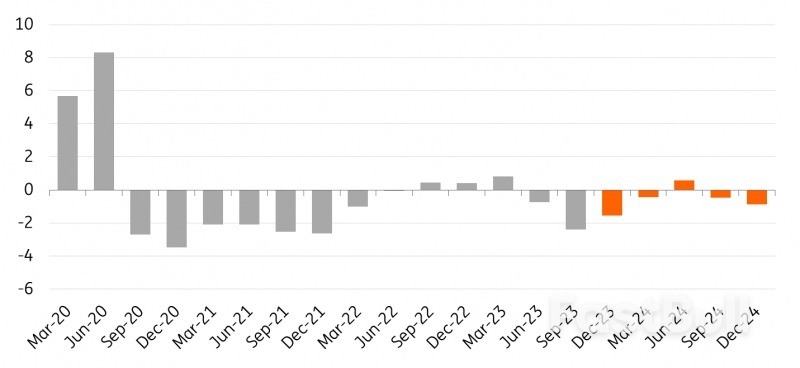
          Going into 2024, the market has been concerned about a looming surplus in the first quarter of next year, driven by seasonally weaker demand. However, at their last meeting, OPEC+ took action to erase this expected surplus. Saudi Arabia and Russia will roll over voluntary additional supply cuts through until the end of 1Q24, whilst a handful of other members have announced their own additional voluntary supply cuts. In total, these cuts amount to a little less than 2.2MMbbls/d. However, the amount that is actually included in the new additional cuts is 900Mbbls/d.
          These supply cuts should be enough to remove the surplus in 1Q24 and, in fact, leave the market in a small deficit early next year. However, our balance still shows a small surplus in 2Q24, which means that the market is largely balanced over 1H24. This could and will likely change depending on how OPEC+ members go about unwinding these voluntary cuts.
          Given that balanced market, we expect ICE Brent to remain trading in the low $80s in the early part of next year.
          The second half of 2024 will see the market return to deficit, which suggests we see prices moving higher in 2H24. We forecast Brent to average US$91/bbl over the last six months of 2024.

          Global oil balance (MMbbls/d)

          OPEC+ Policy Key for Oil Outlook_1

          OPEC+ policy is key

          OPEC+ has been very active over the last year in an attempt to support the market. Saudi Arabia has led the way in pushing for deep cuts, and this is evident with the voluntary cuts we are seeing from the Kingdom. Saudi Arabia has a fiscal breakeven oil price of a little over US$80/bbl, so they are keen to ensure that oil prices remain mostly above this level.
          The view that US supply growth is slowing has also given OPEC+ confidence in cutting supply without the risk of losing market share. While US supply growth has surprised to the upside this year, it is expected to slow substantially next year, which suggests that the Saudis will remain comfortable holding supply from the market.
          However, the latest OPEC+ meeting has highlighted some key issues within the group. Firstly, some members (Angola specifically) are not happy with their production quotas for 2024 and have already said that they will reject their quota level for next year. However, from a supply point of view, given the pressure we have seen on Angolan output this is unlikely to move the needle much.
          A bigger concern for OPEC+ should be the fact that they have been unable to agree on group-wide cuts. Instead, we are seeing voluntary cuts from a handful of members. Clearly, given the scale of cuts we are already seeing from the group, it is becoming increasingly more difficult for some members to stomach further cuts.
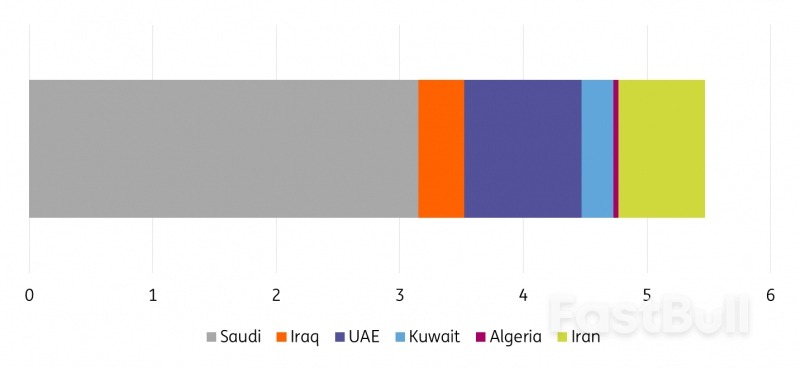
          Also, given the scale of cuts we are seeing, OPEC is sitting on a substantial amount of spare capacity. If we include Iran, OPEC has around 5.5MMbbls/d of spare capacity. And this will only increase over 1Q24 following the latest announced reductions. 58% of this sits with Saudi Arabia. This spare capacity should also offer some comfort to markets given that should we see significant price strength, one would expect this capacity to start to return to the market.

          OPEC spare capacity (MMbbls/d)

          OPEC+ Policy Key for Oil Outlook_2

          Sanction risk

          Sanctions leave a lot of supply risk in the market next year. And this is particularly the case for Iran and Venezuela. The US also appears to be enforcing the G-7 price cap on Russian oil more strictly in recent months.
          Iran has increased its supply significantly over 2023, rising from around 2.5MMbbls/d at the beginning of the year to around 3.1MMbbls/d currently. This has happened despite US sanctions remaining in place against the country. The US has been concerned about the high-price environment and supply risks facing the market since Russia’s invasion of Ukraine and appears to have taken a softer stance against Iran.
          However, following recent events in Israel and the possibility of Iranian involvement, there is the risk that the US will start to enforce sanctions more strictly in future. If this were to happen, we could see more than 500Mbbls/d of supply lost. For now, we are assuming Iranian flows will remain at around 3.1MMbbls/d in 2024.
          As for Venezuela, the US has eased oil sanctions in return for fairer general elections in the country next year. However, if this does not happen, we could very well see these sanctions reintroduced against Venezuela. The supply at risk would be around 200Mbbls/d.
          In recent months, the US Treasury has also been more active in sanctioning shipping companies which have transported Russian oil above the $60/bbl price cap. This move may drive many Western shipping companies away from transporting Russian oil altogether, given the sanction risk they face if it turns out the oil is priced above US$60/bbl. Therefore, going into next year, it might become more challenging to ship Russian oil using Western shipping services. Although, Russia has built up a sizeable fleet of its own tankers in order to get around the G-7 price cap.

          US supply growth

          US oil supply growth has surprised to the upside in 2023, with it estimated to grow by 1MMbbls/d to a record high of 12.9MMbbls/d.
          However, drilling activity in the US has slowed significantly this year, which suggests that the US will see more modest supply growth in 2024, with it forecast to grow by 250Mbbls/d to 13.15MMbbls/d. A focus on shareholder returns, cost inflation, tighter credit conditions, and increased consolidation within the industry are some of the factors holding back drilling activity.

          Global oil demand growth slows

          There is plenty of uncertainty over oil demand in 2024, given the uncertainty over the macro picture next year.
          Global oil demand is still expected to grow by around 1MMbbls/d next year, which would be down from around 2MMbbls/d of growth this year. It is largely Asia, and specifically China, which is expected to be behind the bulk of demand growth next year. Over 60% of oil demand growth is expected to come from the country next year. Meanwhile, Europe and the Americas are expected to see a small decline in demand next year amid weaker economic growth.

          Global oil demand growth-2024 (MMbbls/d)

          OPEC+ Policy Key for Oil Outlook_3

          Source: ING

          Risk Warnings and Disclaimers
          You understand and acknowledge that there is a high degree of risk involved in trading. Following any strategies or investment methods may lead to potential losses. The content on the site is provided by our contributors and analysts for information purposes only. You are solely responsible for determining whether any trading assets, securities, strategy, or any other product is suitable for investing based on your own investment objectives and financial situation.
          Comments
          Add to Favorites
          Share
          FastBull
          Copyright © 2025 FastBull Ltd

          728 RM B 7/F GEE LOK IND BLDG NO 34 HUNG TO RD KWUN TONG KLN HONG KONG

          TelegramInstagramTwitterfacebooklinkedin
          App Store Google Play Google Play
          Products
          Charts

          Chats

          Q&A with Experts
          Screeners
          Economic Calendar
          Data
          Tools
          Membership
          Features
          Function
          Markets
          Copy Trading
          Latest Signals
          Contests
          News
          Analysis
          24/7
          Columns
          Education
          Company
          Careers
          About Us
          Contact Us
          Advertising
          Help Center
          Feedback
          User Agreement
          Privacy Policy
          Business

          White Label

          Data API

          Web Plug-ins

          Poster Maker

          Affiliate Program

          Risk Disclosure

          The risk of loss in trading financial instruments such as stocks, FX, commodities, futures, bonds, ETFs and crypto can be substantial. You may sustain a total loss of the funds that you deposit with your broker. Therefore, you should carefully consider whether such trading is suitable for you in light of your circumstances and financial resources.

          No decision to invest should be made without thoroughly conducting due diligence by yourself or consulting with your financial advisors. Our web content might not suit you since we don't know your financial conditions and investment needs. Our financial information might have latency or contain inaccuracy, so you should be fully responsible for any of your trading and investment decisions. The company will not be responsible for your capital loss.

          Without getting permission from the website, you are not allowed to copy the website's graphics, texts, or trademarks. Intellectual property rights in the content or data incorporated into this website belong to its providers and exchange merchants.

          Not Logged In

          Log in to access more features

          FastBull Membership

          Not yet

          Purchase

          Become a signal provider
          Help Center
          Customer Service
          Dark Mode
          Price Up/Down Colors

          Log In

          Sign Up

          Position
          Layout
          Fullscreen
          Default to Chart
          The chart page opens by default when you visit fastbull.com