• Trade
  • Markets
  • Copy
  • Contests
  • News
  • 24/7
  • Calendar
  • Q&A
  • Chats
Trending
Screeners
SYMBOL
LAST
BID
ASK
HIGH
LOW
NET CHG.
%CHG.
SPREAD
SPX
S&P 500 Index
6827.42
6827.42
6827.42
6899.86
6801.80
-73.58
-1.07%
--
DJI
Dow Jones Industrial Average
48458.04
48458.04
48458.04
48886.86
48334.10
-245.98
-0.51%
--
IXIC
NASDAQ Composite Index
23195.16
23195.16
23195.16
23554.89
23094.51
-398.69
-1.69%
--
USDX
US Dollar Index
97.950
98.030
97.950
98.500
97.950
-0.370
-0.38%
--
EURUSD
Euro / US Dollar
1.17394
1.17409
1.17394
1.17496
1.17192
+0.00011
+ 0.01%
--
GBPUSD
Pound Sterling / US Dollar
1.33707
1.33732
1.33707
1.33997
1.33419
-0.00148
-0.11%
--
XAUUSD
Gold / US Dollar
4299.39
4299.39
4299.39
4353.41
4257.10
+20.10
+ 0.47%
--
WTI
Light Sweet Crude Oil
57.233
57.485
57.233
58.011
56.969
-0.408
-0.71%
--

Community Accounts

Signal Accounts
--
Profit Accounts
--
Loss Accounts
--
View More

Become a signal provider

Sell trading signals to earn additional income

View More

Guide to Copy Trading

Get started with ease and confidence

View More

Signal Accounts for Members

All Signal Accounts

Best Return
  • Best Return
  • Best P/L
  • Best MDD
Past 1W
  • Past 1W
  • Past 1M
  • Past 1Y

All Contests

  • All
  • Trump Updates
  • Recommend
  • Stocks
  • Cryptocurrencies
  • Central Banks
  • Featured News
Top News Only
Share

Syria's President Sharaa Sends Condolences To Trump Over Killing Of USA Soldiers In Syria - Syrian Presidency

Share

ECOWAS Commission President: ECOWAS Rejects Guinea-Bissau Junta Transition Plan, Demands Return To Constitutional Order

Share

On Sunday (December 14), The Bangladesh DSE Broad Index Closed Down 0.62% At 4932.97 Points

Share

US President Trump: A New Federal Reserve Chairman Will Be Chosen Soon

Share

US President Trump: Inflation Is “completely Offset” And You Don’t Want To See Deflation

Share

Trump: Will Be A Lot Of Damage Done To The People That Attacked Troops In Syria

Share

Trump: Terrible Attack In Bondi Beach

Share

Interior Ministry - Syria Arrests Five Suspects In Shooting Of USA And Syrian Troops In Palmyra

Share

France Says Conditions For EU Vote On MERCOSUR Deal Not Yet Met, Despite Recent Progress — Prime Minister's Office

Share

CEO: Tokyo Gas To Steer More Than Half Of Overseas Investments To US In Next 3 Years

Share

In The Past 24 Hours, The Marketvector Digital Asset 100 Small Cap Index Fell By 2.63%, Holding Steady Near The Daily Low Of 3868.93 Points Refreshed At 23:32 Beijing Time, And Has Continued To Fluctuate Downwards Since 12:00

Share

White House National Economic Council Director Kevin Hassett: Economic Data Indicates That The U.S. CPI Is Moving Toward The Federal Reserve's 2% Target

Share

Hamas Says Israel's Killing Of Senior Commander Threatens Ceasefire

Share

Source: Germany's Merz Greets Zelenskiy, Umerov, Kushner, Witkoff At Chancellery In Berlin

Share

[Over 20 Automakers, Including Jike, Xiaomi, And Wenjie, Announce Purchase Tax Guarantee, Saving Up To 15,000 Yuan] Starting January 1, 2026, The Purchase Tax For New Energy Vehicles Will Be Reduced From Full Exemption To A 50% Reduction. Currently, The Vehicle Purchase Tax Is 10%, And The 50% Reduction For New Energy Vehicles Means An Effective Tax Rate Of 5%. The Tax Exemption Cap Will Also Decrease From 30,000 Yuan To 15,000 Yuan. Faced With The Certain Increase In Costs And Uncertain Subsidy Details, The Market Has Proactively "jumped The Gun." Over 20 Automakers, Including Jike, Xiaomi, And Wenjie, Have Launched "purchase Tax Guarantee" Policies, Promising To Make Up The Tax Difference For Customers Who Place Orders Before The End Of The Year And Have Them Delivered Next Year, With A Maximum Amount Of 15,000 Yuan

Share

South Korea Imports 10.8 Million T Of Crude In November Versus 11.3 Million T Year Ago

Share

Qatar's Al Mana Holding Launches $200 Million Project To Produce Sustainable Aviation Fuel In Egypt's Ain Sokhna - Egypt Statement

Share

Israeli Foreign Ministry: One Israeli Citizen Among Dead In Australia Shooting Attack

Share

Israeli Prime Minister Netanyahu: He Warned Australia Prime Minister About Antisemitism

Share

Israel Finance Minister Names Abadi-Boiangiu For Second Stint As Accountant General

TIME
ACT
FCST
PREV
U.K. Trade Balance (Oct)

A:--

F: --

P: --

U.K. Services Index MoM

A:--

F: --

P: --

U.K. Construction Output MoM (SA) (Oct)

A:--

F: --

P: --

U.K. Industrial Output YoY (Oct)

A:--

F: --

P: --

U.K. Trade Balance (SA) (Oct)

A:--

F: --

P: --

U.K. Trade Balance EU (SA) (Oct)

A:--

F: --

P: --

U.K. Manufacturing Output YoY (Oct)

A:--

F: --

P: --

U.K. GDP MoM (Oct)

A:--

F: --

P: --

U.K. GDP YoY (SA) (Oct)

A:--

F: --

P: --

U.K. Industrial Output MoM (Oct)

A:--

F: --

P: --

U.K. Construction Output YoY (Oct)

A:--

F: --

P: --

France HICP Final MoM (Nov)

A:--

F: --

P: --

China, Mainland Outstanding Loans Growth YoY (Nov)

A:--

F: --

P: --

China, Mainland M2 Money Supply YoY (Nov)

A:--

F: --

P: --

China, Mainland M0 Money Supply YoY (Nov)

A:--

F: --

P: --

China, Mainland M1 Money Supply YoY (Nov)

A:--

F: --

P: --

India CPI YoY (Nov)

A:--

F: --

P: --

India Deposit Gowth YoY

A:--

F: --

P: --

Brazil Services Growth YoY (Oct)

A:--

F: --

P: --

Mexico Industrial Output YoY (Oct)

A:--

F: --

P: --

Russia Trade Balance (Oct)

A:--

F: --

P: --

Philadelphia Fed President Henry Paulson delivers a speech
Canada Building Permits MoM (SA) (Oct)

A:--

F: --

P: --

Canada Wholesale Sales YoY (Oct)

A:--

F: --

P: --

Canada Wholesale Inventory MoM (Oct)

A:--

F: --

P: --

Canada Wholesale Inventory YoY (Oct)

A:--

F: --

P: --

Canada Wholesale Sales MoM (SA) (Oct)

A:--

F: --

P: --

Germany Current Account (Not SA) (Oct)

A:--

F: --

P: --

U.S. Weekly Total Rig Count

A:--

F: --

P: --

U.S. Weekly Total Oil Rig Count

A:--

F: --

P: --

Japan Tankan Large Non-Manufacturing Diffusion Index (Q4)

--

F: --

P: --

Japan Tankan Small Manufacturing Outlook Index (Q4)

--

F: --

P: --

Japan Tankan Large Non-Manufacturing Outlook Index (Q4)

--

F: --

P: --

Japan Tankan Large Manufacturing Outlook Index (Q4)

--

F: --

P: --

Japan Tankan Small Manufacturing Diffusion Index (Q4)

--

F: --

P: --

Japan Tankan Large Manufacturing Diffusion Index (Q4)

--

F: --

P: --

Japan Tankan Large-Enterprise Capital Expenditure YoY (Q4)

--

F: --

P: --

U.K. Rightmove House Price Index YoY (Dec)

--

F: --

P: --

China, Mainland Industrial Output YoY (YTD) (Nov)

--

F: --

P: --

China, Mainland Urban Area Unemployment Rate (Nov)

--

F: --

P: --

Saudi Arabia CPI YoY (Nov)

--

F: --

P: --

Euro Zone Industrial Output YoY (Oct)

--

F: --

P: --

Euro Zone Industrial Output MoM (Oct)

--

F: --

P: --

Canada Existing Home Sales MoM (Nov)

--

F: --

P: --

Euro Zone Total Reserve Assets (Nov)

--

F: --

P: --

U.K. Inflation Rate Expectations

--

F: --

P: --

Canada National Economic Confidence Index

--

F: --

P: --

Canada New Housing Starts (Nov)

--

F: --

P: --

U.S. NY Fed Manufacturing Employment Index (Dec)

--

F: --

P: --

U.S. NY Fed Manufacturing Index (Dec)

--

F: --

P: --

Canada Core CPI YoY (Nov)

--

F: --

P: --

Canada Manufacturing Unfilled Orders MoM (Oct)

--

F: --

P: --

Canada Manufacturing New Orders MoM (Oct)

--

F: --

P: --

Canada Core CPI MoM (Nov)

--

F: --

P: --

Canada Manufacturing Inventory MoM (Oct)

--

F: --

P: --

Canada CPI YoY (Nov)

--

F: --

P: --

Canada CPI MoM (Nov)

--

F: --

P: --

Canada CPI YoY (SA) (Nov)

--

F: --

P: --

Canada Core CPI MoM (SA) (Nov)

--

F: --

P: --

Canada CPI MoM (SA) (Nov)

--

F: --

P: --

Q&A with Experts
    • All
    • Chatrooms
    • Groups
    • Friends
    Connecting
    .
    .
    .
    Type here...
    Add Symbol or Code

      No matching data

      All
      Trump Updates
      Recommend
      Stocks
      Cryptocurrencies
      Central Banks
      Featured News
      • All
      • Russia-Ukraine Conflict
      • Middle East Flashpoint
      • All
      • Russia-Ukraine Conflict
      • Middle East Flashpoint
      Search
      Products

      Charts Free Forever

      Chats Q&A with Experts
      Screeners Economic Calendar Data Tools
      Membership Features
      Data Warehouse Market Trends Institutional Data Policy Rates Macro

      Market Trends

      Market Sentiment Order Book Forex Correlations

      Top Indicators

      Charts Free Forever
      Markets

      News

      News Analysis 24/7 Columns Education
      From Institutions From Analysts
      Topics Columnists

      Latest Views

      Latest Views

      Trending Topics

      Top Columnists

      Latest Update

      Signals

      Copy Rankings Latest Signals Become a signal provider AI Rating
      Contests
      Brokers

      Overview Brokers Assessment Rankings Regulators News Claims
      Broker listing Forex Brokers Comparison Tool Live Spread Comparison Scam
      Q&A Complaint Scam Alert Videos Tips to Detect Scam
      More

      Business
      Events
      Careers About Us Advertising Help Center

      White Label

      Data API

      Web Plug-ins

      Affiliate Program

      Awards Institution Evaluation IB Seminar Salon Event Exhibition
      Vietnam Thailand Singapore Dubai
      Fans Party Investment Sharing Session
      FastBull Summit BrokersView Expo
      Recent Searches
        Top Searches
          Markets
          News
          Analysis
          User
          24/7
          Economic Calendar
          Education
          Data
          • Names
          • Latest
          • Prev

          View All

          No data

          Scan to Download

          Faster Charts, Chat Faster!

          Download App
          English
          • English
          • Español
          • العربية
          • Bahasa Indonesia
          • Bahasa Melayu
          • Tiếng Việt
          • ภาษาไทย
          • Français
          • Italiano
          • Türkçe
          • Русский язык
          • 简中
          • 繁中
          Open Account
          Search
          Products
          Charts Free Forever
          Markets
          News
          Signals

          Copy Rankings Latest Signals Become a signal provider AI Rating
          Contests
          Brokers

          Overview Brokers Assessment Rankings Regulators News Claims
          Broker listing Forex Brokers Comparison Tool Live Spread Comparison Scam
          Q&A Complaint Scam Alert Videos Tips to Detect Scam
          More

          Business
          Events
          Careers About Us Advertising Help Center

          White Label

          Data API

          Web Plug-ins

          Affiliate Program

          Awards Institution Evaluation IB Seminar Salon Event Exhibition
          Vietnam Thailand Singapore Dubai
          Fans Party Investment Sharing Session
          FastBull Summit BrokersView Expo

          Europe Nears Deal on Using Frozen Russian Assets as U.S. Pressure on Ukraine Grows

          Gerik

          Political

          Russia-Ukraine Conflict

          Summary:

          European leaders are close to finalizing a plan to leverage frozen Russian sovereign assets to support a €90 billion loan for Ukraine’s reconstruction...

          Europe Pushes Ahead on Asset-Based Support for Ukraine

          Following high-level talks in London, European leaders have expressed growing confidence that a deal can be struck by year-end to use immobilized Russian central bank assets in support of Ukraine. UK Prime Minister Keir Starmer's office confirmed that "positive progress" was made on plans to back a €90 billion ($105 billion) loan aimed at funding Ukraine’s reconstruction, even as internal EU resistance particularly from Belgium, where a significant portion of the assets are held has slowed progress.
          Finnish Foreign Minister Elina Valtonen told Bloomberg that a legally and politically sustainable framework is close, emphasizing that using Russian state assets to support Ukraine is not only justified but necessary. A final decision is expected at the EU leaders’ summit in Brussels on December 18.

          US Stalls on Security Guarantees as Europe Seeks Unity

          While Europe moves toward a financial solution, deepening strategic divergence with the United States has become apparent. The Trump administration has largely paused direct aid to Ukraine, instead floating a 28-point peace plan that, according to officials in Kyiv and Brussels, initially leaned too far in Russia’s favor. Though the framework has since been revised to a 20-point version, the updated plan still lacks clear consensus, especially on key issues like NATO membership and territorial integrity.
          Ukrainian President Volodymyr Zelenskiy stated that the most sensitive components control over Donetsk and Luhansk and binding U.S. security guarantees remain unresolved. He emphasized that a ceasefire must align with the current front line and rejected any proposal requiring Ukrainian troop withdrawal from contested regions. The US, meanwhile, has proposed turning parts of Donbas into a demilitarized zone, which Kyiv and its European backers view as an unacceptable concession to Moscow.

          Zelenskiy Navigates Diplomatic Tightrope Amid US-Russia Peace Talks

          The London summit, attended by leaders from the UK, France, Germany, and representatives from other NATO and EU member states, was followed by broader coordination calls with senior figures from Italy, Poland, the Netherlands, Sweden, and Turkey. These discussions underscored Europe’s growing concern that the US-led negotiations are sidelining allies and veering toward a settlement that lacks enforceable protections for Ukraine.
          Trump’s appointment of his envoy Steve Witkoff and son-in-law Jared Kushner to help broker the deal has added to European skepticism. In contrast, Ukraine continues diplomatic outreach, with Zelenskiy shuttling between Brussels and Rome, and indicating a willingness to meet Trump in person if substantive progress can be achieved.
          Trump, speaking to reporters, criticized Zelenskiy for not reviewing the latest proposal and claimed that Russia was “fine with it.” His administration's latest national security strategy reflects a diminished appetite for prolonged engagement, asserting that Europe harbors "unrealistic expectations" for the war.

          Geopolitical Implications and the Path Ahead

          The proposal to repurpose frozen Russian assets has gained traction partly due to the financial vacuum left by declining US support. The EU estimates Ukraine will require at least €135 billion over the next two years to maintain core government functions and military resilience. As such, the asset-based loan model could become the backbone of Western support moving forward.
          However, the legality of diverting frozen sovereign assets remains contested within international financial frameworks, and member states like Belgium have raised concerns about setting a precedent that could weaken future central bank protections globally. Still, the moral and political argument for such a move has gained ground as the war drags on and reconstruction needs mount.

          Europe Advances While Transatlantic Unity Falters

          As negotiations around Ukraine's future intensify, Europe is proactively seeking financial and political solutions to support Kyiv, including repurposing Russian state assets and aligning on long-term reconstruction. In contrast, the United States under Trump’s recalibrated foreign policy appears more focused on ending the war quickly, even at the risk of undermining Ukraine’s sovereignty.
          With time running out before key summits and decisions, the outcome of these parallel efforts will shape the future of European security, postwar reconstruction, and the balance of power between democratic alliances and autocratic regimes. Whether Kyiv secures both the funding and the guarantees it needs depends on how aligned or fractured its Western allies remain in the crucial weeks ahead.

          Source: Reuters

          Risk Warnings and Disclaimers
          You understand and acknowledge that there is a high degree of risk involved in trading. Following any strategies or investment methods may lead to potential losses. The content on the site is provided by our contributors and analysts for information purposes only. You are solely responsible for determining whether any trading assets, securities, strategy, or any other product is suitable for investing based on your own investment objectives and financial situation.
          Add to Favorites
          Share

          EURUSD In Positive Territory, But The Market Focus May Shift

          Justin

          Forex

          Commodity

          The EURUSD pair has risen to 1.1648. All eyes are on the Federal Reserve's December meeting.

          EURUSD forecast: key trading points

          · Market focus: delayed US labour market data is in the spotlight
          · Current trend: the EURUSD pair is rising ahead of the Fed's decision
          · EURUSD forecast for 9 December 2025: 1.1682

          Fundamental analysis

          The EURUSD rate is edging higher on Tuesday, reaching 1.1648. However, overall, the major currency pair continues to move sideways ahead of the two-day Federal Reserve meeting, where the market is nearly unanimous in expecting a rate cut.

          The likelihood of a 25-basis-point rate reduction on Wednesday is estimated at about 87%, up from around 67% a month ago. Still, the outlook for 2026 remains uncertain. A hawkish cut is possible, in which Jerome Powell signals caution regarding further easing steps.

          Investors are also awaiting key US macroeconomic releases. Today, the postponed JOLTS job openings report for October will be published, followed by initial jobless claims and the trade balance later in the week.

          The EURUSD forecast is favourable.

          EURUSD technical analysis

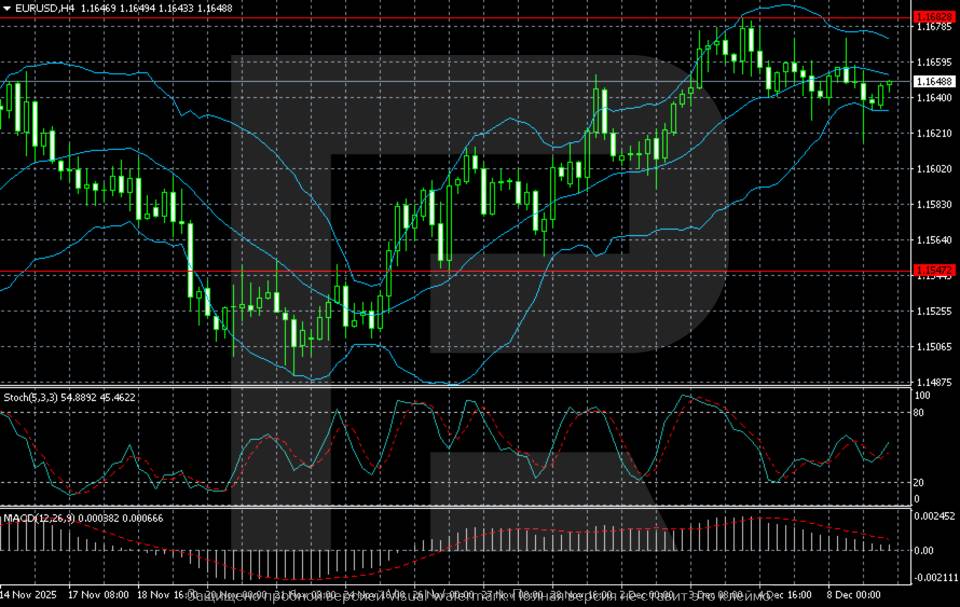
          On the H4 chart, the EURUSD pair maintains a moderately bullish trajectory, but upward momentum has noticeably weakened. The price is consolidating below the 1.1682 resistance level, which has repeatedly capped attempts at growth. Quotes are currently moving along the middle Bollinger Band, indicating the absence of a strong trend. The upper band is slightly turning downwards, reflecting lower volatility.

          The Stochastic Oscillator is in the mid-range around 45, giving no clear signals. The market is out of oversold territory but lacks a confident bullish trigger. MACD remains positive, yet its histogram is declining, underscoring weakening bullish momentum and a likely phase of sideways consolidation.

          The nearest support level is located at 1.1547 – the level from which the previous strong recovery began. The resistance stands at 1.1682. A breakout above this level would open the path towards 1.1750. As long as the pair trades between these boundaries, the baseline scenario is consolidation within the range with a mild upward tilt.

          Summary

          The EURUSD pair is rising slightly, but very cautiously. The EURUSD forecast for today, 9 December 2025, suggests a mild upward move towards 1.1682.

          EURUSD 2026-2027 forecast: key market trends and future predictions

          This article provides the EURUSD forecast for 2026 and 2027 and highlights the main factors determining the direction of the pair's movements. We will apply technical analysis, take into account the opinions of leading experts, large banks, and financial institutions, and study AI-based forecasts. This comprehensive insight into EURUSD predictions should help investors and traders make informed decisions.

          Gold (XAUUSD) forecast 2026 and beyond: expert insights, price predictions, and analysis

          Dive deep into the Gold (XAUUSD) price outlook for 2026 and beyond, combining technical analysis, expert forecasts, and key macroeconomic factors. It explains the drivers behind gold's recent surge, explores potential scenarios including a move toward 4,500 to 5,000 USD per ounce, and highlights why the metal remains a strong hedge during global uncertainty.

          Source: RoboForex

          Risk Warnings and Disclaimers
          You understand and acknowledge that there is a high degree of risk involved in trading. Following any strategies or investment methods may lead to potential losses. The content on the site is provided by our contributors and analysts for information purposes only. You are solely responsible for determining whether any trading assets, securities, strategy, or any other product is suitable for investing based on your own investment objectives and financial situation.
          Add to Favorites
          Share

          BAT Warns 2026 Growth At Low End Of Range Despite U.S. Nicotine Gains

          Winkelmann

          Economic

          Stocks

          British American Tobacco on Tuesday reaffirmed its 2026 growth targets but said performance will likely come in at the lower end of its 3% to 5% revenue growth range, as the London-based tobacco company navigates a transition to nicotine alternatives amid regional headwinds.

          The company expects approximately 2% revenue and adjusted profit growth for fiscal year 2025, with New Category products, encompassing heated tobacco, vapor and nicotine pouches, accelerating to double-digit growth in the second half.

          Chief executive Tadeu Marroco said the company remains "focused on establishing glo Hilo as a premium offering in the largest Heated Products profit pools" with launches in Japan in September and Poland in October, with additional rollouts planned for 2026.

          BAT's U.S. operations showed the strongest momentum, with value share rising 20 basis points while volume share remained flat.

          The company's Velo Plus nicotine pouch drove Modern Oral volume share up 920 basis points in the U.S. market, where BAT said it is on track for full-year profitability in its New Category business.

          The Velo brand achieved 15.9% volume share of Total Oral products and 31.8% of Modern Oral products globally, representing increases of 460 basis points and 590 basis points respectively.

          BAT's Vuse vapor brand, which maintained global leadership in tracked channels with value share in top markets up 10 basis points, showed improved second-half performance despite ongoing challenges from illicit products.

          The company expects full-year Vuse revenue to decline in the high-single digits, compared to a 13% drop in the first half.

          Regional performance varied significantly. The Americas excluding the U.S., led by Brazil, Turkey and Mexico, delivered strong results. However, the Asia-Pacific, Middle East and Africa region faced material fiscal and regulatory headwinds in Bangladesh and Pakistan that will impact adjusted profit growth.

          The company's glo heated tobacco product line saw volume share in top markets decline 1.2 percentage points, impacted by competition in Japan.

          BAT's Americas excluding U.S. volume share for glo declined 60 basis points as the company made resource allocation decisions ahead of the glo Hilo rollout.

          Globally, BAT's group value share in top cigarette markets remained flat while volume share declined 10 basis points. The company projects global tobacco industry volume will decline approximately 2% for 2025.

          BAT announced £1.3 billion in share buybacks for fiscal year 2026, up from £1.1 billion in 2025. The company expects operating cash flow conversion to exceed 95% in 2025, with gross capital expenditure of approximately £1.2 billion.

          For fiscal year 2025, BAT projects mid-single digit New Category revenue growth at constant rates, with approximately 2% adjusted profit from operations growth at constant rates.

          The company anticipates a roughly 3% translational foreign exchange headwind on adjusted profit from operations and approximately 4% on adjusted earnings per share. Net finance costs are projected at approximately £1.8 billion.

          Source: Investing

          To stay updated on all economic events of today, please check out our Economic calendar
          Risk Warnings and Disclaimers
          You understand and acknowledge that there is a high degree of risk involved in trading. Following any strategies or investment methods may lead to potential losses. The content on the site is provided by our contributors and analysts for information purposes only. You are solely responsible for determining whether any trading assets, securities, strategy, or any other product is suitable for investing based on your own investment objectives and financial situation.
          Add to Favorites
          Share

          US JOLTs Report To Set The Stage For Tomorrow’s Fed Decision

          Danske Bank

          Stocks

          Forex

          Economic

          In focus today

          In the US, the delayed September JOLTs report is finally due for release in the afternoon. The number of job openings is a key measure of labour demand for the Fed, and the release will gather extra attention in light of the FOMC rate decision tomorrow. NFIB's small business optimism index for November and ADP's weekly private sector employment estimate will also be released today.

          In Denmark, we expect foreign trade data and the current account for October. It will be interesting as exports remain the key driver of growth in Denmark.

          In China, overnight, we will see CPI for November, which is expected to move more into positive territory (cons: 0.7% y/y, prior: 0.2% y/y). Core inflation has moved higher over the past six months as well. China still suffers from deflationary pressures in the producer prices, though, and PPI is expected to stay around -2.0% y/y in November.

          Economic and market news

          What happened overnight

          In Australia, the Reserve Bank held its cash rate at 3.60%, citing upside inflation risks and recovering demand. Governor Michele Bullock noted the board is considering the likelihood of rate hikes in 2026 and has not ruled out an increase as soon as its next meeting in February. The move resulted in higher yields and a slightly stronger AUD.

          What happened yesterday

          In the US, President Trump announced that Nvidia's H200 chips will be allowed for export to China, with Nvidia required to pay a 25% fee on sales, up from the initial 15%. Trump claimed that President Xi reacted positively to the decision, despite China expressing scepticism about such a deal last week. The decision has faced criticism from US lawmakers, who raised concerns over national security and the risk of the chips being used for military purposes in China.

          In the euro area, the December Sentix indicator came in slightly better than expected at -6.2 (cons: -7.0, prior: -7.4), indicating investors have gotten less pessimistic about the economic recovery. Given how Sentix is the first sentiment indicator for December, the rise could signal improvements in other sentiment indicators to be released this month.

          In Germany, industrial production increased by 1.8% m/m in October, significantly exceeding expectations and marking the second consecutive monthly rise. Growth was driven by construction and manufacturing, while the automotive sector detracted. Despite this sign of short-term stabilisation, soft indicators remain cautious. The Ifo Index fell in November as weaker expectations outweighed a slight improvement in the current assessment, and the Manufacturing PMI dropped to 48.2, its sharpest contraction since February. This highlights that while production shows improvement, weak demand and sentiment suggest recovery remains dependent on the impact of fiscal easing measures.

          Equities: Equities had a slow start to the week and generally ended somewhat lower. The S&P 500 closed down 0.4% and the Stoxx 600 slipped 0.1%. Interestingly, the selling was again concentrated in defensives, similar to Friday. Hence, it was a slow day but not risk off emerging. Futures are little changed this morning.

          One standout style yesterday was momentum, which has regained traction both on the day and over the past two weeks. One driver is the ongoing TPU-vs-GPU battle between Alphabet and Nvidia, which appears to have stalled. Alphabet fell 2% yesterday, while Nvidia and Microsoft both gained around 2%. After the close, the Trump administration announced that some of Nvidia's chip exports (H200 AI chips) to China may resume, which might have contributed to the rotation.

          Another notable sector is health care: A top performer over the past three months—up roughly 8% in global terms. However, it has also been the sector investors have found financing in during the recent rebound, falling about 3% the last two weeks. This contributes to the divergence between defensives and cyclicals, both in risk-off and risk-on phases. Strong recent performance has narrowed global health care's valuation discount to global equities from 20% earlier this year to about 9% today. That is still one standard deviation below the 10-year average of 0%, and so we continue to recommend an overweight in this sector but admit that the upside has declined.

          FI and FX: Yields are grinding higher despite the expectations of a Fed rate cut on Wednesday. Markets are seemingly getting a bit worried that the cut will be delivered with a more hawkish communication, and risk sentiment has also been dented with small declines in US and Asian equity indices overnight. EUR/USD declined towards 1.1620 yesterday afternoon as US yields temporarily spiked around 16.00 CET. With yields subsequently moving lower, EUR/USD settled around 1.1640-1.1650. The RBA kept the policy rate on hold at 3.60% as widely expected and signaled that risks from here are on the upside, resulting in a bearish steepening of the curve with the 2y point rising 9bp and the 10y rising 5bp, along with a stronger AUD.

          Source: Danske Bank

          To stay updated on all economic events of today, please check out our Economic calendar
          Risk Warnings and Disclaimers
          You understand and acknowledge that there is a high degree of risk involved in trading. Following any strategies or investment methods may lead to potential losses. The content on the site is provided by our contributors and analysts for information purposes only. You are solely responsible for determining whether any trading assets, securities, strategy, or any other product is suitable for investing based on your own investment objectives and financial situation.
          Add to Favorites
          Share

          Top-Tier Footballers, Ex-Chair Arrested In Turkish Betting Probe

          Samantha Luan

          Economic

          Political

          Turkey arrested two players from its top football division and a former Super League club chairman as an illegal betting investigation widened to include executives and athletes, escalating a scandal that has already ensnared referees.

          20 of 39 suspects were formally arrested, state-run Anadolu Agency reported. They include Galatasaray defender Metehan Baltaci, Fenerbahce midfielder Mert Hakan Yandas and Murat Sancak, the former chairman of Adana Demirspor — the club where Italian striker Mario Balotelli played in the 2021–22 and 2023–24 seasons.

          Both players and Sancak denied the allegations during their testimony, local media reported. Galatasaray and Fenerbahce have not yet issued public statements.

          Prosecutors sought the formal arrests of Yandas and Baltaci on match-fixing charges, according to Anadolu. Baltaci was first accused of betting on his own team, while Yandas allegedly placed bets through intermediaries on betting platforms. Sancak was detained after suspicious financial transactions were identified in his accounts.

          The Turkish Football Federation said in October that its internal probe had uncovered hundreds of referees engaged in betting. The Federation's Disciplinary Board temporarily suspended more than 100 referees and players, covering both lower and top-tier leagues.

          Istanbul prosecutors followed with detention warrants targeting match officials alleged to have wagered on games. Istanbul Chief Prosecutor Akin Gurlek signaled the investigation could expand to club presidents.

          Source: Bloomberg Europe

          To stay updated on all economic events of today, please check out our Economic calendar
          Risk Warnings and Disclaimers
          You understand and acknowledge that there is a high degree of risk involved in trading. Following any strategies or investment methods may lead to potential losses. The content on the site is provided by our contributors and analysts for information purposes only. You are solely responsible for determining whether any trading assets, securities, strategy, or any other product is suitable for investing based on your own investment objectives and financial situation.
          Add to Favorites
          Share

          Bitcoin's Year of Highs May End in Disappointment as Fed and AI Stocks Dominate Sentiment

          Gerik

          Economic

          Cryptocurrency

          Bitcoin’s 2025 Rally Stalls as Market Volatility Returns

          After a promising start driven by the re-election of crypto-friendly President Donald Trump, Bitcoin’s 2025 trajectory has become increasingly unstable. While early optimism pushed the asset to an all-time high above $126,000 in October, the subsequent announcement of tariffs and looming export controls sent shockwaves through both crypto and equity markets. The result was a rapid liquidation of over $19 billion in leveraged crypto positions the largest in history.
          Bitcoin is currently trading near $89,000, down sharply from its peak and struggling to recover amid risk-off investor sentiment. Analysts note that the cryptocurrency is now at risk of ending the year lower, a reversal from bullish projections made earlier in 2025 by firms like MicroStrategy and Standard Chartered, both of which previously forecast highs of $150,000 to $200,000 by year-end.

          Correlation with Equities Grows Stronger in 2025

          One of the defining features of this year’s crypto market has been Bitcoin’s increasing correlation with equity markets, particularly the S&P 500 and NASDAQ 100. Traditionally viewed as a non-correlated or even counter-cyclical asset, Bitcoin now appears to mirror broader risk asset behavior.
          According to LSEG data, the average correlation between Bitcoin and the S&P 500 rose to 0.50 in 2025, up from 0.29 in 2024. A similar pattern was seen with the NASDAQ 100, with correlation rising from 0.23 to 0.52. This reflects a deeper integration of crypto into traditional financial markets, driven by the entrance of retail and institutional investors seeking high-growth, high-risk opportunities.
          AI stocks, in particular, have exerted a noticeable influence on crypto price movements. As AI-related equities saw their valuations questioned, Bitcoin and other digital assets also declined, suggesting that both markets now share a common sensitivity to investor risk appetite and speculative cycles.

          Interest Rates and Fed Policy Add to Uncertainty

          Alongside its equity-like behavior, Bitcoin has become increasingly reactive to changes in interest rate expectations. While historical data offers little clarity on Bitcoin’s performance during rate cut cycles, recent market dynamics suggest that dovish signals from the Federal Reserve are interpreted as bullish for crypto.
          Following hawkish Fed messaging in October, Bitcoin saw renewed weakness. But with markets now pricing in an 86% chance of a 25-basis-point rate cut at the Fed’s December meeting, crypto markets are cautiously optimistic. Traders have slightly reduced their bearish bets, with the probability of Bitcoin ending the year below $80,000 falling from 20% to 15% in recent weeks.
          Nevertheless, investors remain skeptical about any immediate return to bullish momentum. Phong Le, CEO of MicroStrategy (now referred to as “Strategy”), recently warned of a potential “Bitcoin winter,” even as the company maintains a large exposure. Founder Michael Saylor, however, insisted the company could withstand a 95% drawdown in Bitcoin’s price.

          From Independence to Interdependence: Bitcoin’s Shifting Narrative

          Bitcoin’s journey in 2025 underscores a significant evolution in how it is perceived by the market. Once hailed as a decentralized, inflation-resistant store of value, the asset now behaves increasingly like a high-beta tech stock heavily influenced by macroeconomic conditions, central bank policy, and investor speculation in adjacent sectors like AI.
          This shift has both strategic and narrative implications for the crypto sector. While increased institutional adoption brings credibility and capital, it also subjects crypto to the same systemic pressures and herd behavior that govern traditional financial markets. As a result, Bitcoin’s diversification utility may be diminishing at the very moment it gains broader acceptance.
          Bitcoin’s performance in 2025 has mirrored the volatility of global markets, shaped by trade policy shocks, interest rate uncertainty, and the speculative boom in AI. While the asset achieved historic highs earlier in the year, a combination of macro headwinds and evolving correlations with equities may force it to close the year with a rare annual loss. Whether Bitcoin reclaims its role as a unique alternative asset or remains bound to broader market sentiment will be a defining question as the world enters the next cycle of monetary and technological transformation.

          Source: Bloomberg

          To stay updated on all economic events of today, please check out our Economic calendar
          Risk Warnings and Disclaimers
          You understand and acknowledge that there is a high degree of risk involved in trading. Following any strategies or investment methods may lead to potential losses. The content on the site is provided by our contributors and analysts for information purposes only. You are solely responsible for determining whether any trading assets, securities, strategy, or any other product is suitable for investing based on your own investment objectives and financial situation.
          Add to Favorites
          Share

          Kavanaugh Signals Concern Over Fed Independence Amid Trump’s Push to Expand Firing Powers

          Gerik

          Economic

          Fed’s Unique Status Raises Red Flags in Supreme Court Hearing

          During oral arguments on Monday, Justice Brett Kavanaugh emerged as a critical voice expressing unease about the broader implications of a legal challenge that could expand presidential firing authority over independent agencies. The case focused on the Federal Trade Commission (FTC) may set a precedent that affects institutions such as the Federal Reserve, which historically operates with a high degree of autonomy from the White House.
          Kavanaugh, appointed by Trump during his first term, directly questioned US Solicitor General John Sauer about how the administration's broad claims on executive control could impact the central bank’s longstanding protection from political interference. Notably, he stated, “I share those concerns,” when referring to the Fed’s independence, underlining the stakes of the case as extending well beyond the FTC.

          Trump’s Legal Strategy and the Push to Fire Lisa Cook

          Although the case before the court concerns the FTC, the justices are also preparing to hear a separate challenge in January involving Trump’s attempt to remove Federal Reserve Governor Lisa Cook over unproven allegations of mortgage fraud. That pending case casts a shadow over the current debate, especially given the president's history of pressuring the Fed to slash interest rates and his desire to appoint loyalists to the Board of Governors.
          The administration argues that Congress cannot limit the president’s ability to remove officials who perform executive functions. However, it has stopped short of directly challenging the “for cause” protection that shields Fed officials, instead framing the Fed as a potential exception or “anomaly.”
          Still, the Justice Department has insisted that courts should not be able to reverse presidential firing decisions, a position Kavanaugh challenged. He warned that such a stance could enable end-runs around constitutional protections by preventing judicial remedies for improper dismissals particularly in agencies like the Fed and the specialized tax courts.

          Historical Precedents and Legal Nuance

          The Supreme Court's past rulings have treated the Federal Reserve differently from other agencies. In a May order, the Court referred to the Fed as a “uniquely structured, quasi-private entity,” setting it apart from purely executive bodies. This status echoes its roots in the tradition of the First and Second Banks of the United States and reinforces its intended insulation from electoral and executive cycles.
          When Trump sought to immediately remove Lisa Cook, the Court declined his request for expedited action, opting to let the legal process play out another indication that the Fed’s role is viewed with greater constitutional sensitivity than other agencies where firings were allowed to proceed during litigation.
          Kavanaugh’s remarks and the court’s recent history suggest that while a ruling may favor presidential authority over bodies like the FTC, the same logic may not apply to the Fed. However, any ambiguity left in the final opinion could have lasting implications, especially if legal protections for other agencies are weakened while the Fed remains a standalone exception.

          Implications for Monetary Policy and Central Bank Integrity

          The broader concern, raised by both liberal and conservative jurists, is whether granting Trump unilateral power to remove Fed governors would threaten the central bank’s credibility and policy independence. Former officials and economists have long warned that politicizing the Fed whose primary mandate is to control inflation and support employment would undermine market confidence and macroeconomic stability.
          As the Fed prepares to cut interest rates for the third time this year, the timing of the legal battles is critical. Trump’s repeated criticisms of Fed Chair Jerome Powell and calls for more aggressive rate cuts illustrate the potential for a shift in central bank governance if presidential removal powers are expanded. With Cook still participating in meetings and voting for rate reductions despite the pending litigation, the Court’s eventual ruling could either reinforce or unravel the boundary between monetary policy and political influence.
          The Supreme Court's consideration of presidential firing power raises foundational questions about the structure of the US government. Justice Kavanaugh's reservations reflect a deeper institutional concern: preserving the Federal Reserve’s independence as a safeguard against short-term political agendas. As Trump seeks to reshape federal agencies in his image, the Court must now determine whether preserving historical exceptions like the Fed will remain compatible with a broader expansion of executive power. The stakes, both legal and economic, could reshape the federal landscape for decades to come.

          Source: Bloomberg

          To stay updated on all economic events of today, please check out our Economic calendar
          Risk Warnings and Disclaimers
          You understand and acknowledge that there is a high degree of risk involved in trading. Following any strategies or investment methods may lead to potential losses. The content on the site is provided by our contributors and analysts for information purposes only. You are solely responsible for determining whether any trading assets, securities, strategy, or any other product is suitable for investing based on your own investment objectives and financial situation.
          Add to Favorites
          Share
          FastBull
          Copyright © 2025 FastBull Ltd

          728 RM B 7/F GEE LOK IND BLDG NO 34 HUNG TO RD KWUN TONG KLN HONG KONG

          TelegramInstagramTwitterfacebooklinkedin
          App Store Google Play Google Play
          Products
          Charts

          Chats

          Q&A with Experts
          Screeners
          Economic Calendar
          Data
          Tools
          Membership
          Features
          Function
          Markets
          Copy Trading
          Latest Signals
          Contests
          News
          Analysis
          24/7
          Columns
          Education
          Company
          Careers
          About Us
          Contact Us
          Advertising
          Help Center
          Feedback
          User Agreement
          Privacy Policy
          Business

          White Label

          Data API

          Web Plug-ins

          Poster Maker

          Affiliate Program

          Risk Disclosure

          The risk of loss in trading financial instruments such as stocks, FX, commodities, futures, bonds, ETFs and crypto can be substantial. You may sustain a total loss of the funds that you deposit with your broker. Therefore, you should carefully consider whether such trading is suitable for you in light of your circumstances and financial resources.

          No decision to invest should be made without thoroughly conducting due diligence by yourself or consulting with your financial advisors. Our web content might not suit you since we don't know your financial conditions and investment needs. Our financial information might have latency or contain inaccuracy, so you should be fully responsible for any of your trading and investment decisions. The company will not be responsible for your capital loss.

          Without getting permission from the website, you are not allowed to copy the website's graphics, texts, or trademarks. Intellectual property rights in the content or data incorporated into this website belong to its providers and exchange merchants.

          Not Logged In

          Log in to access more features

          FastBull Membership

          Not yet

          Purchase

          Become a signal provider
          Help Center
          Customer Service
          Dark Mode
          Price Up/Down Colors

          Log In

          Sign Up

          Position
          Layout
          Fullscreen
          Default to Chart
          The chart page opens by default when you visit fastbull.com