• Trade
  • Markets
  • Copy
  • Contests
  • News
  • 24/7
  • Calendar
  • Q&A
  • Chats
Screeners
SYMBOL
LAST
ASK
BID
HIGH
LOW
NET CHG.
%CHG.
SPREAD
SPX
S&P 500 Index
6870.12
6870.12
6870.12
6936.08
6838.79
-47.69
-0.69%
--
DJI
Dow Jones Industrial Average
49306.59
49306.59
49306.59
49649.86
49112.43
+65.59
+ 0.13%
--
IXIC
NASDAQ Composite Index
22836.94
22836.94
22836.94
23270.07
22684.51
-418.24
-1.80%
--
USDX
US Dollar Index
97.530
97.610
97.530
97.560
97.140
+0.330
+ 0.34%
--
EURUSD
Euro / US Dollar
1.17975
1.17983
1.17975
1.18377
1.17901
-0.00200
-0.17%
--
GBPUSD
Pound Sterling / US Dollar
1.36456
1.36467
1.36456
1.37328
1.36419
-0.00508
-0.37%
--
XAUUSD
Gold / US Dollar
4932.89
4933.32
4932.89
5091.84
4855.00
-13.36
-0.27%
--
WTI
Light Sweet Crude Oil
64.958
64.988
64.958
65.221
62.601
+1.324
+ 2.08%
--

Community Accounts

Signal Accounts
--
Profit Accounts
--
Loss Accounts
--
View More

Become a signal provider

Sell trading signals to earn additional income

View More

Guide to Copy Trading

Get started with ease and confidence

View More

Signal Accounts for Members

All Signal Accounts

Best Return
  • Best Return
  • Best P/L
  • Best MDD
Past 1W
  • Past 1W
  • Past 1M
  • Past 1Y

All Contests

  • All
  • Trump Updates
  • Recommend
  • Stocks
  • Cryptocurrencies
  • Central Banks
  • Featured News
Top News Only
Share

Venezuelan Official Alex Saab, Formerly Held In USA, Arrested In Venezuela-Colombian Media

Share

[Key Republican Senator Scott: Powell Did Not Commit A Crime At The Hearing] U.S. Republican Senator Tim Scott Stated That Federal Reserve Chairman Jerome Powell Did Not Commit A Crime When Answering Questions At A Congressional Hearing Last Summer. "I Think He Made A Serious Error Of Judgment. He Wasn't Prepared For That Hearing. I Don't Believe He Committed A Crime At The Hearing," Scott Said

Share

US Used Cyber Weapons To Disrupt Iranian Air Defenses During 2025 Strikes - The Record

Share

Trump Says Iran's Supreme Leader Should Be Worried

Share

Trump Says "Not Much" Doubt That Interest Rates Will Be Lowered

Share

US Nuclear Regulatory Commission Says It Is Undergoing Reorganization In Line With Trump's Push On Licensing Of Nuclear Reactors

Share

Ukraine President Zelenskiy: Ukraine's Western Partners Must Be Prepared To Put Pressure On Russia And Provide Guarantees For Kyiv

Share

Ukraine President Zelenskiy: Talks Must Lead To Real Peace And Not Provide Russia With An Opportunity To Continue The War

Share

Ukraine President Zelenskiy: After Start Of Latest Three-Sided Talks That Ukraine Expects A Prisoner Swap

Share

General Motors CFO: We Hope That The U.S.-Mexico-Canada Trade Agreement (USMCA) Will Preserve North America As A (complete) Trade Area

Share

French President's Top Diplomat Was In Moscow On Tuesday For Talks With Russian Officials - Source Aware Of The Matter

Share

New York Fed Accepts $2.414 Billion Of $2.414 Billion Submitted To Reverse Repo Facility On Feb 04

Share

U.S. Treasury Secretary Bessenter: Credit Risk Transfer (Crt) Is Very Important

Share

Dow Turns Negative, Last Down 0.1%

Share

Russian Foreign Ministry: USA Approach To Russia's Initiative On New Start Treaty Is Misguided And Regrettable

Share

Russian Foreign Ministry On Expiring New Start Arms Treaty: We Assume That We And USA Are No Longer Bound By Central Quantitative Indicators Under The Treaty And Are Free To Choose Their Next Steps

Share

Russian Foreign Ministry On Expiring New Start Arms Treaty: Russia Is Ready To Take Decisive Military-Technical Countermeasures To Counter Potential Additional Threats To National Security

Share

Bessent: The Fed Has To Maintain Credibility And Operate Beyond Reproach

Share

Bessent: Says Has No Opinion On Whether Trump Has Authority To Fire Fed Chair Or Board Member Over A Policy Disagreement

Share

Mexico's Pemex Supplied $496 Million Of Oil To Cuba In 2025

TIME
ACT
FCST
PREV
Euro Zone Services PMI Final (Jan)

A:--

F: --

P: --

U.K. Composite PMI Final (Jan)

A:--

F: --

P: --

U.K. Total Reserve Assets (Jan)

A:--

F: --

P: --

U.K. Services PMI Final (Jan)

A:--

F: --

P: --

U.K. Official Reserves Changes (Jan)

A:--

F: --

P: --

Euro Zone Core CPI Prelim YoY (Jan)

A:--

F: --

P: --

Euro Zone Core HICP Prelim YoY (Jan)

A:--

F: --

P: --

Euro Zone HICP Prelim YoY (Jan)

A:--

F: --

P: --

Euro Zone PPI MoM (Dec)

A:--

F: --

P: --
Euro Zone Core HICP Prelim MoM (Jan)

A:--

F: --

P: --

Italy HICP Prelim YoY (Jan)

A:--

F: --

P: --

Euro Zone Core CPI Prelim MoM (Jan)

A:--

F: --

P: --

Euro Zone PPI YoY (Dec)

A:--

F: --

P: --
U.S. MBA Mortgage Application Activity Index WoW

A:--

F: --

P: --

Brazil IHS Markit Composite PMI (Jan)

A:--

F: --

P: --

Brazil IHS Markit Services PMI (Jan)

A:--

F: --

P: --

U.S. ADP Employment (Jan)

A:--

F: --

P: --
The U.S. Treasury Department released its quarterly refinancing statement.
U.S. IHS Markit Composite PMI Final (Jan)

A:--

F: --

P: --

U.S. IHS Markit Services PMI Final (Jan)

A:--

F: --

P: --

U.S. ISM Non-Manufacturing Price Index (Jan)

A:--

F: --

P: --

U.S. ISM Non-Manufacturing Employment Index (Jan)

A:--

F: --

P: --

U.S. ISM Non-Manufacturing New Orders Index (Jan)

A:--

F: --

P: --

U.S. ISM Non-Manufacturing Inventories Index (Jan)

A:--

F: --

P: --

U.S. ISM Non-Manufacturing PMI (Jan)

A:--

F: --

P: --

U.S. EIA Weekly Crude Oil Imports Changes

A:--

F: --

P: --

U.S. EIA Weekly Heating Oil Stock Changes

A:--

F: --

P: --

U.S. EIA Weekly Crude Demand Projected by Production

A:--

F: --

P: --

U.S. EIA Weekly Gasoline Stocks Change

A:--

F: --

P: --

U.S. EIA Weekly Crude Stocks Change

A:--

F: --

P: --

U.S. EIA Weekly Cushing, Oklahoma Crude Oil Stocks Change

A:--

F: --

P: --

Australia Trade Balance (SA) (Dec)

--

F: --

P: --

Australia Exports MoM (SA) (Dec)

--

F: --

P: --

Japan 30-Year JGB Auction Yield

--

F: --

P: --

Indonesia Annual GDP Growth

--

F: --

P: --

Indonesia GDP YoY (Q4)

--

F: --

P: --

France Industrial Output MoM (SA) (Dec)

--

F: --

P: --

Italy IHS Markit Construction PMI (Jan)

--

F: --

P: --

Euro Zone IHS Markit Construction PMI (Jan)

--

F: --

P: --

Germany Construction PMI (SA) (Jan)

--

F: --

P: --

Italy Retail Sales MoM (SA) (Dec)

--

F: --

P: --

U.K. Markit/CIPS Construction PMI (Jan)

--

F: --

P: --

France 10-Year OAT Auction Avg. Yield

--

F: --

P: --

Euro Zone Retail Sales YoY (Dec)

--

F: --

P: --

Euro Zone Retail Sales MoM (Dec)

--

F: --

P: --

U.K. BOE MPC Vote Cut (Feb)

--

F: --

P: --

U.K. BOE MPC Vote Hike (Feb)

--

F: --

P: --

U.K. BOE MPC Vote Unchanged (Feb)

--

F: --

P: --

U.K. Benchmark Interest Rate

--

F: --

P: --

MPC Rate Statement
U.S. Challenger Job Cuts (Jan)

--

F: --

P: --

U.S. Challenger Job Cuts MoM (Jan)

--

F: --

P: --

U.S. Challenger Job Cuts YoY (Jan)

--

F: --

P: --

Bank of England Governor Bailey held a press conference on monetary policy.
Euro Zone ECB Marginal Lending Rate

--

F: --

P: --

Euro Zone ECB Deposit Rate

--

F: --

P: --

Q&A with Experts
    • All
    • Chatrooms
    • Groups
    • Friends
    john flag
    Nawhdir Øt
    @Nawhdir Øtinteresting,,,,I will as well but I let the market make the first move
    john flag
    Nawhdir Øt
    gotta sleep.
    @Nawhdir Øtwhat ís the time in Indonesia
    Nawhdir Øt flag
    john
    @john2:15
    john flag
    Nawhdir Øt
    @Nawhdir Øtam ?
    Nawhdir Øt flag
    john
    @johntherefore, that's the real best, currently BTC behavior is 50-50.
    Sean flag
    john
    @johnMarginal slowdown matters more than baseline strength
    john flag
    Nawhdir Øt
    @Nawhdir Øtand you normally trade the Asian session which means that you will sleep for less than 4 hrs
    Nawhdir Øt flag
    john
    6 o'clock@john
    john flag
    Nawhdir Øt
    @Nawhdir Øtwhat timeframe are you watching btc
    john flag
    Nawhdir Øt
    @Nawhdir ØtI normally sleep for 6 hours
    john flag
    Sean
    @Sean That is how positioning works especially in macro-driven pairs.
    Sean flag
    john
    @johnlike USD/CNH and USD/JPY correlations
    john flag
    Sean
    @Sean Yes, and also gold reacts indirectly through risk sentiment.
    Sean flag
    john
    @johnweak domestic demand keeps deflation risk alive
    Nawhdir Øt flag
    john
    @johneverything.
    john flag
    Sean
    @Sean Yes and deflation risk keeps global central banks cautious.
    Sean flag
    john
    @johnwhich limits coordinated tightening
    john flag
    we all know this,,,,trump is only turnishing Powell name
    john flag
    john flag
    Sean
    @Sean Exactly, so liquidity remains relatively loose.
    Type here...
    Add Symbol or Code

      No matching data

      All
      Trump Updates
      Recommend
      Stocks
      Cryptocurrencies
      Central Banks
      Featured News
      • All
      • Russia-Ukraine Conflict
      • Middle East Flashpoint
      • All
      • Russia-Ukraine Conflict
      • Middle East Flashpoint
      Search
      Products

      Charts Free Forever

      Chats Q&A with Experts
      Screeners Economic Calendar Data Tools
      Membership Features
      Data Warehouse Market Trends Institutional Data Policy Rates Macro

      Market Trends

      Market Sentiment Order Book Forex Correlations

      Top Indicators

      Charts Free Forever
      Markets

      News

      News Analysis 24/7 Columns Education
      From Institutions From Analysts
      Topics Columnists

      Latest Views

      Latest Views

      Trending Topics

      Top Columnists

      Latest Update

      Signals

      Copy Rankings Latest Signals Become a signal provider AI Rating
      Contests
      Brokers

      Overview Brokers Assessment Rankings Regulators News Claims
      Broker listing Forex Brokers Comparison Tool Live Spread Comparison Scam
      Q&A Complaint Scam Alert Videos Tips to Detect Scam
      More

      Business
      Events
      Careers About Us Advertising Help Center

      White Label

      Broker API

      Data API

      Web Plug-ins

      Affiliate Program

      Awards Institution Evaluation IB Seminar Salon Event Exhibition
      Vietnam Thailand Singapore Dubai
      Fans Party Investment Sharing Session
      FastBull Summit BrokersView Expo
      Recent Searches
        Top Searches
          Markets
          News
          Analysis
          User
          24/7
          Economic Calendar
          Education
          Data
          • Names
          • Latest
          • Prev

          View All

          No data

          Scan to Download

          Faster Charts, Chat Faster!

          Download App
          English
          • English
          • Español
          • العربية
          • Bahasa Indonesia
          • Bahasa Melayu
          • Tiếng Việt
          • ภาษาไทย
          • Français
          • Italiano
          • Türkçe
          • Русский язык
          • 简中
          • 繁中
          Open Account
          Search
          Products
          Charts Free Forever
          Markets
          News
          Signals

          Copy Rankings Latest Signals Become a signal provider AI Rating
          Contests
          Brokers

          Overview Brokers Assessment Rankings Regulators News Claims
          Broker listing Forex Brokers Comparison Tool Live Spread Comparison Scam
          Q&A Complaint Scam Alert Videos Tips to Detect Scam
          More

          Business
          Events
          Careers About Us Advertising Help Center

          White Label

          Broker API

          Data API

          Web Plug-ins

          Affiliate Program

          Awards Institution Evaluation IB Seminar Salon Event Exhibition
          Vietnam Thailand Singapore Dubai
          Fans Party Investment Sharing Session
          FastBull Summit BrokersView Expo

          Euro Traders on Edge as ECB's Next Move Splits Opinion

          Julia Daniels

          Remarks of Officials

          Data Interpretation

          Economic

          Central Bank

          Forex

          Summary:

          ECB's complex outlook: cooling inflation vs. resilient growth, sparking debate on 2026 rate hikes or cuts.

          The European Central Bank is set to meet on February 5, 2026, and while no one expects a change in interest rates, the event is shaping up to be a pivotal moment for the euro. With EUR/USD trading below the key 1.20 level, all eyes will be on President Christine Lagarde's press conference for clues about the ECB's next major policy decision.

          As cooling inflation and a strengthening currency cloud the outlook, policymakers and markets are divided. The central question is whether the ECB’s next move later in the year will be a rate hike or a rate cut. The answer will likely depend on the central bank's interpretation of an increasingly complex economic picture.

          The Economic Backdrop: Growth Meets Cooling Inflation

          At its final meeting of 2025, the ECB presented a confident view of the eurozone economy. The central bank upgraded its growth forecasts, projecting 1.4% growth for 2025, followed by 1.2% in 2026, and a return to 1.4% in 2027 and 2028.

          On the inflation front, the ECB's December projections showed prices normalizing around its 2% target. The forecast anticipated inflation averaging 2.1% in 2025, falling to 1.9% in 2026, and eventually settling at 2% by 2028. This outlook suggested that interest rates could remain unchanged throughout 2026, with the ECB describing its policy as being in a "good place."

          However, recent data has complicated this narrative. January figures from Eurostat showed headline inflation in the euro area slowed to 1.7%, its lowest level since September 2024. More significantly, core inflation, which strips out volatile items, unexpectedly fell to 2.2% from 2.3%. This trend has fueled debate over whether disinflationary pressures are stronger than anticipated.
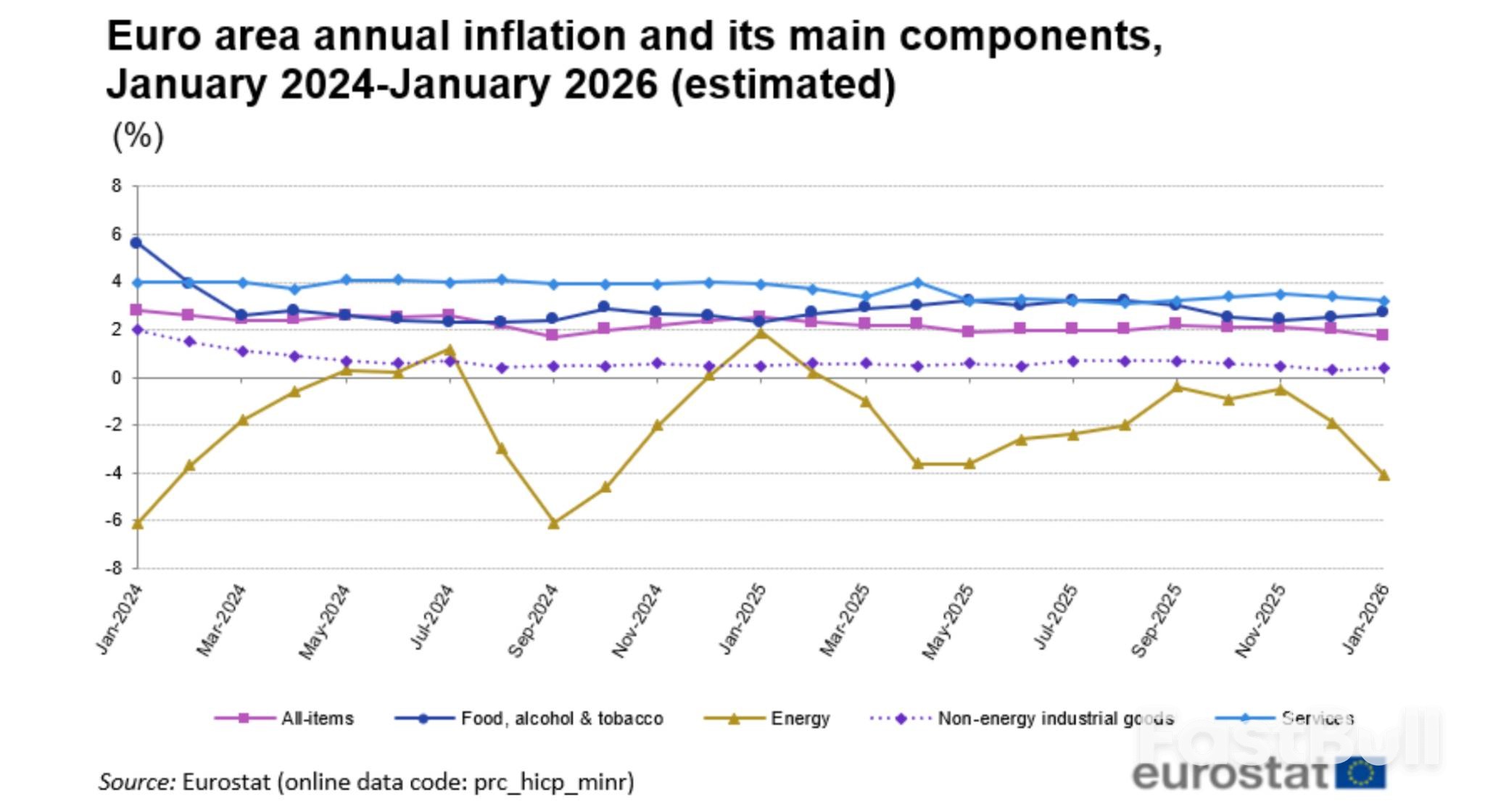
          Figure 1: Euro area inflation components show services remaining elevated while overall price pressures trend downwards toward the ECB's 2% target.

          Two factors are at the center of this concern:

          1. A Stronger Euro: The euro's recent appreciation against the dollar makes imports cheaper, dampening inflation.

          2. Chinese Imports: An influx of lower-priced goods from China is putting downward pressure on prices across European markets.

          ECB Governing Council member Gediminas Simkus recently noted the bank's success in bringing inflation back to target despite global challenges. Still, he warned that ongoing political instability remains a significant risk that could easily disrupt the ECB's current policy balance.

          The Great Debate: Rate Hikes vs. Rate Cuts in 2026

          For the upcoming meeting, the market consensus is clear: the ECB will hold its key interest rates steady for the fifth consecutive time. The deposit facility rate is expected to remain at 2.00%, the main refinancing operations rate at 2.25%, and the marginal lending facility rate at 2.40%.

          But beneath this surface-level agreement, a fierce debate is brewing over the direction of the next policy shift.

          The Case for a Future Rate Hike

          Despite inflation running below target, some ECB officials have not ruled out the possibility of raising rates later in 2026. This hawkish stance is driven by several considerations:

          • Resilient Growth: The ECB's own upgraded growth forecasts suggest the eurozone economy could be more robust than expected. Sustained growth could generate fresh price pressures as economic capacity tightens.

          • Sticky Inflation Risks: Some policymakers worry that the current 2% deposit rate may not be restrictive enough if inflation proves stubborn, especially with rising wage growth or a continued surge in energy prices. Oil and European natural gas prices have both climbed since the start of the year.

          • Official Commentary: Recent remarks from key officials, including board member Isabel Schnabel, chief economist Philip Lane, and President Lagarde herself, have been interpreted by markets as keeping the option of a late-2026 hike alive.

          The Argument for a Future Rate Cut

          On the other side, a growing number of economists believe the ECB's next move is more likely to be a rate cut, potentially restarting the easing cycle paused in June 2025. The arguments for this dovish view include:

          • Disinflationary Trend: With headline inflation at 1.7% and core inflation falling, both metrics are trending away from the ECB's 2% goal. If this continues, holding rates steady could become overly restrictive.

          • Euro Appreciation: A stronger euro effectively tightens financial conditions by making imports cheaper. The ECB might need to offset this with lower interest rates if the currency continues to climb.

          • Structural Pressures: The flood of competitively priced Chinese goods into Europe represents a persistent disinflationary force that could keep a lid on prices.

          • Economic Fragility: Pockets of weakness remain in the eurozone, particularly in Germany's manufacturing sector, which is grappling with weak global demand and high energy costs.

          A Holding Pattern: Why the ECB Will Likely Wait and See

          The reality is that policymakers are genuinely split, with some officials stating that a hike and a cut are equally plausible outcomes depending on incoming data. This uncertainty reflects the unique position the ECB is in—having achieved its inflation target but now facing significant risks in both directions.

          Diego Iscaro, head of European economics at S&P Global Market Intelligence, summarized the middle ground: "With underlying inflation still a little too high for comfort and expectations that the eurozone economy will regain momentum later in the year, we believe the most likely outcome is that the ECB will keep rates unchanged for the foreseeable future."

          ECB chief economist Philip Lane articulated this balanced strategy in mid-January. He noted that the central bank will not debate a rate change in the near term if the economy stays on its projected course. However, he cautioned that new shocks could upset the outlook.

          This statement perfectly captures the ECB's current posture: maintain the status quo for now, but stand ready to act decisively if economic conditions change.

          To stay updated on all economic events of today, please check out our Economic calendar
          Risk Warnings and Disclaimers
          You understand and acknowledge that there is a high degree of risk involved in trading. Following any strategies or investment methods may lead to potential losses. The content on the site is provided by our contributors and analysts for information purposes only. You are solely responsible for determining whether any trading assets, securities, strategy, or any other product is suitable for investing based on your own investment objectives and financial situation.
          Add to Favorites
          Share

          US vs. China: The Global Fight for Critical Minerals

          Daniel Foster

          Remarks of Officials

          Economic

          Commodity

          Daily News

          Political

          China–U.S. Trade War

          The United States is hosting a high-stakes conference in Washington, D.C., gathering ministers from dozens of countries to address the future of critical mineral supply chains. The summit aims to build a global alliance to counter China's dominance over resources essential for defense, artificial intelligence, and the modern technology sector.

          A central point of debate is a proposal to set a minimum price for critical minerals, an idea favored by many participating nations. However, reports suggest the U.S. is hesitant to support a price floor, creating a key tension point at the talks.

          The meeting follows President Donald Trump's announcement of Project Vault, a strategic minerals stockpile for the U.S. This initiative will be capitalized with $2 billion from private sources and backed by a $10 billion loan from the U.S. Export-Import Bank.

          Former U.S. President Donald Trump announced the launch of Project Vault, a strategic minerals stockpile initiative.

          Washington's Push for a New Minerals Alliance

          The Critical Minerals Ministerial, hosted by Secretary of State Marco Rubio at the State Department, is a new U.S.-led effort to build a coalition that can diversify and secure the global supply of these vital resources. The main session is scheduled for Wednesday.

          Currently, China dominates the landscape, controlling most of the world's rare earth minerals. It holds an estimated 60% of these minerals and, more importantly, processes 90% of the global supply, giving it immense leverage over everything from smartphones to fighter jets.

          A Global Coalition Gathers

          Delegations from over 50 countries are attending, including major economic powers like the G7 nations (Canada, France, Germany, Italy, Japan, the UK, and the US), the European Union, Australia, and New Zealand.

          On the sidelines of the main event, Secretary Rubio held key bilateral meetings. He met with South Korean Foreign Minister Cho Hyun to discuss Seoul's commitments to investing in U.S. industries and securing mineral supply chains. He also met with Indian External Affairs Minister Subrahmanyam Jaishankar to explore cooperation on critical minerals.

          Why Critical Minerals Are Vital for Tech and Defense

          Critical minerals are non-fuel resources that form the backbone of modern technology. They are indispensable for manufacturing:

          • Batteries and electric vehicles

          • Semiconductors and advanced electronics

          • Military hardware and defense systems

          • Wiring and renewable energy generators

          The U.S. government defines them as minerals "essential to the economic or national security" with supply chains that are "vulnerable to disruption." This vulnerability is stark: the U.S. is entirely dependent on imports for 12 critical minerals and imports at least half of its supply for another 29. Key examples include nickel, cobalt, lithium, aluminum, and zinc.

          Figure 1: This infographic shows that electric vehicles require a significantly larger and more diverse array of critical minerals, such as lithium, cobalt, and graphite, compared to traditional internal combustion engine cars.

          The Strategic Importance of Rare Earths

          Within this group, 17 rare earth elements—which include the 15 lanthanides plus scandium and yttrium—are particularly crucial. China possesses deposits of 12 of these elements. Their unique magnetic properties make them necessary for producing the permanent magnets used in industrial automation, EV motors, wind turbines, and medical devices.

          With Europe's supply of permanent magnets coming almost entirely from China, Western nations are increasingly concerned about their access to these materials. The high processing costs and the toxic environmental waste generated during mining add further complexity to developing alternative sources.

          China's Dominant Position in the Market

          According to the U.S. Geological Survey (USGS), global rare earth reserves stood at approximately 110 million tonnes in 2024. A 2024 report from the Center for Strategic and International Studies described China's position as a "near monopoly," reinforced by thousands of patents for its advanced processing technologies.

          Figure 2: Global rare earth reserves are heavily concentrated in China, which holds 70% of the world's supply at 44 million metric tonnes, far surpassing other nations like Brazil and India.

          Last year, Beijing began restricting exports of the 12 rare earth metals it controls, imposing curbs on seven in April and the remaining five in October. A temporary trade truce was reached between President Trump and Chinese President Xi Jinping in late October, where China agreed to pause the final five restrictions for one year in exchange for Trump dropping a threat of 100% tariffs on Chinese goods.

          Summit Agenda: Price Floors and Supply Chain Politics

          The ministerial's opening remarks will be delivered by Vice President JD Vance, Secretary Rubio, and other senior U.S. officials. A key topic for discussion is the implementation of a minerals price floor. Proponents argue that a minimum price would de-risk investment, encourage supply diversity, and prevent dominant players from using low prices to squeeze out smaller competitors.

          However, Reuters reported that the Trump administration is backing away from guaranteeing a price floor. The news caused a drop in Australian mining stocks, as Australia has been a vocal supporter of the policy. With its own large rare earth reserves, Australia is positioning itself as a key alternative to China and is investing heavily in its processing capacity.

          Analysts suggest the U.S. will use the conference to align partners with its own strategic goals. "The US is likely to push partner countries to sign minerals deals by which US companies get preferential or at least access to mineral deposits," Raphael Deberdt, a postdoctoral fellow at the Copenhagen Business School, told Al Jazeera.

          Deberdt noted that while securing access is one goal, the U.S. also aims to encourage investment to expand production of rare earths, cobalt, nickel, and graphite. He added that the U.S. will likely promote a "reshuffling of critical minerals supply chains to orient processing towards its own territory and the territories of allied nations." However, he cautioned that this remains a long-term goal, as U.S. processing capabilities are still minimal compared to China's.

          The Global Hunt for Alternative Suppliers

          Besides Australia, which has the world's fourth-largest rare earth reserves, other regions are being explored. A critical minerals agreement signed by Prime Minister Anthony Albanese and President Trump in October gives the U.S. access to Australian minerals in exchange for investment. Still, Australia's reserves are only one-seventh the size of China's, prompting the U.S. to court other potential suppliers.

          Greenland, which is rich in rare earth metals, is another potential source, though mining there is limited due to opposition from Indigenous Inuit communities.

          Nations Worldwide Are Building Strategic Reserves

          In response to supply chain vulnerabilities, countries are increasingly stockpiling critical minerals. The U.S. Project Vault is part of a growing global trend:

          • Japan: In March 2020, Japan reinforced its stockpiling system for rare earth minerals as part of its international resource strategy.

          • South Korea: Maintains a long-running stockpile managed by a state-run corporation.

          • European Union: In December, the European Commission adopted the RESourceEU Action Plan, which includes plans for a European Critical Raw Materials Centre to diversify supplies through stockpiling.

          • Australia: In January, the government announced new details for its $1.2 billion Critical Minerals Strategic Reserve.

          To stay updated on all economic events of today, please check out our Economic calendar
          Risk Warnings and Disclaimers
          You understand and acknowledge that there is a high degree of risk involved in trading. Following any strategies or investment methods may lead to potential losses. The content on the site is provided by our contributors and analysts for information purposes only. You are solely responsible for determining whether any trading assets, securities, strategy, or any other product is suitable for investing based on your own investment objectives and financial situation.
          Add to Favorites
          Share

          No Recession, Just Stagnation: IMF's 2026 Global Forecast

          Michael Ross

          Economic

          Data Interpretation

          The International Monetary Fund's 2026 estimates show the world avoiding a recession, but the forecast paints a troubling picture of an economy stuck in a low-growth pattern defined by high debt, stubborn inflation, and poor productivity.

          While the official data may not signal a recession, many people feel poorer as declining net real wages remain below pre-pandemic levels. This is largely because GDP growth in many developed nations is artificially inflated by government spending. This strategy leads to mounting debt and subsequent tax hikes that stifle private investment and productivity.

          The IMF projects global GDP will grow by 3.3% in 2026 and 3.2% in 2027. These figures are slightly above the October 2025 projections but largely consistent with 2025's performance.

          US Economy Defies Stagnation, Leads G7

          The United States stands out as the primary positive surprise in the IMF's latest report. Advanced economies are expected to grow by 1.8% in 2026 and 1.7% in 2027, but these averages are propped up almost entirely by strong US performance. In contrast, emerging markets are projected to grow around 4.2% and 4.1% respectively, even with a slowdown in China.

          The IMF, which previously warned of significant risks, now calls this "resilient growth." This optimistic turn has surprised analysts who have learned to be wary when the Fund delivers bullish messages. Despite this, the IMF does acknowledge the poor state of economic development in other leading economies. The key drivers behind America's economic strength include:

          • Investment related to Artificial Intelligence

          • Accommodative financial conditions

          • Private sector flexibility

          These factors have successfully offset the negative impacts of geopolitical risk and trade tensions.

          The Fund has sharply revised its US growth forecast to 2.4% for 2026—more than double its early 2025 expectation—before it moderates to 2.0% in 2027. The US is now positioned to be the only G7 economy to escape stagnation between 2025 and 2027, outperforming major peers like Germany, Japan, France, the UK, and Canada, which continue to use public spending and rising immigration to mask recessions in their private sectors.

          Argentina Emerges as a Surprise Outperformer

          Argentina is another major highlight, with the IMF forecasting growth of around 4% for both 2026 and 2027. This rate is significantly ahead of the 3.3% global pace and Latin America's projected 2.2% growth in 2026 and 2.7% in 2027.

          This impressive trajectory follows an estimated 4.5% expansion in 2025 after a 1.3% contraction in 2024. The IMF explicitly credits these gains to the policies of President Milei and recent macro-stabilization efforts.

          In the IMF's baseline scenario, Argentina transforms from a chronic underperformer into a clear regional leader, particularly as the outlook for Mexico and Brazil remains weak. The nation's focus on supply-side policies, private sector growth, and an end to energy sector interventionism positions it, alongside the US, as a key "pocket of strength" keeping global growth afloat.

          Europe's Economy Struggles with Anemic Growth

          For the euro area, the IMF projects moderate but slowly improving growth. Real GDP is expected to expand by 1.3% in 2026 and 1.4% in 2027. However, this weak performance is occurring despite the massive Next Generation EU stimulus plan and expected rate cuts.

          Germany is forecast to recover from near-stagnation to 1.1% growth in 2026 and 1.5% in 2027, but this recovery is dependent on a debatable public spending program. France is expected to deliver real growth of just 1.0% and 1.2% over the same period, also driven by government spending. The underlying message is that the euro area remains a low-growth region held back by weak productivity, excessive regulation, and high taxes.

          Other major economies face similar challenges:

          • United Kingdom: Forecasted to grow by 1.3% in 2026 and 1.5% in 2027.

          • Canada: Expected to expand by only 1.4% per year in 2026 and 2027.

          • Japan: Projected to grow just 0.7% in 2026 and 0.6% in 2027, despite years of government stimulus.

          These figures suggest that policies centered on "net zero," high taxes, and big government are a recipe for stagnation.

          Asia's Mixed Picture: India Rises as China Slows

          In Asia, the IMF highlights a diverging trend between a slowing China and a robust India.

          China's growth is projected to cool to 4.5% in 2026 and 4.0% in 2027, down from 5% in 2025. Despite challenges in its real estate sector, China remains a primary engine of global expansion.

          Meanwhile, India continues to be the fastest-growing large economy in the world. The IMF projects growth in the 6% range for both 2026 and 2027, powered by strong domestic demand. The Fund has identified India as the high-beta growth story in Asia.

          The Verdict: Government Spending vs. Market-Led Growth

          The global economy may not be in a recession, but the pervasive weakness across developed and emerging economies points to a common cause: excessive government interventionism.

          The IMF's own data suggests that the most dynamic economies are those focusing on supply-side, market-oriented policies that strengthen the private sector. Constant expansion of the public sector, in contrast, appears to hinder growth and create long-term financial vulnerability.

          To stay updated on all economic events of today, please check out our Economic calendar
          Risk Warnings and Disclaimers
          You understand and acknowledge that there is a high degree of risk involved in trading. Following any strategies or investment methods may lead to potential losses. The content on the site is provided by our contributors and analysts for information purposes only. You are solely responsible for determining whether any trading assets, securities, strategy, or any other product is suitable for investing based on your own investment objectives and financial situation.
          Add to Favorites
          Share

          Poland's Central Bank Pauses Rate Cuts, But More Are Coming

          Julia Daniels

          Economic

          Remarks of Officials

          Central Bank

          Data Interpretation

          The National Bank of Poland's latest statement signals a readiness for further monetary easing, despite a temporary pause in rate cuts.

          The Polish Monetary Policy Council (MPC) has adopted a dovish tone in its latest statement, signaling a clear readiness for further monetary easing despite holding interest rates steady for now.

          Policymakers noted that incoming data suggests a potential drop in CPI inflation during the first quarter, with stabilization expected around the National Bank of Poland's (NBP) target level in the following quarters. The MPC also downplayed a recent jump in wage growth, suggesting the council views the uptick as temporary after a year of slowing growth. This interpretation points to a clear bias toward future rate cuts.

          Strong Economic Data Justifies a Wait-and-See Approach

          The decision to pause comes just three weeks after the MPC's January meeting, with no new official inflation data released in the interim. During this period, however, real economy data came in stronger than anticipated.

          Key upside surprises included:

          • Industrial and construction output: Growth in December was significantly stronger than market expectations.

          • GDP growth: Preliminary estimates for 2025 suggest the economy expanded at a pace close to 4% year-on-year in the fourth quarter.

          • Wage growth: December data also beat forecasts, interrupting a downward trend, though this was largely driven by annual bonuses in sectors like mining.

          In light of this stronger data, the MPC has adopted a wait-and-see mode. The council requires more time to confirm that the declines in CPI inflation, core inflation, and wage growth are permanent trends.

          The Case for Resuming Cuts: Favorable Inflation Outlook

          Despite the pause, there appears to be substantial room for further interest rate reductions. The inflation outlook remains favorable, with forecasts indicating that inflation has likely already fallen below 2% year-on-year at the start of 2026.

          Inflation is expected to remain below the NBP's target for almost the entire year, averaging 2.1% YoY. In some months of 2026, it could decline to around 1.5%, which is the lower bound of the tolerance range from the 2.5% target. This disinflationary pressure is supported by expectations of continued slowing wage growth, rising imports of inexpensive goods from China, and favorable developments in the food market.

          Rate Forecast: A Path to 3.25% by Year-End

          The reference rate is projected to be cut from its current 4.00% to 3.25% before the end of 2026. Further rate reductions are expected to resume soon.

          March is seen as a suitable moment for the next cut. By then, the MPC will have access to the preliminary inflation reading for January and an updated macroeconomic projection. This new information should reinforce policymakers' confidence that the current disinflation is durable, creating space for further monetary easing, albeit on a smaller scale than in 2025.

          To stay updated on all economic events of today, please check out our Economic calendar
          Risk Warnings and Disclaimers
          You understand and acknowledge that there is a high degree of risk involved in trading. Following any strategies or investment methods may lead to potential losses. The content on the site is provided by our contributors and analysts for information purposes only. You are solely responsible for determining whether any trading assets, securities, strategy, or any other product is suitable for investing based on your own investment objectives and financial situation.
          Add to Favorites
          Share

          Mark Rutte's NATO Plan Is a Strategic Mistake

          King Ten

          Remarks of Officials

          Political

          Mark Rutte, NATO's new Secretary-General, is an experienced and energetic politician. As the longest-serving prime minister in Dutch history, his political instincts would have been a perfect fit for the job in a previous era. But in today's geopolitical landscape, his worldview and approach are precisely what NATO does not need.

          Rutte's Bet: Keeping America First in NATO

          Since taking the helm, Rutte's primary goal has been clear: keep the United States unconditionally committed to European security. To achieve this, he appears willing to flatter U.S. President Donald Trump and discourage European efforts toward greater strategic autonomy. While the motive is understandable—relying on the U.S. as a first responder is a comfortable arrangement—his assessment of the strategic situation is deeply flawed.

          Rutte recently told the European Parliament that Europe simply cannot defend itself without significant U.S. assistance, dismissing any alternative as a "dream." This statement serves as a direct rebuttal to Canadian Prime Minister Mark Carney's widely praised Davos speech, which called for medium powers to unite against the predatory behavior of great powers—a group that now includes the United States.

          While Carney avoided naming Trump, his audience understood the message. Rutte, however, is doubling down on a policy of dependence, seemingly convinced that NATO allies have no choice but to follow the United States, no matter how erratic its leadership becomes.

          Four Flaws in the Dependency Doctrine

          This conclusion is built on at least four serious miscalculations that undermine European security and the future of the alliance.

          1. Europe Can Defend Itself

          First, Rutte is fundamentally wrong about Europe's defense capabilities. While the continent is currently over-reliant on the United States, this is a solvable problem, not a permanent state of weakness. European nations do not need to match America's global power projection. They simply need the capacity to deter or defeat an attack on their own territory.

          The only significant military threat to Europe comes from Russia, which is not in a strong position itself. Consider the raw numbers:

          • NATO's European members have a combined population more than three times that of Russia.

          • Their collective GDP is nearly ten times larger.

          • They already outspend Russia on defense annually.

          The problem isn't a lack of resources but inefficient spending and coordination. Combined with the defensive advantages offered by modern technologies like drone warfare, a robust European defense independent of heavy U.S. support is well within reach, a point made by numerous defense analysts.

          2. Appeasing Trump Is a Failed Tactic

          Second, the strategy of appeasement isn't working. Rutte has gone to great lengths to flatter Trump, once even comparing him to a "daddy." The return on this effort has been minimal.

          The Trump administration's National Security Strategy portrayed Europe as a collection of decadent nations in decline. Furthermore, Washington renewed its push to take over Greenland. History has repeatedly shown the dangers of appeasement, and Trump's actions demonstrate that the tactic often fails to produce the desired results.

          3. Weakness Only Invites Contempt

          Third, constantly highlighting European weakness and dependence reinforces the MAGA movement's contempt for democratic allies. This narrative paints them as strategic burdens, fueling arguments for abandoning the alliance altogether.

          Trump respects strength and exploits weakness. A more capable Europe would be a more valuable partner, better positioned to push back against dangerous U.S. policies. By insisting on a position of compliance, Rutte is inadvertently making Europe an easier target for an administration that bullies the weak and backs down only when faced with resolve.

          4. The Secretary-General's Role Has Changed

          Finally, the job of the NATO Secretary-General has evolved. In the past, the role centered on managing American preferences. Today, it requires preparing the alliance for a future where the United States is less central or potentially even absent.

          Instead of working to overcome the collective action problems that hinder European defense, Rutte's approach reinforces them. He is trying to preserve an outdated status quo at a time when the alliance needs to adapt urgently.

          A New Global Reality Demands a New NATO

          Mark Rutte has not yet grasped the structural shifts in global politics. During the Cold War, U.S. support for Europe was guaranteed by the shared goal of containing the Soviet Union. In the unipolar moment that followed, the risk of war seemed low, and Washington was willing to handle the heavy lifting.

          That world is gone. The Trump administration has no commitment to liberal values and treats both allies and adversaries with a transactional, predatory approach. China has emerged as a major economic and military power, pulling U.S. attention away from Europe. In this new multipolar world, Europe is no longer Washington's primary focus and must learn to chart its own course.

          The Path Forward: A Rebalanced Alliance

          Preserving NATO's old formula of U.S. dominance and European submission is an increasingly risky bet. The safest path forward is a new division of labor within the alliance.

          European members must build up their defense capabilities as quickly as possible. The United States should transition from being Europe's "first responder" to its "ally of last resort." This shift won't happen overnight, but a more unified and capable Europe would command more respect from Washington and be better prepared for a future where it may have to stand on its own. Doubling down on an erratic and increasingly hostile United States is the last thing NATO should be doing right now.

          Risk Warnings and Disclaimers
          You understand and acknowledge that there is a high degree of risk involved in trading. Following any strategies or investment methods may lead to potential losses. The content on the site is provided by our contributors and analysts for information purposes only. You are solely responsible for determining whether any trading assets, securities, strategy, or any other product is suitable for investing based on your own investment objectives and financial situation.
          Add to Favorites
          Share

          Trump's Foreign Policy: The 'Spheres of Influence' Myth

          King Ten

          Russia-Ukraine Conflict

          Political

          A popular theory claims Donald Trump’s foreign policy is built on a simple premise: carve up the world into "spheres of influence" with autocratic rivals. Pundits and social media influencers circulate maps dividing the globe between Trump, China’s Xi Jinping, and Russia’s Vladimir Putin.

          Headlines warn of this new world order, suggesting a grand bargain is in the works. But a closer look at the evidence reveals a different strategy entirely.

          While Trump is fiercely protective of American dominance in the Western Hemisphere, he shows no interest in granting similar power to his main competitors. His approach looks less like a global carve-up and more like a traditional U.S. strategy: secure the homeland's neighborhood while preventing adversaries from dominating key geopolitical regions.

          Defining the Debate: Spheres of Influence

          The term "spheres of influence" carries heavy baggage. Historically, it was a pragmatic way to manage great power rivalries. After World War II, for example, Washington and Moscow tacitly accepted each other's control over their respective parts of Europe to maintain a tense peace during the Cold War.

          Today, the concept is viewed negatively. In a modern liberal system, smaller nations are expected to choose their own alliances and policies without coercion from powerful neighbors. Granting Russia a sphere of influence over Eastern Europe or China one over East Asia would mean consigning nations like Lithuania or Taiwan to subjugation.

          When critics accuse Trump of pursuing this model, it’s an accusation, not a neutral observation. But the facts don't support the charge.

          The "Donroe Doctrine": America's Backyard First

          To be clear, Trump is unambiguous about one region: the Americas. His administration has explicitly called for restoring U.S. "dominance" in the Western Hemisphere, a policy some have dubbed the "Donroe Doctrine."

          This isn't just rhetoric. His administration has actively worked to:

          • Eject Chinese companies from operating ports in the Panama Canal.

          • Seek the removal of President Nicolás Maduro in Venezuela.

          • Apply pressure on the Communist regime in Cuba.

          Trump's desire for an American sphere of influence is clear. The real question is whether he is willing to grant the same privilege to Russia and China in Eurasia. The evidence says no.

          Confronting Putin: Why Trump Isn't Ceding Europe

          If Trump truly intended to grant Vladimir Putin a sphere of influence, the playbook would be straightforward. He would withdraw the U.S. from NATO, cut off military aid to Ukraine, and negotiate a peace deal that effectively hands Kyiv to Moscow.

          Instead, his administration has done the opposite:

          • Strengthened NATO: He has aggressively pushed allies to increase defense spending to as high as 5% of GDP.

          • Armed Ukraine: He has provided weapons to Ukraine (with Europe footing the bill) and approved their use on Russian territory.

          • Sanctioned Russia: He has ramped up economic pressure on Russia's critical energy sector.

          This strategy is far more consistent with containing Putin and preventing a hostile power from dominating a critical region—a core tenet of long-standing U.S. policy.

          Containing Xi: The Real U.S. Strategy in Asia

          The same pattern holds true in East Asia. A genuine plan to concede the region to Xi Jinping would involve cutting off arms to Taiwan, downgrading diplomatic relations, and weakening U.S. alliances with regional partners.

          Again, Trump's actions point in the opposite direction:

          • Prioritizing the Indo-Pacific: The National Defense Strategy identifies deterring conflict in the region—a clear euphemism for containing China—as the second-highest priority after defending the homeland.

          • Boosting Military Spending: The administration passed the largest U.S. defense budget in history, focusing on capabilities designed for a potential conflict with China.

          • Supporting Taiwan: Trump approved the largest arms package to Taiwan in history and the State Department dropped language opposing Taiwanese independence.

          • Pressuring Allies: As in Europe, the administration is urging Asian allies to spend more on their own defense.

          If this is a plan to grant China a sphere of influence, Xi Jinping is likely both perplexed and displeased. Elsewhere, from bombing Iran's nuclear program to amassing a naval armada in the Middle East, the policy is one of containment, not concession.

          A Pragmatic Power Play, Not a Global Carve-Up

          Some argue that Trump’s assertiveness in the Western Hemisphere gives a "permission slip" for Putin and Xi to do the same. This misunderstands geopolitics. Putin has already invaded his neighbors, and Xi considers Taiwan part of China; neither is waiting for an excuse. Precedent matters in a courtroom, not in the raw calculus of international security.

          While Trump may not be as hard-line as some critics wish—he might seek a trade deal with China or avoid pursuing Putin for war crimes—these nuances are not evidence of a plan to cede entire regions to dictators.

          Ultimately, Trump is not an international relations theorist remaking the global order. He is a pragmatist pursuing American self-interest. That pursuit is leading his administration down a well-worn path: ejecting hostile powers from the Americas while working to contain them in their own regions. This has been a central pillar of American grand strategy for decades.

          Risk Warnings and Disclaimers
          You understand and acknowledge that there is a high degree of risk involved in trading. Following any strategies or investment methods may lead to potential losses. The content on the site is provided by our contributors and analysts for information purposes only. You are solely responsible for determining whether any trading assets, securities, strategy, or any other product is suitable for investing based on your own investment objectives and financial situation.
          Add to Favorites
          Share

          Russia's Oil Revenue Plunges to a Five-Year Low

          Dark Current

          Russia-Ukraine Conflict

          Energy

          Economic

          Commodity

          Political

          Russia's government oil revenues crashed to their lowest level in over five years in January, as a combination of weaker global prices, steepening discounts for its crude, and a stronger ruble hammered the national budget.

          According to finance ministry data, oil-related tax revenues were slashed in half to 281.7 billion rubles ($3.7 billion) compared to the previous year. When combined with gas, total energy revenue also fell by 50% to 393.3 billion rubles.

          This sharp decline in proceeds from oil and gas—which together account for roughly a quarter of the budget—intensifies the financial strain on the Kremlin as the war in Ukraine approaches its fifth year. The January oil revenue figure marks the lowest point since June 2020.

          The Double Squeeze of Prices and Sanctions

          While global Brent oil futures were down 15% year-on-year for the fiscal period, the market downturn was far more severe for Russia due to US sanctions.

          The nation's flagship Urals grade traded at a discount of about $26 per barrel below the Dated Brent benchmark at its export point. This is a dramatic widening from the discount of just over $12 a barrel seen a year earlier, according to data from Argus Media.

          These discounts expanded significantly after the US blacklisted Russia's two largest producers, Rosneft PJSC and Lukoil PJSC, in October. Further pressure could be on the horizon, as US President Donald Trump announced plans to cut import tariffs for India—a major buyer of Russian crude—if New Delhi stops purchasing oil from Moscow. The practical extent of India's cutbacks remains to be seen.

          A Budget Under Mounting Pressure

          The revenue collapse starkly contrasts with the government's fiscal planning. Russia's finance ministry based its January revenue calculations on an average Urals price of $39.18 per barrel in December, which was a 38% drop from a year earlier. This price is far below the government's own budget forecast, which anticipated an average crude price of $59 per barrel in 2026.

          According to Sergey Vakulenko, a senior fellow at the Carnegie Endowment for International Peace and a former Russian oil executive, the government’s take is highly sensitive to price. He estimates that Russia's budget receives 57 cents from every dollar of the oil price above $13.60 a barrel.

          Based on this model, the government received only about $14.50 per barrel in taxes last month. Meanwhile, oil companies kept around $24.70, with an estimated $14-$18 of that going toward the costs of pumping crude and delivering it for export.

          The Unexpected Challenge of a Stronger Ruble

          Adding to the fiscal pain is the appreciation of the Russian ruble. In December, the currency averaged 78.4368 rubles to the dollar, making it nearly 25% stronger than it was a year ago.

          "What really hurts both the companies and the government is the exchange rate," explained Vakulenko, noting that their expenses are primarily denominated in rubles and are tied to domestic inflation. A stronger ruble means dollar-denominated oil revenues convert into fewer rubles, squeezing budgets further.

          However, there was one minor positive side effect from the market dynamics. The lower global prices for crude and oil products allowed the Russian government to significantly reduce the subsidies it pays to domestic refiners. In January, these subsidy payments fell by almost 90% year-on-year to just 16.9 billion rubles, the lowest outlay since payments were paused in October 2023.

          To stay updated on all economic events of today, please check out our Economic calendar
          Risk Warnings and Disclaimers
          You understand and acknowledge that there is a high degree of risk involved in trading. Following any strategies or investment methods may lead to potential losses. The content on the site is provided by our contributors and analysts for information purposes only. You are solely responsible for determining whether any trading assets, securities, strategy, or any other product is suitable for investing based on your own investment objectives and financial situation.
          Add to Favorites
          Share
          FastBull
          Copyright © 2026 FastBull Ltd

          728 RM B 7/F GEE LOK IND BLDG NO 34 HUNG TO RD KWUN TONG KLN HONG KONG

          TelegramInstagramTwitterfacebooklinkedin
          App Store Google Play Google Play
          Products
          Charts

          Chats

          Q&A with Experts
          Screeners
          Economic Calendar
          Data
          Tools
          Membership
          Features
          Function
          Markets
          Copy Trading
          Latest Signals
          Contests
          News
          Analysis
          24/7
          Columns
          Education
          Company
          Careers
          About Us
          Contact Us
          Advertising
          Help Center
          Feedback
          User Agreement
          Privacy Policy
          Personal Information Protection Statement
          Business

          White Label

          Broker API

          Data API

          Web Plug-ins

          Poster Maker

          Affiliate Program

          Risk Disclosure

          The risk of loss in trading financial instruments such as stocks, FX, commodities, futures, bonds, ETFs and crypto can be substantial. You may sustain a total loss of the funds that you deposit with your broker. Therefore, you should carefully consider whether such trading is suitable for you in light of your circumstances and financial resources.

          No decision to invest should be made without thoroughly conducting due diligence by yourself or consulting with your financial advisors. Our web content might not suit you since we don't know your financial conditions and investment needs. Our financial information might have latency or contain inaccuracy, so you should be fully responsible for any of your trading and investment decisions. The company will not be responsible for your capital loss.

          Without getting permission from the website, you are not allowed to copy the website's graphics, texts, or trademarks. Intellectual property rights in the content or data incorporated into this website belong to its providers and exchange merchants.

          Not Logged In

          Log in to access more features

          Connect Broker
          Become a signal provider
          Help Center
          Customer Service
          Dark Mode
          Price Up/Down Colors

          Log In

          Sign Up

          Position
          Layout
          Fullscreen
          Default to Chart
          The chart page opens by default when you visit fastbull.com