• Trade
  • Markets
  • Copy
  • Contests
  • News
  • 24/7
  • Calendar
  • Q&A
  • Chats
Trending
Screeners
SYMBOL
LAST
BID
ASK
HIGH
LOW
NET CHG.
%CHG.
SPREAD
SPX
S&P 500 Index
6852.17
6852.17
6852.17
6878.28
6841.15
-18.23
-0.27%
--
DJI
Dow Jones Industrial Average
47821.30
47821.30
47821.30
47971.51
47709.38
-133.68
-0.28%
--
IXIC
NASDAQ Composite Index
23548.34
23548.34
23548.34
23698.93
23505.52
-29.78
-0.13%
--
USDX
US Dollar Index
99.150
99.230
99.150
99.160
98.730
+0.200
+ 0.20%
--
EURUSD
Euro / US Dollar
1.16177
1.16184
1.16177
1.16717
1.16169
-0.00249
-0.21%
--
GBPUSD
Pound Sterling / US Dollar
1.33138
1.33147
1.33138
1.33462
1.33053
-0.00174
-0.13%
--
XAUUSD
Gold / US Dollar
4192.31
4192.65
4192.31
4218.85
4175.92
-5.60
-0.13%
--
WTI
Light Sweet Crude Oil
58.943
58.973
58.943
60.084
58.837
-0.866
-1.45%
--

Community Accounts

Signal Accounts
--
Profit Accounts
--
Loss Accounts
--
View More

Become a signal provider

Sell trading signals to earn additional income

View More

Guide to Copy Trading

Get started with ease and confidence

View More

Signal Accounts for Members

All Signal Accounts

Best Return
  • Best Return
  • Best P/L
  • Best MDD
Past 1W
  • Past 1W
  • Past 1M
  • Past 1Y

All Contests

  • All
  • Trump Updates
  • Recommend
  • Stocks
  • Cryptocurrencies
  • Central Banks
  • Featured News
Top News Only
Share

Israeli Prime Minister Netanyahu: Hamas Has Violated The Ceasefire Agreement, And We Will Never Allow Its Members To Re-arm Themselves And Threaten US

Share

Israeli Prime Minister Netanyahu: We Are Working To Return The Body Of Another Detainee From The Gaza Strip

Share

Iraq's West Qurna 2 Oil Field Will Increase Oil Production Beyond Normal Levels To Compensate For The Production Stoppage Caused By The Trump Administration's Sanctions Against Russia

Share

Israeli Prime Minister Netanyahu: We Are Close To Completing The First Phase Of Trump’s Plan And Will Now Focus On Disarming Gaza And Seizing Hamas Weapons

Share

Moody's Affirmed Burberry's Long-term Rating Of Baa3 And Revised Its Outlook (from Negative) To Stable

Share

The Trump Administration Supports Iraq's Plan To Transfer Russian Oil Company Lukoil Pjsc's Assets In The West Qurna 2 Oil Field To An American Company

Share

JMA: Tsunami Of 70 Centimetres Observed In Japan's Kuji Port In Iwate Prefecture

Share

The U.S. Bureau Of Labor Statistics Plans To Release A Press Release On January 15, 2026, For November 2025, Along With Data For October

Share

Tiger Global Has Established A New Fund, Aiming To Raise $2 Billion To $3 Billion

Share

The U.S. Bureau Of Labor Statistics Announced That It Will Not Release A Press Release Regarding The U.S. Import And Export Price Index (MXP) For October 2025

Share

The U.S. Bureau Of Labor Statistics (BLS) Will Not Release U.S. October CPI Data

Share

Government Negotiator: Dutch Political Center And Center Right Parties D66,  Cda And Vvd Advised To Start Talks On Possible Government

Share

New York Fed: November Home Price Rise Expectation Steady At 3%

Share

New York Fed: US Households' Personal Finance Worries Grew In November

Share

New York Fed: November Five-Year-Ahead Expected Inflation Rate Unchanged At 3%

Share

New York Fed: Households More Pessimistic On Current, Future Financial Situations In November

Share

New York Fed Report: USA Households' Year-Ahead Expected Inflation Rate Unchanged At 3.2% In November

Share

New York Fed: November Year-Ahead Expected Rise In Medical Costs Highest Since January 2014

Share

New York Fed: Labor Market Expectations Improved In November

Share

New York Fed: November Three-Year-Ahead Expected Inflation Rate Unchanged At 3%

TIME
ACT
FCST
PREV
France Trade Balance (SA) (Oct)

A:--

F: --

P: --
Euro Zone Employment YoY (SA) (Q3)

A:--

F: --

P: --
Canada Part-Time Employment (SA) (Nov)

A:--

F: --

P: --

Canada Unemployment Rate (SA) (Nov)

A:--

F: --

P: --

Canada Full-time Employment (SA) (Nov)

A:--

F: --

P: --

Canada Labor Force Participation Rate (SA) (Nov)

A:--

F: --

P: --

Canada Employment (SA) (Nov)

A:--

F: --

P: --

U.S. PCE Price Index MoM (Sept)

A:--

F: --

P: --

U.S. Personal Income MoM (Sept)

A:--

F: --

P: --

U.S. Core PCE Price Index MoM (Sept)

A:--

F: --

P: --

U.S. PCE Price Index YoY (SA) (Sept)

A:--

F: --

P: --

U.S. Core PCE Price Index YoY (Sept)

A:--

F: --

P: --

U.S. Personal Outlays MoM (SA) (Sept)

A:--

F: --

P: --
U.S. 5-10 Year-Ahead Inflation Expectations (Dec)

A:--

F: --

P: --

U.S. Real Personal Consumption Expenditures MoM (Sept)

A:--

F: --

P: --
U.S. Weekly Total Rig Count

A:--

F: --

P: --

U.S. Weekly Total Oil Rig Count

A:--

F: --

P: --

U.S. Consumer Credit (SA) (Oct)

A:--

F: --

P: --
China, Mainland Foreign Exchange Reserves (Nov)

A:--

F: --

P: --

Japan Trade Balance (Oct)

A:--

F: --

P: --

Japan Nominal GDP Revised QoQ (Q3)

A:--

F: --

P: --

China, Mainland Imports YoY (CNH) (Nov)

A:--

F: --

P: --

China, Mainland Exports (Nov)

A:--

F: --

P: --

China, Mainland Imports (CNH) (Nov)

A:--

F: --

P: --

China, Mainland Trade Balance (CNH) (Nov)

A:--

F: --

P: --

China, Mainland Exports YoY (USD) (Nov)

A:--

F: --

P: --

China, Mainland Imports YoY (USD) (Nov)

A:--

F: --

P: --

Germany Industrial Output MoM (SA) (Oct)

A:--

F: --

P: --
Euro Zone Sentix Investor Confidence Index (Dec)

A:--

F: --

P: --

Canada National Economic Confidence Index

A:--

F: --

P: --

U.K. BRC Like-For-Like Retail Sales YoY (Nov)

--

F: --

P: --

U.K. BRC Overall Retail Sales YoY (Nov)

--

F: --

P: --

Australia Overnight (Borrowing) Key Rate

--

F: --

P: --

RBA Rate Statement
RBA Press Conference
Germany Exports MoM (SA) (Oct)

--

F: --

P: --

U.S. NFIB Small Business Optimism Index (SA) (Nov)

--

F: --

P: --

Mexico 12-Month Inflation (CPI) (Nov)

--

F: --

P: --

Mexico Core CPI YoY (Nov)

--

F: --

P: --

Mexico PPI YoY (Nov)

--

F: --

P: --

U.S. Weekly Redbook Index YoY

--

F: --

P: --

U.S. JOLTS Job Openings (SA) (Oct)

--

F: --

P: --

China, Mainland M1 Money Supply YoY (Nov)

--

F: --

P: --

China, Mainland M0 Money Supply YoY (Nov)

--

F: --

P: --

China, Mainland M2 Money Supply YoY (Nov)

--

F: --

P: --

U.S. EIA Short-Term Crude Production Forecast For The Year (Dec)

--

F: --

P: --

U.S. EIA Natural Gas Production Forecast For The Next Year (Dec)

--

F: --

P: --

U.S. EIA Short-Term Crude Production Forecast For The Next Year (Dec)

--

F: --

P: --

EIA Monthly Short-Term Energy Outlook
U.S. API Weekly Gasoline Stocks

--

F: --

P: --

U.S. API Weekly Cushing Crude Oil Stocks

--

F: --

P: --

U.S. API Weekly Crude Oil Stocks

--

F: --

P: --

U.S. API Weekly Refined Oil Stocks

--

F: --

P: --

South Korea Unemployment Rate (SA) (Nov)

--

F: --

P: --

Japan Reuters Tankan Non-Manufacturers Index (Dec)

--

F: --

P: --

Japan Reuters Tankan Manufacturers Index (Dec)

--

F: --

P: --

Japan Domestic Enterprise Commodity Price Index MoM (Nov)

--

F: --

P: --

Japan Domestic Enterprise Commodity Price Index YoY (Nov)

--

F: --

P: --

China, Mainland PPI YoY (Nov)

--

F: --

P: --

China, Mainland CPI MoM (Nov)

--

F: --

P: --

Q&A with Experts
    • All
    • Chatrooms
    • Groups
    • Friends
    Connecting
    .
    .
    .
    Type here...
    Add Symbol or Code

      No matching data

      All
      Trump Updates
      Recommend
      Stocks
      Cryptocurrencies
      Central Banks
      Featured News
      • All
      • Russia-Ukraine Conflict
      • Middle East Flashpoint
      • All
      • Russia-Ukraine Conflict
      • Middle East Flashpoint
      Search
      Products

      Charts Free Forever

      Chats Q&A with Experts
      Screeners Economic Calendar Data Tools
      Membership Features
      Data Warehouse Market Trends Institutional Data Policy Rates Macro

      Market Trends

      Market Sentiment Order Book Forex Correlations

      Top Indicators

      Charts Free Forever
      Markets

      News

      News Analysis 24/7 Columns Education
      From Institutions From Analysts
      Topics Columnists

      Latest Views

      Latest Views

      Trending Topics

      Top Columnists

      Latest Update

      Signals

      Copy Rankings Latest Signals Become a signal provider AI Rating
      Contests
      Brokers

      Overview Brokers Assessment Rankings Regulators News Claims
      Broker listing Forex Brokers Comparison Tool Live Spread Comparison Scam
      Q&A Complaint Scam Alert Videos Tips to Detect Scam
      More

      Business
      Events
      Careers About Us Advertising Help Center

      White Label

      Data API

      Web Plug-ins

      Affiliate Program

      Awards Institution Evaluation IB Seminar Salon Event Exhibition
      Vietnam Thailand Singapore Dubai
      Fans Party Investment Sharing Session
      FastBull Summit BrokersView Expo
      Recent Searches
        Top Searches
          Markets
          News
          Analysis
          User
          24/7
          Economic Calendar
          Education
          Data
          • Names
          • Latest
          • Prev

          View All

          No data

          Scan to Download

          Faster Charts, Chat Faster!

          Download App
          English
          • English
          • Español
          • العربية
          • Bahasa Indonesia
          • Bahasa Melayu
          • Tiếng Việt
          • ภาษาไทย
          • Français
          • Italiano
          • Türkçe
          • Русский язык
          • 简中
          • 繁中
          Open Account
          Search
          Products
          Charts Free Forever
          Markets
          News
          Signals

          Copy Rankings Latest Signals Become a signal provider AI Rating
          Contests
          Brokers

          Overview Brokers Assessment Rankings Regulators News Claims
          Broker listing Forex Brokers Comparison Tool Live Spread Comparison Scam
          Q&A Complaint Scam Alert Videos Tips to Detect Scam
          More

          Business
          Events
          Careers About Us Advertising Help Center

          White Label

          Data API

          Web Plug-ins

          Affiliate Program

          Awards Institution Evaluation IB Seminar Salon Event Exhibition
          Vietnam Thailand Singapore Dubai
          Fans Party Investment Sharing Session
          FastBull Summit BrokersView Expo

          Escalating Risk Aversion Meets Yen Intervention

          Samantha Luan

          Forex

          Economic

          Summary:

          As investors brace themselves, the focus now pivots towards the forthcoming U.S. ADP employment and ISM Services data. However, the market is caught in a conundrum, trying to decipher if positive data will quell or exacerbate the prevailing anxiety.
          Dollar is finding strength amidst an atmosphere of palpable anxiety in the financial markets, stemming from a continuation of the risk-off mood from U.S. into Asian session. This prevailing anxiety in the markets has been heightened by the pronounced drop in U.S. stocks overnight, coupled with a surge in long-end treasury yields. Adding to the complexity, there's been a quick normalization in the yield curve accompanied by a notable spike in the VIX fear index. As investors brace themselves, the focus now pivots towards the forthcoming U.S. ADP employment and ISM Services data. However, the market is caught in a conundrum, trying to decipher if positive data will quell or exacerbate the prevailing anxiety.
          At the same time, Yen has made significant strides, an strong bounce that could be attributed to Japan's unconfirmed intervention in the currency markets. However, this edge was short-lived, with USD/JPY experiencing a swift rebound. Current behavior suggests that speculators might have been gearing up to capitalize on Yen sales, rather than aligning with Japan's presumed objective of buying the currency. With the financial climate teetering on unease and impending significant data releases like Friday's U.S. NFP, we can expect substantial fluctuations in USD/JPY in the immediate future.
          Following RBNZ's decision to keep interest rates steady, New Zealand Dollar is currently languishing near the bottom of the currency chart. Aussie, too, is underperforming, particularly after RBA's parallel decision yesterday. For the time being, European majors display a mixed performance, though the Swiss Franc is exhibiting a slight advantage. Yet, when considering their performances against each other, Euro, Sterling, and Swiss Franc are trading within their usual bounds.
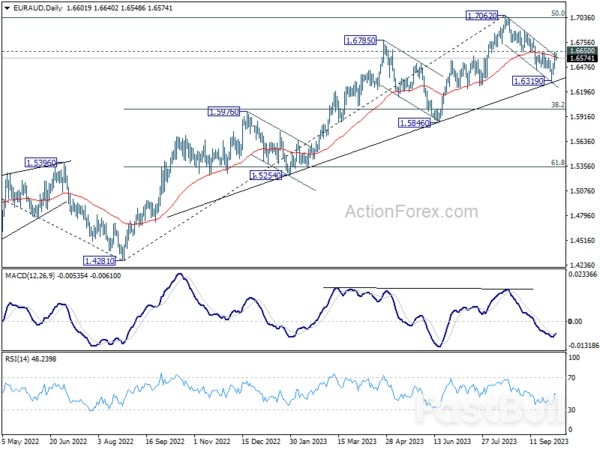
          Technically, EUR/AUD is now pressing 1.6650 resistance after this week's bounce. Firm break there will argue that correction from 1.7062 has completed after drawing support from medium term rising trend line. Stronger rally would be seen back to retest 1.7062 high next. If realized, that would be a signal of more broad based selloff in Aussie, as probably intensification of risk aversion too.Escalating Risk Aversion Meets Yen Intervention_1
          In Asia, at the time of writing, Nikkei is down -1.87%. Hong Kong HSI is down -0.99%. Singapore Strait Times is down -1.50%. Japan 10-year JGB yield is up 0.033 at 0.797, just shy of 0.8 handle. Overnight, DOW dropped -1.29%. S&P 500 dropped -1.37%. NASDAQ dropped -1.87%. 10-year yield rose 0.119 to 4.802.
          Japan's top brass remains mum on intervention claims
          Market watchers were in a frenzy after Japanese Yen surged from 150 to the 147 zone against Dollar overnight , fuelling speculation that Japan's government may have stealthily intervened to push up the struggling currency. While evidence of a Yen-buying, Dollar-selling maneuver abounds, top officials in Japan remained tight-lipped today.
          Finance Minister Shunichi Suzuki, when confronted by reporters, chose the path of silence over confirmation. He held back from validating the swirl of speculations about intervention. Suzuki reiterated a standard narrative, emphasizing the desirability of market-driven, stable currency movements that mirror economic fundamentals.
          "Currency rates ought to move stably driven by markets, reflecting fundamentals. Sharp moves are undesirable," Suzuki noted. "The government is monitoring market developments very carefully with a sense of urgency. We will take appropriate steps against excessive volatility without excluding any options."
          Masato Kanda, the top currency diplomat, provided insights into the government's assessment mechanism for currency movements. "If currencies move too much on a single day or, say, a week, that's judged as excess volatility," Kanda explained.
          The implied volatility stands as a critical metric, among others, shaping the official perspective on whether Yen's moves are reaching alarming amplitudes.
          Kanda further outlined that even in the absence of abrupt shifts, a gradual yet one-sided build-up of significant currency movements over time is also classified as excessive volatility. However, he too refrained from offering a direct commentary on the overnight upswing of Yen.
          RBNZ holds rates, hints at longer duration of restrictive policy
          RBNZ has opted to keep the Official Cash Rate stable at 5.50%, aligning with broad market anticipations. The minutes of the meeting revealed a consensus among committee members that restrictive interest rate environment might be needed "for a more sustained period of time".
          In the short term, RBNZ is looking at a scenario where domestic demand could exhibit "greater resilience", spurred by migration. This situation could "slow the pace of expected disinflation". A related concern is wage inflation, which could take a longer time to ease than initially expected. Recent rise in oil prices could also risk "headline inflation being higher than expected".
          Looking at the medium term, the minuted noted concerns about greater slowdown in global growth. Such a downturn could lead to further reductions in non-oil import prices. Moreover, weakened global demand, with a particular emphasis on China, could exert additional pressure on commodity prices, subsequently affecting New Zealand's export revenues.
          Anxiety grips Wall Street: DOW plummets, VIX jumps, Yields soar
          Economic storm clouds appear to be gathering on the horizon. With DOW experiencing its most significant drop since March and key Treasury yields touching multi-year highs, whispers of a potential recession are becoming more audible. This is further exacerbated by the behavior of VIX, often dubbed the "fear index", which indicates heightened market apprehensions.
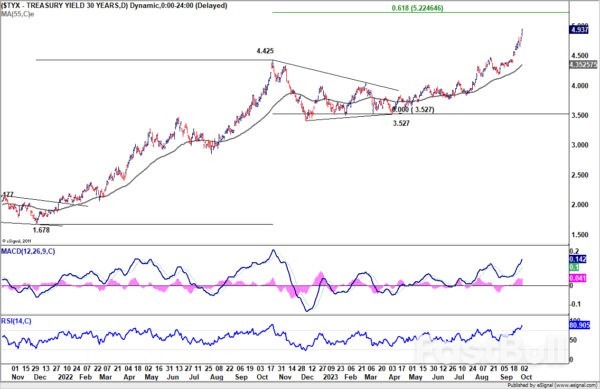
          DOW plummeted by -430.97 points, or -1.29%, nudging it into negative territory for the year, now lagging by -0.4%. This downturn wasn't isolated to stocks. The 10-year yield reached a staggering 4.8%, a pinnacle not seen in 16 years. Similarly, 30-year yield hit a peak of 4.925%, levels of which we haven't seen since 2007.
          Escalating Risk Aversion Meets Yen Intervention_2The narrowing gap between the 2-year and 10-year Treasury yields, contracting to a mere 35 basis points from over 100 basis points a few months earlier, is especially concerning. This normalization, or "de-inverting", of a vital part of the yield curve is often viewed as a precursor to economic downturns, igniting debates on the imminence of a recession.
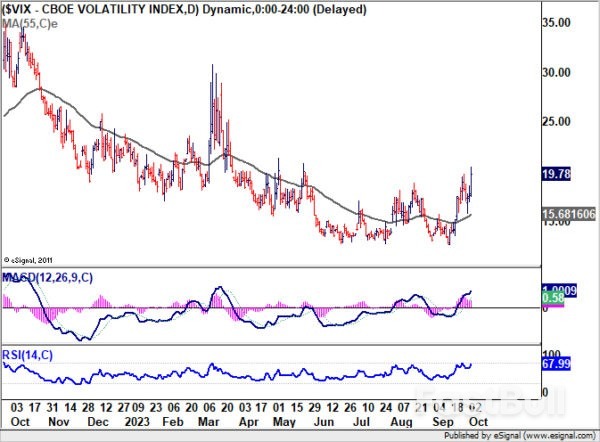
          Adding to the market's jitters, VIX has climbed for three consecutive sessions, momentarily crossing the critical 20 level and finishing at a six-month high. Values below 20 on the VIX generally signify market stability, but as it surpasses this threshold, it denotes an environment fraught with investor unease and skittishness.
          Escalating Risk Aversion Meets Yen Intervention_3Back to DOW, it's now pressing and important near fibonacci support at 38.2% retracement of 28660.94 to 35679.13 at 32998.17. Sustained break of this level will strengthen the case that fall from 35679.13 is reversing whole rise from 28660.94. This decline could be viewed as the third leg of the long term pattern from 36952.65 high. Deeper fall would be seen to 31.429.82 support, which is close to 61.8% retracement at 31341.88.
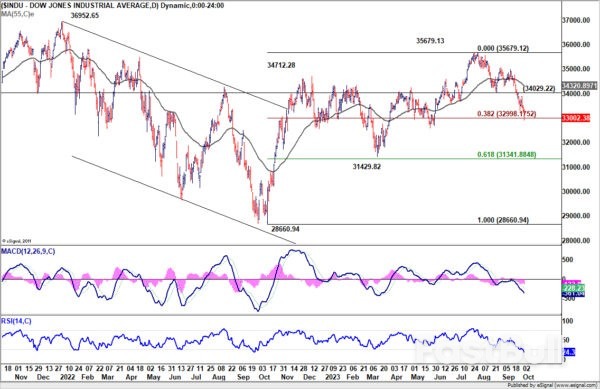
          In any case, near term outlook will stay bearish as long as 34029.22 support turned resistance holds. The rest of the week, with ISM services today and non-farm payrolls release on Friday, will be crucial.

          Escalating Risk Aversion Meets Yen Intervention_4Looking ahead

          Eurozone PMI services final, PPI and retail sales will be released in European session. UK will also release PMI services final. Later in the day, U.S. ADP employment ISM services and factory orderes will take center stage.

          USD/JPY Daily Outlook

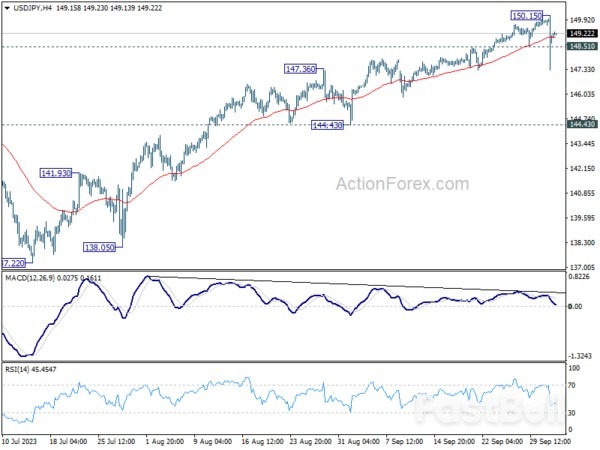
          USD/JPY spiked lower to 147.28 overnight, on alleged intervention by Japan, but recovered quickly since then. As short term top should be in place at 150.15, on bearish divergence condition in 4H MACD. Intraday bias is turned neutral first and more corrective could be seen. But there is no confirmation of bearish trend reversal before firm break of 144.43 support. Another rally remains mildly in favor through 150.15 to retest 151.93 high.Escalating Risk Aversion Meets Yen Intervention_5
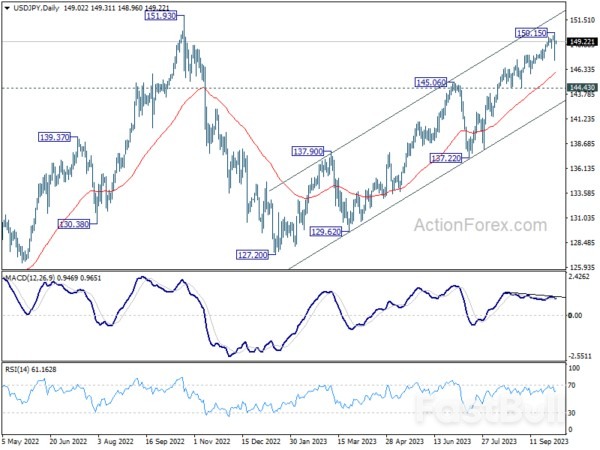
          In the bigger picture, while rise from 127.20 is strong, it could still be seen as the second leg of the corrective pattern from 151.93 (2022 high). Rejection by 151.93, followed by sustained break of 145.06 resistance turned support will be the first sign that the third leg of the pattern has started. However, sustained break of 151.93 will confirm resumption of long term up trend.Escalating Risk Aversion Meets Yen Intervention_6

          Source: ActionForex

          To stay updated on all economic events of today, please check out our Economic calendar
          Risk Warnings and Disclaimers
          You understand and acknowledge that there is a high degree of risk involved in trading. Following any strategies or investment methods may lead to potential losses. The content on the site is provided by our contributors and analysts for information purposes only. You are solely responsible for determining whether any trading assets, securities, strategy, or any other product is suitable for investing based on your own investment objectives and financial situation.
          Comments
          Add to Favorites
          Share

          NZ First Impressions: RBNZ Monetary Policy Review

          Alex

          Central Bank

          Economic

          Forex

          The RBNZ left the OCR unchanged at 5.5% as expected. The tone of the accompanying statement is somewhat more dovish than expected.
          • The RBNZ left the OCR unchanged at 5.5% as expected.
          • The tone of the accompanying statement is somewhat more dovish than expected.
          • The RBNZ assessment of the balance of risks looks unchanged from the August Statement
          • We think this means that the RBNZ is less likely to raise the OCR by 25 basis points at the November Monetary Policy Statement than we forecast.
          • Key factors that will determine the probability and size of a November tightening will be the outcome of the Q3 CPI due 17 October and the Q3 Labour market reports due 1 November.
          The RBNZ left the OCR unchanged at 5.5% and communicated a relatively dovish statement on the future OCR in the accompanying statement.
          The overall tone of the statement and record of meeting displayed a similar degree of concern regarding the persistence of inflation pressures than previously communicated. Market pricing for around a 60% chance of a 25-bps tightening at the November Monetary Policy Statement looks too hawkish and is now adjusting.
          The MPC’s seems to still be concerned about the possibility of persistent inflation pressures and that the economy might not weaken as fast as required in the short term. The MPC noted that GDP was stronger than they expected in the first half of 2023. However, the RBNZ retains confidence that the required amount of slowdown will ultimately occur in light of recent indicators such as the QSBO and PMI indicators. Notably, concerns around increased house prices are not as prominent as in our own assessment with the MPC wanting to see how house prices evolve in the summer period when more activity usually occurs. The MPC seems to also take comfort from the increase in mortgage rates that has occurred since August as global long-term rates have increased, helping add disinflationary pressure.
          Medium term growth and inflation pressures are seen as being held in check by the continued slowing of the global economy and China in particular given that commodity prices continue to be lower than last year.
          We see this statement as more dovish than our expectations. We anticipated the RBNZ would craft a statement that broadly endorsed current market pricing for around a 50/50 chance of a 25 bp rate rise in November. This statement suggests that view was too hawkish. By not communicating any further concern on the inflation outlook means the hurdle for a November tightening remains high.
          While we continue to see a 25 bp rate hike in November at this stage, but this must be a lower probability than previously thought. The Q3 CPI and Labour market data will be key to the probability/size of that rate increase as also will global economic and financial markets developments.

          Source: Westpac Banking Corporation

          To stay updated on all economic events of today, please check out our Economic calendar
          Risk Warnings and Disclaimers
          You understand and acknowledge that there is a high degree of risk involved in trading. Following any strategies or investment methods may lead to potential losses. The content on the site is provided by our contributors and analysts for information purposes only. You are solely responsible for determining whether any trading assets, securities, strategy, or any other product is suitable for investing based on your own investment objectives and financial situation.
          Comments
          Add to Favorites
          Share

          Services PMIs in Focus as Stock Markets Struggle

          CMC

          Economic

          Forex

          Yesterday saw another day where rising U.S. yields and a strong U.S. dollar continued to exert downward pressure on stock markets with the DAX sinking to a fresh 6-month low, while the FTSE250 fell below its July lows to its lowest levels this year.
          U.S. markets also fell back with the S&P500 closing just above its 200-day SMA, as well as at a 4-month low. The Nasdaq 100 also had a poor day after the latest numbers for job openings jumped sharply in August by 600k, while the Dow slipped into negative territory for the year.
          The sharp rise in long term rates relative to short term rates suggests investors think that U.S. interest rates are likely to remain higher for longer due to the continued resilience of the U.S. economy. Consequently, this bear steepening is slowly unwinding the inversion of the 2/10s from the -105bps we saw at the end of June and where we are now at -35bps.
          If this trend of rising long-term rates continues, then stock markets could well be in for even more volatility in the days and weeks ahead.
          Let's not forget 2-year yields are still above 10-year yields, a situation which is far from normal. Under normal circumstances long term rates would be above short-term rates, which means this yield adjustment still has some way to go. How it plays out will be key to how stock markets perform over the next few weeks.
          Also weighing on U.S. markets was the voting out of U.S. House speaker Kevin McCarthy, by fellow dissident Republicans on disappointment over the weekend agreement of a deal to avert a U.S. government shutdown until November 17th.
          With the House now without a majority leader, a new leader will need to be appointed, a time-consuming process if the McCarthy experience is any guide, which could complicate the prospect that we might get a new deal when the current deal expires next month.
          If you thought UK politics was dysfunctional, then the U.S. runs it a close second.
          The weak finish in the U.S. looks set to translate into a weak European open, with Asia markets falling sharply this morning with the focus today on the services sector and the latest U.S. ADP jobs report.
          The recent flash PMIs for France, Germany and the UK suggest further economic weakness in the services sector in September.
          France especially has seen a sharp slowdown despite hosting the Rugby World Cup with the flash services number falling to 43.9 from 46. Germany, on the other hand, saw a modest pickup from 47.3 to 49.8.
          In the UK we also saw a modest slowdown from 49.5 to 47.2, as concerns about a Q3 contraction across Europe continued to gain strength.
          The weak flash readings from France and Germany make it even more puzzling as to why the ECB felt it necessary to raise rates at its last meeting, although one suspects it may well have been its last. In the U.S. the services sector is proving to be more resilient at 50.2, while the ISM services survey has tended to be more resilient and is expected to come in at a fairly solid 53.5.
          Yesterday the latest JOLTS numbers for August showed a big jump in vacancies to 9.6m in a sign that the U.S. labour market remains surprisingly resilient driving long term U.S. yields to new multiyear highs. Today's ISM as well as ADP payrolls report could add further fuel to that yield fire with another set of strong numbers, ahead of Friday's September payrolls report.
          ADP payrolls saw 177k jobs added in August, falling slightly short of forecasts of 195k. Slightly offsetting that was sizeable upward revision to July from 324k to 371k, but overall, the main gains have been in services. Expectations are for 150k jobs to be added.
          EUR/USD – has slipped below the 1.0480 lows of last week, opening up the potential for a return towards parity, with the next support at 1.0400 which is 50% pullback of the 0.9535/1.1275 up move, followed by 1.0200. The main resistance remains back at the 1.0740 area, which we need to get above to stabilise and minimise the risk of further weakness.
          GBP/USD – looks set for a test of the 1.2050 area with a break targeting the 1.1835 area which equates to a 50% retracement of the move from the record lows at 1.0330 to the recent peaks at 1.3145. Only a move back above the 1.2430 area and 200-day SMA stabilises and argues for a return to the 1.2600 area.
          EUR/GBP – appears range bound with resistance at the 0.8700 area and resistance at the 200-day SMA at 0.8720, which is capping the upside. A break of 0.8720 targets the 0.8800 area, however while below the bias remains for a move back to the 0.8620 area.
          USD/JPY – made a 12-month high of 150.16 yesterday before plunging to 147.35 on the back of possible intervention from the Bank of Japan. With no confirmation at the time of writing that intervention took place, any further moves higher could be choppy. Below 147.30 signals the top is in.
          To stay updated on all economic events of today, please check out our Economic calendar
          Risk Warnings and Disclaimers
          You understand and acknowledge that there is a high degree of risk involved in trading. Following any strategies or investment methods may lead to potential losses. The content on the site is provided by our contributors and analysts for information purposes only. You are solely responsible for determining whether any trading assets, securities, strategy, or any other product is suitable for investing based on your own investment objectives and financial situation.
          Comments
          Add to Favorites
          Share

          Gold Price Nosedives, Recovery Could Be Limited

          Titan FX

          Commodity

          Gold Price Technical Analysis
          Gold price started a major decline from well above $1,920 against the U.S. Dollar. The price declined heavily below the $1,900 support zone.
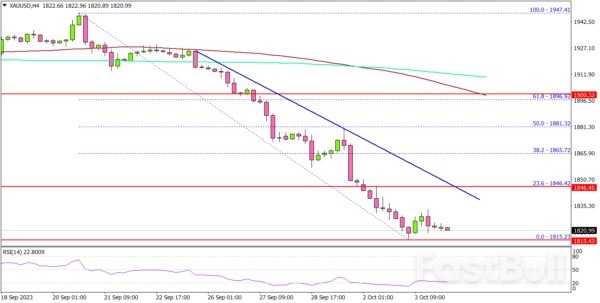
          Gold Price Nosedives, Recovery Could Be Limited_1The 4-hour chart of XAU/USD indicates that the price settled above the $1,865 level, the 200 Simple Moving Average (green, 4 hours), and the 100 Simple Moving Average (red, 4 hours).
          The decline was even extended below the $1,840 level. A low was formed near $1,815 and the price is now consolidating losses. On the upside, the price is facing resistance near the $1,832 and $1,835 levels.
          The next major resistance is near the $1,840 level, above which Gold could revisit the key $1,850 resistance zone. Any more gains might call for a move toward $1,880.
          On the downside, the price might find support near the $1,815 level. The next key support is near $1,800. If the bulls fail to protect the $1,800 support, there is a risk of a major decline. In the stated case, the price could decline toward the $1,750 level.
          Looking at crude oil prices, there was a sustained upward move toward the $95.00 level before the bears appeared and initiated a downside correction.
          Economic Releases to Watch Today
          Germany's Services PMI for Sep 2023 – Forecast 49.8, versus 49.8 previous.
          Euro Zone Services PMI for Sep 2023 – Forecast 48.4, versus 48.4 previous.
          UK Services PMI for Sep 2023 – Forecast 47.2, versus 47.2 previous.
          U.S. Services PMI for Sep 2023 – Forecast 50.2, versus 50.2 previous.
          U.S. ISM Services PMI for Sep 2023 – Forecast 53.6, versus 54.5 previous.
          Risk Warnings and Disclaimers
          You understand and acknowledge that there is a high degree of risk involved in trading. Following any strategies or investment methods may lead to potential losses. The content on the site is provided by our contributors and analysts for information purposes only. You are solely responsible for determining whether any trading assets, securities, strategy, or any other product is suitable for investing based on your own investment objectives and financial situation.
          Comments
          Add to Favorites
          Share

          What Would Japanese Intervention to Boost the Weak Yen Look Like?

          Thomas

          Forex

          Japanese authorities are facing renewed pressure to combat a sustained depreciation in the yen, as investors eye prospects of higher-for-longer U.S. interest rates while the Bank of Japan remains wedded to its super low interest rate policy.
          The yen strengthened sharply against the dollar on Tuesday, leading some market participants to believe Japanese policymakers had intervened to support the currency, although others said the size of the move was not convincing enough.
          Below are details on how yen-buying intervention works:
          Last confirmed yen-buying intervention?
          Japan bought yen in September of last year, its first foray in the market to boost its currency since 1998, after a Bank of Japan (BOJ) decision to maintain its ultra-loose monetary policy drove the yen as low as 145 per dollar. It intervened again in October after the yen plunged to a 32-year low of 151.94.
          Why step in?
          Yen-buying intervention is rare. Far more often the Ministry of Finance has sold yen to prevent its rise from hurting the export-reliant economy by making Japanese goods less competitive overseas.
          But yen weakness is now seen as problematic, with Japanese firms having shifted production overseas and the economy heavily reliant on imports for goods ranging from fuel and raw materials to machinery parts.
          What happens first?
          When Japanese authorities escalate their verbal warnings to say they "stand ready to act decisively" against speculative moves, that is a sign intervention may be imminent.
          Rate checking by the BOJ - when central bank officials call dealers and ask for buying or selling rates for the yen - is seen by traders as a possible precursor to intervention.
          Did Tokyo intervene again?
          Japan's top currency diplomat Masato Kanda told reporters on Wednesday authorities will take "appropriate steps against excessive moves, without ruling out any options." Kanda, who has made similar comments in recent weeks, declined to say whether Tokyo intervened overnight on Tuesday.
          Kanda may be relying on psychological tactics to fight yen bears, as Tokyo did last October by holding off on immediately confirming whether intervention took place.
          By staying mum, authorities can keep investors guessing and discourage speculators from testing the yen's new lows - a tactic known as "stealth intervention."
          Investors will know whether Tokyo intervened, and if so how much it spent, when the Ministy of Finance releases monthly intervention data, usually at the end of each month.
          Line in the sand?
          Authorities say they look at the speed of yen falls, rather than levels, and whether the moves are driven by speculators, to determine whether to step into the currency market.
          With the dollar having breached the psychologically important 150-yen level, many market players see 151.94 yen, where Japan last intervened, as the next threshold, then 155.
          What's the trigger?
          The decision is highly political. When public anger over the weak yen and a subsequent rise in the cost of living is high, that puts pressure on the administration to respond. This was the case when Tokyo intervened last year.
          While inflation remains above the BOJ's 2 per cent target, public pressure has declined as fuel and global commodity prices have fallen from last year's peaks.
          If the yen's slide accelerates and draws the ire of media and public, the chance of intervention would rise again.
          The decision would not be easy. Intervention is costly and could easily fail, given that even a large burst of yen buying would pale next to the $7.5 trillion that change hands daily in the foreign exchange market.
          How would it work?
          When Japan intervenes to stem yen rises, the Ministry of Finance issues short-term bills, raising yen it then sells to weaken the Japanese currency.
          To support the yen, however, the authorities must tap Japan's foreign reserves for dollars to sell for yen.
          In either case, the finance minister issues the order to intervene, and the BOJ executes the order as the ministry's agent.
          Challenges?
          Yen-buying intervention is more difficult than yen-selling.
          While Japan holds nearly $1.3 trillion in foreign reserves, these could be substantially eroded if Tokyo intervened heavily repeatedly, leaving authorities constrained over how long they can defend the yen.
          Japanese authorities also consider it important to seek the support of Group of Seven partners, notably the United States if the intervention involves the dollar.
          Washington gave tacit approval when Japan intervened last year, reflecting recent close bilateral relations. U.S. Treasury Secretary Janet Yellen said last month the question of Washington giving the greenlight over another yen-buying intervention by Japan "depends on the details" of the situation.

          Source: CNA

          Risk Warnings and Disclaimers
          You understand and acknowledge that there is a high degree of risk involved in trading. Following any strategies or investment methods may lead to potential losses. The content on the site is provided by our contributors and analysts for information purposes only. You are solely responsible for determining whether any trading assets, securities, strategy, or any other product is suitable for investing based on your own investment objectives and financial situation.
          Comments
          Add to Favorites
          Share

          U.S. Stocks Outlook: Can It Reverse Its Downtrend This October?

          IG

          Stocks

          The global stock market has finally closed the book on what has been the most challenging month of the year. Both the S&P 500 and the tech-heavy Nasdaq fell by nearly 5% in September, while the Dow Jones declined by 3.2% for the month. The big question on everyone's mind is whether this downtrend can be reversed in the months ahead. What are the key factors to watch for into the final quarter of the year?

          S&P500 October key watch

          Wall Street kicked off the first trading day of October and the last quarter of the year on a cautiously positive note. The S&P 500 finished marginally higher, and the Nasdaq gained nearly 0.7%. The day was marked by a better-than-expected ISM Manufacturing PMI, signaling the beginning of the fourth quarter with hints of a potential easing in the contraction of the U.S. manufacturing sector and associated price pressures.
          Notably, the prevailing sentiment stemming from the Federal Reserve's September meeting, which suggested that interest rates would remain elevated for an extended period, continues to serve as the backdrop for the equity market's risk landscape. Consequently, even though there is no Federal Open Market Committee (FOMC) meeting in October, discussions surrounding the price pressure are expected to remain a focal point for the month ahead.
          Furthermore, from the second week of October, the Q3 U.S. earnings season will provide more insights into corporate revenues and profits. Currently, it appears that the third-quarter earnings season may witness another decline in earnings, further squeezing corporate margins. According to Factset, by the end of September, 64% of companies providing earnings per share (EPS) guidance are projecting negative EPS. This percentage is above the 5-year average of 59%.
          However, it's worth noting that in the past two earnings seasons, despite the overall results being less impressive, a significant number of companies still exceeded expectations and outperformed the consensus forecasts. For instance, during the April to June quarter, 79% of reporting companies surpassed their forecasts, above the five-year average of 75%.

          S&P500 in Q4

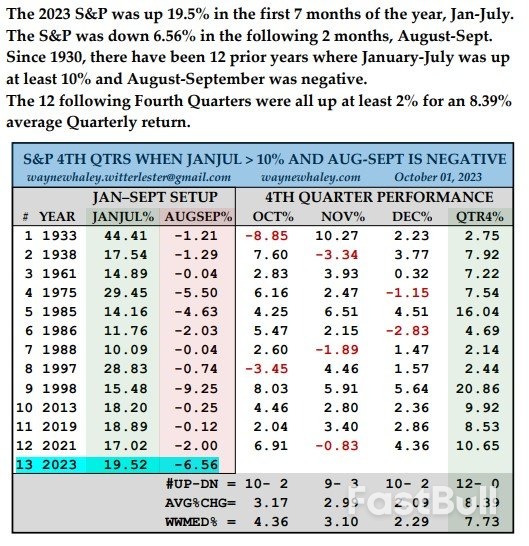
          In fact, despite the sharp decline from August to September, the S&P 500 remains 10% above its opening position in 2023. Historically, the chances of the fourth quarter preserving yearly gains after a mid-year correction are not uncommon. According to the chart below, in the past 12 instances when the S&P 500 followed a similar pattern to that of 2023, the fourth quarter enjoyed a minimum 2.14% and an average 8.39% quarterly return.

          U.S. Stocks Outlook: Can It Reverse Its Downtrend This October?_1Source: S&P500

          S&P500 technical analysis

          The daily chart of the U.S. 500 has depicted a clear downward trajectory from the year's peak above 4500.
          Last week's retreat has brought the S&P 500 to a vital support area, which includes the 200-day moving average, the year-long trend line from October 2022, and the peak from August 2022, situated between 4258-4287.
          Based on the price action in the past five sessions, it appears that the significance of this level has notably eased the selling pressure and successfully pushed the RSI out of oversold territory for the time being. On the other hand, a significant resistance zone lies between the August low and the 20-day SMA at 4340 to 4376.
          Risk Warnings and Disclaimers
          You understand and acknowledge that there is a high degree of risk involved in trading. Following any strategies or investment methods may lead to potential losses. The content on the site is provided by our contributors and analysts for information purposes only. You are solely responsible for determining whether any trading assets, securities, strategy, or any other product is suitable for investing based on your own investment objectives and financial situation.
          Comments
          Add to Favorites
          Share

          Will the Oil Price Hit $100 Per Barrel?

          CMC

          Energy

          The crude oil markets rose for the third consecutive month in September on improved demand outlooks and expectations for OPEC + to keep supply tight by cutting production further. The WTI futures jumped 21%, and the Brent futures rose 26% in the past three months. However, both benchmark prices fell three days in the past four trading days, making traders doubtful about whether the oil market can re-claim the $100 per barrel. The 100-mark might be achievable, given the increasing demand and reduced supply by OPEC + in the past few months. However, crude prices might not be able to sustain above the level due to global economic uncertainties.

          Supply and demand hang in the balance

          On the supply side, the International Energy Agency(IEA)'s report showed that OPEC+'s output reduction took the cartel's oil production to 50 million barrels per day (bpd) in July to nearly a two-year low as the leader of the organization, Saudi Arabia, voluntarily cut production by an extra 1 million barrels per day and may extend the reduction to the end of 2023. The organization's output sharply declined by 2 mb/d from January this year. At the same time, non-OPEC producers ramped up their production by 310 kb/d to 50.2 mb/d, which may take the global oil output to hit a record of 101.5 mb/d in 2023. The U.S. oil production is the biggest contributor to the increase. At the same time, the cartel's supply had hit a bottom in July and rose for the second consecutive month in September. The monthly Reuters survey showed that production increased by 120,000 bpd due to higher output in Iran and Nigeria in August, with Iran's production hitting a new 2018 high of 3.15 million bpd. The OPEC oil production had risen for the first time since February.
          On the demand side, the U.S. commercial crude oil stockpiles decreased by 2.2 million barrels by the week ending 22 September from the previous week. The crude imports increased by 8.2% on average over the past four weeks from the same period last year. The latest IEA's report shows that global oil demand "is set to expand by 2.2 million barrels per day (mb/d) to 102.2 mb/d in 2023, with China accounting for more than 70% of growth. In June and August, global oil demand hit a record of 103 mb/d as major economies had faster growth than forecast in the second quarter. China's improvement in its recent economic data has also fuelled the oil market's rally. However, the momentum may not be sustained in 2024 as the U.S. Fed's rate hikes and China's economic slowdown may dampen demands globally. Also, the increase in electric vehicles will weigh on fuel demands. The IEA expects the global demand will slow to 1 mb/d in 2024.

          Technical analysis

          Will the Oil Price Hit $100 Per Barrel?_1Source: CMC Markets as of 04 Oct 2023

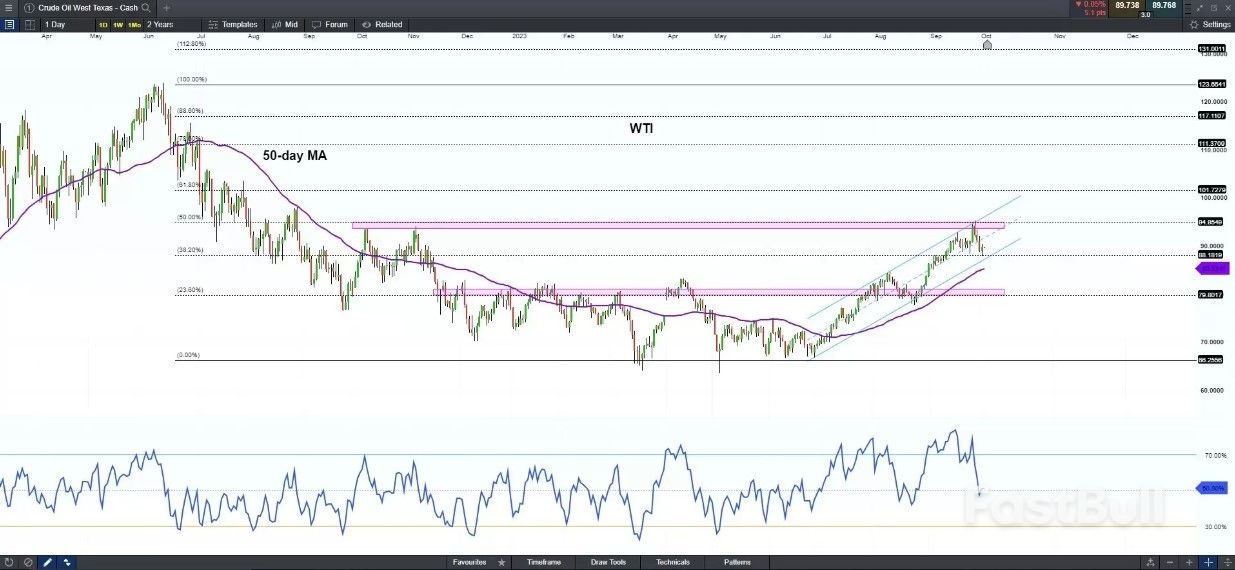
          The uptrend is still intact in the WTI, as it has been moving in an ascending channel since the end of June. However, an oversold signal in the RSI may have caused the correction. In the short term, the price may be able to test the recent high of about 95 again. A bullish breakout of this level can take it to above 101, which is a 61.80% Fibonacci retracement. The near-term key support can be found at the 50-day moving average of 85.33, and then about 80 at the 23.60% Fibonacci retracement.

          Will the Oil Price Hit $100 Per Barrel?_2Source: CMC Markets as of 04 Oct 2023

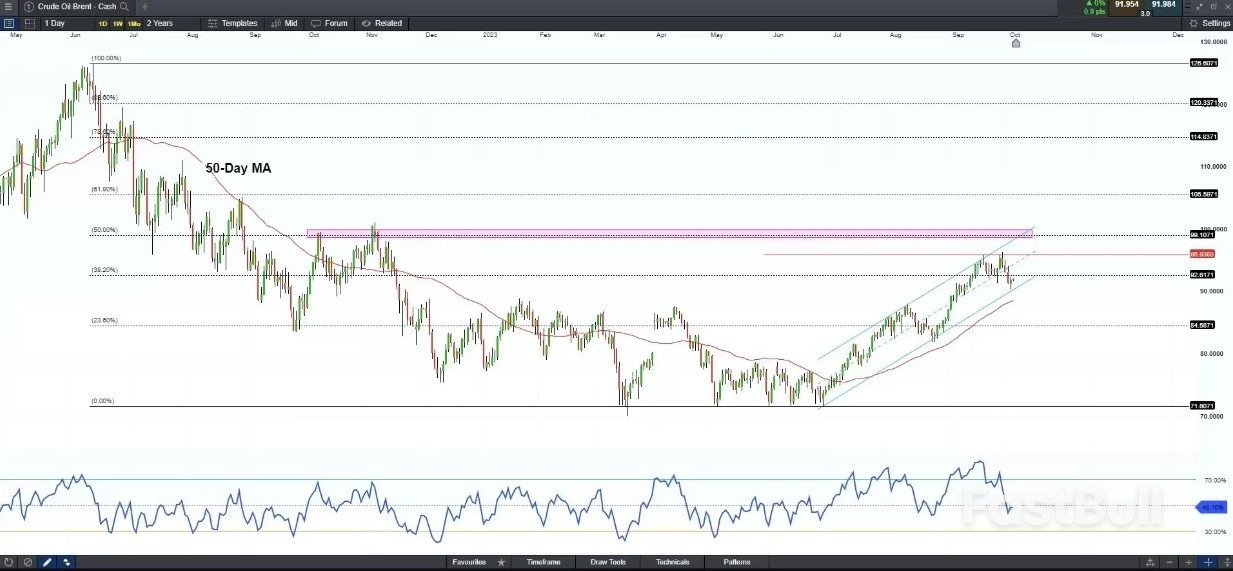
          Brent oil rebounded from the lower band of the ascending channel, and it may continue the uptrend and test the recent key resistance of about 96, a bullish breakout of this level may take the price to 100, which is the 50% Fibonacci retracement and is the previous resistance in November 2022. In the near term, the potential key support can be found at the 50-day moving average of 89. A breakdown of this level could press the Brent price further to test about 84.59 at the 23.6% Fibonacci retracement.
          Risk Warnings and Disclaimers
          You understand and acknowledge that there is a high degree of risk involved in trading. Following any strategies or investment methods may lead to potential losses. The content on the site is provided by our contributors and analysts for information purposes only. You are solely responsible for determining whether any trading assets, securities, strategy, or any other product is suitable for investing based on your own investment objectives and financial situation.
          Comments
          Add to Favorites
          Share
          FastBull
          Copyright © 2025 FastBull Ltd

          728 RM B 7/F GEE LOK IND BLDG NO 34 HUNG TO RD KWUN TONG KLN HONG KONG

          TelegramInstagramTwitterfacebooklinkedin
          App Store Google Play Google Play
          Products
          Charts

          Chats

          Q&A with Experts
          Screeners
          Economic Calendar
          Data
          Tools
          Membership
          Features
          Function
          Markets
          Copy Trading
          Latest Signals
          Contests
          News
          Analysis
          24/7
          Columns
          Education
          Company
          Careers
          About Us
          Contact Us
          Advertising
          Help Center
          Feedback
          User Agreement
          Privacy Policy
          Business

          White Label

          Data API

          Web Plug-ins

          Poster Maker

          Affiliate Program

          Risk Disclosure

          The risk of loss in trading financial instruments such as stocks, FX, commodities, futures, bonds, ETFs and crypto can be substantial. You may sustain a total loss of the funds that you deposit with your broker. Therefore, you should carefully consider whether such trading is suitable for you in light of your circumstances and financial resources.

          No decision to invest should be made without thoroughly conducting due diligence by yourself or consulting with your financial advisors. Our web content might not suit you since we don't know your financial conditions and investment needs. Our financial information might have latency or contain inaccuracy, so you should be fully responsible for any of your trading and investment decisions. The company will not be responsible for your capital loss.

          Without getting permission from the website, you are not allowed to copy the website's graphics, texts, or trademarks. Intellectual property rights in the content or data incorporated into this website belong to its providers and exchange merchants.

          Not Logged In

          Log in to access more features

          FastBull Membership

          Not yet

          Purchase

          Become a signal provider
          Help Center
          Customer Service
          Dark Mode
          Price Up/Down Colors

          Log In

          Sign Up

          Position
          Layout
          Fullscreen
          Default to Chart
          The chart page opens by default when you visit fastbull.com