Markets
News
Analysis
User
24/7
Economic Calendar
Education
Data
- Names
- Latest
- Prev


Signal Accounts for Members
All Signal Accounts
All Contests


U.K. Trade Balance Non-EU (SA) (Oct)A:--
F: --
P: --
U.K. Trade Balance (Oct)A:--
F: --
P: --
U.K. Services Index MoMA:--
F: --
P: --
U.K. Construction Output MoM (SA) (Oct)A:--
F: --
P: --
U.K. Industrial Output YoY (Oct)A:--
F: --
P: --
U.K. Trade Balance (SA) (Oct)A:--
F: --
P: --
U.K. Trade Balance EU (SA) (Oct)A:--
F: --
P: --
U.K. Manufacturing Output YoY (Oct)A:--
F: --
P: --
U.K. GDP MoM (Oct)A:--
F: --
P: --
U.K. GDP YoY (SA) (Oct)A:--
F: --
P: --
U.K. Industrial Output MoM (Oct)A:--
F: --
P: --
U.K. Construction Output YoY (Oct)A:--
F: --
P: --
France HICP Final MoM (Nov)A:--
F: --
P: --
China, Mainland Outstanding Loans Growth YoY (Nov)A:--
F: --
P: --
China, Mainland M2 Money Supply YoY (Nov)A:--
F: --
P: --
China, Mainland M0 Money Supply YoY (Nov)A:--
F: --
P: --
China, Mainland M1 Money Supply YoY (Nov)A:--
F: --
P: --
India CPI YoY (Nov)A:--
F: --
P: --
India Deposit Gowth YoYA:--
F: --
P: --
Brazil Services Growth YoY (Oct)A:--
F: --
P: --
Mexico Industrial Output YoY (Oct)A:--
F: --
P: --
Russia Trade Balance (Oct)A:--
F: --
P: --
Philadelphia Fed President Henry Paulson delivers a speech
Canada Building Permits MoM (SA) (Oct)A:--
F: --
P: --
Canada Wholesale Sales YoY (Oct)A:--
F: --
P: --
Canada Wholesale Inventory MoM (Oct)A:--
F: --
P: --
Canada Wholesale Inventory YoY (Oct)A:--
F: --
P: --
Canada Wholesale Sales MoM (SA) (Oct)A:--
F: --
P: --
Germany Current Account (Not SA) (Oct)A:--
F: --
P: --
U.S. Weekly Total Rig CountA:--
F: --
P: --
U.S. Weekly Total Oil Rig CountA:--
F: --
P: --
Japan Tankan Large Non-Manufacturing Diffusion Index (Q4)--
F: --
P: --
Japan Tankan Small Manufacturing Outlook Index (Q4)--
F: --
P: --
Japan Tankan Large Non-Manufacturing Outlook Index (Q4)--
F: --
P: --
Japan Tankan Large Manufacturing Outlook Index (Q4)--
F: --
P: --
Japan Tankan Small Manufacturing Diffusion Index (Q4)--
F: --
P: --
Japan Tankan Large Manufacturing Diffusion Index (Q4)--
F: --
P: --
Japan Tankan Large-Enterprise Capital Expenditure YoY (Q4)--
F: --
P: --
U.K. Rightmove House Price Index YoY (Dec)--
F: --
P: --
China, Mainland Industrial Output YoY (YTD) (Nov)--
F: --
P: --
China, Mainland Urban Area Unemployment Rate (Nov)--
F: --
P: --
Saudi Arabia CPI YoY (Nov)--
F: --
P: --
Euro Zone Industrial Output YoY (Oct)--
F: --
P: --
Euro Zone Industrial Output MoM (Oct)--
F: --
P: --
Canada Existing Home Sales MoM (Nov)--
F: --
P: --
Euro Zone Total Reserve Assets (Nov)--
F: --
P: --
U.K. Inflation Rate Expectations--
F: --
P: --
Canada National Economic Confidence Index--
F: --
P: --
Canada New Housing Starts (Nov)--
F: --
P: --
U.S. NY Fed Manufacturing Employment Index (Dec)--
F: --
P: --
U.S. NY Fed Manufacturing Index (Dec)--
F: --
P: --
Canada Core CPI YoY (Nov)--
F: --
P: --
Canada Manufacturing Unfilled Orders MoM (Oct)--
F: --
P: --
Canada Manufacturing New Orders MoM (Oct)--
F: --
P: --
Canada Core CPI MoM (Nov)--
F: --
P: --
Canada Manufacturing Inventory MoM (Oct)--
F: --
P: --
Canada CPI YoY (Nov)--
F: --
P: --
Canada CPI MoM (Nov)--
F: --
P: --
Canada CPI YoY (SA) (Nov)--
F: --
P: --
Canada Core CPI MoM (SA) (Nov)--
F: --
P: --


No matching data
Latest Views
Latest Views
Trending Topics
Top Columnists
Latest Update
White Label
Data API
Web Plug-ins
Affiliate Program
View All

No data
Wall Street economists said the US risks a recession this year and inflation could return to pandemic levels followin.
Wall Street economists said the US risks a recession this year and inflation could return to pandemic levels following the Trump administration’s announcement of major tariffs on global trading partners.
Nomura Securities International Inc said it expects gross domestic product (GDP) to expand 0.6% in 2025 after accounting for the new levies on imports, and a key measure of underlying inflation to rise to 4.7%.
Barclays plc economists took a more pessimistic view towards GDP — projecting a 0.1% contraction — and a slightly more optimistic view of inflation, pencilling in a 3.7% increase. They also look for the unemployment rate to climb by year-end.
President Donald Trump’s tariff announcement on Wednesday sent global financial markets into a tailspin, upending forecasts for ongoing expansion in the world’s largest economy. Several major banks offered provisional estimates of the impact which indicated a big hit to growth and boost to inflation, though they declined to make formal revisions, citing the possibility that the measures could be tempered in coming days.
“Clearly such a large adjustment poses material downside risk to the expansion. Our assessment would lift not only inflation into 2026, but also sees GDP fall and the unemployment rate rise,” UBS chief US economist Jonathan Pingle said on Wednesday in a note. “We would expect two quarters of negative GDP growth.”
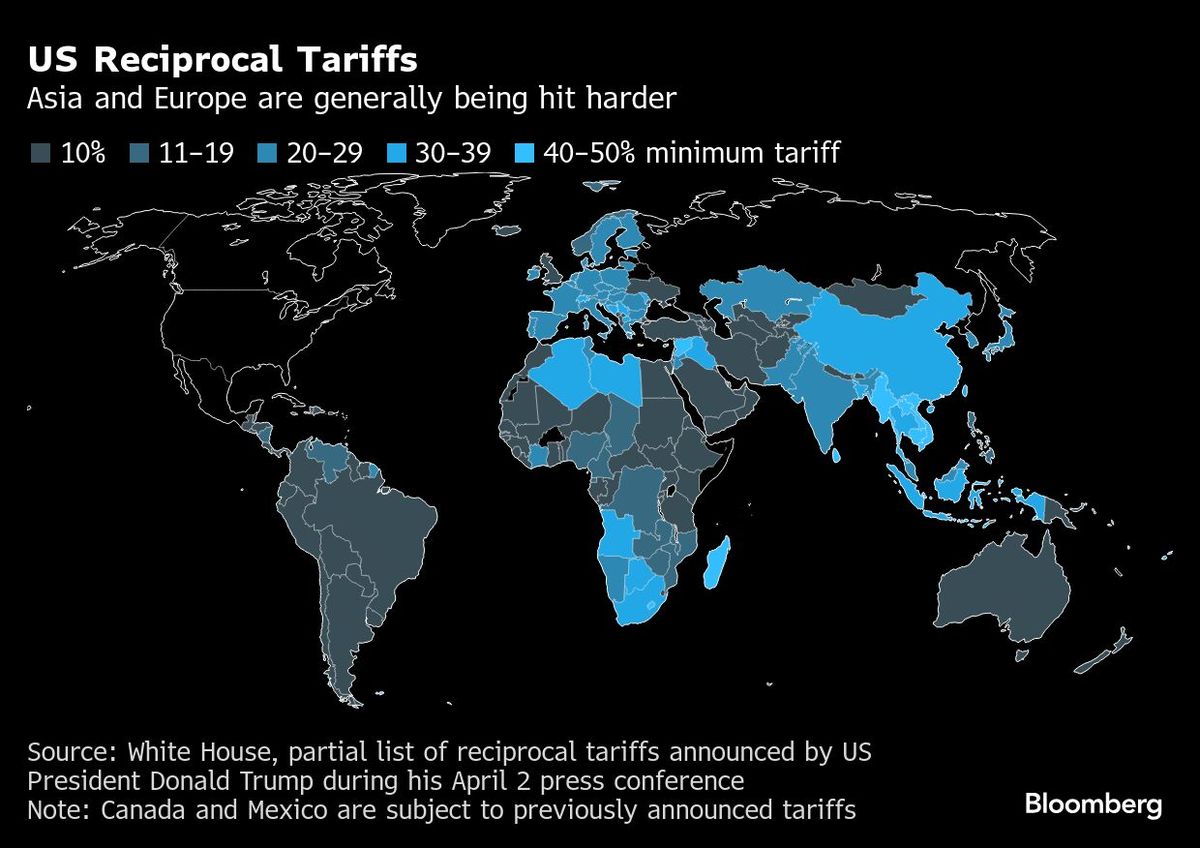
Trump says he wants to rebalance the global trading system in favour of American workers, who he argues have suffered for decades from unfair deals negotiated by his predecessors. In a statement following the announcement, the US Trade Representative Office said tariffs for each country were calculated based on the size of their trade surplus with and the values of their exports to the US.
The levies, if they remain in place, threaten to erase most of the progress made in reducing inflation over the last three years. The Federal Reserve’s preferred measure — based on the personal consumption expenditures (PCE) price index excluding food and energy — stood at 2.8% in February, down from the pandemic high of 5.6% reached in February 2022.
“If one takes a now current policy baseline forward, core PCE forecasts for 2025 should be revised into the 4-5% range,” Peter Williams, an economist at 22V Research, said in a note late on Wednesday. “The low-to-mid 3s seemed appropriate based off policy this morning [Wednesday]. Excess precision feels unnecessary and impractical. There is now going to be the feared second wave higher of core PCE inflation.”
Amid the rout in markets, investors rushed into bets on several Fed interest-rate cuts over the remainder of the year despite the expected rise in inflation. They now see a roughly 30% chance of a quarter-point reduction at the conclusion of the US central bank’s next two-day policy meeting on May 7, and better-than-even odds of cuts at each of the final five meetings of the year, according to futures.
“We’re raising our baseline core PCE inflation forecast for the fourth quarter of 2025 to 3.0% (vs a previous forecast of 2.8%), and our unemployment-rate forecast to 4.8% (vs 4.5% previously). We pencil in a more modest inflation impact from the tariffs than the 2018 Fed model provides, as we think most of the burden will fall on the labour market and on firms’ profit margins,” says Anna Wong, chief US economist at Bloomberg Economics.
Economists were generally more cautious on the outlook for rates. Fed officials “would likely react, but slowly at first, and really only respond forcefully after seeing the economic damage because of the inflation risks, in our view,” Pingle said in the UBS report.
“The price level increase is large enough that monetary policy could risk getting caught offside, not unlike in 2022” when the central bank was slow to raise rates, he said.
Fed chair Jerome Powell will give a speech on the economic outlook on Friday morning after the Bureau of Labor Statistics publishes its March employment report.
The Director-General of the World Trade Organization said new tariffs announced by the U.S. along with those introduced at the start of the year could lead to a contraction of around 1% in global merchandise trade volumes in 2025.
"I'm deeply concerned about this decline and the potential for escalation into a tariff war with a cycle of retaliatory measures that lead to further declines in trade," Ngozi Okonjo-Iweala said in a statement on Thursday.
She warned that the tariffs have the potential to create significant trade diversion effects.
The WTO administers 74% of global trade, down from around 80% at the beginning of the year due to recent tariffs, according to the organisation.
World leaders have warned of the potential negative economic consequences of the tariffs.
"President Trump's announcement of universal tariffs on the whole world, including the EU, is a major blow to the world economy," European Commission President Ursula Von Der Leyen said.
Okonjo-Iweala told member states earlier on Thursday in a letter seen by Reuters that the WTO had received many questions about the tariffs.
"Many of you have been in touch about the U.S. announcement on tariffs, asking for the Secretariat to provide an economic analysis of the impact of these tariffs and any potential reaction on your trade," Okonjo-Iweala wrote.
Observers say U.S. determination to double down on tariffs risks sidelining the Geneva-based WTO and its free-trade mandate.
Jefferson emphasized the value of speeches as a means for the Federal Reserve to deliver its mission to the American people. He highlighted the significance of engaging with people from around the country to understand economic conditions and to learn about specific industries and communities. He suggested that such engagement helps in delivering better policies and that it’s crucial for households, businesses, and financial markets to understand policymakers’ views and assessments of economic conditions.
The vice chair explained that monetary policy affects the economy through financial market prices, such as long-term interest rates, which in turn influence the decisions of households and businesses. He also touched on the evolution of Fed communications, noting that clear and ample communication was not always a hallmark of the Fed.
On the economic outlook, Jefferson noted that significant progress has been made toward the Fed’s dual-mandate goals of maximum employment and stable prices, with solid labor market conditions and inflation somewhat elevated relative to the 2 percent goal. He also mentioned that surveys of consumers and businesses show heightened uncertainty about the economic outlook.
The vice chair pointed out that the economy expanded at a solid pace at the end of last year, with GDP rising at a 2.4 percent annual rate in the fourth quarter. However, he noted that both Fed policymakers and many private-sector forecasters anticipate a slower pace of expansion this year.
Regarding the labor market, Jefferson said conditions remain solid with the unemployment rate at 4.1 percent in February. He also mentioned that payroll job gains have averaged nearly 200,000 per month over the past six months, through February.
On inflation, the vice chair said that it has come down significantly over the past two and a half years but remains somewhat elevated relative to the 2 percent objective. He added that the median FOMC participant forecasts overall PCE inflation at 2.7 percent this year and 2.2 percent next year.
In terms of monetary policy, Jefferson supported the FOMC’s decision to hold rates steady at the last policy meeting in March. He concluded by stressing the value of central bank communication and wished attendees a productive and informative remainder of the conference.
This article was generated with the support of AI and reviewed by an editor. For more information see our T&C.
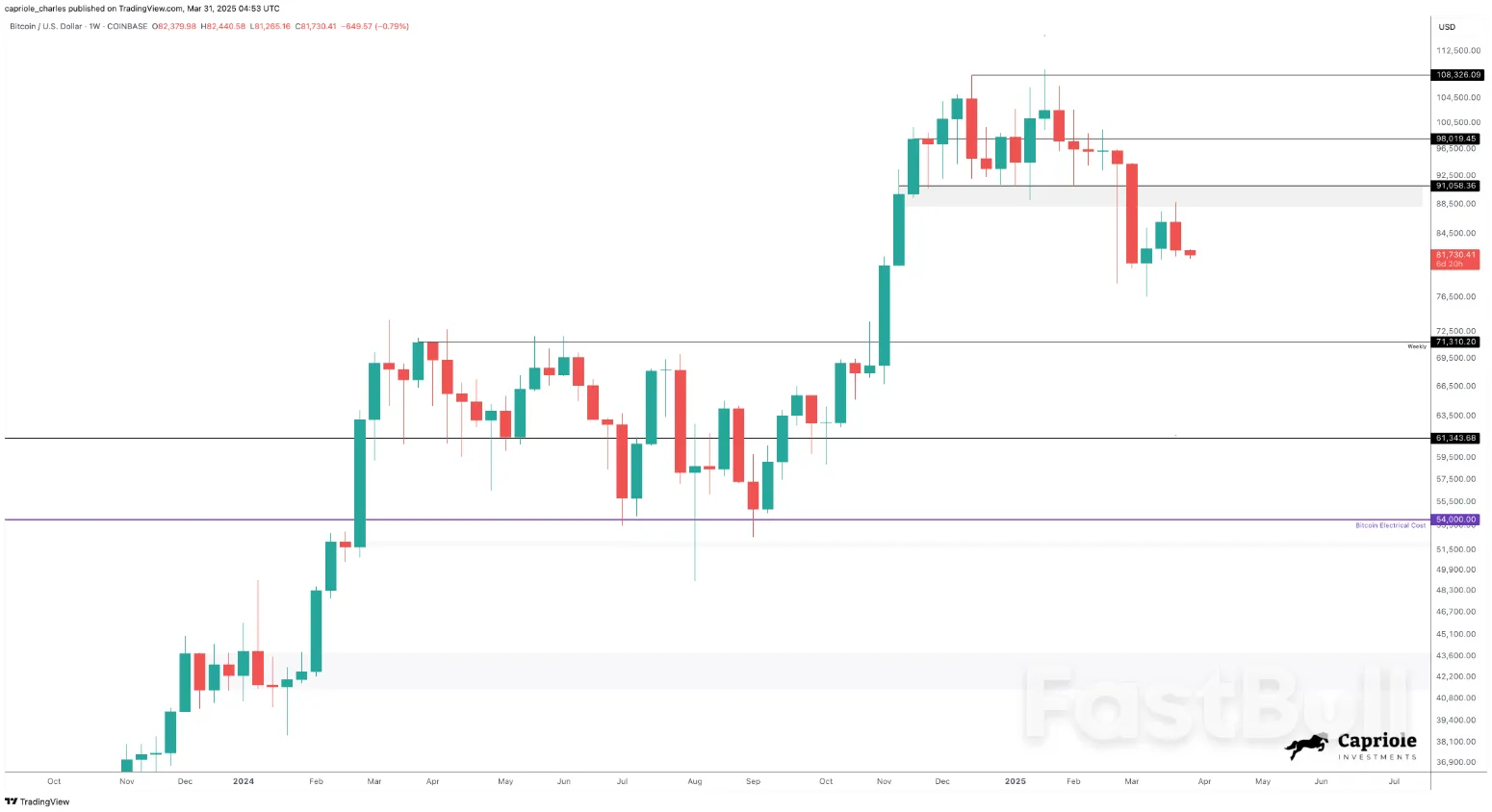
Down more than 5% since President Trump's tariff announcement on Wednesday evening sent markets plunging, bitcoin (BTC) once again is disappointing bulls who have touted its store-of-value properties or potential as a non-correlated safe haven to risk assets like stocks.
"This moment feels like a turning point," said Joel Kruger, LMAX Group market strategist. "We see market participants increasingly drawn to [BTC's] appeal as a store-of-value asset and a compelling diversification tool amid the uncertainty."
Kruger noted that while the Nasdaq and S&P 500 have each tumbled to new 2025 lows, bitcoin for the moment is holding well above its year-to-date bottom of $75,000 — what technicians like to call "higher lows."
But Javier Rodriguez Alarcon, chief commercial officer at crypto exchange XBTO, believes otherwise.
“Despite talk that bitcoin could act as a hedge against dollar-centric volatility, in practice we’re still seeing a strong correlation between digital assets and broader risk markets in moments of uncertainty,” the ex-Goldman Sachs executive said in an email.
Gold still the preferred safe haven at JPMorgan
"Bitcoin's volatility and correlation with equities raises questions over its 'digital gold' narrative," said Nikolaos Panigirtzoglou and team at JPMorgan yesterday. "We see gold continuing to rise as the major beneficiary of the debasement trade," they added.
Even with bitcoin's recent pullback, the price is still above the bank's estimated average cost of production of $62,000, a metric which has acted as a lower boundary in the past, wrote Panigirtzoglou.
Gold today is lower by just 1.25% to $3,126 per ounce and within close sight of its record high of around $3,200.
In addition, 60 countries identified as having substantial nontariff barriers will face reciprocal tariff rates from April 9. Trump noted that the tariffs imposed by the U.S. will be lower than the effective rates, which include nontariff barriers and currency manipulation, charged to the U.S.
He also expressed a willingness to negotiate reciprocal reductions in tariffs. A 25% permanent tariff rate will remain in place for autos, steel, and aluminum.
Analysts at JPMorgan, Bank of America, and Citi, among others, warned that the new tariff regime could lead to increased inflation throughout the year, potentially impacting consumer sentiment, real wages, and consumer spending.
The price of goods could rise, potentially driving the Personal Consumption Expenditures (PCE) inflation rate over the rest of the year. This could then result in a consumer-led slowdown later in the year, and the Federal Reserve may be unable to counteract this by easing monetary policy if inflation remains above its 2% target.
For instance, the 25% tariffs on autos, auto parts, steel, and aluminum are expected to increase the prices of new and used autos, as well as auto insurance, maintenance, and repair costs.
This could lead to sustained inflationary pressures in the broader economy, similar to what was experienced during the pandemic.
The new tariffs are expected to generate at least $300 billion in annual tariff revenues, or potentially $600 billion if the average rate is closer to 20%.
The intensifying trade war sent shockwaves through markets with the S&P 500 falling by as much as 4.5% while tech-focused Nasdaq 100 sank 5%.
Elsewhere, XAU/USD prices fell 1.2% after hitting a fresh record high with market commentator Ed Yardeni saying he expects the yellow metal to reach $4,000 by the end of the year.
"That may happen sooner if Trump persists with his Reign of Tariffs," he said today.


White Label
Data API
Web Plug-ins
Poster Maker
Affiliate Program
The risk of loss in trading financial instruments such as stocks, FX, commodities, futures, bonds, ETFs and crypto can be substantial. You may sustain a total loss of the funds that you deposit with your broker. Therefore, you should carefully consider whether such trading is suitable for you in light of your circumstances and financial resources.
No decision to invest should be made without thoroughly conducting due diligence by yourself or consulting with your financial advisors. Our web content might not suit you since we don't know your financial conditions and investment needs. Our financial information might have latency or contain inaccuracy, so you should be fully responsible for any of your trading and investment decisions. The company will not be responsible for your capital loss.
Without getting permission from the website, you are not allowed to copy the website's graphics, texts, or trademarks. Intellectual property rights in the content or data incorporated into this website belong to its providers and exchange merchants.
Not Logged In
Log in to access more features

FastBull Membership
Not yet
Purchase
Log In
Sign Up