• Trade
  • Markets
  • Copy
  • Contests
  • News
  • 24/7
  • Calendar
  • Q&A
  • Chats
Trending
Screeners
SYMBOL
LAST
BID
ASK
HIGH
LOW
NET CHG.
%CHG.
SPREAD
SPX
S&P 500 Index
6827.42
6827.42
6827.42
6899.86
6801.80
-73.58
-1.07%
--
DJI
Dow Jones Industrial Average
48458.04
48458.04
48458.04
48886.86
48334.10
-245.98
-0.51%
--
IXIC
NASDAQ Composite Index
23195.16
23195.16
23195.16
23554.89
23094.51
-398.69
-1.69%
--
USDX
US Dollar Index
97.950
98.030
97.950
98.500
97.950
-0.370
-0.38%
--
EURUSD
Euro / US Dollar
1.17394
1.17409
1.17394
1.17496
1.17192
+0.00011
+ 0.01%
--
GBPUSD
Pound Sterling / US Dollar
1.33707
1.33732
1.33707
1.33997
1.33419
-0.00148
-0.11%
--
XAUUSD
Gold / US Dollar
4299.39
4299.39
4299.39
4353.41
4257.10
+20.10
+ 0.47%
--
WTI
Light Sweet Crude Oil
57.233
57.485
57.233
58.011
56.969
-0.408
-0.71%
--

Community Accounts

Signal Accounts
--
Profit Accounts
--
Loss Accounts
--
View More

Become a signal provider

Sell trading signals to earn additional income

View More

Guide to Copy Trading

Get started with ease and confidence

View More

Signal Accounts for Members

All Signal Accounts

Best Return
  • Best Return
  • Best P/L
  • Best MDD
Past 1W
  • Past 1W
  • Past 1M
  • Past 1Y

All Contests

  • All
  • Trump Updates
  • Recommend
  • Stocks
  • Cryptocurrencies
  • Central Banks
  • Featured News
Top News Only
Share

China's Central Financial And Economic Affairs Commission Deputy Director: Will Expand Export And Increase Import In 2026

Share

Thai Leader Anutin: Landmine Blast That Killed Thai Soldiers 'Not A Roadside Accident'

Share

Thai Leader Anutin: Thailand To Continue Military Action Until 'We Feel No More Harm'

Share

Cambodian Prime Minister Hun Manet Says He Had Phone Calls With Trump And Malaysian Leader Anwar About Ceasefire

Share

Cambodia's Hun Manet Says USA, Malaysia Should Verify 'Which Side Fired First' In Latest Conflict

Share

Cambodia's Hun Manet: Cambodia Maintains Its Stance In Seeking Peaceful Resolution Of Disputes

Share

Nasdaq Companies: Allergan, Ferrovia, Insmed, Monolithic Power Systems, Seagate Technology, And Western Digital Will Be Added To The NASDAQ 100 Index. Biogen, CdW, GlobalFoundries, Lululemon, ON Semiconductor, And Tradedesk Will Be Removed From The NASDAQ 100 Index

Share

Witkoff Headed To Berlin This Weekend To Meet With Zelenskiy, European Leaders -Wsj Reporter On X

Share

Russia Attacks Two Ukrainian Ports, Damaging Three Turkish-Owned Vessels

Share

[Historic Flooding Occurs In At Least Four Rivers In Washington State Due To Days Of Torrential Rains] Multiple Areas In Washington State Have Been Hit By Severe Flooding Due To Days Of Torrential Rains, With At Least Four Rivers Experiencing Historic Flooding. Reporters Learned On The 12th That The Floods Caused By The Torrential Rains In Washington State Have Destroyed Homes And Closed Several Highways. Experts Warn That Even More Severe Flooding May Occur In The Future. A State Of Emergency Has Been Declared In Washington State

Share

Trump Says Proposed Free Economic Zone In Donbas Would Work

Share

Trump: I Think My Voice Should Be Heard

Share

Trump Says Will Be Choosing New Fed Chair In Near Future

Share

Trump Says Proposed Free Economic Zone In Donbas Complex But Would Work

Share

Trump Says Land Strikes In Venezuela Will Start Happening

Share

US President Trump: Thailand And Cambodia Are In A Good Situation

Share

State Media: North Korean Leader Kim Hails Troops Returning From Russia Mission

Share

The 10-year Treasury Yield Rose About 5 Basis Points During The "Fed Rate Cut Week," And The 2/10-year Yield Spread Widened By About 9 Basis Points. On Friday (December 12), In Late New York Trading, The Yield On The Benchmark 10-year US Treasury Note Rose 2.75 Basis Points To 4.1841%, A Cumulative Increase Of 4.90 Basis Points For The Week, Trading Within A Range Of 4.1002%-4.2074%. It Rose Steadily From Monday To Wednesday (before The Fed Announced Its Rate Cut And Treasury Bill Purchase Program), Subsequently Exhibiting A V-shaped Recovery. The 2-year Treasury Yield Fell 1.82 Basis Points To 3.5222%, A Cumulative Decrease Of 3.81 Basis Points For The Week, Trading Within A Range Of 3.6253%-3.4989%

Share

Trump: Lots Of Progress Being Made On Russia-Ukraine

Share

NOPA November US Soybean Crush Estimated At 220.285 Million Bushels

TIME
ACT
FCST
PREV
U.K. Trade Balance Non-EU (SA) (Oct)

A:--

F: --

P: --

U.K. Trade Balance (Oct)

A:--

F: --

P: --

U.K. Services Index MoM

A:--

F: --

P: --

U.K. Construction Output MoM (SA) (Oct)

A:--

F: --

P: --

U.K. Industrial Output YoY (Oct)

A:--

F: --

P: --

U.K. Trade Balance (SA) (Oct)

A:--

F: --

P: --

U.K. Trade Balance EU (SA) (Oct)

A:--

F: --

P: --

U.K. Manufacturing Output YoY (Oct)

A:--

F: --

P: --

U.K. GDP MoM (Oct)

A:--

F: --

P: --

U.K. GDP YoY (SA) (Oct)

A:--

F: --

P: --

U.K. Industrial Output MoM (Oct)

A:--

F: --

P: --

U.K. Construction Output YoY (Oct)

A:--

F: --

P: --

France HICP Final MoM (Nov)

A:--

F: --

P: --

China, Mainland Outstanding Loans Growth YoY (Nov)

A:--

F: --

P: --

China, Mainland M2 Money Supply YoY (Nov)

A:--

F: --

P: --

China, Mainland M0 Money Supply YoY (Nov)

A:--

F: --

P: --

China, Mainland M1 Money Supply YoY (Nov)

A:--

F: --

P: --

India CPI YoY (Nov)

A:--

F: --

P: --

India Deposit Gowth YoY

A:--

F: --

P: --

Brazil Services Growth YoY (Oct)

A:--

F: --

P: --

Mexico Industrial Output YoY (Oct)

A:--

F: --

P: --

Russia Trade Balance (Oct)

A:--

F: --

P: --

Philadelphia Fed President Henry Paulson delivers a speech
Canada Building Permits MoM (SA) (Oct)

A:--

F: --

P: --

Canada Wholesale Sales YoY (Oct)

A:--

F: --

P: --

Canada Wholesale Inventory MoM (Oct)

A:--

F: --

P: --

Canada Wholesale Inventory YoY (Oct)

A:--

F: --

P: --

Canada Wholesale Sales MoM (SA) (Oct)

A:--

F: --

P: --

Germany Current Account (Not SA) (Oct)

A:--

F: --

P: --

U.S. Weekly Total Rig Count

A:--

F: --

P: --

U.S. Weekly Total Oil Rig Count

A:--

F: --

P: --

Japan Tankan Large Non-Manufacturing Diffusion Index (Q4)

--

F: --

P: --

Japan Tankan Small Manufacturing Outlook Index (Q4)

--

F: --

P: --

Japan Tankan Large Non-Manufacturing Outlook Index (Q4)

--

F: --

P: --

Japan Tankan Large Manufacturing Outlook Index (Q4)

--

F: --

P: --

Japan Tankan Small Manufacturing Diffusion Index (Q4)

--

F: --

P: --

Japan Tankan Large Manufacturing Diffusion Index (Q4)

--

F: --

P: --

Japan Tankan Large-Enterprise Capital Expenditure YoY (Q4)

--

F: --

P: --

U.K. Rightmove House Price Index YoY (Dec)

--

F: --

P: --

China, Mainland Industrial Output YoY (YTD) (Nov)

--

F: --

P: --

China, Mainland Urban Area Unemployment Rate (Nov)

--

F: --

P: --

Saudi Arabia CPI YoY (Nov)

--

F: --

P: --

Euro Zone Industrial Output YoY (Oct)

--

F: --

P: --

Euro Zone Industrial Output MoM (Oct)

--

F: --

P: --

Canada Existing Home Sales MoM (Nov)

--

F: --

P: --

Euro Zone Total Reserve Assets (Nov)

--

F: --

P: --

U.K. Inflation Rate Expectations

--

F: --

P: --

Canada National Economic Confidence Index

--

F: --

P: --

Canada New Housing Starts (Nov)

--

F: --

P: --

U.S. NY Fed Manufacturing Employment Index (Dec)

--

F: --

P: --

U.S. NY Fed Manufacturing Index (Dec)

--

F: --

P: --

Canada Core CPI YoY (Nov)

--

F: --

P: --

Canada Manufacturing Unfilled Orders MoM (Oct)

--

F: --

P: --

Canada Manufacturing New Orders MoM (Oct)

--

F: --

P: --

Canada Core CPI MoM (Nov)

--

F: --

P: --

Canada Manufacturing Inventory MoM (Oct)

--

F: --

P: --

Canada CPI YoY (Nov)

--

F: --

P: --

Canada CPI MoM (Nov)

--

F: --

P: --

Canada CPI YoY (SA) (Nov)

--

F: --

P: --

Canada Core CPI MoM (SA) (Nov)

--

F: --

P: --

Q&A with Experts
    • All
    • Chatrooms
    • Groups
    • Friends
    Connecting
    .
    .
    .
    Type here...
    Add Symbol or Code

      No matching data

      All
      Trump Updates
      Recommend
      Stocks
      Cryptocurrencies
      Central Banks
      Featured News
      • All
      • Russia-Ukraine Conflict
      • Middle East Flashpoint
      • All
      • Russia-Ukraine Conflict
      • Middle East Flashpoint
      Search
      Products

      Charts Free Forever

      Chats Q&A with Experts
      Screeners Economic Calendar Data Tools
      Membership Features
      Data Warehouse Market Trends Institutional Data Policy Rates Macro

      Market Trends

      Market Sentiment Order Book Forex Correlations

      Top Indicators

      Charts Free Forever
      Markets

      News

      News Analysis 24/7 Columns Education
      From Institutions From Analysts
      Topics Columnists

      Latest Views

      Latest Views

      Trending Topics

      Top Columnists

      Latest Update

      Signals

      Copy Rankings Latest Signals Become a signal provider AI Rating
      Contests
      Brokers

      Overview Brokers Assessment Rankings Regulators News Claims
      Broker listing Forex Brokers Comparison Tool Live Spread Comparison Scam
      Q&A Complaint Scam Alert Videos Tips to Detect Scam
      More

      Business
      Events
      Careers About Us Advertising Help Center

      White Label

      Data API

      Web Plug-ins

      Affiliate Program

      Awards Institution Evaluation IB Seminar Salon Event Exhibition
      Vietnam Thailand Singapore Dubai
      Fans Party Investment Sharing Session
      FastBull Summit BrokersView Expo
      Recent Searches
        Top Searches
          Markets
          News
          Analysis
          User
          24/7
          Economic Calendar
          Education
          Data
          • Names
          • Latest
          • Prev

          View All

          No data

          Scan to Download

          Faster Charts, Chat Faster!

          Download App
          English
          • English
          • Español
          • العربية
          • Bahasa Indonesia
          • Bahasa Melayu
          • Tiếng Việt
          • ภาษาไทย
          • Français
          • Italiano
          • Türkçe
          • Русский язык
          • 简中
          • 繁中
          Open Account
          Search
          Products
          Charts Free Forever
          Markets
          News
          Signals

          Copy Rankings Latest Signals Become a signal provider AI Rating
          Contests
          Brokers

          Overview Brokers Assessment Rankings Regulators News Claims
          Broker listing Forex Brokers Comparison Tool Live Spread Comparison Scam
          Q&A Complaint Scam Alert Videos Tips to Detect Scam
          More

          Business
          Events
          Careers About Us Advertising Help Center

          White Label

          Data API

          Web Plug-ins

          Affiliate Program

          Awards Institution Evaluation IB Seminar Salon Event Exhibition
          Vietnam Thailand Singapore Dubai
          Fans Party Investment Sharing Session
          FastBull Summit BrokersView Expo

          Credit Suisse Collapse Threatens Switzerland's Wealth Management Crown

          Cohen
          Summary:

          The fall of Credit Suisse has dealt a serious blow to Switzerland's credentials as the world's leading wealth management centre, experts warn, calling into question its reputation for stability, regulation and corporate governance.
          The fall of Credit Suisse has dealt a serious blow to Switzerland's credentials as the world's leading wealth management centre, experts warn, calling into question its reputation for stability, regulation and corporate governance.
          Battered by years of scandals and losses, Credit Suisse had been fighting a crisis of confidence for months, before its demise was sealed in just a matter of days last week when Swiss authorities brokered a takeover of the bank by larger rival UBS.
          UBS itself needed to be rescued by the government in 2008 after a disastrous foray into U.S. mortgage securities.
          The Credit Suisse collapse and its aftermath "is going to be very damaging," said Arturo Bris, Professor of Finance at the International Institute for Management Development (IMD) in Lausanne, adding it could benefit rival financial centres.
          Switzerland manages $2.6 trillion in international assets according to a 2021 Deloitte study, making it the world's largest financial centre ahead of Britain and the United States. But it faces competition from other centres including Luxembourg and in particular Singapore, which has grown rapidly in recent years.
          "The bankers in Singapore are going to be uncorking the champagne bottles," Bris told Reuters.
          Switzerland's credibility as a stable, predictable country had been upended by moves like the decision to wipe out the holdings of Credit Suisse bondholders, he said.
          Under the takeover deal, holders of Credit Suisse AT1 bonds will get nothing, while shareholders, who usually rank below bondholders in compensation terms, will receive $3.23 billion.
          While Credit Suisse's AT1 prospectus made clear that hybrid (AT1) holders would not recover any value, few anticipated the bank's demise.
          The Swiss Bankers Association has attempted to put a brave face on the crisis, presenting the rescue engineered by the government, central bank and regulator as sign of strength.
          "The Swiss financial sector was able to address a major issue of a significant player," SBA Chairman and former UBS CEO Marcel Rohner told reporters on Tuesday.
          "In that sense I also see a prosperous future for the financial centre because we have hundreds of very well capitalised banks and very successful wealth management and asset management banks."
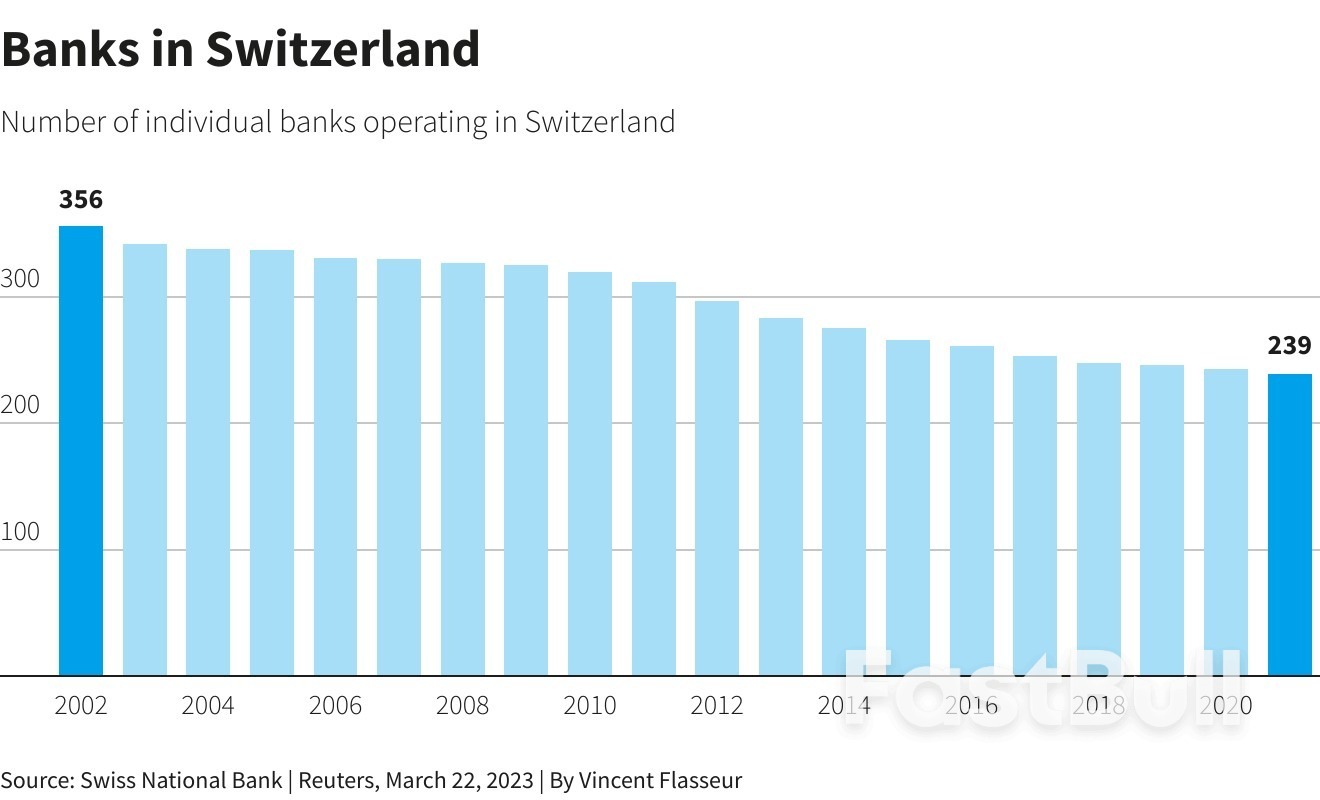
          Still, the number of banks has fallen, down to 239 in 2021 from 356 in 2002. Staff numbers since 2011 have slipped to 91,000 from 108,000.Credit Suisse Collapse Threatens Switzerland's Wealth Management Crown_1
          Credit Suisse Collapse Threatens Switzerland's Wealth Management Crown_2Others were more skeptical about the future, highlighting a reluctance to confront mistakes at Credit Suisse or take responsibility for the aftermath.
          "There are a lot of open questions: the use of emergency law overriding the views of shareholders or the treatment of bond holders," said Stefan Legge, head of tax and trade policy at the University of St. Gallen's IFF Institute for Financial Studies.
          "Maybe some people are a bit delusional – and really believe they are doing a great job."
          Switzerland invoked emergency legislation to allow a public liquidity backstop (PLB) which will provide up to 100 billion Swiss francs in liquidity to Credit Suisse as the PLB was not yet part of Swiss law.
          But perhaps most controversially, the emergency law allowed the takeover to go ahead without shareholder approval.
          Legge said the collapse should serve as a wake-up call, and could see new laws to improve corporate governance introduced.
          Switzerland has few mechanisms for holding top bankers individually responsible for mismanagement, unlike centres such as Britain where senior managers can face criminal sanctions.
          Unions and politicians have also reacted angrily to the rescue, which could leave the taxpayer having to cover up to 9 billion francs in losses.

          Long Decline

          Switzerland's outsized banking sector has been under pressure for years following a decline in banking secrecy as other countries sought to clamp down on tax evasion by citizens.
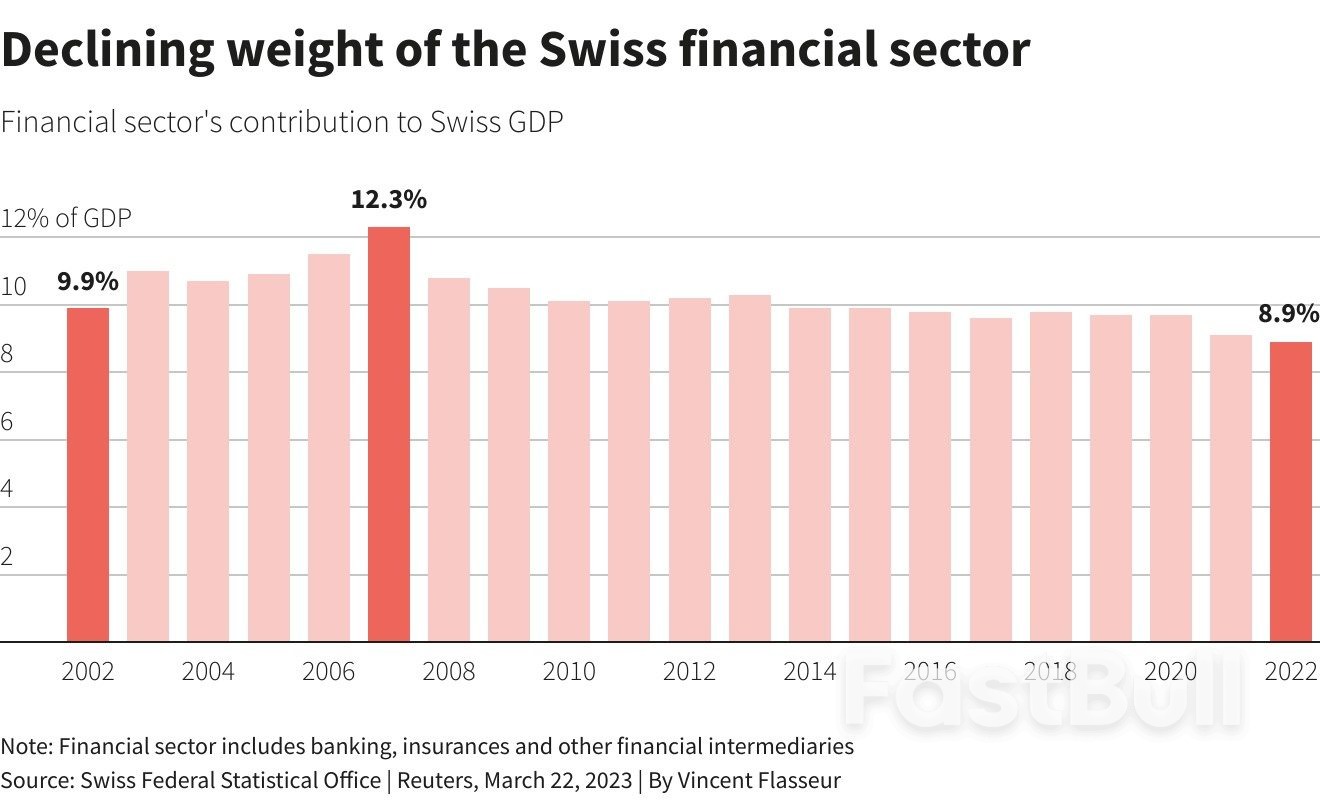
          The financial sector's contribution to the Swiss economy has also slipped, falling to 8.9% of Swiss GDP in 2022 from 9.9% in 2002 as industries like pharmaceuticals became more important in a country with the third highest GDP per capita in the world, according to IMF data.
          Credit Suisse Collapse Threatens Switzerland's Wealth Management Crown_3BAK Economics, a Swiss research institute, said the fallout from the debacle would be contained within the banking sector. It estimated up to 12,000 Swiss jobs being lost, although the impact on the broader economy would be limited.
          Jan-Egbert Sturm director of the KOF Swiss Economic Institute at ETH Zurich, a university, predicted the economic impact of Credit Suisse's demise would amount to a loss of around 0.05% of GDP per year.
          Switzerland's long banking tradition and structural advantages meant the country would remain heavily involved in banking in future, he said, with investors still choosing it for its stability and the strength of its Swiss franc currency.
          Still competition was getting fiercer, and the recent events would eventually see Singapore overtake Switzerland, warned IMD's Bris.
          "I think it's only a matter of time."

          Source: Yahoo

          Risk Warnings and Disclaimers
          You understand and acknowledge that there is a high degree of risk involved in trading. Following any strategies or investment methods may lead to potential losses. The content on the site is provided by our contributors and analysts for information purposes only. You are solely responsible for determining whether any trading assets, securities, strategy, or any other product is suitable for investing based on your own investment objectives and financial situation.
          Comments
          Add to Favorites
          Share

          Erdogan Tries to Salvage Economic Credibility Before Turkey's Election

          Devin

          Political

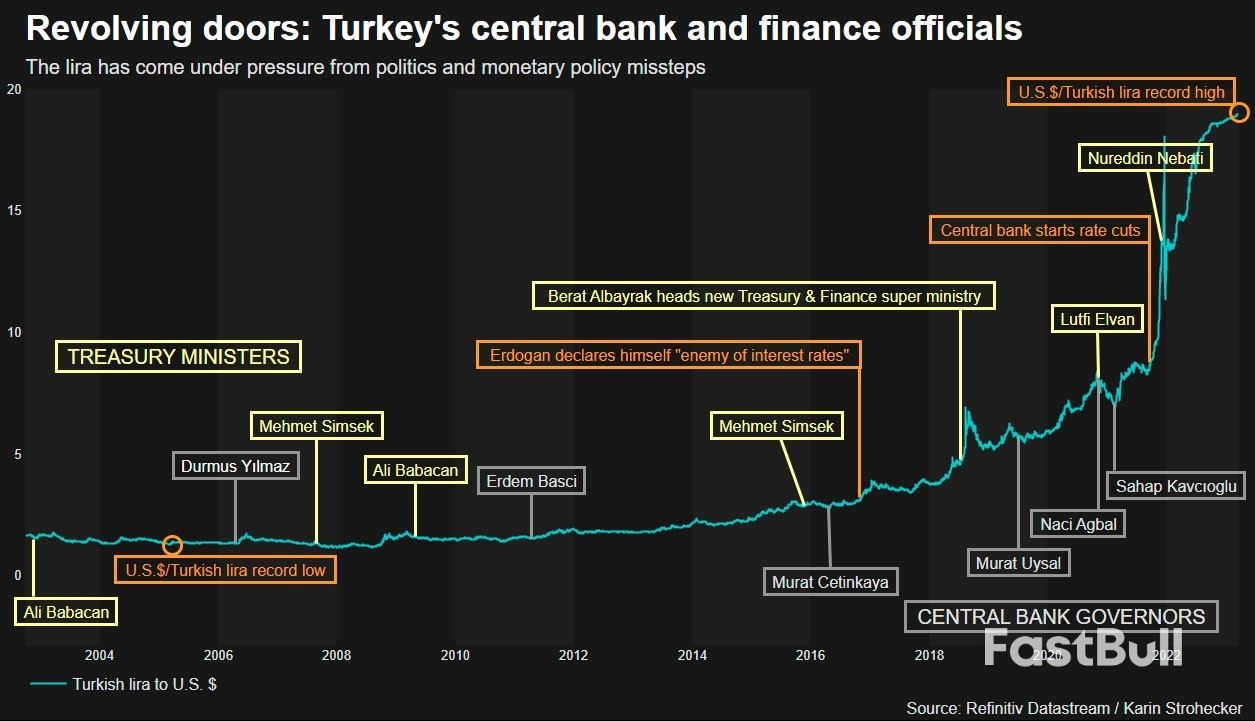
          Former Turkish economy tsar Mehmet Simsek's refusal to return to politics has left President Tayyip Erdogan's ruling party scrambling to rebuild its economic credibility less than two months before landmark elections, insiders and analysts say.
          Erdogan, who has led Turkey for two decades but is trailing in opinion polls ahead of the May 14 vote, had personally appealed to Simsek to return to the government and take up a top role, several people familiar with the matter said.
          Some AK Party (AKP) members had wanted Simsek to champion the party's latest rhetorical pivot to more free-market policies, after years of unorthodoxy under Erdogan that had hammered the lira currency and sent inflation soaring.
          But after a Monday meeting at AKP headquarters, Simsek, well-respected by international investors, said on Twitter he was not interested in "active politics" after having stepped down as deputy prime minister in 2018.
          Yet he is ready to provide any type of support in his area, he added.
          The episode shows the difficulty of rebranding a government whose policies have set off a cost-of-living crisis and left the economy and financial markets heavily state-managed, analysts and investors say.
          "Simsek's refusal to join the ranks is neither the first nor the final indicator of dwindling support for the government," said Ertan Aksoy, of Aksoy Research polling company.
          AKP spokesperson Omer Celik said after the meeting that Erdogan did not offer Simsek a formal posting but that "all the mechanisms and duties of the party" were open to him.
          A senior government official told Reuters the AKP was somewhat divided with some members opposed to Simsek's return, and described the outcome of the Erdogan meeting as "undesirable". The party may now need to revise its economic platform ahead of the election campaign, he added.
          An AKP official who was not also authorised to speak publicly said Simsek's return would have boosted the party's polls. "We are having trouble regarding the economic picture right now. There is no arguing about that," the person said, adding new steps are needed.
          Another party official said its revised election manifesto could include more "balanced" or "mixed" policies, rather than the free-market orthodox approach that some had sought.
          The AKP declined to comment on whether it was revising its economic strategy ahead of the vote. Simsek declined to comment on his meeting with Erdogan.

          Erdogan Tries to Salvage Economic Credibility Before Turkey's Election_1'Dwindling support'

          Erdogan's determination to slash interest rates to stoke economic growth sent inflation above 85% last year. The lira has shed 80% of its value versus the dollar in five years, a period in which foreign investors largely fled the big emerging market.
          The economic cost of the devastating earthquakes that struck Turkey’s south on Feb. 6 is estimated to be around $104 billion, adding to pressures on the economy.
          The opposition bloc - which pledges to roll back Erdogan's economic policies - received a boost on Wednesday when a big pro-Kurdish party said it would not run its own presidential candidate, raising prospects it could unite.
          Two recent polls by MAK and Turkiye Raporu show the opposition presidential challenger Kemal Kilicdaroglu between 4 and 9 percentage points ahead of Erdogan.
          "The AKP ... is surprised and in a state of heavy panic. It is pressing all the buttons at the same time," Turhan Comez, chief adviser to opposition IYI Party leader Meral Aksener, said on Halk TV on Tuesday.
          Though a self-described "enemy" of interest rates, Erdogan has occasionally endorsed free-market policies in recent years. But he then shifted tone again and has adopted a model prioritising production, exports and targeted cheap credit.
          Such pivots - including firing market-friendly central bank governor Naci Agbal after only four months in 2021 - have left investors deeply sceptical.
          Investors are "extremely cautious" about any pivot by Erdogan's government given "multiple past head-fakes", said Blaise Antin, head of EM sovereign research at asset manager TCW in Los Angeles.
          Polina Kurdyavko, head of emerging markets and senior portfolio manager at BlueBay Asset Management, said the economic challenge was "not easily solvable regardless of who comes to power and regardless of what policies you implement".

          Source: Yahoo

          Risk Warnings and Disclaimers
          You understand and acknowledge that there is a high degree of risk involved in trading. Following any strategies or investment methods may lead to potential losses. The content on the site is provided by our contributors and analysts for information purposes only. You are solely responsible for determining whether any trading assets, securities, strategy, or any other product is suitable for investing based on your own investment objectives and financial situation.
          Comments
          Add to Favorites
          Share

          Brazil Central Bank Holds Rates, Flags Increased Inflation Expectations

          Alex

          Central Bank

          Brazil's central bank cited rising inflation expectations as it kept interest rates unchanged for the fifth consecutive policy meeting on Wednesday, drawing concern from the government and weakening bets of imminent monetary easing.
          The bank's rate-setting committee, known as Copom, maintained its Selic benchmark interest rate at 13.75%.
          The decision, which defied intense pressure from the new government of President Luiz Inacio Lula da Silva to reduce borrowing costs, matched the expectations of all 30 respondents in a Reuters poll.
          "Taking into account the uncertainty of the scenarios, the committee remains vigilant, assessing if the strategy of maintaining the Selic rate for a long period will be enough to ensure the convergence of inflation," policymakers wrote in their policy statement.
          "The Committee emphasizes that it will persist until the disinflationary process consolidates and inflation expectations anchor around its targets, which have shown additional deterioration, especially at longer horizons," they added.
          Finance Minister Fernando Haddad criticized the statement, saying it was "very concerning," and the central bank's next decision could put the country's fiscal position "at risk."
          "Copom even signals the possibility of an increase in the interest rate, which is already the highest in the world today," he told reporters, in reference to policymakers' insistence that they would not hesitate to resume hikes if disinflation did not happen as expected.
          Haddad also said Brazil's inflation is more controlled than that of other developing countries, and that inflation expectations could rapidly be reduced in light of new events.
          David Beker, head of Strategy for Latin America at Bank of America, said in a note to clients he still sees the easing cycle beginning in May, but with "higher risks of a delay, given the tone of the statement."
          Several economists expected the central bank to mention challenges to the global economy, which could potentially create space for rate cuts to begin earlier than previously anticipated, after high-profile U.S. bank closures and the Credit Suisse rescue.
          The central bank acknowledged the worsening global environment amid banking turmoil, but emphasized recent data on global activity and inflation have remained resilient.
          The bank also noted the process of monetary policy tightening in major economies continued to advance, following the Federal Reserve's decision to continue raising U.S. interest rates.
          "Given the expectation, I found the statement to be more hawkish," said Gustavo Arruda, Director of Research for Latin America at BNP Paribas.
          "It will probably decrease the probability of interest rate cut scenarios in the next policy meetings," he added, predicting rates unchanged until May next year.
          While policymakers emphasized the government decision to resume fuel taxes has helped to improve public accounts, they said highly volatile financial markets and long-term inflation expectations beyond their targets "require further attention when conducting monetary policy."
          Inflation has cooled to 5.6% in the 12 months through February, but it is still far above this year's 3.25% official target. Meanwhile, the central bank's inflation expectations have risen to 5.8% for 2023 and 3.6% for 2024. Next year, the target is 3%.
          Lula has repeatedly called for lower borrowing costs, describing the current Selic rate "irresponsible" on Tuesday. In a sample of the criticisms that will follow, his chief of staff, Rui Costa, said late on Wednesday that the policy decision "only increases unemployment and the suffering of the Brazilian people."
          Lula put off a proposal for new fiscal rules to keep a lid on public debt levels – one of several upward inflation risks flagged by the central bank.

          Source: Yahoo

          Risk Warnings and Disclaimers
          You understand and acknowledge that there is a high degree of risk involved in trading. Following any strategies or investment methods may lead to potential losses. The content on the site is provided by our contributors and analysts for information purposes only. You are solely responsible for determining whether any trading assets, securities, strategy, or any other product is suitable for investing based on your own investment objectives and financial situation.
          Comments
          Add to Favorites
          Share

          Funds Suffer Record Reversal on Record U.S. Rate Bets

          Samantha Luan

          Commodity

          Commodity Futures Trading Commission (CFTC) data released on Tuesday shows just how badly hedge funds and speculators were wrong-footed by the violent reversal in near-term interest rate expectations triggered by the U.S. and Swiss banking crises.
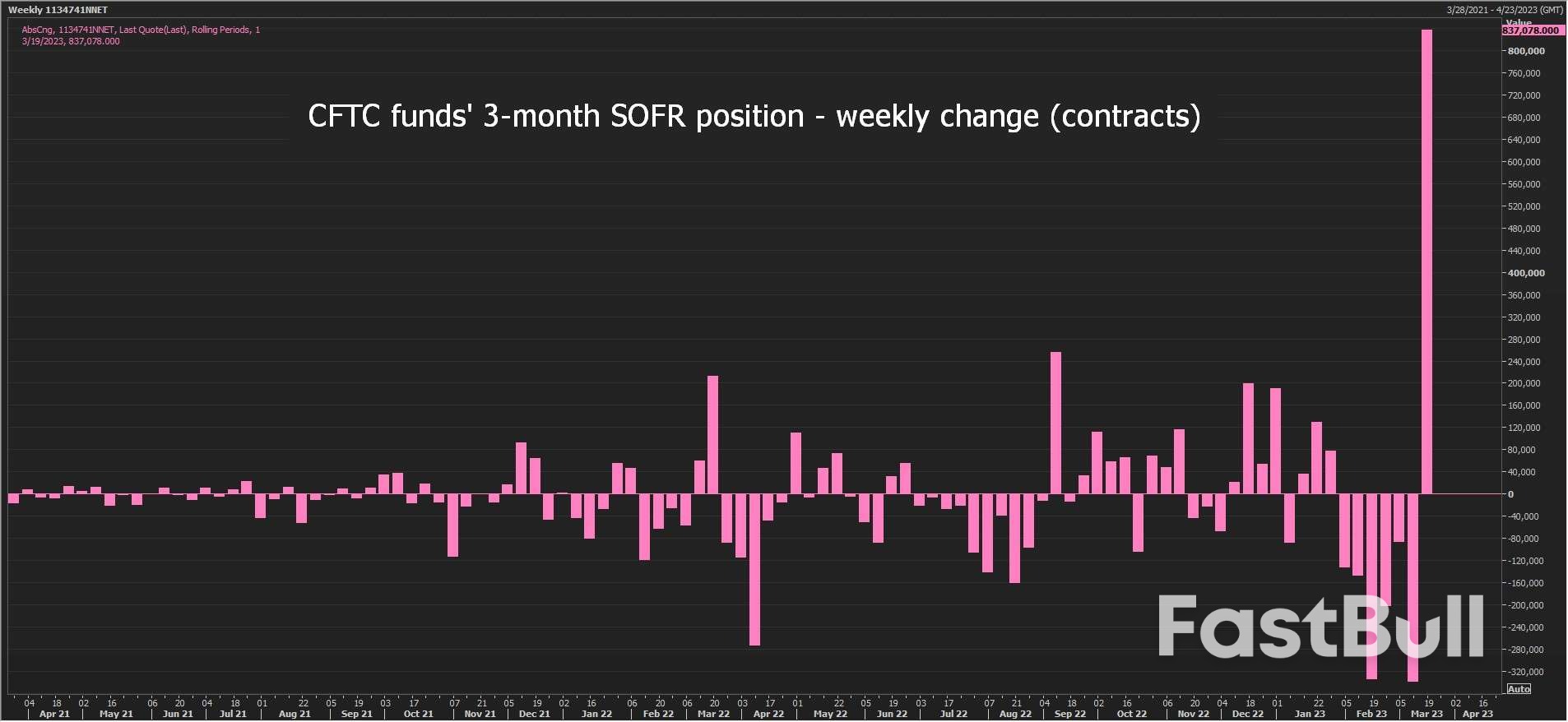
          Their record net short position in three-month Secured Overnight Financing Rate (SOFR) futures of 1.17 million contracts was slashed to 329,638 contracts in the week through March 14.
          That meant around 80% of funds' collective bet that the Fed will continue raising rates towards the 6% zone was wiped out in a week, easily the largest weekly position reversal on record.Funds Suffer Record Reversal on Record U.S. Rate Bets_1
          Funds Suffer Record Reversal on Record U.S. Rate Bets_2Expectations of a 6% fed funds rate have long faded. The Federal Reserve on Wednesday raised its policy rate by 25 basis points to a 4.75-5.00% range, a move many are viewing as a 'dovish hike.' After the decision and Chair Jerome Powell's press conference, implied SOFR rates across the 2023 curve fell as much as 20 bps, and Bank of America economists lowered their terminal rate outlook by a quarter point.
          CFTC positioning data is now up to date, after a cyber-attack on the derivatives platform of ION Group delayed trading firms' reporting earlier this year.
          A short position is essentially a wager that an asset's price will fall, and a long position is a bet it will rise. In bonds and interest rates, yields and implied rates fall when prices rise, and move up when prices fall.
          Hedge funds take positions in short-dated U.S. rates and bonds futures for hedging purposes and relative value trades, so the CFTC data is not reflective of purely directional bets. But it is a pretty good guide.
          Trend-following and macro funds, and Commodity Trading Advisors have been slammed by the sudden rates reversal, with some suffering losses well into the double digits, according to banks, traders and media reports over the last couple of weeks.
          It is difficult to nail down hard numbers, but these losses will almost certainly be running into several billions of dollars.

          In Through the Out Door

          Hedge fund industry data provider HFR's Macro/CTA index was down 3.60% in March and its Macro Systematic Diversified CTA index was down 7.39%, both for the month through March 20.
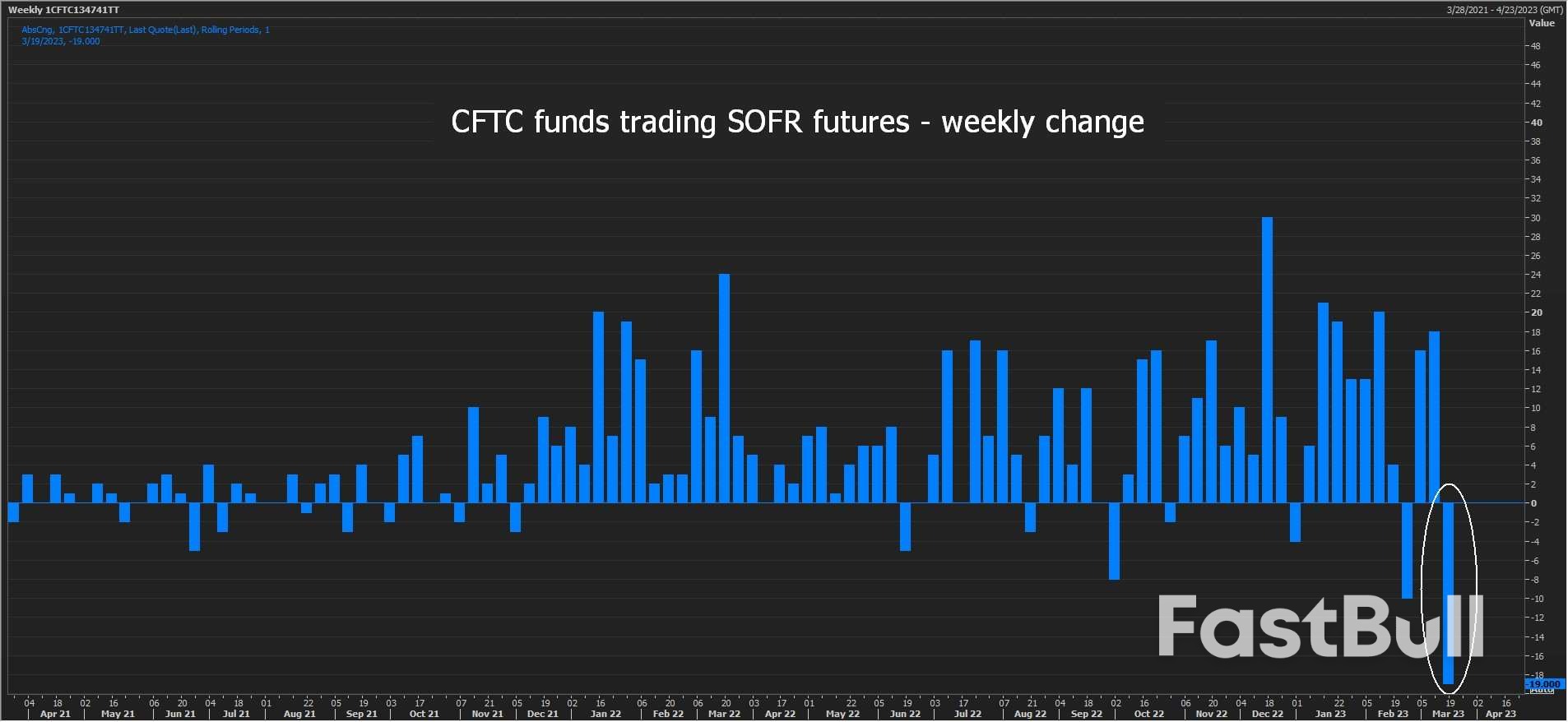
          The latest CFTC figures also revealed how the recent surge in volatility has put speculative accounts trading three-month SOFR futures out of the market. Or out of business.
          Funds Suffer Record Reversal on Record U.S. Rate Bets_3The total number of traders in the week ending March 7 was 676, and in the following week that fell by 19. That doesn't sound like a big change, but it represents 3% of all players in the space and is the biggest week-on-week fall to date.
          It would not be a huge surprise if more were to follow, given the severity of the whiplash in rates markets.
          Implied 2023 rates peaked around 5.70% on March 8 - coinciding with CFTC funds' record short SOFR position - before troubles at Silicon Valley Bank and Signature Bank sowed the seeds of what snowballed into a global banking crisis.
          Implied rates then plunged as much as 200 basis points as traders drastically redrew their Fed outlook. The two-year Treasury yield posted its biggest fall since Black Monday in 1987 and U.S. bond market volatility surged the most since 2008.

          Source: Reuters

          Risk Warnings and Disclaimers
          You understand and acknowledge that there is a high degree of risk involved in trading. Following any strategies or investment methods may lead to potential losses. The content on the site is provided by our contributors and analysts for information purposes only. You are solely responsible for determining whether any trading assets, securities, strategy, or any other product is suitable for investing based on your own investment objectives and financial situation.
          Comments
          Add to Favorites
          Share

          March 23rd Financial News

          FastBull Featured

          Daily News

          【Quick Facts】

          1. The Fed raised interest rates by 25 bps, as the market expectations once again "jumped the gun".
          2. Powell: Recent balance sheet expansion has nothing to do with monetary policy.
          3. Wall Street believes the Fed's rate hike has been as hawkish as possible when the banking industry is in trouble.
          4. Yellen: No consideration for a "full" guarantee of bank deposits.
          5. Lagarde: No clear evidence that potential inflation is on the downside.

          【News Details】

          1. The Fed raised interest rates by 25 bps, as the market expectations once again "jumped the gun".
          The Fed announced on Wednesday to raise interest rates by 25 bps, and the statement removed the wording of "continued rate hikes", leaving the market's first reaction to be a dovish interpretation that the Fed is about to end the current cycle of rate hikes in May. From the dot plot, although the Fed abandoned the "higher" policy path, it still adhered to the "longer" path, and did not hint at a rate cut in the dot plot. In other words, the dot plot is definitely more hawkish than the interest rate path expected by the market. Powell also stressed at the conference that there is no intention to cut interest rates according to the current economic path.
          However, it seems that the market expects to "jump the gun" again, indifferent to the hawkish medium-term interest rate path in the dot plot and Powell's remarks that there is no intention to cut interest rates for the time being. The statement must have been watched for the removal of the "continued rate hike" wording.
          The interest rate swap market shows that the probability of the Fed raising rates by another 25 bps in May is only slightly more than 50%. At the same time, the market expectation of a rate cut further deepened, and traders believe that the effective federal funds rate will fall to about 4.18% in December.
          2. Powell: Recent balance sheet expansion has nothing to do with monetary policy.
          Bank borrowing surged last week, most notably to a record $153 billion through the discount window credit, causing the Fed's overall cash and bond reserves to jump to $8.7 trillion a week ago from $8.4 trillion on March 8. This undid the Fed's months-long efforts to reduce its influence in the bond market.
          In response, Fed Chairman Jerome Powell said that the sharp reversal of the Fed's efforts to reduce the size of its balance sheet in the wake of the Silicon Valley Bank collapse does not mean that its holdings are being used to provide new stimulus to the economy. The balance sheet expansion is actually temporary lending to banks and there is no intention to directly change the stance of monetary policy.
          3. Wall Street believes the Fed's rate hike has been as hawkish as possible when the banking industry is in trouble.
          Wall Street widely expected the Fed to raise rates by 25 bps, and it did. But stock market investors disputed the conflicting messages: policy guidance changed from "continued" rate hikes to "some additional" policy tightening, although Chairman Powell said the Fed was not tied up. Although Powell said at a press conference that policymakers had considered suspending interest rate hikes before the meeting, the Fed remained focused on high inflation risks while keeping an eye on developments in the banking system.
          Win Thin, head of global foreign exchange strategy at BBH, said, "Given the continued pressure on the banking sector, the Fed has been as hawkish as possible, with a statement similar to that of the European Central Bank in my view. What the Fed is trying to say is that the tightening cycle will likely remain intact once we overcome the banking sector pressures."
          4. Yellen: No consideration for a "full" guarantee of bank deposits.
          U.S. Treasury Secretary Yellen spoke at a Senate hearing on Wednesday afternoon on the subject of the "FY 2024 budget review" about whether the current $250,000 insurance deposit limit should be raised.
          Yellen said that the Biden administration is not considering a significant expansion of bank deposit insurance or providing depositors with a "full" guarantee. The statement means that the United States regional and small and medium-sized banks to get the possibility of comprehensive federal intervention is very small.
          But Yellen pointed out that, in response to the current market turmoil, the Biden administration is not considering expanding the scope of deposit insurance, because it requires congressional legislative approval, the Treasury Department is difficult to act unilaterally.
          5. Lagarde: No clear evidence that potential inflation is on the downside.
          The ECB's March interest rate resolution statement said that the Governing Council's future interest rate decisions will be determined by three factors: an assessment of the inflation outlook based on emerging economic and financial data, the dynamics of underlying inflation, and the strength of monetary policy transmission.
          In a speech delivered on Wednesday, ECB President Lagarde further elaborated on these three factors.
          Inflation outlook: The ECB's latest forecasts put headline inflation at 2.1% and core inflation at 2.2% in 2025, down from the December forecast, but the confidence intervals around these forecasts are now unusually wide. Many of the assumptions in the forecasts (fiscal policy, energy prices and food) are volatile.
          Potential Inflation: So far, no clear evidence has been seen that potential inflation is on the downside. Measures of potential inflation are still strengthening. If this continues and aggregate demand picks up, price pressures could shift from imports to domestic, keeping overall price pressures high. Payroll developments will be key. The labor market is quite tight. Payrolls growth could lead to a more sustained cost-push shock.
          Policy transmission: To ease inflationary pressures, monetary policy will have to work strongly in a restrictive direction. This process is just now beginning to take effect. The first stage of monetary transmission - from policy measures to the financing and monetary environment - is already having a significant impact. The second stage - from the tightening of the financing and monetary environment to demand - is now subject to more uncertainty.
          Inflation remains high and uncertainty about the road ahead has increased. Therefore, it is critical to have a sound strategy in place.

          【Focus of the Day】

          UTC+8 16:30 SNB interest rate resolution
          UTC+8 16:40 ECB Governing Council member Yannis Stournaras to speak
          UTC+8 20:00 BOE interest rate resolution
          UTC+8 20:30 US Q4 Current Account
          UTC+8 23:00 BOE monetary policy member Mann to speak
          UTC+8 23:30 ECB Governing Council member Centeno to speak
          UTC+8 00:00 ECB Chief Economist Lane to speak
          Risk Warnings and Disclaimers
          You understand and acknowledge that there is a high degree of risk involved in trading. Following any strategies or investment methods may lead to potential losses. The content on the site is provided by our contributors and analysts for information purposes only. You are solely responsible for determining whether any trading assets, securities, strategy, or any other product is suitable for investing based on your own investment objectives and financial situation.
          Comments
          Add to Favorites
          Share

          Bank of England & Swiss National Bank Both Set to Hike

          Devin

          Central Bank

          Summary

          · The Bank of England and Swiss National Bank both make monetary policy announcements tomorrow, March 23.
          · Our base case is for the Bank of England to raise its policy rate 25 basis points to 4.25% this week, and then pause tightening. However, an unexpected quickening of inflation has added some uncertainty to that outlook. In the absence of a closer, or finely balanced, vote in favor of a rate hike, or a softening in the Bank of England's language, we will be inclined to adjust our outlook towards further tightening, an adjustment that could also be positive for the pound.
          · In Switzerland, growth appears to be bottoming out and there has been an uptick in inflation. While Swiss markets have been dominated by banking sector strains over the past week, with some sense of relative calm restored and after the European Central Bank's rate hike last week, we still expect the Swiss National Bank to raise its policy rate by 50 basis points to 1.50% at this week's announcement.

          Bank of England to Hike, But Will They Signal More To Come?

          The Bank of England (BoE) announces its monetary policy decision on March 23, with market participants focused on both the size of any potential rate hike and any signals of potential future rate hikes. Our base case has been for the Bank of England to hike its policy rate by 25 basis points to 4.25% at this week, a view with which we are still comfortable. In recent days, as banking sector strains in the U.S. and Switzerland led to unsettled global markets, market discussion has centered on whether the Bank of England could even pause at this week's meeting. However, with those strains alleviated to a modest extent, further tightening now seems very likely at this week's meeting.
          A more interesting question, in our view, is whether there will be any further tightening beyond this week's meeting. Our base case has been that this week's rate increase will be the last of the current cycle. The Bank of England's economic projections, which forecast a moderate U.K. recession and below-target inflation over the medium-term, are consistent with a pause from the Bank of England after this week. In our view, some key policymakers have also been quite balanced in their comments and are looking for opportunities to pivot towards a pause. For example, Governor Bailey recently said in early March, "I would caution against suggesting either that we are done with increasing Bank Rate, or that we will inevitably need to do more".
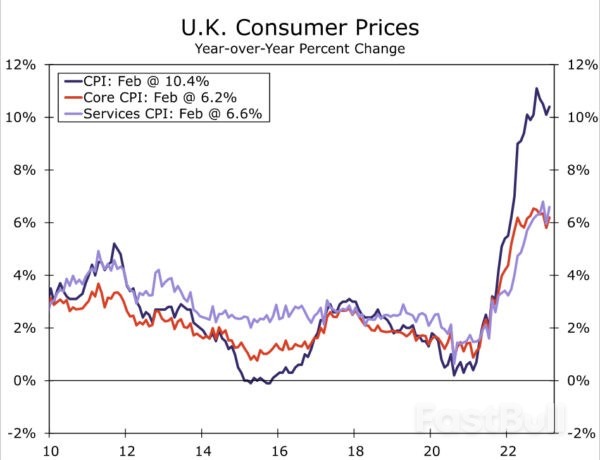
          Bank of England & Swiss National Bank Both Set to Hike_1A moderate slowing in inflation over the last few months had opened the door slightly ajar, in our view, to a Bank of England pause. However, that pause has been thrown into doubt by the U.K. February CPI. U.K. inflation was an upside surprise, with the headline and core CPI unexpectedly quickening to 10.4% and 6.2% year-over-year, respectively. Today's Federal Reserve monetary policy decision may also be a factor—while it is not our base case, if the Fed does hike rates at its meeting, it could potentially make it easier for the Bank of England to deliver additional rate hikes after this week as well. Hence, while we are reasonably confident the BoE will hike rates 25 basis points this week, we will be scrutinizing the accompanying statement closely for signs of a pause (or not) going forward. In particular:
          · The Bank of England voted 7-2 at its February meeting to hike rates, with the two dissents in favor of holding rates steady. We look for a closer vote split (6-3 or 5-4) as a hint that this week's hike could be the last. However, if the vote remains decisively in favor of a rate increase, more hikes could be forthcoming.
          · The BoE also said it "will continue to monitor closely indications of persistent inflationary pressures, including the tightness of labor market conditions and the behavior of wage growth and services inflation. If there were to be evidence of more persistent pressures, then further tightening in monetary policy would be required." (Note: Our bolding). Should the BoE once again highlight these persistent inflationary risks, that would be a signal of further tightening in our view.
          To sum up, we will be looking for a closer vote split and a softening in the Bank of England's language to support the view of a potential pause. In the absence of those elements, we will be inclined to adjust our outlook towards further Bank of England tightening, and adjustment that could also be positive for the pound.

          Swiss National Bank to Hike Despite Banking Sector Strains

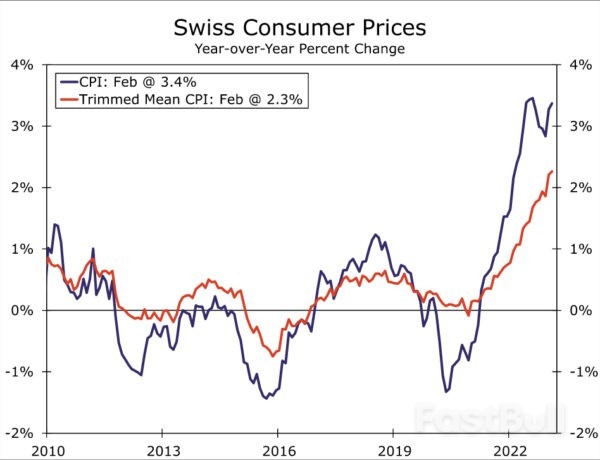
          Early last week, we wrote on the Swiss economy, highlighting that growth appears to be bottoming out while CPI inflation has shown a renewed uptick, as the trimmed mean CPI rose 2.3% year-over-year in February. This led us to anticipate a 50 basis point hike from the Swiss National Bank (SNB) at its March 23 announcement.
          Since then, Swiss markets have been dominated by banking sector strains, which ultimately saw authorities engineer a takeover of Credit Suisse by rival firm UBS. The deal led the SNB to provide 100 billion francs of liquidity support for UBS, and the Swiss government to provide a guarantee of 9 billion francs against potential losses.
          With those developments having restored some relative calm to markets (the emphasis here is very much on the relative rather than the calm), and with the European Central Bank having raised its policy rate 50 basis points last week, we still expect the SNB to raise its policy rate by 50 basis points to 1.50% at this week's meeting.
          Moreover, while Swiss growth could be softer than previously expected, CPI inflation will likely remain mildly elevated above the central bank's 2% inflation target for the time being. If the SNB does raise rates 50 basis points this week, even in the context of recent market events, we believe it will also deliver a 25-basis point rate hike at its June meeting amid what we expect will be calmer markets conditions.

          Bank of England & Swiss National Bank Both Set to Hike_2Source: Wells Fargo Securities

          Risk Warnings and Disclaimers
          You understand and acknowledge that there is a high degree of risk involved in trading. Following any strategies or investment methods may lead to potential losses. The content on the site is provided by our contributors and analysts for information purposes only. You are solely responsible for determining whether any trading assets, securities, strategy, or any other product is suitable for investing based on your own investment objectives and financial situation.
          Comments
          Add to Favorites
          Share

          The Commodities Feed: Fed Hikes

          Samantha Luan

          Commodity

          Energy- Large US product draws
          The oil market saw a further recovery yesterday. ICE Brent settled more than 1.8% higher on the day, whilst WTI managed to settle above US$70/bbl for the first time in a week. The Fed's decision to hike rates by 25bp was the most priced-in outcome and so, as a result, provided little in the way of surprises to the market. Price action is weaker in early morning trading today, not helped by comments from US Treasury Secretary, Janet Yellen, who said that the government was not looking at providing blanket deposit insurance following recent developments in the banking sector.
          Weekly EIA data was constructive. US crude oil inventories increased by 1.12MMbbls over the last week. However, there were fairly large declines in refined product stocks. Gasoline and distillate fuel oil inventories fell by 6.4MMbbls and 3.31MMbbls respectively. These large product draws were on the back of stronger domestic demand, while refined product exports were also stronger over the last week. At a little under 230MMbbls, US gasoline stocks are at their lowest level for this time of year in at least 5 years. As for distillate stocks, whilst they look more comfortable than last year, historically they are still relatively tight.
          Metals – China to cut steel production
          China is considering reducing its steel production by about 2.5% this year amid its existing policy to curb emissions. The target was proposed by officials at a meeting last week. Meanwhile, authorities in the Tangshan region have already asked steel makers in the region to adjust their output as per the regulations, after an orange alert was issued on 20 March. This would likely add further pressure on raw material prices. The most active SGX iron ore contract slipped below US$120/t for the first time in six weeks yesterday as Chinese steel demand disappointed despite peak construction season starting soon. As per the latest estimates from Mysteel, ten steel mills in China have lowered their prices of steel products.

          Source: ING

          Risk Warnings and Disclaimers
          You understand and acknowledge that there is a high degree of risk involved in trading. Following any strategies or investment methods may lead to potential losses. The content on the site is provided by our contributors and analysts for information purposes only. You are solely responsible for determining whether any trading assets, securities, strategy, or any other product is suitable for investing based on your own investment objectives and financial situation.
          Comments
          Add to Favorites
          Share
          FastBull
          Copyright © 2025 FastBull Ltd

          728 RM B 7/F GEE LOK IND BLDG NO 34 HUNG TO RD KWUN TONG KLN HONG KONG

          TelegramInstagramTwitterfacebooklinkedin
          App Store Google Play Google Play
          Products
          Charts

          Chats

          Q&A with Experts
          Screeners
          Economic Calendar
          Data
          Tools
          Membership
          Features
          Function
          Markets
          Copy Trading
          Latest Signals
          Contests
          News
          Analysis
          24/7
          Columns
          Education
          Company
          Careers
          About Us
          Contact Us
          Advertising
          Help Center
          Feedback
          User Agreement
          Privacy Policy
          Business

          White Label

          Data API

          Web Plug-ins

          Poster Maker

          Affiliate Program

          Risk Disclosure

          The risk of loss in trading financial instruments such as stocks, FX, commodities, futures, bonds, ETFs and crypto can be substantial. You may sustain a total loss of the funds that you deposit with your broker. Therefore, you should carefully consider whether such trading is suitable for you in light of your circumstances and financial resources.

          No decision to invest should be made without thoroughly conducting due diligence by yourself or consulting with your financial advisors. Our web content might not suit you since we don't know your financial conditions and investment needs. Our financial information might have latency or contain inaccuracy, so you should be fully responsible for any of your trading and investment decisions. The company will not be responsible for your capital loss.

          Without getting permission from the website, you are not allowed to copy the website's graphics, texts, or trademarks. Intellectual property rights in the content or data incorporated into this website belong to its providers and exchange merchants.

          Not Logged In

          Log in to access more features

          FastBull Membership

          Not yet

          Purchase

          Become a signal provider
          Help Center
          Customer Service
          Dark Mode
          Price Up/Down Colors

          Log In

          Sign Up

          Position
          Layout
          Fullscreen
          Default to Chart
          The chart page opens by default when you visit fastbull.com