• Trade
  • Markets
  • Copy
  • Contests
  • News
  • 24/7
  • Calendar
  • Q&A
  • Chats
Trending
Screeners
SYMBOL
LAST
BID
ASK
HIGH
LOW
NET CHG.
%CHG.
SPREAD
SPX
S&P 500 Index
6827.42
6827.42
6827.42
6899.86
6801.80
-73.58
-1.07%
--
DJI
Dow Jones Industrial Average
48458.04
48458.04
48458.04
48886.86
48334.10
-245.98
-0.51%
--
IXIC
NASDAQ Composite Index
23195.16
23195.16
23195.16
23554.89
23094.51
-398.69
-1.69%
--
USDX
US Dollar Index
97.920
98.000
97.920
98.070
97.810
-0.030
-0.03%
--
EURUSD
Euro / US Dollar
1.17447
1.17454
1.17447
1.17596
1.17262
+0.00053
+ 0.05%
--
GBPUSD
Pound Sterling / US Dollar
1.33835
1.33843
1.33835
1.33961
1.33546
+0.00128
+ 0.10%
--
XAUUSD
Gold / US Dollar
4331.05
4331.39
4331.05
4350.16
4294.68
+31.66
+ 0.74%
--
WTI
Light Sweet Crude Oil
56.843
56.873
56.843
57.601
56.789
-0.390
-0.68%
--

Community Accounts

Signal Accounts
--
Profit Accounts
--
Loss Accounts
--
View More

Become a signal provider

Sell trading signals to earn additional income

View More

Guide to Copy Trading

Get started with ease and confidence

View More

Signal Accounts for Members

All Signal Accounts

Best Return
  • Best Return
  • Best P/L
  • Best MDD
Past 1W
  • Past 1W
  • Past 1M
  • Past 1Y

All Contests

  • All
  • Trump Updates
  • Recommend
  • Stocks
  • Cryptocurrencies
  • Central Banks
  • Featured News
Top News Only
Share

Portugal Treasury Expects 2026 Net Financing Needs At 29.4 Billion Euros, Up From 25.8 Billion In 2025

Share

Bank Of America Says With Indonesia's Smelter Now Ramping Up, It Expects Aluminium Supply Growth To Accelerate To 2.6% Year On Year In 2026

Share

Bank Of America Expects A Deficit In Aluminium Next Year And Sees Prices Pushing Above $3000/T

Share

Fed Data - USA Effective Federal Funds Rate At 3.64 Percent On 12 December On $102 Billion In Trades Versus 3.64 Percent On $99 Billion On 11 December

Share

Brazil's Petrobras Says No Impact Seen On Oil, Petroleum Products Output As Workers Start Planned Strike

Share

Statement: US Travel Group Warns New Proposed Trump Administration Requirements For Foreign Tourists To Provide Social Media Histories Could Mean Millions Of People Opting Not To Visit

Share

Blackrock: Kerry White Will Become Head Of Citi Investment Management At Citi Wealth

Share

Blackrock: Rob Jasminski, Head Of Citi Investment Management, Has Joined With Team

Share

Blackrock: Effective Dec 15, Citi Investment Management Employees Will Join Blackrock

Share

Blackrock: Formally Launch Citi Portfolio Solutions Powered By Blackrock

Share

According To Data From The Federal Reserve Bank Of New York, The Secured Overnight Funding Rate (Sofr) Was 3.67% On The Previous Trading Day (December 15), Compared To 3.66% The Day Before

Share

Peru Energy And Mines Ministry: Copper Production Up 4.8% Year-On-Year In October To 248192 Metric Tons

Share

Security Source: Ukrainian Drones Hits Russian Oil Infrastructure In Caspian Sea For Third Time

Share

Spot Palladium Extends Gains, Last Up 5% To $1562.7/Oz

Share

Mexico's Economy Ministry Announces Start Of Anti-Dumping Investigation And Anti-Subsidy Investigations Into USA Pork Imports

Share

Canada Nov CPI Common +2.8%, CPI Median +2.8%, CPI Trim +2.8% On Year

Share

NY Fed's Empire State Prices Paid Index +37.6 In December Versus+49.0 In November

Share

Canada Nov Consumer Prices +0.1% On Month, +2.2% On Year

Share

Canada Nov CPI Core -0.1% On Month, +2.9% On Year

Share

Canada Nov Core CPI, Seasonally Adjusted +0.2% On Month, Oct +0.3% (Unrevised)

TIME
ACT
FCST
PREV
Japan Tankan Small Manufacturing Outlook Index (Q4)

A:--

F: --

P: --

Japan Tankan Large Non-Manufacturing Outlook Index (Q4)

A:--

F: --

P: --

Japan Tankan Large Manufacturing Outlook Index (Q4)

A:--

F: --

P: --

Japan Tankan Small Manufacturing Diffusion Index (Q4)

A:--

F: --

P: --

Japan Tankan Large Manufacturing Diffusion Index (Q4)

A:--

F: --

P: --

Japan Tankan Large-Enterprise Capital Expenditure YoY (Q4)

A:--

F: --

P: --

U.K. Rightmove House Price Index YoY (Dec)

A:--

F: --

P: --

China, Mainland Industrial Output YoY (YTD) (Nov)

A:--

F: --

P: --

China, Mainland Urban Area Unemployment Rate (Nov)

A:--

F: --

P: --

Saudi Arabia CPI YoY (Nov)

A:--

F: --

P: --

Euro Zone Industrial Output YoY (Oct)

A:--

F: --

P: --

Euro Zone Industrial Output MoM (Oct)

A:--

F: --

P: --

Canada Existing Home Sales MoM (Nov)

A:--

F: --

P: --

Canada National Economic Confidence Index

A:--

F: --

P: --

Canada New Housing Starts (Nov)

A:--

F: --

P: --
U.S. NY Fed Manufacturing Employment Index (Dec)

A:--

F: --

P: --

U.S. NY Fed Manufacturing Index (Dec)

A:--

F: --

P: --

Canada Core CPI YoY (Nov)

A:--

F: --

P: --

Canada Manufacturing Unfilled Orders MoM (Oct)

A:--

F: --

P: --

U.S. NY Fed Manufacturing Prices Received Index (Dec)

A:--

F: --

P: --

U.S. NY Fed Manufacturing New Orders Index (Dec)

A:--

F: --

P: --

Canada Manufacturing New Orders MoM (Oct)

A:--

F: --

P: --

Canada Core CPI MoM (Nov)

A:--

F: --

P: --

Canada Trimmed CPI YoY (SA) (Nov)

A:--

F: --

P: --

Canada Manufacturing Inventory MoM (Oct)

A:--

F: --

P: --

Canada CPI YoY (Nov)

A:--

F: --

P: --

Canada CPI MoM (Nov)

A:--

F: --

P: --

Canada CPI YoY (SA) (Nov)

A:--

F: --

P: --

Canada Core CPI MoM (SA) (Nov)

A:--

F: --

P: --

Canada CPI MoM (SA) (Nov)

A:--

F: --

P: --

Federal Reserve Board Governor Milan delivered a speech
U.S. NAHB Housing Market Index (Dec)

--

F: --

P: --

Australia Composite PMI Prelim (Dec)

--

F: --

P: --

Australia Services PMI Prelim (Dec)

--

F: --

P: --

Australia Manufacturing PMI Prelim (Dec)

--

F: --

P: --

Japan Manufacturing PMI Prelim (SA) (Dec)

--

F: --

P: --

U.K. 3-Month ILO Employment Change (Oct)

--

F: --

P: --

U.K. Unemployment Claimant Count (Nov)

--

F: --

P: --

U.K. Unemployment Rate (Nov)

--

F: --

P: --

U.K. 3-Month ILO Unemployment Rate (Oct)

--

F: --

P: --

U.K. Average Weekly Earnings (3-Month Average, Including Bonuses) YoY (Oct)

--

F: --

P: --

U.K. Average Weekly Earnings (3-Month Average, Excluding Bonuses) YoY (Oct)

--

F: --

P: --

France Services PMI Prelim (Dec)

--

F: --

P: --

France Composite PMI Prelim (SA) (Dec)

--

F: --

P: --

France Manufacturing PMI Prelim (Dec)

--

F: --

P: --

Germany Services PMI Prelim (SA) (Dec)

--

F: --

P: --

Germany Manufacturing PMI Prelim (SA) (Dec)

--

F: --

P: --

Germany Composite PMI Prelim (SA) (Dec)

--

F: --

P: --

Euro Zone Composite PMI Prelim (SA) (Dec)

--

F: --

P: --

Euro Zone Services PMI Prelim (SA) (Dec)

--

F: --

P: --

Euro Zone Manufacturing PMI Prelim (SA) (Dec)

--

F: --

P: --

U.K. Services PMI Prelim (Dec)

--

F: --

P: --

U.K. Manufacturing PMI Prelim (Dec)

--

F: --

P: --

U.K. Composite PMI Prelim (Dec)

--

F: --

P: --

Euro Zone ZEW Economic Sentiment Index (Dec)

--

F: --

P: --

Germany ZEW Current Conditions Index (Dec)

--

F: --

P: --

Germany ZEW Economic Sentiment Index (Dec)

--

F: --

P: --

Euro Zone Trade Balance (Not SA) (Oct)

--

F: --

P: --

Euro Zone ZEW Current Conditions Index (Dec)

--

F: --

P: --

Euro Zone Trade Balance (SA) (Oct)

--

F: --

P: --

U.S. Retail Sales MoM (Excl. Automobile) (SA) (Oct)

--

F: --

P: --

Q&A with Experts
    • All
    • Chatrooms
    • Groups
    • Friends
    Connecting
    .
    .
    .
    Type here...
    Add Symbol or Code

      No matching data

      All
      Trump Updates
      Recommend
      Stocks
      Cryptocurrencies
      Central Banks
      Featured News
      • All
      • Russia-Ukraine Conflict
      • Middle East Flashpoint
      • All
      • Russia-Ukraine Conflict
      • Middle East Flashpoint
      Search
      Products

      Charts Free Forever

      Chats Q&A with Experts
      Screeners Economic Calendar Data Tools
      Membership Features
      Data Warehouse Market Trends Institutional Data Policy Rates Macro

      Market Trends

      Market Sentiment Order Book Forex Correlations

      Top Indicators

      Charts Free Forever
      Markets

      News

      News Analysis 24/7 Columns Education
      From Institutions From Analysts
      Topics Columnists

      Latest Views

      Latest Views

      Trending Topics

      Top Columnists

      Latest Update

      Signals

      Copy Rankings Latest Signals Become a signal provider AI Rating
      Contests
      Brokers

      Overview Brokers Assessment Rankings Regulators News Claims
      Broker listing Forex Brokers Comparison Tool Live Spread Comparison Scam
      Q&A Complaint Scam Alert Videos Tips to Detect Scam
      More

      Business
      Events
      Careers About Us Advertising Help Center

      White Label

      Data API

      Web Plug-ins

      Affiliate Program

      Awards Institution Evaluation IB Seminar Salon Event Exhibition
      Vietnam Thailand Singapore Dubai
      Fans Party Investment Sharing Session
      FastBull Summit BrokersView Expo
      Recent Searches
        Top Searches
          Markets
          News
          Analysis
          User
          24/7
          Economic Calendar
          Education
          Data
          • Names
          • Latest
          • Prev

          View All

          No data

          Scan to Download

          Faster Charts, Chat Faster!

          Download App
          English
          • English
          • Español
          • العربية
          • Bahasa Indonesia
          • Bahasa Melayu
          • Tiếng Việt
          • ภาษาไทย
          • Français
          • Italiano
          • Türkçe
          • Русский язык
          • 简中
          • 繁中
          Open Account
          Search
          Products
          Charts Free Forever
          Markets
          News
          Signals

          Copy Rankings Latest Signals Become a signal provider AI Rating
          Contests
          Brokers

          Overview Brokers Assessment Rankings Regulators News Claims
          Broker listing Forex Brokers Comparison Tool Live Spread Comparison Scam
          Q&A Complaint Scam Alert Videos Tips to Detect Scam
          More

          Business
          Events
          Careers About Us Advertising Help Center

          White Label

          Data API

          Web Plug-ins

          Affiliate Program

          Awards Institution Evaluation IB Seminar Salon Event Exhibition
          Vietnam Thailand Singapore Dubai
          Fans Party Investment Sharing Session
          FastBull Summit BrokersView Expo

          Coal India Share Price Down 4%:Should You Buy,Sell Or Hold The Stock?

          Alex

          Stocks

          Summary:

          Coal India share price declined more than 4% in intraday trades on Tuesday. The company has adjusted its volume guidance, which, analysts say is in line with their earlier estimates. Further rising volumes will compensate for the decline in e-auction premiums.

          Coal India share price corrected more than 4.0% in the intraday trades on Tuesday. The Coal India stock that has scaled 52-week highs of ₹487.75 on 16th February after having more than doubled from 52 week lows of ₹207.75 on MArch'2023, has given up some parts of the gains.
          The volume outlook for Coal India remains strong as was highlighted by the management during the recent investor presentation on 19th February.
          Highest ever 9M Coal production of 531.90 MT and Over burden removal of 1404.85 MCuM was achieved during 9M of FY 23-24 marking a growth of 11 % and 22 % respectively. The strong power demand in the country has lifted col Demand and in turn of Coal India's produce.
          During April-Dec of FY 2023-24, Coal India supplied 552.03 MT of coal against 507.8 MT of coal supplied during the same period last year thereby registering a growth of 8.7%. Supplies to power sector also increase by 4.9% y--y. during the same period.
          As the volume growth run rate stay strong Coal India forward guidance for volumes was slightly lower than earlier guidance, which analysts said that was already high.
          Guided volume run-rate still inline of higher that analysts estimates
          Analysts at Nuvama Institutional Equities said that Coal India lowered the volume guidance for FY24 and 25 to 770 million tonne (MT) and 838 million tonne compared to 780mt and 850mt guided earlier (which anyway was very high). The calibrated volume guidance is due to lower volume from SECL (subsidiary), which, in turn, was due to land shortage (hit volume by 8–10mt), added analyst. However, Nuvama analysts say that they had already factored in volume of 752mt and 790mt for FY24 and FY25 (estimates) and, hence, do not expect any risk to their volume and earnings estimates.
          Analysts at Motilal Oswal Financial Services said that based on the year to date performance, Coal India is confident of achieving 770mt of production during FY24, with five subsidiaries on track to achieve 100% of the annual production target. The number is lower than earlier guidance as its subsidiary (SECL) would fall short by 8-9 million tonne due to some pending clearance for mine.
          Analysts at Jefferies India Pvt Ltd also said that Coal India has slightly cut its FY24 volume guidance from 780 MT to 770mt (Jefferies estimate: 770mt production). For FY25, the company has reduced its volume target from 850 mt to 838 mt, although still higher than Jefferies of 812mt.

          Higher volumes to drive e-auction volumes even though e-auction premiums soften

          Coal India supplies majority of its produce to power sector through Fuel Supply agreements (FSA). The coal produced after meeting FSA demand is sold through e-auctions where Coal India also derives higher realizations s the realisations for fuel being supplied through FSAs is as per agreements.
          As Volume guidance still is in line with analyst estimates, the rise on more profitable e-auction volumes to accrue positives to earnings.
          Rising coal production will also mean higher e-auction sales. The e-auction premiums, though have softened recently, nevertheless rising e-auction volumes compensate for the decline and earnings outlook remains strong.
          Analysts at Jefferies though have cut FY24-26 estimated earnings per shre (EPS) by 2-6% on lower e-auction premiums, but higher e-auction volumes and slightly lower staff cost. Col India as per Jefferies has delivered a strong FY23 with EPS rising 63% year-on-year to Rs46 (FY10-22 peak was Rs28), led by strong volume growth and a sharp rise in e-auction prices. While e-auction prices have eased, improved volume growth and lower-than-expected costs have enhanced earnings outlook. They expect Coal India's EPS to reach all-time high of Rs51 in FY24, and add that despite the 47% rise in shareholders returns and 33% outperformance to Nifty-50 since November, Coal India still is at an inexpensive 9.2x FY25 estimated price to earning versus 2011-18 average of 13 times. They retain Buy with a revised price target of Rs520 based on 10x FY26 estimated price to earnings ratio, which provides 18% share holders returns including 5% dividend yield.

          Source:mint

          Risk Warnings and Disclaimers
          You understand and acknowledge that there is a high degree of risk involved in trading. Following any strategies or investment methods may lead to potential losses. The content on the site is provided by our contributors and analysts for information purposes only. You are solely responsible for determining whether any trading assets, securities, strategy, or any other product is suitable for investing based on your own investment objectives and financial situation.
          Comments
          Add to Favorites
          Share

          Wage Test For The Euro

          ING

          Forex

          The ingredients for more rangebound trading are all there, especially given an uninspiring US data calendar and no impact of Chinese news. However, the ECB’s negotiated wage growth indicator is a key test for the euro. We think a decline in salary pressure can help a further unwinding of EUR longs.

          USD: Markets unimpressed with China's rate cut

          US markets re-open today after an uneventful Monday for global markets. US stock indices’ futures are trading on the soft side, and the US calendar is unlikely to be a big driver today. January’s Leading Index is the only release scheduled for the day, and things will be rather quiet on the US macro front until the FOMC minutes are published tomorrow evening.
          China is once again the focus this morning as banks reduced their five-year loan prime rates by a record 25bp to 3.95% overnight, the first move of this kind since June. This kind of monetary easing has a generally higher impact on the property market, but once again markets have shown little enthusiasm. CNH is bucking the modestly stronger USD momentum this morning, but gains are very limited. Strong travel numbers during the Chinese New Year also generated a modest positive impact on markets, confirming that expectations of a recovery in China’s growth sentiment will be gradual at best.
          Latest positioning data from CFTC show the dollar is generally oversold against EM and overbought against G10 currencies among speculators. That clearly mirrors markets’ favouritism for carry-attractive currencies and signals that the dollar remains too expensive to be shorted consistently against lower-yielding developed currencies. That said, the view that the US data will turn at some point, the Federal Reserve will cut, and the dollar will decline remains a consensus one (and often translates into selling USD rallies). We favour a strong dollar in the near term as US data remains supportive, but this looks increasingly to be the perfect recipe for range-bound trading. In DXY terms, 104/105 may hold as a range in the short run.

          EUR: Wage growth below 4.5% should hit the euro

          Things aren’t as quiet in the eurozone as in the US today. The European Central Bank will publish the eurozone-wide indicator of negotiated wage rates for the fourth quarter, which at this point is one of the most important data input for the Governing Council. The latest ECB meeting put wage growth even more at the centre of the policy discussion, pointing to how rate cuts are to be ruled out unless negotiated salaries move convincingly in the right direction.
          There is no published consensus for the release. We believe our economics team’s call for a 4.4-4.5% year-on-year read is moderately lower than expectations. This wage indicator had been on a steady rise since mid-2022, and a decline, even if contained, should be welcome by the ECB. It will be up to the 2024 first quarter GDP print (which includes detailed wage information) in April and the negotiated wage indicator in May to greenlight or redlight a rate cut in June, given the second quarter GDP figures are published after the June meeting.
          The same speculative positioning data mentioned above tell us that the euro is an outlier in the G10 space, being moderately overbought (+7% of open interest) against the dollar despite its widely negative rate differential. Watch for some positioning adjustment on the downside today in EUR/USD, should the ECB wage growth come in below 4.5%. Still, we would not be surprised to see good support at 1.0700.

          CAD: Disinflation stall

          Canada releases inflation figures for January today, and consensus is centred for a stabilisation in the core measures (trim and median) at the 3.6% YoY level. Headline CPI is seen ticking lower from 3.4% to 3.3% YoY, with a 0.4% month-on-month increase after December’s encouraging -0.3% MoM.
          The expected slowdown in the disinflation process is in line with developments in the US and other major countries, and not too concerning for the Bank of Canada that estimates headline inflation at 3.2% in the first quarter of the year. Nevertheless, a tight labour market and the timing of the first Fed rate cut being pushed back means the BoC will likely opt for patience over more dovish guidance in upcoming communication. That is, unless today’s CPI numbers surprise markedly on the downside.
          USD/CAD can find a bit more support in the coming weeks as we see USD staying strong and risk sentiment fragile. A return to last week’s 1.3585 highs seems appropriate for now. However, we still expect a decline in USD rates to unlock downside potential for the pair in the second half of the year, even with the BoC cutting at the same time as the Fed.
          Risk Warnings and Disclaimers
          You understand and acknowledge that there is a high degree of risk involved in trading. Following any strategies or investment methods may lead to potential losses. The content on the site is provided by our contributors and analysts for information purposes only. You are solely responsible for determining whether any trading assets, securities, strategy, or any other product is suitable for investing based on your own investment objectives and financial situation.
          Comments
          Add to Favorites
          Share

          Oil Slides Amid Continued Uncertainty in Demand Outlook

          Ukadike Micheal

          Economic

          Commodity

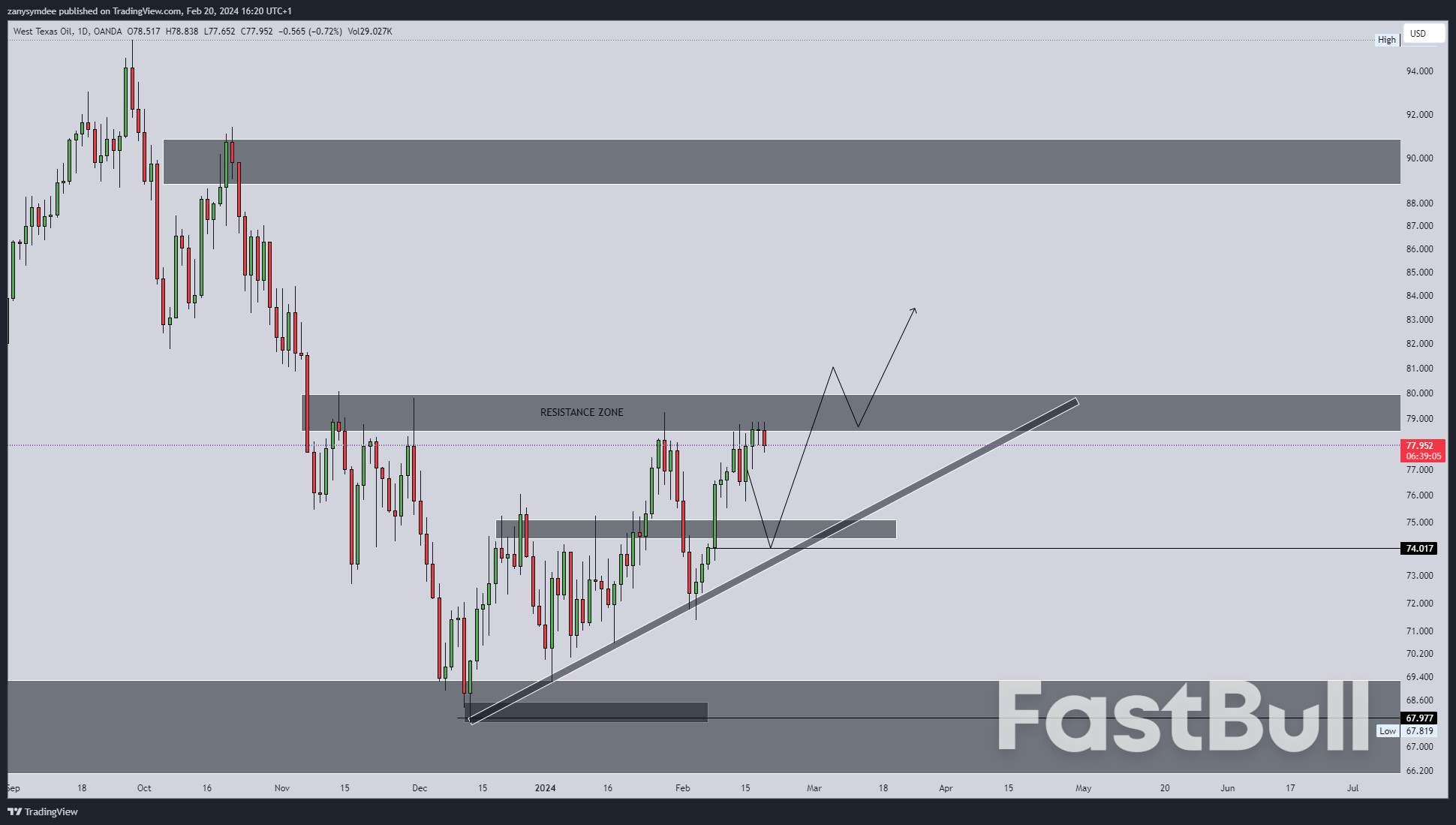
          Global oil prices experienced a decline on Tuesday due to uncertainties surrounding the outlook for global demand, despite some risk premium stemming from the Israel-Hamas conflict. Brent futures dropped to $83.34 a barrel, while U.S. West Texas Intermediate (WTI) crude for April delivery fell to $78.20 a barrel. The market reflected a cautious sentiment as concerns about demand overshadowed geopolitical tensions in the Middle East.
          The six-month spread for Brent reached its highest level since October, indicating a tighter market. However, the overall sentiment remained subdued, with crude markets experiencing marginal losses amid quiet trading during the Presidents' Day holiday in the U.S. The ongoing conflict between Israel and Hamas in Gaza added a layer of uncertainty, with the potential for escalating tensions to disrupt shipping lanes in the region.
          Despite the geopolitical risks, investors were primarily focused on the bearish outlook for global oil demand. The International Energy Agency (IEA) recently revised its 2024 oil demand growth forecast downward, projecting a lower increase compared to OPEC's outlook. While the IEA anticipated a growth of 1.22 million barrels per day (bpd) this year, OPEC's forecast stood at 2.25 million bpd.
          The conflicting views between the IEA and OPEC regarding the future of oil demand highlighted the ongoing transition towards renewable and cleaner energy sources. The IEA suggested that oil demand could peak by 2030, while OPEC anticipated a continued rise in oil consumption over the next two decades. This divergence in perspectives underscored the broader shift towards sustainable energy practices and the challenges facing traditional oil producers in adapting to changing market dynamics.
          From a technical standpoint, the fluctuations in oil prices and market sentiment underscore the complex interplay between geopolitical events, supply dynamics, and evolving demand patterns. The uncertainty surrounding global economic recovery post-pandemic, coupled with the transition towards cleaner energy sources, has introduced additional volatility into energy markets. Investors and industry stakeholders are closely monitoring developments in key oil-producing regions and assessing the implications for supply chains and pricing mechanisms.Oil Slides Amid Continued Uncertainty in Demand Outlook_1
          The current landscape of the oil market reflects a delicate balance between geopolitical tensions, demand uncertainties, and the broader transition towards sustainable energy solutions. As stakeholders navigate these challenges, the need for strategic planning, innovation, and collaboration becomes increasingly paramount in ensuring a resilient and adaptive energy sector for the future.

          Source: Reuters

          To stay updated on all economic events of today, please check out our Economic calendar
          Risk Warnings and Disclaimers
          You understand and acknowledge that there is a high degree of risk involved in trading. Following any strategies or investment methods may lead to potential losses. The content on the site is provided by our contributors and analysts for information purposes only. You are solely responsible for determining whether any trading assets, securities, strategy, or any other product is suitable for investing based on your own investment objectives and financial situation.
          Comments
          Add to Favorites
          Share

          How Does A UK Recession Affect The Pound's Fate?

          Samantha Luan
          Despite dropping its tightening bias at its February gathering, the Bank of England (BoE) maintained a more hawkish stance than the Fed and the ECB, pushing back against interest rate cuts. At the press conference following the latest decision, Governor Bailey said they are not yet at a point where they can lower borrowing costs, adding that policy needs to stay sufficiently restrictive for sufficiently long.
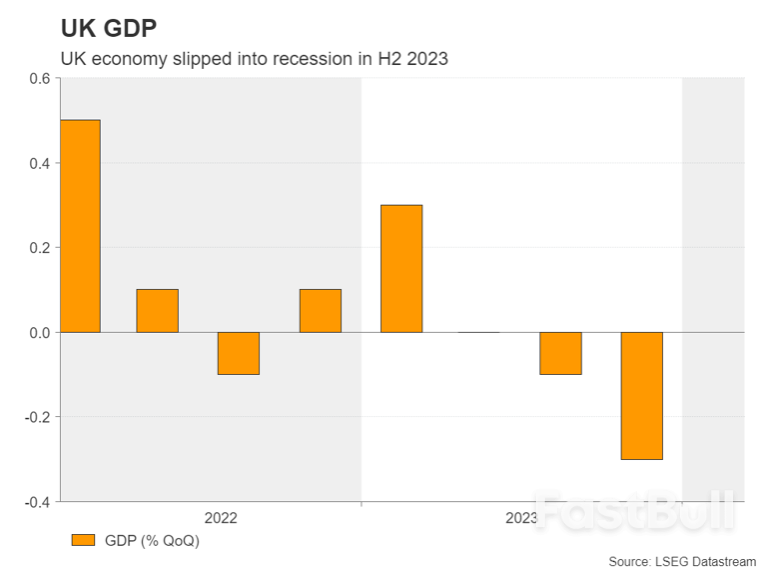
          However, this was before last week's barrage of economic data, with the highlight being the preliminary GDP numbers for Q4, which revealed that the economy contracted by more than anticipated, officially entering a technical recession. This weighed on the British pound, which had already been hurt the day before, after the CPI figures suggested that inflation held steady in January, confounding expectations of a small acceleration.
          How Does A UK Recession Affect The Pound's Fate?_1
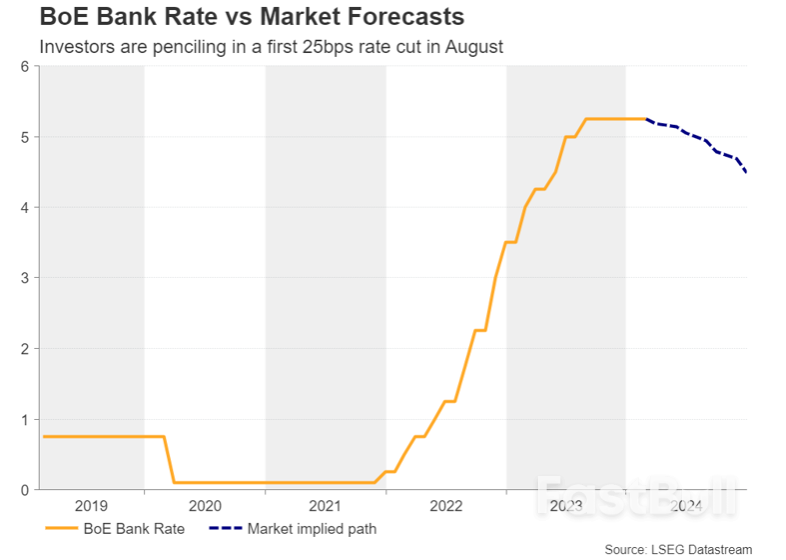
          However, the market's BoE implied path was not lowered. In other words, investors did not bring forward their rate cut bets. Currently, they are pricing in around 70bps worth of reductions by the end of the year, with the first quarter-point cut penciled in for August. Even after the notable upward adjustment to its interest rate projections regarding the Fed, the market still holds a more hawkish – or less dovish – view about the BoE. How Does A UK Recession Affect The Pound's Fate?_2

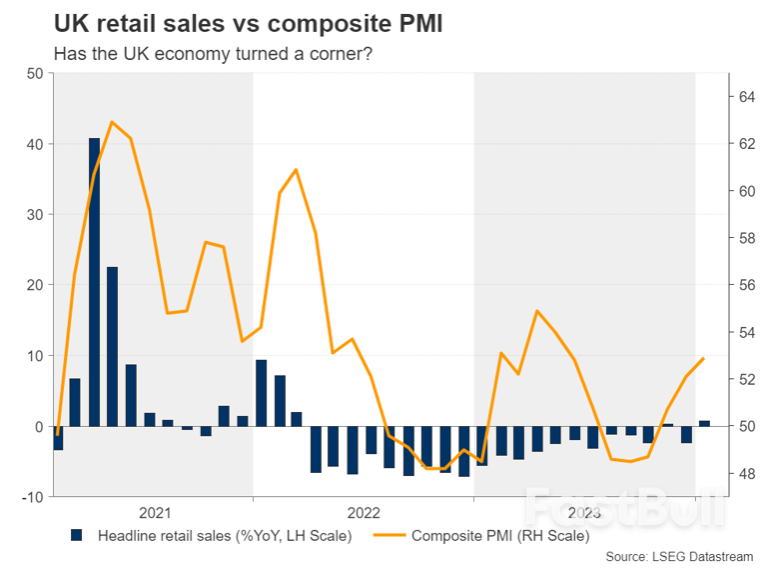
          Has the UK economy turned a corner in 2024?

          But why is that? One reason may be that, despite the latest slowdown, inflation in the UK remains stickier than other major economies, with the core rate at 5.1%, more than 2.5 times the BoE's objective of 2%. On top of that , wages have slowed by less than expected, with the rate of average weekly earnings excluding bonuses coming in at 6.2% y/y in December, well above the CPI rates. This still presents some upside risks to the inflation outlook for the months to come . Last but not least, retail sales for January accelerated to their fastest pace in nearly three years, which combined with the improvement in the PMIs for the month, adds to hopes that the economy may have started turning the corner.
          How Does A UK Recession Affect The Pound's Fate?_3
          The confirmation of a recession in the second half of last year seems to be having more political than economic importance, as it's a heavy blow to Rishi Sunak's popularity ahead of an expected general election later this year. Voters appear to have not been convinced that his The plan of cutting taxes is working, shifting their trust of the economy to the Labor Party, according to opinion polls.
          Just after the GDP data, finance minister Jeremy Hunt said that there were signs the economy is turning a corner and that they must stick to their plan. This means that at least until the election, the fiscal mentality of the government may continue to work against the BoE's efforts to tackle elevated inflation, thereby prompting the central bank to keep interest rates higher for longer, as officials have been already communicating. Just last Wednesday, BoE Governor Bailey said that he still wanted more evidence that inflation pressures were abating, corroborating the notion that the Bank's focus remains on price data.

          Heading into elections, what's next for the pound?

          With all that in mind, should upcoming data confirm the narrative that the UK economy is growing again, investors are likely to further push back their rate cut bets, which could prove supportive for the pound. Considering also that due to the UK's twin deficit, the currency has developed a correlation with risk-sentiment, further advances in the equity world could offer an extra help. The opposite may be true if the economy continues to struggle, even with the government abiding by its tax-cut plan.
          Having said all that, closer to the elections, which need to be held before January, the uncertainty about the change in fiscal attitude may have a negative impact on sterling. The leading Labor party has been portraying itself as the party of fiscal responsibility and thus , scrapping the Conservative's agenda may prompt the BoE to start loosening monetary policy sooner.
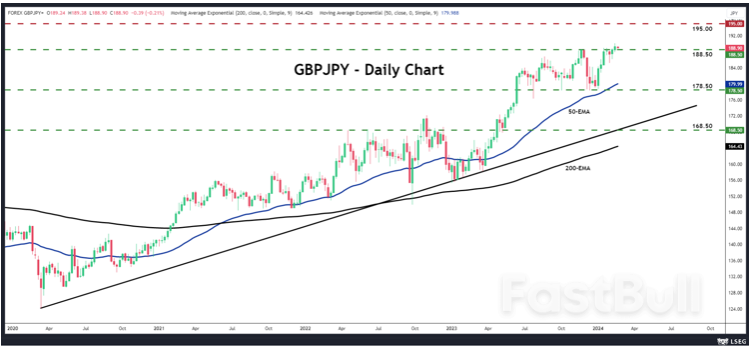
          From a technical standpoint, pound/yen has been trading in a steep uptrend since March 2020. Last week, the pair confirmed a higher high, entering territories last tested back in the summer of 2015, suggesting that the bulls may be willing to continue marching north. How Does A UK Recession Affect The Pound's Fate?_4
          The pair may correct lower should the Japanese authorities step in to support the yen, but the retreat may remain limited and short-lived if the BoJ keeps pushing against speculation of a rate hike soon and if data continues to suggest that the UK economy has turned the corner. The next area to consider as a potential resistance may be at around 195.00, near the highs of July and August 2015. For the outlook of this pair to change, a dive all the way below 178.50 may be needed.
          Risk Warnings and Disclaimers
          You understand and acknowledge that there is a high degree of risk involved in trading. Following any strategies or investment methods may lead to potential losses. The content on the site is provided by our contributors and analysts for information purposes only. You are solely responsible for determining whether any trading assets, securities, strategy, or any other product is suitable for investing based on your own investment objectives and financial situation.
          Comments
          Add to Favorites
          Share

          Canada Inflation Rate Cools More Than Forecast

          Zi Cheng

          Traders' Opinions

          Economic

          Forex

          At the onset of the year, Canadian consumer prices experienced a moderation, indicating progress in alleviating underlying pressures. This development is likely to grant the Bank of Canada increased flexibility to consider potential rate cuts in the near future.
          According to Statistics Canada's report in Ottawa on Tuesday, the consumer price index climbed by 2.9% in January compared to the previous year, a deceleration from the 3.4% rise registered in the preceding month. This figure fell below the median estimate of 3.3% projected by economists in a Bloomberg survey and marks the first instance since June that the headline rate has fallen within the central bank's target range.
          Canada Inflation Rate Cools More Than Forecast_1
          On a monthly basis, the index remained unchanged, contrary to expectations of a 0.4% increase, following a 0.3% decline in December.
          Both of the Bank of Canada's preferred core inflation measures exhibited a slowdown, averaging 3.35% compared to a downwardly revised 3.6% in the previous month, also lower than the 3.6% pace anticipated by economists. Bloomberg calculations indicate that a three-month moving average of these rates dropped to an annualized pace of 3.22% from 3.63% in December.
          The January inflation data reflects further progress in disinflation following a stagnation at the end of the previous year. As the Bank of Canada evaluates the necessity of maintaining its policy rate at restrictive levels, this report is expected to alleviate concerns regarding the persistence of underlying inflation and the sluggish progression towards the 2% inflation target.
          During their January discussions, Governor Tiff Macklem and other officials deemed the current monetary policy stance as adequately restrictive to attain the target, emphasizing the need for more time to restore price stability. They anticipate inflation to hover around 3% in the first half of the year before gradually subsiding and aligning with the target by the following year.
          This report serves as the sole inflation update preceding the next rate decision scheduled for March 6. Economists widely anticipate officials to maintain policy rates at 5% for a fifth consecutive meeting, with the easing cycle projected to commence around mid-2024.
          In January, the primary contributor to the deceleration in headline inflation was the decline in year-over-year gasoline prices by 4%. Excluding gasoline, the index moderated to 3.2% from the previous year, down from 3.5% in December.
          The slowdown in grocery inflation, along with reduced airfare and travel tour prices, also contributed to the overall deceleration.
          Among the components of the CPI basket, namely food, shelter, health and personal care, alcoholic beverages and tobacco, and cannabis products, four experienced growth rates above 3%, collectively constituting approximately 55% of the basket weights.
          Inflation excluding food increased by 2.7%, while excluding food and energy, it rose by 3.1%.
          Mortgage interest costs and rent remained the primary drivers of year-over-year price increases, with mortgage interest costs surging by 27.4% and rent rising by 7.9%.
          To stay updated on all economic events of today, please check out our Economic calendar
          Risk Warnings and Disclaimers
          You understand and acknowledge that there is a high degree of risk involved in trading. Following any strategies or investment methods may lead to potential losses. The content on the site is provided by our contributors and analysts for information purposes only. You are solely responsible for determining whether any trading assets, securities, strategy, or any other product is suitable for investing based on your own investment objectives and financial situation.
          Comments
          Add to Favorites
          Share

          Consumer Price Trends: An In-Depth Analysis of January 2024 Data Reveals Varied Influences on Inflation

          Ukadike Micheal

          Forex

          Economic

          In January, the Consumer Price Index (CPI) inched up by 2.9% on a year-over-year basis, marking a deceleration from the 3.4% gain observed in December. The primary contributor to this slowdown was the decrease in year-over-year gasoline prices in January (-4.0%), in contrast to the rise recorded in December (+1.4%). Excluding gasoline, the headline CPI moderated to 3.2% year over year in January, down from the 3.5% growth in December.Consumer Price Trends: An In-Depth Analysis of January 2024 Data Reveals Varied Influences on Inflation_1
          The decline in the year-over-year price growth for food purchased from stores in January (+3.4%) compared to December's figure (+4.7%) exerted downward pressure on the overall CPI. Additionally, lower prices for airfares and travel tours played a role in the headline deceleration.
          On a monthly basis, the CPI remained unchanged in January, following a 0.3% decline in December. However, on a seasonally adjusted monthly basis, the CPI fell 0.1% in January, marking the first decline since May 2020. Gasoline prices experienced a notable 4.0% decrease in January compared to a 1.4% increase in December, primarily due to a base-year effect. This contrast was influenced by refinery closures in the southwestern United States following Winter Storm Elliott in January 2023.
          Monthly gasoline prices continued to decrease in January 2024 (-0.9%) for the fifth consecutive month, with lower gas prices in Manitoba (-14.1%) contributing to the national decline after a temporary suspension of the provincial gas tax. While grocery prices remained elevated, their year-over-year growth slowed in January (+3.4%) compared to December's pace (+4.7%).
          The deceleration in grocery prices was widespread, with various products such as meat (+2.8%), other food preparations (+4.2%), dairy products (+1.5%), bakery products (+4.0%), and fresh fruit (+1.9%) contributing to the slower year-over-year price growth in January. Conversely, certain food items, including soup (-2.1%), bacon (-8.4%), and shrimps and prawns (-3.4%), experienced year-over-year price declines in January.
          Prices for airfares also witnessed a decline in January (-14.3%) compared with December's figure (-9.7%) on a year-over-year basis, typically reflecting the post-holiday season. On a monthly basis, prices fell in January (-23.7%) compared with December's increase (+31.1%).
          Moreover, cellular services prices fell by 16.4% in January on a year-over-year basis, following a 26.8% decline in December. Monthly prices rose by 6.7% in January compared with December, as prices returned to earlier levels following promotions offered in November and December. Year over year, prices rose at a slower pace in January compared with December in nine provinces, with Alberta being the only province experiencing faster price growth due in part to higher electricity prices.Consumer Price Trends: An In-Depth Analysis of January 2024 Data Reveals Varied Influences on Inflation_2
          In Saskatchewan, the cessation of the carbon levy collection in January 2024 contributed to the province's year-over-year price decline of natural gas (-26.6%).
          From a technical viewpoint, the data indicates mixed trends in consumer prices, with certain categories experiencing declines, especially in the context of seasonal patterns and base-year effects. The fluctuations in prices for goods and services highlight the dynamic nature of inflation and its sensitivity to various economic factors. Policymakers and analysts will closely monitor these trends to gauge the potential impact on overall economic conditions and formulate appropriate strategies.

          Source: Statistics Canada

          To stay updated on all economic events of today, please check out our Economic calendar
          Risk Warnings and Disclaimers
          You understand and acknowledge that there is a high degree of risk involved in trading. Following any strategies or investment methods may lead to potential losses. The content on the site is provided by our contributors and analysts for information purposes only. You are solely responsible for determining whether any trading assets, securities, strategy, or any other product is suitable for investing based on your own investment objectives and financial situation.
          Comments
          Add to Favorites
          Share

          Global Wheat Crisis: War, Weather, And Pandemic's Toll On Food Security

          Alex

          Commodity

          Global Wheat Crisis: War, Weather, And Pandemic's Toll On Food Security_1As dawn breaks over the golden fields stretching from Oklahoma to Texas, the amber waves of wheat tell a story far beyond their tranquil appearance. This narrative, unfolding amidst the chaos of the Russia-Ukraine conflict, a global pandemic, and extreme weather events, speaks of a commodity essential to our survival: wheat. The repercussions of these crises have sent shockwaves through global food prices, leading to a precarious situation that threatens food security worldwide, particularly in regions like Nigeria, where the stakes are even higher.

          The Tumultuous Journey of Wheat Prices

          In the wake of COVID-19, wheat prices saw an unprecedented surge, climbing from a modest $4 to a staggering $8, as nations grappled with the pandemic's immediate impacts. The situation intensified with Russia's invasion of Ukraine, propelling prices to soar over $13, reflecting the critical role these two nations play in the global wheat supply. However, recent developments hint at a stabilization, with the 2024 wheat harvest forward contract price in Oklahoma and Texas currently pegged at $5.50. This figure, while below the tumultuous highs, remains significantly above pre-pandemic levels, illustrating the lingering effects of the past years' events on wheat markets.

          Global Wheat Dynamics: A Delicate Balance

          The conflict between Russia and Ukraine has not only disrupted supply chains but also altered the landscape of global wheat production and exports. Russia has managed to increase its wheat production and exports, while Ukraine struggles with the loss of croplands and shortages of crucial inputs. Despite these challenges, global and U.S. wheat stocks-to-use ratios have remained stable, a testament to the resilience of agricultural systems. Yet, this balance is precarious. The aggressive export strategies adopted by Russia and Ukraine are impacting global prices, contributing to the current state of flux in wheat markets. Coupled with spikes in production input costs, including a notable rise in fertilizer and diesel prices, the agricultural community faces a daunting task.

          Implications for Food Security: A Closer Look at Nigeria

          The volatility of global wheat prices has far-reaching implications, particularly for countries like Nigeria, where the ripple effects exacerbate existing challenges. Rising inflation, the removal of fuel subsidies, and an increase in agricultural input prices post-COVID and post-conflict have compounded food insecurity. Nigeria, reliant on wheat imports, stands at the frontline of this crisis, grappling with the dual challenge of ensuring affordability and availability of food for its population. The scenario unfolding in Nigeria is a microcosm of the broader trends affecting agricultural communities worldwide, highlighting the interconnectedness of global food systems and the vulnerability of nations to disruptions in commodity markets.
          In conclusion, the journey of wheat prices from the fields of Oklahoma and Texas to the global market encapsulates a complex narrative of resilience, uncertainty, and the relentless pursuit of stability in an ever-changing world. The Russia-Ukraine conflict, compounded by the effects of COVID-19 and extreme weather events, has reshaped the global food landscape, underscoring the importance of sustainable agricultural practices and robust food security policies. As the world navigates these turbulent waters, the lessons learned will undoubtedly shape the future of food production and distribution for generations to come.

          Source:BNN

          Risk Warnings and Disclaimers
          You understand and acknowledge that there is a high degree of risk involved in trading. Following any strategies or investment methods may lead to potential losses. The content on the site is provided by our contributors and analysts for information purposes only. You are solely responsible for determining whether any trading assets, securities, strategy, or any other product is suitable for investing based on your own investment objectives and financial situation.
          Comments
          Add to Favorites
          Share
          FastBull
          Copyright © 2025 FastBull Ltd

          728 RM B 7/F GEE LOK IND BLDG NO 34 HUNG TO RD KWUN TONG KLN HONG KONG

          TelegramInstagramTwitterfacebooklinkedin
          App Store Google Play Google Play
          Products
          Charts

          Chats

          Q&A with Experts
          Screeners
          Economic Calendar
          Data
          Tools
          Membership
          Features
          Function
          Markets
          Copy Trading
          Latest Signals
          Contests
          News
          Analysis
          24/7
          Columns
          Education
          Company
          Careers
          About Us
          Contact Us
          Advertising
          Help Center
          Feedback
          User Agreement
          Privacy Policy
          Business

          White Label

          Data API

          Web Plug-ins

          Poster Maker

          Affiliate Program

          Risk Disclosure

          The risk of loss in trading financial instruments such as stocks, FX, commodities, futures, bonds, ETFs and crypto can be substantial. You may sustain a total loss of the funds that you deposit with your broker. Therefore, you should carefully consider whether such trading is suitable for you in light of your circumstances and financial resources.

          No decision to invest should be made without thoroughly conducting due diligence by yourself or consulting with your financial advisors. Our web content might not suit you since we don't know your financial conditions and investment needs. Our financial information might have latency or contain inaccuracy, so you should be fully responsible for any of your trading and investment decisions. The company will not be responsible for your capital loss.

          Without getting permission from the website, you are not allowed to copy the website's graphics, texts, or trademarks. Intellectual property rights in the content or data incorporated into this website belong to its providers and exchange merchants.

          Not Logged In

          Log in to access more features

          FastBull Membership

          Not yet

          Purchase

          Become a signal provider
          Help Center
          Customer Service
          Dark Mode
          Price Up/Down Colors

          Log In

          Sign Up

          Position
          Layout
          Fullscreen
          Default to Chart
          The chart page opens by default when you visit fastbull.com