Markets
News
Analysis
User
24/7
Economic Calendar
Education
Data
- Names
- Latest
- Prev


Signal Accounts for Members
All Signal Accounts
All Contests


Maersk CEO: We Have Seen A Type Of Normalisation Of Tariff Policies, Consumers Have Been Less Impacted By Trade Wars Than Initially Expected
Maersk CEO: We Don't Know If We'll See A Full Return To Red Sea In 2026, Our Guidance Includes A Gradual Reopening Of The Route In 2026
[Announcement: U.S. Initial Jobless Claims Data For Last Week To Be Released Tonight, Expected At 212K] February 5Th, The US Initial Jobless Claims For The Week Ending January 31St Will Be Announced Tonight At 21:30, With The Previous Value At 209K And An Expected Value Of 212K
India Foreign Ministry: Open To Exploring Commercial Merits Of Any Crude Supply, Including From Venezuela
India Foreign Ministry: Diversifying Energy Sourcing In Keeping With Objective Market Conditions, International Dynamics At Core Of Our Strategy
[The Washington Post Announces One-Third Job Cuts] According To Foreign Media Reports, The Washington Post, Owned By Amazon Founder Jeff Bezos, Announced On The 4th That It Will Lay Off One-third Of Its Employees, Stating That The Historic Newspaper Needs A "painful" Restructuring. The Layoffs Will Affect Journalists Across Almost All Reporting Lines, Including Sports, International, Technology, And Breaking News Teams, As Well As Employees In Business And Technology Departments
Danske Bank CEO: We Are Going Into One Of The Larger Investment Cycles Of Our Time, Driven By Energy Transition, Defence, And Changes In Technology

Euro Zone Core CPI Prelim YoY (Jan)A:--
F: --
P: --
Euro Zone HICP Prelim YoY (Jan)A:--
F: --
P: --
Euro Zone Core CPI Prelim MoM (Jan)A:--
F: --
P: --
U.S. MBA Mortgage Application Activity Index WoWA:--
F: --
P: --
Brazil IHS Markit Composite PMI (Jan)A:--
F: --
P: --
Brazil IHS Markit Services PMI (Jan)A:--
F: --
P: --
U.S. ADP Employment (Jan)A:--
F: --
The U.S. Treasury Department released its quarterly refinancing statement.
U.S. IHS Markit Composite PMI Final (Jan)A:--
F: --
P: --
U.S. IHS Markit Services PMI Final (Jan)A:--
F: --
P: --
U.S. ISM Non-Manufacturing Price Index (Jan)A:--
F: --
P: --
U.S. ISM Non-Manufacturing Employment Index (Jan)A:--
F: --
P: --
U.S. ISM Non-Manufacturing New Orders Index (Jan)A:--
F: --
P: --
U.S. ISM Non-Manufacturing Inventories Index (Jan)A:--
F: --
P: --
U.S. ISM Non-Manufacturing PMI (Jan)A:--
F: --
P: --
U.S. EIA Weekly Crude Oil Imports ChangesA:--
F: --
P: --
U.S. EIA Weekly Heating Oil Stock ChangesA:--
F: --
P: --
U.S. EIA Weekly Crude Demand Projected by ProductionA:--
F: --
P: --
U.S. EIA Weekly Gasoline Stocks ChangeA:--
F: --
P: --
U.S. EIA Weekly Crude Stocks ChangeA:--
F: --
P: --
U.S. EIA Weekly Cushing, Oklahoma Crude Oil Stocks ChangeA:--
F: --
P: --
Australia Trade Balance (SA) (Dec)A:--
F: --
Australia Exports MoM (SA) (Dec)A:--
F: --
Japan 30-Year JGB Auction YieldA:--
F: --
P: --
Indonesia Annual GDP GrowthA:--
F: --
P: --
Indonesia GDP YoY (Q4)A:--
F: --
P: --
France Industrial Output MoM (SA) (Dec)A:--
F: --
Italy IHS Markit Construction PMI (Jan)A:--
F: --
P: --
Euro Zone IHS Markit Construction PMI (Jan)A:--
F: --
P: --
Germany Construction PMI (SA) (Jan)A:--
F: --
P: --
Italy Retail Sales MoM (SA) (Dec)A:--
F: --
P: --
U.K. Markit/CIPS Construction PMI (Jan)--
F: --
P: --
France 10-Year OAT Auction Avg. Yield--
F: --
P: --
Euro Zone Retail Sales YoY (Dec)--
F: --
P: --
Euro Zone Retail Sales MoM (Dec)--
F: --
P: --
U.K. BOE MPC Vote Cut (Feb)--
F: --
P: --
U.K. BOE MPC Vote Hike (Feb)--
F: --
P: --
U.K. BOE MPC Vote Unchanged (Feb)--
F: --
P: --
U.K. Benchmark Interest Rate--
F: --
P: --
MPC Rate Statement
U.S. Challenger Job Cuts (Jan)--
F: --
P: --
U.S. Challenger Job Cuts MoM (Jan)--
F: --
P: --
U.S. Challenger Job Cuts YoY (Jan)--
F: --
P: --
Bank of England Governor Bailey held a press conference on monetary policy.
Euro Zone ECB Marginal Lending Rate--
F: --
P: --
Euro Zone ECB Deposit Rate--
F: --
P: --
Euro Zone ECB Main Refinancing Rate--
F: --
P: --
ECB Monetary Policy Statement
U.S. Weekly Initial Jobless Claims (SA)--
F: --
P: --
U.S. Initial Jobless Claims 4-Week Avg. (SA)--
F: --
P: --
U.S. Weekly Continued Jobless Claims (SA)--
F: --
P: --
ECB Press Conference
U.S. JOLTS Job Openings (SA) (Dec)--
F: --
P: --
U.S. EIA Weekly Natural Gas Stocks Change--
F: --
P: --
BOC Gov Macklem Speaks
Mexico Policy Interest Rate--
F: --
P: --
U.S. Weekly Treasuries Held by Foreign Central Banks--
F: --
P: --
Reserve Bank of Australia Governor Bullock testified before Parliament.
India Benchmark Interest Rate--
F: --
P: --
India Cash Reserve Ratio--
F: --
P: --
India Repo Rate--
F: --
P: --


No matching data
View All

No data
Provinces trim 2026 targets. Beijing may cut national goal, signaling a shift to quality, not just growth.
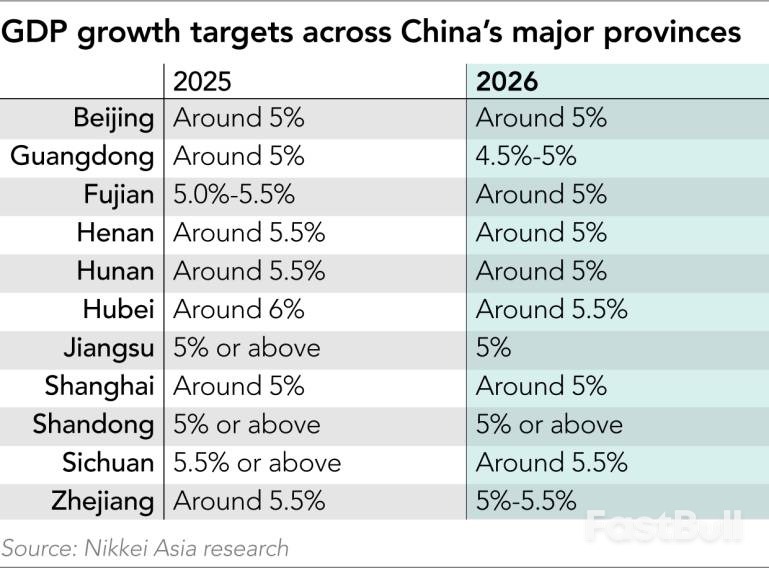
China's provinces are signaling a new era of slower economic expansion, with a majority setting lower GDP growth targets for 2026 compared to the previous year. This widespread adjustment by local governments sets the stage for Beijing to potentially lower the national growth target at the upcoming National People's Congress on March 5.
All 31 provincial-level governments have released their economic goals, which traditionally inform the central government's national forecast. The emerging pattern is one of moderated expectations across the country.
Around two-thirds of China's provinces have trimmed their growth ambitions for the year. This shift reflects a pragmatic acknowledgment of current economic realities.
Key examples of lowered targets include:
• Guangdong: China's largest province by GDP cut its target from "around 5%" to a range of 4.5% to 5% after reporting 3.9% growth in 2025.
• Inner Mongolia: Made a significant one-percentage-point cut from "around 6%" to "around 5%".
• Henan and Hunan: Both provinces lowered their goals from "around 5.5%" to "around 5%".
• Sichuan: Adjusted its target from "5.5% or above" to "around 5.5%".
• Anhui: Set its 2026 target at 5% to 5.5%, down from "5.5% or above" in 2025.
• Jiangsu: Aims for 5% growth, a less aggressive goal than its previous "5% or above" target.
In contrast, major municipalities like Shanghai and Beijing have maintained their growth targets at "around 5%."
With so many provinces scaling back, expectations are growing that the central government will follow suit. China has maintained a national growth target of "around 5%" since 2023. However, reports from the South China Morning Post suggest the government may lower this to a range of 4.5% to 5% for 2026.
This adjustment is seen by analysts as a strategic move rather than a sign of weakness.
"Cutting growth targets are a recognition that China isn't going to do a major demand-side stimulus, rather focusing on structural adjustment towards high-tech manufacturing," explained Duncan Wrigley, chief China economist at Pantheon Macroeconomics.
Wrigley noted that while China can leverage strong competitiveness in electric vehicles and green technology to boost exports, this reliance on external demand carries risks if the global economy cools. He added that a lower target sends a clear message to state-owned enterprises to prioritize long-term goals like technological self-reliance over chasing short-term growth figures.
The move aligns with recent messaging from China's top leadership, emphasizing sustainable and realistic economic development. Zhennan Li, senior Asia economist at Pictet Wealth Management, said a more flexible target allows the government to gradually manage down growth expectations over the coming years.
At a key leadership meeting in December, President Xi Jinping stated that economic planning "must be grounded in reality" and should aim for "genuine growth without exaggeration," as reported by the People's Daily.
This strategic pivot comes against a challenging backdrop. While China's headline GDP grew by 5% in 2025, nominal growth was only about 4% due to deflationary pressures. Many local governments are also burdened with significant debt from decades of investment in infrastructure and property.
As Beijing navigates these headwinds, it remains committed to its long-term goal of doubling per capita GDP by 2035 from 2020 levels. Achieving this ambitious target is estimated to require an average annual growth rate of approximately 4.7%.
Chinese President Xi Jinping recently held separate phone calls with U.S. President Donald Trump and Russian President Vladimir Putin, addressing critical global issues as Beijing works to manage its key international relationships.
The discussions reflect China's strategy of solidifying its partnership with Moscow while navigating persistent tensions with Washington over trade, Taiwan, and international security.
According to official accounts from both nations, the conversation between Xi and Trump covered a wide range of topics, including Iran, trade, Taiwan, and Russia's war in Ukraine.
President Trump described the call as "excellent" on his Truth Social platform, noting that his personal relationship with Xi remains "extremely good."
From the Chinese side, the focus was on de-escalation and building trust. Xi reportedly told Trump that disputes between the world's two largest economies could be resolved "one by one," fostering incremental progress. He outlined a vision for U.S.-China relations built on "mutual respect, peaceful coexistence and win-win cooperation," framing 2026 as a pivotal year for stabilizing bilateral ties.

Taiwan Remains a Core Friction Point
A central message from Beijing concerned Taiwan. Chinese state broadcaster CCTV reported that Xi warned Trump to proceed with "caution" on the issue.
Taiwan continues to be one of the most sensitive subjects in U.S.-China relations. Beijing consistently opposes American arms sales and political support for Taipei, highlighting the island as a major point of strategic friction even as both leaders emphasize the need for stability.
In his separate call with Vladimir Putin, Xi signaled a desire for deeper cooperation with Russia. Both leaders have consistently portrayed their relationship as a source of stability in an uncertain global landscape.
The partnership comes as European leaders continue to pressure China to withdraw its support for Russia, which is facing Western economic sanctions.
Russian state television broadcast Putin's opening remarks, in which he reaffirmed the alignment between the two countries. "I would like to once again assure you of firm support for our shared efforts to ensure the sovereignty and security of our countries, our socio-economic welfare and the right to choose our own development path," Putin stated.
The European Union's sanctions are inflicting a "significant impact" on Russia's economy, which could reach an unsustainable breaking point by 2026, according to the EU's top sanctions envoy, David O'Sullivan. Speaking ahead of the fourth anniversary of the full-scale invasion of Ukraine, the veteran official expressed confidence that the unprecedented economic measures are working as intended.
O'Sullivan acknowledged that sanctions are "not a silver bullet" and will always face attempts at circumvention. However, he remains optimistic about their long-term effects on Moscow's ability to finance its war.

"I am fairly bullish," he stated, noting that the pressure is building. "Defying the laws of economic gravity can only go on for so long."
The core of O'Sullivan's argument is that Russia's pivot to a war economy is severely distorting its entire financial structure at the expense of its civil sector. This strain is manifesting in key economic indicators. Russia is currently grappling with inflation running at about 6% and interest rates set at a high of 16%.
Vladimir Putin's war machine is also facing shrinking revenues. According to Russia's own finance ministry, federal budget revenues from oil and gas—the lifeblood of the economy—were halved in January, falling to their lowest point since July 2020. This economic pressure comes as Russia intensifies its attacks on Ukraine's energy infrastructure during a harsh winter.
Appointed in December 2022, O'Sullivan's primary mission is to counter the evasion and circumvention of EU sanctions. The EU has launched an unprecedented 19 rounds of sanctions since 2022, targeting over 2,700 individuals and entities and restricting trade across sectors like energy, aviation, IT, and luxury goods.
A key focus has been persuading non-EU countries to prevent the re-export of European goods to Russia, particularly components that can be repurposed for military use. O'Sullivan noted some success in stemming the flow of critical products through Central Asia, the Caucasus, Turkey, Serbia, the UAE, and Malaysia. He clarified that in most cases, this circumvention is driven by "economic operators seeing economic opportunity" rather than by deliberate government policy.
The China Factor: A "No-Limits" Challenge
China, however, stands out as an exception. O'Sullivan described Beijing as "clearly sort of backfilling and providing support" to Moscow, though he stopped short of accusing it of supplying direct military equipment.
He said that when EU leaders raise this concern with their Chinese counterparts, the response is consistently dismissive. "The answer is always the same: 'Nothing to see here. We don't know what you're talking about. We don't see any problem.'"
The EU has also claimed significant success in disrupting Russia's "shadow fleet"—a collection of aging oil tankers with obscure ownership used to transport crude to markets in China and India. By December, nearly 600 of these vessels had been placed under EU sanctions.
"We've been very successful in getting flag states to remove their flags from sanctioned vessels," O'Sullivan said. "I think we have tightened the screws on that particular form of circumvention, very considerably. I think the Russians are struggling to keep the oil flowing."
Despite these efforts, the EU has faced criticism from the United States for not going far enough. U.S. Treasury Secretary Scott Bessent recently accused the EU of "financing the war against themselves" by signing a trade deal with India without securing tougher commitments on Russian oil purchases. Since the invasion, India has become one of the top global buyers of discounted Russian crude.
O'Sullivan defended the EU's engagement with India, arguing that cooperation is more effective than isolation. He highlighted several key actions taken before the trade deal was signed:
• EU sanctions were imposed on a large Indian refinery.
• The EU banned imports of refined products made from Russian crude, including those from India.
• The Adani Group, owner of 14 Indian ports, decided to block access to sanctioned tankers.
"India is a hugely important country," O'Sullivan stated, "and I think we gain much more by engaging with it, even if we don't always agree with every Indian foreign policy position."
A critical area of focus for O'Sullivan's team is a "common high-priority list" of 300 products. These items, such as memory cards, optical readers, and circuit boards, are not classified as dual-use goods requiring export licenses but have been consistently found inside deconstructed Russian drones, missiles, and helicopters.
The fact that these components originate from Western countries—including the US, EU, Switzerland, and the UK—is "embarrassing for us all," O'Sullivan admitted. He added that awareness among EU member states about this supply chain vulnerability has grown, and while the problem has been reduced, it has not been completely eliminated.
South Korea is executing a delicate dual strategy to secure its supply of critical minerals, essential materials for its world-leading semiconductor and electric vehicle battery sectors. While joining a new U.S.-led alliance designed to reduce reliance on China, Seoul is simultaneously pursuing closer cooperation with Beijing to ensure a stable flow of these vital resources.
Recognizing its vulnerability, South Korea's trade ministry has announced plans to establish a direct hotline and a joint committee with Chinese authorities. The goal is to help South Korean companies import Chinese minerals more quickly and reliably.
This move addresses a core dependency: South Korea lacks a complete domestic supply chain for rare earths and other critical minerals. The situation grew more precarious in October when Beijing expanded its control over rare earth exports, a move that South Korea's trade ministry noted increased instability in global supply chains. By opening direct channels, Seoul aims to mitigate the risks of unexpected shortages and navigate China's tightening export policies.
At the same time, South Korea is actively diversifying its sourcing away from China. The country was recently chosen to chair the Forum on Resource Geostrategic Engagement (FORGE), a preferential trade bloc for critical minerals unveiled by Washington. This alliance aims to prevent any single country from using resource supply chains as a tool for geopolitical leverage.
As chair of the bloc through June, South Korean Foreign Minister Cho Hyun stated that Seoul will boost coordination with partners and promote investment in projects to secure supply chains.
Domestically, the government is taking several concrete steps:
• Strategic Designation: Authorities will designate 17 specific minerals as critical for national security, placing their supply chains under tighter monitoring and analysis.
• Global Partnerships: Seoul will deepen cooperation with other nations, including the United States, Vietnam, and Laos, to develop alternative sources.
• Financial Support: The government plans to allocate 250 billion won (US$172.35 million) in state funds to support local companies developing overseas mines.
This two-pronged strategy highlights South Korea's pragmatic approach to a complex geopolitical landscape. While the U.S. has taken aggressive steps to secure its own critical mineral supplies, Seoul is adopting a more diplomatic path.
By engaging directly with China while simultaneously building resilience with Western allies, South Korea is attempting to insulate its critical manufacturing industries from the escalating competition over strategic resources.
The Malaysian ringgit, Asia's top-performing currency over the past year, may have more room to strengthen, according to Second Finance Minister Amir Hamzah Azizan. Citing the country's robust economic performance, he signaled that growth forecasts could be revised upward.
In a Feb. 4 interview with Bloomberg TV, Amir stated that the ringgit was undervalued in 2025 and the market is now adjusting to that reality. He noted that inflows into Malaysia's equity and bond markets in January helped strengthen the currency, a trend he expects will continue.
"I think the ringgit still has potential because growth is still intact in this country and it's still growing well," he commented. This follows a prediction he made four months earlier, correctly forecasting the currency would strengthen past the four-per-dollar mark against the US dollar.
For now, Malaysia’s economy has proven resilient in the face of US tariffs, a factor that prompted the central bank to hold its benchmark interest rate steady since July. The nation's economic momentum is outpacing much of Southeast Asia, supported by resilient domestic demand.
Key drivers include strong investment flows into several high-growth sectors:
• Electronics
• Data centers
• Energy transition projects
These investments are helping to cushion the economy from turbulence in global trade.
Malaysia's economic expansion hit 4.9% in 2025, exceeding the government's own forecast of 4% to 4.8%. While the official forecast for 2026 is a more moderate 4% to 4.5%, Amir expressed optimism that Bank Negara Malaysia might revise this estimate upward in the coming months. He also added that he sees no catalyst for inflation to rise this year.
This strong economic foundation is translating directly into currency performance. The ringgit has gained 3% in 2026, building on a 10% surge in 2025. This rally is attributed to structural factors like investment flows and growth momentum, not just the broad weakness of the US dollar.
The government is also focused on improving its fiscal health to attract investors. Malaysia aims to narrow its budget deficit to 3.5% of gross domestic product in 2026, down from a target of 3.8% in 2025. Amir noted that the 3.8% target for 2025 was "within reach," with final numbers expected by the end of February.
To achieve this, Prime Minister Anwar Ibrahim's administration is counting on better tax collection and reduced subsidy spending, even as it contends with lower petroleum-related revenue and a relative slowdown in growth.
Amir emphasized that the government is deliberately reducing its reliance on oil and gas revenues. He stated that the current oil price range was already factored into the budget.
"The key for Malaysia was the diversification," he explained. "The more we push for economic diversification, the more we improve our fiscal space and tax collections, the resilience of the fiscal space of the government is much better."
The risk of loss in trading financial instruments such as stocks, FX, commodities, futures, bonds, ETFs and crypto can be substantial. You may sustain a total loss of the funds that you deposit with your broker. Therefore, you should carefully consider whether such trading is suitable for you in light of your circumstances and financial resources.
No decision to invest should be made without thoroughly conducting due diligence by yourself or consulting with your financial advisors. Our web content might not suit you since we don't know your financial conditions and investment needs. Our financial information might have latency or contain inaccuracy, so you should be fully responsible for any of your trading and investment decisions. The company will not be responsible for your capital loss.
Without getting permission from the website, you are not allowed to copy the website's graphics, texts, or trademarks. Intellectual property rights in the content or data incorporated into this website belong to its providers and exchange merchants.
Not Logged In
Log in to access more features
Log In
Sign Up