• Trade
  • Markets
  • Copy
  • Contests
  • News
  • 24/7
  • Calendar
  • Q&A
  • Chats
Trending
Screeners
SYMBOL
LAST
BID
ASK
HIGH
LOW
NET CHG.
%CHG.
SPREAD
SPX
S&P 500 Index
6827.42
6827.42
6827.42
6899.86
6801.80
-73.58
-1.07%
--
DJI
Dow Jones Industrial Average
48458.04
48458.04
48458.04
48886.86
48334.10
-245.98
-0.51%
--
IXIC
NASDAQ Composite Index
23195.16
23195.16
23195.16
23554.89
23094.51
-398.69
-1.69%
--
USDX
US Dollar Index
97.950
98.030
97.950
98.500
97.950
-0.370
-0.38%
--
EURUSD
Euro / US Dollar
1.17394
1.17409
1.17394
1.17496
1.17192
+0.00011
+ 0.01%
--
GBPUSD
Pound Sterling / US Dollar
1.33707
1.33732
1.33707
1.33997
1.33419
-0.00148
-0.11%
--
XAUUSD
Gold / US Dollar
4299.39
4299.39
4299.39
4353.41
4257.10
+20.10
+ 0.47%
--
WTI
Light Sweet Crude Oil
57.233
57.485
57.233
58.011
56.969
-0.408
-0.71%
--

Community Accounts

Signal Accounts
--
Profit Accounts
--
Loss Accounts
--
View More

Become a signal provider

Sell trading signals to earn additional income

View More

Guide to Copy Trading

Get started with ease and confidence

View More

Signal Accounts for Members

All Signal Accounts

Best Return
  • Best Return
  • Best P/L
  • Best MDD
Past 1W
  • Past 1W
  • Past 1M
  • Past 1Y

All Contests

  • All
  • Trump Updates
  • Recommend
  • Stocks
  • Cryptocurrencies
  • Central Banks
  • Featured News
Top News Only
Share

Ukraine's Navy Says Russian Drone Attack Hit Civilian Turkish Vessel Carrying Sunflower Oil To Egypt On Saturday

Share

Israeli Military Says It Put Planned Strike On South Lebanon Site On Hold After Lebanese Army Requested Access

Share

Norwegian Nobel Committee: Calls On The Belarusian Authorities To Release All Political Prisoners

Share

Norwegian Nobel Committee: His Freedom Is A Deeply Welcome And Long-Awaited Moment

Share

Ukraine Says It Received 114 Prisoners From Belarus

Share

USA Embassy In Lithuania: Maria Kalesnikava Is Not Going To Vilnius

Share

USA Embassy In Lithuania: Other Prisoners Are Being Sent From Belarus To Ukraine

Share

Ukraine President Zelenskiy: Five Ukrainians Released By Belarus In US-Brokered Deal

Share

USA Vilnius Embassy: USA Stands Ready For "Additional Engagement With Belarus That Advances USA Interests"

Share

USA Vilnius Embassy: Belarus, USA, Other Citizens Among The Prisoners Released Into Lithuania

Share

USA Vilnius Embassy: USA Will Continue Diplomatic Efforts To Free The Remaining Political Prisoners In Belarus

Share

USA Vilnius Embassy: Belarus Releases 123 Prisoners Following Meeting Of President Trump's Envoy Coale And Belarus President Lukashenko

Share

USA Vilnius Embassy: Masatoshi Nakanishi, Aliaksandr Syrytsa Are Among The Prisoners Released By Belarus

Share

USA Vilnius Embassy: Maria Kalesnikava And Viktor Babaryka Are Among The Prisoners Released By Belarus

Share

USA Vilnius Embassy: Nobel Peace Prize Laureate Ales Bialiatski Is Among The Prisoners Released By Belarus

Share

Belarusian Presidential Administration Telegram Channel: Lukashenko Has Pardoned 123 Prisoners As Part Of Deal With US

Share

Two Local Syrian Officials: Joint US-Syrian Military Patrol In Central Syria Came Under Fire From Unknown Assailants

Share

Israeli Military Says It Targeted 'Key Hamas Terrorist' In Gaza City

Share

Rwanda's Actions In Eastern Drc Are A Clear Violation Of Washington Accords Signed By President Trump - Secretary Of State Rubio

Share

Israeli Military Issues Evacuation Warning In Southern Lebanon Village Ahead Of Strike - Spokesperson On X

TIME
ACT
FCST
PREV
U.K. Trade Balance Non-EU (SA) (Oct)

A:--

F: --

P: --

U.K. Trade Balance (Oct)

A:--

F: --

P: --

U.K. Services Index MoM

A:--

F: --

P: --

U.K. Construction Output MoM (SA) (Oct)

A:--

F: --

P: --

U.K. Industrial Output YoY (Oct)

A:--

F: --

P: --

U.K. Trade Balance (SA) (Oct)

A:--

F: --

P: --

U.K. Trade Balance EU (SA) (Oct)

A:--

F: --

P: --

U.K. Manufacturing Output YoY (Oct)

A:--

F: --

P: --

U.K. GDP MoM (Oct)

A:--

F: --

P: --

U.K. GDP YoY (SA) (Oct)

A:--

F: --

P: --

U.K. Industrial Output MoM (Oct)

A:--

F: --

P: --

U.K. Construction Output YoY (Oct)

A:--

F: --

P: --

France HICP Final MoM (Nov)

A:--

F: --

P: --

China, Mainland Outstanding Loans Growth YoY (Nov)

A:--

F: --

P: --

China, Mainland M2 Money Supply YoY (Nov)

A:--

F: --

P: --

China, Mainland M0 Money Supply YoY (Nov)

A:--

F: --

P: --

China, Mainland M1 Money Supply YoY (Nov)

A:--

F: --

P: --

India CPI YoY (Nov)

A:--

F: --

P: --

India Deposit Gowth YoY

A:--

F: --

P: --

Brazil Services Growth YoY (Oct)

A:--

F: --

P: --

Mexico Industrial Output YoY (Oct)

A:--

F: --

P: --

Russia Trade Balance (Oct)

A:--

F: --

P: --

Philadelphia Fed President Henry Paulson delivers a speech
Canada Building Permits MoM (SA) (Oct)

A:--

F: --

P: --

Canada Wholesale Sales YoY (Oct)

A:--

F: --

P: --

Canada Wholesale Inventory MoM (Oct)

A:--

F: --

P: --

Canada Wholesale Inventory YoY (Oct)

A:--

F: --

P: --

Canada Wholesale Sales MoM (SA) (Oct)

A:--

F: --

P: --

Germany Current Account (Not SA) (Oct)

A:--

F: --

P: --

U.S. Weekly Total Rig Count

A:--

F: --

P: --

U.S. Weekly Total Oil Rig Count

A:--

F: --

P: --

Japan Tankan Large Non-Manufacturing Diffusion Index (Q4)

--

F: --

P: --

Japan Tankan Small Manufacturing Outlook Index (Q4)

--

F: --

P: --

Japan Tankan Large Non-Manufacturing Outlook Index (Q4)

--

F: --

P: --

Japan Tankan Large Manufacturing Outlook Index (Q4)

--

F: --

P: --

Japan Tankan Small Manufacturing Diffusion Index (Q4)

--

F: --

P: --

Japan Tankan Large Manufacturing Diffusion Index (Q4)

--

F: --

P: --

Japan Tankan Large-Enterprise Capital Expenditure YoY (Q4)

--

F: --

P: --

U.K. Rightmove House Price Index YoY (Dec)

--

F: --

P: --

China, Mainland Industrial Output YoY (YTD) (Nov)

--

F: --

P: --

China, Mainland Urban Area Unemployment Rate (Nov)

--

F: --

P: --

Saudi Arabia CPI YoY (Nov)

--

F: --

P: --

Euro Zone Industrial Output YoY (Oct)

--

F: --

P: --

Euro Zone Industrial Output MoM (Oct)

--

F: --

P: --

Canada Existing Home Sales MoM (Nov)

--

F: --

P: --

Euro Zone Total Reserve Assets (Nov)

--

F: --

P: --

U.K. Inflation Rate Expectations

--

F: --

P: --

Canada National Economic Confidence Index

--

F: --

P: --

Canada New Housing Starts (Nov)

--

F: --

P: --

U.S. NY Fed Manufacturing Employment Index (Dec)

--

F: --

P: --

U.S. NY Fed Manufacturing Index (Dec)

--

F: --

P: --

Canada Core CPI YoY (Nov)

--

F: --

P: --

Canada Manufacturing Unfilled Orders MoM (Oct)

--

F: --

P: --

Canada Manufacturing New Orders MoM (Oct)

--

F: --

P: --

Canada Core CPI MoM (Nov)

--

F: --

P: --

Canada Manufacturing Inventory MoM (Oct)

--

F: --

P: --

Canada CPI YoY (Nov)

--

F: --

P: --

Canada CPI MoM (Nov)

--

F: --

P: --

Canada CPI YoY (SA) (Nov)

--

F: --

P: --

Canada Core CPI MoM (SA) (Nov)

--

F: --

P: --

Q&A with Experts
    • All
    • Chatrooms
    • Groups
    • Friends
    Connecting
    .
    .
    .
    Type here...
    Add Symbol or Code

      No matching data

      All
      Trump Updates
      Recommend
      Stocks
      Cryptocurrencies
      Central Banks
      Featured News
      • All
      • Russia-Ukraine Conflict
      • Middle East Flashpoint
      • All
      • Russia-Ukraine Conflict
      • Middle East Flashpoint
      Search
      Products

      Charts Free Forever

      Chats Q&A with Experts
      Screeners Economic Calendar Data Tools
      Membership Features
      Data Warehouse Market Trends Institutional Data Policy Rates Macro

      Market Trends

      Market Sentiment Order Book Forex Correlations

      Top Indicators

      Charts Free Forever
      Markets

      News

      News Analysis 24/7 Columns Education
      From Institutions From Analysts
      Topics Columnists

      Latest Views

      Latest Views

      Trending Topics

      Top Columnists

      Latest Update

      Signals

      Copy Rankings Latest Signals Become a signal provider AI Rating
      Contests
      Brokers

      Overview Brokers Assessment Rankings Regulators News Claims
      Broker listing Forex Brokers Comparison Tool Live Spread Comparison Scam
      Q&A Complaint Scam Alert Videos Tips to Detect Scam
      More

      Business
      Events
      Careers About Us Advertising Help Center

      White Label

      Data API

      Web Plug-ins

      Affiliate Program

      Awards Institution Evaluation IB Seminar Salon Event Exhibition
      Vietnam Thailand Singapore Dubai
      Fans Party Investment Sharing Session
      FastBull Summit BrokersView Expo
      Recent Searches
        Top Searches
          Markets
          News
          Analysis
          User
          24/7
          Economic Calendar
          Education
          Data
          • Names
          • Latest
          • Prev

          View All

          No data

          Scan to Download

          Faster Charts, Chat Faster!

          Download App
          English
          • English
          • Español
          • العربية
          • Bahasa Indonesia
          • Bahasa Melayu
          • Tiếng Việt
          • ภาษาไทย
          • Français
          • Italiano
          • Türkçe
          • Русский язык
          • 简中
          • 繁中
          Open Account
          Search
          Products
          Charts Free Forever
          Markets
          News
          Signals

          Copy Rankings Latest Signals Become a signal provider AI Rating
          Contests
          Brokers

          Overview Brokers Assessment Rankings Regulators News Claims
          Broker listing Forex Brokers Comparison Tool Live Spread Comparison Scam
          Q&A Complaint Scam Alert Videos Tips to Detect Scam
          More

          Business
          Events
          Careers About Us Advertising Help Center

          White Label

          Data API

          Web Plug-ins

          Affiliate Program

          Awards Institution Evaluation IB Seminar Salon Event Exhibition
          Vietnam Thailand Singapore Dubai
          Fans Party Investment Sharing Session
          FastBull Summit BrokersView Expo

          Banks Break Taboo for High-Risk Bonds

          Cohen

          Bond

          Summary:

          Investors who earned easy money with high-risk bonds invented after the financial crisis are being forced to accept that the rules have changed: they may not get paid.

          Investors who earned easy money with high-risk bonds invented after the financial crisis are being forced to accept that the rules have changed: they may not get paid.
          Banks typically sold these perpetual bonds - known as AT1 bonds - with five years before an option to repay was triggered. In the past, investors got their money back, and banks replaced the bonds with new ones, but some are changing tack.
          The trend highlights the vulnerability of global finance as it grapples with rocketing borrowing costs and the impact of war in Ukraine.
          Earlier this year, Credit Suisse's near collapse prompted a Swiss government-backed rescue that wiped out billions of dollars of AT1 bonds, stunning investors and pushing up the cost for other banks wanting to sell their own.
          Now some smaller banks are no longer repaying the bonds - in an unwelcome development for investors - opting instead to keep them open-ended beyond five years and paying interest on them instead.
          Austria's Raiffeisen Bank International (RBI) is set to skip again an option to repay its 650 million euro ($716 million) AT1 bond in the middle of June.
          "RBI is committed to calling and refinancing at the earliest possible date, provide the economics make sense," an RBI spokesperson told Reuters.
          That follows two German banks, Deutsche Pfandbriefbank and Aareal Bank, which also swerved milestone dates to repay 300 million euro bonds apiece earlier this year, electing instead to keep them open.
          The banks' actions show how the wipeout of billions of dollars of Credit Suisse AT1 bonds still reverberates around this market, which is estimated at roughly $275 billion.
          Investors, caught off guard, are now more wary of investing in such bonds from mid-sized bank issuers.
          Yields on the bonds have surged to more than 10% from around 8% before the Credit Suisse's rescue as investors seek a higher premium for the risk.
          "The AT1 market is splitting," said Alessandro Cameroni, a portfolio manager at asset manager Lemanik.
          "Wary of the stigma attached to not calling (repaying), big banks will act accordingly. But for smaller issuers, that would also like to reimburse investors ... it is now increasingly difficult."
          Costly Split
          Peter Harvey, a fund manager at Schroders, said the stress had split the market between big strong banks and smaller institutions.
          "With smaller, weaker banks I think you'll see more extensions, which is obviously going to annoy people," he said, referring to investors.
          Investors in RBI's bond no longer expect to be repaid in the middle of June because the bank missed a deadline two weeks ago to publicly announce that it would repay, two investors in the bond said.
          RBI, which has come under U.S. scrutiny over its large business in Russia, said the higher cost of issuing a new bond played a role in its decision.
          Shock Absorber
          The AT1 bonds were designed to help banks absorb losses, and they count towards their capital buffers. But investor appetite for the bonds is waning.
          AT1 bond prices sank to three-year lows during the recent banking turmoil, according to Invesco ETF, which tracks the market.
          The prices in the multi-billion-dollar AT1 market show that investors only expect one tenth of bonds to be repaid as usual, according to investment manager Federated Hermes.
          Some big banks, including Italy's UniCredit and Britain's Lloyds, have repaid their bonds.
          But more repayment milestones beckon. In the next 12 months, Societe Generale faces calls on $3 billion of debt, UBS on $2.5 billion and Santander on $2.3 billion, based on the banks' statements.
          The situation poses a conundrum for banks which need to borrow or refinance.
          Morgan Stanley analysts reckon that European banks need to issue more than 400 billion euros of AT1 debt over the next three years.
          The current high cost will deter some.
          "The alternative," said Karsten Junius, chief economist at J. Safra Sarasin, "would be increasing their equity and that would be even more costly."

          Source: Reuters

          Risk Warnings and Disclaimers
          You understand and acknowledge that there is a high degree of risk involved in trading. Following any strategies or investment methods may lead to potential losses. The content on the site is provided by our contributors and analysts for information purposes only. You are solely responsible for determining whether any trading assets, securities, strategy, or any other product is suitable for investing based on your own investment objectives and financial situation.
          Comments
          Add to Favorites
          Share

          Jubilant Markets Eye Jobs in June Jump

          Samantha Luan

          Economic

          With the U.S. debt ceiling removed, world markets see the sky again - encouraged that robust U.S. labor markets continue to defy recession fears as interest rates near peaks.
          May's U.S. employment report later on Friday now stands as the last major data point of a shortened trading week in which June was greeted with glee by global investors.
          And judged by all the other labor market soundings this week, there are few signs yet of any significant disturbance to the still-robust employment picture. Another 190,000 payrolls are expected to have been added last month.
          And although markets could see the end of the debt limit saga late last week, news on Thursday that the Senate joined the House in passing legislation that lifts the ceiling and averts default has cleared the decks of one major outside risk.
          With Federal Reserve officials making noises about skipping a rate hike this month as they assess a complicated macro picture, futures markets have reverted to seeing less than a one-in-three chance of a June rate rise.
          And so after completing three consecutive monthly gains for the first time since 2021, the S&P500 and Nasdaq surged to nine-month closing highs on Thursday. Stock futures pointed to further gains on Friday.
          Wall St's "fear index" - the VIX gauge of implied equity volatility - hit its lowest level since November 2021 early on Friday.
          The relief spread across world bourses, with MSCI's all-country stock index adding another 0.5% on Friday and even Hong Kong's beaten down Hang Seng bouncing back to record its best day in three months.
          Reports that China is working on new measures to support the property market, after existing policies failed to sustain a rebound in the sector, helped the Hong Kong rally.
          To the extent the dollar was bid by debt-ceiling stress and thoughts of another June Fed hike, then it's fallen back again too.
          Elsewhere, oil markets are closely watching the weekend OPEC ministers meeting - although further production cuts are not expected.
          For inflation watchers, annual crude oil price declines are still running at more than 30%.
          And annual world food price declines are also running at more than 20% and hit their lowest in two years, according to The United Nations food agency.
          In stocks, Broadcom shares failed to gain despite the company forecasting third-quarter revenue above market estimates on Thursday amid massive corporate investments in AI-related technologies.
          But Lululemon Athletica shares jumped 13% after the bell on Thursday after it raised sales and profit forecasts as wealthy Americans snap up its pricey activewear.
          In politics, BRICS foreign ministers asserted their bloc's ambition to rival Western powers but their talks in South Africa were overshadowed by questions over whether Russia's president would be arrested if he attended a summit in August.
          Events to watch for later on Friday:
          * U.S. May employment report

          Source: Yahoo

          To stay updated on all economic events of today, please check out our Economic calendar
          Risk Warnings and Disclaimers
          You understand and acknowledge that there is a high degree of risk involved in trading. Following any strategies or investment methods may lead to potential losses. The content on the site is provided by our contributors and analysts for information purposes only. You are solely responsible for determining whether any trading assets, securities, strategy, or any other product is suitable for investing based on your own investment objectives and financial situation.
          Comments
          Add to Favorites
          Share

          London Metal Exchange Renews Stocks Transparency Drive

          Devin

          Commodity

          The London Metal Exchange (LME) is once again looking to shine more light on what lies in the shadows of its warehousing system.
          The exchange's daily stocks reports offer a rare hard data point in a murky statistical landscape for metal traders.
          But their usefulness as a market signal has been steadily undermined by the emergence of a shadow LME storage function, which can mean large amounts of previously uncounted metal suddenly "arriving" in a single day.
          The LME extended its stocks reporting requirements in 2020 to try to capture part of this shadow inventory. But the monthly reports have added only a little light and the LME concedes that calls for more transparency have only intensified in the interim.
          Minds have been focused by last year's nickel meltdown and the 146-year old exchange, owned by Hong Kong Exchanges and Clearing, is on a drive to rebuild confidence with both investors and industrial users.
          Restoring trust in its stock reporting is an important part of the plan and the LME is now consulting on requiring warehouse operators report all eligible metal in their sheds, a move that would bring the exchange into line with its peers.
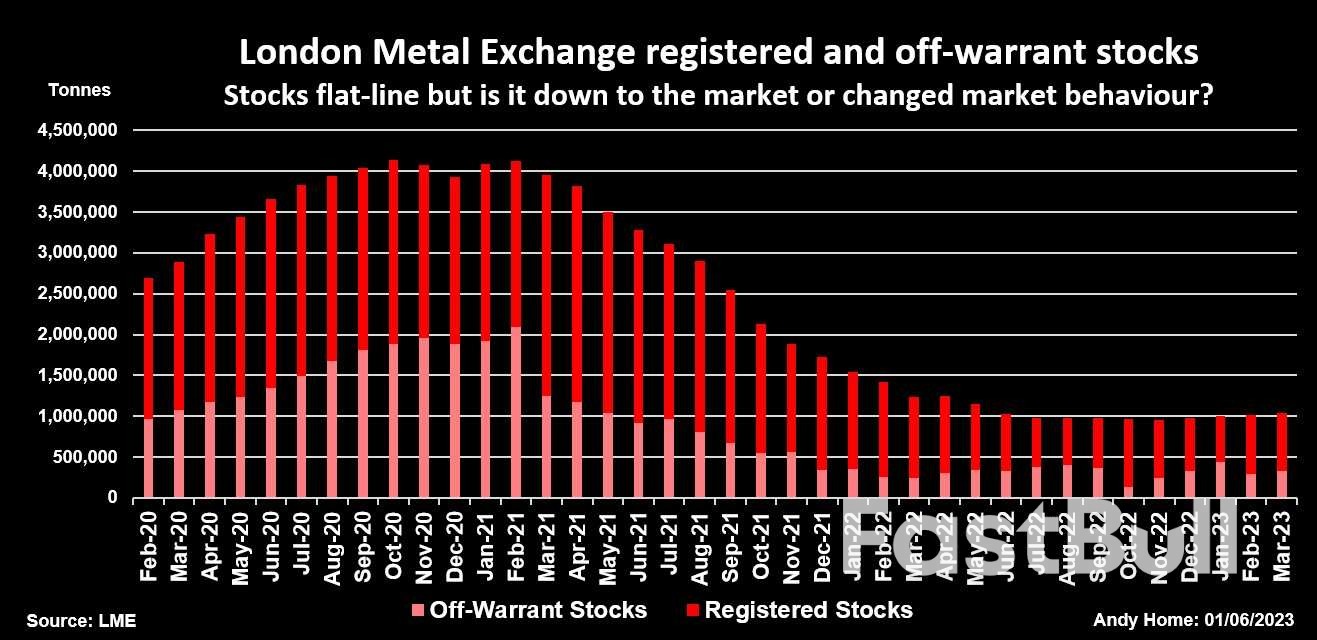
          London Metal Exchange Renews Stocks Transparency Drive_1Shadow Games
          LME stocks have always been gamed but it's become easier to surprise the market with super-size "arrivals" such as the 94,950 tonnes of aluminium warranted on Feb. 10 at Malaysia's Port Klang.
          It is physically impossible for such a large amount of metal to be loaded into a warehouse in a single day. Rather, the aluminium was already sitting there, ready at the stroke of a computer key to be electronically warranted.
          The LME consulted on the issue in 2019 but backed down from forcing warehouses to report all eligible stocks due to a fear of regulatory "over-reach".
          It went instead for a half-way-house solution of requiring warehousers report off-warrant tonnage if it's covered by a contract explicitly referencing LME storage and/or warranting.
          The exchange also, somewhat optimistically, hoped for voluntary reporting of shadow inventory.
          A fading light?
          The LME's monthly "off-warrant" stocks reports initially captured a huge amount of previously unseen tonnage. Shadow stocks of 2,093,000 tonnes in February 2021 even exceeded total registered tonnage of 2,027,000 tonnes.
          However, the reports are released with a one-month time-lag, meaning even if a large build-up of potentially warrantable metal shows up, there's a good change it has already been warranted.
          Moreover, the amount of off-warrant stock has noticeably shrunk. LME shadow inventory totalled 334,251 tonnes at the end of March compared with registered stocks of 707,227 tonnes.
          Aluminium accounted for 93% of the off-market total, the highest ratio since the report was first published in February 2020. Off-warrant inventory of nickel, lead and tin was minimal and shadow copper stocks just 7,261 tonnes at the end of March.
          The decline in off-warrant stocks from their 2021 peak could be down to market dynamics, given that metals such as zinc, lead and tin have seen bouts of extreme physical tightness over the last two years.
          But it's also possible that the decline is down to a shift in market behaviour as owners retreat further into the warehousing shadows to avoid scrutiny.
          Warrantable metal can easily be accumulated without any contractual reference to the LME but still be close enough to an exchange warehouse to hit the market at short notice.
          Eligible Metal
          The LME is now returning to the option of reporting all eligible stocks, meaning anything in an LME shed that meets the exchange delivery criteria.
          Both CME and the Shanghai Futures Exchange already do so with the total deliverable stock figure rather than the warranted component the primary market indicator.
          The LME has historically done things differently and all previous attempts to follow its peers have run into concerted opposition from those who argue their inventory is confidential if they have no intention to warrant it on the exchange.
          The counter-argument, as the LME noted in its 2019 discussion paper, is that such opposition is "driven not by a need for confidentiality, but rather by a preference to use this information for market gain."
          The nickel crisis and accompanying regulatory scrutiny of the LME have shifted the dial of the debate.
          "While the LME understands the drive for confidentiality, it does also recognise that a significant majority of the market prefers increased transparency and believes the value this can add in respect of market stability can be considerable," the exchange said in its latest consultation document.
          It "is not unreasonable" that metal owners should contribute to greater market transparency in exchange for having the option of short-notice LME warranting, it added.
          Restoring Trust
          The LME's consultation closes on July 14 and the exchange said it is "keen to hear further market views on this topic before making a final decision."
          But there's little doubt which way the decision is likely to go.
          "Trusted stock data related to metal stored globally in LME licensed warehouses is viewed by the LME as vital to supporting confidence in the operation of the LME's markets," according to the exchange.
          The LME's stock data haven't been trusted by the market for many years with aluminium, copper and zinc all experiencing large-volume single-day arrivals at various times in the past decade.
          Given the current backdrop of low LME inventories, the impact of even modest tonnages hitting the system can be price disruptive.
          LME warehouses in Singapore saw 29,450 tonnes warranted in the space of two days last week. That's small relative to the 105,800 tonnes of zinc that showed up in two days in January 2021 but a large increase from the 45,500-tonne total the day before the "arrivals".
          Traders will game any system they come up against but the current LME stocks reporting regime makes it too easy. Each stocks surprise chips away at the LME's credibility as a fair pricing mechanism.
          Restoring trust in exchange stocks reporting is a key step in winning back the broader confidence of the market.
          However, those hoping for an immediate replication of the CME and Shanghai stock reports will be disappointed.
          The new eligible stocks reports will initially still only be published monthly, although the LME said it believes it could get closer to real-time reporting "in the longer term" via a new reporting platform.

          Source: Reuters

          Risk Warnings and Disclaimers
          You understand and acknowledge that there is a high degree of risk involved in trading. Following any strategies or investment methods may lead to potential losses. The content on the site is provided by our contributors and analysts for information purposes only. You are solely responsible for determining whether any trading assets, securities, strategy, or any other product is suitable for investing based on your own investment objectives and financial situation.
          Comments
          Add to Favorites
          Share

          The Inflation Story Steals the Show

          Damon

          Economic

          More evidence of an easing inflation story
          Market rates continue to rally – even if more moderately – as more signs of disinflationary trends gaining traction emerge. Not just in Europe where the flash estimate for eurozone inflation in May showed a larger-than-anticipated drop in core inflation, but also in the U.S. where the first quarter unit labour costs were revised down by a good deal.
          The U.S. jobs market data usually takes centre stage for markets, especially now that the Fed is seen at a crucial turning point in its tightening cycle. While today's jobs data look set to still show a tight labour market – the ADP estimate yesterday pointed to a 278k increase in payrolls versus an expected 170k – the underlying labour cost story is looking a little less threatening as our economists note. The ADP release itself came with a commentary that pay growth was slowing substantially.
          And looking further ahead, the indications we get from the Challenger data on falling hiring – but quickly rising job layoff announcements – point to further cooling of the market. The layoff announcements usually have a long lead on the weekly initial jobless claims data, which so far have maintained levels still consistent with a resilient jobs market.
          Recent Fed comments making the case for skipping a hike at the upcoming June meeting might have taken the edge off of today's data release, especially when paired with the mixed bag of other data on the jobs market. In the end, the largest factor for markets to pare their hike expectations is the inflation story. And here the ISM manufacturing index with a substantial drop in the prices paid sub-component provided the market with further evidence of easing pressure yesterday.
          The Inflation Story Steals the Show_1Fine-tuning the final dose of tightening
          The eurozone CPI flash estimate showed core inflation falling. It was the second drop from its peak in March, but in absolute terms a 5.3% reading remains uncomfortably high. Speaking after the release, ECB President Christine Lagarde still stated there was "no clear evidence" that it had peaked and pointed to further interest rate hikes. The market is still close to discounting two more 25bp rate hikes over the next meetings from the ECB.
          he accounts of the May ECB meeting showed a central bank still preoccupied with the persistence of inflation, pointing out that "developments in underlying inflation had become more worrisome". Wage dynamics, especially, were becoming a greater concern, but there was also a discussion around rising measures of longer-term inflation expectations and their risk of becoming unanchored.
          The accounts also showed a bank calibrating its policies amid increasing uncertainties not only about the outlook but also about the transmission of the substantial tightening delivered so far. This was an argument to slow the pace of hikes to 25bp, with policymakers adamant not to convey any impression that a pause of the tightening cycle was imminent.
          Next week: more on the global backdrop
          ECB officials still have a couple of days until Thursday next week to steer market expectations before entering the blackout period ahead of the next meeting.
          The Fed will enter its pre-meeting blackout period already this weekend, leaving the focus on the ISM services at the start of the week. The price component should attract the most interest given the strong reading that was seen in April.
          With regards to the more general risk sentiment backdrop, Chinese data could shift into the focus again after data this week dashed some hopes for a stronger post-Covid rebound. We will get trade data, CPI and PPI readings as well as credit data for May.

          The Inflation Story Steals the Show_2Today's events and market view

          The U.S. jobs data takes centre stage. Consensus is looking for 195k in non-farm payrolls growth with unemployment ticking up to 3.5% from 3.4% and average hourly earnings rising 0.3% month-on-month versus 0.5% in April.
          The market seems more focused on the easing inflation story, and recent Fed commentary making the case for skipping the June meeting has already shifted market hike speculation to July. Only around a 25% chance for a June hike is still discounted, but a larger upside surprise to the tune of 250k and above and higher wage growth could rebuild these expectations.
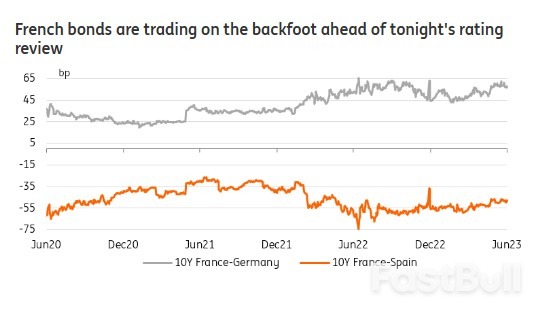
          After the European market closes, eyes are on S&P's rating review of France.

          Source: ING

          To stay updated on all economic events of today, please check out our Economic calendar
          Risk Warnings and Disclaimers
          You understand and acknowledge that there is a high degree of risk involved in trading. Following any strategies or investment methods may lead to potential losses. The content on the site is provided by our contributors and analysts for information purposes only. You are solely responsible for determining whether any trading assets, securities, strategy, or any other product is suitable for investing based on your own investment objectives and financial situation.
          Comments
          Add to Favorites
          Share

          Debt Ceiling Deal Lifts Sentiment, With Asian FX Even Getting a Boost

          Samantha Luan

          Forex

          USD: Dollar bias looks lower unless NFP comes in strong
          Thursday proved somewhat of a turnaround session for the dollar. News that the Federal Reserve was preparing to skip a hike at the June meeting plus later progress on the debt ceiling deal saw the DXY sell off 0.8%. Whether this marks an important reversal for the dollar will largely be down to whether U.S. activity data, particularly U.S. price data, allows the Fed room to breathe – i.e. to reflect on the 500bp of tightening so far – without being rushed into further hikes. The latter largely drove dollar pricing and bearish risk sentiment last month.
          As ING's Chief International Economist, James Knightley, discusses here, today's U.S. NFP data will have a major say in determining whether the Fed hikes in June or not. For FX, we would say that an on-consensus +195k increase in jobs, a 3.5% unemployment rate and a 0.3% month-on-month increase in hourly earnings would not be enough to shift the needle from the view that the Fed pauses in June and the dollar can stay gently offered.
          We also note a slightly better environment coming through in Asia overnight. USD/CNH has reversed recent gains, the Hang Seng is up 4%, as is iron ore – suggesting Chinese pessimism may have run far enough for the time being. A close in USD/CNH today near the week's low of 6.07 could mark an important reversal and set the scene for a recovery in the commodity currency complex. Here we note speculation is growing of another Reserve Bank of Australia hike next week, following a large increase in the national minimum wage and some positive first quarter capex data released yesterday. AUD/USD could recover further.
          High dollar deposit rates will stop the dollar from selling off too quickly, but unless the May NFP surprises on the upside we would say today's DXY bias lies towards the 103.20 area. Take a look at ING's latest monthly update – it looks at where we could get out forecasts wrong.
          EUR: Some welcome relief on inflation
          Eurozone May inflation fell more than expected yesterday, EUR:USD two-year swap differentials stayed wide, but EUR/USD rallied. Probably helping EUR/USD was a mildly positive re-assessment of global growth prospects on the view that late-cycle inflation may not be as severe after all, and central banks may not have to tighten a lot further and deepen recessions. On the subject of the ECB, read our latest eurozone update from Peter Vanden Houte, where we are in line with market pricing of two further 25bp rate hikes from the ECB.
          As above, today's U.S. data will have a big say in determining whether this week's EUR/USD low of 1.0635 was significant. As we have been saying here over the last few weeks, we have expected the 1.05-1.07 area to mark the base in the second quarter, so let's see whether we get much of a rally from here. EUR/USD could press the 1.0810/20 are if NFP does not come in too hot, with outside risk to 1.0865.
          SEK: Still in troubled waters
          EUR/SEK has marginally eased back from the 11.68/11.69 highs, largely on the back of some improvement in risk appetite. But Scandinavian currencies continue to lie at the bottom of the G10 scorecard, and recent domestic news out of Sweden did not offer many reasons to turn less bearish on the krona. The Riksbank released its bi-annual financial stability report yesterday, sounding the alarm on commercial real estate and encouraging exposed firms to strengthen their balance sheets. The overall assessment of the Swedish banking sector's health – especially during the period of distress in the U.S. and Switzerland – was rather positive, even though the structural exposure of lenders to the troubled property market means multiple vulnerabilities may emerge. Speaking on this topic, Riksbank Governor Erik Thedeen said that the commercial real estate risks will not affect monetary policy decisions.
          On the data side, manufacturing PMIs for the month of May came in sharply lower than expected, at 40.6. That marked a sharp divergence with hard data that instead surprised on the positive side last week, when first-quarter GDP figures showed a relatively solid 0.6% quarter-on-quarter growth after the 0.5% contraction in the fourth quarter of last year.
          In practice, domestic data are not having a very material impact on SEK moves at the moment, and we mostly stress them from the perspective of what those can imply for future monetary policy decisions by the Riksbank. The krona is being driven by risk sentiment at the moment but is clearly retaining a bearish bias that – in our view – is primarily attributable to the Riksbank's dovish tilt at the April meeting.
          As discussed in this note, picking a top for EUR/SEK in this environment is hard. The highest-ever intra-day level is 11.79, and unless we see a few consecutive sessions of risk-sentiment improvement in FX, new historic highs in the pair may be reached. The Riksbank's options to counter this bearish pressure on the krona remain, for the moment, quite limited.

          Source: ING

          Risk Warnings and Disclaimers
          You understand and acknowledge that there is a high degree of risk involved in trading. Following any strategies or investment methods may lead to potential losses. The content on the site is provided by our contributors and analysts for information purposes only. You are solely responsible for determining whether any trading assets, securities, strategy, or any other product is suitable for investing based on your own investment objectives and financial situation.
          Comments
          Add to Favorites
          Share

          Inflation Risks Linger

          Alex

          Economic

          The ABS Monthly CPI Indicator surprised to the upside in April, a solid 0.5% lift raising the annual rate of inflation from 6.3% to 6.8%, well above the consensus estimate for a slight up-tick to 6.4%. Although dwelling prices and rents came in stronger than expected, this was largely offset by a fall in electricity prices, leaving total housing costs up only 0.3% in the month. In our view, the most significant driver for headline inflation was a 7.2% rise in holiday travel/accommodation costs. Highlighting the breadth of the pulse, the annual trimmed mean measure – which was reinstated in April– showed underlying inflation lifting from 6.5% to 6.7%.
          The April CPI update poses upside risk to our current Q2 CPI forecast of 1.1% and highlights the need to continue carefully assessing inflation risks.
          In the lead-up to next week's Q1 GDP report, the ABS also released two partial indicators for investment.
          Construction work done rose by a solid 1.8% in the three months to March, centred on the continued uptrend in infrastructure investment, public infrastructure up a sizeable 18%yr and private infrastructure 12%yr. Private building experienced mixed fortunes however, with new dwelling construction down 2.6% but renovation work up 2.7%.
          The Q1 CAPEX survey subsequently delivered an upside surprise. In the detail for current activity, equipment spending posted a notable 3.7% gain, with strength most apparent in mining. On spending intentions, the second estimate for 2023/24 CAPEX plans remained constructive, up 5.0% compared to the second estimate a year ago. In our view, this implies a 5.9% rise in CAPEX spending over the financial year. While positive for now, we anticipate the investment outlook will soften, with later estimates likely to see firms mark down their plans.
          Despite the solid reads on construction work and equipment spending, we have revised down our forecast for Q1 GDP from 0.4% to 0.2%, reflecting a softer read on consumption and a materially weaker contribution from net exports.
          Before moving offshore, a quick note on housing. The recent stabilisation in Australia's housing market continues to reverberate through CoreLogic's home price (PDF 179KB) data, as evinced by the 1.4% gain in May across the nation's capital cities, leaving prices up 3% over the last three months alone. Reflective of this progress, private credit growth (PDF 127KB) within housing-related lending segments is also stabilising at a subdued level, tracking a three-month annualised pace of 4%. While developments around the established market were mostly positive, an 8.1% decline in dwelling approvals highlights the hit to new construction from interest rates and construction costs. For a comprehensive update on the sector, see the Westpac Housing Pulse.
          Offshore, China's NBS manufacturing PMI remained in contractionary territory for a second consecutive month in May at 48.8 as the initial wave of re-opening faded. The non-manufacturing PMI also fell, but at 54.5 remained materially above 50, signalling continued expansion.
          Lower demand from developed economies and anxiety over the outlook likely contributed to the deceleration, with the new export orders detail for manufacturing weaker than total new orders. For services, despite a material decline in new orders, the employment index held steady. This speaks to confidence in the medium-term outlook amongst the service sector. A historic comparison highlights why: over the 5 years before the pandemic, the non-manufacturing PMI averaged 54.1, 0.4pts below May; during the period, annual GDP averaged 6.7%.
          Input and output prices also saw a substantial decline in the month across the economy. The producer price index has been declining on a year ago basis since October 2021 despite the input prices metric in the PMI growing for much of that time. Depressed input prices are flowing through to output prices, contributing to the palsy CPI prints seen since the start of the year – the CPI up just 0.1%yr in April.
          Clearly then, the inflation concern of the developed world is not an issue for China. This provides scope for authorities to offer additional support if/ when they feel there is need. We expect data to remain volatile over coming months, but to orbit a strengthening trend. Policy support should only prove necessary at the margin.
          Over in the US, the ISM manufacturing PMI ticked down to 46.9 points in May from 47.0 in April. The biggest change was seen in the 'prices paid' detail which plunged below 50 to 44.2. Assessed together with the Chinese data, this outcome suggests falling commodity prices and slower demand are resetting price growth globally. New orders and the order backlog also declined, signalling ongoing contraction in coming months. That said, manufacturers look as though they intend to hold onto staff, with the employment index holding above 50.
          The desire to hold onto staff is being seen more broadly across the economy. Earlier in the week, the JOLTS survey reported 10,103k job openings in April, up from 9,745k in March, breaking the downtrend present since December 2022. The series tends to be highly volatile, so this result should not be taken as a sign of renewed labour market tightness but rather resilience. Supporting this view, the hiring rate remained stable in April, corroborating reports from the Fed's beige book that businesses seem less keen on expanding their labour force, with many reporting they are 'pausing hiring or reducing headcount'. Employees are also clearly of the view that it is better to remain in a known role than chance a new opportunity, the quit and separation rates continuing their downward trend.
          Considering economic activity, the Fed's Beige book also confirmed a slowdown in demand for transport services which likely fed through to input costs. But the Fed also reported "growth in spending on leisure and hospitality" and for economic activity overall, pointing to GDP growth below trend or stagnation instead of recession.
          Finally to policy. FOMC committee member Barkin emphasised in a speech this week that he is looking at the employment and inflation data before determining whether demand-side pressures are abating in supporting the case for a pause at the June meeting. Jefferson and Harker however seemed to have a June pause as their base case ahead of tonight's nonfarm payrolls release, as we do. Importantly, this week also saw the debt ceiling suspended until 2025, the market's uncertainty fading as the bill moved through Congress.
          The monetary policy outlook for Europe is much more uncertain. The flash CPI reported inflation fell to 6.1%yr in May as services inflation decelerated to 5%yr. But core inflation remains uncomfortably high. Indeed, ECB President Lagarde opined this week that "there is no clear evidence that underlying inflation has peaked" and that there is still "ground to cover to bring interest rates to sufficiently restrictive levels".

          Source: Westpac Banking

          To stay updated on all economic events of today, please check out our Economic calendar
          Risk Warnings and Disclaimers
          You understand and acknowledge that there is a high degree of risk involved in trading. Following any strategies or investment methods may lead to potential losses. The content on the site is provided by our contributors and analysts for information purposes only. You are solely responsible for determining whether any trading assets, securities, strategy, or any other product is suitable for investing based on your own investment objectives and financial situation.
          Comments
          Add to Favorites
          Share

          Dollar Pullback Continues; Focus Turns to Non-Farm Payroll Data

          Samantha Luan

          Forex

          Dollar is extending the near term pull back in Asian session today, driven by a combination of factors including a risk-on market sentiment, falling Treasury yields, and growing market expectations of a Federal Reserve "skip" in June. However, the greenback, along with other currencies, will be closely watching today's non-farm payroll data for further direction. As it stands, Swiss Franc is trailing Dollar as the week's second worst performer, followed by Euro. On the other hand, Sterling is actually the quiet star of the week, followed by Aussie and Loonie. Yen is currently mixed as near-term consolidation extends.
          Technically, Gold is now eyeing 1985.08 minor resistance with current rebound. Break there will indicate that a short term bottoming is formed at 1931.84. More importantly, such development will keep the medium term rising channel intact. That is, rise from 1614.60 is indeed not over yet. Retest of 2062.95 or even 2074.48 record high could be seen soon, which could also correspond to near term selloff in Dollar.
          Dollar Pullback Continues; Focus Turns to Non-Farm Payroll Data_1In Asia, at the time of writing, Nikkei is up 1.03%. Hong Kong HSI is up 3.79%. China Shanghai SSE is up 0.78%. Singapore Strait Times is up 0.24%. 10-year JGB yield is down -0.0074 at 0.413. Overnight, DOW rose 0.47%. S&P 500 rose 0.99%. NASDAQ rose 1.28%. 10-year yield dropped -0.029 to 3.608.
          Fed Harker: We are clearly in restrictive, we can sit there for a while
          Philadelphia Fed President Patrick Harker recommended a pause in interest rate hikes at the upcoming FOMC meeting, stating. "It's time to at least hit the stop button for one meeting and see how it goes," he said yesterday.
          Harker also noted, "I think we are at the point, or very close to the point now, where we are clearly in restrictive territory, and we can sit there for a while," he explained. "We don't have to keep moving rates up, and then have to reverse course quickly."
          Looking ahead, Harker expects the US economy to grow less than 1% this year, and anticipates unemployment rate, currently at 3.4%, to increase to around 4.4%. Additionally, he forecasts a decrease in inflation to 3.5% this year and 2.5% next year, predicting it to reach Fed's 2% target only by 2025.
          BoJ Ueda: No time frame to achieve inflation target, but not so long as 10 years
          In a parliamentary address today, BoJ Governor Kazuo Ueda said "The time it takes for the impact of monetary policy to appear on the economy could move around a lot depending on circumstances."
          "We therefore do not have any time frame in mind" in achieving the inflation target, he added.
          "Having said that, our baseline view is that it won't take so long as over 10 years. We'll still seek to hit the target at the earliest date possible," he remarked.
          Ueda reiterated that the Bank of Japan's purchases of Real Estate Investment Trusts (REITs) form part of their expansive monetary easing strategy. He noted, "We are conducting the purchases (of REITs) as part of our massive monetary easing program. Given it will take more time to achieve our price target, we will maintain the easy policy."
          US non-farm payroll in spotlight, NASDAQ presses key resistance
          Today, market watchers are turning their attention to US non-farm payroll report, a key indicator of the health of the American labor market. Economists are forecasting job growth of around 180k in May, with the unemployment rate predicted to slightly increase from 3.4% to 3.5%. Meanwhile, average hourly earnings are expected to continue a trend of robust growth with another 0.3% mom rise.
          Looking at some related economic data, ISM manufacturing employment index showed a modest rise from 50.2 to 51.4, while ADP private job data indicated a strong increase of 278k. The four-week moving average of initial jobless claims saw a slight dip from 239k to 230k. All these numbers suggest a job market that remains steady, showing no significant signs of weakening.
          In terms of monetary policy, Fed funds futures are currently pricing in 76% probability that Fed will opt to "skip" a rate hike at the upcoming FOMC meeting on June 14. Nevertheless, there is still around a 60% chance of another 25bps increase in June to a range of 5.25-5.50%. Today's data could significantly alter this picture if it brings any surprises.
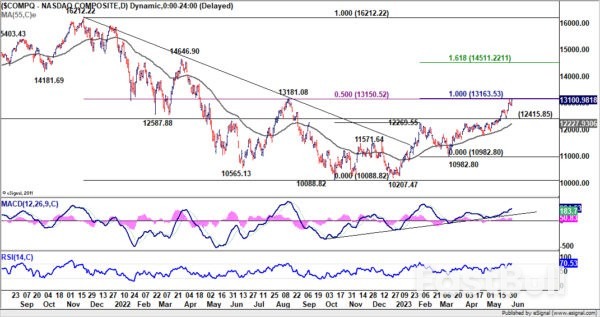
          Over in the equity markets, NASDAQ is once again testing a crucial cluster resistance level at 13181.08, following a brief retreat earlier this week. The level represents 100% projection of 10088.82 to 12269.55 from 10982.80 at 13163.53, as well as 50% retracement of 16212.22 to 10088.82 at 13150.52.
          Decisive breakthrough above this 13150/80 range would confirm underlying medium term bullish momentum in NASDAQ, potentially sparking upward acceleration towards 161.8% projection at 14511.22. Let's see how NASDAQ reacts to today's data.

          Dollar Pullback Continues; Focus Turns to Non-Farm Payroll Data_2AUD/USD Daily Report

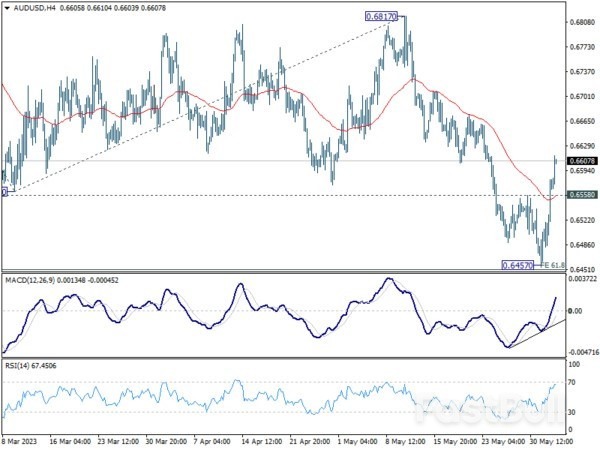
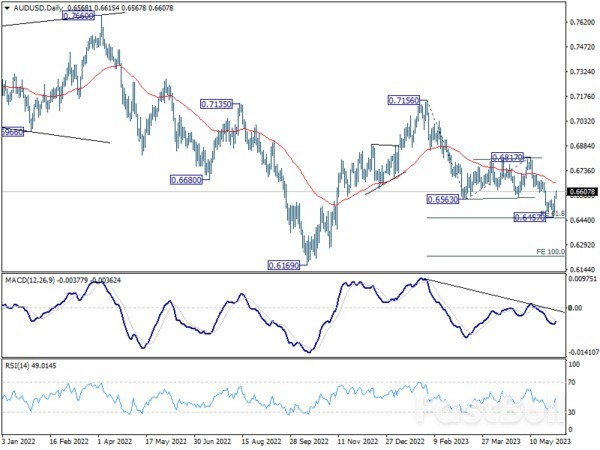
          AUD/USD's strong break of 0.6558 minor resistance confirm short term bottoming at 0.6457, just ahead of 61.8% projection of 0.7156 to 0.6563 from 0.6817 at 0.6451. Intraday bias is back on the upside for 55 D EMA (now at 0.6659). Sustained break there will target 0.6817 resistance next. Nevertheless, rejection by 55 D EMA will keep near term outlook bearish. Firm break of 0.6451 will resume the fall from 0.7156 to 100% projection at 0.6224.Dollar Pullback Continues; Focus Turns to Non-Farm Payroll Data_3
          In the bigger picture, rejection by 55 W EMA (now at 0.6822) keeps medium term outlook bearish. Current development suggests that down trend from 0.8006 (2021 high) is possibly still in progress. Retest of 0.6169 (2022 low) should be seen next. Firm break there will confirm down trend resumption. For now, this will remain the favored case as long as 0.6817 resistance holds.Dollar Pullback Continues; Focus Turns to Non-Farm Payroll Data_4

          Source: ActionForex.com

          Risk Warnings and Disclaimers
          You understand and acknowledge that there is a high degree of risk involved in trading. Following any strategies or investment methods may lead to potential losses. The content on the site is provided by our contributors and analysts for information purposes only. You are solely responsible for determining whether any trading assets, securities, strategy, or any other product is suitable for investing based on your own investment objectives and financial situation.
          Comments
          Add to Favorites
          Share
          FastBull
          Copyright © 2025 FastBull Ltd

          728 RM B 7/F GEE LOK IND BLDG NO 34 HUNG TO RD KWUN TONG KLN HONG KONG

          TelegramInstagramTwitterfacebooklinkedin
          App Store Google Play Google Play
          Products
          Charts

          Chats

          Q&A with Experts
          Screeners
          Economic Calendar
          Data
          Tools
          Membership
          Features
          Function
          Markets
          Copy Trading
          Latest Signals
          Contests
          News
          Analysis
          24/7
          Columns
          Education
          Company
          Careers
          About Us
          Contact Us
          Advertising
          Help Center
          Feedback
          User Agreement
          Privacy Policy
          Business

          White Label

          Data API

          Web Plug-ins

          Poster Maker

          Affiliate Program

          Risk Disclosure

          The risk of loss in trading financial instruments such as stocks, FX, commodities, futures, bonds, ETFs and crypto can be substantial. You may sustain a total loss of the funds that you deposit with your broker. Therefore, you should carefully consider whether such trading is suitable for you in light of your circumstances and financial resources.

          No decision to invest should be made without thoroughly conducting due diligence by yourself or consulting with your financial advisors. Our web content might not suit you since we don't know your financial conditions and investment needs. Our financial information might have latency or contain inaccuracy, so you should be fully responsible for any of your trading and investment decisions. The company will not be responsible for your capital loss.

          Without getting permission from the website, you are not allowed to copy the website's graphics, texts, or trademarks. Intellectual property rights in the content or data incorporated into this website belong to its providers and exchange merchants.

          Not Logged In

          Log in to access more features

          FastBull Membership

          Not yet

          Purchase

          Become a signal provider
          Help Center
          Customer Service
          Dark Mode
          Price Up/Down Colors

          Log In

          Sign Up

          Position
          Layout
          Fullscreen
          Default to Chart
          The chart page opens by default when you visit fastbull.com