• Trade
  • Markets
  • Copy
  • Contests
  • News
  • 24/7
  • Calendar
  • Q&A
  • Chats
Trending
Screeners
SYMBOL
LAST
BID
ASK
HIGH
LOW
NET CHG.
%CHG.
SPREAD
SPX
S&P 500 Index
6853.86
6853.86
6853.86
6861.30
6847.07
+26.45
+ 0.39%
--
DJI
Dow Jones Industrial Average
48608.48
48608.48
48608.48
48679.14
48557.21
+150.44
+ 0.31%
--
IXIC
NASDAQ Composite Index
23294.78
23294.78
23294.78
23345.56
23265.18
+99.62
+ 0.43%
--
USDX
US Dollar Index
97.830
97.910
97.830
98.070
97.810
-0.120
-0.12%
--
EURUSD
Euro / US Dollar
1.17559
1.17567
1.17559
1.17596
1.17262
+0.00165
+ 0.14%
--
GBPUSD
Pound Sterling / US Dollar
1.33948
1.33957
1.33948
1.33961
1.33546
+0.00241
+ 0.18%
--
XAUUSD
Gold / US Dollar
4331.79
4332.13
4331.79
4350.16
4294.68
+32.40
+ 0.75%
--
WTI
Light Sweet Crude Oil
56.888
56.918
56.888
57.601
56.789
-0.345
-0.60%
--

Community Accounts

Signal Accounts
--
Profit Accounts
--
Loss Accounts
--
View More

Become a signal provider

Sell trading signals to earn additional income

View More

Guide to Copy Trading

Get started with ease and confidence

View More

Signal Accounts for Members

All Signal Accounts

Best Return
  • Best Return
  • Best P/L
  • Best MDD
Past 1W
  • Past 1W
  • Past 1M
  • Past 1Y

All Contests

  • All
  • Trump Updates
  • Recommend
  • Stocks
  • Cryptocurrencies
  • Central Banks
  • Featured News
Top News Only
Share

The Nasdaq Golden Dragon China Index Fell 0.9% In Early Trading

Share

The S&P 500 Opened 32.78 Points Higher, Or 0.48%, At 6860.19; The Dow Jones Industrial Average Opened 136.31 Points Higher, Or 0.28%, At 48594.36; And The Nasdaq Composite Opened 134.87 Points Higher, Or 0.58%, At 23330.04

Share

Miran: Goods Inflation Could Be Settling In At A Higher Level Than Was Normal Before The Pandemic, But That Will Be More Than Offset By Housing Disinflation

Share

Miran, Who Dissented In Favor Of A Larger Cut At Last Fed Meeting, Repeats Keeping Policy Too Tight Will Lead To Job Losses

Share

Miran: Does Not Think Higher Goods Inflation Is Mostly From Tariffs, But Acknowledges Does Not Have A Full Explanation For It

Share

Toronto Stock Index .GSPTSE Rises 67.16 Points, Or 0.21 Percent, To 31594.55 At Open

Share

Miran: Excluding Housing And Non-Market Based Items, Core Pce Inflation May Be Below 2.3%, “Within Noise” Of The Fed's 2% Target

Share

Polish State Assets Minister Balczun Says Jsw Needs Over USD 830 Million Financing To Keep Liquidity For A Year

Share

Miran: Prices Are “Once Again Stable” And Monetary Policy Should Reflect That

Share

Fed's Miran: Current Excess Inflation Is Not Reflective Of Underlying Supply And Demand In The Economy

Share

Portugal Treasury Puts 2026 Net Financing Needs At 13 Billion Euros, Up From 10.8 Billion In 2025

Share

Portugal Treasury Expects 2026 Net Financing Needs At 29.4 Billion Euros, Up From 25.8 Billion In 2025

Share

Bank Of America Says With Indonesia's Smelter Now Ramping Up, It Expects Aluminium Supply Growth To Accelerate To 2.6% Year On Year In 2026

Share

Bank Of America Expects A Deficit In Aluminium Next Year And Sees Prices Pushing Above $3000/T

Share

Fed Data - USA Effective Federal Funds Rate At 3.64 Percent On 12 December On $102 Billion In Trades Versus 3.64 Percent On $99 Billion On 11 December

Share

Brazil's Petrobras Says No Impact Seen On Oil, Petroleum Products Output As Workers Start Planned Strike

Share

Statement: US Travel Group Warns New Proposed Trump Administration Requirements For Foreign Tourists To Provide Social Media Histories Could Mean Millions Of People Opting Not To Visit

Share

Blackrock: Kerry White Will Become Head Of Citi Investment Management At Citi Wealth

Share

Blackrock: Rob Jasminski, Head Of Citi Investment Management, Has Joined With Team

Share

Blackrock: Effective Dec 15, Citi Investment Management Employees Will Join Blackrock

TIME
ACT
FCST
PREV
Japan Tankan Small Manufacturing Outlook Index (Q4)

A:--

F: --

P: --

Japan Tankan Large Non-Manufacturing Outlook Index (Q4)

A:--

F: --

P: --

Japan Tankan Large Manufacturing Outlook Index (Q4)

A:--

F: --

P: --

Japan Tankan Small Manufacturing Diffusion Index (Q4)

A:--

F: --

P: --

Japan Tankan Large Manufacturing Diffusion Index (Q4)

A:--

F: --

P: --

Japan Tankan Large-Enterprise Capital Expenditure YoY (Q4)

A:--

F: --

P: --

U.K. Rightmove House Price Index YoY (Dec)

A:--

F: --

P: --

China, Mainland Industrial Output YoY (YTD) (Nov)

A:--

F: --

P: --

China, Mainland Urban Area Unemployment Rate (Nov)

A:--

F: --

P: --

Saudi Arabia CPI YoY (Nov)

A:--

F: --

P: --

Euro Zone Industrial Output YoY (Oct)

A:--

F: --

P: --

Euro Zone Industrial Output MoM (Oct)

A:--

F: --

P: --

Canada Existing Home Sales MoM (Nov)

A:--

F: --

P: --

Canada National Economic Confidence Index

A:--

F: --

P: --

Canada New Housing Starts (Nov)

A:--

F: --

P: --
U.S. NY Fed Manufacturing Employment Index (Dec)

A:--

F: --

P: --

U.S. NY Fed Manufacturing Index (Dec)

A:--

F: --

P: --

Canada Core CPI YoY (Nov)

A:--

F: --

P: --

Canada Manufacturing Unfilled Orders MoM (Oct)

A:--

F: --

P: --

U.S. NY Fed Manufacturing Prices Received Index (Dec)

A:--

F: --

P: --

U.S. NY Fed Manufacturing New Orders Index (Dec)

A:--

F: --

P: --

Canada Manufacturing New Orders MoM (Oct)

A:--

F: --

P: --

Canada Core CPI MoM (Nov)

A:--

F: --

P: --

Canada Trimmed CPI YoY (SA) (Nov)

A:--

F: --

P: --

Canada Manufacturing Inventory MoM (Oct)

A:--

F: --

P: --

Canada CPI YoY (Nov)

A:--

F: --

P: --

Canada CPI MoM (Nov)

A:--

F: --

P: --

Canada CPI YoY (SA) (Nov)

A:--

F: --

P: --

Canada Core CPI MoM (SA) (Nov)

A:--

F: --

P: --

Canada CPI MoM (SA) (Nov)

A:--

F: --

P: --

Federal Reserve Board Governor Milan delivered a speech
U.S. NAHB Housing Market Index (Dec)

--

F: --

P: --

Australia Composite PMI Prelim (Dec)

--

F: --

P: --

Australia Services PMI Prelim (Dec)

--

F: --

P: --

Australia Manufacturing PMI Prelim (Dec)

--

F: --

P: --

Japan Manufacturing PMI Prelim (SA) (Dec)

--

F: --

P: --

U.K. 3-Month ILO Employment Change (Oct)

--

F: --

P: --

U.K. Unemployment Claimant Count (Nov)

--

F: --

P: --

U.K. Unemployment Rate (Nov)

--

F: --

P: --

U.K. 3-Month ILO Unemployment Rate (Oct)

--

F: --

P: --

U.K. Average Weekly Earnings (3-Month Average, Including Bonuses) YoY (Oct)

--

F: --

P: --

U.K. Average Weekly Earnings (3-Month Average, Excluding Bonuses) YoY (Oct)

--

F: --

P: --

France Services PMI Prelim (Dec)

--

F: --

P: --

France Composite PMI Prelim (SA) (Dec)

--

F: --

P: --

France Manufacturing PMI Prelim (Dec)

--

F: --

P: --

Germany Services PMI Prelim (SA) (Dec)

--

F: --

P: --

Germany Manufacturing PMI Prelim (SA) (Dec)

--

F: --

P: --

Germany Composite PMI Prelim (SA) (Dec)

--

F: --

P: --

Euro Zone Composite PMI Prelim (SA) (Dec)

--

F: --

P: --

Euro Zone Services PMI Prelim (SA) (Dec)

--

F: --

P: --

Euro Zone Manufacturing PMI Prelim (SA) (Dec)

--

F: --

P: --

U.K. Services PMI Prelim (Dec)

--

F: --

P: --

U.K. Manufacturing PMI Prelim (Dec)

--

F: --

P: --

U.K. Composite PMI Prelim (Dec)

--

F: --

P: --

Euro Zone ZEW Economic Sentiment Index (Dec)

--

F: --

P: --

Germany ZEW Current Conditions Index (Dec)

--

F: --

P: --

Germany ZEW Economic Sentiment Index (Dec)

--

F: --

P: --

Euro Zone Trade Balance (Not SA) (Oct)

--

F: --

P: --

Euro Zone ZEW Current Conditions Index (Dec)

--

F: --

P: --

Euro Zone Trade Balance (SA) (Oct)

--

F: --

P: --

U.S. Retail Sales MoM (Excl. Automobile) (SA) (Oct)

--

F: --

P: --

Q&A with Experts
    • All
    • Chatrooms
    • Groups
    • Friends
    Connecting
    .
    .
    .
    Type here...
    Add Symbol or Code

      No matching data

      All
      Trump Updates
      Recommend
      Stocks
      Cryptocurrencies
      Central Banks
      Featured News
      • All
      • Russia-Ukraine Conflict
      • Middle East Flashpoint
      • All
      • Russia-Ukraine Conflict
      • Middle East Flashpoint
      Search
      Products

      Charts Free Forever

      Chats Q&A with Experts
      Screeners Economic Calendar Data Tools
      Membership Features
      Data Warehouse Market Trends Institutional Data Policy Rates Macro

      Market Trends

      Market Sentiment Order Book Forex Correlations

      Top Indicators

      Charts Free Forever
      Markets

      News

      News Analysis 24/7 Columns Education
      From Institutions From Analysts
      Topics Columnists

      Latest Views

      Latest Views

      Trending Topics

      Top Columnists

      Latest Update

      Signals

      Copy Rankings Latest Signals Become a signal provider AI Rating
      Contests
      Brokers

      Overview Brokers Assessment Rankings Regulators News Claims
      Broker listing Forex Brokers Comparison Tool Live Spread Comparison Scam
      Q&A Complaint Scam Alert Videos Tips to Detect Scam
      More

      Business
      Events
      Careers About Us Advertising Help Center

      White Label

      Data API

      Web Plug-ins

      Affiliate Program

      Awards Institution Evaluation IB Seminar Salon Event Exhibition
      Vietnam Thailand Singapore Dubai
      Fans Party Investment Sharing Session
      FastBull Summit BrokersView Expo
      Recent Searches
        Top Searches
          Markets
          News
          Analysis
          User
          24/7
          Economic Calendar
          Education
          Data
          • Names
          • Latest
          • Prev

          View All

          No data

          Scan to Download

          Faster Charts, Chat Faster!

          Download App
          English
          • English
          • Español
          • العربية
          • Bahasa Indonesia
          • Bahasa Melayu
          • Tiếng Việt
          • ภาษาไทย
          • Français
          • Italiano
          • Türkçe
          • Русский язык
          • 简中
          • 繁中
          Open Account
          Search
          Products
          Charts Free Forever
          Markets
          News
          Signals

          Copy Rankings Latest Signals Become a signal provider AI Rating
          Contests
          Brokers

          Overview Brokers Assessment Rankings Regulators News Claims
          Broker listing Forex Brokers Comparison Tool Live Spread Comparison Scam
          Q&A Complaint Scam Alert Videos Tips to Detect Scam
          More

          Business
          Events
          Careers About Us Advertising Help Center

          White Label

          Data API

          Web Plug-ins

          Affiliate Program

          Awards Institution Evaluation IB Seminar Salon Event Exhibition
          Vietnam Thailand Singapore Dubai
          Fans Party Investment Sharing Session
          FastBull Summit BrokersView Expo

          Asian Economic Region Is ‘Underachieving Its Own Potential,’ World Bank Says

          Samantha Luan

          Economic

          Summary:

          Asian economies are not doing as well as they could and growth in the region is forecast to slow to 4.5% this year from 5.1% in 2023, the World Bank said in a report released Monday.

          Debt, trade barriers and policy uncertainties are dulling the region’s economic dynamism and governments need to do more to address long-term problems such as weak social safety nets and underinvestment in education, the report says.
          Asia’s economies are growing more slowly than before the pandemic, but faster than other parts of the world. And a rebound in global trade — trade in goods and services grew by only 0.2% in 2023 but is projected to grow by 2.3% this year — and easing financial conditions as central banks cut interest rates will help offset weaker growth in China.
          “This report demonstrates the region is outperforming much of the rest of the world, but it’s underachieving its own potential,” Aaditya Mattoo, the World Bank’s chief economist for East Asia and the Pacific, said in an online briefing.
          “The leading firms in the region are not playing the … role that they should,” he added.
          A key risk is that the U.S. Federal Reserve and other major central banks might keep interest rates higher than before the pandemic. Another comes from the nearly 3,000 trade-distorting measures, such as higher tariffs or subsidies, that were imposed in 2023, the report said.
          Most of those policies were set by major industrial economies such as the U.S., China and India.
          China’s ruling Communist Party has set an official target for about 5% growth this year, just below the 5.2% annual pace of last year.
          The World Bank is forecasting that growth will slow to 4.5%.
          “China is aiming to transition to a more balanced growth path but the quest to ignite alternative demand drivers is proving difficult,” the report says.
          Mattoo said Beijing still has a way to go in shifting its economy away from reliance on real estate construction to drive business activity, and just spending more money won’t fix the problem.
          “The challenge for China is to choose efficient policies,” he said. “Fiscal stimulus will not fix structural imbalances,” he said. What is needed are stronger social welfare and other programs that will enable households to spend more, boosting demand that will then encourage businesses to invest.
          The region could be doing much better with improved productivity and greater efficiency, Mattoo said.
          Vietnam, for example, is drawing huge amounts of foreign investment as a favored destination for foreign manufacturers, but its growth rate of about 5% is below its potential.
          “To be happy that Vietnam is growing at 5% reflects the kind of underachievement we should not be happy about,” Mattoo said in an online briefing.
          One key problem highlighted in the report is lagging improvements in productivity, the report said. Leading companies in Asia are far behind the leaders in wealthier nations, especially in technology-related areas.
          The report faults governments for imposing restrictions on investment that prevent foreign companies from entering key parts of regional economies, a need to build skills and weak management. Opening to more competition and investing more in education would help, it said.

          Source: Fortune

          To stay updated on all economic events of today, please check out our Economic calendar
          Risk Warnings and Disclaimers
          You understand and acknowledge that there is a high degree of risk involved in trading. Following any strategies or investment methods may lead to potential losses. The content on the site is provided by our contributors and analysts for information purposes only. You are solely responsible for determining whether any trading assets, securities, strategy, or any other product is suitable for investing based on your own investment objectives and financial situation.
          Add to Favorites
          Share

          Bank of England Reports 17-Month High in UK Mortgage Approvals

          Zi Cheng

          Traders' Opinions

          Economic

          In February, UK mortgage approvals surpassed expectations, reaching their highest level in 17 months, as indicated by official data reflecting the decline in borrowing costs since mid-last year.
          According to the Bank of England, net mortgage approvals for house purchases increased to 60,400 in February from 56,100 in January. This figure exceeded economists' expectations of 56,500 in a Reuters poll and marked the highest level since September 2022.
          The "effective" interest rate, representing the actual interest rate paid on newly drawn mortgages, dropped by 0.29 percentage points to 4.9 percent in February, the lowest rate recorded since August 2023, as reported by the central bank.

          Bank of England Reports 17-Month High in UK Mortgage Approvals_1Source: Bank Of England

          Interest rate setters closely monitor mortgage approvals and house prices as they serve as timely indicators of the property market's health, which in turn influences the broader economy and plays a crucial role in monetary policy decisions.
          The data released on Tuesday suggests that the housing market recovery is ongoing, driven by the decline in mortgage rates from their peak levels in the summer of 2023.
          The decrease in most quoted fixed rates since the latter half of last year reflects the anticipation of a potential interest rate cut by the Bank of England from the current 16-year high of 5.25 percent.
          Although some quoted mortgage rates have slightly increased since February due to persistent services inflation, as evidenced by Nationwide's month-on-month drop in March, analysts believe that the property market is showing signs of improvement.
          Simon Gammon, managing partner at broker Knight Frank Finance, noted, "The recovery in housing market activity is gaining traction despite a somewhat uncertain start to the year for mortgage rates." He added, "While hotter-than-expected inflation data in January and February led to a few lenders raising mortgage rates, dampening sentiment, it hasn't been enough to stall the market's momentum."
          Additionally, the data released by the Bank of England on Tuesday indicates that the impact of higher interest rates is diminishing, with cash deposits in household bank accounts increasing in February, driven by inflows into instant access accounts.
          Ashley Webb, an economist at research company Capital Economics, commented, "This further indicates that households are no longer seeking higher interest rates by locking up funds in fixed-term accounts."
          However, the figures from Nationwide, which placed the average property cost at £261,142, were worse than anticipated. Economists surveyed by Reuters had expected a month-on-month increase of 0.3 percent in March and an annual rise of 2.4 percent.
          To stay updated on all economic events of today, please check out our Economic calendar
          Risk Warnings and Disclaimers
          You understand and acknowledge that there is a high degree of risk involved in trading. Following any strategies or investment methods may lead to potential losses. The content on the site is provided by our contributors and analysts for information purposes only. You are solely responsible for determining whether any trading assets, securities, strategy, or any other product is suitable for investing based on your own investment objectives and financial situation.
          Add to Favorites
          Share

          RBA Casts Doubt Over 2024 Interest Rate Cut Prospects

          Alex

          Central Bank

          Economic

          he world’s advanced economies are moving towards an easing of a central bank interest rates but the Reserve Bank of Australia (RBA) has hinted that cuts might be slower to emerge here.
          Minutes of the RBA board’s March meeting, released on Tuesday (2 April), would not rule in or out any official cash rate movements, either up or down, but did hint that cuts in 2024 may be off the table.
          “Market participants continued to expect that many advanced economy central banks would begin reducing policy rates from around the middle of the year,” the Board noted, before watering down expectations that Australia would be leading any charge towards rate cuts.
          “(Board) Members noted that fewer reductions in the policy rate were expected in Australia than in many other advanced economies.
          “They observed that, in part, this was likely because the cash rate had not risen as high as policy rates in other economies, as the Board had chosen to return inflation to target gradually over time in order to preserve the gains in employment.
          “Members further observed that market expectations were for policy rates to be at broadly similar levels by the end of 2025 across many advanced economies, including Australia.”
          The suggestion Australia would have fallen in line with the likes of the US and UK by the end of 2025 contradicts forecasts from the Big Four banks and other economists that rates would likely be cut towards the end of 2024.
          Global financial risks also remained high, the RBA Board said, in justifying its most recent decision to keep rates at 4.35 per cent.
          “Further weakness in the Chinese property sector could interact with longstanding macro-financial vulnerabilities. If stresses in the Chinese economy and financial system intensified or broadened, they could spill over to the rest of the world (including Australia) through trade channels and an increase in global risk aversion.
          “Worse-than-expected macroeconomic outcomes – for example, arising from global inflation proving more persistent than expected or a geopolitical shock – could result in a disorderly adjustment in financial asset prices.
          “Events in recent years had demonstrated the potential for this adjustment to be amplified by vulnerabilities in non-bank financial intermediaries in key global financial centres.RBA Casts Doubt Over 2024 Interest Rate Cut Prospects_1
          “Tight market spreads, if they persisted over an extended period, could contribute to a build-up of leverage and future risks to financial stability.”
          Domestic considerations also pointed to the RBA keeping rates steady for a while yet.
          The RBA noted real household disposable income had started growing again — thanks to dissipating inflation and wages growth — and would pick up further this year once Stage 3 tax cuts take affect and disinflation continues.
          “Strong conditions in the labour market and the large savings buffers accumulated during the pandemic were helping households adapt to challenging economic conditions and restrictive monetary policy,” the minutes stated.
          The RBA minutes show the board considered implications for the cash rate if productivity did not pick up as assumed, and any economic adjustment associated “may not be smooth or immediate”.
          The immediate response of the Australian dollar following the release of the minutes was to stay flat, suggesting the market saw no imminent change to the RBA’s interest rate policy.
          If borrowers were to glean any optimism from the latest RBA meeting it is that, for the first time since it began its aggressive run of rate hikes, the Board did not consider the option of a rate rise.
          “Members observed that inflation had continued to moderate over prior months, broadly as expected,” the minutes noted, before again watering down rate cut expectations.
          “That said, services inflation remained high and the recent slowing in the pace of monthly inflation had been influenced by several temporary factors.”
          The RBA forecasts inflation, currently 3.4 per cent on its most recent measure, will not fall within its 2 to 3 per cent target band until December 2025.
          Bringing inflation back to target “remained the board’s highest priority”, but the board admitted it would “take some time before they could have sufficient confidence that this would occur within a reasonable timeframe”.

          Stressed borrowers not an RBA concern

          The still-high interest rate environment was not perceived as a major burden on borrowers by the nine members at the meeting or the ten other economic experts present.
          “Members noted that most Australian households remained able to service their debts and meet essential expenses, and this was expected to remain true even if inflation were to prove more persistent than anticipated.
          “Strong conditions in the labour market and the large savings buffers accumulated during the pandemic were helping households adapt to challenging economic conditions and restrictive monetary policy.
          “Many borrowers, including those on lower incomes, had also increased the savings they held in offset and redraw facilities over the preceding year; some were likely to have reduced consumption in order to facilitate this.”
          There was, however, some qualified empathy.
          “Members recognised that a small group of borrowers, typically those with modest savings or income buffers, remained under acute financial pressure owing to the effects of high inflation and higher interest rates.”
          If interest rates are a source of financial stress, as they were for 26 per cent of respondents to API Magazine’s latest quarterly Property Sentiment Report, relief may still be some way off.

          Source:apimagazine

          To stay updated on all economic events of today, please check out our Economic calendar
          Risk Warnings and Disclaimers
          You understand and acknowledge that there is a high degree of risk involved in trading. Following any strategies or investment methods may lead to potential losses. The content on the site is provided by our contributors and analysts for information purposes only. You are solely responsible for determining whether any trading assets, securities, strategy, or any other product is suitable for investing based on your own investment objectives and financial situation.
          Add to Favorites
          Share

          Iron Ore’s Reset Lower to $100 Heralds China’s New Economy Shift

          Samantha Luan

          Economic

          Commodity

          Iron ore’s reset to around $100 a ton is indicative of a broader reshaping of China’s commodities markets that favors the new economy over the old.
          The steelmaking material plunged to $95.40 a ton on Monday, a 10-month low, before nosing back into three figures, testimony to the damage still being wrought by a years-long property crisis that appears far from over. In early January, Singapore futures hit $143.50 a ton, their highest since June 2022.
          Iron ore’s weakness comes amid tentative signs that the wider economy is beginning to heal. Factory activity snapped a five-month contraction in March, beating estimates and adding to modest signs of recovery.Iron Ore’s Reset Lower to $100 Heralds China’s New Economy Shift_1
          That divergence between a manufacturing-led upswing and a languishing property market is likely to deepen as Beijing pursues new drivers of growth in sectors like renewable energy and advanced technology. At its peak in 2018, real estate accounted for nearly a quarter of China’s economy, according to Bloomberg Economics. Now it’s less than a fifth.
          Property still makes up the bulk of steel demand. But Beijing has held off on delivering the degree of fiscal stimulus — principally infrastructure spending — that could fully offset the housing crash. Ballooning debt levels at local governments are one obstacle. Meanwhile, the usual lift to construction activity in the spring has also failed to properly materialize, creating uncertainty over when consumption might revive.
          All to say, President Xi Jinping’s crackdown on property and his drive for “new productive forces” could well herald an era in which iron ore plays a lesser role to the metals set to benefit from the energy transition.

          Structural Shift

          “It’s understandable if the weakness lasts for a week or two,” said Cao Ying, chief ferrous metals analyst at SDIC Essence Futures Co. “Any longer than that and the market will start to adjust its expectations as it will look more like a structural shift.”
          Iron ore can’t stay below $100 a ton for too long without higher cost producers shutting up shop. That would thin out supply and put a floor under prices in the near term. But it’s the long-term demand side of the equation that’s causing most concern. The government in Australia, China’s biggest supplier, expects free-on-board prices of $95 a ton this year, $84 next year, and then levels in the $70s out through 2029.
          The market’s crash contrasts starkly with another commodities bellwether, copper, which is closing in on a yearly high. Supply issues are the immediate driver, but the metal’s central role in the energy transition is driving predictions of outsized gains in the years to come. Steel and iron ore markets just won’t enjoy the same level of support from that secular shift in commodities consumption.
          “There seems to be no end to the real estate crisis, local governments can’t sustain current investment levels, consumers are still very cautious,” said Tomas Gutierrez, analyst at Kallanish Commodities Ltd. There should be a seasonal demand recovery in the second quarter, “but this is not likely to be strong enough to really turn markets around,” he said.

          Source:Bloomberg

          To stay updated on all economic events of today, please check out our Economic calendar
          Risk Warnings and Disclaimers
          You understand and acknowledge that there is a high degree of risk involved in trading. Following any strategies or investment methods may lead to potential losses. The content on the site is provided by our contributors and analysts for information purposes only. You are solely responsible for determining whether any trading assets, securities, strategy, or any other product is suitable for investing based on your own investment objectives and financial situation.
          Add to Favorites
          Share

          ECB Prepares June Rate Cut as German Inflation Continues to Decelerate

          Zi Cheng

          Traders' Opinions

          Economic

          In March, German inflation experienced its third consecutive month of easing, reinforcing predictions that the European Central Bank will commence interest rate reductions in June. According to data from the statistics office, consumer prices increased by 2.3% annually last month, a decline from February's 2.7% and below the median estimate of 2.4%

          ECB Prepares June Rate Cut as German Inflation Continues to Decelerate_1Source: Destatis

          Following France's report of a deceleration on Friday, similar trends were observed in Italy and Spain, where price gains accelerated. This aligns with policymakers' cautions that achieving the 2% target won't be straightforward. Across the region, as governments phase out aid measures introduced during the period of soaring energy costs, inflation is experiencing fluctuations due to one-off effects. This pattern is evident in Germany as well, where tax adjustments and the introduction of a discounted transport ticket in 2023 are expected to contribute to upward pressure, as noted by Deutsche Bank economist Sebastian Becker.
          However, the overarching trend continues to depict a widespread decline, providing the European Central Bank with an opportunity to signal to investors its intention for an initial reduction in borrowing costs come June. Euro-zone data, slated for release on Wednesday, are anticipated to reveal a decrease to 2.5%. A recent Bloomberg Economics nowcast, adjusted following the release of German figures, indicates a slightly lower estimate of 2.4%.
          The Ifo institute reported on Tuesday that in Germany, a decreasing number of companies, especially those in consumer-related sectors, intend to implement price hikes. In March, an index reflecting these expectations reached its lowest point in three years.
          Persistent apprehension revolves around the resilience of the labor market and the consequent substantial rise in wages, which could prolong elevated underlying inflation. Confirmation of a slowdown in wage growth will be gradual, leading most officials to rule out a rate cut at the upcoming policy meeting next week.
          Last week, ECB Executive Board member Piero Cipollone cautioned against overemphasizing salaries, emphasizing that the fragile economy of the euro zone requires workers' pay to align with prices to support the anticipated gradual recovery.
          The course of events following the initiation of monetary easing remains uncertain. While some officials have emphasized the importance of staying reliant on data and assessing developments on a meeting-to-meeting basis, others seem to advocate for a swifter relaxation of policies.
          To stay updated on all economic events of today, please check out our Economic calendar
          Risk Warnings and Disclaimers
          You understand and acknowledge that there is a high degree of risk involved in trading. Following any strategies or investment methods may lead to potential losses. The content on the site is provided by our contributors and analysts for information purposes only. You are solely responsible for determining whether any trading assets, securities, strategy, or any other product is suitable for investing based on your own investment objectives and financial situation.
          Add to Favorites
          Share

          The Dollar Is More Armoured Division Than Currency

          Cohen

          Forex

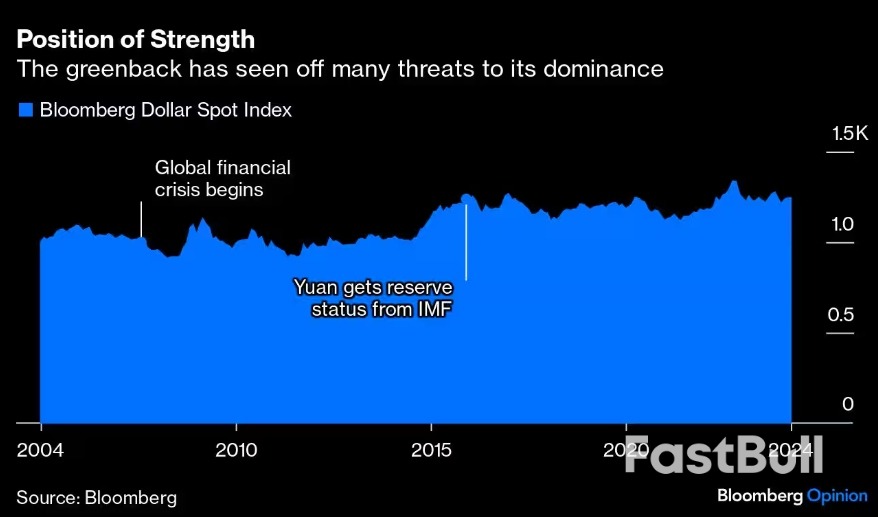
          There’s just no getting past the supremacy of the dollar, much as skeptics of American influence wish for it or lonely yen bulls cry for relief. The greenback has been frequently tipped to retreat, only for it to blow away everything in front of it. This resilience might not last, but as long as it does, it reminds a world once in thrall to China’s ascent that the US is the essential economic force. Just ask all the central bankers quizzed as much, if not more, about the Federal Reserve’s intentions as their own. Sovereignty can be relative.
          Events billed as heralding a pullback have barely made a dent: Japan’s decision to end eight years of negative interest rates fizzled in markets; the country’s finance minister has resorted to jawboning the yen stronger, and traders are handicapping the prospects of intervention by Tokyo. Even projections of rate cuts by the Fed aren’t doing it: Reductions are likely to be synchronous among the biggest authorities, preventing any major currency from outshining the dollar. This year was meant to be one in which the dollar fell, but a key index of its support is off to a strong start.
          That’s the short term. Markets fluctuate and currencies, like stock and bond markets, have good years and times when things don’t turn out so stellar. But the buoyancy of the past quarter — and last couple of years — is built on something more than rate differences. The longer story of dollar firepower is one of a currency beating back challenge after challenge every few years. In the late 1990s, the coming euro was supposed to rival the dollar. A couple of years later, the current-account deficit became the totem of all that was wrong. (When I ran Bloomberg’s foreign-exchange news in the early 2000s, the most commonly-cited reason for any tough trading day for the dollar was the trade shortfall. A close second was the belief that the US had quietly dropped the strong-dollar policy developed during the Clinton administration.)
          Then came the subprime collapse and quantitative easing, followed by the would-be rise of the Chinese yuan. The worry du jour: the aggressive use of sanctions, which critics said would lead to a global de-dollarization. It’s as though the rest of the world scouts for a savior every few years. Assertions that the dollar will be undone are overblown, according to a recent paper by Steven B. Kamin, a former head of the Fed’s international finance division, and Mark Sobel, who served as deputy assistant secretary of the Treasury.The Dollar Is More Armoured Division Than Currency_1
          Kamin and Sobel write that dollar dominance is embedded in the global economic system in ways that are difficult to change. Even if it was to decline relative to another currency, the buck will remain first among equals. And the potential loss of access to US markets and the American banking industry would mean sanctions still matter greatly. The currency remains a vital geopolitical asset both to Washington, and its allies.The duo argue that whether or not the dollar stays top of the heap is the wrong question to ask. Better to inquire whether the factors that have supported such a place at the commanding heights will be sustained. They are confident it will, but add a chilling caveat: The biggest risk to the dollar may be the US itself.
          “Dollar dominance is not a means in and of itself,” Kamin and Sobel wrote in the paper for the American Enterprise Institute. “It is instead a critical reminder of the need to run sound policies, behave responsively at home, and maintain the world’s trust.” (The two expanded on the subject in the Macro Musings podcast last month.)
          The dollar is also a strategic gift, often under-appreciated in geopolitical discussions, which tend to focus on the South China Sea or Donald Trump’s threats against treaty partners. Nor is the US-led economic order, with the greenback at its core, wholly a product of victory in World War II. Born in 1913, the Fed was an important behind-the-scenes player in the Great War. As President Woodrow Wilson was trying to broker peace between the Allied and Central powers in 1916, the Fed fretted that American banks were too invested in the prospects of a triumph by Britain and France, something by no means certain. The central bank warned US lenders against over-exposure, a step that sent European markets into a tailspin, wrote Philip Zelikow in The Road Less Traveled: The Secret Turning point of the Great War, 1916-1917. Allied powers realized they would soon struggle to finance the war.
          Wilson hoped that by squeezing them, he could bring about a resolution.His efforts foundered after Germany resumed unrestricted submarine warfare in the Atlantic, and the US joined the conflict. The Fed reversed its stance and aid began flowing again — generously. Just as well: Britain’s cash reserves were perilously close to depletion. The baton of monetary leadership was passed.
          Let’s hear it for the greenback, more useful than an aircraft carrier, and with greater life expectancy. If there is a historic break with its rule, it’s unlikely to be something as obvious as a turn in the cycle of contemporary borrowing costs. It may be something more subtle, though clear in hindsight. For now, consider keeping those prognostications about the eclipse of the dollar in the barracks.

          Source:Bloomberg

          Risk Warnings and Disclaimers
          You understand and acknowledge that there is a high degree of risk involved in trading. Following any strategies or investment methods may lead to potential losses. The content on the site is provided by our contributors and analysts for information purposes only. You are solely responsible for determining whether any trading assets, securities, strategy, or any other product is suitable for investing based on your own investment objectives and financial situation.
          Add to Favorites
          Share

          Inflation Rises 3.1 Percent in March on Agricultural Products

          Samantha Luan

          Economic

          Inflation last month was led by an overall price jump in agricultural, livestock and fishery products, which advanced 11.7 percent on year in March compared to an annual gain of 11.4 percent the previous month.
          Agricultural products soared 20.5 percent in March after gaining 20.9 percent in February on the back of apple prices, which skyrocketed 88.2 percent. It was the most rapid growth since data was first compiled in January 1980. The price of pears also soared 87.8 percent while that of tangerines accelerated 68.4 percent in March.
          President Yoon Suk Yeol on the day vowed to inject an “unlimited” amount of funds with the intent of reining in agro and livestock products “without a time frame” until people feel that prices have stabilized.
          Yoon added that the government will expand eligibility for support measures currently centered on major supermarkets to include small and mid-sized stores and traditional markets. Qualification for agricultural vouchers targeting vulnerable social groups will be also broadened.
          “The price growth of agro and livestock products has started to slow somewhat from late March, but remains high,” said Yoon. “We will have to thoroughly prepare for climate change, which has become the new normal,” he added, as atypical weather has been partially blamed for the recent price surge.
          The president promoted the utilization of digital technologies like artificial intelligence to run orchards and develop new breeds of agricultural products.
          The stabilization pledge by Yoon comes ahead of the election on April 10, the outcome of which will affect his ability to execute his policies for the rest of his term before leaving office in 2027.
          Core inflation, which excludes volatile food and energy prices, grew 2.4 percent in March, slowing from a 2.5 percent gain in February.
          “The government will put in the utmost effort to quickly bring inflation to the 2 percent range amid uncertainties, including volatility in international oil prices as well as agricultural prices that remain high due to aggravated weather conditions,” said the Ministry of Economy and Finance.
          The Bank of Korea (BOK) has also been doing its part to stabilize inflation by keeping its benchmark interest rate high at 3.5 percent since last January. The central bank said that it will be difficult to cut the benchmark rate in the first half of the year as it needs more evidence confirming that inflation is on a sustainable path down to the target 2 percent rate.
          Core inflation is projected to gradually slow due to a weak recovery in private consumption, said the BOK on Tuesday. Consumer prices are also expected to present a downward trend, but the movement will not be smooth due to the volatility of oil and agricultural prices.
          It added that price movement needs to be observed for a longer period before the bank can be certain that inflation is heading toward the target rate. The BOK’s next rate-setting meeting is scheduled for April 12.
          The Finance Ministry expects prices in Korea to rise 2.6 percent this year.

          Source: Korea JoongAng Daily

          To stay updated on all economic events of today, please check out our Economic calendar
          Risk Warnings and Disclaimers
          You understand and acknowledge that there is a high degree of risk involved in trading. Following any strategies or investment methods may lead to potential losses. The content on the site is provided by our contributors and analysts for information purposes only. You are solely responsible for determining whether any trading assets, securities, strategy, or any other product is suitable for investing based on your own investment objectives and financial situation.
          Add to Favorites
          Share
          FastBull
          Copyright © 2025 FastBull Ltd

          728 RM B 7/F GEE LOK IND BLDG NO 34 HUNG TO RD KWUN TONG KLN HONG KONG

          TelegramInstagramTwitterfacebooklinkedin
          App Store Google Play Google Play
          Products
          Charts

          Chats

          Q&A with Experts
          Screeners
          Economic Calendar
          Data
          Tools
          Membership
          Features
          Function
          Markets
          Copy Trading
          Latest Signals
          Contests
          News
          Analysis
          24/7
          Columns
          Education
          Company
          Careers
          About Us
          Contact Us
          Advertising
          Help Center
          Feedback
          User Agreement
          Privacy Policy
          Business

          White Label

          Data API

          Web Plug-ins

          Poster Maker

          Affiliate Program

          Risk Disclosure

          The risk of loss in trading financial instruments such as stocks, FX, commodities, futures, bonds, ETFs and crypto can be substantial. You may sustain a total loss of the funds that you deposit with your broker. Therefore, you should carefully consider whether such trading is suitable for you in light of your circumstances and financial resources.

          No decision to invest should be made without thoroughly conducting due diligence by yourself or consulting with your financial advisors. Our web content might not suit you since we don't know your financial conditions and investment needs. Our financial information might have latency or contain inaccuracy, so you should be fully responsible for any of your trading and investment decisions. The company will not be responsible for your capital loss.

          Without getting permission from the website, you are not allowed to copy the website's graphics, texts, or trademarks. Intellectual property rights in the content or data incorporated into this website belong to its providers and exchange merchants.

          Not Logged In

          Log in to access more features

          FastBull Membership

          Not yet

          Purchase

          Become a signal provider
          Help Center
          Customer Service
          Dark Mode
          Price Up/Down Colors

          Log In

          Sign Up

          Position
          Layout
          Fullscreen
          Default to Chart
          The chart page opens by default when you visit fastbull.com