• Trade
  • Markets
  • Copy
  • Contests
  • News
  • 24/7
  • Calendar
  • Q&A
  • Chats
Trending
Screeners
SYMBOL
LAST
BID
ASK
HIGH
LOW
NET CHG.
%CHG.
SPREAD
SPX
S&P 500 Index
6870.39
6870.39
6870.39
6895.79
6858.28
+13.27
+ 0.19%
--
DJI
Dow Jones Industrial Average
47954.98
47954.98
47954.98
48133.54
47871.51
+104.05
+ 0.22%
--
IXIC
NASDAQ Composite Index
23578.12
23578.12
23578.12
23680.03
23506.00
+72.99
+ 0.31%
--
USDX
US Dollar Index
98.840
98.920
98.840
98.960
98.810
-0.110
-0.11%
--
EURUSD
Euro / US Dollar
1.16549
1.16557
1.16549
1.16554
1.16341
+0.00123
+ 0.11%
--
GBPUSD
Pound Sterling / US Dollar
1.33387
1.33394
1.33387
1.33420
1.33151
+0.00075
+ 0.06%
--
XAUUSD
Gold / US Dollar
4214.03
4214.37
4214.03
4215.81
4190.61
+16.12
+ 0.38%
--
WTI
Light Sweet Crude Oil
59.999
60.036
59.999
60.063
59.752
+0.190
+ 0.32%
--

Community Accounts

Signal Accounts
--
Profit Accounts
--
Loss Accounts
--
View More

Become a signal provider

Sell trading signals to earn additional income

View More

Guide to Copy Trading

Get started with ease and confidence

View More

Signal Accounts for Members

All Signal Accounts

Best Return
  • Best Return
  • Best P/L
  • Best MDD
Past 1W
  • Past 1W
  • Past 1M
  • Past 1Y

All Contests

  • All
  • Trump Updates
  • Recommend
  • Stocks
  • Cryptocurrencies
  • Central Banks
  • Featured News
Top News Only
Share

Thai Prime Minister: Thailand Does Not Want Violence

Share

Thai Prime Minister: Ready To Take Necessary Measures To Maintain Security, Sovereignty Of Country

Share

China Politburo: Will Better Coordinate Between China's Economic Work And International Economic And Trade Battle Next Year

Share

China Politburo: Moderately Loose Monetary Policy

Share

China Politburo:Continue To Implement More Active Fiscal Policies

Share

India's SEBI Chair: If Any Entity Wants To Advertise Any Past Return They Can Do Only Via The Platform

Share

Vietnam's Plans To Have Nuclear Power Plant Ready By 2035 Are Too Tight - Ambassador

Share

Japan Still Exploring Options For Future Vietnam Nuclear Projects Involving Small Reactors - Ambassador

Share

Ambassador In Hanoi: Japan Pulls Out Of Plans For Vietnam Nuclear Power Plant Ninh Thuan 2

Share

India's SEBI Chair: Platform Will Allow Investors To Access Verified Returns Of Registered Entities

Share

Governor: Russian Drone Strike On Ukraine's Sumy Injures At Least Seven

Share

Inida's Nifty Psu Bank Index Down 1.3%

Share

India Markets Regulator Official: Have Created A Platform For Real Time Monitoring Of Algo Returns

Share

Cambodia Provincial Official: 3 Cambodian Civilians Seriously Injured In Thai-Cambodia Fighting

Share

Russia's Air Defences Destroy 67 Ukrainian Drones Overnight, RIA Agency Reports

Share

India's Nifty 50 Index Down 0.37%

Share

Hsi Down 287 Pts, Hsti Down 13 Pts, Pop Mart Down Over 8%, Ping An Hit New Highs

Share

China's November Coal Imports Down 20% Year-On-Year

Share

At Least One Thai Soldier Killed And 7 Wounded - Thai Army Spokesman

Share

India's Nifty Bank Futures Up 0.73% In Pre-Open Trade

TIME
ACT
FCST
PREV
U.S. Personal Income MoM (Sept)

A:--

F: --

P: --

U.S. PCE Price Index YoY (SA) (Sept)

A:--

F: --

P: --

U.S. PCE Price Index MoM (Sept)

A:--

F: --

P: --

U.S. Personal Outlays MoM (SA) (Sept)

A:--

F: --

P: --

U.S. Core PCE Price Index MoM (Sept)

A:--

F: --

P: --

U.S. Core PCE Price Index YoY (Sept)

A:--

F: --

P: --

U.S. UMich 5-Year-Ahead Inflation Expectations Prelim YoY (Dec)

A:--

F: --

P: --

U.S. Real Personal Consumption Expenditures MoM (Sept)

A:--

F: --

P: --

U.S. UMich Current Economic Conditions Index Prelim (Dec)

A:--

F: --

P: --

U.S. UMich Consumer Sentiment Index Prelim (Dec)

A:--

F: --

P: --

U.S. UMich 1-Year-Ahead Inflation Expectations Prelim (Dec)

A:--

F: --

P: --

U.S. UMich Consumer Expectations Index Prelim (Dec)

A:--

F: --

P: --

U.S. Weekly Total Rig Count

A:--

F: --

P: --

U.S. Weekly Total Oil Rig Count

A:--

F: --

P: --

U.S. Unit Labor Cost Prelim (SA) (Q3)

--

F: --

P: --

U.S. Consumer Credit (SA) (Oct)

A:--

F: --

P: --

China, Mainland Foreign Exchange Reserves (Nov)

A:--

F: --

P: --

Japan Wages MoM (Oct)

A:--

F: --

P: --

Japan Trade Balance (Oct)

A:--

F: --

P: --

Japan Nominal GDP Revised QoQ (Q3)

A:--

F: --

P: --

Japan Trade Balance (Customs Data) (SA) (Oct)

A:--

F: --

P: --

Japan GDP Annualized QoQ Revised (Q3)

A:--

F: --

P: --
China, Mainland Exports YoY (CNH) (Nov)

A:--

F: --

P: --

China, Mainland Trade Balance (USD) (Nov)

A:--

F: --

P: --

China, Mainland Imports YoY (CNH) (Nov)

A:--

F: --

P: --

China, Mainland Exports (Nov)

A:--

F: --

P: --

China, Mainland Imports (CNH) (Nov)

A:--

F: --

P: --

China, Mainland Trade Balance (CNH) (Nov)

A:--

F: --

P: --

China, Mainland Imports YoY (USD) (Nov)

A:--

F: --

P: --

China, Mainland Exports YoY (USD) (Nov)

A:--

F: --

P: --

Germany Industrial Output MoM (SA) (Oct)

--

F: --

P: --

Euro Zone Sentix Investor Confidence Index (Dec)

--

F: --

P: --

Canada Leading Index MoM (Nov)

--

F: --

P: --

Canada National Economic Confidence Index

--

F: --

P: --

U.S. Dallas Fed PCE Price Index YoY (Sept)

--

F: --

P: --

China, Mainland Trade Balance (USD) (Nov)

--

F: --

P: --

U.S. 3-Year Note Auction Yield

--

F: --

P: --

U.K. BRC Overall Retail Sales YoY (Nov)

--

F: --

P: --

U.K. BRC Like-For-Like Retail Sales YoY (Nov)

--

F: --

P: --

Australia Overnight (Borrowing) Key Rate

--

F: --

P: --

RBA Rate Statement
RBA Press Conference
Germany Exports MoM (SA) (Oct)

--

F: --

P: --

U.S. NFIB Small Business Optimism Index (SA) (Nov)

--

F: --

P: --

Mexico Core CPI YoY (Nov)

--

F: --

P: --

Mexico 12-Month Inflation (CPI) (Nov)

--

F: --

P: --

Mexico PPI YoY (Nov)

--

F: --

P: --

Mexico CPI YoY (Nov)

--

F: --

P: --

U.S. Weekly Redbook Index YoY

--

F: --

P: --

U.S. JOLTS Job Openings (SA) (Oct)

--

F: --

P: --

China, Mainland M2 Money Supply YoY (Nov)

--

F: --

P: --

China, Mainland M0 Money Supply YoY (Nov)

--

F: --

P: --

China, Mainland M1 Money Supply YoY (Nov)

--

F: --

P: --

U.S. EIA Short-Term Crude Production Forecast For The Next Year (Dec)

--

F: --

P: --

U.S. EIA Short-Term Crude Production Forecast For The Year (Dec)

--

F: --

P: --

U.S. EIA Natural Gas Production Forecast For The Next Year (Dec)

--

F: --

P: --

EIA Monthly Short-Term Energy Outlook
U.S. 10-Year Note Auction Avg. Yield

--

F: --

P: --

U.S. API Weekly Cushing Crude Oil Stocks

--

F: --

P: --

U.S. API Weekly Crude Oil Stocks

--

F: --

P: --

U.S. API Weekly Refined Oil Stocks

--

F: --

P: --

Q&A with Experts
    • All
    • Chatrooms
    • Groups
    • Friends
    Connecting
    .
    .
    .
    Type here...
    Add Symbol or Code

      No matching data

      All
      Trump Updates
      Recommend
      Stocks
      Cryptocurrencies
      Central Banks
      Featured News
      • All
      • Russia-Ukraine Conflict
      • Middle East Flashpoint
      • All
      • Russia-Ukraine Conflict
      • Middle East Flashpoint
      Search
      Products

      Charts Free Forever

      Chats Q&A with Experts
      Screeners Economic Calendar Data Tools
      Membership Features
      Data Warehouse Market Trends Institutional Data Policy Rates Macro

      Market Trends

      Market Sentiment Order Book Forex Correlations

      Top Indicators

      Charts Free Forever
      Markets

      News

      News Analysis 24/7 Columns Education
      From Institutions From Analysts
      Topics Columnists

      Latest Views

      Latest Views

      Trending Topics

      Top Columnists

      Latest Update

      Signals

      Copy Rankings Latest Signals Become a signal provider AI Rating
      Contests
      Brokers

      Overview Brokers Assessment Rankings Regulators News Claims
      Broker listing Forex Brokers Comparison Tool Live Spread Comparison Scam
      Q&A Complaint Scam Alert Videos Tips to Detect Scam
      More

      Business
      Events
      Careers About Us Advertising Help Center

      White Label

      Data API

      Web Plug-ins

      Affiliate Program

      Awards Institution Evaluation IB Seminar Salon Event Exhibition
      Vietnam Thailand Singapore Dubai
      Fans Party Investment Sharing Session
      FastBull Summit BrokersView Expo
      Recent Searches
        Top Searches
          Markets
          News
          Analysis
          User
          24/7
          Economic Calendar
          Education
          Data
          • Names
          • Latest
          • Prev

          View All

          No data

          Scan to Download

          Faster Charts, Chat Faster!

          Download App
          English
          • English
          • Español
          • العربية
          • Bahasa Indonesia
          • Bahasa Melayu
          • Tiếng Việt
          • ภาษาไทย
          • Français
          • Italiano
          • Türkçe
          • Русский язык
          • 简中
          • 繁中
          Open Account
          Search
          Products
          Charts Free Forever
          Markets
          News
          Signals

          Copy Rankings Latest Signals Become a signal provider AI Rating
          Contests
          Brokers

          Overview Brokers Assessment Rankings Regulators News Claims
          Broker listing Forex Brokers Comparison Tool Live Spread Comparison Scam
          Q&A Complaint Scam Alert Videos Tips to Detect Scam
          More

          Business
          Events
          Careers About Us Advertising Help Center

          White Label

          Data API

          Web Plug-ins

          Affiliate Program

          Awards Institution Evaluation IB Seminar Salon Event Exhibition
          Vietnam Thailand Singapore Dubai
          Fans Party Investment Sharing Session
          FastBull Summit BrokersView Expo

          Apple Takes a Leap into Augmented Reality with $3,499 Vision Pro AR Headset

          Warren Takunda

          Traders' Opinions

          Apple, the technology giant known for its groundbreaking innovations, has unveiled its highly anticipated Vision Pro AR headset. Priced at $3,499, this cutting-edge device promises to redefine the augmented reality (AR) experience and propel Apple further into the realm of immersive technology.
          The Vision Pro AR headset marks Apple's official entry into the augmented reality hardware market. With its sleek design and advanced features, it is poised to capture the attention of tech enthusiasts and consumers alike. Compatible with various Apple devices and services, such as AirPods, Apple Music, and iCloud, the headset seamlessly integrates with the existing Apple ecosystem, providing users with a holistic and immersive AR experience¹²³.
          One of the key selling points of the Vision Pro AR headset is its ability to deliver high-quality graphics and sound. Users can expect stunning visuals and realistic audio, creating a truly immersive environment for gaming, entertainment, and productivity applications. This technological leap showcases Apple's dedication to pushing the boundaries of what is possible in AR and cementing its position as a leader in innovation.
          According to sources familiar with the matter, pre-orders for the Vision Pro AR headset have already begun, and early demand seems strong. This positive response reflects the anticipation surrounding Apple's foray into the AR hardware market. With its loyal customer base and reputation for delivering exceptional products, Apple is well-positioned to make a significant impact in this emerging industry.
          Industry analysts believe that Apple's entry into the AR headset market could have far-reaching implications. As augmented reality continues to gain traction across various sectors, including gaming, education, and healthcare, Apple's expertise and resources could help drive widespread adoption. The Vision Pro AR headset may pave the way for future developments in AR technology and potentially redefine how people interact with digital content.
          While the Vision Pro AR headset's price point may initially seem steep, it aligns with Apple's reputation for offering premium products. The company has a track record of attracting consumers willing to pay a premium for its innovative devices, and the Vision Pro AR headset is no exception. As the market matures and competition intensifies, it will be interesting to observe how Apple's pricing strategy and product offerings evolve.
          Apple's commitment to privacy and data security remains paramount, even with the introduction of the Vision Pro AR headset. The company has emphasized its dedication to protecting user privacy and ensuring the responsible use of AR technology. By implementing robust security measures and transparent data practices, Apple aims to build trust with its customers and alleviate any concerns related to privacy.
          As the Vision Pro AR headset hits the market, all eyes are on Apple to see if it can successfully deliver on its promises. With its reputation for innovation and its ability to create seamless user experiences, Apple has the potential to shape the future of augmented reality. The Vision Pro AR headset represents an exciting step forward, providing a glimpse into the possibilities of a more immersive and interconnected digital world.
          Risk Warnings and Disclaimers
          You understand and acknowledge that there is a high degree of risk involved in trading. Following any strategies or investment methods may lead to potential losses. The content on the site is provided by our contributors and analysts for information purposes only. You are solely responsible for determining whether any trading assets, securities, strategy, or any other product is suitable for investing based on your own investment objectives and financial situation.
          Comments
          Add to Favorites
          Share

          Ukraine Launches Counteroffensive Against Russian Forces, Escalating Tensions

          Warren Takunda

          Traders' Opinions

          Russia-Ukraine Conflict

          In a dramatic turn of events, Ukraine has initiated a comprehensive counteroffensive against Russian forces, intensifying the ongoing conflict in the eastern front. Reports suggest that the offensive is primarily focused on the southeastern region of Donetsk province, with the ultimate objective of severing the critical land bridge that connects Russia with its occupied territory of Crimea. This bold move by Ukraine signifies a significant escalation in the hostilities and threatens to further destabilize the region.
          The counteroffensive, aimed at breaching Russian defensive lines, has been met with heavy resistance and is expected to result in prolonged and intense fighting. Ukrainian forces are determined to regain control of strategically important territories and disrupt the supply routes between Russia and Crimea. This latest development follows months of stalemate and a growing sense of frustration among Ukrainian officials, who have sought to break the impasse and assert their authority over the disputed regions.
          Additionally, Ukraine has reportedly supported rebel groups within Russia's Belgorod region, resulting in attacks on military targets. This move signifies a potential expansion of the conflict beyond Ukrainian borders and raises concerns about the possibility of further destabilization in the region. Russia has swiftly responded, accusing Ukraine of exacerbating the situation and issuing threats of retaliation. As tensions rise, the situation remains unpredictable, and the potential for a wider and more destructive conflict looms.
          The impact of the counteroffensive on financial markets is being closely monitored by analysts, given the potential consequences for global stability. Concerns about the disruption of energy supplies from Russia, as well as the wider geopolitical implications of a protracted conflict, have led to increased market volatility. Investors are advised to closely watch the developments in the region as they could have significant ramifications for commodity prices and international relations.
          International observers, including the United States, have urged both parties to seek a peaceful resolution and have called for an immediate ceasefire. The conflict in Ukraine has already taken a heavy toll on civilian populations and resulted in immense human suffering. A swift de-escalation of hostilities is crucial to prevent further loss of life and protect regional stability.
          As the situation unfolds, it is essential for the international community to prioritize diplomatic efforts aimed at finding a peaceful resolution to the conflict. Escalating tensions in the region have far-reaching implications, and a failure to resolve the dispute could have profound economic and geopolitical consequences. The eyes of the world are now fixed on Ukraine as it navigates this critical phase of the conflict, with hopes that a path towards stability and peace can be forged amid the chaos.
          Risk Warnings and Disclaimers
          You understand and acknowledge that there is a high degree of risk involved in trading. Following any strategies or investment methods may lead to potential losses. The content on the site is provided by our contributors and analysts for information purposes only. You are solely responsible for determining whether any trading assets, securities, strategy, or any other product is suitable for investing based on your own investment objectives and financial situation.
          Comments
          Add to Favorites
          Share

          CBDCs Can Help Protect against Surveillance Capitalism

          Justin

          Central Bank

          Economic

          Among digital privacy advocates, the launch of central bank digital currencies is often greeted with suspicion and alarm. On both sides of the Atlantic, there are concerns that CBDCs represent an opportunity for the state to obtain greater oversight over payments systems. In Europe, protesters demonstrated against a digital euro as an invasion of privacy in February, while in the US, Republican Congressman Tom Emmer has sponsored a bill called the CBDC Anti-Surveillance State Act.
          In early 2022, a convoy of truckers in Toronto had their assets frozen after objecting to vaccine mandates and gridlocking US-Canada trade. This led some people to suggest that a CBDC would consolidate state control over payments and provide an easier tool to suppress dissidents or discourage certain behaviours.
          It is true that certain ways of designing a CBDC might provide new, more efficient means for the state to implement control. Payments are best provided as a public good, and for the state to use access to them as a tool of social engineering is much closer to authoritarianism than most of us are comfortable with.
          But as the example of the Toronto truckers indicates, Canadians are already living in a world where the state has the willingness and capacity to restrict access to payments services, despite not having a CBDC.
          A CBDC might – if designed in a certain way – concentrate data, leading to new risks and the capacity to make the exercise of state authority over payments more complete. But this kind of development does not require a CBDC. Aggregating data from multiple services is a technical challenge, but one that law enforcement agencies are already eminently capable of solving.

          Threatening our privacy? What privacy?

          CBDCs are not a serious threat to the privacy of digital payments because we have so little to begin with. The European Data Protection Supervisor points out that, ‘tracking payments of a person can describe the consumers’ life in great detail… The amount of personal information that actors involved in transactions’ management learn about each individual when a payment system operates is significant. This generates a systemic risk of profiling and surveillance by the parties operating the payment system.’
          Whether a CBDC is implemented or not, there should be more robust protection of privacy. At present, the main defence is simply that most people use a variety of services, but the sophistication of the tools used to aggregate and process payments data is growing. Regardless of whether this is driven by private actors seeking profit or state actors seeking greater control, the prospect is not appetising, as the EDPS also mentions that ‘payment data is often used for purposes other than those strictly related to the payment execution… payment providers may collaborate with private credit scoring companies that inform landlords, creditors and service providers about the individual trust score of their future clients.’

          Can we hope for better?

          Central banks have made it clear that they will not launch a fully anonymous CBDC due to the risk that it would facilitate financial crime. There is a notion that privacy and oversight are a trade-off and the best that regulators and privacy advocates can hope for is some kind of mutually unsatisfying compromise.
          But innovation in privacy-enhancing technology offers a way to improve privacy without degrading law enforcement agencies’ ability to fight crime. In most countries, payments data is generally only available for use by law enforcement agencies under circumstances set out in a comprehensive legal framework. If a CBDC erodes that framework’s ability to protect individuals’ right to privacy, that is a design choice and not a necessity.If (and this is far from certain) a CBDC is designed with the correct principles, it can form a new benchmark for privacy in digital payments.
          A central bank should not become a repository of individuals’ data. Whether the core ledger is distributed or centralised, there is no reason for the central bank to have access to the know-your-customer information of those transacting in CBDCs. That should be sufficient to ensure that a CBDC does not worsen the privacy of digital payments systems. Privacy-enhancing technologies can also be used to make improvements. There are a broad range of such techniques, many of which are discussed in the Bank of England’s digital pound technology working paper. These include: zero-knowledge proofs, which allow a party to verify a statement without revealing additional data; homomorphic encryption, which allows parties to process encrypted data; and distributed data analysis, which allows multiple entities to jointly process datasets without sharing data.
          Central banks and law enforcement agencies will still need the capacity to obtain personal data in their crime-fighting activities, but these data should only be visible to them if rigorous criteria are met. The concept of reciprocal negotiated accountability offers a framework that keeps payment data encrypted and keys held in escrow – released only if certain rules are satisfied. It is a cryptographically secured enforcement of the existing framework.

          Winning public trust

          Much of the challenge in this area is cultural, not technical. The encryption standards and systems architectures already exist but revelations from Edward Snowden, the National Security Agency whistleblower, and others have shaken the public’s trust in the state’s willingness to respect individual privacy. Can the state be trusted to implement these privacy-enhancing technologies without leaving additional backdoors? Convincing the general public will be a tremendous challenge.
          That is not a reason not to try. We are not starting from a point of sufficient privacy so do not risk losing it. Privacy in digital payments is already poor – the chance is that we improve it.
          The digitalisation of the global economy has caused a rapid loss in control over data. The technology exists to regain it but, as the commercial value of such data increases, the likelihood of the private sector willingly deploying that technology shrinks. If, however, the state establishes a benchmark – a free, high-quality payments system that protects privacy without facilitating crime – then the private sector will be forced to raise its standards.

          Source:Lewis McLellan

          To stay updated on all economic events of today, please check out our Economic calendar
          Risk Warnings and Disclaimers
          You understand and acknowledge that there is a high degree of risk involved in trading. Following any strategies or investment methods may lead to potential losses. The content on the site is provided by our contributors and analysts for information purposes only. You are solely responsible for determining whether any trading assets, securities, strategy, or any other product is suitable for investing based on your own investment objectives and financial situation.
          Comments
          Add to Favorites
          Share

          ISM Reports Add to US Recession Fears

          Justin

          Central Bank

          Economic

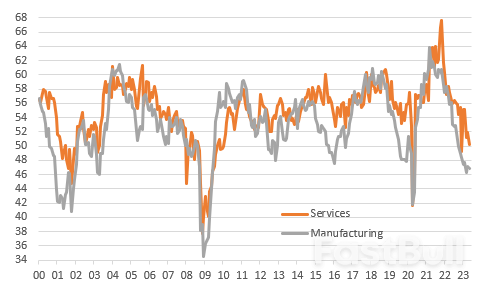
          ISM reports indicate a rapid softening in business activity

          Last week’s ISM manufacturing index dropped to 46.9, the seventh consecutive sub-50 reading with order books, aside from two months of pandemic stress, looking in their worst shape since the 2009. Today’s ISM services report for May, while not quite as grim, only adds to worries about the outlook for the economy.
          The headline balance fell to 50.3 from 51.9 (consensus 52.4). As with many of the manufacturing ISM components, the only time the service sector report has been weaker in the past 14 years was in April and May 2020 at the peak of Covid containment and the December 2022 blip caused by the huge winter storm that was so disruptive for the travel, entertainment and service sectors. The details are poor throughout with business activity having similar metrics to the headline. New orders fell 3.2 points to 52.9, but the backlog of orders plummeted to 40.9 from 49.7. The backlog of orders are not seasonally-adjusted so comparisons are tricky, but for what it is worth, this is the worst reading since 2009. This is something that we also saw in the manufacturing report, dropping from 43.1 to 37.5.

          ISM reports are heading in the wrong directions

          ISM Reports Add to US Recession Fears_1

          Order books need to turn around quickly to avert recession

          Now at least in the manufacturing report we saw the employment component rise to 51.4 from 50.5, yet the payrolls report said manufacturing employment fell 2000. We saw private sector employment rise 257,000 in that same report, yet the ISM has service sector employment in contraction territory at 49.2! The data contradictions underscore the challenge for the Federal Reserve and only support the argument that they leave policy on hold in June to try and get a better gauge of what is happening in the economy. The decline in price pressure is a welcome development though with the manufacturing prices paid below the break-even 50 level at 44.2 and service sector prices falling to 56.2 from 59.6. This leaves the service sector price index at its lowest level since March 2020 and slap bang in the middle of its long run range.
          It looks likely that the manufacturing sector is already in recession (seven consecutive sub-50 readings for ISM manufacturing). The service sectors order books are weak and will need to turn around rapidly to prevent the service sector joining it. Given this situation it is difficult to imagine that employment will continue to make such large gains. Then with price measures rapidly weakening it is understandable that markets doubt that if we do get a pause at the June Federal Open Market Committee meeting that the Fed will be able justifying a restart on rate hikes later in the year.

          Source: ING

          To stay updated on all economic events of today, please check out our Economic calendar
          Risk Warnings and Disclaimers
          You understand and acknowledge that there is a high degree of risk involved in trading. Following any strategies or investment methods may lead to potential losses. The content on the site is provided by our contributors and analysts for information purposes only. You are solely responsible for determining whether any trading assets, securities, strategy, or any other product is suitable for investing based on your own investment objectives and financial situation.
          Comments
          Add to Favorites
          Share

          Jobs Glow, Crude Pops, Dollar Lifts

          Damon

          Stocks

          World markets retained a warm afterglow from Friday's shining U.S. employment reading, with only minor gains in crude oil prices on Saudi Arabia's output cut clouding the picture.
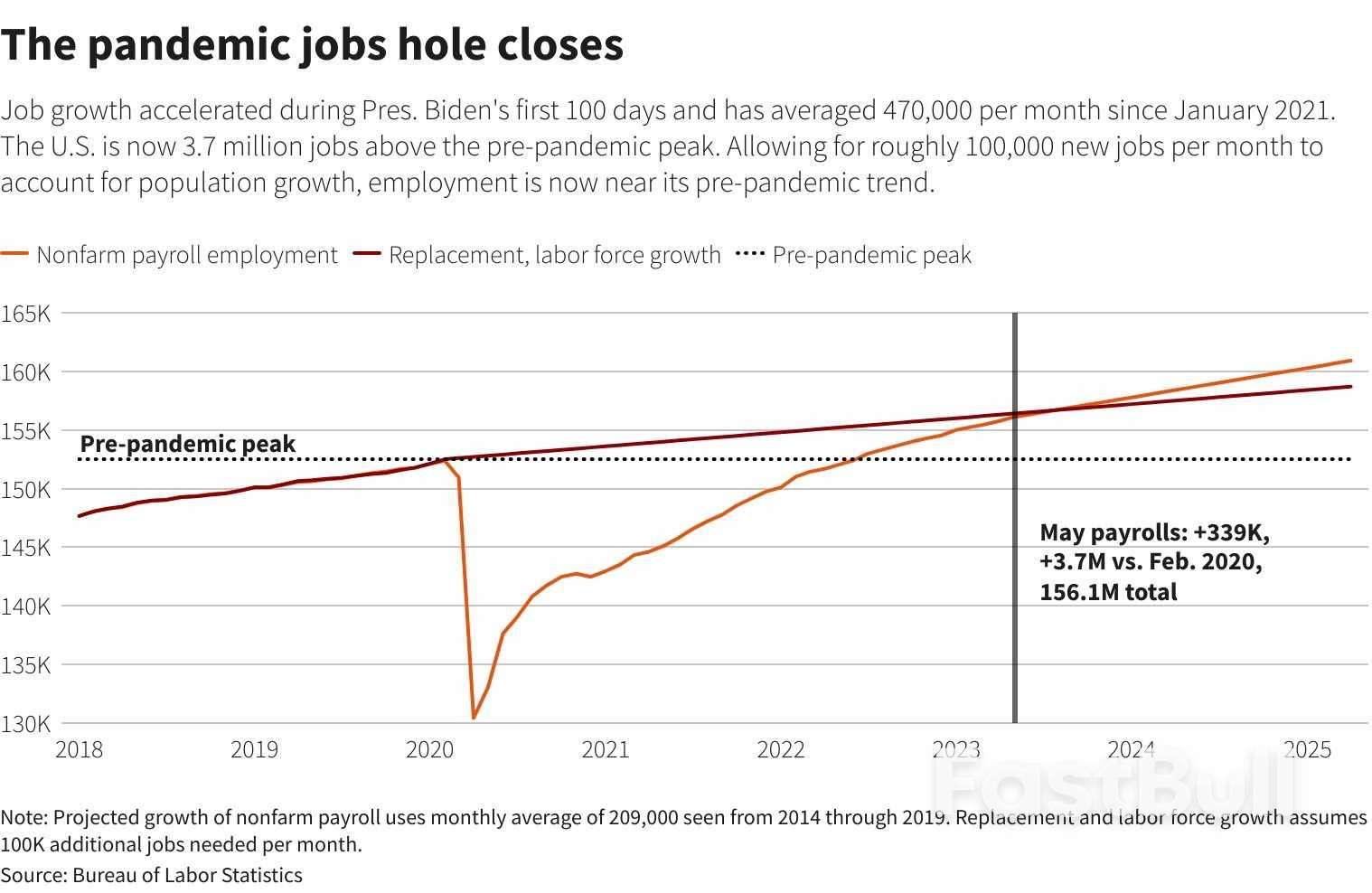
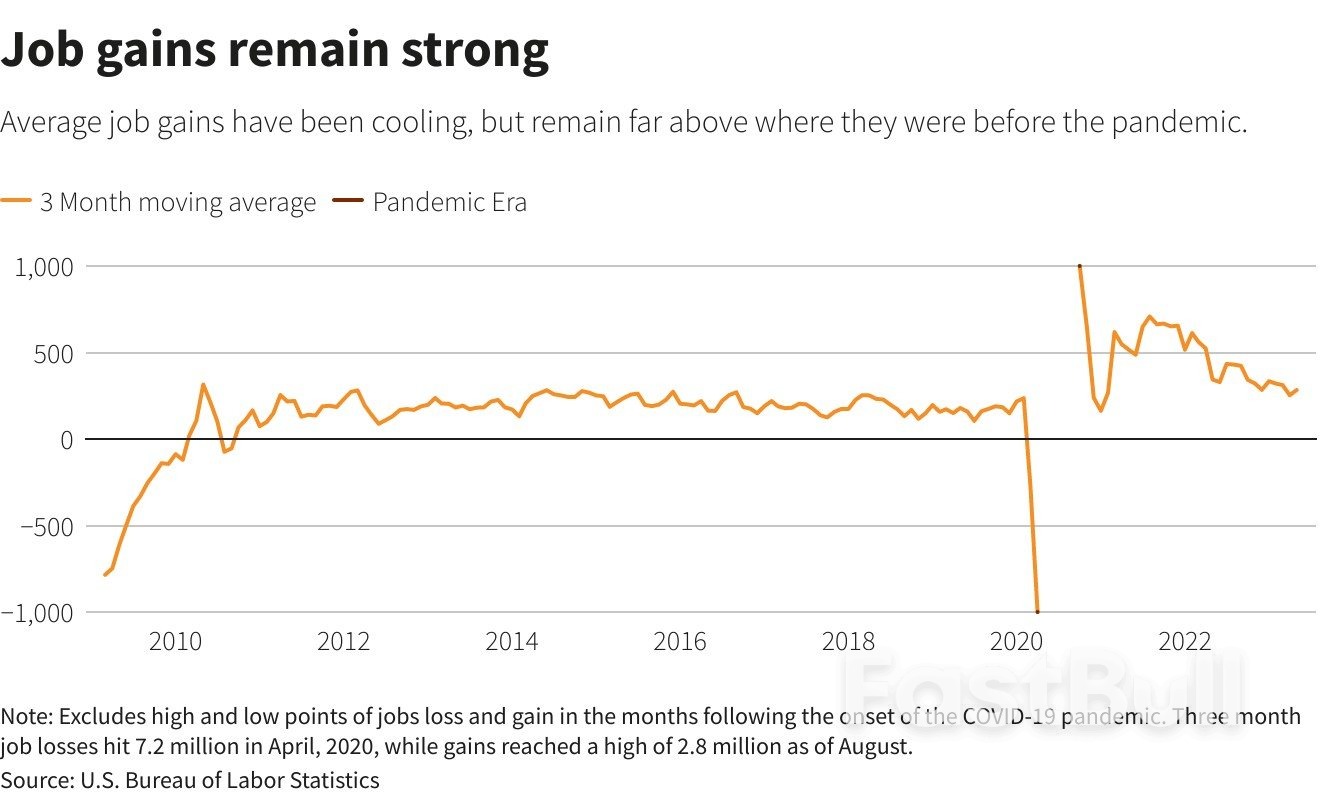
          A forecast-busting May payrolls gain, coupled with signs of cooling wage growth, provided investors with a "soft landing" economic narrative that complemented relief over last week's government debt ceiling resolution.
          With the Federal Reserve moving into a blackout period ahead of a June 14 policy decision, futures markets only see just over a one-in-four chance of another rate hike this month - though one final quarter point rise in July is still largely priced.
          The combined picture was enough to lift the S&P500 and Nasdaq to their highest in almost 10 months on Friday - with S&P futures retaining those gains ahead of Monday's open.
          Remarkably, Wall St's "fear index", the VIX gauge of implied equity volatility, recorded its lowest close since before the pandemic hit more than three years ago.
          While Big Tech stocks have led the way this year with gains of more than 65% - and Apple coming within a whisker of reclaiming record highs last week - stock gains showed some sign of broadening at last.
          The Russell 2000 Index of small cap stocks outperformed both the S&P500 and Nasdaq and is now up some 4% for the year so far.
          MSCI's all-country index hit its highest in more than a year on Monday.
          And the dollar climbed across the board.
          While Brent crude oil prices popped up about $1 per barrel on the Saudi output cut plans, the move was limited and year-on-year crude losses continue to clock some 35%.
          May U.S. service sector readings dominate the Monday diary, as does the likely start of Treasury rebuilding its depleted coffers with 3- and 6-month bill auctions. U.S. 2-year Treasury yields nudged higher to 3.75% on Monday.
          Soundings from China's service sector earlier helped partly to offset fears that dour factory readings questioned its post-COVID recovery. European equivalents were more downbeat.
          As midyear investment outlooks stream in, Morgan Stanley's global take sees developed market government bonds, Asia equities and the dollar all outperforming over the remainder of the year - but it spotlighted "front loaded" risk to growth, earnings and policy that make it something of a "crunch time".
          Elsewhere, U.S. regulators are preparing to tighten rules for large banks, which could raise their capital requirements by 20% on average after a spate of midsize bank failures this year, the Wall Street Journal reported on Monday.
          Turkey's lira slid almost 1% on Monday to weaken past 21 per dollar, in a shaky initial reaction to the appointment of highly-regarded Mehmet Simsek as finance minister.
          Events to watch for later on Monday:
          * U.S. ISM and S&P Global May service sector surveys, April factory goods orders
          * European Central Bank President Christine Lagarde speaks to European Parliament; Cleveland Federal Reserve President Loretta Mester speaks at conference opening
          * U.S. Treasury auctions 3- and 6-month billsJobs Glow, Crude Pops, Dollar Lifts_1Jobs Glow, Crude Pops, Dollar Lifts_2Jobs Glow, Crude Pops, Dollar Lifts_3

          Jobs Glow, Crude Pops, Dollar Lifts_4Source: Yahoo

          Risk Warnings and Disclaimers
          You understand and acknowledge that there is a high degree of risk involved in trading. Following any strategies or investment methods may lead to potential losses. The content on the site is provided by our contributors and analysts for information purposes only. You are solely responsible for determining whether any trading assets, securities, strategy, or any other product is suitable for investing based on your own investment objectives and financial situation.
          Comments
          Add to Favorites
          Share

          Strong Growth and Optimism Continue in UAE and Saudi Arabian Non-Oil Sectors

          Warren Takunda

          Traders' Opinions

          The private non-oil sectors of the United Arab Emirates (UAE) and Saudi Arabia have showcased robust growth in May 2023, as indicated by the latest Purchasing Managers' Index (PMI) reports. Despite a slight dip in the UAE's PMI, both countries' economies remain on a positive trajectory, with strong demand, increased employment, and optimistic outlooks for the future.
          UAE Non-Oil SectorStrong Growth and Optimism Continue in UAE and Saudi Arabian Non-Oil Sectors_1
          The S&P Global UAE PMI declined marginally from 56.6 to 55.5 in May 2023, still surpassing the critical 50 mark, indicating expansion. The non-oil sector continues to drive growth, with notable improvements in both activity and new orders. The pace of new business intakes moderated slightly but remained high, thanks to a rise in domestic demand. Additionally, employment growth reached its second-fastest rate since July 2016, while backlogs of work continued to accumulate, underscoring the sustained momentum in the sector. One encouraging factor is the subdued cost pressures, primarily attributed to improved supply chains. Moreover, business optimism soared to its highest level since October 2021, with firms anticipating the continuation of strong demand in the foreseeable future.
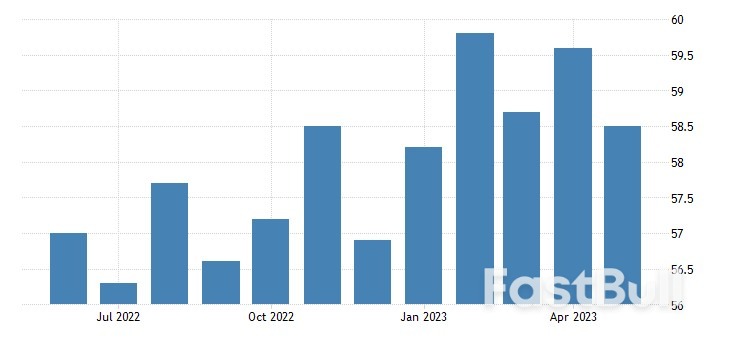
          Saudi Arabian Non-Oil SectorStrong Growth and Optimism Continue in UAE and Saudi Arabian Non-Oil Sectors_2
          In Saudi Arabia, the PMI stood at a healthy 58.5 in May 2023, although it experienced a minor drop from the previous month's 59.6. Despite this decline, the index remained above its long-run average, indicating sustained growth in the non-oil private sector. The rising market demand conditions propelled new order inflows to expand at their fastest pace in eight and a half years, while output also increased significantly, albeit at a slower rate compared to the previous months. Consequently, firms stepped up their purchasing activity, albeit at a relatively lower level compared to earlier this year. Employment growth in Saudi Arabia advanced at its fastest rate since 2018, reflecting a positive outlook for the labor market. However, some firms mentioned the challenges of labor shortages and higher living costs, resulting in increased staff expenses. The rise in wages, in turn, contributed to a broad increase in input costs, leading to a sharp rise in output charges, the highest since August 2020. Despite these challenges, overall business sentiment remained positive, although the degree of optimism declined due to rising competition.

          Outlook

          The sustained growth and positive sentiment in the non-oil sectors of both the UAE and Saudi Arabia are encouraging signs for their respective economies. While the UAE experienced a slight moderation in its PMI, the overall performance remains strong. The UAE's focus on diversifying its economy away from oil and investing in non-oil sectors continues to yield positive results. In Saudi Arabia, the expansion of the non-oil sector and strong market demand highlight the country's economic resilience. However, challenges such as labor shortages and rising costs need to be addressed to sustain growth and maintain a competitive edge.
          The UAE and Saudi Arabian non-oil sectors demonstrated resilience and strong growth in May 2023, supported by robust activity, increased employment, and positive outlooks. Despite a marginal dip in the UAE's PMI, the sector remains on a growth trajectory, benefiting from domestic demand and improved supply chains. Saudi Arabia experienced a slight decline in its PMI as well but continues to exhibit positive expansion, driven by rising market demand and strong output. Both countries should focus on addressing challenges such as labor shortages and cost pressures to sustain growth and capitalize on the optimistic business sentiment. Overall, these developments bode well for the economic diversification efforts and long-term stability of the UAE and Saudi Arabian economies.
          Risk Warnings and Disclaimers
          You understand and acknowledge that there is a high degree of risk involved in trading. Following any strategies or investment methods may lead to potential losses. The content on the site is provided by our contributors and analysts for information purposes only. You are solely responsible for determining whether any trading assets, securities, strategy, or any other product is suitable for investing based on your own investment objectives and financial situation.
          Comments
          Add to Favorites
          Share

          FOMO Regime Change for U.S. Stock Market

          Alex

          Stocks

          On Friday, 2 June, we witnessed a significant flow of rotation among the benchmark U.S. stock indices ahead of the key 16 June "Triple Witching" U.S. options expiration; prior laggards, the Dow Jones Industrial Average and Russell 2000 have recorded one of the best single day outperformance in at least three months against the leading mega-cap tech & AI concentrated Nasdaq 100.

          Dow Jones Industrial Average & Russell 2000 recorded their highest single-day outperformance against Nasdaq 100 since February 2023 & October 2022

          The ongoing medium-term uptrend of the Nasdaq 100 started on 13 October 2022, outperforming the Dow Jones Industrial Average and Russell 2000 in the past seven months. Interestingly, the Dow Jones Industrial Average / Nasdaq 1000 ratio recorded its strongest single-day performance on Friday since 3 Feb 2023 (1.38) while the Russell 2000 / Nasdaq 1000 ratio notched its strongest single-day performance since 26 October 2022 (2.81) supported by strong rallies seen in cyclical, industrial and banking stocks such as 3M (+8.7%), Caterpillar (+8.4%) and U.S. regional banks (KRE ETF +6.2%) on Friday.

          FOMO Regime Change for U.S. Stock Market_1Fig 1: Performances of DJIA & Russell 2000 against Nasdaq 100 measured by their respective ratios as of 2 June 2023 (Source: TradingView, click to enlarge chart)

          On the surface, these positive observations can be considered as an improvement in market breadth as rotation is being spread from the high-flying eight mega-cap tech stocks (FAANG plus MNT; Facebook/Meta, Apple, Amazon, Netflix, Google/Alphabet, Microsoft, Nvidia, and Tesla) that are leading the rally since late October 2022 towards the cyclical laggards.

          A higher cost of funding environment cannot be ruled out

          However, a higher cost of funding environment amid a lingering risk of stagflation may put a damper on earnings growth. The 10-year U.S. Treasury yield has recovered above its 200-day moving ex-post U.S. debt ceiling deal and is looking for a test on a key resistance at 3.90% with positive momentum.

          FOMO Regime Change for U.S. Stock Market_2Fig 2: 10-year U.S. Treasury yield trend as of 5 Jun 2023 (Source: TradingView, click to enlarge chart)

          The leading inverted U.S. Treasury yield curve is pointing to a potential imminent global recession

          In addition, we cannot rule out an impending global recession as the leading U.S. Treasury yield curve, the difference between the 10-year and 2-year is now at -0.81%; it's the most inverted state in almost 42 years.

          FOMO Regime Change for U.S. Stock Market_3Fig 3: U.S. Treasury yield curve (10-year over 2-year) trend as of 5 June 2023 (Source: TradingView, click to enlarge chart)

          However, in a nutshell, the trend is always your friend until its ends so do not be surprised by such positive FOMO irrational behaviour that can persist in the short to medium-term time horizons which in turn may take the U.S. stock market higher due to a relatively low level of positioning, exposure, and sentiment since the start of the year.

          Source: MarketPulse

          Risk Warnings and Disclaimers
          You understand and acknowledge that there is a high degree of risk involved in trading. Following any strategies or investment methods may lead to potential losses. The content on the site is provided by our contributors and analysts for information purposes only. You are solely responsible for determining whether any trading assets, securities, strategy, or any other product is suitable for investing based on your own investment objectives and financial situation.
          Comments
          Add to Favorites
          Share
          FastBull
          Copyright © 2025 FastBull Ltd

          728 RM B 7/F GEE LOK IND BLDG NO 34 HUNG TO RD KWUN TONG KLN HONG KONG

          TelegramInstagramTwitterfacebooklinkedin
          App Store Google Play Google Play
          Products
          Charts

          Chats

          Q&A with Experts
          Screeners
          Economic Calendar
          Data
          Tools
          Membership
          Features
          Function
          Markets
          Copy Trading
          Latest Signals
          Contests
          News
          Analysis
          24/7
          Columns
          Education
          Company
          Careers
          About Us
          Contact Us
          Advertising
          Help Center
          Feedback
          User Agreement
          Privacy Policy
          Business

          White Label

          Data API

          Web Plug-ins

          Poster Maker

          Affiliate Program

          Risk Disclosure

          The risk of loss in trading financial instruments such as stocks, FX, commodities, futures, bonds, ETFs and crypto can be substantial. You may sustain a total loss of the funds that you deposit with your broker. Therefore, you should carefully consider whether such trading is suitable for you in light of your circumstances and financial resources.

          No decision to invest should be made without thoroughly conducting due diligence by yourself or consulting with your financial advisors. Our web content might not suit you since we don't know your financial conditions and investment needs. Our financial information might have latency or contain inaccuracy, so you should be fully responsible for any of your trading and investment decisions. The company will not be responsible for your capital loss.

          Without getting permission from the website, you are not allowed to copy the website's graphics, texts, or trademarks. Intellectual property rights in the content or data incorporated into this website belong to its providers and exchange merchants.

          Not Logged In

          Log in to access more features

          FastBull Membership

          Not yet

          Purchase

          Become a signal provider
          Help Center
          Customer Service
          Dark Mode
          Price Up/Down Colors

          Log In

          Sign Up

          Position
          Layout
          Fullscreen
          Default to Chart
          The chart page opens by default when you visit fastbull.com